
“Name it to tame it” has become a popular phrase among parents and those working with children. It denotes the principle that we can help emotionally overwhelmed children feel better by helping them put their feelings into words. Daniel Siegel provides an example of this principle. Bella, a nine-year-old girl, watched the toilet overflow after flushing it, “and the experience of watching the water rise and pour onto the floor left her unwilling (and practically unable) to flush the toilet afterward.” Her father later sat down with her and encouraged her to tell the story, allowing “her to tell as much of the story as she could,” and helping her “to fill in the details, including the lingering fear she had felt about flushing since that experience. After recalling the story several times, Bella’s tears lessened and eventually went away.” Putting these experiences into words, Siegel writes, “allows us to understand ourselves and our world by using both our left and right hemispheres together. To tell a story that makes sense, the left brain must put things in order, using words and logic. The right brain contributes to bodily sensations, raw emotions, and personal memories, so we can see the whole picture and communicate our experience.”
Category: Adolescents
How to Be Successful in Child Therapy: Lessons From 5 Decades of Practice

The insights I value the most came from direct work with children, adolescents, and families who taught me what is most important and helpful in the work that we do. I learned from children that what is most essential is that we do not give up on them. Embracing unwavering faith in children as they go through the worst times of their lives may prove to be far more important than any technique or intervention we employ.
The Importance of Therapeutic Presence with Children
Repeatedly, my former child clients tell me this when they come back to visit 10, 20, or even 30 years later as they establish themselves in their adult lives. Surprising to me is the fact that at the time I was seeing these former child or adolescent clients, I did not feel that I was particularly helpful. The crises that brought them to therapy were so intense that I was unable to appreciate the power of therapeutic presence and commitment.
One of the most important insights that emerged from my private supervision with the late Walter Bonime, MD, senior training psychoanalyst, has helped sustain me during the most challenging moments of my 55-year career as a clinical psychologist working with children and families. Dr. Bonime taught me that no matter how frustrated, discouraged, angry, hopeless, or impotent the therapist may feel, it cannot begin to match the depth of the same feelings in the child.
Children taught me that sometimes “more is less.” In certain moments what is most important is that we be a caring presence, a trusted witness. The temptation is for therapists to shower intense moments with words that can diminish the transformative potential of a deep encounter with a child.
I’ve met many a “fawn in gorilla suit” during my career. The analogy suggests that the “fawn” as the core self is highly vulnerable — has been hurt too many times! The aggression (putting on the gorilla suit) is intended to protect that vulnerable fawn by keeping people at a safe distance. Yet, the longing for connection burns deeply within.
Another important understanding gained from the decades of work with children is that whenever a youth says, “I don’t care!” we should assume they once cared a lot, but it simply hurts too much, it is too great a risk to care anymore.
I’ve always told my interns and young clinicians, “when you don’t know what else to do, just treat children and families with profound respect and dignity.” They are surprised how far that goes.
Children carry within them powerful narratives that all too often no one takes the time to elicit or hear. The youth, as much as they might avoid it, long to unburden.
The therapist’s willingness to risk themselves in the therapy encounter, and sometimes be wrong, is a “gift” to children by creating a safer context for the child to express what is difficult to put into words.
An 8-year-old boy asked me to explain the initials after my name. This led the boy to say, “Well, you don’t look that smart!” I told him my family tells me the same thing. It reminded me of how important a sense of humility is in working with children. To connect with children, we must be willing to look like fools sometimes. Otherwise, we are no fun at all. Children will only feel free to talk when they feel free to not talk.
Our goal is to honor strengths without trivializing suffering. This is a delicate operation. The work we do is rewarding. We get paid in the currency of the heart. Some of the moments we share with children and families are precious and priceless. But our work is hard. There is an undeniable emotional toll exacted from caring for children with deeply wounded spirits.
Can we hear the hard stories without the hardening of our heart? To do so requires diligent and disciplined efforts to take adequate care of the instrument of healing — our self. As much attention in our field has been paid to the importance of self-care, each child therapist will need to reflect and honestly assess to what degree it is a priority. If we short-change ourselves, it is likely that we are also stiffing our families, and perhaps the children and families we treat as well.
[Editor’s Note: David and I are colleagues and friends, and we are honored to offer his reflection here, which is not about “what to do” with children and teens in therapy, but, “how to be.”]
Questions for Thought and Discussion
- In what ways is the author’s orientation to child therapy Similar to your own?
- What have you found to be the most effective ways to intervene with children and teens?
- What have you found to be some of the greatest challenges in working with young clients?
A Foster Child’s Painful Visit with his Mother
The Child’s Family Visit through the Therapist’s Eyes
His eyes widened with welcome, and a quick smile flashed across his face when he saw me pull in. From that moment, Jason was a 55-pound human-guided missile speeding out the door when I came to transport him and his sister for their weekly family visit.
Like what you are reading? For more stimulating stories, thought-provoking articles and new video announcements, sign up for our monthly newsletter.
Today he is dressed in a royal blue, short, sleeveless shirt rimmed with white. His shiny new soccer shoes and short white socks are in sharp contrast to his small, skinny, naturally honey-brown arms and legs which have been tanned an even darker color by the sun. His straight jet-black hair falls in a circular pattern around his face. He has a child’s small mouth and nose set in a fragile face. It is his enormous, soft, brown eyes fringed with long, black, velvety lashes that tell his story. His eyes are the mirror of the words his lips will not speak.
Jason is silent on the short drive to the office until he suddenly blurts out that he has lost a tooth as he proudly displays its previous location. I respond with excitement and ask if the tooth fairy paid him a visit. He is silent. When we reach the office, he is the first child out of the car, into the agency, and up the stairs to the therapeutic playroom where his mother is waiting.
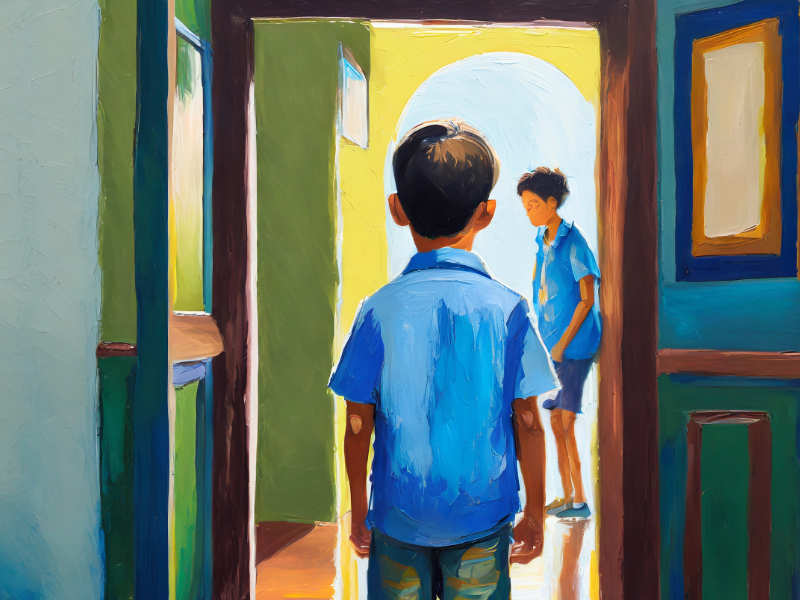
He comes to a standstill in the doorway of the room. His eyes reach across the sea of two brothers and two sisters to connect with his mother. Helplessly, they look at each other, and with their eyes, express the pain they feel in separation, without words or touch. After a moment, Jason tenderly greets each of his brothers and sisters with a kiss and a hug. He receives no display of affection in return. There is no expression in his eyes or on his face when he has finished.
Jason doesn’t play with any of the toys but spends the precious minutes of his visit as a helper and a nurturer. He begins by straightening the toy closet. Standing on tiptoe, he arranges the toys, games, and puzzles. When he is finished, he sits with his hands folded and his little legs dangling over the sofa, watching his brothers and sisters play. When the visit is over, he helps them pick up the toys. Jason is a little old man in a little boy’s body at the tender age of 7.
Jason is the first child to hug and kiss his mother goodbye. His arms tighten around her neck as he buries his face in her shoulder. He lingers in this position until his siblings push him out of the way demanding their hug.
Jason steps back fighting off his tears. In the end he succumbs to his feelings. He turns his head to the side to hide the tears as he wipes them from his eyes with the back of his hand. Jason is the only child who cries when the visit is over.
Jason is quiet in the car on the way back to the foster home. He sits with head bowed so I cannot see the tears flowing. When we arrive at the foster home, he is the first child out of the car. He gives me a brief glance as he looks back on his way to the door. His eyes flicker for a moment with pain.
The Family Visit through the Child’s Eyes
I saw my mom and brothers and sisters today. When Vicki came in her little red car, I called to my sister, “Hurry, Christie, time to go see Mom. Race you to the car!”I beat her to the car by a long shot. Girls are so slow! I jumped in the car. I got the front seat! I buckled my seat belt. I wished Christie would hurry!
During the ride to the visit, I had so many questions I wanted to ask, “Why can’t I live with my mom? Why am I in foster care? What did I do wrong?” I did ask Vicki, but she said she didn’t know. I thought she just wasn’t telling.
I had a lot to tell mom. I couldn’t keep my surprise inside any longer, so I told Vicki. “See what I did! I lost my tooth!” I held my mouth open with my fingers so she could see the big hole where my tooth had been.
She had to look quick cause she was driving. She laughed and her eyes got really big. She asked me if the tooth fairy left me any money. I had never heard of a tooth fairy.
I wondered if mom would be there. She didn’t come last week. Nobody told me why. They said, “Ask mom!” Funny how grownups never give you a straight answer when you ask them questions!
I jumped out of the car when we got to the office. I ran up the steps to the playroom. I ran to the room and stopped really quick in the doorway. Mom was there! She got tears in her eyes when she saw me. I cried too, I was so happy to see her! I wanted her to kiss me and hug me. She couldn’t because she was holding a baby. She said his name was Adam, and he was my new baby brother! Daina, Katie, Jeff, and Christie came charging into the room. The moment was gone. There was no time for me. I was too late.
I love my brothers and sisters. I missed them, so I hugged them to let them know how much I missed them. They didn’t hug back. They didn’t know how because mom didn’t have time to teach them once the babies started coming. She was always too busy or too tired. I had to teach them hugging. I didn’t mind because I liked hugging. It only hurt a minute because they didn’t hug back. I am used to it by now.
I cleaned out the closet this week, like every week, hoping mom would notice me. Vicki noticed me and said something, then mom said something. I felt really special for a minute. The feeling would have lasted longer if mom had said something first.
When I finished, I went to sit by mom. I wanted her to ask me about school. She didn’t because she was too busy playing with Adam. She wasn’t supposed to be playing with Adam all the time. This was MY visit. I was mad and no one noticed but Vicki.
I got down on the floor to play with my brothers and sisters. There wasn’t anything else to do. Just when I started playing, Vicki said it was time to pick up the toys and say goodbye.
I helped put the toys away and turned to my mom. I put my arms around her neck and hugged her as hard as I could. I hoped if I held on long enough, they would let me go with her, or she would say something. Then the little ones pushed me out of the way to get their goodbye hugs and kisses. I gave up! I decided being the oldest meant being last, even if I was only 7!
I fought really hard to keep from crying on the way to the car and back to the foster home. I tried to hide my head when those dumb tears started falling. Vicki saw my tears. She reached over and stroked my head and neck. Her hand felt soft, and I felt better for a little bit. She said it was OK to be hurt and to cry. I wanted to ask if it had to hurt this much, but I didn’t.
When we got to the foster home, I beat Christie out of the car again. It felt good to be first. I’m not first very often. Vicki was watching me when I ran into the house. For a second, I couldn’t keep back my tears. I guess it was OK to let someone know I was a little boy inside, after all.