The Anxiety Disorder Game

The Anxiety Disorder Game

What causes someone to commit so strongly to the need to avoid doubt and distress?

Imagine a man standing in front of an audience and suddenly being unable to think clearly enough to speak his next sentence, finally stumbling through, putting a quick death to his speech and walking out of the room in humiliation. It would be expected that he would worry about how bad the next time might be, even envisioning himself in a repeat performance. Picture a woman on a bumpy flight, unexpectedly becoming terrified of deadly danger, and not being able to calm herself until the turbulence ended. It would be no surprise if she avoided future flights anytime the weather seemed less than ideal. Consider a father suffering from obsessive-compulsive images of choking his infant daughter. That graphic horror would compel any loving parent to avoid being alone with his child.

An almost instinctive reaction to these traumatic events is adaptation, however not all adaptation is psychologically healthy. Unhealthy adaptation could include exaggerated worries, anxiety, and inhibition of the capacity to act on their environment in an attempt to create a feeling of safety or avoid these threats in the future. If these maladaptive responses continue then the person will develop an anxiety disorder. If we look more closely, it seems that many of these same people begin to develop a general maladaptive framework for operating in the world. Safety becomes of paramount importance. The person with an anxiety disorder believes that losing control of their feelings or circumstances can come quickly and easily. Given that belief, avoidance is an easily adopted strategy. When the person with an anxiety disorder avoids, vigilance becomes their primary safety behavior. Once they recognize a potentially troubling situation, they want to end it immediately. If their heart starts racing and their head gets woozy, they fight to get rid of that discomfort as fast as they can. If the discomfort cannot be stopped by escaping, then they begin what they think is a problem-solving process, however this is not problem-solving but only excessive worry.

The goals of worry make perfectly good sense given the crippling anxiety people have experienced. The problem is that this strategy only serves to increase the problems that they are designed to prevent. When we resist the physical symptoms of anxiety, we ensure that anxiety will continue. The adrenals secrete that muscle-tensing, heart-racing epinephrine through the body, the brain matches it, and we will become more anxious.

Using worry to solve problems will backfire. Worry is a problem-generating process since it causes people to think more about how things might go wrong than about how to correct difficulties. “The human mind is built to worry. Worry helps us to prioritize our tasks, and provides us drive to get each task done by kick-starting the problem-solving process.” People who are prone to anxiety doubt that they have the inner resources to manage their problems, so they use worry to brace for the worst outcome in an erroneous belief that they are productively preparing for the negative event.

Two other tendencies contribute to their struggles. Anxious people don’t want to make mistakes, believing they will have dire consequences. They also don’t want to feel any distress, and the goal of the worry is to stop or avoid uncomfortable symptoms as soon as they arise. That message—“don’t get tense!”—is a sure way to create a self-fulfilling prophecy.

All these tactics together become a powerful force structured within a powerful fortress that drives the decisions of anxious people. They follow a belief system—a schema—that tells them how they should respond to doubt and distress. The belief systems of some clients are so strong that they ride roughshod over the therapeutic strategies we employ. No matter what instructions and techniques we give clients, their overriding unconscious and usually conscious, goals are to end the doubt and distress.

Much of my understanding of these drives, to avoid discomfort and seek certainty at all costs, grew out of years of failures. If I began treatment by teaching someone brief relaxation skills, they would incorporate those skills into their strategy of trying to keep the anxiety at bay. If I offered assignments counter to their defensive belief system, clients would not follow-up on the homework, or they would become confused after leaving a session. If I were especially effective in persuading them of the importance of practicing skills, they would simply drop out of treatment.

For over twenty-five years I have gradually modified cognitive-behavioral treatment that included relaxation training, breathing skills, cognitive restructuring and exposure strategies, to address the special issues created by anxiety disorders. By 1992, for instance, I drew on dozens of discrete techniques, some old standards along with some new procedures, to help my panic disorder clients alleviate distress. But as the years passed, I felt that technique alone was insufficient. My experience taught me that if we focus on techniques without first challenging their beliefs, then their fear-based schema will overpower our suggestions.

Personifying Anxiety

Anxiety disorders have a clear strategy to dominate. They condition the person to three contexts: the situation that stimulated their fear, the fear reaction itself, and their use of avoidance as a coping mechanism. The person creates a defensive relationship with each of these: to become doubtful and anxious when approaching that situation, to feel threatened by their anxiety and want to get rid of it, and to avoid when necessary to stay in control. These strategies are incorporated both into the neurology and the belief system of the person. Each interpretation and behavior in response to anxiety is directly linked to this frame of reference. I use a cognitive approach in which most of the therapeutic time is spent addressing clients’ relationship towards the anxiety, not the anxiety itself. My goal is to teach clients therapeutic principles powerful enough to offset their faulty beliefs that they must battle anxiety and must become relaxed again quickly. Clients learn to mentally step back, away from a poor quality interpretation of the situation (“this is a threat”) and a failing strategy to respond to it (“I must stop it”).

In most ways, this approach matches the standard cognitive-behavioral protocol. However, this is also where I begin to diverge from some standard CBT strategies. To win over fearful anxiety, I believe the therapeutic strategy must meet the following conditions.

1. It must be able to compete with the power of fear and distress. This includes creating an emotional shift that is strong enough to match the drama of anxiety.

2. It needs to have a simple frame of reference that makes sense to the client. My most consistent task with anxiety clients is to keep a clear-cut message at the heart of our discussions. The sharper I am about a few points, and the more emphatic I am about using them as guiding principles, the more successful I am at influencing the client’s point of view.

3. It needs to provide a clear system to follow, with simple rules that guide their actions during fearful anxiety. Otherwise, consciousness gets swallowed up by the fortress of conditioning.

4. It needs to permanently influence neurology or, said another way, their physiological reaction to anxiety.

5. It needs to involve tasks that they feel are within their skill set.

6. It needs to help them feel in control instead of out-of-control. Anxious people regard themselves as victims of the anxiety condition. I want clients to feel in charge, to see themselves as the subject, not the object.

7. It needs to be simple enough and available enough for them to utilize during a confusing, anxiety-provoking situation.

Shifting the Client’s Game Plan

Anxiety disorders play a mental game and they create a game board with rules stacked in their favor. Anxiety wants to distract us by getting us to focus on the content and then to attempt to prevent problems being solved within that content area. For instance, in OCD the content is the possibility of causing harm to self or others through carelessness. In generalized anxiety disorder, it is worry about health concerns, money, relationships or work performance. In social anxiety it is the fear of criticism or rejection from others. This is a clever misdirection, since the true nature of the game is the struggle with the generic themes of doubt and distress. The end result is that the actual problems and solutions to the problems that drive the anxiety are not clear to the client.

The disorder only wins if clients continue to play their expected role. If instead they can see the pragmatic opportunities for viewing their anxiety as a mental game, then we can begin to generate a framework to manipulate. Early in treatment I want to accomplish two goals. First, I want clients to recognize this distinction between the content they have been focusing on and the actual issues of doubt and distress that they must address. Second, I want them to take a mental stance and take actions in the world that are the opposite of what anxiety expects of them. “Anxiety wins when clients seek certainty and comfort. “My goal is to persuade clients to go out into the world and purposely look for opportunities to get uncertain and anxious in their threatening arenas.

For instance, learning the skills of relaxation can be a great asset to recovery. But in training to win against anxiety, it is counter-productive to try to stay relaxed. It is best to seek out discomfort. This is one of the biggest early struggles for clients in treatment: to honestly take the stance of wanting to face the symptoms.

Fortunately, I wasn’t alone in creating such a new strategy. In addition to Eastern philosophy and principles of Zen Buddhism, my guides were Victor Frankl’s paradoxical intention, Paul Watzlawick’s reframing, which stems from the Mental Research Institute’s concept of second order change, and Milton Erickson’s fractionation and pattern disruption. Frankl’s work encourages the client to generate the physical symptoms he most avoids. Watzlawick and his colleagues were the first to define reframing as altering the perception of the problem, the solutions and client resources in such a way as to reinforce therapeutic interventions. Erickson’s fractional approach and pattern disruption aim to make small changes in the pattern of client behavior and the external circumstances instead of opposing the behavior and circumstances.

The Moves of the Game

There is an existential game to learn when dealing with anxiety symptoms. People make a judgment that the symptoms of anxiety are unwanted intruders and threatening enemies and they want the trouble to end. They keep hoping that one day they won’t experience any of these symptoms. Thus, they become trapped by their expectations. Existentially, there is no need for such judgment. The symptoms of anxiety disorders can simply exist, without being deemed good or bad. The anxiety disorder wins when clients judge the symptoms to be wrong and to be banished. In order to win over anxiety, they need to start by stepping back from their current experience, observing it and labeling it as acceptable to them in the present moment. Sounds simple enough in theory, and in the end, clients who recover will master this skill. They learn to stop playing the game by anxiety’s rules. But initially it takes all the clever persuasion a therapist can muster to unhinge clients from their old frames of reference.

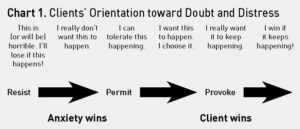
In Chart 1 you will see some possible responses to the symptoms of doubt and distress. Clients enter treatment in the position of resistance. In their most resistant position they say, ‘This is horrible. I’ll lose if this happens.” Even the stance of “I don’t want this to happen” gives anxiety the upper hand, because the mind and body will move into battle mode. Ideally, if clients can respond by saying “yes” to the encounter, and accept exactly what they are experiencing in that moment then they will be back in control.

But for many, the anxiety disorder has become so dominant that the client cannot make such a shift directly. As they attempt to accept their doubt and distress, they do so in order for that discomfort to go away. They are still oriented in their natural position of resisting the symptoms. They are more likely to say, “Let me try relaxing into this situation, and I hope this works, because I’ve got to get rid of this feeling.” The skills associated with permitting the symptoms to exist often allow the client to slide right back into resisting.

For those cases, the game takes a different tact. We re-direct the attention of clients away from fighting the symptoms and purposely toward encouraging them. They choose to act as though the symptoms are good instead of bad, and something to be held onto, even encouraged instead of rejected. As clients master this game and learn its lessons, they develop the insights needed to shift toward a non-attached relationship. If they can endure the discomfort, they can learn. I created this framework of a game to help them endure and to teach them three overarching goals.

1) Step back and identify it as a game
The first critical move is to step away from the drama, observe the event and name it. In meditation and in moments of relative quiet mindfulness, when the struggle isn’t great, you simply “step back.” You let go of your attachment to the thoughts. With anxiety disorders, in order to step back, clients must be able to label the event as one in which the anxiety is trying to dominate their mind. During threatening times, the drama is often too enticing to easily drop. They have already generated an automatic and rigid label that identifies the situation as one in which they should become aroused and worried, for example, “This is a true threat to me.” I encourage them to replace this with any message resembling: “OK, the game’s on: anxiety’s trying to get me to fight or avoid now.”

This is one of the advantages of the game. By training clients in a specific protocol and by strongly reinforcing that protocol, they begin to look for opportunities to practice and they become more astute observers of these moments.

2) Stand down 
Once they step back, they need to engage in a strategy to convey to their mind that it is time to “stand down.” The body and mind need help in backing away from the fight-flight mode. If, in the face of a threatening situation, they attempt to say, “I want this experience,” then the mind begins to have a choice other than battle stations.
Clients also need to stand down from the ego’s archetypal win-lose predisposition—winning by domination—and replace it by a more paradoxical strategy of winning by manipulating the challenger’s moves instead of blocking them.
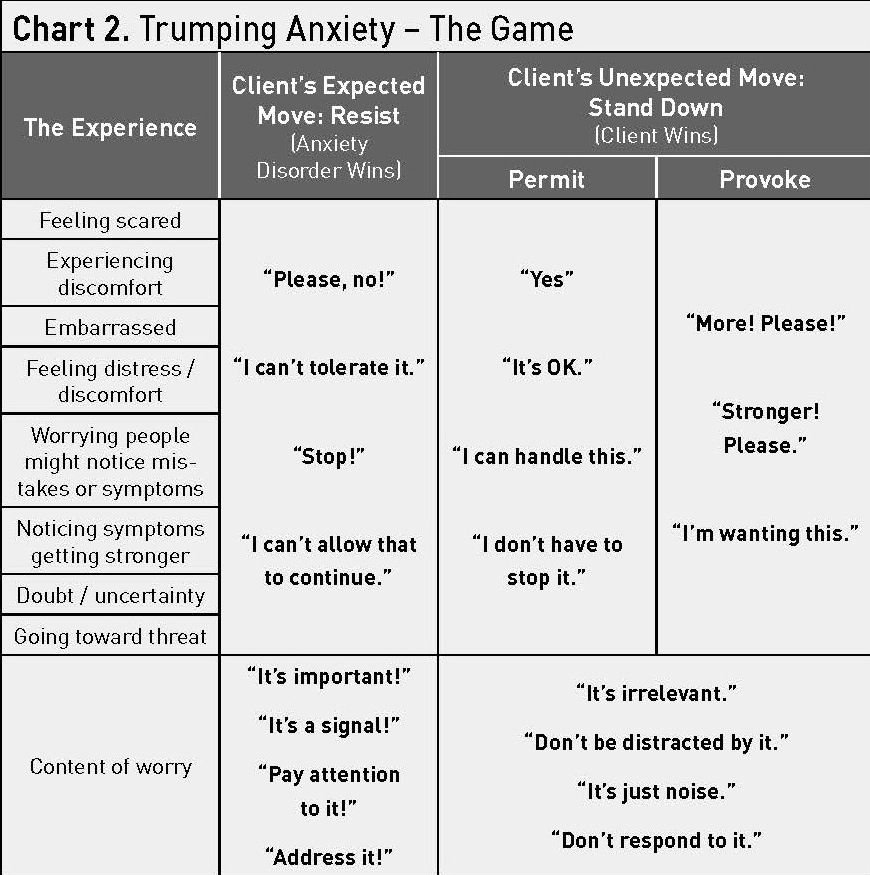
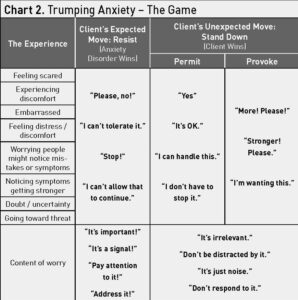
Chart 2 details this next set of moves in the game. Resisting will play right into anxiety’s hands as the expected move. Instead, clients begin the process of standing down by using one of two strategies. Each move is designed to embrace doubt and distress instead of pushing them away.

Standing Down–The Permissive Skills

The first level of the game is to allow the anxiety to continue instead of trying to stop it.

This is manifested in the supportive statements, “It’s OK that I’m anxious,” “I can handle these feelings” and “I can manage this situation.” This approach has a paradoxical flair to it that people often miss. You take actions to manipulate the symptoms while simultaneously permitting the symptoms to exist. With physical symptoms you are saying, “It’s OK that I am anxious right now. I’m going to take some Calming Breaths and see if I settle down. If I do, then great. But if I stay anxious, that’s OK with me too.” We attempt to modify the symptoms without becoming attached to the need to accomplish the task. This is a critical juncture in the work and the therapist must track closely the client’s expected move of, “I’m going to apply these relaxation skills because I need to relax in this situation.” No! While it is fine to relax in an anxiety-provoking situation, it is not OK to insist that you relax. That’s how anxiety wins.We reverse a common American catchphrase by saying, in the face of anxiety, “Don’t just do something, stand there!” When enough epinephrine pumps through the body then the brain yells, “Run!” Consciously overriding this impulsive message takes great courage, but pays great dividends. It differs from desensitization where we help the client gradually approach the feared situation under relaxed conditions. Here we confront their instinct to seek out comfort and encourage them to remain physically anxious and mentally as calm as possible. Instead of believing that there is something broken, they simply accept the status quo.

Going Toward–The Provocative Skills

Many people consider acceptance a weak strategy in the face of the fortress of fear that has been built in the mind. They need to shift from the permissive stance (“It’s OK this is happening”) to the provocative stance (“I want more of this discomfort!”). Here they learn to encourage the symptoms instead of just accepting them. This strategy is extreme and can be thought of as fighting fire with fire. Fear is intense and acceptance is soft. Fear will trump calmness and acceptance every time. I help clients shift to an attitude of provocation that is equally as powerful as, and can compete with, fear. I teach them to use their willpower and conscious intention to seek out an even more rapid heartbeat, to encourage their feeling of contamination to grow even stronger, or to hope someone will notice their hands shaking.

Why this line of attack? Because we want to interrupt the dysfunctional pattern in the most effcient way possible. The straightforward way, using acceptance, is not necessarily the most effcient way because it tends to be susceptible to the clients’ dominant paradigm of resistance, for example, “Let me try to relax here and I hope this works, because if I panic that will be awful!” Consciousness only has so much attention at any given moment. During an anxious moment, I encourage clients to commit themselves to play the game, and to focus their limited attention on following the rules: try to get anxious on purpose by encouraging symptoms. If they will bring their attention to the task of encouraging, even cajoling symptoms to become more uncomfortable, or for doubt to grow exponentially, then they automatically withdraw attention from their fearful goal of ending the doubt and distress.

When I suggest homework activities to clients, I use expressions like, “how about playing with this move?” and “perhaps you can fool around with these responses.” I imply that these strategies are malleable and temporary: “What do you think about just experimenting a few times with this move and see what happens? We can talk about it next time.” For some, we will literally play a game in which they score points for various types of responses to their worry or anxiety, or they will have to pay a consequence when they avoid or engage in some ritual to help themselves feel safe instead of threatened. An example of this strategy can be seen in the case of Samuel. One of Samuel’s fears was that he might unknowingly have cuts around his fingernails and cuticles that would expose him to the AIDS virus while shaking hands at work. Throughout the workday he conducted brief checks of his ?ngers. I gave him the following assignment:

  • Go to the bank and get 40 fresh one-dollar bills.
  • As you leave home in the morning, fold them and place them in your left pocket.
  • Each time at work that you compulsively check your fingers you are to move a bill from your left to your right pocket.

This is a simple intervention, but I gave it to someone who was already oriented to the game. He knew that the only way to keep those dollars in his left pocket was to go toward his distress of not knowing if he was being exposed to AIDS. As he began the game, a typical email from him would say, “By the end of the day, I only had $10 in my right pocket!” There was something about adding that “game” that refocused his attention just enough to lower his struggle and raise his success rate.

I hear this from clients time and again: when they focus on scoring points, or avoiding a therapeutic consequence that we create together, they notice that they become less attentive to fighting the symptoms. When they disrupt their on-going relationship with anxiety by struggling to play the game, they spontaneously become more tolerant of the situation and their distress diminishes. Over time, as they learn the surprise benefits of this pattern disruption, they can congruently adopt the permissive style.

As you might imagine, these people are not easily persuaded to really want this experience. However, this is not the point of the exercise. The point is that they try to associate themselves to the task even if their initial attempts are clumsy. Clients can be encouraged to pretend to want their anxiety, like a role in acting class. This is a cognitive skill, so the work is directed to what they are mentally saying during practice. As they try to subvocalize as if they want to increase their doubt or discomfort, they will automatically dissociate from their typical negative interpretations.

If a client has trouble encouraging the physical symptoms, for example, “I can never want my hands to sweat,” then I suggest a minor shift in their focus. Instead of directly requesting physical symptoms to increase, I ask them to request that the anxiety disorder make the symptoms stronger. Instead of saying, “Come on! I really want to faint right now!,” they say, “please, anxiety, make me more dizzy.” This seems to be just enough misdirection and dissociation to make it tolerable to them, and accomplishes the same goal of competing with their resistance.

The central strategy of the game is for clients to want to embrace whatever the anxiety disorders want them to resist. One of the primary ways I convey the logic behind this wanting is by first defining the process of habituation: prolonged exposure to a feared situation, bringing about a significant decrease in fear.

Wanting Habituation

Habituation requires three elements: frequency, intensity and duration. You have to expose yourself to your feared situation often enough or you won’t progress. When you practice, you need to get up to a moderate level of distress. Practicing while you try to keep yourself calm actually slows your progress. Practicing between 45 to 90 minutes seems to be the ideal amount of time according to the research. These three components of habituation guide all homework assignments.

I think there is a fourth element missing: the spirit of wanting to experience what you need to experience. Clients progress much more rapidly when they desire to have the habituation experience. Unless they are seeking and wanting frequency, intensity and duration as they go toward fear, then by default, they will be trying to do the opposite. They hope they don’t get anxious, that the symptoms don’t get very strong and distress doesn’t last very long. This makes no logical sense to me. If frequency, intensity and duration of exposure to distress and doubt are needed for me to get better, then I want to stumble upon a situation which stimulates my anxiety. I want to do that often, and I want my distress to last, and I want the sensations to be strong. These elements create habituation and habituation is my ticket out the door away from suffering.

Cognitive-behavioral therapy does not teach this specific orientation to clients, although I think it should. If it did, it would alter clients’ disposition toward the problem, help to guide their practice, give them motivation and I’ll bet that it would alter neurochemistry as well. Analogously, if we are receiving chemotherapy for cancer treatment, it would be poor therapeutic form to go to each appointment dreading it, despite the fact that the side effects can truly be dreadful. Instead, you should see the chemotherapy as your friend, augmenting your body’s natural ability to heal. That’s good placebo.

The most important benefit of applying the skill of wanting is that it speeds healing by truncating the habituation process. Clients learn rather quickly that if they invest in the stance of wanting, it returns to them the gift of a rapid reduction in their anxiety. They gain insight sooner in the process, after fewer practices and after fewer minutes within each practice. When they apply the skills of the game during practice, they actually have quite a hard time keeping their distress high (try as they might) or having it linger around for those 45 minutes. By paradoxically applying the orientation of wanting, clients have an “aha” experience during practice that brings freedom.

3) Master the skills of the game through applying technique and practicing (or being a “good student of the work”)
I discuss with my clients the idea of “being a good student of the work.” Good students, of course, are clients who commit to following through on a homework assignment, and then work hard to keep their commitment.

One of Moira’s many OCD compulsions involved her needlepoint work. Frequently she felt compelled to tug on the thread ten times as she tightened a stitch. I offered her a new ritual to adopt. Each time she tugged more than once, on that next stitch she was to tug ten-plus-two times (12). The next stitch she had to subtract three to the number, tugging nine times. Ten on the next stitch, add two, and so forth, until she reached one tug. Her ten-tug stitch became a ritual involving 113 tugs in the next seventeen stitches. She hated that! But she did it, because she was a good student of the work. By forcing herself to stick with our little game, she increased her conscious awareness of her thoughts, feelings and urges during the moments just prior to her compulsive action. At the moment of the urge to pull more than once, she became alert to the punishing consequence. This strengthened her ability to turn away from it. Within a week, that compulsion was of her list of troubles.

Skills Meet Challenge

Doubt relates to clients’ perception that their skills won’t match the challenges they face. If their assignment is within their skill level, then they will be more willing to go forward. This usually means we must lower the challenge and offer them a performance goal within their perceived skill level.

If I am an OCD checker, and I think I have just run someone over, I may yet have the skill to resist my urge to turn the car around and check the highway again. But how about pulling over and running around my car one time before I turn around? I can do that. And now I have interrupted the pattern, which provides me an opening for further changes. One day, as I am having the urge to check, remembering that I now must pull the car over and run around it (again), I might spontaneously decide that that is simply too much effort. At that point I will drive on, and thus experience, with little suffering, exposure to my feared outcome without engaging in my ritual.

Score Points! Win Prizes!

The assigned tasks can be so challenging, so threatening to clients’ frame of reference that they refuse to practice. Even if they do practice, their early efforts may give them only small gains. I mentioned earlier that I create a frame of reference of addressing anxiety as a game in which you can score points. For some clients I create prizes as extrinsic rewards in the early learning phase. Sometimes I offer them metaphorical images, for example, “Imagine that if you walk all the way to the back of the store and stay there 10 minutes that I will magically transfer $10,000 into your savings account. Could you do it then? Play to win, as though your life depends upon it.”

Currently, I have a large woven basket full of prizes, wrapped as gifts. In my anxiety group I bargain with clients: “Anyone who completes three practices this week can draw from the basket.” I have been hiding a $5 bill within two of the prizes as an extra incentive. Last month I rewarded the group member who earned the most points over the previous week with her choice among 12 new self-help books.

Recently I have generated a competition in the group during a several-week period. I agreed that for each member who practices at least 3 times I would contribute $5 into a weekly “pot” of money. I devised a point system to be used for every practice session. Each person decides where and how he or she will practice. Whoever scores the most points, wins the pot. The winnings can grow to be $90.
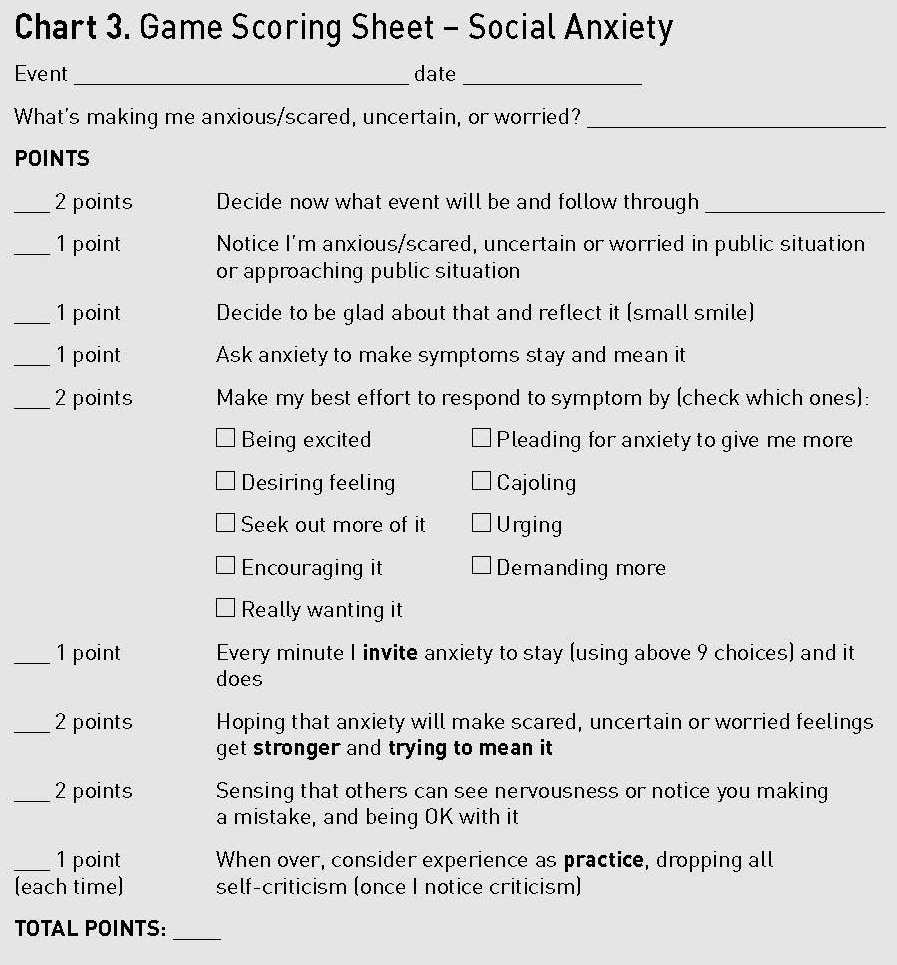
As you review Chart 3, you can see the essence of the provocative game and the weight of each type of activity. These illustrate the goals I want them to set during practice. They reflect the essence of paradoxical action in fearful situations:
In a threatening situation, step back and become an observer of your process, not be 100% the actor in the drama. Decide to be glad about having the doubt or distress. Put a little light smile on your face or in the back of your mind to reflect it. Then, invite whatever struggle you are having, whether physical symptoms or worries, to stay. Work on trying to mean it. If possible, try to strengthen your move by intensifying your reaction. [For example, I offer nine different choices, such as the previously discussed demand that anxiety make the symptoms stronger.] No matter how strong the doubt and distress becomes, you should treat it as if it is never enough. Reward yourself for every minute you actively invite the symptoms to stay or to get stronger. Accept that other people might notice some problem you are having and for extra credit: hope that they do! Then, when you are done with the practice, learn to support yourself. Drop that critical, disappointed voice.Creating the point system has a number of benefits. The client and I establish a broad strategy together that is manifested through specific actions during practice times. But they pick the practice times to apply the skills. They answer the question, “What can I do today to create some strong uncomfortable feelings for a while?” As they act on this choice, they are empowered and feel a sense of control. Once they are in the anxiety-provoking moment, the point system directly guides them to the therapeutic action.

It is poor strategy to get into a threatening situation and then decide how to act. In that setting, they are competing with a well-habituated set of instructions (“brace, worry, and avoid if necessary.”) Clients are much more likely to regress back to their safe actions, or inactions. When they understand the rules of the game and commit themselves to follow those rules, then recall them as they face threats, they have the best chance of winning

Social Anxiety Strategies

Social anxiety disorder gives clients shaky hands, a quaking voice and worry about the critical judgments of others. Here is the role that it expects of the client: to not want the experience, to avoid it when possible, and to try to get rid of it. When choosing to play the game they ask for the opposite of what anxiety expects: they want anxiety to make their hands shake, their voice quake and their sense of threat heightened. Not only do they request those experiences, but they want them to stick around as long as possible! The clients then attempt to exaggerate their wanting of this experience, and might “desperately plead” for social anxiety to generate shaky hands, or to “cajole” the anxiety to make the experience stronger. They can increase their score by hoping that people will criticize their boring talk or question their shaky handwriting. Earn enough points, win a prize! They refuse to play the game that the anxiety disorder expects. They take charge and push that game board away and pull up their own game board of seeking out doubt and distress when anxiety wants them to defend or run.

Julie

Julie decides to practice facing her social anxiety by eating lunch out alone. She walks onto the lunchtime crowd of “Moe’s Southwest Grill” and is instantly greeted by the cooks and other staff. “Hello! Welcome to Moe’s!” they yell, and the other patrons turn to see who’s entered. Julie begins to feel the flush of red rise in her face as she smiles and nods her head in acknowledgement. Then inwardly she smiles and says to herself, “Yes! Another point.”

Here she describes the process. I’ve added my comments in brackets to her key statements.

“I was really nervous walking in there. I felt like everybody noticed that I was by myself. But that was OK, because that was the point of the whole practice. [She is listening in to her inner conversation and she is permitting her feelings instead of blocking them.] Then having to find a place to sit and making that conscious decision: Am I going to sit with my back facing everyone? Am I going to sit and actually have to look at everybody while they look at me? I made the choice to sit and look at everybody while they looked at me. [She is taking control of the situation by listening in on her process and choosing the more intimidating option.] …I reminded myself that the longer I could stay and the longer I could be nervous and be OK with it, then the better it would be for me. [She has adopted a new belief system about her goals in the fearful situation: stay anxious to win.]

“I thought about how I could make it stronger. I thought that facing everyone while I ate would keep the anxiety going. I was just trying to think of ways to keep the anxiety going. [She is actively strategizing how to provoke symptoms as a powerful way to help her stop resisting.]

“I’m not as afraid of social anxiety as a word because I’ve taken social anxiety and I’ve turned it into a person instead of a condition. It’s not a mother, it’s not a father, it’s just this person or this entity and she wants me to take care of myself. She doesn’t want me to be embarrassed. When I do something that she thinks I could not do, she is impressed. I really like that because it is not a judgmental thing. It is like someone saying, ‘You really should wear a jacket, it’s going to rain.’ But you go out there without a jacket and it doesn’t rain, and they say ‘OK, you did it; you’re still a good person.’ So that’s how I’m thinking about it. [She now comprehends that those ogres, worry and anxiety, have been in her life to help her. They just do it in a clumsy way and she has found a better way. Julie will win this game for good.]”

OCD Strategies

OCD wants the person to try to get rid of any doubts about safety and to take any actions necessary to remove distress. Many OCD clients who fear contamination really do believe that at the moment of exposure they must repeatedly wash to save their life or the life of someone they love. Personifying OCD, I emphasize how it needs them to believe the specifics of their fears. Clients who win over OCD will hold fast to the belief that this is an anxiety disorder. As such, their battle should be with the physical symptoms of anxiety and the urge to end doubt. They should by no means battle with the content of the obsessions. It is never about germs or rabies or salmonella. It is always related to the fear of feeling distressed about threat. To play the OCD game clients set the overarching goal of seeking out doubt and distress.

Eventually, everyone in OCD treatment will do exposure (of the feared stimulus) and ritual prevention, which is the standard treatment for this disorder. But modifying the ways clients obsess or how they perform the ritual is the most efficient starting point for many. Starting with small, lower-threat changes allows clients to practice their new skills and experience early success. Instead of not washing their hands at all after they feel contaminated, clients can change how they wash, where they wash, or what they are doing mentally while they wash.

Jai

Jai was living in a residential program for teens. He struggled with about a dozen different types of washing and cleaning rituals, especially when it was his turn to handle the after-meal cleanup. One ritual required that after he was finished with his (thorough) cleaning of the kitchen, he was to squeeze the sponge ten times while rinsing it under running water.

In our first treatment assignment I asked him if he would fool around with the ritual by switching hands each time he squeezed. In this case, Jai got to keep squeezing and keep counting. He simply altered hands, and switching hands was only a minor threat to him. This is what I call throwing the symptom cluster a bone. You leave in place major components of the ritual or obsession, thus lowering the threat level. However, it is still a change that begins to erode the original fortress of symptoms. He agreed to the assignment, and returned the next week to report how easy that task was. I then suggested this further revision: would he be willing to explore his ability to toss the sponge in the air and catch it with the other hand for each switch? Again, he agreed to this small, silly shift and returned the next week reporting no problems with the task. The following week, he simply squeezed one time and set the sponge down without struggle.

Jai’s playful approach to modifying his ritual became a relatively painless means to arrive at exposure and ritual prevention. It served as a building block for some of his more difficult later encounters with OCD.

Jordan

Jordan, a physician, feared contamination with germs that might come in contact with her clothes during the workday at her medical practice. One of her primary rituals was to spray the entire front of her body with ammoniated Windex® as she left work. She used that same Windex® throughout her home when she felt threatened by germs. Ironically, while Jordan obsessed about becoming sick, her husband, who was also a physician in her practice, was developing serious respiratory problems from inhaling the ammonia. Over months, Jordan worked hard to tolerate switching the Windex® to vinegar-based, then to dilute it to a 50% solution and finally to a 33% solution. Each of these steps increased her doubt just enough that she could tolerate it and experiment with the change. Once she implemented the change, she incorporated it into her routine without much struggle.

But we could progress no further with this or the other safety rituals she performed. Jordan was stuck on the content of her obsession: things had to be clean enough. I failed to persuade her that her attention actually needed to be focused on the strategy of confronting doubt and uncertainty.

Vann

Vann came into treatment struggling with OCD checking rituals that lasted up to five hours a day. Often his concern was that he had missed seeing something he should have noticed: new scratches or dents on the trash can, dust particles under the telephone, an inappropriate item in the basement. Other times he checked as a way to prevent a disaster: an electrical cord will be wrapped around the trash can; his son will trip over some item on his bedroom floor; a fire will start in the kitchen or a flood will occur in the basement. Some days Vann would check a particular item over a hundred times.

Our first ploys involved gently modifying his relationship with his symptoms. For instance, he would check the trash can, but only in slow motion, ever so gradually picking it up and unhurriedly rotating it in his vision. Or he would study the telephone, but not allow himself to touch it. These were his first playful explorations into uncertainty and distress. By the sixth session we added a strategy of postponing. OCD would give him the impulse to check the basement immediately. He would choose to wait thirty minutes before he acted on that urge, again learning to tolerate his discomfort. Through this gradual exposure to the principles, by session nine he was able to avoid locking his house for five days.

Here is how he described his progress by session 10:

“In the past I would pull out the backseat of the car, and if there were dirt there, I would have to clean it up. If a bolt was there I would look at it and get stuck on the backseat, focused on that bolt. Now I do this intentionally. I lift up the backseat and try to make something really bother me, try to feel anxious. I feel that anxiety, replace the backseat, shut the back door of the car and walk away.

When I first started walking away I felt really anxious. I wanted to go back and look at something under that seat again. I felt as though I didn’t look at it hard enough and I’d want to look at it again. I would sweat a little bit, my heart would beat faster, I’d become very irritable and I felt very compulsive. I wanted to go check again! But I just decided I wasn’t going to do it. Sure enough, about two hours later the desire went away.”

Vann completed his treatment in eleven sessions over 5 1/2 months. In a follow-up twelve years later, he remained symptom-free and medication-free.

Conclusion

I began this conversation saying that when I work with anxious clients, I keep my points broad and simple and I focus on them repeatedly. My goal is to influence clients’ perspectives and shift their orientation. I encourage you to try the same.

Help clients to turn away from the content of their fears whenever possible. You cannot always ignore content, because clients will be wrapped up in it. But get past content as soon as you can and move into the core themes of people with anxiety disorders: their struggle with doubt and distress.

The central strategy is for them to want to embrace whatever the anxiety disorders want them to resist. They have two choices. They can “stand down” by choosing to let go of their fearful attention and accept the reality of the current situation. This is the permissive approach. When they have completed treatment, this will be their most common response: to say, “I can handle this situation” and to allow their body and mind to become quieter. The other option is to choose to stay aroused on purpose and actually encourage anxiety to dish them more trouble. This provocative choice is an excellent option during treatment, because choice number one is so difficult to embrace during early encounters. Conditioning and a set of false beliefs are calling the shots; they cannot simply relax on cue. Some treatment protocols will suggest that you help them expose themselves to the fearful stimulus and learn that they can tolerate it. I am suggesting that you put a twist on that set of instructions. Help them to take actions in the world that are opposite of what anxiety expects of them. Persuade them to go out into the world and seek out opportunities to get uncertain and anxious in their threatening arenas. This is a shift in attitude, not behavior. The behavioral practice is not to learn to tolerate doubt and distress, it is to reinforce the attitude of wanting them.

Our ultimate goal is to teach clients a simple therapeutic orientation that they can manifest in most fearful circumstances. Early in treatment, however, you will also need to provide a specific system to follow, with simple rules that guide their interactions with fearful anxiety. Using behavioral practice, encourage them to repeat this new interaction again and again, in all their fearful situations.

You can assume that one of the biggest obstacles to success will be poor planning just moments before the encounter. Whenever they wait until they are scared before deciding the best course of action, then conditioning and faulty beliefs will dictate that they struggle or avoid. In that setting, they are trained by fear to mindlessly seek safety and comfort. Before they enter any situation that is potentially threatening, they should review their objectives and remind themselves of their intended responses.

Thinking of their relationship with anxiety as a mental game offers both a broad therapeutic point of reference and specific actions that manifest it. Initially, your skills of persuasion and their belief in you will push them to challenge their faulty beliefs. After that, experience will be their greatest teacher. Once they have acted on these beliefs and gotten feedback during the fear-inducing event, that learning will put the power in their new orientation and it will be self-sustaining. They will then have a set of instructions, such as “anxiety, please give me more” or “I’m looking for opportunities to get distressed” that will point them toward simple choices during difficult times. And they will have a skill set (that I laid out in Charts 2 and 3) that they believe will match the challenge of the situation.

Bethany Brand on the Identification and Treatment of Dissociative Identity Disorder

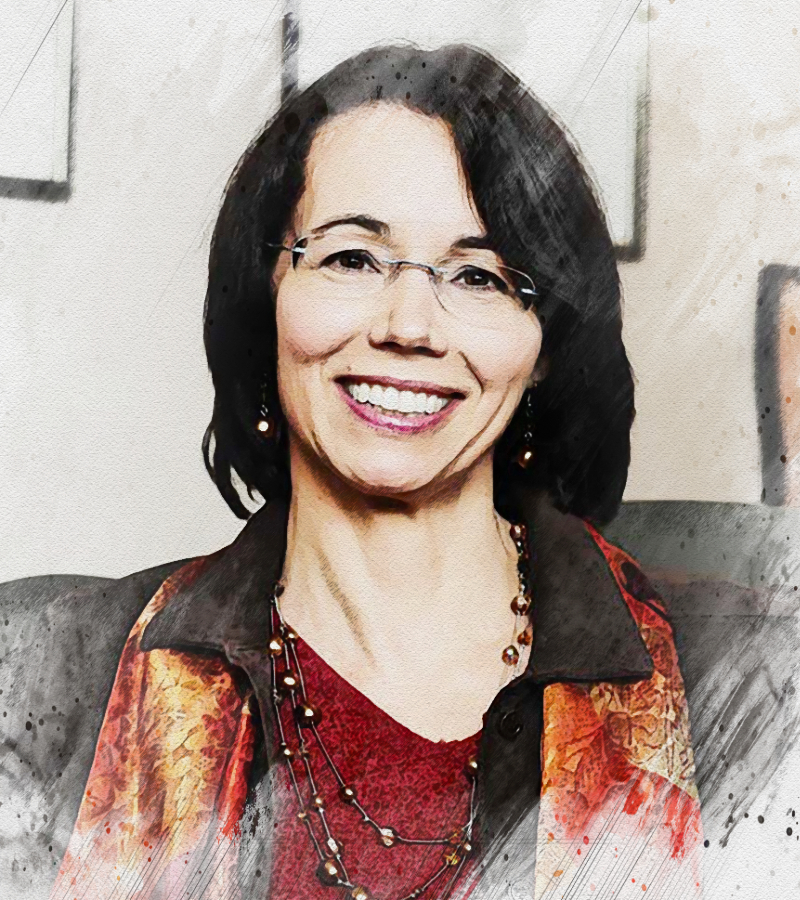
Lawrence Rubin: Bethany Brand is a professor of psychology at Towson University. She’s an expert in trauma, specializing in trauma related disorders, including post-traumatic stress disorder and dissociative disorders. She also maintains an independent practice in clinical psychology in Towson, Maryland. Doctor Brandt serves on international and national task forces developing guidelines for the assessment and treatment of trauma disorders. Welcome, Bethany. Thank you for joining.

Bethany Brand: Thank you so much for having me.

Right Place, Right Time

LR: What got you interested in dissociative disorders, trauma, and ultimately dissociative identity disorder from a personal perspective?

BB: It was a number of things. One of the early experiences I had as an undergraduate at the University of Michigan was working in a shelter for women who’d been battered, which is what it was called back then—not interpersonal violence like we call it now. I started hearing about trauma and remember being very interested in it. In my first semester of graduate school, I was doing a psychological testing practicum at Johns Hopkins Hospital on the kids’ unit. This was in the late 80s, so many of the kids had been abused or neglected according to their charts. I asked my supervisor how that experience might be reflected in their psych testing—how would they be different? And there we were at Hopkins, one of the premier institutions in our country, and she did not know.

To her credit, she acknowledged that and asked her supervisor, who later gave us this fascinating off-the-cuff talk about trauma and his experience with traumatized kids. It was so compelling that I decided that was what I wanted to do my master’s thesis on. I was lucky enough at the time that Frank Putnam, one of the legends in the field of dissociation, called my graduate program, asking for students who might be willing to volunteer on his project—a longitudinal study of girls who’d been sexually abused. I was incredibly lucky to be at that right place at the right time, working with a pioneer.

To be honest with you, I wasn’t sure about the whole idea of dissociative identity disorder because we didn’t see that in the lab and that was not what we were studying, even though Frank was studying it at the National Institute of Mental Health. When I later went on internship at George Washington University Hospital, a woman there said she had multiple personality disorder, with whom I had done the testing.
The treatment team was a little skeptical, but my supervisor referred me to Judy Armstrong at Sheppard Pratt Hospital in Baltimore who offered to review the data with me. After she did so, she said, “You know what; you actually might have somebody with MPD.” After that, it was just luck because I got a postdoctoral fellowship at Pratt, where they had just opened up a trauma disorders unit, and where I did my dissertation on trauma. I remained there and began working very heavily with folks with DID, and other serious, complex trauma disorders. Right place, right time, and fortunately, amazing training with amazing clinical supervisors.

DID and the Dissociative Spectrum

LR: Before I ask you what readers most likely want to know, which is, “What actually is DID,” why the transition from “multiple personality disorder” as a label to, “dissociative identity disorder?”

BB: There were a lot of reasons, but just to be very brief; by calling it multiple personality disorder, many clinicians thought it was a personality disorder like borderline personality disorder, and it’s not in that category. The experts in the field wanted to emphasize it was a trauma related disorder connected to dissociation, not a disorder of personality. The name change was an attempt to reflect that.

LR: Well, I guess relatedly—and I may get back to my initial question—does the DSM’s characterization of DID as a complex post-traumatic developmental disorder, ‘capture it?’

BB: It’s a terrific start. It’s a foundational start, because it implies that it starts in childhood, which is what developmental disorder means. The research strongly points to very early severe chronic child abuse as the cause. But we also know that there is genetic tendency towards dissociation. And often these clients who end up as individuals who develop DID also have attachment problems because they didn’t have secure attachment. There are multiple things going on, but trauma really has an early childhood foundation.

LR: In your writing, you discuss TRD or trauma related dissociation and suggest that DID is almost always related to early childhood trauma and severe disruption of the attachment relationship. Is there such a thing as a NTRD, or non-trauma related dissociation?

BB: Yes! We all dissociate to some extent, so normal non-pathological dissociation can occur. It can be going into a state of automatic pilot. For example, when we’re driving down the highway and we’re really thinking about something, and barely remember the drive when we get home. Or we’re driving down the highway and we miss our exit because we’re so preoccupied, not because of traffic, but because of our mental disconnection from what we’re doing.

It can also happen at moments of peak spiritual experiences or athletic experiences when people can disconnect from their bodies or feel out of their bodies and have this incredible experience. But none of these experiences interfere with functioning.

LR: I imagine getting lost in a book or a song or a movie or a conversation containing elements of dissociation, but on the left side, or benign side of the spectrum.

BB: Exactly. Those are called absorption, and some people are very prone to absorption. We know from research that the more somebody is prone to absorption, they may be more at risk for dissociation. There’s been some debate over whether absorption should be called dissociation or not? For now, it is understood as one of the lower levels, not-so-problematic types of dissociation, which comes from self-report measures.

LR: Is it clinically useful to think of a dissociative spectrum with absorption type experiences on the left or benign side, and DID as the most extreme and pathological form all the way to the right?

BB: Yes, I think it is. But I’ll say that with awareness that some people living with DID really resent that, because understandably, this was an adaptation to horrendous, overwhelming circumstances. And so, I completely get it and respect that they had a brilliant way of adapting and getting through what would have been just harrowing experiences. The research actually supports exactly what you said.
As I said earlier, all of us dissociate to some extent. And then when you start studying dissociation and different psychological disorders, there’s a range of scores that people have on the different, self-report questionnaires. And it starts out with people having [scores] a little bit above what might be for people who are not struggling with any emotional disorder.

And then it gets at the highest level is folks with DID. And in between, there might be people with eating disorders and maybe borderline personality disorder, because there’s often a lot of trauma in those people’s background, and then you start getting into PTSD. And then the dissociative disorders indeed are at the end with the highest levels of dissociation.

LR: I would think that someone who is engaging in non-suicidal self-injury or someone who is in the middle of an intense food or substance binge is in an acute state that requires a certain amount of dissociation to be able to inflict that level of harm on to yourself.

BB: Is there some dissociation that goes on during those moments? The answer is yes! Often people are somewhat disconnected from their bodies. An example is a client who, with DID or severe dissociation, may be cutting and not feel it and be kind of fascinated with what they’re seeing under their skin, like really extreme cutting with the detachment. And they don’t feel the pain.

LR: Is it possible that someone with DID could be cutting while there’s another element of that personality that’s watching? Am I using the right nomenclature for the other “states?”

BB: There are people in the field that are really pushing for those parts to be called dissociative self-states. In the literature, they’re alternatively called identities, personalities, parts, and alters. We’re really trying to emphasize that whatever they’re called, that they’re all parts of one person. They’re self-states. They’re not different people. That’s why we’re encouraging that name to be adopted in the next DSM.

LR: I find myself gravitating toward more questions that may be more of a popular culture artifact, but I’ve heard that different self-states can have symptoms of a particular medical illness or disease while another is asymptomatic. Is that possible in your experience?

BB: It depends on what illness you’re talking about. We know that, depending on our emotional state, our blood pressure may change, right? And Frank Putnam, who I referred to earlier, did some of the early research showing that different self-states have different EEG patterns.

Simone Reinders in the Netherlands has done a bunch of research studying neurobiological differences among some self-states. She’s tried having professional actors impersonate self-states while they were hooked up with all kinds of biological markers, including brain scans. They could not emulate different self-states.

It’s remarkable. It’s not magic. It’s a disorder that is linked to neurobiological changes and differences. And of course, these different self-states are going to include the traumatized self state, the one that remembers trauma and has all the symptoms that go with that PTSD. When they’re scanned, of course you might expect their heart rate to be much faster and for them to have more activity in their limbic system, versus a part that’s very detached and doesn’t recall that trauma. The heart rate of that self-state is not going to be as elevated. And they’re not going to have the intense amygdala activation.

LR: I can see that if someone is in a moment of active sexual abuse, sexual trauma, that it’s in the body’s interest to down-regulate the heart rate and cortical activation.

BB: Yes. There are studies about that, talking about how animals go into survival mode and, you know, like the faint mode or the feigning death mode. There are some animals that have that response of total disconnection from their bottom up to allow them to survive attack. Well, there’s some parallels with humans that have been horrendously abused repeatedly. Their brains shift into dissociation as a survival mechanism.

Their access to memory can be quite different as well. One of the diagnostic requirements is that there be amnesia for some of their life experiences, that are not due to drugs, alcohol, or head injury. Or they may not remember key autobiographical events, like their own wedding. We call that dissociative amnesia.

LR: What are some of the myths and misconceptions about DID that clinicians should know about?

BB: There are a lot, unfortunately. One is that DID is exceptionally rare. On and across different prevalence studies, at least 1% of the general population meets criteria for DID. That’s the same prevalence rate roughly as bipolar disorder and schizophrenia. So, it’s not rare, but there have been some critics.

Critics of the whole notion of dissociation and DID have been putting it out for a long time in articles that are published in journals. And that has found its way into psychology textbooks that undergrads and grad students read that put forward that myth so that unfortunately, many people, even mental health clinicians, think it’s rare. Another myth put forward by the critics is that DID folks exaggerate their symptoms or are prone to create false memories of abuse.

When you actually compare people with DID to people with PTSD to what are called healthy controls, people who don’t have any emotional problem, and professional actors who try and emulate all of this stuff, there are some studies we’ve done that show that people with DID
are no more likely than people with PTSD to develop false memories.

The important thing that most mental health clinicians have not been trained to know is that they are highly symptomatic across a bunch of different domains. They don’t just have amnesia and different dissociative self-states. They also have PTSD. And we know PTSD is a complicated disorder with 17 potential symptoms. And so, at times they’re flooded with traumatic intrusions, pictures, awful memories, awful nightmares. And then there’s periods where they’re shut down and avoid it because it’s so awful to remember and feel that stuff.

And then there can be incredible periods of irritability and sleeplessness and feeling like they’re an awful person and different from the rest of the world. There’s a lot of research showing that dissociation is very common among people with PTSD. They also have major depression and because living with all these symptoms is so brutally difficult, many of them have substance use problems.

They try to knock out the memories by drinking too much or using drugs. They often also have eating disorders because they have a very difficult time tolerating their bodies. They blame their bodies for their abuse, and so they try and get really big so that nobody’s ever attracted to them or—and they often go back and forth, or they get really anorexic and starve themselves hoping to die or to look unappealing that way.

All of that is shown in the literature. And with regard to feigning DID, one of the ways that you look for malingering is when somebody is reporting too many symptoms or reporting exceedingly severe symptoms. They are much more likely to be classified as potentially malingering on some of the evidence-based measures and interviews for malingering. I’ve developed research that helps mental health clinicians and forensic experts know how to differentiate when somebody has true DID and when somebody is attempting to simulate it.

The critics also don’t really understand complex trauma. They are typically not clinicians or academics. But because so few mental health folks are getting trained in the evidence-based information about DID, they come away with these stereotypes out of textbooks that are just wrong. They’re just flat wrong. And myths.

LR: Is there a short list of the cardinal presentations that differentiate DID from some of the other severe forms of psychopathology?

BB: Back when I was trained, I was taught that if you hear voices, you are psychotic. But more than 75% of people who have DID hear voices.

LR: Schizophrenic?!

BB: Yes, schizophrenia or maybe the psychotic phase of bipolar disorder. I would encourage therapists to not automatically assume that hearing voices means psychosis. There’s a whole bunch of research, including people who don’t have DID, experience voice hearing, and this is strongly associated with trauma exposure. There have been meta-analyses that support this, so I suggest that clinicians always ask every client, no matter the setting, if they have been exposed to trauma. So, learn how to do a good trauma assessment.

If somebody endorses having experienced trauma, then ask about PTSD symptoms and dissociative symptoms. Ask about the different types of dissociative symptoms. Ask about depersonalization. Does the person ever feel numb when they should have feeling? Does the person ever feel like their body doesn’t belong to them? Do they ever see themselves at a distance, like outside of themselves, like they’re watching a movie? Those are three common symptoms of depersonalization, and there’s a range of other symptoms they can ask about, like do you sometimes feel like you’re younger or not your own biological age. Ask about voice hearing.

LR: What’s your gut feeling about why there’s such resistance among clinicians to embrace the reality of DID?

BB: It does sound farfetched, right? But that’s because people are misunderstanding the disorder. It is impossible for people to have multiple people inside themselves. It is impossible. Right. But, Lawrence, you don’t have a little Lawrence running around in your brain, and I don’t have a little Bethany running around in my brain. How do you know you’re not me?

LR: I’ll have to check.

BB: I stump my students when I ask that question. You know who you are because you know that you have a cat and that you’ve been married and lived in Michigan, and that you like Hello Kitty, and that you like certain kinds of music and food, and you have knowledge and memory of family and life experiences. But people with DID don’t always feel like all that.

First of all, they have periods of time missing. And so, they’re confused about who they are and what’s happened in their lives. But they’re not different people inside. Now, I’m going to say that, and some of the readers who have the idea are going to object to what I just said, because some people with DID do feel like they are different people.

That is their perceived experience, but people with DID don’t literally have little people running in their heads either. Our personalities are based on the neural firing of networks in our brains. And like we were saying earlier, there’s a neurobiological pattern that is characteristic for trauma related self-states versus ones that are very detached and don’t remember the trauma.

So, I think a lot of mental health people are mistaken and don’t understand what they have heard. It’s rare and I’ve been told this so many times, “Doctor Brand, I’ve been in the field for 30 or 40 years, and I’ve never seen a DID patient.” But I guarantee you, if they’ve really seen a lot of clients, they actually have, but missed it because perhaps they’re looking for dramatic presentations like Sybil. If it was that obvious, then when people switched states, it would be easy to diagnose. But that’s what movies do to make it look right to the audiences. That is not actually what DID really looks like.

A Tiered Approach to DID Intervention

LR: What is a multi-phasic approach to intervention with DID, and why is it considered the gold standard?

BB: It means that clinicians who work with DID and other serious dissociative disorders are realizing that there needs to be three stages of treatment. When somebody comes into treatment with complex trauma, and especially if it’s very serious, there needs to be an initial stage of stabilization of their symptoms. At this early stage, they may be suicidal, self-harming, drinking and using drugs, or engaging in some other kind of addictive behavior.

They often have really high levels of hospitalization, so they need to learn other ways of regulating themselves that are safe and that they can do out of the hospital. If and when they get stabilized, they begin learning how to regulate emotions in ways that ground them, which is the opposite of dissociation.

Once they’re stable and want to go on to stage two work, we are talking about trauma processing. That’s where they may then talk about some of the trauma so that gradually they can heal from that and not have so many intrusions of nightmares and flashbacks and horrible memories or feeling numb to it.

It’s an awful thing to feel like you’re deadened inside. That would be stage two work, which can take a very long time. So can stage one, by the way. And then comes stage three. For complex trauma—and I’m not just talking DID now—but in general, the person works more on developing their life, their friendships, their career goals; they’re no longer so focused on the past and trauma, but integrating into whatever kind of life and relationships they want.

LR: Is this in line with your “Finding Solid Ground” program?

BB: Yes. The program I’ve created with colleagues called “Finding Solid Ground” is a staged stabilization approach where we help clients learn about, first of all, grounding. But it’s not just for people with DID, but also for people with complex PTSD, and what in the United States is called the dissociative subtype of PTSD.

Our research is showing it helps all these folks, not just DID, but they learn to be more present to their emotions and deal with emotions in healthier ways. They learn about how to deal with PTSD so it’s more contained and not so intrusive so they can sleep better so that they’re not having these awful images pop into their mind and interrupt their functioning all day.

We help them learn to separate past and present. When somebody has very bad PTSD, the brain cannot really distinguish the difference between a flashback and the present moment. It feels to the person it is happening now. So, we teach them how to catch their warning signs that they may start being close to being at risk for intrusions of PTSD, that they might start dissociating, that they might start drifting towards self-harm, and then find ways to get out of that cycle. Among other things, we teach them a little bit about the neurobiology of trauma and that it’s not their fault.

LR: Is integration of self-states the absolute end goal for treatment?

BB: When I first accepted that postdoc at Sheppard Pratt in 1993, the emphasis in the field was integration of personality states. And yet that’s not what I was hearing and seeing was happening very often. I was the leader of a study where we asked experts around the world how many patients had they integrated in their careers. It was small numbers.

That may not sound like a jolt of lightning to readers, but it did lead us to rethink whether that was very achievable for most patients or not?

At the same time, many people living with DID do not want to integrate their parts because they have lived often for decades with these parts. And that helps them function from their perspective. That is who they are. They value their parts, or eventually you hope that therapy can help them learn to respect and value their parts rather than be at war. Some of the self-harm and suicide attempts are about one part trying to kill off another. At the time, they don’t recognize they will all die if they commit suicide. So now I have a different perspective and I think there are different options. I think clients should have the right to choose what they want their endpoint to be.

And that may change over treatment. In the beginning, some clients absolutely say get rid of these parts, but they don’t understand. They can’t. I use the metaphor that you can’t live by cutting out your heart or your liver. And it’s the same thing with self-states. You have survived because of the self-state. You can’t get rid of one. You can learn to work as a coherent collaborative group like a business or a healthy family rather than being at war.

DID and the Family Connection

LR: Are there useful systemic interventions that involve family, spouses, children?

BB: Of course, as a therapist, I’m teaching them, but I don’t want their spouse or partner to be doing therapeutic things. Right! But it gets really messy. If they have children who see them switch, and mom or dad doesn’t seem to remember things they’ve said or done, I find ways to explain DID to the kids in an age-appropriate way.

It is incredibly important that they’re not switching a lot in front of their children. Parents should be consistent no matter what, no matter who they are, whether they have DID, bipolar disorder, or PTSD. Children need consistency. So I would work with a client to help them develop the parenting parts and having them learn to look similarly and act similarly with the kids, so they’re not confusing the kids.

LR: In this context, can a person with DID voluntarily call on another self-state, rather than it “taking over” during a time of crisis or trauma-related moment?

BB: Yes. So that might be something that we’d work on, to go back to that last example, when they’re around their children. You would want them to work towards having parts that can be very supportive, caring, loving, consistent parents. And the parts that are little, that feel as if they are young children, terrorized, traumatized themselves, would be in the back of the mind.

All this is metaphor, however, right? There are no little people, right? But metaphorically, those self-states are taken care of internally so that they are consistent. Same thing with work, same thing when they’re driving.

LR: You said earlier, Bethany, that invariably, dissociative states and DID in particular are born out of severe trauma in childhood and attachment disruptions. At what point might a clinician begin to suspect dissociative identity disorder in childhood?

BB: Really good question. Some of the same symptoms that later develop and become more severe in adulthood can be seen in little children with the beginning stages of a dissociative disorder. One thing I haven’t mentioned is that adults with DID can go into trance states where they’re not responsive to the outer world.

Little kids start showing attention and zoning out. They’re often misdiagnosed as having ADHD. So again, we need all clinicians to be trauma-informed and trained. Not that they’re expecting to see a dissociative kid, but they might, especially if they have symptoms of PTSD like nightmares and flashbacks, or report having imaginary friends. Some talk about that for a second.

Developmentally, it’s normal for children to have imaginary friends. But if imaginary friends start to be frightening, or upsetting, or tell the child to hurt their sibling or a pet, or to destroy their toys, that’s not a “normal” kind of scenario. Little kids usually stop talking about imaginary friends around age seven. But people with DID report that they never went away. Those actually linger as parts of their dissociative self-states.

Keyword, Avoidance!

LR: There are clinicians who believe that if we look hard enough for trauma, we will find it. Is it similar for dissociation and DID?

BB: It might be! During medical training, students commonly think they have all the different disorders. The same thing may be happening in our field. For 26 years, I taught a course on differential diagnosis and interviewing. At the beginning of the class, I warned the students that they were going to be tempted to diagnose themselves along with everybody they loved or hated. It is a normal phase of learning the DSM but I asked them to be respectful and stick to the diagnostic criteria, so they don’t go telling people they’ve got borderline personality disorder.

There is a normal stage of training in which, at least for a while, we may overuse certain concepts as we’re learning them. But again, if clinicians are well-trained in differential diagnosis they will be less likely to overdiagnose certain symptoms and disorders—in this case, dissociation and DID. This is one of my research streams.

There is a lot of research out there, and I’ve written a book about how to assess dissociation and how to distinguish it from other symptoms and disorders. Here is where training is critical. The ways you treat schizophrenia and bipolar disorder are very different from the way you treat DID. Schizophrenia and bipolar are the two disorders that people with DID are most often misdiagnosed with.

People with DID don’t need mood stabilizers or heavy-duty antipsychotics. Instead, you do a trauma-informed stabilization approach. Two of my earliest DID clients were misdiagnosed with schizophrenia and treated accordingly for years. One passed away and gave me permission to share her story. By the time I saw her, she had horrible tardive dyskinesia. She had been disfigured by the treatment for schizophrenia that she didn’t have. Once we started working together, she got a lot better— not cured, but a lot better, and she was much more functional. She had dropped out of school and midway through high school, she went back and became a minister in her community.

LR: What do you see as the core elements of training that need to be incorporated into graduate programs so that DID can be correctly identified, and interventions designed?

BB: Only 8% of APA-approved doctoral programs require a course in trauma. That’s gotta change. Information about trauma should be a required part of graduate training in psychology, social work, and related fields. As part of that training, they also need to learn about dissociation and the range of dissociative disorders, and how you assess for dissociative disorders, and how you do differential diagnosis. And, of course, something about evidence-supported treatment. There’s only one program so far based on randomized controlled trial data that shows it helps people with profound dissociative disorders. But they should hear about that. That should be in the textbooks.

LR: What do you think is contributing to that incredible avoidance by the APA of mandating graduate-level trauma training at graduate level?

BB: A group of us have been pushing for different guidelines about working with complex trauma that finally got approved by the APA this last summer. But there is pushback. And a lot of us think there’s a political issue. Let’s just think about what PTSD means. The required criteria center around avoidance. You nailed it there!

Even people who’ve been traumatized don’t want to think about it. It’s human nature not to want to know, think, and talk about trauma. Believe me, it’s a hard part of my job. I do it, and of course I know how to do it. But hearing the stories of what has happened to little children is incredibly difficult.
And there’s some real doubters out there when it comes to thinking about child abuse. Maybe they should read a little bit about child pornography and child trafficking and how rampant they are, because we’ve got plenty of evidence that that happens. Some individuals report that part of their abuse was being the victims of child pornographers.

So, I think we don’t want to think about that stuff!

LR: Avoidance on a large scale.

BB: Avoidance. You nailed that.

LR: Not to get sidetracked, but I wonder if this is what Bessel van der Kolk experienced when he tried to get his developmental trauma disorder approved by APA.

BB: I’m sure that’s some of it, but not-unshockingly, it likely goes back to financial issues.

LR: It’s hard to imagine.

BB: At this point, the National Institute of Mental Health has never once funded a study of the treatment of DID. So, I have literally had to get donations to fund my studies. Do you think cancer researchers do that? Do you think researchers of any other disorder must have bake sales and pass the plate at college?
Where is the money in trauma right now? It’s in the Veterans Administration. I’ve heard this from various people who work there. They do not recognize DID, and they don’t want anybody in the VA system being diagnosed with DID, because that’s a real problem for our military, right? Everybody there has a dissociative disorder. Although believe me, I have assessed people in that system and helped them get honorary discharge. Anyway, there’s a huge amount of funding that goes to VA research and they emphasize working with adults. They want to keep the soldiers “strong” and ready to go or whatever the branches to ready to fight. Yeah. The childhood trauma.

LR: It’s hard not to introduce politics into conversations at this level. But do you have any concerns about funding for dissociative and other disorders as the incoming administration takes form?

BB: I do, and I think many, many researchers are very concerned about funding for new science research in general. But then when you get into groups like research on women, research on children, research on traumatized people, research on any kind of minorities, but especially LGBTQ groups, people are very worried. My funding has always been a problem. But I do have many generous donors.

Wrapping Up

LR: There’s so many big sales you can have, and winter is coming.

BB: So, we’ll have some hot chocolate sales and some coffee. Yes, there is a group called the International Society for the Study of Trauma and Dissociation (ISSTD). They do lots of multi-level, face-to-face and online training for dissociation and children, adolescents, and adults. They also supported RCT studies for our Finding Solid Ground program.

I’m strongly urging clinicians to learn about that program. We’ve got two books out there. One for people living with the disorder, and one for therapists. Our research shows that the Finding Solid Ground program works best when the therapist knows the program and the clients working with the therapist who knows the program.

LR: Has counter transference entered into your work with any particular client?

BB: For anybody working with complex trauma, there is going to be countertransference and traumatic countertransference. And the client will experience transference. There’ve been times I felt like I wanted to rescue somebody because they’ve had such a hard life. But you’ve got to keep the boundaries strong. I consult with a lot of therapists. One of the mistakes I hear from therapists is they do try and rescue, or they go too far. It’s not uncommon that therapists will see a DID client for free and become very burned out. I don’t ever advise that.

The psychotherapy research shows that people benefit from treatment more if they’re paying something. It’s also common for therapists to alternate between feeling helpless, like the child was back during trauma time, and at other times harsh and mean which the client may experience as harsh and mean, almost like the perpetrator or a non-protective bystander. Those three roles are extremely common in the treatment, so I teach a therapists to watch for that, to work on that, and to make that understood.

Something they actually talk about with their clients so neither get stuck in those spaces and can learn from it. It’s part of the healing, rather than becoming the point where the treatment comes off the rails.

LR: I think that we could talk for hours, Bethany. It’s been a fascinating conversation for me as I hope it was for you. Is there anything I’ve left out?

BB: Yes. There are people out there who have died because of this disorder, but there is hope, even despite the tremendous suffering. It’s important that these people know that they are not alone, and neither are their therapists. It’s important that therapists convey that they’re not alone, it’s not their fault, and that they are not weak or dumb. They don’t have to suffer endlessly, and neither do therapists need to feel powerless. There’s hope.

LR: I think the clinical world is a smarter place for your presence in it. Thank you, Bethany.

BB: Thank you!

The Value of Evidence-Based Treatment That Fails

In CBT I Trust

I became a psychotherapist because I wanted to help people feel better. I’m sure all therapists share that motivation. In my master’s program, I learned about cognitive behavioral therapy (CBT), and that no other type of therapy had as much research evidence to support it. I was drawn to its promise of rapid relief from suffering.

I sought out a doctoral program where I could receive specialized training in CBT for depression and anxiety. During my training, I saw firsthand how a few weeks of treatment could lead to big improvements in symptoms—not for everyone, but for many.

As an assistant professor I joined a leading center for the treatment of PTSD and OCD, and I witnessed the power of CBT to reopen lives that had been completely subverted by these conditions. When I found that cognitive and behavioral techniques weren’t always effective, I sought training in mindfulness and acceptance-based approaches. I wanted to be equipped to help everyone who came to me. Just as when I began this journey, I wanted to be a healer.

Later, I added CBT for insomnia so I could treat the frequent sleeping problems I encountered in my work. I began writing about the power of CBT to relieve suffering, first on my blog, then through a co-authored account of recovery from OCD, and then in two self-directed books on CBT techniques. I developed a blog and a podcast under a label that captures cognitive, behavioral and mindfulness-based approaches: “Think Act Be.” I was fully immersed in the evidence-based model, and I continued to be inspired by the successes I witnessed.

And yet I often remembered best the people I couldn’t help—the ones who came to me for a few sessions, or for many months, and never experienced lasting progress. They seemed to feel just as depressed, just as anxious, just as gripped by constant worries or obsessions as they did on the day I first met them. Some felt worse. My inability to help them weighed on me as I felt I’d let them down. Sometimes, when they left my office in obvious emotional pain, I cried at my desk.

Another Form of Healing

My work with Evan comes to mind (details changed to protect his identity). Evan was in his fifties and had been dealing with anxiety, depression, and obsessional thinking for his entire adult life. I introduced the standard CBT and mindfulness-based strategies, which Evan struggled to use. He experienced some relief from the meditations I led him in, but otherwise continued to have debilitatingly severe anxiety and depression. I could have blamed his lack of progress on his infrequent practice between sessions, but I didn’t believe that was the whole story, or even most of it. Whatever the reason, I couldn’t help him find relief.

And yet Evan often expressed his gratitude for everything I did for him. Like what?, I often wondered to myself. On one occasion when he thanked me “for everything,” I told him I wished I could do more to take away his pain. He expressed how much relief he found in our meetings, and particularly in the meditations I led him in and which he diligently recorded for listening between our sessions. “And you listen to me,” he said, “and you don’t give up on me. And I can tell sometimes when we’re talking that you’re feeling what I feel. And that’s huge.”

Many other names and faces stand out from over the years, people whose symptoms I seemed unable to touch. No one ever yelled at me or demanded that I do more to help them. Some expressed frustration at their continued suffering, occasionally directed at me, but most were entirely gracious, even grateful despite our lack of progress. Some even referred their friends or family members to me. It took me several years to realize that some of the deepest work I’ve done as a therapist has been with individuals whose symptoms didn’t improve.

This realization didn’t come until a few years ago as I sat with my friend Jim at his kitchen table. Jim had been battling an aggressive form of cancer for two years and had just learned it had returned. I didn’t realize as we sat there that it was the last time I would see him; Jim died two months later.

What surprised me in our final conversation was the gratitude Jim expressed for his treatment team. I expected he would be disappointed in them; after all, he was receiving the most state-of-the-art cancer treatment in the world, and yet it hadn’t kept his cancer away. I could imagine being bitter if I were in his shoes, and not at all happy to have to return for treatment.

Quite the contrary, Jim described how grateful he was for the care he’d received over the past two years. He noted that his medical team had extended his life, giving him time to put his things in order. He had been given more time with his family than he would have had without treatment. He was dying, and yet he was thankful to those who had done all they could to help him.

And more than the cutting edge care they provided, Jim seemed to appreciate that they cared. Jim wasn’t treated as a cancer case, or a research trial number. He was a complete human being, with a family, with hopes and fears, and likely a foreshortened future. The professionals with whom he worked provided compassionate care right until the end.

When I went through my own debilitating illness—much less severe than Jim’s, I learned what it meant to receive compassionate care. By my count, I saw 13 specialists over a 4-year period, and none of them was able to completely resolve my health problems. And yet most of them provided another form of healing—not of the body and mind, but perhaps of the spirit. I would leave their offices feeling a little less alone, a bit less afraid.

A True Presence

When I was in my late thirties, I was diagnosed with open-angle glaucoma. My optometrist who detected it reassured me that I wasn’t “guaranteed to lose my vision,” but the prospect of going blind hadn’t occurred to me until his reassurance. I didn’t ever want to not be able to see my kids.

The ophthalmologist I was referred to treated me with two rounds of laser surgery in each eye. The first involved boring a hole in the iris, making a tiny second pupil to decrease the dangerously high pressure inside the eye that could destroy the optic nerve. The second was meant to dissolve the blockage in the eye’s drainage ducts, allowing the pressure to return to normal. Unless it wouldn’t!

I learned through my own research that these procedures are effective in about seventy-five percent of patients. Thankfully, mine were successful and my pressures have been in a healthy range for the past few years. But I was struck by the failure rate of this treatment, given how directly it seems to target the root of the problem. Examples like this one abound across medical specialties; whatever the medication or procedure, the success rate of evidence-based interventions is significantly less than one hundred percent.

In light of the limitations of modern medicine, we shouldn’t be surprised at our limits as therapists. And yet many of us are quick to assign blame when a client isn’t showing obvious improvement. Often, we’ll blame the client, assuming there must be personality pathology or that they “don’t want to get better.” We may assume the symptoms bring secondary gain. We might prefer to believe that the treatment is effective, but the client just isn’t ready for change. These factors may be present, but they also have the convenient effect of letting us off the hook. It’s not us, it’s them.

The danger that I found in my own reaction to ineffective treatment was running ahead of the client, as it were, and trying to pull them along. This tendency showed up in things like assigning homework that I knew they weren’t going to complete, so at least I could feel like I was “doing something.” My conscience could be clear. Except it wasn’t, because I knew on a deep level that I wasn’t meeting the person where they were. They needed me to walk alongside them, to sit down with them when they sat to rest. They needed my true presence.

Our presence is what matters most. Otherwise, we would dispense therapy techniques from vending machines, or in fortune cookies. Even self-guided CBT books are written with a personal and encouraging tone. It’s crucial to feel that the guidance is coming not only from someone who is supposedly an authority, but from someone who wants the best for us, who’s in it with us. The relationship with an author matters.

Lessons Learned

I suspect I’m not alone in finding that my eagerness to help is actually unhelpful at times. For example, when Rick told me he felt like his life “hadn’t even been a prelude to anything,” I immediately jumped into cognitive therapist mode. My knee-jerk assumption was that this belief was exaggerated; after all, Rick had done many things in his life–graduated at the top of his high school and college classes, worked abroad, completed law school.

“Is that true?” I asked with skepticism. Immediately I knew I’d missed the mark. Rick wasn’t asking me to change his mind, especially not before he felt I’d really heard him. The truth was that his life hadn’t turned out the way he’d imagined. He’d come close to getting married twice, but never tied the knot, and he never had children. And despite his intelligence and education, his major struggles with anxiety and depression had left him unable to work since a year after he got his law degree. His life consisted mostly of tending to his garden, reading the news, and occasionally seeing a friend.

While I may have been on the lookout for distorted cognitions, on an unconscious emotional level I was motivated to look away from the deep pain expressed in Rick’s statement. It would have been much easier if I could have fixed his thinking and taken away his unhappiness. “See! It’s not that bad,” I wanted to say. But maybe it was. And the life Rick had lived wasn’t a problem I could solve.

As a therapist, I have come to appreciate the importance of remaining with and tolerating my discomfort and feelings of inadequacy, if I am going to serve as a full human being to those I treat. I must make peace with what I can’t change. Otherwise, I run the risk of compelling my clients to fight on two fronts, as they must contend not only with their suffering but with my expectations that there must be a solution.

All of this probably seems patently obvious to many therapists, perhaps especially those from a more psychodynamic background. Maybe my tendencies are specific to CBT, or to me. I do suspect CBT fosters some of the expectation about taking away symptoms, but I imagine some form of that expectation lives in all of us in the healing professions.

Sometimes life-changing work gets done while the symptoms are unchanged. For some that might mean connecting with the strength they have to meet their challenges. Others may discover the life that’s possible even through ongoing struggles. Still others will have their experience validated after a lifetime of being told what they felt wasn’t real or will simply feel less alone.

A Broader Lens

Hopefully it goes without saying that I still want to help people reduce their symptoms, and I want to offer each person all the tools that might be useful. Accepting the limits of my abilities and the value of our presence doesn’t mean I must stop trying to reduce suffering in any way I can. It’s also not a way to settle for less than optimal outcomes for my clients. And it certainly doesn’t mean that I have secret insights into what my clients really came to treatment for and that MY job is somehow to get them there.

I still want everyone I treat to experience less anxiety, better sleep, fewer OCD compulsions, or whatever else they came to me for. I provide referrals when I don’t feel that I have the expertise a person needs. At the same time, I’m trying to use a broader lens through which I see a person’s experience. As physician Rachel Naomi Remen suggests, there is a difference between fixing and healing. This stance isn’t a cop out, as I used to believe—a way to make myself feel better about my lack of skill. Rather, it’s a recognition of the reality that there is pain I cannot take away, and that “treatment success” is a bigger concept than can be easily captured in data from a randomized clinical trial, or from a well-validated self-report measure.

Therapy is as complex as any human relationship, with effects that potentially penetrate much more deeply than the apparent symptoms. The best we can do for anyone is to provide compassionate care until the end, whether that means a triumphant recovery, ruinous tragedy or the wide expanse in between.

I’ve also come to recognize that the end of our time together is not the end of the person’s road to healing. For some the time we spend together will be transformational, while for others there will be no obvious effect. For many others, the work we do together will plant seeds that grow only later, well after therapy has ended. It’s easy for me now to recognize the hubris in believing that the evidence-based therapy I offered was the person’s last hope. Now I know that I’m only ever part of a longer journey.  

David Jobes on Collaborative Assessment and Management of Suicidality

Hospitalization Rarely Works

Lawrence Rubin: Thanks so much for making time today for this important interview Dr. Jobes. Let’s just dive right in: What you think are the greatest challenges for clinicians working with suicidal clients?
 
David Jobes:
we’ve got a mindset that a suicidal person belongs in the hospital
I think the greatest challenges are the ones of our culture and of our mindset about what’s most helpful to suicidal people. I think we’ve got a mindset that a suicidal person belongs in the hospital and that you help a suicidal person by treating the mental disorder. I’m a clinician/researcher so I lead with my clinical eye, but I am very much interested in things that’ve been proven to work.

I don’t think randomized control trials (RCTs) are the only way to go–I think there are many true kinds of validity. But I am partial to RCTs because they give more clarity about the causal impact of things. And there are a lot of well-intended interventions that are surprisingly unhelpful if not actually harmful.

there’s evidence that hospitalization is actually harmful for suicidal people
To that end, I think we’re now seeing a period where the use of hospitalization is under the microscope. There’s evidence that hospitalization is actually harmful for suicidal people. There’s a psychiatrist in Melbourne, Australia who talks about nosocomial suicides, which are those caused by the hospitalization. Marsha Linehan, the developer of Dialectical Behavior Therapy (DBT) has for many years been very critical of hospitalization. I began my career in inpatient care and so while I’m not anti-hospitalization per se, I am when the treatment focus is exclusively on the mental disorder, and kind of skips the bullseye which is the suicidal thoughts and behaviors.

If you look at the literature, most of the hospitalization centers around well-focused pharmacological interventions and very brief stays of a few days. And the clinicians are not really asking important questions about the patient’s suicidality. These might include: Do you have suicidal thoughts? Can you tell me about those thoughts? Can we embrace a stabilization plan? And, there are different flavors of stabilization plans which have been proven to be more effective than no-harm contracts. We can ask questions such as: Can we talk about your access to lethal means? Can you think about the use of a lifeline and other resources? And after discharge, can the community do some psychological education that’s suicide specific and then can we institute some kind of follow up?

You know, I was thinking about this before our interview that, when I take my dog to the vet, I get a follow-up phone call the next day about how she’s doing. We don’t necessarily get that from mental health care. My dog gets a nice follow up phone call and I’m delighted to respond to those calls. But there’s evidence that different kinds of follow up, like a phone call, or a letter, or a postcard, or even texting can be helpful in changing behaviors.

we tend to think that medication is more helpful than it actually is for suicide risk. The evidence is at best, mixed
So, that’s one of my soapboxes! I’m really trying to get the focus on hospitalization shifted to suicide-specific considerations. And then in a related way, we tend to think that medication is more helpful than it actually is for suicide risk. The evidence is at best, mixed. We actually have existing treatments that are psychological in nature that most mental health people don’t know about or use routinely. 
LR: If hospitalization is a quick in-and-out and doesn’t focus on a plan upon release and follow up, then it can be as destructive as whatever the suicidal person brings in with them? 
DJ:
hospitalizing a teenager for a second time creates a more lethal trajectory of their suicidal thinking
I know for a fact that many clinicians, from the trainings that I do, are paralyzed by fear of litigation–malpractice and wrongful death tort litigation. This creates a defensive kind of approach to practice–a better safe than sorry approach. But patients get discharged very quickly from hospitals and there’s evidence that the post-discharge period is very high-risk of suicide. There’s actually a paper that was published in the Journal of Affective Disorders last year at the University of Michigan stating that hospitalizing a teenager for a second time creates a more lethal trajectory of their suicidal thinking. And it’s not that hospitalization, per se, is a bad thing. It’s just that we’re not focusing on suicidal thoughts and behaviors.
LR: So, suicidal patients are out of the hospital after this immersive experience where they have 24-hour care by a team of caring professionals. And then, boom, gone. And if there’s not some really positive powerful bridge, then they may be at even higher risk.
DJ: Well, I would even gently challenge the notion of a team of caring professionals. I think what the literature shows is that patients end up spending a lot of time watching TV in the day room, and they go to a couple psychoeducational groups that they don’t find especially helpful. And the only treatment that really exists is pharmacological. And a lot of the medicines, as you know, don’t really have a full therapeutic effect until weeks after initiation.

What we associate with hospitalization actually is not typically the case. There are of course exceptions. I don’t mean to upset people with the idea that every hospitalization experience is iatrogenic or negative. But I think there’s a fair amount of evidence that it’s not really meeting the needs of suicidal people or their families.

Clinical Conundrums

LR: How do clinicians cull through this massive literature in order to find their way to the most effective treatment?
DJ:
we have a disconnect between proving an intervention works in a randomized control trial, and then actually disseminating and implementing that treatment
That’s a great question and challenge because we have a disconnect between proving an intervention works in a randomized control trial, and then actually disseminating and implementing that treatment. One model is Marsha Linehan’s DBT and the reason that DBT is so famous is that they’ve figured out the dissemination and implementation challenge.

It’s a very labor-intensive team treatment that clinicians can’t do on their own and it’s not for everybody. But if you want to learn about it, you can go to the Behavioral Tech website where there are training programs. The two empirically-supported cognitive therapy programs have effective treatments and associated books, especially for suicide attempters, but they don’t have training programs. And that’s a conundrum. You can’t really learn to do cognitive therapy for suicide prevention that was developed by Greg Brown and Aaron Beck at Penn or brief cognitive behavioral therapy (BCBT) developed by David Rudd and Craig Bryan, at the University of Utah, because these researchers haven’t taken their positive research findings to the next level. and developed a training component that clinicians can utilize.

On the other hand, research supported treatments like Acceptance and Commitment Therapy and some other really well-known therapies including cognitive behavioral therapy that are not suicide-specific. But paradoxically, there are training organizations that make it possible to learn these non-suicide-specific evidence-based interventions. In order to scale up a proven treatment and disseminate it to clinicians so they may learn it, you’ve got to have money to get to the corners of the world that you really want to have use this intervention.

So, for example, in our CAMS (Collaborative Assessment and Management of Suicidality) model and other well-disseminated models, there are books but also deep-dive online roleplay training components. Clinicians hate roleplay training even though it changes their behavior and is shown to be effective in terms of doing something different. And then a really critical element is the use of consultation calls to coach a clinician through a new treatment that they’re trying to learn.

We are in the business of training a lot of people all over the world and our CAMS model is gaining some traction, but a lot of what clinicians prefer in terms of training is not necessarily what’s going to change their behavior with suicidal clients, and that’s a real conundrum the field faces. 
LR: So, the challenge is bridging the gap between the research that proves treatment efficacy and disseminating it in a way that makes it likely that clinicians will effectively utilize it.
DJ: Right, and that’s a tough sell because a lot of us like to do what we know to do. I’m a middle-aged man, an old dog who doesn’t like new tricks, so I kind of get that. But in the case of suicide, it’s life and death. And you know, if the fallback is hospitalization or use of medication without support and there’s even the possibility that those might not be helpful, it’s incumbent upon us to do things that are effective.

clinicians need to be thoughtful about access to lethal means and having lethal means discussions with their suicidal clients
.And that doesn’t necessarily mean that clinicians working with suicidal clients have to learn adherence to intervention, but they do need to be thoughtful about safety planning and stabilization planning. Clinicians need to be thoughtful about access to lethal means and having lethal means discussions with their suicidal clients. These are examples of low-hanging fruit types of questions that any practitioner can embrace. There’s a task force that I was on that developed recommended standards of care for suicidal patients. And that’s available through the Suicide Intervention Resource Center and the National Action Alliance for Suicide Prevention. If clinicians just look up these organizations, they’ll see the low-hanging fruit that have an evidence-base and are relatively easy to incorporate into a standard practice.

The CAMS Program

LR: As a prelude to discussing your CAMS program, I’m interested to know how you developed an interest in suicide? Some clinicians stay away from suicide like the plague. Others run to it. You seem to have invested so much energy and resources in this topic over the years.
DJ: It was something I sort of bumped into. I was trying to get into a PhD clinical program and I wound up in a master’s program at American University here in Washington. My psychopathology professor was Lanny Burman, a leading figure in the field. I was really fascinated by his work in suicide, so he got me involved. I did my master’s thesis with him and I was of the cohort that got to meet the founders of my field–Ed Schneidman, Bob Litman, Norman Farberow and Jerome Moto.

I never felt comfortable having somebody promise they wouldn’t kill themselves
I was so blessed to meet the people that created my field, so I just stayed with it and I found out that it was my passion. Even when I was working early on in inpatient care or as a clinician, I never felt comfortable having somebody promise they wouldn’t kill themselves. That never made sense to me.] Early on, I started having some misgivings about the standard practices for suicidal cases and the seeds were planted to try to create something different that made more sense. 
LR: This leads me to your CAMS program which may not be familiar to psychotherapists in our audience who work with suicidal clients. Can you describe for those folks who might be interested in learning about and using it?
DJ: CAMS stands for Collaborative Assessment and Management of Suicidality. It’s not the typical intervention but instead a framework, a philosophy of care. The cornerstones of CAMS are that we’re empathic of suicidal states, collaborative with the suicidal patient, honest and transparent about the rules and laws about discussing suicide with a licensed provider who has statutes to follow, and that it is suicide specific.

The essential component of CAMS is the Suicide Status form–a multipurpose assessment, treatment planning, tracking and clinical-outcome tool. It consists of assessment, treatment and stabilization planning. Its major focus is keeping a suicidal person out of the hospital, which is a novel notion. But to do so, we have to develop a thoughtful stabilization plan. That means securing lethal means and developing a list of problem-solving skills or coping strategies and resources should a suicidal person get into an acute suicidal dark moment. And then a signature feature of CAMS, which I kind of chuckle at every time I say it because it seems so obvious, is that we ask a suicidal person “what makes you want to kill yourself?”

In CAMS, we call these reasons for wanting to kill yourself “drivers.” What suicidal people say when they are genuinely asked “what puts your life in peril?” are overwhelmingly treatable problems. They say things like: my wife is leaving me, I can’t live without her; I’m going underwater with my mortgage on my house and I’m going to lose it; I can’t get a job. Or they may be experiencing trauma from combat in Iraq. People have idiosyncratic problems that we have treatments for all day long.

We make the argument with suicidal clients that they’ve got everything to gain and nothing to lose by engaging in treatment. We typically see a positive response in six to eight sessions. But if you give us 12 sessions, we can probably reach a lot of what they’re struggling with and maybe give them a different way of coping with their situation than taking their life. 
LR: The buy in.
DJ:
I also tell clients that they can always kill themselves later, which is true
I also tell clients that they can always kill themselves later, which is true. But there’s a reality, which is that as a practitioner here in Washington, DC, there are laws about clear and imminent danger, so you need to know the implications of being suicidal. We’re very transparent and clear about following the law with our clients but that we don’t have to fight over whether they can kill themselves or not. And for a lot of suicidal people, that is comforting and validating. It doesn’t feel shaming. So, there are a lot of aspects of this that sort of capture the imagination of the suicidal person.
LR: So, CAMS is s not a technique but a program that allows clinicians to use techniques from their own particular model, which you refer to as the non-denominationality.
DJ: Exactly. What we typically see is a strong therapeutic alliance because we’re not adversaries and not fighting with whether they can or can’t kill themselves. I let them know that “I’m going to follow the law, but I’d like to collaborate with you.” We literally take a side-by-side seating for certain assessment and treatment planning activities and give the patient a copy of their documents including their suicide status form and stabilization plan.

So, the tone we’re trying to set is to not be shaming, to not be invalidating, to never wag our fingers, to understand that for a person who suffers, this is a viable way of dealing with their situation. And to get our foot in the door to say, “why wouldn’t you try this out? I mean, we all get to be dead forever and I’m not debating whether you can or can’t kill yourself, but I am saying that the problems that you’re describing are treatable problems.”

And the agnostic aspect of it is that the therapist can be psychoanalytic, behavioral or humanistic, we don’t really tell people how to treat. What we’re asking of the provider is that they treat the problems that the patient says puts their life in peril. 
LR: How much of the actual implementation of therapeutic techniques would be occurring during the eight, nine, or 12 weeks? Or, do you use whatever technical skills you have that are theoretically driven during the implementation of CAMS? And then do you refer to a clinician after the CAMS period is over? What’s the timing like?
DJ:
The idea is that if you’re suicidal, we’re going to tackle that and focus on that, and talk really about nothing else except the things that put your life at risk
We’re pretty much like a dog with a bone. The idea is that if you’re suicidal, we’re going to tackle that and focus on that, and talk really about nothing else except the things that put your life at risk. And so, that’s where I think the persistence bubble sometimes rubs certain patients the wrong way. While it’s meant to be a flexible and adaptive model in which we’re not telling clinicians how to treat, we remain focused exclusively on the suicide drivers even when clients don’t want to talk about suicide but instead something like the economy. Because unless it makes you want to kill yourself, we’re not going to really focus on that because we’re trying to take suicide off the table. And that persistence, I think, pays off. A big part of this is that we aren’t looking for somebody to eliminate any vestige of a suicidal thought. But when we wrap up CAMS, they’re managing those thoughts and feelings, and they’ve got a repertoire for coping differently rather than going to suicide as their first response.

And that’s held up well in the clinical trials as our operational criterion for resolution. And then all along the way what the CAMS model has extensive documentation, which is sort of the armor for litigation. People have tried to pursue malpractice lawsuits against CAMS providers, and to my knowledge, there’s never been a successful lawsuit because of the documentation. There’s no evidence of negligence around assessment or treatment planning or the clients falling through the cracks. So, that’s served very different functions in that the patient is a coauthor of their treatment planning. They see what their treatment plan is. They’re an active participant in developing their treatment plan. And we’re working with Microsoft to develop an electronic version of the Suicide Status Form (SSF) that mimics what we do by hand on our hardcopy because, of course, we have to work with electronic medical records. And we’ve got a prototype that will be fully developed in the spring that we’re testing at two medical centers to see if it interfaces with electronic records. So, we’re still working on it, and we still have clinical trials, and we’re learning about it as we go.
LR: What’s the evidence that CAMS is effective?
DJ: The big thing in science is correlational studies that are replicated. We have eight correlational published studies that have been replicated with basically the same findings. But that doesn’t really ring the bell. It’s randomized controlled trials that look at a causal impact. So, there are three published randomized controlled trials all supporting the intervention. There are two unpublished trials that are in review that have very supportive data. And there are three trials that are currently underway.

So, there’s a lot of replicated data showing that CAMS quickly reduces suicidal ideation, overall symptom distress, increases hope and decreases hopelessness. Patients like it and clinicians find it valuable. So, the data is actually quite robust. But as a clinician, it makes sense. At a lot of the trainings I’ve done over the years, people say, “you know, this just makes so much sense.” “You know, I’ve kind of been doing CAMS without realizing it.” And so, that’s always the greatest validation when a thoughtful clinician that says that CAMS worked with a particular client. So, it’s not just the research, it’s also clinical utility, a lot of which has been shaped by feedback from clinicians. 

Countertransference and Paralysis

LR: You write about countertransference with suicidal patients and how clinicians have referred to the experience of malice and hate along with fear and impotence. Can you say a little bit about some of the countertransference experiences that you’ve noticed and how clinicians who work with suicidal clients can effectively deal with these experiences?
DJ: I was dynamically trained and worked with a luminary in the field, John Maltsberger, who was at Harvard, and wrote the definitive and seminal work in countertransference back in 1974. It was a very famous paper about countertransferential hate and the suicidal patient. He didn’t waffle around and instead said that clinicians can hate these patients. And, what I think about that upon reflection is that you know they are threatening. For a lot of providers, it’s really scary to work with somebody who’s at the precipice and thinking about ending their life. It can be scary and anxiety provoking and a lot of providers are afraid of being sued if there’s a fatal outcome.

there’s a kind of head-in-the-sand mentality among clinicians around suicidality
But I also think there’s some data that backs up the idea that there’s a kind of head-in-the-sand mentality among clinicians around suicidality. They may think, I’m gonna kick this patient over to the real doctors who are the psychiatrists who see a lot more suicidal people than psychologists, social workers and counselors–it’s too much for me if I’m just a psychologist or just a counselor, and it’s over my head or I’m not competent. And my feeling is the ubiquity of the presentation requires some level of competence.

To me, it’s like an internist or a family primary care doctor saying, you know, I’ll give you a thorough exam, but I don’t do the heart thing. I mean, trust me on my competence, but I don’t really know about hearts. Because suicide and suicide presentations are very common, I don’t really see how a thoughtful and responsible clinician who aspires to be ethical and competent can say, “I don’t do this.” But the fear is significant. And it’s out there, and I get why people are afraid. It’s not like I relish these tough cases, but I feel like there’s a need to at least be knowledgeable about what’s effective and what we can do, which is actually a lot. 
LR: You mentioned the notion of paralysis that clinicians often experience along with anxiety surrounding work with suicidal clients. What do you mean by this paralysis, how does it manifest, and how can we help clinicians out there who experience it?
DJ: I think it’s a straightforward situation where the reality of malpractice tort litigation is important to understand. People think it happens a lot more than it does and that they’re a sitting duck if there’s a completed suicide. It’s a legal action where the burden of proof is on the plaintiff to prove that there was negligence in subsequent treatment and/or follow through. Both sides then hire experts. It’s a very unpleasant process, and I’ve been involved on both sides. But the reality is that if you’re doing thoughtful work and it’s well-documented, most plaintiff’s attorneys won’t take on the case because the documentation is so critical for these cases. And so, the plaintiff’s attorneys pretty much only take the cases on contingency, so they don’t get the big payoffs until they win or settle.

It doesn’t make the clinician bulletproof, but it decreases the likelihood of being successfully sued for malpractice for wrongful death. And then the other part, which is more up my alley, is the idea that there actually are treatments proven to work that have excellent evidence but are not widely used. These include dialectical behavior therapy and two forms of cognitive therapy that contain suicide-specific interventions. Each of these are highly effective and proof of their use, along with documentation, would greatly reduce the possibility of being found guilty of malpractice. 

Empathic Fortitude

LR: You said earlier that your back had been hurt by years of running and martial arts. I’m curious- do you see a connection between the strength that you have needed over your life to progress through martial arts and the strength that is needed to work with suicidal clients?
What I’m wondering is how have you brought your black belt qualities into this anxiety-eliciting and litigious clinical arena? 
DJ: I guess I don’t think of it that way. I guess there’s a courageous aspect to working with suicide, but I also think there’s just a commonsense-ness to it. When we see a suicidal person as a threat versus being empathic of the struggle, we’re already creating an adversarial dynamic. One of the things that I guess I have found in my experience is that when you tell a suicidal person DC mental health laws and rules regarding my obligation, I can simply say “this is what the law says.”

And when I say to somebody, “I can’t ultimately stop you from killing yourself and of course, this is something that you can do but I would hope that you don’t”, I essentially give them the playbook and put my cards on the table face up and let go of my illusion of control and power over this suicidal person. What I have found paradoxically is that it gives me much more credibility, influence and persuasive ability to offer this person a chance to find their way out of suicidal hell.

So, I appreciate the reference to courage but I think it takes a certain kind of empathic fortitude. I wrote a chapter with Maltsberger years ago that talked about empathic dread versus empathic fortitude. I thought of these dramatic kinds of notions of how out of empathic dread we would avoid working with suicidal clients or countertransference would take over. We’d get rid of these patients by hospitalizing them or transferring to another provider.

So, I do believe that there is a need for empathic fortitude I suppose. But at the same time, when you give the patient the playbook and say, “this is the deal; if you’re going to kill yourself today, I’ve got to call the police. I don’t want to do that, but I will.” You’re working with motivation. You’re working with paradox. You’re looking at counter-projection. And when you do it properly and thoughtfully and with a genuine heart and concern, most suicidal people in your office are relieved.
LR: I understand.
DJ: And they are suddenly less at risk. And, so I guess I discovered that empathic fortitude or courage helps, but being forthright and honest about the situation as it is decreases the tension in the therapeutic relationship dyad and can actually create motivation in the client.

Tailoring Suicide Treatment

LR: As I was watching your CAMS video, you referred to some clients having a love affair with suicide. What do you mean by this and how can a clinician identify it and address it?
DJ:
clients who have been suicidal for a long time are at the point where being suicidal becomes a way of life–it becomes ego syntonic and comforting
What I mean by that is clients who have been suicidal for a long time are at the point where being suicidal becomes a way of life–it becomes ego syntonic and comforting. It’s like surrounding yourself in a warm blanket and snuggling in. I don’t mean that pejoratively or cynically, I mean it descriptively. And we’ve all seen clients like this for whom it’s comforting because they can control their crazy life by having something to hold onto. It’s become a part of who they are and becomes deeply internalized as a comforting thought.

That’s very different than people for whom it’s ego dystonic. They’re fighting the thoughts and they’re anxious. It feels like a hot potato they want to get rid of it, but they don’t know who to throw it to. And those are very distinctly different kinds of suicidal people. Our intervention responds to those people in different ways. And the thing I really want to emphasize is that not all suicidal people are the same. We’ve got relatively good data now of ways to stratify different kinds of suicidal states, and we’re getting into the research now where we can match different treatments to different states.
LR: Can you say a little bit more about this stratification of suicidal patients?
DJ: Yes, this is like the heart of the research we’re doing right now, which is looking at people who are upstream ideators. They’re relatively new to thinking about suicide. It’s kind of a hot potato, ego dystonic kind of experience. They don’t like being suicidal. It makes them anxious or it’s frightening. Or, people who are a little bit further downstream who are kind of on a teeter-totter of thinking, “well, you know, I don’t want to kill myself because I hate what that would do to my kids. But, I would love to flip off my girlfriend.” There’s an ambivalence in place that’s well documented in literature. And then there’s the final group that we’ve got reliable data on, who are chronically suicidal with multiple attempts, who are highly dysregulated and have this ego syntonic relationship with suicide.

The first two groups are pretty treatable quickly. That’s what we’ve seen in our trials. The suicidal types who are mostly attached to living, or the ambivalent types respond quickly to CAMS and other treatments. It’s not that the latter group don’t respond, it just takes more than six to eight sessions. In that latter group there are multiple attempters, or borderline personality disordered clients, or chronically suicidal people with a lot of dysregulation. This group is sort of the sweet spot for DBT. We’re doing trials right now looking at differences between CAMS and DBT for different kinds of suicidal states. We’ve got some promising, exciting data about those different states and then matching different treatments to different states.
LR: In my ethics class a few weeks back, I was discussing informed consent and its various components. The CAMS consent is very different from the traditional ones endorsed by the ACA or APA.  
DJ: Well, I teach ethics and I’m married to a lawyer, so I think a lot about medical, legal, and ethical considerations. And of course, in ethics, informed consent is a huge consideration which has been a dynamic area in the field of ethics in more recent years. What I say to a suicidal person is some version of "you can always kill yourself, and that’s always an option to you, but you’ve got everything to gain and nothing to lose by engaging in treatment.

if you are going to kill yourself in the next 24 hours, I may be compelled to hospitalize you, even against your will
But there are laws that say that if you are going to kill yourself in the next 24 hours, I may be compelled to hospitalize you, even against your will. And I don’t want to do that, I’d rather not go there. I’d rather not fight with you about this. So, wouldn’t it be comforting to know if you do kill yourself, that you’ve done everything in your power and within your control to make this life livable? I’m suggesting that this treatment would be in your best interest and may help you decide whether your life is indeed livable. You can always kill yourself later. But, if you’re going to kill yourself while you’re in the treatment, I’ll have to stop you.”

When I say that in a training, a lot of clinicians are shocked, but then I ask them to take the role of a suicidal person. When they put themselves in the place of a suicidal person, they say “wow, that’s actually really comforting and validating and reassuring. It makes me curious about why you’re saying this to me and what your real agenda is.” And I’m very clear with suicidal clients that my agenda is to find a way to save their life and to make it worth living.

What’s fascinating about it is that everything I said is 100 percent true–it’s the playbook. And to me, it’s the cards faceup on the table. I think it is life and death, and when we give up the illusion of power, we have much more influence and credibility with the client.

The Setback Session

LR: In the training video you demonstrate what I thought was a masterful example of a setback session as you call it. What do you mean by a setback session and can clinicians expect to have those and if so, how can they be constructive or useful moving forward?
DJ: We shot that training video in two days without a script. A clinical psychologist who had been in graduate school and worked in my lab picked a patient he had worked with during his internship and channeled him. And he was not a very easy patient as you probably saw. I want very strongly as a trainer for everything to go perfectly and never make mistakes. However, I am not a miracle worker so feel it is very important to model a setback.

So, when we shot this scene, we were kind of nervous because the client got upset with me and I got upset back. I usually try to be calm, cool, and collected but I kind of lost my cool. I was, however, able to regroup, recover and reassert the model. Contrary to our fears, that setback video, which was session nine, is wildly popular with the thousands of people that have done this training.

I had a guy come to me last week at a training and say, “I really liked the setback session. It was real, I could see myself, you know, in you. And I appreciate your honesty.” So, contrary to our fear that it would be me acting out or my countertransference getting the best of me, it was an example of not doing it perfectly, but then using it as an opportunity to regroup and to reassert the model. And in the final session when we get the outcome disposition, I ask the client what was the turning point, and he said, “well it was that session where I came in here, you know, ready to tear your head off and you got mad at me, but then we kind of coalesced around what didn’t happen. And that was the pivot point.” I don’t like getting upset but, you know, it was a real thing that we shot, and it’s turned out to be really a popular part of the training. 
LR: So, while it was not a real client in the training video, the setback session was helpful to clinicians?
DJ: In my trainings, a lot of people ask if he was a real client because it’s so intense and it’s so realistic. And when we do our roleplay trainings, we’ll go into a group of 50 or 70 clinicians and say, “who wants to play a client?” And then we will demonstrate sections of the CAMS intervention with somebody who comes out of the audience, where obviously it’s not pre-canned or scripted.

I think that’s why people like our training, because we practice what we preach and sometimes people play impossible cases and kind of act out a little bit. So, those are tricky. But for the most part, it’s pretty convincing if I’m demonstrating to you something that isn’t perfectly scripted out. And that’s how we do our training, all of our trainers will basically recruit somebody from the audience to play somebody they’re working with. And it’s a very convincing way to say yeah, you know, we’re taking the risk here to be successful or to fail at the model, but we’re going to assert the model and then you can see what you think, as a provider, that if this is something that you want to try to do. 

Suicide in the Rearview Mirror

LR: You had mentioned earlier that successful outcome is determined by three successive sessions in which the suicide risk on the Suicide Status Form is low. When does a client really turn the corner on suicide so that a clinician can have a greater assurance that they will not end their life.
DJ: That’s a great question because it’s always idiosyncratic. I’ll give you a case example that really kind of nails it. It was a soldier who was in the army and deployed in Iraq–an extremely unstable, traumatized service member. I watched his early videos which was one of our clinical trials. I would lie in bed awake at night thinking “this man’s going to kill himself and he may take out a few people in his unit along the way.”

He was a scary guy. But he got traction and we identified his drivers and we determined that he really needed to leave the military. We started working on his VA benefits, but he was having legal troubles and he had PTSD that we were able to treat as part of the CAMS model. What he later described to me was a perfect metaphor. He said, “when I first came in here, I was in the Humvee and driving towards suicide with no other place to go.” Later, he said, “I was driving towards suicide and kind of pulled up alongside of it, and then I passed it, and now it’s in my rearview mirror. I can still see it, but I’m driving away from it. And now I’m going to turn the corner and leave it behind.” And that, to me, just nailed it and captured what we’re looking for in our resolution session. It’s not somebody who doesn’t see it in the rearview mirror, but who’s determined to leave it behind and turn the corner.

that is what we’re after: somebody who says “killing myself is not the number one way to get my needs met
Metaphorically and literally, that is what we’re after: somebody who says “killing myself is not the number one way to get my needs met. I’ve got these coping strategies. I’ve got this support now that I didn’t have. I’ve got treatment for things that made me want to kill myself that are now approved. And I don’t have to do this most desperate thing a person can do, which is end my biological existence forever. I can press on and pursue a life worth living because I’ve seen that this is not my only option.” 

Closing Reflections

LR: I’ll ask you a question that you can choose to answer or not answer.
DJ: I’ll certainly answer.
LR: Has suicide impacted you personally in your life?
DJ: Oh yeah, I have had many suicidal patients. I had a patient as an intern at the VA Medical Center where I interned who I gave a Rorschach to who killed himself the next week which was devastating. I spent two hours with this man and he laid down in front of a bus in front of the hospital. I mean, it has hugely impacted me. I’ve had colleagues that’ve taken their lives. I haven’t had a psychotherapy case, but I don’t think I’m immune.

So, absolutely it’s touched me and touched people that I care about. And we’ve had three suicides in two different clinical trials. That’s devastating because we’re watching videos of these patients that we’re trying to save. And one in particular last fall was extremely painful. But we’re not going to not do this because the overwhelming flipside to that is that we’re in the lifesaving business. We get cards and letters from clients, and clinicians thanking us. There are hundreds of examples of both clinicians and patients who’ve said, you know, “this saved my life.”

And the reward of that far, far washes away the pain of the individual losses and tragedies that I
I’ve personally experienced, or that my team’s experienced. It is not everybody’s cup of tea, I get that. But my lab is a big group of students, and we are excited about our work and it’s not a morbid topic for us because we’re in the lifesaving business. And what we do translates into people finding a different way to live.

One of my favorite cases was a woman in Oklahoma who’d been suicidal for 20 years in. She got 43 sessions of CAMS, which is a lot of care from a really adherent provider. And when she reached the resolution session after 20 years of being suicidal, she gave the clinician a card and said something to the effect of, “thank you for believing in me. Thank you for persevering. I now think before I act. I’ve changed how I feel about myself and about suicide because CAMS spoiled the milk I used to drink.”
LR: CAMS spoiled the milk I used to drink. What did that mean for you?
DJ: I just love that because this was a way of life for her that’s now been taken away, but in the best possible sense because it means that she’s a mother to her children. She’s a grandmother to her grandchildren, and she is in the world and finding her way. She’s not perfect, but after 20 years of being attached to suicide, she decided to leave it behind.

That’s just an “N of 1.” But when I get that kind of feedback, it makes all the pain, or the fear, or the anxiety sort of wash away because what we’re doing is so helpful and redemptive in the best possible sense.
LR: You know, empirically-oriented clinicians look at an N of 1 and say, okay, great, go out and find me another 17 and we’ll consider it. But when you had an N of 1 such as this woman who was so impactful, that has so much meaning.
DJ: I embrace both the nomothetic and the idiographic, and I am a clinician-researcher versus a research clinician. So, the N of 1 idiographic approach and those testimonials mean a great deal to me. But I also believe in the power of data. And both I think are valid windows into what’s true in the world of clinical practice, and in this case, what is central to the business of trying to save lives.
LR: One final question I would ask is for our readers who are new to the field. What advice would you offer to those who might be interested in working in the area of suicide treatment?
DJ: That’s a great final question. I would say, to the best of your ability, you shouldn’t try to avoid these patients. You don’t have to become a specialist. But there are proven interventions and techniques that you can learn about from the National Action Alliance or from the Suicide Prevention Resource Center that are not a bridge too far. You can learn about stabilization planning. You can learn about how to ask about suicidal risk. You can learn about lethal means safety.

I would also say to them, you can learn about care and contact and follow up, and about the National Lifeline. And every clinician should be conversant with those ideas. And then there’s dialectical behavior therapy, two forms of cognitive therapy, CAMS, and several other interventions that have been proven to work in randomized control trials that need replication. There are treatments that are effective. And I always talk about all the treatments, not just my own, because I believe in the power of data.

there’s more than one way to be in the lifesaving business
I believe in things that are effective and that no one holds a corner on truth. And so, I’m always talking about the other treatments in some ways as much, or more so than my own treatment because I don’t think that there’s one way to do anything. There’s more than one way to be in the lifesaving business.
LR: Thanks, so much David.
DJ: You bet.

Bruce Wampold on What Actually Makes Us Good Therapists

The Zero Percent Difference

Greg Arnold: Bruce, you’ve been in the field of psychotherapy for over 30 years and have made a tremendous contribution to our understanding of psychotherapy from empirical, historical, and anthropological perspectives through what you call the “contextual model of psychotherapy.” Your fantastic book, The Great Psychotherapy Debate: The Evidence for What Makes Psychotherapy Work is in its second edition, and I highly recommend it to our readers.

I want to start right out with what I see as the most significant thing to share with our readers. In your research, you’ve found that the difference in effectiveness of various types of psychotherapy is zero percent. Is that right?
Bruce Wampold: With some qualifications. I would put the differences between various types of psychotherapy at very close to zero percent. That statistic comes from clinical trials comparing treatment A to treatment B—often CBT to another form of CBT or to a dynamic therapy, a humanistic therapy, an interpersonal therapy—and there we don’t find any differences that are consistent or very large. Sometimes they’re small differences. The other area of research, “dismantling studies,” takes out the ingredient that is supposed to be the most important element of the treatment. It turns out that treatment is just as effective without the particular ingredient.

But here’s the qualification. There are a number of trials that compare a coherent, cogent, structured treatment to what’s often called “supportive therapy,” where the patient just sits with an empathic therapist, but there’s no treatment plan, there’s no explanation to the patient about what they’re going to do in therapy to help them get better. And we know, all the way back to Jerome Frank, that we need a coherent explanation for what’s bothering the patient and a believable treatment for them—something for the patient to do so that they work hard to overcome their difficulties. Supportive therapies are a lot more effective than doing nothing, but they’re not as effective for targeted outcomes as those that have a coherent explanation and treatment plan.

As long as what they’re doing is believable, accepted, is given by a therapist who’s skilled and believes in the treatment as well, the treatment tends to go well.
So if a patient comes in with problems in interpersonal relationships, depression, anxiety, we have to come up with a cogent explanation and a believable treatment to overcome their difficulties. As long as what they’re doing is believable, accepted, is given by a therapist who’s skilled and believes in the treatment as well, the treatment tends to go well.
GA: Regardless of the treatment?
BW: That’s right. So that’s the long answer to your question about all treatments being equal. Of course, not all treatments are equal—there are harmful treatments. In my workshops, I show Bob Newhart doing “stop it” therapy.
GA: Yes, I’ve seen it. It’s hilarious.
BW: You can Google it on YouTube. He just keeps saying to the patient, “Stop it!” When we say all therapies are equally effective, we need to be clear that we are not talking about harmful or sarcastic therapy.
GA: Of course. So let’s take a case example, say someone with severe OCD. Most people think exposure with response prevention is far and away superior, its treatment rationale is better than anyone else’s treatment rationale, and that it’s the only therapy that will cure it.
BW: OCD is an interesting one to bring up.
Exposure and response prevention is pretty good, with some provisos, but it’s never been compared to another bona fide, legitimate treatment for OCD.
Exposure and response prevention is pretty good, with some provisos, but it’s never been compared to another bona fide, legitimate treatment for OCD. I would like to see a focused dynamic treatment for OCD, and I would predict it doing just as well.

The other thing about OCD is if you read the literature, outcomes are almost exclusively measured in terms of symptom reduction. There’s a failure to measure quality of life or interpersonal functioning. OCD is a terribly disturbing disorder, and the people who suffer from OCD often have a terrible quality of life—they’re isolated, they’re alienated from people, they’re not integrated into social networks because their disorder interferes, or they have other issues as well. So it’s very misleading to just measure targeted symptoms.
GA: It’s stacking the deck a little bit.
BW: I had a debate with a psychologist here in Wisconsin who has an OCD clinic, and he said the same thing: We know how to reduce symptoms. But the people are not back to work, they don’t have romantic or intimate relationships. So now we’re starting to augment the exposure and response prevention with vocational therapy and counseling for other issues. OCD is an area where we need to do more research.

The claims about CBT being superior to other treatments are not founded.
Another area where we thought CBT was the most effective treatment is panic disorder. But now Barbara Milrod and others have dynamic therapy for panic, and it’s just as effective. Social anxiety is another area. If you read the clinical trials carefully, there isn’t convincing evidence that one particular treatment is more effective. CBT folks have done some amazingly good research and have helped the field immeasurably. I don’t want to discount that, but the claims about CBT being superior to other treatments are not founded.
GA: Those claims are far and wide, deeply rooted. Given that, among the bona fide treatments, they’re all equally effective, then the medical model is not superior either, correct?
BW: Yes. In Western culture, we’re so indoctrinated by the medical model that we ignore the social factors that make psychotherapy particularly effective. Humans are evolved as social animals, and we’re influenced through verbal means. How many of us learn not to stick our fingers in electric sockets because of classical conditioning? Our parents didn’t put our fingers into the socket to learn by experience, or put their fingers in there and have us watch them writhe on the floor in pain. All the parent had to do is say, “that’s dangerous.” We have evolved in such a way that significant others have tremendous influence on us through social means. Psychotherapy very effectively does just that.

A skilled therapist makes a big difference no matter the orientation.
The medical model can have some unfortunate consequences. It leads us to think that a “cure” can come through specific “interventions,” that if a therapist follows some kind of protocol, they will have good outcomes. That’s a myth. A skilled therapist makes a big difference no matter the orientation.
GA: Which is good news, right? People are going to be happy to hear we make a difference.
BW:

Therapists Deteriorate Over Time

Yes, but it comes with responsibility. Let’s ensure that our outcomes are commendable, that they meet benchmarks, and that they improve. We just did a study where we looked at therapists over almost 20 years of practice, and the therapists did not improve. In fact, they deteriorated a bit.
GA: Sobering.
BW: It is. But it’s not surprising when you think about it. What other profession do you go into a room, do your work in privacy, aren’t really allowed to talk about it because it’s confidential, and don’t get any feedback about how you’re doing. How can we expect to get better? Would we go to hear a musician who only performed and never practiced? Do you think world class tennis players just play Wimbledon and the U.S. Open and Australian Open? No, they practice hours a day on particular skills. So becoming a better therapist takes a lot of deliberate practice.
GA: Can you talk a little bit about the therapist factors that make us better or worse that we could be working on—be it in consultation groups or in feedback informed therapy.
BW: For many years I said the fundamental unanswered question in psychotherapy was, “What characterizes an effective therapist? What do they do?” And we didn’t know. But we’re starting to get good scientific evidence about what effective therapists do, so I’ll run through it.
GA: Please do!
BW: Effective therapists are able to form a working alliance—a collaborative working relationship—with a range of patients. The motivated patients with solid attachment histories who easily form an alliance with you—those aren’t the ones that challenge us. The ones that challenge us have poor attachment styles, do not have social networks, they alienate people in their lives, they have borderline features, they’re interpersonally aggressive, they tell us we’re no good. A really effective therapist is able to form a relatively good collaborative working relationship with those types of patients. The therapist effect is larger for more severely disturbed patients, which makes sense.

Effective therapists are also verbally fluent, they can describe the disorder as well as their treatment rationale.
GA: They get the buy-in from the client.
BW: Yes, they’re persuasive as well as verbally fluent, so when they explain things, they do it in two or three sentences and it’s coherent. I have my students practice explaining what they’re going to do in therapy. It’s difficult to do and you have to practice until you can do it in three or four sentence.

An effective therapist can read the emotional state of clients even when they’re trying to hide it. And we know the patients hide what they’re feeling. It isn’t intentional; it’s part of their struggle in life. They suppress anger or they’re not allowed to express sadness. A good therapist can understand and respond to the patient affect. Good therapists also can modulate their own affect.
Can you be expressive and activated when you have a really depressed patient who just kind of sits there?
Can you be expressive and activated when you have a really depressed patient who just kind of sits there? Affect is really contagious. We know that from basic science.

On the other hand, if we have an extremely anxious patient, can we be relaxed and calm? Modulating our own affect takes some practice as well. Are we warm, understanding, and caring? You may think all therapists are warm, understanding, and caring, but it takes work. I had a student whose patient didn’t bathe, so it reeked when the patient came in. What would your facial expression be?
GA: It would be hard not to feel some disgust.
BW: Exactly. We had to practice not displaying disgust. Being warm and empathic is easy with some patients, but really hard with others.
GA: Do people lose faith when they realize that the medical model, that any model really, isn’t the X factor in therapy? Do they just throw in the towel?
BW: I wouldn’t say that. When therapists say, “My treatment is the best there is for X, Y and Z,” in a way I’m glad. I want people to believe in their treatment, as that is an element of effective therapy. But instead of thinking that treatment X is the most effective treatment, we should believe that treatment X as I deliver it to this particular patient is effective.

This is where the focus on outcomes is so helpful. Is this patient getting better? Are they reaching their goals? If so, you can have faith not in the treatment itself but in your use of the treatment with the patient who is getting better. If we’re rigidly attached to a treatment, that’s problematic. I dislike it when therapists say in the first session, “Here’s how I work. This is what we’re going to do here.” You haven’t even listened to the patient yet and understood how the patient wants to work.

You need to modify treatment for some patients, or you might have to abandon it and do something very different for particular patients. Flexibility is another characteristic of effective therapists. That doesn’t mean doing something different every week with them, which is confusing; we need to be consistent, but also flexible.
GA: Dogma gets in the way here, and you’ve shown that more fidelity to a treatment actually gives less positive outcomes.
BW:

The Sweet Spot

There’s a sweet spot. You don’t want to be so flexible that you lack coherence, as that is not effective either. We need to be kind of in that sweet spot where there’s consistency in what we’re doing so the patient feels like we’re working towards their goals with a logical treatment plan.

But there may be a crisis in a patient’s life or a dramatic event or they’re just resistant. One of the things I teach my trainees is to see the nonverbal signs of resistance—they’re not following through on activities or when we explain what we’re doing they look away. They don’t want to say, “No, that doesn’t make sense, you’ve got it wrong.” So we have to be really attuned to those signs and willing to explore them.
GA: Still, it seems like this contextual model kind of suggests that we don’t really need particular treatment models. That if we are naturally good at making alliances with all kinds of clients and verbally skilled, we don’t need to be steeped in a particular treatment model.
BW: Well that’s where coherence and clear articulation of a treatment plan come into play. You don’t have that without having some kind of approach. When we go to a doctor, we want to know what’s wrong with us and how we’re going to get better. CBT therapists are great at this. They incorporate psychoeducation into the treatment structure, so a coherent treatment plan is central to the work they do with clients.

Where CBT therapists can fall short if they don’t attend to it is the warm, empathic, understanding treatment expectation part of the contextual model.
If you administer CBT without warmth and understanding, it’s not going to be nearly as effective.
If you administer CBT without warmth and understanding, it’s not going to be nearly as effective. On the other side are the humanistic therapists who are often great at the warm, empathic part of therapy but don’t always have a coherent treatment structure. I think we all have to look at our practice and assess what we are really good at, what are the elements that seem to work well with our clients and then have a good hard look at the areas where we are falling short.
GA: Yes, for me it’s figuring out the fine line between non-directive and directionless.
BW: That a good way to put it.
GA: It sounds like we should all be multi-modal, integrative, competent in several modalities because different things are going to work with different clients. None of us should be one-trick ponies.

To what extent does this call upon us to be more educated and trained in multiple modalities? Training culture these days seems to be trending towards manualized therapies, those that have been shown to be effective with particular disorders, etc. How do you think students should be getting trained these days?
BW: That’s an interesting question. I’m a counseling psychologist, and in counseling psychology we usually start by teaching the basic interpersonal skills first. In clinical programs, they are more often these days teaching manualized treatment—CBT for panic disorder or exposure therapy for OCD. We need to integrate the basic humanistic skills that are necessary for effective treatments as well as learning treatment protocols.

I have no problem with treatment protocols. I think people should be relatively fluent in several. And we should recognize our limitations. If we’re psychodynamic and have a client who is more interested in doing CBT, or we think would be better served by a CBT therapist, we should refer them out.
We often have this belief that we can help everybody, but it’s really not true.

Look at how many treatment failures there are for widely accepted medical practices. We’re not going to help every psychotherapy patient, and maybe some other therapists could do a better job with particular patients. Flexibility is called for not just within a particular therapist, but within the community of therapists.
GA: One of the elements of effective therapy you cited was being able to create a positive working alliance with a variety of patients, and difficult patients, so how do you balance that with knowing when to refer out?
BW: Well, the really effective therapists probably don’t refer out much because they’re pretty good at accommodating their treatment style to the particular patient. And we have to be careful about referrals because if it appears to the patient that they’re just being referred out because they’re difficult, that can be very wounding. I’ve heard of difficult patients saying, “I didn’t really get better, but this therapist stuck with me, and that was really helpful to me.”

Some disorders are going to take maintenance therapy to keep people out of the hospital and functioning. So even though they’re not going to approach what we would call “normal” functioning, it’s still an appropriate use of therapy. The medical model doesn’t really support this kind of treatment though. It’s looking for a specific outcome in a limited amount of time.

In the United States we’re paid by the health delivery system, which is advantageous for therapists because they’re getting paid, and advantageous for patients because there was a time when only the rich could pay out-of-pocket for therapy. Those without resources simply couldn’t afford psychotherapy and now it is available to many more people, which is a great thing. But there are some unfortunate consequences of being forced into this medical model. Limitations on sessions is probably the one that impacts therapists and clients the most.
GA: This isn’t going to change overnight. It’s deeply embedded in our culture. But in order to change the culture, we need a positive vision for the alternative. What would that look like? I think the contextual model has the potential to really change the system because not only is it scientific, it’s more scientific than the medical model.
BW: That’s a fundamental question we have to address.
We know psychotherapy is remarkably effective. It helps many people. It’s as effective as medication, and longer lasting. But we have to influence policy makers.
Many of us are working hard to influence policy, and the way to do that in my view is to present the evidence. I’ve dedicated my career to providing the evidence for the humane delivery of mental health services. We know psychotherapy is effective. It’s remarkably effective. It helps many people. It’s as effective as medication, and longer lasting. But we have to influence policy makers. There are places where we’re making progress, and there are places where it’s frustrating as hell.
GA: I bet.
BW: But we also have to be making progress as therapists. We have a responsibility to provide effective services.
GA: It’s disheartening to hear that we aren’t getting better over the course of our own professional lives.
BW:

Coming Out of Isolation

We don’t, but as we learn more through research about what makes therapists effective, we can begin to incorporate what we learn into our training and professional development. I’m involved in a start-up company, TheraVue that’s dedicated to online skill building for psychotherapists. I think technology can play an important role in making not just therapy, but consultation and training more accessible to people.
GA: That’s hopeful to hear. So many people want to be in consultation groups, but it’s much harder to make happen than you would think.
BW: This is an isolating profession. We’re sitting one-on-one or sometimes with couples or families, but essentially we’re doing our work in isolation. We have to have that peer support to help us both fight the isolation and to get better, but it’s difficult. We work six, eight hours a day with patients and at the end of the day, we don’t want to drive somewhere for a peer consultation. We want to get home to our families and friends.
GA: So given that there are these challenges, how do we get more therapists to make consultation a regular part of the practice?
BW: Psychotherapy is not the road to riches. I think most of us are in this field because we’re dedicated to helping people, so I think there’s an intrinsic motivation to get better. I don’t think there’s going to be resistance when people really understand what it takes to be a better therapist. In fact, there’s going to be eagerness to improve if it’s built-in in a way that makes it accommodating. I think it’s absurd that we don’t give CE units for actual efforts to improve other than going to workshops and doing online courses. I’m a licensed psychologist, so I do them, and some of them are really good, but is this helping me become a more effective therapist? Tomorrow are my patients going to be getting better therapy than they got before I went to this workshop? So the training and accreditation processes need to support the activities that actually help therapists get better.
GA: So we know that workshops and online courses and reading books isn’t enough. We recently did an interview with Tony Rousmaniere on deliberate practice, although we haven’t published this yet. It’s a concept he learned from Scott Miller that involves literally practicing—like tennis players do between games—the skills of therapy outside of the therapy office. Videotaping ourselves, practicing how we talk, having mentors watch our work, trying to eliminate things that aren’t helping clients—weird idiosyncrasies we wouldn’t necessarily pick up without an outside observer. Are these the kinds of practices you are talking about?
BW:

Good Therapists Are Humble

Yes, exactly. You can’t just reflect and think about your practice, just do process notes or whatever. It’s important to do those things, and certainly one of the characteristics of effective therapists is professional humility. Good therapists, the ones that get better outcomes, are the ones who say, “I’m not sure I’m helping patients. I need to get better.” But Daryl Chow and Scott Miller did a study that revealed that people who work outside of their practice to get better actually have better outcomes.

Good therapists, the ones that get better outcomes, are the ones who say, “I’m not sure I’m helping patients. I need to get better.”
The skills I’ve talked about, you have to do them over and over again with feedback from somebody. This is what we’re doing with practicum students now. Often students will go, “I’m an advanced student now; these are basic skills you’re teaching.” No, we all need to practice these things. By the end, they often say, “this was the best practice class I’ve ever had because we actually practiced the skills we use in therapy.”
GA: So we can improve our skills through practice, get unambiguous feedback from someone we respect and hopefully challenge our own confirmation bias that we’re the best therapist ever, by cultivating some humility.

Still, if the motivation to get better was intrinsic, don’t you think more therapists would be doing these things? Sell us a little more on it if you don’t mind. Like, how much am I going to improve if I implement these new strategies?
BW: That’s a great question. In my presentations I use the example of baseball. The difference between a 300 hitter and a 275 hitter is not very much. In fact, if you watch the poor hitter for two weeks, they may have more hits than the 300 hitter. But if you look over the career, the 300 hitter helps his team immensely more.

A small improvement by each therapist would have a tremendous impact and benefit to patients.
An incremental improvement doesn’t have to be dramatic, but it has a tremendous impact on the number of patients who benefit from psychotherapy. I can give you the facts and figures because I love math and statistics, but a small improvement by each therapist would have a tremendous impact and benefit to patients. It’s quite remarkable.
GA: So that’s our call to action as a profession.
BW: Yes.
GA: We know what we need to do, the gains are there for the taking, and we need to keep pushing on policy to support those efforts. None of us are going to get rich doing it, but it’s hopeful that we can really make a difference as we improve and grow.
BW: I think it is hopeful. We have the strategies and the technology for continual improvement as therapists. Let’s get better. Let’s work at it. Let’s support each other. And let’s measure outcomes so that we know how we’re doing.
GA: That’s a whole other piece we hadn’t talked about: measuring outcomes.
BW: Yes, it’s very important. What the research seems to show is that at least for cases at risk for deterioration, feedback may improve outcomes. But it’s pretty clear that just getting feedback—this patient is improving; this patient is not—doesn’t help the therapist become more skilled.

But it is important to know if you’re actually helping patients, if you’re gradually improving over time. Look and see what types of patients you’re having difficulty with.
GA: Routinely.
BW: Yes, and I would add that, in my experience, and I think the research supports this, discussing the feedback with patients is helpful. What it communicates to the patient is that you are improving and that their feedback actually matters to you. But it also makes it clear that the focus is on, “Are you getting better?” I want to know that continually. We should all be discussing with our patients how therapy is going and how we can change to more readily support their goals. That’s a tremendously powerful message when we discuss that with patients. If we’re not meeting the goals, what can we do differently? Some would call that client-informed, but all therapists are client-informed. To a large degree, we should all be discussing with our patients how therapy is going and how we can change to more readily support their goals.
GA: There’s also an indirect benefit in that it communicates care in a new way to the client, bringing them in on monitoring outcome.
BW: It’s not indirect. It’s direct. In the contextual model, we don’t minimize these things as indirect. This is deliberate.
GA: The meat and potatoes.
BW: Absolutely. The focus on patient progress is central to what we do.
GA: So we have a call to action for clinicians, one for policy makers, what about for psychotherapy researchers?
BW:
My plea to all researchers would be, if you’re going to do a clinical trial, please include a quality of life measure because I want to see that your treatment actually has a significant benefit to patients in the quality of their life.
My plea to all researchers would be, if you’re going to do a clinical trial, please include a quality of life measure because I want to see that your treatment actually has a significant benefit to patients in the quality of their life. That’s why they come to treatment. I don’t want to just see targeted symptoms are reduced and therefore your model is best for a particular disorder.
GA: Any final words of wisdom you’d like to leave our readers from your years in the industry?
BW: I would say to therapists—to all of us—let’s work to get better, to continually improve over the course of our careers. It will benefit patients. It will benefit us. Our satisfaction with our work will improve as well. At this point in my career, I want to do whatever I can to help therapists do that.
GA: I am so grateful for the work you do, and I want everyone to go out and read your work so that we can all become better therapists.
BW: Thank you, Greg, it’s been such a pleasure talking to you.

Tony Rousmaniere on Deliberate Practice for Psychotherapists

The Other 50%

Victor Yalom: Tony, congratulations on your new book, Deliberate Practice for Psychotherapists: A Guide to Improving Clinical Effectiveness. We’ll get to the deliberate practice part later, and find out what that means, but let’s start with clinical effectiveness, which we as therapists all certainly strive for. You’re very candid and self-revealing in this book, which I think is admirable. And it seems the thing that got you started on your quest towards improving your own clinical effectiveness was the realization early on in your training that you were only helping 50% of your clients. Can you tell us about that?
Tony Rousmaniere: When I initially started training at my first practicum, I was working with high school students and I had a number of the clients respond very quickly. They had a range of different goals and whether it was anxiety, or feeling depressed, or wanting to do better at school, and they showed what is called in the research literature, “rapid gains.”
VY: That’s always nice when that happens. It makes you feel like you know what you’re doing, or you’re doing something helpful.
TR: I went into the field feeling like I could be good at this. I’m good with people, so I was optimistic, and the initial response from clients gave me a lot of optimism. But as time went on,
I gradually realized to my disappointment that a fair amount of my clients were not improving.
I gradually realized to my disappointment that a fair amount of my clients were not improving. And when I started to try to assess overall how many that was, it was about 50%. I call that “my other 50%.” There’s some of them who responded a little, and then just plateaued. There’s some of them who deteriorated—they actually got worse during treatment—and then there are also a fair amount, at least a quarter of them, who just dropped out.
VY: Dropouts are certainly a big problem for almost all therapists. I certainly recall, especially early in my career, I had a file of dropouts that came once or twice, and it was a pretty thick file.
TR: Yeah. It’s something we don’t always like to talk about but it is pretty universal across therapists.
VY: So you took the initiative to take a frank look at this, and what did you find?
TR: Well, I spent a number of years throughout my training trying to figure out what was going wrong and then how could I improve. Specifically, how could I reach the 50% of clients that I wasn’t helping effectively? And I started going back to the traditional method of clinical supervision. I was doing the same clinical supervision that pretty much every graduate student does, where they’re meeting weekly with their supervisor for an hour or two individually, and then also with a group.


I’d often feel like I was getting better, and I was learning the theory better, so I could write better papers about psychotherapy, or I could talk in more sophisticated ways about psychotherapy, but the percentage of my clients actually improving stayed the same.
I was very fortunate that throughout my training I had really good supervisors. I know that’s not always the case, but every year of my graduate training I had supervisors who were very open, very collaborative, very encouraging. They had really good advice and understood psychotherapy theory and technique well, but I found that though I was getting all of this great advice from them and my peers in group supervision, my effectiveness was not actually improving.

I’d often feel like I was getting better, and I was learning the theory better, so I could write better papers about psychotherapy, or I could talk in more sophisticated ways about psychotherapy, but the percentage of my clients actually improving stayed the same.
VY: It sounds like one thing you did was actually track your data, which is something most of us don’t do. We rely more on the second form of feedback you described: Do we feel good about what we’re doing? Can we talk about it intelligently? Do our peers seem to respect us? But that’s not really what we’re in the field for.
TR: Our whole field suffers from a lack of outcome data at the individual therapist level. We have lots of data from randomized clinical trials which show you how therapists do in these tightly controlled circumstances. And we have some data from research collaboratives where they’ll track a large group of therapists over time. But pretty much no therapist individually tracks their own outcome data, or reports it to the public. So nobody really knows how effective they or other therapists are. We know how well we can talk about therapy, or how well we can write about therapy, or how well we can theorize about therapy, but imagine if you could never see a basketball player play, you could only hear them talk about how well they played. Or you could never hear a violinist perform, you could only hear them talk about it.

Imagine if you could never see a basketball player play, you could only hear them talk about how well they played.
This is a real problem in our field. Imagine learning to paint, but you’re never able to show your paintings to anyone. You would just describe them to someone and say, “In this painting I used a lot of green. It might have been too much. Do you think I should have used less?”
VY: When I produced my first video, and then got in the business of producing training videos, what I used to say is, imagine a dental student going to a lecture about dentistry, or about a certain technique like doing fillings, and then going off to perform the filling in a private room, and then meeting with a supervisor a week later to discuss what they did. Would you risk getting a filling from such a person? That’s the problem we’re dealing with. And that was one of the things that motivated me to start producing videos of expert therapists doing therapy.

So you were aware of this problem and used the traditional tools available for developing skills as a therapist: clinical supervision, reading, talking with colleagues.
TR: Going to workshops.
VY: But you still found that your client outcome data wasn’t getting better. How did you track your client outcome data?
TR: I was using one of the simpler outcome measures called the “Outcome Ratings Scale” that as well developed by Scott Miller and Barry Duncan and others, and is part of what’s called “Feedback Informed Treatment.” It’s very accessible—it’s free and can be downloaded from their websites. It lets therapists over time track how well each client is doing, and then if they get enough data, let’s say 30 to 50 clients, they can look at how well are they doing as a therapist overall.
VY: Once you got your data, what did you do then?
TR:

Deliberate Practice

Honestly, I just started casting about, trying everything I could get my hands on. I went to lots of different workshops, read lots of different books and got supervision from different people. I was in a supervision group with you, as you well know, where we actually used some of the methods of deliberate practice, though we didn’t call them that. In retrospect, I can see that they were, and we can talk about that later on.

But there’s one supervisor in particular I found, Jonathan Frederickson, who was trained as a classical musician, and as a musician he used the method of deliberate practice. He integrated deliberate practice into his supervision and I found that working with him, using those methods, that it really improved my effectiveness more directly.
VY: Can you define what deliberate practice is and where it came from?
TR: Sure. Did you ever learn a musical instrument?
VY: Depends what you mean by learn, but I tried. And achieved a very low level of mastery with a few instruments.
TR: What instruments?
VY: Piano. Clarinet. Banjo. Harmonica.
TR: So imagine you went to your piano teacher and you said, “I want to be really good at piano. In fact, I want to be a professional pianist. But I just don’t have time to practice. I’m hoping you can assign me some books so I can get better. We’ll meet once a week, and then in a few years I’d like to have some performances.” What do you think your piano instructor would say?
VY: If I could say that with a straight face, I’m sure I’d be laughed out of the room.
TR: Exactly. As part of learning piano you did deliberate practice. Did you ever learn a sport in school or college?
VY: Sure. I played tennis and I’m engaged in some deliberate practice of tennis these days. I have a weekly lesson and am playing during the week and trying to get better, but it’s very difficult.
TR: Well, imagine you went to your tennis coach and said, “I want to play tennis at a professional level, but I just don’t have time to practice. I mean, who has time for that? So let’s meet once a week. Give me some books I can read and I’ll make it work.” They would, again, laugh you out of the room, right?

Most people have experience with deliberate practice, they just do it in other fields. Many fields use deliberate practice as a core part of training—not just to be a professional, but to achieve basic competence, to achieve moderate expertise, and then to achieve full expertise.
VY: So what does that mean in a psychotherapy practice?
TR: Deliberate practice is a term invented by K. Anders Ericsson and colleagues in the early ‘90s. They were trying to figure out how experts achieved their expertise across a broad range of fields—musicians, athletes, chess masters, pilots, you name it—and they isolated only one variable that predicted expertise: solitary deliberate practice.

Deliberate practice is based on five principles. The first is observing your own work. So in psychotherapy that would be watching videotapes of your own work, or having an expert observe your work.

Second is getting expert feedback on the work. So that’s supervision or consultation.

The third is setting small incremental learning goals just beyond our ability. In tennis, that is turning your wrist a little to the left, or in piano it would be just working on this one note.
In psychotherapy, we talk about broad things like trying to improve the working alliance, but there are a hundred skills that fall under that broad umbrella.

The fourth component is repetitive behavioral rehearsal of those specific skills. So when you’re playing tennis you’ve got the ball machine shooting balls at you and you’re just hitting the balls again and again and again. That’s your repetitive behavioral rehearsal. It lets you move the skills that you’re learning into behavioral memory, procedural memory, so that they can begin to happen automatically, which frees up your mind to think about more complicated parts of the game.

The fifth component of deliberate practice is continually assessing performance. That’s something we do subjectively in psychotherapy, but there’s a lot of research to show that our subjective assessments of client outcome are not terribly accurate.
VY: One thing you say in your book, which I find quite refreshing, is, “I am not a master clinician. I am not a master therapist.” Why did you write that?
TR: Well, I wanted to be very clear. This is not a book by an expert therapist and this wasn’t me imparting my wisdom about my therapy techniques. I am a beginner. I am relatively new to the field. However, I am obsessed with becoming a more effective therapist. I might not ever become an expert therapist. I might not ever become a master therapist. That’s okay. As long as I keep getting better, I feel really good about that. So I really wanted to frame this book from the very beginning as one about just trying to improve.
VY: How did you start learning about deliberate practice and then implementing it for yourself?
TR: Well, I should say that I actually found out about deliberate practice when I interviewed Scott Miller for Psychotherapy.net. In that interview, Scott Miller talked about deliberate practice for psychotherapists, and it was the first time I had ever heard of it. So he should get credit. He is the first psychologist to consider this for our field and he worked on this from the ground up.

My supervisor at the time only would supervise therapists who videotaped their work. He said the reason was that there’s so much nonverbal communication going on. A lot of it is totally unconscious. Unless we can see what’s happening in therapy, as well as hear it, we just don’t really know what’s going on. And as I showed him videotapes of my work, there were multiple instances where the transcript of the session looked like good therapy. It read like good therapy. But the nonverbal communication showed that the client wasn’t progressing at all.
VY: You give several examples of that in your book. Can you give us one now?
TR:
I found that I had a bunch of clients who were basically complying with me. They were pretending to go along with therapy.
I found that I had a bunch of clients who were basically complying with me. They were pretending to go along with therapy. They would answer my questions. They would think about themselves, but they weren’t really struggling within themselves. They were appeasing me and kind of assuming, “If I give Tony what he wants, somehow magically I’m going to feel better.”

And I was going along with this. In fact, sometimes I was even cutting them off. I was talking over them. That’s another thing you can’t see in a transcript. Sometimes my tone of voice was very strong. Theirs was very meek. You can’t catch that in a transcript. Sometimes I would be sitting forward, with a lot of intention in my seat, and they would be sitting back kind of passively. In psychodynamic therapy, we call these “transference dynamics.” Each model of therapy has a different way of discussing the relational dynamics between the client and the therapist, but I found that by watching video I was able to identify all kinds of mistakes I didn’t realize I was making.
VY: It takes courage to look at yourself and have someone else observe you.
TR: Thank you, but it felt more like desperation than courage. I got into this field because I really wanted to help people, and I had a lot of clients that I really cared about. I really wanted to help them but I wasn’t. Sometimes they’d drop out and sometimes they’d deteriorate, and that really pained me.

I could give you another example. Role-plays are another great way of getting direct observation of your work and we would do role-plays in the consultation group you and I were in together. You observed while I was role-playing with one of the other group members that my voice was kind of forced.
VY: Yes.
TR: Do you remember?
VY: I do remember it, yeah.
TR:
My voice sounded like someone trying to be a therapist rather than just being a real person.
I was trying to be a therapist. And my voice sounded like someone trying to be a therapist rather than just being a real person.
VY: Right.
TR: That would have never shown up in a transcript. What you advised me to do is to work on this specific skill. We isolated the specific skill. You said, “Just try talking naturally, Tony. Just try saying whatever you’d say naturally.” And if you remember, it was hard. It took a lot of practice for me to do that. I don’t know if I ever told you this, but I went back after that group and I watched video after video of my clients and I practiced just talking naturally to my clients in the videos.
VY: You just sat by yourself and practiced saying the words aloud?
TR: Yeah.
VY: Wow. So that’s an example of solitary deliberate practice. You were just sitting by yourself with a video and practicing speaking.
TR: Exactly. In most other fields, the bulk of the training actually occurs during solitary deliberate practice. So a professional musician might get coaching a few hours a week, but then they’re spending 20 hours a week practicing on their own. The same with an athlete. Same with a master chess player. And that is something that we do not have in our field. We spend time reading about psychotherapy a lot. But we don’t spend time practicing skills ourselves, so the skills don’t move into procedural memory, and then we’re often left floundering in session.
VY: I remember that term procedural memory from graduate school, but I don’t remember what it is. Can you refresh our readers about what it means and why it’s important?
TR: When you ride a bike you are using procedural memory. When you drive a car you’re using procedural memory. It’s when your body just remembers automatically how to do something, because you’ve done it so many hours. It’s automatic. So you can think about other things while you’re driving—like how to get to your destination—because your body knows how to make turns and yield and stop at the light.

Now, that can be a double-edged sword. My wife points out quite frequently that my driving is not always so great. But it’s in procedural memory, so I do it automatically. We want to get the skills into procedural memory, but then we want to also keep refining them throughout time, or else we stay stuck at the same plateau.
VY: Getting back to deliberate practice, so the first step is observing your own work, and one way to do it is through video. Getting expert feedback is step two, and you were getting some feedback from your supervisor about your work via video. The next step is setting small incremental learning goals just beyond your abilities. How do you do that?
TR: Ideally that’s done by the supervisor. In the group supervision we were in, you identified my voice being forced, which was something I couldn’t hear in myself. You showed me how to improve that and then let me practice it. In the group, you gave me little tweaks here and there. Try a little of this, a little of that. And then I took it home to practice on my own with the solitary deliberate practice. Ideally we’re getting that kind of corrective feedback that focuses on specific incremental skills throughout our careers. That’s how you learn pretty much any other skill.
VY: In any other field you’re getting constant feedback. If you’re a lawyer, you’re observing your senior try a case and you’re sitting next to him and maybe you’re getting up and doing some things and they’re observing you. If you’re in plumbing, you’re an apprentice plumber, you’re going to watch a master, they’re going to watch you. We’re about the only field that I can think of where that doesn’t happen on a regular basis.
TR: I think we actually work in one of the most secret fields on the planet, though not intentionally so.
I think we actually work in one of the most secret fields on the planet.
I mean, obviously there’s confidentiality rules and that kind of thing, but even CIA agents in deep cover every few years get some kind of performance review. But I could go the next 30 years without ever having anyone give a meaningful look at my work. We’re required to do continuing education units, but that’s generally about cognitive learning, which is valuable for learning new laws or new theories, but a lot of research has shown that it doesn’t translate to improved skills or effectiveness with clients.
VY: You cite a lot of evidence in your book that even years of clinical experience don’t lead to improved performance.
TR:

The Audience Can Tell the Difference

Researchers have been looking into this for decades. There’s literally decades of research and they’re trying every which way to show that experience improves performance. But except for isolated cases here and there—for example, experienced clinicians can do better with severely psychotic clients—experience is not associated with improved performance.

I think this can be possibly explained by the fact that we do not as a field engage with ongoing deliberate practice. You could take a professional basketball player and if you tell them that they’re not allowed to practice anymore, and then ask them to play 10 years later, they’re not going to be as good.

My friend plays for the symphony in Washington, DC, and she practices two hours a day, six days a week. She’s at the very top of her field and she still practices. She’s getting close to retiring. She still practices. I asked her why she still practices and she said, “If I go a day without practicing, I can tell the difference. If I go two days without practicing, my peers can tell the difference. If I go three days without practicing, the audience can tell the difference.”
VY: The evidence is compelling, but it flies in the face of what we as clinicians think. Most of us feel a lot more confident ten or twenty years into our practice. We feel like we know so much more, not only from our clinical work, but from our life experience. We can empathize with a broader range of clients because we have a broader range of experiences ourselves. We’re not so anxious in session, worrying about how clients are going to think of us, and whether they are going to see how young and inexperienced we are. So it just feels like we are much better therapists. Yet you’re saying that the evidence does not bear that out.
TR: Well, the evidence shows that there’s a lot of variability. Some therapists do improve in time. But some get worse over time. And because we’re typically not tracking our outcome data from an empirical perspective, it’s hard for us to know. We have a lot of cognitive biases, not because we’re bad people, but because it’s the way our brains were built. So it’s risky to trust your own private perception of your work over time without ever getting feedback.

Unfortunately relying on our clients’ opinions is not entirely reliable either. There’s been many studies showing that clients will routinely not tell their therapists when they’re not doing well. In fact, Matt Blanchard and Barry Farber at Columbia University did a study of over 500 clients and found that 93% of them reported having lied to their therapist. Negative reactions to therapy was one of the most common topics they lied about, including pretending to find therapy effective, and not admitting wanting to end therapy.

Now, almost every client I have in my practice has been in multiple previous therapies that they found to be marginally effective or not effective at all. They probably did not tell their previous therapist this. I can tell you, I have a lot of dropouts. I’ve had an overall 25% dropout rate across my career.
Almost none of my clients tell me that I’m not helping them before they drop out. They just leave.
Almost none of my clients tell me that I’m not helping them before they drop out. They just leave. These are the clients we need feedback from the most. Clients who are like, “Oh, this is helping so much!” are not as helpful with their feedback.
VY: Are you still using the same forms to get feedback from your clients?
TR: I use a variety of forms—the session rating scale and some others. I’m always experimenting with different ways of getting feedback from clients and also from experts—but what I do most now is record all of my sessions through video and then get expert feedback on the sessions.
VY: And when you have dropouts, if you look back on those rating forms, do you see warnings signs?
TR: Yes. There often are, but not always. Many clients feel pressure to be nice to their therapist. Look, when I’m at a restaurant and I don’t really like the food, and they come around and ask me how’s the food, I don’t often say, “It’s kind of crappy.” I usually say, “Oh, it’s fine.”
VY: So let’s get back to the final two steps of deliberate practice: engaging in repetitive behavioral rehearsal and continuously assessing performance. How have you gone about doing that?
TR:

Jazzing it Up

So the first three steps we’ve covered are usually pretty easy for therapists to understand, but I often lose them when I talk about repetitive behavioral rehearsal. They’re like, “Psychotherapy is a relational art. Every session is different. Every relationship is unique. This isn’t just playing chess and moving pieces around. It’s not football or basketball where the net is always in the same place. Our clients change their goals every session. We work in an infinitely complex field. So, how can we repetitively practice behavioral skills?”

A metaphor I like to use is jazz. Jazz is the kind of music that utilizes improvisation as an inherent part of the craft. But jazz musicians don’t just sit down and start randomly doing whatever they want on their instruments. To become a jazz musician, you actually go through very rigorous training where you’re learning standardized ways of playing your instrument. You’re learning the same notes as everyone else. You’re learning the same theory as everyone else. You’re practicing the same way as everyone else. And when all those musical skills are moved into procedural memory, you’re then able to improvise with other performers.
VY: That’s why I never got too far with clarinet, because I wanted to improvise. I just wanted to be able to improvise like jazz, but I wasn’t willing to spend the hundreds or thousands of hours playing the scales.
TR: There’s been a lot of research that shows that slavishly adhering to psychotherapy models, kind of following them cookbook style, or doing exactly what’s in the manual with every client, actually leads to worse outcomes. So that doesn’t help either.

There’s a tricky balance where on one hand you know the skills, you’ve internalized the skills, you’ve practiced the skills. But then on the other hand, you’re very adaptable and reflexive to the client.
VY: I think what you’ve pointed out is not obvious to therapists at all, because we just don’t have that in our professional culture, in our training. As you said, so much of the focus is on theory, on reading books, on writing papers, on being able to sound intelligent in class or seminars or group supervision. What are the actual skills to practice?
TR: Many people assume that since they’ve gotten lots of face-to-face hours with clients that that should count as practice. To get a degree and get licensed, typically you have to have hundreds or thousands of hours with clients.

It only counts as practice if there isn’t a real client in front of you.
Something K. Anders Ericsson and the other researchers on expertise found was that it only counts as practice if there isn’t a real client or real engagement in front of you. So a basketball player playing a game doesn’t count as practice. A musician performing doesn’t count as practice. A chess player playing a match doesn’t count as practice. That’s all considered performance. And the reason is that during performance you can’t isolate a specific skill, and you can’t repeat it again and again and again while getting feedback.
VY: I see that in tennis. I’ve spent years trying to learn a top-spin backhand, and yet when I play matches, I’m worried about winning the point. I default to hitting a slice. I don’t do what I’ve learned.
TR: Well that takes us back to procedural memory. When we’re in moments of what we call emotional arousal, your brain immediately goes to procedural memory. That is why it’s important to practice these skills behaviorally and repeat them hundreds and hundreds of times until they’re moved into procedural memory—so you can perform them in those moments of emotional arousal.

In psychotherapy, we work in states of very high emotional arousal. We help clients who are suffering intensely. And we feel that suffering while we’re sitting with them. So we will go almost immediately into procedural memory.
VY: We don’t have a lot of experience or knowledge about how to practice skills that are fundamental in the psychotherapy enterprise. How did you figure this out since there wasn’t a manual for you?
TR: Most fields have taken hundreds of years to figure out models and methods for deliberate practice. I’m hoping that we can start this. Because there wasn’t already a model or method for doing it, I focused on what’s called “facilitative interpersonal behaviors.” These are behaviors that have been shown by research to be effective in therapy across a wide range of models. You can think of them as the basics of psychotherapy. Many of them have to do with attunement with the clients in session, components of the working alliance.

A lot of research shows again and again that the quality of the working alliance in therapy contributes ten times more to outcome than the model or anything else. Bruce Wampold has written a lot about this in his books. He calls it “the contextual model for psychotherapy,” where he focuses on facilitative interpersonal behaviors. An example of that would be tone of voice. I’ve noticed that if I’m not careful I can start speaking louder than my clients. I can talk over them. I can basically overpower them with my voice. This is sometimes due to my own anxiety that goes up in session due sometimes to what they’re presenting, or my own counter-transference.
VY: How do you work on that?
TR: I sit with my own videos, especially videos of clients that I find stir up my own anxiety, and I will practice talking to the video in a level voice. I want to be engaged.
VY: You’ll literally be watching a video and just practice speaking?
TR: Yes. If someone saw me doing that, they would think I was crazy. But think of it like a basketball player shooting, practicing free throws. They’ll just sit there doing it again and again and again, and they might do a hundred a day. So I’ll spend 15 minutes just practicing speaking to videos of clients who I find I have some anxiety with when in session with them.
VY: So you’re experimenting with different tones of voice, and kind of get that into your body, into your procedural memory.
TR: Yes. Another thing I’ll do is I’ll watch videos where there’s clients who are stalled, deteriorating, something’s not going well. I’ll watch the sessions with the volume off. And I will take notes about everything I see in terms of their body language. And as I watch that, I’ll also notice my own anxiety. Does my own anxiety go up or down based on their body language?
VY: Your anxiety in the session, or your anxiety as you’re—
TR: Watching the video.
VY: Your anxiety as you’re sitting there watching the video?
TR: Yeah. I found this very surprising at first, but just watching my own videos was incredibly mobilizing of my own anxiety, my own feelings, and my own defenses. Every therapist I’ve talked with who watches videos of their own work also finds it to be quite challenging emotionally.

It’s exposing ourselves to ourselves, and in a way that we normally aren’t. And that’s one of the reasons it’s difficult to videotape and then watch your own work. So if I can sit there watching the video and noticing the body language and noticing my own anxiety, those are two different skills I’m working on. If I can do enough of that so it moves to procedural memory when I’m sitting with the real clients in front of me, it’ll be that much easier to do those skills in the background, so I can focus on something else.
VY: And what impact did that have on your work? How did you know or notice that that was actually helping you?
TR: Well, one thing I noticed is that I have a butt-load of anxiety with a lot of my clients. And I was shocked to find out. At first I was incredibly embarrassed. I didn’t want to tell anyone. And then I realized that some people could tell anyways when I talked about it with them. And then I thought, keeping it secret is not going to help anyone.
One thing I noticed is that I have a butt-load of anxiety with a lot of my clients. And I was shocked to find out.
And then I realized most therapists have some degree of emotional reaction. I’m a psychodynamic therapist; we call this “counter-transference.” But I also found that there’s a certain level of anxiety that’s kind of universal working with all of my clients. So I don’t know if it’s individual counter-transference from a certain client, or it’s just me.

Some of it might be a sympathetic reaction to what the client is bringing up. Some of it is just my own material. Some of it is wanting to do a good job. And there’s just a certain level of anxiety always going up and down within me during a session. I’m still not really good at this, but I’ve gotten better at tracking that in the background during the session. I can use it psychodiagnostically. So if a client is talking about something that really bothers them, but they’re good at hiding it in their words or even nonverbals, I can often feel their anxiety within me. A sympathetic reaction to their anxiety within me. There’s a clue there.
VY: Using yourself as a tool.
TR: Exactly. When I talk about deliberate practice, people often assume I’m talking about CBT or behavioral therapy, but that’s not accurate. The most benefit I’ve gotten from the deliberate practice methods has been with the more dynamic interpersonal/intrapersonal aspects of therapy.
VY: What do you mean by that?
TR: The more subtle, intuitive sense of myself and the transference roles being played out between me and the client, what I feel pulled to do with the client, how that might be repeating old problematic patterns from the client’s life. How my own counter-transference might be getting stirred up, and I might be guiding the client towards or away from material in ways that are unhelpful. How I might be retreating.

I’ll give you another example. A supervisor once pointed out that I was being critical of a client. I was horrified by this. Horrified. My job is to be empathic, not critical. And if you read the transcript, I was not coming across as critical. In the transcript, I was coming across as very supportive. But he said, “Listen to your voice. It’s critical right here.” I was embarrassed to admit it, but I actually had a sharp edge in my voice. And that was due to my own counter-transference.
VY: Whether you use the term counter-transference or not, or whether you work with a model that has transference or counter-transference or intersubjectivity, or as an important part of a theoretical model, those things are happening anyway.
TR: Yes.
VY: There are feelings between client and therapist that you’re feeling drawn orcompel us to do compelled with certain thing with certain clientsclients to do certain things, whether you act on them or not, whether it’s to support them, whether it’s to tell them what to do. Whether you feel detached or bored. Or whether they pull on your anxiety in one way or the other. Those types of dynamics are always occurring, whether you’re paying attention to them or not.
TR: Many of us know this from reading the theory, but we haven’t practiced actually noticing it in the moment. We practice it with real clients, but that doesn’t count as practice. So, one of the ways that I have addressed this is I’ll sit and watch videos of clients where, again, they’re stalled or deteriorating. And I will just write down what do I feel pulled to do. Do I feel pulled to save them? To criticize them? To support them? Or what role do I kind of want to be in with them?

And over time, doing this again and again, and again, I’ve built my ability to observe that as it happens in session.
VY: So the final idea in deliberate practice is continuously assessing performance. Usually we think that most of our training belongs in graduate school or early in our careers, when we’re interns or psych assistants, accumulating our hours. But you believe that if we want to achieve our maximum proficiency, we should be like other professions and keep doing whatever is necessary to get to the top of our game.
TR: In pretty much every other profession, professionals have to engage in continual deliberate practice throughout their entire career. And if they don’t, they stall, and then gradually decrease in effectiveness.
VY: Let me just challenge you on that. If you’re a professional athlete or musician, yes, you’re going to spend hours a day practicing. Most other professions, I think, you don’t do that. If you’re a surgeon, you do surgery. If you’re a lawyer, you do legal work. You’re not setting aside time to actually practice being a lawyer or a surgeon.
TR:

Competency vs. Excellence

Surgeons actually do set aside time now, and they engage in repetitive behavioral simulations. For other fields, including psychotherapy, it is possible to stay at a level of competence without deliberate practice. So I believe most therapists are competent. In fact, by the end of graduate training, most therapists are competent. Overall, the outcome data for psychotherapy is pretty good. It compares favorably to medicine in many ways. Our deterioration rate of 5 to 10% is actually not horrible. The rate of complications or side effects is very low. The rate of legal problems, people suing us, is relatively low. Overall, we perform a competent service, right? And you can stay an absolutely competent therapist your entire career without using deliberate practice.

Now if you’re an accountant, you might not need to get better. Being competent might be totally fine for your livelihood. Or if you’re a lawyer, being competent might be totally fine for your livelihood. And I’ve met musicians who don’t engage in deliberate practice. They’ve found a level of competence which works for them and they’re totally happy with that. That’s totally fine. For me, it’s not satisfying. It wasn’t satisfying. And it still isn’t satisfying. But that doesn’t mean that it has to be appropriate for everyone.
VY:
You can stay an absolutely competent therapist your entire career without using deliberate practice.
I know that for several years your wife got a job at the University of Fairbanks and you were up there with a lot of darkness. And you used that time productively by learning about deliberate practice and some of these exercises you’ve just described. For therapists that are reading this and are intrigued, and do have that desire to up their game, in addition to reading your book—which is wonderful and well-written and also very funny at times—what would you advise them to do in terms of utilizing these principles?
TR: I’d recommend a few things. One is record your work. Video is really the most effective way of doing that. Using video for consultation supervision is now becoming more and more recommended across the field, and I have advice in the book about how to start videotaping your work. I want to emphasize that this is especially true for psychodynamic therapists, who are traditionally the most resistant to reporting their work.
VY: A lot of therapists worry that their clients will be put off by that.
TR: There’s been a bunch of research on this, and they’ve found that clients in general don’t mind. The client wants to get better. That’s really what the client is thinking about. I don’t mandate recording video for all my clients. I always ask them and it’s always optional and 10 or 20 percent say they don’t want to do it. I don’t argue with them about it.
VY: So you think it’s the therapists who are more uncomfortable about it?
TR: The research shows that, absolutely. Mark Hilsenroth, a psychodynamic researcher, and colleagues did a study recently where they gave the clients questionnaires about using video, and most of the clients were like, “fine, no problem.” They just want to feel better. When I go to the doctor, I’m like “do whatever you got to do.” I want to feel better. That’s what I’m thinking about. However, they also gave the questionnaires to therapists, and they found that when the therapist was uncomfortable with video, the clients were more likely to be uncomfortable with video.

I almost got fired from one of my first supervision jobs because other supervisors were uncomfortable with me using video. Therapists can be very uncomfortable with it, which I find to be quite ironic. Because the clients don’t seem to mind much.
VY: How do you introduce it to clients?
TR: I’m very upfront with the client. I say, “ I’m a human being, I make mistakes like everyone else. And if we record the session, and I can look at the videos later, or show them to experts for consultation, I have a much higher chance of spotting my mistakes. And then we can address them and then I can help you more.”
VY: It makes so much sense. And as you say it now, I recall early in my career, maybe in my internship when we audio recorded our sessions, the idea that I might make mistakes, or that I was getting supervision or consultation, filled me with a lot of anxiety. I think that’s more reflective of the state of anxiety that many beginning therapists feel. And as you mature you realize you’re not perfect, that you don’t help everyone, that there’s always more to learn. Certainly a maxim in psychotherapy is that there is no end to what clients can learn about themselves. There’s certainly no end to what therapists can learn about themselves, including how to be a better therapist.
TR: I’ve found through watching years of my own tapes that if I work with a client for two or three sessions, I’ve already made a mistake. Honestly, I probably made a mistake in the first session, which sometimes can take two or three sessions for me to see. So if I’m not seeing my own mistakes by the third session, it means I’m missing something. And I’m okay with that.
I don’t think being an expert means never making mistakes.
I don’t think being an expert means never making mistakes. It means knowing how to spot your mistakes and correct for them in a timely way.
VY: All right. So you’d encourage therapists first to start video recording their sessions. And then what?
TR: To get expert feedback from someone that they trust. It’s got to be someone you feel good about it. A good supervisor is able to get under your skin. You were able to notice something in my voice. And that’s personal, that’s intimate. And it was okay because I trusted you. We had a good relationship. Without a relationship like that, it’s going to be hard to get the necessary feedback. Ideally it’s a long-term relationship. A lot of our trainings are these one-off weekends or series of two or three weekends, where you’re getting a big knowledge dump, but no one is looking at your work. You’re not getting individualized feedback. And then you’re not getting ongoing long-term feedback. But that’s what’s necessary for the skills to improve.
VY: I think that may be changing. Some of the approaches that we’ve just been making videos of—motivational interviewing and emotionally-focused couples therapy— actually have a lot of that integrated into their ongoing training, where you have to submit samples of your work and get feedback on it. But what you’re saying makes a lot of sense.

Research shows that most therapists think they’re well above average, which statistically is impossible. How do we then go about choosing a supervisor, a consultant, who is good?
TR: This is tricky because I don’t know any supervisor who tracks their outcome data or reports it to people who are approaching them for supervision. At this point all we can really go off of is our gut sense, and occasionally we can watch videos of our supervisor’s work. I found you because I met you and had a good feeling about you. And then as we did supervision together I found it was helpful. But ideally we’ll have a more empirically rigorous way of assessing that in the future.
VY: I tell therapy clients to meet with a therapist a few times. If it doesn’t feel helpful, you may want to discuss with them what feels good, what doesn’t feel good, and see if they’re open and receptive to hearing that. If they’re not, or the therapy doesn’t feel helpful, try someone else. It’s too important not to.

So get a coach, supervisor, a consultant. And then what?
TR:

Track Your Outcomes!

Another thing I recommend doing is tracking your own outcomes, and then using some kind of empirical measure to do that. The outcome ratings scale is a great measure to use. It’s free. It’s easy to use. There are dozens of other measures available. There’s the Outcome Questionnaire. There’s the Behavioral Health Measure. There’s measures made for different settings, like universities, or working with children. And accumulate your own outcome data over time. And over years you’ll start to get a picture of how effective your practice is.

One of the reasons I started doing this is I had a supervisor look at my work and she thought I was doing horrible work. In fact, she said, “You want to kill your clients.” I was shocked. I knew I had made mistakes but I didn’t think I was that bad. But I didn’t have any data; it was just one opinion versus another. This is one of the reasons I doubled down on collecting my outcome data. After a year I had enough outcome data to look at my practice and see that overall I was helping the majority of my clients.

I definitely still have dropouts and deteriorations, but it helped my self-assessment be more level. Before then, there were some weeks I felt like Superman. I felt like everyone was getting better. And then some weeks where it seemed like everyone was getting worse. Of course, neither was ever true.
VY: But we certainly have days like that. If you’re in private practice and you have a few dropouts, or a few no-shows, it’s hard not to feel like something is wrong with you. So getting long-term outcome data is kind of a buffer for that.
TR: I found that my outcomes at my private practice in San Francisco were pretty good. The outcomes at the university counseling center in Alaska were not as good.
The outcome data never looks all good. And it never looks all bad.
Maybe that was due to the setting, the clients, maybe it was due to the darkness. Maybe it was because I was on the edge of being depressed because I was in the middle of Alaska. I mean, it could have been any number of things. Back here in Seattle, the outcome data is looking a little better. But importantly the outcome data never looks all good. And it never looks all bad.
VY: So it’s not so bad that you think you should hang up your shingle. And it’s not so good that you think, “I nailed this. I can coast.”
TR: Yes. Correct.
VY: So people start recording their sessions, getting a consultant in a long-term relationship, but the rubber meets the road with deliberate practice. What would you recommend to help people get over the initial hurdle, because I imagine it’s a big hurdle to actually sit down and do some of these solo exercises that you recommend.
TR:

“It’s the thing I look forward to least in my day”

It is a big hurdle. It’s the thing I look forward to the least in my day. It’s the thing I put off the first in my day. I would rather go to the gym, pay my taxes. In the recent election I was making get out the vote phone calls, which is a very stressful thing to do, and I found that I would do that before my deliberate practice. So it is very, very stressful. And unfortunately in our field it’s not recognized. It’s not rewarded. You’re not compensated for it. Your clients don’t know you’re doing it. Your peers don’t know you’re doing it, or don’t care. A licensure that never asks, or doesn’t care if you do it.
VY: Your spouse may prefer that you go wash the dishes, rather than sit and talk to yourself on video.
TR: Exactly. And to add to that burden is the fact that there are not immediate payoffs. They call deliberate practice short-term effort for long-term gain. So here’s what I do: I think of the therapists who are really, really good who I want to be like. And I know from talking with them that they got that good by engaging in hundreds or thousands of hours of watching their own videos. I’m not smarter than them. I’m not more talented than them. If I ever want to be that good, I’m going to have to put in that time.

The same way that if I wanted to be a really good basketball player, or a really good anything else. It might not make me as good as they are, but it will definitely move me in that direction. I have a reminder that pops up on my computer every day that says, “How good do you want to be in five years?” Now, if that day I don’t really care how good I am in five years, I won’t do it. And that might be fine. I might feel like I’m good enough, and that’s totally fine. But as of today, I still want to be that much better in five years.
VY: Well, I admire what you’re doing. And I’m gratified that I was able to impart some wisdom that was useful to you. It’s lovely to have this conversation and to have been able to read your book and have the tables turned and to be able to learn some very valuable things from you, Tony.
TR: Oh, thank you. To be interviewed by you for your website, it’s a great honor.
VY: I would encourage anyone who finds these ideas interesting to go out and grab your book and read it. Although it is chock full of research citations to back up what you’re saying, it’s not just idle theory. It’s also chock full of funny stories, humorous anecdotes, and I guess I’d like to just leave our audience with one of them. Can you tell the story about the job at the university?
TR:

Professional Identity Politics

Sure. My wife was applying for a job at a university in the West that really wanted to hire her. It was a very small town, and it was full of therapists, so I didn’t think I could just start a private practice there. She’s a wildlife biologist and the ecology department at that university that wanted to hire her were trying to arrange what’s called a “spousal hire,” which is something traditionally done in academic circles when they want to hire a person and there’s a spouse. They call it the “two body problem.” So they went to the university counseling center and they said, “We will give you money, we will pay for the salary if you hire Tony for three years. Part-time. Just so we can get his wife. We don’t care about Tony, but we want his wife, and Tony comes with the wife.” In other words they could have had me as a part-time therapist for three years for free.

We’re more like religions than any kind of public healthcare service.
They asked me to submit videos of my work as part of the application process and I thought, “This is great. I’ve been videotaping my work for years now.” So I sent in some videos and went in for the interview and they were horrified by my work. The style of therapy that I do is short-term psychodynamic psychotherapy. It’s a bit more active and engaged and I work actively with the client’s feelings and defenses. They were doing a more traditional long-term, reflective approach of psychodynamic therapy. When we were watching the video they kept asking, “Do you think this is appropriate for the client?” I kept saying to them, “Why don’t we look at the client outcome data. Why don’t we look at how the client responded?”

It’s like we were having two different conversations. They weren’t really concerned with how the client was responding. They were concerned with the model of therapy I was using. It made me realize that we’re more like religion than any kind of public healthcare service.
VY: You wrote in your book that they weren’t interested in your outcome data any more than a church would want to see how many meals a Buddhist monk had provided to the poor!
TR: Exactly. If we don’t collect our outcome data, if we don’t look at our work, we get unmoored from the outcomes, and we get stuck in professional identity politics where have all these debates about obscure theory because we don’t have actual outcome data to look at. They actually liked me as a person. They said, “You’re such a nice guy. It’s a shame it’s not going to work out.” But they didn’t accept me, and so we couldn’t move there, she didn’t take the job.
VY: The interesting thing is you were both in the general rubric of psychodynamic therapy where oftentimes the clashes are most intense.
TR: Yes.
VY: I had a college roommate who was a Leninist and he would go to some Communist convention. Probably less than a very, very small percentage of the population consider themselves Communist. And instead of coming back with a Kumbaya feeling, he would come back and report to me the big clashes between the Stalinists and the Leninists.

And even now with this emphasis on evidence-based treatments, or so-called evidence-based treatments, there’s a clash often between modalities, not taking into account that the data finds that modalities and theories do not explain outcome.
TR: If anyone ever talks to you about evidence-based treatment, ask them whose evidence. If it’s someone else’s evidence, it is not correlated with your personal outcomes as a therapist. There’s been study after study after study showing that though the models are proven very effective in clinical trials, when taught to therapists they don’t improve the outcomes of individual therapists.
Until evidence means our individual evidence, we’re not really doing evidence-based therapy.
Until evidence means our individual evidence, we’re not really doing evidence-based therapy. We’re working from someone else’s evidence.
VY: Well thank you so much for taking the time to share your journey and your expertise with our readers. Even though you humbly claim not to be an expert therapist, you certainly have accumulated a great deal of expertise on how to become an expert or master therapist.
TR: Yeah, I am learning a lot about how to become one. And thank you for having me. It’s been wonderful.

Note: Tony’s latest article, "What Your Therapist Doesn’t Know," has been been published in The Atlantic.

Louis Cozolino on the Integration of Neuroscience into Psychotherapy—and its Limitations

Neuroscience or Neuro-psychobabble?

Sudhanva Rajagopal: Lou Cozolino, you are a psychologist and professor of psychology at Pepperdine University, where you were a teacher of mine. You’re a prolific writer and researcher on topics ranging from schizophrenia, child abuse, the long-term effects of stress, and, more recently, neuroscience in psychotherapy and the brain as a social organ.As a clinician in training, it seems like there is a lot of neuroscience talk out there in our field, and it gets used to legitimize anything from specific interventions to whole theoretical orientations. My first question to you is, for the clinician in training, how do you recommend that we see through the noise of all that to what is actually helpful in the room with a client? How does knowledge of neuroscience play out in the room and what is actually important for the clinician to know?

Louis Cozolino: There are two main realms where neuroscience can aid clinicians. One is case conceptualization and the other is for clients who aren’t really open to a psychotherapeutic framework or an emotional framework. For them a neuroscientific explanation or conceptualization of their problem is often something they can grasp while they can’t or won’t grasp other things.

People who learn a half a dozen words about neuroscience think they’re neuroscience literate.

But there’s so much psychobabble and neuro-psychobabble out there, and the thing is if you say something is the amygdala as opposed to saying it’s anxiety or fear-based, you haven’t really upgraded the quality of the discourse. You just substituted one word for another. So the risk is that people who learn a half a dozen words about neuroscience think they’re neuroscience literate.

Learning neuroscience takes dedication. It takes work to get beyond the cocktail level of conversation and clichés. It took me ten years to feel like I had any sense of what was going on and I studied it pretty intensively. So I think we all have to be careful, but even more importantly, just because you know some neuroscience doesn’t mean you know anything more than the therapist who doesn’t. It’s really about how you use that information to upgrade the quality of the work you’re doing.

SR: In your book, Why Therapy Works: Using Your Mind to Change Your Brain, you say that science in many ways is just another metaphor. Do you think there are dangers to people using neuroscience to legitimize their work?
LC: Well, sure. There’s a fellow, Daniel Amen, who does these SPECT scans of people and he’s been selling them for thousands of dollars for probably 20 years now. It’s hard to know whether any of his data has any meaning. All we know is he’s made a hell of a lot of money doing them. The danger is in selling things before you know that they have any legitimacy, so you have to watch out for snake oil salesmen just like you do when you’re buying carpets and used cars.
SR: So how do you recommend that someone like me goes about finding and learning about neuroscience in a way that’s helpful? How do I avoid the snake oil salesmen?
LC: It’s important to realize that knowing neuroscience doesn’t make you a good clinician—in fact it doesn’t make you any kind of clinician at all. So I would say for beginning therapists, it’s probably best not to pay too much attention to neuroscience.Learn a few things about it but focus on getting the best supervision you can in a recognized form of psychotherapy—psychodynamic, cognitive, behavioral, family systems, etc. And avoid the passing fancy of all of the new therapies; every day there’s a new therapy with a new set of letters in front of it.

SR: Yeah there are so many different kinds of therapies these days.
LC: Try to learn something that isn’t just a fad, because the fads—I’ve watched hundreds of them come and go over my years. But if you cleave to psychodynamic training and cleave to cognitive behavioral, Gestalt, family systems training—those are the things that you can hang your hat on. Then you can learn the fads to add to your tool box. The fads are very sexy and they create the illusion of understanding because they’ve got fancy terms and nice workbooks and such, but really you’re not a thinker when you’re doing those things, you’re more of a mechanic.Now neuroscience is sort of like a sidecar to conceptualization, but you’ve got to remember the motorcycle is the real tried and true way of thinking about clients. You know, what is a particular problem? What is mental distress or mental illness? Where does it come from developmentally and what are the tried and true ways of approaching it and treating it?

Every Therapy is Embedded in Culture

SR: Speaking of tried and true ways of thinking, you say in your book, “Psychotherapy is not a modern invention, but a relationship-based learning environment grounded in the history of our social brains. Thus the roots of psychotherapy go back to mother-child bonding, attachment to family and friends, and the guidance of wise elders.” My question is, where do you think psychotherapy fits in to the context of healing traditions that have been around for millennia?
LC: Well, I think one thing that seems to be different over the last hundred years in psychotherapy is a kind of structured recognition of the fact that the therapist is imperfect and contributes in a lot of different ways to the problems. The tradition of wise elders was one of an authoritarian stance: This is the truth and I’ll take you on this journey with me to change you into my likeness. To whatever degree psychotherapy has evolved past that has to do with the self-analysis of the therapist and the recognition that whatever pathology exists in the relationship between client and therapist, some—hopefully not the majority, but some—pathology in the relationship comes from the therapist.That type of recognition is a step forward. There are probably some steps backward too. Often psychotherapy is ahistorical and acultural—or at least tries to be—but every therapy is embedded in culture. There is a kind of pretense about an objective scientific stance that is just a fantasy. So in some ways, wise elders in a tribal context with a long history are probably advantageous for some people as compared to psychotherapy.

SR: I was flipping through the index of your book and noticed the word “culture” appears exactly once, though you do talk about the wisdom of the ancients, about Buddhism and Confucianism and some of the Indian traditions. Seems to me that once we start relying on these kind of generalized, evolutionary, and biological forces as explanations for things, there’s a risk of painting people’s lived experience with a pretty broad brush. What’s your take on the importance of culture as it relates to neuroscience and psychotherapy?
LC: From an evolutionary perspective, a basic principle is biodiversity, and culture is too blunt an instrument to understand people because there are so many differences within culture. I think in terms of every individual being an experiment of nature. Every family is a culture in and of itself, and the more different someone’s cultural background is from mine, the more there is for me to learn. I think that culture needs to be interwoven into every sentence of every book, not just included in some special chapter of a book.
SR: From my point of view, many of these older cultural practices have been repackaged and rebranded as psychotherapy theories and techniques. The “mindfulness revolution” and transcendental meditation are based on ancient cultural traditions, but they are marketed as if they are especially effective because they are “new” and “evidence-based.” What is your stance on that?
LC: Having studied religion and philosophy and Sanskrit starting back when I was in college in the 70s, the self-awareness of meditation has been part my worldview since long before it became a cottage industry. But even back then there was the Maharishi Mahesh Yogi and the Beatles, and it was coming into the cultural context. Now people have figured out how to package it as a way to sell more therapy, which isn’t all bad, but runs the risk of becoming “the answer.”

I think we’re in a race between global destruction and global consciousness, so we’ll see who gets to the finish line first.

What I’ve been hoping for since I first discovered Buddhism in the 1960s, is that as the world gets smaller and as people from different cultures communicate more, the wisdom of the ancient Eastern philosophies will be interwoven with Western technology and we’ll come to some higher level synthesis of understanding and consciousness. I think we’re in a race between global destruction and global consciousness, so we’ll see who gets to the finish line first.

SR: Can you say more about that?
LC: Well, it’s a slow evolutionary process for the types of awareness that people four or five thousand years ago discovered in India and Tibet, in China, in Japan, to penetrate Western culture. The Western world view is so different—for so many people it’s almost impossible to conceptualize an internal world; everything is external. Everything is about creation, growth, and, in a more destructive sense, conquering and genocide.So there are forces of destruction—of each other and of the planet—on the one hand and then there are the forces of consciousness and wholeness and a sense of oneness of the species on the other. So will we understand that we’re all brothers and sisters on a spaceship before we destroy the spaceship?

“There only needs to be a piece of you that’s a psychologist”

SR: How can psychotherapy play a positive role in this race you’re talking about? Or psychotherapy as we know it in the Western world?
LC: Well, one of the problems with psychotherapy as I see it is that psychotherapists tend to be sort of passive—they retreat from the world of leadership and create very insulated relationships in their consulting rooms. But for the field of psychotherapy to have any impact, it has to be expressed politically and socially. The types of ideas and theories that we’ve researched and studied, like the importance of early child rearing, self-awareness, authoritarian personalities, positive psychology and so much else, need to become part of political discourse both to elevate it and also have an impact on how resources are distributed.

One of the problems with psychotherapy as I see it is that psychotherapists tend to be sort of passive—they retreat from the world of leadership and create very insulated relationships in their consulting rooms.

Evolution is a slow, meandering process. All you have to do is watch the Republican debates to see that. It reminds me of junior high school in the Bronx in New York where we used to engage in chop fights, which was all about humiliating the manhood of other guys just to get a one-up. It doesn’t make me optimistic about the evolution of consciousness, but we’ll see what happens.

SR: I want to move onto something you said in your preface that I liked a lot: “Like monks and soldiers, therapists of all denominations assume that God is on their side.” What do you think are the limitations of psychotherapy and where does it come up short against the human condition, cultural walls or seemingly immovable, systemic injustice? In other words, when do we have to admit that psychotherapy is just not helpful or effective?

LC: The risk with psychology and psychotherapy is that it can lean too much in the direction of helping people tolerate rather than fight against oppression. Self-awareness and self-compassion are crucial experiences and skills that we foster as psychotherapists, but there needs to be a balance there. You can’t become too much of a psychologist. There only needs to be a piece of you that’s a psychologist and there’s another piece of you that has to be willing to go out and fight for systemic change.

As I said before, psychologists tend to watch from the sidelines, and that’s why as a field it has relatively little impact. In fact, the profession gets a lot of bad press because there are plenty of famous psychologists who do staggeringly immoral and unethical things. They are the basis of the cartoon version of the therapist nodding their head and going, “uh huh.”

SR: You talk about psychology as being an essentially solitary profession. Are there people you can think of who aren’t standing on the sidelines?
LC: Psychologists you mean?
SR: Yeah, psychologists.
LC: No. Can you?
SR: Not off the top of my head.
LC: Psychologists are really good at telling other people they should do something. It’s sort of like life by proxy.
SR: Indeed.
LC: Another problem in psychotherapy is a lack of appreciation or respect for anger; anger is always something you’re supposed to manage. Or you’re supposed to learn how to behave appropriately in society, but that’s not always an appropriate response, especially if you’re a member of an oppressed group. It’s really important sometimes to go on picket lines and carry bricks and defend yourself and make a lot of noise.I very much respect the Black Lives Matter movement and I watch them in these Trump rallies, and they’re getting pushed around. It breaks my heart because it reminds me of a lot of bad memories from childhood during the Civil Rights Movement. And I’m sure you’ve seen pictures too of what happened in India with the British, of people being hosed and slaughtered. There’s a tendency in human behavior to objectify differences and we really need to fight against and not tolerate that. I’m hoping that, given that Trump is consolidating and activating the anger of people in this culture against immigrants and foreigners and God knows what else, that it also energizes the liberal base and brings out a new progressive movement as well.

SR: Absolutely, but this idea of psychologists carrying bricks and taking up arms seems really at odds to me with this image we have of psychologists as dispassionate observers, people who are sitting in their therapy chairs saying, “uh huh.”My interests lie in political action as well and I do remember, at least from my dad’s generation and my grandfather’s generation, thinking about British rule and the independence movement in India and the idea of people really taking a stand. But that doesn’t seem like something psychologists really do. Even in the room with a client, we’re not taught to take a stance on things, you know?

LC: In fact it’s the opposite. Everything that we believe is interpreted as countertransference and non-neutral. It creates a real rift in people. It’s hard to imagine that a lot of younger psychologists with any sort of a political drive would be attracted to psychology. It will continue to attract people who want to stay on the sidelines in the world or avoid the conflict.
SR: How is that going to change?
LC: In truth I don’t know. In the 60s we had something called community psychology, which was very radical at the time and which still exists, but it’s not prominent at all anymore. One of the main focuses of community psychology was to identify those people in the community or in the tribe that other people went to for assistance—people like hairdressers and bartenders and cab drivers. These are the people that folks in trouble tended to talk to, so community psychology emphasized educating people in the community that were sort of hubs of interaction. The field has gotten so much more insular since then.

Transitioning From a Beta to an Alpha

SR: I want to go back to something you said about anger that intrigued me. I’m just thinking back to discussions and supervision I’ve had in training, and whenever anger comes up, you’re told there’s something “behind” the anger. You know, there’s shame behind the anger, or sadness behind the anger. How do you feel about anger as just a primary kind of emotion? And do you think it has value both for the therapist and for the client?
LC: If you’re going to become empowered, if you’re going to transition from a beta to an alpha in your life, you really need to be able to get back in touch with your anger because it can be very propulsive, very helpful in life. It evolved along with caretaking and nurturing because it’s not just necessary to feed and nurture babies, but to protect them.Anger is the only left-hemisphere emotion that we consider negative, but anger is a social emotion, unlike rage. It can be engaging, relational, constructive. In order to combat the social programming that leads to shame, we have to get at least somewhat angry—at both the voices in our head and out in the world that shame us, disempower us, keep us from speaking up.

When I think of somebody like Gandhi or Martin Luther King, Jr., I think of the courage it took to walk into angry crowds. It’s so moving to me and such a powerful act. We can’t just be passive about these voices in our head and in society. We have to get angry because our anger and our assertiveness and our power are all interconnected. If you give up your anger, you give up your power.

SR: Agreed. Tell me a little bit about your idea of the social synapse.
LC: The more I studied different physiologies, social psychologies, organisms, the more I realized that there is a very complex highway of information that connects us via pupil dilation and facial expression and body posture and tone of voice, and probably a hundred things that we haven’t even discovered yet.What we’re doing in psychotherapy, and in any relationship where we’re trying to be soothing and supportive and nurturant, is connecting across the synapse between you and someone else. You’re trying to create a synergy between the two of you and have an effect on their internal biochemistry that enhances their physical health, their brain development, their learning. If you’ve ever been with a really good teacher, you know that in part because you feel a lot smarter because you’re connecting with someone who’s stimulating your brain to work better. If you’re with a bad teacher, you feel dumber, and you get pissed off and angry. And there are not a lot of good teachers out there so you’ve got to cleave to the good ones.

But also there’s a different chemistry between different people. Someone who’s a good teacher for one person may not be a good one for another. Same thing with therapists. Every therapeutic relationship creates a new organism—a dyadic field— and sometimes it works and sometimes it doesn’t. The chemistry part we often don’t have any control over.

SR: Going back to the brain and neuroscience, where do you think we are in right now in the field and where are we headed?
LC: Well, we’re all over the place in brain science, but there is a great deal of focus right now on genetics. In other words, looking at the relationship between experience and interactions and how the molecular level of the brain gets constructed and changes over time in relation to the others and the environment. I think that the translation of parenting and relationships in psychotherapy into actual protein synthesis and brain building is an incredibly complicated but very important paradigm shift that is going to be playing out probably over the next century at least as we uncover those things.Another shift in neuroscience is getting past the phrenology of looking at individual brain regions related to specific tasks and starting to look at these new technologies that measure brain connectivity. In other words, how do different areas connect to regulate each other and synergize? The next step will be figuring out how two or more brains interact and stimulate each other.

I don’t know where the technology to research that is going to come from but I think it’s on the horizon. We’ve got to get beyond thinking about brains as individual organs and think about how they weave into relational matrices so we can understand human connection and have a scientific view for the types of things that Buddhists and Hindu meditators and Tibetan scholars have been thinking about for the last several thousand years or so.

Why Does Neuroscience Matter?

SR: How would you explain to an existential psychotherapist why these advances in technology and in brain science are at all important to what they do?
LC: I don’t know if they are important to what they do. I don’t think neuroscience is more important than Buddhism—it’s basically just another narrative.
SR: Interesting.
LC: It’s just another way of looking at things. Think about when you’re at a museum looking at an exhibit and you’re walking around it trying to experience it and appreciate it from a number of different angles.That’s pretty much what reality is. We walk around it and we have these different ways of thinking about it and explaining it that are partially satisfying and partially unsatisfying. Buddhism is incredibly satisfying a lot of the time and very unsatisfying some of the time. So when you get bored with one way of looking, you want to look at something in a different way. For me it’s interesting to combine and integrate different perspectives but I don’t think that you have to subjugate one to the other.

In the 1950s Carl Rogers was talking about how to create a healing relationship. Fast forward 65 years and now neuroscience is discovering pretty much what Rogers was talking about. Am I better off talking about it from that perspective than listening to Carl Rogers? I don’t know. But it makes me appreciate what Rogers says even more and in a deeper way when I can see it from this scientific perspective.

SR: That makes sense.
LC: If Buddha were alive, he’d say, “Of course,” right? “There’s 5,000 research studies you did, but all you needed to do was read the Sutra and you would have figured it out.”But I think it’s interesting to just keep learning about life from as many points of view as possible. When have your read enough novels?

Each novel you read is a new way of capturing the universe, and they’re entertaining and stimulating and make you feel human. I feel the same way about the sciences, which is why I love reading E.O. Wilson’s work on ants, because I learn a lot about humans by reading about ants. So many things we do are very ant-like. Plus, ants are interesting.

Nobody Has the Answer

SR: Ants are very interesting. That’s a great way to look at it and I completely agree. Moving away from neuroscience for a moment, I’m curious about how your clinical work has changed over the years.
LC: It’s changed constantly. When I started as a student of pastoral counseling at the Harvard Divinity School, Carl Rogers was one of my teachers, so my first real training was Rogerian. The reason I got interested in counseling in the first place was reading Fritz Perls’ Gestalt Therapy. Then when I ended up at UCLA I realized you have to learn cognitive behavioral therapy whether you like it or not. So I was trained in that. I did a couple of years at a family therapy institute in Westwood in L.A. My supervisors were psychodynamic and my therapist at the time was a Jungian, and then I had a couple of other therapists who were psychodynamic and Gestalt.I was working with people who had been severely traumatized as kids, so I got interested in neuroscience through a study of memory, trying to figure out what the heck was going with the memories of people who’d suffered severe trauma.

Since then, my heart is more in the object relations world, I think mostly because it matches my personality and the type of relationships I like to create with people. But I’ve woven in neuroscience, attachment theory, a bit of EMDR, some meditation and self-awareness exercises. It’s a hodgepodge of all the different things that I’ve learned, but I don’t really feel like I’ve got a hammer and everybody who comes in is a nail. It’s more like I’ve got a toolbox of 30 or 40 years of things that I’ve been collecting and I try to figure out how to match as best I can to the needs and the interests of the client.

SR: Is there a certain population or certain pathologies that you’ve been working with more lately or that you’re more interested in?
LC: Not really. My practice is pretty general and I like to keep it that way. I don’t really like to see the same problem over and over again. I always think of psychotherapy as kind of like a collaborative research project. People come in and we work together to figure out what’s going on—how did it arise? Is there any hope of making it better? I really like having problems I haven’t dealt with before.
SR: What do you wish you’d known as a beginning clinician?
LC: When I started, I was looking for an answer and I wanted to know who had the answer. So

I tried to become a disciple of one person or another person. It took me quite a while to realize nobody has the answer. Everybody has a little piece of it.

And what I’ve got to do is just learn the best I can and then sacrifice and move on. This is a very ancient Rig Veda philosophy—every day you wake up, you sacrifice the day before, you move on, you create a new reality.

Had I understood this, I would have spent a lot less time worrying about finding the truth and being acceptable to whatever godhead I happened to run into at the moment. I think idolatry is the problem. Idolatry and objectification.

SR: It’s hard to avoid being exposed to that as a student. At least in my experience, in every new class you’re exposed to something people think is the answer, the best way to look at things.
LC: In my experience, the degree to which someone is enthusiastic and adamant about having “the answer” usually reflects the degree of insecurity they have and their lack of ability to tolerate their own ignorance. If we’ve learned anything, especially when it comes to diversity, it’s that we have to embrace our ignorance and be curious as opposed to leading with certainty.Jacob Bronowski was a physicist who died about 20 years ago, but he did this wonderful documentary about visiting Auschwitz, where his whole family was slaughtered. He waded into the mud behind the crematory and grabbed a handful of mud, realizing that his ancestors were part of this soil, and said, “This is what happens when we’re certain.”

Certainty leads to ideological beliefs that supersede humanity. At a less dramatic level, we get so enamored with our philosophies and our therapeutic beliefs that we miss our clients because we’re so convinced that we’ve got to convince them we’re right about the things we believe should be true.

SR: So last question here; where do you think the field as a whole is going?
LC: Well, I don’t think mental distress is going anywhere. I think that more and more people are going to be having psychological problems as society and civilization become increasingly crazy. No matter how many therapists the schools pump out, the world is creating plenty of suffering, so there will always be a need for therapy.And though there will always be therapists trying to create revolutionary new therapies with great acronyms, I think that the tried and true methods will remain strong and stay strong because they’re tapping into fundamental constructs in human experience—the need to connect with other people, to be able to leverage our thinking to modify our brains, to ask questions about ultimate meaning and existence.

Where the field is going to have to upgrade its sophistication and quality is in the areas of like pharmacology, epigenetics, psychoneuroimmunology, diet. All of the actual mechanisms that create and sustain our brains will have to become part of the dialogue about how we help people sustain and maintain health. This might just be my Eastern philosophy bias, but we’ll probably be moving in the direction of more holistic, integrated thinking and treatment—not just combining East and West, but integrating scientific discoveries into our case conceptualizations and treatments.

Finally, I hope that psychology becomes more integrated with education. I have a book series that I’m editing for W.W. Norton which is on the social neuroscience of education, and we’re pushing to have psychologists, neurologists, neuroscientists and educators communicate more so that the things we’re learning can be integrated into each field.

SR: Well that seems like a great place to end. Thank you so much for taking the time to share a bit about your work and your life with the readers of psychotherapy.net.
LC: It was a pleasure, thank you.

Losing Faith: Arguing for a New Way to Think About Therapy

The Taxi Ride

When I finally made my way to the curb, my taxi was nowhere to be found. Luckily, a group of attendees kindly offered to let me squeeze into the back seat of their already overly cramped cab. I jumped in and we sped off, weaving our way through downtown traffic to Washington Reagan Airport.

From the lively conversation, I surmised that the people in the cab worked together or at least knew one another. I wasn’t paying close attention to what was being said—still thinking about whether or not I would catch my flight—but their sense of enthusiasm was so infectious that to not listen quickly became a chore.

The topic was the diagnosis of Post Traumatic Stress Disorder (PTSD) that had enjoyed a renaissance of popular and professional interest in the wake of 9-11. A new theory about the condition had been presented in one of the breakout sessions at the symposium. Something about how humans deal with trauma differently to animals and how this accounted for why our species developed PTSD and animals did not.

“Yeah,” one of the people went on to explain, “The presenter showed these excerpts from National Geographic films. You know, animals in Africa, on the Serengeti and stuff….” Eager to participate, another chimed in before the first could finish his thought, “Most of those animals are under constant threat by larger predators. But, even though they are hunted and chased relentlessly they don’t get post-traumatic stress disorder!”

Something about that last statement piqued my attention. I was feeling skeptical already and wondered, how do they, or the workshop leader for that matter, know that animals did or did not have PTSD? Anyone familiar with the literature knows that the diagnosis of the disorder in humans is tricky, with agreement between clinicians notoriously low. How could it be otherwise? There are 175 combinations of symptoms by which PTSD can be diagnosed. In fact, using the DSM criteria, it is possible for two people who have no symptoms in common to receive the same diagnosis!

“No, they don’t,” the first continued butting his way back into the conversation, “Because they shake it off.”

“Shake it off?” one of the others asked without a hint of skepticism in her voice.

“Yeah, they don’t repress their natural physiological response to traumatizing events the way we humans have been conditioned to.”

I could feel myself becoming agitated. “Here we go again, I mused, that old Freudian bogeyman, repression, dug up and represented in different words.” It was easy to see that I was the odd man out.

My mind raced back to lazy Sunday afternoons spent with my family watching Mutual of Omaha’s Wild Kingdom. I wondered, Had none of these people ever watched that program? Most of the animals on that and every other nature show I’d ever seen were so jittery from life on the plains it made me want to take medication.

Heads up and heads down, constantly checking, first here and then there, always on the lookout for the thing that might eat them. If anyone on the planet suffered from PTSD, it was those animals.

I turned back to the window, distracted by my inability to recall the name of the host of Wild Kingdom.

“So, what did he say you should do?” one of the group asked, and the second speaker began describing the treatment. To me, it sounded like a variation of the old abreaction technique. You know, helping people “discharge strangulated affects” by having them revisit unresolved traumas. The only difference was the shaking that followed the recollection or reliving of a traumatic event.

At this point, I started shaking—my head that is, from left to right, and back again. No, no, no, no, NO, I was thinking to myself with each turn. And if my response was any indication, it was clear that the “shaking” theory was bogus. I certainly didn’t feel any better. In fact, I was feeling more agitated.

Are you all daft? I wanted to scream. Use your heads, think critically for Heaven’s sake! Instead, looking out the window of the cab, I started imagining these well-intentioned practitioners trying out this new technique. Let me see if I understand your new approach, the sarcasm now dripping from my thoughts, you are working on a disorder that no one can diagnose with any reliability, using a method for which there is no evidence of effectiveness, based on an animal analog that in all likelihood does not happen in nature, and organized around an old Freudian idea that was discredited years ago. I was on a roll now, the invective flowing out of me. Hmm. Sounds great. Sounds like the history of “psycho” therapy…a never ending list of ephemeral fads applied to unspecified problems with unpredictable outcomes for which rigorous training is required. Great. Give it a go.

The intensity of my reaction took me by surprise. What was the matter with me? I wondered. It’s not as if I’d never heard such things before. Our field was full of this stuff: lay on this couch, talk to an empty chair, sit on this person’s lap, watch my finger wave back and forth, or one of my own contributions to the kooky cacophony, “Pretend a miracle happens….”

Where I was cynical, however, my fellow travelers were inspired. In response to any objection I might raise, I could hear them say, Well, maybe you just don’t work with enough of these people to see the value of the treatment. Then they would continue with the typical citation of the evidence used by clinicians to mute all such criticism: the much vaunted “personal experience.” Have you tried it? I did, and it works. At least that had been my experience whenever I made my doubts public.

We pulled up to the curb at the airport. After paying my fare, I muttered a quick “Thank you,” and bolted for the terminal. Sure, my connection was tight but I also wanted to escape. Believe me, it was nothing personal. Of late, I’d been avoiding conversations about therapy whenever I could.

The Epiphany

Before I knew it the pilot was announcing our final approach into O’Hare. And that’s when it hit me.

I could feel my chest tighten at the thought. I wasn’t burned out, depressed, or in the grips of a midlife crisis. It was something much worse. I’d lost my faith. I no longer believed in therapy….

The weeks and months following my epiphany were particularly bleak.

If I hadn’t been depressed before, I was certainly on the verge now. I’d been in love with the field. Now, the passion and commitment that had sustained me for nearly two decades of work as a therapist was gone. I had no energy, no zest. I felt completely adrift, purposeless.

Looking Back, Moving Forward

“Just stick with it,” my clinical supervisor, Bern Vetter, would say whenever I voiced my uncertainty, “everybody feels that way in the beginning.” At that point in my career the little experience I had made it abundantly clear that the practice of psychotherapy was a highly nuanced and complicated affair, requiring years of dedication and study to master. In short, it was not a profession for the impatient. The learning curve was long and steep. Given time, experience and, of course, further training, I had faith that the mountain could be scaled. Once on top, I’d be able to reach out with confidence and offer a helping hand to those struggling on their way up to a better, happier and more fulfilling life.

Looking back, I don’t believe my work as a beginning therapist was necessarily bad. I made a concerted effort to do all the appropriate therapist-like things I’d been taught—maintaining an “open” posture, reflecting feelings, avoiding advice giving, and so on.

I arranged my office to resemble those of experienced therapists I knew and admired, adding warmth and ambiance to the room.

For their part, my clients didn’t complain. Still, I wondered, Could they tell that I didn’t really know what I was doing? Did other therapists feel this way? If so, then why the hell didn’t they talk about it? Was their seeming self-assurance merely a confidence game? If not, then what was the matter with me? Why didn’t I get "it" the way others seemed to?

Bern would always counter, “This is a time to experiment,” in a reassuring voice. “Try some things on for size, see what fits, what the client likes and doesn’t like. In time, it’ll come.” I appreciated Bern’s patience and openness as my experience with other therapists wasn’t always as sympathetic.

I continued to explore, reading books and combing through the research literature. I also went to see everybody who was anybody on the lecture circuit: Barber, Ellis, Haley, Satir, Minuchin, Meichenbaum, Yalom, and Zeig—the entire therapeutic alphabet. As hard as I tried, however, my own work never seemed to equal that of these clinicians. Sometimes what I learned worked and other times it did not. On a few occasions, the new stuff I tried ended in unmitigated disaster.

Why wasn’t I getting “it” the way others—my co-workers, supervisors, book authors and workshop presenters—appeared to? Having always had a strong work ethic, I resolved to continue, reasoning that persistence would, as it often had in my life, eventually win the day. I still had faith.

I thought I’d died and gone to heaven when, shortly out of graduate school, I landed a job at the Brief Family Therapy Center (BFTC) in Milwaukee, Wisconsin. I’d been dreaming about working at the small, inner-city clinic ever since I read Steve de Shazer’s Keys to Solution in Brief Therapy in one of the supervision groups I’d attended. In the first chapter of that book, de Shazer described being “plagued” by the same question I struggled with, “how do you know what to do?” Seeking to answer that question was his stated raison d’etre, the focus of his career and work at the center. I couldn’t imagine a better workplace.

Forget what you know or have come to believe about solution-focused therapy. The mechanical version that exists today bears precious little resemblance to the work being done at the time I joined the staff. On the contrary, the process at BFTC was fluid and dynamic, the atmosphere positively electric. We spent hours watching each other’s work, staying late most evenings, and even showing up on the weekends to record, review and discuss sessions.

As time passed, the confidence I had long sought gradually began to build. I thought about my old supervisor, Bern. Now I recognized, or thought at least, he’d been right all along. With experience, it’d become easier to see patterns in the process, markers that helped me to understand what was going on, told me what would be best to say and do. Together with Insoo Berg, the co-director of BFTC, I even wrote about what I had learned in my first book, Working with the Problem Drinker: A Solution-Focused Approach. In what would become a pattern for me, I used the writing process to “work through” and clarify my feelings about and understanding of the work.

I can still remember one of the first cases I watched at the Center. Brother Joel, a capuchin living and working with the downtrodden in Milwaukee, brought a thirty-something homeless man in for a session. The guy was so high that several team members and I actually had to come out from behind the one-way mirror and walk him around the room in order to keep him awake. All the while, Insoo continued to work, skillfully and patiently weaving a therapeutic conversation into the client’s brief moments of lucidity.

Two years later, the man returned for a follow up interview. Honestly, we didn’t even recognize him. Gone were the dirty and disheveled clothes, the smell and grime of the streets. In their place was a clean-shaven, even dapper looking, businessman. We learned that he was in a committed relationship and planning to marry in the near future. He was now the owner of a small business, had a home, his own car, and money in the bank. I can remember thinking that our former client was, in many respects, better off than me. And, all in a handful of sessions!

With experiences like these a regular occurrence, you can imagine my surprise when, in 1992, two independent studies failed to provide much empirical support for the work we’d been doing. Mind you, the reports did not say we were ineffective, merely that we were no more effective than any other group or treatment approach. Adding insult to injury, the same studies showed that we were not any more efficient either. In other words, we accomplished what we had in the same amount of time it took everyone else—a major blow, you can imagine, for a group known around the world as the Brief Family Therapy Center.

The bad news continued. “In depth interviews with our successful clients revealed that the therapeutic map we’d spent so much time developing—including interviewing strategies, techniques, and end of session homework assignments and interventions—mattered little in terms of outcome.” Indeed, although not reported in the published study, the only time our clients appeared to remember the technical aspects of our work was when they were experienced as intrusive and ineffective!

Needless to say, the sense of assurance that had been building since I’d joined the team at the Center was badly shaken. For months, I struggled to make sense of the results. The challenge, or so it felt to me at the time, was not to throw the proverbial baby out with the bath water.

I vowed not to let the results obscure the bigger picture. What therapists did worked. I’d seen it myself on numerous occasions. My faith in the process of therapy was not misplaced. The problem was that the particular way we worked appeared to have little or nothing to do with our effectiveness.

In this regard, the two studies at BFTC had left me far from clueless about the ingredients of successful therapy. High on the list of strong predictors of a good outcome were the quality of the therapeutic relationship, the strengths and resources of the client, and the person of the therapist. The latter finding was particularly interesting. Despite the fact that all of the therapists at the center were practicing the same approach, outcomes varied considerably and consistently from one therapist to another. Most surprising of all, the two most effective therapists at the clinic were graduate students!

Revisiting Old Ground

Writing on this very subject back in 1936, Saul Rosenzweig, a psychologist in the same graduating class at Harvard as B.F. Skinner, suggested that the similarities rather than the differences between competing treatment models accounted for their effectiveness. Being a Lewis Carroll scholar, he labeled his findings, “The dodo bird verdict,” borrowing a line from Alice’s Adventures in Wonderland that reads, “All have won and therefore all deserve prizes.”

Picking up where Rosenzweig left off, Jerome Frank argued in 1963 in his highly influential book, Persuasion and Healing: A Comparative Study of Psychotherapy, that Western therapies worked in precisely the same way and for the same reasons as healing rites across a variety of cultures. Whether practicing as a licensed therapist in Milwaukee or a shaman in the jungles of Papua, New Guinea, healers inspired hope, giving people plausible explanations for their pain and rituals to ease their suffering.

By the 1980’s, the quest to identify a group of common factors underlying effective psychotherapy had come full circle. Based on forty years of data, researcher Michael J. Lambert identified and even estimated the contribution of four pantheoretical contributors to success. As we’d found in the studies at BFTC, the therapeutic relationship and client emerged as large contributors to success—accounting for a stunning 70% of the variance in treatment outcome.

Coming in last place—tied for insignificance with placebo factors—was the particular model or technique a therapist happened to use, contributing a paltry 15%.

Early in my training, I’d been exposed to and dismissed the research on the common factors view for a number of reasons. First, it wasn’t sexy. After all, how stimulating is the idea that all models work equally well and for essentially the same reasons? What about transference? The Oedipal complex? Denial? What about defense mechanisms, insight, family structure, systems theory, double binds, indirect suggestions, paradox, self-disclosure, the DSM, confrontation, empathy, congruence, getting in touch with your feelings, talking to an empty chair, dysfunctional thoughts, self sabotage, and the biochemical imbalance? What about all those important things they taught me in school?

Being cast as our culture’s equivalent to a shaman was another reason for dismissing the common factors perspective. Sure, I knew there were those in the field who readily identified their work with native forms of healing, but I didn’t see these people accepting chickens in lieu of cash for their services.

No sir, they were right there alongside all the other therapists, trading on their professional credentials, and filling in their forms in order to receive insurance reimbursement. Anyway, I was a scientist. I’d been to college and I was going to graduate school. When I finished, my diploma would read “Doctor,” not witch doctor.

With each of my professors committed to one model or another—eclecticism was especially disdained—I’d quickly forgotten about the research supporting the common factors. Yet, there I was, some nine years after starting graduate school and three years post PhD, feeling a little like a kid who has just learned that his parents bought and placed all those presents under the Christmas tree. Sure, the end results were the same but Santa was dead, better said a fiction. In short, there simply was no magic in the method, no missing ingredient, no right way to do therapy.

The Comfort of Companions

We talked about the problems and challenges facing the field, including the rapid proliferation of new methods and techniques, claims about the effectiveness of particular approaches, and the ever-widening number of behaviors and concerns cast as problems requiring treatment. We also talked about the field’s flagging fortunes. By this time, many therapists were feeling the pinch, struggling to make ends meet. The golden age of reimbursement had vaporized in the mushroom cloud of managed care. As a result, psychotherapists were fast becoming what Nicholas Cummings had predicted nearly a decade earlier, that is “poorly paid and little respected employees of giant healthcare corporations.”

The public’s appetite for mental health services also appeared to be changing. For example, the self-help section at local bookstores—once jammed with latte-sipping, self-help junkies—suddenly dwindled, within a short period going from several aisles to one frequently disorganized and poorly stocked shelf. Meanwhile, average Americans were trading away their mental health benefits at alarming rates during contract negotiations with employers.

Apparently, change in the pocket is worth two therapists in the bush. In relatively short measure, the discussion shifted. We were not cynics. We were pragmatists who believed in therapy, so we were talking about solutions. All agreed that the field did not need another model of therapy. Depending on how one counted, anywhere from 250 to 1,000 approaches already existed. What clinicians from differing therapeutic orientations might benefit from, we reasoned, was a way of speaking with each other about the critical ingredients—about what works—in helping relationships. Our different cultures and languages had left us Balkanized as a field, unable to share, fearful of crossing theoretical boundaries, even distrustful of one another.

Notes scribbled on a cocktail napkin turned into a flurry of articles and three books, including Escape from Babel, Psychotherapy with “Impossible” Cases, and The Heart and Soul of Change. To be sure, all were works in progress, as much statements about our development as clinicians, as they were summaries of the research about “what works in treatment.”

Using the common factors as a bridge between treatment approaches, we spelled out a basic vocabulary for “a unifying language for psychotherapy practice.” In essence, we were advocating for a kind of informed eclecticism. Rather than being dedicated to a single model or approach, we argued that therapists could avail themselves of any technique, strategy, or theory as long as it empowered one or more of common factors and, importantly, made sense to the client. With regard to the latter, the research was clear: therapy was much more likely to be successful when it was congruent with the client’s goals for treatment, ideas about how change occurs, and view of and hopes for the therapeutic relationship.

Our message apparently struck a chord with clinicians. The books sold very well. In fact, The Heart and Soul of Change became one of the publisher’s best selling volumes ever—going on to win the Menninger prize for scientific writing. Feedback at workshops was also positive—glowing even. Heady stuff.

On reflection, however, I decided that the response was not all that surprising. After all, figuring out how to use the knowledge and skills one had to meet the needs of individual clients was what practicing therapists did. If nothing else, it was good business practice.

In my own work, I was making a concerted effort to follow the advice we were giving to others: literally, to put the client in the driver’s seat of treatment. More than ever before, I worked hard at setting aside my own ideas and objectives, purposefully attempting to organize the treatment around the client’s goals and beliefs. I spent more time listening and less time talking or asking “purposeful” questions. I also made sure that the suggestions I gave, and any interventions I used, were derived from the interaction.

The Illusion of Progress

Of course, we’d hoped that presenting the factors as principles rather than mandates would circumvent the problem, providing therapists with a flexible framework for tailoring treatment to the needs of the individual client without creating yet another model of treatment. After all, the research showed that clinicians believe that their skill in selecting therapeutic techniques and applying them to the individual client is responsible for outcome. Unfortunately, the data indicate otherwise. Confidence in our ability to choose the right approach for a given client is simply misguided. Indeed, when combined with other studies showing little or no effect for training or experience on treatment outcome, the hope we’d felt at the outset of our work began to feel painfully naïve.

Around this time, I stumbled across an article I’d read a few years earlier while preparing to write Escape from Babel. A psychologist named Paul Clement had collected and published a quantitative analysis of outcomes from his 26 years of work in private practice. The results had alternately intrigued and frightened me. The good news was that 75% of his clients rated improved at the end of treatment, and quickly. The median number of sessions over the course of his long practice was 12. The bad news, however, was particularly bad in my opinion. In spite of believing—in fact “knowing” that he’d “gotten better and better over the years”—the cold, hard fact of the matter was that he was no more effective at the end of his career than he’d been at the beginning.

At this point, I recognize some readers might be thinking, “Hey, Scott, don’t miss the big picture here! What Clement did with his clients not only worked, but also worked in a relatively short period. So what if this clinician did not improve over time?” Who can argue with success? However, if we are to move forward to better, more effective practices, we need to understand why therapy works. The devil or for that matter, the saint, is in the details. The tradition of the field to pile model upon model and technique upon technique, year after year, has not answered the question. It deceives all of us into believing, as did Clement, that we are getting better when in fact we are not. An illusion of progress, in the end, is hardly progress.

And then the cab ride. The lightening rod. The flashpoint. The final straw that broke this therapist’s back. Alas, it seemed that we therapists would believe almost anything. The “shaking treatment” notwithstanding, the entire history of our field was proof.

Fashions of the Field

Just as studies were beginning to show a high casualty rate among clients in some of these popular experiential treatments, the field’s interest in “letting it all hang out” was reigned in and zipped up. From feelings, the field switched to behaviors and thoughts, then to dysfunctional families. Skinner, Beck, Minuchin, Palazolli, and Beatty among others, became icons; systematic desensitization, confrontation of dysfunctional thoughts, and self-help groups the best practice. The process only continues, morphing most recently from the “decade of the brain,” into a “greatest hits of the field” version known as the “biopsychosocial” approach. The so-called “energy therapies” are all the rage; drugs plus evidence-based psychotherapies now considered the “brew that is true.”

With the speed of therapeutic “developments” rivaling changing skirt lengths and lapel widths on a French fashion runway, who could trust anything the field said? We were like the weather. If you didn’t like the way things were, all you needed to do was wait five minutes. Chances are we’d be saying something different. Remember the multiple personality disorder craze? Where have they all gone anyway?

I’d completed one of my first clinical placements at a hospital that had an entire wing of an inpatient unit dedicated to treating people with “Dissociative Disorders.” The “multiples” were coming out of the woodwork. It seemed like an epidemic with the average daily census at the unit exceeding the total number of cases reported in the literature over the last 100 years!

I could go on and on. In fact, all the way back to Benjamin Rush’s time more than 300 years ago. With the same aplomb that we modern helpers tout the benefits of passing fingers back and forth in front of peoples eyes at regular intervals—don’t forget the “cognitive weave” now or it won’t work—the experts of the day were reporting “significant improvement” and “a return to normal life” in the majority of sufferers tied to a wooden plank and spun into unconsciousness, or blindfolded and dropped unexpectedly through a trap door into a tank of freezing water. Of course, we’d like to think that we’re different, that we’ve come along way since then, are more advanced now. And yet, that has been the claim of every generation to come along. Simply put, it is an illusion. “The same research that proves therapy works shows no improvement in outcomes over the last 30 or so years.” In short, we keep inventing the wheel; each era framing the causes and cure within the popular language and science of the day.

More Placebo Than Panacea?

Initially, I was hesitant about sharing my experience with other clinicians. I’m glad I eventually did as I quickly learned I was not alone. A few were even more discouraged than I was. Others still believed in therapy, but had grown weary of the hype attached to it. To these experienced therapists, the field lacked a memory. The old and forgotten frequently passed as new and the new just wasn’t that different. For many, what had started out as much a calling as a vocation had in time become drudgery, just another job.

The Therapist’s View

Sadly, for all the competition, genuflecting, and moaning about what therapy is, precious little attention has been paid to the client’s experience. No one in the cab that day, for example, asked, or even considered, what a client might feel about shaking like a wild animal. Would it be humiliating? Degrading? Helpful? Or, just plain nonsensical? Neither was there any discussion of what the client wanted, what they might like. No, it was all about us. Now, we knew what to do, what they needed. Even all the recent talk about client strengths and collaborating with clients smacks of “us.” Again, we are in charge, this time liberating client strengths and deciding that collaboration is a good idea. In fact, that’s what my journey as a therapist had been about from the outset: me, me, me.

Frankly, shifting my attention, changing the focus of my search away from me and toward the client, is what kept me from abandoning the field.

Is Client Feedback the Key?

Our own work is based on two consistent findings from the research literature:

1. Clients’ ratings of the therapeutic relationship have a higher correlation with engagement in and outcome from psychotherapy, than the ratings of therapists;

2. A client’s subjective experience of change early in the treatment process is one of the best predictors of outcome between any pairing of client and therapist, or client and treatment program.

Given these results, we simply ask clients to complete two very brief, but formal scales at some point during each session—one, a measure of the client’s experience of change or progress between visits, the other an assessment of the relationship. The entire process takes about 2-3 minutes per visit.

At this point, we’ve collected client feedback on some 12,000 cases—significantly more when our data is combined with that of other researchers following a similar line of inquiry using different measures. Consistent with the results from previous studies, we’ve found that the particular approach a clinician employs makes no difference in terms of outcome, including medication. On the other hand, providing real time feedback to clinicians has had a dramatic effect. Over a six-month period, success rates skyrocketed, improving by 60%. More important, these results were obtained without training therapists in any new therapeutic modalities, treatment techniques, or diagnostic procedures. In fact, the individual clinicians were completely free to engage their individual clients in the manner they saw fit, limited only by their own creativity and ethics.

Two large healthcare companies have moved in this direction and have eliminated the “paper curtain” that has been drawn over modern clinical practice. All I can say is, “It’s about time,” as none of these time-consuming activities have any impact on either the quality or the outcome of treatment.

Other intriguing results emerged. Recall the study cited earlier about the superior outcomes of the two novice therapists at the Brief Family Therapy Center? Combing through our own data looking for factors accounting for success, we noticed dramatic differences in outcome between therapists. Most, by definition, were average. A smaller number consistently achieved better results and a handful accounted for a significant percentage of most of the negative outcomes.

Similar differences were observed between treatment settings. Clinics that were in every way comparable—same type and severity of cases, clientele with similar economic, cultural, and treatment backgrounds, staff with equivalent training and the like—differed significantly in terms of outcome. When it comes to psychological services, it appears that unlike medicine, “who” and “where” are much more important determinants of success than what treatment is being provided.

If you are wondering what accounts for the variation in outcome between therapists and treatment settings, you’re not alone.

We did too. Yet, after parsing the data in every conceivable way, we came up largely empty handed. We did notice that therapists who were the slowest to adopt and use the scales had the worst outcomes of the lot. If the feedback tools are viewed as a “hearing aid,” this may mean that such clinicians didn’t listen, in fact were not interested in listening to the client. One therapist claimed that his “unconditional empathic reception” made the forms redundant.

Truth is, however, we really do not know what accounts for the difference. And frankly, our clients, the consumers of therapeutic services, don’t care—not a wit. They just want to feel better. For them, outcome is all that matters. It’s what they are paying for.

Intriguingly, our experience, and that of other researchers such as Michael Lambert and Jeb Brown, indicates that client feedback may be the key.

Does the client think that the therapeutic relationship is a good fit? Do they feel heard, understood, and respected? Does the treatment being offered make sense to them? Does the type, level, or amount of intervention feel right? Do any modifications made by the therapist in response to feedback make a difference in the client’s experience of the treatment? If so, is the client improving? If not, then who or where would be a better choice?

Let me say just say that I am not selling our scales. You can download the measures for free from our website; however, I’d be cautious about doing even that, as finding the “right” set of scales for a given context and population of clients requires time and experimentation.

The Future

It just doesn’t. Rather, one-by-one, clients and therapists pair up to see whether this relationship at this time and this place will, in the eyes of the client, make that all important difference. Sometimes it’ll sizzle, other times it’ll fizzle. Sometimes we’ll both want and be able to make the adjustments necessary to connect, other times we won’t. In some instances, a perfect match on paper will simply lack the chemistry needed to sustain it in reality. That is the nature of relationships. In the end, no amount of training or experience will enable us to “marry everyone we date.”

It’s true. I’ve lost my faith in therapy. Better said, my faith was misplaced from the outset. In part, because of my training, in part because of the broader “assembly line” culture in which we all live, I’d thought that day would come when, equipped with the tools of the trade, I’d finally be able to execute my job safely and effectively. We were like any other profession. Where physicians had a scalpel and prescription pad, we had insight and interventions; where a carpenter used a hammer and nails, I would use interviewing strategies, homework assignments, and the alliance to build my clients more satisfying lives. When that didn’t work, having never found solace in attributing treatment failures to client resistance or pathology, I would wonder as any good journeyman, what critical skill I lacked.

At length, I’ve come to accept that I cannot know ahead of time whether my interaction with a particular person on a given day in my office will result in a good outcome. Neither is all my knowhow, years of training and experience any guarantee. Our grand theories, clever techniques, even our best efforts to relate to and connect with others are empty—full of potential, yes, but devoid of any power or significance save that given to them by the person or people sitting opposite us in the consulting room. Thinking otherwise is not a demonstration of our faith, but actually conceit. The promises and potential notwithstanding, we simply have to start meeting and then ask, can they relate to us, to what we’re doing together at the moment? I know they will tell us. I now also have faith that, no matter the answer, the facts will always be friendly.

Acknowledgments

  The author wishes to thank his colleague and friend Mark A. Hubble, Ph.D. for his tireless and invaluable assistance in the preparation of this article. This article was originally published in Psychotherapy in Australia and is reproduced here by kind permission of the author.

References

Berg, I.K. & Miller, S.D., (1992) Working with the Problem Drinker: A Solution-Focused Approach, Norton.

Clement, P. W. (1994), Quantitative evaluation of more than 26 years of private practice. Professional Psychology: Research and Practice, 25 (2), 173-176.

Cummings, N.A. (1986). The dismantling of our health system: Strategies for the survival of psychological practice. American Psychologist, 41(4), 426-431.

Duncan, B.L., Hubble, M.A. & Miller, S.D., (1997), Psychotherapy with Impossible Cases: the Efficient Treatment of Therapy Veterans, Norton.

Fancher, R. T. (1995), Cultures of Healing: Correcting The Image Of American Mental Health Care: W H Freeman & Co.

W.H. Freeman. Frank, J. D. (1973), Persuasion and Healing: a Comparative Study of Psychotherapy: John Hopkins University Press.

Hubble, M. A.,Duncan, B.L. & Miller, S.D. (1999) The Heart and Soul of Change: What Works in Therapy: American Psychological Association.

Miller, S.D., Duncan, B.L. & Hubble, M.A., (1997) Escape from Babel: Norton.

Rosenzweig, S. (1936), Some implicit common factors in diverse methods in psychotherapy, American Journal of Orthopsychiatry, 6, 412-415.


Allan Schore on the Science of the Art of Psychotherapy

David Bullard: Allan, you are known for integrating psychological and biological models of emotional and social development across the lifespan. You’ve done a great deal of research and writing suggesting that the early developing, emotion-processing right brain represents the psychobiological substrate of the human unconscious described by Freud. Your work has been an important catalyst in the ongoing “emotional revolution” now occurring across clinical and scientific disciplines.

I’ve been watching my own process while getting ready for this interview, with a lot of left-brain work: reading, taking copious notes and thinking, and anxiously trying to figure out the structure for this interview. After all, it isn’t everyday one gets to interview a person called “the American Bowlby,” and whom the American Psychoanalytic Association has described as “a monumental figure in psychoanalytic and neuropsychoanalytic studies!” But essentially, this will be a conversation, and
I’d like to begin with a quote attributed to Jung, involving a graduate student who went to him, inquiring as to what he could do to become the best therapist possible. Jung said, —loosely translated—“Well, go to the library and read and study everything good that’s ever been written about the art and science of psychotherapy, and then forget it all before you sit down to peer into the human soul.”

It occurs to me, having followed your work for a while—most recently your writing about right brain communication in psychotherapy—that Jung’s quote may be partly what you’re writing about.
Allan Schore: Absolutely. The title of my book, The Science of the Art of Psychotherapy (2012), attempts to more clearly understand the relationship between the two, because on the one hand, as so much clinically relevant research now shows us, there is a science that underlies the clinical domain. And there is a certain amount of information and knowledge that we as clinicians must have in order to succeed in the particular area of expertise that we’re in—psychotherapeutic change processes.

Yet, at the same time it’s also an art, something that is extremely subjective and personal. For most of the last century it was thought that subjectivity was outside the purview of science. But we now understand psychotherapy changes more than overt behavior and language—it also acts on subjectivity and emotion. As you know, the left hemisphere is dominant for language and overt behavior; the right for emotion and subjectivity. This dichotomy fits nicely with left versus right brain functions. The two cerebral hemispheres process information from the outside—and inside—world in different ways: one from an objective stance, the other from a more subjective perspective. The two brains use different ways of perceiving the world and of being in the world.

Neuroscience has legitimized subjectivity in psychology and in therapy.
Neuroscience has legitimized subjectivity in psychology and in therapy. Both science and clinical theory agree that psychotherapy is basically relational and emotional, and so we now think that emotionally and intersubjectively being with the patient is more important than rationally explaining the patient’s behavior to himself. The core self system is relational and emotional, and lateralized to the right hemisphere, and not the analytical left brain. As we empathically “follow the affect” and facilitate the patient experiencing a “heightened affective moment,” we’re intuitively inhibiting the dominance of the left and “leaning right.”
DB: Can you speak more about how neuroscience is changing our understanding of the art of psychotherapy?
AS: Let me try to give a broad overview. In the critical moments of any session the patient must sense that we’re empathically with them. Research shows a difference between the left brain understanding of cognitive empathy and right brain bodily-based emotional empathy. In other words, we’re experiencing and sharing the patient’s right brain emotional subjective states, being with the patient rather than doing to the patient. In this therapeutic context we have to also be in the right brain to make therapeutic contact, and for the patient to make contact with her deeper emotions. Later we may engage our left brains to more cognitively understand the emotional state, but while we’re attempting to “listen beneath the words” in order to “reach the affect” and work with the affect we must, as Reik said, abandon “sweet reason” and “rigidly rational consciousness” and “abandon yourself” to intuitive hunches that emerge from the unconscious.

Intuition and empathy are right brain functions, and both operate at levels beneath conscious awareness. Bion said we must leave conscious expectation behind in order to really hear the whole patient. So getting back to Jung, he also said “Man’s task is to become conscious of the contents that press upward from the unconscious.”

These two different brains, the conscious mind and the unconscious mind, must work together. As my colleague Iain McGilchrist has shown, we are currently out of hemispheric balance. I think psychology has placed too great an emphasis on the conscious mind, and we are now challenging the long-held idea that reason must overcome bodily-based emotion. That the conscious mind needs to control and suppress the unconscious mind, that science and art are always in conflict, and that they would never mesh together. As I’ve written, with the ongoing interdisciplinary paradigm shift our perspective has changed, and not incidentally the gap between the practice and the theory of psychotherapy has really collapsed in the last two decades.

Getting back to your Jung citation, at the very beginning of our clinical education we’re learning techniques, and we’re learning the psychological science of psychotherapy. But as we learn our craft and gain clinical experience, ultimately the bulk of our learning comes from being with and learning from our patients—about them as well as self-knowledge. As I see it, our growing clinical expertise expands within the psychotherapeutic relationships we share with our patients. It’s what our patients are teaching us, if we are open to it. It’s not just about them and the deeper psychological realms within them. It’s at the same time becoming more familiar with the deeper core of our own self system. Being psychodynamically focused, this involves the use of both our conscious left and especially the unconscious “right mind.”

I believe that we’ve overvalued the analytic left mind. So lately I’ve looked more carefully at the neuroscience for the overt and subtle difference between the left and right brain/mind. This has shifted my clinical focus from the explicit to the implicit, from cognitive mental content to affective psychobiological process. I now see the change mechanism acting beneath the words—in process more than content. We now have a better idea what this process is about, and how relational interactions literally can change that process and thereby change character structure.

My idea about science is that we need to update ourselves about what is objectively known about the brain and what is known about the body, as well as “knowing” more about our own subjectivity. And that’s a continual journey. Fundamentally, our psychotherapeutic exploration of somebody else’s subjectivity, which is bodily-based subjectivity, is also an exploration of our own subjectivity. So, there are two types of knowledge here that really underlie psychotherapy change processes: the explicit knowledge of the broader biological and psychological scientific theories, and the “implicit relational knowledge of self and other.”
DB: Before we go any further, as a psychodynamic therapist, even a “neuropsychoanalytic” one, what might you say about your work to therapists who are using more directive methods, such as CBT and EMDR?
AS: The neurobiologically informed psychodynamic perspective that I use emphasizes a clinical focus on not only explicit conscious but implicit unconscious processes. All schools of psychotherapy are now interested in these essential functions that take place beneath awareness. And all are accessing attachment internal working models, which Bowlby said operate at unconscious levels and can be changed by therapy. So I’m interested in not only the patient’s overt behavior, but also her internal world, what cognitive scientists call internal schemas.

My work is fundamentally about how to work with affect, and so clinically I’m exploring with the patient not only conscious but unconscious cognition and, importantly, unconscious affect. The patient may have no awareness of what neuroscience is now describing as “unconscious negative emotion.” Research has now established that fear isn’t necessarily conscious; you can experience it without being aware that you’re experiencing it. So how do we detect these unconscious affects?

And then there’s the matter of the communication of emotions within the therapeutic alliance that are so rapid that they occur beneath conscious awareness. The alliance is a central mechanism in not only psychodynamic therapy but CBT, EMDR, experiential, body psychotherapy, etc. This gets to what used to be called the common factors that impact all forms of treatment. I’m interested in the change mechanisms that occur in all psychotherapeutic modalities, but especially in the right brain, which is dominant for emotional and social functions and stress regulation.
DB: But let me get in a question for the people who may not have had much exposure to the kind of neuroscience and the neuropsychoanalytic approach that you’ve written so much about over the last two decades. At basic levels, you say that right brain development is much more rapid in the newborn, or in the developing fetus even. Can you address those implications?
AS: Let me just go wide for a second and then we can kind of dive in here, because the truth of it is that the last two decades have been remarkable in terms of the changes in the field of psychology across the board. I’m thinking about the early ‘90s when there was a huge split between researchers and clinicians, where there were divisions within the different schools of psychotherapy, and where the focus was very much on verbal content of the session. Although there were breaks away from classical psychoanalytic theory, the focus was still on undoing repression, making the unconscious conscious, and with interpretations being the major vectors of the treatment. Emotion really had not come into the forefront. But that’s the key to the change.

Over the ‘70s we had been moving into a behavioral psychology and from that to a behavioral psychotherapy. Then it transitioned into a cognitive psychology where suddenly, we went beyond just overt behavior and into covert cognition, which became a legitimate field of study. Out of that came cognitive behavioral therapy and then in the ‘90s the emotional revolution, as it’s been called, began, which posited that affect is primary, as well as affect regulation. And that’s where my studies really began, in the early 1990’s.

The Reemergence of Psychoanalysis

DB: Did you have much contact with psychoanalysts Joe Weiss and Hal Sampson in San Francisco who founded a psychotherapy research group and developed Control Mastery Theory?
AS: Not contact, but I was well aware of them and I’m pretty sure they were aware of me.
DB: They were.
AS: Their work has held up, and its impact continues. There’s now an intense interest in gaining a deeper understanding of what used to be called the non-specific mechanisms of change, in all forms of psychotherapy. They were onto that really early.

My first book, Affect Regulation and the Origin of the Self, tied together the social-emotional change processes in early development and in psychotherapy. This was in 1994 and, incidentally, the term “self” was not being used that much back then. Psychodynamic people were still more or less using the term “ego” rather than “self.” As I’m sure you’re well aware, Jung had put his money on “self” and was much closer to describing the core system than Freud’s “ego.”

The early developmental models of the time were dominated by the cognitive models of Piaget.
Everyone had been attempting to try to squeeze Piaget into a psychotherapeutic mechanism. It proved to be kind of an awkward fit.
Everyone had been attempting to try to squeeze Piaget into a psychotherapeutic mechanism. It proved to be kind of an awkward fit. Emotion was the key to attachment.

And so the subtitle of my book was The Neurobiology of Early Emotional Development. That same year Antonio Damasio had come out with his book Descartes' Error, and the whole idea of emotion, which had been ignored by science, began to come out of the closet.

Twenty years later it’s well established that emotion is primary in early human development, that affect dysregulation lies at the core of psychopathology, and that affective communications are essential in all forms of psychotherapy.

The second area of basic change is the matter of the interpersonal neurobiology of attachment—a shift from the intrapsychic to the interpersonal. Many people had been looking at attachment theory, but even attachment theory was hard to anchor clinical process in. That had to be worked out: other than the “strange situation” and the AAI [Adult Attachment Interview], how were clinicians going to use Bowlby’s attachment theory and information about early development? That has been a remarkable change. Now just about every clinician has some understanding of the centrality of early development and how that interpersonal developmental mechanism plays out in the therapeutic relationship.

Indeed, early development really has come into the fore in all forms of psychotherapy, with all patient populations.
Interpersonal neurobiology—how early relationships shape the brain—has transformed attachment theory.
Interpersonal neurobiology—how early relationships shape the brain—has transformed attachment theory. This transformation from what I call “classical attachment theory” to “modern attachment theory” focuses on not only regulation but also dysregulation and ideas of psychopathogenesis, which have also been major themes of my work. My efforts have been to generate a more integrated theory of mind and body, of psychology and biology. In essence I’ve attempted to synthesize these fields in order to create a coherent psychobiological model of how the self develops, how dysregulation and disorders evolve, and then ultimately how to treat these disorders.

A couple of other things to mention: another change over the last two decades has been the reemergence of psychodynamic theory and the revitalization of psychoanalysis, the science of unconscious processes. It took a while, because as you know, classical psychoanalysis was seen as apart from science, and was cast out of academia for a long period of time.

But this reemergence has paradoxically been fostered by neuroscience, and its interest in rapid implicit processes. Neuroimaging research has established that most essential adaptive processes are so rapid that they take place beneath conscious awareness. I’ve suggested that the self system is located in the right brain, the biological substrate of the human unconscious. This differs from Freud’s dynamic unconscious, which mainly contains repressed material, banished from consciousness. At any rate there is now great interest in implicit unconscious processes, and I think we’re now coming back to a modern expression of psychodynamic theory. Indeed all forms of therapy are now looking at right brain to right brain transference and countertransference communications, and how these are expressed in the therapeutic alliance, beneath the words.
All forms of therapy are now looking at right brain to right brain transference and countertransference communications, and how these are expressed in the therapeutic alliance, beneath the words.


One other major change has been the rediscovery of brain lateralization, and the appreciation of the different structural organizations of the right and left brain. Each has different critical periods and growth spurts, and ultimately different specialized functions. For me the terra incognita literally has always been the early developing right brain, the unconscious. More so than the surface conscious mind my interest has been in deeper early forming nonverbal bodily-based survival processes. I became especially interested in how we could bring these survival processes into the open, and how these could be studied. As a clinician-scientist, everything that I’ve authored has had to be clinically relevant. It has to fit the way that I work with my patients, as well as scientifically grounded. My theories are heuristic, and not only open to research but able to generate experimental hypotheses that can be tested.

Hemisphericity

DB: You’ve spoken of the left brain being verbal, rational, and logical, but of the right brain actually having verbal aspects also. How would you describe the verbal capacities of the right brain?
AS: The first person to bring up the idea that all language is not only in the left hemisphere, just for the record, was Freud in 1891 in On Aphasia, which still is studied by neurologists.
Right hemispheric language creates the intimate feeling of “being with.”
But the idea that everything that is verbal has to, by definition, reside in the left brain is still held by many people. Current neuroscience shows this is not the case. The right also has language. The right stores our own names, and processes emotional words. Prosody, the emotional tone of the voice, is right lateralized, as well as novel metaphors, and making thematic inferences. So when a patient all of a sudden is in an emotional state and is using an emotional word, the right is tracking that also. Right hemispheric language creates the intimate feeling of “being with.”
DB: And humor is known to be more right brain?
AS: Absolutely!
DB: And it kind of “wakes up” our left brain with recognition?
AS: Yes. Because the processing of what is familiar is left and the processing of novelty is right. Essentially we’re looking for, not the bottom line preexisting truth, but for the ability to process novelty, especially novelty in social emotional interactions. And for many patients intimacy is novelty. So, yes, anything that is new pops into the right brain first, and you actually get bursts of noradrenaline in the right hemisphere, the hemisphere that is dominant for attention. In fact, I’m now citing studies which indicate that the highest levels of human cognition—the “aha” moment of insight, intuition, creativity, indeed love, are all expressions of the right and not left brain.
DB: It’s in the right, but we don’t know about it until it shows up in the left. The right brain lets us know what’s actually going on, especially in the body, and in the deeper core of the self.
AS: Correct. Essentially, the left has the illusion that it has just discovered something new, but the truth of it is the right has discovered it, and now the left is putting into words what the right just found out about the self, especially in relation to other self systems. My colleague Darcia Narvaez is showing that morality is also a very high right brain process. A body of research indicates that the right is dominant for affiliation, the left for power.

This gets into some of the matters that Jung and others were talking about— these very high symbolic mechanisms are in the right hemisphere. Here’s another example of how neuroscience has changed our ideas about the human experience. It used to be thought that all symbolic processes are a product of the verbal left brain, so the goal was to get the patient to use words, and once there was conscious verbalization, then the patient can understand, and then the unconscious becomes conscious and change occurs. We’re now saying that’s not quite the case. The ultimate expression of the right brain is a conscious emotion. The ultimate expression of the left brain is a conscious thought.
Becoming aware of our bodily-based emotions is more essential than becoming aware of our thoughts.

The right brain and the unconscious mind are more connected into the visceral body. As you know the body has been rediscovered in the last couple of decades. And that’s been an enormous change for psychology and psychiatry.

Trauma and Development

DB: Would you say that has been driven through the clinical work, research and writing on trauma?
AS: Partly that. But also the developmental work on attachment theory and attachment trauma. Clearly, modern trauma theory, which did not really exist until around the late ‘90s, has also been one of the important transformations of the last two decades—the idea that “the body keeps the score,” as Bessel van der Kolk put it. But even beyond that, I would suggest it’s the re-discovery of the autonomic nervous system that is the major player here. It’s now an accepted principle that in order to understand the human experience it’s not just the voluntary behavior of the central nervous system, but also the involuntary behavior of the autonomic nervous system—mind and body. And that’s why much of my bodily-based attachment model involves the autonomic nervous system. The mother is literally a regulator of crescendos and de-crescendos of the baby’s developing autonomic nervous system.

These same bodily-based processes are also involved in the therapist’s right brain psychobiological attunement to and regulation of the patient’s emotional states. So the body has now embedded itself into the core of models of subjectivity—an embodied subjectivity which is not just an abstraction of the left brain, but right brain processes. The body is now seen as essential to right brain to right brain intersubjectivity. In my own work I’ve argued that this conceptual advance has impacted clinical models, such as somatic countertransference—the therapists’ own bodily reactions to patients’ conscious and especially unconscious communications. Also, there is the idea that a major function of the therapist is to regulate the patient’s autonomic arousal, a clinical concept that has challenged the older idea of neutrality, and that expands the previous concept of containment. This perspective attends more to right brain unconscious process than left brain conscious content. Once again, these scientific advances have transformed our clinical models.
DB: Wouldn’t another major transformation be what I heard you saying in a recent workshop: that the very disruptions of intensive therapy allow the repressed traumatic developmental relational issues to come to the surface, and if they’re dealt with properly, there then is healing?
AS: Absolutely the case. Except not “repressed,” but dissociated. There’s also been a shift in defenses, from an earlier clinical model that emphasized insight and the undoing of repression, a model of therapeutic action based on bringing to the patient’s consciousness repressed unconscious material.
Trauma theory emphasizes working with the deadening of affective consciousness by this other bodily-based survival defense, dissociation.
Trauma theory emphasizes working with the deadening of affective consciousness by this other bodily-based survival defense, dissociation. Clinicians are learning to differentiate the two and recognize the latter.

But, yes, the idea about disruptions and repairs came out of the developmental data and was incorporated into my modern attachment theory. My writings emphasize that rupture and repair, both in the developmental and psychotherapeutic contexts, involve important opportunities for interactive regulation of dysregulated affective states.

At the most fundamental level I’m interested in the mechanisms of change, especially in the early developing right brain self system. To use an earlier language, what I’m exploring is how the object relational sequences between the mother and the infant shape emerging psychic structure. In more modern terms these are investigations of interpersonal neurobiology. An interpersonal neurobiology of human development enables us to understand that the structure and function of the mind and brain are shaped by experiences, especially those involving emotional relationships, and to understand how brains align their neural activities in social interactions.

The tie in from my developmental work to my clinical work is that the same right brain to right brain social emotional processes that are setting up between the mother and the infant later play out in the therapeutic alliance. The model links the right brain growth in early development with later changes in the social/emotional context. And as you pointed out rupture and repair are potential contexts of emotional growth. So I’ve paid attention to the work of other developmental psychoanalytic researchers like Beatrice Beebe and Ed Tronick and Karlen Lyons-Ruth, who are also studying ruptures and repairs.

In my most recent writings I’ve focused on the essential role of these repairs in re-enactments of attachment trauma, which really is at the heart of the therapeutic change mechanism. I’m describing how both patient and therapist co-construct both the rupture and the repair, and that these ruptures are not technical mistakes, but literally—
DB: —the universal disappointments that are part of human relationships, and the repairs being the paths of healing?
AS: Beautifully put. Enactments represent communications of previous ruptures that triggered negative affects so intense and so painful that they were dissociated and banished from consciousness. As the therapy progresses and the attachment bond in the therapeutic alliance strengthens, there is enough safety for the patient to dis-assemble the dissociative defenses and let the affects come online more frequently. And then, what has been buried and packed down underneath dissociation surges into bodily awareness in the presence of a regulating other, now offering a possibility of interactive repair.
What has been buried and packed down underneath dissociation surges into bodily awareness in the presence of a regulating other, now offering a possibility of interactive repair.
Jung, who studied dissociation, described how the enduring emotional impact of childhood trauma “remains hidden all along from the patient, so that not reaching consciousness, the emotion never wears itself out, it is never used up.” He also stated the trauma may suddenly return: “it forces itself tyrannically upon the conscious mind. The explosion of affect is a complete invasion of the individual. It pounces upon him like an enemy or a wild animal.”

In my model of “relational trauma” I’ve suggested that it’s not just misattunements that lead to the traumatic predisposition. It’s also the lack of the repair, and that repair and interactive regulation requires a very personal, authentic response on the part of the therapist. Attachment trauma was originally relational, and so the healing must be relational, a mutual process. In Sullivan’s words, the therapist is not neutral and detached, but a “participant observer.”

Love, Repair, and Deepening Love

DB: Okay, can you take what we are talking about and even apply it beyond therapy to other intimate relationships? Could you actually say to a couple that it’s in the very upsets that they have that, if they could approach it in the right way, they’ll have a window into learning about some of their earlier wounds or traumas, and be able to heal them?
AS: Obviously the original context of attachment trauma was a very intimate context. I mean the relationship between the mother and the infant defined an intimate context. Her ability to down regulate negative affect in rupture and repair and up-regulate positive affect in mutual play shaped the attachment bond and the infant’s developing right brain. In a secure attachment the intimate context is characterized by mutual love, and over the course of my studies I’m increasingly using the term love to describe the intensity of the emotional bond. This is more than just pleasant affect. This is intense emotion.

And that love, incidentally, between the mother and the infant also is the mother’s ability to pick up communications that are not only joy but also distress and to be able to hold and to feel that in herself, and then to regulate that and communicate back to the baby.

The idea about being able to hold the pleasure and the pain really is the key to this. In the cases of other intimate dyads, this also applies. A number of clinicians are now focusing on the same right brain psychobiological mechanisms in couple’s work. The couples’ therapist who is working with attachment is able to hold the dyad, to regulate each member of the dyad. She’s also facilitating and reading nonverbal emotional communications within the dyad, and bringing to awareness affective moments in which they are engaging and disengaging, and switching between various emotional states.

The therapeutic action with couples is to allow each member to become more aware of these rapid automatic processes, and how each is communicating or blocking transmissions from the other. As always the clinical principle is to follow the affect, especially authentic affect, whether positive or negative. And again, rupture and repair are important contexts for right brain development and emotional growth. But even beyond couples therapy, interpersonal neurobiology and affective neuroscience are now being incorporated into group psychotherapy. The focus is on what group members are communicating beneath the words, at conscious and unconscious levels, and how right brain emotional communications and regulatory transactions are occurring in the group relational context.

So, although the emotional contact between humans originates in the mother-infant dyad, it ultimately becomes the way in which individual human beings communicate with other human beings. These deeper communications and miscommunications have little to do with left-brain language functions. They have more to do with right-brain abilities to nonconsciously read the spontaneous facial expression, tone of voice, and gestures of other humans.

Self-Regulation, Co-Regulation, and Buddhism

DB: Are Buddhist ideas of the self/nonself of interest to you? Or do you get all you need from psychoanalytic thought and neuroscience?
AS: Most of my ideas about the self come from neuroscience and psychoanalysis, including Jung and others. But the idea of self/nonself and multiple self states have been a focus. In current relational psychoanalytic writings the concept that comes closest to my own is Philip Bromberg’s idea about multiplicity of self-states: that we all have a variety of self states associated with different affects and motivations. Some of these are operating on a conscious level, others of these on unconscious levels. He calls these latter states “not-me” states as opposed to “me” states (a concept he borrowed from Harry Stack Sullivan).

Depending upon context we nonconsciously switch through these states. Each of these self states is tied into a motivational system (fear, aggression, shame, depression, joy etc.). In other words, when threatened, the fear motivational system is triggered. My right brain is attending to and tracking the external threat outside. In that self state noradrenaline and adrenaline is higher, cortisol is elevated, the physiology and attentional systems are altered. The memory system is also altered. When the threat passes or I’ve regulated and coped with it, I become relieved and switch into another self state, say a quiet alert state or a positively valenced exploratory state. So due to self regulating mechanisms we switch through these self-states. Resilience and flexibility is the adaptive ability to fluidly switch depending upon what is occurring in the context and what is meaningful at that point in time.

On the matter of Buddhism’s concept of self—that self state of consciousness that is associated with meditation, as I understand the concept, aims to control and still the fluctuations of the mind. The self (mind, awareness) identifies itself with fluctuating patterns of consciousness. Yoga, for example, is a form of mastering or eliminating such fluctuations and the attainment of stable concentration of attention and non-attachment to sensory experiences. With practice a change from evaluative to non-evaluative self-monitoring occurs during meditation. That said, neuroscience studies show that “compassionate meditation” does have more of a right brain, limbic focus.

I’ve written that self regulation can take two forms: interactive regulation in affiliative interconnected contexts, and autoregulation in autonomous contexts. In yoga the meditating self is acting as an autoregulatory system. My interests in development and in psychotherapy are relational, so I’ve been more interested in interactive regulation that occurs between human beings.

That said, the key is being able to switch between these two modes of self regulation. Both of these derive from the early interactive regulation of the attachment relationship. Going inward to control emotion is different from reaching outwards to others at moments of loss or joy. The inability to emotionally connect with others is at the core of any relational affect focused psychotherapy.
As I look at the significant problems of the larger world I’m convinced that we need more connection, not separation and autonomy.
As I look at the significant problems of the larger world I’m convinced that we need more connection, not separation and autonomy. For me, where we are in this world right now, really what we desperately need, what’s being thinned down on a daily basis, is this capacity for interactive regulation.

We also have the problem that the US and Western cultures emphasize the value of autonomous and independent personalities; they are highly valued over interdependent ones. As I mentioned, the left hemisphere is associated with power and competitiveness, the right with affiliation and pro-social motivations. So, again, that’s the reason why I’ve been more interested in the higher right hemisphere, which processes not only emotional states and higher cognitive functions, but spiritual and moral experiences. It is here in the right where the self is transcended, where the self becomes larger and expanded. In these states the grandiosity of the self literally is collapsed down and there is some understanding that one is part of a much larger organism, a much larger sense of being alive. This sounds like the Buddhist autoregulatory self state.

But let me repeat, interactive regulation is the key to the therapeutic alliance. There is now a push into the relational trend in all forms of psychotherapy. Actually in psychoanalysis the relational emphasis has always been there. I’m thinking of Ferenzci, Jung, Kohut and more recently relational intersubjective psychoanalysis. This relational trend now is coming into mainstream psychology, and is seen as the central mechanism of psychotherapy.

I point this out because psychologists on the one hand can be teaching meditative skills, but can also be accessing relational expertise in the therapeutic alliance.
DB: But they better also have those mindfulness skills themselves so they can be present to receive all of what’s coming in the interaction rather than kind of stereotypically looking through these variety of theories or thinking of what to do next or how to be.
AS: Right. But I suggested that a certain form of mindfulness, including a bodily awareness, must take place in a relational context. The idea being that there are certain parts of the self that cannot be discovered, that cannot come into awareness, unless they are being mirrored by another human being.
DB: Ah! So it’s not just that the relational trauma that gets dissociated can be healed through the relational—there’s a Yiddish term "fargin" that means, “joining someone’s joy.” I love that concept.
AS: That’s a great cultural metaphor—sharing someone’s joy as well as pain.

A Third Subjectivity

DB: So there may be feelings that you are not going to fully experience until you see them mirrored in a reciprocal emotional interaction.
AS: Exactly. One of the central concepts that I’ve written about is resonance. In physics, a property of resonance is the tendency of one resonance system to enlarge and amplify through matching the resonance frequency pattern of another resonance system.
It’s more than mirroring, it’s an intensification of positive arousal and thereby an energetic mechanism, which is a form of interactive regulation.
In psychology, a state of resonance exists when one person’s subjectivity is empathically attuned to another’s inner state, and this resonance then interactively amplifies, in both intensity and duration, the affective state in both members of the dyad. This resonance can occur rapidly at levels beneath conscious awareness, and it generates what has been called “a third subjectivity.” For example, in mutual play states dyadic resonance ultimately permits the inter-coordination of positive affective brain states, shared joy, which increase curiosity and exploration.
DB: What you just described might also be related to what my Zen friends call “one mind.” There’s a great quote sometimes attributed to e.e. cummings about this: "We do not believe in ourselves until someone reveals that something deep inside us is valuable, worth listening to, worthy of our trust, sacred to our touch. Once we believe in ourselves we can risk curiosity, wonder, spontaneous delight or any experience that reveals the human spirit.”
AS: Yes, again, it’s more than mirroring, it’s an intensification of positive arousal and thereby an energetic mechanism, which is a form of interactive regulation.
DB: And it’s also accounting for my increasing enjoyment of this interview versus a little bit of anticipatory anxiety about talking with you in the very beginning. But it quickly became exceedingly enjoyable.

Can you discuss the variability of people in terms of quiet versus very active internal experiences—either auditory and verbal, some other form of thought, or visually active consciousness in contrast to people who have a naturally occurring or developed quiet mind?
AS: Sure. The first thing that comes to mind is what has been termed as “the quiet alert state.” This is the flexible state that the mother accesses to pick up her infant’s varying emotional expressions. It’s associated with a state of autonomic balance between the energy expending sympathetic and energy conserving parasympathetic branches of the autonomic nervous system. Within attachment communications the caregiver sets the ranges of arousal, the set points of the infant’s resting quiet alert state. It’s relationally tuned, and later affects the individual brain’s default state. In other words, regulation is the key to the quiet mind.

But I’m also thinking about right and left hemispheric balance, and individual differences in “hemisphericity.”
There are individuals for whom that chatter is always so intense, so continuous, and even so loud they cannot quietly be with themselves. They can’t tolerate internal silence, and so they can’t monitor what’s coming from the body and from deeper strata of the unconscious.
For example, in a resting state greater right hemisphericity is associated with a history of more frequent negative affect, lower self esteem and difficulties in affect regulation. Greater left hemisphericity, on the other hand, is associated with heavy inhibition of the right brain, repression of emotions, and over-regulation of disturbances. Consciousness is dominated by continuous left brain chatter, and thereby an inability to be emotionally present, to be “in the moment.” There are individuals for whom that chatter is always so intense, so continuous, and even so loud they cannot quietly be with themselves. They can’t tolerate internal silence, and so they can’t monitor what’s coming from the body and from deeper strata of the unconscious. They’re always in a state of “doing” rather than “being.”
DB: And they have difficulty experiencing their bodies and can’t even tell you what they’re sensing, or maybe even how they’re feeling because it’s just pure thought.
AS: Right. When it comes to emotion and emotion dysregulation, for a long time people were thinking only about under-regulation, that the emotions are so powerful and so strong that they interfere with the logical and rational capacities of the left hemisphere. But there is also another problematic state—where it’s over-regulated. In that case the person is habitually packing down emotions, out of awareness, and whose left hemisphere is so dominant that it’s always “in control.” They “live in the left,” and use words to move away from affect. They’re talking about rather than experiencing emotion, from the other side of the callosal divide, not actually allowing themselves to disinhibit the right and to feel what is in the body. And yet, “the body keeps the score.” In the most extreme cases they’re dissociative and alexithymic.

These are patients who use words in order not to feel; they are over-inhibited and susceptible to over-regulation disturbances. Think about overly rational, insecure, avoidant personalities who overemphasize verbal cognition and dismiss emotion. Returning to our earlier discussions of recent changes in the science of affect, dysregulation can be either under-regulation or over-regulation, an avoidance strategy versus an anxious strategy.

Imagery

DB: Coincidental with that, I’ve noticed there are people, such as myself, who are minimally or not at all visual in their memory. Aldous Huxley described this about himself in Doors of Perception. If I were trying to visualize my living room, I would say it’s like 10% clear.

Other people I know are eidetic or photographic in their imagery. People who have that kind of visual memory can also have vivid imagery intrusively interfere in the present, where a person would be walking downtown and, instead of having a thought or worry that a bus might hit a particular woman, he would see the bus hitting her. Or he would visualize a building falling down—all-intruding upon his peace of mind, as you can imagine.
AS: A few things come to mind from your observations. The classical idea of brain laterality is that the right processes visual and spatial images while the left is involved in language.

But when it comes to imagery, the truth is we forget much of the time that imagery can be in any modality. We usually think about the visual image, as in your example of someone having an image of a bus hitting a pedestrian, or a building falling. Or a patient will come up with metaphors that are loaded with visual images. Also think of visual images of faces, especially emotionally expressive faces. But imagery can also be auditory—as when our consciousness becomes aware of a song melody or olfactory images, of an emotionally evocative smell or odor.

So, for those of us who are highly auditory, like both of us, we used to think that was verbal. But as you know, there are nonverbal auditory cues. Aside from the verbal content the voice itself is communicating essential information, even more important in an intimate moment than the verbal. Most psychotherapists are highly auditory and attuned and very sensitive to even slight changes in the prosodic tone of voice of the patient. It’s at that point where we will lean in, so to speak. But we also use our voice as a regulatory tool. In a well-timed moment we intuitively and spontaneously express our calming and soothing voice, or at other times we’ll come in with a more energizing voice, or even a limit-setting voice. Or we’re expressing an auditory metaphorical image.

So I think that when we talk about imagery, especially emotional imagery, we’re usually thinking of visual images. But there also are tactile images. As in an image of what it feels like at this moment, including what it feels like in your body and in my body, because I can pick this up and put that together with another’s facial expression.

But also there’s a difference between implicit visual recognition and explicit visual recall. I may not be able to have a conscious memory of a visual representation. But if there’s a subtle change in an emotional expression on a patient’s face, I can pick it up quickly. And let’s remember that when it comes to processing the meaning of nonverbal facial and auditory expressions, this is not occurring at conscious awareness. These interpersonal cues that denote changes in affects and subjectivity are detected and tracked by the right amygdala, at levels beneath awareness. Again, we’re listening beneath the words, and these signals are triggering unconscious memory systems of various sensory modalities—auditory and tactile, as well as vision.
DB: Hmmm, it just struck me that I often say that I’m not visual. But I must be visual in my right hemisphere because I have these wonderful, clear, visual dreams.
AS: I agree. Remember with the right brain, you’re talking about not only long-term visual memory, but also ultra-short working memory, what has been called the visuo-spatial sketchpad. We hold a momentary image in consciousness long enough to see if it matches with our memory of affectively charged personally meaningful experiences. At a reunion, when you emotionally see your daughter’s face your right brain can immediately detect that there’s something wrong, or that she’s experiencing shame or joy. That right brain function is essential to our ability to be in close relationships. Someone who is mind-blind to facial expressions will have problems with intimacy.

Alone in the Presence of Another

DB: I think back to your former student and couples therapist Stan Tatkin, who has made the point that our partner often knows things about us by looking at our face before we’re aware of what we are feeling, which brings us back to the reasonableness of trying to grow with affect co-regulation versus only self-soothing and all of that through meditation. But is there a name for something that would be like co-meditating? I know we’re talking about co-regulation.
AS: Well now I’m thinking about Winnicott’s idea about being alone in the presence of the other. Remember?
DB: No!
AS: Winnicott talked about the child in the second year achieving a complex developmental advance—the adaptive ability to be alone, and the creation of true autonomy. That is, to be separate, to be processing one’s own individuality and one’s own self system in the presence of another. The other is a background presence, so it doesn’t get swept into the child. But they’re literally both individuating in their presence together. And this is a kind of silent being together without having a need to take care of the other or support the other, of literally that kind of comfort.

So, on the one hand there is the joining of joy, which would be more active so to speak. And on the other hand there is this idea about being alone in the presence of the other, which is more passive. The self-system has stability at that point in time. It can shift out of that state if it needs to, but again, I would suggest to you that comes close to what you’re talking about. And that gets into the importance of solitude, the importance of privacy, which in this day and age is being completely forgotten. The poet Rilke said so eloquently, “For one human being to love another, that is perhaps the most difficult of all our tasks, the ultimate, the last test and proof, the work for which all other is but preparation. I hold this to be the highest task for a bond between two people: that each protects the solitude of the other.”

Repair in Relationship, and Returning to the Matter of Love

DB: I wonder if you would agree with a quote from Kierkegaard when he said "perfect love is learning to love the very one that has made you unhappy.” Does that resonate with you at all?
AS: Absolutely the case.
DB: Anything that you would modify?
AS: In my recent lectures I’m describing the interpersonal neurobiological emergence of mutual love between the mother and infant. Studies on the functional neuroanatomy of maternal love document that the loving mother is capable of empathizing and feeling in her own body what the baby feels in his body, whether it be a joy state as well as a pain state. When the securely attached mother is in the fMRI scanner viewing emotional videos of her infant in a joy state or in a cry state, positive emotions such as love and motherly feeling coexisted with negative ones such as anxious feeling and worry in the mother herself.

Other studies show that insecure dismissive-avoidant mothers cannot hold the distressed baby’s painful negative states. The narcissistic mother only stays connected when the baby is mirroring back a positive state, and is unable to tolerate and repair shame states. So this ability to hold onto both positive and negative affect, and not engage in splitting is essential. In fact, in developmental studies, Ed Tronick has shown that even the secure mother is only attuned about 30 percent of the time. The key is not only the misattunement, but the interactive repair. These misattunements are common—my colleague Philip Bromberg describes frequent collisions of subjectivities within an intimate dyad.

Returning to our earlier discussion, it’s the ability to interactively repair these collisions that allows for the strengthening of an emotional connection between an intimate couple. Clinically, it’s the emerging ability of the therapeutic dyad to co-create and co-regulate ruptures that allows us to tolerate the negative transference and strengthen the positive transference—to move together from positive to negative and back to positive affective states. That really strengthens the bond and it leads to resilience. For me that’s what Kierkegaard’s intuition is describing.
DB: Ah.
AS: But while the moments of emotional connection are important, so are the moments of shared solitude, of being alone in the presence of the other, moments of shared silence. It’s very limiting to think that everything has to be filled with words or interpretations.
For some therapists, when there’s too much silence they’ll start to fill it up with words, for their own regulatory needs.
For some therapists, when there’s too much silence they’ll start to fill it up with words, for their own regulatory needs.You know, for some therapists, when there’s too much silence they’ll start to fill it up with words, for their own regulatory needs. The matter that I’m raising here is that attachment is about the capacity for intimacy. Are intimacy and the capacity for mutual love expanded in long-term psychotherapy? Can patients use what they’ve experienced in therapy to expand the abilities for forming close and personally meaningful bonds with others, as in deep friendships and long term romantic relationships? Can they use these relationships as a source of more intense brain/mind body interactive regulation and autoregulation, and therefore have both interdependence and autonomy?

Both clinical theory and interpersonal neurobiology agree that in optimal social emotional environments the self-system evolves to more and more complexity. Not only the growth of the left brain conscious mind but also the right brain unconscious mind can be enriched and expanded in deep psychotherapy. By emotionally interacting with other right brains, a secure right brain self can continue to grow and develop to more complexity over the later Eriksonian stages of the life span. The secure self is not a static end state but a continuously expanding dynamic system that is capable of both stability and change.

Freud said that, in the end, therapy, and indeed life, was about love and work. Today we might think about that in terms of the expression of the development of the affiliative right and agentic left brains. My work has been an exploration of the primacy of the emotional development of the right brain, over the life span. In The Art of Loving, Eric Fromm described the intense emotional experience of love as “the experience of union with another being” and proposed that “beloved people can be incorporated into the self.” Here’s an example of self expansion that occurs within and between two people.
DB: Well, that’s all a lovely way to end. I’ll respect your own need for solitude by finishing up this conversation, but I would like to close with asking about your current activities. You’re still meeting in several cities with students?
AS: Yes. For almost two decades I’ve continued to meet with study groups here in Los Angeles. I also have ongoing groups in Berkeley-Alameda, as well as Boulder, and in the Northwest.
DB: In Seattle?
AS: Yes, I Skype with clinicians and researchers in Seattle, Vancouver, and Portland. I’m about to start a Skype group in Australia, also.
DB: Well, all of this time with you, at both a personal and professional level has been delightful. So, thank you so much. I’m sure people are going to enjoy what you brought to today’s discussion.
AS: Same on my side, and thanks for today, David. I also greatly enjoyed this back and forth dialogue. As you said at the beginning the key was to have a spontaneous conversation.

Ronald Siegel on Integrating Mindfulness into Psychotherapy

Mindfulness is an Attitude Toward Experience

Deb Kory: Ronald Siegel, you’re an assistant professor of psychology at Harvard Medical School, a longtime student and teacher of mindfulness meditation, on the faculty of the Institute for Psychotherapy and Meditation and in private practice as a psychotherapist. You’ve done a great deal of work in bringing mindfulness to chronic pain patients and co-wrote a book called Back Sense: A Revolutionary Approach to Halting the Cycle of Chronic Back Pain as well as one for therapists, Sitting Together: Essential Skills for Mindfulness-based Psychotherapy. Most exciting of all—for us at least—you are the star of a new video we produced and are releasing this month called Integrating Mindfulness into Counseling and Psychotherapy, which features you doing mindfulness-based psychotherapy with real clients. In it, you go into great detail about the theory and practice of mindfulness-based psychotherapy, and also do four different therapy sessions with clients each presenting different issues. For our readers who haven’t yet had a chance to watch it, let’s start with the basics: What is mindfulness?
Ronald D. Siegel:
Mindfulness is an attitude toward experience—approaching any moment of our lives with both awareness and acceptance.
Mindfulness is an attitude toward experience—approaching any moment of our lives with both awareness and acceptance. Many people mistake mindfulness for mindfulness meditation, which is actually an umbrella term for many different practices that are designed to cultivate mindfulness, some of which involve following an object of awareness, like the breath, others of which involve things like loving kindness practice or equanimity practices. Those are practices designed to cultivate mindfulness, but mindfulness itself is an attitude toward moment-to-moment experience.
DK: Is it possible to practice mindfulness without having some experience with meditation?
RS: Absolutely. We all have moments in which we’re mindful, in which our minds and bodies show up for an experience. In fact, you might take a minute just now, while reading this, to think of a meaningful moment you’ve had. People will often say, the birth of a child or a graduation or getting married or a particular sunset or a conversation with a friend—all of those moments are essentially moments in which our attention is in the present. We’re accepting of what’s happening and we’re not lost in fantasies of the past that we call memories, nor fantasies of the future. We’re actually present.

We have many moments of this kind of mindful presence in the course of our lives, it’s just that once we start to be attentive to various states of consciousness, we notice that they’re the exception, rather than the rule. They’re relatively rare. So we do mindfulness practices to cultivate more of these moments in our lives.
DK: A sunset or being with a loved one—those are positive experiences. Do we tend to be more mindful in positive moments?
RS: I think instinctually we are, because when we’re experiencing painful moments, we recoil from them. We try to change them or get them to stop, and it takes some practice to open to unpleasant experiences as well. That is a central part of mindfulness practices, particularly in the therapeutic arena, where we understand one aspect of psychopathology as a tendency to resist experience, to try to make it stop.
DK: You are considered a mindfulness expert of sorts and you’re also a psychologist. Have you always brought mindfulness into your psychotherapy practice?
RS: Well, I’d like to challenge that designation first. I’m certainly not a poster child for the practice, given my experience with my own unruly mind. However, I first started practicing mindfulness back in high school, so I have been at it for some time and the principles associated with mindfulness have always infused my psychotherapy practice. In fact, when I learned more conventional psychotherapeutic techniques like cognitive behavior therapy, psychodynamic techniques, systems techniques, humanistic psychological techniques, it was always against the backdrop of Buddhist psychology, which is really the ground out of which mindfulness practices grew.

Our Relentless Tendency Toward "Selfing"

DK: How do therapists actually bring mindfulness into therapy?
RS:
Experienced psychotherapists are perfectly capable of having a full session, making reflective comments, insightful interpretations, all while planning a 12-course meal and having our attention quite divided.
Mindfulness can infuse psychotherapy on many different levels. It can infuse psychotherapy simply on the level of the practicing psychotherapist—what happens to us as the tool or instrument of treatment when we start practicing ourselves. For example, we start to actually show up in the room more fully. Experienced psychotherapists are perfectly capable of having a full session, making reflective comments, insightful interpretations, all while planning a 12-course meal and having our attention quite divided.
DK: Shhhh, that’s supposed to be a secret!
RS: Yeah, don’t tell people outside of the field! But the more we practice mindfulness, the more we’re able to be present. The other thing that happens is our capacity to be with and bear difficult emotions increases a great deal as we take up these practices. As therapists, we tend to hear about painful matters all day long, and sometimes it feels like too much, so we start to shut down our feelings; that can get in the way of being present. Mindfulness practices can help us to remain open in a fresh way to those painful feelings.

At the next level, there’s what we might call mindfulness-informed psychotherapy, which involves gaining insights into how the mind creates suffering for itself—through our own mindfulness practice and through the experience of longtime practitioners. As we gain some of those insights, we start to see certain patterns of mind that begin to inform our models of psychotherapy. For example, our relentless tendency toward “selfing”— creating narratives in our minds, starring me. These narratives are often quite distorted and create a tremendous amount of tension and suffering as we try to hold on to one self image and abort another.

As we see this through our own mindfulness practice, we start to notice that our clients or patients seem to be struggling with the same thing and we can help them with that by drawing upon our own insights and practices. Similarly, noticing the tendency to resist experience and how that multiplies difficulty. In psychotherapy, regardless of what sort of treatment we’re doing, we try to help people move toward, rather than away from, painful experience. To be more present, rather than to be lost in the thought stream involving narratives about the past and the future. That’s a mindfulness-informed psychotherapy.

Finally, there’s the option that comes out of our own experience of doing meditation and realizing that it helps us be more present, clear, have greater affect tolerance, more perspective, and more wisdom in on our lives, as well as more compassion for others. We think, “Hmm, maybe this could help my clients or patients to do this same. Perhaps I’ll teach it to some of them.” I should underscore that it’s about teaching it to some of them and having a map or an understanding of what sort of people might respond well to which sorts of mindfulness practices, at what stages in treatment or stages in life development. It’s not a one-size-fits-all practice.

When Mindfulness is Contraindicated

DK: Isn’t it actually contraindicated for some people?
RS: It’s absolutely contraindicated for many people. For example, for folks who have a lot of unresolved trauma, meaning they’ve experienced painful events in their lives that were too difficult to fully let into awareness at the time, so some aspect of them has been blocked. Maybe it’s the narrative historical memory of the event that’s blocked, maybe it’s the affect associated with the experience that’s blocked, but in some way, the experience has been disavowed. Folks like that, if they start doing certain mindfulness practices, such as spending time following the breath, tend to become quite overwhelmed with the rush of previously blocked material that comes into awareness.

The most problematic adverse effect is due to “derepression,” or the rushing into awareness of things which defensively have been held out of awareness.
A colleague of mine at Brown University named Willoughby Britain is doing a large study on the adverse effects of mindfulness practices, and the most problematic adverse effect is due to what she calls “derepression,” which is this rushing into awareness of things which defensively have been held out of awareness up until the start of mindfulness practices. So, much as we wouldn’t in psychotherapy start talking about material in a vivid way that someone’s not ready to talk about, we don’t want to start doing mindfulness practices that might be premature for various people.
DK: Is Britton against using mindfulness at all in psychotherapy?
RS: No, she’s a mindfulness practitioner herself, a research psychologist who is very enthusiastic about these things and is trying to map this territory. What many meditation teachers know from observation is that these adverse effects are much more likely when somebody attends an intensive silent retreat over the course of many days. But I’ve lead countless groups of psychotherapists through mindfulness practices that are as short as 20-30 minutes and it’s not unusual for one or two members of the group to become overwhelmed by the experience, either by the emotions that comes up or by bodily sensations that they tend to keep out of awareness with constant activity and entertainment. Many, many people are vulnerable to reconnecting with split-off contents.
DK: Let’s say someone comes in to see you for psychotherapy and they haven’t done much psychotherapy and they seem somewhat fragile in this way. How might you work with them?
RS: What’s interesting is there are many mindfulness practices that actually help to create a sense of safety, that create a sense of holding, as Winnicott would say. There are mindfulness practices that are akin to guided imagery or have aspects that feel like hypnosis, and if they’re done in the context of a trusting therapeutic relationship, bring the safety of the therapeutic alliance into the experience of the mindfulness practice.

There are also practices that ground us in the safe aspects of moment-to-moment experience. Walking meditation, where we’re feeling the sensations of the feet touching the ground, or listening meditation, where we’re listening to the sounds of nature or the ambient sounds in the city. Or nature meditation, where we’re looking at clouds and trees and sky. Those objects, since they tend to be safe for most people and bring our awareness away from the core of the body—away from where we tend to identify emotion as happening and toward a safe outer environment—can be very stabilizing. In fact, many of those practices are conventionally in trauma treatment called “grounding” practices because they create safety.

A Transtheoretical Mechanism

DK: It seems to me like everybody in our profession is talking about mindfulness these days. And approaches that I would assume are kind of strange bedfellows—CBT and mindfulness, psychoanalysis and mindfulness—are being paired together. If you go to Psychology Today and look at the profiles of psychotherapists, mindfulness is now a little bullet-point you can select as an orientation. I often wonder if most practitioners actually know what they’re talking about when they claim to work within a mindfulness framework. Like, are they saying that because they’ve been to a one-day meditation retreat or are they actually genuinely skilled in this approach?
RS: Well, I think it’s the same as with any psychotherapeutic model, theory or treatment system—people have very variable levels of understanding of what they’re doing. There are some people who have a great deal of wisdom, compassion and knowledge, who are saying that they’re doing mindfulness-oriented treatments, and there are other people who have a much more cursory exposure to it and may not have much depth of personal experience, but are intrigued by the idea or see it as a useful concept to identify with because other people may be interested in it and looking for a therapist who has some expertise.

But I do think that the field is still in its infancy in terms of really understanding the psychological, as well as the neurobiological, effects of these practices.
The field is still in its infancy in terms of really understanding the psychological, as well as the neurobiological, effects of these practices.
It’s quite a complex field, with many different practices, each one affecting the mind, the brain and the body in different ways and in different ways for different individuals. So while we can make some generalizations and have some guidelines, I think clinicians are best served to see it as very complex.

To the other point that you made about various forms of treatment being incongruent with mindfulness, I actually don’t think most are. I think of mindfulness as a transtheoretical mechanism that is operating in virtually any effective psychotherapy, because virtually any effective psychotherapy is going to help people step out of irrational, unhelpful cognitive patterns. Virtually any effective psychotherapy is going to help people connect with, feel and embrace an increasingly wide range of emotions. Virtually any psychotherapy is going to try to help people to engage more fully moment-to-moment in their lives. Since these are cardinal features of mindfulness practice, you can see them as being helpful in virtually any form of treatment.
DK: So you don’t see it as its own model or approach, but more an attitude and set of practices that are brought into all approaches.
RS: Very much so. While we might choose to actually teach a mindfulness practice to a given client or a patient in a given psychotherapy, that could be done within the context of a cognitive behavioral treatment, a systemic treatment, a humanistic treatment, a psychodynamic treatment and many others as well.

When graduate students come to me and say, “I want to get trained as a mindfulness therapist. Where should I go to school? What kind of training should I have?” I tend to implore them, “Please don’t get trained as a mindfulness therapist. Please get trained as a therapist, first and foremost. Have some understanding of the complexities of the human mind and body, some understanding of the myriad forms of psychopathology that we can get stuck in, a good introspective understanding of your own issues and conflicts and how they get in the way of relating to other people, and get supervision from people who’ve been working with troubled folks for a long time; once you develop that foundation, then integrate mindfulness practices into psychotherapy.”
When graduate students come to me and say, “I want to get trained as a mindfulness therapist. Where should I go to school? What kind of training should I have?” I tend to implore them, “Please don’t get trained as a mindfulness therapist.”


Of course it’s very valuable all along in your training to be doing your own mindfulness practice, to maybe even have a meditation teacher that you turn to for advice. Extremely useful. But if I had a friend who was struggling psychologically and I had the choice of either sending them to a brilliant mindfulness practitioner with very limited clinical training or a reasonably good clinician with reasonably good training as a clinician, but who’d never heard of mindfulness, I would send that person to the clinician in a heartbeat.

We Are Hardwired for Misery

DK: That’s an interesting point. I live in the Bay Area, and there are a lot of people who are really into Buddhism and mindfulness practices, who kind of eschew psychotherapy for more spiritual practices of meditation and yoga. But at the same time, I know that the Buddhist teachers around here are often imploring people to get therapy, to not do the “spiritual bypass” thing and avoid the work of getting into the muck of our psyches and how they impact our relationships and lives.
RS: Yes, absolutely. Jack Kornfield, who teaches at Spirit Rock in the Bay Area and has written many books on the subject of integrating psychology and Buddhism, recently wrote an article about highly experienced mindfulness meditation teachers, Buddhist teachers, who needed to go into psychotherapy. Ultimately, it’s not that one is better than the other—they are both pathways toward sanity. There are so many pathways to insanity that we actually need a variety of tools to work toward sanity.

I would argue that our natural evolutionarily determined predilection is to be quite nuts and quite miserable.
I would argue that our natural evolutionarily determined predilection is to be quite nuts and quite miserable. As Rick Hanson, who wrote Buddha’s Brain: The Practical Neuroscience of Happiness, Love & Wisdom, puts it, “Our brains are like velcro for bad experiences and teflon for good ones.” It’s a total setup for human misery, not to mention the hardwired tendency toward self-preservation that makes us concerned with how we rank compared to the other primates in our troop, which results in endless self-esteem concerns.

We are hardwired for misery. It is a good thing that we have both Western psychotherapeutic techniques that can help us untangle our narratives and get in touch with our feelings and do that in a healing, interpersonal context, and also have access to mindfulness and compassion practices that can help us transcend our personal story to see existential reality, to face the reality of change and death, to face the reality of sickness and old age, and develop sanity through those practices as well.
DK: As mindfulness practices are becoming more mainstream in the psychotherapy community and the medical community, it’s also becoming more secularized. People might go to their primary care physician and be prescribed a mindfulness-based stress reduction (MBSR) class for high blood pressure, and never even hear the word “Buddhism.” Is there a downside to that?
RS: Let me talk about the upside first and then the downside. The Dalai Lama was talking to a group of clinicians and researchers at Emory University about depression, and toward the end of the conference, I remember being quite moved when he said, “If you folks discover that some elements of Buddhist meditation practices are useful for alleviating depression, I really have only one request for you: please, please don’t tell people that it comes from Buddhism. My tradition is about alleviating suffering, and if you tell people that these are Buddhist practices, you’re going to miss huge numbers of people whose suffering could be alleviated. Don’t get hung up on that. Express this in whatever form is going to be useful in alleviating suffering.”

So my inclination is to tailor our psychotherapy practices to the cultural background, needs, and proclivities of whoever we’re working with. There’s no need to present mindfulness in a way that is going to be alienating. Not only do you not need to mention Buddhism, you don’t need to mention meditation. These practices can be presented simply as attentional control training. When we train our attention differently, we have very different psychological experiences and it helps us both gain insight and cut through all sorts of forms of suffering.

The first rule of psychotherapy is to meet the client or patient where he or she is, and this should not be forced upon people as some alien cultural system, and nor should people be forced to consider the implications of these practices for developing wisdom and compassion if all they’re hoping for at the moment is a little bit less anxiety. That may come later down the road, but we can help them with that anxiety first.

That being said, there are potentials to these practices that are very deep, very wide, and very rich. If a clinician learns mindfulness-based stress reduction and sees these practices primarily as a tool for helping people to relax, they will miss some of the depth and some of the breadth of what these practices can offer. I think it’s useful for clinicians to practice with some intensity themselves, so they can see personally how transformative these practices can be, in a way that goes far, far beyond any benefits that come from relaxation training. It can be very useful for clinicians to learn about Buddhist psychology. It is a very profound and helpful way to understand the mind and how we get caught in suffering.
DK: I think that there’s a lot of mystery and mystification around what mindfulness is, and one of the great things about this new video with you we’re releasing is that we get to see you doing meditation with clients, and modulating it to the specific needs of each client. In real life you don’t do meditation with everyone, but this gives psychotherapists a chance to see what it looks like to bring it into a session.

I think a lot of people are kind of scared to do it and I know that when I first started doing it in my therapy sessions—and I only do it occasionally—I was actually surprised at how profound an experience it was for people and that it had the capacity to stir up some really intense memories. It’s a powerful tool that we have to learn how to use. Can you say a little bit about how you modulate and decide to use meditation in therapy sessions?
RS: First I’d like to pick up on one thing you said.
Many people in our society are involved in states of distraction all day long. Google says we check our cell phone on average 125 times a day.
Many people in our society are involved in states of distraction all day long. Google says we check our cell phone on average 125 times a day. We spend hours watching television. We spend a lot of time chatting with friends. There’s nothing with that—all of these things can have wholesome aspects to them and can make for a rich and interesting life, but for many of us, they keep us from really noticing what’s happening in our minds and in our hearts in each moment. They help to insulate us from the hundreds of micro-traumas that most of us experience just going through the day. The little disappointments, the “I wonder what she meant by that,” the “I didn’t do that as skillfully as I would have,” or “I haven’t quite achieved what I wanted in my life.” Endless, endless reflections, each of which has a bit of pain in it and each of which we want to distract ourselves from with various forms of entertainment and engagement. When people start taking up these practices, all of the pain of those micro-traumas start to come into awareness, and they can indeed be unsettling. Of course they also offer the opportunity to integrate all of that, which is a wonderful potential. So I think we have to be very judicious about it.

My main criteria for whether to actually teach mindfulness practice in a session are twofold; one is, what’s the person’s cultural background and how weird are they going to think it is to choose an object of attention and bring attention to that and return to that object when the mind wanders? Because for some people, it’s like, “forget it, man, that’s not me.”
DK: Yeah, on of the clients in the video, Julia, is a bit like that.
RS: For folks like that, I’m going to be very judicious about it, but one can bring mindfulness into psychotherapy in many, many ways that don’t involve teaching meditation. I already spoke about the shift in our attitude and our capacity for presence as psychotherapists that occurs, as well as the shifts in our models for psychopathology and for what might help people out of psychopathology that might come from our own practice.

Let’s say we’re sitting with somebody and it’s clear that some feeling got triggered. The conventional way to respond to that in therapy is, “What are you feeling now?” A slightly different way to ask the question might be, “what did you notice happening in the body and the mind right now?” That little shift in phrasing starts to shift the conversation from the normal narrative about “my life starring me,” to an observational stance—to what the CBT folks would call “metacognitive awareness,” or what the analysts would call “observing ego.”

To begin to watch and to identify a little bit with awareness itself, rather than the contents of the process. Of course it might be skillful or it might be unskillful in any given moment. For one person at one moment, what they need is to feel your empathic connection to them and saying, “What were you feeling at that moment?” might feel more empathically connected. But for somebody else, they might need to develop some of this observing ego or metacognitive awareness, and if we’re phrasing it in a slightly more objective way, it might serve that purpose. That begins to develop a little bit of mindfulness, even though we’re not doing anything that looks like meditation.

The second criterion I use is, “What’s their capacity to be with their experience?” If they have very little capacity to be with their experience, I want to start with very small doses and very non-threatening contents. If they have more capacity to be with their experience, we can dive into larger doses and get at whatever arises in consciousness right now. It really depends on the person.

Lighten Up

DK: You mentioned CBT and metacognition and it seems like a lot of what’s happening in mindfulness interventions is “noticing.” In CBT, I tend to think of it more as not just noticing, but blocking or counteracting thoughts. Is there also a methodology within mindfulness training where you’re being more directive with the material that comes up in the brain, or is that off limits?
RS: That’s a very interesting question. Let me correct one thing. There’s noticing, and there’s also feeling in a wholehearted way. I think one mistake people make is they assume that this is a very cognitive kind of endeavor and that’s only one part of it. The other part is really opening to what’s happening on a heart level, in terms of really feeling feelings, as well as noticing what’s happening in the interpersonal field and our relationships and connecting in an alive and juicy way to experience. So I just want to mention that first.

Secondly, CBT folks have described it as the third wave of behavior therapy. The first wave was Skinner on one hand and Pavlov and Watson on the other hand. Operant and classical conditioning and working with modifying behavior. Then came the very important insight that human beings, unlike other laboratory animals, think a lot and our thoughts have tremendous impact on both our emotions and on our behavior. So maybe what we should be doing is using behavioral principles, learning theory, to modify thoughts.

The third wave is coming from a different direction:
What if we start to see all thought as essentially fluid, suspect, unreliable, and based on emotion?
What if we start to see all thought as essentially fluid, suspect, unreliable, and based on emotion? These acceptance and mindfulness-based approaches are all about lightening up in relation to thought, rather than trying to get rid of the bad and hold onto the good.

In my experience, that can be quite powerful, but it takes a while. It’s a much more subtle and in some ways sophisticated way to work with the mind than just replacing maladaptive irrational thoughts with adaptive rational ones. After all, one person’s adaptive, rational thought, is another person’s insanity. We all may agree about our zip code and whether it’s raining at the moment, but as soon as we get into more complex matters, humans differ a great deal and I think we’d do better to have a more relativistic approach toward different thoughts.
DK: So the third wave basically posits that we are all insane.
RS: Yes, we’re all insane. This is a little bit of a bold summary, but my impression of the last 15 or 20 years of advances in cognitive science is basically the realization that all the processes that we’ve thought of as rational are irrational, that bias, desire, cultural proclivity, those kinds of factors are really what determine how and what we think. The idea that we are rational organisms analyzing data for positive goals—yeah, occasionally, but that’s not mostly how we tick. So if we can lighten up generally in our approach to thinking, I think that’s quite helpful.
DK: That is a perfect place to end. Thank you so much for sharing the insights of your otherwise unruly mind.
RS: It’s been a pleasure.