Has Psychotherapy Lost Its Mind?

Losing Our Mind

It’s happening so slowly that we are almost unaware of it. Little by little, psychotherapists seem to be losing their minds. Recent progress in neuroscience has led to the opinion that the mind is out and the brain is in.

We used to think in dualistic terms of body and mind, apart and together, or as two sides of the same coin. Now the mind is viewed as an expression of the brain, and not the other way around. Gilbert Ryle’s concept of the mind has triumphed: there is no ghost in the machine. The downgraded mind has become no more than a scientific misconception. According to Antonio Damasio, it is a remnant of Descartes’ error, the dualist split of mind and body. The only thing that truly seems to matter today is what’s happening within the brain. The mind is relevant only insofar as it has a physical correlate. The brain has won, and the mind has lost in their ancient competition for ascendancy. Maybe it’s just another stage in the evolution of Homo sapiens, or perhaps a paradigm shift in the way we conceive of ourselves as human beings?

The growing prominence of the brain and the body is not only happening within psychosomatic medicine, biological psychiatry, and neuropsychology. Psychotherapists of all persuasions have also been influenced by this paradigm change. Having lost faith in natural observation studies and self-administered tests, an increasing number of mental health professionals have gradually adopted data from biochemistry laboratories and neuroimaging data to explain why people do what they do. Psychological theories are now disposed of as primitive and unfounded folk psychology and have been replaced by scientific evidence from neuroscientific discoveries. The recent popularization of epigenetics has only reinforced this conviction. At every stage of these new findings, it seems as though psychotherapists are gradually losing another piece of their minds. Perhaps large-scale genomic analysis will deliver the final death blow to the mind?

Talking Neuro-Talk

Overenthusiastic media reports have convinced us that we are driven by blueprints in our genes and by various physiological processes. As heard in TED Talks and on YouTube, everybody now thinks that what’s going on in our minds is actually an expression of what’s going on in our brains and bodies. People now assume that when we are stressed out, something has gone wrong within the neural circuitry of our brains. When someone is too excited, for example, it is explained as an overactive amygdala, a deficient regulation of the prefrontal cortex, and abnormal hippocampus mediation. Faulty neurotransmitter messages explain what makes us fearful or sad. Action potentials and neural circuits have become more appealing than analyzing free associations. In the world of psychology today, there should be some kind of biological correlate of every mental occurrence. Psychotherapy should be informed by neurobiology and become neuropsychotherapy.

Perhaps the brain has become so popular because, as a physical organ, it can store data and process thoughts just like a computer? It’s even more powerful than a computer. It can also regulate emotions, modify the neuroendocrine and autonomic nervous systems, and enhance our overall brain functioning by engaging the temporal, frontal, parietal, cerebellar, and limbic structures. This is impressive stuff. As a result, we are no longer categorized as pessimists or optimists. Instead, Elaine Fox suggested we have “rainy” or “sunny” brains. Since brain cells are merely responding to electrochemical signals, Daniel Dennett called consciousness a user-illusion. As a result of these assumptions, Daniel Amen recommended that if we only change our brains, we will also change our lives.

Such neuro-talk is highly appealing to us because we have always had a problem with words such as the soul, spirit, consciousness, self, and personality. Neuronal circuits, on the other hand, or specific parts of the brain, can be observed and investigated. It is, therefore, easier for us to accept that they may in fact regulate what we do, think, and feel. This new language has been extended to everything that is happening in psychotherapy. As a substitute for talking about unconscious childhood trauma that causes later emotional problems, we now search for the various long-term biological effects of early life stress. Instead of talking about the id, ego, and superego, we now regard them as functions of the amygdala, the hippocampus, and the prefrontal cortex. Instead of suggesting that the unconscious is running our lives, we now investigate how the autonomic nervous system, the endocrine system, and the neural circuits in various parts of our brains are affecting us. Freud’s recommendation of putting the ego in the place of the id is now replaced with advocating a better homeostatic balance within all physiological systems. To remain relevant, neuro-psychoanalysis has assimilated this new language into its work.

As a result of this embracing of the brain, more hands-on avenues of healing are now called for when people feel down; psychopharmacological solutions, transcranial magnetic stimulation (TMS), or neurosurgical interventions, to name a few. Anything might work that takes the mind out of the equation. If classical psychotherapy is nevertheless recommended, the goal is no longer to achieve an open mind, but a well-regulated body in balance with environmental stress. It should be firmly based on a medical model of diagnosis, with a focused treatment plan and a follow-up outcome evaluation. Only evidence-based approaches that have been scientifically proven to be effective for specific disorders are recommended. Psychotherapy should be brief, focused, and goal-directed. Even the names of the recommended methods are abbreviated with only a few acronyms (e.g. ACT, CBT, DBT, EMDR, NLP, PE, PT, or SIT). They require following a strict protocol in which the therapist is implementing specific interventions to achieve the desired neurobiological results. If consciousness is at all endorsed, it is achieved through the manipulation of neurotransmitters (e.g. serotonin, norepinephrine, dopamine, and glutamate), rather than by gaining more personal insights. Everything should work quickly, efficiently, and…mindlessly. Therapists have no patience with a prolonged process of analyzing abstract dreams or unconscious fantasies. When the word “head-shrinking” is at all mentioned today, it refers to a reduction of brain cells and the decrease of synaptic connections in aging. It has even been suggested that a neuroscience-based diagnostic approach would be more useful than the present descriptive approach.

Personal memories, which were regarded as the most important parts of our minds, remain relevant only insofar as they can be neuroanatomically located. Such memories have been reduced to engrams: the electrochemical nerve-endings that store and deliver messages between one another. They are now studied as either explicit or implicit and in terms of their affiliation to the old reptilian brain, the limbic system, or the neo-cortex. Rather than talking about past traumatic experiences, episodic memories of fear are assumed to be located in the hippocampus. Nothing escapes such neuroscientific investigations. Even the location of consciousness itself has been sought. Contradicting Descartes’ view that it was situated in the pineal gland, some researchers have suggested that it may be found within the posterior cortical hot zone.

Whereas classical psychology was separated from the physiology of the nervous system, it now seeks to explain how the brain makes us behave, think, and feel. As a result, “neuroscience has also become dominant in academic psychology”. The hard science of the brain is where the grant money is, and it’s the only thing that truly matters. Research on genetic and environmental interactions has replaced studies in social psychology. Brain imaging has replaced dynamic psychiatry. Cognitive neuroscience has replaced cognitive psychology, and social neuroscience is searching for the neural basis for social interactions. The shift in focus to a biological and/or evolutionary bias is apparent among the 50 most influential living psychologists in the world today.

In our overstimulated world, we are not even asked to keep things on our minds anymore. It’s all stored in our computers and smartphones, before disappearing into the “cloud.” As our lives have become less mindful (and less meaningful), many have turned to mindfulness training. But as long as it is practiced as a quick fix within a biological and “evidence-based” framework, its effectiveness will be more doubtful than mindful.

Humanistic psychology, group therapy, and family therapy have been out of fashion for a long time. The interpersonal feedback promoted in these approaches has been replaced by bio-feedback, such as brainwaves, skin conductance, and heart rate monitors. This feedback is now regarded as more reliable than a compilation of biased human beings.

All of this is, of course driven, by technological progress. Sophisticated machines, such as large computers, optogenetics, electron microscopy, and fMRI, can uncover parts of our minds that were previously hidden. Neuroscientists all over the world are searching vigorously for the neural correlates of all mental phenomena and publish their findings in neuroscience journals such as Psychoneuroendocrinology or Cerebral Cortex, where they later become popularized through the online access of neuroscience blogs.

In today’s cynical world of disillusionments, we have downgraded our minds and our common-sense understanding of humankind because we have realized that our minds can be so easily manipulated. We have been told to stop trusting our own minds, to the extent that we sometimes doubt that they exist at all. At this time and age, some may even recommend getting rid of our minds altogether. It’s almost a relief, since the mind has created so much trouble for us in our lives. Without it, we would be able to cease remembering the past (an end to depression) and stop worrying about the future (an end to anxiety). Perhaps that’s why the power of now has become so appealing?

If we can completely lose our minds, we will be able to celebrate the creation of a true bionic human-machine: a mindless zombie without any complex human spirit. We’ve heard this before. In Vance Packard’s 1959 The Hidden Persuaders, he predicted that eventually, the depth of manipulation of the psychological variety will seem amusingly old-fashioned, and the biophysicists will take over with “biocontrol,” the new science of controlling mental processes by bio-electrical signals.

Reclaiming the Mind

At this point, predictions of the end of the mind have not materialized. Despite all the recent signs of humankind losing their minds, the mind is still very much alive and kicking (even if it is not always doing well).

Researchers couldn’t find the source of Einstein’s genius by analyzing his brain. Nor have they been able to diagnose or treat the personal beliefs, feelings, and thoughts of people by analyzing their brains. While a brain scan (or any other biomedical assessment procedure) may detect electrical currents and anatomical irregularities, they don’t necessarily add much additional information about our subjective vital force.

With all neuroscience research’s progress, we would assume that it could significantly improve the diagnosis and therapy of various mental disorders. However, at least until now, the data gathered from neuroscience have not made a substantial contribution to psychiatry¹. Most psychiatric disorders cannot be validated by laboratory tests, and diagnostic biomarkers are absent from psychiatry.

I had my own neuro-mance for a couple of years. But the honeymoon ended when I realized that there could be no definite biomarkers of Holocaust traumatization². As long as neuroscience cannot answer the “hard question”³of what it’s like to be conscious and experience something, neuroscience will remain neuroscience-fiction for mental health professionals. And since neurobiology cannot directly investigate mental events without reducing them to “something else,” our personal minds remain beyond its reach. Psychotherapists who justify what they do with presently available neuroscientific findings are speaking pseudoscientific neurobabble, similar to what we used to call psychobabble. To my ears, they sound like faith healers preaching gospels wrapped up in abstract medical jargon. Describing people as being “hard-wired” for a specific behavior or dominated by one side of their brains, remains a neuro-myth until these statements can be proven with reliable and valid devices and shown to be manifested in specific individuals.

The mind and body are probably interconnected and interdependent. And even though neuroscience cannot prove the existence of consciousness itself, it has presented valuable data on how our brains function. But at the end of the day, psychotherapists still need a more integrative bio-psycho-social explanatory model in their efforts to understand their clients.

References

1. Schmidt, U., Vermetten, E. (2017). Integrating NIMH Research Domain Criteria (RDoC) into PTSD Research. Current Topics in Behavioral Neurosciences, 38, 69-91. doi:10.1007/7854_2017_1

2. Kellermann, N.P.F. (2018). The search for biomarkers of Holocaust trauma. Journal of Traumatic Stress Disorders and Treatment, 7(1), 1-13.

3. Chalmers, D. (1995). Facing up to the problem of consciousness. Journal of Consciousness Studies, 2(3), 200-219.

Us Versus It: Racism, Family Treatment, and Eco-Systemic Considerations

As an Eco-Systemic Structural Family Therapist (ESFT), I help families establish and learn new patterns of interactions both within and outside of their homes by creating a contextual frame in the form of “Us versus It.” Using this frame, which refers to the family (Us) versus the impacts of racism (It), I attempt to help each member of the family to view their problems and possible solutions in the context of broader issues related to race and racism. Hence, here I will reflect on my work in the therapy room from the perspective of my child client, their caregivers, the therapists, and the ESFT model.

The Child

“It should not be like this; it should not be like, this Miss Paula.” I sat quietly as I listened to my 14-year-old Hispanic client Valentina express her agony over the recent killing of George Floyd, the racially charged incidents surrounding police brutality, and the global protests in support of the Black Lives Matter movement. As I sat quietly, listening to Valentina’s innocence being diminished at this sensitive stage of development where her sense of self, identity, and beliefs about herself and the world are being shaped by the horrific reality of what she described as “not normal,” I began reflecting on my role as a therapist of color. Identifying the truth of Valentina’s distress did not bring me comfort as I realized uncomfortable conversations about race and racism needed to be had.

Not knowing what response I was expecting from this 8th grader who wants to live in a world where she does not have to be “the adult” in her father’s household and where her mother does not have to devote all her time to working multiple jobs in order to take care of her and her younger brother, I asked Valentina, “What do you understand about what is going on in the world today?”

As we discussed the differential treatment of people of color, Valentina began to identify that she herself belongs to a marginalized group. Drawn to tears, I felt empathetic as I heard Valentina describe her hurt over possibly being racially profiled or being told to “go back to her country” because she speaks fluent Spanish. With the decades of individual and systemic racial injustice and inequality that people of color, specifically black people, have experienced in the United States, a significant negative impact on the mental health and wellbeing of the members of this racial outgroup has occurred as well.

From differences in socioeconomic status, to impoverished conditions of living, to discrimination within organizations where there are limited opportunities and resources for African Americans to grow professionally, racism is very much still prevalent today, as affected families are still disproportionately disadvantaged in their access to opportunities for wealth, education, employment, and housing.

As a black female myself, as I reflected on this not-so-surprising inequality and injustice black people are subjected to, I thought about the families who come each week to my therapy office looking to change systems and patterns within their family and establish better attachments with their children. A significant portion of these families are African American, and in one form or another are a representation of the experience of all black people in America. Early in his life, my 10-year-old African American male client learned social cues signaling to him that he was different from his classmates from other racial groups simply because he looked different from them. My 6-year-old female client refers to her mixed-raced skin color as “ugly” and her white mother’s skin and hair as “pretty.”

The Caregiver

The more I have felt challenged to create the space to conceptualize my clients from a broader sociocultural perspective, the more I have acknowledged the “hard truths” that my African American family clients bring into the therapy room every week. Some of these hard truths include my 12-year-old African American male client Andre’s grandmother/legal guardian, who has been raising him since he was a toddler, sharing her fears about raising two African American men from different decades. She experienced the same fears for Andre’s father when she was raising him that she now experiences while raising Andre.

I recall feeling cold as I listened to Andre’s grandmother narrate her feelings as she recalled watching and re-watching the video recording of the killing of George Floyd. I personally could not bring myself to watch the complete video, as I was overwhelmed with sadness and hurt from the injustice and perpetration of violence against black people—especially black men—by the police and criminal justice system. However, I sat in the session hearing my client as she narrated the events that occurred in this video as if it were Andre’s father or Andre. As I heard her, I saw her “hard truth” that she saw Andre’s father and Andre in George Floyd.

Discussing her feelings about raising a young African American male in a world where racism is not only prevalent but inescapable because it is being recorded, she expressed how much effort she has put into raising a “kind, caring, intelligent” young black boy, but also how that is not enough to guarantee his safety or access to the best opportunities. It appears that Andre’s grandmother may have some regret around how she raised Andre’s father, as she recalled “sheltering” him out of fear, which contributed to his not being responsible or self-sufficient.

To understand why Andre’s grandmother felt that it was safer to “shelter” his father when raising him helped me to better understand the connection between impoverishment and segregation, and the high levels of crime, substance abuse, mental illness, and violence that she had attempted to protect Andre’s father from and was now trying so desperately to protect Andre from.

When I think about impoverished neighborhoods, I also think about my 13-year-old African American female client Tracy’s biological mother, who lost her son in a “suspicious” car accident a few years back about which my client reports, “There is more to the story we will never know.” Tracy’s mother, who since losing her son became very active in seeking justice for him and other young black males like him, has also acknowledged that her son often got into trouble and that their “unsafe” neighborhood had a significant impact on how he lived his life.

Although well aware of the effect one’s environment and upbringing can have on them, I still found it difficult hearing Tracy’s mother express the disadvantaged conditions of living she and her family have experienced, and how they cost her the life of her son. Tracy’s mother’s grief sits with her every day, as this was not only her child, but a child whose life she continues to prove to anyone who will listen…mattered!

The Therapist

As the recent racially charged incidents in the country made me reflect, perhaps anew, on what role I am currently playing as a therapist of color in and outside of the therapy room, I went back to the ACA Ethics Code, which says, “The primary responsibility of counselors is to respect the dignity and promote the welfare of clients.” It also directs counselors to actively understand the diverse cultural backgrounds of the clients they serve, and to explore their own cultural identities and how these affect their values and beliefs about the counseling process. These words are the core of competent and compassionate multicultural practice.

In the context of these ethics, “it is even more important for me to see my clients not how I want to see them, but rather how they want to be seen”. If I have a African American single mother of two who is managing two jobs and unable to remember session times, my first conceptualization of that client should not be of her as “lazy” or “forgetful,” because it may just be she is a mother trying to provide for her family and may need a little extra support from me, such as a twice-weekly rather than weekly session reminder.

Former NFL player, motivational speaker, and pastor Miles McPherson believes that every consultation should be a race consultation. The problem comes when you have assumptions based on a social narrative stemming from your own beliefs and upbringing. Putting them aside and having a race consultation allows us to let our clients tell us who they are. I view McPherson’s ideology as a positive and useful one in that it allows me to enter the therapy room viewing it as a “race consultation” with the goal of setting aside my preconceived race-related notions about my clients. This orientation also frees me of the fear of acknowledging my “blind spots” because it gives me room to learn as well as see where I may be falling short. Not acknowledging the racial elephant in the room is like being comfortable doing the wrong thing.

I have come to realize the importance for therapists who belong to non-black racial groups, specifically white racial groups, to be more knowledgeable around the historic and systemic disadvantage African Americans have experienced for decades and how that plays a role on their mental and physical health. Culturally competent therapists who are knowledgeable around the impact of systemic and intergenerational racism may be in a better position to “buy-in” with their clients, that is, to recognize their own privilege and take the extra step, like making an extra phone call to a client when needed, advocating for a client who needs extra resources from the community, or exploring their own cultural identities beliefs as they help their client identify their own.

The Model

The Eco-Systemic Structural Family Therapy (ESFT) framework identifies certain overlapping and interacting individual, systemic, and societal patterns that contribute to the interactions, hardships, and coping strategies of the African American families with whom I frequently work. This framework posits that the symptomatic child is reflective of the breakdown of family life as an adaptive response to hardship. Using this collaborative, strength-based, and trauma-informed model, my work with families applies the four pillars of ESFT—attachment, co-caregiver alliance, executive functioning, and self -regulation—to help develop caregiver-to-child attachment, strengthen the level of functioning and skills caregivers have in order to perform day-to-day tasks for managing their lives and the lives of their child, identify social support systems that help the family build caring and stable environments, and observe how the family makes meaning of and copes with emotional and affective experiences.

Take, for example, my 9-year-old African American male client Tyree, whose “Core Negative Interactional Pattern” (CNIP) includes Tyree’s getting “easily frustrated” and instigating fights with his sister, which leads to Mom yelling, Tyree being punished, and then Tyree’s “shutting down” or engaging in emotional outbursts such as yelling, crying, or screaming.

When I think about what hardship, tragedy, and trauma that may contribute to these presenting problems Tyree exhibits, I think about his witnessing domestic violence between his father and mother on several occasions. Additionally, his father is currently incarcerated, and his mother now occupies the single-parent role and is busy ensuring that she is able to financially provide for Tyree and his siblings. Given these changes in Tyree’s family system, it is useful for me to recognize his interactional pattern within the family as a reaction to the loss of having his father in the home and the burdens on the entire family unit against the racial/cultural backdrop of their lives.

In such cases where caregivers may suddenly take up the role of single parent or have been upholding the role for a very long time, ESFT promotes executive functioning and caregiver-to-child attachment with concepts like “Ennoblement,” where caregivers are able to view themselves as competent, caring, and able to keep their child safe. For instance, my work with my 11-year-old African American male client George’s mother included a consistent level of “Ennoblement,” as she needed a reminder and affirmation that she was competent, caring and able to keep George safe even though she did not currently have the support from his father. Because of the hardships experienced by George and his mother, many sessions with this family included George’s mother expressing the difficulties of being a single mother and lacking a support system.

I have learned that it is essential for African American mothers and their families in particular to be empowered, as research indicates that most African American homes are female-headed homes helmed by mothers, grandmothers, and aunts. According to the United States Census Bureau, the percentage of White children under 18 who live with both parents almost doubles that of Black children. This data is very reflective in my therapy room, as a large proportion of the African American families I see are single-parent families which are female-headed.

***

In thinking about the various children and family members with whom I have and will work and reflecting on my role as a therapist of color using the ESFT model, I aspire to bring deeper and more meaningful racially-informed conversations into the therapy room. I hope to do so by creating a safe space for more racially-sensitive and race-oriented conversations between caregivers and their children. In doing so, I also hope to join more authentically and empathetically with African American families while together we construct more adaptive narratives.

Consigned to Virtual Therapy

Tensions had been mounting inside and around me. “It is time,” I decreed to no one listening. “I need to call Estelle, it’s time to get back into therapy.” As always, Estelle responded immediately. Always there for me. We traded availabilities and landed on an appointment. I felt an ever-so-faint welling sensation of relief. I couldn’t wait to get back on the couch, both literally and figuratively.

Then came the blow. “I’m seeing clients virtually,” she said.

Like what you are reading? For more stimulating stories, thought-provoking articles and new video announcements, sign up for our monthly newsletter.

I first met Estelle when, nearly three decades earlier, I had, with her help, finally extricated myself from a very painful and self-destructive relationship. Ever since, I have been seeing her on an as-needed basis, during fair and foul emotional weather, for issues great and small, and at times just for a well-check. I have followed her from one location to the next, until she finally landed in a charming little 1920s Florida cracker house in the old-town section of Fort Lauderdale. Aptly named “Serenity Place,” Estelle’s office was inviting and warm, a throwback to a past era. Wood floors, rattan furniture, and that wonderfully perfect, just-short-of-mildew smell of “old” that permeated houses of that period.

It was a comfortable little space where I felt room and permission to spread out in all directions. While Estelle practiced a disarming blend of client-centered, Gestalt, existential, and systemic techniques, she was in essence, an Estellist; competent, genuine, and genuinely caring. She knew my backstory. It was her warm, confrontational, engaged, and creative personae that attracted and kept me coming back to that place of serenity. It was a package deal—therapist and space, inextricably bound. And it was to that space I wanted to return when I reached out to her for an appointment.

But virtually? No Serenity Place? No rattan couch, no creaky wooden floors, no lush foliage vying for my attention just outside her windows? And what about the basket of scarves she would cajole me to choose from to express my feelings? And how would she walk behind me to offer a counterpoint to the self-defeating prattle in my head?

Ironically and in the interim, I had taken on two former brick-and-mortar clients with whom I had worked over the years. COVID and all its related discontents had worn them down. When I first met with each of them, I had, of course, asked them how the transition to the small screen was for them. One, a physician who had expanded his telehealth services, and the other, a university professor granted the privilege of teaching from home during the pandemic, concurred that they were “used to it.”

The small screen had become second-nature to them, as it had for me as therapist, teacher, and editor; for in the latter role, I had and continued to solicit articles for Psychotherapy.net on the transition to virtual therapy. And a reading of the various blogs and essays on this topic indicated that therapists “out there” have, of necessity in many cases, adapted to the many challenges of this new mode of service delivery. For others, it was already a part of their therapeutic tool box. But I don’t think any of those who have written on the transition to telemental health have shared personal experiences of being a client during this new wave. Sure, they’ve shared some of the challenges of working with particular clients online, but that is as far as it has gone.

My hope is that each of them has created the space in their therapeutic work to explore the changed dynamics of intimacy between themselves and their clients, rather than presuming that all clients have adjusted similarly or optimally. The closest any of the therapists has come to addressing this was Matthew Martin and Eric Cowan, who wondered about the I-Thou relationship in the era of telehealth.

So here I am, now at this juncture in my 30+ year relationship with my own therapist, wondering if the “I” of me can still connect as deeply and intimately with the “thou” of her, or even if I want to try. I know the therapy outcome literature, particularly the key roles that alliance, collaboration, congruence, and empathy play; and I embrace the burgeoning literature on the efficacy of teletherapy compared to face-to-face encounters.

I acknowledge the privilege of having my choice of therapists, the money to pay her handsome fee, and the state-of-the-art technology to do so. The double standard is not lost on me, but I want to wail on Estelle’s couch, and I want to stand before her, eye-to-eye, as we role-play, and I want to have the option of refusing those gut-wrenching Gestalt exercises before petulantly conceding.

I wonder what will be sacrificed in that seemingly artificial moment, or what will be lost in the existential “here-and-now,” should I decide to pay a digital visit to Estelle. And along the way, I hope that therapists out there wonder the same.

The I-Thou Relationship in the Age of Telehealth

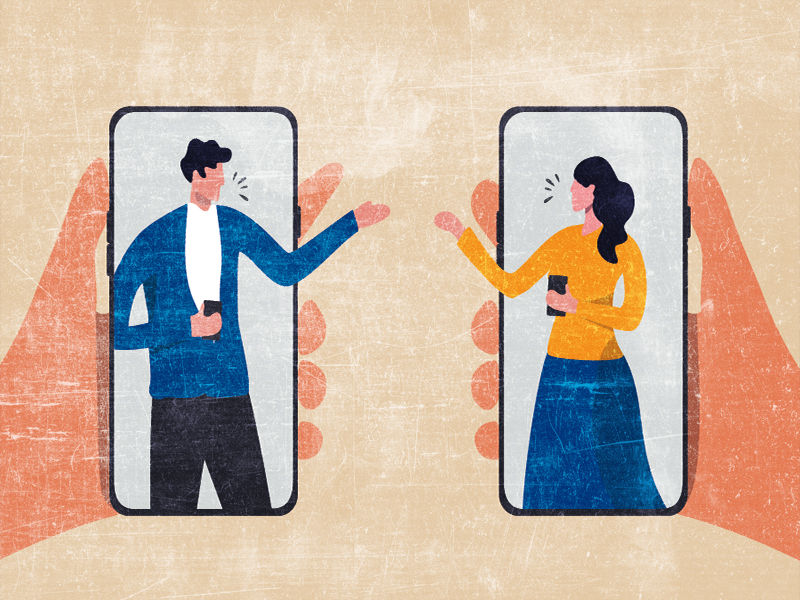
Clinicians have long understood the therapeutic relationship to be the most powerful meta-intervention supporting client change and transformation. As Carl Rogers observed, the prerequisite for therapeutic change is that the client and therapist be in psychological contact. But when a computer mediates between counselor and client, how much does that impair this contact and obstruct the potential for therapeutic movement? In a world increasingly reliant upon telehealth services, we are challenged to preserve the authenticity of meeting if we hope to effectively combat the challenges to real connection inherent in technology-mediated relationships. Luckily for us, philosopher Martin Buber dedicated his entire life to uncovering the invisible potential embedded in relationships, and much of what he discovered can help us to remedy some of these relational complications in the age of telehealth.

Like what you are reading? For more stimulating stories, thought-provoking articles and new video announcements, sign up for our monthly newsletter.

Martin Buber believed that we have the capacity to relate to each other in two distinct ways. When we actively and authentically engage each other in the here and now, Buber believed that we open up to ourselves and orient towards another as a “Thou,” which he characterized by mutuality, directness, presentness, intensity, and ineffability. He saw the I-Thou relationship as a bold leap into the experience of the other, while simultaneously being transparent, present and accessible to one’s own experience. I-Thou encounters in therapy occur when we are able to truly “show up” for our clients, which then affords them the possibility of embodying themselves. Martin Buber designated this meeting between I and Thou as the most important aspect of human experience. He viewed our capacity to confirm and be confirmed in our uniqueness by others as the source of growth and transformation that structures the foundation of our shared humanity.

However, to confirm another as a Thou is no simple task. We must be willing to embody the fullness of our own experience and release ourselves to the ambiguity of the moment if we are to open up the space for an I-Thou relationship. Instead, we tend to slip into seeing the person as an “It.” When we do this, the other person is experienced as an object to be influenced or used, or a means to an end. The world of I-It can be coherent and ordered, even efficient, but inevitably lacks the essential elements of human connection and wholeness that characterize the I-Thou encounter. When an extreme I-It attitude becomes embedded in cultural patterns and human interactions, the result is greater objectification of others, exploitation of persons and resources, and forms of prejudice that obscure the common humanity that unites us.

Buber emphasized the importance of holding a balance between these two necessary poles of existence. However, in the current age of telehealth, the computer itself fundamentally alters the medium through which an I-Thou meeting can emerge and tips the scale towards an I-It interaction. As technology pulls interactions toward I-It orientations, we increase the risk that our clients will miss the authentic growth and transformation that blossoms out of a real meeting between client and therapist. The process of trusting another person with one’s vulnerabilities and sharing a lived-in experience held and expressed through one’s body is much more dimensional than two talking heads communicating through a screen with words and ideas only. We must resist the danger inherent in telehealth, so the therapeutic encounter does not become abstracted, experience-distant, and limited to language spoken from the neck up.

I feel the gravitational pull towards I-It orientations when I find myself leaning into the comfort of familiar habits while facing a client on my computer screen. The presence of the technology tends to pull me into thinking about all the relevant interventions I could implement with my client in order to help them remove their suffering. This orientation is useful at times; however, it also encourages a lack of presence in the teletherapy session that bends attention away from the invisible elements of therapy that foster human connection and growth. Instead, therapy becomes centered on the visible elements of practicality that can distract client and therapist from the deeper therapeutic aim. However, I’ve noticed that I can counter this natural bending of attention by remaining centered in my body and trusting my intuition to guide me. Technology inherently obstructs the therapeutic relationship, but it does not destroy its potential. There still exists an invisible bond that can survive the medium of pixels, a power that can be actualized if we can trust our intuition to guide us towards opening up spaces for its potency. To do this, our presence must remain oriented towards the possibility of an I-Thou encounter.

However, I find that this new technology-centered therapeutic process can be much more draining than in-person therapy because of the extra effort needed to attend to elements that would otherwise be naturally apparent and expressed. The lack of ease in reciprocity in engagement is also dually draining for the therapist, as the usual “beats” of body-to-body communication are absent. I must remember to replenish myself with moments of deep connection and meaningful engagement outside of the therapy room if I am to sustain spaces for I-Thou encounters during the age of telehealth. Though the demand for therapists to pull clients into real participation requires us to hold an age-old responsibility in a new and complicated way, the taking up of that responsibility has the power to foster a type of healing that extends far beyond the therapy room. As Martin Buber once said, “In spite of all similarities, every living situation has, like a newborn child, a new face that has never been before and will never come again. It demands of you a reaction that cannot be prepared beforehand. It demands nothing of what is past. It demands presence, responsibility; it demands you.”

***
 

Part 2 will continue the conversation on how Martin Buber’s philosophy can help to remedy some of the relational complications in the age of telehealth, while expanding his concepts to include challenges from a client’s perspective, personal examples of my struggle to remain faithful to the I-Thou relationship, and the broader sociocultural implications of technology-mediated relationships.

Family Therapy in the Age of Zoom: What a Long Strange Trip It Has Been

If there is no plan, nothing can go wrong
Kim Ki -Taek — Parasite

It’s not the strongest of the species that survive, nor the most intelligent, but the one most responsive to change.
Charles Darwin

It’s recycling day, can’t we just put the kids outside on the curb?
Parent — Pandemic, week five

Dude!…You’re Glitching!
Fourteen year old girl on Zoom session

Long Strange Trip

The pandemic has changed the larger world forever and will forever change the world of therapy. Our therapeutic ecology — how we practice our craft, where and with whom — will never be the same. It’s as if we’ve clicked into a science fiction show and can’t change the channel because we’re in it — clients and therapists have become talking heads, connecting as best we can and collectively feeling the fatigue attrition that accompanies the absence of being in person. The Grateful Dead were right: it’s been a long strange trip, especially for the empaths.

Michael is a single man in his thirties. He’s suffered a lifetime of painful shyness and being overweight. His job requires computer skills, so he spends most of his time in his cubicle, with little socialization on the phone or with co-workers. He’s described breaks and lunch as “torture.” Prior to lunch, he would get revved up with good intentions and then, he said, “I’m like Wile E. Coyote chasing the Roadrunner — I hit the wall.” One time, he got the gumption to attend a meet-up group for shy people, and no one showed. Yet, despite these challenges, he’s determined to be more social. Then, something happened. At our last Zoom therapy meeting, he was more confident and relaxed, like he’d just put on old slippers — smiling and even cracking jokes. For me, it was a kind of optimistic disorientation. At first, I thought that it was the combination of medication, his Wile E. Coyote resolve and hopefully some of the therapy that, like the British Baking Show, had produced a slice of Magic Pie. It wasn’t — it was the pandemic.

Because of “social distancing,” Michael paradoxically experienced being together with people while he was apart. Everyone now shared his life — now he could enter conversations with the knowledge that others also shared the taut, jangled wiring of his interior. It was as if he became an Italian apartment-dweller sheltering in place with his neighbors and singing together with them off their shared community of balconies, everyone listening with hearts joined in the absence of judgement and the voices of hope. Better still, because of the imposed distancing, Michael could now be safely social.

The Zoom Era

And what about therapists — what is this doing to us? Many are working from home. Those of us with children, pets or partners and who don’t have a home office have to find a “quiet space.” Ha! Good luck with that basement, people! Or, if we’re lucky and the landlord isn’t banning entry, we can go into our off-site office space — but that, too, has its own set of Zoomy consequences, not the least of which is “Zoom Fatigue.” By day’s end, sessions can feel like you’re in the front row at a lecture on sofa cushions where the speaker can see you. Just as you start to blissfully nod off, your head suddenly jerks back, and you snort loudly and say something weakly therapeutic like, “really..?” and then wipe the drool onto your sleeve — très embarrassing.

Zooming our client’s home space is not without merit. Back in the day when I was a probation officer in Cabin Creek, West Virginia, and then a social worker doing school evals, and then a research therapist on a project with heroin addicts and their families, I was blessed with being both witness and participant in the amazing diversity of the human condition. You learned to go with the flow and, you swam in the deep end of the family pool — dogs, cats, kids, babies, ferrets, frogs, multiple TV’s, radios blaring, grandparents, people who just showed up whom you didn’t know, dinner on the stove, or a silence that also spoke to you — all this before the age of the Internet. It was so powerful that when I first started my private practice, I would ask families to invite me to dinner and a family session at their home. “Now, we have Zoom — welcome to the shallow end. But we can all still learn to swim.”

You can observe a lot by watching.
Yogi Berra
Peter Lopez, a family therapist on the board of The Minuchin Center for the Family, is a home-based family therapist. On one of his Zoom visits, he wanted to speak to both parents and have an enactment with them that would increase the parent’s executive capacity and demonstrate to themselves and their kids that Mom and Dad were on the same page. In a moment of inspiration spurred by there not being enough headphones for everyone, he asked the parents to “move closer together so you can share…”

Another family therapist, a young woman who works with a diverse population of low-income families and mandated, substance-abusing high-risk teenagers, finds that being “in & not in” someone’s house can diminish her connection and, in some cases, embolden teens to challenge her — like the fifteen year old teenager who greeted her on FaceTime lying in his bed with his shirt off. “Would you do that in my office?!,” she asked, incredulous. “Uh, no, but I’m not in your office….” “Well, when we meet on Facetime, you are in my office!” And then, softer — “So when you put your shirt on we can start, and you can tell me how you’re doing.”

She still delineates the boundaries — for the kids she sees, her office is their safe space. To compensate for the in-person absence, she’s upped the amount of between-session “homework” that she and her clients then share at the next session. Trauma and disconnect are prevalent. A young girl being raised by her grandmother whose mother is absent provided a path in between sessions. Together they came up with an assignment to come to sessions with a weekly playlist of songs that emotionally spoke to the client. The girl picked “How Could You Leave Us?” by NF, which should come with a warning label and tissues — it’s remarkable.
We have to be inter-connected with everyone and everything.
Thich Nhat Hanh

You cannot solve a problem from the same level of consciousness that created it.
Albert Einstein

An informal survey asking therapists to describe their experience of practicing Zoom therapy in the pandemic seems to break into two distinct groups: one, maintaining a kind of Buddhist perspective of acceptance –— that life is suffering and impermanence in which every day is an opportunity to practice mindfully — to another, a bit less accepting — “I fucking hate it!”

A Third Way?

Which begs the question — is there a third way? The short answer is “Yes.” And it’s not without precedent. Einstein’s quote is like learning a brilliant escape trick from a gifted magician. The magic is not what is seen or said but in what he doesn’t say. What he omits is the specificity of consciousness — it does not have to be higher or lower, just different. And we therapists are all about being different. To be effective, we access different aspects of ourselves that then activate different and more adaptive aspects of our clients. It’s what Minuchin described as the “differential use of self.” If we want others to be different, then we have to be different. For systems thinking and for family therapy, in particular, those differences in thinking were already in the works well before the pandemic.

Lynn Hoffman pointed out in Foundations of Family Therapy (1981) that “the advent of the one-way screen, which clinicians and researchers have used since the 1950s to observe live family interviews, was analogous to the discovery of the telescope. Seeing differently made it possible to think differently.” And by circular extension, thinking differently also comes from acting differently.

Up until now, we’ve relied on our in-session felt experience, one-way mirrors and videotaping to guide ourselves as instruments of change. One recursive emotional and visual distinction between the now and the then of the one-way mirror’s transformative introduction, is that families could not see the people behind the glass, nor could the people behind the glass see themselves being seen. Videotaping sessions, however, offered a “third” answer, giving therapists the capacity of “seeing” themselves and the family’s patterns in context. It shined a light on how to experiment with adapting interventions systemically and collaboratively. While inventing Structural Family Therapy, for example, Minuchin, Jay Haley and Braulio Montalvo invited family members behind the mirror. They recognized cultural and class differences between themselves and the “natural healers” from the minority community that they were training to be therapists. Minuchin realized that “in order to join, we needed to change.”

“With Zoom however, there is a binding irony that holds therapists and clients in its’ grasp. It is as if we share front row seats watching a mystery play”. The opening scene’s roiling dense fog and dim lights mask the fullness of detail, so we squint, holding our breath hoping to see what’s really there. We’re doing our parasympathetic best to figure out the plot. It’s the work of it that fatigues us and leaves us wondering if this is as good as it gets.

Therapy is therapy as therapy does, but how we use ourselves in this new environment re-boots an age-old clinical question; what exactly is both necessary and sufficient to produce change? Montalvo called the position from which we work “The possibilistic premise.” Meaning that regardless of the location of the family’s pain, we are still faced with respectfully challenging the system’s homeostatic “stuckness.” We know that we can effect those changes in person. When Zooming, however, it can sometimes feel as if we’re “Major Tom,” floating in space, attempting to weld the hull as we circle the earth.

So, as Bowlby, Susan Johnson, the Gottmans and our own families have shown us, the quality and kind of our earthly and relational attachments are important. While we may feel even more like Russian Dolls, breathlessly stacked within each other’s context and the context of the world writ large, it’s not a question of “if” we adapt and attach in different ways, it’s more a matter of “How?” Perhaps as Theodore Reik suggested, we should listen with greater clarity, not just with a “Third Ear,” but now with ear buds. We are finding ways to compensate for what’s lost with diminished sight and the absence of physical presence. Our adaptive make-up is yielding results. However because we are inherently empaths, we feel the absence of presence. But we shouldn’t feel bad entirely. Rumi’s poem, “Love Dogs,” reminds that “the howling necessity” implores us to “cry out in your weakness,” such that “the grief you cry out from, draws you toward union.”
It’s the end of the world as we know it, and I feel fine.
R.E.M.

Postscript from the Bunker

After not seeing our granddaughters at our house for eleven weeks, my wife and I share a grandparental Folie à Deux — an ache like an old injury that we’d come to accept, now reawakened with every primitively crayoned coloring book that hung on our walls like an in-home Children’s Louvre. As grandparents of a certain age, now when my wife and I see all their stuffed animals in a pile, we silently share the Buddhist themes of impermanence and suffering. It feels like a Christmas Story staging of Toy Story — our precious time together is ghosted in front of us as a reminder to our mortal selves that “this is it.” This perfect time of their lives, full of wonder and imagination, is just another pandemic curtain closing on the “Duck Duck Goose” show. Now our own mortality is awaiting, as quiet mourners do when “joining” family and friends on a Zoom funeral.
Alone together.
Dave Mason

Then there’s this — amidst all the noise, people find themselves and others. I see a recovering alcoholic/substance abuser in his thirties. He’s been in recovery for seven years. He has a great sponsor and a solid home group. As the pandemic continued, he began to miss the in-person connection with his group and his sponsor. So last week, with the intent of doing “Step work,” he and his sponsor sat safely apart on his sponsor’s back porch. As night began to fall, he said that without any cues, they both simultaneously became silent and quietly surveyed the backyard as darkness fell. He said it was one of the best conversations that he’d ever had.

Like the scene from Little Miss Sunshine, when on their way to the “Little Miss Sunshine” contest, Dwayne flips out after finding out that his color blindness has just destroyed his dream of joining the Air Force, getting away from the “fucking losers” that constitute his family and having a life of his own. He’s profanely inconsolable. His mother says, “I don’t know what to do!” Then his stepfather says to Olive, “Olive, do you want to try talking to him?” Without a word or hesitation, Olive gingerly makes her way down the embankment, ignoring the dust scuffing up her red cowboy boots, and squats down next to her big brother. She puts her arm around Dwayne, leaning her head onto his shoulder. She doesn’t say a word. They both sit together as one in the silence. Quietly, as if whispering a confession, Dwayne says, “O.K., I’ll go.” He then helps Olive up the hill and says to his family, “I apologize for the things that I said, I didn’t mean them.” They load in the van and continue on.

“Off in the distance is a billboard, the message faded but visible, “United We Stand.” We can hope”.

Barriers and the Black Experience in Mental Health Care

Initially, I struggled with writing this piece. After a couple of weeks of writing, rewriting and tossing, I finally locked in on my block. The issue is this: it is nearly impossible to write a short blog piece about the black experience in mental health. This goes for both my perspective as a black physician and the perspective of the black patient. I worried about being reductionistic with an incredibly important and deeply layered topic.

Like what you are reading? For more stimulating stories, thought-provoking articles and new video announcements, sign up for our monthly newsletter.

There is no simple way to condense the experience of being black in any context. As I considered the different factors that influence the black experience in mental health care, I realized that the histories of discriminatory practices, unethical research, denial of care, racially biased diagnosis and treatment, and poor representation among mental health care providers each deserve volumes of exploration.

That being said, I know that discussing the foundation of racism and discrimination in mental health care is a start. This is the legacy upon which many black patients sit when they come to our offices each day. Three issues in particular have been substantial barriers to my own patients’ seeking care: lack of resources, distrust, and mental illness stigma.

Lack of resources

Jared, a 20-year-old black male, arrived at my office with his mom. Jared, who was living with his mom and younger sister, was unemployed and spent most of his time in his room. They had traveled nearly an hour to see me, as there were limited mental health resources in their community. Jared wanted to see a black psychiatrist but struggled to find any in his city.

Low-income communities and communities of color typically have the fewest mental health resources. To find care, residents often travel far outside of their communities, creating an unnecessary burden. For those with limited finances, arranging transportation, time off from work, and childcare can make access difficult.

When resources aren’t available, information and education aren’t brought into these communities. Mental health practices and clinics not only provide clinical services, but often are the center of knowledge about mental illness and support for those dealing with these conditions. When those resources are absent, members of a local community may not understand their conditions or their options for care and support.

Also absent from the black community are black mental health professionals with a similar lived experience and background. Many black individuals are interested in working with a black therapist or psychiatrist. However, only 4% of psychologists and less than 4% of psychiatrists are black. Non-black mental healthcare providers are less likely to provide racially sensitive and culturally competent care. Black providers are more likely to understand how blackness has impacted the black mental healthcare experience. There’s no need to explore the racial differences between the provider and patient. The focus can be on the reason the individual is seeking care. More importantly, black providers are more likely to understand and be sensitive to the problems black clients experience accessing mental health services.

For some patients and clients, there is a sense of pride in seeing one’s own people successfully navigate the training and career pathway involved in becoming a therapist or psychiatrist. Many black patients feel strongly connected to the success and accomplishments of other members of the black community.

Distrust

Dustin, a 24-year-old black male, had recently moved to Austin. He had dealt with anxiety since childhood. Now living with his aunt, he struggled to go to work each day and rarely socialized. After a long discussion, we agreed to start a low dose SSRI. He missed his first follow-up appointment. He came to his next appointment only to disclose that he had not started his medication and didn’t believe that it would help.

The history of medicine in the United States is fraught with racially discriminatory practices against black people. From non-consensual sterilization to the syphilis experiments, black people have been dehumanized and harmed by unethical medical practices. On the flipside, more recent medical research often fails to include representative black populations and often underrepresents the impact of disease and treatment in the black community.

In mental health, studies have consistently shown bias in diagnosis in black patients. Black patients are more frequently diagnosed with schizophrenia rather than mood disorders when compared with white patients presenting with the same symptoms. Even when a correct diagnosis is made, black patients are less likely to receive evidence-based care than their white counterparts.

These deeply embedded practices and history have cultivated a mistrust, and at times a fear of health care and mental health care institutions in the black community. There is legitimacy in the black community’s concern about misdiagnosis and inappropriate care. Unfortunately, some have chosen not to seek care when needed.

Mental Health Stigma

Erica, a mid-30’s black woman, presented with depression for most of the past year. Raised by two loving parents, she had attended graduate school after college and now worked as an assistant professor at a local university. She had never sought professional help for her mood symptoms, but worried that they were interfering with her work and home life.

Stigma surrounding mental illness is pervasive in the black community. When Erica opened up to her mother about her mood concerns, her mother advised her to talk to her pastor. She discouraged her from seeking professional help worried that people might think she was “crazy.”

Mental health stigma and misinformation has created a reluctance for many in the black community. Holding shame around mental illness means that individuals are less likely to seek appropriate care. When they do look for help, black individuals are more likely to seek counsel from places of worship or family and friends. Unfortunately, their help-seeking often stops there.

Culturally sensitive care recognizes these issues and makes space within the therapeutic relationship for these issues to be acknowledged honestly to the degree that each individual needs.

***

Consider all the spoken and unspoken concerns that accompany your clients or patients into your office. The basics of accessing care, trusting the intentions and guidance of care providers, and trusting the legitimacy of their own health concerns complicate the black experience in mental health care. Psychiatrists and therapists should examine their own beliefs about and around issues of race. Understand what influences your practice and informs how you bring cultural sensitivity into your patient or client interactions.
 

Countertransference: How Are We Doing?

The subject of countertransference, or the sum total of our conscious and unconscious emotional responses to our clients, has fascinated me since I first learned about it in graduate school. Our instructors repeatedly emphasized the importance of self-care, but their focus was more on burnout and compassion fatigue than active engagement with our countertransference.

Most clinicians have some way that they unwind after a day of intense sessions. Perhaps they get some exercise, read a book, binge watch their favorite show, or spend time with loved ones. All these activities feel good, help us to rest and stay connected to our sense of peace or calm, and keep us stable enough to continue to do the hard work of being a therapist. For many practitioners, this will be enough to sustain them for many years in the field.

But how do we therapists continually manage our own emotional responses to the myriad of clients and stories we hear day in and day out? Should we have better systems in place specifically for the management of countertransference? “Traditional self-care activities, which are usually focused on relaxing, reducing stress, and increasing our joy, may be inadequate in and of themselves for managing countertransference”.

That we would have emotional responses at all to our clients is natural. Human beings are social and relational animals, and when we work in such proximity to one another, dealing with such intensely personal subject matter, countertransference is inevitable. These responses in clinicians can be constructive when they are recognized and contextualized, but they can become obstacles to good treatment when they are ignored, devalued, or isolated in our psyches. Countertransference has valuable lessons to teach us if we pay attention. The question is… are we?

Unrecognized Countertransference

Unrecognized countertransference may not be just a barrier to doing great clinical work; perhaps it is the barrier. I should ask myself: Who am I attending to? When I do or say anything in session, For whose benefit is it? I have found that when I can quickly answer, “For the client,” I am generally on the right track. If that answer comes more slowly or with more hesitation, it usually cues me to look inward at my own feelings and motivations.

We have all had clients who trigger an emotional response in us. If I am working with someone who is intimidating to me, I may be more hesitant to challenge that person or hold professional boundaries when appropriate. If I am working with someone who is experiencing something similar to what I have gone through, I may suggest that they do what I did, or do the thing that I failed to do. This is one of the most classic examples of countertransference, wherein I attempt to resolve conflicts in myself via my work with the client. In another example, when I am more interested in a particular aspect of the client’s story, I will probably focus on it more, and when I am less interested, that experience will receive less focus. In all these instances, the direction I take is informed by my own feelings rather than the client’s needs.

To use a real example from my own practice, some months back I found myself feeling impatient with one client in particular and was frustrated that he was not applying the skills and concepts we were practicing in session. I had a very difficult time getting him to engage with nearly anything I thought was indicated. He would almost exclusively recount stories in which he was the hero. In his narratives, he always did the right thing, made the hard choice, and overcame the villains. I was aware of my impatience and frustration, but at the time I still attributed my feelings to his lack of engagement and insecurity. In other words, with all my education, training and experience, I was inwardly blaming the client for my emotional state. “I began to dread sessions with him” and engaged in avoidant behaviors while working with him. I fell into a pattern of offering tepid, half-hearted validation instead of addressing his avoidance and hesitation. My approach served more to make the sessions bearable to me by reducing my frustration, and less to help him reduce his chronic PTSD symptoms. He didn’t seem to be making progress, so what did that say about me? Sound familiar?

Is Self-Care Enough?

At around this time, I attended a workshop on trauma treatment. I asked the facilitator how he stayed calm and well-adjusted while doing so much trauma work. He responded that positive self-care was critical to this process; he did not elaborate further. He clearly knew something, because he has been doing trauma treatment for decades. He was a wonderful clinician and trainer and I suspect that at that moment, he just did not want to get sidetracked on that issue. But I found the response for my own training and understanding to be inadequate. You might be surprised to hear how many times I have received this response from the numerous professionals I have asked. As clinicians, I think we need to have a collective strategy for countertransference, and one that has an active dialogue around it.

There are many skilled clinicians who specialize in working with countertransference issues; the problem for me is that they are not getting much notice or airtime in the profession. When I have spoken about this issue with colleagues, I have encountered a wide range of responses. Usually, what I find is that they have a basic familiarity with the concept of countertransference but no actual working tools for recognizing, addressing, and resolving it. We teach our clients that we are emotional beings, and that we are experiencing some level of affective response throughout the day. Is it possible that countertransference is taking place with our clients all or much of the time, whether we notice it or not? The critical aspect of this is how and when we begin to notice that it is occurring.

In Ernest Hemingway’s novel The Sun Also Rises, the character Mike Campbell is asked, “How did you go bankrupt?"

“Two ways,” he replies. “Gradually, and then suddenly.”

So, “it is in that way countertransference starts to impair our clinical work: gradually, and then suddenly”. Like any problem, it is always best to catch it early, when it is a small and manageable issue.

The Solution Must Be Social

Experienced clinicians can teach and model that self-care is not the miracle cure that will resolve countertransference. Taking a bath or watching Netflix will not resolve countertransference, because these activities do not address some of the underlying mechanisms through which it takes place. Stress and fatigue are important factors, but they are not always the principal engines that drive our experience of countertransference. It arises from a very complex set of interpersonal and neurobiological factors. As such, simply relaxing more often or more effectively is not always an appropriate solution by itself. A close friend and colleague of mine once said to me that “social problems require social solutions.” Much of my self-care is not sufficiently social in nature; being in such a social job, my reset button often involves solitary pursuits like playing music, writing, and woodworking — all things that I do by myself. Perhaps a social phenomenon like countertransference can only be resolved in a social situation. We need other people to help us get through it.

Given the appropriate limitations of confidentiality in our profession, this leaves the earnest clinician with a few viable options. Much has been written about the benefits of social relationships, personal therapy, supervision, and consultation, and I agree with many of these points. All of these provide a social experience to solve a social problem. There are, however, some limitations to regular socializing, supervision, and therapy for resolving countertransference.

Social Relationships

Our social relationships with friends and family should provide us with outlets to find support, reduce our stress, and feel a sense of community. Sometimes our friends and family are not as equipped to hold the enormity of what we might have to share. Therapists tend to develop a fairly thick skin for hearing about truly awful human experiences. It is not that we are numb to them, it is probably more the case that experience in the profession has allowed us to develop the proper cognitive and emotional mechanisms to deal with them on a daily basis — just as the trauma surgeon is not probably too distressed by what she sees on a regular day, but her neighbor might not be able to handle the details of what her job requires her to see and experience. This leaves us with the option to share some feelings, perhaps, but not the intimate aspects of our experience with our friends and families.

Supervision

A supervisory relationship offers support, is social in nature, and is often accepted as the place for clinicians to deal with countertransference. Numerous therapists receive effective support and leadership from very capable and experienced supervisors. For everyone to work through countertransference in this way presumes every therapist’s having access to a very competent supervisor. For my colleagues who place their trust in statistics, an analysis of any bell curve should suggest that supervisor competency follows the same statistical rules as nearly anything else in the natural world. There will be exceptional supervisors who can hold and handle anything, and there will be supervisors who are not equipped for the challenge of addressing therapist countertransference effectively. In many situations, the supervisee often does not feel free to authentically share an experience of countertransference, and for good reason: it could easily be perceived as a limitation, and therefore hinder advancement opportunities. It can result in very real consequences.

Imagine a supervisee reporting experiencing a romantic attraction to the client. The supervisee finds her or himself trying to impress the client, or to be seen as funny. He or she notices that being liked has suddenly become a distraction and wants to work through this. In clinical work, scenarios like these happen from time to time. In the best-case scenario, the supervisor would help the supervisee address this countertransference, work through it, and hopefully resolve it. It is possible that they would agree that referring the client out to another therapist is necessary; it is also possible that they would not come to this conclusion, if the supervisee can effectively work through their emotional responses to the client. But what if the supervisor is incredibly stressed out because his agency is currently being sued for malpractice? What if the supervisor is dealing with the same issue with one of her clients? What if her name is on the building? A supervisor, by definition, is in a position of power which is greater relative to that of the supervisee. It is not hard to imagine scenarios where a supervisee could be negatively affected by sincerely trying to seek out help in resolving countertransference, which is an ethical thing to do.

There is a time in most clinicians’ development where supervision often sounds like, “Have you tried this intervention? Have you tried that technique?” As clinicians progress in their skill development, if and when they get stuck, supervisors can assume that they have tried their usual go-to stock of interventions and tools. While training therapists in new techniques and interventions has a large role to play, they may also search for emotional barriers in their supervisees to carrying out good clinical work. The Discrimination Model of supervision in particular allows that sometimes, the supervisor will act as your counselor in the process. As stated above, many experienced and skilled supervisors can expertly help their supervisees navigate countertransference issues. The problem is that supervisees will not know who can and cannot do this until they have truly put ourselves out there. “Revealing our struggles with countertransference can be a deeply vulnerable experience”. It must be held in a safe and supportive environment. While supervision is enormously helpful, it has limitations for addressing countertransference. I write this as a supervisor myself, and someone who has had some truly phenomenal supervisors.

Personal Therapy

Doing our own personal therapy will certainly help us recognize our patterns of relating and certain triggers that may set us off. It is invaluable for our overall health and well-being. It seems fair to say that anything I do in my own personal therapy is about me, and therefore when I bring things from that personal therapy into my working sessions with clients, I will at least sometimes be dealing with my own issues. This is not black and white; some countertransference is diagnostic in the sense that I may infer that if I feel a certain way around the client, then others likely feel the same. From there, I can make educated guesses about the client’s social world and ways of relating. I may gather additional psychosocial information based on this. And then there is the kind of countertransference that has little or nothing to do with the client but is based on my own history and experiences. In short, just because I am frustrated in session with a client does not mean that everyone gets frustrated when interacting with this person. It is critical that we are able to separate these two ideas.

A psychologist whom I greatly admire once told me that he works through countertransference in his own personal therapy. While I do not begrudge him that preference and have done so myself, there is potential for us to muddy the personal and professional waters there. I may end up setting goals in my own personal therapy, such as being more assertive or holding better boundaries, and I may then bring those ideas into the professional session with my clients. These are fine things to work on and have obvious application in therapy. But there will be times when those pursuits have absolutely nothing to do with my clients. I will refer to earlier questions I asked in this article: Who am I attending to? For whose benefit is this? In my previous example about the client who only wanted to tell stories that bolstered his sense of personal power, suppose my well-meaning therapist encourages me to name this behavior and challenge it, even if gently. Perhaps I will return and in the next session challenge the client on his avoidance. In response, he stops showing up to sessions with me. On one hand, I overcame my own hesitance and mustered the courage to challenge him. On the other hand, a traumatized client who was in therapy is now not in therapy. Have I, in a stroke of clinical genius, revealed the client’s lack of readiness for treatment? Is it possible that if I were simply more patient, this client would come around in time, even absent any challenge or confrontation from me?

Consultation

Consultation, in my opinion, holds more promise than supervision or personal therapy for addressing countertransference, for several reasons. These groups can be set up so there are not marked power differentials. Given the reduction in power dynamics in a consultation group, it follows that each attendee incurs less risk by sharing authentically. In addition, the group’s diversity of experience, perspectives and opinions can offer any therapist increased response flexibility for countertransference when compared with the judgement of almost any lone supervisor or therapist. A consultation group of peers can be more objective, explorative, and therefore helpful, given that they also do not incur any personal risk based on what they hear. I should note the exception, of course, is when unethical or negligent behaviors are revealed in a consultation group. Then the members of that group will need to decide if they should report that behavior to their state licensing board, just as a supervisor or therapist might.

Returning to the example discussed earlier, simply experiencing a romantic attraction to a client is not in and of itself unethical. Whereas a lone supervisor with a large personal stake in the clinician’s performance may have a disproportionate reaction to that, a consultation group made up of peers is less likely to have the same response. They are more likely to consider the times they may have experienced this and what might have been helpful to them at the time. “The consultation group format also provides a social solution to the social problem”.

As part of this exploration, some colleagues of mine formed a consultation group that was focused on countertransference. I have found it enormously helpful to share my own internal conflicts in the profession with a group of trusted professionals. They help to normalize and contextualize my experience, while showing me where my blind spots are and where there is room for growth and development. Because these clinicians are not signing my paychecks, I feel a certain freedom to share openly. And in doing so, I have found that countertransference really can be addressed, processed, and resolved.

Regarding the client I was working with, the consultation group helped me to recognize that my impatience had more to do with my own desire to be competent and achieve some specific result. I needed to solve the client’s problem to end my frustration and thereby feel effective. How much more cliché could I get? My peers helped me to see that this client has lacked safety most of his life. As a result, he has crafted an internal narrative where he occupies a position of power and influence. I can reduce my frustration outside of session and work to increase my sense of competence on my own time. I now have more confidence that I can thread the needle by being patient and allowing him to establish safety and comfort with me, while also moving in the direction of gently prompting him to engage more with working to reduce his symptoms. My personal feelings are not all tied up in this client’s progress now. I was lucky to have a community of knowledgeable and supportive clinicians with whom I could consult. These friends and colleagues were able to create a helpful container in which I could safely discuss this issue and ultimately resolve it.

Flexibility is Key

Examining our own countertransference regularly and often is an important part of being an effective clinician.

I wholeheartedly believe that self-care is a critical aspect in maintaining one’s own wellness and longevity in the profession. We all encourage our clients to reduce their stress and to engage in hobbies and activities that bring them peace or joy, and we should absolutely walk the talk. When we are calm, healthy, and centered, we can do our very best work. As countertransference is a social and relational issue, the more solitary pursuits involved in self-care may not be of much help in recognizing and resolving it. This was true in my case.

“Friends and family can be an outlet for support, although we may feel limited in what we can share” by their lack of familiarity with the profession’s norms and difficulties. Capable and experienced supervisors can provide a wonderful space for working on countertransference. But there is usually a power differential, and with natural variability in supervisor’s competence, these factors can become limits. For those of us who examine countertransference in our personal therapy sessions, I hope we can recognize our patterns and responses, and apply those lessons to our work somewhat dispassionately. Otherwise we run the risk of inadvertently playing out our own therapeutic goals with our clients and will continue to experience unresolved countertransference. Consultation would seem to offer positive support in addressing countertransference, both in the variety of opinions that can be expressed and the potential for reducing or removing power differentials among the participants. I would recommend doing all the above. The important thing is that we keep looking at our countertransference and keep paying attention to what it is telling us.
 

Bret Moore on Military Psychology and Getting the Mission Done*

Challenges During the Pandemic

Lawrence Rubin: Good afternoon, Dr. Moore, and thank you for sharing your time with us today. Much has obviously changed in the world since the time we scheduled this interview. My understanding of the role of the military psychologist is that they serve the mental health needs of veterans and active personnel. What clinical challenges have you noticed in light of the COVID crisis?
Bret Moore: We often think about service members deploying and helping overseas, fighting wars and those kinds of things. But they actually have quite a strong mission stateside as well. So, in episodes like the COVID-19 pandemic, many military members are tasked to help support local response efforts in states like New York and California that have been been hit the hardest. You have probably seen the news where certain units have been activated to support those efforts — whether it be quarantine or getting supplies to individuals that are sometimes done by National Guard service members or active duty service members.

In the case of the COVID-19 crisis, one of the challenges to military clinicians is having to shift our practice to telehealth
In the case of the COVID-19 crisis, one of the challenges to military clinicians is having to shift our practice to telehealth, just like civilian practitioners are having to do. Obviously you have to be concerned about privacy and not violating HIPAA, and other related issues like what if the video's not working. Can you do the session over the phone, and how much good can you do without seeing each other and having that visual interaction, those visual cues? So, again, not so much unique to military psychologists, but it's something that we're struggling with. You did mention at the beginning that military psychologists provide mental health care to military members. But that is really only one small part.

We also provide consultation to commanders about morale and unit cohesion. In a way we also function as consultants and industrial organizational psychologists. We not only focus on individual wellness; we focus on unit wellness. We focus on organizational functioning. That's what I really like about military psychology. It is a very diverse field, and it is very difficult to get bored being a military psychologist. 
LR: Telehealth is a transition that military and non-military clinicians are making right now, feverishly trying to catch up, get up to speed, so to speak. Do you think that providing telehealth to military personnel, either active or veterans, is a different challenge at this point to military clinicians than it might be to non-military clinicians?
BM: I think the transition to telehealth may be a little bit easier from the standpoint that the VA has been doing telehealth for over a decade. All branches of the military — but primarily the army seems to have had the most sophisticated behavioral telehealth infrastructure for at least a decade, so we are somewhat used to it. Even clinicians within the VA and military systems who don't provide telehealth on an ongoing basis are certainly familiar with certain aspects of telehealth. So, providing telehealth during this crisis is not a shock. It's not a huge amount of adjustment for clinicians within those systems as it is to some of my friends and colleagues who were practicing outside of the federal military system and who are asking questions like, “What system do I use?” “Is it secure?” “How do I get paid?” “How do I bill insurance companies?” The nice thing about the VA and the DOD is that they are really somewhat of a socialized healthcare system. We're not billing insurance companies per se, so clinicians aren't really having to struggle as much with answering those kinds of questions that our civilian counterparts are.
LR: Is telehealth something that a military clinician might use for someone who is deployed, if that clinician is not deployed with them?
BM:
Telehealth has been provided in places like Afghanistan and Iraq, and we have telehealth services that are being provided currently to Germany. Wherever there's a connection
Telehealth has been provided in places like Afghanistan and Iraq, and we have telehealth services that are being provided currently to Germany. Wherever there's a connection, theoretically you could provide services. I think the VA has done very nicely, and I do believe that the Department of Defense is going to be coming online with providing care from federal hospitals, VA clinics, or Department of Defense clinics to patient's homes. Now the VA has been doing that for quite some time and I think we are going to be moving toward in the future. It's important for the VA mostly because so many veterans live in remote areas. When I worked in North Dakota for two years and when I needed to go see and check in, have a physical with my doc at the VA, I literally had to drive four or five hours. So, it is important to be able to provide these services in the home, and hopefully the Department of Defense will come online with that at some point.
LR: What advice might you offer civilian clinicians in our audience about what may be gained after this pandemic passes as opposed to what will be lost?
BM: Well, that's a tough question. It is an excellent question, but it is a tough one because that is something I have been thinking about over the past several weeks. What I hope to see is a deepening of relationships, maybe — certainly within the immediate family. We're spending all this time together and you see memes and jokes like, “We're going to end up killing each other because we're spending all this time together.” I think the opposite is probably more likely, in that people are starting to reconnect and rekindle some of the things that brought them together in the first place. And dads are learning more about their daughters, and mothers are learning more about their sons.

Hopefully, we are developing deeper bonds. But what I really hope is that we develop some compassion and connection with people we have never even met, with larger society in general. We watch the news and we see everything that's going on and it's hard not to feel some kind of connection to the people who are suffering the most right now. So, I am hoping we gain a sense of greater compassion. And I just really wish that we would stop fighting each other. And I wish our politicians would set a good example by showing how we can all play together nicely and respect each other and get along with each other.
But I do hope that we see a deeper connection between individuals once this is all over
But I do hope that we see a deeper connection between individuals once this is all over. 

Trained to Solve Problems

LR: If we want to call the battle against the pandemic a war, would you say that from the standpoint of a military psychologist, service men and women are uniquely prepared to address some of the mental health challenges that crises such as this one create? 
BM: Oftentimes I am asked if there is a certain type of person who joins the military. And the short answer is no. I mean there are a lot of shared characteristics, but there is a lot of individual variability. There is a strong sense of public service and patriotism that you see obviously within the military population. And those individuals who join tend to have people within their immediate family that have served in the military. So, there is a sense of something that is passed down from generation to generation. I will also say, to generalize, I think individuals who join the military already tend to be fairly resilient individuals. And I think that the hard work and training they do in boot camp strengthens their resilience, whether or not they are eventually deployed.

You're probably aware of some of the research that Martin Seligman has done with comprehensive soldier fitness, and how the military has made a strong effort to strengthen the cognitive reserve, cognitive strength and emotional, psychological, physical and spiritual strength of service members. I am not going to speak for that particular program, but I think in general,
our men and women in uniform are some of the toughest individuals you'll ever find. and probably are more equipped to deal with the anxiety and stress that comes with something like the pandemic we are dealing with now
our men and women in uniform are some of the toughest individuals you'll ever find. and probably are more equipped to deal with the anxiety and stress that comes with something like the pandemic we are dealing with now.
LR: Would you anticipate that the levels of anxiety, depression and fear that have been reported in the civilian population might be lower in the military because of their preparation, resilience and the skills that they bring to service?
BM: I would think so. Even though we're not in necessarily active conflict right now, many service members have done deployments, and in some cases, multiple deployments in some of the most stressful environments that you can imagine, where every day is filled with new anxieties and new tensions and new fears. So, yes, just based on that, I think from a larger standpoint or from a broader standpoint, these individuals would be better equipped to deal with the anxiety and tensions that we see today. Absolutely.
LR: Do you think that this preparation and hardened resilience might make it difficult for some military personnel to address the potential lethality of the pandemic? Might they downplay it or minimize the risk because they are accustomed to being ready and prepared for war and death?
BM: No, I don't think so. I think it is more of understanding what the challenges are, because military members and veterans are trained to be problem solvers. You identify the problem and you come up with several solutions. You pick the best solutions, implement them, and then if that doesn't work, you implement something else. So, it is really a calculated approach to things. But no, I don't think that they would under-appreciate the significance and the risks that are associated with something like this. If anything else, I think they may appreciate it more.
LR: So, although not prepared to handle pandemics per se, you're saying that military members, by virtue of their training, by virtue of the resilience and problem solving skills are uniquely prepared to help each other and civilians to address the challenges of the virus.
BM: Yes, absolutely.

The Caretaker’s Perspective

LR: During this crisis, what concerns do you have for the mental health of military clinicians?
BM: There's been a few studies out there looking at provider burnout, compassion fatigue, vicarious trauma.
In general, the stress for clinicians comes with managing their large caseloads, which are made up of trauma
In general, the stress for clinicians comes with managing their large caseloads, which are made up of trauma. A third or a half of their cases are post-traumatic stress. I think it's not so much which area you practice in. I think it's the kind of disorders and presentations that you see, just like a social worker who treats child sexual abuse cases nonstop. If you have clinicians that are constantly treating post-traumatic stress disorder, combat-related trauma, military sexual trauma, whatever the case may be, I think that's going to take a toll more so than someone who's treating adjustment disorders, or even depression or panic disorder. So, I don't think it is any different, but I think it is something that is shared across the profession. So, you know, working with trauma survivors can be very challenging, and I think we probably have a similar rate of burnout and compassion fatigue that you would see across the system.
LR: You had mentioned earlier that by virtue of their training and resilience, service men and women are perhaps better suited than the average person for dealing with crises like this one. Do military clinicians bring a unique blend of characteristics into their role during times like these?
BM: You have military psychologists who, like me, were in active duty for five years. I did two and a half years in Iraq providing services to service members. And then I transitioned back to the civilian world as a civilian psychologist for the Department of the Army. So, my experience is going to be a little bit different than someone that comes out of internship from a university and has never worked with this population, and steps into an internship working with combat veterans. You know, I think over time there is a strength that these clinicians build if they stay within the system long enough.

I do think that those who choose to enter the VA to work as psychologists or the Department of Defense oftentimes have a strong sense of public service and a strong sense of patriotism. One of the webinars I provide is on military mental health and how to treat PTSD and related conditions. I get a lot of clinicians saying that they like working with veterans because “my dad was a veteran.” “My uncle was a veteran.” “I used to sit on my grandfather's lap, and he would tell me stories about what it was like serving in World War II.” So they come with their own experiences, even though they may not be direct experiences. 
LR: When you made that transition from a combat to non-combat military psychologist, did you notice any changes in the way you practiced, or what you brought from the combat sphere into the non-combat sphere?
BM:
I trained as an Adlerian, which involves insight-oriented work and a focus on the past; but I had to shift. You do not get to spend six months doing in-depth insight-oriented work with veterans.
I trained as an Adlerian, which involves insight-oriented work and a focus on the past; but I had to shift. You do not get to spend six months doing in-depth insight-oriented work with veterans. A lot of times, at least with active duty military personnel, you may get four to six sessions. So, I had to shift my approach and, when needed, to be solution-focused. I had to work collaboratively with the service member and identify what it is that we needed to correct, to “fix,” so that they could continue to do their job.

My job as an active duty army psychologist was to care for the wellbeing and emotional health of the personnel, but it was also to make sure they could continue in the fight. You know, a soldier's job is to fight, to win wars. So, if they are not psychologically and emotionally healthy, they cannot do their job. So, not only do I have to take care of them emotionally and psychologically and help them, but also, I have to get them to return to the mission so they can finish what they started. And sometimes people who don't understand the military all that well have a deep conflict with that because they ask, “How can I as a psychologist try to patch people back up just to send them back out to fight?” Well, what is the alternative? Just send them back out to fight and not patch them up? They're soldiers. They're going to have to go to war. So, I need to be able to do whatever I can to make sure they can do their job to the best of their ability. 
LR: If you thought a particular combatant was not fit to continue, did you have the flexibility to send them back stateside, or was there a mandate to patch him up, get them back? In other words, was the threshold lowered because the mission was the mission, and your role was to get him back into the battle?
BM: No, I didn't experience the pressure at any point in my active duty days. The psychologist, the mental health professional in general, has a lot of power, a lot of control and influence over what happens with service members who may be struggling and are not mission-ready. Ultimately, it is usually the commander's call to decide whether to send a soldier away from the fight, maybe back to the States so they can recover. But in general, a commander,
a good commander will listen to his docs and say, “okay, if my doc is telling me that sergeant so-and-so is not fit, I am not going to put him back out there
a good commander will listen to his docs and say, “okay, if my doc is telling me that sergeant so-and-so is not fit, I am not going to put him back out there. Because not only does that put him at risk, it is going to put the rest of my unit at risk.” So, yeah.
LR: Did you ever feel caught between that conflicting obligation toward the military to continue the mission versus the person who might not be ready to get back in the fight?
BM: Near daily. Over two and a half years of being deployed, probably most every day I wrestled with that to varying degrees. Brad Johnson and Jeff Barnett have written a lot of great stuff about that. There is always that push and pull, and you have to find a balance, and you can't be overly rigid. This is not a black and white game. You have to think in various shades of gray and you also don't want to work in a vacuum. So, that's why if, when I was an active duty army psychologist, I got on my high horse and said, “all right, I'm just sending this person home, this person home, and that person home, I don't care what you think,” I wouldn't have lasted very long. There had to be some trust that developed through consultation and education, which oftentimes was an important part of my job, was to educate commanders about the impact of mental illness and mental health conditions on functioning. With that proper education, I was able to resolve most all conflicts in a rapidly short period of time.
LR: So, that moral conflict servicemen and women experience can also be experienced by the military clinician who struggles with the morality of where to send them in or send them back.
BM: Absolutely. I trained as a psychologist. I wanted to help people. If it would have been up to me, we would not have been there in the first place. But it was not up to me, and if it were up to me, I would send everybody home. But I knew I couldn't do that. That is not my job, not my responsibility. So, yeah, it was a challenge.

Military Clinical Competencies

LR: I would like to drop back to some of the core questions I had initially prepared because many of our readers will not have experienced military psychology. I recently did an interview about multicultural competence, and since the military is its own culture, I'm wondering if there might be core clinical competencies that a military clinician must have or develop in the course of their training and service?
BM: The core clinical competencies include being a generalist. The military and the VA definitely have specialists, including neuropsychologists, aviation psychologists, as well as behavioral medicine specialists. But to be a military psychologist, you have to be a generalist because, for example, you may find yourself deployed or in a remote location where you may be the only person available. So, you do not have the luxury to knock on the door of the specialist down the hallway.

There are some good articles and chapters out there about this notion of the distinctiveness of the military culture. In 2008, Greg Reger and colleagues wrote an article in The Military Psychologist in which they talked about the ethical challenges that military psychologists face that are not fully understood by the average clinician. The military has a unique language and a certain class caste system, a socio-economic status of sorts within the military that distinguishes the officers from the lower enlisted.

The lower enlisted have different responsibilities from the senior enlisted versus the officers. So, there is a hierarchy that must be understood.
Sometimes things in the military are not about fairness and it is not about the individual, it is about collectivism and working as a team
Sometimes things in the military are not about fairness and it is not about the individual, it is about collectivism and working as a team. You know, if you think about our current society, we put a lot of emphasis on individual rights and what is best for us. You know, what is best for me. If I take care of myself, I can take care of other people. You hear us say that as clinicians quite often. But in reality, that is not necessarily the mentality within the military. You take care of your group and then as you take care of the group, you are also taking care of yourself. 
LR: So, a commitment to a more generalized approach to intervention and an appreciation for the collectivism that is part of the military. Are there any other core competencies that you can think of that distinguish military clinical competence from non-military clinical competence?
BM: I think comfort with and being well trained in the treatment of trauma-related conditions. Combat trauma is a lot different from civilian trauma, meaning motor vehicle accidents or natural disasters and sexual assault. Combat trauma is more along the lines of complex trauma and multiple traumas. There is generally not one specific incident that leads to post-traumatic stress. For a combat veteran, it could be a year or years-long worth of traumatic events. So, it is about having a comfort to work with very trying and difficult cases, presentations and diagnoses, and being versed in evidence-based treatments. You know, the VA and the DOD are very focused on providing manualized evidence-based therapies for PTSD, like prolonged exposure and cognitive processing therapy. You also must be comfortable with a solution-focused, problem-oriented approach to care. Again, a psychodynamic psychotherapist is going to struggle a bit more than someone who is more of a behavioralist or cognitive behavioral clinician.
LR: Might a non-military clinician working with military personnel be more susceptible to compassion fatigue or vicarious trauma more so than a military psychologist who has worked side by side with these military personnel?
BM: I think that is a reasonable assumption to make. I'm not aware of any data to support that, but
plenty of friends and colleagues who have never served in the military or have never even worked within the military system, but who are private practitioners who take veteran patients, tell me, “Oh my goodness, how do you deal with this on a day-to-day basis?”
plenty of friends and colleagues who have never served in the military or have never even worked within the military system, but who are private practitioners who take veteran patients, tell me, “Oh my goodness, how do you deal with this on a day-to-day basis?” Some of the cases are very overwhelming, as they must listen to the horrific traumas that some of our men and women experience. And the military can be a difficult environment to work in. You know, there is no eight-hour shift for the most part. You work until the job is done. The mission comes first, whether it’s to complete training or to win a war. And that means everything else must come second, third, fourth and fifth, including family, friends, socialization and even self-care.

Non-military clinicians may say that these types of conditions and stresses are an unfair position to put clinicians in. How do you expect them to be happy when they are living in such a stressful environment? And so, I think compassion fatigue and an increased level of frustration are certainly going to impact the non-military clinician. And I think that is normal and to be expected that you are going to find yourself frustrated not only working with this population but with the system that you have really never been a part of. They may be hearing second hand the difficulties of working within that system, but not necessarily the benefits of working in the military. 
LR: It almost sounds like the clinician, whether military or non-, who is working with military personnel has to readjust their relationship with Maslow’s hierarchy of needs because in active military combat, there's not a hell of a lot of time for self-actualization.
BM: No, that is way down on the list.

The Privilege of Prescribing

LR: You are in a unique position because you are a prescriber, one of an elite group, so to speak, in a nation where very few states provide prescription privileges to psychologists. How has this added privilege been a benefit in working with the folks you have had to serve?
BM: It has reduced the number of referrals I have had to make. I will tell you that. I do a lot of medication management as well as administration. About half of my time is research and administration and half of my time is clinical work. I am not a huge proponent of medication and believe in using it sparingly, smartly and only in cases where psychosocial interventions have not worked. But as a clinician who trained initially as a psychotherapist, I know that sometimes psychosocial interventions don't work, or they don't work well enough, and then medications are warranted. I might at times have to refer to somebody else and lose that patient because they resist psychosocial intervention, but also resist having to start over and believe that they have to tell their stories over and over again, especially trauma victims.

So, I might lose patients once I attempt to refer, or if I could obtain a referral while convincing them to stay in treatment, it could be three months before there's an appointment. But, as a prescribing psychologist, I get to do both my therapy and medication management. I have the ability to provide a level of continuity of care that you don't get, I think, in any other mental health profession — even psychiatrists. You know, psychiatrists obviously can do medication management, but very few choose to or can do psychotherapy. So,
I really think prescribing psychologists are in a good position to show that continuity of care is important, that collaborative care is important, because we do best as professionals when we collaborate
I really think prescribing psychologists are in a good position to show that continuity of care is important, that collaborative care is important, because we do best as professionals when we collaborate. I collaborate with primary care physicians and other healthcare professionals. I do not operate in a vacuum. But I have become more effective, I think, as a clinician, and I have grown to truly appreciate the complexities of human nature and psychological presentations and have come to appreciate how powerful psychotherapeutic interventions can be as well. 
LR: Have you found any particular challenges prescribing to service men who are either predisposed to substance abuse or who have histories of substance abuse? Or who are actively using substances while serving?
BM: Not so much substances. My guess is that the rate of true substance use disorders in the military is probably equal or a bit lower than you would see in the general population. The challenge you tend to find as a prescriber within the military system is that there are medications that are not conducive to serving in a harsh environment. So, medications that require careful monitoring and updated laboratory values might not be the most appropriate during times of active combat. Medications like benzodiazepines — Valium and Xanax — can reduce a person's focus and concentration and can lead to drowsiness, so you don’t want someone who is rappelling off a tower on high doses of one of these types of drugs. But there are mechanisms in place if you put someone on one of these medications. Commanders are alerted that hey, these are some limitations that you need to follow while this or that soldier is on this or that medication. That is the biggest challenge.
LR: Are there difficulties certain service men or women have who are prescribed during active combat, and then return home or are transferred into a non-combat area?
BM: I kind of see it as the opposite. The need for meds is limited in a combat environment except for sleep meds. Sleep meds are very, very useful for service members who are working very long shifts in a very noisy environment where it is very difficult to sleep even when allowed to. So, what I find stateside is there's more time to ask the existential questions, even though you would think you would be asking these questions on deployment. But it's so busy and the operational tempo is so fast that you don't really get a chance to sit back and do a lot of introspection about the meaning of life, and why am I not happy, and what's this anxiety that I'm dealing with? When deployed soldiers return home to relative comfort and regular days, we start to see more anxiety and maybe more dissatisfaction with life.

I think transitioning medication from non-deployment to deployment is the bigger challenge — getting them off the medication so that they can be aware, alert and not have any cognitive deficits related to medication so they can really focus on the task at hand
I think transitioning medication from non-deployment to deployment is the bigger challenge — getting them off the medication so that they can be aware, alert and not have any cognitive deficits related to medication so they can really focus on the task at hand. I'll give you a concrete example with nightmares. There is a medication called Prazosin that’s used for nightmares. It's been shown to be really effective. And if you're taking that stateside, that's fine. But when you deploy and take it, one of the side effects is that if you get up too fast, you can faint and hurt yourself. So, yeah, if you are sleeping and a rocket comes in, you hop up out of bed too fast, you could fall and hurt yourself. There are just some medications that aren't conducive to a combat environment. 
LR: It sounds like in your training for prescription privileges, there were specific components of that training that addressed the issues of transitioning from deployment to non-, from non- to deployment, and to the use of medications in combat. Is it that specific during your prescription training?
BM: Not during the formal educational/clinical training. On the job training, yes. One of the nice things about the military is they tell you what they want you to do. There is no shortage of regulations and memos and guidelines to follow. So, there's definitely guidelines for which medications are a go versus no-go, and for what to do if a person is on a medication and they're getting ready to deploy or transition from one base to another base. So, there's definitely plenty of guidelines out there to help clinicians make those decisions.

Myths and Misconceptions

LR: Are any popular misconceptions about the military persona, the military psyche? 
BM: There are some popular misconceptions out there, likely based partly on some truth. Back in the day, the only people that went into the army were the people who went before the judge who said, “Hey, you either go to the army or you go to jail.” But it's not like that anymore. Actually, there are more people joining the military right now who are from the middle class. People tend to think that they’re from lower SES groups. So, it is more of the middle class, middle America that really serves. And the military can be a springboard for very successful careers, not only in the military, but after service ends. You can serve 20 years and get out at the age of 38 with a full retirement and then have another career set aside for you. I guess my point is the idea that people join the military because they don't have any other options is no longer accurate. It's just not true.
LR: Choice versus default. And it is the default conception that leads people to think that military personnel are unstable or simply do not have anywhere else to go.
BM: Sure, there is going to be a segment of military people that join because they do not have any other options. They may come from a small town where either they work at the sawmill or they go into the military. College isn't always an option. And the great thing about the military is it has a very robust college opportunity where if you serve, you basically can go to college for free. And there are some people within inner cities that say, “You know, I've got to get out of this. This is an opportunity for me to make a life of my own.” I don't want this to sound wrong, but it's not the bottom of the barrel of our country that joins the military by any stretch. It is people who come from hardworking families and the middle class, from across the country. And again, many who have a strong patriotism, a love of the country and want to serve others.
LR: You'll probably find the most misconceptions coming from those who are most removed from the military.
BM: Absolutely. Another misperception or conception that I think that some people have post- 911 or post-Iraq and Afghanistan, is that our soldiers are broken, busted, unhinged, crazy. It really, really troubles me. I know they've made great stories for media, but anytime a veteran does something that's not good, you know, a shooting or a high profile crime, they always lead with “combat veteran does this” in the heading — they don't lead when a non-veteran that does something bad, they don't lead with “non-combat veteran does this.” I think it's done to create some of the sensationalism. But I think it feeds into that wrong narrative that our service members are busted and broken, and they are really not. If you look at the vast majority of service members, they don't return home with post-traumatic stress disorder.

And if they do, they go on to lead very healthy and successful lives with symptoms of PTSD. We look at our World War II veterans, you know, the level of post-traumatic stress that these men and women dealt with — primarily men — they helped build this country into what it is today. And they didn't get a lot of treatment. They didn't get a lot of services, but they still found a way to live with those experiences. And that has led me to another area that I am really interested in, which is post-traumatic growth. Working with Rich Tedeschi and Lawrence Calhoun, we have found that
not only do returning soldiers experience symptoms following trauma, they experience growth
not only do returning soldiers experience symptoms following trauma, they experience growth. You can actually become a stronger, better, person following trauma and lead a more rewarding and fulfilling life because of what happened to you. 

Challenges to Military Families

LR: What are some of the challenges that military clinicians typically confront when working with the children and partners or spouses of deployed personnel when they come home, when wheels go down, as you say in one of your books?
BM: When the spouse stays home, it’s typically the female partner. The military member maybe took care of everything when they were home. But again, each household differs. What I found is that the stay-at-home partner or the partner that didn't deploy, the non-military partner, has to take on the responsibilities previously handled by the military member of the family, which creates a significant level of stress, feelings of being overwhelmed — “I'm doing this by myself. I'm having to raise the kids, but now I also have to take care of everything else that you were taking care of.” So, there can be a bit of anger, frustration and animosity toward the service member who is deployed, and when they return home.

But, I have also seen the transition from that frustration and animosity to a new sense of independence. After a year of paying the bills, after a year of making sure the home was being maintained and the cars were maintained, the partner who remains home might feel something like, “I'd like to keep doing this” or “I want to keep doing this.” So, now when the service member comes home and believes that they are going to take over their former responsibilities, there can be a bit of a conflict, as the stay-at-home partner feels, “I don't want to give this back up. I am more capable than I originally thought. I can actually handle a lot.” It's hard to turn that back over. I think non-military clinicians who want to work with couples, especially couples that had at least one party deployed, should understand that this kind of military-related conflict may be a common occurrence. 
LR: What are some of the issues that you've noticed in the parent-child relationship between the deployed and now-returned veteran and the child(ren)?
BM:
One of the complaints I hear from the returning service member is feeling disconnected from their family, especially if they were away for a long time
One of the complaints I hear from the returning service member is feeling disconnected from their family, especially if they were away for a long time, and the only previous contact was through Skype or phone calls. There is a sense of disconnection, and sometimes it is connected to post-traumatic stress, while other times it is outside of the realm of post-traumatic stress. I am not really clear on where that disconnection comes from. It probably has something to do with being separate for so long. And sometimes the children mature and develop in their own ways. So, that tends to be a struggle.

This is certainly true from an adolescent standpoint, particularly if the service member was a strong disciplinarian before deployment, and returns to an older and more independent child who feels something like, “They come back and tell me now what to do,” or “I've been taking care of mom or the sister or brother for the last year while you were off at war, so don't come home and start bossing me around.” The same thing may occur for the spouse, who feels, “Don't come home and start bossing me around. I'm the one that's been taking care of the household for this long.” But again, the nice thing is that with good counseling, marriage counseling, couples counseling, family counseling, this can be corrected. That is because a lot of times it's just a matter of understanding how expectations have changed and understanding how people are feeling, and helping these individuals discuss what they're feeling and what they would like to see happen going forward.
LR: So, is being a well-trained family or couples therapists enough to work with families of returning veterans, or is there additional training they should have in order to work with military families that are reunited after deployment?
BM: I think being a grounded and solid couple or family therapist is important, but also having some additional training. It doesn't have to be formalized training. It could be a CE activity or even reading a couple of books on military culture. Family therapy is family therapy is family therapy.
If the clinician can pair their skills as a couples therapist or family therapist with their newfound awareness of cultural, military cultural aspects, then I think they will be just fine
If the clinician can pair their skills as a couples therapist or family therapist with their newfound awareness of cultural, military cultural aspects, then I think they will be just fine.
LR: If, as we close, you could send a message to those military psychologists, military clinicians working in the combat theater or at home, what would you say to them?
BM: Well, first of all, thanks for doing such an incredible job over the years, and that's directed toward those that have been doing this for a while, because I think we have had a challenge providing for the many needs that our families and our service members have experienced over the past decade and a half. And for those that are new to this field and are just starting to work with veterans and military members, don't give up. You are going to feel frustrated. At times you are going to question, “Why in the world am I doing this? Why would I work with families or individuals that I really don't have a strong connection to?” Because as a civilian provider, you can oftentimes feel like an outsider if you don't have military experience.

Military experience and military service is valued by service members and military families, but it is not a requirement for helping them. But in honesty, in all honesty, it is valued. But for the non-military clinician or clinician who has no experience in the military, ask when you don't know something — don't try to fake it. If you don't understand what the terminology means, let the service member teach you. Let the family teach you. Develop a collaborative relationship, and don't give up. Just work through the frustration, because we have plenty of veterans and families that need the help of good clinicians. 
LR: Stay in the fight.
BM: Stay in the fight. Get the mission done.


* The views expressed herein are those of the interviewee and do not reflect the official
policy or position of U.S. Army Regional Health Command-Central, the U.S. Army Medical Department, the U.S. Army Office of the Surgeon General, the Department of the Army and Department of Defense or the U.S. Government.


Integrating Technology into Mental Healthcare: Theory and Practice

Recent Trends

A recent review by the American Psychiatric Association (APA) found that there are currently over 10,000 mental health apps on the market¹.

At first glance, that number is astounding. However, “technology in mental health is not necessarily a new concept”. The 1966 advent of the Rogerian artificial intelligence therapist named Eliza marked the first formal introduction of technology’s application to mental health in general, and to the process of therapy in particular. Although the limited technology that built Eliza was far from a meaningful contribution to the course of mental healthcare in America, it nonetheless represented an important milestone that has since snowballed into our current ecosystem of mental health applications used by billions of people worldwide.

While there are all kinds of mental health-related applications that service a wide range of functions, most of which are of the “self-serve” type, what has drawn my attention most are those that are used to supplement or enhance my own work as a therapist. Truth be told, my skepticism around the prevalent use of self-serve apps — particularly those with largely unfounded clinical outcome claims about producing a quick fix for [insert any diagnosis here] — has limited my interest in recommending these apps as an alternative to face-to-face therapy. However, technological innovation in the context of supporting, rather than replacing, the work that we do in therapy has piqued my interest for quite some time.

In this context, I have found that technology used to enhance the therapeutic process can be clustered into three overarching domains, which are detailed in brief below.

1. Technology for improving access to care.

It’s no surprise that the largest impact that technology has had on the mental health and wellbeing of individuals across our world is the advent of online telehealth platforms. Individuals who previously were denied care due to a lack of access to qualified health professionals (e.g., those in rural areas, with disabilities, or with limited resources for transportation) can now access quality care in a matter of minutes. Telehealth companies such as Regroup and Ginger are changing the way in which we understand the therapeutic relationship, and the process of therapy more generally, through the addition of a computer screen separating therapist and client. Although there are certainly several noteworthy factors that warrant consideration regarding providing telehealth services (client safety, confidentiality and boundaries come to mind), “even the technology-wary therapist has a hard time arguing against the profound benefits that come from increasing access to care for those who need it”.

2. Technology for screening, assessment, and risk management

Leaders in our field have advocated for measurement-based care for decades, and countless research studies have confirmed that integrating routine screening and outcome monitoring into your practice in one way or another significantly improves your ability to detect client deterioration, make appropriate referrals and make better treatment decisions throughout the course of therapy, among other benefits. However, the implementation of measurement into practice has traditionally been halted by the cumbersome process of collecting relevant information and, quite frankly, the annoyances that inevitably arise when administering and making sense of paper-pencil assessments during your sessions. As a result, less than 20% of clinicians currently practice measurement-based care². Luckily, technological advances are solving these issues by making it easier than ever to routinely screen and assess client symptoms and progress in therapy. For example, companies such as Blueprint allow therapists to assign rating scales and screeners for clients to complete on their own time while at home. These platforms can alert you when a client’s data shows a spike in severity and can even link the client to local crisis resources for just-in-time interventions. Although seemingly simple, these advances can make a world of difference when trying to integrate measurement and screening into your otherwise busy clinical practice.

3. Technology as an adjunct intervention

The research around combining app-based interventions with face-to-face therapy tells a similar story to what is commonly found in outcome studies for psychotropic medication and therapy: they work alone but are better together. Many mental health apps are specifically designed to serve as a supplement to individual therapy by focusing on aspects of care that you want your clients to be doing anyway, such as learning new skills and practicing techniques outside of the therapy office. In fact, simply monitoring thoughts and emotions daily, which represents a fundamental component of cognitive behavior therapy (CBT), has been identified as a leading predictor of early positive change in CBT for depression and anxiety. “It’s no surprise that self-monitoring apps are also among the most downloaded mental health related apps on the market today”. As therapists, we should be encouraging our clients to partake in this type of behavior as a means of engaging more fully in the process of therapy and generalizing skills outside the therapy office.

A Lesson Learned

For some of you, the addition of the three domains of technology into your practice mentioned above comes naturally. For others, myself included, it does not. In fact, throughout my early years of clinical training I was vehemently opposed to introducing technology and apps into my clinical work. The foundation of my focus was (and still is) all about cultivating the therapeutic relationship; between this and my burgeoning passion for helping clients build a contemplative/meditative practice into their daily lives, I just couldn’t fathom why I would ever want to pull up a computer screen or bring out my cell phone during a session.

It wasn’t until my clinical training with Hasbro Children’s Hospital & Alpert Medical School at Brown University that the integration of technology into quality mental healthcare was de-mystified. The psychologists I worked under had a wonderful approach to implementing the three domains of technology mentioned above in a non-invasive and rapport-strengthening manner, and in a way that enhanced the therapeutic work that was being done. I’ll share one small excerpt from this experience in the form of a case study to illustrate how technology can be integrated into your clinical practice to support your work and improve your clients’ mental health and wellbeing. Please note that all identifiable information and certain aspects of the case report have been modified for privacy purposes.

Case Study — Katie

Katie was a 16-year-old female who was referred to me due to PTSD symptoms following a traumatic experience with a family member. She initially presented as cautious, with flat affect, and with little ability for back-and-forth conversation. Given her presenting symptoms and overall demeanor, I used a trauma-focused cognitive-behavioral therapy (TF-CBT) approach to help her overcome distressing internal experiences that were holding her back from engaging fully in her academic, home and social life.

Following a few weeks of psychoeducation and building rapport, we started working on relaxation and grounding skills to help her reduce the panic and hyperarousal that she would experience in the face of trauma-related triggers at school and with friends. Although she would engage in exercises during our sessions, she had difficulty maintaining this practice outside the office. After reviewing several relaxation apps, we collaboratively identified the app “Stop, Breathe & Think” to support her independent practice of these skills. Katie found this app extremely helpful, particularly its feature to support paced breathing, as well as its daily journal function, where she could express her thoughts and feelings in the moment. Moreover, she enjoyed bringing up the journal entries during our sessions as a means of communicating significant events that occurred over the week with more detail than if she relied on recall.

Over the course of six months, Katie became increasingly able to manage her symptoms of PTSD and felt as though she was finally beginning to take back control of her life. However, an upcoming out-of-state move with her parents required that we make a decision regarding the remainder of her care. I felt as though she still required the support and assistance of a therapist, yet had progressed sufficiently to warrant holding off on transferring to a new therapist for continued care. As such, we decided on using a telehealth platform to continue having sessions virtually on a bi-weekly basis with the goal of ending services within the year.

Given that I would no longer be meeting with Katie face to face, I decided to implement a remote assessment and screening platform as an additional precaution for keeping an eye on Katie’s health and wellness as she adjusted to the move. Katie was assigned the Patient Health Questionnaire Adolescent (PHQ-A) and the Trauma Symptom Checklist Short Form (TSCC-SF) to complete through the mobile app on her phone on a bi-weekly basis. I would review the results with Katie during our sessions and bring up any noteworthy changes to her functioning for further discussion.

“Six weeks into her move, I met with Katie through the telehealth platform as usual and things seemed to be going just fine”. She was keeping up with her journal entries in the Stop, Breathe & Think app, which we would use as an additional source of communication. However, when reviewing her most recent assessment, I noticed that Katie reported “sometimes” to the suicide-related question on the PHQ-9. When asked about this response, Katie reported that she had been feeling “a little off lately” and that she had been experiencing suicidal thoughts that were like her experiences early on in our time together. Upon further inquiry and discussion, Katie and I jointly decided to make a referral to a trauma specialty clinic in the area that could better assess safety and set her up for a longer course of care with a local therapist. Katie and I had one final session before her transition to the new therapist, and at that time she was feeling hopeful and optimistic for positive change. Although Katie’s case doesn’t have a resolution for our story today, I hope that it is a helpful example of the ways in which technology can be integrated into clinical practice to support the process of therapy across the care continuum.

Looking Back, Looking Forward

 While the list of mental health apps entering the market is growing each day, the practice of psychotherapy is, and always will be, founded upon the uniquely human relationship that occurs between a therapist and a client – something that technology in and of itself cannot reproduce. As a result, it is our responsibility as therapists to adjust to this new culture and learn how to integrate these tools into our practice, while also being mindful of the limitations that technology may have in supporting our work.

For example, a primary area of interest in contemporary mental health app development is the ability to detect psychological disorders or pathological behaviors using complex data analytic techniques such as machine learning and artificial intelligence. Doing so would, in theory, enable better prevention through linking individuals to healthcare services earlier in the disorder progression, and would help therapists identify clients at risk for relapse before they exhibit observable symptoms or behaviors. However, despite this type of technology’s current availability the market, such innovation is far from obtaining widespread research support and validation. As a result, clients may be vulnerable to the effects of misinformation (e.g., being wrongly identified with a particular mental health disorder), and clinicians need to increasingly trust their clinical judgement amongst potentially opposing information from unvalidated sources.

In summary, technology can and should have a place in the therapy office. In particular, therapists should take notice of technology that increases client access to care, assists in screening and routine assessment, or can be used as an adjunctive intervention to support face-to-face therapy sessions. My own experience has taught me that cultivating a sense of curiosity and willingness for change, together with a healthy sense of skepticism, is the best approach to jump-starting a technology-friendly practice. I’m hopeful that with regard to integrating technology into your mental healthcare services, you all can get out of your comfort zone and do the same.

References:

(1) Torous, J., Luo, J., & Chan, S. R. (2018). Mental health apps: What to tell patients. Current Psychiatry, 17, 21-24.

(2) Lewis, C., Boyd, M., Puspitasari, A., Navarro, E., Howard, J., Kassab, H., Hoffman, M., Scott, K., Lyon, A., Douglass, S., Simon, G., & Kroenke, K. (2019). Implementing measurement-based care in behavioral health: A review. JAMA Psychiatry, 76(3), 324-335. 

Usha Tummala-Narra on Living Multicultural Competence

Lawrence Rubin: I want to thank you very much, Usha, for being with us today and sharing your time and expertise with our audience of psychotherapists.
Usha Tummala-Narra: Thank you for inviting me.

Towards a Definition

LR: Multicultural competence seems to have become somewhat of a buzzword in the field of counseling and psychotherapy, defined differently by different clinicians; but since it’s the nexus of your own clinical and research work, can you tell our readers what you think it is and what you think it isn’t?
UT: Indeed, there’ve been many different definitions. I arrived at cultural competence from a psychoanalytic perspective. Given that, I think of multicultural competence as a way of understanding, a way of engaging with sociocultural context and how it shapes interpersonal processes as well as intrapsychic life and extending into the therapeutic relationship. How do the sociocultural context and dynamics that are evident in broader society get mirrored in the relationship between the therapist and the client? So, cultural competence to me looks at the various layers of an individual’s life, both intrapsychically and interpersonally.
LR: Irvin Yalom talks about the therapeutic relationship as a microcosm for the client’s interpersonal world, so I’m wondering if what you’re saying is that a multiculturally competent clinician strives to build a connection with the client’s broader contextualized experience.
UT: That’s certainly a part of it. I think the other piece is the person of the therapist in terms of their own socio-cultural history. This includes their own history of social oppression – what they find as positive and identify positively with in terms of their cultural background, their religious background or linguistic background. It’s about how all those sets of cultural and socio-cultural experiences shape the therapist and their subjectivity and how that in turn interacts with the subjectivity of the client. There’s this kind of interaction between multiple cultural worlds happening regardless of who we’re working with therapeutically. And this is not specific to working with clients from a particular socio-cultural background, but rather I see it as broader than that. It’s about engaging our broader context within the therapeutic relationship.
And so for me, cultural competence isn’t a specialty, it’s just part of professional competence. I just really see it as a regular part of psychotherapy.
LR: So, it’s more than just two people coming together, but it’s almost like two worlds coming together in the therapeutic encounter.
UT: Yes, that’s right.

Revealing Full Personhood

LR: Traditional therapeutic practice, particularly dynamically-informed practice, is built upon the premise of therapeutic neutrality; so how can a clinician bring their full contextual personhood into the relationship with a client and still be faithful to the ethics and the tenets of psychotherapy?
UT: That’s a great question. We should consider what neutrality actually looks like and feels like for the client. We’ve been socialized as therapists to put everything about ourselves to the side so that we’re not imposing our agenda onto the client. And so, therapists have this idea that “if I was to initiate a discussion about race or culture or gender, that it’s really my personal wish that’s being filled in some way, or my personal longing to engage in those discussions rather than the client’s needs and what might be actually helpful to the client.” But in fact, what I have found is that so many clients in fact need to talk about issues of race and culture and religion but have been told all their lives in one way or another that they shouldn’t. As a result, people’s experiences of racism are often kept hidden, are kept silent, and are more often spoken about within somebody’s home or with a circle of friends.
But, we should consider that psychotherapy is actually a place where we can talk about things that we have been told not to because therapy is not an ordinary conversation, as Freud himself pointed out. For me, then, we must think about what’s not being spoken about when we neglect to address issues of sociocultural context and background. If we’re not talking about something like social class and how it impacts our clients, then perhaps neither will our clients. I don’t see those particular issues as being separate from what may be going on internally for a person – what they might be struggling with. I just see the two as quite intertwined in terms of a person’s suffering and conflicts and relational issues. They’re very intertwined for me.
 
LR:  It’s interesting how you’re saying that people who differ from the so-called mainstream are taught to be invisible, to homogenize themselves and hide the rich context of their life. And the same seems to go for therapists who are taught to blend into the background, to neutralize the rich cultural, racial, gendered, religious aspects of themselves so they may be fully available. But you’re also saying that both client and therapist need to step out of that invisibility and reveal themselves to each other.
UT: Yes. If we’re interested in exploring a full range of experience within our client’s lives, then we must actually explore all of those different aspects of our own life. And I don’t see how we can separate the individual from their context. One other thing that comes to my mind is how we might even from the very start think about developmental history. When we do an intake assessment and ask questions about a person’s development, we typically ask questions about their family, school experiences, work and health history – things of the like. But we tend not to ask more specific cultural, racial and contextual questions like, was the family struggling financially, did they have resources in the community, what was it like growing up in this particular family?
It can be so important to ask about the immigration history not only of the client and their immediate family, but of the extended family. Deep and culturally-informed questions can be so valuable like, was there any bullying related to racism or to sexism or homophobia? These are the kinds of questions I think that could extend what we already do, but into a realm that considers the fact that development is occurring in multiple contexts and that we ought to know and learn about what’s happening in those contexts, especially for kids. But also for adult patients, who have been internalizing all sorts of things as a function of being in and living through those contexts. 

Becoming Culturally Competent

LR: It goes back to what we talked about before—the need to de-neutralize the relational encounter with our clients. What are some of the challenges that you’ve seen clinicians deal with, or that you want to caution clinicians to be careful of?
UT: Actually, something you said pointed to part of my response to this in that I don’t see cultural competence as necessarily an outcome, but as a process. It’s a journey, as you say. And I think one of the things that clinicians are challenged with is this idea that somehow cultural competence only relates to certain outcomes related to people of color, or people holding some kind of minority status, rather than this being relevant to all people of all backgrounds. And so, I think that an important challenge to overcome is the assumptions we make about what is cultural competence and who it is relevant for. If we don’t see it as relevant to all of us, then it becomes a situation for certain people at certain times rather than thinking more broadly. I also don’t see it as only a professional endeavor, but a personal endeavor as well, because if we are not learning to listen to issues of context and culture in our everyday lives, then it’s very difficult to know how to listen for that in our professional work. So, to think that we just need a set of competencies to apply in a technical way in the therapeutic relationship, that’s really not what I think of as cultural competence. To me that’s a mechanical way of being rather than investing the self into the work.
LR: A more fluid way of living multiculturally rather than simply turning on the multicultural switch when in therapy! What do you see as some of the blind spots clinicians may have in working with the “other,” basically someone who’s different from yourself in any regard?
UT: I think that’s a great way to phrase it because so much of the time, the assumption or presumption in our literature is that the clinician is white, and the client is the racial minority person or something like that. Whereas certainly in my case, it might be reversed or there are two racial minority people in the room. So, you can have any combination. I think one blind spot may have to do with our human tendency to overgeneralize about groups or our conceptions about certain, if not all, socio-cultural groups. It is the notion that if someone is affiliated with or identified with a particular group, then they carry certain characteristics or that they have this or that particular set of values. I do think it’s important to have some working knowledge about the history of different cultural groups and a good working sense of that. To me, those form just a beginning framework, a beginning sense, rather than a story or rather than really understanding what belonging to that particular cultural group means for and feels like to the person.
Everybody has a unique experience of their own culture or their own religion or belonging to a particular racial group or being multiracial. I think this is why for me, a psychoanalytic perspective is particularly well-suited to this line of inquiry, because it does allow us to think about experiences that are deeply embedded in relationships, within early life relationships, but also throughout one’s lifespan and one’s evolving relationship with the broader context as well.
Another blind spot that comes to mind has to do with working with somebody who is, in some way, of similar background and making an assumption of sameness, which can get in the way of differentiating ourselves from the other. This is the flip side of overgeneralizing about the other, sort of more about merging – two people whom you think might be similar in some dimension which may not necessarily be true. 
LR: Overgeneralizing about the other and undergeneralizing about someone we perceive to be like ourselves or with whom we share certain demographics. Like me working with a white Jewish male and not inquiring into their whiteness, Judaism or their maleness and as a result, missing out on a lot of potentially good information about what it is like for them.
UT: And sometimes the clients are making assumptions about the therapist, too. So, you might hear a client say, “Oh, you know what it’s like to be Christian,” or biracial, or gay? And I could say, “Well, I know what it’s like for me, but I’m still learning about what it might be like for you and trying to understand that more.” And certainly, with some of my white clients, I routinely ask about their ethnic background. I will ask them to describe it. Some of these clients will say, “Well, I’m just white you know; that’s just who I am.” And to me it always reflects how we’re socialized around race, particularly in this country, to believe that some people don’t have a history beyond just being white. So any previous family history is really kind of disavowed, which people may actually have a lot of complicated feelings about.
LR: And if we don’t allow that into the conversation, then it just continues to be a force of oppression. Just out of…
UT: Disavowal of some kind.

Bearing Witness

LR: Along these lines, what have you learned about social oppression, racism and trauma in working with immigrants and refugees that could help our audience of therapists along their own journeys towards multicultural awareness and competence?
UT: The journey I’ve had has been an incredible one. I feel very grateful for the opportunity to have learned from the people I’ve worked with in therapy. They have been an incredible resource in transforming my understanding of immigration and trauma. One of the things that I have learned along the way is how incredibly complicated the process of immigration is psychologically.
Immigration is rife with hope and optimism and resilience, but also with deep separation and loss. And the ways that people reconcile this are unique to that individual and depend on so many different factors. It depends on their families, the quality of their relational life, their own personalities and what they bring to those relationships. It also very much depends on the traumatic experiences, the support they’ve received and the willingness of people to listen to them and to hear their perspectives. So much of what’s happened in more recent years, certainly since Trump’s election, is we have enormous anxiety among immigrants and refugees.
This anxiety is not only about status, the fear of deportation and separation from loved ones, but also related to the underlying anxiety that immigrants have always felt around not belonging and not being wanted. You know, feeling as though one must find other ways to sustain the self. And that’s been important for me to understand and bear witness to. So, listening to the stories of immigrants and refugees is not just about hearing what happened, but about witnessing and bearing what is happening now and what has happened in the past. There’s tremendous transformation that occurs across the lifespan for immigrants and refugees, as well as developmental points and junctures where their kids and their grandkids are also challenged. And that itself transforms one’s own experience of what it means to be an immigrant or refugee. So, there’s a lot that we still have to understand and learn and research. Actually, I think about these changes that occur as a function of time and cultural shifts and political context and social oppression – all those things.
LR: On a more personal level, if I may, how has or is being an Indian, Hindu female, informed your own multicultural journey as a clinician and a researcher?
UT: Well, certainly it informs a great deal of my whole self, which you know, I bring to my work as well. I immigrated to the United States when I was seven years old from India and grew up first in New York City and then in New Jersey and then moved to Michigan. And we traveled around quite a lot while growing up in the US as well. So, I think that one of the things that stood out to me in that process of adjusting to being in America was how incredibly resourceful my family as well as people in my community — my Indian community, the Hindu temple — were. We really found ways to take care of each other and be very present with each other in one sense. And yet in another way, people also have difficulty talking about painful losses and traumas, so there was this really interesting paradox within the community where I grew up.
I think it’s true for many communities that there’s this sense of cohesion and an incredible connection that feels positive that brings a great deal of strength for people. And yet at the same time, when there are issues of trauma such as violence in the home, racism, sexual abuse, or political oppression that people might have faced prior to immigrating, these things become much more complicated to talk about openly and become stigmatized. So, I became increasingly interested in figuring out what can we do about that and why is that the case? A lot of what I do in my research and in my practice has to do with trying to figure out those gaps and try to make mental health care more accessible to people who typically wouldn’t seek it out or who may not trust the typical mental health professional to understand their context, their values and their families.
I think anything that’s not considered mainstream American is not necessarily considered positive or normal in some cases or normative. People within immigrant communities have a lot of concerns. Racial minority communities as well.
I have concerns that if an immigrant sees a therapist, are they going to be seen as abnormal, or are their families going to be devalued? Is their culture going to be devalued in some way because of the very theories that we use to conduct psychotherapy? And so, there’s a lot of concern around that for people in addition to around providers’ not having awareness of the impact of trauma or the impact of emotional suffering on individuals and families. This is one way I think about my own journey interfacing with and guiding my professional life and is clearly very important to me. 

A Different Worldview

LR: What are the elements of the Indian and Indian American worldview that psychotherapists need to understand?
UT: I think there are some common shared elements. But I think that it’s also important to point out that, as you say, there isn’t one worldview. Somebody may say something like, “what’s it like to be an Indian person?” Well, you can ask a million Indian people and you’ll hear different things about what that means. So, I would say that there’s no one thing that’s definitive. There are many things, but I will try to narrow it down to a Hindu Indian perspective — but again, it depends on how much a person identifies with a particular religion or a particular ethnicity, and even a region within India and language, all those things.
One of the things that comes to mind as a common or a shared element of Indian culture is the ways in which families interact with each other. There is traditionally a respect for older members of a family, in a way — a deference.
And this leads us to think about conflict within families. While there is the tradition of deference to older members of the family, younger members may want to do something that’s not approved of by the older members, but they may then go ahead and do it. But in this instance, they tend to avoid speaking about the conflict. So, there are ways of communicating that are more culturally accepted or valued.
From a Hindu perspective, there’s also a belief in Karma, or a belief in the inevitability of suffering in human life. This is very interesting to me because it parallels psychoanalysis in a particular kind of way in that there is an acceptance of the fact that suffering happens and that there’s value in bearing suffering, at least to a certain extent in service of others, in service of a greater good. So, this feeling of being a part of something greater than yourself or bigger than yourself is something that I think a lot of Indians more broadly, but certainly Hindus, tend to value as well.
These are a couple of more common types of shared elements. There’s also a third thing I could highlight, which is a different sense of ideology around parenting. Parents are typically pretty involved in their children’s lives throughout their lifespan. The Hindu Indian notions of parenting don’t necessarily follow the same developmental lines of being 18 and going to college or being 21 and experiencing a definitive separation from the family. And so, in a lot of Indian families the separation may happen later, or it may take a different form in some other way later in life. So, that can look a little bit different from Western notions of parent involvement. And sometimes it’s extended family too, like aunts and uncles who play a significant role in the attachment and separation experiences within families. 

Sitting with Suffering

LR: Along these lines of differences in worldview, I understand that in Hinduism, as in some other religions, suffering for the greater good is seen as a virtue, as aspirational. Western psychotherapy, in contrast, seems bent on eliminating suffering, resolving irrational thoughts, helping the person to regulate themselves, helping the person to change their behaviors so they don’t suffer. And even though the third wave of cognitive behavior therapy incorporates mindfulness and acceptance, do you still see a tension between traditional Western psychotherapies that are designed to eliminate suffering and therapeutic orientations that embrace suffering for growth?
UT: To see some type of suffering as a normative part of life feels very aligned to me with the reality of what I see every day. But the idea that somehow to live a happy, fulfilled life you must eliminate all suffering, just doesn’t add up. I think it’s sort of a setup for people to actually feel even worse, and it creates more suffering because there’s a way in which this expectation creates the unrealistic expectation that one should never feel bad or one should never have negative experiences. And in fact, we all do and we all will and that’s sort of a foundational idea. So, I do see it as a problem of trying to eliminate the suffering as quickly as possible rather than trying to understand what’s happening. I do see that as a big tension.
LR: I wonder then if Western psychotherapists need to be aware of the intrinsic pressure of our models to sanitize living. An example, perhaps, is our seemingly uncomfortable relationship with death, dying and grieving. We remove people to facilities. We don’t talk about death. We have special grief counselors, which is okay, but what about conversations in families around loss and death? I worry that many therapists in our audience may be too caught up in that need to sanitize and cleanse the person of suffering.
UT: I think we probably feel some pressure to have to relieve people of how bad it feels. And I understand that. And of course, there are certain situations where that suffering is so overwhelming that we do need to help and relieve people. But if it’s something that is a natural part of a loss or separation that happens, we can help people to bear those and know that they will come through it. And so, you’re certainly instilling hope. But you’re not also giving this false hope that somehow everything will be fine after this. Because in fact, it often isn’t, you know?
LR: I wonder if therapists working with refugees and immigrants who have been trafficked, tormented or brutalized simply find it so hard to be in the presence of someone who’s suffered that they try purge them (and themselves by association) of their suffering? Or might some therapists simply not be cut out to work with these clients for reasons related to countertransference?
UT: I do think there are certainly some types of suffering that feel too much to bear for therapists, but that varies for each of us. Some things are going to just feel harder. And perhaps it’s because we’ve been through something similar or that we just don’t want to imagine, you know, and bear witness to that. And certainly, that happens. I’m thinking also of situations where a therapist may not know what to do with that suffering, so they minimize it or push it aside.
LR: Ignore it.
UT: Ignore it. I’m thinking of a situation where clients will talk about experiences of racism at the workplace or at school and wonder within themselves, was that racism? Was that why I feel so badly?
LR: It goes back to something we were talking about earlier in the conversation — core competencies of a clinician who is aspiring to cultural competence. So maybe we should add to this conversation the willingness and ability to sit in the presence of pain, someone else’s pain, our own pain, and bear witness to it — to embrace it, to allow it into the conversation. And in doing so, honor the client who has been oppressed, who’s been trafficked, who’s been marginalized, who’s been hunted.
UT: You’re right. You’re mentioning situations of extreme trauma like trafficking that feel, in some way, so foreign to so many people, as though it’s happening out there somewhere. And in fact, it’s happening in our own neighborhoods and in our own microcosms. I think that it speaks back to that earlier point we touched on which has to do with our own personal investment in these issues. If we don’t take the time to learn about what’s happening to people within our broader society, then it’s going to be very hard to listen for these experiences.
LR: You speak about our broader society. I worry that some psychotherapists consider our broader society maybe a few states away, or “all the way” out to the Coast. But when you expand the definition of “our broader society” to humanity beyond borders, then it’s really a commitment to considering that there but for the grace of Allah or Brahma or Yahweh, go I — that we are all potential sufferers.
UT: Yes.
LR: I wonder if certain therapists would actually benefit from working with such clients and to consider doing so to be a gift of enlightenment for them. A potential gift of the opportunity for awareness and growth.
UT: I think it’s so pivotal to growth as a human being and as a therapist. It’s transformative when you listen to people’s stories from various places and contexts; it is unbelievably transformative.

Final Thoughts

LR: Given that patriarchy and the masculine worldview have historically infused psychotherapy and religion, how does male privilege impact the practice of psychotherapy for you? What are some of the learning lessons we need to learn?
UT: It’s a big framework kind of question. When I think about male privilege more broadly, I see it in the context of our traditional theories that I think hold so much weight over how we think today. I don’t think, oh, well these were some of the older theories or theorists and that was a long time ago. But in fact, I think about how we’ve all been and continue to be socialized under certain models of thinking. In the research world, for example, there is still a valuing of a certain type of research which is quantitative and includes randomized clinical trials as the gold standard. Only certain types of methodologies fall under that umbrella, whereas qualitative research such as case studies are actually more feminized and seen as less valuable. Storytelling and listening and witnessing and participatory action research, which is not valued as highly as quantitative research, is really rooted in community psychology and feminist psychology.

So, I’ve been really interested in using the feminized methodologies and rethinking the issue of being privileged, how it applies to our research paradigms and ultimately to our clinical practices. You know, what narratives and whose narratives are being privileged, and why? Not to say that there isn’t value in all these different paradigms. I see great value and I learn a great deal from each of them, but I do think that the issue of male privilege brings up a broader question about privilege in terms of what therapies are available to different communities. I think about what research is considered to be gold standard and acceptable, and how that all translates to public welfare and people’s wellbeing. I think there are many ways to challenge the status quo in terms of that.

LR: A dichotomy between quantitative and qualitative as masculine and feminine. It seems that the newer therapies are much more relational, inter-psychic, narrative and contextual than the traditional therapies. This makes me wonder about you as a psychotherapist. When a client walks into a room with you, a Hindu, Indian female, what can they expect from you based on the intersectionality of you, of your Usha-hood?
UT: When someone comes to me for psychotherapy, I think they can expect someone who is really interested, curious about their life, about their perspective, how they make meaning of things in their life, and what’s important to them. And I want to hear their story. I want to know who they are as fully as I can know them and as they will let me know them. I want them to understand that we’re all vulnerable in some way or another, but also that being in psychotherapy itself can feel really precarious and that I understand that. I hope to make it a space where they can connect with as much of themselves as they can and make decisions that feel more fulfilling.
LR: So, you are curious, and you are caring, and you are contextual, and you are collaborative.
UT: I would say so, yeah. That’s what I try to be.
LR: Well, it’s about the journey, not about the destination. Right?
UT: True. Very true.
LR: Do you have any questions of me before we stop, Usha?
UT: I have one question. I am curious about how you’re finding this mode of interacting with your audience and what you’ve been learning from that.
LR: This mode of communication, the interviews I conduct, is the pinnacle of the work I do for Psychotherapy.net, because each interaction expands me as a teacher, clinician and as a person. Learning from some of the experts in the field, those who are passionate and committed has ignited my own passion and commitment to learn and grow. It has also made me painfully aware of my biases and limitations, but also of my gifts and strengths. It has made me all the more sensitive to stories, to context, and to the importance of deeply felt personal experiences. I hope that answered the question.
UT: It does and very much aligns with how I’m experiencing you. So, I just want to say that. It’s really been lovely to talk to you.
LR: Same here, Usha. I hope we can speak again.
UT: Me too.

© 2020 Psychotherapy.net, LLC