Therapy as a Means of Balancing Loss with Acceptance

Arlene felt dismayed by the arrival of her 71st birthday. “It’s not the same as when I was young and carefree, now that I’m getting older,” she said during a psychotherapy session at a nursing home. She has a long history of schizophrenia with mild autistic features, obsessive features, social anxiety, and a chronic yet stable blood condition. Arlene mostly stays in her room, wears hospital gowns, and dresses only on rare occasions, such as when a family member takes her for a shopping and lunch outing.

Like what you are reading? For more stimulating stories, thought-provoking articles and new video announcements, sign up for our monthly newsletter.

Nurses point out to me that she sometimes refuses her meals or her medications. “I always take my medicine if I know the nurse who is giving it to me,” Arlene said. When approached by a new clinician or caregiver, she might clam up, make few or no remarks, or raise her voice and order the person to leave her room, due to paranoid thinking. Arlene clarified to me that she was not purposefully avoiding eating, and that she had no intentions of harming herself or worsening her medical condition. “I’m embarrassed to say it, Tom, but it’s my teeth. They’re broken, you see, and it can hurt if I eat something tough. I just look at the food they bring me, and right away I know if I can eat it or not,” she remarked. “Oh, no, I don’t want them to know about my problem with my teeth.”

After further discussion, though, she agreed that it might be helpful if her care providers understand the reasons for her occasional avoidance of meals. Arlene allowed me to speak with other team members at the facility, and then worked with nursing and speech therapy on the types and textures of foods she might better tolerate and enjoy, but she did not want to have dental care.

Therapy as a Road to Acceptance

In psychotherapy one day, Arlene said, “I thought I was depressed because I’m stuck in a nursing home, and that’s true. Then I thought I’d be happier if I went to a different nursing home, but then I would miss my nurse Jane and my aide Jamie, and the other people and things I like here. Even my fan on the table there, I love that fan. So, I decided to look around and notice the things I do like, and let it be good enough.” I spoke with Arlene about the wisdom of her idea, and about ways we might seek to implement that outlook in her daily life.

Arlene had touched upon a wise and simple conundrum of human life. If you substitute the words nursing home in the above quote with family, marriage, relationship, school, home, job, car, town, etc., you notice the universal applicability of the idea of letting what one has be good enough. Why is it so hard, so much of the time, for many of us to simply look at the things and people we do have in our life and let it be good enough? Is the purpose of psychotherapy always to aspire for more than one already has, or to accept more reasonably and gratefully the people and things and abilities one already has?

Many clients I work with in nursing facilities refer to the well-known Serenity Prayer, and some post it on the wall of their room, as they strive for serenity, courage, and wisdom. The ability to distinguish between what can and cannot be changed might be impacted by cognitive deficits, as well as by psychological denial, or simply the anguish of tolerating an unacceptable situation that must be borne.

Some of the clients I work with in nursing homes suffer from severe medical illnesses or major disability conditions, in addition to psychiatric and mood disorders. They might understandably wish for a return to how things once were in their lives, yet not be able to attain those wishes.

Martine, for example, asked a hundred times why she could not go home from the facility, and a hundred times staff and her husband, Mike, answered her questions with careful explanations of her current conditions and needs (dementia, incontinence, fall risks, bipolar illness, and emotional dyscontrol), yet to no avail, as she would persist in the ineffective mental loop of questions and refusals — or inability — to absorb the answers.

Psychotherapy did help Pamela come to tolerate and accept her needs for daily care at the nursing home. She initially suffered a depressive reaction to the loss of her home, her former roles, and a reduced sense of control over her life. But over time she came to recognize and reconcile to the situation as it was, rather than as she might wish it to be. “As long as I know my kids are okay, I can be okay with this place,” Pam said.

Walter, who is debilitated by the effects of Parkinson’s disease, had suffered many losses in his life and was now learning to adapt to residential care. “I’m lucky to have what I do have. It’s not as wonderful as what I did have before, but I’m still lucky,” he said.

A Requiem for All That Was Lost

Education about medical and psychiatric conditions must be balanced with emotional support to assist understanding and tolerance of the knowledge, and guidance to learn to adapt to changes and limitations.

Many clients focus intently on What This Isn’t. “Living in a nursing home, being dependent on others for daily care, isn’t what I want, what I expected at this time of life or what I can easily tolerate,” they might say. All those things, I point out in therapy, may be true, but intense and sustained attention on the disappointments might simply magnify the realistic distress associated with the situation. To help moderate some of that distress, I therapeutically suggest attending as well to What This Is. While this is not home, and the others are not family, this situation is safe, a place of shelter, with meals, medicine, nursing care, rehab, and some socializing with others.

During a recent therapy conversation with Arlene, I referred to her prior remarks about letting her situation be good enough. “Oh, I said that? I don’t remember,” she said. Progress in therapy with my clients might involve small steps towards goals, or might simply be aimed at sustaining reasonable stability, depending on the disorders and capabilities of the nursing home resident.

Therapy is sometimes provided to persons with fully intact mental and physical capabilities, yet other times psychotherapy is needed to help individuals with varied degrees of impairments and functional limitations, who still need to find ways to cope, tolerate losses and limitations, and still be themselves — even under adverse and challenging conditions.

Meaning and a sense of purpose and security are needed not only by those most self-sufficient, but by all people — even, or most particularly, those groping their way through circumstances they don’t want yet cannot overcome. Psychotherapy can provide a relationship for addressing those existential human needs.

Sometimes psychotherapy can be viewed as striving for the highest and best of human capacities. Yet it can also be a humble undertaking, joining in the depth of troubles to help someone get through a day that will be difficult for them.

Questions for Thought and Discussion

How does the author’s notion of acceptance resonate with you personally? Professionally?

What might you have said to Arlene, or the others mentioned in this essay when they expressed their losses?

How do you work with elderly clients around loss and acceptance of “what is?”   
Using Psychotherapy to Heal a Lifetime of Pain and Shame

As a child, Darlene would change to lower-watt light bulbs in the small bathroom attached to her bedroom so that the light would be dimmer. “How can you see anything in here?” her mother would ask in dismay. But Darlene preferred to brush her hair, and later apply makeup, in subdued lighting.

Like what you are reading? For more stimulating stories, thought-provoking articles and new video announcements, sign up for our monthly newsletter.

As a young adult Darlene had lived for several years in a state psychiatric facility. One day the psychiatrist and a nurse sat with her and suggested that she apply to nursing school. She thought she was in trouble when the doctor asked to speak with her, and was surprised when he spoke of her potential — and the possibility of her living outside of the hospital. Darlene became a licensed practical nurse (LPN), got an apartment, and enjoyed a career working at a state school for persons with developmental disabilities.

Darlene had weathered a very brief and turbulent marriage that ended when her husband was physically abusive to her. “I don’t know why I ever married him,” she said. “Partly, my parents thought it would be good for me, and partly I was at least hoping I’d be loved.”

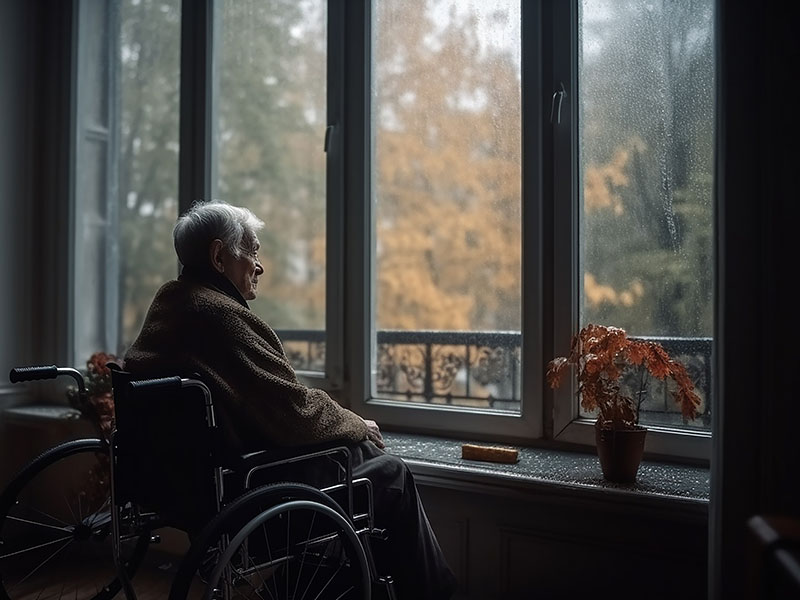
Now, as an elderly woman at the nursing facility, she mostly stays in bed, and typically prefers that the shades be down. While she attends a few group activities, Darlene feels relieved when she can finally get back into her bed and the low-lit security of her room.

Therapy as Sanctuary

One day as I sat next to her in her room during a psychotherapy session, Darlene asked that I raise the shades because she could hear it was raining outside. “This is the only time when I feel good, when the weather outside matches the weather inside me," she remarked.

Dim and dreary weather conditions had always matched Darlene’s moods, and provided a sort of comfortable retreat for her, whereas sunshine and groups of people could be anxiety provoking for her. Her Poe-like melancholy was matched by an attraction to poetry, and she would recite to me verses of poems she had long memorized.

Darlene also had a lifelong struggle with bipolar illness that mostly involved depressive episodes, and rare manic periods with grand persecutory delusions (“I’m being nailed to a cross, everyone’s looking at me!”). Oh, what could be more distressing for Darlene than to be under the glaring and judging eyes of others!

As she aged, Darlen suffered from macular degeneration with progressive loss of sight. She ate meals sitting up in bed, and often felt increasingly frustrated and embarrassed by the messy results. She was helped when her meals were changed primarily to finger foods, and she could be guided by touch more than by sight.

Dignity in the Shadow of Shame

Darlene also experienced problems with bowel and bladder incontinence. The need for someone to witness and attend to her humiliating problem felt horrible and shameful to her. She inadvertently made the matter worse, though, by her ineffective effort to clean or hide the results of a bowel accident — causing a staff person to come to me stating that Darlene was “playing with her feces.” After a conversation with Darlene, I could explain her predicament and her sense of shame to the staff, and they were then more helpful with keeping her clean while protecting her dignity.

One day at the nursing facility as I was pushing Darlene in her wheelchair through the hallway, we encountered a new female resident who loudly exclaimed, “Darlene, Darlene, it’s me, it’s Ellen!” With a panicked expression, Darlene looked at me and said, “Get me out of here, now!” Darlene explained that she knew Ellen and that they had both lived at the psychiatric facility at the same time. Darlene did not want anyone to know that she had once lived there, because she felt it was yet another source of shame.

Over the course of several therapy sessions, Darlene and I explored her reactions, and her underlying thoughts, feelings, assumptions, and beliefs as they related to her encounter with an old friend who had resided along with her at a chronic care psychiatric hospital many years ago.

We focused on reframing her story of time at the hospital from one of self-perceived shameful illness to a story of triumph. We discussed ways she had achieved many significant and meaningful successes: through her trust in her psychiatric care providers while at the hospital, through her education and attainment of a nursing license, with her subsequent career providing valued care to her patients, and by living in an apartment on her own during her working career.

Darlene was praised for the many triumphs in her life story. We spoke of how others might be impressed by and applaud her achievements, rather than look poorly on them, if she might be willing to share her story, to raise the shades, and let in the light!

Questions for Thought and Discussion

In what ways does Darlene’s story resonate with you personally and professionally?

How might you have addressed Darlene’s dilemma of encountering her “old friend?”

What clinical experiences have you had with the elderly and how have they impacted you?  

Effective Nursing Home Psychotherapy: Blending Skill And Heart

“My mother literally made gin in the bathtub; it was part of how she made money. She also had men ‘guests’ in the apartment, and unfortunately, she didn’t always protect me from them.” Daphne remarked as she spoke of her childhood in Brooklyn, New York.

Like what you are reading? For more stimulating stories, thought-provoking articles and new video announcements, sign up for our monthly newsletter.

Daphne was now 84 and resided in a nursing facility. She used a wheelchair, and spoke in a raspy voice due to polyps on her vocal cords. As a result, she would not sing one note, since she knew it would never again sound like it had when she was younger. But she would laugh, and she would share her stories, and she was always curiously asking about the stories of other people, even mine.

On Her Own Terms

We often sat for psychotherapy in a small TV room in her unit. The room was about 8 feet wide by 10 feet long; just space for a loveseat, one chair, her wide wheelchair, a small TV on the wall, and a window looking out at the woods behind the facility.

During one session Daphne was speaking about the ironic balance of shyness and confidence of a performer. “How about you, you seem calm, but do you feel shy or do you feel confident?” she asked. I explained that when I was younger, I went to acting school, partly because someone wrongly suggested to me that taking up acting was a way to overcome shyness. Daphne laughed, and asked, “Well, so how did that work out, anyway?”

Daphne had a regal quality, along with her charmingly refreshing genuineness. Her issues in therapy were related to acceptance of aging and reduced functional independence, tolerance of the loss of her singing voice, and easing of suffering due to abuses experienced in her childhood. Daphne was intolerant of anything phony. She’d seen too much in her life, and seen through the disguises of so many persons. I could not have “played the part of a therapist” with Daphne — hiding behind a veneer of neutrality — my choice was to meet her on the terms she expected of authentic sharing, or nothing.

She roared with laughter as I told of the nausea and fear I’d experienced before a stage performance, and my delighted excitement during the performance. That pattern continued with each show — dread in anticipation, and elation while acting — and no, I certainly never got over being shy, I explained, as she threw her head back and laughed.

“So, why did you give it up?” she asked. I did not think it would be a successful, or tolerable, career — I could hardly tolerate putting myself through those ups and downs, so I went back to school to get a master’s degree to practice psychotherapy. “Well, didn’t you still have those same ups and downs in your new career?” she asked with her bright and penetrating gaze.

Actually, I would sometimes give talks or make presentations at professional conferences, and would experience the same nauseating apprehension, and then the same enthusiastic enjoyment while at the podium. ”Of course, I knew it!” she laughingly stated. “Let me explain to you why that happens,” she said.

Personality and Talent

“That’s the difference between personality and talent. Your shyness and your anxiety about putting yourself in the spotlight, that’s personality. But the joy and enthusiasm you felt when performing, in one way or the other, is talent. Talent and personality are not the same thing, but so many performers harm themselves because they never understand the difference.” Daphne wisely explained.

Daphne used examples of famous performers who confused their personality with their talent, and who got caught up in the projections of fans who thought that their personality ought to match their talent, and who developed problems because they could not, and should not, blend the two things that were categorically different.

Sometimes in psychotherapy, my clients are vulnerable and in need of guidance, strict boundaries, and a straightforward application of therapeutic techniques. In nursing facilities, I sometimes work with residents who have diagnosed mental disorders, and who need formal and conventional psychotherapy. Yet sometimes the residents I see in therapy don’t have a psychiatric disorder, but may instead wrestle with real-life problems such as illness or loss, and who may benefit from a less formal educational and supportive approach.

Daphne was of the latter; wise and resilient, she lived vibrantly, even when she was less able to function on her own. Her wisdom, her humor, and her curiosity about the lives of others were key strengths, and they found a place in our therapeutic conversations.  

Therapy in the Shadow of Death and Its Remarkable Privileges

Concerns Converging on Loss
 

“So, the doctor told me that it is cancer, and that there's nothing they can do. I just hope I have a little more time; my biggest hope is that my sons will reconcile with each other.”

Like what you are reading? For more stimulating stories, thought-provoking articles and new video announcements, sign up for our monthly newsletter.

“The doctor came to my room to see me. He held my hand and said, 'I'm sorry you have cancer, and I'll do everything I can to keep you comfortable.' And he said, 'From everything you've told me about who you expect to meet when you leave, I think that should be the best comfort for you,' and the doctor was right, my faith is a comfort to me.”

“My daughter, my beautiful daughter killed herself. There's just no answer to explain it.”

“Don't say goodbye, I'll see you in heaven; I've been there before (near-death experience) and it's beautiful.”

“Oh, Tom, can you see this client today, her son just died; they think it was a drug overdose.”

“They're all gone, my parents, my wife, my children, everyone; I'm the last one left. I don't know why, but I'm still here.”

“This is the third time my mother is in hospice. I wish she would die, but then I feel so guilty for wishing that. Then I wish she would get better, but I don't think she will; it's all just so difficult and confusing.”


Walking with My Clients
 

Over four decades, I’ve provided psychotherapy to residents in nursing facilities. I have worked with many thousands of clients, most of whom have died. I have been privileged to accompany so many on the last steps of their journey through this world. All persons die, and virtually all persons have lost someone, or many others dear to them. I have likewise been privileged to provide companionship to so many amid of their grieving. Speaking with someone with a terminal illness or someone grieving is a weekly, if not daily, or even several-times daily part of psychotherapy in a nursing facility.

Sometimes I know in advance, and can have sessions in which to work reflectively with the client as they approach the end. Other times I come to the room of a resident and their belongings are gone, and inquire of the nurse and am told they died. Sometimes, I receive an email telling me the sad news before I arrive, and sometimes a staff person will console me, “I know how close you were to her.”

For many clients who have a terminal illness, it is a comfort and relief to speak frankly in psychotherapy about matters of death and dying. The person's family members, and even some caregivers, might tend to avoid the topic, perhaps due to personal discomfort.

Staff persons might encourage continued socialization, yet the dying individual may be occupied with the internal work of preparation. A nurse asked me to “talk to” a dying resident because she thought her TV show was inappropriate. The resident was sitting up in bed while a television show for toddlers was quietly playing. While the resident sat facing the TV, she was clearly looking inwardly.

As I quietly kept her company between brief bits of conversation, I noticed how the TV show in the background provided a soothing backdrop. This particular resident, like others close to death, needed to pull away from the ordinary things of this world and reflect on their life, their relationships, and their eternal future. My father was lucky to die at home. As I visited him weekly towards the end, he would each time give me a book or another item of his. I thought of how I pack up when I am preparing for a journey. He was unpacking as preparation for his journey.

Sometime around 12 to 15 years into my 40-year career, I started to experience burnout; a result of too much trauma and human suffering. For me, it was a deepening of religious faith that allowed me to once again fall in love with psychotherapy and learn to practice without being harmed by it.


Of Greeting and Bidding Farewell
 

Some dying individuals are comforted by their faith, and some struggle with doubts. Everyone will have some fear of death, yet I notice how each person has their own kind of fear as they near it. For many of my clients, the fear is of God's judgment. Clients often voice worries about their mistakes and misdeeds in life — yet I regularly see how narrowly a person might look at their life experiences and influences, and how harsh and disproportionate is their judgment of themselves.

Many of my clients have been rejected by so many in life, they doubt there is a God, or let alone a God awaiting them with kindness and understanding. I feel a tenderness for each of my clients, yet often in therapy, sometimes as a client most severely chastises themselves, I feel a loving kindness in me that does not seem to begin in me. I notice a gentle feeling of wanting to reach out and touch their cheek, or a reassuring largeness of understanding that surrounds all the good and the bad of that person’s life, and I simply hold those ideas or sensations as aspects of my bringing a therapeutic presence to their suffering.

I have worked for many years in particular facilities; maybe 10 years in one, or 18 years in another. As I walk through the halls, I often think of the individuals who previously stayed in those different rooms, recalling their personalities and the challenges of their life.

Psychotherapy in nursing facilities is often a process of greeting, uplifting, supporting, and of saying goodbye. It can encapsulate and intensify the general experiences of life and death one might encounter in other settings or ordinary living. I am grateful for this work. When the time comes to retire, I will continue to see in my mind's eye the many people I have worked with and to thank them for their trust when they were most vulnerable.


The Encounter at the Doorway

Francis Thompson was born on December 18, 1859, and died on November 13, 1907. He is the author of the great mystical poem “The Hound of Heaven.”

I fled Him, down the nights and down the days;
I fled Him, down the arches of the years;
I fled Him, down the labyrinthine ways
Of my own mind; and in the midst of tears
I hid from Him, and under running laughter.
 

So begins the first verse of the poem that is considered a spiritual autobiography of Thompson’s attempted flight from God, and the gentle and persistent presence that always pursued him no matter how much of a mess he made of his life. Francis Thompson was often homeless on the streets of London and addicted to Laudanum (alcohol with a tincture of opium).

Like what you are reading? For more stimulating stories, thought-provoking articles and new video announcements, sign up for our monthly newsletter.

One day Francis went to the office of Wilfred Meynell at the Merry England magazine. At his desk, Mr. Meynell saw the office door open slightly and close, then open and close again. In the doorway, Francis had no shirt beneath his coat, bare feet in his broken shoes, and a soiled and wrinkled manuscript in hand. He was scared. Thankfully for Francis Thompson and for the history of English literature, the impeccably dressed Mr. Meynell looked beyond the surface of Thompson’s broken-down appearance. He read the manuscript with mounting astonishment, helped Francis get into a hospital, and gave him a job. Francis relapsed into addiction several more times between periods of rest and recovery at a monastery in the countryside and bursts of literary productivity, until his death that resulted from the effects of addiction and tuberculosis.

I have personally witnessed dramatic and counter-intuitive ways in which demographics have changed in skilled nursing facilities over the past several years. The general population may be aging, yet the trend nationally has been one of younger adults increasingly being admitted to nursing facilities. A dearth of funding for home-based services, and a lack of available and appropriate residential programs for psychiatric and substance abuse issues are among the factors that contribute to these changes, and those that most directly impact the clinical work I do with these populations.

In the nursing facilities where I work, I have encountered relatively young residents with complex medical and psychiatric and substance use disorders. I can attempt to prepare for these doorway encounters, as did Mr. Meynell all those years ago when first meeting Francis Thompson. But as Meynell’s first impression of Thompson was skewed by his streetworn and drug-addled presentation, so, too, might be our own first impression of a younger person whose substance abuse and psychiatric history has taken a toll on their body and mind. Their need to be seen fully as a person is no less than was Thompson’s when he first appeared in Meynell’s doorway. And, like Thompson, each of the residents who present in my clinical doorway is so much more than their respective psychiatric and substance abuse histories.

Every person wants his or her life to turn out well. The person with a substance use problem yearns to be recognized as someone who wants their life to turn out well, and who needs the help of others to rebuild that life. The person we meet might be a creative genius, but that doesn’t matter; they are always an individual human person of infinite value.

Residents I spoke to with a history of addictive illness have offered insightful comments that have guided me in my clinical role at these various nursing facilities.

“Staff make negative assumptions based on a person being homeless and self-medicating,” according to Casey. “It’s hell out on the streets; you get overcome and paranoid sometimes, and you use again,” Rod said. “Don’t tell them ‘Just get off drugs,’ but help them to get a job, a home, and social contacts,” he added. “You know, they once had a job and they were in society once; they need programs to help get back in society.” Casey said that staff should realize that for the newly admitted resident “their body is going through a metamorphosis because they are not drinking or using drugs.”

Trent pointed out that “you’re not relaxed and calm when you come into a nursing facility.” He suggested that too often caregivers have a negative attitude: “You’re busy and irritated, and it makes me irritated and angry.” Trent suggested that “it should be up to the patient if they want to talk about it [addiction].” “Too much pressure and they close up. You feel pressured by people always on your case, and telling you what to do, when you have to figure out what to do; it can be overwhelming, and you can clam up and want to be left alone,” he said.

The individual with a substance use illness will “need a little love; something like a Big Brother program for grown-ups,” said Rod. “Help them get to a place where they can at least have hope,” he said. “It’s going to take love and patience to help them rebuild themselves.” Casey suggested that nursing facilities might offer practical and age-appropriate group activities, and not simply Bingo or crafts. She suggested bringing in persons from the community to offer life skills training on how to budget, how to use the internet, how to interview for a job, how to prepare food, find an apartment, or apply for disability income. “You’ve got to help open doors to encourage people to want to do better: Give someone a reason to get up in the morning; you’re never too old to love to do something new,” she said.

I think we cannot reasonably say, “Let someone else deal with this; I’m not trained or qualified to deal with this kind of problem.” The residents I spoke with pointed out occasional shortcomings of the inpatient addiction treatment programs where they sometimes fruitlessly sought help. Frank was impressed by the practical advice and suggestions he heard during his first alcohol detox admission. He was surprised to hear the same points during his second admission, and then disappointed to find during repeated subsequent admission that “they just talk from the textbook, and they don’t really have something new to say to you.” Frank spoke of a 19-year-old woman who had been through 30 detox admissions—citing the evident insufficiency of the specialized treatment offered. The residents spoke to me about the perceived limited knowledge and understanding of some professionals with specialized credentials for treating persons with addiction. The residents stated that they could encounter negative judgmental attitudes and unhelpful advice as often in specialized in-patient treatment programs as in skilled nursing facilities.

In my own experience working with these residents, I have found it important to encourage fellow clinicians and nurses to acquire additional training and certification, yet not discount the array of skills, knowledge, and personal qualities that they already bring to bear in the service of these residents. Residents with addiction and/or psychiatric disorders tend to have developed acute BS-detectors; they observe us with an X-ray type of vision. The person with an addictive illness has a refined intuitive ability to notice the underlying attitude of the nurse or clinician who encounters them. That capacity typically emerges from the deep emotional wounds of shame that accompany an addiction. The person with the addictive illness feels under a cloud of suspicion and judgment from the first encounter. We should strive to receive that person with a wise and open heart, as well as with a wily awareness of the risks of manipulation that can also be an unfortunate part of the picture. We cannot hide or disguise attitudes of fear or revulsion or judgment from the awareness of the persons we meet and work with.

***

The encounter at the doorway is a two-way process: I encounter my personal attitudes and values and beliefs about illness, addiction, and homelessness as I also meet with a person in need of kindness and patience and practical encouragement. My own genuineness and authenticity and humility have often made the critical difference as I greet the other at the doorway of despair or new opportunity.