Using Psychotherapy to Heal a Lifetime of Pain and Shame

As a child, Darlene would change to lower-watt light bulbs in the small bathroom attached to her bedroom so that the light would be dimmer. “How can you see anything in here?” her mother would ask in dismay. But Darlene preferred to brush her hair, and later apply makeup, in subdued lighting.

Like what you are reading? For more stimulating stories, thought-provoking articles and new video announcements, sign up for our monthly newsletter.

As a young adult Darlene had lived for several years in a state psychiatric facility. One day the psychiatrist and a nurse sat with her and suggested that she apply to nursing school. She thought she was in trouble when the doctor asked to speak with her, and was surprised when he spoke of her potential — and the possibility of her living outside of the hospital. Darlene became a licensed practical nurse (LPN), got an apartment, and enjoyed a career working at a state school for persons with developmental disabilities.

Darlene had weathered a very brief and turbulent marriage that ended when her husband was physically abusive to her. “I don’t know why I ever married him,” she said. “Partly, my parents thought it would be good for me, and partly I was at least hoping I’d be loved.”

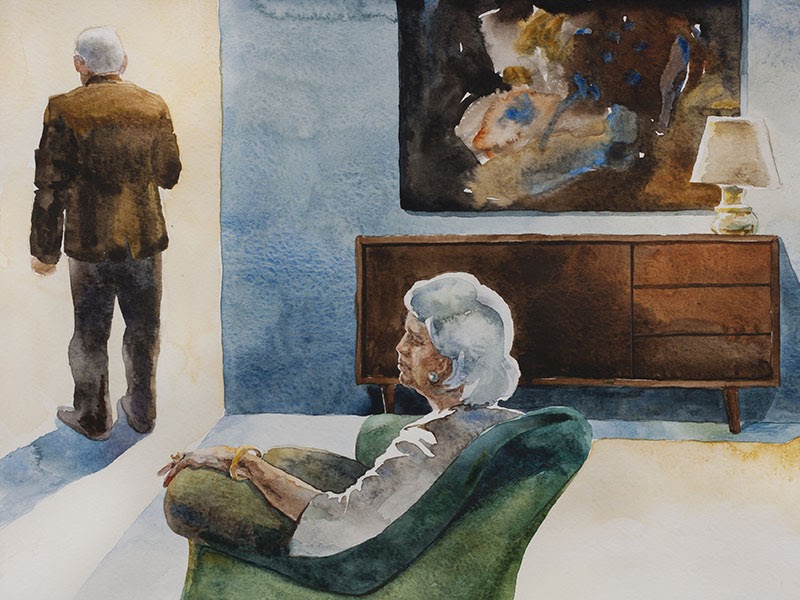
Now, as an elderly woman at the nursing facility, she mostly stays in bed, and typically prefers that the shades be down. While she attends a few group activities, Darlene feels relieved when she can finally get back into her bed and the low-lit security of her room.

Therapy as Sanctuary

One day as I sat next to her in her room during a psychotherapy session, Darlene asked that I raise the shades because she could hear it was raining outside. “This is the only time when I feel good, when the weather outside matches the weather inside me," she remarked.

Dim and dreary weather conditions had always matched Darlene’s moods, and provided a sort of comfortable retreat for her, whereas sunshine and groups of people could be anxiety provoking for her. Her Poe-like melancholy was matched by an attraction to poetry, and she would recite to me verses of poems she had long memorized.

Darlene also had a lifelong struggle with bipolar illness that mostly involved depressive episodes, and rare manic periods with grand persecutory delusions (“I’m being nailed to a cross, everyone’s looking at me!”). Oh, what could be more distressing for Darlene than to be under the glaring and judging eyes of others!

As she aged, Darlen suffered from macular degeneration with progressive loss of sight. She ate meals sitting up in bed, and often felt increasingly frustrated and embarrassed by the messy results. She was helped when her meals were changed primarily to finger foods, and she could be guided by touch more than by sight.

Dignity in the Shadow of Shame

Darlene also experienced problems with bowel and bladder incontinence. The need for someone to witness and attend to her humiliating problem felt horrible and shameful to her. She inadvertently made the matter worse, though, by her ineffective effort to clean or hide the results of a bowel accident — causing a staff person to come to me stating that Darlene was “playing with her feces.” After a conversation with Darlene, I could explain her predicament and her sense of shame to the staff, and they were then more helpful with keeping her clean while protecting her dignity.

One day at the nursing facility as I was pushing Darlene in her wheelchair through the hallway, we encountered a new female resident who loudly exclaimed, “Darlene, Darlene, it’s me, it’s Ellen!” With a panicked expression, Darlene looked at me and said, “Get me out of here, now!” Darlene explained that she knew Ellen and that they had both lived at the psychiatric facility at the same time. Darlene did not want anyone to know that she had once lived there, because she felt it was yet another source of shame.

Over the course of several therapy sessions, Darlene and I explored her reactions, and her underlying thoughts, feelings, assumptions, and beliefs as they related to her encounter with an old friend who had resided along with her at a chronic care psychiatric hospital many years ago.

We focused on reframing her story of time at the hospital from one of self-perceived shameful illness to a story of triumph. We discussed ways she had achieved many significant and meaningful successes: through her trust in her psychiatric care providers while at the hospital, through her education and attainment of a nursing license, with her subsequent career providing valued care to her patients, and by living in an apartment on her own during her working career.

Darlene was praised for the many triumphs in her life story. We spoke of how others might be impressed by and applaud her achievements, rather than look poorly on them, if she might be willing to share her story, to raise the shades, and let in the light!

Questions for Thought and Discussion

In what ways does Darlene’s story resonate with you personally and professionally?

How might you have addressed Darlene’s dilemma of encountering her “old friend?”

What clinical experiences have you had with the elderly and how have they impacted you?  

Listening for Meaning in the Voices Nursing Home Clients Hear

Several years ago, I worked with a lovely lady in her early seventies who resided in a nursing facility, and who heard the voices of her daughter and son daily. She had been delighted to be a young mother of two children but was ill with bipolar disorder and psychotic features that necessitated repeated psychiatric hospital admissions. Her husband subsequently divorced her, gained custody of the children, and remarried. The children bonded with the stepmother and cut off all contacts with their biological mother. One day I asked her, “If we had a new pill that would eliminate all voices, would you want it or not?” “Oh, no, Tom; then I’d have no contact with my children,” she answered.

Different Kinds of Voices

Over the next few years, I asked that question to hundreds of therapy patients in nursing facilities. I had initially assumed that most persons who hear auditory hallucinations would like to turn them off completely. To my surprise and increasing fascination, the majority, approximately 70–80% of those that I asked said no, they would not take a pill that would erase all voices.

Individuals with whom I’ve worked therapeutically have explained that there is indeed a negative aspect of the voices, usually involving insulting and hurtful remarks, but there is also a positive aspect—something that was pleasing, and they would not want to do without. For each person, the positive element was different, and was personally meaningful. “Tom, if it wasn’t for the voices, I’d be very lonely,” said a woman in her fifties with schizophrenia.

“I’d have no one to talk to if it weren’t for the voices,” said a male patient.

“I don’t really talk back to them, but I like them, and I listen to them; and it’s better than talking with people,” said a 73-year-old man with schizophrenia.

“I guess it’s a side benefit of schizophrenia: I can hear the voices of my dead relatives,” said a male patient.

“The good voices I think of as the children, and the bad voices are the adults; I’d just feel terrible if I stopped hearing from the children; they cheer me up,” said a different female patient.

“It’s easier talking to the voices than to people,” a man said.

Some believe they gain special knowledge from voices. “How else would I know what’s going on?” one man asked. “I read people’s minds; I can tell what they’re thinking because I can hear it.”

Some patients, though, do wish to eliminate all auditory hallucinations, and their psychiatric medications do offer symptomatic relief. Some patients tell me that they used to hear voices, but no longer do because of their medication.

Some individuals with whom I’ve worked have achieved insights through psychotherapy that helped them understand and manage the symptoms. I worked with a 74-year-old woman who had more than a 50-year experience of schizophrenia. She knew the name of the condition yet could not recall ever being educated about the symptoms of the illness. She believed that she had super hearing and could hear persons in different rooms saying nasty things about her. Often, she would yell out when passing by the nurse’s desk—because of hearing the nurse making insulting remarks about her. After months of therapeutic conversations about voices as symptoms of schizophrenia, she greeted me one morning by saying, “Guess what happened today, Tom? I was walking past the nurse’s area, and I heard them talking bad about me, and I realized; I’m hearing it, but they are not saying it!”

Troubled Journeys

Multiple factors might cause or contribute to one’s hearing an auditory hallucination—they can be associated with neurologic conditions, seizures, autism, bereavement, medication effects, drug effects, trauma and dissociation, borderline personality disorder, dementia, and/or postpartum psychosis. But for persons with a diagnosed psychiatric condition who hear voices, there may often be a pattern of additional, related life experiences that can further limit social functioning and productive activities.

Many patients who speak with me in psychotherapy about the voices they hear also report early-education learning difficulties, special education classes, and a growing sense in childhood of being different, with estrangement from peers and few childhood friends—and, therefore, reduced opportunities to develop and refine social relationship and communication skills.

Autistic elements are commonly identified in schizophrenic illnesses. Learning disabilities, likewise, are commonly associated with schizophrenic illness. Autistic features, learning disabilities, and mental illnesses can contribute to social estrangement and reduced development of adaptive social communication skills.

Affected persons may withdraw into substitute communications with voices, and that can in turn contribute to worsening of symptoms of depression—as can be manifested in the menace of some perceived voices—and to progressive depths of withdrawal, thereby adding to paranoid distrust of others.

My clinical experience suggests that many patients rely on an imaginary companionship through the voices and would like to minimize or eliminate only the malignant (the derogatory, or depression-reflective) voices. Yet other persons report significant relief when their experiences of hearing voices have been quelled by medication. If those persons had been asked prior to remission of auditory hallucinations/delusions (AH/D) symptoms, might they, too, have said they would prefer to retain the voices? I believe that relief from symptoms would better serve an individual than a pseudo-accommodation to them.

The Gifts of Therapy

I think there is a vital need for new and more effective medications, and for optimum application of presently available medications, along with psychotherapy and psychosocial interventions that can be applied by staff persons in the nursing facility.

Sometimes one learns in unexpected ways that a patient is experiencing hallucinations. I worked with a 48-year-old man with a diagnosis of bipolar disorder and no known experience of hallucinations or other psychotic symptoms. He often complained of pain and argued with staff persons. He was making vague remarks about something bothering him one day, and among other questions, I asked if he ever heard voices in his ears, anticipating he would say no. He surprised me by saying, “Not in my ears, I hear voices in the mattress; I hear the voices of the dead people who died on the mattress before I started using it. That’s why I don’t sleep at night.” The physical frailty that brought him to the facility for nursing care and rehab triggered underlying fears of dying.

Images in dreams typically hold specific and personal meanings that can be identified through sensitive personal conversation, and awareness of those meanings can improve a person’s understanding and coping with internal experiences. Hallucinations and delusions likewise contain personalized meanings and tend to provide protective psychological functions. Symptoms can be remarkably clever psychic creations that help balance an imbalanced psyche.

Many persons who don’t have a mental illness might entertain glorious daydreams of special accomplishments. Some persons with a psychiatric diagnosis develop grand delusions that protect against feelings of shame and disappointment over inadequacies. A 54-year-old man with schizophasia and thought disorders due to schizophrenia who found it difficult to communicate in ordinary ways with others once told me he had written the lyrics for many of the major rock bands.

Sometimes a patient will openly discuss their hallucinations during therapy yet deny having them when questioned by other care providers. “That was a red flag for me,” a 54-year-old female patient said about an initial conversation with a psychiatric consultant asking assessment questions. “I didn’t know who he was, and he was asking these personal questions, so I hardly said anything.”

Some patients say they do not report their internal (symptomatic) experiences, such as hearing voices, to other care providers because “they might not believe me,” “they might think I’m crazy,” “they might just think it’s not true,” “they might make fun of me,” or “they might send me to the hospital.”

I explain that in psychotherapy we are looking for the true personal meaning of the experience, so that they might better understand and manage those experiences—and, for persons hearing voices associated with dissociative conditions, so that they might better integrate the meaning of the perceptions. In therapy we talk about the difference between objective reality and subjective reality, so that the person might feel less perplexed and afraid, and more willing to discuss and examine their experiences.

The Other Side of the Sun

I met for weekly psychotherapy for two years with a 53-year-old man with schizophrenia who told me one morning, “I just got back to earth. For the last 30 years I was living on a planet on the other side of the sun.” He was upset because the staff had laughed and told him it was not true when he told them earlier that morning about his experience. I spoke with him about things that are true as shared realities and things that are true as psychological experiences that have symbolic personal meaning. We spoke of ways he wanted to fit in and get along with others, yet how that might be difficult and how he might sometimes feel far away from others. So far that it would be like being on a different planet; and how good it feels when one starts to feel better, and back down to earth, and better able to connect with people. This conversation helped him to speak more directly about the alienation he sometimes feels because of his illness.

In psychotherapy, some patients argue that the brain is not capable of creating convincing experiences that are not real. The following remarks represent a composite of conversational points from sessions with a few patients.

Therapist: Have you ever awakened from a dream and thought, wow, that dream was so real!

Patient: Yeah.

Therapist: And where did the dream come from?

Patient: Okay, it came from the brain, I see.

Therapist: Have you heard of someone taking LSD?

Patient: Yeah.

Therapist: What happened during the “trip?”

Patient: Oh, yeah; they heard things and saw stuff, and maybe went to another world.

Therapist: Those seemingly real experiences were caused by a chemical that triggered an imbalance of other brain chemicals.

Patient: My psychiatrist said my illness was a chemical imbalance in the brain.

Therapist: And psychiatric medications work to correct imbalances of brain chemicals.

Patient: Oh, so brain chemicals can make you hear and see things that are not there, except in your brain.

Therapist: Do you hear a high-pitched ringing sound?

Patient: No.

Therapist: I do, because I have a condition called Tinnitus. The ringing is not coming from outside of me, but from inside, because of a medical condition. It is subjectively real, because only I hear it. It would be objectively real if we both heard it at the same time.

Patient: Okay, so some things can be real for me on the inside, but not real between you and me; I guess that’s like mental illness.

Asking the Right Questions

Assessment questions using clinical terminology might trigger anxiety and reluctance to acknowledge internal perceptions and beliefs. “Do you hear auditory hallucinations?” might trigger a denial, yet asking “Do you hear voices or receive communications that are pleasant, unpleasant, both or neither?” might initiate conversation about one’s experiences. Asking if one feels paranoid might stir resistance, yet asking “Is it sometimes frightening or confusing to deal with people?” might lead to conversation about the thing’s others do that cause fear or mistrust.

What do auditory hallucinations compensate for? What do they replace? Do internal or out loud conversations with these voices represent a form of self-treatment for the patient? What type of adaptive skill training might address those needs?

Turning to the literature does not always result in answers to these enigmatic questions. I believe that additional research is needed to:

  • Improve awareness of the incidence of AH/D amongst persons with psychiatric diagnoses residing in nursing facilities
  • Identify how many patients have achieved remission of AH/D resulting from psychiatric medication
  • Determine how many persons experience auditory hallucinations without delusions
  • Identify the percentage of patients preferring to retain rather than eliminate AH/D
  • Elicit examples of personal meanings of AH/D
  • Develop educational guidelines to assist Activities Department staffers, including occupational and physical therapists, to teach and practice adaptive social communication skills
  • Gather ideas/suggestions from patients on how professionals might inquire about symptoms without causing shame or triggering denials

***

I have been and continue to be deeply moved by the trust and disclosures offered to me by the many vulnerable persons with whom I have been privileged to work. I ache with hopes that we find new ways to quiet their symptoms, relieve their shame, and help them deepen their willingness and capacity for ordinary social communications.

Melting Fear with Love

Walking up the back stairs, I heard someone yelling and cursing loudly. I pressed the red button releasing the door lock and came onto the third-floor unit. The fire of her fury had burnt out rapidly, and a 32-year-old young woman—I’ll call her Gwen—now sat hunched and sobbing in the nook at the end of the hallway. I thought if I spoke or approached too closely she would dismiss me, so I sat quietly 10 feet away. Her breathing slowed, she sighed and looked questioningly at me. I introduced myself and my role as a therapist, and she began to tell me of her frustrations: with her medical problems, her mood shifts associated with bipolar disorder, and feeling trapped in a nursing home with people ordering her around.

Like what you are reading? For more stimulating stories, thought-provoking articles and new video announcements, sign up for our monthly newsletter.

During her stay, Gwen had many similar fiery outbursts aimed at authority figures, and weekly conversations with me in which she spoke of being trapped and tormented as a child in foster care. She felt furious with her biological mother for abandonment, and with her abusers. As a child, her proficiency with math was a saving grace for Gwen, and her most keen desire was to teach young children about the delights of mathematical thinking. Gwen had been burned by betrayal as a child, and suffered inflammatory medical problems and destabilizing bursts of inflamed emotions that limited her progress in pursuit of her goals of a stable life and a teaching job. She loved being a teacher of young children and wanted to stabilize her physical and mental wellness so she might obtain an apartment and a return to work.

Yet Gwen could easily erupt in dragon’s breath fury when frustrated or challenged or limited by an authority figure. We talked of how her suffering as a child was unjust, and how her feelings of anger were understandable, yet how the heat, hammer, and anvil of her anger needed to be forged into steel-strength skills for successful adult functioning.

Watching the movie Frozen with our grandchildren, I was reminded of Gwen, and reflected further on the emotional themes she and the fictional character Elsa had played out in their lives. Each an orphan with a gift, overwhelmed by circumstances and emotional reactions to them and fleeing into unhelpful and alienating defenses—either with ice or fire—and as yet unable to assume full adult responsibility until brought home by love.

***

In the movie Frozen, the initially playful child, Elsa, has been endowed with special powers over the piercingly beautiful yet dangerous elements of winter.

In Norway, the setting for the movie, the freezing powers of winter exert tremendous influence over the lives of the Norwegians. It seems only natural to mythically imagine reversing the dynamic and exerting unique and personal control over cold, ice, and snow.

Elsa is not only endowed from birth with ice magic, but she is also likewise enlisted from birth to inherit grand royal authority as the Queen. Yet with a lack of parental or adult guidance or guardianship, she is left unprepared to understand or to cope with either form of power. With no guiding principles or instruction, she can only rely on her increasingly troubled and difficult-to- control emotions for direction.

In her journey from fear towards love, Elsa magically conjures two characters: Olaf and the Snow Monster, which represent differing elements of her character and of her reactions to the overwhelming circumstances enveloping her. Olaf represents the playful joy of Elsa’s childhood with her younger sister Anna, and the Snow Monster embodies the ferocious defensiveness Elsa has developed as a coping strategy.

Elsa learned only fear and cover-up as ways of managing her special gift. Added to that were the burdens of unresolved grieving over the deaths of her parents and her misguided estrangement from Anna. Under the additional burden of authority as a newly crowned queen, Elsa fails and flees; from the sister she ostensibly wants to protect—even when Elsa knows that Anna is actively endangered by a conniving scoundrel—and as well from her responsibility for the needs of the people she is destined to rule.

Elsa experiences an initial, albeit illusory, euphoric sense of release—which is anything but genuine freedom—as she isolates herself ever further inside a grand though chilling fantasy of solace through solitude.

Elsa, sadly, is not—at least not yet—a heroic figure. She never risks herself for the sake of another. Elsa is a tragically lonesome figure who withdraws from others into an ever-deepening coldness. Elsa even rejects her sister after Anna has come to call her back to family and community and responsibility.

The real heroine of the movie is Anna, who remains hopeful even while enduring a childhood of rejection and imposed isolation. Anna always believes the best about her older sister Elsa, and Anna departs immediately, and on her own, to find and rescue the sister who has run away.

Anna awakens love and heroism in the character Kristoff. It is their budding love for each other, along with the vestiges of Elsa’s hope and joy in the figure of Olaf, which prepares the way for Anna to give of herself to the end in a successful attempt to save Elsa through an act of true love.

***

Two years after my initial encounters with Gwen, I had the opportunity to work again with her in a different nursing facility after she experienced another medical flare-up. This time, her attitude and outlook were far more mature and optimistic than when we first met, yet she still struggled with unstable medical and emotional distress. She was considering the short-term goal of moving in with a family—a lady and her two young adult daughters—under a foster family care program. One morning she was crying heavily when I came to her room. Gwen said, “I know it’s different, it’s not the same as foster care when I was a kid, but it reminds me of that.”

The host family was patient and kind and invited her six times to their home, so she might gradually consider the option of living with them, without any rush to decide. Gwen reflected with me on each contact she’d had with the potential host family—what they said and did, and how kind they had been and how hard it was for her to trust that it might turn out well. However, she also felt reassured to learn that the host family would hold no authority over her, and that she would be free to move on from their home to her own when it became available. She could live in a house with a friendly family—with ordinary routines and with full opportunities and encouragement to pursue her dreams.

Here finally was a chance for the stability she yearned for without the need of flame-throwing defenses. For me, Frozen was the perfect illustration of the challenges of coping with losses and misfortunes and injustices, while learning to love and care for others and to responsibly develop one’s particular gifts. As a psychotherapist, I was able to draw from the riches of mythology, fairy tales, literature, and cinema to elicit analogies and insights to formulate broader understanding of the trials encountered by my client.

Two weeks after moving in with that family, Gwen returned in triumph to the nursing facility to share her relief and satisfaction. The gentle and loving support of the host family helped to melt her dreadful fear and allowed her to enjoy the ordinary, yet for her rare pleasures of family life.

Joseph Burgo on Shame, Narcissism and the Art of Empathy

A Personal Journey

Lawrence Rubin: You’ve been a practicing psychotherapist for over 30 years and have authored several best-selling clinical books. You seem fascinated by the clinical concept of shame. What’s its appeal to you personally and professionally?
Joseph Burgo: I guess it begins personally because for the last 15 years I’ve been coming to terms with my own shame, learning to recognize the role it has played in my life that I didn’t quite understand even at the end of my analysis. During that time I’ve been applying my new understanding to my clients in my clinical practice, and writing a book about it that would be helpful to people who aren’t necessarily in therapy. So, I suppose it’s the case that when you’ve been researching, and writing and thinking about something for a while, it takes a central role in your life.
Right now, it seems to me like shame explains almost everything
Right now, it seems to me like shame explains almost everything.
LR: It seems to be a really elastic concept that can be applied to all forms of pathology and client presentation. What kind of therapist do you think you were before you worked through your own shame issues?
JB: I was a blank-screen, classical sort of psychoanalyst trained in the object-relations school—Melanie Klein, Donald Winnicott, those people. I focused on issues of need and dependency because, from the object relations framework, everything is viewed in the context of maternal-infant relationships—what it’s like for a baby to depend upon her mother and the emotional impact when dependency doesn’t go very well. This is when the infant must protect itself from unbearable feelings of pain and disappointment.

That was the old paradigm. I wouldn’t say that I don’t think that way anymore, but I focus more now on shame and self-esteem. I don’t like the word self-esteem but it’s the word we’re stuck with. I focus more on shame and defenses against shame, the way we protect ourselves against feelings of defect and unworthiness, rather than defending against feelings of neediness and helplessness. 
LR: If your personal work on shame has allowed you to be freer of its pull, would you say that, irrespective of the type of therapy you practice, you’ve become a better or different therapist as a result of your own resolved shame issues?
JB: I like to think so. I’ve become a more empathic therapist for sure. I’ve always been empathic and had the ability to empathize with what my clients were going through, but for too many years I regarded that as information I needed to use in order to formulate interpretations. I still do that, but often now it means that I need to say something a little more personal or more directly empathic like speaking to the agony of their shame and letting them know that I have felt that way too. I understand what they’re going through in a way that isn’t distant, isn’t intellectual, but is immediate and authentic.
I’m much more likely to communicate my affection for my clients because I think that feeling joy and interest from another person is a very healing experience
I’m much more likely to communicate my affection for my clients because I think that feeling joy and interest from another person is a very healing experience. It isn’t enough just to make interpretations.
LR: That’s interesting because somewhere in my readings about or by you, you said that clients must wait for their therapists to grow enough to be able to help them. Is that what we’re talking about here?
JB: It is, and when I wrote that I was thinking in particular about two of my very long-term clients who went through a fallow period in their therapy until I addressed my own shame, and then understood shame better and could help them address theirs. That took a while. And it’s interesting that one of them will sometimes refer back to that period when I hadn’t quite figured it out as a fallow period, when we were kind of spinning our wheels.
LR: That fallow portion of the therapy was in part influenced by the growth that you had not yet made!
JB: I think eventually I was able to communicate that to them. However, in the beginning of that fallow period, I defended myself. I had been giving the correct interpretations, but they weren’t making use of them. I didn’t say that, but I think that was my attitude, and it was a somewhat blaming attitude.
LR: It must have been very empowering for you and those particular clients to reach out of that fallowness and find your ways to growth.
JB: It was. It was very productive. It was very moving and relieving that we found a way through that impasse.
LR: You also mentioned that you’ve been most successful in helping those clients whom you have found endearing. Has your own growth around shame allowed you to find clients more endearing and maybe, by association, have you felt more endearing?
JB: I don’t think so. I think this has been a feature of my work from the very beginning. The longest-term client I’ve dealt with, who I’ve mentioned in some of my writing, is very difficult, very volatile, probably in the realm of borderline personality disorder. And yet, endearing to me from day one for some reason. I don't know why, and that was many, many years ago.
LR: Do you find that you’ve become more endearing as a person and a therapist as a result of the work you’ve done on your own shame?
JB: It’s something I hadn’t thought about before. I know I’ve become warmer, more accessible, less intimidating for sure. I don't know if I’ve become more endearing. I think to my closest friends, yeah, probably. They will remark on how I’ve changed.
LR: What are some of the signs that a therapist is being overly influenced by their own shame to the point that it’s adversely affecting their work?
JB: I would say that one of the most common ways is for the therapist to hide behind their professional role and to allow clients to view them in an idealized light–as if they’ve got it all together. This sustains a therapist’s own defenses against their shame. I think this is common, and you hear about therapists who are amazing to their clients, adored by them, and their personal life is a disaster.

The Value of Shame

LR: What do therapists need to understand about working with clients whose pathology is shame-based? Clients don’t come in wearing t-shirts saying, “I’m shame-based.”
JB: I think there are several things. First, I think we need to expand our idea of what shame is.
We’re stuck in this paradigm in which shame is viewed as this uniformly bad thing
We’re stuck in this paradigm in which shame is viewed as this uniformly bad thing, and it usually has to do with some intolerant social perspective, some way that people are influenced by perfectionism and intolerance in the broader culture, and the work of John Bradshaw and toxic shaming. That’s the way we view it. That’s one of the things I try to challenge in my new book, to help people, both clients and therapists, look at shame as something else. The other thing I’m trying to do in that book is to look at the ways that everybody defends against shame. There are a consistent set of defenses that people use when shame is unbearable in their lives. I talk about as avoiding shame, which is in the realm of social anxiety; denying shame, which focuses on narcissistic issues; and controlling shame, which is more in the realm of masochism and self-deprecation.

I think you have to learn to recognize a defense against shame, understand what it is, and then help the person to gradually, over time, defend less against it, understand what it is that they’re running from and learn from it. Sometimes, when we’re behaving in ways that we don’t respect, we have a lesson to learn about our behavior, and shame is a message to us that we need to take a look at ourselves. Sometimes shame is telling us we need to try harder and that we’re not holding ourselves accountable. Sometimes shame is telling us that we have some room to grow. That’s a way I really try to reframe shame as an opportunity for growth rather than this uniformly bad thing.
LR: If we look at shame as part of being a human, we can then consider whether it is serving us and how we can develop a new relationship with it so that there’s more room for growth.
JB: I think so. I think that’s a good description.
LR: You wrote about a client named Caleb, the one we highlighted in the excerpt on this site in a chapter called “Superiority and Contempt.” Upon reading, I didn’t like him and know that you struggled to feel connected with and empathetic toward him. What impact did he and clients like him have on you?
JB: It’s a challenge working with a client like that because your own feelings of worth are impacted. Intentionally and inevitably, when a client like Caleb is in flight from their own shame and defending against it, they will often project it onto other people and then hold them in contempt as inferior and defective. Even though I’ve evolved a lot, I still see the transference and the working relationship between therapist and client as a microcosm of the client’s issues, and often the best way to address them.

Caleb was always trying to make me feel inferior, that he was better than me, that I wasn’t very smart and that I wasn’t very insightful
Caleb was always trying to make me feel inferior, that he was better than me, that I wasn’t very smart and that I wasn’t very insightful. If you’re not aware it’s very easy to become defensive and to make the sort of interpretation that might be shaming to the client, or to sort of shore yourself up, and end up in a tit-for-tat relationship. It’s a conversation that’s being had beneath the conversation in therapy.
LR: Exactly. This very morning, I had to decide to delete a contact from my phone contact list, a guy that I’ve known for 50 years. We are in a constant tit-for-tat, but it seemed that at the core was his need to shame me. He finally stopped communicating with me, and then I texted him on his birthday and got no response. I texted him again yesterday with no response, and this morning I was thinking, and this was my own shame talking, “What can I say that will shame him the most deeply?” And I came up with a perfectly crafted text that would have probably put him through the roof, but instead I decided that that’s sort of a poison you take waiting for someone else to die, so I just said “the heck with it,” and deleted his contact.
JB: The difficult thing about that experience is when someone doesn’t communicate with you and ignores your texts, what they’re saying to you is that you are unworthy of their attention, which is shaming. It’s painful when you express interest in somebody else and they don’t return it. That’s a kind of shame, and it’s natural for people to want to retaliate in kind and to say, “No, you’re the one who ought to feel ashamed.” But you did really do the right thing, which was to recognize that you wanted to shame him, and then decide not to do it.

The Flip Side

LR: We seem to be in a golden age of narcissism. A few years ago, you wrote, The Narcissist You Know. Why are we all so fascinated by narcissism? 
JB: Well, I will start off by saying that nobody wanted a book on shame. I originally tried to sell a book on shame about 10 years ago. It was called Learning from Shame: The Less Traveled Road to Self-Esteem, and nobody wanted it. I was told by agents and editors that the book was a downer and that nobody wanted to read about shame. So, I said, well okay, I will then write a book about narcissism, which I see as the flip side of shame, because everybody’s interested in narcissism right now.

I think that
as a culture we’re fascinated by narcissism in the wrong way. I think we’re not horrified enough by it
as a culture we’re fascinated by narcissism in the wrong way. I think we’re not horrified enough by it. We’re not repelled enough by it. We’re fascinated by it because we really enjoy these images of people–particularly celebrities–who seem to have it all, who are beautiful, rich and successful, and we like to believe that somebody actually does get to have that ideal life. Then we spend our time on Facebook, Instagram, and Twitter convincing everybody else that we’re leading this incredible life, that we have these amazing vacations, and we go to these fantastic parties, and here’s this amazing meal I’m having at this incredible restaurant. It all feels really unhealthy to me. 
LR: So, narcissism is a destination for people in hopes that once they are on display and revered, they will be able to escape shame? So, as you say, narcissism the flip side of shame?
JB: Yes it is. It’s the primary defense against shame, to disprove to everybody else and yourself that you’re damaged in any way.
LR: What’s interesting to me is that both are equally illusory and not tangible, though both can have tangible impacts on the body and mind. They seem so illusory but so powerful in their ability to just take over a person and deprive them of a true sense of self.
JB: Well, I agree. I think the problem is that for the narcissist, shame feels like an actual condition, an actual state of being in which they’re damaged, defective, ugly. It’s felt on an almost physical level to be a real sort of damage, a deformity, and that’s unbearable. So, they try to create this opposite steady state, this idealized self, that’s perfect and complete, which completely denies the existence of that other steady state: shame and the sense of being damaged.

That’s the problem I see.
The quandary for the narcissist is that either you’re perfect and you’ve got it all together—you’re fabulous; or you’re so damaged and defective that you’re beyond hope and there’s nothing to be done
The quandary for the narcissist is that either you’re perfect and you’ve got it all together—you’re fabulous; or you’re so damaged and defective that you’re beyond hope and there’s nothing to be done. 
LR: And it makes sense that the dichotomy of shame and narcissism are part of borderline functioning, this either-or, black or white, idealized or brutalized images of others.
JB: Absolutely.
LR: Is that why in your writing and thinking you’re drawn to borderline pathology–because it is the epitome of this dual narcissism-shame quandary?
JB: I also see the same issue in bipolar disorder. You see people vacillating between thinking that everything about themselves is so damaged, so screwed up that it’s hopeless, and then going on a manic flight into some magical state in which none of that’s true; they’re super powerful, super capable, they can do anything. I see the polarity not only in borderline symptoms but also in bipolar symptoms.
LR: We seem to be so caught up in seeing bipolar disorder as a so-called emotional disorder of dysregulation, so we medicate people for it. But the medication is not going to modify the core dynamic that drives the bipolar behavior, which is the vacillation between shame and narcissism.
JB: Exactly.

The Challenge of Treatment

LR: What are the clinical challenges of working with narcissistic clients, especially those whose narcissism is considered toxic? It must be very trying and demanding for a therapist.
JB: Well, yes. But the truth is that the people who have extreme narcissistic symptomatology usually don’t come for therapy. They think they’re fine or they’ve got some other mechanism for dealing with it that doesn’t involve acknowledging their own difficulties and asking for help. But when they do come, it is a challenge, whether or not you’re dealing with someone like Caleb, the therapist client we were talking about who projected shame into me, or some of the clients who struggle with borderline symptom.s People who have struggled with borderline symptoms are challenging because they go back and forth between idealizing you and hating your guts. As the transference gets underway, it’s a very volatile and emotionally immediate relationship in which what’s going on between you and how you’re viewed is at the core of the work. It’s very painful to have clients say, “Fuck you. I hate your guts. You’re a leech feeding off my neediness,” and on and on and on. I’ve had clients say the most vicious things to me over my career, and the hard part is that the clients I’m describing often are very insightful in certain ways, like they’re able to identify something true about you but use it against you in a really hurtful way. So, your own issues get stirred up. Are you going to defend against that because it’s so painful? Or are you going to hear it and maybe learn something from it yourself? I don't know. I would say
I’ve grown the most with my clients who were the most difficult
I’ve grown the most with my clients who were the most difficult.
LR: I can imagine that a therapist who’s not done their personal work around shame and whose self-esteem vacillates would have the most difficulty and be caught up in the most damaging counter-transference relationships with clients like this.
JB: I think so, and I think those clients probably don’t stay very long with that type of therapist.
LR: I briefly had a client who I really messed up with because he was like Caleb, but younger and much more energetic, and I constantly found myself trying to prove myself. And there are some clients I’ve had that I wish I could call now and say, “I’ve grown. Can you come back and give me another try. I think I could help.”
JB: Oh, do I know that feeling. And the shame of failure. I feel that.
LR: Some people reify therapists, perhaps out of their own shame and inadequacy. We are the mental health celebrities, the equivalent of the celebrity athletes who they idolize. Then when we fail in their eyes we also fail in our own.
JB: Yes, absolutely. It’s kind of nice to be idealized in the beginning. It can easily feel great that somebody thinks you’re a really together person, and you’re full of insight and empathy, and they look up to you and want your attention. That’s flattering, right?
LR: Until it’s not.
JB: Until it’s not. Until they flip to the other side.
LR: You got that little thing there, doctor, in your teeth and now I’m going to just tear you to shreds.
JB: Exactly.
LR: It seems that working with these complex, characterologically involved clients is not about going to an evidence-based manual and pulling out a couple of techniques drawn from a meta-analysis. It’s not that kind of approach. Can you say a few words about the orientation, beyond technique, that’s necessary to work with narcissistically damaged or shame-influenced clients?
JB: It’s a very personal experience for the therapist because inevitably you’re going to be triggered and your own narcissistic issues are going to be stirred up. So, working with that kind of client means that you have to be paying a lot of attention to yourself. You have to be learning and growing from your shame experiences and acknowledging when you’re off base, when you make a mistake, when your interpretations aren’t helpful, and modeling a kind of ability to tolerate shame experiences and to learn from them for your client. So, it’s really personal, I think.
LR: I’m just sort of wandering back to this morning and how I spent 15 minutes crafting the most toxic, shaming message I could to someone who seemed hell-bent on diminishing me over the years, five decades, and how liberating it was, although painful, to delete his contact. Not that I couldn’t find him if I needed to, but the symbolic gesture of saying to myself, “I won’t allow myself to be shamed in this way anymore because I don’t need to pursue shame.” It came with the package.
JB: But they key element there, I think, is that you said it was painful.
Too often I think we want to take flight into some sort of superior position where we don’t feel any pain
Too often I think we want to take flight into some sort of superior position where we don’t feel any pain. We want to think “In fact, they weren’t worth wanting anyway. They were a terrible friend and I don’t really care about them.” That’s an understandable position to take. I always think that allegory of the fox and the grapes explains so many things. That’s one position we can take but what you said is, “Look, this isn’t good for me because this hurts me.”
LR: The allegory of the fox and the grapes?
JB: It’s the “sour grapes” story. There are some grapes hanging over the wall and the fox keeps jumping up to try and get them because they look so yummy. And then when he can’t he finally decides, well, they were probably sour anyway, I didn’t want them.

Rebuilding Esteem

LR: You have been interviewed by countless folks like me. You’ve offered your words in a public venue. You’ve written, so your words are out there. Does this feed your narcissism in a good way or bad way?
JB: I’d say both. In my new book I talk about how the real antidote to deep feelings of shame is to behave in ways and achieve things that build self-respect and pride to sort of off-set this sense of defect and damage. That has been absolutely true for me. I was at a low point in my life following the economic downturn in 2008 and 2009, following the end of my first marriage. I was just feeling bad about myself. The temptation was to sort of give up and to sink into despair. But I worked hard instead to build my website, rebuild my practice, write my first, second and third books, and to become an authority in some sense on a number of subjects that matter to me. I would call that healthy narcissism, building pride and self-respect, and I feel so much better about myself now than I did 10 years ago.

At the same time there’s a part of me that wonders: Why aren’t I Brene Brown? Why don’t I have my TED Talk?
At the same time there’s a part of me that wonders: Why aren’t I Brene Brown? Why don’t I have my TED Talk? And why aren’t I a public authority who’s making lots and lots of money off very similar ideas? So, I think there’s an unhealthy sort of narcissism that wants me to be bigger and better than I am. 
LR: I understand in ways that sort of transcend this interview. My work with Psychotherapy.net came at a really good time for me. I was a low point professionally, just tired and drained. Teaching but not giving, more withholding than anything else, and wondering how much I really knew and protecting what little was left of my energy and empathy. I feel good about what I do know and what I’ve learned. I feel better about myself, so I think there are those of us who, like you said, embrace opportunities to escape shame and others see shame as sort of a deceptive friend that we can’t quite let go.
JB: That illustrates exactly what I’m trying to say in the book. There was a choice point in your life. You could have continued in that kind of ungiving way. You could have abandoned your profession and looked for something else, or you could find this opportunity that allowed you to apply everything you knew in this new framework where you felt good about yourself. You built self-esteem by doing something you feel good about.

Exploring Defenses

LR: We’ve been talking about shame and narcissism, your training, and your own professional evolution. It seems that at the core of your understanding and your work is the notion of defense mechanisms. You wrote a book called, “Why Do I Do That?: Psychological Defense Mechanisms and the Hidden Way They Shape Our Lives.” Is it always necessary to attend to a client’s defense mechanisms? And if we don’t, is the therapy doomed to a lesser level of effectiveness?
JB: No, I don’t think so. We all have defenses. We couldn’t get through life without our defenses, and some defenses are healthy and helpful. I don’t think those need to be pointed out or challenged. But, when defense mechanisms are deeply entrenched and pervasive, they get in the way of everything. And that’s why we have to draw our clients’ attention to them and help them understand what they’re defending against, so that they can deal with the pain in a more constructive way. For example, narcissism is a defense against shame, and we need to help our clients see how their defenses—their narcissistic behaviors that are meant to defend against shame—are causing all sorts of trouble in their lives, and that the solution is worse than the problem.
LR: So, if a therapist is not psychodynamically trained, and does not understand how to work with defenses and is themselves shame-based or defended against shame through narcissism, is the therapy doomed to a lesser level of positive outcome if for whatever reason defenses don’t get acknowledged or worked through? Is it just going to be patchwork?
JB: I think that a lot of growth and development can occur even if somebody doesn’t think the way I do. Even if they don’t view people in terms of their defensive structures or they don’t see shame in narcissism the way I do, lots of growth can occur. There are a lot of great cognitive behavioral therapists who are helping people, but certain issues aren’t going to get addressed, that’s all. I think that the deeper, more profound issues aren’t going to be addressed. That doesn’t mean it’s not helpful.
LR: The book itself is a self-help manual. I agree, as you said, that a lot of good work has been done by CBT therapists. There are apps for CBT. There are self-help manuals for CBT. Is a self-help manual for dealing with defense mechanisms really going to be helpful without the supplemental work with a real live therapist?
JB: I have clients who have asked me the same question and challenged me on having written self-help books. I don’t know. I do know that I hear from people all the time who have read my book saying how helpful it was to them and how it opened their eyes to themselves and they saw things they hadn’t seen before. You know, I just feel that most people can’t afford therapy. That’s the bottom line. Are we just supposed to say, “Well, you can’t afford therapy, so you’re doomed?” Or do we try to find some way to bring these ideas that inform our practices into a book that people can read, and offer them exercises that they can work on? I feel kind of obligation to do that.

Digital Empathy

LR: As we wind down, I want to draw attention to your involvement with distance therapy for these last five years. What are some of the advantages and disadvantages that you see in this delivery method?
JB: Mostly I see advantages because it gives people the opportunity to have contact with a professional when there isn’t anybody they can see face-to-face. I’ve worked with ex-pats in other countries where there isn’t anybody available. I’m thinking of a client I work with who is married to a Japanese woman and lived and taught in Japan. He couldn’t find anybody there that really would be able to understand him and his culture. So, there’s that great advantage, or there are places where there just isn’t anybody.

It’s usually very convenient for everybody involved, but sometimes there are obstacles. The client might live with somebody else so privacy can be a challenge. When I was in analysis it was really time consuming because I had to leave enough time for traveling and parking. When you do it digitally, you can log on and have your session and then you’re done with it.

Other therapists are often very skeptical about the fact that you’re not in the same room and feel that that might mean there’s a lack of immediacy and lack of a real personal empathic connection. I understand that, and I understand that’s got to be true to some extent but, especially after researching how empathy works in my last book, it’s not magic, and it doesn’t necessarily have to do with physical proximity. When we empathize with other people, we are reading their emotional experience on their faces, and we are unconsciously bringing our own facial expressions into alignment with theirs, which stimulates an echo of their experience inside of us. You can do that on a video screen, and I do.
I do feel a deep empathic connection with my clients when we’re face-to-face over a computer
I do feel a deep empathic connection with my clients when we’re face-to-face over a computer. I have worked by telephone. I won’t do it anymore because it’s so inferior if you can’t see somebody’s face.

The other thing is there’s often an extra bit of information that comes with seeing a client in her own milieu that you don’t get when they come to your office. That’s your terrain, right? I wrote an article for The New York Times about some of my clients who have pets and who connect from their homes, and how I get to watch them interact with their animals and I learn things about them that way. You learn things about people by what they choose to include in the video frame for their sessions. You sometimes have intrusions from people who forget that your client is in session then and they’ll come into the room or there’ll be sound from another room in the home. There’s all these extra bits of information that make it a very rich experience.

I do understand the reluctance of some therapists to work this way, and the sort of mystical view of empathy as this kind of ESP that happens when people are physically in the same space, but my experience tells me otherwise.

One of the personal bonuses of working in distance therapy is just this exposure to all these people I never would have had the chance to meet and work with on the west side of Los Angeles. It affords me the freedom to transcend the only thing I have never liked about my job, which is that I’m stuck in one place. I spent two months in Europe this summer and I worked the whole time. It’s always been my dream to not be a tourist but to just go somewhere and have my daily life there. I would do what I would normally do but at the end of the day rather than being home in Los Angeles or Palm Springs, I’d be in London or Paris, which is what I did, and it was fabulous.
LR: So, doing distance therapy can be liberating in that you’re in many places by virtue of the clients with whom you’re working, but you can also be in many places and sort of get filled up in that way.
JB: That’s a good way of putting it.
Distance therapy feeds me, and it makes me a happier therapist to be able to do that
Distance therapy feeds me, and it makes me a happier therapist to be able to do that.
LR: A happier therapist is a better therapist.
JB: Yes.
LR: Has it expanded your world view as a therapist in addition to making you a happier therapist?
JB: I like to think so. It’s kind of a humbling experience. I remember I was working with a man who came from a wealthy family in India. He had grown up in India, then been educated at boarding school in England, and was presently working in a family business in Dubai. There were so many aspects of his experience that I had to keep reminding myself that my set of cultural assumptions really weren’t going to hold true for this guy. I just had to listen and learn a lot about his experience and not try and impose my own fully Westernized values on him. It was challenging.
LR: I would imagine that the ability to rise to that challenge is based on one’s humility, but as you said, it is about empathy–the willingness to open yourself to others no matter who they are, where they are, and how they struggle.
JB: People might have different sets of cultural values and assumptions but their faces all express emotion in the same way. That’s biological.
LR: I guess that is as good a place to stop as any. Thanks so much for your time today and the wonderful conversation.
JB: I really enjoyed this interview, it was different from many that I’ve had before. Thank you for reading my books and for giving me the opportunity just to go on at length about subjects that mean a lot to me. This was very enjoyable.

Give Me that Feedback

Therapeutic Impasse

Rachel is a delightful patient: ambitious, creative, open about her problems and willing to work hard to overcome them. Diagnosed with bipolar II disorder, she had been seeing me in my private psychiatry practice periodically over the past four years, trying one medication, then another: the usual bipolar II fare and beyond (bupropion, citalopram, lamotrigine, aripiprazole, lithium, thyroid, selegiline patch, light therapy, omega 3’s, vit D, hormones). Some months she would be doing well, full of ideas for her business or excited about a new relationship, but these spells didn’t last. She could be depressed for months on end, mired in ruthless self-criticism, avoiding friends, neglecting her projects, spending days in bed wondering how long it would take someone to discover her dead body. “With so little success in her pharmacologic treatment, she had lost interest in trying new medications, and, well, frankly, so had I.”

Rachel had a therapist, a good one, someone I liked and with whom I collaborated well. We would exchange head-shaking messages, feeling rueful and helpless about our inability to help Rachel achieve her abundant potential. Money was tight for Rachel and her business was flagging due to her discouragement. She was in state of desperation, struggling with intense suicidal thoughts in the face of a depressive episode that had been dragging on for nearly a year. We had to do something! I still felt anemic about the idea of more medications: a stimulant? Did she need ECT? TMS? Ketamine?

She sat in my office, her head in her hands. “How is your therapy going?” I asked her after an uncomfortable silence.

 She exploded in frustration, “She’s not helping, and I can’t talk to her about it!”

“Really?” I responded, surprised, “What happens when you try to bring this up with her?”

“She just gets defensive and tells me it’s my fault, that I’m not trying hard enough!”

Huh. I did not experience her therapist as a defensive person; this must be a depressive distortion, I told myself. But if I bring that up now, Rachel is going to feel even more criticized.

A phone conversation with Rachel’s therapist did little to break the impasse. For financial reasons, Rachel was only able to afford therapy once or twice a month (even with a reduced fee), and I heard her therapist, in the midst of what must have been therapeutic despair, echo what Rachel had told me: “Rachel just can’t seem to muster the motivation to change. I really don’t think I’m able to help her, at least not until something shifts on her end.”

Challenging Tribal Suspicions

As it happens, I saw Rachel right after I’d done an intensive workshop with David Burns, learning about CBT for depression. I’d been trained psychodynamically and had harbored tribal suspicions of this other form of therapy, but “my curiosity had gotten the best of me, and I was excited to try the new techniques I’d learned”. What if I offered Rachel a brief course of CBT?

Inviting a patient who already has a therapist to see me for therapy, even briefly, is a dicey business. I could easily be helping the patient avoid some important issue that she really needs to sort out with her primary therapist. But when I mentioned this idea to Rachel’s therapist, she burst out, “By all means!” almost laughing with relief. With this blessing, I invited Rachel to come see me for time-limited weekly sessions.

The David Burns brand of CBT therapy, “TEAM therapy,” requires the patient, after every session to fill out an “evaluation of therapy” feedback form, in which the patient scores the therapist for “therapeutic empathy” (How warm, supportive, trustworthy, respectful is the therapist? Does she do a good job of listening to me? Does she understand how I feel inside?), “helpfulness of the session” (was I [the patient] able to express my feelings, did I talk about the problems bothering me, were the techniques useful?). What did I like least about the session? What did I like best?

I’d heard about this idea of getting written feedback from patients, and frankly I’d had a lot of resistance to asking my patients to fill out these forms. It seems like everyone wants your feedback these days (my breast imaging center, really?), and I generally treat these requests with irritable skepticism, believing that my negative feedback will be discounted and that my positive feedback be touted for some political end.

The conference with David Burns changed my mind about that. David Burns is a lot of what you might expect the founder of a therapy brand to be – charismatic, smart, self-confident bordering on cocky. At one point, a young woman (who was clearly still in training) questioned him challengingly. His response was brief and brutal- “I just don’t think you get the point of what I’m trying to say. Maybe you can pass the mic to someone else.” Dinner with a colleague at the end of the first day found us rolling our eyes, snickering at Burns and his narcissistic tendencies. I did not pull my punches on the required feedback form.

The second day of the workshop started with Burns reading aloud the feedback from the previous day. He started with the positive, and unabashedly read effusive comments, “I learned so much! Best conference I’ve ever attended! Love your sense of humor!” His glee at these strokes was charming, and not undeserved – he is an effective presenter and he has a rich set of ideas. Where things got interesting; however, was during his response to the negative feedback, which he read out loud as unflinchingly as he had the positive. “Dr. Burns seems kind of arrogant.” Burns looked up at us with a little grin. “You know, it’s not the first time I’ve been told that. I hope it doesn’t get in the way of your understanding the points I’m trying to make.” And then he read what I had written on my feedback form: “You were incredibly tactless to the young woman who was questioning you.” He sobered and took a pause. “Yes.” Another pause. “I was thinking about that last night. I think I was impatient and became rude, probably even harsh.” He put his hand over his eyes and peered into the audience. “Are you still here?” The young woman tentatively raised her hand. “I am so glad you came back,” he said to her, “I owe you an apology. I am very sorry that I cut you off like that. Are you free during the lunch break? I would like to see if I can do a better job addressing your question.”

As Burns spoke, I could feel my eyebrows soften as my snarky skepticism leached away. “Narcissistic guru or no, Burns had been genuinely interested in my critical feedback.” He had neither launched a counter-attack nor collapsed in self-criticism; rather, he accepted the truth of the criticism with humility and curiosity. I felt both respected and humbled; the interaction became a meeting of equals, a moment of connection between two people with different but equally legitimate perspectives. When I described the feedback component of the TEAM method to Rachel, explaining that it would be very important for her to tell me when I got off-track, Rachel got tears in her eyes. “I’ve never felt comfortable giving negative feedback directly,” she said. “The only way I can do it is if I know that I am 100% right.”

That makes sense. Perfection is an excellent defense, because what better way to deflect critical feedback than to focus on whatever part of that feedback is wrong? Of course, Rachel would be wary of criticizing me; she could be setting herself up for a counter-attack.

I should note that psychodynamic therapists also work to elicit feedback from patients – they call this “working in the transference” or the “here and now relationship”; it can lead to profound change. The trouble is that many, if not most, “patients find it scary to directly criticize someone to whom they are already intensely vulnerable”. Since this kind of communication is challenging, it tends to come out impulsively, when feelings are already running very high. More often than not, the therapist, unprepared or already activated, gets defensive and can’t see the important truth in what the patient is saying. Contrast this with asking for written feedback after every session, making it a normal and expected routine of the relationship: the therapist doesn't expect to get it right every time, or even to necessarily know in real time that things have gone wrong. The patient spends a few minutes in the waiting room, while the experience is still fresh, but apart from the direct gaze of the therapist. And likewise, while the therapist gets this feedback promptly, she can digest it away from the heat of the moment, giving her a much better shot at relaxing her own perfectionism and focusing on what is true about any criticism.

Eureka!

So, it was with no small excitement that I awaited my first feedback form from Rachel. I thought our first session had gone okay. We’d focused on her frustration that she wasn’t following through with a new idea about marketing her business. Rachel’s thoughts were brutal: “I’m a failure. Nothing ever changes. I will never accomplish anything.” “Rachel’s defense of perfectionism had become a paralyzing shell”. For my part, I was anxious that I wasn’t following the steps of the technique in an organized way, and that I might have left out something important. Her first feedback reflected this – she indicated that she felt overwhelmed and that there had been too much bouncing around. In the space to write what she liked least, she said she felt kind of dumb because she had a hard time understanding me, and that I was talking fast.

Talking fast. Ouch! It wasn’t so hard to forgive myself for being new at this technique, but I was grateful to have some time to digest that last bit of feedback. Since I was a child I’ve been told, “slow down, you talk too fast!” I can remember feeling humiliated after chattering with excitement to my grandparents about a story from camp, only to have my grandmother say irritatedly, “Dearie, can’t you just slow down? I can’t understand a word of what you are saying!” It took some work to remind myself that Rachel had usually been able to understand what I was saying, and that there were circumstances that might have made me speak particularly quickly that session.

So, with a deep breath, I pulled out the feedback form the following week.

“Rachel, I see that last week, you felt overwhelmed, and that it was hard to understand the techniques we were talking about. It is a lot to cover, and I think I was kind of nervous doing this for the first time. When I’m nervous, I know I can talk even faster than I usually do!”

Rachel smiled weakly, “You know, hearing you say that is such a relief. I’ve been feeling so stupid all week because I can't keep up with you.”

Ah, one of those therapy paradoxes. I was worried about coming off as incompetent, so I crammed in too much and talked too fast, but Rachel took her difficulty following what I was saying as further proof that she is stupid.

“Hold on, are you saying that you interpreted the fact that you had a hard time understanding me as meaning that you were stupid?” We both laughed.

“Well, now that you say it that way, maybe that one is on you.”

“Yeah, I think so.”

“So maybe neither of us is stupid! And maybe I need to keep telling you when you talk too fast.”

In that moment, I felt like doing an end zone dance.

Perhaps helped along by watching me accept my imperfections, it clicked for Rachel that her recovery would involve her being more gentle and encouraging with herself. She would have to lower her standards and stop demanding that she be in a place she was not. Her feedback that next session was positive. “Heather made it okay to make mistakes.” She embraced the psychotherapy homework with enthusiasm, and by our seventh session, she was feeling motivated and optimistic. On our last visit, we used the relapse prevention technique of making a recording of herself neutralizing every one of her negative beliefs. She wrote on her final feedback form, “We knocked it out of the park!”

It would be hubris to say that the seven sessions we had together cured Rachel, though our work did illuminate her intense perfectionism, and gave her tools for softening it. When I followed up with her a year later, she reported that she was doing well after continuing to work hard in an extensive self-care practice that included 12-step work and an Ayurvedic approach to diet and lifestyle. She wrote: “From our work, I realized that I don't have to be perfect to be happy.” “Turns out I don’t have to be perfect to be an effective therapist”. I just need to get (and accept) feedback.  

Mental Illness in Politics

In a recent debate about mental health services in Britain’s House of Commons, a Member of Parliament paused and laid aside his prepared notes, departing from the abstractions of rhetoric, the lingua franca of all legislative bodies since antiquity, and spoke at length in concrete terms of his own past experience with debilitating depression. The very next speaker, possibly prompted by his colleague’s candor, decided to see and raise the ante on a past history of mental health challenges, revealing that he presently deals daily with the symptoms of obsessive-compulsive disorder and has done so, sometimes more successfully than others, since childhood. In the course of this rather remarkable Thursday afternoon an additional two members chipped in, relating personal stories of dealing with mood disorders.

The use of gambling terms to portray the day’s events may strike the reader as being somewhat flippant, but considering the stakes, also apropos. These four individuals each took a sizable risk in revealing information that could quite possibly effect their future electability in a negative way. Those in the political class rarely reveal weaknesses to the electorate if it can at all be avoided; and, of course, the stigma endemic in a mental health diagnosis, past or present, need not be elaborated upon. Yet, at least initially, the wager has paid off for those involved, as press accounts speak of their courage and statesmanship in dealing with such an issue so honestly. Reportedly, comments emanating from their various constituencies have been overwhelmingly favorable as well. At least one mental health advocacy group has praised the day’s events as a shining moment for the parliamentary government system.

Just now in the United States, public discourse is much noisier but less substantive. We are, of course, in the final months of one of our multi-years long Presidential campaigns and have just completed the nominating convention phase. Party conventions have largely outlived their usefulness in an age when the nominee of each party is almost always known months before they convene. Today they serve primarily as a sort of infomercial designed to sell or re-sell a particular candidate to the populace. Due to the lack of any real suspense and a general disillusionment with government at present, the vast majority of Americans may simply be glad there are so many more viewing options than there used to be when the conventions first began to be televised in 1948. Still, despite the largely ceremonial and theatrical nature of the political conventions, at the end of the process one of the two men celebrated will be the next President of the United States.

It used to be a common practice to accord the nominee’s home state delegation the honor of putting the candidate over the top in the delegate count. Typically, the state in question would abstain from awarding its delegates until the appropriate moment, passing in the roll call so that they can be returned to at the appropriate juncture. This tradition was set aside at both conventions this year. Had it not been, President Obama’s home state of Illinois would have had the honors at the Democratic Convention. Absent from that state’s delegation was a man much in the news of late, Representative Jesse Jackson, Jr. Mr. Jackson is now reportedly back at home with family but had been in treatment in a number of facilities, most recently, the Mayo Clinic since June of this year for physical and emotional issues the latter eventually identified by medical personnel as being Bipolar II.

During the time of Rep. Jackson’s inpatient hospitalization, his opponents in the fall election have somewhat predictably attempted to call into question his ability to adequately represent his district due to his supposed mental status. (Jackson’s emotional collapse reportedly occurred following his primary victory and he has remained on the ballot as the Democratic Party’s nominee.) The usefulness of this tactic seems limited, as Jackson is widely expected by observers of the local political scene to retain his seat in Congress in November. The opinions from more relevant quarters—state and local Democratic Party VIPs and prominent elected officials have generally been guardedly supportive of Mr. Jackson during his hospitalization. Similar courtesy was extended to one of Mr. Jackson’s high-profile visitors to the hospital, former Rhode Island Congressman Patrick Kennedy, when he also acknowledged and sought treatment for mental health issues several years ago. Kennedy continued to serve in Congress following his diagnose until choosing to retire in 2010 to devote his time to a brain health research initiative.

Knowing what we know as trained professionals about the efficacy of modern treatment for Bipolar illness, this optimism and slowness to judgment seems perfectly sensible. It is quite reasonable, after all, to assume that Mr. Jackson, his physicians and family have all collaborated in the best manner possible to ensure his recovery and, considering his continued status as a candidate, his ability to successfully withstand the continued rigors of public service at minimal or no detriment to his wellbeing.

The importance of this relatively new attitude of acceptance in regard to political clay feet cannot be overstated, I believe. A single generation ago the current Republican Presidential nominee Mitt Romney’s father, George, a candidate for the same office in the 1968 election effectively crippled his campaign when an offhand remark he had made to a reporter the previous year came to light in which he had explained that his prior but since renounced support for the Vietnam War had come about as a result of a “brainwashing” by Pentagon officials. In the 1972 Presidential campaign, the Democratic Vice Presidential nominee, Senator Thomas Eagleton of Missouri, was summarily dropped from the ticket after damaging press scrutiny of his history of hospitalization for depression and treatment with electro-convulsive therapy.

The turning point, when a mental health diagnosis ceased to be politically fatal, may perhaps be traced to Lawton Chiles’ 1990 campaign for governor in Florida. Rather than attempting to conceal his treatment for depression (as Eagleton allegedly had after being invited on to the ticket by nominee George McGovern), Chiles spoke openly about it and extolled the virtues of the then-revolutionary Prozac, which he felt benefitted him greatly. He went on to win his party’s nomination and won the governorship with nearly 57% of the vote in the fall election, going on to serve two terms.
Odds are that there are more than 4 members of 650-member British House of Commons and more than 1 member of the 435-member United States House of Representatives dealing with mental health issues.

Perhaps others in these august legislative bodies will now be comfortable in sharing their trials and success stories, further normalizing the experience of living with a mental illness. Those of us concerned with advocacy can possibly take heart that as the elected class comes to understand that mental illness is not an automatic disqualification for service and that it can strike anyone, and that those able to successfully avail themselves of treatment dealing with it are quite capable of carrying out tasks as important as governing large Western democracies, policy makers may begin to be more receptive to arguments on the importance of adequate funding for mental health and expansion of preventive services. Time and helpful affirmation from the ballot box will tell.