Insight into the Clinical Challenges of Adoption

What does it mean to truly embrace the journey of families made by adoption? This question has both intense personal and professional significance for me. I am both an adoptive parent of BIPOC children and a play therapist who has taken the journey with many adoptive families as my practice has moved into the worlds of complex trauma and attachment issues. Adoption has long been seen as a solution—the miracle, that solves the problem of child abuse, neglect, and abandonment. During the era in which my husband and I were building a family, it was our solution to pregnancy loss and challenges to fertility. The miracle version of the story has inspirational, even profoundly spiritual overtones in many families. The idea of bringing together caring adults who want to be parents with children who have lost the care of their first parents through some version of tragedy and harm is an inspirational narrative. To the degree that it replaced the secrecy and shame of earlier decades’ approach to child placement and adoption, or overtaxed, harmful group institutional care, it represents a significant step forward in the lives of children and families.

Beyond Happily Ever After

Despite being a child mental health professional, I was not well prepared as a parent for the “what’s next” part of the adoption journey. However, neither was I alone. Many of the families that I have come to work with over the years have struggled to balance their own “miracle” language with the realities of the trauma and attachment loss for the child, even when placement and adoption occur early in life, before the so-called “age of memory.”

Thanks to Bessel van der Kolk and others, we are increasingly aware of the importance of somatic memories built implicitly in the earliest months of life, even in utero. When the preverbal or early in life trauma experiences compound with attachment loss and disruption, it make the realities of emotional and behavioral regulation deeply challenging. Parents, like myself, struggle to respond adequately to a day-to-day reality quite different from “the happily ever” after version of the adoption miracle story.

In this space, a trauma and attachment-focused play therapist who enters the family system can have such a profound impact. We have to be ready to challenge the miracle narrative and, in its place, use the best clinical tools we have to help the child feel supported in the unfolding of their own true and three-dimensional story. This story includes a recognition of the emotional, and often cultural, dislocation and disruption that is at the core of this adopted child’s life journey.

It also must address an understanding of the messages from the most fragmented parts of the self that are communicated through the body. Attempts to deny, dress up, or over-soothe these losses and disruptions can land badly. When loss and adversity are left unprocessed and unresolved, this can lead to the intense emotional dysregulation some children display, and for others, can lead to a ticking time bomb for a crisis of worthiness, belonging, and the capacity to form deeply satisfying attachments over the life span.

For children with multiple disruptions as they moved through the foster care system, the complicated wounds to their attachment exact a painful and complex cost, as there are so many missed opportunities for adults to keep their part of the attachment bargain—that every little human born into the world deserves to have their basic needs met, to be enjoyed and nurtured. By the time the adoption happens, these forever caregivers may have a lot to prove and the negative energy they get from the child is the cumulative effect of others’ failures.

Many of my clients’ parents with whom I’ve worked have despaired that their efforts to connect with, and shape, the behavior of their dysregulated and insecurely attached adoptive child(ren) are met with rage and rejection, instead of responsiveness. Often, I have felt those impulses as well, during struggles to make the child’s response make sense in a cause-and-effect, logical consequence version of the parent-child relationship. For a child who missed out on the basic building blocks of the serve and return part of secure attachment, consequences are perceived as threats, and may work to grow the most defensive and rageful parts of the child’ personality.

A Layer Cake Metaphor for Adoption-Based Therapy

One of the attachment concepts I find so useful in these moments is based on the notion of mentalization, and the ability of caregivers to create and sustain an attuned mental map of what is going on inside the child. Peter Fonagy and others have been writing for many years about mentalization and the impact on reflective functioning in the attachment between parents and children. In my own experiences, I have come to realize that clinging to the “miracle” narrative can sabotage mentalization.

Why does this happen? So often the impulse to spare children the hard parts of their own story or soothe away uncomfortable information leads to a real phobia of their own child’s distress and the resulting failure of mentalization. The answer to this challenge is for therapist—and the adoptive parent—to help the child make sense of their story, including the hard parts; expand the family system’s capacity to hold the distress without minimizing it, and do this work with the parent as an active participant, with support from the therapist.

In attempting to teach a group of clinicians about weaving together of all the things that seem important in therapy with families, I came up with the metaphor of the layer cake. Play therapy, trauma/attachment work, dissociation theory/parts work and family therapy are all a part of this multi-layered work, even as we try to help our clients eat the “whole thing,” bite by bite.

I think of my work with a child who was adopted from an orphanage in the developing world as a preschooler, and the complicated, but beautiful layers of how the therapy unfolded for him a few years after his adoption in the US.

Play Therapy Layers

Like many children, offering open and child-centered play in the playroom, led to the emergence of post traumatic play narratives, giving clues or hints to the preverbal experiences. One example was many narratives around characters fighting over scarce resources, as well as abandonment stories played out with dinosaurs, video game characters, and superheroes.

Dissociation/Parts-Work Layer

Dissociation is the infant/child’s solution to the unbearable threat of betrayal by the original caregiver whether through overt abuse, neglect, sexual exploitation, or attachment loss. To fragment and isolate that chain of painful associations and emotional/somatic stress is a very adaptive way to cope. By the time this child entered therapy, these dissociative patterns had resulted in some fragmentation, including rageful episodes and “baby” parts who were almost incapable of receiving soothing from the parent. The parent admitted to a lot of dysregulation herself in the early months after placement and compounded the effect with threats, yelling, spanking. It was clear that we needed to playfully befriend these dissociated parts through some expressive work. Using a lot of drawing and flexible sand tray creations, we involved the parent experientially in play scenarios apologizing to the hurt parts of the child that she had frightened.

The EMDR/Trauma Protocols Layers
Bridging from trauma content held implicitly in play into first person narrative work, while staying grounded in the present is a tricky business. I used a flexible and playful approach to adding EMDR processing in the playroom for short periods, especially when the adoptive parent was able to support and bear witness to that work. This often served an additional purpose of shifting angry and embittered caregivers into empowered and compassionate ones.

As they come to see their child’s story through their eyes, it increased their reflective capacity and attunement. This parent struggled at times with her own impulse to soothe—she and I talked of her desire to “put a bow on it” and keep the child from feeling the intensity of his losses and rejection as he grew older, and became more aware by following my lead in the playful EMDR sessions.

Anti-Racist, Anti-Bias Icing on the Cake

This is an area of great challenge for adoptive parents who may have limited experience with the day-to-day realities of being Black or Brown, especially in the White majority spaces where many adoptive kids are growing up. In this case, the parent had really minimized the impact of cultural dislocation for her child, but as I insisted on broaching the subject directly, we discovered a lot of distress for him around looking different from her, navigating racial/cultural groups of peers, and as we began to work through the hard parts of his own story, anger at the birth country for “throwing away children” arose.

Permission to feel big feelings was needed throughout that work, and collateral work with the parent on her own biases and perceived need to soothe and minimize these experiences of microaggressions was crucial. Given the polarization and negative narratives in the wider culture, this work will likely be ongoing throughout his development, but the work so far has helped them both to have a framework in which to stick together, and build the parent’s capacity to move past the “miracle” of coming together into the power of growing together through adversity.

***

As my own children have moved from adolescence into young adulthood, I continue to marvel at how unfolding layers and the expanding capacity hold the hardest parts of their stories. I never cease to be humbled by my own invitation to that process, in my own family, as well as in my psychotherapy work, and even the potential to act in a wider culture that needs that capacity now more than ever.

Psychotherapy with Dissociative Identity Disorder

“I call them the persons of my mind, my “pers,” Robin said, in reference to the split personalities she experiences due to trauma. “I talk out loud to them and I find it therapeutic, but I try to be careful because I know it can bother my roommate, and other people,” she said.

Like what you are reading? For more stimulating stories, thought-provoking articles and new video announcements, sign up for our monthly newsletter.

The Long-term Consequences of Trauma

Robin had suffered severe trauma years earlier, and subsequently was diagnosed with Dissociative Identity Disorder, with associated psychotic symptoms (voice-hearing and delusions).

She currently resides in a nursing home, where she receives care and treatment for a painful chronic medical condition that she keenly understands may be a terminal one. She also receives psychiatric medications, and she meets with me for psychotherapy.

Robin is intelligent and articulate, and able to think in rational and logical ways. The psychotic and dissociative features have a common origin in her traumatic experiences. Addressing split personality issues is only a part of the scope of our therapy conversations, yet will be the focus of this blog.

Robin had experienced much psychiatric care over the years, and she was fluent with professional terminology. I did not begin to directly address the split personalities, or pers as she calls them, until a trusting therapeutic rapport had been well established, and only after she had initiated comments that were directly including the pers in our conversation. We then began to discuss the therapeutic goal of reintegration of the personality fragments into the self, and to include the pers in conversations.

Robin would tell me how the pers were listening to and reacting to comments I was making, and she would convey questions they raised. “They like the way you talk to me, and to them,” Robin said.

Robin would sometimes mentally gather the pers so they might participate in our sessions. I would speak in a teaching way about the trauma she previously experienced, about the fragmenting impacts of trauma, and about ways that dissociative features could have a protective effect — at least at the time of the trauma. I would explain that the so-called split personalities were actually all parts of Robin, and that one purpose of therapy was to help them all come together again as one person.

“There is only one Robin,” I said. “There are no other persons or personalities inside of you that are not Robin. Parts of you, Robin, might be experienced as if being separate — but only because of the psychologically explosive impact of trauma. The task of healing is a gathering up of the parts into the whole — of learning to recognize and identify with those thoughts and feelings and memories that have seemed peculiarly different, due to shattering troubles.

Some pers would argue or complain to or about Robin because, “they feel frustrated being stuck in this nursing home, and they want to be out in the world doing things. They get mad at me because I can’t easily move or walk.

“I can feel the pers moving in my body, and sometimes others come in and enter the pers, and I can feel them in my body, and I don’t really know who they are or what they want,” Robin remarked.

We would talk about the pers as aspects of Robin’s own feelings — that she feels frustrated being ill, and restricted to the nursing home, for example. We spoke of how the “others” were Robin’s as-yet unfamiliar, or unconscious, thoughts and feelings, and that her bodily sensations were ordinary visceral elements of emotions (but feelings numbed by suffering for Robin or pushed away from awareness to the point of seeming to be other than self).

When her subjective experiences were considered as unfamiliar elements of her own thoughts and feelings, Robin could glean new understandings about the complexity of her reactions.

When providing psychotherapy to someone with dissociative identity disorder — like Robin — I have found it important to keep in the front of my mind, and for the client, that this is one person; one unfortunate person, yet one quite resilient and remarkable person. Robin suffered great misfortune, yet she has been quite resourceful in her coping and her capacity for growth. Her well-being has been served by our careful, gentle, and sustained reconsideration of her internal experiences, with the aim of “bringing it all back home,” as Bob Dylan said, or returning the many parts into the one whole.  

Janina Fisher on Innovations in Treating Trauma

Enduring Conditions and Animal Defenses

Ruth Wetherford: Dr. Janina Fisher, you’re a clinical psychologist and expert in the treatment of trauma, author of the book, Healing the Fragmented Selves of Trauma Survivors, and have worked with many of the giants in our field—Judith Herman, Bessel van der Kolk and Pat Ogden and are currently an instructor at the Trauma Center, an outpatient clinic and research center founded by Bessel van der Kolk. Since trauma is such a overused, broad term these days, can you describe how you understand trauma?
Janina Fisher: There was a time when we defined trauma as an event outside the realm of normal human experience. Remember that?
RW: I do, yes. It had to be life threatening.
JF: Boy, were we wrong. We believed it was a rare occurrence. And we now know that 70 percent of the human race will be traumatized in their lifetimes, and probably about 40 percent will develop post-traumatic issues. So it is certainly far from outside of the norm. But over the years, the term started to lose its meaning in terms of its magnitude—now people talk about having critical and rejecting parents as traumatic, so I’m a little concerned that we have found the meaning of trauma and then lost it again, but I’ll tell you the definition I use:

Trauma can be a single event, it can be a series of events, or it can be a set of enduring conditions. Slavery was a set of enduring conditions, child abuse is a set of enduring conditions, domestic violence, war, the Holocaust.

It’s actually more common for people to be traumatized in the context of enduring conditions than to have a single event and have the rest of life be easy and smooth.
It’s actually more common for people to be traumatized in the context of enduring conditions than to have a single event and have the rest of life be easy and smooth. Then, that single event, series of events or enduring conditions have to overwhelm the individual’s capacity to cope and to activate a sense of threat to life.

It doesn’t have to literally be life threatening, like a bus barreling towards you as you cross the street. The key is that we feel a sense of threat to life whether we are capable of verbalizing it or not. Small children can’t say, “I’m afraid I’m going to be killed,” but their bodies can feel it.

RW: You’re talking about the subjective experience of threat to life. Your work focuses extensively on the brain’s reaction to it and the activation of the sympathetic nervous system. It seems like many more psychotherapists are trained in this area these days, don’t you think?
JF: Unfortunately what I hear from graduate students and from young therapists who’ve just been through training is that trauma wasn’t even mentioned in their graduate programs.
RW: That’s shocking. Well perhaps you could talk a bit about this aspect of your work for our readers who may be new to it.
JF: Well, when I first became interested in trauma in 1989-90, we still thought of trauma as being something that war veterans had exposure to and victims of sexual assault. We were still putting the pieces together and hadn’t incorporated more enduring traumas like child abuse and domestic violence.
RW: Neglect.
JF: Yes. Then 9/11 brought credibility to the concept of trauma and changed the whole world’s attitude toward trauma. Pioneers in the trauma field began to make sense of why patients could recover from depression, anxiety disorders, they could manage hallucinations and delusions, but they couldn’t manage post-traumatic reactions.

Bessel van der Kolk had this insight that “the body keeps the score,” that what was different about trauma was how it encoded in the body and activated the animal defense responses that we share with all mammals. People thought he was nuts. I remember people coming up to me and saying, “Stay away from that guy. He’s a nut case.” But over the years, research has proven him to be accurate.

RW: So what are those animal defenses that we share?
JF: There are 5 animal defenses: fight, flight, freeze, feign death, or submit and cry for help. Fight is basically anger. Interestingly, animals are much better at fighting than humans—that’s why we’ve taken up weapons. Then there’s flight, and again, animals are faster at fleeing. Animals play possum and human beings say things like, “I pretended to be asleep,” which is the human equivalent of playing dead. We freeze like a deer in the headlights and we cry for help. Humans are better at crying for help than mammals because we have language, but all animals make sounds to communicate to their fellow animals that they’re in trouble.
RW: How do those get manifested in the effects of trauma?
JF:
Clients who have chronic submission responses tend to present as chronically depressed, hopeless and helpless, ashamed, feeling less than, and because we call it depression, we don’t treat it as a trauma symptom.
The average therapist sees the animal defenses every day in the office. For example, clients who have chronic submission responses tend to present as chronically depressed, hopeless and helpless, ashamed, feeling less than, and because we call it depression, we don’t treat it as a trauma symptom. People who chronically have the freeze, deer-in-the-headlights response get an anxiety disorder diagnosis. They’ll report, “I’ve been having panic attacks, I can’t leave the house, I can’t drive the car more than a few blocks.” Those who have chronic fight responses can’t stop fighting, can’t stop being angry, engage in aggressive behavior including aggression toward their own bodies. Some people with chronic fight responses tend to be violent toward others, some toward themselves, and an even smaller percentage have both. They have aggressive responses toward others and they harm themselves.
RW: So these patterns of behavior in adult life correlate with the animal responses that we have as children in response to various kinds of trauma.
JF: Right. We have come to understand—and this is the essence of the body keeps the score—that when something bad happens to us, not just our minds, but our bodies become sensitive to related cues. This is why when people have a car accident they avoid the place where the accident occurred for months or years afterwards. Or sexual abuse survivors who can’t tolerate being in the company of men of a certain age. The body gets sensitized to anything that vaguely resembles the original event.

Body Memories

RW: Can you talk about how traumatic experiences are encoded in the brain differently than normal day-to-day events?
JF: In the first brain scan studies, which were conducted in the mid-90s, a small group of trauma survivors were asked to write a script describing a traumatic experience and then hear someone reading the script back to them while undergoing a brain scan. I think that’s pretty brave in and of itself.
RW: It sure is.
JF: What the researchers found, which astounded them, is that the part of the brain that remembers normal narrative memories shut down when they were being read the traumatic event—even though they themselves had written the script. The part of the brain that became active was a part of the brain that we’ve come to understand holds emotional nonverbal memories.
RW: The amygdala?
JF: Yes, the amygdala. For some reason, the amygdala on the right hemisphere side seems to be the center for traumatic memories. What this meant was that we couldn’t work with the narrative memory of the event because post-traumatic memories are held as non-verbal feeling and physical reaction memories—what I call body memories.
RW: Body memories.
JF: Yes. It literally changed everything about our thinking on trauma.
RW: It was revolutionary. Why isn’t it being widely taught in psychotherapy training programs?
JF: I wish that that research, which has been replicated many, many, times, was taught in graduate school and training institutes, hospitals and clinics, because most therapists still practice the type of trauma treatment that we were practicing in the late ‘80s and early ‘90s, which consists of asking people to remember what happened.
RW: Without a sense of what to do with it.
JF: Exactly.
The “talking cure” belief that if it’s talked about, it will resolve, unfortunately does not work with trauma.
The “talking cure” belief that if it’s talked about, it will resolve, unfortunately does not work with trauma. As patients talk about the trauma, their amygdalas and their limbic systems start to go crazy, they feel overwhelmed, and they don’t want to talk about it anymore.
RW: So they leave the session feeling very undone, and they don’t want to come back. You’ve said that you learned that the hard way, as many other trauma therapists did. So, if it’s not enough to just talk about it, what is enough?
JF: What seems to be enough is a variety of activities that help us to restructure our relationship to the memories—techniques, interventions, and experiences that help to slowly recalibrate the traumatized nervous system and animal defenses that are triggered by everyday kinds of stimuli. It’s two pieces: one is the body piece and the other is the feeling-memory piece.
RW: This gives a lot of creativity and flexibility to what the therapist does in the moment.
JF: True, but one of the difficulties, and the reason why I wrote the book, Healing the Fragmented Selves of Trauma Survivors, is that there’s a relatively large subset of traumatized clients who have what we call complex trauma related disorders—some of which are reflected in DSM, but many of which are not. Complex post-traumatic stress is not in the DSM. Dissociative disorders are in the DSM, but not in a very clear, usable way. And there’s a huge amount of literature that attests to the relationship between self-harm, suicidality, addiction and trauma. There’s huge correlations between them.

I happen to be a therapist who likes complexity—I like challenging cases—so I kept seeing people who, despite their best efforts, could not get sober, could not manage their suicidality, could not manage their anxiety, had treatment-resistant depression no matter what medication or what kind of therapy. I became intrigued by how to help these clients.

I had the opportunity to hear a theory proposed by Onno Van der Hart and Ellert Nijenhuis in the Netherlands called the “Structural Dissociation Theory,” which is a very well-accepted model in Europe. As soon as I heard them describe this model, the lights came on, the orchestra started playing, and I thought, this explains so much, including what we now call personality disorders, which are beautifully described by this model. It explains them as neurobiologically based, and that we all have a part of our brains, and therefore part of our personality, that keeps on going no matter what. No matter what disaster is befalling us, the left brain part of the personality just keeps on keeping on.

The “Going on With Normal Life” Self and the Traumatized Self

RW: You call this the “normal life part” or the “going on with normal life” part.
JF: Right. The authors call it the “apparently normal” part, but I didn’t like that language because it fed into my clients’ sense of having a false self. So I renamed it the “going on with normal life” self.

Repeated trauma can cause splitting in the personality such that we start to develop subparts representing the animal defenses.
And then the model says we all have a right-brain side of the personality that’s emotional, reactive, and nonverbal, which I call the traumatized part. They describe the way in which repeated trauma can cause splitting in the personality such that we start to develop subparts representing the animal defenses: a part that fights, a part that flees, a part that submits, a part that freezes, a part that cries for help.

For me, this theory makes sense of the most confusing of our clients. It makes sense of borderline personality where you see a very big cry-for-help response, but an equally big fight response. And in high-functioning individuals, a very strong going on with normal life self who’s actually quite ashamed of these big fluctuations between neediness and anger, and doesn’t understand them any more than the therapists do.

As you know, the problem often with psychotherapy is that clients want help but feel shame or defensiveness as we delve deeper into issues that they need to work on. What I found was that this language of parts helped my clients look at very difficult issues without feeling shame and defensiveness.

RW: Well there is so much pathologizing of this symptomology in our field and so much pejorative language around it. To have a language that frames the symptom as a creative solution to an early problem or trauma can be very relieving.
JF: Absolutely. It opens a door. I can talk to clients about how their fight part takes prisoners, right?
RW: Or stands up for a cause.
JF: Right. And then they’re free to say, “Yes, but it’s embarrassing because that angers drives people away.” Or I can say, “The cry for help part of you is just a little kid, and of course a little kid would cry for help.” It gives them a way to be in a relationship to these reactions rather than either being mortified and ashamed or saying, “What anger? I wasn’t angry.”
RW: It’s a form of psycho-education it seems to me. Can you talk about why that is so helpful?
JF: Well, I was trained in a traditional psychodynamic way.
RW: Me too.
JF: Most therapists from our time were, and psychoeducation didn’t have any place in psychodynamic psychotherapy. But when I went Judith Herman’s clinic in 1990 as a post-doctoral fellow, it was one of the major things she was recommending for trauma. She said that we had to educate clients, that it didn’t work for trauma survivors to have an imbalance of power. Aside from all the usual ways therapy can create an imbalance of power, there’s the imbalance of the therapist knowing everything and the client knowing nothing. She said, “Your job is to educate the client to make meaning of the trauma symptoms so that the playing field is more even.”
RW: In addition to balancing the power in the interpersonal dynamic that kind of learning activates the pre-frontal left brain. You begin to have a model and words for understanding what happens to you when you are triggered.
JF: Exactly. I learned that you can activate the prefrontal cortex when it automatically shuts down in the presence of a threat by getting people to be interested and curious.
My psychodynamic training was all about asking very complicated, beautiful questions, but I realize now my poor clients didn’t have the brain power to answer these very abstract questions.
My psychodynamic training was all about asking very complicated, beautiful questions, but I realize now my poor clients didn’t have the brain power to answer these very abstract questions. But when we just help people to be interested and curious, then things start to hum in the prefrontal cortex.

RW: Can you give some examples of how you might talk with the client that would encourage their curiosity about parts of themselves that they previously were too ashamed of or too frightened of?
JF: I start in the very first interview with someone. Most clients come in saying, “I’m here because I am depressed,” “I’m here because I’m having panic attacks,” “I’m here because I hate myself,” “I’m here because my relationships aren’t working.”
RW: They’re not coming to therapy to learn about the amygdala.
JF: Right. So in that initial conversation, I ask them, “When did these issues begin? When did you start to feel depressed? When did you start to have the panic attacks? When did it become difficult to leave the house?” And I say, “My guess is that something triggered that depression.”

Triggers

RW: You start looking for the triggers right away.
JF: I do that to help them be curious. They come in saying, “There’s something wrong with me because I can’t leave the house.” And usually within the first 20 minutes I say, “Wow, you must have been really, really triggered,” and they kind of go, “Huh?” That “huh” is what I want because it means that their fixed belief that there’s something wrong with them has just been disturbed.
RW: The idea that your difficult feelings are actually in response to something rather than just in your head without connection to the real world. That’s so reassuring.

JF: Yes, it is. At the same time, I want to be careful not to do a one-to-one correspondence to a specific event because most clients are suffering as a result of enduring conditions, and if they think they have to have a single event connected to every symptom, it becomes more difficult to work with them. I try very hard to connect the current trigger—like the death of the cat, or the fight with the husband—to the enduring conditions.

“The effect of living in a world where only the cat loved you is still with you, still in your body.”
So for the client whose cat died, I asked, “What did your cat mean to you when you were growing up?” And she responded, “The cat was the only person in the family who loved me.” “Well, no wonder it was triggering to lose your cat six months ago. The effect of living in a world where only the cat loved you is still with you, still in your body.” We connect the triggers to the enduring conditions, not to single events.

The Role of Empathy

RW: So your motive is to understand the experience from his or her point of view and you call that empathy. What is the role of empathy in your work?
JF: Well, there’s empathy as most of us have learned it in school where we say, “That must have been very hard for you.” The purpose there is to connect to the client’s pain and to say, “I get that these are not just bad events, they also caused you pain.” But I find that many traumatized clients have trouble with that kind of empathy because they’re afraid of the pain that we’re trying to evoke more of.

So I tend to express empathy more in terms of why it makes sense that they have a particular symptom. I say many times a day, “Well, of course, it makes so much sense. If you’re depressed, it’s easier to be seen and not heard, isn’t it?”

I have a long-term client who I’ll call Annie—not her real name, of course—who said to me once,

“Why are therapists so interested in every gory detail of what happened to us? Why don’t they ever ask us how we survived?”
RW: That’s such a great question.
JF: What she was saying was, “If you empathize with how I survived, that’s going to be more validating than empathizing with how victimized I was.”
RW: That appears to many to be paradoxical.
JF: If the purpose of empathy is to resonate to our clients’ feeling states, resonating to their strengths can feel very empowering, especially if you’re someone who has felt unempowered, ashamed, hopeless, weak, and your therapist says, “Wow, you were a pretty ingenious little kid to have survived that.” There’s a feeling of empowerment there as opposed to when we say, “Oh, that must have been so hard.” That pulls for the feelings of vulnerability which are connected to feeling weak, helpless, hopeless.

The Contagion of Confidence and Calm

RW: This touches on what you’ve referred to as the contagion of the confidence and the calm of the therapist. It’s related to what we think of as the placebo effect in medicine. We know that when doctors have absolute belief that their methods are going to help us get well, and they’re focusing on the self-correcting immune responses and the strengths of our bodies, it has a strong positive effect on patients.

It’s so important to think of empathy not just as for the painful negative aspects of the self, but for the positive surviving parts.

JF: Absolutely. Certainly we want therapy to be a safe place for people to share their pain, but why shouldn’t it also be a safe place to share their pride, pleasure, excitement, curiosity? Trauma survivors can get deeply mired in the trauma the more they go for the grief and anger.
RW: And many trauma survivors don’t have a lot of sources of recognition and appreciation. They’re not coming in with stories of little triumphs through the day, so when the therapist does point it out and they see that it’s not just window dressing, that it was substantive, that’s so affirming.
JF: Exactly.
RW: Would you talk about the role of the person of the therapist?
JF: As you know, it’s a topic near and dear to my heart because what I’ve come to realize over my 37 years in this field is that we are really the instrument of psychotherapy.
Research shows that the relationship with the therapist is still the strongest variable affecting therapy outcome, regardless of the model being used.
RW: I believe it.
JF: We have so many models now which are wonderful, and I like most of them, but we have a tendency to assume it’s the model helping rather than us helping. But who and how we are makes a huge difference. You and I are probably both old enough to remember the blank screen approach.
RW: I hated people who were blank screens.
JF: Me, too. And now we understand that if the therapist is a blank screen and the client has suffered abuse or neglect, it is immensely triggering and even threatening. It’s not going to feel neutral. Freud’s idea was to be neutral so as not to be threatening, but that’s just not how it works, particularly with clients who’ve experienced trauma.
RW: Carl Rogers pointed out that there is no neutrality because a blank screen or silence or non-responsiveness is itself a response usually perceived by the right brain as rejecting, or at least disconnecting.
JF: It’s funny, I didn’t love Carl Rogers when I studied him in graduate school, but I’ve really come to appreciate his work because he got this idea that the therapist is the instrument, and how you play your instrument makes such a difference in the client’s receptivity.

RW: How do you think therapists can be more personally connected with clients?
JF:
We are both triggers of hope and triggers of fear
. First and foremost a willingness to be curious rather than to assume from the diagnosis or from the presenting symptoms that someone is in a certain category. The willingness to assume that every symptom represents what was once an adaptive way of coping with and surviving their circumstances, because we become who we become in a habitat, in a context. Lastly, and this is hard for therapists, but remembering that we are both triggers of hope and triggers of fear.
RW: Can you say more?
JF: If we get caught up in seeing ourselves as triggers of hope or safety only, we’re going to pathologize the client when the client gets afraid. I’ve had very few clients in 37 years who’ve actually said, “I’m afraid,” but I’ve had lots of clients who’ve been reactive and angry, defensive, resistant, suspicious—all of which are expressions of fear.

It’s very important to know that even as we are building a relationship and creating safety, we’re also triggering fear. So we do our best to notice those moments that we can hear or decipher the fear and then do what securely attached parents do, or what dog owners do: Change your body language and your voice to help change the child’s state, the dog’s state. We do it without thinking.

I watch how the client responds to what I just said, and then I vary my next remark based on the data I just got. So I say something and I see the client looking a little uncomfortable, then I’ll smile and say something light and see if the client’s body relaxes. Or I might say something that really underscores how bad they feel—“Wow, I get that this is really awful”—and see if the body relaxes. Or is this a client who feels defensive when I say, “Wow, this is really tough.”

They feel safer not because I have good boundaries and a therapeutic frame and all those good things, but because I’m scaring them less and less.
RW: In my consultation with trainees where we’re going over audio or videotapes, it’s usually apparent that when the therapist says something that sounds pejorative or a little bit pathologizing, there’s a loss of empathy because of some perceived threat, and it’s often unconscious. An angry client, particularly a smart, articulate angry client, can be a trigger for the therapist. What are some things that you do to help yourself stay non-defensive? Not triggered?
JF: I sort of have a split screen. I’m very attentive to the client and to resonating to the client&rsq

Robert J. Lifton on Political Violence, Activism and Life as a Psycho-Historian

The Psycho-Historian

Deb Kory: Robert Lifton, you’ve long been one of my heroes, and I’m delighted to be able to interview you and share your work with our readers. For those who may not know, you are a psychiatrist, researcher and writer, and have written many books on the psychology of political violence, the effects of such violence on both perpetrators and victims, totalitarian ideologies, the traumas of war, the threat of nuclear weapons, and much more.
I’m an early career psychologist and I started my doctoral program back in 2004, just before revelations emerged about psychologist’s involvement in torture at Guantanamo and other CIA black sites. It would turn out that the involvement went up to the highest levels of the American Psychological Association, but outside of a small group of activist psychologists, nobody in the field of psychology was talking about it. You were among the few mental health practitioners who publicly denounced this collusion with torture from the very beginning. When I wrote my dissertation on this subject, I drew heavily from your writings, particularly The Nazi Doctors: Medical Killing and the Psychology of Genocide, to help me understand and contextualize how seemingly normal, good people can commit evil acts.
As I came to learn through reading several of your books, your activism and commitment to social justice has been a fundamental and inextricable part of your professional work as a psychiatrist, researcher and writer.
Robert J. Lifton: Well, thank you.
DK: Your most recent book, Witness to an Extreme Century: A Memoir, weaves together your various works with your personal life, and the ways in which witnessing atrocities—you were a teenager during WWII, for example—impacted the course of your life. In it, you call yourself a “psycho-historian.” Can you explain what that means?
RL: It means applying a psychological approach to historical events, which requires a handling of psychology that is open-ended and sometimes outside of the orthodoxies within our field. The derivation is from Erik Erikson, who used the term as an adjective—he spoke of a “psychohistorical perspective.” It’s probably better to avoid the noun.
DK: When you say applying psychological methods, are you talking about research methods in particular?
RL: In my case, I’ve systematically used a psychological interview. I believe very much in the interview method. Though I haven’t spent much of my career doing psychotherapy, I have done a kind of equivalent by means of interviews. I think that the psychological interview is a beautiful instrument if one is careful and rigorous about the context. And it’s underused, even in the profession of psychology.
DK: How so?
RL: In terms of psychological research, the interview has become much less popular—the tendency is more toward questionnaires or statistical studies these days. The interview method that I have made use of is a modification of a psychoanalytic method. I was trained in psychoanalytic psychiatry, as we used to call it, and then had some training in psychoanalysis, but there was a kind of paradox for me. I thought then, as I still do, that psychoanalysis has been a great intellectual movement; but in its more rigid and dogmatic form, it can undermine the very historical approach that one wants to develop. So I modified it quite a lot.
DK: You talked in your autobiography about studying at the Psychoanalytic Institute in Boston and how you found some similarities between the kind of totalitarian mentality that you’d found among survivors of Chinese thought reform and the atmosphere at the institute. Can you say a little bit more about that?
RL: I was careful about how I wrote about that. I didn’t dismiss psychoanalytic training and, as a matter of fact, I learned a great deal from the psychoanalytic training that I did. But I found that there was an inherent problem in psychoanalytic institutes. Many others had spoken of it, but I had studied Chinese thought reform as well as the Cultural Revolution and so had that framework. The difficulty in psychoanalytic institutes at the time was that one was simultaneously a student, a candidate, and a patient. In a sense, the same people were one’s teachers, one’s therapists, and one’s judges in terms of whether one was accepted into the profession. There was a danger of requiring adherence to the existing doctrines as a necessary element for success, as opposed to originality or a creative perspective.
So I said those things, and I made the comparison with a thought-reform like environment. I did it carefully, but it was a fairly bold thing to do at that early stage of my own work.
DK: Were you ousted?
RL: No, no, I wasn’t ousted at all. There have always been within psychoanalysis people who are more open and more critical of their own group. Erikson was like that himself, as have been many other psychoanalysts whom I’ve known over the years. In fact, over time psychoanalysts have invited me to their programs—I’ve spoken at various institutes and groups. I chose to discontinue psychoanalytic training when I received a chair at Yale back in 1962, both because I had reservations about the dogma, but also because I had no need to become a psychoanalyst in terms of the direction I was going in my research. But, still, psychoanalytic tradition has a lot to offer and has been important to me in my work.
DK: You also wrote that breaking away from the Institute and the psychoanalytic framework allowed you to approach Freud in a new way and to connect to some of his more radical ideas.
RL: Yes, that was important to me. Back then, Freud had almost a deified kind of standing at the institute, and there were constraints on criticism and open-minded thinking that might find him lacking in any way. And so it was more difficult for someone like me to really engage with his ideas in a creative way. Later when I left the Institute, I was free to do that and did so in particular in relation to death and death imagery, which I was exploring after my study of Hiroshima survivors. I found that Freud had a lot to say about these things if one could translate the instinctual rhetoric into a rhetoric of symbolization. That’s what I tried to do in relationship to death imagery in one of the books that I wrote in those early years, in 1979, called The Broken Connection: On Death and the Continuity of Life. It was about those issues as they affected psychological and psychiatric thinking in general.

Hiroshima and the Symbolization of Death

DK: Can you explain what you mean by the symbolization of death? It sounds in some ways like an existentialist perspective.
RL: I don’t call it existential or phenomenological, but it resembles that kind of approach in many ways. What I mean by a symbolizing approach is that Freud did speak of symbols in his work, but it was more in terms of one thing representing another. A pen symbolizes a penis or whatever. But a broader approach to symbolization came through Ernst Cassirer and Susanne Langer, symbolic philosophers. Their idea of symbolization is that the mind can perceive nothing without recreating it, at least during adulthood and during mid and late childhood. We are inveterate symbolizers. And that means that every perception includes a recreation with this wonderful and sometimes dangerous gray matter of the human brain, so that we recast every perception and have no choice but to do so.
That’s what symbolization really is. And in that sense, although Freud rightly emphasized denial of death, I could evolve making use of his work and also the work of Otto Rank, a great early psychoanalyst, the idea of the symbolization of immortality—not as a denial of death, but as a symbolization of human continuity. Because we’re a cultural animal, we need to feel a continuity with those who go before and those who will go on after what we know to be our limited life span. And that is a symbolization of immortality rather than a literal claim to it, which of course is never realizable.
DK: It sounds like a non-religious way of thinking about what happens after death. Did these ideas emerge out of your study on Hiroshima survivors?
RL: Much of this research about death and death symbolism did evolve from my work in Hiroshima. And it’s my way of developing a secular perspective—because I remain secular—that takes into account some of the insights that have been developed in relationship to death, but also in relationship to what is thought to be immortality or some kind of afterlife.
My approach is a natural one. It’s never supernatural. But what I’ve learned is that the mind and the brain are extraordinary instruments that, in extreme situations, can go places that we find hard to imagine.
DK: You have been exposed to a great deal of death imagery not only through your research in Hiroshima, but with Vietnam vets, Nazi doctors, and other research you’ve done. What do you think drew you to this kind of work and to these questions?
RL: It’s not easy to answer that question, and I don’t think there’s any single characteristic or single experience that drew me to these events. I hadn’t probed the issue of death and death symbolism until my Hiroshima study, and I came to my Hiroshima work through a certain kind of activism leading to scholarship, rather than in reverse, as we usually think about it. It was through my exposure to a group called the Committee of Correspondence in Cambridge [MA] led by David Riesman in the late ‘50s. He was an early antinuclear academic, a sociologist who probed ways in which nuclear weapons were harming our society and our social institutions.
It was because of him and others in the group that when I was in Japan subsequently in the early 1960s to do a study of Japanese youth, I decided to make the trip to Hiroshima.
I was stunned to find that nobody had ever done a comprehensive study of that first atomic bomb. I developed a principle, which may not always hold up to scrutiny, that the larger a human event, the less likely it is to be studied. It’s difficult to study large events, and we don’t like to get out of our comfort zone, which a study like that certainly required.
I was then just beginning my chair at Yale and I was able to work out with the chairman of my department an arrangement to stay on in Hiroshima for six months to do the study. But it was the exposure to activism that led to the scholarship, and then I tried to do the work very systematically through interview methods in a modified way. The book I wrote from that study, Death in Life: Survivors of Hiroshima, was my scholarly contribution to antinuclear activism.

Combining Scholarship with Activism

DK: You say in your autobiography, “I was groping for ways of expressing in my work and in my life deeper opposition to what America was doing and becoming. The sequence involved for me consisted of first outrage, then research to deepen knowledge, and then protest in the form of writing and action.”

Most people don’t associate psychiatry and psychology with activism. Did you feel like you were forging a totally new path? Or were there other psychiatrists doing what you were doing?

RL: I was intent on combining scholarship and activism. I didn’t call it that at the very beginning, but I came to the realization that I wanted to combine them over time. There were a few others doing it at the time and I think there always are people doing it in any given field. I think each of us who tries to combine scholarship with activism does it in his or her own fashion.

There’s great value in obtaining good training for one’s profession, in deeply learning the trade we’re doing and combining that with activism. One can make certain kinds of contributions through professional knowledge that enhance activism in a way that contributions without that professional knowledge wouldn’t be able to do.

There are always some people, however few, who can look critically at their profession and yet see value in its tradition. In the case of psychology, as you know, there have been quite a number of very good psychologists who have spoken out passionately in opposing the American Psychological Association’s involvement with torture.

DK: Yes, like the folks at Psychologists for Social Responsibility who kept this in the media and fought against it for over a decade, finally getting a resolution through the APA to remove psychologists from all national security interrogations last year in 2015.
RL: They’ve always been there. And one no doubt has to seek them out and work with them and find ways in both one’s training and in one’s life to combine scholarship with activism. It can be done.

Of course, institutions can be backward and can, as we saw in the case of the American Psychological Association, take dangerous directions. But mostly if one is rigorously combining scholarship and activism, one is not really that condemned and on the whole one is honored for the effort. It’s demanding and it can lead to moments of conflict and difficulty, but it’s also rewarding.

DK: Well, it requires going against the grain, right?
RL: It’s going against the grain of the mainstream, but there is much in cultural experience that goes against the grain of the mainstream. One way of looking at it is that every profession has an ethical dimension as well as a technical one, and it’s a good thing to be well trained in the technical aspects of one’s profession, but not at the expense of ethics.

I was very aware of this in relation to studying Nazi doctors. Some of my friends warned me against doing it because they thought I would simply reduce them to psychopathology and lose sight of the ethical issues. I thought that was a fair warning and decided that whatever I did, I would look to both psychological and ethical elements, never leaving out the latter.

DK: That must have been difficult.
RL: In my work on Vietnam, I talked about the scandalous moment that we reached during the Vietnam War, where the duty of psychologists and psychiatrists was to help soldiers, traumatized by what they were seeing and doing, return to duty and daily atrocities.
DK: That reminds me of the army resilience training that positive psychologist Martin Seligman has been doing at the University of Pennsylvania. Among other things it’s designed to help troops better withstand multiple deployments in places like Afghanistan.
RL: When this was happening in Vietnam, I began to study the history of the concept of “profession.” It was originally a religious concept, a profession of faith, and then with our secular age it became more and more technical. Professions became learning technical details specific to that profession, and that technicization was highly overdone at the expense of the ethical dimension. We need to newly incorporate the ethical dimension to combine it with the techniques that we learn in our profession. That idea has been a common theme throughout my work.
DK: How do you imagine the ethical dimension being reincorporated into training? It strikes me that in the ethics classes that we take in psychology training, often times we’re dealing with thorny individual situations—when to break confidentiality, what’s the best way to protect yourself from lawsuits etc.—but we are rarely taught how to break free from toxic groupthink, how to stand up against immoral ethical transgressions like what happened in the American Psychological Association, how to dismantle unethical systems that might be contributing to the mental illness of the patients we see. We’re not often tackling these larger ethical issues that are deeply wounding and affecting the people we see in therapy. It can feel like a kind of resilience training we’re doing, helping people better navigate an unjust world without tackling the injustice that brings them to us.
RL: I think each of us can question things in the world around us, but there is no perfect answer to this problem. It’s not always possible to combine one’s activism with one’s professional work, sometimes they are things you do in parallel ways. Sometimes that means working with an institution that doesn’t live up to one’s activist principles, one’s activist desires, but I think it’s a constant balance one struggles for within oneself.

In work with patients, even if one doesn’t impose on them a full expression of all that one believes about how the world should be, every patient in psychotherapy has a strong sense of the ethical and political qualities of a therapist.

Even when things are not said. One’s holding to these principles does make its way into the relationship. And, of course, these are things that can be discussed in therapy, though one has to use one’s judgment about that. But I’m not one to give extensive advice about therapy. It’s not an area of expertise of mine at all.

DK: What went into your choice to not become a clinician?
RL: I was trained in psychotherapy and I did some of it early on, but relatively little. I began doing research and I found that the research I did was so involving and I was so intensely bound up with it that I wanted to deepen it and extend it. Doing individual therapy in a way was a distraction from that kind of research. Individual therapy requires one’s presence and a lot of one’s imagination. It’s very demanding and it’s also very satisfying. I felt its demands and I even enjoyed it, but I really preferred to develop the research, which I did with great intensity, and that required giving up the work in therapy.

The Nazi Doctors

DK: You’ve written many well-known books, but Nazi Doctors is one of your most well-known. When I read it, I was shocked that you were able to have so much face-to-face time with people I assumed would have been in prison. They had obviously perpetrated or witnessed a great deal of atrocity, some were still Hitler enthusiasts, and they were just living life in post-war-Germany like everything was dandy.
RL: It was the most difficult study I did. It was hard to sit down with Nazi doctors, you’re right. Most of them were not fanatical, but they tried to present themselves to me as conservative professionals who had experienced pressures during the Nazi era and tried to handle them as well as they could.

They knew I didn’t accept that self-presentation, but I worked from a standpoint of probing them and constantly asking questions and then asking more questions rather than confronting them and calling them evil or anything of that sort.

What happened in general with most of them was that they were surprisingly ready to talk to me, but behaved as though that person during the Nazi era was somebody different from the person sitting with me in the room, and that he and I were talking about that earlier figure as a third person—a kind of extreme dissociation.

I studied as much as I could about the particular person I was talking to, what people in his situation with the Nazis actually did, so I had a considerable knowledge of the context in most cases before I even sat down with them.

There were one or two who remained ardent Nazis in a way, but mostly they didn’t. Still, it was very uncomfortable and partly I could manage it because I knew I would have my say in the book I would write. And I deeply valued the research enterprise, its potential to say something that other studies of Nazi behavior couldn’t say.

DK: I researched those studies for my dissertation, particularly Stanley Milgram’s studies on obedience around the same time that Hanna Arendt was writing for The New Yorker about Adolph Eichmann’s trial in Jerusalem, both of them coming to the conclusion that normal people can, indeed, commit atrocities. It was a big scandal to say at the time that Nazis were human beings, not monsters. Were you worried that your work would humanize them too much?
RL: Some people were worried about that. But, you know, they were human and that was the problem. They were human beings. They were human beings who did evil things.

Evil things are only done by human beings in my view, not by god or by the devil, but by fellow human beings. And in that sense, yes, I had to encounter all of their sides. Not humanizing them to the extent of leaving out or negating their evil, but rather recognizing and trying to probe ways in which human beings are capable of evil, or what I came to call the psychological and historical circumstances that are conducive to evil.

DK: What you call, “atrocity-producing situations?”
RL: Yes, atrocity-producing situations are those in which ordinary people may be socialized to evil. They come to belong to a group in which the norm is destructive—murderers in Auschwitz, let’s say. Or even in Vietnam. And since we are social animals and we all belong to groups, we never work totally in isolation intellectually or emotionally. If one enters into a group which holds an ideology of genocide or mass killing, one tends to internalize much of that ideology. That is a way in which human beings carry out evil projects and, of course, do so as human beings.
DK: Was one of the difficulties of doing this work that you could sort of imagine yourself in their shoes?
RL: One has to wonder that. If I had been a German, would I have done some of the things that they did? I wouldn’t necessarily condemn myself and say I would have, but one has to ask oneself that kind of question. And one has to also come to value, as I did, those who opposed the Nazis. For instance, I became a friend of two of the few psychoanalytic heroes I know of, Alexander and Margarete Mitscherlich, a husband and wife who were anti-Nazis and were part of the underground during the Nazis era at great risk. He reintroduced Freudian psychoanalysis into Germany after the war and was the first to expose, on the basis of the Nuremburg medical trial, the deeds of Nazi doctors.

I also met Jewish survivors of Auschwitz who had managed to remain healers while in Auschwitz. So there were people one could admire in those extreme situations and one could at least hope that one would have been among them, should one have been exposed to that sort of pressure. But who can be sure?

DK: Do you hope through this kind of research to prepare people to be among the helpers, the healers?
RL: Yes, the research is very much meant to expose the destructive behavior, the killing, and assert its opposite, the healing. In all of the studies I’ve done, I’ve looked at the alternative to the extremity of behavior that I was studying. Even in my first study of Chinese thought reform, which applied great pressure in coercing change in people, I had a long concluding section on what I called “open personal change.” All of my work is in the service of openness and healing and ultimately justice, even though—or particularly because—it studies the opposite.
DK: Do you think that people who deny their own darkness are more likely to act out in evil ways?
RL: I think we all have a potential for destructive or evil behavior. When I completed my work on Nazi doctors, people would say, now what do you think of your fellow human beings? And most people expected that I’d completely lost my faith in humanity, but what I said was, “We can go either way.”

I haven’t lost my sense of possibility in human beings. And, yes, we do have a potential for destruction. Somebody wrote a book called We Are All Nazis and I didn’t like that kind of approach because it ceases to make distinctions. Having the potential for evil is very different than actually engaging in evil behavior. But we all have a potential for destructive behavior and it’s well to look at that.

I think that the relationship to ideology and groups that form around ideology has a lot to do with which direction we take. By ideology, I mean idea structures that have intensity and which explain aspects of the world to us. This is something we all engage in, even though we Americans like to think we’re non-ideological. The kind of idea structures we embrace and the groups that we immerse ourselves in have a lot to do with which aspects of the human potential we find ourselves expressing.

DK: Is your concept of the “protean self” a counter to this more strictly ideological way of being?
RL: Well, the protean self is a counter to the more rigid, fixed self and to the totalistic tendencies that I am averse to or even allergic to. The all-or-none kinds of totalism that I studied and wrote about in my first study of Chinese thought reform in particular. What I found is that the reverse of totalism is a kind of proteanism, which has surprising capacity for change and transformation and for a multiplicity of elements in one’s character or personality. This has its vulnerabilities, too, but at least means that we needn’t be stuck in totalitarian dogma. To the extent that we are protean, there are constant opportunities for new beginnings.
DK: Does it mean just being a flexible, open person?
RL: Yes, it does, but also more than that. It’s consistent with flexibility and openness, and a capacity for change and transformation.

Apocalyptic Violence

DK: In your book, Destroying the World to Save It: Shinrikyo, Apocalyptic Violence, and the New Global Terrorism, you do a study on the Japanese cult that released sarin nerve gas in the Tokyo subways. We’re certainly living in a time of apocalyptic violence and I’m wondering what your study in this book has to teach us about it more generally.
RL: The Japanese cult, Aum Shinrikyo, was notably apocalyptic. The guru and his close disciples believed passionately in the end of the world, and in actively contributing to that end. It was an example of what the ancient Rabbis called “forcing the end.” I write of an ancient rabbinical dialogue about whether it’s correct for people, for rabbis, to advise joining in the violence to force the end of the world and help bring about the appearance of the messiah. The rabbis decided against it, saying that only god kept that timetable.

But some of the most extreme groups do embrace violence to bring about the end of the world, as did Aum Shinrikyo. And there are certain American right-wing groups that have that intent, who have tried to destroy the government through acts of violence, and contribute to an apocalyptic vision, as well as to forcing the end.

But there’s also a lot of apocalyptic thinking in this country without necessarily resorting to violence. There are confused, highly fundamentalist groups in America with an element of apocalypticism who, for instance, deny climate change. They say that only god could change the climate, that it would be impossible for human beings to be responsible for it. And some of those people are in the mainstream of American political life in the Republican Party. That’s a fundamentalist approach that can also be apocalyptic. It isn’t necessarily violent, but it can be highly dangerous.

DK: Do you think that the war on terror, particularly as it was waged by George W. Bush, had elements of apocalypticism in it?
RL: Yes, it did. I wrote about this in my book, Superpower Syndrome: America’s Apocalyptic Confrontation with the World. George W. Bush saw it as a war against evil and that takes on something close to an apocalyptic tendency. To destroy evil is to create an endless war against an enemy that can never be destroyed. It also is to polarize the world into one’s own good and the evil of the other. It’s that tendency that we’re seeing now with regard to terrorism.

Terrorism is real. And ISIS is a real danger. And it’s a highly apocalyptic and murderous movement. But there’s a tendency among some groups in this country to view it the way that communism was viewed in the past as absolute evil in contrast to our absolute good. That radical polarization of the world is enormously harmful and can feed violence ultimately rather than diminish it.

DK: Is that the kind of historical issue that you bring your psychological methods and moral complexity to, for purposes of understanding the “other”?
RL: That’s right. Moral complexity becomes extremely important. That’s where we psychologists and psychiatrists can have something to say.

Climate Change and the Nuclear Threat

DK: Right now you’re working on a book about climate change and you are also making a connection between the antinuclear movement and the climate change movement. You basically never hear about nuclear proliferation these days and I’m wondering why people aren’t more freaked out by it. To my knowledge, the world’s arsenals have only gotten bigger.
RL: Yes. The nuclear threat is still very much with us and there are people who are saying this, but it has lost its visibility in a larger society. So there’s a gap between mind and threat. During the ‘80s, the heyday of the antinuclear movement, when there was the million-person demonstration in Central Park and the nuclear freeze or moratorium, there was a certain amount of fear that was useful. And there was a closer relationship between mind and threat.

I don’t equate nuclear threat with climate threat, but I look at the nuclear threat and the antinuclear movement for both parallels and differences in order to think more critically and understand the challenges of climate change.

They both are realities that threaten the human future; they both have world-ending possibilities—yet they both are movements that the human mind is capable of addressing. We haven’t figured this out in time to prevent enormous amounts of suffering because of climate change, and there’s a great amount of work that has to be done even to limit that suffering. Nonetheless, there is a demonstration of what I call “formed awareness” about the nature of climate change that has great value to us because it’s the basis for anything constructive that we do in that area.

DK: But there’s not that sense of imminent crisis that the threat of nuclear war gives us.
RL: The comparisons are complicated because, yes, there’s something about a bomb—it’s an entity, it’s a thing that explodes and destroys a city. We saw that in Hiroshima and Nagasaki and I’ve experienced it viscerally by studying it in Hiroshima. Climate doesn’t do that. It’s a slower incremental series of changes, but what’s changed now in relation to the climate threat is that it’s become more active. We’ve had hurricanes and floods—
DK: Super storms.
RL: We’ve had coast lines being destroyed. It’s closer to us. The gap between mind and threat is narrowing. Climate change has become not just something that will become much worse in the future—it will if we don’t do more about it—but also something that’s now affecting and threatening us in profound ways at this moment. So, that distinction between the two is still there, but it’s lessening. And climate change is closer to us as a real threat.
DK: Well thank you so much. This has been such an interesting conversation.
RL: You’re very welcome.


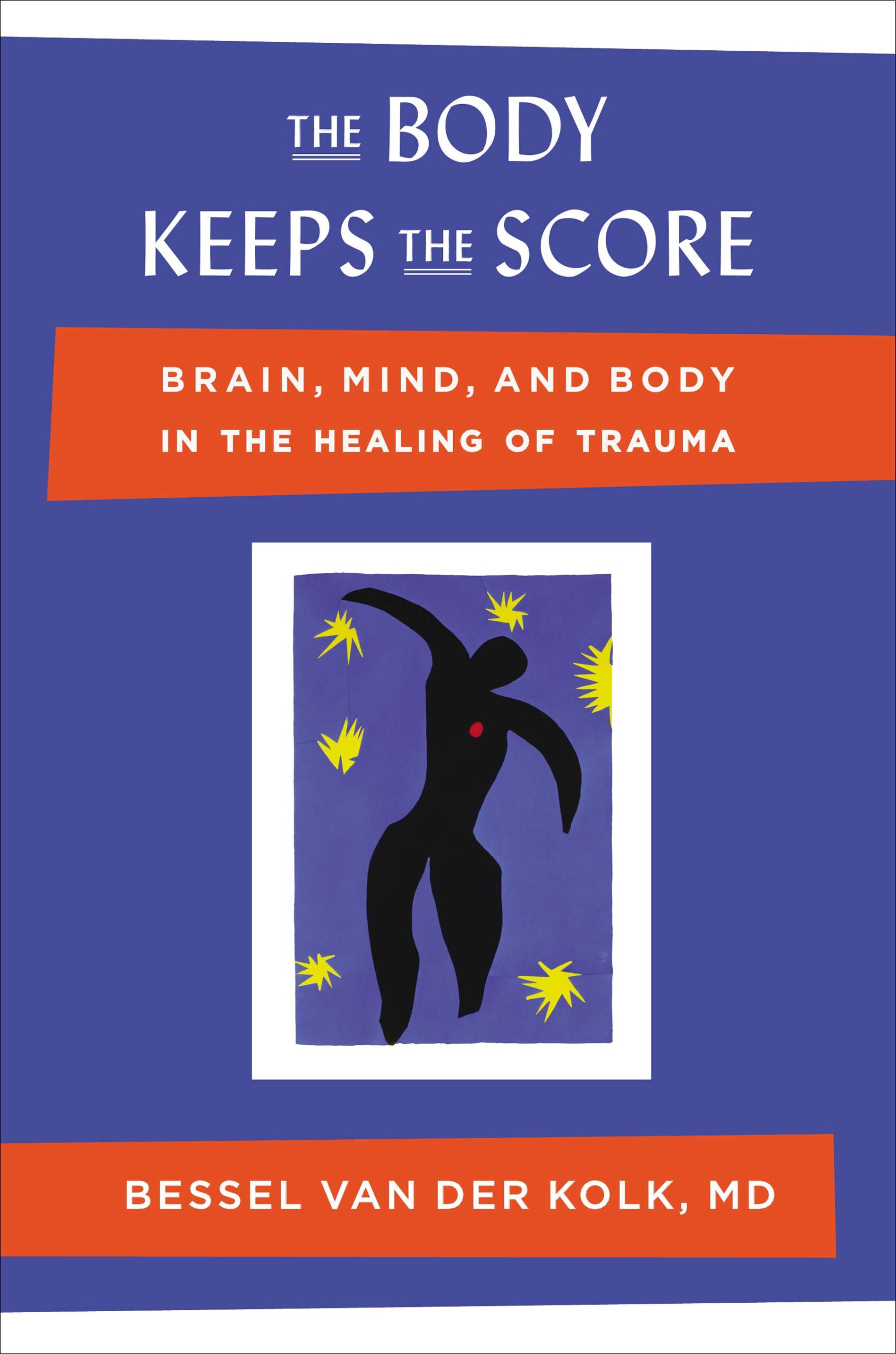
The Body Keeps the Score: Brain, Mind, and Body in the Healing of Trauma

The following is an excerpt from The Body Keeps the Score: Brain, Mind, and Body in the Healing of Trauma by Bessel van der Kolk, MD. Reprinted by arrangement with Viking, a member of Penguin Group (USA) LLC, A Penguin Random House Company. Copyright © Bessel van der Kolk, MD, 2014.

****

Marilyn was a tall, athletic-looking woman in her mid-thirties who worked as an operating-room nurse in a nearby town. She told me that a few months earlier she’d started to play tennis at her sports club with a Boston fireman named Michael. She usually steered clear of men, she said, but she had gradually become comfortable enough with Michael to accept his invitations to go out for pizza after their matches. They’d talk about tennis, movies, their nephews and nieces—nothing too personal. Michael clearly enjoyed her company, but she told herself he didn’t really know her.

One Saturday evening in August, after tennis and pizza, she invited him to stay over at her apartment. She described feeling “uptight and unreal” as soon as they were alone together. She remembered asking him to go slow but had very little sense of what had happened after that. After a few glasses of wine and a rerun of “Law & Order,” they apparently fell asleep together on top of her bed. At around two in the morning, Michael turned over in his sleep. When Marilyn felt his body touch hers, she exploded—pounding him with her fists, scratching and biting, screaming, “You bastard, you bastard!” Michael, startled awake, grabbed his belongings and fled. After he left, Marilyn sat on her bed for hours, stunned by what had happened. She felt deeply humiliated and hated herself for what she had done, and now she’d come to me for help in dealing with her terror of men and her inexplicable rage attacks.

My work with veterans had prepared me to listen to painful stories like Marilyn’s without trying to jump in immediately to fix the problem. Therapy often starts with some inexplicable behavior: attacking a boyfriend in the middle of the night, feeling terrified when somebody looks you in the eye, finding yourself covered with blood after cutting yourself with a piece of glass, or deliberately vomiting up every meal. It takes time and patience to allow the reality behind such symptoms to reveal itself.

Terror and Numbness

As we talked, Marilyn told me that Michael was the first man she’d taken home in more than five years, but this was not the first time she’d lost control when a man spent the night with her. She repeated that she always felt uptight and spaced out when she was alone with a man, and there had been other times when she’d “come to” in her apartment, cowering in a corner, unable to remember clearly what had happened.

Marilyn also said she felt as if she was just “going through the motions” of having a life. Except for when she was at the club playing tennis or at work in the OR, she usually felt numb. A few years earlier she’d found that she could relieve her numbness by scratching herself with a razor blade, but she had become frightened when she found that she was cutting herself more and more deeply, and more and more often, to get relief. She had tried alcohol, too, but that reminded her of her dad and his out?of?control drinking, which made her feel disgusted with herself. So instead she played tennis fanatically, whenever she could. That gave her a feeling of being alive.

When I asked her about her past, Marilyn said she guessed that she “must have had” a happy childhood, but she could remember very little from before age twelve. She told me she’d been a timid adolescent, until she had a violent confrontation with her alcoholic father when she was sixteen and ran away from home. She worked her way through community college and went on to get a degree in nursing without any help from her parents. She felt ashamed that during this time she’d slept around, which she described as “looking for love in all the wrong places.”

As I often did with new patients, I asked her to draw a family portrait, and when I saw her drawing, I decided to go slowly. Clearly Marilyn was harboring some terrible memories, but she could not allow herself to recognize what her own picture revealed. She had drawn a wild and terrified child, trapped in some kind of cage and threatened not only by three nightmarish figures—one with no eyes—but also by a huge erect penis protruding into her space. And yet this woman said she “must have had” a happy childhood.

As the poet W. H. Auden wrote:
Truth, like love and sleep, resents
Approaches that are too intense.

I call this Auden’s rule, and in keeping with it I deliberately did not push Marilyn to tell me what she remembered. In fact, “I’ve learned that it’s not important for me to know every detail of a patient’s trauma. What is critical is that the patients themselves learn to tolerate feeling what they feel and knowing what they know.” This may take weeks or even years. I decided to start Marilyn’s treatment by inviting her to join an established therapy group where she could find support and acceptance before facing the engine of her distrust, shame, and rage.

As I expected, Marilyn arrived at the first group meeting looking terrified, much like the girl in her family portrait; she was withdrawn and did not reach out to anybody. I’d chosen this group for her because its members had always been helpful and accepting of new participants who were too scared to talk. They knew from their own experience that unlocking secrets is a gradual process. But this time they surprised me, asking so many intrusive questions about Marilyn’s love life that I recalled her drawing of the little girl under assault. It was almost as though Marilyn had unwittingly enlisted the group to repeat her traumatic past. I intervened to help her set some boundaries about what she’d talk about, and she began to settle in.

Three months later Marilyn told the group that she had stumbled and fallen a few times on the sidewalk between the subway and my office. She worried that her eyesight was beginning to fail: She’d also been missing a lot of tennis balls recently. I thought again about her drawing and the wild child with the huge, terrified eyes. Was this was some sort of “conversion reaction,” in which patients express their conflicts by losing function in some part of their body? Many soldiers in both world wars had suffered paralysis that couldn’t be traced to physical injuries, and I had seen cases of “hysterical blindness” in Mexico and India.

Still, as a physician, I wasn’t about to conclude without further assessment that this was “all in her head.” I referred her to colleagues at the Massachusetts Eye and Ear Infirmary and asked them to do a very thorough workup. Several weeks later the tests came back. Marilyn had lupus erythematosus of her retina, an autoimmune disease that was eroding her vision, and she would need immediate treatment. I was appalled: “Marilyn was the third person that year whom I’d suspected of having an incest history and who was then diagnosed with an autoimmune disease—a disease in which the body starts attacking itself.”

After making sure that Marilyn was getting the proper medical care, I consulted with two of my colleagues at Massachusetts General, psychiatrist Scott Wilson and Richard Kradin, who ran the immunology laboratory there. I told them Marilyn’s story, showed them the picture she’d drawn, and asked them to collaborate on a study. They generously volunteered their time and the considerable expense of a full immunology workup. We recruited twelve women with incest histories who were not taking any medications, plus twelve women who had never been traumatized and who also did not take meds—a surprisingly difficult control group to find. (Marilyn was not in the study; we generally do not ask our clinical patients to be part of our research efforts.)

When the study was completed and the data analyzed, Rich reported that the group of incest survivors had abnormalities in their CD45 RA?to?RO ratio, compared with their nontraumatized peers. CD45 cells are the “memory cells” of the immune system. Some of them, called RA cells, have been activated by past exposure to toxins; they quickly respond to environmental threats they have encountered before. The RO cells, in contrast, are kept in reserve for new challenges; they are turned on to deal with threats the body has not met previously. The RA?to?RO ratio is the balance between cells that recognize known toxins and cells that wait for new information to activate. In patients with histories of incest, the proportion of RA cells that are ready to pounce is larger than normal. This makes the immune system oversensitive to threat, so that it is prone to mount a defense when none is needed, even when this means attacking the body’s own cells.

Our study showed that, on a deep level, the bodies of incest victims have trouble distinguishing between danger and safety. This means that the imprint of past trauma does not consist only of distorted perceptions of information coming from the outside; the organism itself also has a problem knowing how to feel safe. The past is impressed not only on their minds, and in misinterpretations of innocuous events (as when Marilyn attacked Michael because he accidentally touched her in her sleep), but also on the very core of their beings: in the safety of their bodies.

Note: Find out about Bessel’s new in-depth, online Trauma Certificate Course

Bessel van der Kolk on Trauma, Development and Healing

Talking About it Doesn’t Put it Behind You

David Bullard: Bessel, you are the medical director and founder of the Trauma Center at Justice Resource Institute and professor of psychiatry at the Boston University School of Medicine. You have been one of the most influential and outspoken clinicians, educators and researchers contributing to our understanding of trauma and its treatment.
I don’t remember reading a professional book in several intense sittings like I just did with your new book, The Body Keeps The Score: Brain, Mind, and Body in the Healing of Trauma. It’s been praised by everyone from Jon Kabat-Zinn and Francine Shapiro to Jack Kornfield, Peter Levine and Judith Herman, who called it a “masterpiece that combines the boundless curiosity of the scientist, the erudition of the scholar, and the passion of the truth teller.” (Read an excerpt from the book accompanying this interview.)
Let me start with some basics: Could you say something about why talk therapy alone doesn’t work when treating trauma?
Bessel van der Kolk: From my vantage point as a researcher we know that the impact of trauma is upon the survival or animal part of the brain. That means that our automatic danger signals are disturbed, and we become hyper- or hypo-active: aroused or numbed out. We become like frightened animals. We cannot reason ourselves out of being frightened or upset.
Of course, talking can be very helpful in acknowledging the reality about what’s happened and how it’s affected you, but talking about it doesn’t put it behind you because it doesn’t go deep enough into the survival brain.
DB: Would you say that is one of the distinctions between your work and Edna Foa’s “prolonged exposure therapy”? In a New Yorker article on trauma, Foa talked about rewriting memories, rather than destroying them, and describes her work with a patient with PTSD who had been raped years before: “We asked her to tell the story of that New Year’s Eve (when the rape occurred) and repeat it many times….to distinguish between remembering what happened in the past and actually being back there…and when, finally, the woman did that she realized that the terror and her rape were not her fault.”That sounds like cognitive learning.
Bv: That’s a lovely example of the ability of talk to get a better perspective. But there is a mistaken notion that trauma is primarily about memory—the story of what has happened; and that is probably often true for the first few days after the traumatic event, but then a cascade of defenses precipitate a variety of reactions in mind and brain that are attempts to blunt the impact of the ongoing sense of threat, but which tend to set up their own plethora of problems. So, trying to find a chemical to abolish bad memories is an interesting academic enterprise, but it’s unlikely to help many patients. It’s a too-simplistic view in my opinion. Your whole mind, brain and sense of self is changed in response to trauma.
In the long term the largest problem of being traumatized is that it’s hard to feel that anything that’s going on around you really matters. It is difficult to love and take care of people and get involved in pleasure and engagements because your brain has been re-organized to deal with danger.
It is only partly an issue of consciousness. Much has to do with unconscious parts of the brain that keep interpreting the world as being dangerous and frightening and feeling helpless. You know you shouldn’t feel that way, but you do, and that makes you feel defective and ashamed.

EMDR and Body Awareness Approaches to Trauma Treatment

DB: You are a big proponent of body awareness approaches to trauma treatment—and for a fully lived life. For example, you’ve done research on yoga for trauma survivors and recommend yoga for patients. I saw recently that your Trauma Center offers trainings to yoga teachers in working with the trauma of their students. You also speak very highly of the body-oriented therapies of Peter Levine and Pat Ogden, and especially of EMDR. You devote a whole chapter to your learning EMDR and examples of your use of it.
Bv: We have done the only NIMH-funded study on EMDR. As of 2014, the results of that study were more positive than any published study of those who developed their PTSD in reaction to a traumatic event as an adult.
There are opinions and there are facts.
Traumatized people often become insensible to themselves. They find it difficult to sense pleasure and to feel engaged. These understandings force us to use methods to awaken the sensory modalities in the person.
The facts are that the EMDR study was spectacularly successful in adults, a bit less with childhood trauma–at least not in the short period of time (eight 90-minute sessions) in the research protocol. But our research found that the impact of trauma is in the somatosensory self, trauma changes the insula, the self-awareness systems. Traumatized people often become insensible to themselves. They find it difficult to sense pleasure and to feel engaged. These understandings force us to use methods to awaken the sensory modalities in the person.
DB: The following quote from your book beautifully addresses some of this:
“The neuroscience of selfhood and agency validates the kinds of somatic therapies that my friends Peter Levine and Pat Ogden have developed…. [In] essence their aim is threefold:

  • to draw out the sensory information that is blocked and frozen by trauma;
  • to help patients befriend (rather than suppress) the energies released by that inner experience;
  • to complete the self-preserving physical actions that were thwarted when they were trapped, restrained, or immobilized by terror. 

Our gut feelings signal what is safe, life sustaining, or threatening, even if we cannot quite explain why we feel a particular way. Our sensory interiority continuously sends us subtle messages about the needs of our organism. Gut feelings also help us to evaluate what is going on around us. They warn us that the guy who is approaching feels creepy, but they also convey that a room with western exposure surrounded by daylilies makes us feel serene. If you have a comfortable connection with your inner sensations—if you can trust them to give you accurate information—you will feel in charge of your body, your feelings, and your self” (p.96).

EMDR trainers now seem to be focusing more on sensory modalities than when I first was taught about EMDR, and they also use “resource installation” (Leeds) and more recently “dyadic resourcing” (Manfield). But if there has been an identified single trauma that doesn’t resolve after several sessions, they look for an older “feeder memory,” and get there by asking the patient to focus on body sensations to see if he or she has ever felt those sensations before. It often is a gateway to an earlier trauma.
Bv: A lot of different schools do that, where the body is a pronounced part of therapy. My own teacher, Elvin Semrad, in the early 1970s in Boston, was very somatically oriented; same thing for Milton Erikson and many schools of hypnotherapy. Most people I hang out with who work with traumatic stress are somatically oriented.

The Limits of CBT

DB: The popular media are often puzzlingly ignorant about the nature of trauma and its treatment. You are very well aware of this, but an otherwise interesting article in the May, 2014 issue of The New Yorker magazine stated that a study “published in Nature in 2010, offered the first clear suggestion that it might be possible to provide long-term treatment for people who suffer from PTSD and other anxiety disorders without drugs.” That article never even mentioned EMDR, which was listed in a 1998 task force report of the Clinical Division of the American Psychological Association as being one of three psychological therapies (together with exposure and stress inoculation therapy) empirically supported for the treatment of PTSD. How could they miss that?
Bv: Well, they often get things not quite right! It intrigues me how the public is much more fascinated with the potential of false memories in patients than in the gross distortions of our society’s memory of trauma.
Articles like the one you cited often relate to the study of memories in mice. It is a huge leap, of course, from rodents to human beings, which not only leads to misinformation about the nature of traumatic stress and its treatments, but also about the rather trenchant differences between humans and mice. Humans are profoundly social animals—everything we do and think is in relation to a larger tribe. Our brains are cultural organs. It probably has something to do with people’s temperaments; people who do rodent research are drawn to the simplicity of rodent brains. In order to work with humans you need to have a taste for culture, complexity and uncertainty. People would be astonished if a psychotherapist gave advice to rodent researchers on how to run their labs! But the popular press takes the liberty of making these misinformed leaps with the general public all the time.
DB: How best to treat trauma is a crucial question, of course. You saw CBS’ 60 Minutes television show that first aired in November, 2013, describing a Veterans Administration program treating war veterans using “cognitive processing therapy” and prolonged exposure treatment methods. Your understanding of and approach to treating trauma is very different. Can you address a couple of points that distinguish your views from those presented by that VA treatment program?
Bv: Cognitive Behavioral Therapy (and “Trauma Focused CBT”), talk therapies, and prolonged exposure therapies can make some changes in people’s distress, but traumatic stress has little to do with cognition—it emanates from the emotional part of the brain that is rewired to constantly send out messages of dangers and distress, with the result that it becomes difficult to feel fully alive in the present. Blasting people with the memories of the trauma may lead to desensitization and numbing, but it does not lead to integration: an organic awareness that the event is over, and that you are fully alive in the present. The VA seems to be surprised by how many veterans drop out of prolonged exposure therapy. It would be helpful for them to find out why, but the likely answer is that it is re-traumatizing them.
DB: More recently, there was the profile of your work with trauma in the Sunday Magazine of the New York Times (May 22, 2014). The author shadowed you for a month, and it seemed to me that the article minimized the outcome of the clinical demonstration you did with an Iraqi war veteran at an Esalen Institute workshop.
Bv: The current Family Therapy Networker magazine just ran a piece about all the inaccuracies in that article, and the difficulties journalists have in getting the story straight. “Eugene” was the participant in the workshop, and he said “The takeaway when I read [the New York Times article] was that I was confused by the experience and that it didn’t help, which just isn’t true…When I spoke with the reporter, I said very positive things about the concrete ways that it helped me in terms of physical symptoms that disappeared, and also the fact that Dr. van der Kolk recommended people for me to work with afterward. He really spent some time finding a good recommendation for EMDR, and it really helps.” He wrote a letter to that effect and they wouldn’t publish it. I just got an email from him with a picture of my new book saying, “Thank you for helping me to regain the capacity for calmness and focus to be able to engage, and read books again.”
DB: The New York Times article also quoted sound bites from some other researchers, seemingly questioning your work, but later corrected some misinformation.
Bv: That’s another intriguing issue. There seems to be a tendency among therapists to become very religious about their own particular method—some seem to be more committed to their method than to the welfare of their patients. When patients don’t improve, they blame their resistance, and slam the people who point out that one size never fits all. The New York Times article also alluded to the Roman Catholic Church’s problems with clergy abuse and trying to defend itself by claiming that these plaintiffs suffered from “false memories,” and were the victims of “repressed memory therapy.” Testifying on behalf of pedophiles became a whole industry that seems to have entirely disappeared now that these trials are over.
DB: The newspaper did publish your brief (and, I thought, restrained!) rejoinder clarifying the issues presented, and you received an overwhelmingly supportive response in other letters to the editor and online comments. Here’s an excerpt from your letter to the New York Times:
Trauma is much more than a story about the past that explains why people are frightened, angry or out of control. Trauma is re-experienced in the present, not as a story, but as profoundly disturbing physical sensations and emotions that may not be consciously associated with memories of past trauma. Terror, rage and helplessness are manifested as bodily reactions, like a pounding heart, nausea, gut-wrenching sensations and characteristic body movements that signify collapse, rigidity or rage…. The challenge in recovering from trauma is to learn to tolerate feeling what you feel and knowing what you know without becoming overwhelmed. There are many ways to achieve this, but all involve establishing a sense of safety and the regulation of physiological arousal.
Bv: I also mentioned in the Networker article, “What happened …is a reflection of the incredible difficulties society has with staring trauma in the face and providing people with the facts of what happens, how bad it is, and how well treatments work.”

Talent and Compassion Aren’t Enough

DB: I appreciate your emphasis on research and fact-based discussions versus theoretical ones. Along those lines, George Silberschatz, a past-president of the international Society for Psychotherapy Research, said in a recent interview that the between-therapist effects were as large if not larger than the between-treatment effects in current psychotherapy research, and this is perhaps from non-specific treatment effects.
Bv: Well, talent and compassion are central elements of being an effective therapist, but learning to feel your feelings and be in charge of your self, and working with someone who knows how to deal with bodily sensations and impulses can make all the difference between visiting an understanding friend once a week, and actually healing your trauma.
DB: Could it relate to Stephen Porges’ description of the Polyvagal Theory and the social engagement system? The nonspecific treatment effects from psychotherapy research seem to be powerful about the therapist helping to create a safe environment.
Bv: I have been very much inspired by Porges’ work. The reason that Porges has become an important part of our world is his finding that trauma interferes with face-to-face communication. It is very important how you get regulated in the presence of other people. We need to learn very specific ways to activate the social engagement system. Sitting in your chair and chatting might not always be the most effective way of doing that.

Porges’ work was very helpful and clarifying about where in the brain trauma makes it difficult to feel comfort, to feel intimate and connected with other people. Knowing those things can help therapists to become more conscious about the specifics of their interactions, and should become part of the training of therapists. For example, I recently took a month-long intensive training course for Shakespearean actors to learn how the modulations of my voice, the configurations of my facial muscles, and the attitudes of my body affect my self-experience, and that of the people around me.
Porges’ work points to the importance of working with the reptilian brain—the brain stem, as well as the limbic system. We need to teach breathing and movement and work with the parts of the brain that are most impacted by trauma—areas that the conscious brain has no access to.
So I am dubious about the nonspecific relational impact of treatment on benefiting traumatized individuals. Seeing someone nonspecifically does not help the fear circuits and that collapsed sense of self. We need to learn very specific ways to activate the social engagement system. Sitting in your chair and chatting might not always be the most effective way of doing that.
DB: A colleague of yours from your Harvard days, neuroscientist Catherine Kerr, recently writing about mindfulness research, said:
The placebo effect is usually defined, somewhat tortuously, as the sum of the nonspecific effects that are not hypothesized to be the direct mechanism of treatment. For example, having a face-to-face conversation is not hypothesized as what makes psychotherapy work—you could have a face-to-face conversation with anybody. But for some reason, if you go every week to therapy, you are going to get better. But you could talk about the weather! When we perform these rituals with a desire to get better, we often do. We now know that a lot of the positive therapeutic benefit from psychotherapy and from various pain drugs may come from that initial context; it often has nothing to do with the specific treatment that is being offered. It is really just about the person approaching a situation with a sense of hope and being met by something that seems to hold out that hope (October 01, 2014, Tricycle Magazine).
And I think Allan Schore at UCLA would say that there is “unconscious right brain to unconscious right brain communication” going on, between therapists and patients, or between any of us in close relationships that might be what is otherwise thought to be “nonspecific” in therapy research. A deep ability to be present and connect empathically with patients is easier for some individual therapists than for others. Perhaps we are discussing a situation in therapy of “necessary, but not sufficient!”
Bv: I can’t really comment on all that—you’ll have to ask Catherine Kerr and Allan Schore. I have always been a bit puzzled about that “right brain to right brain” stuff. The research shows that the part of the brain most impacted by trauma is the left hemisphere, and I would imagine that every single part of the brain is necessary for effective functioning and feeling fully alive in the present.
DB: Well, I will be interviewing Schore next month, so we now have some good material to discuss!
Bv: I’ll look forward to reading that.

Neurofeedback & Yoga

DB: Is there anything in your own thinking that you feel has significantly changed in the last couple of years due to your continuing growth in the work and in all you are exposed to?
Bv: The biggest has been my exposure to neurofeedback (a type of biofeedback that focuses on brain waves, instead of peripheral phenomena like heart rate and skin conductance). In neurofeedback you change your brain’s electrical activity by playing computer games with your own brain waves. Learning how to interpret quantitative EEG’s helped me to visualize better how the brain processes information, and how disorganized the brain becomes in response to trauma. What made it necessary to look for other, non-interpersonally-based therapies was the realization, followed by research that dramatically illustrated how being traumatized may interfere with the ability to engage with other human beings to feel curious, open and alive.
Learning how to interpret quantitative EEGs allowed me to actually visualize what parts of the brain are distorted by traumatic experiences, and this can help us target specific brain areas where there is abnormal activity and where the problem actually is.
The trauma is not the story of what happened long ago; the long-term trauma is that you are robbed of feeling fully alive and in charge of your self.
For example, for the part of the brain supposed to be in charge, after trauma it will have excessive activity, keeping people in a state of chronic arousal—making it difficult to sleep, hard to engage and to relax. We find neurofeedback can change the activity in parts of the brain to allow it to be more calm and self-observant.
In another example, the frontal lobes of traumatized people often have activity similar to that of kids with ADHD, which makes it difficult to attend with the subtlety that we need to lead nuanced lives.
DB: So would the neurofeedback be with or without exposure to a particular traumatic memory?
Bv: Again, traumatic stress results in not being able to fully engage in the present. The trauma is not the story of what happened long ago; the long-term trauma is that you are robbed of feeling fully alive and in charge of your self.
DB: You would say that also is a positive outcome from yoga and other body awareness exercises, activating and strengthening the parasympathetic nervous system?
Bv: In our NIH-funded yoga for PTSD study we saw people did considerably better after 8 weeks of yoga. It can make a contribution to help people be more present in the here and now. The whole brain gets reorganized. Some quotes from participants in that study included:

  • “My emotions feel more powerful. Maybe it’s just that I can recognize them now.”
  • “I can express my feelings more because I can recognize them more. I feel them in my body, recognize them, and address them.”

This research needs much more work, but it opens up new perspectives on how actions that involve noticing and befriending the sensations in our bodies can produce profound changes in both mind and brain that can lead to healing from trauma. When we understand these things about the brain, how it works, we learn more about how to adjust our treatments.

DB: I’ve heard you say that you do not identify as belonging to any one particular school of therapy; that you do not even identify as an EMDR therapist even though you often utilize it.
Bv: Well, that would be like a carpenter saying he was a “hammer carpenter.” We need many different tools that will work for different patients and different problems.

Meaningless Pseudo-Diagnoses

DB: Can you talk a bit about your battles to get deeper and more sophisticated understandings of trauma treatment into the professional arena? Your book recounts the research you did that identified a traumatized population quite distinct from the combat soldiers and accident victims for whom the PTSD diagnosis had been created.
Bv: Yes, well, in the early 1990’s our PTSD work group for the Diagnostic and Statistical Manual of Mental Disorders voted nineteen to two to create a new diagnosis for victims of interpersonal trauma: “Disorders of Extreme Stress, Not Otherwise Specified” (DESNOS), or “Complex PTSD” for short. But when the DSM-IV was published in May 1994 the diagnosis did not appear in the final product.
Fifteen years later, in 2009, we lobbied to have “Developmental Trauma Disorder” listed in the DSM-5. We marshaled a lot of support, such as that from the National Association of State Mental Health Program Directors, who serve 6.1 million people annually, with a combined budget of $29.5 billion.

Everybody who holds forth should have a practice, otherwise you get seduced by your ideas and don’t get confronted with the limits of your ideas in clinical practice.
Their letter of support concluded: “We urge the American Psychiatric Association to add developmental trauma to its list of priority areas to clarify and better characterize its course and clinical sequelae and to emphasize the strong need to address developmental trauma in the assessment of patients.”
It was turned down also, and a lot of criticism of DSM-5’s approach has since been levied and they have lost credibility from a variety of professional sources.
DB: You recently published the results of an international survey of clinicians on the clinical significance of a Developmental Trauma Disorder diagnosis. Can you tell us why it might be so beneficial to have such a diagnosis?
Bv: Because it would help us to start focusing on helping kids feel safe and in control , rather than labeling them with meaningless pseudo-diagnoses like oppositional defiant disorder, impulse control disorder, self-injury disorder, etc.
DB: A significant part of your career at the Trauma Center has been working with traumatized children. There is a lot in your book relevant to work with children.
Bv: Yes, with Joseph Spinazzola and Julian Ford, we are involved in studies through the Complex Trauma Treatment Network of the National Child Traumatic Stress Network, which now is comprised of 164 institutions in almost all States.
DB: You are doing so much traveling with international teaching, you are involved in ongoing research, and you have quite a large staff at the Trauma Center in Boston to manage.
Bv: About 40 people are working at the trauma center now.
DB: Are you still personally able to do one-on-one clinical work or only have a supervisory role?
Bv: Everybody who holds forth should have a practice, otherwise you get seduced by your ideas and don’t get confronted with the limits of your ideas in clinical practice.

Posttraumatic Growth and Aliveness

DB: I’ve always liked the subtitle of Peter Levine’s book Waking the Tiger: Through Trauma Into Aliveness. Others are talking about “posttraumatic growth.”
Bv: That’s what the New York Times article should have been about. The guy they described so poorly actually recouped his life. People get better by befriending themselves. People can leave the trauma behind if they learn to feel safe in their bodies—they can feel the pleasure to know what they know and feel what they feel. The brain does change because of trauma and now we have tools to help people be quiet and present versus hijacked by the past. The question is: Will these tools become available to most people?
DB: You are certainly doing your part, Bessel, by being so very active and productive. I counted 35 workshops out-of-town on your calendar for 2014, in addition to your teaching at the various medical schools in Boston, at the Trauma Center and a new certification program. Right now you are about to embark on a 10-day bo

Encounters with Suicide: A Psychotherapist Remembers Not to Forget

Forgetting Begins

Back when phones had cords and I was sixteen, my mother’s friend called our house one afternoon and told me that she had a shotgun across her lap and asked me if I could give her one good reason why she shouldn’t blow her head off with it. I was alone in the house because I had not joined my family that year on our annual summer vacation in Maine. Instead, I was flirting with an eating disorder by trying to live on iceberg lettuce with low-fat blue cheese dressing and getting up each morning at 4:30 to ride my bike two miles to the Holiday Inn just outside town where I was working as a waitress on the breakfast shift. So there I was, all by myself, trying really hard to think of the right good reason. Already I was imagining the explosion roaring through the headset, the result of my inadequate and faulty answer.

I am quite certain that I did not give her one good reason, but I must have said something that furthered the conversation, because I remember her saying, “Do you know what it is like to live with a man who hasn’t touched you in years?”

Well, no.

I think we talked for a while. I tried to imagine what a compassionate adult would say to her, and tried saying it. I offered her my mother’s phone number in Maine. There was not a telephone in the cabin, but the owners could deliver a message. My mother’s friend refused. “Oh no, I couldn’t bother her on vacation.” I was thinking that bothering my mother on vacation was the best possible idea under the circumstances, but clearly it was not going to happen. My mother’s friend told me that she was feeling desperately lonely now that her youngest child had gone to college. She told me her husband of thirty years was having an affair with a woman in her twenties. I did not want to know any of this, at least not first hand.

Gradually she came out of herself and seemed to remember that I was the kid her daughter used to babysit for. “I shouldn’t be saying all this to you,” she said. I couldn’t disagree. I made her promise that she would not shoot herself.

“You don’t need to worry,” she reassured me. “I’ll be fine. It has been a really bad couple of weeks, but I’ll be fine. My neighbor will be home from work soon. I’ll go see her.” I felt a lack of sincerity in this. “It is quite a distance from blowing your head off to visiting a neighbor, and I was quite sure our conversation had not traversed it.” But there was nothing I could do, so I said, “I’ll tell my mother to call you when she gets home.”

“Don’t call her,” she said. “Don’t bother your mother. I’ll be fine.”

I hung up the phone and put this conversation so thoroughly out of my mind that I nearly forgot to mention it to my mother when she returned from vacation, and when I did tell her I found myself experiencing a sort of delicacy and shame that precluded any mention of the shotgun. I suspect I did not even mention the threat of suicide. I can’t quite remember, but I imagine myself saying that her friend seemed unhappy.

Forgetting Returns

I remembered this incident only recently when I was sitting in session with a client who was telling me about how she was going to buy a gun in order to shoot herself. This client, now in midlife, has been suicidal to varying degrees since she was sixteen, so her thoughts were not new, but the method she was proposing was far more likely to be lethal than anything she had considered before. At one level, I was working hard to assess her immediate safety and devise a plan. At another I was aware that I was feeling oddly wooden, disconnected, and ashamed. I knew I was irritated with her, as well as anxious. She is coy, deceitful, challenging—there is a way in which she teases me with the drama of her death, a drama she has been crafting with loving care for decades, a narrative in which her final explosive act of rage sears all of us who know her. It is a story she caresses like a beloved, spoiled pet, but also one that frightens her, and I have found over the years that she is readily diverted by small gestures of empathy on my part, or that she inserts her own delaying tactics, such as the need for a pretty death dress, or her plan to be honest on the permit application for the gun regarding the purpose of her purchase.

What she will not do is explore how this story serves her, what its purposes are in her life, what it helps her to avoid. I struggle to find some way toward this conversation, but as often happens, my own thinking is muddled by anger, anxiety, and that odd sense of shame. The only question I seem to be able to articulate clearly to myself is, “Will she kill herself now?” I believe she would not, and extract a promise to that effect. The promise comes easily, almost too easily, and prompts a new discomfort: I worry she is lying because, after many years of experience, she knows what would happen if she acknowledges an active plan. In the end, we contact her husband together, and afterward I let her leave.

And when she leaves, I forget completely—not about her, but about her thoughts of suicide. At our next session, fortunately before I have a chance to reveal my forgetfulness, she reminds me, but I forget again anyway. Or maybe forgetting is not quite the right word. It just seems to fall out of my mind. I start having defensive little conversations with myself about this forgetfulness. Maybe, I tell myself, it is because I am not really worried. After all, I am as confident as I can be when she leaves that she will not kill herself. She has been doing this for over 30 years. She can’t live in a hospital. But then I worry that I should be more worried. And then it falls out of my mind again, until our next session.

Of course it is hard for all of us who are clinicians to think about suicidal clients. It is frightening. It is a sad, hostile, violent act, in which we stand to lose a great deal at many levels: most importantly our client, but also self-esteem, self-trust, and professional reputation. We fear losing our livelihood if we fail these clients. We fear blame from ourselves and others. We choose not to think about it in many ways, including by resorting immediately to hospitalization as a way of ensuring not only our client’s physical safety but our own emotional safety. We insist on safety contracts before exploring deeply with the client. We find excuses and the means to get rid of them. “We rush to make repairs before we have the courage to examine the injury, slapping bandages on wounds so deep we are afraid to see them.” We increase medications, we loosen boundaries, we are afraid to ask questions, we demand answers we want to hear. With those who make chronic threats, we can become impatient and irritated. Some of these actions are of course sometimes necessary and desirable. But often what we are feeling first and foremost is a need to put a lot of distance between ourselves and the thought of a client’s suicide. These intense feelings and avoidances are common in one way or another at one time or another to all of us as clinicians, and certainly in this case they were part of mine, but I was beginning to suspect that for me, there might be something else coming up as well.

The Roots of Forgetting

On the surface, it seemed obvious. My father’s family worked very hard to forget my grandfather’s suicide. This dramatic issue, however, seemed so far from my direct experience I wasn’t sure if I could legitimately connect it in any way to what I was noticing about my feelings and behavior with my client. On the other hand, it seemed risky to assume my own even indirect personal experience with suicide was irrelevant, so I gave it some thought.

“My grandfather hanged himself when my father was four, and my grandmother did all she could to erase every memory of him.” I know a couple of things about my grandfather that I am pretty sure are true. He was a rumrunner in Pennsylvania during Prohibition, and he brought big bands like the Dorsey brothers to local hotels and night clubs. I have seen only one photograph. He is a broad-shouldered, dark-haired man standing next to a three-year-old version of my father on a merry-go-round horse. Once after my grandmother died I went on a search of her house for evidence of his life. I thought I had hit the jackpot with a pile of photo albums in the closet of an extra bedroom. It turned out that in each of the scalloped-edged photos from the 1930s, every one held carefully in place with little black corner pockets glued to the page, she had ripped out the images of my grandfather, leaving the others standing and laughing and smiling in front of buildings and cars, unaware of the torn edges framing the emptiness where he had been.

My grandmother lied about her husband’s death for more than 30 years, claiming he had died of a variety of unlikely ailments, including back problems. Nonetheless, her feelings of abandonment, rage, and shame were palpable to everyone who knew her. Even once she had admitted the real cause of his death, her explanations were dislocated and strange, and for me, always at least secondhand. In one version my grandfather was in a mental hospital and had what we now call bipolar disorder. In another, less likely but still my preferred version, he was also in a hospital, but possibly hiding from mob associates who murdered him.

There is no one left now who knows what really happened to my grandfather, or who can really even guess why. Like in the children’s game of telephone, the stories I have heard are probably distorted beyond recognition from their original source as they have been whispered down an almost century’s long lane. Even my own memory is confused by odd and inexplicable distortions and images. I remember with crystal clarity, for example, driving with my father and hearing him tell me that my grandfather probably had an affair with one of my grandmother’s many older sisters. I remember seeing the colors out the passenger side window, rural New York in the fall: the fields yellowing, bark darkened with rain, leaves brown and drifting, hints of lavender and red, the steady green of conifers. There was only a little gray in my father’s beard. I remember not just envisioning but knowing, remembering, the dark-haired older sister I never met, more settled than the younger, more beautiful red-haired one my grandfather married. I imagined her specifically. I could see her hanging laundry on a warm day in her flower-patterned dress. I could see the intense sexiness of the seam of her stockings drawn along her slim calves from the fall of her skirt to her square-heeled shoes.

But my father is bewildered by my memory of this conversation and has no recollection of any such affair. Why have I imagined it? Why has he forgotten? I am reminded of another children’s game, where one child draws a head and folds the paper over so the drawing can’t be seen, another draws the arms and folds her part in turn, another the legs, another the feet. Once unfolded, a figure is revealed, a crazy patchwork of imaginings. This is my portrait of my grandfather.

He is for me essentially fictional, his only reality in my life the shadow he cast on those he chose to leave behind. There is no pain in his release of any claim on me, although the long, slow-burning coals of the suppressed rage that were his legacy have in their way come down to me. Yet I think that in these odd moments—with my mother’s friend, with my client—I become aware of something else my grandfather has left with me. He lives with me in my unreasonable, inherited loyalty to my cranky little gnome of a grandmother, who demanded that my father never remember, never even try to remember, his father. He lives with me when my client’s words obediently fall out of my mind. In my father’s family, it is an act of loyalty to erase my memory and bury my anger and fear. Even though he died 20 years before I was born, my own memory of my grandfather is in its way constant and precise: “I remember him by forgetting.”

Awareness and Remembering

As so often happens in therapy, it is hard to be certain that this subtle, internal shift in awareness that I experienced thinking about my inability to hold my client’s suicidality in mind produced a change in my client. The role of therapist self-knowledge and self-awareness in the course of therapy is really immeasurable, in both senses of the word—certainly not readily quantified, but equally certainly a source of lasting, profound growth for ourselves and for our clients. I know it has become easier to get past my anger, fear, and denial when my client is suicidal, and this has created a change in the quality of our conversations about it. We are less focused on management and more focused on meaning. Usually by the time we wrap up with a safety plan it has become unnecessary, more of an addendum than a centerpiece of our conversation. Between sessions, I do not forget how she has been feeling. I know I will feel deeply angry, sad, betrayed and, yes, guilty, if she kills herself one day, but whatever happens, it will not be because I have allowed that possibility to fall out of my mind. She still holds on to her fantasy of killing herself, but for some time now speaks of it not as a plan, but as a feeling. “I am feeling suicidal” for her is no longer a threat of immediate action, but a description of despair. Like partners in a dance, we have both taken steps away from the concrete and into the symbolic, for I have replaced the concrete act of forgetting with engagement and curiosity.
 

Shades of Gray: When a therapist and her client are survivors of child abuse

Not a case to wow you with

This story is about humanness, grayness, and uncertainty in practicing psychotherapy. It's not about the times I've wowed a client with my perceptiveness and incisive interpretations. Neither will I focus on times when I've made a clear misstep, like mixing up two clients' stories. This is about intentionally making an imperfect decision to accept a college student as a client who was suffering from the effects of severe childhood sexual and physical abuse, while I at the same time was dealing with my own similar past. In the case I will present, it later became clear that Callie was living with significant dissociation and identity confusion.

My decision to work with her was based partly on the difficulty of finding a better alternative. But I can now say, in retrospect, that underlying this decision was my own difficulty in acknowledging the power of my past and the strength of my defenses. In the end, did I make the right decision? I must admit the results were mixed. Like a swirling mixture of white paint with distinct flecks of black, a picture emerges for me that now, from the distance of time, reads as gray.

I've seen many times over (on both sides of the couch) this insidious grayness seeping into therapeutic relationships. My first therapist took a position that suddenly put him in frequent contact with all my peers in my graduate program—the very people I had been talking to him about. His decisions and handling of the matter brought about multiple problems involving boundaries, trust and our alliance which were painful for me and ultimately interfered in our relationship and the work.

I, too, have found that in my current position, working at a counseling center in a small, rural university, unavoidable boundary questions pop up regularly. “Do I allow a client to join a student project I'm running at the university? Do I attempt to prevent a former client from later working as a graduate assistant at our center?” When I present to a class, will clients be in the audience? I imagine most therapists unwittingly find themselves in uncertain ethical waters from time to time and that guidelines for dealing with such matters offer no off-the-shelf solutions. Instead, they must be worked through taking into account the people involved and the risks and benefits of the available options.

In this article I will examine just one type of ethical dilemma, but one that any therapist with a traumatic past must face: “When are we far enough down the path of our own healing that we can safely go back and help someone else along?” To what extent are we actually in a better position to help our fellow survivors because we can relate to their pain and have a burning desire to help them? Or are we so familiar with the client's pain that it triggers our own pain and the ensuing defenses? Or is it a little of both, and if so, what then?

Tragic life story

Callie1 first became known to me through Ella, an experienced counselor I was supervising during her doctoral internship at our center. Callie was a plucky woman in her early twenties who was referred by one of her professors. His class was working on a project that had sexual abuse as its theme, and the professor sensed from Callie's reaction that it was raising some emotional issues for her. At first, Callie denied any emotional difficulty with the project. But this stoicism proved to be a thin veneer covering a deeply wounded individual. Her life story, as she related it over the course of one and a half years of treatment with Ella and me, was the most tragic I have heard.

Callie was bounced from caretaker to caretaker from the time she was six months old until she was eight years old. At four years old, she was repeatedly sexually abused by her mother's boyfriend, causing permanent damage to her uterus. The perpetrator went to jail. Her mother, who knew about the abuse and didn't prevent it, also abused her both physically and emotionally. Indeed, Callie recalled how on her fifth birthday her mother had taken away an unopened present she had bought for her because Callie had let child protective workers into the house. Callie recalled other punishments, such as being burned with cigarettes and being locked in a room for a week.

One of the most horrific abuses occurred after a teacher told her mother that Callie preferred to write with her left hand, but should be encouraged to use her right hand. “Her mother brought Callie outside and told her to hold her left hand behind the tire of their car while she drove over it, crushing the bones.” Verbal abuse included her mother calling her vulgar names and telling her that she had never wanted Callie, and in fact hated her.

Callie was also abused by another of her mother's boyfriends. Over the years, he broke approximately eight of her bones. Once he dropped her head-first off a balcony. After the injuries, she was driven to far-away hospitals so that no one would suspect abuse.

In therapy with Ella, Callie reported that she experienced recurring depression with occasional suicidal thoughts. She had been cutting herself off and on for about seven years. Significantly, she also stated she felt different than others. This hint at identity problems would prove to be a huge understatement.

Introducing Stacie

Callie let Ella know that she trusted her, and opened up to her about these very painful past and present difficulties. “In her tenth session, Callie arrived in fancier clothes and, to Ella's surprise, referred to herself as "Stacie."” Rather than question it, Ella decided to "go with it." Realizing this as an opportunity to understand a normally hidden part of Callie, Ella asked Stacie questions about herself. Stacie, she said, protects Callie. Stacie saw herself as different from Callie. For instance, Callie didn't like her live-in boyfriend, but Stacie did and worked to keep him around. Stacie showed up again the next session. She stated that she first appeared on the scene when Callie had been sexually abused at age four. In Stacie's mind, Stacie herself was never abused. In fact, she didn't even have the same mother or last name as Callie. Stacie asked Ella not to mention her existence to Callie because Callie would "freak" if she knew about her.

Ella agreed to this request, but disclosed in supervision that she was not sure if this was the right decision or not. We discussed Callie's ultimate need to know about Stacie, but decided not to push the issue at that time. We wanted to give Stacie a chance to express herself without fear of overwhelming Callie.

It was Callie who showed up for the following session. Although she talked of forgetfulness, she didn't see it as a real problem. “If she saw books around her apartment that she didn't recognize, she would simply think to herself, "I must have bought them."”

Ella's internship was coming to an end, and the termination with Callie was not a smooth one. Two months before Ella's departure, Callie called her in crisis. Walking to her off-campus apartment the night before, Callie had been raped by a stranger. For many subsequent weeks, Callie naturally felt terrified, and would sometimes even hide in her closet at night. Although she continued to present herself as Callie during these sessions, during one session she said she felt like a child, and during another she described feeling like she was in a dollhouse with others controlling her. Her depression and cutting behaviors increased, and she hinted at feeling suicidal. Ella spent the last sessions continuing to help Callie cope with the rape, and processing her sadness about friends graduating and their therapeutic relationship ending.

Unspeakable, unthinkable and unknowable

The decision about where Callie should be seen next for therapy was not taken lightly. Ella suggested the possibility that I take her on as my client. This option made sense for several reasons: I had supervised Ella over the previous six months, so I was familiar with the case; Callie did not have transportation, money or insurance, so a workable off-campus referral would have been difficult to arrange; and, with Callie's permission, I would be able to continue consulting with Ella while working with Callie. While a referral to another therapist in our center would normally be a possibility, our center only employs one other psychologist. Callie had expressed fear of the other psychologist because she looks similar to her mother. The reasons for me to see Callie were stacking up, but the idea made me anxious.

This is where my own past enters in. Like Callie, I was sexually abused as a young child on multiple occasions. For me, it was by my father. Here, the "un" words best describe my reaction: The terror was unspeakable. The sinking feeling I felt upon realizing that my own father was capable of hurting me in that way was unthinkable. In fact, the whole experience was unknowable. It was too much to take in, too much to remember. A severing process began taking place in my brain. I now believe I would actually forget the abuse between episodes. But when the circumstances that led to abuse would recur, I would remember. In my child mind I would plan how to keep myself safe. Unfortunately, my army of stuffed toys, oversized nightgown, and tucked-in pajama shirt were surprisingly poor defenses. This thing that was too much to know would happen again. By middle school, I feared I was becoming insane because I spent so much time out of my body and things felt unreal. For instance, I would be engaged with others at school and then suddenly feel as if my connection to both myself (my identity, body and past) and my surroundings had been severed. I felt more like a consciousness than a person. I would try to behave as normally as possible until the episode passed, but it was hard.

Today, I function well. I have come a long way through my own psychotherapy. In fact, it's easy to be lulled into a sense of having made it, having survived and moved on. Occasionally, something will trigger my memories, and my defenses will rush to the rescue, warping my sense of time, place, and self. It's hard to process information at those times, which I suppose is the point of dissociation. But that state is transient and I understand it. That said, I do sometimes wonder if what seems normal to me, like episodes of dissociation, may be more abnormal than I can appreciate.

At first, I declined to take on Callie as a client, but offered to meet with her temporarily while we worked out a more appropriate referral. Soon after termination with Ella, Callie cut herself deeply enough to require hospitalization. She did not remember making the cuts. I realized that, ideally, Callie should receive treatment from an agency that had emergency back-up and a specialist in Dissociative Identity Disorder (DID). I referred her to a crime victim's center in the nearest town that specializes in trauma treatment. However, I was surprised to find that the therapist assigned to Callie was less qualified to take her on than I was. In fact, I learned that no one at the agency had experience working with DID. Although the nearest city had appropriate referrals, it was an hour and a half away.

Soon after her release from the hospital, Callie cut herself again, and was again hospitalized. Like the last time, she did not remember making the cuts. As the only therapist currently connected with her, and with an obligation to manage our students' mental health crises, I continued seeing her for crisis management.

Entering the grayness

Over these sessions, I started gaining confidence in my ability to meet with Callie. I felt like my interventions were helpful. I revisited the idea of taking her on myself. I considered the facts: By default and necessity, I had already established a therapeutic alliance with Callie; I had an understanding of her past and current difficulties; I was knowledgeable about the psychological effects of childhood trauma; and I wanted to help her. I decided to take the plunge. I offered Callie regular psychotherapy sessions and she agreed. I looked into the possibility of consulting with a DID specialist for supervision over the phone and was able to set this up. I assured myself that if I ran into personal problems doing this work, I would process them with this DID supervisor or with my informal peer supervision group. I would like to announce that I opened up and worked through my past fully in this case, but in reality, I never found the courage to do this. Although I discussed my work with Callie, along with my less-private reactions toward her, I avoided anything that had to do with my own abuse. The anxiety that would get triggered when I contemplated bringing up my past felt insurmountable.

Callie was open and disclosing with me but also seemed a bit distant. I wondered if she was reacting to my own sense of uneasiness. I was aware of an internal sensation of steeling myself when she talked. I wanted to be receptive to her, but I could feel that I was also being self-protective. I was slightly unnatural with Callie, always trying to work against my instincts to defend myself.

Nonetheless, we were making progress. “At the suggestion of my supervisor, I began to talk to Callie about her alters.” She was resistant, so I proceeded cautiously. She admitted that her boyfriend would tell her that she was other people sometimes. He told her that she would occasionally drink from a baby bottle. When he would report on her strange behaviors, she would cover her ears and start humming. She also disclosed that she stopped reading her journal because she would read things she didn't remember writing, such as entries about her mother, but from a younger perspective. At times, she would get fuzzy in session and dissociate. She would say that she did not feel she was fully in her body. We would stop and do grounding work.

One evening I received a crisis call from Callie. Her boyfriend told her she had just pulled a knife on him in a threatening manner. Despite her objections, I called an ambulance to pick her up so she could be evaluated at a hospital. She did not remember this incident either, and I suspected involvement of the alters. In fact, there was accumulating evidence that the alters were "out" quite a bit of the time.


A gift to the therapist from Stacie upon termination of therapy.
This painting depicts Callie and the alters in front of the house in which they live.

A turning point in our sessions came when, again at the suggestion of my supervisor, I asked Callie, "Is there a Stacie there?" She paused. She said that she would find things with the name Stacie around her apartment. Also, her foster mother had given her a red-haired doll named Stacy, and she had always liked that name. I explained she had presented herself as Stacie to Ella.

The next session, Callie showed up looking differently. She wore make-up, fancier clothes and smiled a lot. I asked if she was Callie. She said, "No, I'm Stacie." For the rest of the school year, until Callie graduated, I would see Stacie often. Stacie knew all about the others.

“In all, Stacie told me about all 11 different parts or alters, including herself and Callie, ranging in age from 4 to 22” (Callie's age). In Stacie's mind, they all lived in a house where they each had their own room. In addition to Stacie, I also saw the four-year-old, Tracy, who missed her "mother" (actually, Callie's elderly relative who took care of her for several years). Jenna, who was sad, angry, and wanted to die, presented herself as well. Jenna called one day to tell me that her ribs hurt and she didn't understand why no one would take her to the hospital.

By the time of graduation, evidence of improvement came when Stacie started whispering things to Callie. Callie was apprehensive, but also intrigued at the prospect of getting in touch with another part of herself.

The silver lining

As we came to the end of the school year and were facing termination due to Callie's graduation, we talked about our relationship. She told me that she liked me and that I was one of only five people she trusted. However, she also disclosed her initial reactions to me that confirmed some of my fears. “She said that in our early sessions she felt I didn't like her because I tend to sit back in my chair and talk in the lower range of my natural voice.” She initially reacted to this, she said, by not liking me either, so she wouldn't get hurt. Also, she said that she did not find me as warm and open as Ella. However, she reported that her feelings changed over time and she grew to like and trust me. Because this feedback was different than any of the feedback I've received over the years, I assume that I was, indeed, somehow different with Callie.

Those words were hard to hear, but they also gave me a great opportunity. Callie had some borderline tendencies, and not surprisingly, in her relationships with others, she tended to split. I pointed out that she seemed to put people into two camps: perfect people who she saw as her saviors, and others who she viewed as "all bad." She immediately accepted this observation, and added that saviors who fail her fall right down into the "all bad" category. I told her that I hoped that our relationship helped her to see that there's actually gray in the world. I had my imperfections, but she had found that she could still like me, trust me, and connect to me overall.

And so, out of the gray imperfect mismatching of a wounded therapist with a wounded client, came a lesson that I hope has staying power for Callie. Sometimes gray is what we get, and sometimes gray is enough.

I will never know if I made the right decision in accepting Callie as a client. Healing from early trauma is a process with no definite end point. I do know that the timing was not ideal. I had not fully appreciated the power of my past, and was too ashamed and avoidant to seek out more intensive supervision when I suspected it was interfering. Indeed, based on my experience in working with Callie, I have become even more convinced of the value for therapists who are survivors to explore their past in supervision when working with client survivors. When ready to do this, I believe he or she will be in a more powerful position to help his or her fellow survivors.

Perhaps most therapists are never fully trained or completely ready to work with such overwhelming stories of child abuse, but certainly getting extra support for myself would have eased the burden. Perhaps if I had disclosed to my supervisor my concerns about taking on Callie due to my own past, she could have helped me talk through the pros and cons and we could have made a decision together. If we decided that I should go ahead and work with Callie, which I suspect would have been the case, I would have felt supported and therefore more confident in my decision. I believe this would have made me more confident in sessions with Callie.

Mostly though, I simply needed to express to someone the emotional hurt I felt—for the both of us—when Callie talked about the abuse and her longing for a loving parent. Her therapy was emotionally difficult for me, as well as for her. With more support, I believe I could have been less self-protective and more open to her pain.

It's been a year since Callie graduated from college. She has contacted me sporadically over the course of the year. After graduating, she moved away to live and work in the post-academic world—a heroic but ultimately shaky endeavor. She had searched for a therapist in her new city, but no one would take her on due to liability concerns. At her new job, coworkers began telling her that she seemed like different people at different times. Her thoughts turned to suicide. She moved back to her college town and was taken in by a middle-aged couple who had helped her through her college years.

By coincidence, after not hearing from Callie in months, I ran into Stacie last week. Smiling and radiant, she gave me a big hug. Her hair color had changed since I last saw her; she had added a reddish hue. She said she had dyed it on impulse the night before. I thought of her beloved Stacy doll. I wondered what Callie would think of it.

Thunderclouds, weapons and armor

Gray is the color of thunderclouds, weapons, and armor. We often use the word gray to describe situations of uncertainty. A blending of black and white, it represents a mixture of good and bad, right and wrong, danger and safety. It's harder to take a stand on gray areas. It's often not clear if we should turn back or soldier on. Ironically, gray is also a red flag. It warns us that if we decide to soldier on, we must go forward with humility and support, things which could have helped me to face myself more fully as a person and as a therapist. Whereas the basic supervision and consultation I received was quite invaluable, I was often left adrift and rudderless without the support and resources that I wish I would have engaged.

Just as Callie struggled to understand the gray areas in life, so did I. Gray is not something we choose, but so often something we get anyway. Gray was what I gave to Callie. I hope it was enough.

In such moments of hope paired with self-doubt, I remind myself what I told Callie: Sometimes we must accept a level of disappointment in order to take in the positives. We are called to accept our limitations, and do what we can do, even with the messiness and inherent contradictions life offers us. On one hand, my own childhood trauma offered me a way to understand and connect to Callie and her house full of alters; on the other, it kept me from being fully present with myself and Callie.

“Grayness is real, so running from it does little for those like Callie or for our own growth as therapists and human beings.” Perhaps in the meeting of my grayness with hers, some meaningful realness was forged that can sustain her in the roughest of times. Remembering that gray truth helps to sustain me, as well.

Notes

1 Names are changed to pseudonyms throughout the article, including the author.