A Behavior Treatment Plan as a Psychological MRI

As a psychotherapist providing services in nursing facilities, I am accustomed to using a variety of forms, including initial assessment, progress notes, and treatment plans. I have come to appreciate that the behavioral treatment plan may be the most powerful, yet the most overlooked or avoided, clinical form.

Like what you are reading? For more stimulating stories, thought-provoking articles and new video announcements, sign up for our monthly newsletter.

My clinical task is to provide direct assessment and treatment services to nursing facility residents. Yet I also have an obligation to offer insights that help the facility caregivers to better understand and more effectively manage the sometimes-troubling behaviors demonstrated by that resident. Direct care staff persons at the nursing facility might observe only the most obvious and observable element of the resident’s behavior—the unkempt appearance, the irritable defensiveness, the argumentative refusals of care, the unwelcome sexual remarks, the tearfulness, the yelling, the social avoidance, or the aggressive and abusive language aimed at them. In response, the caregiver may react in a personal manner, with expressions of indignation or criticism, or even patronizing efforts at persuasion. What I have often seen lacking is a keen awareness of the inner meanings and motives behind those behaviors; the ways they might reflect or represent symptoms of varied medical and psychological conditions and the ways that the caregivers’ responses might increase or decrease the intensity and duration of those symptomatic behaviors.

Nurses and clinical aides might occasionally notice the assessment and progress notes that I and fellow clinicians generate but at the same time never read those documents. However, the nurse or aide might not readily gain a new understanding of the resident even if they did read those forms. A behavior treatment plan, though, can provide a window into the psychological nuances that illuminate and explain the actions of the resident. The behavior treatment plan can be like a psychological MRI that provides an inside view of factors influencing a resident’s behavior.

A behavior treatment plan is effective because it does not simply get written and quietly entered in the chart. It requires review, explanation, and education so the facility staff persons can understand and implement the plan. Brief staff in-service training follows the writing of a plan so that it can be introduced and clarified. Those trainings allow for discussions that may be a first opportunity for the staff persons to readily understand the psychiatric diagnoses of the residents and how their psychiatric symptoms are behaviorally manifested.

Resident: Leslie (Identifying information has been altered from the example below.)

Diagnosis: 295.70 Schizoaffective Disorder, Bipolar Type; Epilepsy; Developmental Disability due to Fetal Alcohol Syndrome; and PTSD Associated with Childhood Sexual Abuse.

Presenting Problem/Target Behavior: Leslie demonstrates unstable affect with frequent bouts of crying or expressions of anger; fluctuating levels of alertness and mental clarity; and apparent passive-aggressive and/or attention-seeking behaviors such as self-admittedly putting herself on the floor and crawling towards the bathroom to express her anger over perceived delay in staff response to her need to use the toilet. In general, Leslie sometimes displays a child-like manner with inconsistent cooperation with care and treatment and a tendency to over-dramatize daily upsets in ways that elicit comforting and extra involvement of staff persons.

Description of Resident & History of Problem: Leslie is a 51-year-old single woman with epilepsy and major mental illness, developmental problems, and past trauma. Considering the above diagnoses, it is to be anticipated that she might demonstrate problems with her social behaviors and critical thinking skills. It is important to remember that her actions reflect serious problems with brain development and functioning and do not simply represent “bad behavior.” Behavior and cognition can be significantly affected for persons with epilepsy as well as by unwanted effects of antiepileptic drugs. Also, a person with the above diagnoses can be burdened by painful feelings of social stigma and by difficulties establishing and sustaining trusting relationships with others.

Clinical Assessment of Behavior & Resident: Leslie experienced developmental disability due to effects of Fetal Alcohol Syndrome. She later developed Schizoaffective Disorder, Bipolar Type. Her psychosocial development was further undermined by sexual abuse by her father, the forced termination of a resulting pregnancy, and associated traumatic consequences.

It is well known that consequent to long-term institutional care, some persons can develop dysfunctional patterns of behavior referred to as “learned helplessness.” These factors provide a background context in which to view and understand the behavior problems demonstrated by Leslie. The resident is not to be blamed or negatively judged for having acquired a child-like, passive-aggressive, and dependent style of coping and problem solving. At the same time, Leslie cannot be expected to simply snap out of it and immediately display a fully adaptive adult style of coping with daily stresses. Over time and with consistent encouragement and reinforcement, Leslie can be helped to learn and practice dealing with problems and expressing emotions in more reasonable and mature and independent ways. Presently, she is effective in soliciting emotional support and the close and helpful attentions of others by displaying emotional distress (tears or anger) or by taking risks, such as placing herself on the floor in defiance, that draw others closer to her.

Behavioral Interventions: The main purpose or intent of this behavior plan is to foster, encourage, and reward small progressive steps towards more self-reliant adult ways of meeting her needs. Leslie directly contributed to the development of this behavior plan. I shared with her the feedback and observations and stated concerns of staff persons and elicited from Leslie her own ideas for ways to address those concerns.

Leslie offered the following points: “I will not express anger by doing unsafe things like putting myself on the floor; I learned my lesson good.” “I will try to show good emotional self-control.” In the event that she was to again lower herself to the floor, Leslie suggested that staff persons should stand safely nearby and “let me try to pull myself up.” Leslie said, “Let me do more on my own.” “If I am crying or angry, let me alone for a while and I’ll calm myself down.”

Staff persons interacting with Leslie should keep in mind the general principle of promoting her growing maturity and improved ability to soothe her own upset emotions and to work constructively and cooperatively with staff to meet her needs. Avoid correcting her with scolding or display of annoyance, as that could trigger withdrawal or passive-aggression or tearful emotional collapse. Invite Leslie to brainstorm ideas for ways to correct problems, resolve dissatisfactions, compromise with others, or be more compliant with needed care and treatment. Encourage Leslie to take deep breaths and to collect herself emotionally before engaging in such brainstorming or came back later if she needs more time to soothe her emotions. Expect Leslie to adopt a more measured and sensible sets of problem-solving skills, but do not become frustrated or annoyed by the unavoidable delays and lapses she will continue to display along the way. Use your words and actions as ways to invite her into more mutually rewarding adult ways of coping. Guide her toward the acquisition of genuinely adult skills and viewpoints while remaining patiently aware of the deep and longstanding obstacles that interfere with her having already learned those methods.

***

I met with the unit nurses and aides to review and discuss this treatment plan. Some had not been aware of Leslie’s history of Fetal Alcohol Syndrome, of her hearing voices, or of her history of sexual assault. Some were surprised by the discussion of epilepsy and psychological and behavioral symptoms. Yet a renewed sense of compassion and of helpful mission were awakened by the conversation about ways they might aid her development—even during their ordinary and routine tasks. The workers now applied the new insights and asked thoughtful questions about her specific behaviors. They felt less reactive in a personalized sense, and better prepared to shape their actions so as to improve hers.

The Practice of Behavior as Medicine

Unintended Effects

Medicine can have intended and beneficial impacts which alleviate target symptoms, or unintended and detrimental ones. The latter may be referred to as iatrogenic effects, a type of adverse outcome directly attributable to treatment, more traditionally defined as one brought about by the healer. Medications, even those designed to treat even the most innocuous conditions are not neutral—even placebos exert observable and measurable effects.

Like what you are reading? For more stimulating stories, thought-provoking articles and new video announcements, sign up for our monthly newsletter.

In the nursing facility that I work at, some of the symptoms displayed by the residents are labelled “behavioral.” In such cases, the psychiatric consultant might be asked to intervene—either with medication, a behavior plan, or with psychotherapy—to change or to eliminate the problem behavior. But shouldn’t the first question be “What exactly is behavior?” And for what reasons should a specific behavior be changed, and how?

Very often, patterns of current behavior often have roots extending back to the earliest stages of an individual’s life. Behaviors have purpose—one of which is to solve problems.

Behaviors may be directed to obtain or achieve a goal or to aid the person in avoiding or escaping a situation—but irrespective, their aim is purpose-oriented. If the psychiatrist or physician simply tries to change the surface of a behavior with medication, or with psychotherapy without understanding its purpose, we might more likely simply bring about a different type of behavior that serves the same purpose or makes it worse. So to change behavior, I as a clinician need to knowingly address the purpose or aim of that behavior.

Behavior is communicative, as well as purposive. Behavior communicates or reflects social meanings. Behaviors do not occur in a social vacuum—they always have an interactive component to them. I may notice that behavior X is bothersome or disruptive to the milieu but fail to notice that I may have contributed to or participated in the occurrence of that behavior. I have found that it is far more productive to attempt to identify (as best I can) the purpose of a behavior, and to then consider the kinds of circumstances in which that behavior X is more or less likely to occur. I must also consider how my own response to that behavior may actually make it more disruptive to the milieu or disturbing for the patient.

My reaction has equal power to displease, calm, excite, reassure, or aggravate the patient. How quickly, how abruptly or loudly, or how calmly, deliberately, and gently I act or react will have a direct and immediate impact on the wellbeing of both the patient and others nearby. I have noticed that even patients with dementia can still “read” the language of the caregiver's tone of voice and behavioral communication.

I have been most effective in my work with these patients when I intervene through purposefully calm, pleasant, and comforting actions and by avoiding loud, harsh, critical, or demeaning types of actions. Demonstrating those unpleasant types of actions tends to excite and provoke symptoms such as fear, anger, sadness, or mistrust in others. This is behavioral iatrogenesis.

Residents of a nursing facility do not simply demonstrate pleasant behaviors or problem behaviors. Simply labeling patients such as these “behavioral” diminishes them and reduces the complexity of their behavior to what is seen on the surface by those who tend to them. Each individual may exhibit some pleasant behaviors or some disruptive or problem behaviors under different conditions and circumstances. The key point for clinical staff persons is to learn to notice the specific circumstances or conditions under which a particular person will be more or less likely to display positive—or negative—behaviors.

The heart and art of behavioral management is therefore the management of my own behavior. I must constantly consider how my actions serve as good medicine or as bad medicine. In any interaction with a patient, whether it is through casual or informal conversation or within the therapeutic moment, I must consider whether I am contributing to the anxiety or sadness or embarrassment or anger of the person I am ostensibly trying to help.

Max

Max was a 59-year-old, single gentleman with a complex history of medical and psychiatric illnesses. He reported active bereavement over the death of his father. He also reported distressing anxiety over medical ailments—to the point of panic; and he reported auditory hallucinations. Max had a diagnosis of Schizophrenia and cognitive impairment associated with intracerebral aneurysm, meningioma, and encephalopathy; dysphagia with prior placement of G-tube; and decreased renal function. Two types of target behaviors had been identified for Max: repetitive questions and moaning or yelling vocalizations (“Can I have a glass of water? Can I have a glass of water?, OOOH, OOHH, OH OH”). What internal experiences motivated those actions for Max? While it might have been far easier to attribute these behaviors to his cognitive impairment and mental illness, it was more productive (and humane) to ask, “What do these actions help him to avoid or to acquire?”

Max was beset daily by significant feelings of anxiety, and he felt burdened as well by feelings of loss. He experienced acute feelings of vulnerability about his body, his well-being, and his prognosis. Sensations of bodily discomfort such as pain, thirst, or hunger triggered bouts of sharp anxiety for Max. Those target behaviors served as a barometer of the current level of obsessive anxiety he was experiencing. He tried to find relief and solace, and to communicate his distress, through those target behaviors.

During psychotherapy sessions Max had verbalized awareness that when his anxiety built he found it difficult if not impossible to curb his actions, even when he knew that he should, and that others might be annoyed by his actions. Indeed, his awareness of the frustrations of others added to his anxiety and further diminished his ability to stop or control those actions. He could not (unaided) comfortably tolerate the tension of frustration as he waited. If a care provider became annoyed or impatient with his actions, Max would notice it, his anxiety would be fueled, and the target behaviors intensified. Giving corrective attention to the surface of his actions (“Stop it, Max,” “I already gave you a drink”) would only cause then to increase—so we want to instead give supportive attention and praise to his efforts at waiting calmly and quietly (“Good job, Max, thanks for waiting”).

Nurses and nurses aides were responding with understandable yet counterproductive frustration to Max’s questions and moaning. I observed tongue clicking, eye rolling, head-shaking, and sarcastic remarks—“Oh, there he goes again”—even when Max was ten feet away from us.

I met with the unit manager, social worker, and Max’s brother/guardian to discuss the situation, and I then had three in-service training sessions with the three shifts of unit staff. After one session a nurse approached me and said, “I see now, I was getting mad at him and that made it worse.”

***

When I returned the following Wednesday, the nurse said, “Oh, Max, he’s fine; that’s not a problem anymore.” Max was quietly engaged in a craft project in the activity room.

Enhancing understanding of the problem-solving nature of the behaviors and awareness of how our actions might increase or decrease the frequency of a “problem behavior” helped to change the dynamic and direction of interactions between Max and his caregivers.

Is Psychotherapy Still an Infant Science?

The field of psychotherapy has been around for quite a while—well over 100 years. According to sociologists of science, a field only reaches “maturity” when there exists a consensus amongst those working in the field. Within psychotherapy, we have yet to reach that stage. Instead, psychotherapy is characterized by someone coming up with still another new form of therapy. What seems to be most revered is what is “new.” As therapy practitioners and researchers, we are therefore confronted with some important questions: Are we destined to continue to forget what we know and instead focus on what is new? Will it always be the case that we emphasize who, not what, is right? Will the field forever be characterized by “dogma eat dogma?” “Is there nothing about psychotherapy about which we can agree?

Like what you are reading? For more stimulating stories, thought-provoking articles and new video announcements, sign up for our monthly newsletter.

Having spent approximately 60 years teaching, researching, supervising, and practicing psychotherapy—and ruminating all these years about these questions—I believe that one day we will have answers to them. In the meantime, where do we stand? I would suggest that there are indeed a few things we have learned over the years from the convergence of both clinical observation and psychotherapy research that can provide a crude, if not basic understanding of a few points of agreement.

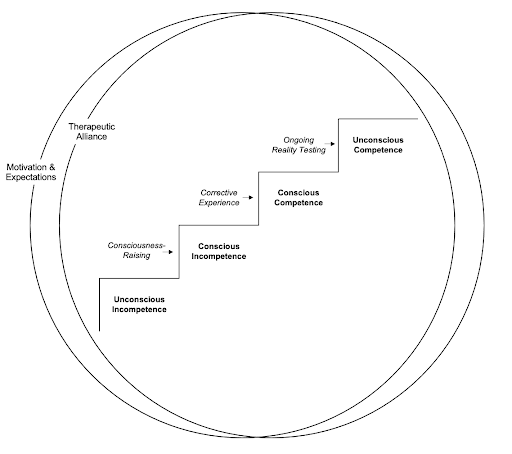
To begin with, if we step back and temporarily set aside our theoretical perspectives, it might be possible to say that most (all?) therapies proceed along somewhat similar stages of change. If effective, therapeutic change progresses as follows:

1. Unconscious Incompetence
2. Conscious Incompetence
3. Conscious Competence
4. Unconscious Competence

What does this mean? The patient comes in and says that there's something about their life that's not working, be it relational or symptomatic, but they don't know the factors that are contributing to this lack of effectiveness or incompetence. Thus, they are in an initial phase of unconscious incompetence.

As a result of the therapy—either what occurs in session or between-session self-observations—patients become more aware of the thoughts, actions, and/or emotions that may be creating problems in their life and contributing to their lack of competence. They may be misinterpreting what other people's motives are; not recognizing how their actions may be having a negative impact on others; becoming angry over not getting what they want instead of asking for something directly; and a host of other factors that are uncovered over the course of therapy. There are numerous ways that patients can come to understand why things are not working for them. Through the methods used to come to this understanding, they are now in the phase of conscious incompetence.

Becoming better aware of the reasons for their lack of effectiveness/competence may then lead to the need to function in a different way, taking into account those factors that are causing the lack of their intrapersonal or interpersonal competence. It is then that patients need to make deliberate efforts to behave, think, and/or feel differently: conscious competence.

If the therapy is successful, and over a period of time they benefit from numerous instances of corrective experiences, patients’ conscious competence may become more automatic, resulting in the final phase of unconscious competence.

In order to move patients through these phases, there are certain transtheoretical principles that cut across different schools of therapy.

  • To begin with, our patients need to have some degree of positive expectation and motivation that therapy will help. The most effective of therapies will not do anything if the patient's negative expectations and lack of motivation causes them to do nothing—or to terminate.
  • There also needs to be the presence of an optimal therapeutic alliance. Much has been written about this, and there's both research evidence and clinical observations that this is an important transtheoretical principle.
  • Helping patients to become better aware of themselves and their world can be implemented clinically in varying ways, depending on one’s theoretical approach and individualized case formulation.
  • A most important principle of change involves encouraging the patient to try out new ways of functioning—corrective experiences—that help them become more effective emotionally, cognitively and behaviorally in their lives.
  • Over the course of effective therapy, there develops a synergistic reciprocity of having corrective experiences that enhances patients’ awareness resulting in an ongoing reciprocity between corrective experiences and increased awareness—a form of ongoing reality testing.

The following is a graphic depiction of the how transtheoretical principles of change articulate with the transtheoretical stages of change in therapy:

None of this says anything about the specific techniques that different schools of therapy may use to implement the strategic principles, nor does it say anything about the overarching theoretical interpretation of why the interventions may work. At the level of abstraction that I have proposed, it clearly does not say it all. Still, it can provide the foundation for practice, training and research.
For those interested in learning more about this topic, I have written elsewhere on the topic. You can find these articles listed below.
__________

I would appreciate it if you could take this very brief survey (approximately 5 minutes) about transtheoretical principles of change: Please click here.

__________

Obtaining consensus in psychotherapy: What holds us back?American Psychologist, Issue 74, pages 484-496
Consensus in psychotherapy: Are we there yet? Clinical Psychology: Science and Practice, Issue 28, pages 267-276

Metaphor and Early Warning Systems in Psychotherapy with Narcissistic Patients

The other day, my patient Jeremiah was explaining that he could not sleep because he felt “blackmailed” by a former employee who was demanding excess severance pay. He was in what we had come to identify in our clinical work as narcissistic rage, feeling that the employee’s demands were an assault on his sense of self. But we both knew from prior work that his rage was typically triggered when he felt he had done something wrong that contributed to the situation, which brought with it a sense of shame, a common narcissistic dynamic.

Like what you are reading? For more stimulating stories, thought-provoking articles and new video announcements, sign up for our monthly newsletter.

Jeremiah’s use of the word “blackmail” was the key—you can only be blackmailed if you believe or feel that you have done something wrong and can be compromised if that information is revealed. Once we figured out what he felt guilty about, Jeremiah could acknowledge that he had a choice about paying the severance or not. In our subsequent work, the term “blackmail” has become a shared metaphor. We both now understand that it means he feels forced to give someone something that he does not want to give but feels in danger because of his guilt.

I have found that creating and maintaining a working alliance is difficult with patients suffering from narcissistic and/or borderline personality disorders. However, developing shared metaphors and creating an early warning system has been very useful in my therapeutic efforts with these particular patients.

In psychoanalysis, the core concept of transference is based on a metaphor—the patient is responding to me as if I am their parent. Within that macro-metaphor, a multitude of micro-metaphors emerge in psychotherapy—both the patient’s and my own. There is usually a great deal of unconscious material to be mined from the patient’s metaphors (e.g., the analysis of dreams is based on interpreting unconscious metaphors). The therapist’s use of metaphors is also important, because it can betray countertransference and/or can be a tool to cut through the patient’s resistance.

I have come to appreciate that these shared metaphors create what Winnicott called a “transitional space” in which the patient’s and therapist’s unconscious and conscious overlap. At its best, psychotherapy takes place in that metaphoric, or play, space. The therapist’s job is to bring the patient into a state of being able to engage fully in the metaphoric, as-if scenario—to play. With narcissistic patients, I have found it particularly difficult to develop enough trust for them to be willing to play, which requires a degree of unmonitored spontaneity, vulnerability and trust. Sometimes, when Jeremiah and I are in that play space, I forget that if I go beyond the mirroring response and make an interpretation, I might trigger his narcissistic rage. However, having inhabited that play space together over a course of years, we have developed an early warning system.

Our warning system is reciprocal—sometimes he warns me that I am treading on dangerous grounds, while other times I warn him I’m going to say something he might not like. After ten minutes of inhabiting the same play space we may have a warning interchange as in the following:

Roberta: Maybe you got drunk to get Diana to break up with you?

Jeremiah: Please be careful here.

Roberta: What just happened?

Jeremiah: I don’t want to end the session feeling the connection between us is broken.

Roberta: What did I say that threatened to break our connection?

Jeremiah: You’re making me feel ashamed.

Roberta: I’m sorry. I didn’t mean to do that. [I could have focused on his shame but thought repairing our connection was primary.]

Jeremiah: I know. I’m okay. You can go on now.

In this interchange, Jeremiah gave me a warning that he experienced what I said as a shaming response and that he was in danger of sinking into narcissistic rage.

At other times I give him an early warning:

Roberta: I want to take a risk here.

Jeremiah: Yes, it’s okay. Go ahead.

Roberta: Do you think you are experiencing your partner as if he’s your brother?

Jeremiah: Yes, I can see that. Yes, that’s right.

By warning Jeremiah that I was going to make an interpretation, he was more able to tolerate it. The warning neutralized his potential experience of humiliation.

***

I have come to value the therapeutic play space in which patients and I use various metaphors to deepen our connection and their self-awareness. The use of shared metaphors with patients like Jeremiah has allowed me to create a safe creative space for our analytic work. This has been particularly important with narcissistic patients with whom I have been deeply challenged to create a working alliance. Since these patients have a special sensitivity to injury and shaming, I have made good therapeutic use of this early warning system to reduce the chances of the rupturing the working alliance and increasing my patients’ resilience when it is broken.

To Text or Not to Text: A Vacationing Therapist

It was the second day of my vacation. Wrapped by the noonday heat and sitting on the terrace of a charming Thai house, I looked like an ordinary, relaxed tourist—shorts, a t-shirt from the local market and a glass of freshly squeezed mango juice. This time I had managed to avoid scheduling client sessions during vacation, for which I praised myself. However, my head was like a busy rush hour interchange, with work-related thoughts buzzing quickly in all directions. Even a monkey, clearly lacking in boundaries and social etiquette who decided to gobble half of my breakfast couldn’t distract me from this mental traffic. I decided that it would be a good time to sort out the emails that had accumulated during my brief absence from practice.

Like what you are reading? For more stimulating stories, thought-provoking articles and new video announcements, sign up for our monthly newsletter.

I moved to a pleasantly chilled room and opened my laptop, and as I hurried to remove spam, I nearly deleted an email with the subject line “Quality literature on social anxiety. Help!" It was the call for help that caught my eye. “N” asked me to recommend self-help books on social anxiety. In the email, he stated that psychotherapists could not help him, and that instead he had to rely on himself and the self-help literature. Although I had become accustomed to people who don’t believe in psychotherapy, the phrasing of his request seemed somehow different. I recommended what I thought would be useful books to N and then asked him how he arrived at the idea that psychotherapists could not help him. His quizzical response, and possibly a hidden challenge or invitation was “Because no single session with a psychotherapist has happened.” At that point, I became curious, and so decided to continue our conversation.

It turned out that N's social anxiety precluded both face-to-face and online visits with a therapist. He had previously approached several specialists asking for text-based sessions but was consistently refused. The psychotherapists with whom he had made these requests typically responded in a manner suggesting that they had no idea how to conduct such sessions and expressed concern that doing so would be ineffective. Interestingly, N’s written language skills suggested that he was an educated and thoughtful person, and I could feel the pain in his written words. I thought, “Despite the negative experiences he had with those therapists, he still seems to be hopeful that psychotherapy, albeit in text format, could help.”

At that moment, the promise I had made to myself not to work with clients during vacation melted like sugar in the tea I had just brewed. I agreed to having a text session with N. He became extremely enthusiastic and started thanking me, perhaps a bit too soon. The entire first session was devoted to the discussion of his feelings in connection with the multiple refusals of psychotherapists to help him. With each refusal, he had felt “even more worthless, rejected and condemned” and “did not want to interact with people at all, since even those who could help did not want to do that.” However, N had managed with impressive effort not to fall into despair but instead to keep searching for a way to battle his social anxiety. Contacting a psychiatrist for pharmacotherapy was not an option for N, at least at this point, because he clearly understood that he would not be given any prescription without a personal appointment. N tried to read papers and books on the subject, but he was not getting any better. It was at that point he had decided that perhaps he was reading improper literature, so decided it might be more effective to ask a psychotherapist for a recommendation. That is how he came to me.

I admired N’s guts and resilience, as well as his desire to cope with this illness which had created many obstacles in his life. N had read online forums suggesting that people with similar problems tend to rely on alcohol and illegally-obtained benzodiazepines to ameliorate their anxiety and alleviate their anguish, at least temporarily. N had not considered this medicinal route as a solution and understood that these would only provide short relief followed by a worsening of his symptoms. I had met similarly mindful and purposeful clients in the past, so I already admired his tenacity. He truly seemed to have faith in himself and his capabilities and wanted to re-enter the social world but needed professional psychotherapeutic support to get there.

After that first text session, N said that for the first time in a long period, he felt that he had found an ally. His hope of a successful outcome therefore strengthened while my attempt to spend a vacation without clients completely failed—we decided to keep working together.

In subsequent text sessions with N, I did pretty much the same as I would during online or face-to-face sessions, except that it took more time because typing is far more cumbersome to me than simply talking. At the end of the fourth session, N actually suggested holding the next session online, saying that “the calluses that had developed on my fingers required treatment.” While I believed that this was actually the case, I also thought that his desire to see me face-to-face represented a significant step towards progress in dealing with his social anxiety. After the seventh session, N started leaving his house, and by the eleventh, we were already “rehearsing” an appointment with a psychiatrist, which took place soon thereafter. His belief in himself and in our work, as well as our mutual commitment to the goals of therapy, helped N to progress rapidly. In a few months, he could already spend time with people including strangers while experiencing a tolerable anxiety of 6 points out of 10 according to his own assessment.

Can I be sure that I wouldn't have been among the therapists who refused N in his request for a text session? Unfortunately not. I discussed this issue with colleagues, and many of them admitted that they would not be ready to hold therapy sessions in text format. Our teachers and supervisors direct us towards face-to-face sessions, sometimes touching the nuances of online therapy, but therapy in text format is often considered with skepticism. How is it possible—not to see and hear the client? Safety is an important factor in the therapeutic relationship, and in this case, N clearly did not feel safe in any social sphere, let alone therapy. Texting felt safe for him, and I believed it was my role to honor his need for safety, so I accepted the format of our relationship on his terms. In general, but particularly after working with N, I believe therapists should honor and respect the client's desires as long as all possible and foreseeable risks are considered. In this case, it was important to understand N’s reasons for requesting text-based sessions, which seemed fair. I trusted my intuition that he was yearning for connection, but it had to be on his terms. It was for that reason alone, despite it being contrary to my typical way of practicing and being on vacation, that I accommodated him.

***

Working with N reminded me of one of the fundamental rules of psychotherapy: therapy is for the client, not the client for therapy. We spend years studying the rules of psychotherapy, and then for the rest of our professional lives, we learn to break these rules sensibly and for the benefit of the client. The “don't work on vacation” rule should probably also be considered with certain flexibility. I discovered, although somewhat reluctantly, that conducting sessions on vacation can work if the therapist has the sea, sun, and a brazen monkey nearby; and the client has a desire to change.
 

Confusion of Tongues

Confusion of Tongues

I’m not surprised when I get an email from Lara, who was my patient nineteen years ago. Lara was only ten years old when her parents suddenly ended her treatment and moved the family to the West Coast. In the years since, I have thought about her often, remembering her unusual story, wondering how she is doing. When I see her name in my inbox it is almost as if I am expecting it.

“I’m writing to see if we could meet,” Lara writes. “I’m twenty-nine years old now and there is so much I would like to talk to you about. Do you even remember me?”

It is hard not to remember Lara. She was one of my first child patients when I opened my private practice in New York City. I saw her for two years and often felt uneasy thinking about her unresolved family situation, which I have revisited in my head over all these years.

Lara’s was one of the most confusing cases of sexual abuse that I have treated, and as time passed and I studied the nature of the intergenerational aspect of sexual abuse, I felt that I was able to make better sense of it. Maybe it was my ongoing desire to share those thoughts with Lara that made me hope that she would contact me.

I was researching the topic of sexual abuse in childhood when I started seeing Lara.

Beatrice Beebe, one of my mentors and an infant researcher at Columbia University, is known for saying “Research is me-search.” By that she means that all psychological research, even when we are not aware of it, is our quest to understand and heal ourselves and the people who raised us.

Starting this research, I was not sure what I was looking for. What was it that I really needed to know about myself and about the world around me? What was my “me-search”?

That is the question I have asked every student I have mentored since, with the genuine belief that deep inside we continuously try to resolve the mysteries of our own minds. Feelings are always the motivations for intellectual investigations, even as we rationalize the world around us. I started my research interested in what the Hungarian psychoanalyst Sándor Ferenczi called “the confusion of tongues.” Borrowing from the biblical story of the Tower of Babel, Ferenczi refers to the confusion between the language of tenderness that children speak and the language of passion that abusers introduce.

The paradox of affection and exploitation is one of the most prevalent confusions related to sexual abuse, one that leaves children bewildered and tormented. Abusers don’t just threaten and scare children; they often provide affection, promise security, and make the child feel special. I focused my research on what children’s play could teach us about their emotional experiences and vulnerabilities, and I was particularly interested in documenting the playing out with children of fairy tales, stories that contain emotional material that carries universal meaning. I chose one fairy tale to research with my young patients: “Little Red Riding Hood.”

About a week after my research proposal was approved, Lara walked into my office. She opened the session by saying, “Today I have an idea of what we could do.”

She and I usually played “family” together. She would ask me to play the daughter so she could be the mother, and through that role-play I not only learned but also felt how painful it was to be a daughter in her family. Playing a daughter who, like herself, lived with her parents, Hanna and Jed, and with her half brother, Ethan, who was nine years older, allowed me to know what no one could tell me in words: that they were all confused and scared and that Lara was holding a family secret for all of them.

“What is your idea?” I asked, and Lara surprised me with the answer: “Can we play Red Riding Hood together?”

I was stunned by the coincidence. How did she know that this was the fairy tale I had chosen for my research and that I had gotten the approval to start only the week before?

The more experience I have with patients, the more I learn how unconsciously connected we are to the people around us. With Lara, it was the first time I’d experienced that, but it wouldn’t be the last. Since then I have had many uncanny coincidences with my patients. Through our dreams, reveries, and synchronicities we realize that we know more about one another than we are aware of.

Lara smiled. “You are the daughter and I am the mother,” she said.

I opened the closet. There were the new puppets I had just gotten: a girl with a red dress, a mother, a grandmother, and a wolf.

“What about the grandmother and the wolf?” I asked. “Who plays them?”

Lara paused. “We don’t need a wolf,” she said. “There are no wolves in our story.”

A few weeks before my first session with Lara, I had met with her parents, Hanna and Jed.

When working with children I always meet first with the parents, to gather information about the child and the family and to discuss the goals and process of therapy. Although the child is the one in therapy, very often it is the parents who need the most help. Children frequently express the reality of the family and become what we call the “identified patient,” which means the one who seems like the “sick” member of the family. Those children usually carry and express the problems of the whole family as a unit. Most families have one member who is unconsciously assigned to carry the symptoms, that is, the family member on whom the family projects the pathology. That person, often one of the children, will be the one sent to therapy. When treating families as a system, we explore the role of the child as the symptom carrier for the family.

Lara was the “identified patient” in her family. She was in second grade and would wake up in the mornings nauseous, holding her stomach and crying that she didn’t want to go to school. Her parents believed she suffered from social anxiety. After meeting with Lara, I understood her anxiety a little differently, realizing that she was worried about her mother, and therefore it was hard for her to separate from her. It wasn’t that Lara didn’t want to go to school, but rather that she wanted to stay home with Hanna, whom she experienced as distressed and felt she needed to protect.

A Frightening and Unusual Story

During that first session, Hanna and Jed told me an unusual and frightening story. They explained that when Lara was only five years old, her grandmother, Hanna’s mother, Masha, filed a complaint against Ethan, Jed’s son from his first marriage, for molesting Lara. Ethan was fourteen years old then, and social services were called to the house to investigate. But no signs of sexual abuse were found and the file was closed. Since then, Masha had filed eight more complaints against Ethan. Each time there was an investigation but no evidence was found and no charges were filed.

“Our family is torn. We don’t know what to do and whom to believe,” Hanna told me during that first session. “I haven’t slept well since it happened.”

Jed looked at Hanna and told me that Hanna was the one who had raised Ethan. Jed’s first wife had died when Ethan was only seven years old, and when Hanna had married Jed, she had become a mother to his son. Hanna loved Ethan.

“Since her mother accused Ethan of molesting Lara, everything in our family has changed,” Jed said. “We all became suspicious of one another, not sure who lies and whom to believe, whom we need to protect and whom to blame.”

Hanna started to cry. “I don’t believe he did it,” she said. “I really don’t believe it. I know him so well and I know my mother; when it comes to these things she can be a little crazy.”

“What are ‘these things’?” I asked.

Jed reached out and held Hanna’s hand. She didn’t answer.

“This situation has created a lot of tension between us,” he said. “Hanna became depressed. She blames herself.”

“What are you blaming yourself for?” I asked.

“I’m her mother,” Hanna said, sobbing. “I’m the one who should know what the truth is.” She grabbed a tissue from the box and looked at me. “I don’t know, maybe I’m wrong and my mother is right and something terrible happened right in front of my eyes. I don’t know how to protect my daughter.”

There was a long silence and then Hanna said, “I realize that maybe it’s my mother that I should protect my daughter from. My own mother, whom I love. But why would she blame him? Why would she do that?”

Hanna and Jed hoped that someone would tell them what had really happened. They yearned for the truth.

“What does Lara know about this situation? Is she aware of anything?” I asked before we ended the session.

Jed looked at Hanna and they were both silent for a long minute.

“About a year ago, my mother came to visit and told Lara that Ethan had sexually abused her.” Hanna sighed.

“She told Lara that all those years she had been trying to help her, ‘to scream her scream’ she called it. But that no one listened to her. She told her that she should never be alone with Ethan.”

Jed nodded. “From then on, Lara didn’t want to go to school anymore. We thought she had become afraid of people and that’s why we decided to bring her to therapy.” The first session ended and my head was spinning. I felt nauseous and realized that those were exactly the symptoms Lara’s parents described Lara as having. I was curious to meet her.

The next day Lara arrived at her first session accompanied by Jed. She held her father’s hand, her long black hair tied in a ponytail, and didn’t look at me. “I like your office,” she said quietly, looking around, a shy smile on her face. I liked Lara from the first moment. In that initial session, Lara told me about her family and described nonchalantly how Ethan was accused of touching her inappropriately.

“My grandmother doesn’t like my brother,” she said. “Maybe she even hates him and she wants him to go to jail.”

Lara talked about these facts without emotion, as if none of this was about her. She turned to look at the dolls in the corner of the room and asked if she could play with them.

For a year, during every session we played while we talked. I observed the play and tried to listen to what she was teaching me about her world, her emotional experience, and her vulnerabilities.

Since it was not clear whether Lara had in fact been sexually abused, I decided not to include her in my research. It was surprising then when she suggested that we play Little Red Riding Hood. “It’s my favorite fairy tale.” She smiled. “Except there are no wolves in our story, remember?”

Years before it was adapted by the Grimm Brothers, “Little Red Riding Hood” made its debut in a version written by Charles Perrault in 1697. Perrault’s story was adapted from the folktale, and in it he described the moment the child met the wolf, referred to as “Mister Wolf,” implying that the wolf stood for a human being.

In Perrault’s version, when Little Red Riding Hood arrives at her grandmother’s house, the wolf is lying in bed and asks her to undress and join him. Little Red Riding Hood is alarmed to see his disrobed body and says, “Grandmother, what long arms you have,” to which the wolf replies, “The better to hug you with.” Perrault’s version ends with the wolf devouring Little Red Riding Hood, followed by a short poem that teaches the moral of the story: that good girls should be cautious when approached by men. As for wolves, he adds, these take on many different forms, and the nice ones are the most dangerous of all, especially those who follow young girls in the streets and into their homes.

Perrault presented his readers with a somewhat refined version of the popular folktale, which was originally filled with sexual seduction, rape, and murder. His version speaks to the deceiving nature of nice wolves, who hurt their victims while pretending to offer something special, presenting sexual perversion as a form of love. It was to become even more highly refined over the years to the point where the sexual innuendo was entirely omitted and the story transformed into a children’s fairy tale.

While fairy tales usually differentiate between good and bad people in ways that help children organize their world and feel safe, “nice wolves” leave children confused, unsure of what is dangerous and what is not. Abused children end up feeling that they themselves are bad, that they have done something wrong. That confusion of tongues between love and perversion will haunt them for years.

“You are Little Red Riding Hood,” Lara says, and hands me the puppet of the girl with the red dress.

“She is going to visit her grandmother,” she says and then whispers, “The girl thinks the grandmother is an old lady but she is actually a wolf.”

“A wolf?” I repeat her words and remember how she kept stating there were to be no wolves in our story.

“You will see.” She smiles as if hiding something. “You will see what I mean soon. The grandmother has a lot of secrets.”

But we don’t find out what the grandmother’s secrets are, nor do we ever get to her house. Instead Lara instructs me, as Red Riding Hood, to sit under a tree and wait for her to come pick me up.

“I will be back soon,” she says firmly.

She turns her back to me and starts playing on her own. I am left to sit there for a long while, knowing that I have been assigned to be the girl that Lara has been, lost alone in the woods, overwhelmed by the secrets of others. Sitting there in silence, waiting for Lara to come back, I feel like the little girl I used to be, when I was left to wait for my parents to come pick me up from the candy store. My “me-search” enters the room and I realize what I am looking for. I suddenly remember what I always knew.

I was seven years old, younger than Lara. I had started second grade in a new school far from our home. During the first week of school my parents had told me that we were planning to move to a new apartment, closer to the new school, but until then I should wait at the candy store after school and they would pick me up from there.

Every day, I walked to the candy store on the corner and waited, exactly as they’d told me to do. Moses, the owner of the store, was a kindly old man with a white mustache and a big smile. I liked him. I believed that he liked me too, and I especially liked that he gave me candy.

As a little girl, there was nothing I loved more than candy. My mother, in an attempt to feed us healthy food, did not allow it in the house. She used to serve us plates with sliced apples and dried fruit. “Candy made by nature,” she called it.

When Moses offered me candy for the first time, I was thrilled and ate it as fast as I could. He looked at me and smiled. “I see that you really love it.”

The following day he offered me ice cream that he kept in a freezer in the back of the store. “What kind do you like?” He had a cone in each hand. “Vanilla or chocolate?”

I pointed to the vanilla one.

“Why did I know you would choose that one?” he teased, and then asked if I wanted to come pick out something from the back of the store.

“I will let you choose whatever you like,” he said.

Moses always smiled, and his kisses were ticklish and wet. Once in a while his wife would come to the store and he would put a little chair for me in the front and ignore me until she left.

When my dad arrived to pick me up, Moses would tell him what a good girl I was and wave goodbye. “See you tomorrow.”

I liked waiting for my parents there, but as time passed I started feeling nauseous.

“Moses gives you too much candy,” my mother would say. “That’s why your stomach hurts.”

But that wasn’t the reason. I wasn’t sure why; I just knew that I didn’t like it when he hugged me so tight. I still liked him even when I didn’t.

In third grade I stopped liking Moses. We moved to our new home and I tried to avoid walking near his store. Only years later was I able to put it all together and understand what had really happened in the first few months of second grade. I never told anyone, and I wasn’t always sure if it had actually happened or if I’d imagined it.

Freud viewed memory as a fluid entity that was constantly changing and being reworked over time. He referred to this dynamic as nachträglichkeit, translated into English as “afterwardness,” which means that early traumatic events are layered with new meanings throughout life. Freud was especially focused on sexual abuse as an event that would be reworked retrospectively as the child got older and reached certain developmental phases. Sexual abuse in childhood isn’t always registered by the child as traumatic. The child is overwhelmed with something they cannot process or even make sense of.

As time passes, the traumatic experience is reprocessed. In every developmental phase the child will revisit the abuse from a different angle and with different understanding. When that abused child becomes a teenager and then an adult, when they have sex for the first time or have children, when their child reaches the age they were when the abuse happened — in each moment the abuse will be reprocessed from a slightly different perspective. The process of mourning keeps changing and accrues new layers of meaning. Time will not necessarily make the memory fade; instead, the memory will appear and reappear in different forms and will be experienced simultaneously as real and unreal.

Nineteen years after I first met Lara, it is a gloomy day in mid-September and I’m about to meet her again. It is also my birthday. In the intervening years, I’ve had three children. I have stopped working with children and am now only seeing adults. My office is in the same neighborhood as it was nineteen years ago, in downtown Manhattan.

I open my door and look at the tall young woman who stands there. I do not recognize her.

“I grew up quite a bit.” She smiles as if reading my mind. “Thank you for answering my email so quickly, and for agreeing to see me.”

She sits on the couch and looks around. “I like your new office.”

I recognize her smile and these first words.

“Those were your exact words when I met you for the first time,” I say, trying to learn something about her from the way she looks: the black T-shirt, the black long silk skirt, her sneakers and blue nail polish, and her long straight hair, which I think used to be curly. I’m trying to read what has happened to her in the years since then. Where has she been? Is she happy? Did she find out what really happened?

“I know it’s your birthday today,” she then says to my surprise.

I nod and smile. Some things don’t change. She still knows more about me than I expect.

“Don’t worry, I can’t read your mind,” she adds as if reading my mind. “When I tried to find you, I googled you, and one of the first things I found on your Wikipedia page was your birthday. I was happy you scheduled our session for today. I really wanted to give you a gift.”

Traditionally, therapists do not accept gifts from patients. The contract with our patients is clear; there is no dual relationship, no exchanges other than our professional services for an hourly fee. Psychoanalyst and patient share a joint goal of trying to explore the unconscious; therefore, it’s interesting to understand when and why a patient brings a gift and what that gift represents. But in reality nothing can make a gift feel unappreciated and dismissed more than analyzing it.

Lara opens her bag and hands me a small puppet. It is a girl wearing a red dress. Our Little Red Riding Hood.

She surprises me again.

“Do you remember?” she asks, and she suddenly sounds like the little girl she used to be.

“Of course I do. I never forgot,” I say.

We look at each other. I like her as much as I did all those years ago, and I wonder what has made her look for me now.

“I came to see you because I need your help.” She answers the question I haven’t yet asked out loud.

We start where we stopped years before. Lara tells me about her family’s move back then to the West Coast. It was sudden; she didn’t even have a chance to say goodbye. “In retrospect maybe we were running away,” she says. “Running away from the unhappiness my family lived in. But the unhappiness followed us and in fact only got worse.” The tension between Lara’s parents, Hanna and Jed, became intolerable, and four years later, they got divorced. Jed lost his job and had to move to work in Denver. Hanna grew even more depressed and was hospitalized. Lara found herself alone, and at the age of fourteen she had to move yet again, this time to live with her grandmother Masha.

Lara talks and I feel sad and worried. How was it for her to move again, to separate from both her parents? To live with her grandmother, whom she used to have mixed feelings about?

“At that point things actually got better,” she continues. “My grandmother was wonderful and my life with her was so much easier. I realized why my mother loved her so much. She supported me and understood how hard this new living situation was for me. She was caring and gave me everything I needed. Once a week we traveled together to visit my mother in the hospital, and once a month we visited my father. At some point, after my mother was discharged, I made the decision to stay and live with my grandmother permanently.”

I listen to Lara and remember the way Hanna used to talk about her mother, defend her, describe how in spite of the fact that she believed her mother was responsible for the break in their family, she loved her and could never fully blame her. When Jed expected Hanna to cut her mother out of their life, she refused. Now Lara expresses the same feelings about her grandmother. Something has changed since her grandmother was our bad wolf.

“My grandmother grew up in Russia with eight siblings,” Lara tells me. “She is the youngest and the only one who is educated. She values education and encouraged me to go to graduate school. In fact, she’ll be paying for my doctoral degree,” Lara says and then smiles shyly. “I decided to study psychology. I was just accepted into a PhD program.” Then she starts giggling. “Maybe I want to be you. I mean, as a child, therapy was the only time I didn’t feel alone. I felt that you really wanted to know me.”

Lara takes a deep breath. She looks tired and I see how hard she tries to be likable, easygoing, not depressed like her mother. She was always tuned in to others, making sure she was not a burden on them and instead taking care of those around her.

“You said you needed my help.” My voice sounds softer than usual as I ask, “Tell me, what brings you here today, Lara?”

Lara stares out the window for a long time.

“Your old office used to have big windows looking at Grace Church, I remember,” she says, still gazing outside. “There was a coffee place across the street and I used to sit there with my father every week after therapy. He would order fresh mint tea and a croissant, and I would get a baguette and use all the chocolate spreads that were on the table. Every week we would sit there silently, eating and not looking at each other. He never asked me how therapy was. Maybe he was too afraid to know. And I didn’t think about anything else but the sweet spreads that my mother didn’t like me to eat and that made the end of a session less bitter. I never liked separations."

“I remember sitting across the street, staring at the entrance of your building, hoping to see you walk out and wave to me. I didn’t want you to meet anyone else after I left. I wanted you just for myself. And I wished that my father would say something, ask me something, it didn’t matter what. Even one question would have been enough, so we wouldn’t have to sit there in silence. I wished that he would wonder out loud if I liked the spreads and which one I liked most. I would point to the hazelnut chocolate, and maybe then I could tell him about Little Red Riding Hood’s basket that we packed just before the end of the session and how I put unhealthy candy in it and nothing else. I wished that he would smile and say that he knew I loved sweets because he noticed that I ordered the spreads after therapy every time. But he didn’t ask anything, and I wasn’t sure that he noticed what I was eating or anything else about me.”


Lara pauses and looks straight into my eyes.

“There are many questions from my childhood that were never asked. There was no grown-up who could know the answers. There is a mystery that I wasn’t able to resolve on my own,” she says, and I know what she is talking about.

Lara and I start meeting again once a week. She begins her doctoral program, trying to find the topic for her dissertation, her “me-search.” Her mind will lead us to the questions that were never asked. Her research question will be born in that void and so will the truth.

It is a winter day when Lara comes in holding an old picture; in it she is thirteen years old, with a backpack on her shoulders. She is wearing gym clothes and is smiling at the camera.

“This is from the time before my parents got divorced,” she says, and I recognize the girl in the picture; she looks very much like the girl I knew. “I will never forget that day; it’s when I got my period for the first time. My mother took this picture and then called my grandmother to tell her that the ‘aunt was visiting’ or something funny like that.” She pauses.

“I heard them fighting for the first time. My mother was crying and yelling at my grandmother. I couldn’t hear what my grandmother was saying but I knew it was bad. I knew she made my mother very upset and I felt terrible. I thought it was all because of me.

“It was the one time I remember asking directly: ‘Mom, what happened?’ “‘It’s nothing; it’s between me and Grandma,’ my mother said, but I didn’t give up. ‘What did she say? Why are you crying?’”

Hanna told Lara that her mother had asked her to cut Lara’s hair short.

“My mother told me that and started crying again. She thought it was the meanest thing one could do to a girl. She thought it was crazy.

She told me that when she was about my age and got her period for the first time, my grandmother took her to the barber and without further explanation had her hair cut short. She remembered looking in the mirror and the tears running down her cheeks. ‘I look like a boy,’ she sobbed.

“‘Why did she do that?’ I asked, but my mother didn’t answer. I asked again, ‘Mom, why did Grandma do that to you when you were my age?’

“‘Sometimes it’s hard to understand Grandma,’ my mother answered. ‘She brought strange traditions from her country, from her own childhood, who knows.’”

Lara and I are silent. I wonder if she has the same thought I have. Does she realize that her grandmother was trying to protect her daughter by making her look like a boy and not a girl? Did she try to protect her daughter, and now her granddaughter, from sexual abuse?

No one wanted to know. No one ever asked.

I remain silent, asking myself if Lara is ready to question her family history.

Our wish to know everything about our parents is a myth. Children are in fact often ambivalent about learning too much about their parents. They don’t want to know about their parents’ sexuality and often try to avoid knowing intimate things from their history.

“I need to know what really happened,” Lara says decisively and points her finger at the girl in the picture.

The girl in the picture smiles a fake smile.

“My grandmother,” she says, touching her long straight hair, “was always so protective of me. She accused Ethan of abusing me, but then after my parents got divorced that was all forgotten. No one talked about it anymore. That was strange.”

Lara looks severe. She suddenly seems much older than her twenty-nine years. She takes a brief glimpse at her watch, calculating how long we have until the end of the session. I know she needs time to think through her history.

“When I lived with my grandmother she used to scare me,” she says. “She used to repeat that I had to be careful. She would tell me strange things, for instance, that I needed to wear underwear to bed, other- worms would get into my vagina. She would whisper it and I remember feeling nauseous. Every time she talked about my body she would start whispering. When it came to sex her boundaries were strange. She talked about inappropriate things as if they were normal and about normal things as if they were perverse. Her whispering made me feel dirty, as if she had dark secrets that came out at night, and then in the morning she would be my loving grandmother again.”

“When you were ten years old and we played Little Red Riding Hood, you told me that the grandmother in the story had a lot of secrets,” I say. ‘You will see,’ you used to repeat, ‘you will see.’ But we never found out what those secrets were. Maybe you are ready now to ask the questions that were never asked.”

Lara travels to meet with her grandmother Masha. She wants to learn about Masha’s childhood and hopes to find her own answers there.

Masha grew up in a chaotic household with very few resources. Her parents went to work early in the morning and came back late at night. Her oldest sister, who was thirteen, became her main caretaker. Masha told Lara that she always felt her mother didn’t want her, that deep inside, her mother regretted having so many children. Masha was a shy girl and a good student. Excelling at school was her way to feel special and worthy.

One night, when Masha was ten years old, she had a bad dream. She often had bad dreams but knew she couldn’t wake her parents up or they would be upset with her. She sneaked into her fifteen-year-old brother’s bed. Her brother was the smartest; he was funny and brave and the one she admired the most.

He kissed her.

From then on her brother came into her bed every few nights. She would make believe she was asleep and wouldn’t make any noise. He would touch her gently and never hurt her. In the morning they behaved as if nothing had happened.

It was when Masha was about thirteen and got her period for the first time that her mother told her in a very matter-of-fact way that she shouldn’t let her brother in her bed anymore.

“Do you mean her mother knew?” I can’t stop myself as I interrupt Lara, who is still shaken by what she learned.

Lara nods. “Yes, but they never talked about it. She never told anyone.”

Unprocessed experiences always find ways to come back to life, to reenact themselves again and again. Masha’s repressed memory came to life in the typical way repressed memories do. It snuck into the mind unexpectedly, triggered by later events. For Masha, Ethan and Lara were a reminder of her and her older brother. That close relationship between a brother and a sister awakened her own repressed memory, and she felt the urge to give Lara the protection she never had, to be the parent she herself had always wanted. Her request that Lara’s hair be cut short was an attempt to protect Lara, in the same way that Masha believed she protected her daughter, Hanna, when she became a woman. Through Lara, Masha relived her own sexual abuse, which she could never fully process.

Sexual abuse is one of the most confusing traumatic experiences that we know. The intergenerational aspect of sexual abuse is unique in the way that each generation overwhelms the next and inflicts on it the drama of their sexual trauma.

The next generation’s world is often sexualized in the same way that the victim was sexualized as a child. They feel flooded by the parent’s unintegrated sexuality and perplexing boundaries. As Lara describes, innocent, trivial things, such as the underwear she wore when she went to sleep, were filled with sexual meanings. The adult — in this case Lara’s grandmother — who tries to make sense of her own feelings often communicates to the child the confusion about what is safe and what isn’t. The original confusion between innocence and perversion is played out through the next generation, with seduction, promiscuity, and prohibition all intermingled. The next generation usually describes growing up with a constant, vague feeling of violation that only later in therapy is understood to be related to the original break of boundaries in their family’s history of sexual abuse.

In her article “Enduring Mothers, Enduring Knowledge: On Rape and History,” Dr. Judith Alpert describes how sexual abuse can present itself in the mind of the next generation. Using her own childhood experience, she discusses the way traumatic thoughts and “memories” can be transmitted from parents and grandparents and present themselves in the child’s mind as their own. That phenomenon leaves everyone, the child and her caretakers, with the confusion that is at the core of sexual abuse. As in Lara’s case, our challenge is to hold all generations in mind — grandmother, mother, and child — as victims of either sexual abuse or the intergenerational inheritance of sexual abuse.

Masha, who was reliving her own unprocessed trauma, devastated her family with the idea that Lara’s brother sexually abused her. Lara became more and more overwhelmed. It was as if she were reliving her grandmother’s repressed feelings. Through the family’s ongoing rumination and the premature introduction of sex, Lara felt the intrusion into her body and thus the scene of sexual abuse was reenacted.

“When I was sitting with my grandmother last week and she told me about her childhood, I cried. She didn’t,” Lara says, and tears drop down her cheeks. “I tried to listen to her the way you listen to me, and to help her understand that she could tell me anything and I wouldn’t judge her, that I really wanted to know her.

“At some point she stopped and said she didn’t want to talk about it anymore. But she kept talking and I didn’t say a word. She started blaming herself, saying it was she who went into his bed first. Then she started to question her memory and said that it all sounded much worse than it actually was, that things were different then.

“Before we went to sleep she made me a cup of tea and served it with a slice of the chocolate cake she had baked for me.

“‘I know how much you like chocolate,’ my grandmother said, and hugged me. Then she held my shoulders, making sure I looked at her. ‘Lara, please don’t take my problems on you,’ she said. ‘I don’t want you to be sad because bad things happened to me. Worse things happen to people. That’s life; my life isn’t so special.’

“‘You had to keep a secret for so many years, Grandma,’ I said, and hugged her as tight as I could. But she just kept nodding. ‘I didn’t keep a secret. It was something I didn’t always remember. The secret kept itself.’”

“I think I found my ‘me-search,’” Lara tells me as she wipes her tears.

       ***

She will go on to study the tormenting and deceptive impact of incest and sexual abuse on the next generation, those aspects that are hard to research, as they are seemingly irrational, puzzling, and unformulated experiences, but that Lara lived through in her own childhood. We both recognize that one way to face that transmission from generation to generation is to process those experiences and help others process and own them, too. Demons tend to vanish when we turn on the lights.

Listening for Meaning in the Voices Nursing Home Clients Hear

Several years ago, I worked with a lovely lady in her early seventies who resided in a nursing facility, and who heard the voices of her daughter and son daily. She had been delighted to be a young mother of two children but was ill with bipolar disorder and psychotic features that necessitated repeated psychiatric hospital admissions. Her husband subsequently divorced her, gained custody of the children, and remarried. The children bonded with the stepmother and cut off all contacts with their biological mother. One day I asked her, “If we had a new pill that would eliminate all voices, would you want it or not?” “Oh, no, Tom; then I’d have no contact with my children,” she answered.

Different Kinds of Voices

Over the next few years, I asked that question to hundreds of therapy patients in nursing facilities. I had initially assumed that most persons who hear auditory hallucinations would like to turn them off completely. To my surprise and increasing fascination, the majority, approximately 70–80% of those that I asked said no, they would not take a pill that would erase all voices.

Individuals with whom I’ve worked therapeutically have explained that there is indeed a negative aspect of the voices, usually involving insulting and hurtful remarks, but there is also a positive aspect—something that was pleasing, and they would not want to do without. For each person, the positive element was different, and was personally meaningful. “Tom, if it wasn’t for the voices, I’d be very lonely,” said a woman in her fifties with schizophrenia.

“I’d have no one to talk to if it weren’t for the voices,” said a male patient.

“I don’t really talk back to them, but I like them, and I listen to them; and it’s better than talking with people,” said a 73-year-old man with schizophrenia.

“I guess it’s a side benefit of schizophrenia: I can hear the voices of my dead relatives,” said a male patient.

“The good voices I think of as the children, and the bad voices are the adults; I’d just feel terrible if I stopped hearing from the children; they cheer me up,” said a different female patient.

“It’s easier talking to the voices than to people,” a man said.

Some believe they gain special knowledge from voices. “How else would I know what’s going on?” one man asked. “I read people’s minds; I can tell what they’re thinking because I can hear it.”

Some patients, though, do wish to eliminate all auditory hallucinations, and their psychiatric medications do offer symptomatic relief. Some patients tell me that they used to hear voices, but no longer do because of their medication.

Some individuals with whom I’ve worked have achieved insights through psychotherapy that helped them understand and manage the symptoms. I worked with a 74-year-old woman who had more than a 50-year experience of schizophrenia. She knew the name of the condition yet could not recall ever being educated about the symptoms of the illness. She believed that she had super hearing and could hear persons in different rooms saying nasty things about her. Often, she would yell out when passing by the nurse’s desk—because of hearing the nurse making insulting remarks about her. After months of therapeutic conversations about voices as symptoms of schizophrenia, she greeted me one morning by saying, “Guess what happened today, Tom? I was walking past the nurse’s area, and I heard them talking bad about me, and I realized; I’m hearing it, but they are not saying it!”

Troubled Journeys

Multiple factors might cause or contribute to one’s hearing an auditory hallucination—they can be associated with neurologic conditions, seizures, autism, bereavement, medication effects, drug effects, trauma and dissociation, borderline personality disorder, dementia, and/or postpartum psychosis. But for persons with a diagnosed psychiatric condition who hear voices, there may often be a pattern of additional, related life experiences that can further limit social functioning and productive activities.

Many patients who speak with me in psychotherapy about the voices they hear also report early-education learning difficulties, special education classes, and a growing sense in childhood of being different, with estrangement from peers and few childhood friends—and, therefore, reduced opportunities to develop and refine social relationship and communication skills.

Autistic elements are commonly identified in schizophrenic illnesses. Learning disabilities, likewise, are commonly associated with schizophrenic illness. Autistic features, learning disabilities, and mental illnesses can contribute to social estrangement and reduced development of adaptive social communication skills.

Affected persons may withdraw into substitute communications with voices, and that can in turn contribute to worsening of symptoms of depression—as can be manifested in the menace of some perceived voices—and to progressive depths of withdrawal, thereby adding to paranoid distrust of others.

My clinical experience suggests that many patients rely on an imaginary companionship through the voices and would like to minimize or eliminate only the malignant (the derogatory, or depression-reflective) voices. Yet other persons report significant relief when their experiences of hearing voices have been quelled by medication. If those persons had been asked prior to remission of auditory hallucinations/delusions (AH/D) symptoms, might they, too, have said they would prefer to retain the voices? I believe that relief from symptoms would better serve an individual than a pseudo-accommodation to them.

The Gifts of Therapy

I think there is a vital need for new and more effective medications, and for optimum application of presently available medications, along with psychotherapy and psychosocial interventions that can be applied by staff persons in the nursing facility.

Sometimes one learns in unexpected ways that a patient is experiencing hallucinations. I worked with a 48-year-old man with a diagnosis of bipolar disorder and no known experience of hallucinations or other psychotic symptoms. He often complained of pain and argued with staff persons. He was making vague remarks about something bothering him one day, and among other questions, I asked if he ever heard voices in his ears, anticipating he would say no. He surprised me by saying, “Not in my ears, I hear voices in the mattress; I hear the voices of the dead people who died on the mattress before I started using it. That’s why I don’t sleep at night.” The physical frailty that brought him to the facility for nursing care and rehab triggered underlying fears of dying.

Images in dreams typically hold specific and personal meanings that can be identified through sensitive personal conversation, and awareness of those meanings can improve a person’s understanding and coping with internal experiences. Hallucinations and delusions likewise contain personalized meanings and tend to provide protective psychological functions. Symptoms can be remarkably clever psychic creations that help balance an imbalanced psyche.

Many persons who don’t have a mental illness might entertain glorious daydreams of special accomplishments. Some persons with a psychiatric diagnosis develop grand delusions that protect against feelings of shame and disappointment over inadequacies. A 54-year-old man with schizophasia and thought disorders due to schizophrenia who found it difficult to communicate in ordinary ways with others once told me he had written the lyrics for many of the major rock bands.

Sometimes a patient will openly discuss their hallucinations during therapy yet deny having them when questioned by other care providers. “That was a red flag for me,” a 54-year-old female patient said about an initial conversation with a psychiatric consultant asking assessment questions. “I didn’t know who he was, and he was asking these personal questions, so I hardly said anything.”

Some patients say they do not report their internal (symptomatic) experiences, such as hearing voices, to other care providers because “they might not believe me,” “they might think I’m crazy,” “they might just think it’s not true,” “they might make fun of me,” or “they might send me to the hospital.”

I explain that in psychotherapy we are looking for the true personal meaning of the experience, so that they might better understand and manage those experiences—and, for persons hearing voices associated with dissociative conditions, so that they might better integrate the meaning of the perceptions. In therapy we talk about the difference between objective reality and subjective reality, so that the person might feel less perplexed and afraid, and more willing to discuss and examine their experiences.

The Other Side of the Sun

I met for weekly psychotherapy for two years with a 53-year-old man with schizophrenia who told me one morning, “I just got back to earth. For the last 30 years I was living on a planet on the other side of the sun.” He was upset because the staff had laughed and told him it was not true when he told them earlier that morning about his experience. I spoke with him about things that are true as shared realities and things that are true as psychological experiences that have symbolic personal meaning. We spoke of ways he wanted to fit in and get along with others, yet how that might be difficult and how he might sometimes feel far away from others. So far that it would be like being on a different planet; and how good it feels when one starts to feel better, and back down to earth, and better able to connect with people. This conversation helped him to speak more directly about the alienation he sometimes feels because of his illness.

In psychotherapy, some patients argue that the brain is not capable of creating convincing experiences that are not real. The following remarks represent a composite of conversational points from sessions with a few patients.

Therapist: Have you ever awakened from a dream and thought, wow, that dream was so real!

Patient: Yeah.

Therapist: And where did the dream come from?

Patient: Okay, it came from the brain, I see.

Therapist: Have you heard of someone taking LSD?

Patient: Yeah.

Therapist: What happened during the “trip?”

Patient: Oh, yeah; they heard things and saw stuff, and maybe went to another world.

Therapist: Those seemingly real experiences were caused by a chemical that triggered an imbalance of other brain chemicals.

Patient: My psychiatrist said my illness was a chemical imbalance in the brain.

Therapist: And psychiatric medications work to correct imbalances of brain chemicals.

Patient: Oh, so brain chemicals can make you hear and see things that are not there, except in your brain.

Therapist: Do you hear a high-pitched ringing sound?

Patient: No.

Therapist: I do, because I have a condition called Tinnitus. The ringing is not coming from outside of me, but from inside, because of a medical condition. It is subjectively real, because only I hear it. It would be objectively real if we both heard it at the same time.

Patient: Okay, so some things can be real for me on the inside, but not real between you and me; I guess that’s like mental illness.

Asking the Right Questions

Assessment questions using clinical terminology might trigger anxiety and reluctance to acknowledge internal perceptions and beliefs. “Do you hear auditory hallucinations?” might trigger a denial, yet asking “Do you hear voices or receive communications that are pleasant, unpleasant, both or neither?” might initiate conversation about one’s experiences. Asking if one feels paranoid might stir resistance, yet asking “Is it sometimes frightening or confusing to deal with people?” might lead to conversation about the thing’s others do that cause fear or mistrust.

What do auditory hallucinations compensate for? What do they replace? Do internal or out loud conversations with these voices represent a form of self-treatment for the patient? What type of adaptive skill training might address those needs?

Turning to the literature does not always result in answers to these enigmatic questions. I believe that additional research is needed to:

  • Improve awareness of the incidence of AH/D amongst persons with psychiatric diagnoses residing in nursing facilities
  • Identify how many patients have achieved remission of AH/D resulting from psychiatric medication
  • Determine how many persons experience auditory hallucinations without delusions
  • Identify the percentage of patients preferring to retain rather than eliminate AH/D
  • Elicit examples of personal meanings of AH/D
  • Develop educational guidelines to assist Activities Department staffers, including occupational and physical therapists, to teach and practice adaptive social communication skills
  • Gather ideas/suggestions from patients on how professionals might inquire about symptoms without causing shame or triggering denials

***

I have been and continue to be deeply moved by the trust and disclosures offered to me by the many vulnerable persons with whom I have been privileged to work. I ache with hopes that we find new ways to quiet their symptoms, relieve their shame, and help them deepen their willingness and capacity for ordinary social communications.

Grief, The Dismissed Yet Common Experience

When I mention grief and loss to my clients, I see their eyes widen with concern. Some will quickly offer, “Oh but wait, no one close to me has died.”

One day it hit me, everyday grief is not normalized nor validated in society. We are so quick to acknowledge the death of someone but not quick enough to acknowledge ended relationships, loss of a job, divorces, loss of finances, loss of friendships, miscarriages, loss of identity, expectations, aging, or retirement.

Like what you are reading? For more stimulating stories, thought-provoking articles and new video announcements, sign up for our monthly newsletter.

As I continue to advance my knowledge and practice in grief, I realize it’s not that grief is not acknowledged, but that instead many—clinicians likely included—don’t fully appreciate its innumerable forms, both great and “seemingly” small, especially, perhaps, if they have not directly experienced it. Recently, this awareness hit me when a client in my grief group expressed with sadness, “I don’t think I belong here.” This person had joined the group after losing their eyesight, while others were in attendance due to losing someone from either suicide or homicide.

I remember feeling the urge to tear up, hearing someone who was experiencing a huge loss invalidate their own pain. In that moment I realized just how dismissed the common experience of grief and loss truly is.

I then offered the client a list of commonly experienced feelings including sadness, anger, confusion, heaviness, pain, disbelief, fear, numbness. They answered, “Yes, I've felt every single one of those.” I then explained to the client that grief is not a “one size fits all” type of experience. It is unique to every individual, not linear. Nor are there rules to grieving, which often make it seem complicated. Some clients simply don’t have a vocabulary that extends to emotions, so providing a list such as this one has been helpful in my work with grieving clients.

It was my goal to help this client understand that grief is a reaction to loss, which explains why they not only belong here in the group, but they also belong in their grief. The truth is, grief does not have to be recognized by others to be validated.

As time went on and the group members became closer, the “who/what” of their grief no longer mattered because they eventually started to bond over the “why.” They began to realize that their pain was the same. Sure, they were all there for different reasons, but their tears looked the same, and their voids felt similar. Eventually, they found comfort and healing within each other’s experiences and words.

After realizing that grief has no face, just different cases, my client no longer felt as if they didn’t belong. Their differences are what made the group feel full. They provided support and balance for each other. The group became a safe space to feel their grief that was either dismissed by themselves, society, or by those around them. Dismissed not because it did not matter, but because it was simply not understood or spoken about.

This client felt that they didn’t belong because the discussion of grief had been shoved under the table for far too long. Discussions around or about grief can be easily dismissed because they are heavy and can be scary. Yet it is something that can’t or at least shouldn’t be avoided. All will someday experience loss, and grief will inevitably follow. Working with grieving clients has taught me that opening a space in clinical conversations can and has helped my clients feel normal, something that loss takes from them. I always say, “Awareness can lead to understanding, and understanding can lead to healing.”

I then ask the next question, “Do clients dismiss grief out of fear that if they talk about it, the pain attached to it becomes real or too much of a burden to bear?” No one likes feeling sadness, pain, anger, and irritation, but ignoring these feelings doesn’t make them go away. If anything, dismissing them will only make them come back harder. The sadness they feel isn’t there for no reason. It’s there because what they are experiencing is part of being human.

If I were to have dismissed my client’s pain and referred them to a colleague, who knows what their grief would have morphed into—it would have likely expanded to include loss-of-clinician. Dismissing the client’s grief would not have made their eyesight come back, nor would it have made the emotional pain they felt lessened or disappear. Yes, this client’s loss differed from others in the group, but if we crossed out “loss of eyesight” and had that same client explain the feelings of loss they were experiencing, we would see that the “who/what” attached to our losses doesn't make them more or less painful. Yet the “who/what” attached to our support system can increase chances of healing and acceptance.

***

It is my hope that one day no one will say, “My loss does not belong here,” but until that day, I will welcome all losses and forms of grief into my therapy group and in conversations with my clients. I will open similar doors to these experiences in my own life.

Stefani Goerlich on Becoming a Kink-Affirming Therapist

Defining Our Terms

Lawrence Rubin: Hi, Stefani. Thank you for joining me today. I’m just going to get right into it and ask you—especially for those readers who may not be fully aware—what is kink?
Stefani Goerlich:
kink is nonnormative sexual and relational expression
Kink is a very broad term, but at its most basic, simply means any sort of sexual or relational expression that falls outside of the social norm or mainstream for the people who are engaging in it. What is normal, obviously, varies from culture to culture. But kink is nonnormative sexual and relational expression.
LR: Are there certain standards for normative sexual behavior across cultures that make a place for kink?
SG: When it comes to relational models, polyamory versus monogamy here in the States for example, polyamory is considered a form of kink expression. They’re often sort of rolled in together. But if you go into parts of Europe or the Middle East, polyamory is a cultural norm. On the other hand, things like sadomasochism and sensory exchange tend to be considered somewhat atypical across the board. So there are some things that lend themselves more towards universal kinks and others that are much more culturally contextualized.
LR: For some of our readers unfamiliar with these terms, what are “sadomasochism” and “sensory exchange?”
SG: Within kink, most of what people talk about is BDSM, which actually encompasses several different, smaller sorts of acronyms. It’s a multipurpose concept that includes bondage and discipline, which is an exchange of control. Usually this means control of movement, control of behavior. Then, there’s DS—dominance and submission—which I explain as an exchange of authority between the partners. This may or may not include control of behavior. But often, authority involves decision making sort of power. S&M is sadism and masochism, which we as clinicians think about as pain, giving and receiving pain.

But pain is a very subjective term and varies widely based on the individual. When I’m training other professionals, I talk about sadism and masochism as the exchange of intense sensation. So, within kink relationships, we’ll have one or more of those three—an exchange of control, an exchange of authority, or an exchange of sensation.
LR: So, that exchange of sensation does not necessarily include sexual sensation—direct stimulation of the genitals, which is only one subset of sensory exchange or pain?
SG:
We tend to assume that kink is sexual. But kink, in its most basic, is relational
Absolutely. That’s actually true for all three. We tend to assume that kink is sexual. But kink, in its most basic, is relational. Kink can sometimes be sexual in how it’s expressed. But ultimately, it is a relational form. So you’re right that the exchange of sensation might never involve sexual contact. It could be temperature. It could be impact. It could be electrostimulation. There’s a wide variety of sensations that can be exchanged that never involve removing one’s clothing.

50 Shades of Confusion

LR: How has American pop culture impacted consumers’ (therapists included) understanding of BDSM?
SG:
I think that pop culture has definitely sexualized BDSM
I think that pop culture has definitely sexualized BDSM, but I also think that is true historically. I’m working on a new conference talk and potentially a new journal article that looks at 500 years of how BDSM practices have been portrayed in popular media. And they’ve often been conflated with deviant sexual behavior regardless of whether the people engaging in kink view it as sexual. So that lends itself to this perpetuation of kink stigma. We typically see BDSM signals or cues, like leather or somebody wearing a collar, and immediately sexualize those in a way that they perhaps might not mean for themselves and their relationship.
LR: I go immediately to my only pop culture experience with BDSM, 50 Shades of Grey. Given that therapists are certainly part of the consuming public, did the movie and book help or undermine our understanding of BDSM?
SG:
Unfortunately, the actual relationship the 50 Shades books portray is incredibly abusive
I’m deeply conflicted. I have a conference talk that I offer—or, now, in COVID times, a webinar—called “Kink Affirming Practice: What Your Clients Wish You Knew but Are Afraid You’ll Ask.” And I noticed that my rooms started becoming much fuller after the 50 Shades book and then the movie came out.

On one hand, E. L. James did a great job of bringing kink dynamics into the mainstream, where soccer moms, housewives, and school teachers were reading about this kind of relationship. It was no longer the secreted experience of buying the pulp novel from behind the counter at the adult bookstore. So from that perspective, it was fabulous.

Unfortunately, the actual relationship the 50 Shades books portray is incredibly abusive. It is not a healthy model of kink. And in fact, the only time I mention it in my intro talk is as a case example where I walk people through a case study and offer a few different scenarios. I then ask the participants to tell me if the various scenarios represent consensual kink or domestic violence. At the end, I ask them if they recognize my case study, which is 50 Shades. So, it’s done wonders for normalizing conversations about and knowledge of BDSM. But I think it’s done a lot of harm in terms of how people understand BDSM relationships to actually be.
LR: So 50 Shades sort of limited our understanding of BDSM by grabbing our focus and making it sexual and, as a result, the line that separates BDSM from intimate partner violence was blurred.
SG: And its normalized dominance as a form of coercion, as opposed to dominance as a gift that the submissive gives to their partner.
LR: This may seem like a weird analogy, but when the movie 101 Dalmatians first came out, the breeders were going wild breeding dalmatians. And around Halloween, black cats are oversold and many later abandoned or abused. Did 50 Shades of Gray drive people to the therapists’ office, partners wanting to experiment and their partners not being open to it? Did it increase your practice?
SG: I saw an increase in my conversations with members of the BDSM community who expressed frustration with an influx of people who had read these books and had decided that they wanted to explore kink, but who were coming into it with this unhealthy understanding of what kink should look like. And so a lot of my already kinky clients were very, very frustrated and upset with the sort of change in the zeitgeist of the community, and the way new dominants were expecting submissives to respond or were expecting behaviors to be okay that are not. And newly-identified people who wanted to explore their submissive side seeking out really unhealthy dynamics because they weren’t clear on what healthy kink looks like. So what I saw in my practice was long-time kinksters being very frustrated with the sort of new people that 50 Shades brought into that world.
LR: And I wonder if it also resulted in an influx of clients with already very disturbed patterns of relationships who now wanted to incorporate kink without having a sound, healthy relational foundation. I’d imagine that there needs to be a reasonably healthy pattern of communication and awareness of power dynamics before adding in kink.
SG:
the problem is when people who have never identified as kinky before start to take on a BDSM identity as a way to rationalize or contextualize their already problematic behavior
Absolutely! I think that in general, there is a lot that the BDSM community can teach the vanilla world about negotiation, about consent, about communication, about after-care. But the problem is when people who have never identified as kinky before start to take on a BDSM identity as a way to rationalize or contextualize their already problematic behavior.

When somebody who has struggled to form relationships because they have abusive patterns now decides, “Well, I’m a dominant and so the way I have a relationship with a partner who won’t leave me is to find a partner who likes being mistreated.” That sort of mindset misunderstands what it means to be submissive and also misunderstands what it means to be dominant.
LR: So this kind of person might say, “All these years, the people I’ve dated have called me abusive, but I’m really not. I’m just a dominant. And they’re not understanding. So, I need to find just the right submissive.”
SG: Exactly.

Kink-Affirming Practice

LR: Shifting gears a bit here, Stefani, what exactly is kink-affirming clinical practice?
SG:
Kink-affirming practice understands that kink is its own distinct subculture, with strengths and resources and things that we can use in clinical work with our clients
Kink-affirming practice is the understanding that kink is not just something that we need to know about. Most clinicians that I encounter will say that they are kink-aware. They know what BDSM stands for. They have a general understanding of the idea of kink. But that’s about where their knowledge ends. Kink-affirming practice understands that kink is its own distinct subculture, with strengths and resources and things that we can use in clinical work with our clients, and that we can leverage their kink identities in our treatment planning, in our intervention strategies, and really work with that in the same way that we would use any other aspect of our clients’ identities. So it’s taking it beyond “I understand this” and moving it into “This is a key part of your identity. And we are going to weave this into our work.”
LR: Just as a clinician working with any client is interested in tapping into their resources, you’re saying that a kink-aware therapist uses the person’s kink identity as potential for resources. Can you give me an example of what kind of resources for healthy relationships kink clients bring to you as a therapist?
SG: Sure, but I want to clarify—that’s what I mean when I say, “kink-affirming.” Kink aware therapists understand what kink is, but they might not necessarily have a structure for using that in their work with their clients. They just know enough about it to not cause harm or to stigmatize their clients for being kinky.

In kink-affirming practice, we would look at the use of protocols and rituals to enhance the work that we’re doing with clients perhaps with a trauma history or with a rejection dysphoria. Working daily protocols with their partner into their treatment planning can be really positive for them. If we’re working with somebody with disordered eating, for example, working with their partner—their dominant partner—to help establish rules around that so that they have accountability in their relationship in a way that doesn’t feel focused on their eating but becomes an act of service to complete a meal, can be a really healthy reframing for them.

Another great example for a dominant partner would be—I had a client who struggled with their own med management, blood pressure medication in this case. But they were very busy, and because it wasn’t a huge priority for them, their health was compromised. So we actually worked together to make it an act of service for their partner to remind them of their meds. It became, “Sir, it’s 6:00. It’s time for you to take your medication.” In another context, or one that was not kink-affirming, this reminder could have felt bossy or nagging, controlling. But we played to the strengths of their dynamic and made it something that felt like service to them. Both of these examples reflect a DS context.
LR: These two scenarios are perfect examples of how kink and BDSM are not necessarily about sexual gratification, sexual stimulation, or sexual experiences. It’s about a relational process. One aspect of which might be sexual. You brought up trauma, which is a whole other area. But it made me wonder if it might be a dog whistle to a kink-unaware or non-kink-affirming therapists to search for trauma in the history of these folks who bring their kink identities or practices into therapy?
SG:
One of the biggest misconceptions and biases is that people who identify as kinky are kinky because they have a trauma history
One of the biggest misconceptions and biases is that people who identify as kinky are kinky because they have a trauma history. Actually, when you look at the research and the data, it’s fascinating because people who identify as kinky do not have—they don’t report a trauma history any more than the general population. So trauma within the kink community is on par with trauma in the general community. Where we see a difference is that people within the kink community tend to report higher rates of PTSD than vanilla people. And what that tells me is that you don’t necessarily have more traumatized people who identify as kinky. But what you have is a group of people who have found an outlet and a cathartic modality that works for them who are then coming to kink as a way to further their own healing. So, I can understand why on the surface if you’re working with a heavy population of PTSD, you might make that corollary that, oh, kink is more prevalent in people with trauma. That’s statistically not true. But more likely, people with PTSD may be using kink as an outlet to process those feelings.
LR: What do you mean in your book when you say that consensual BDSM for trauma survivors can be an effective way of processing trauma memories?
SG:
Kink is not, in and of itself, therapy
I want to be really clear. We don’t have enough evidence to say that BDSM play is an intervention. We have some people who are doing that research. But we’re not there yet. Kink is not, in and of itself, therapy. But my background is with sexual assault and trauma survivors, and for a lot of people who have had their control taken away, who have been in situations where they have lost agency, lost autonomy, literally lost physical control over their bodies and their voices, kink can be very powerful. Being able to put themselves in a situation where they can say, “These are my limits. This is what I want. This is what I don’t,” to know with absolute certainty that if they say stop, things will stop. It can be very, very healing to put themselves in situations that offer similar sensory experiences to their trauma in a controlled, safe setting. So it works almost similarly to exposure therapy with a phobia. But it’s self-directed and self-controlled.
LR: When you talk about the healing potential of kink, I think about people who have had chronic health conditions or who have had to undergo medical procedures that have involved involuntary intense pain or submission to painful procedures.
SG:
illness and medical trauma can often be supported and processed through the use of intentional sensory experiences like BDSM
Emma Sheppard is doing some phenomenal work around using kink as an outlet for chronic pain treatment and using intentional chosen pain to offset and to recontextualize pain that perhaps we don’t choose. I know Lee Phillips, in Virginia, does a lot of work around chronic illness and BDSM. So there is a growing sort of small but strong number of voices working on exactly that—on recognizing that illness and medical trauma can often be supported and processed through the use of intentional sensory experiences like BDSM.
LR: If there’s anything I want the readers to take from this interview, it is the importance of that simple finding from research and practice that BDSM and kink in general are not necessarily about sexual gratification, which was the misconception you mentioned earlier. Are there other kink-related myths and misconceptions?
SG: I think there are a number. One of the big ones that I encounter is the idea that people who identify as sadists are intentionally or are diagnostically problematic and that we need to be vigilant around these sadistic clients because they are more likely to be offenders who are sublimating this violent urge into their relationships. Which, on one hand, if that is true for a given client, I would argue that’s exactly what we want them to be doing.

If they have a consenting partner who enjoys receiving the kind of aggressive sensation they want to be giving out, then, yay, we all win, and nobody’s consent is being violated. But we also need to recognize that there is such a thing as prosocial sadism—people who enjoy evoking these reactions in willing people who, in turn, enjoy receiving these sensations. We need to be mindful as clinicians to not assume deeper social or psychological implications here simply because our clients enjoy giving or receiving these intense sensations.
LR: I know that as a clinician, you’re also a certified sex therapist, so would assume that some clients seek you out for sex-therapy related issues, and others do not. What are some of the main concerns that clients bring to you?
SG:
people that perhaps are kink-unaware or kink-uninformed rush to assume that you’re kinky because you’re depressed, or you’re depressed because you’re kinky
I would say that even within my general mental health clients, a sizable number of them come to me because they know that they are kinky and depressed or and anxious or considering divorce. They want to work with somebody who is not going to tie threads that don’t need to be tied. So often—and this comes back to the question you asked about myths—people that perhaps are kink-unaware or kink-uninformed rush to assume that you’re kinky because you’re depressed, or you’re depressed because you’re kinky, or you’re anxious because you’re kinky, or you want to get divorced. Sometimes my clients just need a clinician who understands the way they like to have relationships or the way that they like to have sex, and that this is not necessarily connected with their mental health issues.

Another good chunk of my practice is people who are experiencing desire discrepancy between themselves and their partners, mismatched fetish interests, mismatched kink dynamic interests. I’m starting to look at those sorts of cases more as a mixed-orientation marriage than as a libido issue, because when we look at things as a desire-libido issue, we’re operating from the assumption that one person’s libido needs to be adjusted. When instead we look at it as a mixed-orientation relationship, neither person is wrong. Neither person needs to be fixed or corrected or medicated. We simply need to find the Venn-connection between their common erotic maps. So helping these couples through a mixed-orientation framework has become a big part of my practice.

And the last group is couples and individuals who are newly aware of or newly willing to discuss their interest in kink or polyamory. They’re coming to me for guidance and for a place to talk through and process these new ideas and new experiences as they start to enter into those initial sort of explorations and community engagements.
LR: So a kink-unaware therapist or a therapist who might be conflicted around their own sexuality or relational dynamics might be predisposed to see a red light flashing over the head of a client when kink comes into the room, rather than sort of hold it as just one of the other elements of the person’s identity.
SG: Exactly. There’s also just the resource knowledge. If we have a client who’s struggling with a substance use issue, if we have somebody that’s perhaps overusing alcohol, we can—most of us—have a conversation around several different treatment options for them. We can talk about AA versus Smart Recovery versus Dharma Recovery. We can talk about intensive outpatient versus going to rehab. But if you’re not kink aware or kink affirming, and a client comes to you and says, “I really want to explore this side of me and I don’t know where to start,” most of us are totally unprepared to talk about what conferences are best for somebody who’s curious about pet play versus age play versus BDSM, where somebody can go for educational content without an expectation that there’s going to be any sort of public play component versus somebody who’s interested in polyamory but maybe not swinging. Those are resources our kinky clients need to have access to. And as clinicians, we need to be able to have those conversations with them in the same way we would about any other community resource.
LR: Might there be a profile of the clinician who might be more susceptible to countertransferential responses to a kink client—a kink-practicing client?
SG:
The clinician who is more philosophically conservative and wedded to the sex addiction model is more likely to struggle when working with kinky clients and to pathologize BDSM and kink
I don’t know if I could say there’s an evidence-based profile. I can tell you anecdotally what I’ve encountered. The clinician who is more philosophically conservative and wedded to the sex addiction model is more likely they are to struggle when working with kinky clients and to pathologize BDSM and kink. I have several local colleagues who have told me, verbatim, that I’m the one they send the weird sex stuff to, which is fascinating because the weird sex stuff they send me tends to be masturbation.
LR: Oh, my! Blindness next, right?
SG: I mean I have a lot of conversations with referrals who are sent to me because they’re told they have very problematic sexual behavior. In their intakes, I’m like, “You are well within the margins of normal. Nothing you are telling me is at all concerning to me.” And I’m not saying that as a kink-affirming clinician. I am saying that just as a sex therapist.
LR: One of the things our readers will not be able to appreciate unless they look you up is that you have pink hair, you’re sitting in a pink chair with a statue of Wonder Woman next to you, and that behind you is a beautifully colored floral wreath. I don’t know if it’s macramé.
SG: Embroidered lace I brought back from Romania as we were fleeing Europe ahead of COVID.
LR: So I wonder if a therapist who is not as comfortable in displaying themselves as freely as you or who is struggling in their own relationships is going to have much more difficulty accepting kink clients.
SG:
I try very hard to be very cheerful, very colorful, very approachable, so that I don’t look like what people picture when they picture a kink specialist therapist
It’s interesting that you bring up sort of the color palette of things. Because one of the things I very intentionally try to do in my practice is to be very approachable to avoid that sort of black metal, sleek chrome look—I don’t want my office to look like a dungeon space. I want to look friendly and cheerful and approachable, partly because it’s so important to me to normalize these relationships for my clients, for my colleagues. And a huge part of that is looking normal in the work that I do. I mean the pink hair, I suppose, is maybe a little bit atypical. But I try very hard to be very cheerful, very colorful, very approachable, so that I don’t look like what people picture when they picture a kink specialist therapist.
LR: I wonder if clients who are on the verge of experimenting with or beginning to wonder what kink is, and who approach a therapist who is not particularly approachable—if the relationship will not work.
SG: I will say that every single year, I ask my accountant if I can write my hair dye off as a marketing expense because I hear from so many people that I look friendly and like somebody they could talk to because I had pink hair.
LR: Stefani, I’m going to be presumptuous here and say that I think you need to explore the power dynamics with your accountant. Perhaps you should be telling your accountant what is to be written off and push your accountant into a submissive position when it comes to that. A practice-what-you-preach sort of thing. Sorry, I couldn’t resist that one.
SG: I’ll let her know you said so.
LR: Is the therapist who has not practiced kink at any level capable of working with a client who either is kink practicing or contemplating kink practice or experimentation?
SG:
I don’t think it’s fair to ask our clients to pay us to use their therapeutic hour to teach us what we need to know to do the work with them
I think so. I think that, in the same way that I don’t necessarily have to be gay to work with a gay male couple, I simply need to be willing to educate myself and empathize with them and respect them, that other people can work with kinky clients if they’re willing to do that same work. I actually think it can sometimes be easier because when I’m doing case consultation with peers who themselves are kink-identified, that’s where I see countertransference. That’s where I see, well, the way that their relationship is set up or the way that they’re doing kink isn’t the way I think that kink should be done. And so we have to have conversations around your kinks, not their kink. But that doesn’t make their kink wrong. At times, it might actually be easier to have somebody who is very affirming, but not necessarily kinky themselves, doing that work.

I think that one caveat I would add is we need to be willing to let clients teach us about their dynamic and the way that they do kink. I do not think we should be looking to our clients to educate us about kink in general. We need to be pursuing continuing education. We need to be reading books or watching documentaries or attending conferences written by members of the kink community. We need to be educating ourselves, and then asking our clients, “What does this look like for you?” I don’t think it’s fair to ask our clients to pay us to use their therapeutic hour to teach us what we need to know to do the work with them.

Hard Places and Soft Spots

LR: When should a therapist consider referring a client who may be reconsidering their relationship style and/or sexual practices to include kink practices?
SG: I think, if it’s not something that you’re willing to—if it’s outside your scope of practice and you’re not willing to do the work of learning, then you need to refer. And it’s okay to be uncomfortable with something. I’ve worked with clients whose individual practices or particular fetishes made me uncomfortable. I’ve referred a couple of people out whom I simply know I can’t provide unconditional positive regard to. Not because there’s anything wrong with them. But because I just know where I’m at. So if you are encountering a client you are unprepared to work with and unwilling to educate yourself to do the work with, you have an ethical obligation to them to connect them with somebody who can and who will.
LR: You said that you will refer some clients and you talked about fetishes. Are there some fetishistic behaviors that go beyond your level of moral acceptance? I mean, when would a person’s fetish be such that you would need to refer them, since I’m sure you have seen and heard it all.
SG:
Moral is tricky because my clients, both kinky and non-kinky, engage in all sorts of behavior that I have moral issues with
Moral is tricky because my clients, both kinky and non-kinky, engage in all sorts of behavior that I have moral issues with. If somebody’s stealing from their employer, I have a moral issue with that. I think that we tend to ascribe socially greater moral weight to sexual things than to nonsexual things. But that doesn’t make it any more or less moral. So I don’t know that I want to define it as a moral thing.

But for me, in terms of comfort, really diving into the details of somebody’s experience, where I’m able to sit and hold space for a given narrative, people who are zoophiles—that’s something that I personally struggle with.

Thankfully, I have colleagues I can refer out to. And I do. And again, I’m not necessarily putting a moral weight on that. It’s just I can’t be what they need. I work with people who struggle with pedophilic urges. And I’m comfortable doing that. I’m a member of the Association for the Treatment of Sexual Abusers. I’m comfortable working with non-offending pedophiles. I don’t work with actively offending pedophiles. But for the most part, those are the two big ones for me. I have people that engage in a lot of niche fetishes that some of my peers struggle with, like coprophilia. So, most things I am fully capable of holding space with. For me, really, just in terms of being able to sit and hear the stories and process and be present for, those are the two that I refer out for, personally.
LR: So, like any competent clinician, you have your boundaries. What kinds of concerns around BDSM do you hear from parents who have concerns for their children and teens?
SG:
I have such a soft spot for kinky adolescents because they are completely adrift
I have such a soft spot for kinky adolescents because they are completely adrift. There are very few ethical resources available to young people who identify as kinky. And it’s tricky because when we interview kinky adults, most of them say that they first recognized an interest in kink starting around age 10, if not a little bit earlier. So, most people who are kinky knew they were kinky early.

And we have a huge population of young people who know that this is a part of how they form relationships, how they give and express affection. And yet they can’t attend kink conferences. They can’t go to BDSM events. And absolutely, we have to be aware of predators and of problematic situations. That’s because, when you’re talking about power exchange in young people, you want to make sure that they’re capable of consent. So, there are really no great answers. I think where I focus with parents is on recognizing that BDSM is a healthy relational expression, on normalizing BDSM as something that can be done in a safe, consensual way, on recontextualizing power exchange as not coercive and grooming behavior, but as a future relationship model their children may aspire to. Even though they’re not adequately able to enter into a dynamic like that now.
LR: Research tells us that children who are victimized by sexual and physical abuse are at higher likelihood of becoming abusers themselves. Is kink interest in children and teens a potential risk factor for them? Especially for trans youth, who are at even higher risk for adverse outcomes?
SG:
providing gender-affirming care to young people is so fraught and contentious that we haven’t even gotten as far as people being able to have a conversation around affirming kink identities
I honestly don’t know that I could speak to that. I don’t know that there’s been enough research. And I think right now, the conversation around simply providing gender-affirming care to young people is so fraught and contentious that we haven’t even gotten as far as people being able to have a conversation around affirming kink identities in gender nonconforming young people. I think that might cause heads to explode in ways that are not fair to young people.
LR: I’m wondering if there’s a hierarchy of kink practice and kink fetish that can be ranked in terms of likelihood of bringing ire to parents and people in general?
SG: SG: I think somebody’s gender identity is such a core aspect of who they are that that has to be supported and affirmed before any sort of relational preference or sexual expression could ever be hoped to act on. They can’t have a happy, healthy, consensual power exchange relationship or engage in a happy, healthy, sensory exchange relationship if they’re not happy and healthy in who they are as a human. And so their ability to engage in any sort of relationship model—kinky, vanilla, or otherwise—is really predicated on our first affirming them and their gender identity to start with.
LR: So healthy kink practice requires healthy personality development first.
SG:
I don’t know that we necessarily need to be rushing to include kinky young people in the broader kink community
Absolutely. As you know, the last part of the brain to develop is the area that controls cause and effect thinking, good and ethical decision making, and being able to anticipate outcomes. And all of those skills are necessary in order to truly negotiate with a potential partner and especially when it comes to BDSM and kink—in order to be able to consent to some of the things that kinky people do. So, I think that supporting young people in their identity formation, in affirming their gender identity, in teaching strong consent culture early and often and bodily autonomy and sex positivity—these are all ways that we can support kinky young people. But I don’t know that we necessarily need to be rushing to include kinky young people in the broader kink community. I think that we need to give them space to be able to have the adult conversations that kinky people have around negotiation of scenes and relationships.
LR: What might be the relationship between the age of the therapist and their capacity to embrace broader elements of identity like kink? Or is it more a matter of the developmental level of the therapist rather than their age?
SG: I don’t know that I would want to speak to that. I feel like it might be far more generational. I think that my son’s generation is so much more inclusive and eager to affirm and accept people with diverse identities and experiences in a way that my parents’ generation really struggles with. And I know that as a Gen-Xer, we try really hard to always get it right. So, I don’t know if it’s an age thing so much as it is a generational thing.

Unanticipated Outcomes

LR: That makes a lot of sense. From your own clinical experience, can you share an unanticipated success story and an unanticipated unsuccess story—I won’t call it “failure”—around working in the kink domain?
SG:
it broke my heart a little bit because they deserved to—whatever their identity was—be affirmed in that
When I first went into private practice after leaving agency settings, I was still in sex therapy supervision. And my very first gender nonconforming client was a person who had lived as a heterosexual man their entire life, who had always struggled with thoughts that perhaps they would be happier as a woman and had come to therapy to explore this. Being me, I was very, very, very excited to help explore this. And we had many wonderful conversations and I offered lots of activities and resources. One day, they came in and said, “I don’t want to do it. It’s too hard, and the payoff isn’t worth it. If I were to announce that I am a woman, I would lose my children, I would lose everything I have. I’ve been doing it this long, I can keep doing it. Sure, it would be nice. But, at the end of the day, the reward isn’t worth the risk and having these conversations is just too painful. So, I’m done.”

There was nothing I could say to that. You have to respect everybody’s process. But it broke my heart a little bit because they deserved to—whatever their identity was—be affirmed in that. Whether that was a heterosexual cis-man that just liked wearing dresses every so often, or whether that was a complete reshaping of their gender identity, I wanted them to be loved and accepted for who they were. And after having so many conversations about what it would be like if they could have that, to have them come in and say, “I just decided it’s not worth trying,” was really—it made me very sad for them.
LR: Perhaps it’s the therapist or supervisor in me that says, maybe it wasn’t really a failure. You created a space for the conversation. And they weighed the pros and cons and did what was best for them, even though you would have hoped that they could have done what was better for them, rather than just best. How about another experience from the—you’re glowing—oh, my God—this was wonderful and…
SG:
I am very much—as you might guess—not a kink-shaming person
I had a client who said that she was in a 24/7 DS relationship, but that it didn’t feel comfortable for her and she wanted to work through her feelings because her dominant was telling her that she wasn’t doing DS right. He wanted her to come to therapy to figure out how she could be a better submissive. And I am very much—as you might guess—not a kink-shaming person. But about two months into this, I paused mid-conversation and said, “I want to print something off, and I want to show it to you.” I went to my laptop and printed off the Duluth Model of Domestic Violence Wheel of Power and Control. I said, “I want you to tell me whether or not anything here looks familiar to you.” And she pointed out—I gave her a highlighter—and she started highlighting a whole bunch of things. And she said, “Well, yeah. But this says, ‘Power and Control.’ This is just what DS is.” And I said, “But how much of this did you agree to?”

I then asked her, “How much of this is okay, because not everything on here can be healthy. And sure, there are things on the Wheel of Power and Control that can be negotiated. Absolutely. Name-calling—absolutely. If that’s your thing, go for it. But there are some things like threatening to harm pets or children that are never a part of—and it seems sort of counterintuitive considering the conversation you and I have had.” Looking back on that powerful interchange, I was able to help somebody understand that they had been gaslighted by their partner into thinking that she was just a terrible submissive, and, if she was just a better submissive, they would have a great relationship. She understood at that moment that this was not kink, that this was a really abusive relationship—and that was very hard.

That was the start of about two years’ worth of work. She ended up moving out. He ended up making some threats to me. I had to have security walk me to and from my car for quite a while. And then she terminated. And I was worried about her. But last summer, out of nowhere, I got a text message saying that she had moved across the country and she had gotten her dream job and she had a new dog that she’d always wanted to have that he would never have let her have. It was a very lengthy text message. And she was just living her best life. And she told me that she would never have thought that she was capable of doing that if she hadn’t had me look at her and say, “This isn’t what kink looks like.”
LR: It is wonderful to have those kinds of memories. I could not possibly end this wonderful conversation, Stefani, without asking you the significance of the Wonder Woman action figure on your desk.
SG:
Wonder Woman originally was intended to represent a new vision of womanhood that was intended to challenge patriarchal norms
I love Wonder Woman. William Moulton Marston, the creator of Wonder Woman, not only invented the first lie detector, but he created the DISC personality profile, which is one of the first attempts to actually use the concepts of dominant and submissive. He tried to sort of codify what those personality types looked like. And Wonder Woman originally was intended to represent a new vision of womanhood that was intended to challenge patriarchal norms and to challenge relationship models and to give young people a new vision for what relationship dynamics could look like.
LR: Does Gal Gadot capture the essence of what Marston envisioned?
SG: As a Jewish woman myself, I love having a Jewish Wonder Woman. She is my favorite.
LR: There was an ad in a magazine in the ‘40s that featured Wonder Woman strapped to a lie detector. I wonder if that was a subtle domination image—not so subtle actually.
SG: Not so subtle. Golden Era Wonder Woman had some pretty overt bondage themes. Marston was in a DS relationship with his partners—a DS poly relationship with his partners.
LR: Well, we’ll leave our readers with that, and I thank you, Stefani.

Setbacks in Psychotherapy

Introduction

When I was in graduate school learning about psychotherapy, I read a lot about how to do therapy, but I found myself yearning to see clinicians doing the work as models to emulate or reject. Now that I am a university professor training graduate students in clinical psychology, I expose my students to as many clinical video recording demos as I reasonably can. In my first-year interview and psychotherapy courses and in my second-year practicum, my grad students watch hours of clinicians doing psychotherapy. In turn, they seem to really benefit from watching the work and seeing the full range of styles, techniques, and theoretical approaches. We all agree that seeing clinicians in video demonstrations makes our readings on assessment and psychotherapy come to life as we appreciate and critique excerpts from my library of videos. Like me, they find it helpful to see models of how this kind of work is done. Moreover, they also have a yearning—like I had in graduate school—to actually see work that does not go well, in order to discern how clinicians react and recover when there are setbacks in the course of psychotherapy.

To this end, as the creator of the Collaborative Assessment and Management of Suicidality (CAMS), an evidence-based framework for effectively engaging and treating suicidal risk, I can now satisfy and promote my early yearnings to see and understand what to do when faced with a clinical setback. However, this particular article is not about extolling the virtues of CAMS or its extensive supportive evidence base (including nine published clinical trials, five published randomized controlled trials, and a rigorous and convincing meta-analysis of nine CAMS trials). Rather, my emphasis here is focused on an aspect of a training video that has been offered for several years by our training company, CAMS-care, LLC.

The Setback Session

Over the course of my career, I have routinely done live roleplay demonstrations, recruiting someone out of the audience to roleplay a case they know well. Obviously as an unscripted and spontaneous demonstration, it always puts a bit of pressure on me to “perform” with a variety of different roleplay “clients” that I encountered. There have been many times over the years when a volunteer audience member plays an especially difficult or provocative case, and everyone then gets to watch me squirm and struggle—just like what happens in real life! Beyond my early yearnings to see clinical demonstrations, I also wanted to see demonstrations of things not going perfectly as well—just as in real life. Overwhelmingly, most clinicians at my workshops have appreciated these live roleplay demonstrations and my taking the risk to demo techniques even when they do not go perfectly. It follows that when CAMS-care moved to scale up our training of CAMS, we shot a 12-session role play video in a studio with a former grad student—now colleague—named Dr. Kevin Crowley, who played a difficult client he saw during his VA internship.

Over two days in the studio, we shot unscripted segments of the first session of CAMS, portions of the second session, a latter interim session, a rather provocative setback session (where the patient has a major suicidal crisis), and the final outcome disposition session of CAMS. This online course has proven to be quite popular and has held up quite well over the years since we shot it. It has now been viewed by thousands of clinical providers being trained in CAMS around the world. Moreover, we know from an unpublished doctoral dissertation project defended last year that this three-hour online course has a notable and meaningful impact on clinicians learning to use CAMS within our integrated training model.

But, getting to the point of this article, what has been most popular—and contentious—about this online course has been Session 9, the “setback session.” I would say overall that 80-90% of those we train praise, appreciate, and feel quite positively about the setback. In contrast, there is a small minority who emphatically do not like the setback demo and share critical comments, with some even feeling offended by it! In any case, the setback session evokes a lot of strong reactions. I have often reflected on why this might be.

The online course provides overview portions of me talking about the model, but most of the course features various demo excerpts of Sessions 1-12, depicting a successful course of CAMS-guided care. My “client” Kevin plays a tricky case—he behaves peculiarly and is extremely wary of being in therapy at all. What emerges is a significant trauma history and a lifelong preoccupation with suicide. More to the point, he does not generally trust people, as he has experienced extensive interpersonal betrayal, one of his “drivers” of suicide (in CAMS parlance) and thus a major focus of his treatment. After making steady clinical progress, depicted in the video training over the first eight sessions, Kevin comes into the ninth session of CAMS angry and belligerent after a series of disappointments since his previous session that evoked an acute suicidal crisis. Clearly upset, Kevin immediately goes on the attack, accusing me of “lying” to him, “letting him down,” and “not having his back.” At first, I patiently hear his accusations but gently observe that he did not follow his CAMS Stabilization Plan, which involves engaging in predetermined coping strategies and ultimately contacting me on my cell phone. But as he repeatedly accuses me of lying to him and betraying him, I became increasingly angry myself. As my voice raises, I point out that he did not even give me the chance to have his back—a critical therapeutic issue within his suicide-focused treatment.

There is an awkward pause in a kind of “gotcha” moment, and his head drops in shame as he sees that we are experiencing a re-creation of a dynamic that he has experienced repeatedly. Seeing this clear shame response, I immediately drop and soften my voice, regroup, and apologize and endeavor to clarify the therapeutic moment: that we can do this differently and it could be a corrective experience! The session quickly settles down, eye contact is regained, and we both discuss and learn about what did and did not happen. I also quote my research mentor, Marsha Linehan, who famously would say in such situations, “The patient never fails the treatment, only the treatment fails the patient!” I have to work hard to move Kevin from a position of embarrassment and shame following this contentious exchange. By the end of the session, we clearly do come back together with smiles and an obviously increased bond for having weathered the intensity of our intense exchange. In our final outcome-disposition session (Session 12), when asked what made the difference, without hesitation Kevin notes the breakthrough in Session 9 and the insights gained in that setback session.

Takeaways

So what exactly are viewers reacting to when they see our setback demo? Many say they like how real it is and that my anger shows how much I care. Others are relieved to see an expert lose their cool because it has happened to them, and still others appreciate my recovery and reasserting of the model in a therapeutic manner. Detractors of the setback are not happy with my getting angry at the patient and raising my voice and shaming the client. There are sometimes comments about my being a privileged white male who is asserting my power in a paternalistic way. There are some native cultures in Australia and the United States who find my approach offensive towards a vulnerable client. My UK colleague and friend Dr. Zaffer Iqbal reviewed the setback in isolation (not having seen the previous sessions) and noted, “Oh, the Brits will never go for that!” Incidentally, while we have heard some negative feedback from our UK colleagues, the overall take has been quite positive (also, seeing the setback within the context of a demo of a full course of care is very important). Still others object to my personalizing the crisis and focusing on Kevin’s not calling me on my cell—and notably many clinicians are not comfortable sharing their personal cell phone number. And some say it is never okay to let the client see the clinician get upset.

Recently for suicide prevention month (September 2020), our training company posted a new video on our website of the same setback session, with Dr. Crowley reprising his role of Kevin. But this time the clinician is Dr. Blaire Ehret, who is a VA Staff Psychologist (Dr. Ehret got her Ph.D. at Catholic U and worked in my lab and is now a CAMS-care consultant). The goal was to show that within this same provocative session, a different clinician could handle the same situation quite differently and still adhere to the CAMS model. Dr. Ehret did an outstanding job; she never once lost her cool. She was empathic to Kevin’s anger and validated his feelings of betrayal with no particular pushback. Kevin the client eventually comes around and responds to her earnest appeals to look more closely at what has happened. I watched it and marveled at how reactive I still felt towards Kevin’s pointed attacks of the clinician, and I appreciated her composure and patience. We have received very positive feedback about this redo of the setback session, and it shows there is more than one way to do this kind of work and the model still prevails in both versions. And unlike my version, it is hard to imagine anyone being offended by the way Dr. Ehret does the same session!

So what is the point? The setback clearly evokes a lot in those who see it. Do I regret having reacted so strongly in the original rendition? Yeah, a bit; I wish I had not raised my voice quite as much as I did. But then again, no, because it is me—warts and all—and who among us is perfect at doing this? I certainly know that I am not perfect! How about you? What is plain to me is that being real, earnest, honest, and responsible matters a lot. My reaction was real, my attempts to apologize were earnest and honest, and I calmed down and recovered. I gently pushed to achieve a therapeutic breakthrough, and, in the end, I think I was quite responsible, owning my imperfection but still endeavoring to achieve a “teachable moment” which my client ultimately appreciated as the turning point within this demo of using CAMS.

*****

Who among us is perfect at doing something as complex as psychotherapy? Is it better to train by showing relative perfection, or is it better to be real in showing a setback and then recovering? Clearly, I favor the latter. But I respect those who disagree and have strong opinions otherwise. Perhaps it is useful to reflect on the evolution of psychoanalysis during the 20th century. Early analysts saw clinicians’ reactions (like becoming emotional) as countertransference and evidence of poor training (i.e., time to go back into analysis to rid oneself of such reactions). Then there was a notable shift as drive theory psychoanalysis split off into various relational models (e.g., the British School of Object Relations and Self Psychology).

I am a fan of these relational models, particularly as they relate to the evolving notion of countertransference, as increasingly such reactions have been seen as data about the client. What the client evokes in the therapist can be helpfully used to directly inform and shape interventions. Rather than being admonished as an imperfect clinician in need of further psychoanalysis, the relational models emphasize using the clinician’s own reactions as a valuable part of the therapeutic exchange. Perhaps not surprisingly, I love Kohut’s argument that invariably there will always be empathic failures; the key is how one handles such failures in order to create a therapeutic moment. Believe me, such a view is music to the ears of beginning clinicians. And for my part, I want the people I train to see that while all of us are imperfect, there are appropriate ways to work within our imperfections for therapeutic good. Should beginning clinicians and even seasoned clinicians actually see a setback and consider the range of ways of responding? There is no doubt in my mind. And until I finally master being perfect, I will continue to show struggles in my trainings and how such struggles can ultimately be made into therapeutic gold!