A Counselor Visits the US/Mexico Border

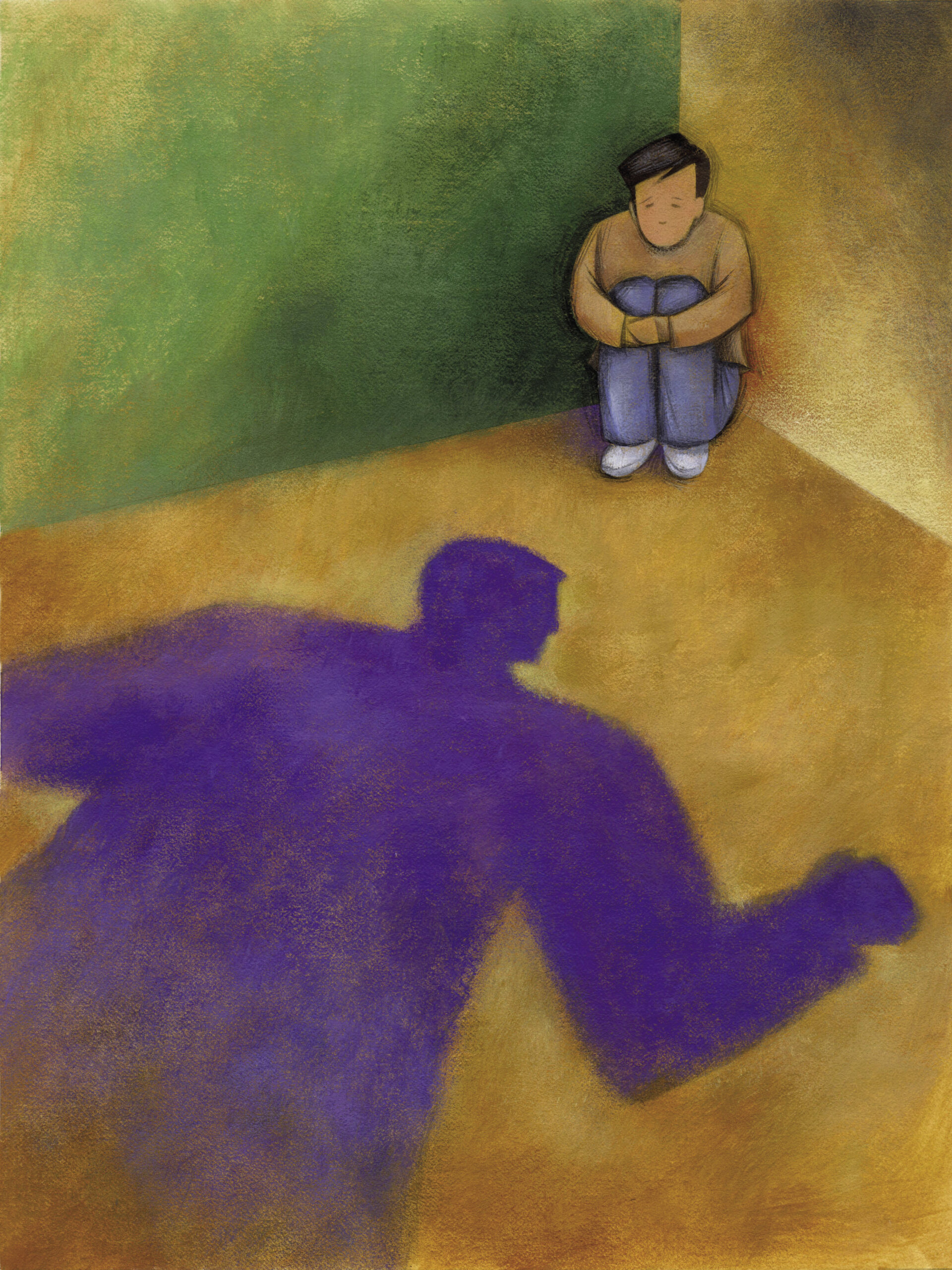
He sat nestled on a chair, clinging to his father. His quivering 6-year-old body told its story with every tortured word uttered by the man who tried his best to protect him. His father recounted the death of his wife at childbirth and of the life he had created for his beloved son, which included a small business and a supportive community. He recalled how one of his friends and fellow business owners had shared with him that the Mara (a violent predatory gang) had demanded a monthly payment and that he had refused. Two days later, the boy had opened the door to their apartment only to see the mutilated lifeless body of the man who had dared stand up to the gang. Later that evening, the boy’s father was visited by the very same gang who had killed his friend, and who now demanded the same payment from him. They threatened to kill both father and son if the extortion was denied.

Try as I might to engage the child as his father’s pain became more palpably agonizing, he clutched the man even tighter. The father continued telling his story to a pair of young pro-bono law students surrounded by a throng of legal advocates and other fathers recently reunited with their children. He recounted how after the threats, he had gone to the police for help and was assured of his safety and confidentiality. The next night, the child was awakened by the sight of his father being brutally beaten by both the gang members and the police. Desperate and frightened, the boy ran to the neighbors who united to save his father. With borrowed money, father and son fled the very next day. With coyotes on their heels, the journey to safety ended as he held his son aloft to protect him from the bone chilling cold of the Rio Grande.

Amidst the screaming of the men in uniforms, who flashed guns in their faces, father and son were arrested, violently separated with the sound of “How do you like your American dream, now amigo”? Two months later, the father was reunited with the boy at a Texas ICE Detention facility, awaiting probable deportation and the certainty that if he and his son were deported, he would be eagerly greeted by the Mara and killed, leaving his young son alone. If the boy remained in the US and he returned home, his boy would surely be orphaned.

Like what you are reading? For more stimulating stories, thought-provoking articles and new video announcements, sign up for our monthly newsletter.

This story of human beings fleeing from Guatemala, Honduras and El Salvador was repeated over and over, replete with the most horrific violence imaginable. I thought that I had been prepared for this by my work as counselor in Greece where I bore witness to the trauma incurred by unaccompanied child refugees from Syria, Iraq, Afghanistan and other conflict zones. I thought I had been prepared by my years of counseling experience, but nothing prepared me for the trauma inflicted upon these helpless children by the United States policy of family separation. I accompanied law school students and faculty who were deeply affected by the inevitable experience of vicarious trauma and compassion fatigue.

In retrospect, I don’t believe that any educational or clinical knowledge would have adequately prepared any of us for what we encountered. ICE Detention Facilities and places where children are housed separated from their parents, are epicenters of disregard for human dignity, human rights and the immoral infliction of generational trauma on thousands of children. As mental health practitioners, we know this to be true. As lawful people we know this to be unjust. As decent human beings we know this to be immoral.

Mental health practitioners may be completely unaware of a client’s legal status because survival requires invisibility. A child may ostensibly be referred for depression, anxiety or behavioral problems, but be struggling with the pain of separation from their caretakers. Therapists need to learn the intricacies and ever-changing landscape of immigration and asylum that potentially impact their clients, whether directly or indirectly touched by the border separations. Even an otherwise healthy and intact family may in the blink of an eye be devastated by the breadwinner’s arrest and imprisonment. Therapists need to help their affected clients to identify coping skills and obtain grounding in extant and emerging pathways to the assessment and treatment of trauma. The world’s most vulnerable and most invisible will evoke an abiding respect for their unimaginable strength and resilience. If you believe in the inviolable right to the dignity and you are willing to walk the journey together with humility and heart, your client will experience love made visible through a shared humanity.   

Janina Fisher on Innovations in Treating Trauma

Enduring Conditions and Animal Defenses

Ruth Wetherford: Dr. Janina Fisher, you’re a clinical psychologist and expert in the treatment of trauma, author of the book, Healing the Fragmented Selves of Trauma Survivors, and have worked with many of the giants in our field—Judith Herman, Bessel van der Kolk and Pat Ogden and are currently an instructor at the Trauma Center, an outpatient clinic and research center founded by Bessel van der Kolk. Since trauma is such a overused, broad term these days, can you describe how you understand trauma?
Janina Fisher: There was a time when we defined trauma as an event outside the realm of normal human experience. Remember that?
RW: I do, yes. It had to be life threatening.
JF: Boy, were we wrong. We believed it was a rare occurrence. And we now know that 70 percent of the human race will be traumatized in their lifetimes, and probably about 40 percent will develop post-traumatic issues. So it is certainly far from outside of the norm. But over the years, the term started to lose its meaning in terms of its magnitude—now people talk about having critical and rejecting parents as traumatic, so I’m a little concerned that we have found the meaning of trauma and then lost it again, but I’ll tell you the definition I use:

Trauma can be a single event, it can be a series of events, or it can be a set of enduring conditions. Slavery was a set of enduring conditions, child abuse is a set of enduring conditions, domestic violence, war, the Holocaust.

It’s actually more common for people to be traumatized in the context of enduring conditions than to have a single event and have the rest of life be easy and smooth.
It’s actually more common for people to be traumatized in the context of enduring conditions than to have a single event and have the rest of life be easy and smooth. Then, that single event, series of events or enduring conditions have to overwhelm the individual’s capacity to cope and to activate a sense of threat to life.

It doesn’t have to literally be life threatening, like a bus barreling towards you as you cross the street. The key is that we feel a sense of threat to life whether we are capable of verbalizing it or not. Small children can’t say, “I’m afraid I’m going to be killed,” but their bodies can feel it.

RW: You’re talking about the subjective experience of threat to life. Your work focuses extensively on the brain’s reaction to it and the activation of the sympathetic nervous system. It seems like many more psychotherapists are trained in this area these days, don’t you think?
JF: Unfortunately what I hear from graduate students and from young therapists who’ve just been through training is that trauma wasn’t even mentioned in their graduate programs.
RW: That’s shocking. Well perhaps you could talk a bit about this aspect of your work for our readers who may be new to it.
JF: Well, when I first became interested in trauma in 1989-90, we still thought of trauma as being something that war veterans had exposure to and victims of sexual assault. We were still putting the pieces together and hadn’t incorporated more enduring traumas like child abuse and domestic violence.
RW: Neglect.
JF: Yes. Then 9/11 brought credibility to the concept of trauma and changed the whole world’s attitude toward trauma. Pioneers in the trauma field began to make sense of why patients could recover from depression, anxiety disorders, they could manage hallucinations and delusions, but they couldn’t manage post-traumatic reactions.

Bessel van der Kolk had this insight that “the body keeps the score,” that what was different about trauma was how it encoded in the body and activated the animal defense responses that we share with all mammals. People thought he was nuts. I remember people coming up to me and saying, “Stay away from that guy. He’s a nut case.” But over the years, research has proven him to be accurate.

RW: So what are those animal defenses that we share?
JF: There are 5 animal defenses: fight, flight, freeze, feign death, or submit and cry for help. Fight is basically anger. Interestingly, animals are much better at fighting than humans—that’s why we’ve taken up weapons. Then there’s flight, and again, animals are faster at fleeing. Animals play possum and human beings say things like, “I pretended to be asleep,” which is the human equivalent of playing dead. We freeze like a deer in the headlights and we cry for help. Humans are better at crying for help than mammals because we have language, but all animals make sounds to communicate to their fellow animals that they’re in trouble.
RW: How do those get manifested in the effects of trauma?
JF:
Clients who have chronic submission responses tend to present as chronically depressed, hopeless and helpless, ashamed, feeling less than, and because we call it depression, we don’t treat it as a trauma symptom.
The average therapist sees the animal defenses every day in the office. For example, clients who have chronic submission responses tend to present as chronically depressed, hopeless and helpless, ashamed, feeling less than, and because we call it depression, we don’t treat it as a trauma symptom. People who chronically have the freeze, deer-in-the-headlights response get an anxiety disorder diagnosis. They’ll report, “I’ve been having panic attacks, I can’t leave the house, I can’t drive the car more than a few blocks.” Those who have chronic fight responses can’t stop fighting, can’t stop being angry, engage in aggressive behavior including aggression toward their own bodies. Some people with chronic fight responses tend to be violent toward others, some toward themselves, and an even smaller percentage have both. They have aggressive responses toward others and they harm themselves.
RW: So these patterns of behavior in adult life correlate with the animal responses that we have as children in response to various kinds of trauma.
JF: Right. We have come to understand—and this is the essence of the body keeps the score—that when something bad happens to us, not just our minds, but our bodies become sensitive to related cues. This is why when people have a car accident they avoid the place where the accident occurred for months or years afterwards. Or sexual abuse survivors who can’t tolerate being in the company of men of a certain age. The body gets sensitized to anything that vaguely resembles the original event.

Body Memories

RW: Can you talk about how traumatic experiences are encoded in the brain differently than normal day-to-day events?
JF: In the first brain scan studies, which were conducted in the mid-90s, a small group of trauma survivors were asked to write a script describing a traumatic experience and then hear someone reading the script back to them while undergoing a brain scan. I think that’s pretty brave in and of itself.
RW: It sure is.
JF: What the researchers found, which astounded them, is that the part of the brain that remembers normal narrative memories shut down when they were being read the traumatic event—even though they themselves had written the script. The part of the brain that became active was a part of the brain that we’ve come to understand holds emotional nonverbal memories.
RW: The amygdala?
JF: Yes, the amygdala. For some reason, the amygdala on the right hemisphere side seems to be the center for traumatic memories. What this meant was that we couldn’t work with the narrative memory of the event because post-traumatic memories are held as non-verbal feeling and physical reaction memories—what I call body memories.
RW: Body memories.
JF: Yes. It literally changed everything about our thinking on trauma.
RW: It was revolutionary. Why isn’t it being widely taught in psychotherapy training programs?
JF: I wish that that research, which has been replicated many, many, times, was taught in graduate school and training institutes, hospitals and clinics, because most therapists still practice the type of trauma treatment that we were practicing in the late ‘80s and early ‘90s, which consists of asking people to remember what happened.
RW: Without a sense of what to do with it.
JF: Exactly.
The “talking cure” belief that if it’s talked about, it will resolve, unfortunately does not work with trauma.
The “talking cure” belief that if it’s talked about, it will resolve, unfortunately does not work with trauma. As patients talk about the trauma, their amygdalas and their limbic systems start to go crazy, they feel overwhelmed, and they don’t want to talk about it anymore.
RW: So they leave the session feeling very undone, and they don’t want to come back. You’ve said that you learned that the hard way, as many other trauma therapists did. So, if it’s not enough to just talk about it, what is enough?
JF: What seems to be enough is a variety of activities that help us to restructure our relationship to the memories—techniques, interventions, and experiences that help to slowly recalibrate the traumatized nervous system and animal defenses that are triggered by everyday kinds of stimuli. It’s two pieces: one is the body piece and the other is the feeling-memory piece.
RW: This gives a lot of creativity and flexibility to what the therapist does in the moment.
JF: True, but one of the difficulties, and the reason why I wrote the book, Healing the Fragmented Selves of Trauma Survivors, is that there’s a relatively large subset of traumatized clients who have what we call complex trauma related disorders—some of which are reflected in DSM, but many of which are not. Complex post-traumatic stress is not in the DSM. Dissociative disorders are in the DSM, but not in a very clear, usable way. And there’s a huge amount of literature that attests to the relationship between self-harm, suicidality, addiction and trauma. There’s huge correlations between them.

I happen to be a therapist who likes complexity—I like challenging cases—so I kept seeing people who, despite their best efforts, could not get sober, could not manage their suicidality, could not manage their anxiety, had treatment-resistant depression no matter what medication or what kind of therapy. I became intrigued by how to help these clients.

I had the opportunity to hear a theory proposed by Onno Van der Hart and Ellert Nijenhuis in the Netherlands called the “Structural Dissociation Theory,” which is a very well-accepted model in Europe. As soon as I heard them describe this model, the lights came on, the orchestra started playing, and I thought, this explains so much, including what we now call personality disorders, which are beautifully described by this model. It explains them as neurobiologically based, and that we all have a part of our brains, and therefore part of our personality, that keeps on going no matter what. No matter what disaster is befalling us, the left brain part of the personality just keeps on keeping on.

The “Going on With Normal Life” Self and the Traumatized Self

RW: You call this the “normal life part” or the “going on with normal life” part.
JF: Right. The authors call it the “apparently normal” part, but I didn’t like that language because it fed into my clients’ sense of having a false self. So I renamed it the “going on with normal life” self.

Repeated trauma can cause splitting in the personality such that we start to develop subparts representing the animal defenses.
And then the model says we all have a right-brain side of the personality that’s emotional, reactive, and nonverbal, which I call the traumatized part. They describe the way in which repeated trauma can cause splitting in the personality such that we start to develop subparts representing the animal defenses: a part that fights, a part that flees, a part that submits, a part that freezes, a part that cries for help.

For me, this theory makes sense of the most confusing of our clients. It makes sense of borderline personality where you see a very big cry-for-help response, but an equally big fight response. And in high-functioning individuals, a very strong going on with normal life self who’s actually quite ashamed of these big fluctuations between neediness and anger, and doesn’t understand them any more than the therapists do.

As you know, the problem often with psychotherapy is that clients want help but feel shame or defensiveness as we delve deeper into issues that they need to work on. What I found was that this language of parts helped my clients look at very difficult issues without feeling shame and defensiveness.

RW: Well there is so much pathologizing of this symptomology in our field and so much pejorative language around it. To have a language that frames the symptom as a creative solution to an early problem or trauma can be very relieving.
JF: Absolutely. It opens a door. I can talk to clients about how their fight part takes prisoners, right?
RW: Or stands up for a cause.
JF: Right. And then they’re free to say, “Yes, but it’s embarrassing because that angers drives people away.” Or I can say, “The cry for help part of you is just a little kid, and of course a little kid would cry for help.” It gives them a way to be in a relationship to these reactions rather than either being mortified and ashamed or saying, “What anger? I wasn’t angry.”
RW: It’s a form of psycho-education it seems to me. Can you talk about why that is so helpful?
JF: Well, I was trained in a traditional psychodynamic way.
RW: Me too.
JF: Most therapists from our time were, and psychoeducation didn’t have any place in psychodynamic psychotherapy. But when I went Judith Herman’s clinic in 1990 as a post-doctoral fellow, it was one of the major things she was recommending for trauma. She said that we had to educate clients, that it didn’t work for trauma survivors to have an imbalance of power. Aside from all the usual ways therapy can create an imbalance of power, there’s the imbalance of the therapist knowing everything and the client knowing nothing. She said, “Your job is to educate the client to make meaning of the trauma symptoms so that the playing field is more even.”
RW: In addition to balancing the power in the interpersonal dynamic that kind of learning activates the pre-frontal left brain. You begin to have a model and words for understanding what happens to you when you are triggered.
JF: Exactly. I learned that you can activate the prefrontal cortex when it automatically shuts down in the presence of a threat by getting people to be interested and curious.
My psychodynamic training was all about asking very complicated, beautiful questions, but I realize now my poor clients didn’t have the brain power to answer these very abstract questions.
My psychodynamic training was all about asking very complicated, beautiful questions, but I realize now my poor clients didn’t have the brain power to answer these very abstract questions. But when we just help people to be interested and curious, then things start to hum in the prefrontal cortex.

RW: Can you give some examples of how you might talk with the client that would encourage their curiosity about parts of themselves that they previously were too ashamed of or too frightened of?
JF: I start in the very first interview with someone. Most clients come in saying, “I’m here because I am depressed,” “I’m here because I’m having panic attacks,” “I’m here because I hate myself,” “I’m here because my relationships aren’t working.”
RW: They’re not coming to therapy to learn about the amygdala.
JF: Right. So in that initial conversation, I ask them, “When did these issues begin? When did you start to feel depressed? When did you start to have the panic attacks? When did it become difficult to leave the house?” And I say, “My guess is that something triggered that depression.”

Triggers

RW: You start looking for the triggers right away.
JF: I do that to help them be curious. They come in saying, “There’s something wrong with me because I can’t leave the house.” And usually within the first 20 minutes I say, “Wow, you must have been really, really triggered,” and they kind of go, “Huh?” That “huh” is what I want because it means that their fixed belief that there’s something wrong with them has just been disturbed.
RW: The idea that your difficult feelings are actually in response to something rather than just in your head without connection to the real world. That’s so reassuring.

JF: Yes, it is. At the same time, I want to be careful not to do a one-to-one correspondence to a specific event because most clients are suffering as a result of enduring conditions, and if they think they have to have a single event connected to every symptom, it becomes more difficult to work with them. I try very hard to connect the current trigger—like the death of the cat, or the fight with the husband—to the enduring conditions.

“The effect of living in a world where only the cat loved you is still with you, still in your body.”
So for the client whose cat died, I asked, “What did your cat mean to you when you were growing up?” And she responded, “The cat was the only person in the family who loved me.” “Well, no wonder it was triggering to lose your cat six months ago. The effect of living in a world where only the cat loved you is still with you, still in your body.” We connect the triggers to the enduring conditions, not to single events.

The Role of Empathy

RW: So your motive is to understand the experience from his or her point of view and you call that empathy. What is the role of empathy in your work?
JF: Well, there’s empathy as most of us have learned it in school where we say, “That must have been very hard for you.” The purpose there is to connect to the client’s pain and to say, “I get that these are not just bad events, they also caused you pain.” But I find that many traumatized clients have trouble with that kind of empathy because they’re afraid of the pain that we’re trying to evoke more of.

So I tend to express empathy more in terms of why it makes sense that they have a particular symptom. I say many times a day, “Well, of course, it makes so much sense. If you’re depressed, it’s easier to be seen and not heard, isn’t it?”

I have a long-term client who I’ll call Annie—not her real name, of course—who said to me once,

“Why are therapists so interested in every gory detail of what happened to us? Why don’t they ever ask us how we survived?”
RW: That’s such a great question.
JF: What she was saying was, “If you empathize with how I survived, that’s going to be more validating than empathizing with how victimized I was.”
RW: That appears to many to be paradoxical.
JF: If the purpose of empathy is to resonate to our clients’ feeling states, resonating to their strengths can feel very empowering, especially if you’re someone who has felt unempowered, ashamed, hopeless, weak, and your therapist says, “Wow, you were a pretty ingenious little kid to have survived that.” There’s a feeling of empowerment there as opposed to when we say, “Oh, that must have been so hard.” That pulls for the feelings of vulnerability which are connected to feeling weak, helpless, hopeless.

The Contagion of Confidence and Calm

RW: This touches on what you’ve referred to as the contagion of the confidence and the calm of the therapist. It’s related to what we think of as the placebo effect in medicine. We know that when doctors have absolute belief that their methods are going to help us get well, and they’re focusing on the self-correcting immune responses and the strengths of our bodies, it has a strong positive effect on patients.

It’s so important to think of empathy not just as for the painful negative aspects of the self, but for the positive surviving parts.

JF: Absolutely. Certainly we want therapy to be a safe place for people to share their pain, but why shouldn’t it also be a safe place to share their pride, pleasure, excitement, curiosity? Trauma survivors can get deeply mired in the trauma the more they go for the grief and anger.
RW: And many trauma survivors don’t have a lot of sources of recognition and appreciation. They’re not coming in with stories of little triumphs through the day, so when the therapist does point it out and they see that it’s not just window dressing, that it was substantive, that’s so affirming.
JF: Exactly.
RW: Would you talk about the role of the person of the therapist?
JF: As you know, it’s a topic near and dear to my heart because what I’ve come to realize over my 37 years in this field is that we are really the instrument of psychotherapy.
Research shows that the relationship with the therapist is still the strongest variable affecting therapy outcome, regardless of the model being used.
RW: I believe it.
JF: We have so many models now which are wonderful, and I like most of them, but we have a tendency to assume it’s the model helping rather than us helping. But who and how we are makes a huge difference. You and I are probably both old enough to remember the blank screen approach.
RW: I hated people who were blank screens.
JF: Me, too. And now we understand that if the therapist is a blank screen and the client has suffered abuse or neglect, it is immensely triggering and even threatening. It’s not going to feel neutral. Freud’s idea was to be neutral so as not to be threatening, but that’s just not how it works, particularly with clients who’ve experienced trauma.
RW: Carl Rogers pointed out that there is no neutrality because a blank screen or silence or non-responsiveness is itself a response usually perceived by the right brain as rejecting, or at least disconnecting.
JF: It’s funny, I didn’t love Carl Rogers when I studied him in graduate school, but I’ve really come to appreciate his work because he got this idea that the therapist is the instrument, and how you play your instrument makes such a difference in the client’s receptivity.

RW: How do you think therapists can be more personally connected with clients?
JF:
We are both triggers of hope and triggers of fear
. First and foremost a willingness to be curious rather than to assume from the diagnosis or from the presenting symptoms that someone is in a certain category. The willingness to assume that every symptom represents what was once an adaptive way of coping with and surviving their circumstances, because we become who we become in a habitat, in a context. Lastly, and this is hard for therapists, but remembering that we are both triggers of hope and triggers of fear.
RW: Can you say more?
JF: If we get caught up in seeing ourselves as triggers of hope or safety only, we’re going to pathologize the client when the client gets afraid. I’ve had very few clients in 37 years who’ve actually said, “I’m afraid,” but I’ve had lots of clients who’ve been reactive and angry, defensive, resistant, suspicious—all of which are expressions of fear.

It’s very important to know that even as we are building a relationship and creating safety, we’re also triggering fear. So we do our best to notice those moments that we can hear or decipher the fear and then do what securely attached parents do, or what dog owners do: Change your body language and your voice to help change the child’s state, the dog’s state. We do it without thinking.

I watch how the client responds to what I just said, and then I vary my next remark based on the data I just got. So I say something and I see the client looking a little uncomfortable, then I’ll smile and say something light and see if the client’s body relaxes. Or I might say something that really underscores how bad they feel—“Wow, I get that this is really awful”—and see if the body relaxes. Or is this a client who feels defensive when I say, “Wow, this is really tough.”

They feel safer not because I have good boundaries and a therapeutic frame and all those good things, but because I’m scaring them less and less.
RW: In my consultation with trainees where we’re going over audio or videotapes, it’s usually apparent that when the therapist says something that sounds pejorative or a little bit pathologizing, there’s a loss of empathy because of some perceived threat, and it’s often unconscious. An angry client, particularly a smart, articulate angry client, can be a trigger for the therapist. What are some things that you do to help yourself stay non-defensive? Not triggered?
JF: I sort of have a split screen. I’m very attentive to the client and to resonating to the client&rsq

Louis Cozolino on the Integration of Neuroscience into Psychotherapy—and its Limitations

Neuroscience or Neuro-psychobabble?

Sudhanva Rajagopal: Lou Cozolino, you are a psychologist and professor of psychology at Pepperdine University, where you were a teacher of mine. You’re a prolific writer and researcher on topics ranging from schizophrenia, child abuse, the long-term effects of stress, and, more recently, neuroscience in psychotherapy and the brain as a social organ.As a clinician in training, it seems like there is a lot of neuroscience talk out there in our field, and it gets used to legitimize anything from specific interventions to whole theoretical orientations. My first question to you is, for the clinician in training, how do you recommend that we see through the noise of all that to what is actually helpful in the room with a client? How does knowledge of neuroscience play out in the room and what is actually important for the clinician to know?

Louis Cozolino: There are two main realms where neuroscience can aid clinicians. One is case conceptualization and the other is for clients who aren’t really open to a psychotherapeutic framework or an emotional framework. For them a neuroscientific explanation or conceptualization of their problem is often something they can grasp while they can’t or won’t grasp other things.

People who learn a half a dozen words about neuroscience think they’re neuroscience literate.

But there’s so much psychobabble and neuro-psychobabble out there, and the thing is if you say something is the amygdala as opposed to saying it’s anxiety or fear-based, you haven’t really upgraded the quality of the discourse. You just substituted one word for another. So the risk is that people who learn a half a dozen words about neuroscience think they’re neuroscience literate.

Learning neuroscience takes dedication. It takes work to get beyond the cocktail level of conversation and clichés. It took me ten years to feel like I had any sense of what was going on and I studied it pretty intensively. So I think we all have to be careful, but even more importantly, just because you know some neuroscience doesn’t mean you know anything more than the therapist who doesn’t. It’s really about how you use that information to upgrade the quality of the work you’re doing.

SR: In your book, Why Therapy Works: Using Your Mind to Change Your Brain, you say that science in many ways is just another metaphor. Do you think there are dangers to people using neuroscience to legitimize their work?
LC: Well, sure. There’s a fellow, Daniel Amen, who does these SPECT scans of people and he’s been selling them for thousands of dollars for probably 20 years now. It’s hard to know whether any of his data has any meaning. All we know is he’s made a hell of a lot of money doing them. The danger is in selling things before you know that they have any legitimacy, so you have to watch out for snake oil salesmen just like you do when you’re buying carpets and used cars.
SR: So how do you recommend that someone like me goes about finding and learning about neuroscience in a way that’s helpful? How do I avoid the snake oil salesmen?
LC: It’s important to realize that knowing neuroscience doesn’t make you a good clinician—in fact it doesn’t make you any kind of clinician at all. So I would say for beginning therapists, it’s probably best not to pay too much attention to neuroscience.Learn a few things about it but focus on getting the best supervision you can in a recognized form of psychotherapy—psychodynamic, cognitive, behavioral, family systems, etc. And avoid the passing fancy of all of the new therapies; every day there’s a new therapy with a new set of letters in front of it.

SR: Yeah there are so many different kinds of therapies these days.
LC: Try to learn something that isn’t just a fad, because the fads—I’ve watched hundreds of them come and go over my years. But if you cleave to psychodynamic training and cleave to cognitive behavioral, Gestalt, family systems training—those are the things that you can hang your hat on. Then you can learn the fads to add to your tool box. The fads are very sexy and they create the illusion of understanding because they’ve got fancy terms and nice workbooks and such, but really you’re not a thinker when you’re doing those things, you’re more of a mechanic.Now neuroscience is sort of like a sidecar to conceptualization, but you’ve got to remember the motorcycle is the real tried and true way of thinking about clients. You know, what is a particular problem? What is mental distress or mental illness? Where does it come from developmentally and what are the tried and true ways of approaching it and treating it?

Every Therapy is Embedded in Culture

SR: Speaking of tried and true ways of thinking, you say in your book, “Psychotherapy is not a modern invention, but a relationship-based learning environment grounded in the history of our social brains. Thus the roots of psychotherapy go back to mother-child bonding, attachment to family and friends, and the guidance of wise elders.” My question is, where do you think psychotherapy fits in to the context of healing traditions that have been around for millennia?
LC: Well, I think one thing that seems to be different over the last hundred years in psychotherapy is a kind of structured recognition of the fact that the therapist is imperfect and contributes in a lot of different ways to the problems. The tradition of wise elders was one of an authoritarian stance: This is the truth and I’ll take you on this journey with me to change you into my likeness. To whatever degree psychotherapy has evolved past that has to do with the self-analysis of the therapist and the recognition that whatever pathology exists in the relationship between client and therapist, some—hopefully not the majority, but some—pathology in the relationship comes from the therapist.That type of recognition is a step forward. There are probably some steps backward too. Often psychotherapy is ahistorical and acultural—or at least tries to be—but every therapy is embedded in culture. There is a kind of pretense about an objective scientific stance that is just a fantasy. So in some ways, wise elders in a tribal context with a long history are probably advantageous for some people as compared to psychotherapy.

SR: I was flipping through the index of your book and noticed the word “culture” appears exactly once, though you do talk about the wisdom of the ancients, about Buddhism and Confucianism and some of the Indian traditions. Seems to me that once we start relying on these kind of generalized, evolutionary, and biological forces as explanations for things, there’s a risk of painting people’s lived experience with a pretty broad brush. What’s your take on the importance of culture as it relates to neuroscience and psychotherapy?
LC: From an evolutionary perspective, a basic principle is biodiversity, and culture is too blunt an instrument to understand people because there are so many differences within culture. I think in terms of every individual being an experiment of nature. Every family is a culture in and of itself, and the more different someone’s cultural background is from mine, the more there is for me to learn. I think that culture needs to be interwoven into every sentence of every book, not just included in some special chapter of a book.
SR: From my point of view, many of these older cultural practices have been repackaged and rebranded as psychotherapy theories and techniques. The “mindfulness revolution” and transcendental meditation are based on ancient cultural traditions, but they are marketed as if they are especially effective because they are “new” and “evidence-based.” What is your stance on that?
LC: Having studied religion and philosophy and Sanskrit starting back when I was in college in the 70s, the self-awareness of meditation has been part my worldview since long before it became a cottage industry. But even back then there was the Maharishi Mahesh Yogi and the Beatles, and it was coming into the cultural context. Now people have figured out how to package it as a way to sell more therapy, which isn’t all bad, but runs the risk of becoming “the answer.”

I think we’re in a race between global destruction and global consciousness, so we’ll see who gets to the finish line first.

What I’ve been hoping for since I first discovered Buddhism in the 1960s, is that as the world gets smaller and as people from different cultures communicate more, the wisdom of the ancient Eastern philosophies will be interwoven with Western technology and we’ll come to some higher level synthesis of understanding and consciousness. I think we’re in a race between global destruction and global consciousness, so we’ll see who gets to the finish line first.

SR: Can you say more about that?
LC: Well, it’s a slow evolutionary process for the types of awareness that people four or five thousand years ago discovered in India and Tibet, in China, in Japan, to penetrate Western culture. The Western world view is so different—for so many people it’s almost impossible to conceptualize an internal world; everything is external. Everything is about creation, growth, and, in a more destructive sense, conquering and genocide.So there are forces of destruction—of each other and of the planet—on the one hand and then there are the forces of consciousness and wholeness and a sense of oneness of the species on the other. So will we understand that we’re all brothers and sisters on a spaceship before we destroy the spaceship?

“There only needs to be a piece of you that’s a psychologist”

SR: How can psychotherapy play a positive role in this race you’re talking about? Or psychotherapy as we know it in the Western world?
LC: Well, one of the problems with psychotherapy as I see it is that psychotherapists tend to be sort of passive—they retreat from the world of leadership and create very insulated relationships in their consulting rooms. But for the field of psychotherapy to have any impact, it has to be expressed politically and socially. The types of ideas and theories that we’ve researched and studied, like the importance of early child rearing, self-awareness, authoritarian personalities, positive psychology and so much else, need to become part of political discourse both to elevate it and also have an impact on how resources are distributed.

One of the problems with psychotherapy as I see it is that psychotherapists tend to be sort of passive—they retreat from the world of leadership and create very insulated relationships in their consulting rooms.

Evolution is a slow, meandering process. All you have to do is watch the Republican debates to see that. It reminds me of junior high school in the Bronx in New York where we used to engage in chop fights, which was all about humiliating the manhood of other guys just to get a one-up. It doesn’t make me optimistic about the evolution of consciousness, but we’ll see what happens.

SR: I want to move onto something you said in your preface that I liked a lot: “Like monks and soldiers, therapists of all denominations assume that God is on their side.” What do you think are the limitations of psychotherapy and where does it come up short against the human condition, cultural walls or seemingly immovable, systemic injustice? In other words, when do we have to admit that psychotherapy is just not helpful or effective?

LC: The risk with psychology and psychotherapy is that it can lean too much in the direction of helping people tolerate rather than fight against oppression. Self-awareness and self-compassion are crucial experiences and skills that we foster as psychotherapists, but there needs to be a balance there. You can’t become too much of a psychologist. There only needs to be a piece of you that’s a psychologist and there’s another piece of you that has to be willing to go out and fight for systemic change.

As I said before, psychologists tend to watch from the sidelines, and that’s why as a field it has relatively little impact. In fact, the profession gets a lot of bad press because there are plenty of famous psychologists who do staggeringly immoral and unethical things. They are the basis of the cartoon version of the therapist nodding their head and going, “uh huh.”

SR: You talk about psychology as being an essentially solitary profession. Are there people you can think of who aren’t standing on the sidelines?
LC: Psychologists you mean?
SR: Yeah, psychologists.
LC: No. Can you?
SR: Not off the top of my head.
LC: Psychologists are really good at telling other people they should do something. It’s sort of like life by proxy.
SR: Indeed.
LC: Another problem in psychotherapy is a lack of appreciation or respect for anger; anger is always something you’re supposed to manage. Or you’re supposed to learn how to behave appropriately in society, but that’s not always an appropriate response, especially if you’re a member of an oppressed group. It’s really important sometimes to go on picket lines and carry bricks and defend yourself and make a lot of noise.I very much respect the Black Lives Matter movement and I watch them in these Trump rallies, and they’re getting pushed around. It breaks my heart because it reminds me of a lot of bad memories from childhood during the Civil Rights Movement. And I’m sure you’ve seen pictures too of what happened in India with the British, of people being hosed and slaughtered. There’s a tendency in human behavior to objectify differences and we really need to fight against and not tolerate that. I’m hoping that, given that Trump is consolidating and activating the anger of people in this culture against immigrants and foreigners and God knows what else, that it also energizes the liberal base and brings out a new progressive movement as well.

SR: Absolutely, but this idea of psychologists carrying bricks and taking up arms seems really at odds to me with this image we have of psychologists as dispassionate observers, people who are sitting in their therapy chairs saying, “uh huh.”My interests lie in political action as well and I do remember, at least from my dad’s generation and my grandfather’s generation, thinking about British rule and the independence movement in India and the idea of people really taking a stand. But that doesn’t seem like something psychologists really do. Even in the room with a client, we’re not taught to take a stance on things, you know?

LC: In fact it’s the opposite. Everything that we believe is interpreted as countertransference and non-neutral. It creates a real rift in people. It’s hard to imagine that a lot of younger psychologists with any sort of a political drive would be attracted to psychology. It will continue to attract people who want to stay on the sidelines in the world or avoid the conflict.
SR: How is that going to change?
LC: In truth I don’t know. In the 60s we had something called community psychology, which was very radical at the time and which still exists, but it’s not prominent at all anymore. One of the main focuses of community psychology was to identify those people in the community or in the tribe that other people went to for assistance—people like hairdressers and bartenders and cab drivers. These are the people that folks in trouble tended to talk to, so community psychology emphasized educating people in the community that were sort of hubs of interaction. The field has gotten so much more insular since then.

Transitioning From a Beta to an Alpha

SR: I want to go back to something you said about anger that intrigued me. I’m just thinking back to discussions and supervision I’ve had in training, and whenever anger comes up, you’re told there’s something “behind” the anger. You know, there’s shame behind the anger, or sadness behind the anger. How do you feel about anger as just a primary kind of emotion? And do you think it has value both for the therapist and for the client?
LC: If you’re going to become empowered, if you’re going to transition from a beta to an alpha in your life, you really need to be able to get back in touch with your anger because it can be very propulsive, very helpful in life. It evolved along with caretaking and nurturing because it’s not just necessary to feed and nurture babies, but to protect them.Anger is the only left-hemisphere emotion that we consider negative, but anger is a social emotion, unlike rage. It can be engaging, relational, constructive. In order to combat the social programming that leads to shame, we have to get at least somewhat angry—at both the voices in our head and out in the world that shame us, disempower us, keep us from speaking up.

When I think of somebody like Gandhi or Martin Luther King, Jr., I think of the courage it took to walk into angry crowds. It’s so moving to me and such a powerful act. We can’t just be passive about these voices in our head and in society. We have to get angry because our anger and our assertiveness and our power are all interconnected. If you give up your anger, you give up your power.

SR: Agreed. Tell me a little bit about your idea of the social synapse.
LC: The more I studied different physiologies, social psychologies, organisms, the more I realized that there is a very complex highway of information that connects us via pupil dilation and facial expression and body posture and tone of voice, and probably a hundred things that we haven’t even discovered yet.What we’re doing in psychotherapy, and in any relationship where we’re trying to be soothing and supportive and nurturant, is connecting across the synapse between you and someone else. You’re trying to create a synergy between the two of you and have an effect on their internal biochemistry that enhances their physical health, their brain development, their learning. If you’ve ever been with a really good teacher, you know that in part because you feel a lot smarter because you’re connecting with someone who’s stimulating your brain to work better. If you’re with a bad teacher, you feel dumber, and you get pissed off and angry. And there are not a lot of good teachers out there so you’ve got to cleave to the good ones.

But also there’s a different chemistry between different people. Someone who’s a good teacher for one person may not be a good one for another. Same thing with therapists. Every therapeutic relationship creates a new organism—a dyadic field— and sometimes it works and sometimes it doesn’t. The chemistry part we often don’t have any control over.

SR: Going back to the brain and neuroscience, where do you think we are in right now in the field and where are we headed?
LC: Well, we’re all over the place in brain science, but there is a great deal of focus right now on genetics. In other words, looking at the relationship between experience and interactions and how the molecular level of the brain gets constructed and changes over time in relation to the others and the environment. I think that the translation of parenting and relationships in psychotherapy into actual protein synthesis and brain building is an incredibly complicated but very important paradigm shift that is going to be playing out probably over the next century at least as we uncover those things.Another shift in neuroscience is getting past the phrenology of looking at individual brain regions related to specific tasks and starting to look at these new technologies that measure brain connectivity. In other words, how do different areas connect to regulate each other and synergize? The next step will be figuring out how two or more brains interact and stimulate each other.

I don’t know where the technology to research that is going to come from but I think it’s on the horizon. We’ve got to get beyond thinking about brains as individual organs and think about how they weave into relational matrices so we can understand human connection and have a scientific view for the types of things that Buddhists and Hindu meditators and Tibetan scholars have been thinking about for the last several thousand years or so.

Why Does Neuroscience Matter?

SR: How would you explain to an existential psychotherapist why these advances in technology and in brain science are at all important to what they do?
LC: I don’t know if they are important to what they do. I don’t think neuroscience is more important than Buddhism—it’s basically just another narrative.
SR: Interesting.
LC: It’s just another way of looking at things. Think about when you’re at a museum looking at an exhibit and you’re walking around it trying to experience it and appreciate it from a number of different angles.That’s pretty much what reality is. We walk around it and we have these different ways of thinking about it and explaining it that are partially satisfying and partially unsatisfying. Buddhism is incredibly satisfying a lot of the time and very unsatisfying some of the time. So when you get bored with one way of looking, you want to look at something in a different way. For me it’s interesting to combine and integrate different perspectives but I don’t think that you have to subjugate one to the other.

In the 1950s Carl Rogers was talking about how to create a healing relationship. Fast forward 65 years and now neuroscience is discovering pretty much what Rogers was talking about. Am I better off talking about it from that perspective than listening to Carl Rogers? I don’t know. But it makes me appreciate what Rogers says even more and in a deeper way when I can see it from this scientific perspective.

SR: That makes sense.
LC: If Buddha were alive, he’d say, “Of course,” right? “There’s 5,000 research studies you did, but all you needed to do was read the Sutra and you would have figured it out.”But I think it’s interesting to just keep learning about life from as many points of view as possible. When have your read enough novels?

Each novel you read is a new way of capturing the universe, and they’re entertaining and stimulating and make you feel human. I feel the same way about the sciences, which is why I love reading E.O. Wilson’s work on ants, because I learn a lot about humans by reading about ants. So many things we do are very ant-like. Plus, ants are interesting.

Nobody Has the Answer

SR: Ants are very interesting. That’s a great way to look at it and I completely agree. Moving away from neuroscience for a moment, I’m curious about how your clinical work has changed over the years.
LC: It’s changed constantly. When I started as a student of pastoral counseling at the Harvard Divinity School, Carl Rogers was one of my teachers, so my first real training was Rogerian. The reason I got interested in counseling in the first place was reading Fritz Perls’ Gestalt Therapy. Then when I ended up at UCLA I realized you have to learn cognitive behavioral therapy whether you like it or not. So I was trained in that. I did a couple of years at a family therapy institute in Westwood in L.A. My supervisors were psychodynamic and my therapist at the time was a Jungian, and then I had a couple of other therapists who were psychodynamic and Gestalt.I was working with people who had been severely traumatized as kids, so I got interested in neuroscience through a study of memory, trying to figure out what the heck was going with the memories of people who’d suffered severe trauma.

Since then, my heart is more in the object relations world, I think mostly because it matches my personality and the type of relationships I like to create with people. But I’ve woven in neuroscience, attachment theory, a bit of EMDR, some meditation and self-awareness exercises. It’s a hodgepodge of all the different things that I’ve learned, but I don’t really feel like I’ve got a hammer and everybody who comes in is a nail. It’s more like I’ve got a toolbox of 30 or 40 years of things that I’ve been collecting and I try to figure out how to match as best I can to the needs and the interests of the client.

SR: Is there a certain population or certain pathologies that you’ve been working with more lately or that you’re more interested in?
LC: Not really. My practice is pretty general and I like to keep it that way. I don’t really like to see the same problem over and over again. I always think of psychotherapy as kind of like a collaborative research project. People come in and we work together to figure out what’s going on—how did it arise? Is there any hope of making it better? I really like having problems I haven’t dealt with before.
SR: What do you wish you’d known as a beginning clinician?
LC: When I started, I was looking for an answer and I wanted to know who had the answer. So

I tried to become a disciple of one person or another person. It took me quite a while to realize nobody has the answer. Everybody has a little piece of it.

And what I’ve got to do is just learn the best I can and then sacrifice and move on. This is a very ancient Rig Veda philosophy—every day you wake up, you sacrifice the day before, you move on, you create a new reality.

Had I understood this, I would have spent a lot less time worrying about finding the truth and being acceptable to whatever godhead I happened to run into at the moment. I think idolatry is the problem. Idolatry and objectification.

SR: It’s hard to avoid being exposed to that as a student. At least in my experience, in every new class you’re exposed to something people think is the answer, the best way to look at things.
LC: In my experience, the degree to which someone is enthusiastic and adamant about having “the answer” usually reflects the degree of insecurity they have and their lack of ability to tolerate their own ignorance. If we’ve learned anything, especially when it comes to diversity, it’s that we have to embrace our ignorance and be curious as opposed to leading with certainty.Jacob Bronowski was a physicist who died about 20 years ago, but he did this wonderful documentary about visiting Auschwitz, where his whole family was slaughtered. He waded into the mud behind the crematory and grabbed a handful of mud, realizing that his ancestors were part of this soil, and said, “This is what happens when we’re certain.”

Certainty leads to ideological beliefs that supersede humanity. At a less dramatic level, we get so enamored with our philosophies and our therapeutic beliefs that we miss our clients because we’re so convinced that we’ve got to convince them we’re right about the things we believe should be true.

SR: So last question here; where do you think the field as a whole is going?
LC: Well, I don’t think mental distress is going anywhere. I think that more and more people are going to be having psychological problems as society and civilization become increasingly crazy. No matter how many therapists the schools pump out, the world is creating plenty of suffering, so there will always be a need for therapy.And though there will always be therapists trying to create revolutionary new therapies with great acronyms, I think that the tried and true methods will remain strong and stay strong because they’re tapping into fundamental constructs in human experience—the need to connect with other people, to be able to leverage our thinking to modify our brains, to ask questions about ultimate meaning and existence.

Where the field is going to have to upgrade its sophistication and quality is in the areas of like pharmacology, epigenetics, psychoneuroimmunology, diet. All of the actual mechanisms that create and sustain our brains will have to become part of the dialogue about how we help people sustain and maintain health. This might just be my Eastern philosophy bias, but we’ll probably be moving in the direction of more holistic, integrated thinking and treatment—not just combining East and West, but integrating scientific discoveries into our case conceptualizations and treatments.

Finally, I hope that psychology becomes more integrated with education. I have a book series that I’m editing for W.W. Norton which is on the social neuroscience of education, and we’re pushing to have psychologists, neurologists, neuroscientists and educators communicate more so that the things we’re learning can be integrated into each field.

SR: Well that seems like a great place to end. Thank you so much for taking the time to share a bit about your work and your life with the readers of psychotherapy.net.
LC: It was a pleasure, thank you.

Robert J. Lifton on Political Violence, Activism and Life as a Psycho-Historian

The Psycho-Historian

Deb Kory: Robert Lifton, you’ve long been one of my heroes, and I’m delighted to be able to interview you and share your work with our readers. For those who may not know, you are a psychiatrist, researcher and writer, and have written many books on the psychology of political violence, the effects of such violence on both perpetrators and victims, totalitarian ideologies, the traumas of war, the threat of nuclear weapons, and much more.
I’m an early career psychologist and I started my doctoral program back in 2004, just before revelations emerged about psychologist’s involvement in torture at Guantanamo and other CIA black sites. It would turn out that the involvement went up to the highest levels of the American Psychological Association, but outside of a small group of activist psychologists, nobody in the field of psychology was talking about it. You were among the few mental health practitioners who publicly denounced this collusion with torture from the very beginning. When I wrote my dissertation on this subject, I drew heavily from your writings, particularly The Nazi Doctors: Medical Killing and the Psychology of Genocide, to help me understand and contextualize how seemingly normal, good people can commit evil acts.
As I came to learn through reading several of your books, your activism and commitment to social justice has been a fundamental and inextricable part of your professional work as a psychiatrist, researcher and writer.
Robert J. Lifton: Well, thank you.
DK: Your most recent book, Witness to an Extreme Century: A Memoir, weaves together your various works with your personal life, and the ways in which witnessing atrocities—you were a teenager during WWII, for example—impacted the course of your life. In it, you call yourself a “psycho-historian.” Can you explain what that means?
RL: It means applying a psychological approach to historical events, which requires a handling of psychology that is open-ended and sometimes outside of the orthodoxies within our field. The derivation is from Erik Erikson, who used the term as an adjective—he spoke of a “psychohistorical perspective.” It’s probably better to avoid the noun.
DK: When you say applying psychological methods, are you talking about research methods in particular?
RL: In my case, I’ve systematically used a psychological interview. I believe very much in the interview method. Though I haven’t spent much of my career doing psychotherapy, I have done a kind of equivalent by means of interviews. I think that the psychological interview is a beautiful instrument if one is careful and rigorous about the context. And it’s underused, even in the profession of psychology.
DK: How so?
RL: In terms of psychological research, the interview has become much less popular—the tendency is more toward questionnaires or statistical studies these days. The interview method that I have made use of is a modification of a psychoanalytic method. I was trained in psychoanalytic psychiatry, as we used to call it, and then had some training in psychoanalysis, but there was a kind of paradox for me. I thought then, as I still do, that psychoanalysis has been a great intellectual movement; but in its more rigid and dogmatic form, it can undermine the very historical approach that one wants to develop. So I modified it quite a lot.
DK: You talked in your autobiography about studying at the Psychoanalytic Institute in Boston and how you found some similarities between the kind of totalitarian mentality that you’d found among survivors of Chinese thought reform and the atmosphere at the institute. Can you say a little bit more about that?
RL: I was careful about how I wrote about that. I didn’t dismiss psychoanalytic training and, as a matter of fact, I learned a great deal from the psychoanalytic training that I did. But I found that there was an inherent problem in psychoanalytic institutes. Many others had spoken of it, but I had studied Chinese thought reform as well as the Cultural Revolution and so had that framework. The difficulty in psychoanalytic institutes at the time was that one was simultaneously a student, a candidate, and a patient. In a sense, the same people were one’s teachers, one’s therapists, and one’s judges in terms of whether one was accepted into the profession. There was a danger of requiring adherence to the existing doctrines as a necessary element for success, as opposed to originality or a creative perspective.
So I said those things, and I made the comparison with a thought-reform like environment. I did it carefully, but it was a fairly bold thing to do at that early stage of my own work.
DK: Were you ousted?
RL: No, no, I wasn’t ousted at all. There have always been within psychoanalysis people who are more open and more critical of their own group. Erikson was like that himself, as have been many other psychoanalysts whom I’ve known over the years. In fact, over time psychoanalysts have invited me to their programs—I’ve spoken at various institutes and groups. I chose to discontinue psychoanalytic training when I received a chair at Yale back in 1962, both because I had reservations about the dogma, but also because I had no need to become a psychoanalyst in terms of the direction I was going in my research. But, still, psychoanalytic tradition has a lot to offer and has been important to me in my work.
DK: You also wrote that breaking away from the Institute and the psychoanalytic framework allowed you to approach Freud in a new way and to connect to some of his more radical ideas.
RL: Yes, that was important to me. Back then, Freud had almost a deified kind of standing at the institute, and there were constraints on criticism and open-minded thinking that might find him lacking in any way. And so it was more difficult for someone like me to really engage with his ideas in a creative way. Later when I left the Institute, I was free to do that and did so in particular in relation to death and death imagery, which I was exploring after my study of Hiroshima survivors. I found that Freud had a lot to say about these things if one could translate the instinctual rhetoric into a rhetoric of symbolization. That’s what I tried to do in relationship to death imagery in one of the books that I wrote in those early years, in 1979, called The Broken Connection: On Death and the Continuity of Life. It was about those issues as they affected psychological and psychiatric thinking in general.

Hiroshima and the Symbolization of Death

DK: Can you explain what you mean by the symbolization of death? It sounds in some ways like an existentialist perspective.
RL: I don’t call it existential or phenomenological, but it resembles that kind of approach in many ways. What I mean by a symbolizing approach is that Freud did speak of symbols in his work, but it was more in terms of one thing representing another. A pen symbolizes a penis or whatever. But a broader approach to symbolization came through Ernst Cassirer and Susanne Langer, symbolic philosophers. Their idea of symbolization is that the mind can perceive nothing without recreating it, at least during adulthood and during mid and late childhood. We are inveterate symbolizers. And that means that every perception includes a recreation with this wonderful and sometimes dangerous gray matter of the human brain, so that we recast every perception and have no choice but to do so.
That’s what symbolization really is. And in that sense, although Freud rightly emphasized denial of death, I could evolve making use of his work and also the work of Otto Rank, a great early psychoanalyst, the idea of the symbolization of immortality—not as a denial of death, but as a symbolization of human continuity. Because we’re a cultural animal, we need to feel a continuity with those who go before and those who will go on after what we know to be our limited life span. And that is a symbolization of immortality rather than a literal claim to it, which of course is never realizable.
DK: It sounds like a non-religious way of thinking about what happens after death. Did these ideas emerge out of your study on Hiroshima survivors?
RL: Much of this research about death and death symbolism did evolve from my work in Hiroshima. And it’s my way of developing a secular perspective—because I remain secular—that takes into account some of the insights that have been developed in relationship to death, but also in relationship to what is thought to be immortality or some kind of afterlife.
My approach is a natural one. It’s never supernatural. But what I’ve learned is that the mind and the brain are extraordinary instruments that, in extreme situations, can go places that we find hard to imagine.
DK: You have been exposed to a great deal of death imagery not only through your research in Hiroshima, but with Vietnam vets, Nazi doctors, and other research you’ve done. What do you think drew you to this kind of work and to these questions?
RL: It’s not easy to answer that question, and I don’t think there’s any single characteristic or single experience that drew me to these events. I hadn’t probed the issue of death and death symbolism until my Hiroshima study, and I came to my Hiroshima work through a certain kind of activism leading to scholarship, rather than in reverse, as we usually think about it. It was through my exposure to a group called the Committee of Correspondence in Cambridge [MA] led by David Riesman in the late ‘50s. He was an early antinuclear academic, a sociologist who probed ways in which nuclear weapons were harming our society and our social institutions.
It was because of him and others in the group that when I was in Japan subsequently in the early 1960s to do a study of Japanese youth, I decided to make the trip to Hiroshima.
I was stunned to find that nobody had ever done a comprehensive study of that first atomic bomb. I developed a principle, which may not always hold up to scrutiny, that the larger a human event, the less likely it is to be studied. It’s difficult to study large events, and we don’t like to get out of our comfort zone, which a study like that certainly required.
I was then just beginning my chair at Yale and I was able to work out with the chairman of my department an arrangement to stay on in Hiroshima for six months to do the study. But it was the exposure to activism that led to the scholarship, and then I tried to do the work very systematically through interview methods in a modified way. The book I wrote from that study, Death in Life: Survivors of Hiroshima, was my scholarly contribution to antinuclear activism.

Combining Scholarship with Activism

DK: You say in your autobiography, “I was groping for ways of expressing in my work and in my life deeper opposition to what America was doing and becoming. The sequence involved for me consisted of first outrage, then research to deepen knowledge, and then protest in the form of writing and action.”

Most people don’t associate psychiatry and psychology with activism. Did you feel like you were forging a totally new path? Or were there other psychiatrists doing what you were doing?

RL: I was intent on combining scholarship and activism. I didn’t call it that at the very beginning, but I came to the realization that I wanted to combine them over time. There were a few others doing it at the time and I think there always are people doing it in any given field. I think each of us who tries to combine scholarship with activism does it in his or her own fashion.

There’s great value in obtaining good training for one’s profession, in deeply learning the trade we’re doing and combining that with activism. One can make certain kinds of contributions through professional knowledge that enhance activism in a way that contributions without that professional knowledge wouldn’t be able to do.

There are always some people, however few, who can look critically at their profession and yet see value in its tradition. In the case of psychology, as you know, there have been quite a number of very good psychologists who have spoken out passionately in opposing the American Psychological Association’s involvement with torture.

DK: Yes, like the folks at Psychologists for Social Responsibility who kept this in the media and fought against it for over a decade, finally getting a resolution through the APA to remove psychologists from all national security interrogations last year in 2015.
RL: They’ve always been there. And one no doubt has to seek them out and work with them and find ways in both one’s training and in one’s life to combine scholarship with activism. It can be done.

Of course, institutions can be backward and can, as we saw in the case of the American Psychological Association, take dangerous directions. But mostly if one is rigorously combining scholarship and activism, one is not really that condemned and on the whole one is honored for the effort. It’s demanding and it can lead to moments of conflict and difficulty, but it’s also rewarding.

DK: Well, it requires going against the grain, right?
RL: It’s going against the grain of the mainstream, but there is much in cultural experience that goes against the grain of the mainstream. One way of looking at it is that every profession has an ethical dimension as well as a technical one, and it’s a good thing to be well trained in the technical aspects of one’s profession, but not at the expense of ethics.

I was very aware of this in relation to studying Nazi doctors. Some of my friends warned me against doing it because they thought I would simply reduce them to psychopathology and lose sight of the ethical issues. I thought that was a fair warning and decided that whatever I did, I would look to both psychological and ethical elements, never leaving out the latter.

DK: That must have been difficult.
RL: In my work on Vietnam, I talked about the scandalous moment that we reached during the Vietnam War, where the duty of psychologists and psychiatrists was to help soldiers, traumatized by what they were seeing and doing, return to duty and daily atrocities.
DK: That reminds me of the army resilience training that positive psychologist Martin Seligman has been doing at the University of Pennsylvania. Among other things it’s designed to help troops better withstand multiple deployments in places like Afghanistan.
RL: When this was happening in Vietnam, I began to study the history of the concept of “profession.” It was originally a religious concept, a profession of faith, and then with our secular age it became more and more technical. Professions became learning technical details specific to that profession, and that technicization was highly overdone at the expense of the ethical dimension. We need to newly incorporate the ethical dimension to combine it with the techniques that we learn in our profession. That idea has been a common theme throughout my work.
DK: How do you imagine the ethical dimension being reincorporated into training? It strikes me that in the ethics classes that we take in psychology training, often times we’re dealing with thorny individual situations—when to break confidentiality, what’s the best way to protect yourself from lawsuits etc.—but we are rarely taught how to break free from toxic groupthink, how to stand up against immoral ethical transgressions like what happened in the American Psychological Association, how to dismantle unethical systems that might be contributing to the mental illness of the patients we see. We’re not often tackling these larger ethical issues that are deeply wounding and affecting the people we see in therapy. It can feel like a kind of resilience training we’re doing, helping people better navigate an unjust world without tackling the injustice that brings them to us.
RL: I think each of us can question things in the world around us, but there is no perfect answer to this problem. It’s not always possible to combine one’s activism with one’s professional work, sometimes they are things you do in parallel ways. Sometimes that means working with an institution that doesn’t live up to one’s activist principles, one’s activist desires, but I think it’s a constant balance one struggles for within oneself.

In work with patients, even if one doesn’t impose on them a full expression of all that one believes about how the world should be, every patient in psychotherapy has a strong sense of the ethical and political qualities of a therapist.

Even when things are not said. One’s holding to these principles does make its way into the relationship. And, of course, these are things that can be discussed in therapy, though one has to use one’s judgment about that. But I’m not one to give extensive advice about therapy. It’s not an area of expertise of mine at all.

DK: What went into your choice to not become a clinician?
RL: I was trained in psychotherapy and I did some of it early on, but relatively little. I began doing research and I found that the research I did was so involving and I was so intensely bound up with it that I wanted to deepen it and extend it. Doing individual therapy in a way was a distraction from that kind of research. Individual therapy requires one’s presence and a lot of one’s imagination. It’s very demanding and it’s also very satisfying. I felt its demands and I even enjoyed it, but I really preferred to develop the research, which I did with great intensity, and that required giving up the work in therapy.

The Nazi Doctors

DK: You’ve written many well-known books, but Nazi Doctors is one of your most well-known. When I read it, I was shocked that you were able to have so much face-to-face time with people I assumed would have been in prison. They had obviously perpetrated or witnessed a great deal of atrocity, some were still Hitler enthusiasts, and they were just living life in post-war-Germany like everything was dandy.
RL: It was the most difficult study I did. It was hard to sit down with Nazi doctors, you’re right. Most of them were not fanatical, but they tried to present themselves to me as conservative professionals who had experienced pressures during the Nazi era and tried to handle them as well as they could.

They knew I didn’t accept that self-presentation, but I worked from a standpoint of probing them and constantly asking questions and then asking more questions rather than confronting them and calling them evil or anything of that sort.

What happened in general with most of them was that they were surprisingly ready to talk to me, but behaved as though that person during the Nazi era was somebody different from the person sitting with me in the room, and that he and I were talking about that earlier figure as a third person—a kind of extreme dissociation.

I studied as much as I could about the particular person I was talking to, what people in his situation with the Nazis actually did, so I had a considerable knowledge of the context in most cases before I even sat down with them.

There were one or two who remained ardent Nazis in a way, but mostly they didn’t. Still, it was very uncomfortable and partly I could manage it because I knew I would have my say in the book I would write. And I deeply valued the research enterprise, its potential to say something that other studies of Nazi behavior couldn’t say.

DK: I researched those studies for my dissertation, particularly Stanley Milgram’s studies on obedience around the same time that Hanna Arendt was writing for The New Yorker about Adolph Eichmann’s trial in Jerusalem, both of them coming to the conclusion that normal people can, indeed, commit atrocities. It was a big scandal to say at the time that Nazis were human beings, not monsters. Were you worried that your work would humanize them too much?
RL: Some people were worried about that. But, you know, they were human and that was the problem. They were human beings. They were human beings who did evil things.

Evil things are only done by human beings in my view, not by god or by the devil, but by fellow human beings. And in that sense, yes, I had to encounter all of their sides. Not humanizing them to the extent of leaving out or negating their evil, but rather recognizing and trying to probe ways in which human beings are capable of evil, or what I came to call the psychological and historical circumstances that are conducive to evil.

DK: What you call, “atrocity-producing situations?”
RL: Yes, atrocity-producing situations are those in which ordinary people may be socialized to evil. They come to belong to a group in which the norm is destructive—murderers in Auschwitz, let’s say. Or even in Vietnam. And since we are social animals and we all belong to groups, we never work totally in isolation intellectually or emotionally. If one enters into a group which holds an ideology of genocide or mass killing, one tends to internalize much of that ideology. That is a way in which human beings carry out evil projects and, of course, do so as human beings.
DK: Was one of the difficulties of doing this work that you could sort of imagine yourself in their shoes?
RL: One has to wonder that. If I had been a German, would I have done some of the things that they did? I wouldn’t necessarily condemn myself and say I would have, but one has to ask oneself that kind of question. And one has to also come to value, as I did, those who opposed the Nazis. For instance, I became a friend of two of the few psychoanalytic heroes I know of, Alexander and Margarete Mitscherlich, a husband and wife who were anti-Nazis and were part of the underground during the Nazis era at great risk. He reintroduced Freudian psychoanalysis into Germany after the war and was the first to expose, on the basis of the Nuremburg medical trial, the deeds of Nazi doctors.

I also met Jewish survivors of Auschwitz who had managed to remain healers while in Auschwitz. So there were people one could admire in those extreme situations and one could at least hope that one would have been among them, should one have been exposed to that sort of pressure. But who can be sure?

DK: Do you hope through this kind of research to prepare people to be among the helpers, the healers?
RL: Yes, the research is very much meant to expose the destructive behavior, the killing, and assert its opposite, the healing. In all of the studies I’ve done, I’ve looked at the alternative to the extremity of behavior that I was studying. Even in my first study of Chinese thought reform, which applied great pressure in coercing change in people, I had a long concluding section on what I called “open personal change.” All of my work is in the service of openness and healing and ultimately justice, even though—or particularly because—it studies the opposite.
DK: Do you think that people who deny their own darkness are more likely to act out in evil ways?
RL: I think we all have a potential for destructive or evil behavior. When I completed my work on Nazi doctors, people would say, now what do you think of your fellow human beings? And most people expected that I’d completely lost my faith in humanity, but what I said was, “We can go either way.”

I haven’t lost my sense of possibility in human beings. And, yes, we do have a potential for destruction. Somebody wrote a book called We Are All Nazis and I didn’t like that kind of approach because it ceases to make distinctions. Having the potential for evil is very different than actually engaging in evil behavior. But we all have a potential for destructive behavior and it’s well to look at that.

I think that the relationship to ideology and groups that form around ideology has a lot to do with which direction we take. By ideology, I mean idea structures that have intensity and which explain aspects of the world to us. This is something we all engage in, even though we Americans like to think we’re non-ideological. The kind of idea structures we embrace and the groups that we immerse ourselves in have a lot to do with which aspects of the human potential we find ourselves expressing.

DK: Is your concept of the “protean self” a counter to this more strictly ideological way of being?
RL: Well, the protean self is a counter to the more rigid, fixed self and to the totalistic tendencies that I am averse to or even allergic to. The all-or-none kinds of totalism that I studied and wrote about in my first study of Chinese thought reform in particular. What I found is that the reverse of totalism is a kind of proteanism, which has surprising capacity for change and transformation and for a multiplicity of elements in one’s character or personality. This has its vulnerabilities, too, but at least means that we needn’t be stuck in totalitarian dogma. To the extent that we are protean, there are constant opportunities for new beginnings.
DK: Does it mean just being a flexible, open person?
RL: Yes, it does, but also more than that. It’s consistent with flexibility and openness, and a capacity for change and transformation.

Apocalyptic Violence

DK: In your book, Destroying the World to Save It: Shinrikyo, Apocalyptic Violence, and the New Global Terrorism, you do a study on the Japanese cult that released sarin nerve gas in the Tokyo subways. We’re certainly living in a time of apocalyptic violence and I’m wondering what your study in this book has to teach us about it more generally.
RL: The Japanese cult, Aum Shinrikyo, was notably apocalyptic. The guru and his close disciples believed passionately in the end of the world, and in actively contributing to that end. It was an example of what the ancient Rabbis called “forcing the end.” I write of an ancient rabbinical dialogue about whether it’s correct for people, for rabbis, to advise joining in the violence to force the end of the world and help bring about the appearance of the messiah. The rabbis decided against it, saying that only god kept that timetable.

But some of the most extreme groups do embrace violence to bring about the end of the world, as did Aum Shinrikyo. And there are certain American right-wing groups that have that intent, who have tried to destroy the government through acts of violence, and contribute to an apocalyptic vision, as well as to forcing the end.

But there’s also a lot of apocalyptic thinking in this country without necessarily resorting to violence. There are confused, highly fundamentalist groups in America with an element of apocalypticism who, for instance, deny climate change. They say that only god could change the climate, that it would be impossible for human beings to be responsible for it. And some of those people are in the mainstream of American political life in the Republican Party. That’s a fundamentalist approach that can also be apocalyptic. It isn’t necessarily violent, but it can be highly dangerous.

DK: Do you think that the war on terror, particularly as it was waged by George W. Bush, had elements of apocalypticism in it?
RL: Yes, it did. I wrote about this in my book, Superpower Syndrome: America’s Apocalyptic Confrontation with the World. George W. Bush saw it as a war against evil and that takes on something close to an apocalyptic tendency. To destroy evil is to create an endless war against an enemy that can never be destroyed. It also is to polarize the world into one’s own good and the evil of the other. It’s that tendency that we’re seeing now with regard to terrorism.

Terrorism is real. And ISIS is a real danger. And it’s a highly apocalyptic and murderous movement. But there’s a tendency among some groups in this country to view it the way that communism was viewed in the past as absolute evil in contrast to our absolute good. That radical polarization of the world is enormously harmful and can feed violence ultimately rather than diminish it.

DK: Is that the kind of historical issue that you bring your psychological methods and moral complexity to, for purposes of understanding the “other”?
RL: That’s right. Moral complexity becomes extremely important. That’s where we psychologists and psychiatrists can have something to say.

Climate Change and the Nuclear Threat

DK: Right now you’re working on a book about climate change and you are also making a connection between the antinuclear movement and the climate change movement. You basically never hear about nuclear proliferation these days and I’m wondering why people aren’t more freaked out by it. To my knowledge, the world’s arsenals have only gotten bigger.
RL: Yes. The nuclear threat is still very much with us and there are people who are saying this, but it has lost its visibility in a larger society. So there’s a gap between mind and threat. During the ‘80s, the heyday of the antinuclear movement, when there was the million-person demonstration in Central Park and the nuclear freeze or moratorium, there was a certain amount of fear that was useful. And there was a closer relationship between mind and threat.

I don’t equate nuclear threat with climate threat, but I look at the nuclear threat and the antinuclear movement for both parallels and differences in order to think more critically and understand the challenges of climate change.

They both are realities that threaten the human future; they both have world-ending possibilities—yet they both are movements that the human mind is capable of addressing. We haven’t figured this out in time to prevent enormous amounts of suffering because of climate change, and there’s a great amount of work that has to be done even to limit that suffering. Nonetheless, there is a demonstration of what I call “formed awareness” about the nature of climate change that has great value to us because it’s the basis for anything constructive that we do in that area.

DK: But there’s not that sense of imminent crisis that the threat of nuclear war gives us.
RL: The comparisons are complicated because, yes, there’s something about a bomb—it’s an entity, it’s a thing that explodes and destroys a city. We saw that in Hiroshima and Nagasaki and I’ve experienced it viscerally by studying it in Hiroshima. Climate doesn’t do that. It’s a slower incremental series of changes, but what’s changed now in relation to the climate threat is that it’s become more active. We’ve had hurricanes and floods—
DK: Super storms.
RL: We’ve had coast lines being destroyed. It’s closer to us. The gap between mind and threat is narrowing. Climate change has become not just something that will become much worse in the future—it will if we don’t do more about it—but also something that’s now affecting and threatening us in profound ways at this moment. So, that distinction between the two is still there, but it’s lessening. And climate change is closer to us as a real threat.
DK: Well thank you so much. This has been such an interesting conversation.
RL: You’re very welcome.


Look at me!

Many people struggle to fully meet their therapist’s eyes the beginning. Particularly those who are shy or introverted.

The warmth, care, interest or love that we may perceive in a therapist’s compassionate gaze may seem “too much” or even unbearable for many who missed or never received it from their original caretakers.

Rachel was my first therapy client totally unable to tolerate the eye contact during a session. The first time we met, this lack of eye contact made me sense her anxiety; she looked like a captured bird, scared and ready to fly away at the first occasion. I thought she would not come back for another session, but she eventually did.

Rachel stuck to the regularity and timing of our sessions, but I kept having an uneasy impression that she was not entirely there. She had been in therapy previously for several years, and her previous therapists had seemed to accept her lack of eye contact without questioning it.

We were doing interesting work, she was open and honest, but my feeling of unease grew. So I decided to address it in the “here and now” with her.

What sense did she make of her avoidance of eye contact?

It helps me to not be really here. At the same time she readily admitted that she wanted to be in therapy and was coming willingly. But to be fully present was “too much.”

To avoid looking into other’s eyes is a very primitive and powerful defense mechanism. For human infants, it is not only a natural way of attracting attention and maintaining it, but also an efficient way of grading the intensity of contact. When we look away and avoid eye contact in a crowded subway train, we expect others to do the same and to not push in, staring at us. When somebody does not respect this tacit message, we may feel invaded, intruded upon in our private space.

Rachel had experienced sexual abuse in her childhood. When our freedom is restricted and we feel trapped (this is what any victim of sexual abuse goes through), the only way we are able to escape, at least partly, the abuser is to close our eyes or to look away. It then becomes the unique way of measuring the quantity of contact, a desperate hope to gain some control over an uncontrollable situation.

I felt compassion for the little girl that had been abused and silenced, but at the same time my frustration with her kept growing. I knew that somehow without confronting this problem our work would get stale.

Talking this through with Rachel helped us put the problem on the table. She was entirely conscious of the impact of her avoidance on our interaction, but still unable to take the risk and meet my eyes.

Look at me! I would I have screamed, had I not been aware of my countertransference.

But with the risk of repeating a traumatic experience, I needed to be patient and “to stay with it.” Her need for security and control was to be respected.

After a while, Rachel felt safe enough to share some painful details of her past. When her abuser, a family member, was with her in the room, she felt too terrified and ashamed to scream. Her parents “were not noticing” what was happening to their young daughter. Years later, when she could finally tell them what had happened, they still chose to ignore the uneasy truth and did not estrange the abuser from the family.

Rachel, a mature adult now, had to face her childhood nightmare, her abuser, at every family gathering. How did she do this?

She learnt to ignore him, to avoid looking at him. This strategy helped again to gain some form of control, an illusion of not entirely being there. Once again, this was the only thing in her power.

With time, I got used to her way of being only half-present, her need to securely preserve some parts of her self. I still enjoyed our dialogue, and the work we were doing around her artistic expression as a cello player.

After a year or so our work came to a natural end. Rachel was doing reasonably well, and she had played successfully at the audition she had initially been so anxious about. As result she landed her dream job in an important orchestra.

At out last session, before saying our goodbyes, Rachel’s eyes briefly met mine. I was now used to this fleeing, light contact between us and appreciated its meaning.

Thank you for not forcing me to make eye contact. When I was abused… he kept saying : “Look at me!” But I never did.

And she gazed at me steadily.

She seemed strong and composed: that looking away had preserved something precious in her; this is how she had defended herself and stood up to the abuser. The new Rachel was able to esteem herself, to fight, to win, and to be a passionate musician.

The Imprisoned Brain: Psychotherapy with Inmates in Jail

Officer Smith

There’s a strange smile I get from one of the correctional officers at the county jail where I do psychotherapy with inmates. The correctional officer?—?let’s call him Officer Smith?—?presides over the maximum security wing where one of my clients is housed. Officer Smith is not a talker. None of the small-town, yessir/nossir politeness or the jocular workaday chit-chat of some of the other COs. Just that smile?—?every time he buzzes my client out of his cell, shackles him up, escorts him to the multipurpose room where we do therapy, right up until he locks us in and steps away.

It’s an iceberg kind of a smile?—?the only visible portion a slight jut at the corner of the mouth; the rest of it looms somewhere beneath. And it conveys something different to me every day?—?anything from benign fascination to good-humored skepticism to impatience, disapproval, or even outright disdain for what I do (some COs refer to the jail counseling program as the Hug-A-Thug program). When Officer Smith smiles, I find myself smiling back, and I find myself feeling those same things?—?ranging from fascination to disdain?—?for what he does too.

It occurs to me that Officer Smith and I have been smiling at each other for months now across some kind of unbridgeable rift, and I’ve gotten to thinking about what that rift might be. We are alien to each other in so many ways. But strip away titles for a moment, his of Correctional Officer, mine of Psychologist-in-Training. Strip away disparities in age and physical stature. Strip away hierarchy and authority. Strip away every other superficial difference and I’ve realized that what really stands between officer Smith and me is this:

Mario

My client. His inmate. We’ll call him Mario. A lifelong addict who nearly killed a cyclist during a meth-induced paranoia. A man facing 25 to life for a third strike offense. A survivor of horrific, repeated, unchecked sexual and physical abuse since the age of four. A gentle, remorseful, introspective man who would almost certainly use and hurt someone again if he were to be let out of prison. A man who has sought professional help since his teens to no avail. A criminal and a victim who embodies the saying “Hurt people hurt people.”

And this is the rift: Every week Officer Smith and I smile at each other across Mario. And Officer Smith’s smile is saying “You think you can change him, but you can’t.” And my smile is saying “You think he can’t change, but he can.”

And my intractable fear is that Officer Smith may be right.

During a recent session Mario presented me with a thick document compiled by his public defender. The document presents a detailed, chronological account of the sexual and physical abuse Mario endured as a child, as well as his early exposure to drug-use by his own mother. Mario wanted me to read it because he didn’t feel comfortable talking about it. He sat there as I flipped the pages and I don’t know if my expression changed when I read the phrase “screws and bolts forcibly inserted into the anus,” or any of a dozen other phrases like it in the document. And then there were the accounts of his own crimes. His addiction and extreme aggression. The police report describing the raw and bloodied face of his ex-wife. The abject deeds done to support his habit.

Beautiful and Precious

Sometimes life just boggles the mind. It can so quickly overload our meaning-making engines?—?“hope” is one of these meanings, just like “justice”?—?that we are left slack-jawed and blank. During so many sessions Mario talked about what he would do if he got out?—?how things might be different for him. But at the end of each session Officer Smith would be there to unlock the door, and his smile would be there too, saying, “This guy?—?he’s gotten out before. He’s used again, hurt someone again, and gone to prison again. You think talking is going to change that? Talking?”

He has a point. And after reading Mario’s file I’ve felt the searing truth of that point?—?the cold, hard biology that I believe is the real mass beneath Officer Smith’s iceberg smile: that the human cerebral cortex doesn’t stand a chance against the reptilian brain. Reason, Abstract thought, symbolism, language, complex planning and executive function?—?the mainstays of talk therapy, and the very things that we insist set us apart from and above the rest of the animal kingdom?—?are imperfect and meager evolutionary tools in the context of our animal condition. My inability to make sense of the horrors of Mario’s life; Mario’s repeated relapses into drug use and violence. Inevitably?—?Officer Smith’s smile would surely insist?—?the higher brain fails to explain the world, and it fails to legislate our behavior in it.

Of course as a therapist, I’m trying to give Mario an emotional experience, not just a cerebral one. But it doesn’t change the fact that my tools for doing so are words and gestures. Mario’s own limbic system has far more potent tools?—?tools that can make even our highest, most uniquely human endeavors seem trifling. We revel in the fact that art can move us to tears, churn our stomachs, increase our heart rates, make us laugh, fill us with desire. But the limbic system can evoke these sensations with less effort and a great deal more intensity. A breathtakingly attractive person could walk by. A spider could scurry from beneath the blanket. You could be beaten, isolated, drugged, fed, fucked. Threat, reward, pain, appetite?—?art is nothing compared to this. Art is the neocortex trying desperately to emulate its older, more successful sibling. In the process it squawks and hollers about truth and meaning and humanity. But what do we generally know about the loudest ones in the room? They’re usually the weakest. The mammal in us is a quiet, ancient, powerful force. Our cortex is a small, yipping dog, ever making threats and pronouncements it can’t back up.

“Life is precious,” it insists. But I’d guess Mario has had a decidedly more animal experience of it; to the criminal justice system, to his community, to his own family?—?life was and is cheap, violent, and appetite-driven. “Life is beautiful,” our meaning-making machine cries. But it is also ugly and terrifying and senseless and painful. Nor, as we would sometimes like to believe, is even ugliness the sole domain of human behavior. Reading about Mario’s childhood, I was tempted to think, “Only humans are capable of such atrocities.” But this is just another way of setting humans apart, of maintaining our own centrality in the tapestry of life. Copernicus might have warned us of the unfolding truth?—?that the great discoveries have been a series of decenterings, of dethronings. The Earth is not the center, nor is the sun. The possibility of life beyond this planet is now a probability. And everywhere there is life, there are atrocities. Sea otters rape baby seals to death for sport. Chimps kill and dismember their own kind. Infanticide, gang rape, and physical and sexual abuse of the young and helpless are practiced?—?in the complete absence of any threat to survival or territory?—?by all manner of mammals including lions, dolphins, penguins, and meerkats. Put a rat in a cage with a lever that dispenses an opiate, and the rat will choose that lever over food, family, and ultimately, survival. We are distinctly human, yes. But far more damningly than the human condition, we inhabit the Animal Condition.

That is what Officer Smith’s smile tells me. “Let it go. They’re animals. We all are.”

And I’m almost convinced.

Except that when he smiles, I’m smiling too. And what’s that about? Defiance? Wishful thinking?

The validity of Officer Smith’s skepticism of psychotherapy is not lost on me?—?and in fact it’s helpful. When we attempt to impose the will of the higher brain, we should know what we’re up against. Any addict in recovery will tell you: taming the mesolimbic pathway?—?the brain’s reward system?—?takes a cortical feat of immense, sustained, almost unbelievable proportions.

And yet people do it.

In the overwhelming majority of significant battles, the animal brain may win; but every now and then, for some reason, it doesn’t. A torture victim finds a life beyond nightmares and flashbacks. A serial abuser tames the animal urge to hit, to hurt, to maim, and talks instead. An addict finds a way to stay sober in the face of blaring environmental and emotional cues to use.

But the thing is, the vast majority of these people?—?the ones I know of anyway?—?were only able to pull off their supermammalian feats in the context of relationships. Healthy, loving relationships. And that is what Officer Smith is missing?—?that therapists bring something decidedly animal to the table, something that a man like Mario has likely never experienced, not even from his own parents. Call it what you want: attachment, safety, nurturing, connection, love. This is not a higher function. It is basic and mammal and ancient and powerful and adaptive, just like fear and aggression.

And this, I hope, is why I smile back at Officer Smith. Because at the end of that session with Mario, after I’d finished reading his file, it so happened I had to inform him that I would be missing the next week’s session due to a medical procedure. And he’d responded, “You gonna be okay, man?”

And I’d said, “Yeah, Mario. Nothing serious. I’ll be back in two weeks.”
And just as Officer Smith opened the door to let us out, Mario said, “Well, shit, take care of yourself, brother. I’ll be sending you good thoughts.”

And in that fraction of a second?—?it was just a flicker?—?I saw Officer Smith’s smile falter.

Note: I have grossly simplified the structure of the human brain in service of clarity and meaning. And of course, personal details have been altered to protect confidentiality.

A Little Girl in a Dark Corner

Some mornings Nora would wake up, and the little girl would be there. She would always be curled up in the darkest corner of the room, concealed behind the curtains. Her un-natural white skin, her bare feet, and a part of her burgundy-red dress would be clearly visible in the early morning light.

She looked wicked, and the very fact of her presence in the room seemed uncanny. But at the same time, Nora felt a compelling desire, almost a necessity, to look at her.

The child was always silent, Nora never heard the sound of her voice.

After a while, Nora would usually choose to ignore the intruder, closing her eyes again and pretending to be asleep. Then, as she would reopen her eyes, the corner would be finally empty, with nothing to suggest that the little one had ever existed.

Sometimes, as she walked through the Parisian winter, Nora wondered where the little girl could be hiding during the day. She worked at a school, teaching English to children, usually half-asleep herself.

I was Nora’s therapist, and the only person who knew about the little scary girl.

As Nora told me her secret about the little girl, I asked whether she knew how the child was feeling.

—Scared… and very lonely.

Nora thought that the little scary girl wanted to be let out of the room. These feelings of loneliness and fear were far too familiar to her: she had grown up surrounded by parents too busy with their own struggles, leaving her without any emotional support. After school, she would usually stay upstairs, doing her homework in her room and hearing her parents’ argue. She knew something was not quite right between them. Not sure whether it was her father’s drinking or something else… She just intuited that something bad, really bad, was going to happen, and felt she was probably responsible for her family’s misfortune.

When her mother would finally call her for supper, Nora would feel a huge relief, but then her heart would sink: she was finally freed from that room, although nothing good was awaiting her downstairs. Her worst fear was to have her parents announce their decision to split.

As Nora was sharing with me her old fears, her level of despair was such that I could feel a painful knot in my stomach. And the little scary girl was there again, with me in the room, curled up on the edge of the chair, which suddenly looked too big for her frail body.

Years ago, Nora had left the little Scottish town where she was born, and her country altogether. Her departure had been abrupt, no planning nor goodbyes had been needed. As soon as she got admitted to a college, she packed and escaped from the house where she had been lonely and anxious for years.

She had little or no contact with her parents, and had never discussed with them those darks moments of their shared past, when she had been fearing they would divorce.

Putting miles between her and that “wicked” place (as she called her parent’s home) did not make the anxiety disappear. The old feelings persisted and made her dizzy at times: for several days in a row, she would lock herself in her Parisian one-bedroom flat. The worst days were those with the scary little girl. She would appear in the morning after a bad night. Nora’s nightmares had repetitive themes—doors shut tight with uncanny noises behind, and creepy creatures trying to burst out and get her. Scared to death by her own cupboards, and especially, by the ones in the kitchen, which might hide anything or anybody, Nora would stay safe in her bed, unable to make it through the tiny corridor to the bathroom. The wicked girl could be hiding in the wardrobe, between her clothes; Nora would wear the same outfit for days, too terrified to open that closet.

—I want her to go away.

I had never seen Nora so upset. The little girl was there again and looked even sicker then usual, she reported.

—What do you think she wants?

It took Nora some efforts to visualize the girl, in order to ask her what she was looking for.

“Bringing” the little one into the room with us helped Nora realize that this “phantom” was her younger self, whom she had left behind.

The needs of this child—her desperate wish for warmth, security and connection—had been overlooked for years, and had brought an unbearable distress to the adult Nora.

“Sick, ugly, and wicked” were the exact terms in which Nora used to think about herself. She was not able to feel any compassion or warmth towards that hurt part of her self.

Once Nora was able to look at the scary girl with more understanding and compassion, the little one was finally freed from her dark solitary place. And with time, she eventually left Nora’s bedroom completely.

How many of us keep this kind of scary and scared girl or boy in a closet?

In my practice I see many impressively functional adults whose realities are silently haunted by these phantom children. These scattered parts of their personalities are locked away, often back in their original homes where, as children, their emotional needs were not properly met.

In therapy, whenever we manage to get in touch with the emotional pains of this often terrified child, we help the adult to integrate these parts and to let go some old fears and hurts.

With some modelling from me, and a lot of patience and tenacity, Nora eventually learned how to better take care of herself, and also accept this care from others.

In our last sessions together, Nora shared her new dream to have a family of her own, possibly with a child that would never be left alone with his fears. And I trust her on this.

Nothing To Say

Clair* walks into my office this morning as she does every week. She sits downs and looks up. “I’ve got nothing to say today,” she tells me. Sometimes, I say nothing. I just sit and wait. Something will come. The unconscious mind can often be counted on to send something forward into the silence. But sometimes I feel the need to help things along. “Well,” I say, “What’s most on your mind?”

Clair has been with me for a little over a year. We’ve sorted through some muck together. I’m not her first therapist. There’s been a lot for her to talk about over the years. With me, it was mostly empty nest syndrome, peeling back yet again the layers of her abusive childhood and her loving, but sexually dormant marriage. We’ve been over the sadness, the joy, the poignancy. We have been talking about making her sex life better. She is interested in this, only mildly. Seems like in these more senior years they are both okay with a collectively lower libido and comfortable companionship.

So today there is nothing pressing. We make small talk. The weather. The upcoming holidays. Less small: the anniversary of her mother’s death. A little more silence. We have an easy connection. Just sitting together is healing in its own way.

So we sit in quiet comfort for a minute or two.

“Did I ever tell you about the time I was gang raped?” She says.

I shake my head.

“I was sixteen. You know in the projects there was a lot of that.”

I nod.

“Funny. I remember it like it was yesterday. Don’t think I’ve ever talked about it to anyone before.”

“Hmm.” (me)

“There were six of them. All colors. Was like the United Nations. I was walking home from school, under an underpass. You could pretty much not be seen in there. Up closer to the bridge. It was a big underpass. One held me down. One was a look out. They took turns. ”

Silence.

“I wonder if that has anything to do with the nightmares I always have. You know, that one where I feel something holding me down. The one where I think someone’s hand is on my throat. I’ve have that one so many times. I guess I never put it together.”

Silence.

“Nah. Never mind. I don’t think that’s it. I think it’s something else.”

Nod.

Silence.

“Well. That was a long time ago. Funny. Hey, do you know that George (husband) wants to take everyone on a Disney Cruise for Christmas this year? I think the grandkids will love it. But I don’t know. The last one we went on was so crowded. The food was good. You ever been on a Disney Cruise?”

Shake.

Silence.

“I told my mother. She didn’t believe me. Told me to stop being so selfish, always trying to get attention. Well, she was drunk anyway. Time up?”

Shake. Gently.

“They had good Karaoke on the last cruise. George loves it. Of course he put on ten pounds.”

Nod.

“I should never have walked home that way. My eye was black for two weeks. I don’t even remember that part happening. Just my mother yelling at me for getting into trouble. I told her, ‘Ma, I was not fighting. I told you. I got jumped. They raped me.’ But she didn’t want to hear it.”

Nod. Slight. Gentle.

Say something Melissa. I am telling myself. Say something. Go ahead. There is so much to say. There is everything to say. There is this: Oh My God! All these years! And how did you manage? And how did you cope? And how alone you must have felt! And all those feelings! And by yourself! And your mother! And why now? And can you say more? And. And. And Oh my God. And Oh. Oh. Oh. Oh baby.

I know. I don’t think that it would have quite come out that way. If I spoke. If the words would come. But I don’t have the words. I have the feelings. I have the thoughts. I have the quiet safety of my office.

I am just here. Just with her in the story. I am back in 1966 under an overpass in the projects watching a sixteen year old girl get gang raped. And for now, just for now, I have nothing to say.

*Names and dates have been changed.

Francine Shapiro on the Evolution of EMDR Therapy

When a Cup Isn't Just a Cup

Ruth Wetherford: Francine Shapiro, you are the originator of EMDR therapy, the founder and executive director of the EMDR Institute, and author of numerous books, articles, and other interviews about this process. I want to begin by asking you a basic question: What is EMDR therapy?
Francine Shapiro: Eye Movement Desensitization and Reprocessing, or EMDR, is a form of therapy that focuses on memory and the brain. Every different form of therapy has a different model, a different way of conceptualizing cases and different procedures. For instance, in cognitive behavior therapy (CBT), pathology is based on inappropriate beliefs and behaviors. In psychodynamic therapy, it’s intra-psychic conflicts. In EMDR therapy, pathology is based on unprocessed memories that are stored intact—so if someone has some irrational beliefs or negative behavior, that’s not the cause but rather the symptom.

For example, let’s say we’re humiliated or bullied in grade school, and instead of the brain digesting it and making sense of it and letting it go, it actually gets stored in the brain with the emotions and the physical sensations and the beliefs that were there at the time. One of the functions of the information processing system of the brain is to make sense of the world, so if something happens 30 years later as an adult that is similar in any way, it has to link up with the memory networks to be made of sense of. In other words, if I’ve never seen a cup before, I don’t know what it is or what to do with it. The perceptions that we have about something in the present link up with the memory networks, and if it connects with that unprocessed memory, it gets triggered, and the emotions, physical sensations, and beliefs—“I’m terrible, I’m not good enough, I can’t succeed”—get triggered as well.

People may have no idea why they continually feel anxiety in social situations or when they talk to somebody at work, because the situation is linking them to an unprocessed memory, and those feelings are coming up automatically.
People may have no idea why they continually feel anxiety in social situations or when they talk to somebody at work, because the situation is linking them to an unprocessed memory, and those feelings are coming up automatically. We really are at the mercy of our memory networks, and if an experience hasn’t been processed, we’re just buffeted hither and yon by all of these negative emotions and feelings. With EMDR therapy, we identify what those earlier experiences are and we process them. We bring that information processing system back online. And what happens during an EMDR therapy session is that very rapid associations and connections or insights are made, and the emotions, physical sensations, beliefs—all of those shift to a level of learning and resilience, so we simply aren’t triggered that way any longer.
RW: You’re making the point that the mind and body connection cannot be separated. The cognitions, feelings, and other thought activities of our minds are so integrated with our bodies. This is not new, of course, but it does seem to be getting a lot more attention lately. In a recent interview with Bessel van der Kolk on Psychotherapy.net, he describes having done the only NIMH funded study on EMDR, and as of 2014, the results were more positive than any published study of those who developed PTSD in reaction to a traumatic event as adults. He goes on to talk about the impact of trauma on the somatosensory self, that it changes the insula, the self-awareness systems—which is exactly what you’re saying.

But EMDR therapy is also very easily integrated into other kinds of therapies. In fact, I saw that you won the Sigmund Freud award from the City of Vienna.
FS: People who have been trained as psychodynamic therapists say that EMDR lets them use what they know. They use EMDR therapy to help identify the earlier memories that cause maladaptive defenses and intra-psychic conflicts, and it helps people process those memories and experiences. It’s the same with those who practice cognitive behavioral therapy. EMDR therapy is used to process the memories that are causing dysfunctional behavior and irrational cognitions.

It’s a remarkably efficient treatment. There are three studies that have indicated that for single trauma victims there’s an 84 to 100% remission of PTSD within about five hours of treatment.
RW: That’s great.
FS: A study with EMDR therapy in combat veterans found that after only 12 sessions, 78% no longer had PTSD. Of course, the amount of treatment time it takes depends upon the number of memories that have to be processed, but you don’t have to process each and every event because memory is connected. Instead, you choose one that represents a whole group, and then you have a generalization effect. It rapidly shifts.
RW: This is the phase that has so much in common with all approaches to trauma. Learning self-soothing skills is consistent with all mindfulness meditation and stress reduction methods. It gives people a sense of confidence that they’re not going to be lost when they leave the session. It’s remarkable how fast the dysfunctional beliefs can shift from “it was my fault that I was abused” to “I didn’t deserve that.” It doesn’t happen all in one session, but—
FS: Well, it can.

The 8 Stages of EMDR

RW: Perhaps you could tell us a bit more about the stages of EMDR therapy?
FS: EMDR therapy is an eight-phase approach. During the first phase, the clinician takes an appropriate history of the client, finding out what the current problems and symptoms are, how long they’ve been going on, what the systems issues and the relationship issues are, etc. Then we begin to identify what earlier memories are causing many of these problems.

If you’re coming in with relationship issues like, “I always overreact to criticism,” we try to see what’s causing the overreaction. What earlier memories might there be that are pushing it? Does the sound of your husband’s voice remind you of your father’s voice before he hit you? We have specific techniques to identify these problematic memories.

The second phase involves preparation. We teach a variety of self-control techniques so that people learn to shift from negative feelings to positive ones.
You don’t have to process each and every event because memory is connected. Instead, you choose one that represents a whole group, and then you have a generalization effect.
These techniques can be very useful for everyone, but ultimately we’re trying to lessen the need for them. That is, if I’m always buffeted by these unprocessed memories, and I’m constantly needing to shift out of negative feelings into positive feelings, what I really want to do is process these memories so I’m not getting triggered by them any longer. A preparation technique will allow the person to feel in control so that when we start the processing, if a disturbance comes up, and they feel like they want to stop, we just stop. We use the technique to shift back into feeling good, and then when they’re ready, we go back and continue the processing.

The amount of preparation depends on how debilitated the client is to be begin with. Some people have never had good experiences—they had a terrible childhood, were beaten, ignored, neglected; they didn’t have anyone in their life that they could turn to or count on. These folks can be extremely debilitated emotionally, so we may need to spend more time preparing them. For most people it doesn’t take very long at all, maybe a session or so.
RW: That’s true, it can.
FS: For an individual trauma, it might take two or three sessions. And you simply want the client to be in the best possible state, not only during the processing but also in between sessions.
RW: So they can shift into and out of the self-paced imagery?
FS: Exactly. It’s not homework, as you would get with cognitive behavioral therapies for trauma. But let’s say it’s going to take three sessions to finish an individual trauma—you can do that morning and afternoon, or you can do it three consecutive days. In other words, the treatment can be done in days or weeks, rather than months or years.
The treatment can be done in days or weeks, rather than months or years.
And because all of the therapy is done with the clinician, they don’t have to go out and confront negative feelings and experiences on their own in order to try to make things change.
RW: So the history, identifying the memories, and preparation are the first phases. What happens next?
FS: Then we move into processing. We identify a memory that has been causing the symptoms and then we identify different aspects of it—the image, the negative thoughts associated with it, where they’re feeling it in their body, what the emotion is, etc. And once we access the memory in a certain way, we start the processing, which involves stimulating the brain’s own information processing system that allows the different connections to be made.

One of the procedures in the processing involves a form of dual attention stimulation—meaning the client follows the clinician’s fingers with their eyes as they move rapidly back or forth, or it can be tones or taps. It seems to stimulate the brain’s information processing system, and the client then has different, rapidly moving associations. They may have new thoughts about the memory, or other memories may emerge, or new insights can come up. It allows the brain to do the digesting by making all of the appropriate links that it hadn’t been able to make before.

Eye Movement

RW: After the preparation phase, I usually introduce the eye movement component. First I do the protocol, the target image. Many people don’t want it to be a memory—they’re coming in with some anxiety that they’re dealing with right now, and they don’t necessarily make the connection to memories. So I might start with a target image like, “when my husband’s face gets angry and frowny, I go into a panic.” Then I write down the negative self-beliefs after and rate their anxiety on a scale of intensity from zero to ten. I see where that anxiety is felt in the body. While they’re doing this protocol, they’re identifying what they’re feeling, what their beliefs are—“I’m a bad person. I’ll be a failure. I’ll be humiliated. I’ll be punished.”

And then I draw a line across the tablet and say, “What beliefs would you like to have?” This is straight out of your protocol. It’s often surprising to people, but once they get it, they can really elaborate. “I’d like to feel confident that I can handle this moment.” “I’d like to feel certain that I can stay calm and reasonable”—that sort of thing.

It’s a powerful moment when I move my ottoman over in front of the person and hold my hand up after customizing it for them. The rapidity of the motion back and forth, how wide the sweep is—these are custom tailored for each person, and then they go into that image—they’re seeing the husband’s face, angry and escalating, and they can actually feel their beliefs: “I’m getting ready to be demolished.” It is phenomenal. It’s very different.
FS:
It’s been demonstrated in about 16 randomized controlled trials now that the eye movement also rapidly causes the vividness to shift and emotion to decrease.
It’s been demonstrated in about 16 randomized controlled trials now that the eye movement also rapidly causes the vividness to shift and emotion to decrease. So they may start out with a disturbance, but it very rapidly decreases and shifts to that new understanding—from “that’s how my father used to look at me” to “that was wrong of him” to “It wasn’t my fault” to “it was his fault.” It’s getting liberated from how they felt as a child so that they can see the present more clearly.
RW: It’s so true.
FS: Of course there might be a need for couples counseling, but in many instances, these overreactions are caused by early childhood events stored as unprocessed memories.
RW: We all know that when our sympathetic nervous system gets aroused, clear thinking goes out the window.
FS: Right, exactly.
RW: The point here is that when you’re doing the eye movement part of it, after having prepared the self-soothing and the cognitive component of the beliefs and the desired beliefs, the shift is so remarkable.

The person may have four or five associations: “I see my parents fighting. I see myself hiding behind the door. I feel terrified. I feel like I should stop their fighting. It’s my fault.” The therapist picks out one of those, which I think is an area of the art of the therapist, knowing which one to pick that will lead to the next set of associations. But when it’s very, very accepting, no judgment, no anxiety on the part of the therapist, that calmness is often rewarded. After the next set of repetitions, the person says, “I do not have to rescue. It’s not my fault.” They’ll say it. You never have to say it. They get to it themselves.
FS: Very often the therapist can stay completely out of the way and foster and support the client nonverbally. We’re conveying acceptance because we do accept it. We are conveying unconditional regard because that’s part of the therapy process, so the clients don’t have to be afraid of their own emotions. They don’t have to be afraid, and they can reveal as much as they want.

With other forms of therapy, you have to describe the memories in detail. With EMDR therapy, that’s not necessary. The client says as much or as little as they want to.
With other forms of therapy, you have to describe the memories in detail. With EMDR therapy, that’s not necessary. The client says as much or as little as they want to. As a matter of fact, in many instances, you can do it content free, and the client just gives you enough information to know that it’s changed. So rape victims, molestation victims, who may feel so much shame and guilt that they don’t want to talk about it initially—they don’t have to. You don’t have to force the client to do or say anything that they don’t want to.
RW: Your point about the calm, accepting, unconditional regard is a component you’ve emphasized in the trainings, but I don’t know that it comes across to some people who think EMDR is technique-y.
FS: There are specific procedures about when you continue the associations and when you return to the target, but the beauty of it is to allow that internal, intrinsic healing mechanism to take over and to make the appropriate associations and not take a clinical stance that you know more than the client, that you are the one that has to give the answers. In most instances, the connections are all there for the client and when they’re not, we have specific EMDR therapy procedures to kick start it again. It’s not about clinicians imposing themselves on the client, but rather allowing the appropriate healing to take place.
RW: So what is the next stage?
FS: Assessment is the third phase, where you’re identifying the memory and the different components of it, and then you move into a phase that we call Desensitization, which is allowing the insights and connections to be made until they’re a zero on the Subjective Units of Disturbance Scale (SUDS). It could start off at an eight or nine, but it’s down to a zero.

Then we move to a phase we call Installation, which has to do with concentrating on that desired positive belief the client wants and seeing if we can strengthen it so that it feels completely true to the client.

Then we move to the Body Scan phase, where we have the person think of that memory, think of the positive belief, and scan to see if there’s any disturbance in the body; and if there is, we process it.
We process the memory, evaluate, reevaluate, reassess, and see what else needs to be done until we've basically addressed all of the issues, and the client is feeling empowered.
For instance, a molestation victim who is feeling good and powerful scans her body and notices that there is a strange sensation in her back, and we focus on that. It turns out that’s where she was held down when she was raped. So we process that.

At the end of the session, the Closure phase brings the clients back to the full state of equilibrium. We remind them of their self-control techniques and the in-between-session processing they can continue to do. We also suggest that if a disturbance comes up, to just write down what happened very briefly—“I walked into X situation and I got triggered”—so that they can be targets for next time.

Then the eighth phase at the next session is Reevaluation, where we bring back the memory and see how it feels. See if there’s anything else that needs to be addressed. For instance, I worked with a girl who had been molested by her grandfather, and by the end of the session she was saying, “He was really weak. I ran into the bathroom and he tried to get in, and I just kept telling him to go away, and he went away.”

At the next session when I saw her, she felt fine. She didn’t feel dirty. She didn’t feel shameful. She didn’t feel powerless. She had a good grip on it. But in asking her what else might be coming up, she said, “Well, I was thinking of my grandmother, that she didn’t believe me when I told her I was molested.” So that’s the new target. We identify what else needs to be processed, and that’s how the therapy continues.

We process the memory, evaluate, reevaluate, reassess, and see what else needs to be done until we've basically addressed all of the issues, and the client is feeling empowered. It’s not only that the major symptoms are gone, but they feel like a positive, healthy, resourceful human being and are now able to establish and maintain positive relationships in their life.

Death by a Thousand Cuts

RW: In my own practice, the vast majority of my clients don’t come in to do EMDR therapy. They are coming in with other problems in living—anxiety, depression, relationship problems, etc.—and then I introduce it to them. It’s looking at the current target image, the current source of the anxiety, that then leads to association with past memories of actual trauma. But another source of trauma is the reaction of the social environment to the trauma. Like in the example you just gave, the woman’s grandmother, in her disbelief, was another source of trauma in addition to the molestation.

This is a common consideration in most trauma therapies—that it’s not just the trauma, it’s everybody’s reaction to the trauma that makes it worse, so I think that’s such an important component. It’s all interconnected.
FS: PTSD has commonly been thought of as a response to major traumas—earthquakes, rape, molestation, combat, etc. But the research now is very clear that general life experiences can cause even more PTSD symptoms than major trauma. Childhood experiences, humiliations, divorce, conflicts in the home—these things can be a source of chronic PTSD.
RW: Death by a thousand cuts. All the micro traumas that get accumulated.
FS: It doesn’t even need to be accumulated. You can have individual childhood events, like an individual being pushed away, being left behind, being humiliated in grade school, having people laughing at them. Any of these things can get stored in the brain with terrible feelings and thoughts of, “I’m not good enough. I can’t succeed. I’m not powerful.”
PTSD has commonly been thought of as a response to major traumas—earthquakes, rape, molestation, combat, etc. But the research now is very clear that general life experiences can cause even more PTSD symptoms than major trauma.
They get locked in and run the person for the next 30 years. So it’s important for people to have some compassion for themselves and not just dismiss their anxiety or their depression or their insecurity just because they don’t know where it came from. Many of us simply don’t remember because it’s a long past childhood event, and we don’t recognize that the problems we’re having in relationships or at work are influenced by these earlier events.

Also there’s a lot of research now showing the negative impact parents can have on the lifelong health of their children. There was a study done at Kaiser Permanente that clearly showed that adverse childhood experiences were the leading causes not only of mental health problems in adults, but of physical health problems as well—cancer, lung problems, etc. So I think we need to be more aware of how these experiences are being stored in our brain and constantly pummeling us with negative feelings that impact not only our minds but our bodies. These problems are transferred easily to children because research has clearly shown that mothers who have posttraumatic stress disorder are more likely to mistreat their children—not purposely, but they simply react more harshly.

Research has also shown that highly disturbing experiences within two years before childbirth can prevent the mom from bonding with her child, which has extremely negative effects. Maternal depression is one of those factors that Kaiser Permanente identified as causing these lifelong negative effects for adults because depressed mothers may not be able to bond with their children. It’s not only major traumas that are the problem—all kinds of experiences can have long-lasting detrimental effect on individuals.
RW: That is certainly corroborated by all the new imagery and radiology advances that have been made in which various autonomic processes—not only the body but the brain—are shown to react during negative interactions with people. There is this whole cascade of activity—everything from cortisol to high blood pressure to galvanic skin response to a change of blood flow to the frontal cortex and the amygdala. We all have this sympathetic arousal over traumatic interactions.

What is the latest research on how neurological reprocessing of trauma actually works?
FS:
EMDR processing seems to link in to the same processes that occur during rapid eye movement sleep.
EMDR processing seems to link in to the same processes that occur during rapid eye movement sleep. REM sleep processes the events of the day in order to make sense of them, and it moves them from episodic memory to semantic memory, where you can remember what happened, but you no longer have those emotions and physical sensations locked into memory. Until that happens it’s stored in episodic memory, which seems to get triggered with PTSD.

People who have posttraumatic stress disorder often wake up in the middle of a nightmare. That’s the brain attempting to process the event, but it’s too disturbing, so they wake up in the middle of it. What EMDR therapy appears to do is to take the brain further than it’s able to go in its natural state. The eye movements tax working memory and stimulate REM processes, which allows the rapid shift in imagery, emotion, cognition and sensation.
RW: A possible physiological analogy would be how insulin produced by carbohydrates causes the pores of fat cells to open and take in fat, and it’s only when we have proteins that the cells open and the fat comes back out so that we can lose weight. Similarly, there’s some unlocking of synapses where the memories of the trauma are stored. The anxiety has to go down, but there’s something about the bilateral movement that not only allows the memory to be stored, but also then connect with current, more rational, more safe feelings that give people a sense of identity and agency. It connects together and desensitizes the memory, which loses its power, while the current situation gains power. The current sense of self gains power.
FS: What we say is that it arrives at an adaptive resolution. What’s useful from the event is incorporated and the learning takes place. What’s useless is let go, so the negative emotions and physical sensations and beliefs are basically all gone. But it’s different than the concept of “extinction” employed in cognitive behavioral therapies, where the person is asked to describe the memory in detail as if they’re reliving it, making sure they don’t think of anything else but just stay there with that memory. It allows desensitization to occur, but the original memory that’s being targeted doesn’t change; rather a new one is created. The theory is that the person has been disturbed because of avoidance behavior—they haven’t allowed themselves to stay with it because they believe they’ll go crazy, they’ll die. And as their therapist causes them to tell the story over and over again, they realize they won’t die, and that creates a new memory that competes with the old one—but the old one is still there.

With EMDR therapy, there’s a short exposure where you ask the person to think about it, have the eye movement for about 30 seconds or so, and then you specifically elicit associations. They often move right to another memory.
It appears that the original memory is transformed as these connections are made, and the new learning and the new insight is made, and then it’s stored in this changed form.
It appears that the original memory is transformed as these connections are made, and the new learning and the new insight is made, and then it’s stored in this changed form. They no longer feel terrible about themselves. The transformed memory is stored and the original form it began with no longer exists. We call that “reconsolidation,” not extinction. So with exposure therapy, the original memory is still there, but in EMDR therapy the original memory is no longer there in its old form. This may be responsible for certain differences that we’ve seen in treatment.

For instance, there was a study comparing exposure therapy and EMDR therapy for those who had complicated mourning—intense grief that wasn’t changing. When somebody dies suddenly, very often the person who is bereaved continues to have negative imagery, negative thoughts of the person dying, seeing them in pain, guilt about what they should’ve done, could’ve done, etc. When individuals were treated with EMDR therapy and with exposure therapy, the EMDR was more rapid with better outcomes. Interestingly, there was twice the positive recall of the deceased than after treatment with exposure therapy. The fact that the original memory was still intact might be the reason for that.

Another example is the EMDR therapy treatment of phantom limb pain, where accident victims and combat veterans, who lost limbs in a traumatic experience continue to feel pain in a limb that’s no longer there. What we’ve found from the articles that have been published so far is that by identifying the trauma in which the leg was damaged, for instance, and processing it with EMDR, at the end of the treatment, 80% of people either no longer had any pain or it was substantially reduced.
No other form of therapy has reported elimination of chronic phantom limb pain.

One last example. In a treatment of psychotic people who had suffered trauma, when treated with EMDR therapy that targeted the trauma, not only were the PTSD symptoms eliminated, but a majority of those who had started out with auditory hallucinations reported that they were completely gone at the end of treatment, which was only about six sessions. That had never been reported with CBT. So there’s a lot more to explore over the next decade or so.

Neurons That Fire Together…

RW: Particularly as we learn more about specifics of the neurophysiological underpinnings of each mind function, like the functions you were talking about just now—extinction and consolidation. This reminds me of the work of Norman Doidge, the Columbia psychiatrist and psychoanalyst who wrote the book about neuroplasticity, The Brain That Changes Itself. He believes that EMDR therapy is one of the greatest breakthroughs in psychology in his lifetime. He would say that there’s probably a neuroplastic underpinning to each one of these very dramatic changes. He talks about how when we are really listening to something, the auditory cortex will make acetylcholine. And when we have a sensation of pleasure or decreased anxiety, there’s a little bit of dopamine secreted, and it’s that combination of acetylcholine and dopamine that creates the brain’s dendritic growth factor, which causes the dendrites to grow a few microns per hour.

Over time these dendrites find each other, which is why a dog will salivate at the sound of a bell once he learns that he’ll be fed after the bell rings. The auditory cortex has absolutely nothing to do with saliva, but the bell creates salivation because those dendrites have found each other. In other words, neurons that fire together, wire together. During EMDR therapy, there must be a lot of firing going on—self-soothing and the reduction of anxiety is getting wired together with the old memories and the new sensations of agency and safety and new cognitions. They somehow get wired together, and that really does replace the old wiring. I believe at some point we’ll be able to confirm this on the molecular level.
FS: I think ultimately that’s where the field is going, but the field of neurophysiology is still in its infancy, so as of yet no one has ever seen a memory network. But there are more than a dozen studies showing how the brain functions both before and after EMDR therapy, and you can see many differences including growth of the hippocampus as well as changes in cortical and limbic activation after EMDR therapy. Why and how that happens will probably take another decade or so to discover, since imaging will need to become much more sensitive.
RW: I just read, I think in Wired magazine, that the new MRI machines can measure 10,000 times greater detail than the current ones, so they can actually see the electrochemical impulse go down the neurons. Isn’t that wild?
FS: Yes. We have a very exciting decade to look forward to.
RW: What about critics who believe that the research is weak because the dependent variables are all self-report? It makes me think about how innovations are accepted in any field, but particularly scientific fields. There are the early adopters, who are just a few, then the middle adopters as more people hear about it, and then there’s a tipping point where everybody jumps on and incorporates the new learning or the new innovation. It seems to me like you’ve been working on this now for 25-plus years. Where do you think we are in that curve of adoption?
FS: I think we’re in the latter stage now. Those critics you’re talking about were responding to research from 15 years ago. At this point, there are more than 25 randomized controlled trials that have demonstrated the positive effects of eye movements, and a recent meta-analysis has shown there’s a significant effect. In fact, one of EMDR’s original vehement critics has completely turned around and stated that it’s clear that the eye movements have been demonstrated to be effective. Critics who make derogatory statements are very much out of date.

The same is true about the research on EMDR’s effectiveness. There are now more than two dozen randomized controlled trials that have demonstrated the positive effects of EMDR therapy with all of the bells and whistles of good research, including standardized measures, interviews, etc. The World Health Organization (WHO) has even stated that trauma focused cognitive behavior therapy and EMDR therapy are the only psychotherapies recommended for the treatment of PTSD across the lifespan. That is for children, adolescents, and adults.

The Trauma of Everyday Life

RW: I want to return to this idea that is so prevalent in our society that if you didn’t have any major traumas, then you should be all right. In fact, that’s not the case at all, as you pointed out. There are so many life events that become traumatic based on cultural influences. There are so many traumatic and worsening aspects of our culture—the increase in poverty and unemployment as wealth is sequestered in smaller and smaller groups; the emphasis on extroversion and positive feelings over fear, anger and grief; the pathologizing of normal problems in living. All of these things are enormously traumatizing, but we don’t think of it as something that our culture needs to look at.
FS: That’s one of the reasons I wrote the self-help book, Getting Past Your Past—to bring attention to the many things that can be causing our negative reactions and symptoms in the present and explain what to do about it. There are so many events in life and so many things about our relationships that can cause anxiety, depression, insecurity and PTSD. It is explainable and it’s treatable.

We have a nonprofit organization that came into being after the Oklahoma City bombing in 1995. We got a call from a FBI agent, who said, “Can you please do something because the mental health professionals are dropping like flies.” There were no empirically validated treatments for trauma back then. We sent out clinicians to do free treatment for the frontline providers and victims, and the program evaluation showed that it had the same positive effects—about an 85% success rate within three sessions—as a randomized controlled study that was published that year. Since that time our Trauma Recovery/EMDR Humanitarian Assistance Programs, has been providing free treatment for victims of natural and manmade disasters throughout the world and low cost programs for inner city areas in the U.S.
RW: How many people do you have volunteering or doing low cost treatment?
FS: There are hundreds. We have responded to all the major disasters in the US such as Katrina, Sandy, the Boston Marathon Bombing and Newtown shootings. Trauma Recovery Networks have been established in about 30 cities throughout the country. And we’ve also sent teams out after the tsunamis and earthquakes around the world. EMDR Asia came into being a couple of years ago, so now they’re able to do the humanitarian work on the continent themselves.

But there are so many more that need help. People who have been hurt can hurt others. Child molesters, for instance, are often viewed as intractable. Many people don’t want to have anything to do with them. We basically keep them ostracized from society.
RW: Further traumatizing.
FS: But a director of a program incorporated six sessions of EMDR therapy for those molesters who seemed the most incorrigible. They themselves had been molested in childhood—which is often the case with those who molest children—and when their own molest was targeted and processed, they came in contact with how they felt at the time.
We can take people that seem intractable and transform them into positive human beings so they’re no longer hurting others.
They recognized that they hadn’t wanted it and empathy emerged for their own victims. They no longer felt sexually attracted to children. It was measured by something called a penile plethysmograph, which measured their arousal, and 90% no longer exhibited deviant arousal towards children. So we’re attempting to conduct more research in this area.

The bottom line is that we’re looking at the potential that no one needs to be left behind. We can take people that seem intractable and transform them into positive human beings so they’re no longer hurting others. We want to make sure that we’re able to get the treatment to all who need it, so that we stop the pain for future generations.
RW: For any clinicians who are reading this and are interested in getting EMDR training, what’s the best way for them to do so?
FS: It’s extremely important that clinicians who are interested in being trained go to a program certified by the EMDR International Association in the U.S or the EMDR Europe Association in Europe. There are people out there offering programs that are not up to snuff. Certified trainings are six days plus consultation. There are international standards that have been developed to make sure that clinicians know what they’re doing before they treat any clients. Non-profit agencies can arrange for low cost trainings from the Trauma Recovery/EMDR Humanitarian Assistance Programs.
RW: Any final comment you’d like to make before we sign off?
FS: I’m hoping that interviews such as this will really allow people to get a better understanding of EMDR therapy and its potential for healing. The unimaginable amount of suffering that’s going on out there does not have to continue. People can truly heal in a comparatively short period of time and move to a state of happiness, strength and resilience, with healthy relationships.
RW: Thank you so much, Francine, for a very good interview.
FS: Thank you.

The Body Keeps the Score: Brain, Mind, and Body in the Healing of Trauma

The following is an excerpt from The Body Keeps the Score: Brain, Mind, and Body in the Healing of Trauma by Bessel van der Kolk, MD. Reprinted by arrangement with Viking, a member of Penguin Group (USA) LLC, A Penguin Random House Company. Copyright © Bessel van der Kolk, MD, 2014.

****

Marilyn was a tall, athletic-looking woman in her mid-thirties who worked as an operating-room nurse in a nearby town. She told me that a few months earlier she’d started to play tennis at her sports club with a Boston fireman named Michael. She usually steered clear of men, she said, but she had gradually become comfortable enough with Michael to accept his invitations to go out for pizza after their matches. They’d talk about tennis, movies, their nephews and nieces—nothing too personal. Michael clearly enjoyed her company, but she told herself he didn’t really know her.

One Saturday evening in August, after tennis and pizza, she invited him to stay over at her apartment. She described feeling “uptight and unreal” as soon as they were alone together. She remembered asking him to go slow but had very little sense of what had happened after that. After a few glasses of wine and a rerun of “Law & Order,” they apparently fell asleep together on top of her bed. At around two in the morning, Michael turned over in his sleep. When Marilyn felt his body touch hers, she exploded—pounding him with her fists, scratching and biting, screaming, “You bastard, you bastard!” Michael, startled awake, grabbed his belongings and fled. After he left, Marilyn sat on her bed for hours, stunned by what had happened. She felt deeply humiliated and hated herself for what she had done, and now she’d come to me for help in dealing with her terror of men and her inexplicable rage attacks.

My work with veterans had prepared me to listen to painful stories like Marilyn’s without trying to jump in immediately to fix the problem. Therapy often starts with some inexplicable behavior: attacking a boyfriend in the middle of the night, feeling terrified when somebody looks you in the eye, finding yourself covered with blood after cutting yourself with a piece of glass, or deliberately vomiting up every meal. It takes time and patience to allow the reality behind such symptoms to reveal itself.

Terror and Numbness

As we talked, Marilyn told me that Michael was the first man she’d taken home in more than five years, but this was not the first time she’d lost control when a man spent the night with her. She repeated that she always felt uptight and spaced out when she was alone with a man, and there had been other times when she’d “come to” in her apartment, cowering in a corner, unable to remember clearly what had happened.

Marilyn also said she felt as if she was just “going through the motions” of having a life. Except for when she was at the club playing tennis or at work in the OR, she usually felt numb. A few years earlier she’d found that she could relieve her numbness by scratching herself with a razor blade, but she had become frightened when she found that she was cutting herself more and more deeply, and more and more often, to get relief. She had tried alcohol, too, but that reminded her of her dad and his out?of?control drinking, which made her feel disgusted with herself. So instead she played tennis fanatically, whenever she could. That gave her a feeling of being alive.

When I asked her about her past, Marilyn said she guessed that she “must have had” a happy childhood, but she could remember very little from before age twelve. She told me she’d been a timid adolescent, until she had a violent confrontation with her alcoholic father when she was sixteen and ran away from home. She worked her way through community college and went on to get a degree in nursing without any help from her parents. She felt ashamed that during this time she’d slept around, which she described as “looking for love in all the wrong places.”

As I often did with new patients, I asked her to draw a family portrait, and when I saw her drawing, I decided to go slowly. Clearly Marilyn was harboring some terrible memories, but she could not allow herself to recognize what her own picture revealed. She had drawn a wild and terrified child, trapped in some kind of cage and threatened not only by three nightmarish figures—one with no eyes—but also by a huge erect penis protruding into her space. And yet this woman said she “must have had” a happy childhood.

As the poet W. H. Auden wrote:
Truth, like love and sleep, resents
Approaches that are too intense.

I call this Auden’s rule, and in keeping with it I deliberately did not push Marilyn to tell me what she remembered. In fact, “I’ve learned that it’s not important for me to know every detail of a patient’s trauma. What is critical is that the patients themselves learn to tolerate feeling what they feel and knowing what they know.” This may take weeks or even years. I decided to start Marilyn’s treatment by inviting her to join an established therapy group where she could find support and acceptance before facing the engine of her distrust, shame, and rage.

As I expected, Marilyn arrived at the first group meeting looking terrified, much like the girl in her family portrait; she was withdrawn and did not reach out to anybody. I’d chosen this group for her because its members had always been helpful and accepting of new participants who were too scared to talk. They knew from their own experience that unlocking secrets is a gradual process. But this time they surprised me, asking so many intrusive questions about Marilyn’s love life that I recalled her drawing of the little girl under assault. It was almost as though Marilyn had unwittingly enlisted the group to repeat her traumatic past. I intervened to help her set some boundaries about what she’d talk about, and she began to settle in.

Three months later Marilyn told the group that she had stumbled and fallen a few times on the sidewalk between the subway and my office. She worried that her eyesight was beginning to fail: She’d also been missing a lot of tennis balls recently. I thought again about her drawing and the wild child with the huge, terrified eyes. Was this was some sort of “conversion reaction,” in which patients express their conflicts by losing function in some part of their body? Many soldiers in both world wars had suffered paralysis that couldn’t be traced to physical injuries, and I had seen cases of “hysterical blindness” in Mexico and India.

Still, as a physician, I wasn’t about to conclude without further assessment that this was “all in her head.” I referred her to colleagues at the Massachusetts Eye and Ear Infirmary and asked them to do a very thorough workup. Several weeks later the tests came back. Marilyn had lupus erythematosus of her retina, an autoimmune disease that was eroding her vision, and she would need immediate treatment. I was appalled: “Marilyn was the third person that year whom I’d suspected of having an incest history and who was then diagnosed with an autoimmune disease—a disease in which the body starts attacking itself.”

After making sure that Marilyn was getting the proper medical care, I consulted with two of my colleagues at Massachusetts General, psychiatrist Scott Wilson and Richard Kradin, who ran the immunology laboratory there. I told them Marilyn’s story, showed them the picture she’d drawn, and asked them to collaborate on a study. They generously volunteered their time and the considerable expense of a full immunology workup. We recruited twelve women with incest histories who were not taking any medications, plus twelve women who had never been traumatized and who also did not take meds—a surprisingly difficult control group to find. (Marilyn was not in the study; we generally do not ask our clinical patients to be part of our research efforts.)

When the study was completed and the data analyzed, Rich reported that the group of incest survivors had abnormalities in their CD45 RA?to?RO ratio, compared with their nontraumatized peers. CD45 cells are the “memory cells” of the immune system. Some of them, called RA cells, have been activated by past exposure to toxins; they quickly respond to environmental threats they have encountered before. The RO cells, in contrast, are kept in reserve for new challenges; they are turned on to deal with threats the body has not met previously. The RA?to?RO ratio is the balance between cells that recognize known toxins and cells that wait for new information to activate. In patients with histories of incest, the proportion of RA cells that are ready to pounce is larger than normal. This makes the immune system oversensitive to threat, so that it is prone to mount a defense when none is needed, even when this means attacking the body’s own cells.

Our study showed that, on a deep level, the bodies of incest victims have trouble distinguishing between danger and safety. This means that the imprint of past trauma does not consist only of distorted perceptions of information coming from the outside; the organism itself also has a problem knowing how to feel safe. The past is impressed not only on their minds, and in misinterpretations of innocuous events (as when Marilyn attacked Michael because he accidentally touched her in her sleep), but also on the very core of their beings: in the safety of their bodies.

Note: Find out about Bessel’s new in-depth, online Trauma Certificate Course