Rollo May, PhD
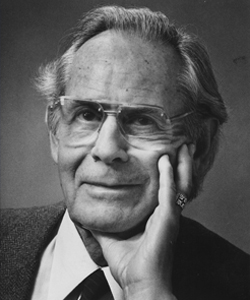
Rollo May, PhD (1909-1994) is the father of Existential Psychotherapy in the United States and inspired Yalom, Bugental and countless others through his teachings and books. He edited the first book in the field in 1958, Existence, and authored the seminal books Love and Will and The Meaning of Anxiety. He is a legendary teacher, scholar and psychotherapist.
After a brief stint at Michigan State (he was asked to leave because of his involvement with a radical student magazine), May attended Oberlin College in Ohio, where he received his bachelors degree. After graduation, he went to Greece, where he taught English at Anatolia College for three years. During this period, he also spent time as an itinerant artist and even studied briefly with Alfred Adler. When he returned to the US, he entered Union Theological Seminary and became friends with one of his teachers, Paul Tillich, the existentialist theologian, who would have a profound effect on his thinking. May received his BD in 1938.
May suffered from tuberculosis, and had to spend three years in a sanatorium. This was probably the turning point of his life. While he faced the possibility of death, he also filled his empty hours with reading. Among the literature he read were the writings of Søren Kierkegaard, the Danish religious writer who inspired much of the existential movement, and provided the inspiration for May’s theory.
He went on to study psychoanalysis at White Institute, where he met people such as Harry Stack Sullivan and Erich Fromm. At Columbia University in New York, May received the first PhD in clinical psychology that institution ever awarded in 1949. From 1955–1975, May taught at the New School for Social Research, and in 1975 he relocated to California. He is well known for many of his books, including Man’s Search for Himself, Love and Will, The Meaning of Anxiety, and The Courage to Create.