“. . . because there is in this world no one thing
to which the bramble of blackberry corresponds,
a word is elegy to what it signifies.” Robert Hass, from ‘Meditation at Lagunitas’
“Take love . . . Or consciousness. With love we experience many flavors—romantic love, platonic love, love of our children, love of nature, love of art, etc. And you cannot find this in the brain. . . And yet it is real. A sense of wonder or awe, the aesthetic and emotional responses we have to poetry and music, cannot be measured or quantified and cannot be seen under any microscope. . . We do not know where love is located. Is it just inside somewhere? The head or the chest or the blood? Or is it in the air between people?”—Iain McGilchrist*
Metaphor: The Mother Tongue
Since the first ooze of life on planet earth, the most awe-inspiring evolutionary push, one hundred thousand or so years ago, resulted in homo sapiens’ capacity for language. Not just a language of warning hoots and mating calls, but a prosocial language with syntax and semantics. As the pressures of evolution selected for longer necks with room for a lower larynx and longer vocal cords, bipedal homo sapiens could speak to each other, granting them the exponential advantage of speed and agility in teaching skills and passing along accumulated wisdom. Symbologies followed, and today written language offers an incalculable reservoir of knowledge we can access by tapping our fingertips on a keyboard.
While smart primates can understand words that label things, they do not engage in true conversation. Chimpanzees do not ask each other how yesterday’s foraging went, what plans they’ve made for the day, or if they like the chimp who stays to himself. We human beings ask each other questions to better simulate in our own consciousness what goes on in the consciousness of someone else.
We make inferences about someone else’s experiences because we have the capacity for metacognition and empathy—the abilities to think about our own thoughts and feelings, our own behaviors, and then infer their likenesses in others. The self-referential chats that run continuously in our minds give us a sense of self-identity—despite our complexity—and also a sense of continuity through episodic memory. All that mind-wandering, imagining and simulating of the highest potential, say, for gastronomic delight at either the Italian or Mexican restaurant reminds us of the ongoing theater of bi-hemispherical supported consciousness.
At one remove from the impersonal all of reality, that prelude and postlude to our individual existences, our words bring the world close and communicable. With our remarkable ability for pattern recognition, we agree to see what we label as a ‘tree’, whether in our backyards, on the page of a book or on the television. Syntactical language gives us the magic of combining words in an infinite number of ways to generate both the wondrous semantics of felt experiences, as well as to explain what we call facts; those discoveries and lenses through which to test hypotheses and generate new observations and information.
Whether speaking academically or in poetic prose, all language starts with metaphor. As Iain Gilchrist describes in his brilliant work ‘The Master and His Emissary’, metaphors link language to life. The word ‘metaphor’ has Greek origins—‘meta’ meaning across and ‘pherein’ to carry. Metaphor ferries us from the world of implicit, embodied experience to the referentially explicit, co-scripted, and co-conscripted in culture.
Paradoxically, language both separates us from the totality of nonverbal living while hand-in-hand, allows us to revisit the sense of that experience in terms that favor either a more denotative, fact-based take, or a more connotative, phenomenological one. Like light refracts from water to air, so too, when we speak, words bend away from the dense phenomenology of conscious experience and emerge distorted in the thinner, utterable substance of language, the way a straight straw looks bent at an angle with half of it submerged in a glass of water.
Neuroscience generates questions that lead toward fascinating discoveries about the human brain and aim to generate facts and sustaining truths that can help us operate more efficiently and specifically to treat the ills that bring people into psychotherapy.
In general terms, the development of antidepressants, anxiolytics, mood stabilizers and other pharmacological compounds serve the function of altering production, retention, or inhibition of our neurochemistry. And that technology aims to translate these alterations to shifts in how an individual experiences the world, predominantly to either calm it down, rev it up, or shut it down to sleep. Even more recent experimental treatments with such drugs as the stimulant MDMA and the hallucinogen Ketamine have offered some palliative, even life changing shifts in perspective, particularly to those with intractable PTSD. Other technologies like neurofeedback, transcranial magnetic stimulation, and to some extent EMDR, and tapping, the latter two not requiring equipment, provide technical assistance, propelled by similar values.
We require metaphors to open novel ways of looking at something. Freud predicted that his concepts of id, ego and superego would find their foundations in the brain well before the boom in neuroscience. Jung introduced the notion of the shadow, the anima and animus, and universal archetypes. Freud died in 1939 but in the 1960’s, the neuroscientist Paul MacLean developed the evolutionary, and now superseded theory of the triune brain—limbic system layered upon the reptilian foundation, and on top of the limbic system, the neocortex.
Today’s neuroscience research on the brain has grown highly more sophisticated as imaging techniques allow for increasingly detailed looks inside the functioning brain under experimental conditions. While the notion of brain “networks” replaced “modules,” the views of human brains as repositories of separate response centers for developmental or adult trauma, for example, have paved the way for the concomitant ‘parts’ work of today, such as Internal Family Systems (IFS) and sensorimotor therapies. The notion of parts remain a fundamental metaphor but reimagined from the prior psychoanalytic concepts.
Parts-work aims to transform multi-feeling and fluctuating physiological experiences that sometimes result in problematic behaviors, into a less self-annihilating vocabulary. Because of our conversational reliance on forms of the verb, ‘to be’, with its totalitarian authority–I am unworthy, unlovable, stupid—parts work utilizes language that reduces how much real estate of the self, each part owns; each member of the home owners association has survived with something useful to contribute to the community.
IFS utilizes an interesting group of disparate metaphors—managers, firefighters and exiles—each of which derives from vastly different matrices of association. Managers hail from the corporate world, firefighters from the world of emergency responders, and exiles from geopolitics or institutional shunning. And yet these imaginative constructions open lines of inquiry and lenses through which to re-view one’s experiences and reconstruct narrative with the purpose of living more fully in the present.
Sensorimotor work, targeted primarily to persons who’ve experienced developmental and adult trauma, ties characteristic emotional, behavioral and relational clusters of feeling and thought to parts named for components of trauma—fight, flight, freeze, submit, and cry-for-help.
Parts work utilizes our metacognitive ability to think about our thoughts and feelings and therefore has the power to shift our relationship to disturbing thoughts and feelings, mostly by distancing and depersonalization. The parts metaphors, to the extent they suggest a theory of consciousness, have no other option than to refer to the brain itself as a part, albeit an overlord part.
Authorship of ‘the truth’: A Clash of Languages
A recent post from an excellent education network illustrates both the potential benefit of psychoeducation about the brain as a means of offering psychic distance to a worried client struggling with OCD symptoms, and also its downside.
In the middle of the exchange, the client says, “So, the thoughts don’t mean I want those things?” To which the therapist responds, “They mean your brain is misfiring its alarm system.”
In so responding, the therapist helps the client shift her relationship to the unacceptable thoughts by assigning a different meaning to them—a malfunctioning brain rather than wanting to do bad things. This planar shift utilizes intellection to reduce the intensity of the client’s felt experience as well as switching the vocabulary in which further discussion will take place.
In so many ways we feel the palliation, even the buoyancy of such cognitive life rafts—thank goodness it’s just my accelerator and brakes that get wonky, or my amygdala’s apparently on overdrive—and yet, doesn’t the gain also result in some loss of fullness? Of presence? Of essence? Of authorship?
Of course, taking these two lines of exchange out of context, doesn’t do justice to the mastery of improvisation that therapists possess, encountering both the planned and spontaneous exchanges that come up in the therapy hour, with fluidity and attunement. Having a theoretical or methodological foundation can help organize a therapist’s perceptions and interactions, so long as it doesn’t overly limit the possibilities of going where imagination takes the conversation.
When a client tenders their own metaphor, a therapist could ask, “What do you mean by that?” Such a question asks for translation, literalization, and abstraction. Or, as in the example above, to explain the experience as something else, which shifts context at the expense of blunting nuance. An alternative might involve staying close to, and tracking the way a client speaks, staying in that conversation, which demonstrates respect for the client’s imaginal terrain as well as the invitation to enter it.
As an example, Diana, a woman in her seventies, subject to ritual sexual abuse for several years in early childhood has gifted me with conversations for over twenty years. A brilliant painter with a hearty sense of humor, in a long-term marriage with successful adult children, she hardly looks like someone partially shaped by the most egregious of traumas. And yet, under triggering circumstances, myoclonic jerks shake her whole body. I’ve seen her jump out of her chair. I know she will often leave a church, or a party, or any situation where certain sounds get too loud.
The other day she said, “I feel like a big balloon, so filled with air that if anything else touches me I will burst.” From past experience, and knowing the time of year as relevant, I inferred that a triggering event had occurred. It would have made sense to get curious about that. Many conversational paths lead from the hub of every comment; but I heard her speaking in balloon. An embodied language. So, I asked her whether she could find a way to release at least some of the air in the balloon.
She thought she might try to loosen the knot and let out a bit.
Silently, we both imagined her doing that, holding the cinched end with her left hand, while with her artist’s right hand she deftly tugged out the knot and then retied it with both hands after letting some air seep out. Then she looked at me. She said she didn’t want to let the whole balloon deflate, and fly around the room. She sighed. Her shoulders dropped. We smiled at each other. I thought: Sometimes urgency requires releasing some air from the balloon, so its skin gets thicker. Then I thought: I adore you.
Today’s Model of the Brain in Psychotherapy: Artificial Intelligence
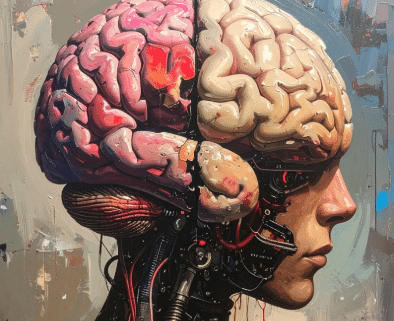
In our current world of brain neuroscience, the metaphor of rewiring the brain has achieved unprecedented ubiquity. Nearly every workshop, seminar, or course sells itself on the basis of its ability to rewire the brain, based on evidentiary findings. The language of wiring and circuitry belonged at one time to electronics—hardwiring, circuitry, breaker boxes, operating systems—but has been imported into the language of artificial intelligence (AI) and dramatically expanded. Interestingly, the coincident evolution of AI, according to Max Bennett in his book, ‘A Brief History of Intelligence’, involved modeling software based on discoveries about how neurons function in the learning brain. The more neuron-like the software, the more AI can “think” like a person.
Perhaps it’s not so much a tragicomic twist of fate, that as AI compares itself more and more to the human brain, neuroscientists compare the brain more and more to AI. Perhaps a reciprocal necessity arises from our learning something novel by comparing it to something known. We understand new things and ideas as-like or not-like something else.
Of importance, metaphors have a half-life. Having saturated the field, the initial illumination of a wired brain and its active circuitry starts to degrade. At some point it literalizes as if referencing the almighty truth and shuts out other lines of inquiry as if all the pressing questions will find their answers in some revelation about the behavior of neurons, a simple binary.
If prima facie we accept the rewiring metaphor as the most accurate description of what really happens in the brain, with its almost one-to-one correspondence with the processes and activities of consciousness, then that metaphor should possess a robustness great enough to answer the problems and concerns it raises.
For a start, brains have no feeling, no pain receptors (nociceptors), and therefore, unlike feelings—proprioceptive, interoceptive, and so forth—they cannot act as our personal gauges of change. We have another issue in that we cannot directly access our own or anyone else’s brain. We cannot open the circuit breaker box. Phenomenologically, we do not work with someone’s brain stem, limbic system or right amygdala, so if our goal in psychotherapy involves rewiring our clients’ brains, then in a clinical setting how do we demonstrate such an achievement?
Charles Duhigg, in his book ‘The Power of Habit’ argues against the implied notion that rewiring the brain retires old and problematic circuit “loops”. We can and do build new habits. With our neural plasticity, we can both repurpose neurons as well as develop new circuits. But older habit loops remain as is evident with our stalwart clients who struggle with addictions, enjoy sobriety for years, and then experience a relapse. On a positive note, we can relearn more quickly how to play the piano, ride a bike, ski or do crosswords, if we had learned how to do those things in the past.
The rewiring metaphor struggles even more when you consider that even if you could, somehow rewire brain circuitry directly, not every activated brain circuit is coincident with a specific behavior or mood state. Human behavior does not have causes; it has reasons. Agitated, someone might run a half marathon while someone else provokes a fight and punches someone.
In Lisa Feldman Barrett’s book, ‘How Emotions Are Made’, she argues against the existence of universal, hardwired emotions, instead suggesting that internal energetic and valenced sensations combine in a contextual and culture-based moment. Along with past experiences, these common arousal states then evoke culturally specific emotions. It makes neuroscience research fuzzier when emotionally laden meanings have different names in different cultures and countries. For example, Max Bennett sites a German word, ‘sehnsucht’, that has to do with the emotion of wanting a different life. A Persian word, ‘ænduh’, expresses the concepts of regret and grief simultaneously. Just for fun, a work of fiction by neologist John Koenig, called ‘The Dictionary of Obscure Sorrows’, creates words for complex, often paradoxical and moving human experiences. I’ve loved the German word, ‘le·bens·künst·ler’ ever since introduced to it, referring to a person for whom living is inspirational, an ever-unfolding work of art.
In 1962 Schachter and Singer tried to make a related case for emotional relativity. Their study looked at men revved up with injections of epinephrine in two scenarios, one with a happy actor in the room and one with an angry actor. Their findings illustrated that the experimental subjects interpreted their feelings in tandem with the actors. Alternate theories, such as the James-Lange and Cannon-Bard disputed the findings because of differences in view of temporality and sequence of experience, but all referenced a connection between states of arousal, description of emotion, and context. This complex interconnectedness, and the invalidity of considering human emotion in a vacuum, or as accurately portrayed within the confines of an experimental environment makes it less likely that brain activity will give a clean read on the specific thoughts and feelings of an individual in psychotherapy.
If the potential relativism of emotion and mood descriptors doesn’t challenge the rewiring metaphor enough, then the fascinating and laudable advancements in neuroscience itself will. Now researchers can produce more granular views of the brain in action. Beyond neural circuits, the appearance of more global activation (proactive or inhibitory) across the brain will complicate the usefulness for the clinician when trying to integrate information on the brain with clinical work on the ground, both in intervention and psychoeducation.
As an example, The International Brain Laboratory (IBL) researchers published findings in ‘Nature’ that shed light on how decision-making unfolds—an example of a mentalizing process across the entire brains of mice at the resolution of single cells. Their article suggests that rather than organizing information and experience hierarchically, the brain does so across regions
Beyond the Brain: Lived Experience Manifests Globally
Focalizing the brain as the preeminent hub of all expressions of consciousness results in a theoretical severing of the brain from a more embodied and holistic view. Somatic resources and nervous system hacks arise as add-on fuels to lubricate treatment because they’ve suffered from disenfranchisement. Even the notion of implicit memory that is ‘stored’ in the body makes it sound like traumas live somewhere particular, holed up like burrowing rodents or encapsulated tumors. But the body never defected in real life, leaving a disembodied brain behind.
Anyone can see the obvious attraction to studying the brain, to inform psychotherapies, because of its complexity and support for consciousness. The disadvantages, as discussed above, leave the clinician on the ground blind to the client’s brain’s registering of improvements.
Would it prove equally worthy to study the ways in which, say, attachment or adult trauma affects the musculoskeletal system, for example? Or to some other bodily signatures of mental health more available to naked eye or perceptions and sensations already experienced by humans?
In the past, some theorists have developed notions about the shaping influences of trauma and emotional hardship on the body, such as Wilhelm Reich. Later disgraced for his unsanctioned practices, and dying in prison in 1957, he nonetheless made an important contribution in his description of character and muscular armoring as the results of emotional trauma and fear. Visible defense mechanisms, such as chronic muscle tension, showed up in the jaw, chest, shoulders and pelvis; and blocked or diminished feeling and connection.
Reich mentored Alexander Lowen. Lowen developed Bioenergetics as an approach to releasing physical blocks through expressive movements and breathing to heighten vitality and improve emotional connection; a still active method.
The actor Matthius Alexander, by self-experiment to correct his vocal problems as a Shakespearian actor, discovered unconscious tension in his head, neck and back, and later the postural realignment exercises he developed, also served as an alternative medicine.
More quantitative, replicable research has yet to supply these healing practices with the approbation of “evidence based.” For the meantime, we base the validity of somatic work today on a brain-based context about what pathology, specifically trauma, looks like, and the realization of the gap between that information and its resultant treatment success if it doesn’t include the body, meaning the remaining parts of the body other than the brain.
On one hand, what a benefit to reap from the prolific harvest of neuroscience research into the human brain and tend to that mysterious gap between brain and lived, embodied human consciousness. On the other hand, to remember to leave room for the miraculous moment-to-moment variety of individual experience; to not rush so fast to contain it within the borrowed neuroscience vocabulary of software programmers. Even at the level of turning neurons on and off, which Karl Desisseroth’s research in optogenetics has made possible in animal models, we don’t have an explanation for how neurons become relevant to one another.
In life, no matter how many times we remember burying a loved one, or the joy of falling in love, we will never feel the same way twice. Like crossing a familiar bridge over the same river that is also not the same river as last time. Healing occurs in both momentary ways as well as in ongoing lived experience. Living a sustaining way of life in community supports us well beyond a breathing “hack”, a vagal nerve sternocleidomastoid massage, or the singular application of an evidentiary touted “brain-based” technology. Adopting a both/and attitude will serve us well in the coming years as our field seeks an integrated approach to mental health treatment, or, as I would prefer to say, ‘interaction’ instead of ‘treatment’.
Undoubtedly, in the near future, we will incorporate brain implants or prostheses, like other medical specialties utilize—a peace-maker perhaps, instead of a pacemaker, that maintains or jolts us back into brainwave frequencies of 8 to 12 Hertz so we can enjoy the calm focus and reduced stress state brought to us by Alpha waves—into psychotherapeutic treatment. Yet these marvels of our human ingenuity do not need to erase our humanity and applaud only a mechanistic vision of healing and societal wellness.
“Who I am” has no correlative location in my brain. I can think that thought, say the words in my mind, feel something about this, but my being does not have a location. No “me” spot sits in my brain. No “God” spot lives in my brain. We cannot locate living, breathing me-ness or living, breathing holiness in the complex and vast geography of our brains. No train, no rocket, no ‘beam-me-up Scotty’ will get us there because there’s no ‘there’ there.
Instead, we spend much of our waking and sleeping lives mind-wandering, and wondering, in the unlimited lushness of consciousness. Mostly self-referential, mind wandering reminds us that we exist; allows us the chance to meet our existential selves in reference to those thousand things and people and situations we encounter or can imagine.
It still has value to meet our clients in an honest, attuned, real-person way. Most of our interactions happen in conversation. Language has more potential than any method available, for mind to meet mind, and provides the prerequisite for empathic communication. Because language has connotative potential as well as denotative, it can invite embodied, whole person experiences that inspire change. Conversation is not a done–to the client, but a done-with, co-creative exchange. Unlike applications—EMDR, Neurofeedback—and without diminishing their helpfulness, conversation creates connection and a mutual experience in the therapy hour. Still, the best evidence that a client gets what they want out of psychotherapy amounts to what they say.
Suggested Bibliography
Bennett, M. (2023). A brief history of human intelligence. Mariner Books.
Duhigg, C. (2012). The power of habit. Random House.
Feldman-Barrett, L. (2017). How emotions are made. Harcourt Mifflin
McGilchrest, I. (2019). The master and his emissary. Yale University Press.
van der Kolk, B. (2015). The body keeps the score. Penguin Books.
Go Deeper in Your Practice
Get unlimited access to 350+ real therapy demonstration videos, CE, webinar replays, and more with a Psychotherapy.net membership.