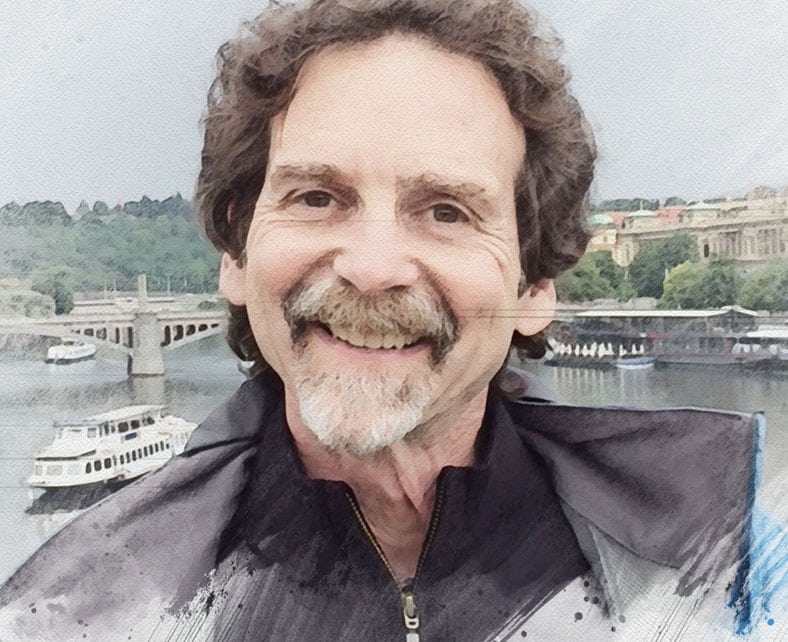
Lawrence Rubin (LR): Thank you for joining me today, Kirk.
KS: Thanks so much, Lawrence.
The Struggle to Live Fully
LR: I’ll start off with the basics in a rather oversized nutshell. What are some of the core values of the existential-humanistic model?
KS: I would say that the question of how you are presently living pervades the entire existential humanistic therapy process, both explicitly and implicitly through the therapist’s and client’s presence with each other, which in turn supports the client in that search, that exploration process.
On the heels of that question, the other very permeating question is, “okay, that’s how you’re presently living, now how are you willing to live, how are you willing to put it into action? How are you going to translate all this struggle that we are illuminating in the therapy process into your life here with me and your life outside?” Those are the two pivotal themes or questions as I see it.
LR: So, would the therapeutic relationship be a bridge between how the client is currently living and how they want to live?
KS: That’s a good way of putting it. I do think it goes from ‘how are you currently living’ to ‘how are you wanting to live’ organically. I call that the client’s battle, the part of themselves that’s trying to break through and liberate themselves, to live more freely, more richly, and the part that holds them back, which we call self-protections. On the heels of that, which part are you going to align with and how are you going to live it? We could also use the term struggle, but I think phenomenologically it’s often perceived as a battle, a real life and death tussle.
LR: If existential-humanistic therapy is about helping the client to liberate the self that they want to be, what metaphor would you use to describe the role of the therapist?
KS: I see the therapist basically as a midwife to that process. We do everything we can to preside by the client’s self-discovery of what direction they want to take in their lives. I like to use a Daoist notion that’s similar to the idea of effortless effort on the part of the therapist, but I call it effortful non-attachment. The therapist does everything he or she can and makes every effort to support, to facilitate, to help co-create conditions whereby the client finds the path that is the most vital, the most core for them to live their lives.
LR: Within the context of the midwife metaphor, what happens in the event of a breech birth, where the client is just stuck in their psychic birth canal?
KS: The actual midwives as I understand them, engage in different levels of press, if you will, or different levels of engagement. My overarching guide in this is the client’s desire and capacity for deeper or more experiential change. By experiential I mean an emphasis on the immediate, the affective, the kinesthetic and the profound or spiritual.
The question of whether the client has the desire or capacity to work at a deeper level then gets into the whole existential-integrative approach which I view as one way of understanding and coordinating a variety of bonafide approaches within an overall existential or experiential context. This is basically asking, ‘how do we best meet this person in this moment and given the context that we have?’ To me, that’s very existential and very phenomenological.
Sometimes we have to meet the person in such a way that is more directive. If they’re being beaten by their spouse, I’m not going to be the same therapist authentically as I would be if they weren’t in such an emergency situation. I’d be likely to show a lot of concern about their current situation and maybe make a suggestion about finding a shelter for the night, or a referral to an agency that that could help support them in some way in addition to the work that we’re doing.
Sometimes, we simply have to help people get through the night. Life happens while you’re planning something else. So, this is where a more, directive or even programmatic kind of approach may come in. There are also clients who are more oriented to a very structured or cognitive/rationalistic way of coping, so the approach might adjust to a more cognitive one
I would want to address this as best I could, as authentically as I could by bringing in, for example, cognitive restructuring because that seems to be most helpful for them. I would help them clarify whether the black and white way they see this problem is the most productive one for them, such as with a client who feared her boss would think she was a bitch if she asked for a higher pay, and feared not only her boss, but that the whole company would be against her for that. After unpacking that and even doing some role play and rehearsal with how she might ask for that pay raise, she might begin to see other options that weren’t as fearful. Perhaps she would see that her question about a pay raise is more important than his presumed judgment and more immediate and to the core of her life struggles at that point. It’s helpful for any therapist to have a pretty wide range of tools in the toolbox to address where the person is at that moment.
I should also mention that through work with these different modalities and at these different levels of depth, clients are often enabled to work more deeply. They get footholds on the way to working toward what I call the experiential level of contact which is the culminating level for the existential-integrative approach.
LR: So, regardless of what therapeutic technique you’re using in the moment, the core values of existential-humanistic orientation are always running in the background and fidelity to that ideology doesn’t preclude using, for example, cognitive behavioral or somatic methods.
KS: That’s right, and I want to be very clear that that embodiment of an existential-humanistic sensibility is vital through the whole therapy. In other words, making available that experiential level of contact is ever there for me. And that’s the difference between going in as a technician, or the doctor with the white coat who’s giving the patient the answer, from Irv Yalom’s notion of sitting with a fellow traveler. The fellow traveler of the therapist just happens to have traveled some more miles than the other fellow traveler and has survived some of the very difficult challenges that the other fellow traveler perhaps has not, or has done so at greater depth.
LR: Or maybe the clinician hasn’t necessarily traveled more miles, but has put more attention into the travel, and has explored the journey. I imagine you can have a very talented, very present, younger, existentially oriented clinician as well.
KS: That’s true. It’s not just quantity or age per se.
In an Era of Quick Fixes
LR: You mentioned something earlier that I wanted to follow up on. How is contemporary existential-humanistic therapy perched to address the cultural ethos of quick fixes and easy answers?
KS: I think this is a vital question today. I believe that existential-humanistic and existential- integrative therapy are central to the counterbalance of mainstream society which is increasingly focused on the quick fix, instant result model of living. I see that focus on the quick fix as reflective of our increasing enchantment with machines and computerization. We’re becoming more and more used to quick reactions, quick responses, and instantaneous answers.
A machine model for living and machine-mediated consciousness are becoming more and more pervasive. I think this is very important, and something which psychologists and therapists often miss. This enchantment with mechanization dovetails disturbingly with the socioeconomic model that we live under which reinforces, or is in many ways compatible with the notion of the quick fix, instant answer, and a quantitative/profit margin view.
Bean counting is very influential on our profession. Existential practices offer a means of countering this very big juggernaut. I think it’s also resonating with more and more people who are dissatisfied with that quick fix and instant result.
LR: I love your use of the word ‘enchanted’ when referring to the hold that mechanization has over our society. It suggests a spell or some sort of induced state of passivity and subservience.
KS: I think it’s true. That element of enchantment is becoming more and more evident because of the effects of high tech which often hits us at a subconscious level. So yes, we are unwittingly becoming more and more subservient and manipulated in many ways to becoming subservient to those dopamine hits that social media companies and AI capitalize on.
I think the more that it has an impact on mainstream psychology and the helping profession, the more that impacts us at the cultural level. At the same time, I do think mainstream psychology, at least in several important quarters, is opening up to existential-humanistic psychology. Here, I’m talking about for example, the publishing arm of the APA, which is open to a number of textbooks in existential-humanistic psychology and psychotherapy. Recently, there has been a proliferation of them, from Louis and Heatherlyn Cleare-Hoffman’s Case Formulation in Existential-Humanistic Therapy, to surveys of the theory, to the third edition of my and Orah Krug’s textbook, Existential Humanistic Therapy. I’ve also done a number of videos for APA illustrating the approach and I believe Orah has done some books, so, we’re getting the word out and we’re also seeing more and more people attracted to our Existential Humanistic Institute trainings where we have waiting lists. We are seeing a hunger among more students for this perspective.
A Hunger for Existential-Humanistic Practices
LR: Why do you think there is that hunger?
KS: I think it’s because people are becoming increasingly disillusioned with the machine model for living. I think people are recognizing that this model is not helping them find a greater sense of meaning and purpose in living. It’s not helping them to tap into their deeper yearnings for relationships with others, for intimacy with others, for creative work and creative projects, for experiencing what I call the awesomeness of life.
I do think people get tastes of the humility and wonder and sense of adventure toward living, but quickly become frustrated and despair when they have to return to that very routinized and mechanical way of living.
LR: Or when they realize that satisfaction of immediate need has a short shelf life.
KS: Yes, exactly and that’s another problem. It’s not as enduring as the deeper encounter with one’s life and the cultivation of a deeper presence to oneself and the world. By presence, I mean the holding and illuminating of that which is palpably significant within oneself and between oneself and the world. I also mean “really being there,” with one’s whole body experience.
LR: I wonder if some of the younger clinicians out there are going to be able to break the spell of enchantment in midlife, and return to the existential fold when they realize that professional success and fulfillment are not the same—that there’s something missing.
KS: I think it’s possible that many people will have this crisis more in their mid-lives, but I don’t see it as a straight line by any means. I experienced a midlife crisis when I was three years old and my seven-year-old brother died, shattering my family system. I won’t go into detail, but it opened very profound existential questions for me at a very early age. So, part of it is life circumstance and the crises people encounter. Just look at our world today where I think young people are encountering a surfeit of political and cultural crises. Obviously, we are at war right now!
LR: Which one?
KS: That’s the problem. Wars are surrounding us. Violence is surrounding us. Coarseness of discourse and interaction are surrounding us, including the debasing of relationships at the highest levels of leadership in our government. All these things are having profound effects on young people and disillusioning effects.
I see that all the time at conferences where young people are saying that this can’t be the way to continue living our life. There’s got to be other ways. I should also mention that the existential-humanistic approach is having an influence at the level of the cultural and political arena in terms of projects like the one that I’ve been developing with Tyler Gamblin called the Corps of Depth Healers.
LR: Please say more.
KS: It draws to a great extent from psychodynamic and existential-humanistic principles of practice. We have a website called Corpsofdepthhealers.com which offers a certificate program through a curated curriculum for those in the helping professions who are interested in applying depth principles of practice to social crises.
Our guiding vision is to make more available and affordable what we call emotionally restorative relationships in which people are feeling seen and heard, and can get at the roots of their problems. You can see the resonance of that with existential-humanistic practices which are all about helping people to cultivate greater presence within themselves and between themselves and others. In this way, they hopefully can achieve more meaningful relationships and more inspiring ways of living in a whole range of sectors within our society, from child rearing to the educational, work, and religious settings.
LR: And the judicial setting?
KS: Yes, I was going to get to the legislative, deliberative settings as well as diplomatic settings. We offer a number of videos and articles by leaders in various areas who illustrate how we can bring more emotionally restorative relationships to these various sectors.
Looking into the Abyss
LR: Thinking about you sharing the loss of your brother during your own childhood, I’m thinking that we get lost thinking about kids in behavioral terms and get so caught up trying to fix the kids rather than look at the real, true, deep existential concerns they have, especially surrounding death, illness, poverty, discrimination, and war.
KS: I really think the core wounds that we all share actually begin at birth. I’m an increasing fan of the work of Otto Rank, and in particular his notion of the trauma of birth. I call it the drama of birth because I don’t think it’s just shock and overwhelm. Right on the heels of that is the beginning of curiosity and wonder and presence. I would say those are the seedlings of presence, but the initial shock of coming into a world and shifting from relative nonbeing and unity with the mother and with the cosmos, to an abrupt and pandemonium-filled space is an extremely powerful beginning and a most impressionable time. I believe that that sense of groundless loss and helplessness is at the core of virtually all future anxiety and trauma.
Some people are ripped open to it in abrupt ways through traumas and other experiences that are more in the shadows and the background that don’t become quite as explicit. I do believe that how we’re met, especially in those early years, but ongoingly is critical to restoring us to a place where we can be more present to both our vulnerable and sensitive sides as well as our great capacity to venture out, to take risks, to ask questions, and to create. I think that is the staging ground for the existential basis for our anxieties, whether we get there explicitly or not.
LR: You’ve now mentioned Otto Rank and the birth trauma, or drama, and rebirth. There’s this interesting thread that goes through your process that suggests that rebirthing is essential to existential-humanistic therapy.
KS: I think it is almost literally and figuratively, because existential humanist and integrative therapies, at their best, are about helping the person to reinhabit their whole body experience—a reoccupation project. They’re reinhabiting with the parts of themselves that have been blocked off. And that goes to a very primal wounding. They’re re-occupying that sense of groundlessness and helplessness with a greater presence.
It’s almost like flip sides of a coin. On one side of the coin is the terror, overwhelm, and groundlessness that we experience at birth. But on the other side of that coin, and also native to us, is the capacity to begin to be curious about all that chaos that we come into and hopefully develop the courage to see the rich possibilities in that chaos as distinct from terror and overwhelm. I call this life-enhancing anxiety, which is the capacity to live with and make the best of the depth and mystery of existence. Or to put it more concretely, it’s the ability to live more on the edge of wonder and discovery, rather than terror and overwhelm.
The parental system, the cultural system that meets the child is all important here. If they meet the child with relative support and understanding and a deep appreciation for the gift of life and of their lives, I think the child has a better shot at living a fuller, richer, more gratifying life than if they’re met with all kinds of prejudices and assumptions and bigotries and fears. So, a more presence-based meeting as distinct from fear-based meeting. That’s really what we’re offering in our therapy.
It’s the battleground within which we may be born anew, to re-inhabit that battleground or come at that battleground with fresh eyes such that what was formerly a battle was now seen as something that could be drawn upon or converted into living in a more meaningful, creative, or intimate way.
I’ll give you another metaphor here since you like metaphors. Existential-integrative therapy is a striving for wholeness that Rollo May often talked about. I like to describe it to students, I like to say it’s not only ‘wholeness,’ but ‘holeness.’ It’s the whole picture. It’s about occupying much wider and deeper ranges of thoughts, feelings, sensations, imaginings, but never forgetting that all of that is also in the face of the abyss of our existence—that’s partly our vulnerability, our fragility, our groundlessness. The issue is not to eliminate groundlessness, but to find greater ground within the groundlessness. To me, that’s the vital life. In fact, I would fear, as some strident transpersonal theorists seem to advocate a seamless unity between self and not self that is completely reconciled with that abyss. I fear that could become a very non-evolving, very static life.
LR: While common wisdom suggests that the devil you know is better than the devil you don’t, doesn’t the devil potentially hold the answers if you’re willing to endure the heat?
KS: This kind of therapy supports the client’s ability to be courageous in the face of the unknown, the radically unknown, the radically other. And I don’t see how you get around the need to encounter the radically unknown and the radically other if you’re going to live a fuller, more meaningful life. In a way, we provide a laboratory, or a spare room for experimenting with your life, one that is safe and structured where we can try out all kinds of possibilities, boundary breaks, ruptures, and repairs and learn to thrive in the face of those breakages.
Walking the Existential Talk
LR: Using the microcosm of therapy, as Irvin Yalom put it.
KS: That’s an interesting way to put it. A microcosm to the macrocosm of living.
LR: Doesn’t this all presume that the existential-humanistic therapist needs to have done a fair amount of work on themselves, and have been courageous and questioning and challenging and battling in their own life?
KS: I think it’s huge. Personally, my life has not only been transformed by particular in-depth therapies that I’ve had, but they may have saved my life, if not literally, then certainly figuratively. This is especially the case of the therapy I had from an existential analyst when I was in graduate school that I feel has lasted until now. That was so powerful. What did I learn through that process? I learned to stay present, to stay with whatever it was that came up between us, within myself, in between sessions. My therapist provided the home, the grounding for me to feel safe enough to go to those places even outside the session. There you go. Presence is the core.
So yes, I highly recommend therapy for the practitioner. I also recommend that therapists who go in this direction consider working in psychiatric emergency rooms or state hospitals, which I have a background in as well. Those were also pivotal for me, given my fears of craziness and of being on the edge.
LR: Kirk, in what ways does your practice of existential-humanistic psychotherapy intersect with your life?
KS: I feel this work should lead to walking your talk. In our teaching, we often talk about how this type of work is not confined to the consulting room. For some, this is a way of being, a way of looking at life. Hopefully, if you’re really going to work this this approach, it kind of becomes part of your life. It’s not just a technical tool or skill that you apply in the office. Otherwise, I think there’s something disingenuous about it. It’s been compatible with my life for a long time.
LR: Since childhood?
KS: I like to say that I was introduced to existential psychology when I was two and a half years old. I had psychoanalysis when I was six because I was in very bad shape. I know it’s strange, but my mother was in analysis, and she had the wherewithal and emotional intelligence to refer me to a child analyst. That was the first really transformative period for me.
LR: The word transformative is interesting because it presumes a destination, like an emotional Nirvana, but from what you’re saying, it sounds like a fully lived life is one of continual transformation.
KS: Absolutely. My life has improved a great deal since those two major therapies that I had; the one in childhood, and the later one during graduate school. I mean, it’s not Nirvana by any means, but I felt, I felt liberated to experience a much wider range of thoughts, feelings, sensations, fantasies, and imaginings than I ever could when I was a youth. I was too terrified, so as a result, of those experiences, I feel less terrified of many of those places. And I think that’s been helpful to my clients, too.
But what I would say is, in terms of how it’s directly related to my life, is I attempt to stay in touch with that significance of being present. I try to tune into the bigger pictures when I find myself caught up in narrow and petty judgments or self-devaluing or devaluing of others or getting stuck on the stupid things like a little conflict with a friend or a spouse.
It’s so easy to identify with those, so what we learn in this therapy is that those actions and reactions are part of yourself, but not your whole being. The existential question is ‘can you come into the more of who you are?’ It’s about life in its largeness, or as Jim Bugental said, ‘coming into the more.’ I think it was William James who said that before him. It’s beautiful because that’s a lot of what I think about when I’m with my kid or my wife or friends or when I’m taking a walk. What you might think are quotidian things or ordinary situations, I will try to connect them with the bigger picture. Okay, this is amazing, there’s something awe inspiring. It’s about life in its largeness.
A Time to Die?
LR: Speaking of the bigger picture, and life in its largeness, I know one size doesn’t fit all, Kirk, but does suicidality raise a unique challenge for the existential-humanistic therapist around issues of freedom and choice? Must suicide always be relegated to pathology?
KS: I see it as really dependent on where the person is coming from. All I can do, or what I try to do when working with folks who are deeply depressed and suicidal is to encourage them to stay with, and to reflect, as deeply as possible on the question of whether they should live. It’s very connected to the kind of work that we do generally, which is to offer to folks who are able to go there, the opportunity to not just talk about the situation, but to feel into it.
LR: To be as fully present as possible within themselves.
KS: Or to take a moment to see what they’re sensing in their body right now? I often find these pre-verbal kinesthetic invitations to be very powerful gateways to core places, certainly core wounding, but also possibly core realizations about one’s life and the direction one needs to take in one’s life. This gives many people the best chance at making the most substantive decision about their lives and the direction of their lives, even if that means ending their life. When a person is contemplating suicide, the point is, ‘have I helped to give them the best shot at clarifying what direction they want and need to go in their lives?’ That’s a staging ground that I feel is very important when making that experiential level of contact with the person.
It’s very striking to me how that can open the floodgates when people stop talking or intellectualizing. I invite them to make contact with that heaviness they feel in their chest, and to take a few more moments to see what other feelings, body sensations, or images arise as they make contact with that heaviness. It’s amazing what that can open up for people such as past scenes, or maybe something presently that’s striking them or just a whole range of things. It’s often extremely core.
LR: Primal!
KS: Primal. I did want to make sure to bring in the experiential level of contact into our conversation because that is often the culminating phase of this work for people who are ready for it and willing to go there.
LR: Kirk, I think that would be a good place to stop for now. It’s been wonderful chatting so deeply with you. We touched on so many different, important issues, but then again, it was about existential-humanistic therapy, so why wouldn’t we? I thank you very much.
KS: Well, the feeling is very mutual, Lawrence, so much appreciated.
References
Books
Schneider, K. J., & Krug, O. T. (2026). (3rd Ed.). Existential-humanistic therapy. American Psychological Association.
Schneider, K.J. (2026). The vibrant center: A new consciousness for our broken age. University Professors Press.
Yalom, I. (1989). Existential-humanistic therapy. Basic Books.
Psychotherapy.net Videos
Rollo May on Existential Psychotherapy
Existential Humanistic Psychotherapy in Action by James Bugantal
Irv Yalom and the Art of Psychotherapy
Go Deeper in Your Practice
Get unlimited access to 350+ real therapy demonstration videos, CE, webinar replays, and more with a Psychotherapy.net membership.
