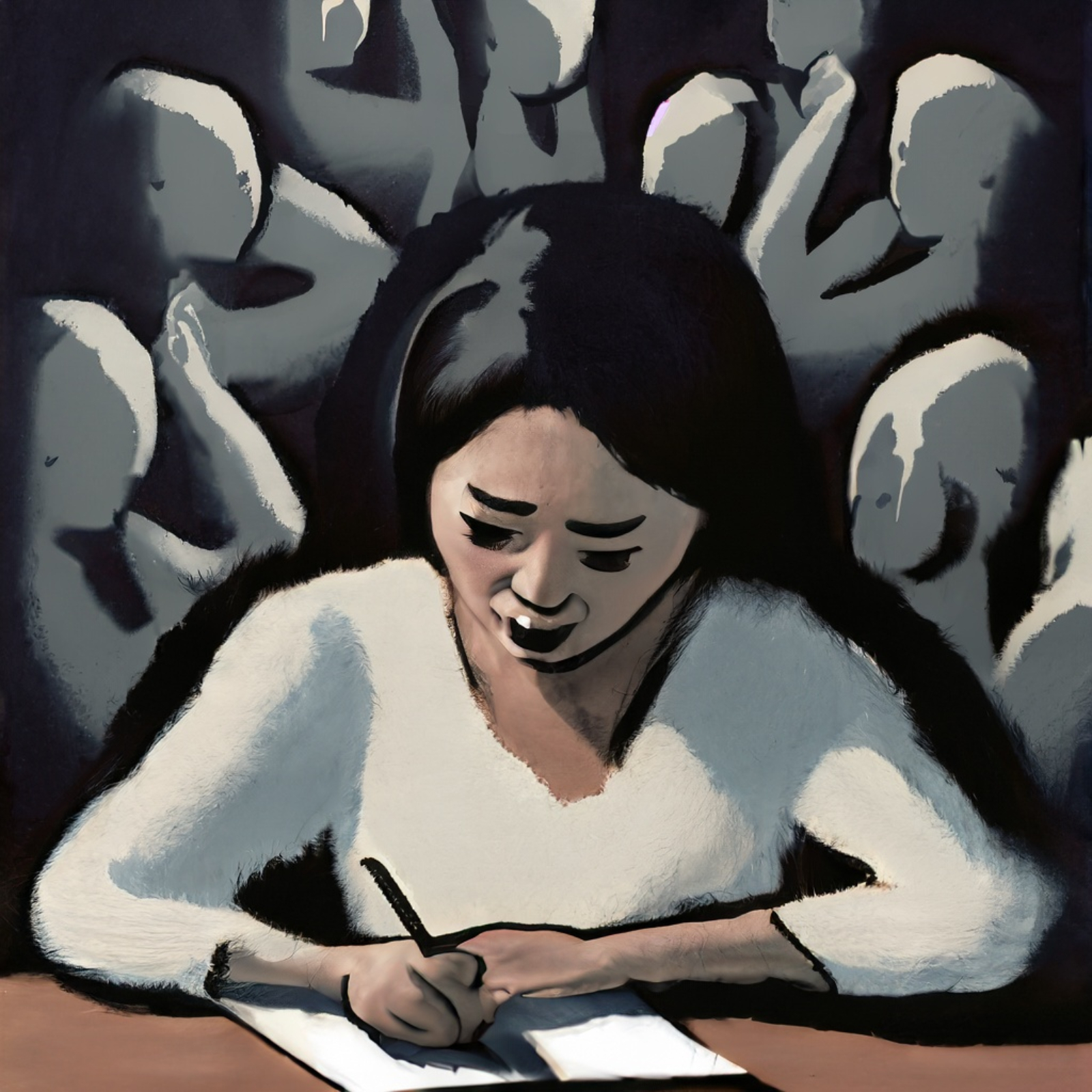
“Love of the Written Word”
Poem by Irene
I feel like singing, dancing, — yes, even weeping,
I feel like playing music, loudly rejoicing, — yes, even singing psalms,
I feel like exploring, re-experiencing, — yes, even dreaming,
Each time I look to the written word.
I feel special, chosen, — yes, even honored,
I feel pure, poetic, — yes, even pretty,
I feel happy, joyful, — yes, even worthy,
Each time I look to the written word.
I enjoy paper, pencils, — yes, even glue,
I enjoy stanzas, verses, — and rhyming too,
I enjoy letters, notation, — yes, even grammar,
Each time I look to the written word.
I fill with harmony, trust, — yes, even wisdom,
I fill with loss, sorrow, — yes, even wrath
I fill with zeal, loyalty, — yes, even love,
Each time I look to the written word.
This paper describes a writing-based, storytelling approach to engaging with the consequences of extreme violence and sexual assault in childhood. This approach emerged spontaneously during a therapeutic collaboration between myself, psychologist Christoffer Haugaard (Aalborg Psychiatric Hospital, North Jutland Region, Denmark), and Irene. We wish to provide an insight into how this approach arose, how we practice it, and what effects it appears to have. In doing so, we hope that others may derive some benefit from these experiences towards finding ways to live a life beyond trauma that maintains and empowers one’s dignity and humanity.
Irene is in her early thirties. Throughout her childhood, her parents had subjected her to a multitude of forms of violence, including rape and physical as well as psychological violence. Shortly after reaching adulthood, she started seeking help in order to deal with the traumatization caused by her parents. This eventually led her to contact psychiatric services. Prior to this, Irene had some experience with self-harm practices, but this was inconsequential. This changed dramatically upon becoming a psychiatric patient, after which extreme and even life-threatening self-harm was a persistent hazard (Irene has not performed self-harmed since 2015). She was diagnosed with a personality disorder.
The Early Therapeutic Relationship
I met Irene after she was referred to psychotherapy for the second time within the hospital. This was in early 2012 when Irene was in her twenties. By then, she had frequently been hospitalized on account of dramatic self-harm and suicide attempts over the previous seven years. We have had weekly meetings since then and up until the present. Finding a way to engage with Irene’s story proved to be a significant challenge in itself. The fact that I am a man made it no easier for Irene. Therefore, our collaboration has also very much consisted of a search for, and a testing of, ways of talking about matters of concern. We would like to begin by describing some of the history of how the approach to therapeutic conversations that we discovered emerged:
Christoffer: We were attempting to talk about your life, Irene. I was focused on understanding how the things you were subjected to through so much of your life had been a shaping force on your way of being, and how you had resisted that power and the violence. I think that sometimes led to rather divergent characterizations of your person, whether your past self should be regarded as wrong, selfish, dirty, and guilty, or alternatively be regarded as caring, intelligent, and strong-willed.
At that time, I began to write abbreviated stories about you to convey what it was that I saw in you. I remember you telling me that when you read those stories, you were seized by a strong urge to refute the veracity of my claims, as if the text was subjected to an intense criticism because I dared to propose a different perspective on your character to the dominant version. At some point, you named this urge to criticism The Shadow Side. It readily reacted against attempts to challenge the heavy and dark interpretation of your story and your moral character. I recall you forcefully bringing The Shadow Side’s refutation to my attention at one point regarding the significance of me referring to you by the pronoun “you.”
Irene: I could hardly read the texts when you referred to me as “you.” The Shadow Side, the judging side of me, got angry and became automatically defensive. It wanted to tear the paper apart and shout at you, but it knew nothing was to be gained that way. Instead, it scolded me for being so stupid as to talk to you or read anything from you. We talked about how it was nearly impossible for me to read anything that portrayed me in first- or second-person grammar, so you changed your text into the third person. It was still a tough read, but it was acceptable because The Shadow Side perceived a small victory in this.
Christoffer: The first time I wrote to you addressing you in the third person was in 2013. You made me aware of The Shadow Side, and we described it and tried to deal with it through 2014. Would you mind describing The Shadow Side as it was at that time to provide an impression for our readers?
Irene: The Shadow Side destroyed my possibilities by repeatedly telling me that I was too ugly for anyone to like me, too fat to have friends, too dirty to receive a hug, too stupid to give my opinion, too wrong to breathe, and more insults like these. It constantly brought my attention to similarities with my parents whenever I said or thought anything that could remind me of their cruelties. If I got angry, The Shadow Side immediately made me think that I was evil and therefore capable of becoming violent or otherwise mean-spirited. Even though I never became violent, it had me believe that I was. The Shadow Side convinced me that I had anger like my parents and therefore I was identical to them and their atrocities.
The Shadow Side was a merciless judge or a desperate prosecutor. It devised well-thought-out and devious methods of making me portray myself as stupid and unworthy. Every time the cautious Defence managed to argue well, the desperate Prosecutor convinced everyone in the court with 10 strong arguments to the contrary. Some were a little far-fetched and had no truth to them, but when you listen to something long enough it is likely that you will come to believe it.
The Shadow Side was always hard, indifferent to anything anyone else said and always awake and alert. It never took a break. The Shadow Side made me become hard and live my life in a self-destructive bubble. It made me harm myself so that I could cope with everyday life, keep others out so that I would not be let down, live a façade so that I did not fully realize the horrors, ignore possibilities for getting help so that I could be strong, and so on. The Shadow Side made me believe that I was insignificant, as if I wasn’t even alive. It always told me how wrong and useless I was. The Shadow Side was my thoughts, beliefs and actions. It took over everything and swallowed my identity.
Christoffer: We arrived at me attempting to write about a fictional person instead. Someone not you, but similar to you and having endured similar trauma. In 2013, I started writing such stories about a fictional version of you in the third person that I called Kate. These stories were surprisingly not attacked by The Shadow Side. They were allowed, and you were able to read them, and we could talk about them without The Shadow Side attacking the veracity of the facts in the story or Kate’s moral character. It also made it easier for me to write stories, because now that it was fiction, I had creative license and consequently didn’t have to worry so much about getting all the facts right. Instead, I could focus more on the moral of the story. You have told me that when you read these stories about Kate, you were able to have an opinion and feelings concerning the subject matter. It became possible for you to feel compassion for Kate in the story.
Irene: That is correct. Kate came alive through third-person stories.
Christoffer: In 2015, we were focusing on circumstances, events, and actions that have contributed to your survival and to the moral character that you have today [Christoffer and Irene looked through examples from her childhood with a focus on her ways of taking care of herself and her dignity, as well as her survival strategies]. There were many things, but two things are of particular relevance in this context:
Having an Audience
As a child, Irene was the one amongst her siblings who took care of most of the practical tasks on a daily basis, while her parents did nothing. At a young age, her parents charged her with the responsibility for cleaning the house, tidying up, cooking, doing the dishes, looking after her younger siblings, including comforting them, protecting them from violence and rape, helping with their schoolwork, washing clothes, tucking in her siblings at night, getting them up in the morning, getting them to school and so on. She was also held responsible for unjust chores, such as chores given to other siblings that they had neglected or avoided, in addition of course to the basic unfairness of being forced to do all the work parents normally do.
Irene was often given additional tasks on top of this, or their demands were increased with the intent of punishing or humiliating her. She was forced to live such a slave-like existence by means of threats of violence, humiliation as well as acts of brutal violence leading to physical injuries.
How does a 10-year-old child survive such circumstances? Irene did so by imagining she was the main character in a fairytale like Cinderella. She would make believe that all these exhausting, humiliating, and unfair chores were like Cinderella’s, and that she herself was a kind of Cinderella in a movie and had an audience that witnessed everything.
This audience understood Irene to be the main character of the story and felt sympathy for her. They could see all the injustice that was otherwise hidden from everyone’s view and never spoken of as anything unjust within the family. The audience saw what happened, understood the injustice and reacted to it. This type of fantasy contributed to Irene maintaining a sense of dignity and justice throughout her childhood.
Writing Stories
Irene only revealed to me that she had previously invented a similar writing practice for herself after we had already developed our method of writing fictionalized versions of her life in the third person. She had begun writing stories about a fictional alter ego when she was around 10 or 11 years old and had even made an illustrated story prior to having the skills to author a written narrative. Irene’s fictional alter ego was called Katja, and Irene continued to update Katja as the years passed. The latest additions were written when Irene was in her early twenties. I was quite amazed when Irene told me this. Had we reinvented a new version of a practice that Irene had in fact invented for herself many years before? Unlike Irene, Katja of the story fled her home and had adventures and faced dangers in the wide world, finally becoming a physician and married with children. However, this alter ego was more to Irene than a character of this unfolding narrative. She was also a sort of invisible friend and companion to her. Here is Irene’s poem about her, written in July 2018:
Who Is Katja?
Katja was once a little girl who fled from her home.
She is the girl who held my hand when mom yelled at me.
She played with me when no one else was around.
Katja was moved to a foreign land.
She is the girl who held me when I fell.
She helped me when life was hard.
Katja was subjected to horrible things by her own parents.
She is the girl that hid with me when dad beat me.
She whispered words of comfort into my ear when dad left my bed.
Katja hurt herself.
She is the girl who carried the pain when I cut my body.
She managed fear so that I could breathe.
Katja experienced many betrayals.
She is the girl who suffered with me when dad kicked me.
She gave me sustenance when mom starved me.
Katja was assaulted many times.
She is the girl who never complained when we were tortured.
She sang for me so that I could fall asleep.
Katja never grew up.
She is the girl who shielded me from evil.
She followed me my whole life as a side of myself.
Katja’s life is my life.
Looking back and wondering what may have inspired the character of Katja, Irene points to fictional characters that were significant to her in her childhood: Astrid Lindgren’s “Pippi Longstocking” and Katarina Taikon’s tales about the Roma girl Katitzi that she had seen on television (Use of the name Astrid in the stories about Kate is in tribute to Astrid Lindgren).
We did not consciously create a therapeutic method out of these elements, but we discovered in hindsight that these survival strategies seem to foreshadow the approach that we arrived at. For that reason, we have chosen to name our approach after, and in honor of, Katja. The step from me sometimes writing to Irene about a fictitious version of her that I called Kate (Both names — Kate and Katja — are short for Katarina, a name that means “The Pure.” What a fitting name!) and to the approach containing precisely those two elements described above didn’t happen until 2017.
The World of Katja-Writing
Irene had been haunted by several nightmares her entire life. They were connected to her childhood but were not simply horrifying memories on repeat. Some of them did indeed take place in her childhood, but they contained twists and events that belonged in other periods of her life and even contained events that had never happened in waking life. An example was a nightmare about her school years in which she self-harmed in a way that was not part of her life until later. It also happened that she discovered her parents’ violence in a dream, and that someone tried to help her, even though that did not happen in waking life.
Anticipating such nightmares prevented her from getting any proper sleep. She would wake up in shock every morning due to the extreme content, feeling as if the events of the dream had really just taken place. It took half a day to get out of this state of shock and it was difficult for her to relate to other people due to the nightmares. She would have this surreal sense of something catastrophic having just happened; by contrast, all the while the whole world acted as if nothing had happened.
This chronic lack of sleep resulted in periodically occurring depressive states that involved an increase in risk of self-harm and suicide attempts. This pattern had led to frequent hospitalizations for years, often involving physical restraint. Irene and I had been working since 2012 on escaping the emotional numbness she had experienced for many years, so that she could feel and react to these bouts of depression at an early point and reduce the intensity of these cycles. We hoped that this would lead to less dramatic hospitalizations and a reduction of the risk to Irene’s health and life. This part of our collaboration was quite successful.
In June of 2017, we were focused on finding ways of alleviating these nightmares. I had the idea that perhaps Irene could influence her dreams by bringing moods with her from the waking to the dreaming state and thus create a less devastating course of dreaming. Irene had said that she was sometimes able to become lucid towards the end of her dreams and then be able to influence the events to some extent. Could this be expanded so that Irene could act within the dreams or shape them? I suggested writing a kind of good night story to investigate if elements of such stories could be brought into the dream if Irene read it just before retiring. The nightmares felt indescribably horrible to Irene, and therefore she had not described them to me in great detail. Based on what impressions I had, I wrote a short fiction about the girl Kate, and let the story take a turn in which Kate fled her parents and sought refuge at the house of a kind woman living next door. This woman realized that Kate was a victim of violence and called the police. Irene took this story home to read before bedtime.
It did not work!
Irene had become annoyed and frustrated with my story. It did not succeed at all in describing the reality of an 11-year-old girl who is a victim of rape and violence from her own parents. Irene was shocked at how ignorant I was and realized that she had assumed that I understood a lot more than I actually did. I could do nothing but admit to this and say that my own life experiences had not equipped me to know what it is like to grow up amidst such violence. It became very apparent to us both that we were on opposite sides of a deep gulf in understanding and experience.
We came from very different life experiences that amounted to inhabiting different realities, each lacking insight into that of the other. She felt compelled to write a story of her own and wrote an account of the fictional Kate, based on one of her many recollections of being brutally beaten by her parents. Like me, she allowed the story to end with Kate running away with her younger sister. She then gave me this story to help me gain some insight into the reality that she knew only too well.
I admit that her story was horrible to read. It confronted me even more directly with what I already knew I did not comprehend: How can parents do that to their own child — or any child for that matter? It was painful to read and to know that it was based directly on Irene’s reality as a child. The story also taught me something of what it is like to be a child under such circumstances that I obviously had great difficulty imagining dependent on my own imagination and disparate life experiences.
For example, the sympathy she felt for her father as he kicked her again and again. Or how guilty she felt for every blow she received, as if she deserved it. And how most of her attention was directed at her little sister who was hiding nearby, and how Kate was preoccupied with keeping her parents’ attention fixed on her, so that her sister was not discovered. It was so painful and heartrending to read that I felt I could not refrain from some kind of response. But how? This was a fictional version of something that happened many years ago. I had the spontaneous inspiration to write a reaction to the events, much like a witness that sees all these things unfolding, but who cannot be seen or heard by any of the people involved until many years later. I read the story again, but this time I marked every place in the text that made me think, evoked an emotion — whether it was anger, despair, compassion, hope, or that provoked my sense of justice and morality — and made comments that were sincere, immediate, and spontaneous responses to everything I had marked out. I gave this, unedited, to Irene to read and then we talked it through at our next meeting.
Without knowing it, we thereby created a method that we would continue to use with a number of Irene’s nightmares and memories from several periods of her life, a method that uncannily seemed to contain those two prominent survival strategies from Irene’s childhood: Writing fictional versions of her life about an alter ego in the third person, and having a sympathetic and responsive audience, advocating for the protagonist of the story.
In August 2017, Irene decided to convert one of her recurring nightmares into such a story about the alter ego Kate, who had now become our shared version of Katja. We agreed to follow the same procedure as before: I would write down my immediate, unfiltered responses while reading the story and send this back to Irene.
An Example of Katja-Writing
Irene and I would like to share with you an example of this work as we believe demonstration is the best possible explanation for it. We also hope that the contents of the example may contain knowledge about the effects and the responses of a survivor of severe childhood trauma, sexual assault, parental violence, and horrification. We hope such knowledge may be of some assistance to others seeking to address such problems. This specific example is the second story of this kind that Irene wrote to me in August 2017, based on a recurrent nightmare. It makes reference to sexual assault and parental violence but does not contain explicit descriptions of such actions. It does, however, contain an explicit description of self-harm which might affect some readers and therefore reader discretion is advised. To read this material, we refer you to Part Two of this paper, which will be published separately.
How We Do It
Irene writes a fictional story about an alter ego going through something very much like real events from her life or an actual dream. I receive this story and respond to it in writing as I read it. The concept of responding that guides me is this: I read the story as if I were a fly on the wall, an invisible presence in the story as if it were reality, or like an audience watching a live documentary in the cinema. I take Kate to be real, but someone I can only reach with considerable delay. I respond as a human being and not a therapist delivering psychological interventions to some determined effect. I am a representative of humanity and a moral universe that is against violence and oppression and holds the person to be of fundamental worth, and life to be sacred.
When I have received such a story, I find the time to privately commit myself to it without having to hurry or be interrupted. I return the text to Irene with my comments and when she has read it on her own, we have a conversation where we go through it comment by comment and discuss the significance and meaning of it. Conversations emerge that are by no means limited by the story but go beyond it. Sometimes Irene writes a response to my responses. And sometimes I also write a response to her responses to my responses, creating a written record of effects and reflections emanating from the story. Such material has been an invaluable source of learning for me.
Effects of Katja-Writing.
The following is Irene’s account of the effects of working in this way for about a year:
Irene: Having this heap of accounts is evidence. Evidence for reality and existence. It is hard evidence of a history and a life. It is there — no matter what anyone else thinks. It makes it possible for me to be a person, and not to just have to fit in, in the eyes of others. These accounts give me a place to stand. It makes it possible for me to live and exist and find peace with myself and not have to “pretend” so much to other people, in place of the feeling that I always have to please others by approaching them, being polite and similar things. The heap of tales make up my life and give me the right to be — in my own way. This is a great change. Being able to feel that way just some of the time is unbelievable!
Living with these stories about Kate and the responses to them is a whole other way of living your life. It makes a very big difference. Everyday life itself becomes different. For example, it matters in daily life that I can say to myself that, “I am allowed and have the right to go and buy groceries.” This gives me a place to stand in life that makes it possible to be. My history still takes up space and haunts me, of course, but suddenly without being heavy and depressing. I can breathe.
All those things I have been called so many times, I have always just had to take it. These words tear one’s personality apart – one’s whole identity that you try to build up — and divide body and soul. It is ripped to pieces so that it is in rags and tatters, but the stories about Kate make it possible to sometimes accept myself.
Working with Katja-writing means that I don’t have to be the main character and carry all the burdens. Instead, it is “someone else,” even if it is about me. It is not remote, but there is more distance. It is almost like becoming part of the audience, and there it doesn’t hurt the same way. There is space to have an opinion about the story. When it is not “yourself,” then maybe you don’t need to keep your guard up to defend and explain yourself so much.
Reading the stories about an alter ego makes it possible to think about the content. It makes it possible to feel something, to see clearly, and to have compassion for the person in the stories. It sort of takes all the “noise” away so that you are able to look at something ugly, but at the same time relate to it. When it is written about someone else, then you can feel something without it being “wrong.” If it is written about me, then it is dangerous and forbidden.
The stories and the responses are enticing. They give me a desire to read them again and again, both inside my head as well as reading it aloud to myself. It is fascinating that it is your own story that you suddenly gain access to.
Katja-Writing and The Shadow Side
In October 2017, Irene explained to me something of the conduct of The Shadow Side when she read my responses to her stories. It had basically given us permission to do this writing practice and seemed to have an interest in it. Irene told me that she got the impression that The Shadow Side is like a frightened child acting in a violent and repellent way to keep everyone away. It doesn’t trust anyone. It had helped and protected Irene and she feels she has an obligation to it. Hearing Irene’s impressions of it, I began to feel sorry for The Shadow Side and desired to recruit it “on our team” rather than seeing it as something “evil.” Irene explained to me that it can take on many guises and speak with different voices, but she could tell that at its core, it is basically a frightened, rejected child.
Irene has kept a continuous diary of every conversation she has ever had with me. In May 2021, she decided to share an entry with me as part of a letter from her, concerning our work on the story Freedom:
“Around the summer of 2017 I suddenly felt a stomachache — in a good way. I started to look forward to reading Christoffer’s responses to my Katja-stories about Kate. I think it was when I read the responses to the story Freedom that I quietly smiled to myself. It was responses like: “Dear Kate. You protected your sister in this ugly night. That is what you did. Your love is so great that I struggle to fathom it. And the injustice is so great.” Did he just praise Kate? And if it was praise for Kate, then was it not also praise for me who survived that ugly night?
In the same text, Christoffer responded: “You are giving something good to your sister’s life, Kate…” Did Christoffer think that Kate did a good thing when she looked after Little Sister? In that case, would that also be what he would think of me, if he had been around at the time?
I smiled and got all warm inside — someone thinks I am doing well. That I did well when everything was at its most chaotic and I didn’t know what to do.
For some reason, I was not attacked by The Shadow Side when I read these responses to Kate. That was probably why — because they were for Kate. But I was Kate! The responses had to apply to me too! Apparently, that was all right with The Shadow Side, who began to empathize with me instead of acting like a harsh judge.
In a diary dated August 18th 2017, I wrote about a conversation with Christoffer:
“We started talking about those responses he has written for the first part of the dream. I asked him if he wrote these responses for ME or Kate?! He replied that it was probably for Kate, but that he was also aware that there was a certain connection between me and Kate. He told me that he didn’t try to analyze what was me and what was Kate but responded very directly to what the story said. I was happy with this. I made a point that I was not Kate and at the same time not not-Kate [This is similar to the ‘Insider Witnessing Practices’ of Epston and Carlson (1)]. So, he chose to respond in the same way. I felt gratitude that he could be so liberated and honest, without hidden motives about achieving something definite. That he was willing to share his immediate thoughts with me without reservation. I explained to him that by doing this, I actually felt that Kate was finally getting a response! Yes, and maybe I am getting it too through Kate, but that is really good, because when I reflect on all that has happened, then it feels so real and at the same time so unreal. Almost like Kate — or Katja.
I said that this in a way made the past easier to deal with. And that someone could react to it. I added that at home, I had imagined that I had to remove everything that didn’t fit into the story. Make it chronological and detailed — and as such write a completely truthful account of that time. I would not have been able to do that. It would not have been nearly as free — and it would have been way too hard. But th
Christoffer Haugaard is a psychologist from Denmark who has worked with psychotherapy with a particular focus on psychosis for over 14 years. Between 2017 and 2023, he collaborated with David Epston to develop a co-research approach to voice-hearing, psychosis, and trauma, resulting in a series of publications. Christoffer presently works at a private psychiatric hospital in Denmark. He is the father of three children and enjoys Korean drama series and Ghibli films. haugaardch@aol.com

“Irene” is in her mid-thirties and grew up in a dysfunctional family with violence and incest. She was an active child who loved to spend time with her friends, climb trees and throw pebbles in the creek. She took loving care of her siblings from a young age. During a prolonged period of her life, she performed self-harm, attempted suicide many times, and was often hospitalized. This is no longer the case. She still enjoys spending time with friends and siblings. She loves being an aunt and is doing well despite the odds against her in life. The illustration is “Irene’s” painting of her childhood alter ego named Katja and the photo is Irene’s eye, that much of her image she was comfortable sharing.

David Epston was, along with his close friend, Michael White, one of the originators of what came to be known as “narrative therapy”(White and Epston(1990), Narrative Means to Therapeutic Ends and Epston and White (1992), Experience, Contradiction, Narrative and Imagination. He has (co) authored 16 books, most recently Heath, Carlson and Epston(2022), Reimagining Narrative Therapy through Practice Stories and Autoethnography and Tejs Jorring with Alexander and Epston(2022), Narrative Psychiatry and Family Collaborations along with well over 150 published papers. He has taught widely throughout the world over the last 40 years and is co-leader of Apprenticeships in Narrative Artistry along with Tom Carlson and Kay Ingamells.