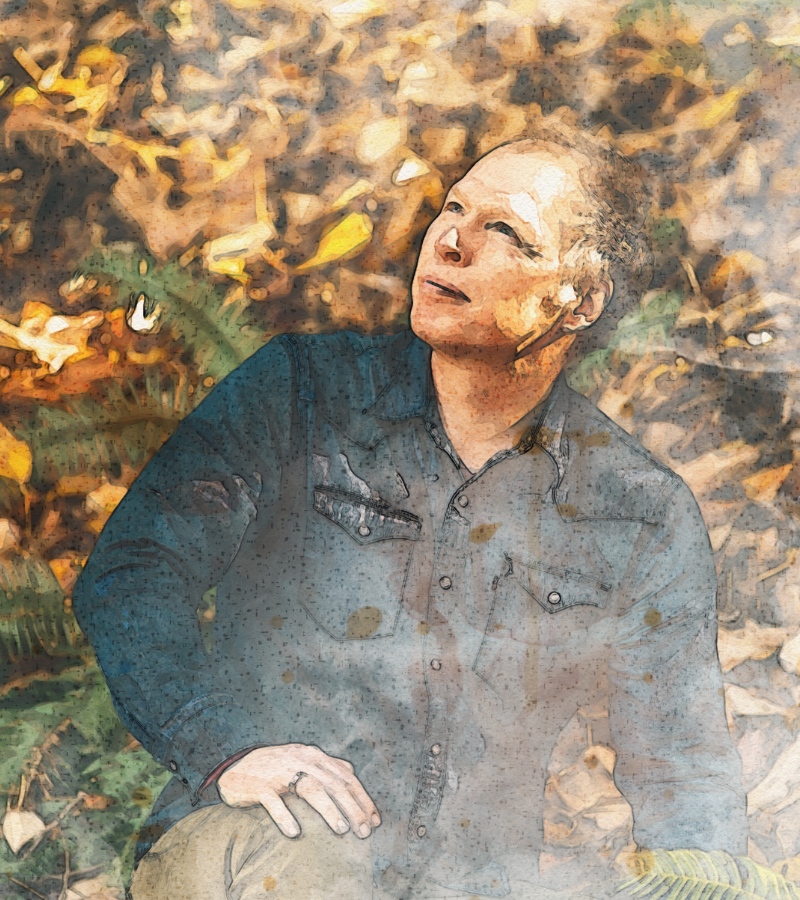
Now, this would also focus on concerns about climate change; although, I think in the ‘90s, climate change was not the pressing crisis that it is now. Ecopsychology kind of came about like a lot of movements — outside of academia and outside of the mainstream schools of psychotherapy. In some ways, it was a reaction to them in the sense of the lack of obvious presence or mention of nature, the natural world, and other species in classic psychotherapy, which, in the lingo, we’d consider more anthropocentric, more human-centric. These folks were more eco-centric; they were thinking more in terms of ecology. And so, once you start to think more ecologically, it does bring all this stuff up. All these ideas in ecopsychology are pretty understandable now and actually have gotten well into the mainstream.
It’s about people thinking of their ideas — their identity — in the sense of their connection with nature, and the value of, as you know, being out in nature for our mental health. A lot of the research has caught up with these ideas as well. There’s a very robust body of research on nature connections and mental, as well as physical health. And so, yeah, ecopsychology, at least up to recently, has kind of existed on the outside, as a commentary.
When I was teaching, I would distinguish between environmental psychology, which is a subfield of psychology, and was started by researchers that were studying how people interacted with places and with buildings, and with architecture and landscape design. Issues such as why certain landscapes are more pleasing or easy to navigate, studying things like noise and crowding.
And then, environmental psychology, in the late ‘60s and early ‘70s became more environmental in terms of thinking about environmental problems, the design of recycling programs and things like that. It’s also separate from clinical practice. It’s not a therapeutic or clinical field; it’s an academic research field. But with ecopsychology, and with my work, and with what’s going on now, these things are kind of coming together.
If you draw a box that’s labeled psychology, we can put all kinds of things in that box and study all kinds of things from a psychological perspective. You know, we can study relationships; we can study human development; we can study pathology. We can also study our relationships with the environment from a psychological perspective. But it’s a different endeavor to create a box that’s called ecology, and then put a smaller box in there called psychology. Then we’re actually practicing psychology from a different base.
It helps us realize that “wow, I didn’t realize that traditional psychology had such a human focus which is really tied in with the enlightenment and the idea of human superiority over nature. I like that idea of thinking of ecology as a larger sphere, and then the question would become, “What could or should psychology look like if it focused instead on people, not apart from or above nature, but as natural beings on the planet?” It’s pretty interesting philosophically. And then, unfortunately, the press and distress of environmental issues broadly, and climate change more specifically and in the short term, have really put a lot of pressure on people to start thinking about this, essentially whether they like it or not.
Therapists might have to learn about a new disorder, a new form of treatment, or a social phenomenon like different gender presentations. But the therapists themselves might not personally be experiencing any of these things. But with climate, with the climate crisis, therapists, like everyone else, are experiencing disasters: smoke, heat, flooding, storms. They’re going through it right alongside everyone else. So, there's a double urgency here. And then, what happens is that as people get involved in this, they begin to realize, “Oh, I didn't know there was ecopsychology and environmental psychology, and that people have been writing books and thinking about this for a long time.” So, they’re kind of rediscovering these things for a new generation.
And we have our lowercase “i” issues, which is our stuff: our own personalities, our own strengths and weaknesses, our vulnerabilities, our losses, our traumas, our neuroses. So, when I'm working with people, I'm trying to hold both of those things in conversation; people obviously resonate with larger social issues that have some relevance for them personally, and then that could be an obvious undoing process from their own background or work, dealing with their own traumas in a classic sense. Or it just resonates with their values, or they’re seeing it playing out in their communities. So, all that intrapsychic stuff is relevant.
So, what exactly is healthy, and what is the role of psychotherapy in promoting it? What has been in the shadows and largely ignored in therapy like spirituality, has turned out to be quite important? I think it is the same with environmental issues. I work with a lot of therapists that are seeking to be climate-conscious. They're either wanting to get some basic skills or they’re even wanting to specialize in this area. And part of how you specialize in any area is that you advertise your specialty.
People wouldn’t seek you out for any problem unless they somehow got a signal that you worked in that area. There’s a permission giving. There’s a permission giving to say, “Yes, I'm open to talking about these kinds of things.” unlike in past years, just mentioning LGBT somewhere on your webpage to acknowledge that you work with people of different sexual orientations is common now. It gives permission for clients to know that you deal with spirituality or trauma or workplace concerns or substance abuse. You get the idea! And so, it’s like an experiment and I’ll even encourage readers to think about this. Just add ‘environmental concerns and/or climate concern’ to your list of services and you'll be surprised.
I think we have an ethical responsibility to talk about climate and environmental issues because they are the biggest public health threat that the world has ever faced. And it is only going to get worse. We know very well from science that more climate-related weather problems and disasters are going to occur all over the US and all over the world, and people are going to be affected by these. To not talk about the greatest public health threat in history seems odd to me. So, I think psychologists and therapists have a responsibility to learn a bit about this.
But the rub is that it’s politicized, so it’s not a clean topic, and that’s another part of the climate elephant. I use this metaphor of the elephant in different ways with climate change. It’s the elephant in the room, obviously. It’s something that’s not acknowledged for a number of reasons. Partly, it’s an inconvenient truth, as Al Gore says. It affects our entire economic and political system to talk about these things. I think it’s ethically responsible to know a little bit about it and to let the public know that you’re open to talk about this if people want to.
People can take it further if they want. A number of therapists I know are personally interested in this for themselves and find that it’s something they want to get more deeply into. Because of my background doing the Ecopsychology Journal, I’ve had to learn a lot about this stuff. These are like extra degrees that I’ve picked up over the years. And so, there’s just a wealth of information out there. It can easily be a specialty or even just a personal exploration for someone’s own identity and health. There are a couple of different ways to approach it.
Essentially, bringing environmental issues into the therapy room would be a form of ecotherapy, as would taking the therapy process either outside in terms of walking sessions, or sessions that are done in an outdoor space where the actual natural environment is more a part of the process. So, it can go in different directions, but there's generally some sort of intent there to recognize nature and the natural world and our ecological connections.
Many therapists don't necessarily think of themselves as ecotherapists, but they’ve integrated outdoor and walking since COVID. I find walking therapy quite interesting because it’s kind of its own thing. It’s a technique, but some people think of themselves as walking therapists; it becomes kind of an orientation. I was just meeting with a therapy group this morning with people from around the US, Italy, and India. We were talking about walking therapy, and if you Google walking therapy, even in the last year, you’ll see how it’s exploded. Walking therapy doesn’t automatically have the deeper ecological thinking component of ecopsychology, though it can be practiced that way. What it shares with ecotherapy is a different view of the container of therapy, and also adds a movement and experiential component. It doesn’t have the environmental-political angle of ecotherapy, which tends to be environmental, in terms of environmental politics. But walking therapy is quite fascinating.
As a tangent, just think of the explosion of psychedelic therapies in the last couple of years. I was just at the American Association for Behavioral and Cognitive Therapy Conference here because it met nearby. I was speaking on a panel on some of these environmental issues there. But it surprised me to see all the psychedelic therapy work there at this behavioral therapy conference. Things change rapidly; walking therapy is more accepted, psychedelic therapy, more accepted. Ecotherapy is more accepted as well for all the reasons we’ve been talking about.
When I help therapists think about walking therapy, it’s actually quite interesting. I haven’t really thought about it directly in existential terms, but it is because we think about our existence as a being in relation to other beings and in time and in weather: it’s inherently transpersonal in the sense that it takes us out of ourselves. So, we can think of walking therapy as transpersonal. We can think of it as existential. I tend to think of it as an embodied approach because when I am walking and moving, my body, my brain works slightly differently than when I’m sitting in a room. And so, I think of it as a brain-based approach because it activates things similar to EMDR; it’s activating the brain in bilateral ways.
You might experiment with reflecting on something in a room in a stationary setting, and then reflecting on the same content while you’re walking. It’s hard to describe, but it feels different, and it’s more empowering. There was a great story in Outside Magazine this writer Erica Berry interviewed me about. We did walking sessions, and she wrote about it. She had a great quote. She said, “It was hard to feel powerless when you were reminded with every step of your power.” As we were walking, she shared feeling empowered. So, I totally agree with what you’re saying is that this modality does add all kinds of things. It’s quite healthy, and it’s more therapy-friendly than you think in terms of all the different orientations that are likely to come into play.
And so, it does exacerbate people’s natural tendencies to be anxious, and with someone who already has trauma or other anxieties, or have experienced earlier disasters in their life, then new ones can really tip things over. Young moms, postpartum moms who are already highly protective of their young ones, are going to be hyperactivated by smoke and heat because it is literally dangerous to babies. So, you’ve got all that to cope with. And then, of course, people feel natural concern and loss about issues like extinction and lack of places, especially when certain iconic places are destroyed, like Lahaina in Hawaii, or from the fires in California. The Hawaii fires were catastrophic, not only locally, but many people had emotional connections with that place, these places they had visited, Maui and Lahaina. And so, it touched a lot of people.
So that grief and loss is right under the surface. It’s a chronic issue when I talk to people. When you get people to open up, these issues come up. I don’t think I’ve ever met anyone who doesn’t have some of this going on. So yes, it’s important. Erica later said, “As we continued up the hill, I tried to recall where my train of thought had stopped, but it no longer felt important,” because we had seen a bird, and we were listening to the bird. And she said, “I had been talking about suppressing climate sadness because I didn’t want to sound like an evangelist or bum my loved ones out. But now, I was thinking about the bird, and wasn’t that the opposite of doom brain, tuning into all that lived around me.”
She added, “This sort of reflection certainly wouldn’t happen in a therapy office, but it wasn’t a bad thing. You know, the bird had, for a moment, airlifted me out of my anxiety.” So that idea of being present in nature and walking gives us this expanded scope, and you can think about these things and contain them, but you’re also living. You’re also in the moment in a way that’s just quite different. So, there is a tie-in between eco-anxiety and some of these modalities. People do seek out therapists that can help them with eco-grief or anxiety, either because the person’s highly connected with nature, or they’re an environmental professional or a climate scientist, or they’ve dealt with a disaster; or it’s just a developmental stage for them.
There’s a concept called the “Waking Up Syndrome,” where people just become aware — they have an ecological awakening of some sort. Many people have this in school, when they’re in college or graduate school, or when they’re studying things, they realize, “Wow, everything is connected, and there’s a system here, and I just didn’t realize, and I never realized the scope of some of these things.” So, there’s a natural developmental experience that most every adult can speak to where they kind of woke up to the world. They woke up to the state of the world. They became adults. They became aware of the systems, and of justice and injustice and identity and all these kinds of things. And sometimes we have a container to hold that and someplace to process that—a mentor or parent or counselor. Many people don’t. It’s like a rite of passage.
Countertransference is unconscious, right. And so, it’s really that kind of conspiracy of, “I’m not going to bring this up because I don’t know how to handle it. “I don’t want to expose either of us to something that we can’t cope with,” right? I think that therapists are coming to grips with this. They’re people, and they have their own environmental identity, right? You were hinting at this in your earlier comments. So, we have a sense of our environmental identity, our sense of connection, our sense of ourselves as a human in relation and nature in the natural world.
It’s implicit for everyone until we talk about it, just like any other form of identity: our gender identity, sexual identity, cultural identity; we have all the values and beliefs in action, but unless we’re taught to think and have a metacognition about them, we can’t necessarily elucidate it. It is similar to environmental identity. When therapists start to understand their own environmental identity and feel comfortable with it, they can better understand how, when, and when not to bring it into therapy.
We’re not perfect. We’re flawed people. Everyone wants to do more. We’re in a tough system. Most people are constrained. We’re hostages to a system that’s quite unsustainable. We don’t control it. Once we learn to forgive ourselves and to be comfortable with our own environmental story, then we can sit comfortably with other people’s stories, right? And then we don’t have to solve climate change. You don’t have to solve climate change to cope with it.
We don’t have all the answers to our clients’ problems. That’s not our job. Our job is to support our clients while they’re seeking the answers. But to get to that level of comfort with the material in the room and let go of it so it can just be there, that’s where the developmental task is for the therapist. Some issues are so difficult, we’re never fully comfortable with them. But we learn to have the capacity to contain them and be with them. A lot of the challenge with doing ecotherapy is developing the capacity to sit with ecological issues in the therapy room, knowing that we cannot solve these things, and we may not solve them in our lifetime, but we do have values, and existentially, we do what we can and be our best self.
So, yes, I do think, for many, many reasons that understanding our unique connection with nature and the natural world, the outdoors, is just generally an essential life task. We’ve forgotten that we’ve evolved on a planet. We are creatures. We are animals. We didn’t come from a machine. We’ve forgotten all these things. Some people would laugh and say, “Well, of course, we forgot. How could we not?” But this speaks to our society and our culture not our essential selves. So yes, I do think it’s part of self-actualization. I think of Maslow a lot, too — all parts of his pyramid a
