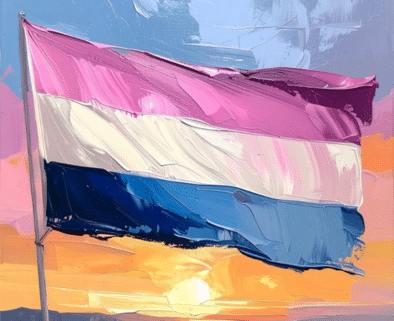
Being Doubly Colonized
Lawrence Rubin (LR): Hi, Anastasia. A while back, I interviewed you on your therapeutic work across borders with expatriates. Today, I’d like to ask some questions that center on borders of a different type; those around gender. How has your clinical work with expatriates impacted your empathy with gender questioning clients, and conversely, has your work with gender questioning clients affected your work with expatriates?
Anastasia Piatakhina Giré (APG): It’s been an organic shift for me. As a result of working with immigrants and people who are highly mobile, I became aware and sensitive to my clients’ shame, especially how it impacts the choices they make, and how it gets in the way of their relationships. This has been extremely helpful in my work with gender nonconforming clients because shame is always around. It’s not called masked emotion for nothing. There is a reason for that.
LR: I know from our conversations that for some who leave their homeland, there may be a sense of betrayal or disloyalty—of their family, or their culture, or their values. Have you found this with those who cross gender borders?
APG: I’m not sure about betrayal, but loyalty to the family, or the country, or cultural language definitely come up a lot. When we go against that loyalty, there is ridicule, shame, and guilt and resolving that, or living in harmony with that takes a lot of ego strength.
Knowing who you are and what matters to you to kind of go against these deeply rooted loyalties especially if there’s little or no support. If a young person doesn’t have the strength yet, or are in the process of building it up, they really need that extra time and help in building that stronger sense of self to properly rebuild in the least violent and most productive way they can. Good therapy can support this rebuilding.
LR: How did your interest in working with gender questioning teens and young adults evolve?
APG: This has been kind of a natural shift for me, or rather a natural expansion since I have been interested in, and working with, displacement for a long time. As I explored the psychological experience of displacement with my immigrant and expatriate clients, we kind of bumped into this identity confusion thing. As a result, I started seeing displacement as a point of crisis when identity is challenged, and within that crisis, the feeling of shame is common.
Being an immigrant, having the accent, and not being aware of the local codes and rules expose people in such a way that they don’t fit in. It’s similar in many ways to the experience of gender confusion. Gender nonconforming children sense their difference early on.
Several years ago, I was very close to a friend and colleague whose child was transitioning and that kind of sparked my interest. I began educating myself about the issue, and then at some point, I started seeing these young clients in therapy. I soon realized there were many similarities in how they experienced themselves in the world.
As with immigrant clients, that commonality was all about being somewhat different and not conforming to what is perceived to be normal or expected. And that always comes with shame, right? We feel shame when we don’t fit in or conform. That’s how it all started, so I work with these two populations simultaneously. I see quite a few young clients who are gender nonconforming or questioning, but who also have some immigrant background which is a very interesting overlap as well.
LR: I find it fascinating, Anastasia, that, as you describe it, both expatriate and gender questioning clients are up against externally imposed borders. Does being a gender questioning person locked into an unaccepting culture deepen the challenge for these clients, a form of double colonization?
APG: Of course it does. Because I work online and across borders, as you say, these clients come to my virtual door. Many young people just don’t find that safe space where they can explore their gender expression, their identity, and their sexuality. They have to push the walls, or in my case, virtual walls. But, I also see immigrants, people who have left oppressive regimes like China, Russia, or Turkey, and who have come to a different place, a freer place, a place where they hope to live more freely to express their sexual orientation or their gender expression. But it’s never straightforward because being exposed to the unfamiliar world and the language barrier often amplifies the internal processes. There is more shame in the struggle of having to figure out who they are and finding a place for themselves. These are very good moments of opportunity for starting therapy.
LR: So, just as a client can live within an oppressive regime, prescribed gender or what is considered normative is also an oppressive regime. A while back, Karisa Barrow wrote an article on working with transgender clients that you said was based on faulty presumptions like, ‘sexual orientation is entirely independent of gender identity, and trans identity is immutable.’ What did you mean?
APG: We’re entering a very tricky territory of ideology and politics here, which I really cannot resist, but I will stick to my clinical experience. We can have a clinical understanding of these issues. Sexual orientation is about identity—who we are attracted to; sexual orientation is a deep disposition and is therefore an important part of who we are. I do believe in science and biology, and think gender is biologically framed. But I also believe in human creativity. We have multiple ways of expressing or inhabiting our biological gender.
And this is where gender nonconforming individuals have a harder kind of developmental task. Being gender nonconforming is a relatable experience for me personally because I grew up as a gender nonconforming girl who found it very hard to inhabit my biology. My gender didn’t comply with the societal norm associated with this gender.
This is where the whole problem begins and where therapy is extremely useful, because if we can offer these young people a nonjudgemental space at the right developmental time, which is safe enough, and where they can experiment with who they are and whom they are attracted to, it can be a very powerful experience.
We can give them this window of possibility and the space to find their own way. We don’t choose to be gender nonconforming, but we can choose how we express our gender.
Life Decisions that Parallel Therapy
LR: I know from our recent conversations that you recently made a major decision in your life, and if you’re comfortable sharing, can we discuss how that has impacted yourself as a therapist with these particular clients?
APG: I’m perfectly fine talking about this because it is relevant to the work I’m doing as a therapist. I can’t keep it totally aside because it’s part of my own process. I grew up as a gender nonconforming girl in the Soviet Union where I didn’t have many options. I actually had no idea that I even had options. I knew that I had to be a girl somehow––the expectation was very clear. I remember being very angry about this when I was young, around 7 or 8. I remember battling with my mother because I had to be a girl. I only had male friends. I did all male activities and played with boy’s toys and had the typical tomboy kind of experiences until the age of 15.
I figured out that being a girl had its upsides and gave me some power, and boys were more interested in me in that way. I wanted to be on that road, rather unconsciously, of course, but at the time, therapy was not an option, and I couldn’t talk about this with anyone at all. It all existed in my own head. Nobody was really interested.
Only later in life, through some therapy work with clients and deep reflections, I realized that my own sexual orientation wasn’t that straightforward. I kind of went from being a gender nonconforming girl to perfectly straight and very conforming, to playing by societal rules, and finally identifying as lesbian, which feels right at this point.
It’s a kind of interesting journey, because of this experience of mine, I now fully realize that identity formation doesn’t stop—it’s a fluid process through the lifespan––we can continue exploring our identity, our sexuality, and our gender expression. We can keep adding to it and expanding on it as we evolve.
This is what we help clients to do in therapy, especially with these young gender nonconforming clients, who I find very relatable. I feel for their struggle. I know how difficult it is, especially when the environment feels oppressive and may be punitive. It’s about helping them to navigate those realities and figuring out what matters to them, what kind of lives they would like to have, to whom they are attracted. I’m just creating a space where this work can be done.
LR: Thank you for that transparency, Anastasia. Have you experienced any internal debates or conversations, what some have referred to as noise, that may distract your attention when working with these clients?
APG: I have. We can certainly put it into the psychoanalytic frame of countertransference, but it’s really a matter of what you do with that ‘noise’ as you put it. I’m constantly aware of how much this work brings up in me. It’s important to draw the distinction between gender expression and sexual orientation. For example, a masculine woman can be a lesbian or can be heterosexual. In both cases, she’s expressing her gender in a nonconforming way.
At the same time, when young people who are gender nonconforming come to therapy, they may be exploring their sexual orientation. They’re still trying to figure out who they are attracted to— they’re often not there yet. There may be other struggles going on at the same time. For example, a teenage client may come to therapy who or may not be gender nonconforming, and who self-identifies as trans; however, they may be struggling with depression or anxiety, or they may be self-harming or have an addiction. It is also common that they are somewhere on the autism spectrum.
Against this backdrop, I will ask them at some point in our first session about their sexuality and/or their sexual orientation. In this case, their symptoms may be an escape from something that feels uncomfortable or confusing. They’re not ready to address gender and sexuality issues, but we cannot put it aside. I need to help them to figure out what their sexual orientation is in order for them to make choices about where they are on the gender/sexual continuum or where they want to stand in the way they express their gender and inhabit their body. It’s a very complex process.
But getting back to your original question, that ‘noise’ enters into my clinical awareness, and I have to find a place for it. I had time and space to figure this out, the therapy is about their journey not mine.
Good Enough Therapy
LR: What is ‘good enough’ therapy with young clients who are questioning their gender, their sexuality?
APG: I think ‘good enough’ is a great term because it doesn’t indicate that this is about what’s good or right. Instead, it actually raises the question of what would be good enough therapy with these young people. It’s most important to not frame things too early for them or to ‘finalize’ them––when we do, we close doors. Closing doors that should remain open for as long as possible is a mistake. We are talking about teens and very young adults whose identities are still developing. Good enough therapy is about not closing doors. It’s about creating a breathing space in place of their sense of urgency to resolve the struggle between being a boy or girl.
I don’t want to sacrifice that for a desire to resolve their pain or to find a quick solution. If I do, I will likely miss something extremely important in their developmental journey. They need time and to learn to struggle, and the capacity to sit with ambiguity, uncertainty, and discomfort. A good therapist creates that space and models some of this capacity.
LR: In that context, would a diagnosis of gender dysphoria or the broader notion of gender affirming therapy be finalizing rather than an opening?
APG: That’s my sense of it and the reason why I’m intentionally using the term ‘gender questioning’. When you say ‘gender dysphoria’ where does this actually exist? The sense of not being quite aligned with your body, is based in large part on societal expectations that come with your biological gender. If we look closely at these cases, which is where the clinical material is, these are very complex clinical pictures.
There is usually a lot going on for these young people, especially when you expand the clinical frame to include neurodiversity, trauma, and displacement. If we focus solely on gender, we miss everything else, which seems foolish to me because we’re talking about young people who are at that stage of identity development where all of these issues can feed back into their lived experience. This also doesn’t even take into account family dynamics that is critical to a systemic approach which is very important when working with teens and young adults—especially if there’s trauma in the family’s history.
Widening the Clinical Frame
LR: If you were appointed to create a term to replace gender affirming mental health care, what would you offer?
APG: If we’re talking about adolescents and young adults, I would try to frame it within the context of a stage of identity development. I would rather talk about gender confusion, gender questioning, gender expression, gender nonconforming––all of these terms seem appropriate to me in the way I practice.
LR: The way you talk about your own journey and the challenges these young folks experience brings the word courageous to mind.
APG: I think these young people are extremely courageous. In my own experience, courage is a very important value to me. It’s interesting because traditionally in most Western societies, and where I grew up, it’s the men who have to be brave. Boys have to be courageous, to fight, to protect those who are dear to them. I strongly associated myself with those traditionally male values at a time that wasn’t part of what I, or any girls, were supposed to be.
I remember being questioned and shamed by teachers. They would talk about me, about my reputation, because I was doing boyish stuff and acting as a boy was supposed to act, and how girls weren’t. It was tough, but it was the only way to be, and it wasn’t a rational decision or act of bravery. It was just too visceral, like nothing else made sense, but coming to therapy helped and I was able to question the status quo. This whole thing about coming out as trans, doesn’t sound quite right. “Coming out” is a term used for gay people, but coming out as trans is quite a new term.
It’s all about a form of rebellion where they’re pushing against something that isn’t quite working for them, a frame that is too narrow. Maybe it’s about trying to explode the frame, to exist in a freer, more honest way. This is the best time for therapy. It’s a privileged position to be there as a therapist with these young people to assist them in finding the way to inhabit their bodies, their realities.
LR: Are there dangers or perils if the therapy is being offered by a young clinician, who perhaps has not established their own gender or sexual identity?
APG: I think it wouldn’t be ideal. I think we’re better therapists for these young people when we have that stronger sense of self and clarity about who we are and what we’re about, especially in this case regarding sexual orientation. I mean how we inhabit our own bodies, our agenda, our values, and who we are because in a way, we become mentors. We become important figures in their lives. I could have never done this work ten years ago. I think I would have done a lot of harm unwillingly and unconsciously. I’m glad I’m stepping into this at my age and stage of my practice when I’ve had life experience, training, and support.
The Self of the Therapist
LR: What internal realities must a therapist address when working with these clients, and relatedly, and what are the qualities of a good enough therapist who chooses to, or works with, gender questioning clients?
APG: When working with any kind of minority, whether it’s race, immigration status, gender, or sexuality, it takes a lot of openness, curiosity, self-awareness, and honesty. It’s important to be able to place yourself in relation to them in an honest and humble way, and to be open to meeting their reality that is different from yours. I constantly have to do that. I’m a White woman. I’m an immigrant, and I’m a lesbian which kind of helps to connect more naturally.
I’m also very familiar with the shame and struggle that comes with these different parts of my identity. But at the same time, my clients will always come with something different, with a different struggle––a harder struggle, more hardships, more obstacles. It takes a lot of self-awareness and knowing where you are and who you are to relate to them in this kind of honest way.
LR: There’s a controversy in the field of therapy over whether it is the therapist’s place to bring race, culture, or religion into the conversations if the clients don’t. How does this apply to your work with gender questioning clients?
APG: I certainly don’t market myself as a lesbian therapist because I don’t want to push it onto my clients. It’s a private matter. At the same time, when at some point of our therapeutic journey together, I feel that this may be helpful to my client, I will share—but never in the first session. There may be some exceptions to that, but mainly I reserve that for the point where I feel that we have a relationship that can absorb that kind of self-disclosure, or when I’m really sure that it will help my client, especially if they are feeling very alone and extremely ostracized, or are experiencing a lot of shame. It can be a very powerful self-disclosure and extremely helpful and beneficial to them at that point. I will never do it for my sake, but instead, for my client’s sake.
LR: If someone was a fly on the wall of your therapy room as you worked with a gender questioning client, and trying to figure out not your theoretical orientation, what would they come away with?
APG: I was trained as a integrative therapist, and I think that’s what I am at the end. My work is informed by an understanding of developmental processes, attachment theory, and of psychoanalytic concepts like transference and countertransference. After being in practice, I also think I work with my soul and a set of values and beliefs that parallel my knowledge and experience.
LR: For those who will read this interview and want to know more about some of the professional voices that inhabit your style and some of the resources that you have found important, what would you recommend? I know you mentioned in our conversations Therapy First, the Society for Evidence Based Gender Medicine.
APG: Talking about people who inspired me, I would probably quote Steven Levine, who wrote extensively on working with this population and is extremely wise and experienced.
Therapy First is a great association which is not political or ideological. It is a clinical association that offers incredibly good quality, free supervision groups for practitioners who work with gender nonconforming clients and gender questioning youth. It’s a space where you can honestly and openly talk about your work. There are colleagues of all traditions, gender, and sexual orientation, and all are treated equally. I appreciate the open dialogue.
The Society for Evidence Based Gender Medicine has been bringing into the heated space of ideology battles a calmer voice, which solely focuses on research in this clinical area that is still young and in need of more evidence. As therapists practicing with this population, we need more access to good quality research and professional spaces where the loud “noise” from media and politics is tuned out, and an open clinical dialogue can happen instead.
LR: With that, I think I’ll stop for now and hope that we’ve given our readers a lot to think about. Thank you so much, Anastasia, for your time and wisdom.
APG: Thank you, Larry. I truly enjoyed our time together.
Go Deeper in Your Practice
Get unlimited access to 350+ real therapy demonstration videos, CE, webinar replays, and more with a Psychotherapy.net membership.
