Assessment and Intervention with Suicidal Clients
$179.00

Looking to purchase for a business or organization?
Explore our solutions for universities and for group practices.
Overview
Do you dread working with suicidal clients? If so, you’re not alone. But anxiety from burdensome beliefs that you must assume the “expert role” and that it is your responsibility alone to stop clients from self-harm or suicide may actually undermine your potential clinical effectiveness. John Sommers-Flanagan offers an alternative, research-based approach that emphasizes working collaboratively with clients to help them to develop strategies to improve their lives so they orchestrate and implement better options than ending it. As he emphatically asserts, “No-suicide contracts are out; collaborative safety planning is in!”
In this unparalleled series of enlightening clinical demonstrations and in-depth discussions, you’ll develop powerful tools for use during assessment and intervention. Sommers-Flanagan seamlessly blends strategies for revealing all facets of client suicidality with techniques designed to uncover hope and resources both within and around them.
Whether using the Mood Rating Scale with a Suicide Floor during assessment, or the Safety Planning Form during treatment, you will develop and deepen not only your competence but your confidence with these highly challenging clients. If working with suicidal clients leaves you feeling anxious, ill-equipped and isolated, then this compelling and deeply-instructive course is just the resource you need.
A research-informed approach that emphasizes collaboration and offers an alternative to suicide contracts. In this course you’ll…
- Learn to intervene collaboratively and empathically rather than from a position of authority and anxiety.
- Optimize your clinical effectiveness and develop strategies for assessing and enlisting clients’ strengths and resources.
- Acquire skills to create an effective safety plan with diverse suicidal clients.
- Learn how to incorporate contextual factors such as race, age, gender, sexual orientation and religion into your clinical work with suicidal clients.
- Expand your clinical flexibility and confidence with all forms of suicidality, from passive to active, acute to chronic, and indirect to lethal.
- Meets requirement for mandated Suicide Assessment and Prevention training for Psychologists, MFTs, Social Workers and Counselors in California and other states. Check your state board for requirements in your state.
What's Included
Increase your confidence in working with the single greatest clinical and ethical challenge faced by any therapist. Includes over 8 hrs of clinical sessions and discussions demonstrating tools and strategies to effectively work with an array of suicidal clients, 7.5 CE credits and supplemental resources to give you the confidence and the competence you need for working with this important issue.
Volume 1
Through compassionate and targeted sessions with a 30 year-old single mother and a 22 year old native-american alcoholic Iraq veteran, Dr. Sommers-Flanagan demonstrates the assessment and treatment skills necessary to work collaboratively with suicidal clients.
Learn to recognize and apply the eight dimensions of suicidality and the seven fundamental clinical tasks in your own assessment and early interventions.
Volume 2
Working with a teenager, a recent widow and a woman struggling with the memories of a schizophrenic mother, Sommers-Flangan demonstrates the use of various tools to optimize clinical effectiveness: the “Mood Rating Scale with a Suicide Floor” to help identify changes in a client’s emotional status and the “Suicide Rating Form” to develop strategies for accurately assessing your client’s risk for suicide. You will also acquire the skills necessary for developing an effective safety plan with suicidal clients
Volume 3
In this video, Sommers-Flanagan addresses the issue of acute suicidality as he works with a 35-year-old white gay male who is socially isolated, hopeless, and with access to lethal means. You will develop a deeper clinical appreciation for issues such as such as balancing a client’s autonomy with the duty to protect, the inter-generational transmission of trauma, incorporating hospitalization into treatment planning, and appropriate referral of suicidal clients.
Supplemental expert interviews cover the issues of suicide in Asian-American cultures, the challenges to effectively assessing suicidal minority youth and coping strategies for family members who have lost loved ones to suicide.
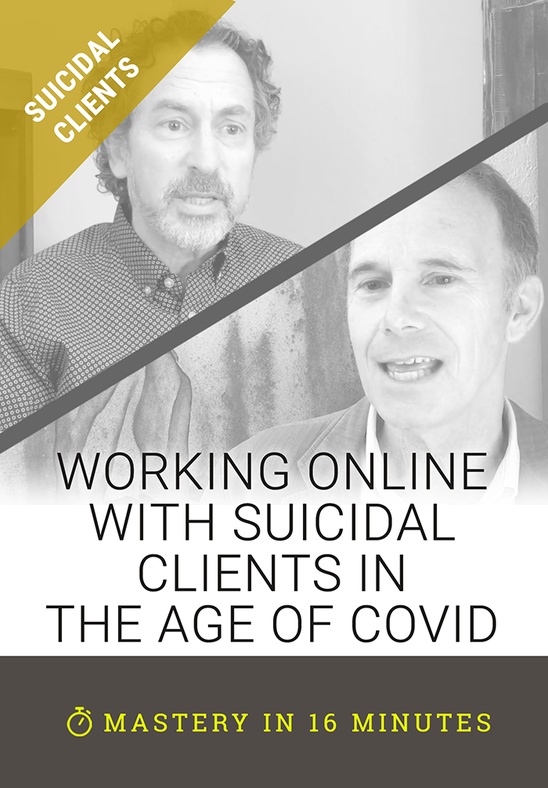
BONUS VIDEO: Working Online with Suicidal Clients
How has the rapid shift to online therapy affected the way we work with suicidal clients? Victor Yalom and John Sommers-Flanagan discuss how to effectively engage, assess and monitor suicidal clients in the age of online therapy and the impact that COVID has had on suicidality.
About the Experts
John Sommers-Flanagan, PhD is a professor of counselor education at the University of Montana, a clinical psychologist and a mental health consultant.
Primarily specializing in working with children, parents, and families, John is author or coauthor of over 50 professional publications and nine books, including How to Listen so Parents will Talk and Talk so Parents will Listen (John Wiley & Sons, 2011), Counseling and Psychotherapy Theories in Context and Practice (2nd ed., John Wiley & Sons, 2012), Clinical Interviewing (5th ed., Wiley, 2014), and Tough Kids, Cool Counseling (2nd ed., ACA, 2007).

Disclosures
General Disclosure
This Disclosure Statement has been designed to meet accreditation standards; Psychotherapy.net does its best to mitigate potential conflicts of interest and eliminate bias in all areas of content. Experts are compensated for their contributions to our training videos; while some of them have published works, the purchase of additional materials are not required for any Psychotherapy.net training. Each experts’ specific disclosures can be found under the heading, ‘Therapist Disclosure.’
Psychotherapy.net offers trainings for cost but has no financial or other relationships to disclose.
Therapist Disclosure
John Sommers-Flanagan was compensated for his contribution to this course. None of his books or additional offerings are required for this course. Should such materials be referenced, it is only as additional resources.
Psychotherapy.net defines ineligible companies as those whose primary business is producing, marketing, selling, re-selling, or distributing healthcare products used by or on patients. There is no minimum financial threshold; individuals must disclose all financial relationships, regardless of the amount, with ineligible companies. We ask that all contributors disclose any and all financial relationships they have with any ineligible companies whether the individual views them as relevant to the education or not.
Additionally, there is no commercial support for this activity. None of the planners or any employee at Psychotherapy.net who has worked on this educational activity has relevant financial relationship(s) to disclose with ineligible companies.
Learning Objectives
In Volume 1 you’ll learn how to…
- Describe the core skills in working collaboratively with suicidal clients
- Apply the the seven clinical tasks in your clinical work with suicidal clients
- Plan treatment with suicidal client that incorporate culture-bound beliefs
In Volume 2 you’ll learn how to…
- Describe strategies for assessing suicidal clients’ strengths and resources
- Plan effective assessment strategies using the Suicide Rating Form and Mood Rating Scale
- Design an effective safety plan with suicidal clients
In Volume 3 you’ll learn how to…
- Describe start-to-finish interventions for suicidal clients
- Discuss the challenges to effectively assessing minority and LGBT clients
- Explain how Asian values and beliefs impact suicide assessment and treatment
What you get in this course

Real Sessions
8 hrs of clinical sessions and discussions demonstrating tools and strategies to effectively work with an array of suicidal clients

Therapist Commentary
Multiple commentaries and debriefings to distill Sommers-Flanagan’s process and give you confidence in using these techniques

Continuing Education
7.5 continuing education credits available for licensed professionals

Bonus Video
Victor Yalom and John Sommers-Flanagan discuss how to effectively engage, assess and monitor suicidal clients in the age of online therapy
“This video comprehensively addresses a sensitive, often anxiety-provoking topic for both beginning and seasoned clinicians.”

“This course presents one of the most accurate and easy to understand approaches to assessing and intervening with suicidal clients utilizing multiple case vignettes. In my opinion, it is one of the most useful resources available to assist in suicide assessment training of helping professionals.”

“Dr. John Sommers-Flanagan does a marvelous job of assessing and interviewing with several clients who struggle with suicidal ideation. His manner is natural, personable, calm, compassionate, insightful, and engaging.”
Get more value with a membership