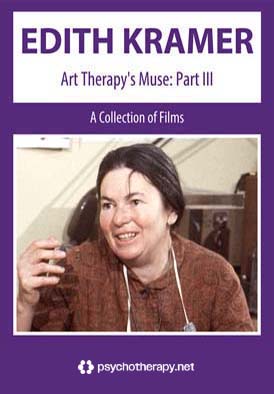
Edith Kramer – Art Therapy’s Muse Part 3
Video
with
Judith A. Rubin, PhD, David Henley, Jim Pruznick
Video

Edith Kramer – Art Therapy’s Muse Part 3

This video offers an overview of Kramer’s pioneering clinical work in art therapy with children and her unique, effective methods. Video Length: 45m 45s
COURSE DETAILS

Overview

Historic photos at Wiltwyck School for Boys mark the beginning of art therapy in the US and introduce the film. We meet Kramer in live group sessions with children at the Jewish Guild for the Blind where she worked during the 1960’s–1970’s. She explains how these blind children’s perception of body image becomes unconsciously incorporated into their plastic art expression, revealing hallmark features of this disability. Kramer demonstrates that art therapy enables children to be themselves, promoting a greater sense of personal autonomy. Strikingly, she confidently entrusts the handling of adult tools to them, generating in them a sense of respect for safety issues.

Finally, Kramer invites us to witness two diagnostic demonstration interviews. The first, with a young boy, is from the film “Art Therapy: Beginnings” made in 1975. The second was filmed at Walter Reed Army Medical Center. In both, Kramer uses her unique diagnostic procedure designed to reveal the complexity of an individual as revealed by each of three art therapy creations using the primary materials of art expression – drawing, paint and clay Psychological dynamics are elicited in each child through the three tasks. Kramer’s astute observational insights demonstrate the effectiveness of this method, which differs widely from many other art therapy diagnostic procedures. The depth and competence of training that the art therapist brings to the diagnostic interview clearly enables these uncontrived tools to be used evocatively and powerfully, particularly in contrast to diagnostic procedures that rely upon more formulaic rating scales.
About the Experts

Judith A. Rubin, PhD
Expert

Judith A. Rubin, PhD

Judith A. Rubin, a pioneer in the field of art therapy, is on the faculty of the Department of Psychiatry, University of Pittsburgh and the Pittsburgh Psychoanalytic Society & Institute. She is a Registered, Board-Certified Art Therapist and a Licensed Psychologist. Dr. Rubin is the author of several books, including: Child Art Therapy, The Art of Art Therapy, and Art Therapy: An Introduction. She was the "Art Lady" on Mister Rogers' Neighborhood in the 1960s. A past President and Honorary…

View full profile
Expert

David Henley

David Henley was compensated for his contribution. None of his books or additional offerings are required for any of the Psychotherapy.net content. Should such materials be referenced, it is as an additional resource.

View full profile
Expert

Jim Pruznick

Jim Pruznick was compensated for his contribution. None of his books or additional offerings are required for any of the Psychotherapy.net content. Should such materials be referenced, it is as an additional resource.

View full profile

Disclosures

Psychotherapy.net offers trainings for cost but has no financial or other relationships to disclose.

This Disclosure Statement has been designed to meet accreditation standards; Psychotherapy.net does its best to mitigate potential conflicts of interest and eliminate bias in all areas of content. Psychotherapy.net offers training for cost but has no financial or other relationships to disclose. Additionally, there is no commercial support for this activity. None of the planners or any employee at Psychotherapy.net who has worked on this educational activity has relevant financial relationship(s) to disclose with ineligible companies.

Psychotherapy.net defines ineligible companies as those whose primary business is producing, marketing, selling, re-selling, or distributing healthcare products used by or on patients. There is no minimum financial threshold; individuals must disclose all financial relationships, regardless of the amount, with ineligible companies. We ask that all contributors disclose any and all financial relationships they have with any ineligible companies whether the individual views them as relevant to the education or not. Each experts’ specific disclosures can be found in their biography.

Ulman Personality Assessment Procedure (UPAP)
  • Video

Ulman Personality Assessment Procedure (UPAP)

Individual Art Interviews with Adolescents
  • Video

Individual Art Interviews with Adolescents

Solution-Oriented Family Therapy
  • Video

Solution-Oriented Family Therapy

Person-Centered Career Exploration with a Pre-Teen
  • Video

Person-Centered Career Exploration with a Pre-Teen

Rollo May on Existential Psychotherapy
  • Video

Rollo May on Existential Psychotherapy