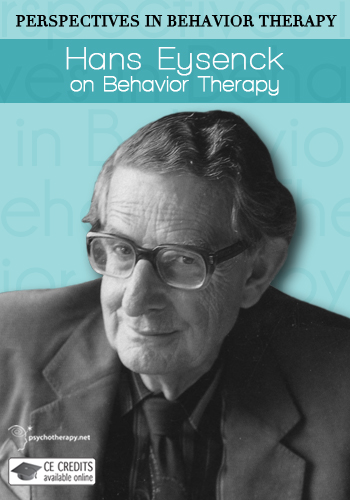
Hans Eysenck on Behavior Therapy
Video
with
Hans Eysenck, PhD
Video

Hans Eysenck on Behavior Therapy

Highly prolific and influential in the field of psychology, Hans Eysenck is well known for his bold, contentious theories on intelligence, personality, cancer and therapy. In this video, the “maverick psychologist” offers his insights about the practice of psychotherapy with his characteristically perspicacious flair. Video Length: 50m
Buy a Membership
COURSE DETAILS

Overview

Never one to shy away from provocation, Hans Eysenck is often regarded as an iconoclast in the field of psychotherapy. In 1952, he penned a very controversial paper in which he famously argued that psychoanalytic psychotherapy had not been shown to be more effective in facilitating recovery from “neurotic disorder” than no treatment at all. He faced further ire from psychoanalysts when he introduced behavior therapy at the Royal Psychomedical Association in 1959.

In this interview, Eysenck makes a compelling case for these groundbreaking ideas, and exemplifies his ability to be an intrepid agent of change against the dogmatic elements of the field.

In conversation with Dr. Philip Kendall, Eysenck shares his frank assessment on the modern developments in psychotherapy. Taking issue with integrative approaches to psychotherapy, Eysenck suggests that due to the theories’ divergent ideas on the origin of pathology, they are irreconcilable in practice. With specific regard to cognitive-behavioral therapy, Eysenck offers the paradoxical view that “cognitive behavior therapy, it’s either an oxymoron– they’re different things, they don’t really mean the same– or it’s a redundancy,” explaining that even early behaviorism took cognition into account. He adds that so far the combination of cognitive and behavioral therapy has not been shown to be superior to behavior therapy alone. Expressing concern that psychotherapists do not keep up with advances in the science of the field, he proposes changes in the way research is conducted and disseminated. Eysenck’s careful consideration and irreverent manner lead to appraisals of the field that are at once deeply thought provoking, and impossible to ignore.


About the Experts

Hans Eysenck, PhD

Hans Eysenck, PhD

Hans Eysenck was professor of psychology at the Institute of Psychiatry, King's College, London from 1955 to 1983. He was a major contributor to modern scientific personality theory, having created and developed a distinctive dimensional model of personality. Born in Germany, Eysenck immigrated to the UK when he was 18 because of his opposition to the Nazi party. When he was informed that his prerequisite courses for entry into a physics or chemistry program in the UK would not transfer…

View full profile

Disclosures

Hans Eysenck was compensated for his contribution. None of his books or additional offerings are required for any of the Psychotherapy.net content. Should such materials be referenced, it is as an additional resource.

This Disclosure Statement has been designed to meet accreditation standards; Psychotherapy.net does its best to mitigate potential conflicts of interest and eliminate bias in all areas of content. Psychotherapy.net offers training for cost but has no financial or other relationships to disclose. Additionally, there is no commercial support for this activity. None of the planners or any employee at Psychotherapy.net who has worked on this educational activity has relevant financial relationship(s) to disclose with ineligible companies.

Psychotherapy.net defines ineligible companies as those whose primary business is producing, marketing, selling, re-selling, or distributing healthcare products used by or on patients. There is no minimum financial threshold; individuals must disclose all financial relationships, regardless of the amount, with ineligible companies. We ask that all contributors disclose any and all financial relationships they have with any ineligible companies whether the individual views them as relevant to the education or not. Each experts’ specific disclosures can be found in their biography.

Shes Leaving Me: A Four-Stage Treatment Model for Men Struggling with Relationship Loss
  • Video

Shes Leaving Me: A Four-Stage Treatment Model for Men Struggling with Relationship Loss

Cognitive-Behavioral Therapy with Donald Meichenbaum
  • Video

Cognitive-Behavioral Therapy with Donald Meichenbaum

Encounter Groups for Addictions, Volume I: Evolution of the Encounter Group
  • Video

Encounter Groups for Addictions, Volume I: Evolution of the Encounter Group

Through the Eyes of a Child: Reducing the Trauma of Child Removal
  • Video

Through the Eyes of a Child: Reducing the Trauma of Child Removal

To Move is to Be Alive
  • Video

To Move is to Be Alive