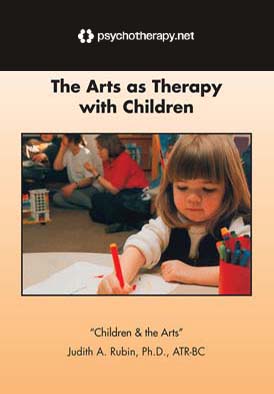
The Arts as Therapy with Children
Video
with
Judith A. Rubin, PhD
Video

The Arts as Therapy with Children

This video shows activities in multiple arts modalities—music, dance, art, and drama—in a creative arts program for young children at risk for the development of emotional problems. Video Length: 40m
COURSE DETAILS

Overview

There is an emphasis on the mental health values common to all of the art forms in therapy. Examples are depicted in each of the arts of the naturalness of engaging in creative activities for all children, the need for practice and control in order to achieve control, and the feeling of well-being that accompanies the sense of mastery.

The film illustrates how the arts help children channel aggression, as well as the multicultural social benefits of group creative activities. (Copyright 1973; Rev. 2008)

Excerpts from:

Glass Art as Therapy – James Minson, M.A., ATR
A program created by an art therapist and glass artist for Guatemalan orphans leads to increased self-esteem and a livelihood for the participants.

Multi-Arts Resource Guide – Maida Abrams, Ed.D., ATR, OTR
A guide for teachers showing activities in art, music, movement, and drama and ways of introducing them in the classroom, applicable to work with all children.

This video was formerly included in the Expressive Media Arts Therapies Films Collection distributed by Expressive Media Inc.


About the Experts

Judith A. Rubin, PhD
Expert

Judith A. Rubin, PhD

Judith A. Rubin, a pioneer in the field of art therapy, is on the faculty of the Department of Psychiatry, University of Pittsburgh and the Pittsburgh Psychoanalytic Society & Institute. She is a Registered, Board-Certified Art Therapist and a Licensed Psychologist. Dr. Rubin is the author of several books, including: Child Art Therapy, The Art of Art Therapy, and Art Therapy: An Introduction. She was the "Art Lady" on Mister Rogers' Neighborhood in the 1960s. A past President and Honorary…

View full profile

Disclosures

Psychotherapy.net offers trainings for cost but has no financial or other relationships to disclose.

This Disclosure Statement has been designed to meet accreditation standards; Psychotherapy.net does its best to mitigate potential conflicts of interest and eliminate bias in all areas of content. Psychotherapy.net offers training for cost but has no financial or other relationships to disclose. Additionally, there is no commercial support for this activity. None of the planners or any employee at Psychotherapy.net who has worked on this educational activity has relevant financial relationship(s) to disclose with ineligible companies.

Psychotherapy.net defines ineligible companies as those whose primary business is producing, marketing, selling, re-selling, or distributing healthcare products used by or on patients. There is no minimum financial threshold; individuals must disclose all financial relationships, regardless of the amount, with ineligible companies. We ask that all contributors disclose any and all financial relationships they have with any ineligible companies whether the individual views them as relevant to the education or not. Each experts’ specific disclosures can be found in their biography.

A Brush With Life
  • Video

A Brush With Life

Psychotherapy with Gay, Lesbian and Bisexual Clients 6: Diversity and Multiple Identities
  • Video

Psychotherapy with Gay, Lesbian and Bisexual Clients 6: Diversity and Multiple Identities

Scott Miller on Improving Psychotherapy Outcome
  • Video

Scott Miller on Improving Psychotherapy Outcome

Art Interviews by Child Psychiatrists
  • Video

Art Interviews by Child Psychiatrists

Contemporary Techniques for Bringing Stories into Your Sessions
  • Video
  • Webinar Replay

Contemporary Techniques for Bringing Stories into Your Sessions