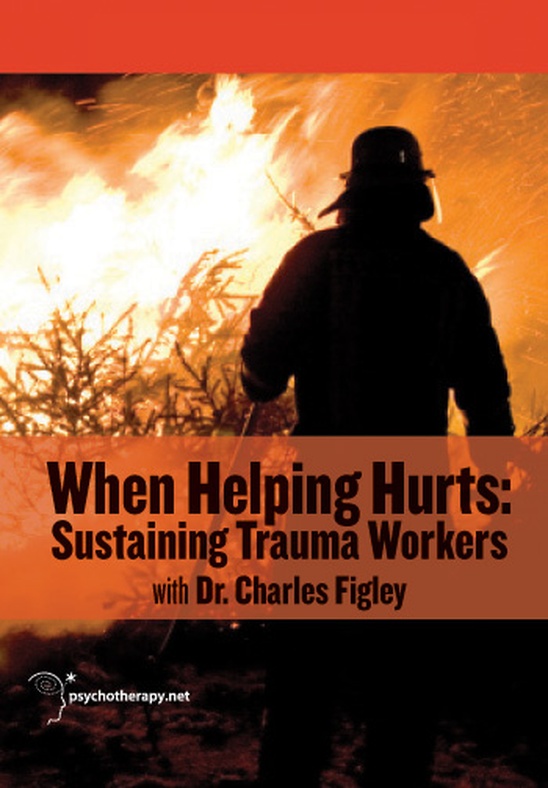
When Helping Hurts: Sustaining Trauma Workers
Video
with
Charles Figley, PhD
Video

When Helping Hurts: Sustaining Trauma Workers

Six noted therapists and experts offer their stories and advice on dealing with Compassion Fatigue, and discuss ways of recognizing and addressing this condition in yourself and others.
Video length: 1h 09m
Buy a Membership
COURSE DETAILS

Overview

Produced for trauma workersrelief workers and those exposed to trauma due to their profession or work as volunteers, this video addresses the issue of Secondary Traumatization and Compassion Fatigue. These conditions are  a hazard to the helping professionals that deal with traumatic events and through the voice of six therapists and experts, this video heightens awareness of  symptoms and risks, and provides new information about prevention, resilience and treatment. Specific strategies on awareness, lifestyle balance and connecting with others are given to assist trauma workers. You will hear personal stories and advice from Frank Ochberg, MD, Charles Figley, PhD, John Wilson, PhD, Carl Bell, MD, Atle Dyregrov, PhD, and Angie Panos, PhD. This video is used by the US Army as part of their Sexual Assault Prevention and Response Program.

About the Experts

Charles Figley, PhD
Expert

Charles Figley, PhD

Prof. Charles R. Figley, Ph.D., is the Paul Henry Kurzweg, MD Distinguished Chair in Disaster Mental Health and a Tulane University Graduate School of Social Work Professor since July 2008. He is also director of the Traumatology Institute and the Co-Director of the Disaster Resilience Leadership Academy. In addition to traumatic stress and resilience, Dr. Figley and his research teams have focused on other types of stress including fame-related stress, animal care-related stress, social, and lawyers and law librarians stress.…

View full profile


Disclosures

Charles Figley was compensated for his contribution. None of his books or additional offerings are required for any of the Psychotherapy.net content. Should such materials be references, it is as an additional resource.

This Disclosure Statement has been designed to meet accreditation standards; Psychotherapy.net does its best to mitigate potential conflicts of interest and eliminate bias in all areas of content. Psychotherapy.net offers training for cost but has no financial or other relationships to disclose. Additionally, there is no commercial support for this activity. None of the planners or any employee at Psychotherapy.net who has worked on this educational activity has relevant financial relationship(s) to disclose with ineligible companies.

Psychotherapy.net defines ineligible companies as those whose primary business is producing, marketing, selling, re-selling, or distributing healthcare products used by or on patients. There is no minimum financial threshold; individuals must disclose all financial relationships, regardless of the amount, with ineligible companies. We ask that all contributors disclose any and all financial relationships they have with any ineligible companies whether the individual views them as relevant to the education or not. Each experts’ specific disclosures can be found in their biography.

David Barlow on Treating Anxiety Disorders
  • Video

David Barlow on Treating Anxiety Disorders

Counseling Adolescents: Exploring Intersections of Race and Sexuality
  • Video

Counseling Adolescents: Exploring Intersections of Race and Sexuality

Working Online with Suicidal Clients in the Age of COVID
  • Video

Working Online with Suicidal Clients in the Age of COVID

Gender Differences in Depression: A Marital Therapy Approach
  • Video

Gender Differences in Depression: A Marital Therapy Approach

How to Use Play Interventions with Neurodivergent Children and Teens
  • Video

How to Use Play Interventions with Neurodivergent Children and Teens