How to Be Successful in Child Therapy: Lessons From 5 Decades of Practice

The insights I value the most came from direct work with children, adolescents, and families who taught me what is most important and helpful in the work that we do. I learned from children that what is most essential is that we do not give up on them. Embracing unwavering faith in children as they go through the worst times of their lives may prove to be far more important than any technique or intervention we employ.

The Importance of Therapeutic Presence with Children

Repeatedly, my former child clients tell me this when they come back to visit 10, 20, or even 30 years later as they establish themselves in their adult lives. Surprising to me is the fact that at the time I was seeing these former child or adolescent clients, I did not feel that I was particularly helpful. The crises that brought them to therapy were so intense that I was unable to appreciate the power of therapeutic presence and commitment.

One of the most important insights that emerged from my private supervision with the late Walter Bonime, MD, senior training psychoanalyst, has helped sustain me during the most challenging moments of my 55-year career as a clinical psychologist working with children and families. Dr. Bonime taught me that no matter how frustrated, discouraged, angry, hopeless, or impotent the therapist may feel, it cannot begin to match the depth of the same feelings in the child.

Children taught me that sometimes “more is less.” In certain moments what is most important is that we be a caring presence, a trusted witness. The temptation is for therapists to shower intense moments with words that can diminish the transformative potential of a deep encounter with a child.

I’ve met many a “fawn in gorilla suit” during my career. The analogy suggests that the “fawn” as the core self is highly vulnerable — has been hurt too many times! The aggression (putting on the gorilla suit) is intended to protect that vulnerable fawn by keeping people at a safe distance. Yet, the longing for connection burns deeply within.

Another important understanding gained from the decades of work with children is that whenever a youth says, “I don’t care!” we should assume they once cared a lot, but it simply hurts too much, it is too great a risk to care anymore.

I’ve always told my interns and young clinicians, “when you don’t know what else to do, just treat children and families with profound respect and dignity.” They are surprised how far that goes.

Children carry within them powerful narratives that all too often no one takes the time to elicit or hear. The youth, as much as they might avoid it, long to unburden.

The therapist’s willingness to risk themselves in the therapy encounter, and sometimes be wrong, is a “gift” to children by creating a safer context for the child to express what is difficult to put into words.

An 8-year-old boy asked me to explain the initials after my name. This led the boy to say, “Well, you don’t look that smart!” I told him my family tells me the same thing. It reminded me of how important a sense of humility is in working with children. To connect with children, we must be willing to look like fools sometimes. Otherwise, we are no fun at all. Children will only feel free to talk when they feel free to not talk.

Our goal is to honor strengths without trivializing suffering. This is a delicate operation. The work we do is rewarding. We get paid in the currency of the heart. Some of the moments we share with children and families are precious and priceless. But our work is hard. There is an undeniable emotional toll exacted from caring for children with deeply wounded spirits.

Can we hear the hard stories without the hardening of our heart? To do so requires diligent and disciplined efforts to take adequate care of the instrument of healing — our self. As much attention in our field has been paid to the importance of self-care, each child therapist will need to reflect and honestly assess to what degree it is a priority. If we short-change ourselves, it is likely that we are also stiffing our families, and perhaps the children and families we treat as well.

[Editor’s Note: David and I are colleagues and friends, and we are honored to offer his reflection here, which is not about “what to do” with children and teens in therapy, but, “how to be.”]

Questions for Thought and Discussion 

  • In what ways is the author’s orientation to child therapy Similar to your own?
  • What have you found to be the most effective ways to intervene with children and teens?
  • What have you found to be some of the greatest challenges in working with young clients?

In the Shadow of COVID, It’s Play Therapy to the Rescue

Kevin’s Worried Parents

In March of 2021, families were emerging from almost a year of isolation due to the COVID pandemic. As a Licensed Professional Counselor Supervisor and Registered Play Therapist Supervisor in private practice specializing in children, I was flooded with requests for services.

During one particular intake interview, the parents of a four-year-old boy I’ll call Kevin asked me a fair question. “How will our son’s development and mental health be impacted by this year of isolation?” I immediately reflected their feelings with, “You are really worried about the long-term impact on your son.”

Their worry was understandable given the emerging research showing increases in children’s anxiety and depression since COVID began. Yet, multiple factors of genetics, parents’ behavior, peer interaction, and available resources contribute to children’s developmental and mental health trajectory after a crisis. To respond to their fair question, I needed more information from them.

I asked, “What is concerning you the most?” Both parents had college degrees and were well read so they had valid concerns in mind. “Our son has not seen, much less interacted with, another child for over a year. He is our only child. Even though we took him to the public playground, as soon as another child got within 20 feet of us, we would leave quickly.” I thought to myself, risk factor one — no peer interaction during a critical developmental period.

Preschool is when children learn to tune into peer facial cues, scaffold their own physical and cognitive learning by watching other children, negotiate sharing, and so on. I needed to provide some hope to the worried parents, so I tried to normalize the fact that most of his peers had a similar experience. I replied, “Some children’s social, physical, and cognitive development may be a bit delayed during COVID. Fortunately, children are resilient and can learn together, starting from where they left off.” They nodded with seeming understanding.

Then Kevin’s parents said, “Our son could tell we were stressed when we were working from home and paying bills with less money. We tried to play with him, but we had many conference calls. He didn’t understand and thought that we were ignoring him. He became clingy and we became irritated, occasionally speaking to him more harshly than we desired.”

I thought to myself, risk factor two — parent behavior that was interpreted by the son as anger, resulting in increased anxiety. Being a parent myself of an only child who also has ADHD, I empathized and normalized with a compassionate groan. “I get it. I experienced something similar with my child.

We can feel so disheartened, trying our best to juggle it all, and losing our temper more than we want. We are human, not superheroes. We need self-compassion. That’s why I go by the 80-80 rule of parenting. About 80 percent of the time, I try to do about 80% of what I know to be helpful. But during COVID, I lowered my standard to 70-70 because that is passing.” They laughed!

The parents added with a heavier tone, “We are also concerned about his anxiety because we both suffered with anxiety during our childhoods.” I thought to myself, risk factor three — genetics. Research shows a strong genetic influence on the development of childhood anxiety disorders. Again, the parents needed some hope. I reflected, “You both know the pain and struggle as a child with anxiety. You love your son so much that you want to intervene as early as possible. You are wise to do so. I can help with that. Research shows that play therapy can decrease children’s anxiety. Together, we can work to build those limbic system neural networks toward calmness rather than fight or flight.”

Yes, the risk factors for this child were compounded during COVID. He had no peer interaction for a year, stressed and distracted parents, and a genetic predisposition toward anxiety. Yet, he also had the biggest protective factor we could hope for — caring and proactive parents. This plus mental health treatment, interventions of parent guidance, twelve sessions of Child-Centered Play Therapy (CCPT), and psychoeducation could shift this boy’s development and mental health toward a more positive path.

Prior to beginning my work with Kevin and his parents, and to gauge the level of his behavioral and emotional difficulties, I sent his parents a link for the web-based child version of Achenbach’s System of Empirically Based Assessment (ASEBA) Child Behavior Checklist for ages one and a half to five. The results revealed a pattern of emotional reactivity, anxious and depressive symptoms, and sleep problems. While Kevin’s scores on the DSM-related scales for Autism and ADHD were in the normal ranges, his other scores were consistent with DSM anxiety and depressive symptomatology. These results corroborated his parents’ concerns.

The parents’ main goal was to decrease Kevin’s anxiety so that he could calmly engage with others without clinging to his parents. Their prior attempts to reassure him through reason were ineffective. Using Daniel Siegal’s Hand Model of the Brain, I explained strategies to calm the lower regions of the brain through deep breathing, rocking, and soft voice rather than trying to reason with his prefrontal cortex, which was “offline” during his anxious times.

To reinforce these concepts, I asked Kevin’s parents to watch a parenting video by Tina Payne Bryson called 10 Brain-Based Strategies: Help Children Handle Their Emotions, and to read Siegal and Payne Bryson’s No Drama Discipline. These two resources helped them improve their ability to calm their own anxieties so their son would co-regulate with their calmness. To deal specifically with anxiety, I also recommended Calming Your Anxious Child: Words to Say and Things to Do by Kathleen Trainor to guide them in the step-by-step process of systematically desensitizing his fears.

A World Opens

In the waiting room prior to his first play therapy session, I greeted Kevin, commented on his red tennis shoes and matching shirt, and said, “It is time to go to the playroom. Your mom will be waiting right here.”

I smiled with friendly confidence, moving toward the door, and gestured for him to follow me. “We have lots of toys there.” His curiosity was stronger than his anxiety, so, he followed me. Kevin’s eyes opened wide seeing my play therapy room filled with carefully selected toys for nurturing (dolls, doctor’s kit), creativity (puppets, paints and easel, dress-up clothes), real-life mastery (kitchen, tool bench), and aggressive release (swords, bop bag, army men). As we entered, I said, “In here you can play with all the toys in most of the ways you like.”

Kevin was hesitant and stood near me, asking questions. “What do I do first?” Given his anxiety, this was not surprising. “In here you can decide.” He moved his eyes but not his body. I view this as a “freeze” state, a survival response for people perceiving threat and feeling overwhelmed. The threat was not necessarily coming from the playroom but from being separated from his parents or close family members for the first time in over a year. I reflected his feeling with reassurance, “You are a little scared being in a new place,” and role modeled taking a deep breath. I waited patiently so he could sense my calmness and confidence, thereby communicating this was a safe place.

Kevin moved toward some small cars on the shelf and pushed them along the floor. This action with familiar toys gave him a sense of security and mastery. I reflected his feelings by saying, “You enjoy seeing how far you can push those cars.” My statement reassured him that he really was welcome to play and built his confidence. He said, “Yes, I have a blue and red one at home that I like to race.” I gave him credit for his skills, “You are an experienced car racer!” He smiled and pushed the cars toward the four-foot red bop bag, named “Bobo.” Kevin lightly pushed on it to see how quickly it moved. “What’s this for?”, he asked. I returned responsibility to him with “You are curious what you can do with that. In here, you can play with it in most of the ways you like.”

Little by little, he courageously experimented with different actions from punching it, sitting on it, hitting it with a sword, and shooting at it with a dart gun. With each step, his sense of power grew. Toward the end of the session, he expressed creativity by painting a picture of the bobo. I ended the session with 10 minutes of psychoeducation on managing stress. I demonstrated and guided him through deep breathing, progressive muscle relaxation, and a self-soothing butterfly hug. After walking Kevin back to the waiting room, I prompted him to demonstrate his new skills for his parents and asked them to practice at home each day.

Bugs All Over You

In the fourth session, Kevin began with rolling cars again followed by punching Bobo, providing him with a familiar rhythm and routine. Once he established his sense of mastery and power, he collected toy spiders, snakes, and bugs and put them on my legs, hands, and shoulders. “You have bugs all over you. You can’t move.” I stated, “You are showing me it is scary to have bugs on me and not be able to move around.”

He exclaimed, “Yes, you are going to be stuck there forever.” I responded, “It seems like it will never end!” Eventually, Kevin decided to rescue me by knocking off the bugs with a sword. His symbolic play reflected his experience during the pandemic of feeling scared and trapped. Yet now he was in charge, rather than being the one trapped. He was gaining an emotional understanding to master his traumatic experience of COVID isolation.

At the end of the session, I engaged him in a children’s book that illustrated listening to his body to notice when he may need to take deep breaths and seek soothing sensations such as rubbing his hands and legs. This combination of child-led restorative play reenactment plus the intentionality of anxiety management skills strengthened his ability to emotionally self-regulate.

Mommy Dies

By the sixth play session, Kevin had gained enough comfort in the playroom that he was ready to play out a hidden fear — mommy dying. He approached the playhouse and put the “daddy doll” upstairs in the office to do his work. The “boy doll” was downstairs by himself watching TV. The mommy doll ran out of the house to go to a work meeting on a nearby table. Kevin drably said, “Mommy went out of the house, got COVID and died.” I reflected, “Super scary and so sad she died.” Kevin quipped, “Yup. Now who’s going to make dinner? Daddy is busy working.The boy will have to go out and hunt for food.”

I responded, “The boy feels all alone AND he knows how to get some of what he needs.” Eventually, Kevin brought in the army to help him hunt for food. I facilitated understanding: “There were strong people out there who could help the boy when he needed it. They kept him safe.”

Underlying Kevin’s fear of his mother dying was the basic existential question of “Will I survive?” Through play, Kevin created his answer — letting strong people help him. During the last 10 minutes of the session, I facilitated psychoeducation by playing a detective game with Kevin. “Let’s list lots of things many kids are worried about these days.” Kevin said, “Losing their favorite toy and their dog running away.” I added, “Family members getting sick, going to the hospital, and dying.”

Then I challenged his all-or-nothing thinking. “There are 100 kids. One kid loses their toy. Does that mean every kid loses their toy?” “No.” “There are 100 dogs. One dog runs away, does that mean everyone’s dog will run away?” “No.” “There are thousands of people. One person may get sick from COVID and die. Does that mean everyone will?” “No. If someone gets sick, they go to the doctor and the doctors do their best to help them.” “Let’s think about all the kids who are playing with their toys, dogs, and family members. What would they be doing?” “Playing fetch.” “Yes! I love to play fetch with my dog.” Since Kevin was calm, he could engage in basic reasoning that most people will be OK and the importance of focusing on the positives in the here and now.

Doctor Superhero

In the tenth session, Kevin walked in with confidence. He rolled the cars, punched the Bobo, and took the baby to the doctor. “Your baby is sick. I am the doctor.” He used the stethoscope, took the temperature and blood pressure, and gave the baby a shot. I reflected, “You knew how to doctor the sick baby and get the baby better.” He got the cash register and declared, “That will be $10,000.” I paid up — a small price for his victory.

Then Kevin put on the Superman costume and flew around the room “saving everyone.” I enlarged the meaning: “You are an important, powerful person who can help so many — even yourself.” With his chin tilted up, he said, “Yup, I’m not scared anymore!” Indeed, his parents had confirmed that he was no longer sleeping with them, and he was willing to stay with a babysitter for them to have a date night.

Reflections

From a Child-Centered Play Therapy perspective, Kevin was experiencing incongruence between his ideal self as a confident, engaging boy, his current self as an anxious boy, and his experiences of isolation and fear during the COVID pandemic. He was not accurately symbolizing the behavior of his parents and other adults in that he interpreted their cautions as a lack of confidence in him. Over months of physical and emotional isolation, his self-concept was of a timid, weak child who was unable to move forward in his world.

Kevin’s time in the playroom with me along with his parents’ support provided him with a developmentally appropriate intervention in a safe playroom with an empathic play therapist, representing a microcosm through which he could master his world. He was able to come to an emotional understanding that his past anxious experiences were about an illness doctors were trying to heal and not about him. His self-concept strengthened to see himself as a strong, powerful boy who knew how to get help, help others, and help himself. Parent consultation, Child-Centered Play Therapy, and psychoeducation were the healing components of treatments that showed such love to this family. Kevin emerged from his isolation and anxiety. He flies like Superman toward a more positive developmental trajectory.

Parents and children experienced suffering during COVID. Many experienced existential anxiety from recognizing mortality, confronting pain and suffering, and struggling to survive. Mental health professionals were trained to support people in crises such as COVID. Yalom and Josselson remind us, “No relationship can eliminate existential isolation, but aloneness can be shared in such a way that love compensates for its pain.”

Reference

1. Yalom, I. D., & Josselson, R. (2011). Existential Psychotherapy. In R. Corsini & D. Wedding (Eds.), Current psychotherapies (9th ed., pp. 310–341). Brooks/Cole, Cengage Learning.  

Jessica Stone on Play Therapy in the Digital Age

Crossing the Digital Divide

Lawrence Rubin: Hi, Jessica. Thanks for joining me today. How did you become interested in digital play therapy, which really is cutting-edge and somewhat controversial with children?
Jessica Stone: I kind of straddle a few worlds here. I am a licensed psychologist with a specialty in play therapy. Within it, digital play therapy has become one of those areas of interest over the last 20 years, stemming from experiences with my own kids, who had this whole portion of their world that I didn't really understand, know about, or enter into. It struck me as a little bit ironic and maybe even hypocritical that here I spend my time at work and my energy learning and doing play therapy with children and entering their world, while my own kids have this whole portion of theirs that I was putting no effort into understanding. And so, I kind of had to smack myself upside the head and say, all right, I need to learn more about this. Why is this important to them? Why are they interested in it?

Long story short, I ended up entering into an online game called Runescape that my oldest two (of four children) were both playing at the time. I am no digital native by any means, and I was not very good at these games, but the point was that I was taking interest. I was listening to them. I was asking them questions. We were having conversations about what happened in the game, what quest they were working on; things that were important to them that prior to my entering their world, I couldn't participate in or even understand. I began to see that because this co-play was so impactful with my own children, I needed to incorporate it into my work, which really opened the door to what I have been doing for all these years.
LR: So, you recognized that technology was so important and present in your kids’ life that you would be almost doing a disservice to your young clients if you didn't cross that bridge into their digital world. Tell me, what exactly is digital play therapy?
JS:
I am no digital native by any means, and I was not very good at these games, but the point was that I was taking interest
Digital play therapy is a modality that is based in speaking the client’s language through what I call the four C’s, which are competency, culture, comfort, and capability. These are basic elements of therapy in general, but digital play therapy in particular is couched within the broader context of prescriptive play therapy, which taps into what Charles Schaefer calls the therapeutic powers of play. So the point is that there is a foundation for it. It's not just, oh, let’s just jump on this bandwagon and start throwing these digital things into what we’re doing. We as clinicians need to have a very firm and solid foundation in what it is we’re doing and why we’re doing it regardless of our theoretical foundation, therapeutic modality, and interventions, or whether the platform is virtual or face-to-face. And as in all therapies, we must ground our interventions in solid case conceptualization and treatment planning.
LR: I know that Charles Schaefer co-founded the Association for Play Therapy and has written extensively on play therapy, but can you tell our readers what he means by the “therapeutic powers of play?”
JS:
it's not just, oh, let’s just jump on this bandwagon and start throwing these digital things into what we’re doing
If you can close your eyes for a minute, imagine a graph with four quadrants that represent what he calls the core agents of change. These are facilitating communication, fostering emotional wellness, increasing personal strength, and enhancing social relationships. In turn, each of those quadrants consists of the 20 therapeutic powers of the play. For instance, in the quadrant of “facilitating communication”, we have self-expression, access to the unconscious, direct and indirect teaching. In the quadrant of “enhancing social relationships,” we have the therapeutic relationship, attachment, social competence and empathy, and so on. I think what Dr. Schaefer has done is given us a really amazing foundation from which to then tailor and customize it as fit for whatever our modality and our theoretical foundation would be.
LR: So when working with children, it's important to consider their communication skills, their emotional development, their strengths, and their social connectivity, and then if you choose to work digitally with them using an app, a video game, or even a virtual reality platform, you are doing so from a solid theoretical foundation and justification for that intervention.
JS: Right, and one of the things that I wanted to add was
there are three levels of digital play therapy: at the first level, you are simply open to it, including it in the conversation, and trying to understand why it's important for that client
that there are three levels of digital play therapy. At the first level, you are simply open to it, including it in the conversation, and trying to understand why it's important for that client. The second level would be when someone brings in, for example, a YouTuber that they are interested in, or a game, and they want to show you a video of it, or together you're looking up information about it. So you're using a digital tool, but it's to learn more about it and to share in some aspects of your client’s life. The third level would be all of the above and would also include actually meeting with your client within a game (whether you are with them in the room or virtually) or using an app together. And so, in order to have digital play therapy, you don’t have to be in the Roblox game with them. You could be at level one or level two, talking about it, asking questions about it, or having your client show it to you, or taking a tour of it.

If Not for the Legend of Zelda

LR: And that becomes part of the treatment plan as well. And you may not even know which level you're going to be entering into until you know the child a little better. Can you give an example off the top of your head of a level three experience that you had with a client?
JS: Absolutely, but I’ll sanitize all over the place for obvious reasons. I had a little elementary school age guy who came in to me because he was selectively mute. He didn't speak to any adults, including his teachers. He spoke to his parents, but he didn't speak to any adults outside of his home.

We had this amazingly intricate way of playing the physical game Guess Who, not the digital version. We came up with this whole worksheet with all the different options that he could point to and we were really proud of ourselves for having gotten to that point. But then he wanted to move on and saw that I had a Nintendo Switch sitting on my shelf. He pointed to it, and I said, “Oh, yeah. You know, I have this Switch, and really the main game I have on there is Legends of Zelda.” I listed the other games I had, but the main one that the kids really wanted to play at the time was Zelda: Breath of the Wild, and so he wanted to play it. By the way, I have the “regular” Nintendo Switch, the one with the two removable handset controllers and central viewing screen that both players can see.

We each had a controller, and I said, “But what we have to do now is to figure out how we’re going to communicate, because one of the handsets controls where the person is looking, and the other one controls where the person is walking. So if we’re not communicating, we’re going to go off a cliff, or we’re going to run into an enemy, or, you know, something is going to happen because we’re not explaining to each other what our agendas are, or what our desires are.”

it was a breakthrough that I really don’t know that we would have had it were it not for Legend of Zelda
He also had a tablet that he could type on to communicate so he indicated that he would point because he was the walker, and I would be the looker. As we were playing, we came to this dangerous thing and it became this frenzied moment because we were going to be attacked. All of the sudden, he screams out at me, “Look over there!” While I had never heard his voice before, I didn’t want to make too big of a deal of it.

I was like, okay, play it cool, but inside I was so excited. Out of the corner of my eye, I see his hand fly up over his mouth, like, oh, my gosh, I can’t believe I just did that, right? And I said, “Oh, I’m so glad you said that,” and I looked where he told me, averted the danger and we went on. I said, “You really saved us. I’m so happy that you talked to me to tell me that because we would have totally been attacked.” After that pivotal moment, he would chitchat, and there weren’t any communication lapses. It was kind of like, well, the cat is out of the bag, and I didn't make it an unsafe environment for him to do so, and it was a breakthrough that I really don’t know that we would have had it were it not for Legend of Zelda, the two controllers, and the need to communicate with each other. It's amazing.

The 4 C’s of Digital Play Therapy

LR: That was a breathtaking moment. How does it capture those 4 C’s of digital play therapy you referred to earlier on?
JS: The first three—competency, culture, and comfort really culminate with the fourth, which is capability.

Competency is those core skills that derive from our theoretical beliefs, experience, and continued education, regardless of our discipline of practice. It is within the professional. It is what we bring into the therapeutic space.

Culture is very interesting to me and something that we’ve talked about for decades as being important to incorporate into our clinical work. It has blossomed and expanded from religion, race, and place of origin to include other facets of peoples’ experience, like music, food, and interests, and of course their digital involvement.

A while back, I was invited to speak at a PAX convention, which is like Comic Con but for people who enjoy gaming. There were literally thousands of people there, all of whom shared this common experience and who have historically been characterized as “other,” with all the stereotypes that go along with gamers, like spending days in their mother’s basement playing video games.
LR: They don't fit in.
JS: They don’t fit in. And while I don’t want to perpetuate any of those damaging and non-appropriate stereotypes, there I was with thousands and thousands of people and I was the “other.” I’d never felt like the other in my life, but in that moment, it really struck me that it is such a disservice to think of people who have digital interests as “others.”

First of all, it is quite hypocritical, because at any given moment, most of us have a device near us. We have a phone we don’t leave our house without. We have our computer, and millions of people play very casual games like Bejeweled or Candy Crush on their device. So, it's quite hypocritical for us to say, “Oh, those people are others,” when really, there are simply different levels of gaming. So, the culture piece is really important to me, and we can’t simply reject portions of our clients’ lives—in this case their digital interests.
LR: If technology is so significant a part of our culture, why is there still a seeming reluctance on the part of some clinicians to incorporate it into therapy, and in this case play therapy with children?
JS: That actually brings us into the next C, which is comfort, the importance of which is that we be genuine and congruent within ourselves, and that's something that I think that a lot of therapists don’t have about technology. I talk to people, and they're like, “I don't know how to get my photos off my phone. I don't know where to find them.” So first, I think it's just basic knowledge and comfort. We know that at the beginning of the pandemic, people were freaking out. They didn't know how to use a platform like Zoom or, you know, whatever it is that they're using. Where do I get the link? How do I get into the app? How do I talk to people? What if they can’t hear me? As therapists, regardless of whether we are working with adults or children, we have a lot of things to think about when we’re in session, including, how does this fit into our case conceptualization and align with our treatment goals?
LR: How do I validate it?
JS: So
when a new anything is added into that therapeutic mix, like technology, it throws everything else off kilter a little bit so that we don’t feel secure, we don’t feel congruent
when a new anything is added into that therapeutic mix, like technology, it throws everything else off kilter a little bit so that we don’t feel secure, we don’t feel congruent, and now we are not only worrying about the logistics, but also whether I am doing the right thing for my client. And so when you package all that together, it's like, oh, I don’t even want to touch that because it’s too risky. It's too scary. In my book, Digital Play Therapy, I refer to this as techno-panic. We can point to so many different points throughout history, such as Socrates saying that the written word was going to destroy the oral word. Radios are going to destroy… TV is going to destroy… Video is going to destroy…
LR: So techno-panic results in people, and perhaps in our case therapists, keeping their distance from technology because of anxiety, worry, and insecurity.
JS: Yes, I’m going to keep my distance, because that has enough in it to scare me but not enough to inform me.

And by the way, the fourth “C” is capability—something to bring the other 3 C’s together. Capability means continually striving and reaching forward throughout one's career to embrace, or at least consider new modalities, concepts, and techniques to discover, explore, and practice.

The Virtual Sandtray: Origins

LR: This conversation reminds me of an experience I had a few years back when I encouraged a fellow play therapist, Deidre Skigen, who had been using the SIMS program as a virtual sandtray, to write an article for Play Therapy magazine. Soon after it was published, a veteran sandtray therapist (and purist) sent in a 32-page paper lambasting the idea of using a simulated sand tray. According to your 4 C’s model, this veteran clinician could probably not check off any of the C’s. With that said, please tell us about your groundbreaking app, the Virtual Sandtray.
JS: Sandtray is amazing and has been around for just about 100 years.
Dr. Margaret Lowenfeld started with the World Technique in the 1920s while working with kids after the war
Dr. Margaret Lowenfeld started with the World Technique in the 1920s while working with kids after the war. She really wanted to understand more about their experience and, in particular, their resilience. She understood that the sand tray is a creative, projective way of working with people either nonverbally or verbally. Traditionally, it's a tray with a blue bottom, and depending on the clinician’s theoretical orientation, can be made in different sizes. It can be populated with various objects and figures, which when placed in the sand create a symbolic representation of the child’s external world, their unconscious conflicts, fantasies, and projections.

It can be freeform, and then it becomes the clinician’s job to understand what that client is expressing. Sometimes people will tell a story and narrate it. Sometimes they won’t. There’re so many things that will depend on where someone’s theoretical foundation is coming from with regard to sand therapies. This is the foundation and fundamental aspect of doing sandtray therapy—your client is creating a world, a microcosm right there with you.
LR: And your Virtual Sandtray app?
JS: In 2011, following a devastating tsunami in Japan, my very good friend and colleague, Dr. Akiko Ohnogi, co-founder of the Japanese Association for Play Therapy put out a plea, “Please send us materials. We have all these people.” She and her therapist-colleagues needed materials to work with people impacted by the tsunami.
no matter what you do, sand is bulky and heavy and will escape whatever you put it in, no matter what, so an alternative was needed


I got together a bunch of stuff, and I sent it over feeling quite proud of myself for contributing to all of this but then thought to myself, how are they going to do sandtray without a sand tray? While sand trays are very popular in the United States and come in many varieties, portable kits are clumsy at best, and how were we going to get all the necessary miniatures to them? No matter what you do, sand is bulky and heavy and will escape whatever you put it in, no matter what, so an alternative was needed.

As it happened, I had received an iPad for Mother’s Day that was pretty cool to have, but it wasn’t getting much use until I thought, “It should be on an iPad.” And then I started thinking about how it could be used by clinicians and interns in hospitals and schools, in crisis situations as well as in traditional therapy spaces, whether in-person or online. A virtual sand tray could be used with immunocompromised people and clients who were traumatized and would be triggered by the sensory contact with the sand. Interestingly, my husband had taught himself to program when he was a teenager. He said enthusiastically, “You know, I’m going to start that project for you.” Being married, I had of course heard that line before, but he proudly proclaimed, “Oh, that sand tray project.” It just bloomed from there.

the Virtual Sandtray started out as a touchscreen app so that you could have the kinesthetic experience of the creation of the tray
Dr. Schaefer invited me to his annual retreat/think tank, so I was able to share my thoughts and receive excellent feedback from my play therapy colleagues. And Drs. Linda Homeyer and Daniel Sweeney, who wrote the definitive book Sand Tray Therapy, offered to beta test it and provide additional feedback. So, I was very fortunate to have such amazingly educated and experienced people giving us information, knowledge, and feedback on our app.

The Virtual Sandtray started out as a touchscreen app so that you could have the kinesthetic experience of the creation of the tray. I also did a lot of research and reading into Dr. Cathy Malchiodi’s art therapy work about the inclusion of digital-art representation and symbolism and I am so proud to say that we have recently partnered with the Lowenfeld Trust, who endorsed our product and the way it has stayed faithful to the basic tenets of her original work with the sandtray.

The Virtual Sandtray: Applications

LR: So what exactly can you do with the Virtual Sandtray app, and what clients is it best suited for?
JS: So, I'll say this as a nutshell and then put it to the side. There are a lot of administrative features that we’ve built in for the therapist which are separate from the actual clinical uses. It is also important to note that the app is atheoretical, as is use of a physical sand tray. The Virtual Sandtray app is like all other materials in the playroom, a tool that is adaptable to the clinician and the client, regardless of presenting issues. It is also useful for any age, as is a physical sand tray.

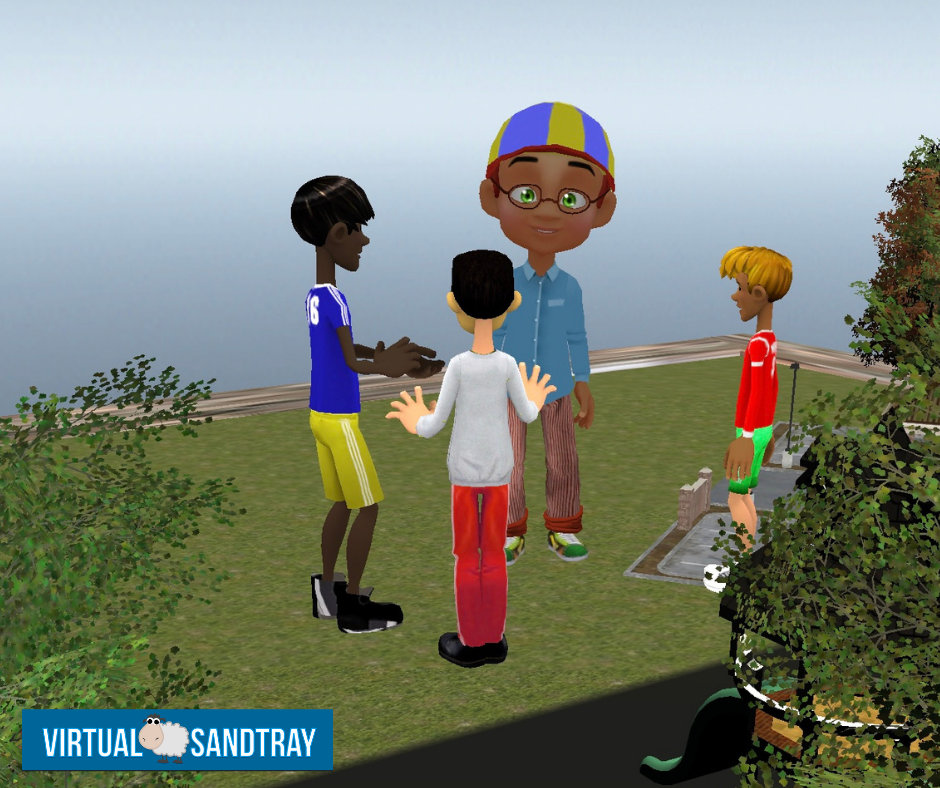
You can dig in the sand. You can build up the sand. You can paint it, add grass, or water, or cobblestone, or you can have it be sand color. You can place 3D models in it, rotate the tray, and navigate at any angle. Like a physical sand tray, it is three-dimensional in every regard.

a happy-go-lucky scene of rainbows, butterflies, and unicorns can be created against a dark and foreboding background


You can make the models bigger or smaller, turn them around, move them, and knock them over. You can blow them up. You can change the background. A happy-go-lucky scene of rainbows, butterflies, and unicorns can be created against a dark and foreboding background. Congruence between the main scene and the background is relative. You can dig down in the sand, paint the inside of the tray blue so that the bottom of the tray is like water.


11 Year-Old: Safety and Security with Unicorns and Fence, but Danger (Dragons) Lurking


Adult: Castle as Calm Space/Sanctuary


You can create a multidimensionality in the sand so that, for instance, two layers would just be sand, but the third layer is liquid. So, in the happy-go-lucky scene I mentioned above, you can change the liquid layer to lava. So now we have a multilevel, multidimensional depiction of this world for this client. We also have camera filters, so you can make it look like it's snowing, or raining, or you can invert the colors. You can do night vision, like it’s seen by aliens or something like that.


9 Year-Old: Red Dragon Scene- Danger, Missing Scary, Unsafe, Trauma


Therapist Process Tray: Sadness Over Missing out On 4th of July Due To COVID

LR: Jeez.
JS: One of my current favorites is this one called “broken,” and there’s a couple different broken varieties, but if you can imagine a scene where the person has created a scene depicting their family and then they use the camera filter so it appears shattered. This might reflect how that client feels about their family.

By the way, you can save trays and load previously saved trays to work on again. The clinician can review and compare/contrast the in-person with the online sessions. In the secure, encrypted remote mode with a free client version, no personal health information is collected, and there are multiple language and accessibility features and well over 7,000 3D models available.

Sandtray with a VR Twist

LR: In your book, you talk about the virtual reality version of your sandtray app.
JS:
In VR with the Virtual Sandtray, you can be either up in what's called God mode, where you're up above the tray, looking down, or you can come down to the level of the sand tray and interact with your creation
In 2016, I started learning more and more about VR. I remember thinking, "Mental health is going to explode with virtual reality." So my husband created a version of the app for virtual reality. In VR with the Virtual Sandtray, you can be either up in what’s called God mode, where you're up above the tray, looking down, or you can come down to the level of the sand tray and interact with your creation. So imagine a child is depicting a theme in which they have been bullied at school, or an adult client is interacting with their spouse and that interaction has been traumatic. Unlike with the Virtual Sandtray app, the client can go right down to the level of the depicted scene to walk and interact within it. It is an entirely different level of immersion. You can certainly crouch down in a traditional tray and become more physically engaged—grab the items and narrate, and move them around and all of that. But in VR, you're staring them in the face. The thing is right there. It's a really powerful, amazing, immersive experience to use the virtual reality version of it, and I’m really proud of that.


Animated Bullies Looking Down on Child Who is Much Smaller/Crying


Bullied Child As He Would Like It To Be—He Is Now Bigger and Talking To Them


VR Version of Sandtray of 11 Year-Old’s Sandtray Scene From Above

LR: Readers may be familiar with the use of virtual reality in cognitive behavioral therapy, in exposure and response prevention. And this isn’t necessarily used for exposure in an anxiety or trauma reduction sense, but it's adding another level of immersion into the play.
JS:
VR could be used in an exposure play therapy format by putting a big spider in the tray or scene
VR could be used in an exposure play therapy format by putting a big spider in the tray or scene. I can make that thing enormous, and then it becomes a challenge to the client, who has to ask themselves, “How do I manage that? How do I keep myself safe? How do I titrate toward, or away, or whatever it is?” I use VR in my clinical practice for a variety of reasons. I’ve used it with adult women for empowering them. I’ve used it with all ages for identifying safe places and spaces.

I even have a job simulator. I have a kid whose life is very regimented, and she comes in, and she just destroys the whole office. She chooses the job of being an office worker, and she goes in and dumps the coffee, and throws things, and just makes this huge mess, and it's so cathartic for her to do this with no real-world consequences.

Synchronicities

LR: What’s the difference, Jessica, between synchronous and asynchronous telemental health play therapy?
JS: This conversation that we’re having right now is synchronous. We’re both here at the same time, speaking to each other, even though we’re in different locations. If you have synchronous learning, it's the educator and the student in the same place at the same time. Asynchronous is when we were emailing back and forth. Or it may be an online platform where the educator and the student are not in the same realm at the same time. In therapy, it would be the therapist and the client were not in the engagement at the same time. So when we give a client homework, or when they're going to draw something or create something, or make a list, or whatever it is, that would be asynchronous.
LR: In face-to-face (live) play therapy, the clinician has all the goodies right there in the room—the drawing materials, blocks, sand tray, clay, papier mâché, and dollhouse, to name a few. How is this done online in a synchronous format?
JS: There are just so many different things that people are doing, and it's just wonderful. The resilience of human beings is amazing. A lot of clinicians have either identified what the client has on their end and what the therapist has on their own end, and then they can each use their materials when they see each other; for example, they could play Uno. And we’re talking about, like, traditional play materials. If we’re talking about digital, there’s a way to do so many things digitally.

Other clinicians have created play therapy kits that the client can pick up or that get delivered, so both have similar materials in their respective spaces. In a sense, it’s parallel play. I’ve had a couple of clients just say, “Okay, let’s draw a whatever-it-is,” and then on my end, I do it, and on their end, they do it, and then I hold it up and they hold theirs up and we show each other. If you’re doing it digitally, you can screen share. What it boils down to is using the tools and materials that have clinical significance and relevance and that meet the needs of the client and their treatment, and that ties into your therapeutic modality of choice.

And this brings us way back to that fourth “C,” capability, because if we really understand what we’re doing and why we’re doing it, then we are able to identify those components and find alternate ways to employ them, but if we don’t have them identified, what the hell are we doing?
LR: What you're describing seems parallel to your experience at the PAX conference where there was this alternate mainstream, and you were the “other.” I imagine that there are some therapists out there who fall into this “other” category, as well as those who are curious and in need of training and exposure, and a third group that has already embraced digital play therapy.

As we come to an end, Jessica, can you name five apps that you have found most useful therapeutically with children?
JS:
I will say that the Nintendo Switch has been an amazing resource for me in therapy, whether through telehealth or in person, and the same goes for my use of virtual reality platforms
Like you said, the Virtual Sandtray would be my tippy top. I have found a lot of therapeutic value in VR programs, and that, again, can open up a whole ‘nother conversation. I will say that the Nintendo Switch has been an amazing resource for me in therapy, whether through telehealth or in person, and the same goes for my use of virtual reality platforms. Underneath that, Roblox. While I know a lot of people who let out a collective groan about Roblox for a number of reasons, I would ask techno-curious readers to watch YouTube videos. Learn more about it. Play some things yourself. It's not as scary and awful as a lot of people think it is. You have to be savvy and have some digital citizenship.
LR: Digital citizenship.
JS: There’s hundreds and hundreds of options to choose from, different varieties and genres that you can then tailor to your client’s needs and interests. It's like Disneyland, you know, for options. Then we have Uno Freak. I mean, that's really basic. We’re just going to play Uno. Like, you put a card. I put a card. You put a card. I put a card. Draw cards. You know, just really basic, fundamental. I actually like the Uno Freak version of Uno better than the card version.

There’s Board Game Arena, and there’s a couple other board game types, as well, traditional games like chess, checkers, Othello. Battleship is a good one, but there are hundreds of other games that you may never even have heard of that you can explore, and they each have little tutorials to walk you through it. So I would say those are really fundamentals that people could start with. Certainly, if people want to know more about some of the other arenas, then I’m happy to do that. Skribbl is there if you want to play something like Pictionary. You both join. You draw. You guess. You laugh. You engage. You learn a lot about people’s frustration tolerance and their coping skills and styles, as well as their interpersonal skills and styles.
LR: Maybe the greatest takeaway from this conversation, Jessica, is that, while this may be scary and new and even evoke techno-panic in those who are probably prone to techno-panic anyway, it really is worth becoming more aware of, because there’s probably not as much of a divide between digital play therapy and nondigital play therapy as people fear or think. Anyway, the real healing comes in the relationship between the therapist and the client and how we use whatever we have or whatever they bring to help them to get where they're going.
JS: I really would like people to think of it as an "and", not an "or". And that we can take all those fundamentals and use them in really powerful ways, whatever the medium is.


LR: And I think, on that note, we’ll stop. Thanks so much, Jessica, for pointing us to the bridge between the digital and non-digital world of therapy and, in particular, play therapy.

What Do a Mango Tree and Child Therapy Have in Common?

I am from Brooklyn. While a tree might have grown there for someone else, it certainly did not do so for me. A few shrubs here and there, some weeds poking up in the cement cracks perhaps, but nothing more verdant than that. I was thrilled, upon moving to my current home in Florida to have a mango tree on my property.

Everything I ever needed to know about therapy I’ve learned from that mango tree…but more about that in a bit. Each year like clockwork, the tree blooms, fruits, sheds and ultimately yields. And each year like clockwork, I worry that for a variety of reasons, it will not actualize its mission. And each harvest season, I must remind myself that this magnificent living thing has its own rhythm, its own wisdom and needs me there simply as a witness, unassuming caretaker and gentle guide.

In similar cyclical fashion, right around this time for the last two years, I received a call from Jamie’s parents. “Hi Larry”, says Tom, Jamie’s dad, “Jamie just finished 4th grade and asked to see you; he misses you.” Tom went on to describe how his creative, playful and precociously intelligent and self-aware child had flourished and evolved despite the challenging climate of public school. Now, a rising fifth-grader, Jamie was again expressing anxiety over leaving the familiar landscape of fourth grade.

I first met Jamie when a mere sprig of a second-grader, who at the time was nervous at home and at school, fearful of making mistakes, prone to clashes with his parents and the occasional classmate as well as very sensitive to criticism. Our therapeutic play was at his pleasure, not my design, as I believed a client-centered approach best fit his growing needs. I trusted that through his drawing, role-plays, arts-and-crafting as well as popular culture-based story telling that he would play out exactly what he needed to express; and that my non-directive feedback would provide whatever additional insight he might have needed.

It was now two and-a-half years later, and there stood Jamie in the middle of my therapeutic playroom, surveying all the possibilities before him. Without flinching, he quickly went to work; reminding the bobo doll who was boss, animating a group of hand puppets in lively conversation about fears, worries and confidence, and finally turning to me saying “I’m done, let’s go talk to my parents about why they brought me here.”

And so it was! This little mango tree named Jamie told me exactly what he wanted and needed, reminding me of my role and its limitations while imparting a simple lesson that applies to mango trees and child therapy alike. Trust in their wisdom, potential to grow and ability to tell you exactly what they need. The measure of the bounty will be its own reward.  

Eliana Gil on Play Therapy and Working with Traumatized Children

What is Play Therapy

Lawrence Rubin: Eliana, you are perhaps most well-known for using art and play therapy to help traumatized children. But first let’s take a step back by opening the conversation around play therapy, because many of the people who will be reading this interview may not have had formal training or experience with this form of intervention or may work with children but still may have questions about how play therapy works. What exactly is play therapy and how can play be used therapeutically?
Eliana Gil: I think that there are so many misunderstandings about play therapy.
I have a very good friend who always says, “I can see where the play is, I just don’t get where the therapy is.”
I have a very good friend who always says, “I can see where the play is, I just don’t get where the therapy is.” In other words, I think because play is such a generic activity – a worldwide activity – and people are so used to children playing in the parks and the playgrounds, that it is very difficult for them to think that such a spontaneous behavior can have any therapeutic benefit.

So, I always say to people that play inherently has some very curative qualities, as Charlie Schaefer has discussed so well. Play gives kids the ability to solve problems, to pretend, to compensate for feelings that are very difficult to express, to have fun, and to delight in. All of those are really positive things and it’s clear that play tends to release endorphins. You’re also forming bonds with the person that you’re playing with. So, there are all kinds of inherent qualities that a child is engaged in when they’re using play.

When kids come to a therapeutic relationship there’s a relational piece that’s built in where the therapist is viewing the child’s play and interpreting that play in a different way than an untrained person. A therapist is going to look at the child’s play with a different lens and begin to interpret it as the child’s way of releasing emotions or trying to process things that are difficult for them to express because they may be worried about something or they may be feeling conflicted about something.

In other words, I think what ends up happening with kids when they come into that therapeutic environment is that there’s an expression of things that are very internalized that begin to make their way out into the open so that therapists can learn about them. I always trust that whatever is on the child’s mind will come forward – and that if we give them specific kinds of props then there are things that are really going to be much more amenable to symbolic play. What we’re trying to do is gain an understanding of something that’s internalized and that children may not have words for. So, again, the context of a play therapy environment is much more structured than free play, and the therapist is focused on the child’s play in a different way than you would be if you were simply playing with a child.
I think what ends up happening with kids when they come into that therapeutic environment is that there’s an expression of things that are very internalized that begin to make their way out into the open so that therapists can learn about them.

Free play tends to have very few goals. I think the intent when you’re doing play therapy is to advance certain goals that have to do with a child’s growth, or removing obstacles that they may be experiencing towards development, or helping them deal with traumatic events that they can’t figure out what to do with except they have big feelings or they have thoughts that they can’t really make sense of. So, the therapeutic relationship is intended to help create this environment of trust and comfort so that the child can do some of the things that they will do naturally if given the time, space, and proper context. 
LR: You talk about play therapy as such a natural outgrowth of play in the hands of someone who appreciates it, understands it and uses it intentionally with children. What do you think are some of the essential ingredients that make for a good play therapist?
EG: Yes. That’s a really good question. I think that for the most part it has to be somebody who feels really comfortable with children who can find some benefit of their own in the experience of sitting with a child. I think they have to be relationally-oriented and comfortable with connections that are emotional. It’s interesting because you meet so many different kinds of play therapists. Every now and then I say, “Wow. It’s hard to believe that they do play therapy.” When I say that it’s usually because I find a person who is a little bit more rigid in her thinking or looks a little bit physically uncomfortable or shy, and yet that same person with a child could be completely different, you know?

I think many of our play therapy colleagues are by nature very playful, maybe take more risks, and think a little bit more openly. I also think that they are oftentimes well-prepared. I think that play therapists can get a little bit defensive about the potshots that come about “it’s not a credible field,” or it’s “hocus pocus.” I think because of that we tend to be more serious about how we prepare ourselves for the job. Mostly now I see the young people wanting more and more courses, and even more and more certificates in this and that, and they really want to prepare themselves to do the best job that they can do. But the qualities that I seem to think of when I think about the play therapists I know are flexibility, and the ability to be warm, connected, emotionally present, and playful with the child.

First Play Therapy Experiences

LR: I remember the very first play therapy experience I ever had was as college psychology intern in the Child Life Program center of a New York pediatric hospital. I was mesmerized by the playroom and how the children gravitated to play during very serious moments in their medical treatments. Would you share one of your earliest experiences when you realized that play was a pretty cool thing to be able to do in a therapeutic context?
EG: Yes. I remember this very clearly. My first internship was at the Children’s Trauma Center in Oakland, California. All of those children had very severe experiences of physical abuse and neglect. One of the first kids that I got was a little boy who had been malnourished. So, he was really small, he didn’t look well, and he had been in the hospital for a few months. He was now going into a foster care placement. I remember feeling like I wanted to do the very best job that I could do. I had no idea really what I was doing or what to expect, I just had read so much about him and already had so much empathy for him. I remember that he walked into the room and just grabbed me around the knees and just wanted to hug me.

I didn’t know what to do, and was just patting him on the back. Then he grabbed my hand right and wanted to walk me around the room. I hadn’t been in the room enough to really see everything and it was interesting to see the things that he was pointing out. But eventually he got over to a little kitchen and he wanted me to sit down. Then he sat in front of that kitchen and started making soup with a spoon and then he wanted me to open my mouth and eat the soup. So, there was I was going, “wow,” I didn’t quite even have enough time to think about what was happening.

I just was so amazed by the fact that he immediately found what he needed to do, and that this was so important to him, and that he was immediately showing me the things that were on his mind and they had to do with the fact that he was malnourished, and he hadn’t been given enough food, and he was completely over-focused on food. So, for the next few months, this was his play. It was about making the food and about feeding me. Eventually, he became the person that would be fed, but it took awhile for him to allow himself to be in the position of showing that he was hungry or wanted to be fed. It was an amazing process to behold – my first experience with being led through this room with this little child who eventually just knew exactly what he needed to do and really was able to show me what he needed from me right away. From then on, I was just completely hooked.

I couldn’t wait to get back in there and started having all of these fantasies about should I bring real food in, or should we make this, or what should happen? It was very interesting because he eventually wanted to be given a bottle. So, there was a baby bottle, and then we were feeding the baby bottle to the babies, and then suddenly he started sucking on the baby bottle, and then he wanted to come into my lap and suck on the baby bottle. I remember having so many questions at that time about should I let this happen, is this okay, or is he getting regressed. It was such an amazing first case for me to have.

Luckily, I had a woman supervising me who wasn’t necessarily a play therapist, but definitely knew a lot about children’s behavior and some of the ways that they acted out some of the traumas that they had endured, and so she was completely willing to follow the child’s lead and to deal with my questions and anxiety about whether this was helping the child. She just kept saying, “Eventually, you’re going to trust that this is going to be helpful to the child.” I was in a program where they let you see the child long enough, so I worked with the child for something like two and a half years. It was so gratifying just to see this child eventually be able to receive the nurturing he needed from his foster parent who eventually adopted him, and to watch him act out all of the changes in the play that he was going through.

It was incredible, but it all came out through the play because he really was very much language-delayed given the fact that he had so much neglect in his early life, so the play was really how he spoke and how he showed me everything that was important to him. The relational aspect of play therapy was in the forefront because it was clear to me that there was a lot of countertransference that was going on. Luckily, as I said, the supervisor was able to help me navigate through all of that. That was my first and my most memorable play therapy experience.

Play Therapy as a Creative/Expressive Modality

LR: What strikes me the most is there was a beautiful parallelism between your relationship with the child and your supervisor’s relationship with you. You trusted that the child would take you where he needed to go, and your supervisor trusted that you would go where you needed to go with this child. So, the whole relationship – that three-part relationship – was this wonderful teamwork of trust and security.

Art, music, dance, drama and play therapy are described as creative/expressive modalities, but I thought that all therapies involve a certain degree of creativity and expressivity. Why the divide?
EG: I agree with you that, yes, I think we need to be creative and promote expression in almost any therapy that we do. But I think that it is the utilization of some of the creative arts that some therapists simply don’t choose to do. There are so many. For example, I got my doctorate in family therapy and I saw some of the most creative family therapists in the world. They were verbally creative. I mean, I remember Peggy Papp and some of the family therapy sessions that she would do. She would get people up and she would do family sculpting. There was so much creativity involved in that.

However, if you said to them anything about, “Well, you know, maybe we can do some artwork during the therapy,” there was less of a tendency to want to do that because the emphasis was so much more on verbal communication and people just didn’t feel as comfortable. Oftentimes, they would say, “Well, I don’t know what to do after somebody makes a piece of art.” I would watch, for example, some of those family therapists put the kids – little kids like under six – sort of in a corner, give them a paper and pencil, and ask them to draw something or just kind of be quiet while the therapy took place with the parents. If the kids were older, they were very interested. There’s so much creativity, for example, in circular questioning and different things that family therapists do, but the kids were in the corner making these pictures.
I was always interested in pictures they made. You know, let me go through that trashcan and see what they threw out.

So, I think it really is a different focal point. It’s saying I value the artwork that people can create, I value the process of doing it, and I value the product that they come up with. I think it has therapeutic benefits to allow people to engage in those activities and then to process those activities. It’s a different kind of punctuation, as it were.

I love watching movement therapists because they get people off the seats. And then suddenly they access a different kind of energy that’s available when you start doing that. In music therapy now, there’s so much research that’s indicating that it can be really incredibly therapeutic for people. Then there’s the access issue – that a lot of people feel, “Well, I can’t do that because I’m not trained to do that.” So, there’s a little bit of that separatism with each of those fields valuing that modality so much that there’s coursework required and practicums required. For example, to become a drama therapist, which my daughter recently became, you have to really study a lot about the history and development of drama as therapy, and how it is utilized in contemporary circles, and how it is different from psychodrama.

There’s a ton of stuff there that I don’t know anything about, but I watch her do it and it’s just – it takes your breath away because it’s punctuating the therapeutic process a little bit differently and it is valuing an activity or some kind of creative process in a different way. So, we, as play therapists, tend to do that with play. One of my little pet peeves is that almost every person that I know that works with children will have toys, papers and markers in their room, but the purpose of those things in the room is so much different when you’re trained as an art or a play therapist.

So, I really encourage people to decide how they actually even say what they’re doing because I think unless you’ve been really trained to be an art therapist you should say you’re doing art or using art in a therapeutic fashion, which is true. But to be either a trained play therapist or a trained art therapist, you are privileging that activity in a different way and you think of that as where the therapy is happening, not as a mechanism to get to a therapy process. I see so many people – they’ll get kids to start a painting and then as soon as kids are like spreading the paint around, they say, “So, how are you feeling?” 
LR: Right. “How are you feeling today?”
EG: Yes. “How are you and your mom doing this week or weekend?” So, what you do is you interrupt the process that art therapists consider so valuable because it is right hemisphere of the brain activity. So, you’ve actually invited someone to be in that area of their brain where there is symbol language, metaphor, and all this really important stuff going on, and suddenly you crash in with a question and you’re asking them to shift into this cerebral activity of responding to you. Now, you’re not doing either verbal therapy well or art therapy well. The same applies in cases of play therapy.
LR: So, it’s the difference between seeing the toys, games, and materials as sort of adjunctive as opposed to being the means through which we connect with the child –
EG: Exactly.
LR: – as opposed to really seeing that those are the means of communication?
EG: You’ve got it.
LR: Have you had any thoughts about the use of play therapy with adults and even perhaps the elderly?
EG: Yes. One of the things that became very clear to me being in the family therapy field before I got into child therapy was this lack of connection between, “hey, we’re here to work with the grown-ups and the older kids,” and the people mostly in the child development field who were seeing kids individually and/or with their parents. It just felt like this real disconnect where the family therapist didn’t feel comfortable with kids and the play therapist often didn’t really want the parents in the room. So, that was one of those bridges that I really felt needed to be built between those two fields. So, I started making a concerted effort to teach family therapists how to do play therapy, how to invite younger kids into their meetings, and vice versa with the individual play therapists to consider the possibility of dyadic work with parents and kids.

I started thinking about activities that could be done in systemic work and family play activities that could be brought in to invite everyone to engage. Thus, family play therapy was one of the things that I felt really was the connecting bridge, and there were simple things that could be taught to family therapists and to play therapists that could actually engage this systemic point of view and/or the expressive point of view. So, I totally see that. In the process of doing that, of course, I always invited everyone who was living in the home and that meant some of the grandparents and other people who happened to be staying with the families. So, I worked with a lot of people that were seniors, as it were.

The one thing I haven’t done which I think would be a wonderful thing to do is to actually go into senior centers. I know that that’s being done. I know that some of the senior programs that I’ve visited with my mom do playful activities, they do bingo, and they have balls that people throw around. I’ve seen video examples of these kinds of things. I think that would be a wonderful thing to interject because laughter is really important, as we now know, for the whole system to kind of get re-energized. I think it was Patch Adams who first started talking about the healing power of laughter and play. So, I think that that’s wonderful to incorporate with seniors.

Is it Evidence-Based?

LR: I feel compelled at this point to throw in this nagging question that I know clinicians, especially those just starting out, have. The creative-expressive therapies have – and maybe especially play therapy – have struggled for scientific recognition when compared to some of the more empirically informed practices, like cognitive behavior therapy. Does this tension in the field detract from or add to the legitimacy of play therapy? Are we just trying to prove ourselves in a way that we may not have to? Or do we have to?
EG: Yes. Those are really good questions. I have seen an evolution over the last 10 to 15 years about this particular question. I was concerned about was the defensiveness that came with this debate. In other words, those of us who are in art therapy or in the expressive therapies obviously were defensive because the research hadn’t been done and maybe can’t be done as well. I mean, I think CBT, for example, is one of the easiest things to research because it is such an obvious protocol, you apply it, and then you see what the outcomes might be. But art and music? I mean, that’s a little bit more difficult to figure out.

Over the years, though, something interesting has happened. I think that it’s been good for us in the play therapy world because it has prioritized some of us doing research in play therapy, especially trying to figure out a way to do it when you’re not in an academic setting. So, doing some of the smaller research studies is useful and it’s valuable for us as therapists to put on that other hat and say, “We can accumulate some data.” It may not be the gold standard of a research study, but we can do something, and we can contribute something. So, that’s happened. I think there’s been a shift to incorporating the collection of data or data analysis when that is at all humanly possible.
Some of these evidence-based programs that are now on the record or are SAMHSA approved as evidence-based – these things actually incorporate play therapy.

But I think the other thing is that some play therapists really took on this whole notion of trying to get the evidence support that we as a field need. So, I feel really comfortable now that the play therapy research has really advanced a lot. So, that’s all good. I think that’s positive in the end for all of us. For example, Parent-Child Interaction Therapy has a component of psychoanalytic play therapy. Theraplay was just recognized by SAMHSA as being evidence-based and now, filial therapy looks to be evidence-based at this point because people have been doing research for quite a while.

There has been sort of a movement towards “let’s put an external stamp of approval on this,” but it legitimizes everything we do in a way. It has rippling effects into the larger play therapy field. So, I do think that we can all pretty much say now that we’re using evidence-based and practice-informed types of play therapy 
LR: Even though we may not put the emphasis on play as the carrier of change, it clearly is an important component?
EG: Well, yes. In some of those. Now, in others – I think in Theraplay, obviously play is what it is all about – play and relationship – and I think filial therapy as well. But these other two that are a little bit more recognized outside the play therapy field – the child-parent psychotherapy as a model for working with domestic violence. CBT was originally designed to work with physically abusive parents, as I remember. But those are a little bit less connected to the play therapy world, and yet they are being recognized, valued, and they have a big inclusive piece that is play therapy. So, I think that’s interesting, but here’s where we are at. I think everybody is feeling a little bit settled, a little bit more able to justify what they do, and so I think that’s all good. It worked in the right direction.Then, just as a final comment, trauma-focused cognitive behavioral therapy, which many people were calling the gold standard for working with sexually abused children, is now a hybrid. 
LR: Trauma-focused cognitive behavioral therapy
EG: I’ve heard TFCBT people say that it’s a hybrid model. So, they use art, play, narratives, etc. to make the whole program a little bit more accessible to children. I think that’s interesting, too, that you can field test something, you can research it, and there’s a protocol that was researched. I think we’re very far away from using that rigid of a protocol anymore. I think that most people who use TFCBT are using it in ways that they have found is more accessible to the clients that they work with. But nevertheless, insurance companies and counties want to pay for is anything that is evidence-based, so there has been a financial push towards getting these evidence-based programs into effect as well.

Working with Traumatized and Abused Children

LR: On the heels of these comments about trauma-focused cognitive behavior therapy, I know that you have been in the process of developing trauma-focused integrated play therapy. May I take a step back and ask a question that may be self-evident? What is it about play therapy that you have found to be particularly useful for kids and teens who have been abused and/or traumatized who may not be free, so to speak, to play?
EG: Well, it’s funny that you use the word free because I think by definition a traumatic event sort of traps the person. The person experiences helplessness, no options, and vulnerability, and young children really don’t have the cognitive ability to sort out what just happened, what meaning does it have, and what does it explain about that person, or me, or whatever it is that’s going on. Language is problematic for young children in terms of being able to both perceive and then report out what just happened sometimes because they don’t have the language skills, but other times because they sense that this isn’t something you speak about – that there’s something about it that remains sort of in secrecy and they may be encouraged or threatened to keep something secret.

So, for all of those reasons, they’re really not free. They don’t feel free to come forward to knock on someone’s door and say, “Hey, you know what just happened to me?” It’s a very complicated kind of situation, especially when it is interpersonal trauma in the family. Now, we’ve got to add to all of the things I just said the relational issues with the person you love, or the person that takes cares of you, or the person that you’re dependent on. It gets extremely complicated. So, I think what play does is allow a child to come forward to take whatever that big feeling, or that big thought, or whatever that language might be and somehow externalize it so that it’s out here and he or she can look at it and the therapist also can at least take in what the child is showing.

So, for example, one of the phrases I always use with kids is “You can tell me, or you can show me in whatever way you want.” That’s a really important little thing that goes a long way because if you just say to kids things like, “Yes, and then I’m going to just ask you some questions,” or, “And then you get to talk to me about that,” that’s inconsistent with what they’re in a position to do at that moment in time. So, to say instead, “You can just show me in whatever you want – you can draw about it, you can play about it, or any way that you want to show me,” doesn’t feel like so much pressure on the child. Just being able to give them that message that you can work at your own pace, I’m not going to ask you a bunch of questions in here, and you can show me what’s going on inside of you – that is it.
One of the phrases I always use with kids is “You can tell me, or you can show me in whatever way you want.”

Then I honestly do believe, as I said earlier, that they’ll bring to you whatever is on their mind or whatever big question or big feeling they have. I have a little kid who came in – this is just a little example, but I must have hundreds of little miniatures on shelves for doing sandtray work. This little girl had just been removed from her mother and she for some reason she zoned in on a mother kangaroo that had a joey in her pouch. What she did in the therapy – and this was a little four-year-old – what she did immediately was she took the little joey out and buried it. The rest of the session she was walking this mother kangaroo around the room going, “Where’s my baby? Where’s my baby?”

I just thought, “Oh, my gosh, this is exactly what’s on her mind.” Is she going to be found? Will her mother find her? Is her mother looking for her? How’s her mother doing? All of that separation stuff was immediate. That was this remarkable ability that toys have to speak to children and for them to speak with the toys. So, I’m just absolutely a believer that given this environment of calm and inviting kids to look around and see what they want to see – that eventually they’re going to show you whatever it is they need. I trust them to do that. 
LR: That’s that same trust that you shared around that very first case that you described and that seems to be an elemental part of your personality when it comes to kids – this sense of trust and the desire to empower children.
EG: Yep.
LR: Do you think that there are core qualities that make for a clinician who might become a competent play therapist for traumatized and abused children?
EG: It’s funny that you say that about that initial case. I now trust that process a whole lot more because I’ve seen it so many more times, but even then there was a little quality that I was trusting that something good was happening. So, I think that that’s part of it – you’ve got to believe in the value of the things that you’re offering. I take a child into a play therapy office and I feel like, “Okay, I’m doing the very best thing that I know for this child right now. I know this will be in some way beneficial. Whether he can start doing it immediately or it’ll take him some time to do it, I believe that he will pace himself, and that he needs to slowly walk towards the things that he fears, and that sometimes we push him too hard.”

Some of the programs that involve psycho-education for kids in the first few meetings to me seem like…
LR: Too much. Too much.
EG: Yes, they’re not really taking it in, and they’re probably just nodding their head, but I don’t know that they’re really getting it. I also really believe in that neuro-sequential model of therapy – the thing that Bruce Perry does where he says, “You know, you have to really think about the functioning of the brain. When you meet a kid for the first time, what are the parts of the brain that are most activated at that point?”
If you’ve got a kid who is scared to death, it’s the brain stem, right? So, it wouldn’t make any sense for me to start talking to that child. I have to first make sure that they can self-soothe or that they can somehow comfort themselves.
If you’ve got a kid who is scared to death, it’s the brain stem, right? So, it wouldn’t make any sense for me to start talking to that child. I have to first make sure that they can self-soothe or that they can somehow comfort themselves. So, I might be more willing to blow bubbles with that child than to sit there and say, “Let me tell you what we’re going to do,” because as Bruce says, “I mean, cognitive behavioral therapy is great, but you’ve got to wait until that part of their brain is online and that’s usually later.” They’re not usually online immediately.

So, that part has really kind of helped support some of what intuitively I was doing without really understanding why. It’s wonderful when work comes out that really supports everything you’ve been doing. Bruce of course values TFCBT or any kind of cognitive behavioral work. He just says that it has to be done at the right time. He says that he never starts with that. That’s something that I would say, too – that that is not my go-to. It could be a long-term goal or certainly a goal in the third phase of treatment, but not necessarily where I would start.
LR: Right. In your recent book, Post-Traumatic Play in Children, you differentiate between play therapy with traumatized children that you just described, and post-traumatic play. Can you explain that difference for people who are not even familiar with play, let alone play with kids who have been or are being traumatized or abused?
EG: Yeah. I think over the years what we’ve been able to identify is that children who have traumatic experiences oftentimes have this resource available to them which is called post-traumatic play, which is a literal acting out of the things that have occurred in a very miniaturized way. It has some very distinct features. Oftentimes, it is incredibly repetitive, so the child is initiating and completing the play in the same fashion over, and over, and over again. Sometimes you see differences in how kids are interacting in that play. There’s very little joy or spontaneity and it almost looks very structured and very rigid. Again, I think that this is the child’s desire to bring this experience out, and then to be able to start seeing it gradually, and eventually be able to feel things associated to it in a safe environment, and be able to use what is more typical in play therapy like pretend play, to incorporate some changes into the play and some new options and possibilities.

This process ends up unfreezing some of the play and helping that child move beyond the rigid memory of what happened into maybe what they wished would have happened or seeing a part of what they did as resilient or fighting back. But there’s some real opportunities here for movement for the children in this miniaturized and externalized play where they’re really projecting stuff and eventually showing that they can go beyond what happened into what is more normal for kids, which is compensatory play, or pretend play, or something where they change the end of the story just because they can and that begins then to free the child up.
There are times in therapy where you might want to “tickle the defenses,” as Carl Whitaker used to say….
So, it’s a beautiful process to behold and it is very much self-initiated. There are times in therapy where you might want to “tickle the defenses,” as Carl Whitaker used to say, and provide kids with some of the literal symbols if they’ve had a specific traumatic experience. That sometimes helps them initiate the play. I’m pretty sure there are some kids who can’t access this play for a long time, so they may look very different in a play therapy situation. They may look unresponsive or as if there’s “not much going on,” and then they may eventually be able to do post-traumatic play. So, one of my goals with kids who have been traumatized is always to facilitate the environment of the relationship so that they can eventually start doing post-traumatic play because I think it can be such a release for them. 
LR: So, not the environment of the playroom per say, but the environment of the relationship with the play therapist? –
EG: Yes, exactly.
LR: – where children come to feel free to share the unsharable, to express the inexpressible.
EG: Most of the kids who do get into the door with an interpersonal trauma – boy, have they been already interviewed by people, asked a million questions, and had to meet four or five new people. So, that’s why if you can do child-centered play therapy initially, if you can take all of that pressure off and alleviate the sense that the child has to provide immediate information, then I think then the child can begin to relax a little bit and eventually access their own healing resources.

I’m really interested how people self-repair in any catastrophe or tragedy. I’ve been interested to see how in different cultures, people pray and sometimes sing together. I remember in the streets of New York after 9/11 they started these drama therapy programs where people would come together and do these little plays. After the tsunami in Sri Lanka, I was really struck that some of the children would actually go pick the rubble up and create little villages. So, that reconstructive task of putting together that which was destroyed, I mean, that’s one of the benefits of play, right? There were the kids doing that and then sometimes they would destroy it and put it back because that was what had happened. But it’s beautiful to behold prayer meetings and just all of the different ways that people came together to draw pictures and paint things after tragedies, to both acknowledge and express all of the different ways that things had affected them and then how they had responded to it.
LR: I recently heard a TED talk with Andrew Solomon about how African healers view Western therapists who sit in a dark little room and ask sufferers to talk about the most upsetting things when for them, it’s the sunlight, and it’s dancing and movement with others that heals.
EG: There you go. There you go.
LR: So, I get it.
EG: I completely agree with that and understand that. That’s why with kids we have this great ability to just invite them into lots of different kinds of things. We just recently got our first animal assisted therapist and I can’t wait. We had been doing an equine program and to watch the kids with the horses was amazing. There’s a lot of research that shows that these are mechanisms for healing. There are going to be a lot of therapists who are going to say, “What? How is that different from having a dog at home?” I know there’s skepticism for almost everything, but we have to keep inviting people in lots of different ways because you don’t know what their way is going to be.
LR: You don’t. Well, clearly, you are a lifelong learner. Are you also a lifelong player, Eliana? Is play something that is important in your life outside of the therapy room?
EG: Yes, absolutely. My structured play activity is tennis and I play a lot of it. But I just pick up things. Like my new thing is stone art. So, I’ve been going on walks with the dog and I pick up stones and now I’m making this art with the stones and I’m really, really, really enjoying that. So, I would say, yes, playfulness and – gosh, you should see me with my grandchildren. 
LR: Oh, I can only imagine.
EG: That’s a treat for me. Then a lot of the Theraplay activities I love with the kids. Whenever I have groups of people in the house I’m always wanting to do something Theraplay-based because I just think it is so much fun. So, I love charades. I’m really good at charades. We do a lot of stuff like that when we get groups together. My kids are great that way, too. They know they are coming to play.

Lynn Ponton on the Challenges and Joys of Working with Teens

A Delicate Balance

Rachel Zoffness: Lynn Ponton, you are a practicing psychiatrist and psychoanalyst who has been working with teens for over thirty years, and are author of the books, The Romance of Risk: Why Teenagers Do the Things They Do and The Sex Lives of Teenagers: Revealing the Secret World of Adolescent Boys and Girls. Let’s start with some of the salient issues that come up when you’re working with children and teenagers. I find that confidentiality when working with kids and teens is often a tricky subject because teenagers have rights as clients and they want to maintain their privacy, which is critical to the alliance. But at the same time parents want to know what’s going on with their children. How do you maintain this delicate balance?
Lynn Ponton: I think it begins with the first session, and even before, when you talk with the parents on the phone—you have to alert them about how you run your therapy practice and your work with kids. I almost always say that I try to encourage privacy with the teens so that they feel open to talk with me, and I will tell their child during the first session that I’m going to try to keep things confidential, but that there will be some exceptions, and I let parents know that right away on the phone. In general, I meet the teen with the parents before I even start and I alert everybody to the parameters and the boundaries around confidentiality.
RZ: So that both the teenager and the parent are on the same page and know exactly where you stand.
LP: Exactly. The kinds of things I would need to share with parents, which I’m clear about right from that first session, would be drug use that was risky or risky behavior that would result in serious self-harm. And sometimes other things—abuse when it’s disclosed has to be shared with the parents for a variety of reasons, and because I’m a mandated reporter.

It’s often hard for a teenager to tell their parents these things directly, so I’ll offer to meet with them and their parents and we’ll work together to help them disclose this material. Collaboration with the young person assures them that even if they do tell me something, it’s not going to be reported over the telephone to their parents. They’re not going to find out about it by surprise. Instead, we’re going to collaborate together as a team to make sure that parents know this.

Of course there are times when this doesn’t always work perfectly. Having worked with kids for more than 35 years, there have been exceptions where I’ve found out quickly that a teenager is suicidal and I have to let the parents know. Maybe we have to work toward a hospitalization period or something like that, but I try as much as I can to have the teenager be part of this process and be involved with it.

Cutting

RZ: You mentioned a very hot button and interesting topic, cutting, which to me seems to have become almost a contagious and trendy behavior among teenagers. What’s your thought about that?
LP: Well, self-mutilation in all of its forms is something that therapists have to learn to feel comfortable with working with teenagers. It’s a big part of our work to connect with them, to know about it, to seem comfortable with it and not put off by it when we hear about it in a session. I first saw it about 30 years ago and wrote a paper on it in the ‘80s, which talked about self-mutilation as a communication. As you point out, it’s a contagious risk-taking behavior. In a group of teenagers, one will do it and the others will copy. They’ll think, “I’ll try it and see what I can learn from it.” That’s how that process really starts. In the ‘80s there were big concerns about self-mutilation because of sharing of implements and a lack of understanding around HIV risk, so we had to be very careful about that until we better understood it.

I think it’s often scariest for parents. So how do you work with teens around the cutting for parents? How do you help a teenager who is cutting really find other ways to cope with some of their feelings and to develop identity in a healthier way? In general I try to educate teens about cutting. I often employ them to get involved in it, to look online, look up articles about cutting. We’ll have conversations about it so that it’s really an educational process with them.

Some teens don’t want to engage in that process.
They may tell you they’re cutting, but they don’t want to learn about it, they want to do it.
They may tell you they’re cutting, but they don’t want to learn about it, they want to do it. This is something private that they’re going to do to help themselves feel better, so I’ll respect that, but I’ll still engage in conversations with them about it. I want to make sure that if they are cutting that it is safe in other ways. There’s significant risk of scarring, of infection—there’s a whole lot of risks that are associated with it.

Many teens cut because they say they feel better afterwards. A number of papers point to the beta endorphin release with cutting—the focus then becomes the physical cut and not the emotional pain that they’re feeling. So it accomplishes a lot for teenagers, but it is an unhealthy coping strategy and risk-taking behavior that you have to work with teens to limit. There are many different ways to do that.
RZ: The way you talk about cutting, it sounds like it might serve an important function for the teenagers who are doing it. What would you say to people who say that it’s just an attention-seeking strategy?
LP: Your question is well placed because I think a lot of times therapists who work with teenagers are faced either by teachers or parents or even other therapists who say, “I don’t want to work with those teens. They’re engaged in a lot of attention-seeking behaviors. How do you handle that?”

I think many behaviors in life are attention-seeking, and often we’re seeking greater attention from ourselves, that we pay attention to our own pain. Teens usually cut because they’re in pain and they don’t necessarily understand their own emotional pain but when they cut, it allows them to at least understand that it’s a painful thing that they’re dealing with. So, yes, it is attention-seeking, and adults will often be drawn in to it. Teachers at school are shocked when they find out about it and they’re worried other kids will cut.

But I think there are a lot of other factors that play in to cutting besides seeking attention. I’m also interested in questions about molestation with cutting. Were they ever hurt? Did they ever suffer abuse? Are they using that in the context of cutting? Has it become very ingrained, so it’s a behavior that they use as a coping strategy that they may have done thousands of times and they find themselves unable to stop? How does it fit in with their family?

Does their family know much about it?
There are many, many reasons why young people cut, and attention-seeking is only one of them.
One of the cases that I worked on for a long time, a girl cut because her father was a surgeon. He talked about cutting all the time, a different kind of cutting, but she imitated him in a kind of identification with her father. It took a long time to unravel, as it wasn’t obvious at the beginning of her treatment. There are many, many reasons why young people cut, and attention-seeking is only one of them. And it’s not often the major one. You have to address the complexity of the behavior and also the feelings that go with them.

Five Perspectives

RZ: I think some professionals are concerned that giving too much time and attention to cutting might be positively reinforcing. So it seems to me that as a clinician addressing it you want to find a balance between over-reacting and under-reacting.
LP: I think that’s more of a strict cognitive behavioral model way of looking at it, and it gets to the question of models and how they affect our work. Cutting is a behavior, but it’s attached to many other perspectives that we look at when we’re engaged in therapy. I try to look at things from at least five perspectives.

One is the more dynamic-relational, where you engage and are looking at aspects of the relationship—how it affects you, the parents, the cutting behavior, all of that. How disclosure plays a role in that. Attachment. Therapeutic alliance. Then there’s the behavioral model. A lot of therapists don’t use that model, but I think it helps to focus on the behavior. I often have kids keep a timesheet or a workbook on their cutting behavior and have them draw their feelings at the time that they’re cutting in addition to recording the number of times they cut. It’s a kind of cutting journal that we look at from a behavioral perspective. We also look at their thoughts that are occurring at the time that they’re cutting, so we can target really negative thoughts.

Then there is the family system. Cutting is usually very much connected with parents in some way or another—they’re worried about the parent’s reactions; they’re worried about feelings they have that they feel the parents can’t help them with. A lot of our kids have trouble with self-soothing, so they’ll cut to self-soothe. The parents might like to learn how to help soothe their teen, or help their teen gain self-soothing mechanisms, but they don’t even know the cutting is going on so they can’t focus on that area with them. Or they, themselves, may be unable to self-soothe and not know that it’s an important skill that you need for raising teenagers.

Carl Whitaker always said, "You lose the parents, you lose the family, you lose the case."
And then there’s the aspect of meaning for the teenager. What does cutting mean to them? Do they think about suicide? Some cutting is related to suicide. Self-harm that is related to suicide is very important to pay attention to, not just for our board tests but in our office with our kids.

Lastly there’s the biological perspective. With some kids that I work with, they carry biological conditions which may lead to increased cutting behavior. Prader-Willi Syndrome is one of those that has some increased cutting and self-harm. You want to be thinking about underlying conditions that might contribute to this behavior.

All of those things are going through my mind, so I’m not thinking, “if I pay attention to this behavior I will reinforce it.” Instead I’m working on all of these levels if I can. I didn’t start with this in the first year or two of being a therapist working with kids, but the longer I’ve worked with kids, the more I’ve been able to see the complexity of so-called simple behaviors.
RZ: I really appreciate that more systemic approach to working with families because when you work with children and teenagers you’re never just working with a child. You’re always working with the family and the larger system.
LP: One of my greatest teachers was Carl Whittaker, a well-known family therapist I worked with as a young medical student therapist in Wisconsin. He always said, “you lose the parents, you lose the family, you lose the case, Lynn.” I kept that in mind and it’s really helped me with all of these cases.

Manualized Treatments

RZ: Apropos of what you just said, I was trained in manualized treatments and I do see a use for them. But a lot of therapists think they’re mumbo jumbo and that they don’t address and can’t respond to the spontaneity of what happens in treatment face to face with clients. How would you make a case for manualized treatments, if at all, or what would you say to people who don’t believe in them?
LP: Well, there are now manualized treatments in dynamic relational work. There are over 400 manualized treatments that I know of in working with children and adolescents from a behavioral modality. Family therapy, too, has manualized treatments. I don’t think there are any in the more existential perspective, because it kind of runs counter to manualization. In biological therapies they have always had manualized treatments for how you evaluate symptoms and work with things.

When I work with young therapists—and I supervise a lot of residents, fellows, psychologists, psychiatrists who are at all stages of training—I really encourage them to pick one or two manualized treatments and really learn them—go away for a day or a weekend, learn the strategy, practice it, and try to become familiar with it. Even if you’re going to be a strict psychoanalyst or family therapist, I think they’re valuable because they teach you how to focus on specific things, how to evaluate. Often manualized treatments have an evaluative component built in, so you have to look at your actions and evaluate how they’re working at the end. That’s a very important part of all therapy.
RZ: Measuring one’s progress?
LP: Exactly. That’s the key, I think, in mastering some of our work. Now, which ones would I recommend? I think one of the best ones to know about is the basic cognitive behavioral therapy approach as developed by Aaron Beck at Pennsylvania. He was my supervisor when I trained there as a resident, and it’s a very successful modality to use. It helps us understand the impact of negative thinking. Another supervisor of mine was Joe Weiss, who worked on Control Mastery theory—which is about negative thoughts and ideas and the power of unconscious beliefs. I admire Marsha Linehan a great deal and the Dialectical Behavioral Therapy model. I’ve had some wonderful conversations with her about her work with adolescents and I think she really grasps what it’s like to work with high-risk adolescents. I would encourage almost anyone to look at her book on working with high-risk adolescents. It’s a wonderful model and it adds much to the work we do with young people. A third area that I think people should look into is trauma. We work so much with trauma as child and adolescent therapists. There is a trauma focused interview that we can do with kids that I use all the time. It’s very useful in diagnosis and at looking at symptom category.

I think learning a little bit about any one of these models helps any child and adolescent therapist function in a more complete way.
RZ: So it sounds like what you would advocate for is an understanding and knowledge of these manualized treatments because it gives you, as a clinician, more tools in your tool belt to pull out for individual clients as they come to you with their individual differences.
LP: It’s one of the reasons the tool belt concept is helpful. But it also makes you feel more comfortable as a therapist, knowing that you have some grasp of these different ideas. Knowing that you’re not following one dogma, but are open to new ideas, because I think ultimately as therapists we end up constructing our own way of working. The theories that we use to support our work, the collection of tasks and techniques that we define and use—these form the basis of our work . It’s very valuable to look at other people’s constructions, integrate them into our own work and say, “hey, this is useful for me. It works with these patients. I can really take this and run with it.” I mentioned five perspectives that I’ve accrued over maybe 35, 40 years of work, but I anticipate over the next 40 years there are going to be others that will greatly benefit our work as child and adolescent therapists.
RZ: There are therapists and other mental health practitioners who would say that defining yourself as eclectic dilutes your work. Do you believe that that’s true? How do you define your theoretical orientation when asked?
LP: I remember that same question from 35 years ago in residency. I think having multiple perspectives strengthens our work, and there are multiple perspectives within each of these theories, so it’s not like people who belong to one model are necessarily doing some ossified therapy that was created by some individual or group of individuals. In my work, I want to stay open and patients open me up.

One reason I like adolescent work, even though I feel like I’m getting older, is that it keeps me young. It keeps me open to new ideas. My patients actually taught me how to text on my cell phone; my patients are coded in by their first name so that they can call me and have a relationship with me.
My patients actually taught me how to text on my cell phone.
I remember one of my other supervisors, Hilda Brook, who worked a lot with eating disorders, was working with teens into her 70s and early 80s in a wheelchair, and she had greater facility with them than even I have today in my 60s. We can continue to grow in our work with teens if we stay young in other ways.

Texting

RZ: You bring up a very important and hot button issue when working with teenagers, which is texting. And I think doing therapy with teenagers and kids today is a whole new world because teenagers and kids are used to communicating through their technology. What are the upsides and downsides of deciding to be a clinician who texts with your clients as you are?
LP: I think it’s important to be aware of some of the legal parameters around texting. Many of us work with large organizations, and it’s important to be aware of HIPAA regulations and such. HIPAA doesn’t regulate all therapists, only certain therapists who are involved with electronic billing, which you might be if you work in a large institution and you bill electronically. In that case you are HIPAA regulated and with regard to texting, HIPAA states that you cannot be sending clinical decisions through a texting modality or an unsupervised modality. You have to have some regulations around it.

When I worked at UCSF for 35 years, I was in a large system that was HIPAA regulated. My texts, which I did with teenagers for 10 years during that period, dealt with scheduling, and if they texted me about an issue that I was clinically concerned about, I’d have them come in so that we could then talk about it and then work on it in person.

But the texting connection I think is very, very important with teens and therapists. Not all therapists can do it for a variety of reasons. Not everyone feels comfortable with it and not all teens have phones. I’ve done a lot of work with homeless teens, who usually don’t have phones, so you have to figure out other ways to communicate with them.

But the bulk of teens out there today do have access to texting and they will communicate that way, often just to check in with you. They may just want to know you’re there and I think that sets up a relationship with them. I don’t always respond to those texts, but they know that I’m receiving and reading them.

But let’s say you’re not HIPAA regulated, so you can put anything on text. I would still say if you’ve got a big clinical concern with a teen—let’s say they text you, “I’m cutting, I think it’s out of control, I’m feeling really anxious”—I’m going to call them immediately rather than text, and most likely try to get them in to see me if I can. So it’s not that I’m sending long texts back and forth about that type of behavior. I’m really using it as a way to communicate to stay in touch.

Other ways that teens will keep me informed, they’ll often text me, “Saw an article you should be reading, doc,” or “thought you’d like this.” Those things are important because it is a reciprocal relationship. I’m largely involved in educating young people, but they help me a lot, too, and I get a lot from them.
RZ: For therapists in private or group practice who don’t work for large organizations, is there a downside to texting? For example, what if you lose your phone?
LP: I think that gets back to just have their first name, maybe an initial afterwards, but no way that they could really be identified. And if they’re very sensitive texts you can also erase them, although we all know that things are out in the cloud forever. So be aware that that information is out there.

This is also one of the things that you should discuss in the first session. I often discuss with my patients my availability, how they can get a hold of me, so they know that I will have their first name on the cell phone, and their phone number, and that I’m fairly easily accessible. I believe one of the reasons I’ve been so successful with teenagers and their parents is because I have very good accessibility. I take my cell phone all over the world when I travel. I do have somebody on call to cover, but I’m available in that way. But let’s say that cell phone is lost, and I’ve never lost my cell phone, though I fear it all the time, Rachel. I’m looking around for it and I worry about memory loss and loss of cell phone. But if it’s lost I think you have to alert the patients, especially those that you’re texting with, that there is a risk and the cell phone was lost. Most of them are not that concerned about it because their whole name is not out there. There’s not a lot of information out there. But I think it’s important to do that. But I also know from forensic cases that you can actually remove data from a distance off of a cell phone, which might actually be required if you work for a university or large organization.

Sexting

RZ: Technology and internet use seems to be a primary source of conflict between parents and kids. Do you see this a lot in your practice? And how do you go about addressing it both with the parents and with the children?
LP: Very young kids, 9, 10, 11, 12 are using the internet or videogames or other media for large periods of time, and parents are often seeing symptoms—kids are struggling with school, their concentration is impaired, and they’re not engaged in other activities or relationships.
Some boys are being prosecuted for texting sexual photos and parents of boys are very concerned about this.
I think that that’s a very important area to be aware of. Parents need education around the signs to be looking out for when kids are struggling. We need to think about their media profiles, how much time are they on TV, how much time they are playing videogames, how much time are they on internet, and what different modalities they’re involved with.

When families come in, I’ll have both the kid and the parents keep a journal and write their feelings down about what’s happening when there’s a confrontation at home regarding this behavior. And all of that comes back into the session. I often will use the family modality to meet at that point and we’ll talk about what’s going on in that type of interaction.

The other area that comes up frequently with teenagers is sexting—texting sexual material. During the past five years I would estimate I’ve had 50 teenagers referred to me who have been involved in sexting activities.

In general, the girls are involved in sexting pictures, nude photos of themselves that have caused some great difficulty. These are often selfies where the girls will hold the camera out in front of themselves, often in their bedroom or bathroom, sometimes partially clothed, sometimes not, and then they’ll text the photo to a friend or friends, and then it gets texted everywhere. That type of interaction is very important to pay attention to and I’ll generally work with the teenage girl alone and talk with her about what happened. The feelings around sexual development are very private and tender, and it’s deeply shocking that this is suddenly exposed to a large group of people. I work with the family around this behavior, too, and sometimes will meet with parents alone to help them understand why this behavior might have taken place.

I would say a smaller number of the sexting cases, roughly 20%, are boys texting nude photos of themselves, but they’re mostly texting nude photos of girls. There are also laws involved with this and I’ve been involved with the FBI and other law enforcement officials around how to handle these cases. There’s awareness in high schools now that they have to report these cases when they discover that boys are texting sexual photos of girls. Some boys are being prosecuted for texting sexual photos and parents of boys are very concerned about this.
RZ: How do you handle those cases when they come in?
LP: First be aware of the legal ramifications. Second, encourage them to get legal advice, because we as therapists can’t provide all of that. Third, I often will meet with the boy individually and try to get a sense of what happened and work with them around that. Many boys are shocked that this has happened. They may have thought they were doing what the other guys at school were doing, that it was cool, they were getting more status. But I’ve also seen boys who’ve had long-standing problems and the texting of the sexual photos is connected to other sexual difficulties that they’ve been struggling with. They may have been molested. They may have molested another person. So to be aware of that, to be open to hearing about that is very important.

Parents of boys are often very angry about this process. They feel that the boy is at a disadvantage because though he sexted the photos, it was the girl who originally sent the photos out so it should be her responsibility. Helping the parents see that we have to take a deeper look at what’s going on with their son under these circumstances is really, really important and not easy to do. You have to stay open to their feelings about their boys being scapegoated, but at the same time point out this is something we have to pay attention to.

The intersection of online work and sexuality is really a key area to focus on, to get as much help as you can as a therapist. Sometimes if I have a question, even today I’ll go to another therapist that I think has more expertise in this area and get supervision.
RZ: Are there particular resources for therapists who want to learn more about how they can be better clinicians when addressing something like sexting?
LP: Yes. I’m not going to toot my own horn about this, but I’ve written an article that’s online about sexting and working with clinicians that I think is very helpful. It has a literature review of a couple of cases and ten guidelines for parents and therapists around this area. There are not recent and current books because it’s a fairly new topic, but I think it’s something we’re going to see more of in textbooks and articles. A lot of young psychologists’ dissertations have been done on sexting, and those are valuable if you can get a copy and read them.

Learn to Like Kids

RZ: What advice do you have for beginning clinicians treating kids and teens?
LP: The most important thing about doing this work is that you have to be knowledgeable about your own childhood and adolescence. You have to have thought about it, its impact on your own development, the issues that you might bring to the work, questions and preconceptions about it, etc. I encourage almost all therapists to have their own experience in therapy and to explore some of these issues.

Second, what helps the most in this work is really loving children and adolescents. Having a strong love for that age group or working toward it. Let’s say you don’t love it, you’re kind of afraid of it, maybe you’re going to work toward a passion in that area. You’re going to learn why you’re afraid of that age group and you’re going to try it out and get supervision with somebody who is really very good at it. It is a group that is fun to work with, is very challenging, and can really be a growth opportunity for you as a therapist. But I’d say try to develop a passion for it. Learn to like kids. Learn a lot about child and adolescent development. I think either being a parent or playing a role with your nieces and your nephews and other kids is really important.

Third, you’ve got to be able to work with parents. When I was younger and starting out one of my mistakes was that I thought I knew what it was like to be a parent long before I was a parent, and I was often angry with how parents treated kids. By now I’ve gone through decades, I’ve had my own kids and I see it differently. I see myself as a valuable resource to parents and I have great empathy for them.

Sometimes I have to do very difficult things with parents.
Once I had to climb through a glass window when a young mother was holding her new baby and was psychotic and trying to do something to the baby.
Once I had to climb through a glass window when a young mother was holding her new baby and was psychotic and trying to do something to the baby. The police were there and there was obviously a lot involved with this, but we had to save the baby and rip the baby out of the mother’s arms. So there are things that you often have to do in this work that are not very easy with parents and I think I’ve learned how to do those with concern and empathy as I’ve grown older and become an older therapist. But at the beginning I would say stay open to the work with parents. Keep your eyes open. Realize you don’t know everything.

Fourth, Don’t just accept a dogma. Try to integrate and construct your own idea of how to do the work. I talked earlier about the five perspectives I use but think about those that work best for you, yourself, as a therapist, and with the patients you’re working with.

Lastly I’d focus on the first session and developing a good alliance with kids relatively quickly. That first session is really important—how you connect to your passion, staying open, not being judgmental. Watching tapes of other therapists do first sessions can be really helpful, or being in a study group where you share information about your sessions with kids. Or even observing preschool teachers, who are often very good with kids, welcome kids into the classroom, integrate them, and get them playing and involved in activities. All of that adds to our abilities in that area.
RZ: What do you think has helped you become a better clinician?
LP: Years of experience have helped a lot. Reading widely has helped a lot. Having my own children has helped a lot. I have four—two step sons and two daughters—and I’ve learned from all of them. It’s not been easy.

Supervising younger therapists has also been really helpful, because I’ve listened to their problems and I really try to figure out what they’re going through, which keeps me more in touch with what it’s like to start this work. This is not easy work. There’s a lot to learn. We make a lot of mistakes in it, but we do a lot of good.

Maybe the last thing I’d say about it is I’ve been so impressed over all the years of working with adolescents how many return. They bring their own kids back for treatment. That keeps me in it more than anything—having the kids come back with their own children, and seeing that they’ve shared things I said to them. This is not everybody, of course, because I’ve had over the course of my career two adolescents who killed themselves. I’ve gone through a lot of difficult experiences, as have my patients, but I am impressed with this type of work and how much we can help kids if we stick with it.

It’s wonderful work that makes you feel very good about your life’s work at the end of it. I don’t see myself at the end of it, but I have talked with others, like James Anthony, a role model of mine who was a wonderful child therapist who worked with Anna Freud. When I was a very young student I had the opportunity of working with him in London. He loved the work and he still continues to teach me things—and he’s in his late ‘90s. He talks about having patients come back and treating the grandchildren of the children he saw. That is an amazing thing. It’s a chance to be very connected with others in life really.

Suicide

RZ: It sounds incredibly powerful to have had such a positive impact on someone as a teenager that they want to bring their own teenagers to you once they have had children. It also sounds incredibly powerful to have lost an adolescent client to suicide and I’m wondering if you feel comfortable talking about that a little bit.
LP: It’s a reason that a lot of therapists seek out supervision.
RZ: It’s admittedly my worst fear.
LP: I think it is for all of us. It’s not just the legal aspects of it. We all carry liability insurance and we’re worried about that part of it—but it’s also just the connection. I will say that I really remember these patients and their treatment very, very well because of going through this and thinking about it a lot. The first was a young man who killed himself when I was the director of the adolescent unit at UCSF.
RZ: How old was he?
LP: He was 19 and he had very severe bipolar disorder. He stopped his medicines when I went on vacation and then went into the woods and shot himself. I had arranged for somebody to cover me during this period of time. It was a short vacation, but still enough for this to happen. I’ve thought about it a great deal, of course. It’s changed the way I take vacations. I still take them, but I’m very alert, thinking about coverage and concern about these teenagers and children when I leave.

I spent several months working with his family. They had anticipated it more than I had and that surprised me. I went to the service and worked with them in a collaborative mode, which I did not charge them for, and they were very grateful. I’ve stayed in touch with them in some ways, though that happened I’d say roughly about 30 years ago now.

The other suicide was about 20 years ago and was a patient I’d worked with for years. She had a chronic psychotic condition. She was a very bright young woman and I had spent a lot of time with her. She had promised me that she would not harm herself until she was 30 years old, and then she killed herself not long after her 30th birthday. So she stayed alive working with me for years I think to try to get better, and we tried everything. Family therapy, medications—and it was clear that she was going to be living with a chronic psychotic illness that was incredibly painful for her.

I still think about her all the time. I think she helped me in many ways to understand that sometimes we work with individuals who are suffering so much that from their perspective, their life is really not worth living.
Sometimes we work with individuals who are suffering so much that from their perspective, their life is really not worth living.
We can discuss that with them, we can work to help them, many different things can be done, but there are limits to the work that we do. She left me a number of drawings she drew and painted. I think a lot about her family. I worked in much the same way that I described with the earlier boy. I met with her family and had contact with them for a long period of time. I still think about her all the time.
RZ: I bet. I think this is particularly important to talk about for young therapists who are, as you mentioned before, maybe put off entirely by cutting because they’re so scared of it, or don’t want to work with suicidal clients because they’re so afraid of losing a patient. It’s really valuable for me as a young therapist to hear you talk about having gone through this worst fear with a couple of your clients and not only did you get through it, but it made you a stronger clinician ultimately.
LP: I think ultimately it did. Of course, a big part of this was questioning what I had done with them and if I had made the right decisions.
RZ: Of course.
LP: Had I done something wrong?
RZ: That’s natural.
LP: I think any therapist who has had a patient suicide question their work. Families question their interactions with their children after suicide. We all think about it. I work with many teenagers, especially here in the Bay Area, who have had friends suicide, and the young teens question what they could have done to help their friend. It’s not only us as a group of therapists who question ourselves, but it’s really the world that comes forward to question itself around suicides.
RZ: It seems like that’s the first question people ask friends, family, and therapists alike: What could I have done? Could I have done something different or better? And I think that is a real challenge.
LP: It’s natural and appropriate to ask those questions and explore them, but it’s also important to really understand that there are limits in life to what we can do. It’s important in this line of work to talk about this aspect of it.
RZ: That’s a very realistic and compassionate perspective. Thank you for your time and for your wisdom.
LP: And thank you for your good questions, Rachel.

Counseling Kids: When a Cigar Is Just a Cigar

Nine year old Malcolm was one of the fortunate clients. Because his family had a very modest income a local counseling center with a sliding fee scale was seeing Malcolm on a pro bono basis. Better yet, the agency was providing free transportation for him on a school bus. His emotional difficulties began two years ago after his parents got a divorce. He was now living with his natural father and his new step-mother.

Treatment seemed to be working well. Then it happened and it changed everything. One day while riding to the agency, he pointed out the window at a very upscale, plush shopping center and exclaimed, "My mother owns that shopping center."

The bus driver (who was trying to talk some sense into the young man) said, "Now Malcolm, that's not true. You know your parents don't have a lot of money and they surely do not own that shopping center. You lied. Now you need to admit to the other kids you a not being honest and apologize."

Malcolm began crying and insisting his family really did own this center. The kids on the bus starting yelling at Malcolm and insisted he owed all of them an apology. The incident ended with Malcolm screaming at the top of his lungs at the children who taunted him.

The bus driver dutifully reported the entire incident to the clinical director of the organization who thanked him and swung into massive therapeutic action. They knew Malcolm was depressed since the divorce, nevertheless, the clinicians had never seen anything resembling this seemingly psychotic like break from reality and tendency to lie, combined with extreme hostility.

The treatment plan was stepped up to a whole new level. Instead of Malcolm seeing only an individual counselor, he would also be placed in group counseling and play therapy. He was also referred for an extensive battery of psychological tests, a medical management session with their psychiatrist, and a session with the neurologist at the agency. He was also referred to a therapist specializing in anger management. Malcolm's progress (or lack of it) would be assessed 30 days later at a case conference in which all the aforementioned psychotherapeutic players would be present.

Finally, it was the day of the big staffing but there was one new treatment player on the field. David, a graduate student serving his practicum at the facility.

The meeting began with the clinical director turning to David and asking, "David, this is a fascinated case. How do you think we should proceed with our intervention with Malcolm?"

"Well sir," said David, "since this is my first day here I haven't had time to read the record. Like everybody else, I just recall that his natural mother is filthy rich. I'm sure we can all remember the firestorm of publicity in the newspaper and on television when she built the upscale giant mall down the street from us. Right?"

The room was dead silent for what seemed like eternity. You could hear a pin drop even if you were using construction worker grade ear plugs during the staffing. Score one for Malcolm!

Since Freud was the master of symbolism, the story goes that around 1920 somebody wanted to know about the symbolism of Freud's own propensity to smoke upwards of 20 cigars a day. The Freudian interpretation at the time was that a cigar was a phallic symbol. When confronted by his fellow analysts about his own behavior Freud remarked, "Sometimes a cigar is just a cigar."

As of late, scholars have come to the conclusion that the famous "sometimes a cigar is just a cigar" statement attributed to Freud is false. Or to put it forthrightly, Freud never said it. My humble two-cents regarding Freud is that even if he never said it, he should have!

But here's the point. If 20 years from now Malcolm is lying on an analyst's couch babbling on about his tendency to smoke cigars, the analyst would do well to keep the notion in mind that sometimes a cigar really, truly is . . . well just a cigar.

Philip Kendall on Cognitive-Behavioral Therapy

Working with the Masters

Deb Kory: Hi Philip. You’re a researcher, scholar, clinician, and a professor at Temple University. You’ve done a great deal of seminal work on treating anxiety disorders in children and adolescents, as well as cognitive behavioral theory, assessment and treatment. In doing research for this I opened up your CV and noticed that it was 127 pages long. You’ve been rather prolific over the course of your career and have worked with some of the great masters in the field of cognitive behavioral therapy. This month we’re releasing two DVDs that contain interviews with Albert Ellis and Aaron Beck. Can you tell us how these guys influenced you and what it was like working with them?
Philip Kendall: Tim [Aaron] Beck had an influence because my first job was at the University of Minnesota and I was hired to do research on children and adolescents in treatment and outcome. I worked with Steve Hollon there, whose office was adjacent to mine and he had just finished working with Beck on the first outcome study for cognitive therapy for adult depression. So I was influenced, in part, by Beck through that process.
Years later I now live about 10 or 15 houses from where Tim Beck lives here in suburban Philadelphia. He’s 91 now and moving into a townhouse in the city, but up until a few months ago we were neighbors and I’ve seen him at movies and restaurants and such. But the intellectual influence was the manualization—or manual-based approach—to treatment and its systematic, organized evaluation, which I was doing with kids and he was doing with adults.
DK: And how about Albert Ellis and Rational Emotive Behavior Therapy (REBT)?
PK: A number of years ago I did a paper with Albert Ellis that was intended to correct a slight trajectory difference. Tim Beck had succeeded nicely in pursuing the research side of cognitive therapy, whereas Al Ellis had succeeded beautifully in the practice side of rational emotive therapy, but not quite as much on the research.
So we collaborated on a paper that was intended to outline what was known and what were the next needed studies in REBT to try to correct its trajectory, which didn’t include as much research. I would say the focus is similar. Al Ellis focused more on neurotic styles and Tim Beck focused more on the diagnosis of depression. But, interpersonally Al Ellis was much more the New Yorker and in your face and Tim is not. And so, you have some therapist personality differences.
DK: What was it like working with Ellis?
PK: I guess I would say this: I found him to be very true to his view. His theory would say things, many of which are very insightful and smart, like, “you can’t be liked by everybody,” and “you can’t worry about what someone else is going to say if you say what you think is true.” And I found in my interactions with him around several things that he didn’t pull punches.
DK: He “called a spade a spade,” as he was fond of saying.
PK: Yeah, and I found it a likeable quality. And to be candid, in the paper that I ended up writing, it included some comments that were less than supportive, so we had a little back-and-forth and he accepted my criticisms.
I would say he was a little bit more inclined to want to look at the literature from a view that supported what he thought. I would say he [Ellis was a little bit more inclined to want to look at the literature from a view that supported what he thought.] And I would come from a perspective that says, “let’s look at the literature and think about what we know based on what we found.” That’s a slightly different read on how you process information.
DK: What other major intellectual influences would you cite?
PK: Don Meichenbaum was probably just a few years past his PhD at the University of Waterloo and he was working with kids. He had written some materials and they were literally printed on an old dot matrix printer and when he and I were communicating it was snail mail. So I would get these correspondences in the mail and I would send him our papers. I didn’t realize at the time that he was a leading thinker on this theme and that I was involved early in a major shift in our discipline. Mike Mahoney, Al Kazdin and Ed Craighead were colleagues at Penn State at the time and some of their work was also important and influential.

“These Kids Think

DK: How did you come to psychology and to CBT in particular?
PK: I would say my initial training in psychology was with learning. First with animal learning, where you study the acquisition of behavior patterns in fish, mice, monkeys, white rats, that kind of thing. One of the features that we were studying was called “avoidance learning,” where animals learn to make responses that they think are helpful but, in fact, aren’t. And they just can’t unlearn those unhelpful avoidance responses, which is a very behavioral learning theory view of anxiety.
Then in graduate school, while doing a lot of behavioral work, the animals were no longer the animals. The animals were people. And it became apparent not just to me but to others that these kids think. And how they think alters their behavior. So we started talking about cognitive behavioral therapy as a way to take learning theory and still pay attention to the cognitive processing of the participants.
DK: Did you have any psychoanalytic training?
PK: I never had graduate level psychoanalytic training, but I did have several courses that were psychoanalytic and I remember reading a book that was about children and adolescents that was psychoanalytic, but it kept blaming the parents, and showed no reflection of normal development. It seemed like everything a normal kid would do or say was seen as a symptom, and that’s very disrespectful of the fact that normal development includes times of sadness, times of anxiety, times of conflict. Psychoanalysts didn’t seem to be informed by what we know about human development.
Psychoanalysts didn’t seem to be informed by what we know about human development. So I kind of rejected it, thinking it’s a rich theory and a couple of things seem right about it, but so much of it seems not based on what we already know.I hate to say it, but I think that was in 1974. Oh my goodness.

DK: That was the year I was born.
PK: And I was getting my PhD, oh my God.
DK: Well…and 450 publications later here you are.
PK: Yeah, it seems to have gone by quickly because time does pass quickly as you age.
DK: I’ve noticed that.
PK: But it also seems to have been relatively cumulative. What we know now is informed by studies that were done in the last two decades. And that’s a good feeling.

CBT Then and Now

DK: That leads to my next question. How have you seen cognitive therapy change over that time? Looking at Aaron Beck’s cognitive therapy and what you today call cognitive behavioral therapy, are there any majors differences?
PK: My hunch is it’s very, very similar. For example, in cognitive therapy for depression, even though the word “behavioral” isn’t in the title, it’s in the implementation of the therapy. There’s homework, there’s practice, there’s even scheduling and rewards. Those things are out of the behavioral tradition. In cognitive behavioral therapy there’s certainly practice and reward and homework, but there’s also the cognitive part. It’s just the title that was popular at the time.As far as what’s changed, there’s the good and the bad.

One of the dilemmas is that CBT has become more accepted and more popular—that’s a good thing—but in the popularization, more people seem to misunderstand it than understand it.

One of the dilemmas is that CBT has become more accepted and more popular—that’s a good thing—but in the popularization, more people seem to misunderstand it than understand it. I think our profession is well informed, but people outside the field have some long-standing misconceptions. “CBT—Isn’t that the power of positive thinking?” No, it’s not. “Oh, isn’t that where you tell yourself not to be depressed?” There are these simplistic, if not buzz-word answers that are just wrong and a misperception.

In addition, you have a sort of knee-jerk reaction among some—“Oh yeah, I read about that. I tried it. It doesn’t work.” But when you actually ask them, they didn’t really experience it or try it. Those things are unfortunate.

What’s changed for the better, I think, is the cumulative part. Psychology and clinical psychology is not a breakthrough science. It doesn’t change overnight based on one study. It’s a cumulative process that takes decades, not days, for things to go from point A to B to C to D. And when I see the American Psychiatric Association say they require clinically supported treatments such as CBT taught to their residents, and I see empirically supported treatments reviewed at a government level or by a state like California, and the programs that qualify as empirically supported are largely CBT, it’s showing the positive progress of cumulative knowledge.

DK: You’re being generous in stating that most therapists really know what CBT is. That’s not been my experience. We didn’t get a lot of CBT training in my graduate program. I’ve found in professional circles that CBT is often conveyed as kind of wooden, lacking in spontaneity, not focusing at all on the quality of the relationship, etc. Can you speak to that conception or misconception?
PK: Sure. And I’m kind of smiling. If we were on Skype you’d see a big grin because we just finished two large and, I think, important papers on the role of the relationship in CBT for anxiety in youth. The first is based on 488 kids treated at six different universities by close to 40 different therapists. The supervisors rated the therapists. The therapists had to send us tapes, which we watched and rated. The methodology of the study is really good.The bottom line is that therapists who are “teachy”—as in “Hi, Johnny, you’re anxious about this. Here’s what you should do”—don’t do as well as therapists who are more like coaches.

Therapists who are “teachy”—as in “Hi, Johnny, you’re anxious about this. Here’s what you should do”—don’t do as well as therapists who are more like coaches.

A coach would be more likely to say, “Johnny, you’re anxious about that. Hmm. What are some things we could try? What are some things that might have worked for other kids? Which one of those do you want to try?” And then try it out and say, “Hmm, that one seems to work okay for you. What do you think?” The coach style had better outcomes than the teachy style. Clearly that reflects different therapeutic relationships, different ways of interacting.

When you do an exposure task in treating anxiety, you take an anxious kid and you put them in a situation that makes them anxious. For years people thought, “Oh, that damages the relationship.” But the second study we did, also looking at the relationship, found that conducting exposure tasks does not rupture the therapeutic alliance. The challenges that are brought to a kid in CBT do not damage the relationship. It holds up pretty well. The relationship’s important. There’s variability in the way therapists do treatment. But relationship alone is not sufficient. It may be necessary, but not sufficient.

DK: There’s a lot of emphasis these days on more experiential, emotion-focused therapies that draw upon the adaptive potential of emotions and work to elicit deeply emotional responses within the framework of an empathic therapy relationship. CBT seems to focus primarily on cognitions and behaviors, but there is a fair amount of empirical support for the efficacy of emotion-focused therapies. How does CBT work with emotions?
PK: Again I have a little bit of grin on my face. Although the words are different—“expressed emotions” and “emotion focused” might not be the way we describe it—we’re doing much the same thing. For example, a child says, “I’m afraid to talk to people I don’t know.” So on Thursday at two o’clock, if she has an appointment, we set it up so that there are three other kids who are going to be there and this child is going to have an opportunity to meet one of them and have a conversation.And we say to this child who’s coming for the two o’clock appointment: “We have it set up that you’re going to meet someone else. What do you think is going to happen? How are you going to feel? What happens if you get all nervous? What happens if you feel your heart racing? What are you going to do if you get confusing thoughts? What are you going to do if you have to go to the bathroom? What are you going to do if you can’t think of what to say? What are you going to do if they ask you a question?”

Then we’ll go into the room. We’ll have the child being treated meet a new kid and every minute or two during that experience we’re going to say, “How are you feeling now? What’s your set rating? How anxious are you?” And then we’ll keep those ratings. Then when it’s over we’ll go back to the therapy room and say, “How’d it go? We can talk about it here. That was great! You said you were uncertain about what you were going to say, but you were able to come up with questions and he had the same interests you did in comic books.”

If you were to not call it CBT, you would see that anxiety, which is an emotion, was the primary focus. We were in the experience totally. We were getting their set ratings on a minute or two minute interval and we were very much focused on how he was reacting and feeling. It’s just somebody’s lack of understanding that contributes to the misperception of differences.

DK: So you’re saying there’s not a real split here between CBT and EFT?
PK: Right. There’s a common undertaking with the use of different descriptive language.
DK: Exposure therapy throws you right there into the midst of whatever really intense emotions you have.
PK: Exactly, but with proper preparation.
DK: But there certainly are some real differences in how emotions are conceptualized and responded to. In EFT or psychodynamic or existential therapies, the therapist often will dig into the emotions to better understand the meaning underneath the emotions. Isn’t there a real risk in trying to change the emotional response before it is fully understood?
PK: There are different opinions, with many folks saying that there is a degree of understanding within CBT, but in other schools of thought, the understanding alone is not enough. I would fall in this group.
DK: What about the unconscious? We certainly have plenty of empirical evidence that there is much outside of our conscious awareness, and as you know, in psychodynamic therapies excavating and bringing to light our unconscious beliefs, desires, drives, etc. is seen as an essential part of healing and becoming an integrated person. How does CBT conceptualize or make use of the unconscious—if at all?
PK: When asked if I believe in the unconscious, I answer “Not that I am aware of.” Kidding aside, the “underlying cognitive beliefs” are exposed as part of CBT. But, again, simply getting this to be more aware is not the end point, only a part of the goal.

CBT with Kids

DK: You’ve done a tremendous amount of research over the course of your career. In fact, you are one of the most frequently cited individuals in all of the social and medical sciences. I noticed that pretty much all of your research has been with children and adolescents. What’s the name of the clinic you founded and is that where the majority of your research is done?
PK: It’s called the “Child and Adolescent Anxiety Disorders Clinic” and I started it in 1985. Every child or adolescent who comes into the clinic pays a fee, but it’s a reduced fee. In exchange for the reduced fee, they agree to participate in research and complete all of the measures. So literally every child who comes through our clinic is a participant in research. And that allows for them to get carefully monitored services, including very detailed analysis of what’s going on and what happens in the end and pre- and post- and follow-up measurement and things like that. But it also allows us to have real clinical data with real patients. We have a small group of graduate students who are doing their master’s or their dissertation with funding we receive from NIMH, who are able to do a lot of pretty sophisticated work. So I think that helps the research productivity a great deal to have external funding, a real clinic, and bright, motivated staff and colleagues and graduate students.
DK: What was it about working with children that appealed to you?
PK: There’s a professional answer and then there’s kind of a silly one. The professional answer is that if you’re going to have an impact on how someone experiences life and thinks about the world, if you wait until they’re 20 or 30 or 40 years into it and have established biases and perceptions, your task is quite daunting and challenging.If you get to them early you can prepare them for these life experiences and catch—if not correct—some of the potential misperceptions when it’s developmentally appropriate. A first sleepover at age 12 is a meaningful social event; a first sleepover at age 30 is a different thing, you know.

DK: Indeed.
PK: The silly answer—and I have to be careful how I use the word patience here—is that I lose patience with adults. They can be rigid, misguided, less motivated and not quite as willing to try things. And I find with kids, they’re more willing to try things when they’ve got an adult who’s giving them some confidence to give it a try. And then it’s their own experiences that convince them to go forward. With adults there’s a lot of interference and baggage.
DK: I don’t automatically think of kids as having a lot of meta-consciousness around their thoughts and ideas. I think of therapy with children as being play therapy, where the therapist is making meaning of symbols and introducing ideas and concepts through a reparative relationship based in play. Do you still play with kids in CBT therapy? How do you incorporate concepts like homework and exposure into the play? Do they get homework?
PK: I’m going to do the homework part of the question first. We definitely have homework. Kids are accustomed to workbooks at school. They have math problems or other homework. So they also have homework in the “Coping Cat” workbook we developed, which they use as they go through their anxiety treatment.Rather than making treatment complicated and difficult, I try to make it acceptable to kids. So we’ll talk about a cafeteria of things like relaxation or talking back to your anxiety or trying things out to see how they work. You kind of walk through the treatment as a cafeteria, where you don’t have to eat everything that’s offered.

At first the homework is easy: remember your therapist’s name; write down a time that you had fun; write down a TV show that you’ve watched and enjoyed. You know, simple things.

But gradually that homework becomes the very challenge they need to do to overcome their anxiety. So homework later on in treatment, let’s say after 14 weeks, might be to enter a new group at school. Join the drama club, join the chess club, try out for a play, start a club with remote control cars. The aim is to do something that’s an initiation that might have been something they were so afraid of even thinking about months before.

So the homework becomes the practice of the skills that we teach them. It’s a very important part of CBT, because one hour a week sitting with us in a safe environment isn’t the real world.

So the homework becomes the practice of the skills that we teach them. It’s a very important part of CBT, because one hour a week sitting with us in a safe environment isn’t the real world. But if they’re out there doing what they’ve learned with us multiple times a week in the real world, that’s got some punch.

The other half of it you mentioned was play. And I have to be careful how I say this because I often put my foot in my mouth, meaning I misspeak. We do play with kids. But play is not the goal or the vehicle that’s crucial. Play is just part of what you do with kids to communicate with them. It’s more the context of building a relationship onto which you’re then going to add the challenges.

So as an example, if we’re talking about a misperception, a social misperception or a probabilistic misperception—and I wouldn’t use these words with kids—but the kid will think, “Oh, I can’t do that because lightning will strike me.” We might say, “Oh, yeah, lightning. What would happen if you got struck by lightning? Let’s look it up on Google or let’s do some homework. What are some things that increase the chances? What are the things that decrease the chances? Holding a metal rod increases the chance. Golfers hold golf clubs. Let’s see how many people play golf, how often, that have how many clubs,” and then you’re playing. But in the game you come up with the conclusion that it’s one in 64 million people who might get a bolt of lightning on a golf course with a golf club. The probability isn’t that high.

DK: So you’re disconfirming the fear.
PK: Right. And again it goes by that coach notion. When a kid comes in and says, “I can’t call a friend on the phone. I don’t interact with peers at school. I don’t raise my hand. I’m scared of what’ll happen,” we think of it as, okay, in 16 weeks we want the kid raising his hand, calling a friend to ask about homework and having a sleepover.In other words, the things that are difficult are the things we’re going to do. And how would a coach get there? A coach wouldn’t say, “You have to do it today,” because you haven’t taught them how. Just like a piano teacher wouldn’t say, “Perform your recital” the first day of your lessons. You have lessons, you practice and then you have the recital at the end.

So in our 16 weeks we’ll have lots of practice at pretend-calling people, at pretend-raising your hand, actually raising your hand in front of a staged audience, having catastrophes happen and helping you deal with them. So that when the kid goes to school and part of their homework is to raise their hand and ask a question, they’re kind of into it and practiced and know what to do. And that’s part of that coach notion that we allow them to have practiced at the things that may or may not happen so that they know how to deal with them if and when they do happen and it’s no longer so frightening or new or novel, it’s, “I’ve done that before.”

DK: Well that sounds different from one of the conceptions or misconceptions that people have about CBT, which is that the therapist is the “expert”–as opposed to, say, a more non-directive Rogerian approach or even the semi-directive approach of motivational interviewing, which guides clients with open-ended questions and seeks to “meet clients where they are.”
PK: In our approach we look at it a little differently. We say, “You’re the expert on you, Johnny. I’m sort of the expert on what other kids have tried and learned from. But I can’t do it without you and maybe you can’t do it without me. So we have to really collaborate on this. And I can give you some ideas for you to try out, but you have to tell me what works and what doesn’t work.”
DK: These approaches certainly make a lot of intuitive sense, especially when there is some clear behavioral change that is desired. But how does CBT think about situations where the emotional response of the clients seems appropriate—e.g. a girl is understandably distressed about her parents’ divorce, and she really just needs someone to talk to and work through her own feelings. Does CBT have anything specific to say about a situation like this?
PK: In general, the goal of “treatment” is to remediate an identified problem. For emotional disorders, for example, there may be irrational thinking or illogical processing that is interfering and maladaptive. These problems need to be treated.In cases where someone has a “genuine and real” reaction to a real situation that is not excessive (though reasonably distressing), the rationality isn’t faulty nor is the thinking illogical. Rather, these are relatively normal processes that don’t meet criteria for disorder and don’t necessitate treatment.

If someone wants to have “personal growth” and learn about their thoughts, feelings, and behavior, that’s fine, but it’s not the same as effective treatment for an identifiable problem.

“I Must Be Doing Something Right”

DK: Of your many roles—teacher, researcher, writer, clinician—what’s your favorite?
PK: How do you pick a favorite child?
DK: Well, parents usually secretly have one….
PK: I don’t think I can pick a favorite. I can maybe rank them on different dimensions. I get a great deal of satisfaction from mentoring and seeing people go on and have their own careers flourish. I get a great deal of pleasure out of kids who were scared shitless (pardon my language) when they came in, going on to do things and 16 years later we’re in touch with them and they’re doing well. I like that stuff. That’s very satisfying. And then professionally I like doing good research and publishing it in good journals because I feel like that communicates to my colleagues, even though I recognize that the impact takes a long time.
DK: Okay, final question. I’m just starting out. I’m about to get licensed and I’m just wondering what advice you have for new therapists in the field.
PK: Every happily married person had been turned down prior when asking for a date. Every successful book author has had a proposal not go perfectly well. Every successful scientist has had a paper not accepted on first submission. And the best basketball player on the planet, Michael Jordon, shot 49.9 percent for his career. So having things not go well should be expected. And doing the best treatment you can might mean four or five out of ten get better. And if you do that, you’re doing better than most. Our profession is such that we remember the ones that don’t work and we blame the treatment we’re doing for its failures, rather than an objective view which states that this treatment response rate of 60 percent is 20 percent better than anything else, so I must be doing something right.
DK: That’s lovely. Thank you.

Violet Oaklander on Gestalt Therapy with Children

An Unorthodox Notion

Rafal Mietkiewicz: Violet, what makes me curious is that you are trained as a Gestalt therapist and people connect you with Gestalt therapy, but Gestalt therapy was mainly considered, at least here in Europe, to work primarily with adults. How did you find your way to do Gestalt therapy with the kids?
Violet Oaklander: I was already working with emotionally disturbed children in the schools when I got interested in Gestalt therapy. One of my children became very ill and died. I was very depressed. My friend was going to Esalen Institute to be in a group for a week with Jim Simkin, so I went with him, and I was so impressed with what happened to me. It made such a difference for me that when I came back, I started training in the Los Angeles Gestalt Therapy Institute, and while I was training, I thought, “How could I apply this to children?”It seemed very organic to me. Fritz Perls talked about the body and senses and all of that. I found that it fit my work with children and child development. And of course, over the years, I started using a lot of creative media, like drawing and clay and puppets and music, because that’s the only way it would interest children. But behind that, the basis of my work was Gestalt therapy theory and philosophy. And I developed it more and more as time went by. That’s how it got started.

RM: That’s what you wrote in your book—that children already know, but they are wearing special glasses, so you just take the glasses off?
VO: Yeah. I have many stories working with kids. I’m trying to think of when I first started. When I first began, I was working in the schools with maybe a group of 12 children. And they were older—maybe 12 and 13 years old, all boys. These were kids that didn’t make good contact; they didn’t connect very well with other children.I started doing things that were sort of different. I would have them finger paint. I’d line up the desks so it was like a table, and they’d stand around the table finger painting. At first, they didn’t want to do it. “It’s for babies.” But while they were finger painting, they would talk to each other, make really good contact. And of course it was important to establish boundaries—what they could not do and what they could do. So that was very clear.

Another thing I started doing was bringing in wood, and they would build things. These were children who weren’t allowed to hold a hammer or a saw because they were very disturbed children—it was dangerous. But I saw other classes had wood and got to build things, so I got that. And they had rules: they couldn’t swing the saw or the hammer, or else they had to sit down that day.

I wouldn’t let them build guns, but they could build boxes and birdhouses, and they would work together because they had to share the tools. You would not believe they were emotionally disturbed children. They were making such good contact and really enjoying this. I did many things like that.

RM: You look like you really enjoy your work.
VO: Oh, yeah. I even had the old empty chair. I had two chairs in the front of the room, and when a kid would get really upset and angry, I would have him sit in the chair and talk to the empty chair.And the child that he was angry at might be in the room there, but he would be talking to the empty chair. And then I’d have him switch and say, “Well, what do you think he would say back to you?” and it was so amazing because he would realize that he was projecting. They didn’t know that word—they didn’t have that insight. But they could see that they were projecting their own stuff on the other boy.

It would be so amazing. They would come into the room and say, “I need the chairs.” They would talk to a teacher who had yelled at them outside. They would talk to that teacher, and then they would begin to see that the reason the teacher yelled at them is because they did something they weren’t supposed to do. They knew this, but when they sat in the empty chair, they’d say, “Well, I yelled at you because you hit this other boy!” And then I’d say, “Now, what do you say to that?” They’d say, “Yeah, I guess I did. I did do that, yeah.” It was just little things like that that I began to do, to experiment with some of the techniques.

After I left teaching and I was in private practice, I thought a lot about what I was doing, and I started developing a therapeutic process that was based on Gestalt therapy, beginning with the “I-thou” relationship, and looking at how the child made contact, and then building his sense of self and helping him to express his emotion.

RM: It seems like you combine a bunch of techniques and approaches in your work—like expressive art therapy or child group therapy.
VO: Yeah. We do a lot of sensory work. I mentioned finger painting—anything they can touch. Clay is incredibly sensory and evocative. If it seems like they need to do some movement, we do that. Sometimes we play creative dramatics—charades—because to show something, you have to really be in touch with your body. We might start with fingers: “What am I doing? Now, you do something.” And they think of something and they have to use fingers to act it out.And then maybe we do a sport—they have to show with their body what sport they’re playing, and I have to guess. It might be obvious, but they enjoy doing that anyway—maybe catching a ball or hitting with a bat or tennis racquet. They have to get in touch with their body to do that.

The projective work with drawings and the clay is also very important, because this is how they can project what’s inside of them and then own it. One example is a boy who had a lot of anger but he kept it inside. He presented himself as just very nice and sweet, and nothing was wrong with his life. It was only after I asked him to make something, anything—I usually say, “Close your eyes and just make something, and then you can finish it with your eyes open”—he made a whale, and told a whole story about how the whale had a family—a mother and a father and sister.

What I always do after they tell the story is try to bring it back, so I said, “Well, does that fit for you? Do you have a family like that?” He said, “No, my father lives far away because he and my mother don’t live together. I never see him.” “Well, how do you feel about that?” And then we started talking about his father, which he would never have mentioned, and all this feeling came up. It’s very powerful.

The First Session

RM: How do you approach the first session with a child?
VO: I always meet, if possible, with the parents and the child the first session, because I want the child to hear whatever the parents tell me. I don’t want the parents to tell me things and have the child not know what they told me.Even if the parents are saying bad things about the child, the child needs to hear what I hear from the parents.

Usually in the first session, I have a checklist, and very often I would put it on a clipboard. First I would say, “Why are you here?” and all that. Then I would ask the child these questions. “Do you have a good appetite? Do you have bad dreams?” A whole list of questions.

Sometimes the parent would chime in, but mostly it’s to the child. It was a way of really making a connection with the child. Of course, if they were very, very young, four years old, maybe I’d still ask these questions, but not everything—and use language they could understand.

That’s always pretty much the first session. But if there are no parents involved—because I saw many kids who were in foster homes or group homes—the first session is an important one to establish some kind of connection or relationship. Sometimes I’d ask the child to draw a picture on that first session. I’d ask them to draw a house-tree-person. But I wouldn’t interpret it. It’s not for interpretation. It was to say to them when they were done, “Well, this picture tells me that you keep a lot of things to yourself. Does that fit for you?”—because maybe they wouldn’t draw many windows. And they usually would say “yes.” Or, “This picture tells me that you have a lot of anger inside of you. Does that fit for you?” If they’d say, “No, I’m not angry,” I’d say, “Oh, okay. I just need to check out what I think it tells me,” and we would have that kind of a session.

I did that once with a very resistant 16-year-old girl who at first said she wouldn’t speak to me. And when we finished, she wanted her sister and her mother to come in and do that drawing. So it’s a way of connecting.

But we don’t always do that. If it’s a child who is very frightened—I had a girl, for instance, who was very severely sexually abused for many years, and it finally came out when she was about 11, and she was removed from the home. So she was in a foster home, but the foster mother was very devoted to her and came in, too.

But she was very, very frightened and didn’t want to talk to me. So in the beginning we would take a coloring book, and we’d both color in the book. And we wouldn’t really talk about anything. I’d say to her, “Should I use red for this bird? What do you think?” and just begin to connect with her that way. Pretty soon I was asking her, “Well, what do you think the bird would say if it could talk?”—that kind of thing.

Pay Attention

RM: It’s my guess that you don’t really diagnose kids in clinical terms.
VO: No. I mean, sometimes I would have to for an insurance company. But it’s a matter of seeing where they’re at, where they’re blocked. I had one boy who walked very stiffly all the time. He was 11 years old. And I thought, “Maybe we need to do something to help him loosen up before we even talk about his feelings”—that kind of diagnosis.
RM: So, you don’t find clinical diagnosis useful in therapy?
VO: Not very much, no.
RM: You trust in what you see and what you feel about the kid.
VO: What I see, yeah.If, for example, the child has a lot of difficulty making a relationship with me, that’s what we have to focus on, because I can’t do anything unless we have that relationship. Sometimes children have been very hurt and damaged so early, they have trouble making a relationship. So we have to figure out how we could do that.

I used to see a lot of adolescents who were arrested by the police because they had committed a crime. I was involved in a program where they would send these children to counseling. It was a special program they were trying. So this one girl came in. She had to come—she had no choice. She was 14. She wouldn’t look at me, she wouldn’t talk to me. She just sat there. Naturally when a child does that, it makes you have to come forward more. Well, it didn’t work. So I thought, “Maybe I cannot see this girl. Maybe I have to refer her to another person.”

I went out into the waiting room the next time she came, and she was reading a magazine. I sat down next to her and I said, “What are you reading?” She flashed the cover at me. I said, “I didn’t see it,” so she held it up.

RM: And that was the beginning of contact.
VO: Yeah. Already we were making contact. And it was a music magazine about different groups. I said, “I don’t know anything about that. Could we look at it together?” So we went into my office and looked at the magazine, and she was telling me about the different groups. It was mostly heavy metal. And she was all excited, telling me about the groups and which ones she liked.We tried to find the music on the radio because I said, “I don’t know what it sounds like.” We couldn’t find it, so she said she would bring in a tape. The next week, she brought it in and we listened together. Some of the songs were so amazing—all these feelings and anger. So we just started working with that. And we had a relationship.

But we need to do that—start with where they are. Pay attention. I wasn’t paying attention in the beginning. It was only when I thought, “What am I going to do?”

RM: So apparently the child therapist must be very in touch with his own senses. I guess it’s more important than clinical knowledge.
VO: I think you’re right. You have to know things, but that’s most important—to be in touch with yourself. It’s not easy to be a child therapist. An adult comes in and says, “This is what I want to work on,” or, “This is what’s happening.” When a child comes in, she doesn’t have a sense of what she needs to do. And you have to talk to parents, and you have to talk to teachers, and that kind of thing, too. So it’s different.
RM: Do you do something particular to help bring each session to an end—to help bring the child back to “regular life?”
VO: I think the job of the therapist is to help the child express what’s going on inside. But I notice that most children will only express what they have the strength to, and then they get resistant or they close down. They take care of themselves better than adults that way.But if they do open up a lot, we have to pay attention to what I call “grounding” them. I have a policy that children have to help me clean up whatever we’ve used. So we start cleaning up and then I’ll say, “Well, that was hard. Maybe we’ll talk some more about it next time, but where are you going now?” or “What are you having for dinner?” or “What did you have for dinner?” We talk about regular things to help them come back to ground.

RM: I know that Gestalt therapists hate “shoulds,” but using a paradox, are there any “shoulds” that a good child therapist should obey?
VO: Nothing comes immediately to mind, other than things I’ve already said. But speaking of “shoulds,” it’s worth noting that children have a lot of “shoulds.” People don’t realize that, but children are very hard on themselves. They’re split—there’s a part of them that’s very critical of themselves and then a part of them that, of course, rebels against that. Sometimes we help them understand that, especially if they are adolescents.
RM: Do you touch or hug your clients?
VO: Sometimes, but I’ll always ask them. I might say, “Can I give you a hug?” I don’t just do it. I have to ask them. Or I might put my hand on their shoulder. I can tell if they pull away that that’s not a good thing to do. Or sometimes we shake hands. We do a little bit—not a lot.

Working with Parents

RM: Do you often talk to parents?
VO: Oh, yes. This girl that I just mentioned, she lived in a foster home, and they didn’t care about her, so they weren’t interested. They just did what they had to do. But yes, parents come in. Every three or four weeks they have to come in with the child. Sometimes we just have a family session and I don’t see the child individually. It depends. You have to just decide which is the best way to go.
RM: We have agreed that it’s important for therapists to be in touch with their own feelings. What other qualities should one have to be a good child therapist?

VO:

You have to understand child development so you have a sense of if the child is not at the level she needs to be at. You have to understand the process. You have to be in touch with yourself. You need to know when your own buttons are being pressed—in psychoanalytic vocabulary, they call it transference. You have to understand when you have some countertransference, and to deal with that and work with that.

RM: In your Child Therapy Case Consultation video, a therapist is presenting a case of a child who is acting aggressively. You state at one point that kids can’t change their behavior with awareness. Is this why you often use art or have kids smash clay or other activities, versus just talk therapy?
VO: Yeah. What I mean is children don’t say, “This is what I’m doing to keep me from being happy or satisfied.” Even adults have trouble being aware of what they do to keep themselves stuck. So, with children, these drawings and clay are powerful projections. And it’s the way they can articulate what’s going on with them, without bypassing the intellect, but coming out from a deeper place. And at some point, they will own it. They will say, “Oh, yes, that fits for me.”When children feel stronger about themselves and they express what’s blocking, their behaviors change without having to force it or say anything. I mean, what makes children do what they do? All the behaviors that bring them into therapy are really ways of not being able to express what they need to express—of not being heard or not feeling good inside themselves.

RM: How do you measure progress in your work with children?
VO: It’s important to help the parents see the small changes, and not to expect complete reversal. And, of course, we have to work with the parents, too. Often the parents have a lot of difficulty with their own anger, and we have to work to help them understand how to express these feelings without hurting people around them. We can often do that in family sessions—help them to express what they’re feeling and what they’re wanting and what their sadness is about.One of the things I’ll say to parents is that I don’t fix kids. But what I do is I help them feel better about themselves. I help them express some of their deeper feelings that they’re keeping inside, and help them feel a little happier in life. We do many things to make this happen. And that’s what you have to look for. So when a parent comes in a month later and I say, “How are things going at home?” and the father says, “I think he’s a little happier,” then I know that this father has got it, and he’s seeing some progress here.

I am thinking of this was a boy of maybe 14 who was stealing, and the father wanted to send him to a military school because he couldn’t control him. There was a lot of reason the boy was like that, but that doesn’t help to understand the reason. It’s good to understand the reason why he’s like that, to help him change and be different.

So that’s how I look at progress. When they’re doing better out in life, they’re going to school and have some friends, and doing some of the things they have to do at home, and doing their schoolwork, then you’re seeing progress. They may not be altogether different, but they’re functioning in life.

The other thing that’s important is that it has to be at their level. Children can’t work everything out. They have different development levels. So the girl who was very severely sexually abused, we did a lot of work about that. But when she was 13, she had to come back into therapy for more work—things came up. They reach plateaus. They have to go out and be in life, and then maybe more things come up.

Becoming a Child Therapist

RM: Does it happen often that, when therapists work with a kid, the therapists’ trauma from childhood appears?
VO: Absolutely. That’s something one has to really know about—be in therapy, have a therapist. I have several people who come to me for supervision who are very experienced therapists, and that’s the reason they come. I think it’s really good for a child therapist to have somebody to talk to and consult with because it’s very difficult sometimes. You can’t always see what’s going on.
RM: How long does it take to be fully trained as a child therapist?
VO: Oh, gosh. For many years, I did a two-week training. People would come from all over the world. And sometimes they would get it in those two weeks, and other times they didn’t, so I don’t know. Two weeks is not enough, but it was the most that people could give of their time. Sometimes they’d come back two or three times to the training, but those were people who actually got it the most, because they were so committed to learning more.I can’t define a time. They have to have the experience of working with children first, I suppose, and understand about children. You have to have patience when you work with children. If one thing happens in a session—if they say, “I’m like that lion. I get so angry, just like that lion,” or whatever—if they say one thing, sometimes that’s it for a session. You have to be patient.

RM: What are the most frequent mistakes that therapists make when they work with kids?
VO: Usually what happens is therapists get stuck. They don’t know where to go next or what to do next.
RM: But why do they get stuck?
VO: Maybe they’re just not able to stand back and look. Sometimes, in a supervision or consultation, I’ll give a suggestion, and they’ll say, “Oh, of course, why didn’t I think of that? Of course, I know that.” They get too close to it and worry about doing the right thing. They’re afraid to make mistakes, really. I always tell them, “No matter what you do, you can’t really go wrong.”
RM: If you were to give the best advice to the young therapists about working with children, what would be this advice be?
VO: I might say if you’re working with children, you have to like children!

If you’re working with children, you have to like children!

What Keeps Me Going

RM: My last question is personal. How do you manage to keep so vital?
VO: You know, I’m 84.
RM: You don’t look it.
VO: I don’t know. I am who I am, I guess. I’m still working some. I have this foundation (The Violet Solomon Oaklander Foundation), and we’re having a conference this weekend at a retreat center, and I’m going to do a keynote. So every now and then I still do something like that, or conduct a supervision. That’s what keeps me going. I do a little writing. I read a lot.I lived in Santa Barbara, California, for 21 years. And my son, who lives in Los Angeles, decided I was getting too old to live there by myself. So he tore down his garage and he had a little cottage built, and that’s where I live now, in this little cottage behind their house.

I miss Santa Barbara. I had a lot of friends. I’d be more vital if I was back in Santa Barbara. But I am getting older, and I had a little heart attack this year—little. I’m okay. But I was in the hospital a few days. So it’s good that I’m near my son and my daughter-in-law.

RM: It is obvious for me that you, at 84, have still have so much to give to the others.
VO: Thank you very much for those nice words. I will, as long as I can.That’s what keeps me vital: just doing as much as I can, as long as I can. I just have to learn to take it easy.

Madeline Levine on Psychotherapy with Adolescents

Working with Teens

Keith Sutton: I’m very pleased to be speaking with you today about working with adolescents. Many therapists are trained to work with children or adults, but really, adolescents fall in between. How do you work with adolescents? Is it child therapy? Is it adult therapy?
Madeline Levine: I'm always slightly embarrassed or hesitant to talk about the way I actually work with teenagers. I think working with teenagers demands a degree of fluidity and flexibility very particular to teenagers. One of the things you need to do with adolescents is really enter into their world, because it is so profoundly different, both cognitively and emotionally, than the world of children or adults. I may take them out, feed them ice cream, go to their house and hang out in their rooms. I incline to bring in friends and boyfriends, and the people who matter in a teenager's life—something I wouldn't do ordinarily if I were seeing adults or children.
KS: So you really try to enter the teenager’s world in a much more concrete way than you would with an adult or a child. Some people think of teenagers as a very difficult population to work with. What do you think?
ML: Well, they're my favorite population to work with, mostly because a lot of them are really angry. Give me an angry teenager any day over a depressed child, or a depressed teenager, for that matter, because they have the energy to help themselves. And I think one of the things you want to do is not necessarily pathologize their anger, but enlist it in the service of being used in a healthier way.

For example, a kid who's doing some dangerous risk-taking—that's worrisome. On the other hand, I think there is a healthy risk-taking that's imperative for adolescents. Usually the kid who's doing dangerous things sees no opportunity to do some risk taking. So we can take the anger that a kid brings in and try to turn it into part of the developmental task, which is to get out there and try new things and push your boundaries—and that often includes pissing a few people off, particularly your parents, from time to time. But that's okay — as opposed to doing meth behind the school gym.

KS: So channeling that energy into more appropriate or safer activities?
ML: Yes. I think one thing that's misunderstood about teenagers is that all this risk-taking is an indication of pathology. I think, in general, teenagers are horribly pathologized. And this started long ago with Hall's concept of Sturm und Drang — Anna Freud basically said it was a period of pathology and you could be diagnosed as having adolescence. I don't think that's true—I think it's just another developmental stage with very major psychological tasks to be accomplished, and that if we could start looking at it and normalizing some of what adolescents do, making sure they're safe, then you'd have adolescents who are much more willing to talk to you. So this issue of, "How do you see teenagers? They never talk"—I don't find that really a problem at all in my practice.
I think teenagers are hungry to talk to adults who truly are interested in their internal lives.

Trouble or Normal Development?

KS: I think often some parents want their kids to get through adolescence on a straight and narrow kind of line, and actually the normalcy of adolescence actually is not so straight and narrow. So can you talk a little bit about what is “normal” adolescence?
ML: That's like, "What's normal adulthood?"
KS: How can a therapist tell between a teenager that’s got some big problems or big issues, and a teenager who is just going through the normal development of adolescence?
ML: Well, teenagers as a group do not have higher rates of pathology than any other group—so we think that they're more depressed and they're not. Are they moodier? Are they a little more labile? Sure. And I actually think we missed the boat a little bit about when that happens developmentally. My observation is that we think teenagers are going to be really difficult toward the end of adolescence when they can drive and have sex and stuff like that. But I actually think the height of their struggle with autonomy happens a lot earlier than that. So what I see is much more likely to be a 12-year-old who's running into trouble with their parents, and their parents are completely freaked out because they were waiting for the kid to be 15 or 16 before they were anticipating having autonomy problems. I think when we talk about it, we need to move down a little bit in terms of, is a 12-year-old who is saying, "Leave me alone and don't tell me what to do" and sneaking out and doing those kinds of things, is that way out of line? And I actually don't think so, because, like I said, I think the struggle for autonomy starts earlier than the popular perception.

But I want to answer a little more clearly your question of, "How do you know if a kid is really in trouble or not?" Aside from all the obvious things—you'd want to look for the same things you'd look for in anybody, which would be severe depression or an eating disorder, self-mutilation, or anxiety disorders, or a family history of bipolar; none of that is any different for teenagers than it would be, I think, for adults. I think what is different is that, in spite of the fact that, in early adolescence, cognitively kids are at the stage of abstract reasoning—they actually can think more or less the way an adult does, which gives the impression that they're older than they actually are, so they have the cognitive skill, but they don't have any experience.

So a parent comes in and says, "Well, my kid argues all the time, and he's rude." But that's what a young teenager's supposed to do, because how do you go from having the cognitive skill with no experience to having the cognitive skill and some experience, if you don't get it by being out in the world and trying things out and banging up against parents? So I always tell parents, "That's a great thing that your kid is arguing. Think of it in the same way you would think of practicing pre-calc or soccer—that it's a skill that needs to be honed and not pathologized." And I think the parent's job is to stay reasonably calm, which can be very difficult because kids want the argument—it's their way of expressing their growing autonomy, so they want it to be an argument. And they're like Jedi masters at knowing where to get you.

So the fact that a kid is arguing, the fact that a kid is moody, the fact that a kid is doing some risk-taking that doesn't endanger them in any way—none of those things are particularly worrisome to me.
I'm most worried about a kid who has really retreated into themselves and has no capacity for self-reflection.
I'm most worried about a kid who has really retreated into themselves and has no capacity for self-reflection. With all the demands for academic and athletic success, the standard task of adolescence — which is solidifying a nascent sense of self — tends to get lost because you don't have the time to daydream and you don't have the time to hang out and all that kind of stuff. I think kids are absolutely overwhelmed with the amount of structured activity and the demands for academic excellence, particularly in upper-middle-class communities. And I don't think you can forgo the period of time of learning how to think about oneself.

Developing a Sense of Self

KS: In your book, The Price of Privilege, you talked about developing that sense of self. Can you talk more developing that strong sense of self that as a developmental task in adolescence?
ML: If we go back and think in our own lives about the experiences that added to a sense of self, I mean, what comes to my mind is very visual— lying out in the backyard with my dad and looking at the clouds, and making up… The Rorschach test of childhood is looking at the clouds. The teachers who I had a relationship with who actually encouraged me to write. The hundreds of hours spent listening to Bob Dylan records and trying to figure out what he was saying. These were all sort of slow, internal activities without any particular evaluation.  My parents might have said once or twice, "Shut off the Bob Dylan," because I listened to him obsessively. But in general, they were internal, they were tolerated, because adults weren't in teenagers' lives all the time—not in the way they are now, and I'd like to be clear about this particular point.

I think we're way overinvolved in the wrong things and underinvolved in the right things.
I think we're way overinvolved in the wrong things and underinvolved in the right things. So moms stand at the door when their kids come home from school and want to know how they did on their math test that day. We know every teacher, every grade, every pop quiz, but we don't provide the space or the container for that kid to come home, sit at the kitchen table, have a glass of milk and a couple cookies, tell you or not tell you what their day was like. And I think that those are the spaces in which an internal sense of self develops. And it's much harder to develop if you're constantly being evaluated. So the kid down the block is smarter, or somebody has better grades, or your sister's daughter got into Harvard. What I hear in my office over and over again is, "I'm only good as my last grade." And that is an incredibly sad comment on the internal life of the kid. You know, kids walk into the office and I say, "Tell me a little bit about yourself," and they rattle off their metrics: "I get an A in this, and I get a B in this, and my parents are really mad because my SAT scores…" It's like, "No, tell me about yourself." I think one of the things that work pretty successfully with teenagers is absolute boredom with their metrics. You know, I look at my watch, I look out the window. I'm not interested in that. And every therapist knows the line where the kid says something that's really authentic. "I was so pissed, I went to my room and I listened to Sublime," or, "I took out my drawing pad…" And that's the moment you want to jump all over. You're not interested in the metrics—you're very interested in the part of the kid that feels authentic. And I think kids are a little suspicious of that at first, but very quickly get that you're interested in something entirely different about them than what they're used to adults being interested in.

Building Rapport

KS: How do you build rapport with teenagers? How do you approach them? It sounds like this is one approach, where you’re interested in some authentic part of themselves rather than the metrics. What else?
ML: I think in order to be an adolescent therapist, you have to really like teenagers, and you have to have a pretty good relationship with your own adolescent self. So I'm real knowledgeable about the culture, and I'm real knowledgeable about the music, and I'm real knowledgeable about the language. I'm not so good on the technology because it goes faster than I can possibly keep up with. But I'm knowledgeable and not in the least dismissive of adolescent culture. Your own authenticity is incredibly important.
The standard classical therapeutic position of not revealing about yourself, absolutely does not work with teenagers.
The standard classical therapeutic position of not revealing about yourself, absolutely does not work with teenagers. They want to know, and from their position, rightfully, so: "Who the hell are you? Why should I tell you anything? I tell my teacher at school and he tells me to work harder. I tell my parents and they tell me they're disappointed in me."

I would say the majority of the teenagers who come to see me really want to be in therapy. They're desperate to be in therapy. And talking, for them, is no issue—which is just surprising to me, and is still surprising to me. Then you have the kid who's dragged in by a parent who's worried, either appropriately or not so appropriately, about some kind of bad behavior. With those kids it takes a period of time of hanging out.  I had this one teenage boy who just was really difficult, but he had a passion for tropical fish, and we ended up doing—I saw him for about three years—we did his whole therapy through tropical fish. I went to his house, and I saw his tropical fish, and I learned about tropical fish, and we talked about the habits of tropical fish. It's a mistake to push teenagers into the model that most of us were most comfortable with, which is, "Well, what do you think about that?" Because I think when a parent says to a child, "What were you thinking?" the real answer is, "Nothing." I mean, nothing like what the parent wishes the child was thinking. It's kind of like a freight train going on in there.
KS: Things are moving so fast they’re not really paying attention to what they’re thinking.
ML: That's right. Now we have the neuropsychology, and we know a lot about how active the adolescent brain is. You have to take that brain where it is and be respectful. The other thing is adults aren't respectful of teenagers. Things they would never say to another adult I hear all the time in my office. A parent will come in and say, "Look at what he looks like." You wouldn't say that to your spouse or your best girlfriend, but it's kind of okay to be disrespectful towards teenagers. And that same parent turns around and is shocked when the child is disrespectful to them. So I try to stay very respectful, and very curious. I talk a lot more than I do with an adult patient. They know a lot more about my life. I have a hard time bringing out some of it in case conferences, but I think it works. I think they need to know that you're the real deal. And that can take a while.
KS: How do you deal with the issue of self-disclosure? Because in general, in children, adults, adolescents, people approach that very differently.
ML: I think it depends on the case. So there are kids who know absolutely nothing because I don't think it would be helpful to them. I use self-disclosure when kids have really become convinced that, and are treated as if, there's something incredibly wrong with them that isn't.

For example, I have three sons – two of whom are very academic and one who is less so. I will use the notion that people are good at different things. "Yeah, well, what do you mean by that? I'm not good at anything except noodling around in my car." And that's your way in to this client. I'll show that I want to know about cars; I want to come up with anything I can remember about cars; I'll  want to engage them in cars. And then I might say, "Well, it's interesting, because one of my kids is at a hands-on college because that was how he learned." It becomes not only normalized but valuable. For a lot of kids, especially in a community like ours, that experience of somebody saying, "You know, being a mechanic—everybody needs their car fixed. What a great skill. You must be good with your hands, you must really be able to see things…." And I may add something like "My spatial relations are absolutely awful." Teenagers, are like children in that they look at adults and we appear incredibly confident. That's because we get to do what we're good at. There's a whole bunch of stuff that teenagers don't see that we're not good at. So often I'll say to a kid like that, "You know, I have a trip coming up and I really can't visualize where I'm going. Can you help me?" The whole notion that there are things I'm good at and things I'm not is just a revelation for some of these kids.

Nobody’s Perfect

KS: Pointing out that you’re not perfect.
ML: That nobody's perfect. I do a tremendous amount of speaking at the Young Presidents Organization — these are the Young Turks of business, they have big corporations. If you talk to them and ask them how they did in high school, they, for the most part, were average students who went to state universities. I'm very interested in dispelling the notion that there's this one way that people get successful. It just isn't true.
KS: That’s an interesting area that I’m looking more into, which is around resilience. On the one hand, in working with adolescents, oftentimes I’m trying to help them better their family relations. But I also know extremely successful people who went through a lot of hardship. What do you think about that, especially how that translates to the work we’re doing as therapists with adolescents, trying to decrease the hardship in their lives?
ML: So this is the topic of the new book I'm writing, and I'm very interested in it. If you look at who's successful where they went to school, what their grades were, what their IQ is, none of that stands out. But someone said, "Success is how high you bounce after failure." I think that's true. I think what people forget is that we all hit terrible bumps in our lives. There are losses, there are deaths, there are divorces, there's heartbreak. That's life. So parents run around like crazy trying to make sure that their kid isn't kicked off the team, and if it was a B- it should really be a B and they're going to go up and talk to the teacher, and they're going to help them write the essay to get into the college they want them to get into, thinking that they're giving their kid a leg up.

Bad stuff is going to happen to you in life. And it's going to happen no matter what you do with your kids. Instead of all this focus on protecting kids from age-appropriate challenge, stay out of your kid's grade in the fourth grade or the sixth grade or the eighth grade. Teach them to talk to the coach if they're not getting enough playing time. We're really busy protecting kids in that way, which is a tremendous loss for the kids, because then they don't know. And side by side with that, by the way, I think we're not busy enough saying to our 16-year-old, "It's Saturday night and I want you home by 1:00 or midnight because nothing good happens after midnight," or, "Where are you going?"

So what are the components of resilience? I'm interested in this. I think things like perseverance, self-management, autonomy, self-reflection are all part of becoming resilient. But if I had to pick the most important one, it's the ability to tolerate mistakes. And I think that's exactly what we're not tolerating in kids.
KS: Can you give me an example of what you mean?
ML: I was speaking in New York, and I'm walking down Fifth Avenue, and there's a mom with a very well dressed four-year-old boy, and he jumps in a puddle of water right in front of Bergdorf Goodman. And it's kind of muddy and he's splashing. And the mother has an absolute meltdown on Fifth avenue, just a meltdown—she's screaming at the kid and crying. And of course with the grandiosity of a famous psychologist, I walk over and go, "Hi, I'm Madeline Levine, I'm a psychologist. Are you okay?" And what happened? They were on their way to a preschool interview, and now she couldn't decide, did she have enough time to get him home and spiff him up again, or would she be late and would that be a strike against him? It sort of breaks your heart because now the four-year-old looks like a four-year-old instead of like little Lord Fauntleroy. But she's yelling at him—"How could you make a mistake like that? How could you get dirty?" So it's a little bit of a dramatic example, but I think that goes on all the time. The normal parts of mistake making aren't tolerated.

Collaborating with Parents

KS: How do you decide whether to do individual therapy or family therapy? Because a lot of your book is geared toward parents — helping parents change their thinking or behavior.
ML: Again, this is just how I work—I wouldn't think of seeing a teenager without their parents. Not necessarily together, but parents are — and should be — a really big part of an adolescent's life. The research is that teenagers want more, not less. They may not tell you that, and they may roll their eyes when you say, "It's family day," but all the research is pretty consistent, that kids want more contact with their family.

What's the reality of working with the family and a teenager? About two-thirds of the families I see, I continue to see the parents—we're collaborative. You have to be pretty good at boundaries and at issues around confidentiality, and those have to be clear up front. And I would say with maybe a third of the parents, the reality is they're not going to collaborate with me, they don't especially like what I'm doing with their children, they don't like being told, "Back off." I had one dad who had this really nice daughter, very mild level of difficulty, and she wanted a small nose piercing. A very wealthy guy. And he said, "If you encourage her in that, I will cut her out of my will."

I'd love to tell you that all the families come around and they're really helpful. Some of them aren't. And then part of what you do is, you never really diss the parents, but you're allied with the child's perception that there's something crazy here. Those can be really tough cases. But most of the time there is enough of a good parent in there, which is what you're always calling for: "I know you want to be a good parent. I know that you've been a great mom. I know you want to do best. But this is how I see it" So
in a best-case scenario you work collaboratively with parents, mostly trying to teach them some really basic skills about adolescent development
in a best-case scenario you work collaboratively with parents, mostly trying to teach them some really basic skills about adolescent development—not to flip out at the wrong things, and not at the right things. I still will get calls from time to time that say, "I found cocaine in my daughter's room. Should I do anything?" That's when you flip out. Well, you don't flip out, but that's when you do something. The parent who says, "My kid keeps coming in ten minutes late and why won't they listen to my authority"—that's the not-flip-out stuff.
KS: How do you manage the different relationships and the rapport with both parent and adolescent at the same time, especially if they have very competing interests?
ML: Good question. I don't see the teenager and the parent together frequently. Maybe I'll see them together twice a year. But I'll see the parents once a month, because, again, it's an hour a week or two hours a week, and you're trying to make some systemic change in the house around things like chores. You know, none of these kids have chores. They're supposed to have chores. There's good reason for kids to have chores. Optimally you get buy-in. But I don't see them in the same room more than once or twice a year for a very particular reason, and that is that I think the teenager has to feel that your alliance is primarily with them, that you don't have this split alliance. And you can run into some of that when everybody's in the room together. And, again, as a point for therapists, I think the fastest—I don't know how good this will sound—but the fastest way to get buy-in from a teenager is to get something for them. You want a teenager to come back the next week. It doesn't matter if it's ten minutes on their curfew. It doesn't matter if it's just a quarter on their allowance. You get something, you can be useful to a teenager in some way, you at least have a beginning relationship. So I don't bring them all in together that frequently, and I bring friends in but not that frequently. It has to be very clear that your main allegiance is to your teenage patient and that you use other people selectively to be helpful, to provide a better environment, and things like that.
KS: I’m wondering about countertransference with the adolescent and the parent. I know a lot of young therapists tend to identify with the adolescent over the parents, and I’m wondering, as you became a parent of adolescents yourself if that changed your experience with your teenage clients and their parents?
ML: Did I change when I had teenagers of my own? Not so much. I mean, I always liked teenagers, and if I have to really think about it, it's probably somehow related to the fact that I was one of those really, really goody-two-shoes teenagers. I didn't lie and I didn't do any of those things. So there's something about the spiritedness of adolescence that intrigues me. And my own kids' adolescences were not particularly difficult. So I think certainly I have a greater tolerance or more empathy for parents. I had three boys. That's a challenging period of time.
KS: Did you change how you worked with the parents after gaining that greater empathy?
ML: I think I use a tremendous amount of humor in working with parents. Maybe what I learned in having teenagers is that they grow out of it—and they grow out of it really pretty quickly. It seems interminable in the middle of it, but it's not. We think of these kinds of things in young children as kind of dear. You have young children, right? Your child starts to learn how to walk, and they totter and they fall down, and they totter, and we love it. We don't get mad at them and we don't say, "If you keep falling down, you're going to be flipping burgers for the rest of your life." We don't do that. We find their motions toward independence and autonomy…the word that comes to mind, is "dear." And I think that's how I found my own kids' adolescence—the stories in The Price of Privilege, of mistakes and times my kids got in trouble and stuff like that. But if you frame it as kids really trying to do their best and they're not out to get you, that the tasks of adolescence are so multiple… When I talk to parents, and it's usually about college and grades and all this stuff, and what they've forgotten in their pursuit of all of this is these kids have to learn how to talk to each other, they have to learn social skills, they have to learn how to ask a girl out, they have to go to school in spite of the fact that they've got acne all of their face or a boner when they go up to the blackboard, or one girl's bust… I mean, just all the physical, physiological and social changes and all that is happening, and you want your kid to get straight A's also? So I think that what changed for me in having teenagers of my own was seeing on how many multiple fronts they had to deal with change, and that instead of being pissed at some of it, I started to see it more like the two-year-old who's stumbling.
KS: That’s a good metaphor for it. In your book, you write about the authoritarian, authoritative, and permissive parenting styles. How do you deal with the issue of one parent that’s over-involved? I find, at least in my practice, that the parent who’s very strict is a little bit easier to slow down. But the parent that’s so worried if they step back that everything’s going to fall apart—how do you work with that?
ML: That's our toughest dilemma, isn't it? That, or the divorced family where there are entirely different sets of rules. I don't have any magic words for that, because I think it really is very difficult. In my experience, it's usually the mother that's over-involved. Sometimes I'll have a session or two with Mom alone. My take on mothers is this: I'm practicing thirty years. I've never, ever had a mother come to therapy and say, "Would you help me screw up my child?" That's just not what moms want to do. So I think usually a mom's over-involvement is coming out of anxiety.

There's usually something in that mom's background that needs some exploration, and if you don't get to it, you can say over and over, "It would be better for your kid if you backed off," but I think the anxiety becomes so overwhelming that it's really impossible. If you can bring that mom in—and I've never had a mom not do that, because mothers in communities like this are very lonely and are very eager for connection—and if you can find out what the anxiety is about, that's your best chance at effecting some change with the mother.

Here's a personal example of what I'm talking about. My youngest kid was a hands-on, nonverbal kind of kid, and I found myself, in spite of knowing so much better, giving him a hard time with English—that was where his learning disability was. So I went, "I know better, what the heck am I doing?" I really had to think long and hard about it, but what I came up with was my father died when I was the age that Jeremy was when I was giving him a hard time, and we had no money, and I got to college on my verbal skills. I had a scholarship. So when I was yelling at him about his English grades, it wasn't him. I was just remembering my own sense of whether or not I was going to make it at all.

So I think it's like those ghosts in the nursery—Selma Fraiberg's ghosts in the nursery kind of stuff—that if you can get to with the parent, you can, first of all, strengthen your relationship with that mother because she feels understood and I think you have a better chance.

Dangerous Issues

KS: How do you deal with the dangerous issues that you run into with adolescents in therapy, like drug or alcohol abuse? Or other issues like cutting, or suicidality, or sexual acting out. How do you deal with these?
ML: That's the hard part. It's not just stressed-out kids that we see. We see some sick kids and some kids who are doing very dangerous things. I probably have a divergent point of view about some of this, and I think along some of what you're talking about, I'm as much a mother as a psychologist. If my kid was in danger and was seeing a therapist and I didn't know about the danger, I would be really pissed. Now what constitutes real danger? Is smoking marijuana real danger? Not if the kid's experimenting and he's 15 or 16 years old. If he's high all the time, yes. Is cocaine a real danger? Well, you think you're going to say yes, because it's a much more dangerous drug, but if the kid's tried it twice as experimentation and they're done, then no. So I think you look at several things. You look at the age of the child, because we do know that the younger kids experiment with drugs and alcohol and sexual relations, the more at risk they are. There's a huge difference between an 18-year-old smoking a couple of doobies and an 11-year-old doing that. That's one thing you look at. The other thing you look at is whether or not it's being used for experimentation or self-medication. So the kid who's self-medicating is at much greater risk than the kid who's out with their friends and they're 12 years old and somebody has a beer.

If I have a kid who's actively suicidal, I have to tell the parents. And because teenagers are so sensitive to issues of trust, those things have to be laid out really early. "If I feel that you're a danger to yourself or others, I will tell your parents. Do you still want to do this with me?" Clearly, you want the teenager, if possible, to be the person to say, "I'm having a problem." I think for me, personally, the hardest moments as a therapist have been when I've had to decide whether or not I'm going to give the kid the week — when I'm worried about them — to talk to their parents themselves. I tend to keep in a lot of contact with the kid over that week. If somebody's actively suicidal in my office, I take them to the hospital. If there's a clear and immediate threat, obviously I know what to do. But I think there's this little bit of a grey area where you're worried about a kid, you think they're going to be able to talk to their parents, but you're not sure. You have to know the kid you're treating really well. And for me if I'm going to err, I'm going to err on the side of involvement.
KS: What about sexual acting out, especially for male clients versus female clients?
ML: Well, I see almost all girls, so I can talk more about girls than boys. I think the thing that I find troubling for girls is disengagement of sexual activity and affect—you know, the twelve-year-old girls who have given blowjobs behind the gym at the middle school here. So as a therapist, once you get over the shock of that—because it is shocking the first couple times you hear it—what you find is an incredibly frightening lack of being there. They don't feel much of anything—they don't really care much about whether what they're doing is right or wrong or a good idea or a bad idea. For most of them, depending on the status of the boy, it accrues to either their popularity or sense of self.I see that as really quite troublesome, as one of the more distressing things about the kids I see.

Look, I grew up in the sixties. There was a lot of sexual activity, but it was "make love not war"—it was in the context of relationships. I think if I had to pick one thing that troubled me about young kids now, it is this kind of friends-with-benefits, very early sexual acting out. Kids going to school dressed sort of like hookers. Is some of this the media? Absolutely, some of it's the media. Why are parents tolerating it?
Why does the mother of a 12-year-old let her kid go to school dressed looking like a whore?
Why does the mother of a 12-year-old let her kid go to school dressed looking like a whore? So part of it is the community. But part of it, I think, is symptomatic of a de-emphasis on the value of relationship. Look at the times we live in. Our grandest people have no morals, and kids will say that all the time. Like, "What are you giving me a hard time for? I didn't steal money from my grandmother or anything like that." So we have to work extra-hard because these kids have grown up in a period, starting with Enron, of terrible disconnection between people. I mean, how do you steal all that money without being psychopathic and not really being connected to people?

So the work—and I see a fair number of these girls—the work with them is to start to restore some sense of self, because these girls have awful self-esteem. They have a very poor sense of self, based entirely on their sexuality, and for somebody like me, it's challenging. Anybody who went through the women's movement and has a girl in her office saying, "All I want to do is give head to the cutest boy because then maybe he'll marry me and I can lie back and be rich," and it's kind of like, "What?! You want to do what with your life?" I'd have to think about whether this is fair to say or not… Anecdotally, a fair number of these kids come from divorced homes, so I don't know if it's true or not, but the whole issue of a father's involvement with an early adolescent girl's sense of sexuality is really, really important. So if Dad's out of the picture or hanging around with young girls… Again, it's purely anecdotal, but I do have a sense that it's an issue for these kids in the same way that work can be an issue for adolescent boys.
KS: In the same way as what?
ML: It seems to me, at least in my practice, that girls have issues around trust and sexuality, and boys seem to have issues around work.

The Price of Privilege

KS: Interesting. Now, the premise of The Price of Privilege is that kids of affluent, upper-class and very affluent families, have more mental health problems than middle-class or poorer adolescents.
ML: Yes.
KS: And that seems against common sense—
ML: Counterintuitive.
KS: Yes, counterintuitive. Especially, working in my internships and practicum in Richmond, which is one of the most dangerous cities in California, with very poor families and adolescents and all those issues, I have a hard time wrapping my head—
ML: Buying it.
KS: Yeah, buying it.
ML: Well, okay. So, first of all, they don't have higher rates of mental illness across the board. They have higher rates of depression, anxiety disorders, and substance abuse. They do not have higher rates of the acting-out disorders—behavioral disorders.
KS: Yeah, that’s what I was wondering. I imagine PTSD and things like that, too.
ML: Right. It's a perfectly legitimate question that comes up a lot. It's like, "What are you talking about? How could you possibly be more impaired coming from Kentfield than from Richmond?" You're impaired in different ways. And also I worked in Harlem when I lived in New York, so I had a lot of trouble with it, too. But the numbers are pretty consistent. And substance abuse among inner-city kids is a lot lower than among suburban white kids. But the big ones are the depression and anxiety—upper-middle-class adolescent girls have three times the rate of depression of the general population, and just slightly higher than inner-city girls. And what the research says is that their pressure to be successful and to be perfect is intolerable. I think girls have tremendous pressures on them. I think they have the wrong kind of supervision, and I think they don't feel known at all. My experience is that these kids come in and just don't know themselves. Now, teenagers aren't supposed to be done knowing themselves, but they're supposed to be starting to know themselves. And these kids have developed astounding facades. They look great, they…
KS: It sounds like especially for the girls, it’s more on the outward appearance, either the metrics or the physical appearance, rather than the inward self.
ML: Right. There's not much value on going off by yourself and playing the guitar—unless you're a really cute boy and you can bring it to the party or something like that—just those kinds of experiences that nurture the internal sense of self. So there's this issue of academic pressure, there's this issue of appearances. And there's disconnection from adults. And you ask upper-middle-class parents if they're close to their kids, they overwhelmingly say yes, and you ask the kids, and they overwhelmingly say no. Because the parent says, "I took you to lacrosse and I took you to your coach, and then I took you to Kumon [Learning Center]," and the kid is going, "And so? You don't know anything about me." So certainly poverty has a huge range of different pressures and stuff on it, but there tends often to be more of a community. I grew up very working class. You didn't buy your way out of anything. Somebody had a problem in the neighborhood, every door was open, everybody came over. You didn't go down to the Woodlands and buy the frozen lasagna, you had to make the lasagna. So I think there are a lot of problems, clearly, and I think the issues of involvement are actually the opposite—inner-city kids, you want more involvement from their parents, not less, which we're trying to do. But I do think there's a broader net.
KS: So it sounds like it’s different issues than the low-income areas or middle-class.
ML: It is different issues, but I thought it was really important to bring that information forward, because it is so incredibly counterintuitive. And I think a lot of upper-middle-class kids were not getting the kind of attention and the kind of services that they needed. You talk to counselors in schools around here, and they're afraid to refer a kid to therapy because they're afraid the parents are going to be angry and threaten to sue the school and all that kind of stuff. So I think the assumption has always been, "Well, these kids get services left and right," but I don't think that's entirely accurate.
KS: So they’re somewhat neglected in that way, too.
ML: I think they are, yeah.
KS: Do you have any other words of wisdom or thoughts to pass on for therapists of adolescents that could be helpful?
ML: I think to be an adolescent therapist, like I said, you have to really like teenagers, and you have to have a pretty good capacity for uneven progress. So just when you think you've got that teenager stopping the blowjobs behind the gym or the cocaine or something, they get really stressed and they're back doing it. That's true in therapy in general, but I think kids are not very good drivers of their own cars yet, both literally and metaphorically. So
I think an important trait for an adolescent therapist is to be able to tolerate disappointment reasonably easily, because if you don't, you become just like everybody else in the teenager's world.
I think an important trait for an adolescent therapist is to be able to tolerate disappointment reasonably easily, because if you don't, you become just like everybody else in the teenager's world. And that's not to say that you don't have an authentic relationship. If that kid has really done something and you're disappointed, I think you get to talk about that with the teenager. But I think you save it for things that are critical in terms of their development, and you have to be able to take pleasure in the fact that these are really works in progress and not treat them like adults. I think people make a mistake when they treat teenagers like adults. You've got to be more forthcoming, you've got to be more fun, you've got to know something about the world in which they live. You don't look like them and you don't talk like them—that's not the point. You absolutely have to be the adult. So you walk a very different line. You're knowledgeable, but you don't come in dressed like they do or talking like they do. And I think, like any psychologist, you have to be really curious, because what you want is the development of that ability to reflect, so you have to value curiosity.
KS: Well, great. Thank you so much for the interview. I appreciate it.
ML: My pleasure.