Deliberate Practice in Psychotherapy

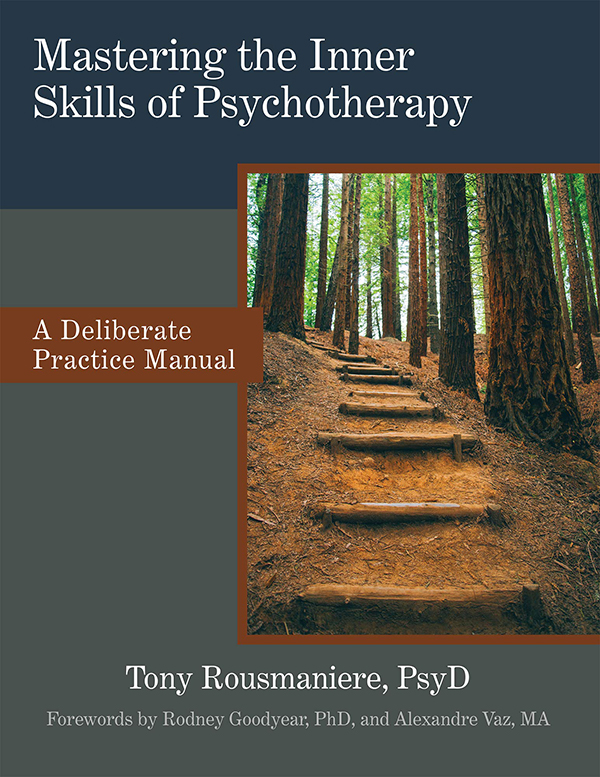
Editor’s note: The following is an excerpt taken from Mastering the Inner Skills of Psychotherapy, by Tony Rousmaniere, published by Gold Lantern Books © 2018 and reprinted with permission of the author.

“Could there be a better way for therapists to acquire the inner skills of psychotherapy?” To explore this question, let’s look to other fields. Most professions have developed specific exercises that help trainees acquire the capacity necessary for professional performance. For example, musicians rehearse challenging pieces repeatedly, so they will sound effortless during the actual performance. Pilot trainees spend hours intentionally stalling their plane, so they can practice recoveries. Athletes engage in physical conditioning, so they will have improved performance in competitions. In deliberate practice, therapists use practical exercises to build their inner skills and psychological capacity to improve their psychotherapy performance.

Deliberate Practice

I lead deliberate practice workshops around the world on developing therapists’ psychological capacity. Participants who are new to the idea of psychological capacity often ask, “How can this help me be more effective with my clients?” To answer this question, let’s begin with a case example of how deliberate practice helped me with a challenging case a few years ago.

My client was a man in his early twenties. He had recently been fired from his job and was discouraged about applying for work. He struggled with depression and had started to have thoughts of suicide. His goal for our work was to improve his mood and morale so he could find new employment.

My client and I formed a good working relationship in our first few sessions. However, despite my best efforts, he did not improve. Over the following weeks his mood gradually worsened, and he became more socially isolated. The outcome monitoring software I was using indicated that he was at a high risk of deterioration and possible suicide. With the client’s consent, I recorded a video of one of our sessions and showed it to my supervisor.

When we reviewed the video together, my supervisor noticed that the client looked disassociated during our session. He said, “Notice that after you ask your client a question, his eyes glaze over and he is slow to respond? Notice how he is nodding his head but not really engaging your questions? This could be a sign that your client is experiencing so much anxiety that he is disassociating. He may be politely going along with you but not fully understanding what you are asking him or benefiting from the therapy.”

As I watched the video closely, I could see what my supervisor was pointing out. My client’s eyes were unfocused, and his speech was slow. Although he was able to follow our conversation, his comments seemed superficial or compliant, like he was going along with me rather than really expressing himself.
I was surprised that I had not seen these obvious signs of disassociation in session with my client. I had learned about disassociation years prior and had successfully helped many clients with these symptoms. “Why was I unable to help this client?”

I said, “It’s so strange that I didn’t see these symptoms in session with my client. They seem so obvious when you point them out right now.”

My supervisor replied, “I wonder if you may be having an unconscious internal reaction that is blocking your conscious awareness?”

I said, “How can I tell if I am having such a reaction?”

He replied, “They often are accompanied by thoughts, emotions, physical sensations or behavioral urges. You can look for these as signals.”

“How?” I asked.

“I’ll show you,” he replied.

Seeing in Real Time

My supervisor said, “Play the video again. Turn the volume down low so you can hear the sound of your client’s voice but not get caught up in the content of the conversation in the video.”

I did as my supervisor instructed. It felt strange to watch the video without following the content of the conversation.

He continued, “Now, try to notice any thoughts, emotions, physical sensations, or behavioral urges you may feel while watching the video.”

I tried this for a few seconds and noted that paying attention to my internal experience while simultaneously watching the video was hard. I said, “My attention keeps trying to follow what the client is saying.”

“That’s normal,” he replied, “just keep trying.”

I watched the video while trying to tune in to my internal experience. After a few moments, I noticed I was clenching my fists. I told my supervisor.

“Great,” he said, “what else do you notice?”

“My chest feels tense,” I replied.

“What else?” he asked.

“I’m holding my breath.”

“What else?”

“As I tuned in to my internal world, I realized that I was having many uncomfortable reactions I had previously not noticed”. “My legs are tense, my mouth is dry, and my palms are sweaty. There’s also a slight ringing in my ears.”

He said, “Great that you can see all of these reactions within you. Let the video keep playing so you can continue. Do you notice any thoughts? You don’t have to tell me the details, but it’s important for you to see them.”

I noticed I was having strong doubts about myself as a therapist. How could I be effective if I was having all these unconscious reactions? Was something wrong with me? Should I give up and leave the profession? I felt some shame and didn’t want to reveal the details of all these thoughts to my supervisor. Instead, I simply said, “I’m having negative thoughts about myself.”

My supervisor could probably tell that I was experiencing some shame. He looked at me with kind eyes and normalized my experience, saying, “Great that you can notice those thoughts. Self-doubt, shame, or other negative thoughts about yourself are a normal and very common response to reaching your own psychological capacity limits. Consider these thoughts to be like how an athlete will sweat or get out of breath during a tough workout. It’s just part of the process.”

He continued, “Do you notice any behavioral urges? Again, you don’t have to tell me the details. Just try to notice them within yourself.”

I noticed I felt the urge to stop following his instructions. I was glancing at the clock out of the corner of my eye and hoping our consultation would end soon. I was also surprised to notice that I was starting to feel frustrated with my supervisor. This felt awkward, as I liked him a lot personally and trusted his advice. I didn’t feel comfortable telling him all of this, so instead I just nodded my head.

My supervisor paused the video. “Congratulations,” he said, “you were able to observe your own experiential avoidance in real time as you had it. This is not easy! However, it is a very important skill for effective psychotherapy.”

I took some deep breaths. I felt shaken from this experience and a bit confused. “How can this help me with my client?” I asked.

He replied, “Your ability to be empathic and attuned with this client is being limited by the discomfort and experiential avoidance that he stirs up in you. To address this, we need to increase your ability to see your own experiential avoidance in real time. This will let you downregulate your emotional state, so you can be more empathic, attuned and helpful.”

He continued, “You know how to assess and treat disassociation. You could write a paper about it. You can perform it proficiently with many of your other clients. You could teach it to beginning trainees. However, we have discovered that your proficiency in this skill is conditional on your psychological state. When you have particularly strong experiential avoidance—such as with this client—you lose your ability to be helpful. We call this your psychological capacity threshold.”

“How can I increase my threshold?” I asked.

He replied, “By practicing therapy skills with stimuli that provoke your experiential avoidance. This is called state dependent learning. For example, this video will work well for practice. I’ll show you how.”

Engaging the Client

My supervisor said, “You are going to practice engaging the client with anxiety regulation techniques while simultaneously noticing your experiential avoidance. Do you remember the somatic anxiety regulation techniques we reviewed last week?”

I replied, “The technique where I ask the client where he notices his anxiety in his body?”

“Yes, we’ll use that,” he said, “Start the video again at low volume. Now, while watching the video, take a moment to notice your internal reactions. Raise your hand when you notice any experiential avoidance.”

After a few moments watching the video, I noticed my chest tightening and breath restricting. I raised my hand.

“Good,” he said, “now use the first technique we discussed last week.”

“Just say it to the video?” I asked.

“Yes,” he replied, “just say it to your client in the video.”

Looking at the video, I said, “Right now, where physically do you notice any anxiety in your body?” I felt strange talking to the video.

“Good,” said my supervisor, “now watch the video for about twenty more seconds while noticing your inner reactions.”

My supervisor used his watch to count down twenty seconds and then said, “Now use the anxiety regulation technique again.”

“The same one?” I asked.

“Yes,” he said, “you can play with the words if you like.”

Looking at the video, I said, “Right now, where do you notice any anxiety, physically in your body?”

“Good,” said my supervisor, “do this process again: twenty seconds of self-observation, followed by engaging the client.”

I watched the video for twenty seconds while noticing my inner reactions and then said, “Do you notice any anxiety physically in your body right now?”

“Good,” my supervisor said, “again.”

I repeated the process.
“Again,” he said.

As I repeated the process, I noticed I had conflicting feelings toward my supervisor: I was simultaneously frustrated at him and appreciative of his help.
“Again,” he said.

I repeated the process and noticed I was starting to feel fatigued.

“Okay, pause,” he said. “What did you notice while repeating the exercise?”

“It got easier,” I replied.

“Great!” he said. “”You are building your psychological capacity to engage the client” while you have experiential avoidance.”
I asked, “Why does this client provoke such a strong reaction in me?”

He replied, “We don’t know yet. I’ll give you some deliberate practice exercises to do as homework, and maybe you’ll find out.”

Doing the Homework

My supervisor said, “Between now and our next supervision session, try to do an hour of the same deliberate practice exercise we just did together. Doing these exercises on your own may be more challenging than it was here with me, so try to be patient and self-compassionate. Remember that the goal is just to notice your reactions and practice engaging the video. Do not try to change or ‘fix’ any of your reactions.”

Over the following week I did the deliberate practice homework in three sessions of twenty minutes each. Doing it myself was much harder than it had been with my supervisor. I had to fight strong urges to avoid it. I scheduled practice in the morning but put it off until the afternoon. When I sat down to practice in the afternoon, I felt tired and decided to do it the following morning. The next morning, I was tempted to put it off yet again. However, I summoned the willpower and did the exercise.

When I started the video, I noticed a general tension throughout my body and fogginess in my mind. I kept losing track of time, so I set my phone to count down in twenty second intervals. I found it hard to say the anxiety regulation words out loud to the video. I felt awkward and had strong thoughts of shame and self-doubt. When I stopped after about twenty minutes, I felt discouraged by how much harder it had felt doing the exercise on my own rather than with my supervisor.

Two days later I did the exercise for a second time. Like my first practice session, this took considerable willpower. However, this time I had less fogginess and noticed more distinct internal experiences, including dry mouth, sweaty palms, and ringing in my ears. I felt clearer when saying the anxiety regulation words out loud. My shame and self-doubt were less pronounced. I ended the practice after about twenty minutes feeling more optimistic.

Three days later I did the exercise again. This time felt very different. As I watched the video, I noticed strong waves of tension rising from my stomach through my chest to my throat. I almost choked as I said the anxiety regulation words. The waves increased in intensity as I repeated the exercise. With surprise, I noticed tears forming in my eyes. “I felt a sharp spike in my shame and self-doubt and a strong urge to end the exercise”. However, I gathered my willpower and persisted. As I watched the video, I realized my client reminded me of times as a teenage boy when I had felt anxious and disassociated. I remembered the pain of those days, along with the social isolation and confusion. As I spoke the words of anxiety regulation to the video, I pictured saying them to myself as a teenager. I started crying out of sadness for my younger self as my shame melted into self-compassion. Resisting the temptation to stop the video, I continued with the exercise. I cried throughout the last ten minutes of the practice session.

Deliberate Practice Helped

This experience helped in multiple ways. First, my effectiveness as a therapist improved dramatically. I felt less tense and foggy sitting with the depressed young client whom I had videotaped. I was better able to help him see his own disassociation and use anxiety regulation techniques to reduce his anxiety. Over time, his mood improved, and he became more socially engaged. My effectiveness with other clients improved similarly.

Second, my morale and confidence as a therapist improved. I experienced less shame and self-doubt in my work. I felt optimistic about resolving other clinical impasses I was encountering and enthusiastic to practice more.

Third, the effects of the practice carried over to my personal life. I grew more open and engaged with my friends and family. I felt like I had further healed an old wound.

“The impact of deliberate practice on my personal life has been surprising”. I had previously done years of my own therapy, in which I had talked extensively about my teenage years. I assumed I had finished processing these old wounds. However, empathizing with this client stirred up painful memories that I had not recalled in my own therapy. Deliberate practice with my session videos helped me process those memories. After having many similar experiences myself and hearing of many from my trainees, I have come to see that deliberate practice with session videos can be a valuable tool for therapists’ personal growth. Deliberate practice helped me build my psychological capacity to be more effective with this client—and with my other clients.

David Jobes on Collaborative Assessment and Management of Suicidality

Hospitalization Rarely Works

Lawrence Rubin: Thanks so much for making time today for this important interview Dr. Jobes. Let’s just dive right in: What you think are the greatest challenges for clinicians working with suicidal clients?
 
David Jobes:
we’ve got a mindset that a suicidal person belongs in the hospital
I think the greatest challenges are the ones of our culture and of our mindset about what’s most helpful to suicidal people. I think we’ve got a mindset that a suicidal person belongs in the hospital and that you help a suicidal person by treating the mental disorder. I’m a clinician/researcher so I lead with my clinical eye, but I am very much interested in things that’ve been proven to work.

I don’t think randomized control trials (RCTs) are the only way to go–I think there are many true kinds of validity. But I am partial to RCTs because they give more clarity about the causal impact of things. And there are a lot of well-intended interventions that are surprisingly unhelpful if not actually harmful.

there’s evidence that hospitalization is actually harmful for suicidal people
To that end, I think we’re now seeing a period where the use of hospitalization is under the microscope. There’s evidence that hospitalization is actually harmful for suicidal people. There’s a psychiatrist in Melbourne, Australia who talks about nosocomial suicides, which are those caused by the hospitalization. Marsha Linehan, the developer of Dialectical Behavior Therapy (DBT) has for many years been very critical of hospitalization. I began my career in inpatient care and so while I’m not anti-hospitalization per se, I am when the treatment focus is exclusively on the mental disorder, and kind of skips the bullseye which is the suicidal thoughts and behaviors.

If you look at the literature, most of the hospitalization centers around well-focused pharmacological interventions and very brief stays of a few days. And the clinicians are not really asking important questions about the patient’s suicidality. These might include: Do you have suicidal thoughts? Can you tell me about those thoughts? Can we embrace a stabilization plan? And, there are different flavors of stabilization plans which have been proven to be more effective than no-harm contracts. We can ask questions such as: Can we talk about your access to lethal means? Can you think about the use of a lifeline and other resources? And after discharge, can the community do some psychological education that’s suicide specific and then can we institute some kind of follow up?

You know, I was thinking about this before our interview that, when I take my dog to the vet, I get a follow-up phone call the next day about how she’s doing. We don’t necessarily get that from mental health care. My dog gets a nice follow up phone call and I’m delighted to respond to those calls. But there’s evidence that different kinds of follow up, like a phone call, or a letter, or a postcard, or even texting can be helpful in changing behaviors.

we tend to think that medication is more helpful than it actually is for suicide risk. The evidence is at best, mixed
So, that’s one of my soapboxes! I’m really trying to get the focus on hospitalization shifted to suicide-specific considerations. And then in a related way, we tend to think that medication is more helpful than it actually is for suicide risk. The evidence is at best, mixed. We actually have existing treatments that are psychological in nature that most mental health people don’t know about or use routinely. 
LR: If hospitalization is a quick in-and-out and doesn’t focus on a plan upon release and follow up, then it can be as destructive as whatever the suicidal person brings in with them? 
DJ:
hospitalizing a teenager for a second time creates a more lethal trajectory of their suicidal thinking
I know for a fact that many clinicians, from the trainings that I do, are paralyzed by fear of litigation–malpractice and wrongful death tort litigation. This creates a defensive kind of approach to practice–a better safe than sorry approach. But patients get discharged very quickly from hospitals and there’s evidence that the post-discharge period is very high-risk of suicide. There’s actually a paper that was published in the Journal of Affective Disorders last year at the University of Michigan stating that hospitalizing a teenager for a second time creates a more lethal trajectory of their suicidal thinking. And it’s not that hospitalization, per se, is a bad thing. It’s just that we’re not focusing on suicidal thoughts and behaviors.
LR: So, suicidal patients are out of the hospital after this immersive experience where they have 24-hour care by a team of caring professionals. And then, boom, gone. And if there’s not some really positive powerful bridge, then they may be at even higher risk.
DJ: Well, I would even gently challenge the notion of a team of caring professionals. I think what the literature shows is that patients end up spending a lot of time watching TV in the day room, and they go to a couple psychoeducational groups that they don’t find especially helpful. And the only treatment that really exists is pharmacological. And a lot of the medicines, as you know, don’t really have a full therapeutic effect until weeks after initiation.

What we associate with hospitalization actually is not typically the case. There are of course exceptions. I don’t mean to upset people with the idea that every hospitalization experience is iatrogenic or negative. But I think there’s a fair amount of evidence that it’s not really meeting the needs of suicidal people or their families.

Clinical Conundrums

LR: How do clinicians cull through this massive literature in order to find their way to the most effective treatment?
DJ:
we have a disconnect between proving an intervention works in a randomized control trial, and then actually disseminating and implementing that treatment
That’s a great question and challenge because we have a disconnect between proving an intervention works in a randomized control trial, and then actually disseminating and implementing that treatment. One model is Marsha Linehan’s DBT and the reason that DBT is so famous is that they’ve figured out the dissemination and implementation challenge.

It’s a very labor-intensive team treatment that clinicians can’t do on their own and it’s not for everybody. But if you want to learn about it, you can go to the Behavioral Tech website where there are training programs. The two empirically-supported cognitive therapy programs have effective treatments and associated books, especially for suicide attempters, but they don’t have training programs. And that’s a conundrum. You can’t really learn to do cognitive therapy for suicide prevention that was developed by Greg Brown and Aaron Beck at Penn or brief cognitive behavioral therapy (BCBT) developed by David Rudd and Craig Bryan, at the University of Utah, because these researchers haven’t taken their positive research findings to the next level. and developed a training component that clinicians can utilize.

On the other hand, research supported treatments like Acceptance and Commitment Therapy and some other really well-known therapies including cognitive behavioral therapy that are not suicide-specific. But paradoxically, there are training organizations that make it possible to learn these non-suicide-specific evidence-based interventions. In order to scale up a proven treatment and disseminate it to clinicians so they may learn it, you’ve got to have money to get to the corners of the world that you really want to have use this intervention.

So, for example, in our CAMS (Collaborative Assessment and Management of Suicidality) model and other well-disseminated models, there are books but also deep-dive online roleplay training components. Clinicians hate roleplay training even though it changes their behavior and is shown to be effective in terms of doing something different. And then a really critical element is the use of consultation calls to coach a clinician through a new treatment that they’re trying to learn.

We are in the business of training a lot of people all over the world and our CAMS model is gaining some traction, but a lot of what clinicians prefer in terms of training is not necessarily what’s going to change their behavior with suicidal clients, and that’s a real conundrum the field faces. 
LR: So, the challenge is bridging the gap between the research that proves treatment efficacy and disseminating it in a way that makes it likely that clinicians will effectively utilize it.
DJ: Right, and that’s a tough sell because a lot of us like to do what we know to do. I’m a middle-aged man, an old dog who doesn’t like new tricks, so I kind of get that. But in the case of suicide, it’s life and death. And you know, if the fallback is hospitalization or use of medication without support and there’s even the possibility that those might not be helpful, it’s incumbent upon us to do things that are effective.

clinicians need to be thoughtful about access to lethal means and having lethal means discussions with their suicidal clients
.And that doesn’t necessarily mean that clinicians working with suicidal clients have to learn adherence to intervention, but they do need to be thoughtful about safety planning and stabilization planning. Clinicians need to be thoughtful about access to lethal means and having lethal means discussions with their suicidal clients. These are examples of low-hanging fruit types of questions that any practitioner can embrace. There’s a task force that I was on that developed recommended standards of care for suicidal patients. And that’s available through the Suicide Intervention Resource Center and the National Action Alliance for Suicide Prevention. If clinicians just look up these organizations, they’ll see the low-hanging fruit that have an evidence-base and are relatively easy to incorporate into a standard practice.

The CAMS Program

LR: As a prelude to discussing your CAMS program, I’m interested to know how you developed an interest in suicide? Some clinicians stay away from suicide like the plague. Others run to it. You seem to have invested so much energy and resources in this topic over the years.
DJ: It was something I sort of bumped into. I was trying to get into a PhD clinical program and I wound up in a master’s program at American University here in Washington. My psychopathology professor was Lanny Burman, a leading figure in the field. I was really fascinated by his work in suicide, so he got me involved. I did my master’s thesis with him and I was of the cohort that got to meet the founders of my field–Ed Schneidman, Bob Litman, Norman Farberow and Jerome Moto.

I never felt comfortable having somebody promise they wouldn’t kill themselves
I was so blessed to meet the people that created my field, so I just stayed with it and I found out that it was my passion. Even when I was working early on in inpatient care or as a clinician, I never felt comfortable having somebody promise they wouldn’t kill themselves. That never made sense to me.] Early on, I started having some misgivings about the standard practices for suicidal cases and the seeds were planted to try to create something different that made more sense. 
LR: This leads me to your CAMS program which may not be familiar to psychotherapists in our audience who work with suicidal clients. Can you describe for those folks who might be interested in learning about and using it?
DJ: CAMS stands for Collaborative Assessment and Management of Suicidality. It’s not the typical intervention but instead a framework, a philosophy of care. The cornerstones of CAMS are that we’re empathic of suicidal states, collaborative with the suicidal patient, honest and transparent about the rules and laws about discussing suicide with a licensed provider who has statutes to follow, and that it is suicide specific.

The essential component of CAMS is the Suicide Status form–a multipurpose assessment, treatment planning, tracking and clinical-outcome tool. It consists of assessment, treatment and stabilization planning. Its major focus is keeping a suicidal person out of the hospital, which is a novel notion. But to do so, we have to develop a thoughtful stabilization plan. That means securing lethal means and developing a list of problem-solving skills or coping strategies and resources should a suicidal person get into an acute suicidal dark moment. And then a signature feature of CAMS, which I kind of chuckle at every time I say it because it seems so obvious, is that we ask a suicidal person “what makes you want to kill yourself?”

In CAMS, we call these reasons for wanting to kill yourself “drivers.” What suicidal people say when they are genuinely asked “what puts your life in peril?” are overwhelmingly treatable problems. They say things like: my wife is leaving me, I can’t live without her; I’m going underwater with my mortgage on my house and I’m going to lose it; I can’t get a job. Or they may be experiencing trauma from combat in Iraq. People have idiosyncratic problems that we have treatments for all day long.

We make the argument with suicidal clients that they’ve got everything to gain and nothing to lose by engaging in treatment. We typically see a positive response in six to eight sessions. But if you give us 12 sessions, we can probably reach a lot of what they’re struggling with and maybe give them a different way of coping with their situation than taking their life. 
LR: The buy in.
DJ:
I also tell clients that they can always kill themselves later, which is true
I also tell clients that they can always kill themselves later, which is true. But there’s a reality, which is that as a practitioner here in Washington, DC, there are laws about clear and imminent danger, so you need to know the implications of being suicidal. We’re very transparent and clear about following the law with our clients but that we don’t have to fight over whether they can kill themselves or not. And for a lot of suicidal people, that is comforting and validating. It doesn’t feel shaming. So, there are a lot of aspects of this that sort of capture the imagination of the suicidal person.
LR: So, CAMS is s not a technique but a program that allows clinicians to use techniques from their own particular model, which you refer to as the non-denominationality.
DJ: Exactly. What we typically see is a strong therapeutic alliance because we’re not adversaries and not fighting with whether they can or can’t kill themselves. I let them know that “I’m going to follow the law, but I’d like to collaborate with you.” We literally take a side-by-side seating for certain assessment and treatment planning activities and give the patient a copy of their documents including their suicide status form and stabilization plan.

So, the tone we’re trying to set is to not be shaming, to not be invalidating, to never wag our fingers, to understand that for a person who suffers, this is a viable way of dealing with their situation. And to get our foot in the door to say, “why wouldn’t you try this out? I mean, we all get to be dead forever and I’m not debating whether you can or can’t kill yourself, but I am saying that the problems that you’re describing are treatable problems.”

And the agnostic aspect of it is that the therapist can be psychoanalytic, behavioral or humanistic, we don’t really tell people how to treat. What we’re asking of the provider is that they treat the problems that the patient says puts their life in peril. 
LR: How much of the actual implementation of therapeutic techniques would be occurring during the eight, nine, or 12 weeks? Or, do you use whatever technical skills you have that are theoretically driven during the implementation of CAMS? And then do you refer to a clinician after the CAMS period is over? What’s the timing like?
DJ:
The idea is that if you’re suicidal, we’re going to tackle that and focus on that, and talk really about nothing else except the things that put your life at risk
We’re pretty much like a dog with a bone. The idea is that if you’re suicidal, we’re going to tackle that and focus on that, and talk really about nothing else except the things that put your life at risk. And so, that’s where I think the persistence bubble sometimes rubs certain patients the wrong way. While it’s meant to be a flexible and adaptive model in which we’re not telling clinicians how to treat, we remain focused exclusively on the suicide drivers even when clients don’t want to talk about suicide but instead something like the economy. Because unless it makes you want to kill yourself, we’re not going to really focus on that because we’re trying to take suicide off the table. And that persistence, I think, pays off. A big part of this is that we aren’t looking for somebody to eliminate any vestige of a suicidal thought. But when we wrap up CAMS, they’re managing those thoughts and feelings, and they’ve got a repertoire for coping differently rather than going to suicide as their first response.

And that’s held up well in the clinical trials as our operational criterion for resolution. And then all along the way what the CAMS model has extensive documentation, which is sort of the armor for litigation. People have tried to pursue malpractice lawsuits against CAMS providers, and to my knowledge, there’s never been a successful lawsuit because of the documentation. There’s no evidence of negligence around assessment or treatment planning or the clients falling through the cracks. So, that’s served very different functions in that the patient is a coauthor of their treatment planning. They see what their treatment plan is. They’re an active participant in developing their treatment plan. And we’re working with Microsoft to develop an electronic version of the Suicide Status Form (SSF) that mimics what we do by hand on our hardcopy because, of course, we have to work with electronic medical records. And we’ve got a prototype that will be fully developed in the spring that we’re testing at two medical centers to see if it interfaces with electronic records. So, we’re still working on it, and we still have clinical trials, and we’re learning about it as we go.
LR: What’s the evidence that CAMS is effective?
DJ: The big thing in science is correlational studies that are replicated. We have eight correlational published studies that have been replicated with basically the same findings. But that doesn’t really ring the bell. It’s randomized controlled trials that look at a causal impact. So, there are three published randomized controlled trials all supporting the intervention. There are two unpublished trials that are in review that have very supportive data. And there are three trials that are currently underway.

So, there’s a lot of replicated data showing that CAMS quickly reduces suicidal ideation, overall symptom distress, increases hope and decreases hopelessness. Patients like it and clinicians find it valuable. So, the data is actually quite robust. But as a clinician, it makes sense. At a lot of the trainings I’ve done over the years, people say, “you know, this just makes so much sense.” “You know, I’ve kind of been doing CAMS without realizing it.” And so, that’s always the greatest validation when a thoughtful clinician that says that CAMS worked with a particular client. So, it’s not just the research, it’s also clinical utility, a lot of which has been shaped by feedback from clinicians. 

Countertransference and Paralysis

LR: You write about countertransference with suicidal patients and how clinicians have referred to the experience of malice and hate along with fear and impotence. Can you say a little bit about some of the countertransference experiences that you’ve noticed and how clinicians who work with suicidal clients can effectively deal with these experiences?
DJ: I was dynamically trained and worked with a luminary in the field, John Maltsberger, who was at Harvard, and wrote the definitive and seminal work in countertransference back in 1974. It was a very famous paper about countertransferential hate and the suicidal patient. He didn’t waffle around and instead said that clinicians can hate these patients. And, what I think about that upon reflection is that you know they are threatening. For a lot of providers, it’s really scary to work with somebody who’s at the precipice and thinking about ending their life. It can be scary and anxiety provoking and a lot of providers are afraid of being sued if there’s a fatal outcome.

there’s a kind of head-in-the-sand mentality among clinicians around suicidality
But I also think there’s some data that backs up the idea that there’s a kind of head-in-the-sand mentality among clinicians around suicidality. They may think, I’m gonna kick this patient over to the real doctors who are the psychiatrists who see a lot more suicidal people than psychologists, social workers and counselors–it’s too much for me if I’m just a psychologist or just a counselor, and it’s over my head or I’m not competent. And my feeling is the ubiquity of the presentation requires some level of competence.

To me, it’s like an internist or a family primary care doctor saying, you know, I’ll give you a thorough exam, but I don’t do the heart thing. I mean, trust me on my competence, but I don’t really know about hearts. Because suicide and suicide presentations are very common, I don’t really see how a thoughtful and responsible clinician who aspires to be ethical and competent can say, “I don’t do this.” But the fear is significant. And it’s out there, and I get why people are afraid. It’s not like I relish these tough cases, but I feel like there’s a need to at least be knowledgeable about what’s effective and what we can do, which is actually a lot. 
LR: You mentioned the notion of paralysis that clinicians often experience along with anxiety surrounding work with suicidal clients. What do you mean by this paralysis, how does it manifest, and how can we help clinicians out there who experience it?
DJ: I think it’s a straightforward situation where the reality of malpractice tort litigation is important to understand. People think it happens a lot more than it does and that they’re a sitting duck if there’s a completed suicide. It’s a legal action where the burden of proof is on the plaintiff to prove that there was negligence in subsequent treatment and/or follow through. Both sides then hire experts. It’s a very unpleasant process, and I’ve been involved on both sides. But the reality is that if you’re doing thoughtful work and it’s well-documented, most plaintiff’s attorneys won’t take on the case because the documentation is so critical for these cases. And so, the plaintiff’s attorneys pretty much only take the cases on contingency, so they don’t get the big payoffs until they win or settle.

It doesn’t make the clinician bulletproof, but it decreases the likelihood of being successfully sued for malpractice for wrongful death. And then the other part, which is more up my alley, is the idea that there actually are treatments proven to work that have excellent evidence but are not widely used. These include dialectical behavior therapy and two forms of cognitive therapy that contain suicide-specific interventions. Each of these are highly effective and proof of their use, along with documentation, would greatly reduce the possibility of being found guilty of malpractice. 

Empathic Fortitude

LR: You said earlier that your back had been hurt by years of running and martial arts. I’m curious- do you see a connection between the strength that you have needed over your life to progress through martial arts and the strength that is needed to work with suicidal clients?
What I’m wondering is how have you brought your black belt qualities into this anxiety-eliciting and litigious clinical arena? 
DJ: I guess I don’t think of it that way. I guess there’s a courageous aspect to working with suicide, but I also think there’s just a commonsense-ness to it. When we see a suicidal person as a threat versus being empathic of the struggle, we’re already creating an adversarial dynamic. One of the things that I guess I have found in my experience is that when you tell a suicidal person DC mental health laws and rules regarding my obligation, I can simply say “this is what the law says.”

And when I say to somebody, “I can’t ultimately stop you from killing yourself and of course, this is something that you can do but I would hope that you don’t”, I essentially give them the playbook and put my cards on the table face up and let go of my illusion of control and power over this suicidal person. What I have found paradoxically is that it gives me much more credibility, influence and persuasive ability to offer this person a chance to find their way out of suicidal hell.

So, I appreciate the reference to courage but I think it takes a certain kind of empathic fortitude. I wrote a chapter with Maltsberger years ago that talked about empathic dread versus empathic fortitude. I thought of these dramatic kinds of notions of how out of empathic dread we would avoid working with suicidal clients or countertransference would take over. We’d get rid of these patients by hospitalizing them or transferring to another provider.

So, I do believe that there is a need for empathic fortitude I suppose. But at the same time, when you give the patient the playbook and say, “this is the deal; if you’re going to kill yourself today, I’ve got to call the police. I don’t want to do that, but I will.” You’re working with motivation. You’re working with paradox. You’re looking at counter-projection. And when you do it properly and thoughtfully and with a genuine heart and concern, most suicidal people in your office are relieved.
LR: I understand.
DJ: And they are suddenly less at risk. And, so I guess I discovered that empathic fortitude or courage helps, but being forthright and honest about the situation as it is decreases the tension in the therapeutic relationship dyad and can actually create motivation in the client.

Tailoring Suicide Treatment

LR: As I was watching your CAMS video, you referred to some clients having a love affair with suicide. What do you mean by this and how can a clinician identify it and address it?
DJ:
clients who have been suicidal for a long time are at the point where being suicidal becomes a way of life–it becomes ego syntonic and comforting
What I mean by that is clients who have been suicidal for a long time are at the point where being suicidal becomes a way of life–it becomes ego syntonic and comforting. It’s like surrounding yourself in a warm blanket and snuggling in. I don’t mean that pejoratively or cynically, I mean it descriptively. And we’ve all seen clients like this for whom it’s comforting because they can control their crazy life by having something to hold onto. It’s become a part of who they are and becomes deeply internalized as a comforting thought.

That’s very different than people for whom it’s ego dystonic. They’re fighting the thoughts and they’re anxious. It feels like a hot potato they want to get rid of it, but they don’t know who to throw it to. And those are very distinctly different kinds of suicidal people. Our intervention responds to those people in different ways. And the thing I really want to emphasize is that not all suicidal people are the same. We’ve got relatively good data now of ways to stratify different kinds of suicidal states, and we’re getting into the research now where we can match different treatments to different states.
LR: Can you say a little bit more about this stratification of suicidal patients?
DJ: Yes, this is like the heart of the research we’re doing right now, which is looking at people who are upstream ideators. They’re relatively new to thinking about suicide. It’s kind of a hot potato, ego dystonic kind of experience. They don’t like being suicidal. It makes them anxious or it’s frightening. Or, people who are a little bit further downstream who are kind of on a teeter-totter of thinking, “well, you know, I don’t want to kill myself because I hate what that would do to my kids. But, I would love to flip off my girlfriend.” There’s an ambivalence in place that’s well documented in literature. And then there’s the final group that we’ve got reliable data on, who are chronically suicidal with multiple attempts, who are highly dysregulated and have this ego syntonic relationship with suicide.

The first two groups are pretty treatable quickly. That’s what we’ve seen in our trials. The suicidal types who are mostly attached to living, or the ambivalent types respond quickly to CAMS and other treatments. It’s not that the latter group don’t respond, it just takes more than six to eight sessions. In that latter group there are multiple attempters, or borderline personality disordered clients, or chronically suicidal people with a lot of dysregulation. This group is sort of the sweet spot for DBT. We’re doing trials right now looking at differences between CAMS and DBT for different kinds of suicidal states. We’ve got some promising, exciting data about those different states and then matching different treatments to different states.
LR: In my ethics class a few weeks back, I was discussing informed consent and its various components. The CAMS consent is very different from the traditional ones endorsed by the ACA or APA.  
DJ: Well, I teach ethics and I’m married to a lawyer, so I think a lot about medical, legal, and ethical considerations. And of course, in ethics, informed consent is a huge consideration which has been a dynamic area in the field of ethics in more recent years. What I say to a suicidal person is some version of "you can always kill yourself, and that’s always an option to you, but you’ve got everything to gain and nothing to lose by engaging in treatment.

if you are going to kill yourself in the next 24 hours, I may be compelled to hospitalize you, even against your will
But there are laws that say that if you are going to kill yourself in the next 24 hours, I may be compelled to hospitalize you, even against your will. And I don’t want to do that, I’d rather not go there. I’d rather not fight with you about this. So, wouldn’t it be comforting to know if you do kill yourself, that you’ve done everything in your power and within your control to make this life livable? I’m suggesting that this treatment would be in your best interest and may help you decide whether your life is indeed livable. You can always kill yourself later. But, if you’re going to kill yourself while you’re in the treatment, I’ll have to stop you.”

When I say that in a training, a lot of clinicians are shocked, but then I ask them to take the role of a suicidal person. When they put themselves in the place of a suicidal person, they say “wow, that’s actually really comforting and validating and reassuring. It makes me curious about why you’re saying this to me and what your real agenda is.” And I’m very clear with suicidal clients that my agenda is to find a way to save their life and to make it worth living.

What’s fascinating about it is that everything I said is 100 percent true–it’s the playbook. And to me, it’s the cards faceup on the table. I think it is life and death, and when we give up the illusion of power, we have much more influence and credibility with the client.

The Setback Session

LR: In the training video you demonstrate what I thought was a masterful example of a setback session as you call it. What do you mean by a setback session and can clinicians expect to have those and if so, how can they be constructive or useful moving forward?
DJ: We shot that training video in two days without a script. A clinical psychologist who had been in graduate school and worked in my lab picked a patient he had worked with during his internship and channeled him. And he was not a very easy patient as you probably saw. I want very strongly as a trainer for everything to go perfectly and never make mistakes. However, I am not a miracle worker so feel it is very important to model a setback.

So, when we shot this scene, we were kind of nervous because the client got upset with me and I got upset back. I usually try to be calm, cool, and collected but I kind of lost my cool. I was, however, able to regroup, recover and reassert the model. Contrary to our fears, that setback video, which was session nine, is wildly popular with the thousands of people that have done this training.

I had a guy come to me last week at a training and say, “I really liked the setback session. It was real, I could see myself, you know, in you. And I appreciate your honesty.” So, contrary to our fear that it would be me acting out or my countertransference getting the best of me, it was an example of not doing it perfectly, but then using it as an opportunity to regroup and to reassert the model. And in the final session when we get the outcome disposition, I ask the client what was the turning point, and he said, “well it was that session where I came in here, you know, ready to tear your head off and you got mad at me, but then we kind of coalesced around what didn’t happen. And that was the pivot point.” I don’t like getting upset but, you know, it was a real thing that we shot, and it’s turned out to be really a popular part of the training. 
LR: So, while it was not a real client in the training video, the setback session was helpful to clinicians?
DJ: In my trainings, a lot of people ask if he was a real client because it’s so intense and it’s so realistic. And when we do our roleplay trainings, we’ll go into a group of 50 or 70 clinicians and say, “who wants to play a client?” And then we will demonstrate sections of the CAMS intervention with somebody who comes out of the audience, where obviously it’s not pre-canned or scripted.

I think that’s why people like our training, because we practice what we preach and sometimes people play impossible cases and kind of act out a little bit. So, those are tricky. But for the most part, it’s pretty convincing if I’m demonstrating to you something that isn’t perfectly scripted out. And that’s how we do our training, all of our trainers will basically recruit somebody from the audience to play somebody they’re working with. And it’s a very convincing way to say yeah, you know, we’re taking the risk here to be successful or to fail at the model, but we’re going to assert the model and then you can see what you think, as a provider, that if this is something that you want to try to do. 

Suicide in the Rearview Mirror

LR: You had mentioned earlier that successful outcome is determined by three successive sessions in which the suicide risk on the Suicide Status Form is low. When does a client really turn the corner on suicide so that a clinician can have a greater assurance that they will not end their life.
DJ: That’s a great question because it’s always idiosyncratic. I’ll give you a case example that really kind of nails it. It was a soldier who was in the army and deployed in Iraq–an extremely unstable, traumatized service member. I watched his early videos which was one of our clinical trials. I would lie in bed awake at night thinking “this man’s going to kill himself and he may take out a few people in his unit along the way.”

He was a scary guy. But he got traction and we identified his drivers and we determined that he really needed to leave the military. We started working on his VA benefits, but he was having legal troubles and he had PTSD that we were able to treat as part of the CAMS model. What he later described to me was a perfect metaphor. He said, “when I first came in here, I was in the Humvee and driving towards suicide with no other place to go.” Later, he said, “I was driving towards suicide and kind of pulled up alongside of it, and then I passed it, and now it’s in my rearview mirror. I can still see it, but I’m driving away from it. And now I’m going to turn the corner and leave it behind.” And that, to me, just nailed it and captured what we’re looking for in our resolution session. It’s not somebody who doesn’t see it in the rearview mirror, but who’s determined to leave it behind and turn the corner.

that is what we’re after: somebody who says “killing myself is not the number one way to get my needs met
Metaphorically and literally, that is what we’re after: somebody who says “killing myself is not the number one way to get my needs met. I’ve got these coping strategies. I’ve got this support now that I didn’t have. I’ve got treatment for things that made me want to kill myself that are now approved. And I don’t have to do this most desperate thing a person can do, which is end my biological existence forever. I can press on and pursue a life worth living because I’ve seen that this is not my only option.” 

Closing Reflections

LR: I’ll ask you a question that you can choose to answer or not answer.
DJ: I’ll certainly answer.
LR: Has suicide impacted you personally in your life?
DJ: Oh yeah, I have had many suicidal patients. I had a patient as an intern at the VA Medical Center where I interned who I gave a Rorschach to who killed himself the next week which was devastating. I spent two hours with this man and he laid down in front of a bus in front of the hospital. I mean, it has hugely impacted me. I’ve had colleagues that’ve taken their lives. I haven’t had a psychotherapy case, but I don’t think I’m immune.

So, absolutely it’s touched me and touched people that I care about. And we’ve had three suicides in two different clinical trials. That’s devastating because we’re watching videos of these patients that we’re trying to save. And one in particular last fall was extremely painful. But we’re not going to not do this because the overwhelming flipside to that is that we’re in the lifesaving business. We get cards and letters from clients, and clinicians thanking us. There are hundreds of examples of both clinicians and patients who’ve said, you know, “this saved my life.”

And the reward of that far, far washes away the pain of the individual losses and tragedies that I
I’ve personally experienced, or that my team’s experienced. It is not everybody’s cup of tea, I get that. But my lab is a big group of students, and we are excited about our work and it’s not a morbid topic for us because we’re in the lifesaving business. And what we do translates into people finding a different way to live.

One of my favorite cases was a woman in Oklahoma who’d been suicidal for 20 years in. She got 43 sessions of CAMS, which is a lot of care from a really adherent provider. And when she reached the resolution session after 20 years of being suicidal, she gave the clinician a card and said something to the effect of, “thank you for believing in me. Thank you for persevering. I now think before I act. I’ve changed how I feel about myself and about suicide because CAMS spoiled the milk I used to drink.”
LR: CAMS spoiled the milk I used to drink. What did that mean for you?
DJ: I just love that because this was a way of life for her that’s now been taken away, but in the best possible sense because it means that she’s a mother to her children. She’s a grandmother to her grandchildren, and she is in the world and finding her way. She’s not perfect, but after 20 years of being attached to suicide, she decided to leave it behind.

That’s just an “N of 1.” But when I get that kind of feedback, it makes all the pain, or the fear, or the anxiety sort of wash away because what we’re doing is so helpful and redemptive in the best possible sense.
LR: You know, empirically-oriented clinicians look at an N of 1 and say, okay, great, go out and find me another 17 and we’ll consider it. But when you had an N of 1 such as this woman who was so impactful, that has so much meaning.
DJ: I embrace both the nomothetic and the idiographic, and I am a clinician-researcher versus a research clinician. So, the N of 1 idiographic approach and those testimonials mean a great deal to me. But I also believe in the power of data. And both I think are valid windows into what’s true in the world of clinical practice, and in this case, what is central to the business of trying to save lives.
LR: One final question I would ask is for our readers who are new to the field. What advice would you offer to those who might be interested in working in the area of suicide treatment?
DJ: That’s a great final question. I would say, to the best of your ability, you shouldn’t try to avoid these patients. You don’t have to become a specialist. But there are proven interventions and techniques that you can learn about from the National Action Alliance or from the Suicide Prevention Resource Center that are not a bridge too far. You can learn about stabilization planning. You can learn about how to ask about suicidal risk. You can learn about lethal means safety.

I would also say to them, you can learn about care and contact and follow up, and about the National Lifeline. And every clinician should be conversant with those ideas. And then there’s dialectical behavior therapy, two forms of cognitive therapy, CAMS, and several other interventions that have been proven to work in randomized control trials that need replication. There are treatments that are effective. And I always talk about all the treatments, not just my own, because I believe in the power of data.

there’s more than one way to be in the lifesaving business
I believe in things that are effective and that no one holds a corner on truth. And so, I’m always talking about the other treatments in some ways as much, or more so than my own treatment because I don’t think that there’s one way to do anything. There’s more than one way to be in the lifesaving business.
LR: Thanks, so much David.
DJ: You bet.

Working with Teens: The Good, the Bad and the Ugly

“I never set out to work with teens.” For many years after I started my private practice, people would ask, “what is your specialty?” and I would demure. I thought it was pretentious to say I’m a “specialist.” I didn’t feel like a “specialist.” I also thought it would be boring if I specialized. I wanted to mix it up (a little ADHD?). But I soon found myself gravitating to adolescents and young adults, and them to me. Given my years of training in family therapy, it started to feel natural that I would work with this population, those not-quite-children but not-quite-adult people who most therapists feared. And then I had two teen girls of my own; one now 20. What better breeding ground for insight could there be, I thought. Boy, or should I say girl, was I wrong!

Girls Will Be Girls

A therapist can no more easily treat herself and her family than a doctor can heal herself. As far as I can tell, my own family problems stem back generations. Mark Wolynn’s recent book called, It Didn’t Start with You: How Inherited Family Trauma Shapes Who We Are and How to End the Cycle lends some credence to this assertion. Jewish-check, anxiety-check, narcissism-check, mental illness-check. And the list goes on!

“I sought to correct all that with my girls. Clearly, I overreached.” Not only did it not help to hold myself to exacting, unrealistic and perfectionistic standards; it was in fact, impossible. Fast forward to last weekend, my girls now 20 and 17, fistfighting (I kid you not) over a sweatshirt.

My sense of failure runs deep but I am thankful that I was blessed with pure luck with these two. My insights are largely useless. My husband, however, excels at mediation (he’s a lawyer after all), and he has filled in the missing pieces on numerous occasions. We make a good team. Nevertheless, my girls have taught me a number of key things:

1. Each kid is different.
2. They teach you.
3. The “0-60” phenomenon of the teen brain is alive and well.
4. Use humor.
5. Be strong. If you are emotionally weak, they will have no one to push against, leading to a failure to launch.
6. No matter the age and stage, be patient. As soon as you master it, it changes.

Mary and her Parents

There are some cases that make me feel like a complete idiot. Take the case of Mary. She never wanted to be there. My first tenet of teen therapy is that they have to own it. It’s their life. If I am doing all the work, something is wrong. It took me a long time to realize this one. It’s great to get them when they’re young enough to change but old enough to understand, which I’d put at 17– a beautiful age! Raring to go to college yet clinging at will to parents, kids this age are a pleasure to help. Change comes fast and furiously and if you’re lucky you’ll get hugs in there too! They go off bolstered by the therapy, and they don’t come back. On the other hand, if they are there against their will it’s a different story. We know this. No therapy is going to work by force.

Mary had a history of acting out and strict, somewhat eccentric parents who did not understand her difficulties (see “Far from the Tree” by Andrew Solomon). With this mismatch, things got off to a miserable start. She was returning from a multi-thousand-dollar wilderness program of questionable long-term repute. “Please fix her from here,” her parents dumped on me. And so I did, sort of. She continued awful acting out, rages, mood-swings, and long before I knew it there was a team of professionals all over the case. No problem. We continued to integrate her back to home. But the back-to-family part never happened. You see, the parents were the problem. This is hardly uncommon. Now they were avoiding me. They were done. I tried to explain to no avail that their participation would be key. More avoidance. So, we continued weekly until the girl simply said “this entire enterprise is futile. I give up.” What a sad case indeed when parents induce helplessness in their teens. Where will all her energy go, I wondered sadly. The case had fizzled out before my eyes. After questioning my abilities, I concluded that this was case was doomed from the start. Her only channel was anger and that wasn’t a channel I was on. Thankfully there was group therapy to warm the soul and I gladly referred her to the care of another clinician.

Group Therapy with Teens

Witness however, Cecilia. Her case was the best! Coming from a childhood of unspeakable trauma, she was rescued by a relative and set on another course. When she came to group therapy, she was literally an outcast from school, home and family. The group embraced her. She lit up each week. In my group there are no restrictions except on gossiping and phone use. I actually pretend that I am the most casual and chill person on earth so that they talk as freely as possible. It’s like when you’re driving your kids to the mall and they’re in the back seat, with no eye contact, finally telling you the most important thing they ever shared. That is my posture in the group. The more I lay back, the more they seem to talk. These kids have no other avenue to ask questions about sex, drugs, birth control, family, siblings, mental illness, physical issues, sexism, racism and relationships. They even accept academic support from me. I become like a big sister in the group, and it works. Cecilia grew to become her class president. She vented for a solid two years about her childhood. She was made to feel normal. She heard from other kids of all backgrounds. They all became “normal” together- normalized by the group process. Who doesn’t have a crazy mother/father/sibling/uncle/friend/teacher? My god, they were normal! Just the celebration of that became the group creed. We welcomed newcomers with near joy. Parents waiting outside would never have believed it. Their angst-filled, moody, belligerent offspring had finally shed their shells. I almost never told anyone my secret. Do you want to know the secret to teen group therapy? Pretend you’re not there, do not wince at disgusting revelations about sex, and by all means allow cursing of all stripes and colors.

As the “core group” began to solidify I worried if I was being effective and compulsively tried to “deepen” the conversation. As I began to relax, they were able to tell me that they liked the group just the way it was. Just talking, venting, sharing and taking turns. It soon became clear that my need to control and get it right and my own insecurities still plaguing me after all these years of experience were beside the point. The group had sustained itself. Nevertheless, the interventions I made aimed to reinforce the shared group values and purpose, the universal nature of the teenager experience and the shepherding of the inner self to the surface despite fear. I also increasingly pushed the more reticent members to link up their past with their present, thus gaining insight for the first time. Finally, I was “motherly” in that I could see from where I sat that life would ultimately deal them their share of traumas, yet I knew they could withstand it by holding that space for them, quieting down my own thoughts. By testing their judgment or lack thereof with their peers, they gained the self-knowledge to withstand pain rather than avoid it.

Teens and Divorce

Parents have often asked me what the best/worst age for a child to be at the time of divorce. There are many answers to this. First off, it depends not only on the age at divorce but rather on how the parents handle the divorce that really matters. Second, all ages suck, period, end of story. But divorce in the teen years royally sucks. Social/emotional development is significantly impacted. What the research says is not pretty: not only does the effect of divorce on teens have a huge impact for years, but also, it lasts forever and ever. The researcher Judith Wallerstein has asserted that unlike a parent’s death which has a beginning, middle and end, divorce just goes on and on. Once again, the teen brain, volatile as it is, is not prepared and will surely rebound with rage, defiance, profound risk behavior, testing limits and all the things you tried as a teen but on steroids (social media strikes again). So, buckle your seatbelts on this one and seek help early and often.

“One of my teen clients of divorce casually sent a nude photo to a boy in 10th grade”. The next day, it traveled around the school with the speed of rumor and she found herself in the hospital dealing with a new diagnosis- humiliation. With one parent working round the clock and the other nowhere to be found, she did what anyone in that situation would do, she went underground. The numbing, cutting and sheer embarrassment got worse. She started cutting school too. Each setback snowballed mercilessly. We had to get her back to herself. The therapy consisted of gradually starting her activities again, putting it behind her and structured-only phone use. To this day, she calls me every year on my birthday and says, “if it wasn’t for you, I’d be dead.” She is now a successful hairdresser hoping to open her very own shop. Her parents’ divorce was the hardest step from teen to adult, but she got by because she persisted, used her strengths and had a passion.

Older teens feel lost, insecure and socially stigmatized after divorce. The post-divorce financial uncertainty adds to the overall stress. College plans can change. One divorce created a situation with the parents telling their twins in my office, “surprise, we can no longer pay…” Plus, shuttling between two homes can be disorienting, to say the least (or in the case of my own parents’ divorce, jetting between two coasts). Parents often dwell on how and when to tell their children that they are getting divorced, rather than the aftermath. Just like birth plans, divorce plans go awry. Better to sort it out for the long-haul than have it scripted in the short.

I try to help the teens in therapy by “joining” with their rage. Damn straight your parents suck. They are the ones who should be here! Once I do that, and establish trust, rapport and confidentiality, it is easy to win their hearts and minds. I provide gentle support and strategies for coping and self-care while reminding parents that part of the confusion is normal teen angst. If parents make the common error of ascribing all behavior to the divorce, then guilt steps in and over-compensates in many forms including the of throwing money at the child, which rarely helps.

More times than not, my job is to mitigate confusion. You cannot believe what’s in these kids’ heads. For younger kids, they go right to the most concrete –will my room be pink at Mom’s house still? Can I have two stuffed animals-one for each house? If my parents separate, will I ever see dad again? Are my grandparents still going to be my grandparents? For teenagers and young adults, it can be far more morose, as it was for me with my own parents’ divorce. “Why why why?” is one refrain. The other is a lurking sense of doom some might call dysthymia. As soon as I labeled that for myself as an adult, I started to get help, including antidepressants. The clinicians’ definition of the word would be a “low-grade depression.” I call it, the lowering of expectations, always second-guessing myself. Demystifying the wild ideas kids and teens formulate goes a long way toward alleviating crippling anxiety and dread. It’s hard enough to grow up without constant stress in this world, let alone have your parents fighting all the time. One family was fighting so badly about the kids’ shoes at each house that I offered to go to Payless and buy them a second set of sneakers.

I now run a successful teen support group for kids between the ages of 13-19. I remember how my losses haunted me at that stage, but I never had the words to feel and let go–I was constantly grasping for meaning or truth that didn’t exist. I tortured myself to figure something out about my family. But all that I got in return were meaningless intellectual insights that couldn’t sustain me. Nevertheless, I did rebound. I got many degrees and certificates, had scores of talented friends and married the love of my life. Economic times have since hit us hard, but our fortitude is paramount. “I model this resilience to my patients through gentle wit, disclosing when necessary that I “get it.”” Then reminding them there is no one path; there is no perfect; there is only you, open to the ups and downs, or as my yoga teacher would say, “meeting each moment as a friend.”

It All Adds Up

A perfect case to illustrate when all cylinders are firing in teen therapy is Megan. This teen came in with what I call the “break up story.” Megan, like many other girls with whom I have worked, was a ruminator. So, the task is how to utilize all the teen’s strengths just to make it to another day. Why? The phone (you didn’t think I would forget the social media part, did you?). Because I was an “early adopter” of the internet age and even worked in the field of online production and community building in its heyday, I have always taken a favorable view of technology. That said, if my daughter doesn’t unwrap her phone from her head soon I’m going to throw it into the Hudson River. It is her permanent appendage. There is no doubt in my mind that she would benefit from a screen break. But instead of being that mom who limited screen time, I was actually the mom who was the first on the block to get the kids a phone. That did not make me popular among the neighborhood parents. I prefer to know where they are. On the other hand, I have friends who have their adult kids on “find my friends” which would literally put me in a full-time state of panic. There must be balance.

Megan started cutting in 9th grade because she already had a family history of poor emotional regulation combined with an awkward style and no real avenues for getting her feelings straight. Her father was absent and alcoholic. Her mother was a determined and high functioning administrator who was always on the brink of a breakdown, and who could blame her? Therefore, Megan was accustomed to caretaking not care-receiving, which she desperately needed. In therapy, she was able to use her intellect and motivation for good. I encouraged her to think of things in a less catastrophic/dramatic, black and white and exaggerated way. “My boyfriend friended his ex on Twitter” she would say. “So what!” I would chime. “I’m stalking him. I see he’s online at 3am. I saw him with her. She liked his status.” It goes on. Yes, this goes to his character of questionable trustworthiness. But does it REALLY matter? Growing up in the 70’s and 80’s has made me a bit cynical to what real love is (memories of Kramer versus Kramer dance through my brain). I try to get them from point A- everything matters, to point B- nothing matters. “The therapeutic technique most attuned to this might be called Freud-light”. What is getting in your way of allowing this process to work? What is coming up as a trigger/resistance? What can we work through/process/vent/feel/release/analyze or simply let go of to move forward? Nevertheless, the point is the phone doesn’t matter! What matters is can he be at the right place at the right time, can he talk and communicate, can you be friends first and foremost, do you even know him, can he get off his phone…? Megan started putting herself first. She got into the college of her choice. A big girl with body-image issues, she bought herself the shiniest red prom dress I have ever seen and danced right through to morning!

What’s my Theory?

Lest you think that I’m just flying by the seat of my pants, there is plenty of theory to support my approaches. I rely on several methods and philosophies, yet I’m not married to one. I lean toward mind/body (Van Der Kolk, Levine), existential, person-centered (Rogers) and family systems (Haley, Minuchin, Bowen), and group (Yalom.) Much of my work is based on the idea that anyone can relieve anxiety by allowing it to flow through you. Just like going to the gym, anxiety is a habit of mind that if practiced will be reinforced. It’s the faulty circuit of fight or flight. It’s the mammalian brain. The goal (CBT and DBT) is to allow yourself to practice a better way of coping. A way with ease and equanimity; a way with kindness and support. A middle way, a way that allows you to press the pause button while you cool off. Getting flooded by one’s emotions is useless, so learning CBT (“I’m a mess and everything is a mess” to “I made a mistake; humans make mistakes and learn from them” makes good sense.” With DBT, “let me calm down for a second–getting worked up is totally unproductive. I’m just going to breathe and let it pass,” you will most likely get results. What I have not done more of until recent years is appreciate the role of trauma in that it can completely derail or retard the above process to the point of paralysis.

Lessons Learned

Therapists may turn away from working with teens because of their volatility and the resultant risks involved in their care. They flake out of appointments, come late, walk out, don’t return calls, and show up high and hungover. Their parents are often difficult, defensive and in denial. Sessions have to be coordinated with who can drive when, a logistical nightmare from volleyball to work to therapy and back all after a parent has put in a full day’s work. In short, it’s a pain in the butt. Nevertheless, teens are fast learners, quick to laugh out loud, they can cry their hearts out one week and the next week show up like nothing happened. They leave you with all the debris while they move on. My kids started doing this in daycare. Sobbing when I left, then an hour later, having the time of their lives. You simply can’t take it all personally. This takes a concentrated effort on the part of you, the therapist and mom, to feel as deeply and sensitively as they do, and then drop the whole damn thing. Only time can teach you that.

What it has taken me my whole adult life to learn is that there is no absolute answer. There is no one truth. There is no lasting stability. There is only you, open to the shattering of reality, embracing the change; knowing that change is the only constant. My history of loss/resilience/loss makes my therapy genuine. My genuine interest in teens, my blessed gifts from my parents, and my profound belief in being curious is what helps the therapy. It’s the turbulence, the roller-coaster, the deep pain and sorrow, and even the helpless confusion that instructs me how to remain flexible, less anxious, more prepared and physically more resilient (Yoga!). I still crave stability, but I have learned to create it for myself both inside and outside of the therapy office.

Family Therapy and Yoga: A Connection?

Family therapy and yoga; what interesting companions. Through both, one seeks to move towards a union or connection – with self, others or the wider world.

Working for over 30 years as a family therapist in public schools, with thousands of families and students on a myriad of issues, I have promoted positivity as a means of achieving mental health. Many families are referred to me due to their child’s current and/or past difficulties functioning in the classroom, although I know that they usually also struggle in the home. Many of the parents do not make the connection that their child is a member of a family, just as they are members of a school community. Their view is often that “this is a school problem,” unaware of the connection between the child’s behavior in school and at home. They don’t see the connection, and there is that nagging word again! Connection. Helping these families, and particularly the parents, to shift their perception so that they may make the connection is the challenge.

In a similar vein, people often participate in my yoga class to gain physical, mental and at times spiritual flexibility. Or they may come for a sense of connection to something larger than themselves, both within and outside of the yoga space. Just as in the family therapy context, many of my yoga students do not make the connection that what they do in the room, so to speak, is directly connected to what they do outside of it. And just as with my school counseling clients, I try to guide them to focus on their total positive wellbeing.

Like what you are reading? For more stimulating stories, thought-provoking articles and new video announcements, sign up for our monthly newsletter.

Whether in therapy or yoga, people are seeking a shift, a change and a positive connection with something or someone. Or maybe, it’s simply yet powerfully the therapist or yogi with whom they want to connect. Maybe it is their spouse or child. The common thread is that all are seeking positive mental, physical and/or spiritual health.

Typically, I do not get to choose who enters the journey of therapy or yoga. and I rarely know the impact, influence or outcome. I do know that I trust the process, which is easy to do when all is going smoothly. But it during the challenging times when the real work takes place. The process of building connections, whether with self, others or the larger world is just that, a process. One step at a time, one intervention at a time, one breath at a time.

I recall working with an extremely angry 16-year-old who was resistant to change, connection or being in therapy. She grew up in poverty, witnessed domestic violence and lived with her grandmother as a result. Her reactions to peer conflict were swift and impulsive and like those she experienced in her family of origin- she’d yell and hit, no questions asked. While I attempted to build a relationship by connecting with her intellect and desire to graduate, she rarely came by my office unless in crisis. On one of those days as I waited to begin my mindfulness class, she ran to me in tears over a friend’s domestic crisis much like those she had experienced earlier in life. Particularly susceptible in the moment, she agreed to join my yoga class where I took her through some grounding, breathing and movement exercises into a final guided meditation Seizing the moment, I was able to connect with her and begin her on a path towards connection her with herself, the moment, and the possibility of positive change within herself. She left happy and connected. Who knew how long the impact would last? However, when I visited her class later that semester, she voluntarily stood up and recalled that moment aloud, proudly explaining its positive impact to her classmates. A connection was made. 

David Barlow on Transdiagnostic Treatment of Emotional Disorders

Lawrence Rubin: Before we begin, Dr. Barlow, I'd like to congratulate you on being honored by the American Psychological Association with its Gold Medal Award for Lifetime Achievement in the Practice of Psychology. It's well deserved, and I applaud you. We often hear lifetime Award recipients say, "I'm not dead yet. I don’t need a Lifetime Award. I still have work ahead." So, is there any irony in receiving the Lifetime Award, over and above the gratitude that you have?
David Barlow: Well, you do have in the back of your head the notion that maybe they're trying to tell you something. But actually you know, I'm just about at the 50th anniversary of getting my Ph.D., so I certainly have been very blessed with a long and thoroughly enjoyable career. As I've said several times in talks of late, in all those years, I can never ever remember being bored for even an hour. 

Early Anxiety Research

LR: Your most recent work involves the development and testing of the Unified Protocol for the Transdiagnostic Treatment of Emotional Disorders, which primarily addresses anxiety and related disorders. And since anxiety is perhaps what you're most well-known for, I thought we could begin our conversation with anxiety and your work at Boston University’s Center for Anxiety and Related Disorders (CARD). You have dedicated your long career to the study and treatment of anxiety. What drew you in this direction and what's been enlightening and sustaining for you along the way?
DB: When I came on the scene in graduate school, I had the opportunity one summer to work in Boston with Joe Cautela, and also the South African psychiatrist Joseph Wolpe. People were very intrigued by what he was doing. He had developed an approach called systematic desensitization, the theoretical rationale for which turned out to be incorrect, but nevertheless it drove some of his work. What he did was take somebody with a phobia and have them gradually imagine being closer and closer to the phobic object or situation while in a very relaxed state. And he did it very gradually, because in those days we all thought, whether we were behavioral or psychoanalytic, that too much anxiety all at once was a very dangerous state of affairs that might lead to a psychotic break of some kind. So, this procedure turned out to be successful and people did seem to recover from their phobias. But of course in hindsight, it was not nearly as successful as it seemed to be at the time. That's often the case with new approaches. They seem more impressive at first than they turn out to be later.

Nevertheless, in those days, when we had very little in the way of more structured interventions, it was something people were intrigued with. And I trained with him, and so it was very natural when I went on to then do my doctoral work that I began to do my research on that technique and on its anxiety-reducing and phobic-behavior-reducing properties.

LR: So, you were entranced by Cautela’s and Wolpe's work. You saw it as a successful effort to address anxiety in a practical and effective way. What kept you in the anxiety game? For those therapists out there who search for specialties or search for an area that really grabs them, what was it about anxiety – it's ideology and its treatment – that really caught you and kept you?
DB: Well, I think there were several things.
First of all, anxiety is ubiquitous
First of all, anxiety is ubiquitous, as we now know. Everybody experiences anxiety. But in those days, we knew very little about it. We had not yet recognized that experiencing a panic attack was in some way unique and different from the more general background anxiety we all face. We had not yet really delineated the differences between anxiety and the day-to-day stress we all find ourselves under when we're challenged by one thing or another. So, it was very vague. People had not operationalized, as we say now in the game, the concepts of anxiety.

There was also very little connection with what we now call emotion science. In the old days, there used to be courses in motivation and emotion, but by the late '60s and early '70s, they began to fade away. And there was a long period of time when the basic field of studying emotion and motivation was under-emphasized and was often not taught in schools. So, it was such a common problem that we knew so little about. When we began to scratch the surface of it with Wolpe's early procedures which directly targeted the emotional symptoms of anxiety, we began to find out there was something there, but it did not work for the reasons Wolpe thought it did. He had a fancy kind of physiological theory about why it might work that was disproven rather quickly. And it was not as generally applicable as it would seem. And so, what was it about that procedure that at least benefited some people some of the time? Those are the kind of questions that we began to ask.

And, of course, to accomplish that, the other thing we did in the late '70s was to begin to study this in a real systematic way. I did my dissertation, as did many of my colleagues in those days, on female college sophomore who were afraid of snakes. And so did everybody else including my colleague Jerry Davidson. Why did we do that? Well, because it was so easy to find young women who were afraid of snakes. We'd just need to measure their fear. How afraid were they on a scale of zero to 10, and how close could they get to a snake in a cage? And we could then try different aspects of the treatment and look at the effects.

It wasn't too many years before we found out that that was all well and good, but it had very little to do with the kinds of patients we were seeing in real life, it did not transfer to the clinic, and to really find out something more important and more substantive, we had to begin working with patients. So, we established one of the first specialty clinics for people with anxiety disorders.

In those days, in clinical psychology and psychiatry, unlike medicine, we did not have specialty clinics that focused on a specific problem. Psychotherapy was kind of a general approach to a variety of problems people might have. But because we developed and then publicized this focus, we created a real niche. And it wasn't long before people were flocking to the clinic when we began to talk about what it was we were treating and began educating the public, often through the media, on what anxiety was, that panic was as a separate phenomenon, and the sorts of things we were beginning to do for it. And so, we had no shortage of patients, and that turned out to be a big reason for expanding research into the causes and treatment of these emotional disorders – much bigger than we thought it would be – in terms of playing into our training and research goals. 

LR: So, you saw a real need, not so much in the general, non-clinical population where anxiety was a day-to-day experience, but in clients who were struggling with anxiety at a level significantly higher and different than the average person, and that need caught your attention and just never let go.
DB: That's exactly right. And we found out that the simple, straightforward procedures like systematic desensitization, which were effective with less severe forms of emotional disturbance, often did not work with the more complex patients. Something was working, but we were not really sure exactly what was resulting in the positive changes we were seeing. What were we doing? What were the specific mechanisms or procedures we were using that seemed to be having an effect? And that started our program of research on really developing comprehensive treatments that had more general positive effects.
LR: So, you've always been interested in developing a real pragmatic, useful, and effective way to address, in this instance, an anxiety problem that's very, very common, that really didn't exist before beyond psychoanalysis, which had its own notions of anxiety as an overflow from unstable defenses.
DB: Yeah. We certainly shared with psychoanalysis that desire to come upon a set of principles that would be effective for anxiety disorders more generally. We also, in a separate but related line of research, began focusing on the nature of anxiety. You know, what was it that actually contributed to the development of really severe anxiety in people? What kind of personality characteristics? What kind of situational characteristics? What kind of early learning experiences contributed to this? Psychoanalysis, of course, had its hypotheses and theories, and then there were other theories coming out of attachment theory and the basic learning approaches in the laboratory. And we began another line of research which focused on, "How do these things all relate to each other? How do they come together?" And that was a very interesting parallel line of research.

Also, when the DSM came out, it had some similarities with previous versions, and also with the International Classification Disease schema that separated out the anxiety disorders. There were phobic neuroses — social phobia, and generalized kinds of neurotic symptoms. And so, people would separate out these things. And often it was not based on a reliable way of identifying disorders or problems. It was relatively vague. Two clinicians looking at the same patient couldn't agree on what was said. So, we began another project to attempt to delineate the different presentations of anxiety and determine "how do they differ?" but also, "what do they have in common?" And over the decades, you know, in the '80s, we all focused on how they differed, and this resulted in a greater and greater number of disorders and treatments to address them. And then, in the late '80s and '90s, I began to think many of these things are very similar, and many of the treatments that we'd developed for these individual disorders such as panic disorder or obsessive-compulsive disorder or phobias, they really were very similar in many ways.

Maybe there were some common kinds of approaches underlying all of them that were really responsible for success.

The Unified Protocol

LR: David, there is a symphonic piece by Bedrich Smetana called The Moldau which starts slowly and softly by depicting a small little rivulet at the top of a mountain, and then as that rivulet flows down, it joins others, and the music builds and builds. And by the end of it, there's a magnificent crescendo of this massive flowing river. As you're talking, my sense is that the Unified Protocol is something that wasn't born fully made. It's something that evolved from all your work and all your observations. And it just made sense that it should evolve, because your research determined that there are common factors underlying many anxiety disorders, and, therefore, why not look at a common set of treatments and treatment components to address those underlying common factors?

So, on the heels of that, can you describe the Unified Protocol for the Transdiagnostic Treatment of Emotional Disorders for those of our readers who probably have never heard of it? They've heard of CBT, they've heard of behavior therapy, but not the Unified Protocol

DB: Sure. I'd be happy to. And let me say, I think that's a very apt description about things coming together and forming a symphony, in some ways. But it's also important to add that it's not done yet. I think every month, every several months, the community of people doing clinical research and the community of people doing clinical work are getting their heads together and coming up with new issues that need to be added to this river to make it more comprehensive. But as it stands now we conceptualize what we are doing rather differently than we used to. We now approach these problems from the point of view of the overarching personality dimensions that are shared by these people.
Whether they have generalized anxiety disorder or depression or panic disorder or social anxiety disorder- they all share a personality trait or temperament called neuroticism
Whether they have generalized anxiety disorder or depression or panic disorder or social anxiety disorder- they all share a personality trait or temperament called neuroticism. Now clearly they had some other things going on that, in fact, define their disorders but we think that the basic overarching concept that actually has to be addressed is the neurotic temperament.And that neurotic temperament, as most everybody knows, has to do with a tendency to experience frequent out-of-control negative emotion and to be very reactive to that emotional experience because it seems out of one's control, it seems beyond one's ability to cope. And so, the Unified Protocol addresses this in what are now five core modules.

The first one would be making people more aware of their emotional life. People in the personality area and psychodynamic area talk of alexithymia or the difficulty in really recognizing or experiencing intense emotion. And so,

one of the things we do is help people to experience their emotion more fully
one of the things we do is help people to experience their emotion more fully. We have exercises to do that. We call them mindful awareness exercises, but they're a means to an end.

A second component would be helping them to recognize what kinds of attributions and appraisals they're making about their emotions. Not about the situation that provokes their emotions, but about the emotions themselves. And there's a lot that's very much like Beckian cognitive therapy in that approach.

Then, a third module helps people to focus on some of the somatic components of their emotional responses, of which they are often unaware. And so, we provoke, we examine, we evaluate the kinds of somatic symptoms that, for these people, signal the beginnings of intense emotion. For some, it's rapid breathing, kind of a hyperventilation. For others, it might be heart rate increases or decreases. Others may just have some feelings or sensations of unreality, some dissociation. And so, there's a variety of these somatic sensations that become important.

And then, we work on a fourth component, the tendency to avoid all emotional experience. And the avoidance obviously has long been recognized as a major part of all of the anxiety disorders, but the focus has been on the situations that are avoided, like a social situation or a crowded shopping mall for somebody with agoraphobia, or certain triggers or obsessions in somebody with OCD. But what we're focusing on is the avoidance of the emotion itself, which we think is what all these people have in common. And so, we work on identifying all the various subtle kinds of strategies our patients use to avoid experiencing any kind of intense emotion which, because of their temperament they feel, if it occurs, is out of their control and dangerous.

And then in a fifth module, finally, we put all these together into what we call emotion exposure exercises, where we have them experience intense emotions, often in context. We work with them in a collaborative fashion to provoke these emotions, and have them begin to experience these emotions in what ultimately would be a non-threatening way, as something that is a natural part of all of our existence, all of our behavior, and not something to be avoided at all costs.

if one does practice a greater awareness and acceptance of these kinds of emotional experiences, then they will repair naturally
And if one does practice a greater awareness and acceptance of these kinds of emotional experiences, then, in the lingo of the emotion theorists, they will repair naturally. They will diminish more quickly. 
LR: So, these are five core modules based on the underlying factors in the neurotic temperament that give rise to the various anxiety disorders, and then the actual specific techniques flow from these five core modules.
DB: That's correct. That's how we go about it now.

Whither the Dodo Effect

LR: There are numerous interventions for anxiety and related disorders, from psychoanalysis to somatic therapies, but there are those like John Norcross, Bruce Wampold and Michael Lambert who have proven through their research that all treatments are equally successful. And I don't know if that sends hackles down your back. But my question is, what is it about anxiety that lends itself so well to CBT? And conversely, what is it about the marriage of CBT and anxiety that's such a perfect union compared to these other treatments which these other folks say work just about the same?
DB: First of all, we do not agree with my good colleagues and friends John Norcross and Bruce Wampold that all treatments work the same. We think that's a gross oversimplification of the research literature. We think that there's irrefutable evidence that some psychological procedures and interventions work better than others– they're not all CBT by the way. I think we're getting away from schools of therapy. As we're beginning to identify actual components of mechanisms of action of various therapies, we're finding that all therapies, to some degree, may have, more or less, some of these components.

However, if we look around the world at the various health care policy making organizations that make these decisions, such as the National Health Service in the U.K., the Veterans Administration Health Care system, and others – there are people who just look at whether there are some treatments that are better than others and should be first-line treatments, and they find that there are and then write them in the clinic practice guidelines. And these are continually being updated and revised based on the evidence, and they are not limited to CBT, by any means.

Having said that, it's very clear that the so called "common factors" of all therapies are very active in themselves and very important. Nobody would disagree, certainly not the CBT folks, that alliance and things like client/patient expectancies contribute to outcomes in therapy. What we would say, and I think what a lot of people in the psychotherapy field are now beginning to say, is that,

given that we know some of these "common factors" are important, maybe it's time we did some research on how we could make them even more powerful
given that we know some of these "common factors" are important, maybe it's time we did some research on how we could make them even more powerful.

Rather than simply doing one's psychotherapy and waiting for the expectancies to develop, we know that the social psychologists have spent a lot of time determining how we could really enhance expectancies. How could we shape expectancies among patients and clients and whomever we're working with so that they will be maximally effective? We think that those are important. They do contribute. They're not the sole determining factor; they're not the only factor. But they should, to the extent that they are useful, be enhanced. 

LR: Are you seeing the field moving in a way that utilizes CBT to enhance some of these common factors? Or could other therapeutic approaches also build on expectancy, alliance and rupture repair and those other relational variables? Or is it CBT that has the greatest promise for building on those factors?
DB: Well, if we look at, let's say, the anxiety disorders – and really I'm talking about the emotional disorders now, the depression and the various dissociative disorders and trauma-related disorders – we know there are some very powerful psychological procedures that, if used properly, are just as powerful as medications and have more enduring effects. One of them would be organizing, in a therapeutically beneficial way, exposure to anxiety- and panic-provoking cues. Without that kind of exposure, nothing we know of any substance is going to happen.

Now, if you look at the varieties of psychotherapy, you'll see that CBT focuses rather explicitly on that in the treatment of anxiety disorders, and it's proven time and time again to be powerful. But other approaches also tend to incorporate basic exposure, whether it's through narrative exposure or another approach. But to the extent that these therapies are different it may be that some of the CBT approaches have structured the exposure exercises in a more efficient and parsimonious kind of way. Another important mechanism that has been demonstrated time and again in both clinical and basic laboratories is altering the individual's attributions and appraisals of their own emotional experience and the context in which it occurs. And we all know cognitive therapy does that, but there are also other therapies that approach that in some ways.

So, we think there are some fundamental psychological strategies that are responsible for improvement in anxiety disorders. And these strategies can be enhanced by, let's say, focusing on expectancies and the alliance. So, for example, patients are going to be less cooperative with what, at times, is a difficult kind of exposure exercise if they have a therapist they don’t like telling them to do it. I mean, it's just as simple as that. Or requesting that they do it or working through it with them in some way. And similarly, if they have very little hope that these procedures are going to do anything worthwhile, then we know they probably won't.

LR: Based on our conversation, it's interesting that the notion of a “unified protocol” suggests more than just CBT, because you really are taking into account the research on common factors and relationship, and integrating those into a unified approach, recognizing that without a good relationship, without an attempt to directly address alliance and repairing ruptures, that none of these techniques, whether they be CBT-oriented or otherwise, will be effective. So, the unification of the protocol seems to now be grabbing on to these other common factors, and even more inclusively than I originally thought when I read your book on the Unified Protocol.
DB: Well, I think that's fair. Again, our emphasis would be that it's the psychological factors that are most central, and that the so called "common factors" of alliance and expectancy then contribute to the efficacy of those. You're just not going to have one without the other. Many people now see much of the future of behavioral health care, given the overwhelming needs in the population – even in our country, let alone underdeveloped countries – as focusing on different ways of delivering services. It's like tele-health, web-based interactive therapies, all the new apps that are able to reach so many more people.

A New Care Continuum

LR: Do you see those newer forms of service delivery, whether it's tele-health or apps, being a useful adjunct or component of the Unified Protocol as it evolves?
DB: I think they’re a useful component of all protocols to the extent that they're structured.
They are considered by many to be a new, more efficient way of reaching many, many more people than we would ever reach by individual doctor-level kind of therapy, small office therapy, one-on-one kind of therapy.
We need to develop some ways to be more efficient
We need to develop some ways to be more efficient.

Again, what I'm saying is, right now, it seems to be the case that when you approach the severe cases, you still need to have the therapist involved. But for the bottom half of the distribution of severity, it looks like this may be a much more efficient way to help people deal with their problems initially. So, it's a stepped care kind of approach. So, initiall we can implement self-help procedures, followed by maybe therapist-assisted procedures, and only for those who don’t benefit from those would you step up to the full therapeutic thing. 

LR: So, you don’t think that therapy through apps and telehealth are a threat to service delivery, but part of the growing continuum of connecting with clients based on severity and accessibility; that
these other delivery mechanisms can be part of a continuum of care rather than something that's sort of inimical to face-to-face care
these other delivery mechanisms can be part of a continuum of care rather than something that's sort of inimical to face-to-face care.
DB: I think not only can it be a part, but I think that it will be a part, given the overwhelming needs of people in society for the kinds of programs we have for them.
LR: On that note, how can the Unified Protocol be adapted to everyday practice, the line worker in the trenches in a community mental health center or a private practitioner who may not have the time or take the time to become familiar with or train in it?
DB: One of our hopes is that the Unified Protocol, containing as it does kind of five core modules, will be much more easily disseminated to our frontline clinicians working in the trenches. As we continue to distil these five protocols clinicians will see that they are not too awfully different from what almost most of them are already doing. The protocol would help them organize their approach in a more structured way and offer some quick and hopefully easily utilized assessment devices to incorporate into their practice. It saves them from learning one treatment for panic disorder, another treatment for OCD, a different treatment for depression.

A Few Remaining Issues

LR: Changing direction just a bit; kids seem to be epidemiologically at a much higher risk level for anxiety disorders. What are your recommendations with regard to applying the Unified Protocol or components of it with them?
DB: Certainly the
kids with internalizing disorders are at risk to develop more severe anxiety disorders later in life
kids with internalizing disorders are at risk to develop more severe anxiety disorders later in life even if they have mild kinds of internalizing symptoms. So, one of our colleagues, Jill Ehrenreich at the University of Miami, has developed the Unified Protocol for children and adolescents. There are slightly different versions for kids four to 10 or 11, versus adolescents, maybe 12 to 17/18, but they have the same principles.
LR: You suggest in your Unified Protocol training video that patients can continue medication throughout the protocol. Can you say a few words about the place of medication in the administration of the Unified Protocol?
DB: Well, the approach we learned to take decades ago is that it's obviously difficult to discontinue people from medication, and we find that, with these protocols, there's no need to. They wouldn't come to us unless they were continuing to suffer from their disorder. So, clearly medication, while perhaps benefiting them a little bit, has not mitigated the disorder to the extent that they don’t need any help. And we find that we can administer the protocol, and we simply tell them that they can keep taking their medication if they like.
We find that 40 to 50 percent begin cutting back on or discontinuing their medications anyway
We find that 40 to 50 percent, as the treatment progresses and they find they're getting better, begin cutting back on or discontinuing their medications anyway. For those people who do not feel that they can totally discontinue their medications but would like to, we can add on a few extra sessions to help them do that and we are also working with their internist or their prescriber. And then, for the minority of people who really seem to be very much addicted, as is often the case with the high-potency benzodiazepines, we have a few extra modules that are in a separate program that we recommend.
LR: Okay. So, you're not averse to medication. You respect the client's relationship with medication, and your program is not forcing clients/patients to make choices between talk therapy and medication therapy.
DB: That's exactly right.
LR: Let's say that you have a time machine and you're propelled into the future by 25 years, and it's the next generation of researchers and clinicians who have taken up your mantle on the Unified Prot

Give Me that Feedback

Therapeutic Impasse

Rachel is a delightful patient: ambitious, creative, open about her problems and willing to work hard to overcome them. Diagnosed with bipolar II disorder, she had been seeing me in my private psychiatry practice periodically over the past four years, trying one medication, then another: the usual bipolar II fare and beyond (bupropion, citalopram, lamotrigine, aripiprazole, lithium, thyroid, selegiline patch, light therapy, omega 3’s, vit D, hormones). Some months she would be doing well, full of ideas for her business or excited about a new relationship, but these spells didn’t last. She could be depressed for months on end, mired in ruthless self-criticism, avoiding friends, neglecting her projects, spending days in bed wondering how long it would take someone to discover her dead body. “With so little success in her pharmacologic treatment, she had lost interest in trying new medications, and, well, frankly, so had I.”

Rachel had a therapist, a good one, someone I liked and with whom I collaborated well. We would exchange head-shaking messages, feeling rueful and helpless about our inability to help Rachel achieve her abundant potential. Money was tight for Rachel and her business was flagging due to her discouragement. She was in state of desperation, struggling with intense suicidal thoughts in the face of a depressive episode that had been dragging on for nearly a year. We had to do something! I still felt anemic about the idea of more medications: a stimulant? Did she need ECT? TMS? Ketamine?

She sat in my office, her head in her hands. “How is your therapy going?” I asked her after an uncomfortable silence.

 She exploded in frustration, “She’s not helping, and I can’t talk to her about it!”

“Really?” I responded, surprised, “What happens when you try to bring this up with her?”

“She just gets defensive and tells me it’s my fault, that I’m not trying hard enough!”

Huh. I did not experience her therapist as a defensive person; this must be a depressive distortion, I told myself. But if I bring that up now, Rachel is going to feel even more criticized.

A phone conversation with Rachel’s therapist did little to break the impasse. For financial reasons, Rachel was only able to afford therapy once or twice a month (even with a reduced fee), and I heard her therapist, in the midst of what must have been therapeutic despair, echo what Rachel had told me: “Rachel just can’t seem to muster the motivation to change. I really don’t think I’m able to help her, at least not until something shifts on her end.”

Challenging Tribal Suspicions

As it happens, I saw Rachel right after I’d done an intensive workshop with David Burns, learning about CBT for depression. I’d been trained psychodynamically and had harbored tribal suspicions of this other form of therapy, but “my curiosity had gotten the best of me, and I was excited to try the new techniques I’d learned”. What if I offered Rachel a brief course of CBT?

Inviting a patient who already has a therapist to see me for therapy, even briefly, is a dicey business. I could easily be helping the patient avoid some important issue that she really needs to sort out with her primary therapist. But when I mentioned this idea to Rachel’s therapist, she burst out, “By all means!” almost laughing with relief. With this blessing, I invited Rachel to come see me for time-limited weekly sessions.

The David Burns brand of CBT therapy, “TEAM therapy,” requires the patient, after every session to fill out an “evaluation of therapy” feedback form, in which the patient scores the therapist for “therapeutic empathy” (How warm, supportive, trustworthy, respectful is the therapist? Does she do a good job of listening to me? Does she understand how I feel inside?), “helpfulness of the session” (was I [the patient] able to express my feelings, did I talk about the problems bothering me, were the techniques useful?). What did I like least about the session? What did I like best?

I’d heard about this idea of getting written feedback from patients, and frankly I’d had a lot of resistance to asking my patients to fill out these forms. It seems like everyone wants your feedback these days (my breast imaging center, really?), and I generally treat these requests with irritable skepticism, believing that my negative feedback will be discounted and that my positive feedback be touted for some political end.

The conference with David Burns changed my mind about that. David Burns is a lot of what you might expect the founder of a therapy brand to be – charismatic, smart, self-confident bordering on cocky. At one point, a young woman (who was clearly still in training) questioned him challengingly. His response was brief and brutal- “I just don’t think you get the point of what I’m trying to say. Maybe you can pass the mic to someone else.” Dinner with a colleague at the end of the first day found us rolling our eyes, snickering at Burns and his narcissistic tendencies. I did not pull my punches on the required feedback form.

The second day of the workshop started with Burns reading aloud the feedback from the previous day. He started with the positive, and unabashedly read effusive comments, “I learned so much! Best conference I’ve ever attended! Love your sense of humor!” His glee at these strokes was charming, and not undeserved – he is an effective presenter and he has a rich set of ideas. Where things got interesting; however, was during his response to the negative feedback, which he read out loud as unflinchingly as he had the positive. “Dr. Burns seems kind of arrogant.” Burns looked up at us with a little grin. “You know, it’s not the first time I’ve been told that. I hope it doesn’t get in the way of your understanding the points I’m trying to make.” And then he read what I had written on my feedback form: “You were incredibly tactless to the young woman who was questioning you.” He sobered and took a pause. “Yes.” Another pause. “I was thinking about that last night. I think I was impatient and became rude, probably even harsh.” He put his hand over his eyes and peered into the audience. “Are you still here?” The young woman tentatively raised her hand. “I am so glad you came back,” he said to her, “I owe you an apology. I am very sorry that I cut you off like that. Are you free during the lunch break? I would like to see if I can do a better job addressing your question.”

As Burns spoke, I could feel my eyebrows soften as my snarky skepticism leached away. “Narcissistic guru or no, Burns had been genuinely interested in my critical feedback.” He had neither launched a counter-attack nor collapsed in self-criticism; rather, he accepted the truth of the criticism with humility and curiosity. I felt both respected and humbled; the interaction became a meeting of equals, a moment of connection between two people with different but equally legitimate perspectives. When I described the feedback component of the TEAM method to Rachel, explaining that it would be very important for her to tell me when I got off-track, Rachel got tears in her eyes. “I’ve never felt comfortable giving negative feedback directly,” she said. “The only way I can do it is if I know that I am 100% right.”

That makes sense. Perfection is an excellent defense, because what better way to deflect critical feedback than to focus on whatever part of that feedback is wrong? Of course, Rachel would be wary of criticizing me; she could be setting herself up for a counter-attack.

I should note that psychodynamic therapists also work to elicit feedback from patients – they call this “working in the transference” or the “here and now relationship”; it can lead to profound change. The trouble is that many, if not most, “patients find it scary to directly criticize someone to whom they are already intensely vulnerable”. Since this kind of communication is challenging, it tends to come out impulsively, when feelings are already running very high. More often than not, the therapist, unprepared or already activated, gets defensive and can’t see the important truth in what the patient is saying. Contrast this with asking for written feedback after every session, making it a normal and expected routine of the relationship: the therapist doesn't expect to get it right every time, or even to necessarily know in real time that things have gone wrong. The patient spends a few minutes in the waiting room, while the experience is still fresh, but apart from the direct gaze of the therapist. And likewise, while the therapist gets this feedback promptly, she can digest it away from the heat of the moment, giving her a much better shot at relaxing her own perfectionism and focusing on what is true about any criticism.

Eureka!

So, it was with no small excitement that I awaited my first feedback form from Rachel. I thought our first session had gone okay. We’d focused on her frustration that she wasn’t following through with a new idea about marketing her business. Rachel’s thoughts were brutal: “I’m a failure. Nothing ever changes. I will never accomplish anything.” “Rachel’s defense of perfectionism had become a paralyzing shell”. For my part, I was anxious that I wasn’t following the steps of the technique in an organized way, and that I might have left out something important. Her first feedback reflected this – she indicated that she felt overwhelmed and that there had been too much bouncing around. In the space to write what she liked least, she said she felt kind of dumb because she had a hard time understanding me, and that I was talking fast.

Talking fast. Ouch! It wasn’t so hard to forgive myself for being new at this technique, but I was grateful to have some time to digest that last bit of feedback. Since I was a child I’ve been told, “slow down, you talk too fast!” I can remember feeling humiliated after chattering with excitement to my grandparents about a story from camp, only to have my grandmother say irritatedly, “Dearie, can’t you just slow down? I can’t understand a word of what you are saying!” It took some work to remind myself that Rachel had usually been able to understand what I was saying, and that there were circumstances that might have made me speak particularly quickly that session.

So, with a deep breath, I pulled out the feedback form the following week.

“Rachel, I see that last week, you felt overwhelmed, and that it was hard to understand the techniques we were talking about. It is a lot to cover, and I think I was kind of nervous doing this for the first time. When I’m nervous, I know I can talk even faster than I usually do!”

Rachel smiled weakly, “You know, hearing you say that is such a relief. I’ve been feeling so stupid all week because I can't keep up with you.”

Ah, one of those therapy paradoxes. I was worried about coming off as incompetent, so I crammed in too much and talked too fast, but Rachel took her difficulty following what I was saying as further proof that she is stupid.

“Hold on, are you saying that you interpreted the fact that you had a hard time understanding me as meaning that you were stupid?” We both laughed.

“Well, now that you say it that way, maybe that one is on you.”

“Yeah, I think so.”

“So maybe neither of us is stupid! And maybe I need to keep telling you when you talk too fast.”

In that moment, I felt like doing an end zone dance.

Perhaps helped along by watching me accept my imperfections, it clicked for Rachel that her recovery would involve her being more gentle and encouraging with herself. She would have to lower her standards and stop demanding that she be in a place she was not. Her feedback that next session was positive. “Heather made it okay to make mistakes.” She embraced the psychotherapy homework with enthusiasm, and by our seventh session, she was feeling motivated and optimistic. On our last visit, we used the relapse prevention technique of making a recording of herself neutralizing every one of her negative beliefs. She wrote on her final feedback form, “We knocked it out of the park!”

It would be hubris to say that the seven sessions we had together cured Rachel, though our work did illuminate her intense perfectionism, and gave her tools for softening it. When I followed up with her a year later, she reported that she was doing well after continuing to work hard in an extensive self-care practice that included 12-step work and an Ayurvedic approach to diet and lifestyle. She wrote: “From our work, I realized that I don't have to be perfect to be happy.” “Turns out I don’t have to be perfect to be an effective therapist”. I just need to get (and accept) feedback.  

Do We Really Know What We Look Like?

We all think we know how we look, but do we really ‘know’? How can we? Certainly, we can see ourselves in the mirror, but do we really have a sense or knowledge of how others see us? We only have an idea based on what the mirror tells us and ultimately how we regard ourselves, the value we place on appearance, what our mood is and the feedback we receive from others. Is that objective?

How we perceive things changes from person to person. Have you ever found someone you regarded as attractive, only to ask someone else who comments, “Yeah, he or she is alright looking”? Well, how can that be if it is the same person? Yes, we all have different concepts of beauty, and the value we place on attractiveness determines how much attention we pay to our looks or those of others. The value that I place on attractiveness or brilliance would influence how I, and I alone, perceived that person. The same goes for ourselves.

I specialize in the treatment of people with Body Dysmorphic Disorder (BDD), which is a preoccupation with one or more nonexistent or slight defects or flaws in physical appearance. This preoccupation gives rise to compulsive behaviors that are performed in response to the appearance concerns that range from picking to plastic surgery. To the outsider, BDD may seem like a trivial concern and a matter of vanity, but it is really quite the opposite. The person feels disgust and shame regarding some aspect of his or her appearance and is often highly anxious about being seen and evaluated by others. About 40 percent end up homebound, they are hospitalized more often than schizophrenics, and 80 percent have suicidal ideation with 29 percent attempting suicide. It is a significant and serious disorder.

I was drawn to these clients because they are challenging and often misunderstood. They are perpetually wounded and cannot escape from their symptoms because they are of their own making and, after all, how do we escape our own bodies? Unfortunately for them peace does not come at the end of a surgeon’s blade, and this is where I come in trying to convince these clients to change the way they think about their body rather than the body part itself. Our goals are very different, and our first challenge is to agree upon a common goal.

I remember the day Jimmy, 22 years old, came to my office after trying to convince his parents to pay for surgery, angry that he was wasting his time with me. He sported a baseball cap with a hint of bangs showing partly below. He said he did not like the way his hairline looked, and that he wanted a second hair transplant, which his parents would not allow. In his sophomore year of college it had become impossible for him to sit in class or socialize and he had to finally had to take a protracted leave of absence. Jimmy thought that his forehead was too big and that his hair was receding. Nothing would convince him otherwise, so to hold onto my own receding credibility, I did not dare argue my perception with him. I said that I understood and that there was little I could do except ask him to try to think a bit differently about his appearance over the next few months, since his parents would not pay for another surgery.

My road ahead was not going to be easy, nor was his. He came in a few times a week, trying to align his purported values with the time he spent catering to them. Although he claimed that he did not value attractiveness as highly as education, family and friends, he soon realized that he spent more time on his appearance than anything else. We tried to set that straight. I took him out of the office without his hat and had him expose his hairline at the beauty counter of a nearby store. He had to sit with his anxiety, hair and forehead exposed in all the places he had avoided including the university cafeteria, the local bar and with friends. His anxiety and disgust decreased over time in all of these situations. After almost 6 months Jimmy was able to return to school, socialize with friends and eventually date. He had regained his life and had no need for surgery. At that point, he was able to recognize that the problem was not his hairline, but instead his beliefs about it, and the ways in which his preoccupation interfered with his life. He was back on track with a better sense of control. I believe that my CBT-oriented approach with Jimmy was useful; although I believe that it was equally important helping him reconnect with those experiences in his life that were of greater value than his hairline and appearance.

Supply and Demand Psychotherapy

I am a believer in psychotherapy. For close to three decades I had the privilege of working with clients as they transformed their lives in amazing ways. Nothing is more satisfying in life than hearing from a former client years later and learning about the wonderful ways their lives unfolded after our therapy was completed. As a psychotherapist, my entire focus was on the person sitting in the chair across from me. I rarely thought about the people who didn’t make it into my office. I didn’t focus on the waiting list or the people who were referred out. I was content and satisfied in providing effective therapy and a great therapeutic relationship to my clients.

When I became an administrator, whose primary clinical responsibilities were to oversee all of service delivery, my awareness of those who don’t make it into a therapist’s office was heightened. I worked in college and university mental health clinics, and the consequences for students who were made to wait were dire. If a student waited four weeks to get treatment for their depression, they were likely to lose their entire semester. If they failed classes in a particular semester, the entire trajectory of their lives could be altered. Their graduation prospects were in jeopardy, graduate and professional school could be out of reach, and job recruiters might very well may pass on them.

As an administrator, I found myself in the intolerable position of determining who would flourish and who would flounder based entirely on the date on which that student sought services. If a student arrived in late August, we rolled out the smorgasbord; group therapy, individual therapy, biofeedback, psychiatric consultation. Whatever they wanted we could provide. In contrast, if a student arrived in early October, they would get a quick triage and then be placed on a waitlist, sometimes for a month to 6 weeks.

Compounding the problem were the obvious differences between the people who came in August and those who waited a few weeks. Students who sought services in August were more likely to have been in therapy before. They were also more likely to come from higher socioeconomic groups-they were more often white. On the other hand, students who waited tended to be from lower SES families, first generation college students and “of color.” We were operating a system that provided advantages to the already privileged, and disadvantages to the already oppressed.

I could not continue to have our agency work this way. I had to find new ways to provide effective help to these young people on their way to adulthood. We needed to increase our capacity without sacrificing effectiveness, knowing we would never be able to hire our way out of our supply and demand problem. Our efforts to solve this problem lead to the creation of my company, Therapy Assistance Online (TAO). Problems of supply and demand are not unique to college counseling centers. Over 106 million people in the US live in federally designated underserved areas for mental health. About 56% of US counties have no licensed psychologists or licensed clinical social workers. We are unlikely to ever meet the mental health needs of the population through face-to-face individual psychotherapy. In digital and online tools and services we have the best hope for putting a dent in the problem.

Our software (TAO Connect, Inc.) is used in 120 college and university counseling centers and we’ve expanded into community mental health centers, employee assistance programs in the US and Australia, a Canadian Province, and two large provider groups. I am very proud to know that our software is helpful to ten times more people than I was able to treat with individual therapy. Recently, one of our university clinicians told me the story of a student whose anxiety disorder was so overwhelming that she had to leave school. She did not have insurance to cover any private therapist, so she worked with TAO’s online CBT for anxiety course. She was able to recover fully and returned to school, and had a great semester. She credited the TAO course with teaching mindfulness skills and learning to challenge her unhelpful thoughts.

As a field we need to explore, develop, research, and test digital and online tools, especially to populations at great risk. Too often mental health apps are developed by software engineers with little or no input from mental health practitioners. Our input is vital if effective tools are going to be developed consistent with what we know works. Practitioners in mental health need to be at the forefront of addressing these dire supply and demand problems and we need to lead in the development of effective tools. We can’t afford to concede our field to software engineers.
    

The Modular View of the Mind

My earlier blog post suggested that the human organism contains multiple selves in the same way that your cell phone contains multiple apps. I now want to link that metaphor to an actual therapeutic model known as Internal Family Systems that I have found useful in my clinical practice and then discuss its application with one of my clients.

IFS is predicated on a modular theory of the human mind. The human mind consists of modules (apps on a cell phone), discrete mental models that interact with each other to produce our experience of aliveness. You might consider the idea that we have mental models of parenting, careerism, friendship, family, as well as more philosophical mental models such as the meaning of life or our role and purpose in the universe. These mental models operate within discrete modules that are activated depending on the circumstance the individual encounters. One’s behavior (the manifesting of the “self”) hinges on the module that takes precedence within the human mind at any moment. The full range of our inner life reflects the complex interplay of these modules which is neither haphazard nor random. They function interactively and synergistically as a system. That’s why the IFS model uses systems theory—how parts interact to create the whole—to underpin the way psychotherapy is done. Human distress is often productively seen as the breakdown of a system—namely, the breakdown in the way modules within the psyche interact.

IFS envisions a tripartite system. That system consists of the Manager, the Exiles, and the Firefighter. The Manager module is the most familiar, for it is that version of the self that tries to exert control. When we say to ourselves, hey, let’s keep it together, we are trying to activate the managerial self. When we present our best selves to the public, we are giving priority to the managerial self (the managerial self is a kind of public-relations self). The Manager is the module in the psyche that promotes order and combats chaos and disorder. The Manager module vigilantly stands guard against the Exile module which contains the unwanted aspects of ourselves (the pain, the shame, the trauma that accumulates over the course of a life). When the managerial module fails to quell the upsurge of the exiles sequestered in the exile module, the “self” behaves in maladaptive ways. We often call that falling apart, or having a meltdown, or losing our cool. Enter the Firefighter module. This module is allied with the Manager module since it, too, exists to keep the exiles sequestered within the human psyche. The firefighters are aroused into action when the managerial self finds itself unable to quell the upsurge of the exiles. You could look upon a person who resorts to alcohol or drugs to numb the pain of trauma as one who has unleashed the firefighters upon the escaping exiles. The managerial self would prefer to shepherd the exiles (the pain of the trauma) back into the recesses of consciousness; but when it cannot do so, the firefighters spring into action, which is experienced as the irresistible urge to get high. Firefighters aren’t concerned with what’s optimal. Firefighters douse the fire.

It is the interplay of these three modules that inform an IFS practitioner. But I want to be clear that the IFS tripartite system isn’t the sum total of the modular view of the mind. Quite the contrary. It is the specific therapeutic application of it. The modular view of the mind is better understood as a philosophical model of the human organism, where the notion of the unitary “Self” is seen as an illusion. The upshot is that suffering arises from a disharmony among the various modules within the psyche, a kind of fragmentation of the mind. Mental and emotional health—equanimity, inner peace, self-command—reflects psychic integration. The healthy person is an integrated person (a person with integrity).

The therapeutic project of achieving integration is collaborative, non-pathologizing, and above all, ongoing. It was quite useful for me in working with Phil, a client struggling with alcohol abuse, who came to me because his estranged wife gave him an ultimatum—therapy or divorce. He said his wife thinks he needs “anger management lessons.” He admitted sometimes going “semi-postal” –a characterization that alarmed me but that he shrugged off as flippant—and wanted to “fix that, you know.” I didn’t “know,” which is why the first session explored Phil’s motivation with the hope that the Managerial-self could fully explain what “fix[ing] that” would look like. The second and third sessions brought to light the subtleties in his Managerial module. What sorts of perceived chaos was Phil seeking to avert? What kind of inner monologue preceded and followed an outburst? Why is his managerial self so ineffectual? The fourth session attempted an exploration of Phil’s exiles, but he disavowed having any (“I’ve never been abused.” “Seen bad things but not like I’ve been to war or anything like that.”). The fourth session; however, was far from a bust. He offhandedly admitted that whiskey with a dab of Coke help him “cool out.” He said he only goes “semi-postal” when he hasn’t had a drink in the last twenty-four hours.

“Ah, there’s his Firefighter module in action,” I thought.

Once we got beyond the Managerial module, things got interesting. Anger-management therapy transmogrified into substance-abuse counseling, which ultimately turned into something quite dramatic. That story, too involved for this blog, will be presented soon as a full-length article.

Stay tuned!

A Barbie in Paris

Barbie girls do not visit my therapy room that often.

This one was from a Fashionista kind – perfectly blond and dressed up for a lunch in town with her equally well-groomed girlfriends on stilettos.

This is the unkind thought that crossed my mind as I opened the door and greeted her. I felt bad; a spark of shame made me smile a bit more broadly to her than I would usually do. How could I reduce this person to a soulless doll? Nadia (no, she was not called Barbie) was probably suffering – otherwise why would she be here?

She was a Russian-American living in Paris. Her parents had immigrated to Texas when she was eleven; and this is where she had grown up – she stressed at the very beginning of our session. She felt American and preferred to speak English with me, if I did not mind. I did not.
Her English was perfect indeed, with a subtle Southern twist.

Ignorant of my inner thoughts about her, she sat down, crossed her long legs and kicked off:

– I hate everything here.

This was a rather unusual beginning. My American clients are typically fascinated about Paris, though, sometimes, this initial idealization turns into disillusionment or frustration about the French administration or widespread snobbiness.

– Everything?
– Yes, I hate French people, I hate French food…
– Is there anything you might like about Paris?
– Nope.


She sounded certain; the frozen frown on her perfect face confirmed this commitment to disgust. I believed her feeling. She looked fed up with trying to fit into a place she did not belong to.

The only reason Nadia was still living in France was her French boyfriend.

At first she had found the idea of following this Frenchman to Paris rather appealing. Her Texan girlfriends were finding it exciting, they could not hide their envy. This sat well with her – she was into fashion, and Paris was the place. She could picture herself working for one of the luxury brands, wearing a Chanel jacket and some fine jewelry…

Who was this man? How did he connect with her? What did he appreciate in her apart from her looks?
I did not get much out of her: he was rational, well-organized and made good money.

Is it ever possible to love someone and completely dislike the culture this person belongs to? Having loved France and a French man for twenty years, I naturally doubted that, but Nadia’s story was different: they had met in her step-motherland, the US, and her knowledge about France was limited to Hollywood movies and her mother’s dream to visit Paris, an impossible fantasy during Soviet times.

But Nadia was not interested in philosophical questions. She made it clear – she just wanted me to tell her that “her feeling was normal” and would pass with time: should she stay and give France another chance, or return home? She was desperately homesick.

Was this place rejecting her? Probably. This had been my first reaction after all – Paris is not to welcoming Barbie girls – its well-known lights can be disappointing and lack the promised glamour. My own Frenchness, acquired through hard work, had rejected the way she was exhibiting herself.

She stubbornly rebuked my attempts to enquire into her relationship with her original home, Russia. She did not have much recollection from her first years of life there, and had never given it much thought. She insisted on being happily American. Could it be that her current exposure to another strong culture was threatening her American identity?

Working on this is possible in long-term therapy and can be painful at times. I suggested that, as long as she was ready to commit.
Nadia was resisting taking any responsibility for the flaws in her relationship with France, she just could not do anything else than hating the country, the people, or the food here.

After going in circles for an hour, we did not manage to move an inch beyond this initial point. I sat there in front of her, moving closer to the realization that I could not help her without her cooperation.

When I finally closed the door behind her, I felt exhausted and relieved. My guess was that she would not be coming back. I felt used by her, and as result mildly ashamed.

Shame is a tricky but always informative feeling.
What was it about? Maybe this shame was something Nadia was experiencing deep down under her tight red top, under her perfectly tanned skin?

Reflecting on our session, based on the very little she had shared with me about her past, I could imagine the young Russian girl brought by her parents to a new and probably alienating place. She had mentioned that the first year had been hard – children at school mocking her for her wrong clothes and wobbly English. But she was a tough kid, and soon enough she had joined the group of the ‘popular girls’. This had come with a cost – losing weight and learning how to play totally new and strange sports among other things …

Thinking about this teenager dealing with her new immigrant condition that she had not chosen, I could finally feel some compassion.
Here in Paris, the adult Nadia was certainly feeling as inadequate as the younger Nadia during her first years in America. The fact that this time she was the one making the choice to move did not make it any easier.

My intuition was proven right – Nadia never came back, neither did she follow up on our unique encounter. This happens rarely, and every time it does I am left with more uneasy questions than answers. Did I fail her somehow? Should I have done something differently or was I simply not the right therapist for her?
Even now as I am writing about Nadia, I feel an uneasy feeling, a mild embarrassment about failing to connect with her, to feel for her more in the moment. Had I been able to connect with the young Russian girl, ridden by the feeling of being too different from other truly American kids, would it have gone any differently? Perhaps her Barbie-like façade was the only way she had found at the time to fit in, to belong. How desperate she would have been to fit in to adapt her own personality to this caricature of a perfectly American girl. Had she played with foreign-looking Barbie dolls as a little girl back in her native Russia?

Most probably I will never find answers to these questions, and as any other therapist, I had to learn how to deal with such frustrations and uncertainties – they are part of my job.

I hope that one day Nadia is safe enough to get in touch with her shame about her imperfect origins. After all, she chose to contact me – a Russian become French, rather than one of the many American psychotherapists in Paris. Maybe a well-hidden part of her wanted to connect with her ‘shameful’ roots; but for now this part was too small and too insecure. I had to accept that and hope that in the future she will give therapy another chance…