Interrupting the Conversation: Gestalt Therapy Here and Now

It’s well established in the clinical literature that the therapeutic relationship is of key importance; attending to client-therapist contact is a useful lens for any therapeutic practice, whatever the orientation. But how this knowledge is played out in the course of our work can be unclear. It is easy to get caught up in our clients’ ever-urgent presenting problems and try to “fix” whatever is wrong.

Part of the power of Gestalt therapy is that its focus is not on problem solving or on getting people to think differently. Rather, Gestalt calls us to attend closely to the here and now of the relationship, creating an encounter in which the client can develop awareness of the therapeutic encounter—what is happening to him between us in the moment.

Jim: A Case Study

Jim came into therapy because he was feeling “stuck” in his life. When he strode into my office for the first time, grabbed my hand, and pumped it a few times. He seemed like he was in a hurry to catch a bus. But despite his energetic demeanor and polished appearance, Jim was deeply unhappy. Forty-one years old and divorced, Jim had two children from his previous marriage. He felt that he was in a dead-end job in finance. He was also unhappy with his ability to have deep, enduring positive relationships with women and peers.

In the first two minutes of our initial session, as I went briefly over what I do and how I do it, Jim interrupted me. “That’s really good,” he said, “but here is what I want to talk to you about.”

“Jim, let me just finish,” I replied, and continued what I was saying.

“Yeah, yeah, yeah—I’ve got it.” Jim then barreled forward in great, great detail – overwhelming detail – explaining his concerns.

As he wrapped up his first monologue, I attempted to interject some thoughts about what he was saying; I particularly wanted to explore his relationships with women. As I asked my questions, he rolled right over me and continued to explain what it was that he thought I needed to know – completely oblivious to the idea that I was trying to explore what he had just said. I began to feel frustrated.

After a while, I said to him, “Jim, are you aware that every time I want to say something to you, you cut me off?”

But rather than respond to what I said, he raced on with his story about a terrible first date he’d recently been on. He explained that he had regaled his date with wild tales of his life. All the while he delivered his story, he did not look at me.

A few minutes later, I stopped him again and said, “Jim, I want you to notice as we talk what happens. I just want you to pay attention to what’s going on between us as we are talking. Not just what you’re saying to me, not just the ideas, but what’s happening between us.”

He answered me with a jerk of his head. “Okay, okay. Well, you did say that I don’t give you a chance.” He went on to tell me in greater detail the content of some of these stories with which he had entertained this beautiful young woman. “I can’t figure out,” he said, “how she couldn’t want to go out with me again!”

Now, in response to my repeated attempts to respond to him, Jim had raised his voice, was speaking even more quickly, and was leaning into me, gesticulating forcefully, as he explained to me in intricate detail how, after being so entertaining on this date, he couldn’t possibly have failed to get this woman’s attention.

Several minutes later, as I was preparing to say something, he raised his hands high, looked right at me, and said, “I know, I know. I need to let you talk.” But immediately he dropped his eyes and started up again. Clearly, he had noticed what I was doing but then had plunged forward into another rush of content.

This time I cut in firmly.

“You don’t ‘have’ to let me talk,” I said. “I’m just trying to help you notice what happens between us as I try to have this conversation. It’s very hard to get a word in edgewise.”

He stopped for a minute. Then, in a lower voice tinged at the end with an edge of sadness, he said, “You know, some of the women I’ve dated have complained to me about that.”

“Really?” I said wryly, with a slight amount of mock curiosity.

“They say I’m so enthusiastic that I never ask them about themselves.”

“What do you think it’s like to be in a relationship with somebody who does that, Jim?”

He paused again. “Ahh…Probably not great.”

“Probably not.”

“You know,” he said, “what you’re saying reminds me of the way it was at my dinner table. Everybody talked non-stop, especially my father and my brothers. It was hard to get a word in edgewise. We all fought for the mike, trying to get someone to listen to us.”

“Well, it’s obvious from the way you are now that it’s something you are still doing,” I replied.

“You’re right.” His face grew sad. “Do you think that has anything to do with my problem developing close relationships?”

“Of course I do. You’ve already told me that people have pointed this out, but clearly their pointing it out hasn’t had much of an impact on you.”

He shook his head sheepishly and looked down. “You’re right,” he repeated. After this, he began to look at me with a little bit of interest, with more respect and curiosity. He became a little more interested in what I had to say, as well as to notice his own voice. From a Gestalt perspective, he started becoming more aware of how he was interacting in the session. This, in turn, heightened his awareness of his internal experience as well as the impact of his behavior on me.

As the session continued, Jim began to be more aware not just of what he was saying, but how he was saying it. By the end, he was noticing how often he interrupted me. He seemed sadder, and his bullet-train monologue had slowed down. As I looked in his eyes, I could see a slight clouding and the beginning of a sorrowful look, as opposed to his earlier wild, intense expression. As he started to calm down, he paid more attention to me, and in the process, his sadness began to well up inside of him.

At the end of the session, he asked, “Is there something I can do?”

“I just want you to pay attention the best you can, between now and the next time we meet, to see if you can notice when you feel like interrupting anyone—before you do it.”

“This was really helpful,” he said, leaving.

The Here and Now: A Historical Perspective

Unlike other forms of psychotherapy, what was important to me with Jim in this first session was not understanding his history or his concerns in detail. Rather, from the very beginning of the session, I was paying attention to how we were together. What was important to me was the nature of contact, how we engaged each other. In this case, what I focused on was the experience of Jim not being able to listen to me, his talking a mile a minute, his inability to respond, and the fact that he was semi-disengaged from me and what I was saying.

So, from the very beginning of the session, I focused on raising his awareness, helping him to begin to notice how he was saying what he was saying as well as the quality of our engagement. Throughout the first session, I did not concentrate on gathering details of his life, trying to teach him how to combat the thoughts in his head, or trying to establish a relationship by getting to know him. I was primarily interested in helping him to experience the process of how we are together.

The Gestalt approach originated in the late ’40s with a group of New York intellectuals objected to psychoanalysis, which they saw as severely limited because it focused on pathology, as opposed to potential. These intellectuals—Laura and Fritz Perls, Paul Goodman, and Ralph Hefferline, among others—responded to this lack by creating a more open, engaged, enlivened psychotherapeutic experience, one focused on liberation and growth, which allowed the human personality to transcend the limitations of the defenses.

Gestalt took people off the couch and put them into a face-to-face encounter with the therapist. Rather than intellectual analysis, Gestalt’s primary vehicles were awareness and contact. In focusing on the “here and now” encounter, Gestalt made a left turn from psychoanalysis and brought the idea of the experience of the client into the therapy process, as well as the presence of the therapist into the encounter. It’s a relationship, and the therapeutic process emerges out of the relationship.

In its early days, Gestalt was closely connected to the work of Fritz Perls, who rightly or wrongly, was perceived as narcissistic and at times insensitive. Because of his aggressive approach, Gestalt got an unsafe, brutal, almost encounter-group-like reputation. But Perls was also incredibly bright and able to develop great insight into clients’ processes. In the years since its origins, Gestalt has emerged as a philosophy and methodological approach that is used by psychotherapists all over the world. While it is still true to the basic foundational principles outlined by its founders, Gestalt has evolved into a model that truly allows clients to experience themselves and use their resources to create fundamental change in themselves.

Moving Forward

In the Gestalt process, as the client makes contact and begins to experience himself in relationship to the other, his self becomes more visible to him and to his therapist. As Jim became more aware of what was going on inside of him, his self began to emerge in the moment. He began to be able to access his internal world in a different way than he had before, and he began to be more aware of the impact of his behavior on others.

As the therapy progressed, he began to feel and express sadness about his low quality of life; and as he experienced his feelings more, his engagement with me improved. Rather than talking at me, he made eye contact and talked to me about his sadness and loneliness, and his inability to be successful in the way he wanted to be with women and with peers.

One of the things that he discovered in our encounters was that as he began to interrupt less and focus more on what I had to say, he became more anxious and unsure of himself. He realized talking so much was an effort to relieve his anxiety—he was scared to slow down and engage people in a more intimate way. Clearly, Jim began to encounter on a deeper level the core issues that were troubling him about his current existence.

Staying in the Present While Working With the Past

One of the myths that have floated around the therapy world for many years is that Gestalt is only about the present. Somehow the here-and-now focus of the Gestalt approach created an impression that the past was never dealt with in Gestalt therapy. What is different about Gestalt is not whether the past is dealt with, but how it is dealt with.

As I worked with Jim through our relationship in the moment, his past began to emerge in a historical way. At one stage, when I pointed out to him that he never responded to what I said, but rather told me whatever came to mind in reaction to my words, some childhood memories emerged forcefully. As a child, he told me, his parents had always been telling him what to do, talking at him, and very seldom listening to him or taking what he said and making that the focus of the conversation. In other words, as I pointed out in our sessions what was happening in the present, Jim’s past began to emerge organically.

In another moment in the therapy when Jim tuned into a feeling of sadness at his current lack of relationships, he began to talk about how difficult it was that his family was isolated. They didn’t have very many family friends, and didn’t spend much time together as a unit. As a result, Jim did not have a lot of practice at engaged relationship building.

In this way, the past is slowly unwound and filtered into the present. Early childhood issues emerge in the moment and are dealt with in the moment, rather than being called up intellectually by taking a history.

When the past does emerge in Gestalt therapy, we frequently bring it back into the present. For instance, when Jim brought up his mother, I often asked him to imagine her in the room and to say something to her, so that he was able to experience vividly his feelings about the past, in the present. As a result, he was more able to encounter and engage the impact of the past on his behavior today.

Jim’s Turning Point

Jim slowly became able to notice his own tendency to coopt conversations with his own thoughts rather than respond to what others were saying. He recognized that this was keeping him from deepening his relationships. As Jim’s therapy continued, he began not only to listen, but for the first time also to respond to those around him.

At this point in the therapy process, he met a woman named Sarah. The interesting part for Jim was that he met her on a flight home from a business trip. While he was sitting next to her on the plane, he had what he called his “little Norman bird” on his shoulder, who told him he needed to listen to what she had to say, draw her out, and try to understand her perspective, instead of regaling her as he always did with vignettes from his life.

He spent time talking to Sarah and really used his newfound skills. They got into what he called “a wonderful conversation.” They had so much fun on the plane that Sarah gave him her number. He asked her out and she accepted. They began to date.

It was important for Jim to handle the dating process a completely new way. Rather than focusing on trying to interest her in himself and thereby driving her away, he actually reversed the process and listened; and as he spent time getting to know her, she became increasingly interested in learning about him.

In addition to his budding relationship with Sarah, Jim began to do a better job in his work environment. He had always been semi-successful professionally, but as he became more engagement savvy and able to build relationships with people, his rapport with his employees began to flourish. Previously, those who reported to him at work had seen him only as a windbag and taskmaster. As he began to change, his employee satisfaction scores rose and he even got promoted, solely because his employees began to experience him as a more effective manager and leader.

Jim’s Ability to Live a Fuller Life: The Goal of Gestalt

As Jim engaged more fully in life by actively listening and responding to what was happening around him, life in turn rewarded him. This is one of the most powerful parts of psychotherapy, and of Gestalt therapy specifically. Jim received more attention from women as they began to feel like he was interested in them. Jim’s colleagues noticed his new responsiveness and relative ease at engagement. All of these changes emerged as a result of struggling in the encounter.

Of course, my work with Jim was much richer and more multifaceted than it has been presented here, but focusing on this particular issue illustrates what happens in the Gestalt therapy process and how the world can begin to seem different to our clients. He heard more. He was more aware. He took more personal responsibility. He really heard what people said and it had more of an impact on him, he was able to be touched by others. He got more positive feedback and support from the world as his self evolved.

This, then, is the heart of Gestalt therapy: to help our clients expand and meet their potential for fuller, more rewarding lives, while always starting in the moment, wherever they happen to be. For Gestalt therapists, strengthening the therapeutic relationship by attending to contact in the here and now of the session is not merely an end in itself; rather, it is by attending to the quality of connection in that moment that the client learns how to be present, both with his own internal experience and in relationship with the therapist. This awareness itself is the catalyst for change, opening new doors of possibility to both the past and the future.

Violet Oaklander on Gestalt Therapy with Children

An Unorthodox Notion

Rafal Mietkiewicz: Violet, what makes me curious is that you are trained as a Gestalt therapist and people connect you with Gestalt therapy, but Gestalt therapy was mainly considered, at least here in Europe, to work primarily with adults. How did you find your way to do Gestalt therapy with the kids?
Violet Oaklander: I was already working with emotionally disturbed children in the schools when I got interested in Gestalt therapy. One of my children became very ill and died. I was very depressed. My friend was going to Esalen Institute to be in a group for a week with Jim Simkin, so I went with him, and I was so impressed with what happened to me. It made such a difference for me that when I came back, I started training in the Los Angeles Gestalt Therapy Institute, and while I was training, I thought, “How could I apply this to children?”It seemed very organic to me. Fritz Perls talked about the body and senses and all of that. I found that it fit my work with children and child development. And of course, over the years, I started using a lot of creative media, like drawing and clay and puppets and music, because that’s the only way it would interest children. But behind that, the basis of my work was Gestalt therapy theory and philosophy. And I developed it more and more as time went by. That’s how it got started.

RM: That’s what you wrote in your book—that children already know, but they are wearing special glasses, so you just take the glasses off?
VO: Yeah. I have many stories working with kids. I’m trying to think of when I first started. When I first began, I was working in the schools with maybe a group of 12 children. And they were older—maybe 12 and 13 years old, all boys. These were kids that didn’t make good contact; they didn’t connect very well with other children.I started doing things that were sort of different. I would have them finger paint. I’d line up the desks so it was like a table, and they’d stand around the table finger painting. At first, they didn’t want to do it. “It’s for babies.” But while they were finger painting, they would talk to each other, make really good contact. And of course it was important to establish boundaries—what they could not do and what they could do. So that was very clear.

Another thing I started doing was bringing in wood, and they would build things. These were children who weren’t allowed to hold a hammer or a saw because they were very disturbed children—it was dangerous. But I saw other classes had wood and got to build things, so I got that. And they had rules: they couldn’t swing the saw or the hammer, or else they had to sit down that day.

I wouldn’t let them build guns, but they could build boxes and birdhouses, and they would work together because they had to share the tools. You would not believe they were emotionally disturbed children. They were making such good contact and really enjoying this. I did many things like that.

RM: You look like you really enjoy your work.
VO: Oh, yeah. I even had the old empty chair. I had two chairs in the front of the room, and when a kid would get really upset and angry, I would have him sit in the chair and talk to the empty chair.And the child that he was angry at might be in the room there, but he would be talking to the empty chair. And then I’d have him switch and say, “Well, what do you think he would say back to you?” and it was so amazing because he would realize that he was projecting. They didn’t know that word—they didn’t have that insight. But they could see that they were projecting their own stuff on the other boy.

It would be so amazing. They would come into the room and say, “I need the chairs.” They would talk to a teacher who had yelled at them outside. They would talk to that teacher, and then they would begin to see that the reason the teacher yelled at them is because they did something they weren’t supposed to do. They knew this, but when they sat in the empty chair, they’d say, “Well, I yelled at you because you hit this other boy!” And then I’d say, “Now, what do you say to that?” They’d say, “Yeah, I guess I did. I did do that, yeah.” It was just little things like that that I began to do, to experiment with some of the techniques.

After I left teaching and I was in private practice, I thought a lot about what I was doing, and I started developing a therapeutic process that was based on Gestalt therapy, beginning with the “I-thou” relationship, and looking at how the child made contact, and then building his sense of self and helping him to express his emotion.

RM: It seems like you combine a bunch of techniques and approaches in your work—like expressive art therapy or child group therapy.
VO: Yeah. We do a lot of sensory work. I mentioned finger painting—anything they can touch. Clay is incredibly sensory and evocative. If it seems like they need to do some movement, we do that. Sometimes we play creative dramatics—charades—because to show something, you have to really be in touch with your body. We might start with fingers: “What am I doing? Now, you do something.” And they think of something and they have to use fingers to act it out.And then maybe we do a sport—they have to show with their body what sport they’re playing, and I have to guess. It might be obvious, but they enjoy doing that anyway—maybe catching a ball or hitting with a bat or tennis racquet. They have to get in touch with their body to do that.

The projective work with drawings and the clay is also very important, because this is how they can project what’s inside of them and then own it. One example is a boy who had a lot of anger but he kept it inside. He presented himself as just very nice and sweet, and nothing was wrong with his life. It was only after I asked him to make something, anything—I usually say, “Close your eyes and just make something, and then you can finish it with your eyes open”—he made a whale, and told a whole story about how the whale had a family—a mother and a father and sister.

What I always do after they tell the story is try to bring it back, so I said, “Well, does that fit for you? Do you have a family like that?” He said, “No, my father lives far away because he and my mother don’t live together. I never see him.” “Well, how do you feel about that?” And then we started talking about his father, which he would never have mentioned, and all this feeling came up. It’s very powerful.

The First Session

RM: How do you approach the first session with a child?
VO: I always meet, if possible, with the parents and the child the first session, because I want the child to hear whatever the parents tell me. I don’t want the parents to tell me things and have the child not know what they told me.Even if the parents are saying bad things about the child, the child needs to hear what I hear from the parents.

Usually in the first session, I have a checklist, and very often I would put it on a clipboard. First I would say, “Why are you here?” and all that. Then I would ask the child these questions. “Do you have a good appetite? Do you have bad dreams?” A whole list of questions.

Sometimes the parent would chime in, but mostly it’s to the child. It was a way of really making a connection with the child. Of course, if they were very, very young, four years old, maybe I’d still ask these questions, but not everything—and use language they could understand.

That’s always pretty much the first session. But if there are no parents involved—because I saw many kids who were in foster homes or group homes—the first session is an important one to establish some kind of connection or relationship. Sometimes I’d ask the child to draw a picture on that first session. I’d ask them to draw a house-tree-person. But I wouldn’t interpret it. It’s not for interpretation. It was to say to them when they were done, “Well, this picture tells me that you keep a lot of things to yourself. Does that fit for you?”—because maybe they wouldn’t draw many windows. And they usually would say “yes.” Or, “This picture tells me that you have a lot of anger inside of you. Does that fit for you?” If they’d say, “No, I’m not angry,” I’d say, “Oh, okay. I just need to check out what I think it tells me,” and we would have that kind of a session.

I did that once with a very resistant 16-year-old girl who at first said she wouldn’t speak to me. And when we finished, she wanted her sister and her mother to come in and do that drawing. So it’s a way of connecting.

But we don’t always do that. If it’s a child who is very frightened—I had a girl, for instance, who was very severely sexually abused for many years, and it finally came out when she was about 11, and she was removed from the home. So she was in a foster home, but the foster mother was very devoted to her and came in, too.

But she was very, very frightened and didn’t want to talk to me. So in the beginning we would take a coloring book, and we’d both color in the book. And we wouldn’t really talk about anything. I’d say to her, “Should I use red for this bird? What do you think?” and just begin to connect with her that way. Pretty soon I was asking her, “Well, what do you think the bird would say if it could talk?”—that kind of thing.

Pay Attention

RM: It’s my guess that you don’t really diagnose kids in clinical terms.
VO: No. I mean, sometimes I would have to for an insurance company. But it’s a matter of seeing where they’re at, where they’re blocked. I had one boy who walked very stiffly all the time. He was 11 years old. And I thought, “Maybe we need to do something to help him loosen up before we even talk about his feelings”—that kind of diagnosis.
RM: So, you don’t find clinical diagnosis useful in therapy?
VO: Not very much, no.
RM: You trust in what you see and what you feel about the kid.
VO: What I see, yeah.If, for example, the child has a lot of difficulty making a relationship with me, that’s what we have to focus on, because I can’t do anything unless we have that relationship. Sometimes children have been very hurt and damaged so early, they have trouble making a relationship. So we have to figure out how we could do that.

I used to see a lot of adolescents who were arrested by the police because they had committed a crime. I was involved in a program where they would send these children to counseling. It was a special program they were trying. So this one girl came in. She had to come—she had no choice. She was 14. She wouldn’t look at me, she wouldn’t talk to me. She just sat there. Naturally when a child does that, it makes you have to come forward more. Well, it didn’t work. So I thought, “Maybe I cannot see this girl. Maybe I have to refer her to another person.”

I went out into the waiting room the next time she came, and she was reading a magazine. I sat down next to her and I said, “What are you reading?” She flashed the cover at me. I said, “I didn’t see it,” so she held it up.

RM: And that was the beginning of contact.
VO: Yeah. Already we were making contact. And it was a music magazine about different groups. I said, “I don’t know anything about that. Could we look at it together?” So we went into my office and looked at the magazine, and she was telling me about the different groups. It was mostly heavy metal. And she was all excited, telling me about the groups and which ones she liked.We tried to find the music on the radio because I said, “I don’t know what it sounds like.” We couldn’t find it, so she said she would bring in a tape. The next week, she brought it in and we listened together. Some of the songs were so amazing—all these feelings and anger. So we just started working with that. And we had a relationship.

But we need to do that—start with where they are. Pay attention. I wasn’t paying attention in the beginning. It was only when I thought, “What am I going to do?”

RM: So apparently the child therapist must be very in touch with his own senses. I guess it’s more important than clinical knowledge.
VO: I think you’re right. You have to know things, but that’s most important—to be in touch with yourself. It’s not easy to be a child therapist. An adult comes in and says, “This is what I want to work on,” or, “This is what’s happening.” When a child comes in, she doesn’t have a sense of what she needs to do. And you have to talk to parents, and you have to talk to teachers, and that kind of thing, too. So it’s different.
RM: Do you do something particular to help bring each session to an end—to help bring the child back to “regular life?”
VO: I think the job of the therapist is to help the child express what’s going on inside. But I notice that most children will only express what they have the strength to, and then they get resistant or they close down. They take care of themselves better than adults that way.But if they do open up a lot, we have to pay attention to what I call “grounding” them. I have a policy that children have to help me clean up whatever we’ve used. So we start cleaning up and then I’ll say, “Well, that was hard. Maybe we’ll talk some more about it next time, but where are you going now?” or “What are you having for dinner?” or “What did you have for dinner?” We talk about regular things to help them come back to ground.

RM: I know that Gestalt therapists hate “shoulds,” but using a paradox, are there any “shoulds” that a good child therapist should obey?
VO: Nothing comes immediately to mind, other than things I’ve already said. But speaking of “shoulds,” it’s worth noting that children have a lot of “shoulds.” People don’t realize that, but children are very hard on themselves. They’re split—there’s a part of them that’s very critical of themselves and then a part of them that, of course, rebels against that. Sometimes we help them understand that, especially if they are adolescents.
RM: Do you touch or hug your clients?
VO: Sometimes, but I’ll always ask them. I might say, “Can I give you a hug?” I don’t just do it. I have to ask them. Or I might put my hand on their shoulder. I can tell if they pull away that that’s not a good thing to do. Or sometimes we shake hands. We do a little bit—not a lot.

Working with Parents

RM: Do you often talk to parents?
VO: Oh, yes. This girl that I just mentioned, she lived in a foster home, and they didn’t care about her, so they weren’t interested. They just did what they had to do. But yes, parents come in. Every three or four weeks they have to come in with the child. Sometimes we just have a family session and I don’t see the child individually. It depends. You have to just decide which is the best way to go.
RM: We have agreed that it’s important for therapists to be in touch with their own feelings. What other qualities should one have to be a good child therapist?

VO:

You have to understand child development so you have a sense of if the child is not at the level she needs to be at. You have to understand the process. You have to be in touch with yourself. You need to know when your own buttons are being pressed—in psychoanalytic vocabulary, they call it transference. You have to understand when you have some countertransference, and to deal with that and work with that.

RM: In your Child Therapy Case Consultation video, a therapist is presenting a case of a child who is acting aggressively. You state at one point that kids can’t change their behavior with awareness. Is this why you often use art or have kids smash clay or other activities, versus just talk therapy?
VO: Yeah. What I mean is children don’t say, “This is what I’m doing to keep me from being happy or satisfied.” Even adults have trouble being aware of what they do to keep themselves stuck. So, with children, these drawings and clay are powerful projections. And it’s the way they can articulate what’s going on with them, without bypassing the intellect, but coming out from a deeper place. And at some point, they will own it. They will say, “Oh, yes, that fits for me.”When children feel stronger about themselves and they express what’s blocking, their behaviors change without having to force it or say anything. I mean, what makes children do what they do? All the behaviors that bring them into therapy are really ways of not being able to express what they need to express—of not being heard or not feeling good inside themselves.

RM: How do you measure progress in your work with children?
VO: It’s important to help the parents see the small changes, and not to expect complete reversal. And, of course, we have to work with the parents, too. Often the parents have a lot of difficulty with their own anger, and we have to work to help them understand how to express these feelings without hurting people around them. We can often do that in family sessions—help them to express what they’re feeling and what they’re wanting and what their sadness is about.One of the things I’ll say to parents is that I don’t fix kids. But what I do is I help them feel better about themselves. I help them express some of their deeper feelings that they’re keeping inside, and help them feel a little happier in life. We do many things to make this happen. And that’s what you have to look for. So when a parent comes in a month later and I say, “How are things going at home?” and the father says, “I think he’s a little happier,” then I know that this father has got it, and he’s seeing some progress here.

I am thinking of this was a boy of maybe 14 who was stealing, and the father wanted to send him to a military school because he couldn’t control him. There was a lot of reason the boy was like that, but that doesn’t help to understand the reason. It’s good to understand the reason why he’s like that, to help him change and be different.

So that’s how I look at progress. When they’re doing better out in life, they’re going to school and have some friends, and doing some of the things they have to do at home, and doing their schoolwork, then you’re seeing progress. They may not be altogether different, but they’re functioning in life.

The other thing that’s important is that it has to be at their level. Children can’t work everything out. They have different development levels. So the girl who was very severely sexually abused, we did a lot of work about that. But when she was 13, she had to come back into therapy for more work—things came up. They reach plateaus. They have to go out and be in life, and then maybe more things come up.

Becoming a Child Therapist

RM: Does it happen often that, when therapists work with a kid, the therapists’ trauma from childhood appears?
VO: Absolutely. That’s something one has to really know about—be in therapy, have a therapist. I have several people who come to me for supervision who are very experienced therapists, and that’s the reason they come. I think it’s really good for a child therapist to have somebody to talk to and consult with because it’s very difficult sometimes. You can’t always see what’s going on.
RM: How long does it take to be fully trained as a child therapist?
VO: Oh, gosh. For many years, I did a two-week training. People would come from all over the world. And sometimes they would get it in those two weeks, and other times they didn’t, so I don’t know. Two weeks is not enough, but it was the most that people could give of their time. Sometimes they’d come back two or three times to the training, but those were people who actually got it the most, because they were so committed to learning more.I can’t define a time. They have to have the experience of working with children first, I suppose, and understand about children. You have to have patience when you work with children. If one thing happens in a session—if they say, “I’m like that lion. I get so angry, just like that lion,” or whatever—if they say one thing, sometimes that’s it for a session. You have to be patient.

RM: What are the most frequent mistakes that therapists make when they work with kids?
VO: Usually what happens is therapists get stuck. They don’t know where to go next or what to do next.
RM: But why do they get stuck?
VO: Maybe they’re just not able to stand back and look. Sometimes, in a supervision or consultation, I’ll give a suggestion, and they’ll say, “Oh, of course, why didn’t I think of that? Of course, I know that.” They get too close to it and worry about doing the right thing. They’re afraid to make mistakes, really. I always tell them, “No matter what you do, you can’t really go wrong.”
RM: If you were to give the best advice to the young therapists about working with children, what would be this advice be?
VO: I might say if you’re working with children, you have to like children!

If you’re working with children, you have to like children!

What Keeps Me Going

RM: My last question is personal. How do you manage to keep so vital?
VO: You know, I’m 84.
RM: You don’t look it.
VO: I don’t know. I am who I am, I guess. I’m still working some. I have this foundation (The Violet Solomon Oaklander Foundation), and we’re having a conference this weekend at a retreat center, and I’m going to do a keynote. So every now and then I still do something like that, or conduct a supervision. That’s what keeps me going. I do a little writing. I read a lot.I lived in Santa Barbara, California, for 21 years. And my son, who lives in Los Angeles, decided I was getting too old to live there by myself. So he tore down his garage and he had a little cottage built, and that’s where I live now, in this little cottage behind their house.

I miss Santa Barbara. I had a lot of friends. I’d be more vital if I was back in Santa Barbara. But I am getting older, and I had a little heart attack this year—little. I’m okay. But I was in the hospital a few days. So it’s good that I’m near my son and my daughter-in-law.

RM: It is obvious for me that you, at 84, have still have so much to give to the others.
VO: Thank you very much for those nice words. I will, as long as I can.That’s what keeps me vital: just doing as much as I can, as long as I can. I just have to learn to take it easy.

The God of Hellfire Will See You Now

The Crazy World of Arthur Brown

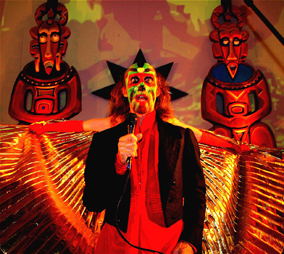
On a number of occasions in the late 1960s, an exceptionally gangly gentleman made up in skeleton face paint would affix what has been described as a metal plate to the top of his head with a leather strap and commence singing a song called “Fire” to assembled crowds in a dark, cramped Paris nightclub. The song begins with the spoken/shouted intro, “I am the God of Hellfire and I bring you…FIRE!” The key to making this routine particularly dangerous (rather than just slightly odd) was the fact that the plate, probably more of a shallow bowl, contained gasoline, which would be set aflame as the performer took the stage. The showman in question would cavort about the stage in an approximation of a cross between a witch doctor’s contortions and the popular ’60s novelty dance, the Frug. Not surprisingly, his ill-designed headgear would tip and spill varying amounts of flaming liquid on his body and brightly-colored stage costume, turning the already smoky club even more so. Fortunately for him, his bandmates quickly became adept at performing as an ad hoc fire brigade.

While the DSM may not have a particular diagnosis for such behavior (yet), a casual observer might be forgiven for assuming that the sort of person who would behave in such a manner might be more likely to be a recipient of psychotherapy rather than a provider. The fact that in this instance the reverse is true provides one of the more interesting chapters in the annals of mental health practice. Arthur Brown, the pop singer who gave new meaning to the term “smoldering stage presence,” followed a long and unusual path from performing rock and roll in the psychedelic sixties to performing psychotherapy in the early 1990s in Texas.

Brown was born in England on June 24, 1942. Like many artistically inclined young Englishmen of his generation, Brown went away to college and ended up in a band. But unlike ersatz “art” students Mick Jagger and John Lennon, despite his keen interest in music, Brown stayed the course and graduated with a bachelor’s degree in philosophy.

Soon after, music became his full-time vocation, and his band, The Crazy World of Arthur Brown, released their eponymous debut album in 1968. Their single, the aforementioned “Fire,” reached number 1 in the UK charts and number 2 in the States. Their failure to follow up this initial success marks Brown and company as one of the benighted breed popular culture terms “One-Hit Wonders.” Despite their lack of chart success, Brown, with his band and later as a solo artist, continued to work steadily well into the 1970s. His greatest contribution to music history, however, may be the influence he wielded through his choice of material and stage persona. Brown may today be viewed as a clear link on the continuum from Screamin’ Jay Hawkins in the 1950s to artists like Alice Cooper in the 1970s and Marilyn Manson today. You may or may not have heard of Brown or his most famous song, but his Goth-before-Goth-was-cool style has influenced just about every bombastic and excessively theatrical heavy metal/progressive rock act you’ve ever seen.

By 1980, his career as a musician was at such a low ebb that Brown and his then-wife decided to make a fresh start in America. They chose as their destination “the live music capital of the world,” Austin, Texas. Willie Nelson had famously retreated there for similar reasons a decade earlier with productive results, and Brown found amiable company in a number of other expatriates from the world of rock stardom. Brown kept at the music but soon found himself working as journeyman carpenter and the proprietor of a house painting business. While the work was rewarding enough financially, it did little to satisfy the creative muse. Brown found himself ready for another change but unsure what it was to be.

From Rockstar to Masters Student

Then in 1989, Vincent Crane, former keyboardist in The Crazy World of Arthur Brown and Brown’s longtime friend and bandmate, lost his long battle with bipolar illness, committing suicide. Whether this tragedy was the catalyst for Brown’s next move is open to speculation. But not long after returning to Texas from the funeral in Britain, Brown enrolled in the Masters in Counseling program at Southwest Texas State University (today known as Texas State University).

Such an endeavor may seem to be a truly unexpected left turn in the life of an avant-garde artiste. However, there were portents aplenty in Brown’s past which indicated an interest in helping others and exploring personal growth. In a period when it seemed almost de rigueur for pop stars to explore Eastern religion, Brown took a shine to Sufism. Other religions had been a fascination as well, as he studied formally and informally with everyone from practicing Druids to priests of the Greek Orthodox Church. Moreover, Brown seems to have delved deeply into the primordial soup of the ’70s self-actualization/encounter ethos, taking a self-guided tour of the “Me” decade. A trip to Israel during the Yom Kippur War to entertain wounded soldiers (presumably he spared them the flaming hat) inspired in him a keen interest in the healing properties of music.

But perhaps the biggest giveaway to his future career was the b-side of “Fire,” a song called “Rest Cure.” While the term is now archaic, it refers to a discreet stay in a sanitarium of the sort described by Simon and Garfunkel in “Mrs. Robinson”—a getaway to nice, quiet facility to collect one’s nerves. The lyrics reveal that Brown seems even then to have seen himself as able to provide a cure for the ills of modern society.

When the world is getting you down.
And nothing is in its right place;
Your friends are letting you down.
And you can’t seem to find the right face.
All you want is me,
All you need is me to give you,
Rest cure for all your ills,
Rest cure to make the world stand still.
Rest cure and the world won’t bring you down no more.

Brown was an able and ardent non-traditional student, making the 60-mile round trip from home to school each day, and he rapidly established positive relationships with classmates and professors alike. It was at a party on campus one day at which both groups mixed that Brown performed a light-hearted impromptu tune, name-checking all present. This so impressed one of his professors that she was moved to suggest he find a way to blend his musical gifts with his newly minted learning.

Brief Atypical Music Therapy

Shortly after picking up his diploma, he set up a counseling practice with a fellow alumnus to do just that. They named their venture “Healing Songs Therapy,” and in this context Brown and his cohort introduced a new therapeutic form.

As described in various media outlets, the session began much like a normal 50-minute hour. Brown’s partner would allow the client to describe his or her concerns and issues offering feedback in the normal therapist-client interaction as Brown sat to the side of the room with notepad and guitar at hand. Following the cessation of the first portion of the session, Brown would then perform an original song in which he brought forth insights and reflection about things he believed he had heard in the client’s narrative. The client would be given an audiotape of the song and be sent on his or her way, having completed a course of what might be called Brief Atypical Music Therapy.

In 1992, not long after Healing Songs had opened up shop, a feature reporter from the Austin daily paper came to Brown and his partner ostensibly seeking help with a mild phobia of driving in rush hour highway traffic, and more to the point, for a story. Following her hour with the duo, she reported coming away with her trepidations at least somewhat alleviated, along with a personalized song on cassette which she could pop into her stereo the next time she was caught in traffic. Evidently from the snippet of lyrics she published of her seven-minute personalized “healing song,” Brown saw in her presenting problem echoes of deeper existential issues.

I have a dream that I am keeping,
And I will not let it surface,
For the fear that rules my life
Has taken me and chained me to my own
Image of reflecting everything,
That I can’t hold onto.

A certain amount of notoriety followed as the fledgling practice grew. Other news outlets across Texas began to feature stories, as did People magazine with a story entitled “The Singing Shrink.” Of these stories, the early reporter/client from Austin offered one of the few independent reviews of Brown’s new therapy technique. Most of the accounts are long on Brown’s unmistakable enthusiasm for his latest venture and favorable words from experts about the broad efficacy of more traditional forms of music therapy, but very short on any sort of objective examination of the Healing Songs modality. The rejoinder from more knowledgeable quarters (such as representatives of the duos’ alma mater) was less than favorable, however. In response to the mostly positive article in the Austin paper, a professor from the Southwest Texas counseling faculty took exception in a letter to the editor decrying the inference that the university in any way endorsed or even recognized the potential validity of Brown’s approach.

The perturbed prof seemingly didn’t need to worry so, as what might one day have developed into a new therapeutic discipline seems to have fallen by the wayside when Brown’s music career began to heat up once again, probably due in part to the sudden spate of publicity regarding his side venture. Just when Brown put aside the formal role as a budding psychotherapist is hard to ascertain. The state credentialing board offers no record of Brown ever actually obtaining licensure as a Professional Counselor or Music Therapist. However, it’s safe to assume he gave up formal counseling at some point after departing Texas for a European tour with his new band in late 1992. Given Brown’s interest in his own inner world as well as that of other human beings, it seems likely that he still, shaman-like, exerts whatever healing powers he believes are in his possession from the stage. However, office hours are a thing of the past.

In the end, one has to wonder about the great unreleased Arthur Brown album. Ballads and Poems of Fin-de-Siècle Problems of Living, it might be called, or Arthur Brown Makes Your World Not So Crazy. According to the account in People, Brown and his partner had reached a height of 20 sessions a month at the time of writing. Thus, there could well be as many as hundreds of unknown Arthur Brown compositions out there in the world. While cassette tapes are today an almost forgotten technology, surely a personalized song dealing with a deeply personal issue and written by an erstwhile rock star is the sort of thing more than just a few people might have held onto. Secreted away in junk drawers and the back of closets, they await a 21st-century John Lomax to bring them to light once more.

Supervision of Executive Coaching

Last year I was tempted out of my retirement as a psychotherapist to provide supervision to a group of colleagues working with business executives. This was not psychotherapy but coaching, and my protests that I had never done any coaching or even read very much about it were overruled: they wanted me and they had every confidence that I would do a good job. I was flattered of course, intrigued too, and the extra money was welcome. So I began. Sessions were individual and scheduled to last an hour and a half, not the usual fifty minute hour. I met my supervisees just once a month. These parameters took some getting used to and I found myself having to take detailed notes in the session, something I had not done for years, simply in order to keep in mind who people were, what their place was in a particular firm, what work they were doing and who they related to. It was a steep learning curve and, more than once, I wondered whether I had taken on something of a monster. But I got used to it and developed a way of working that suited me. Interestingly, only one person out of the six I was supervising asked me at the outset what my model of supervision was. I was not expecting the question and answered without preparatory thought. I listen to what you tell me, I said, and, where appropriate, I shall say something. I admit that this is terribly vague but it is nevertheless accurate. I could have said something about attending to the currents and undercurrents in the material, or about the dynamics of relationships, or about the transactional nature of coaching. But I felt that that was too prescriptive and even, to some degree, false. I would do what I was good at and what I had done as a therapist, which was work out what I thought might be going on and seek out the best moment to make an intervention. This is not as straightforward as it sounds.

In supervision there are three levels of ‘what might be going on.’ What the coach/therapist and client are doing in the world outside, what material the coach/therapist chooses to bring to the session, and what is happening there and then in the supervisory relationship. The last is particularly important. One of the supervisees was someone I had met 20 years ago when we were both involved in training clinical psychologists but I had not seen since. He is a likable and charismatic person with an unusual background. At our first supervisory meeting, he said that, when he had heard I was to be their supervisor, he had told his colleagues how great I was and how he had known me for 20 years. My ears pricked up not just at the effusive compliment but the claim to have known me for 20 years when the truth was he had known me briefly 20 years ago, an important difference. I said nothing. Time would reveal whether his desire for special recognition would be important in the work as indeed it has proved to be.

The man who asked me what my model of supervision was suddenly quit. He came to one session and bluntly told me that he had decided to stop. It was not adding enough value and he was a busy man. I was filled with overwhelming anger. I felt the narcissistic wounding and I knew this was in part counter-transference, how I hated to be wrong-footed and made to seem a worthless minion. I waited a while for my feelings to lessen and then formulated my response. “You have sacked me,” I said, deliberately using that dismissive word, “and I am feeling quite angry at that.” Immediately, he acknowledged the peremptory way he had done this, apologising for it. The anger, which had been felt by both of us, was transformed and even though, he stuck to his decision to quit, we could spend the last session in productive work.

There are some who argue that supervisors have a responsibility to tell their supervisees what they are doing wrong or to suggest particular techniques to use. While there is a place for this, it is far less important that understanding and reflecting back. It is better for supervisees to find things out for themselves and unless something very bad is going on, the supervisor should not be directive. In a heated debate on supervision in the late 1970s, I vividly recall a distinguished psychoanalyst quietly saying, “Those who tell their supervisees what to do end up telling their clients what do.” He did not mean it as a compliment.
 

Sue Johnson on Emotionally Focused Therapy

Foundations of EFT

Victor Yalom: Sue, it's great to be with you today. We might as well start with the basics. Can you just say a bit about what is emotionally focused therapy or EFT?
Sue Johnson: EFT is an approach that was developed in the '80s to work with couples, that now has a very strong empirical base. It's been tested. There's lots of outcome data. We know that we get results with lots of different kinds of couples. We know how we get results. As its name suggests, it's an approach that focuses very much on how people deal with their emotions and how they send emotional signals to their spouse, and then how this emotion becomes the music of their interactional dance.

It's an attachment-oriented approach. Attachment is a broad theory of personality and human development that focuses, also, very much on emotion. It's an attachment approach, so it assumes that we all have very deep needs for safe connection and emotional contact, and that when we don't get those needs, we get stuck in very negative interactional patterns; the dance music gets very complicated.
VY: Of course, humans are complex creatures. Emotions are an essential component, but we also have cognitions. Why do you focus on emotions?
SJ: We focused on emotion, in some ways, because they were pretty much left out of interventions, particularly systemic interventions—interventions that looked at relationships. Emotions were really considered the enemy. They were the things that people had difficulty with. Particularly, anger and conflict were considered the enemy. So there was a lot of focus on just teaching people skills to control emotion—to be nicer to each other.

And what we tried to do is say, "No, focusing on emotion and helping people send key emotional messages to each other that help the other person feel safe is the most important part of a relationship. It's the key part of the attachment bond. And we really need to teach people how to do that." So that's why we focused on emotion.

VY: And how did attachment theory become such a central component?
SJ: Really, couples taught us how to do EFT. We started looking at how couples got caught in being overwhelmed by their emotions, or numbing out their emotions, or putting very negative emotions out to each other, and getting caught in really negative cycles. But we didn't understand why these cycles were so powerful, took over the whole relationship and induced such distress in people. We knew there was something powerful here. And we learned how to help people get out of these negative dances and move into positive, trusting, more open dances with each other.

So we discovered how to do that, but we didn't really understand why this dance was so incredibly powerful, why it had the effect it did until
VY: And when you refer to the dance, you’re referring to the patterns that couples get into.
SJ: Yes, I think of the patterns of interaction in a relationship as a dance. And I like to think of emotion as the music of the dance. I think that is a shorthand way of talking about how powerful emotions are. It’s very difficult to learn skills and do a new dance that’s about tango when there’s waltz music playing. You end up going on with the music in the end. That’s what happens in relationships with emotion.
VY: What do you mean?
SJ: If I'm really hurting and really upset with you, and I'm vigilantly watching everything you do, waiting for some sign that I don't really matter to you and you are about to turn away from me, I discount the positive things you say, for a start. I wait for you to raise your left eyebrow and say something negative. And when you say that, I'm ready—I have all these catastrophic ideas and feelings in my body, and this felt sense of falling through space and insecurity. And I react like crazy. And you turn to me and you say, "But I was so sweet to you yesterday. Doesn't that count?" And if I'm honest, I would say no. So our emotional realities are very powerful.
VY: The kind of situation you just described is something that therapists often get tripped up on. When we’re in the room with a couple, things happen so quickly, even before we understand what’s happening and they’re off to the races.
SJ: That’s right.
VY: So how does the theory help us? How do you understand that?
SJ:
It really helps to understand that you're dealing with an attachment drama. You're dealing with dilemmas in human bonding.
It really helps to understand that you're dealing with an attachment drama. You're dealing with dilemmas in human bonding. So the emotions that you're dealing with are high-voltage emotions, because your mammalian brain sees these emotions—these situations—in terms of life and death: "Does this person care about me?" It looks like we're having a fight about parenting, but, in fact, if you tune into the emotions, oftentimes two minutes after the fight started—or two seconds after the fight started—the fight ends up being about attachment issues like, "Do you love me? Do I matter to you? If I hurt do you care? Are you there for me? Will you respond to me? Can I depend on you?"

I started to realize after we'd done the first outcome study that the logic behind these emotions was that they were all about attachment and bonding, and our deep human need for that secure bond.

Johnson's Flash of Insight

VY: How did that come to you?
SJ: It was a flash of insight, I’m afraid. It sounds corny, but it was one of those traditional corny "Aha!" things that just hit you in the head.
VY: How did that happen?
SJ: Actually, I was at a conference. We'd done the first outcome study of EFT. It had worked amazingly well. I couldn't really understand how it had worked so well, and I was at a conference listening to Neil Jacobson talking. And Neil Jacobson, who was really the father of cognitive-behavioral marital therapy, was giving a talk and basically saying that relationships are rational bargains, so what you have to do is teach people to negotiate. His theory was that you can negotiate almost anything, including affairs. And this was the theory of relationship underneath the behavioral approaches: you teach people communication skills so that they can problem solve and bargain better.

Afterwards, I and my colleague Les Greenberg, who originally helped me put together EFT for couples, were sitting in a bar, and he said, "He's wrong." And I said, "Of course Neil's wrong." And he said, "Well, why is he wrong?" And I said, "Oh, he's wrong because an adult love relationship is an attachment bond, and you can't bargain for basic responsiveness and safety and love." And that was it. And then suddenly the whole of John Bowlby, who I'd read, but who I'd never made the links—it was like somebody hit me with a sledgehammer.

I went home and wrote an article called "Bonds or Bargains," which ended up being in the Journal of Marriage and Family Therapy, even though Alan Gurman sent it out for review four times, and each time he got two people who hated it and who said that adult relationships were not attachment bonds like the bonds between mothers and children. They were adult friendships, and they were rational, and dependency was a problem, and we got over it. And the other half of the people said, "Oh, this is really new and interesting." And Alan Gurman finally said, "I can never get people to agree. They either hate it or love it. So, Sue, I like it so I'm going to publish it"—for which I bless him forever.

That was the first article—it came out in '86. And in '87 Hazan and Shaver, who were social psychologists, bought out their first little study of adult attachment. Bowlby always said adults had attachment, but we'd never really done anything with his remarks.
VY: So the interesting thing is you developed the theory and practice of EFT before you conceptualized the centrality of attachment in it, and it worked without that understanding.
SJ: It worked because, I think, we were Rogerian, and we understood how to create new interactions from a systemic point of view. But we didn't really understand why these new interactions worked so well.

And don't forget, also, in those days not much was written about adult attachment. Since then there have been hundreds of studies. It's a very rich literature now—lots of studies on adult attachment linking adult attachment to better health, feeling better about yourself, better ability to deal with stress. But in those days—in the '80s—nobody was writing about adult attachment. So there wasn't a literature sitting there that I could go to and say, "Oh, this is it." I just understood suddenly what I was looking at between adult partners, and how this paralleled the between the bonds between mothers and children, which many people still find very difficult to accept. They say, "No, they're totally different."
VY: It certainly goes against the strong sense of psychological independence that we cherish in the West and is so central to so many of our conceptions of psychological health.
SJ: Yes. I think what we've done is we've pathologized dependency. If you really think about it, though, how on earth do we get to be independent anyway?
Bowlby basically said for a child to really become independent, he has to be dependent first.
Bowlby basically said for a child to really become independent, he has to be dependent first. He has to be able to turn to other people and reach for them, and know how to connect with others in order to build this sense of self and in order to deal with how your self evolves and how big the world is. In other words, Bowlby basically said we're mammals. We need other people. A strong sense of self and the ability to be separate are tied to how connected you feel. They're not opposites—they're both the two sides of the same coin. We made a mistake in that.

In psychology and in therapy, we often see a little piece of the picture, and we go with that because that's all we can see. Then when the whole picture suddenly evolves, we can put things together in a different way.
VY: So you don’t like the ideas of co-dependency or enmeshment?
SJ: Well, enmeshment confuses anxiety about closeness and coercion, for one thing. It's a very vague concept, and a lot of it came out of watching families where adolescents were in deep trouble and the therapist was trying to help the adolescents assert themselves with the parents. There's nothing wrong with the word "enmeshment" if you put it in a very particular context.

Co-dependency came out of the addiction literature, and we used it as a global blame for people without understanding that we have amazingly powerful emotional links with the people we love. To say you shouldn't have those links is craziness. Those links are wired into our brains by millions of years of evolution. Bowlby says if you're a mammal, there's no such thing as real self-sufficiency. And there's no such thing as real over-dependency. But there are massively anxious behaviors around dependency.

What healthy people have is effective dependency, which means—and there's lots of research behind this now—the more you know how to turn to other people, the more you can trust other people, the more you can go inside of yourself and access, for example, your loved one's face when you're feeling upset or distressed, the stronger you are as a person, the better you feel about yourself and the more able you are to take autonomous decisions.
The more you know how to turn to other people, the better you feel about yourself and the more able you are to make autonomous decisions.
And I'm not making this up. I can quote you study after study, and you see it in therapy.
VY: I know that you can. And I know you can talk passionately and animatedly about the attachment literature for hours—
SJ: Yes, I can. It’s the best thing to ever hit psychology and therapy in the last hundred years, so there you go.
VY: Yes, you’re not one shy of opinions!
SJ: No. Life's too short to not put out what you think. And if someone can show you you're wrong, that's good.

EFT Techniques

VY: How did it change your thinking and the technique of EFT when you had that "aha!" moment and started to understand the significance of attachment in adult couples?
SJ: I think it helped me understand, on a deeper level, how powerful these emotions were that I was seeing in the couple. It helped me understand the power of fear in a couple—fear of abandonment, fear of rejection. It helped me understand the logic behind some of the apparently self-destructive positions people take in relationships.
VY: Can you give an example of the fear or the self-destructive positions?
SJ: For example, one of the classic ones in relationships is, "I feel lonely. I feel unsure that you care about me. I don't even know quite how to put that into words because I'm an adult—I'm not supposed to feel that way. But I somehow feel like I'm starving emotionally. And I decide that what I'm going to do is I'm going to make you respond. Ironically, I'm feeling all these feelings inside of abandonment and loneliness and fear, and what I say to you is, 'You never talk to me.'"
VY: What you're describing is what's underneath, unconscious, as it were—not what the person's actually saying, but what you posit is driving their behavior.
SJ: You don't have to posit it if you slow people down, and you say, "In the second before you get angry and tell your husband that he's ridiculous because he can't talk to anyone—in the second before you attack him to get his attention and to make him listen to you—what's happening to you?" If you just slow people down, there are enormously powerful universal patterns that you can see, and they fit very well with what John Bowlby saw in situations between mothers and infants.

There are only so many ways we have of dealing with our emotions. If I'm in a relationship with somebody and I want them to respond to me, and suddenly I'm not getting responsiveness and connection, I've got to reach for them and say, "Where are you? I need you." If somehow I'm afraid to do that or that doesn't work too well, then there are really only two alternatives. I get angry and shriek—children shriek or they get mad or they get aggressive with the mother, and so do we. We say, "Why don't you ever talk to me?" Unfortunately, if that gets to be a habitual pattern, I end up pushing you away. And in classic marital distress, the other person hears, "I'm being rejected. I'm disappointing. I'm messing up. I'm not pleasing this person. I don't know how to please this person. This hurts like hell. I want this fight to stop. I'm just going to stop talking."

So one person numbs out. And the more he numbs out, shuts down, shuts his partner out, the more his partner gets angry and pushes.
So one person numbs out. And the more he numbs out, shuts down, shuts his partner out, the more his partner gets angry and pushes. And that is the most classic dance of relationship distress in North America. It's a hot number. We all do it a lot.
VY: This is what you refer to as a cycle?
SJ: That's a cycle. And in Hold Me Tight, which is the book I wrote for the public a couple of years ago, it's one of the main "demon dialogues." What's important is if you understand that that drama is not about communication skills or your personalities, or that you're deficient somehow, but rather that drama is about both of you being caught in feeling disconnected from each other and not knowing how to handle it—if you understand that, what we first teach people to do in EFT is to basically understand they're scaring the hell out of each other. Then we teach them how to step out of the negative patterns, and then deliberately learn how to reach for each other—which is what mothers and infants and bonded partners and people who love each other in positive relationships naturally do—learn how to reach for each other and create loving, responsive, open emotional communication where they can get their needs met.
VY: Sounds nice.
SJ: It is nice. It’s fun to do, as well. As a therapist, it makes you feel like you’re actually really doing what you wanted to do in grad school when you decided to be a therapist.
VY: So how do therapists do that? The first thing, I guess, is to start to be able to identify, in your own mind, this dance—this cycle.
SJ: Yeah. At this point, we’ve been doing EFT for 25 years. We’ve set it out pretty clearly and we’ve even done research on what you have to do to make this work. First of all, you’ve got to create safety in the session.
VY: Okay, safety is number one. So how do you do that?
SJ: You do that by being empathic and by being emotionally present. Really, this is a Rogerian therapy. So you do that in the traditional Rogerian way, but I think it's more intense than Rogers really created because you also help the couple understand the drama that they're caught in. So you're a relationship consultant. You follow the couple's drama. You make it clear to them the steps they're doing in the dance.
VY: That's "Rogers plus," because you're not just reflecting back—you're starting to explain to them what you see that they're doing.
SJ: I think you have to do more than explain. You have to give them a felt sense.
You have to catch it as it's happening, and you have to help them see the dance they're caught in and how it leaves them both alone and hurting.
You have to catch it as it's happening, and you have to help them see the dance they're caught in and how it leaves them both alone and hurting. You also have to help them see that underneath this dance they're both in pain, and that this pain is just built into us. It's part of who are as human beings. So that is key. You have to create safety in the session. You have to help people explore their emotions so that they can talk about some of these softer feelings.

If you're always telling me that you don't want to hear me because I'm so angry, after a while all I show you is anger. And all I see you do is be cold and indifferent. And what we help people do is talk about the softer feelings that they don't even know how to name sometimes, and certainly don't know how to share. So the reactively angry partner will start talking about how "I feel lonely. I don't know what to do. I do get angry. I do get critical because underneath I'm so scared I don't matter to him."

And we will help her not only access that and work with those feelings, regulate them differently, integrate them so she can talk about those softer feelings—we'll help her turn and share with her partner in interactions where we scaffold the safety in. We help her share that, and we help her partner hear it—because one of the reasons you need a therapist is that sometimes you do give these clear emotional messages to your partner, and because of the negative music playing in the relationship, your partner doesn't even hear it. Your partner doesn't trust, doesn't respond to it.
VY: When you say you help them share these feelings with their partner—this is what you refer to as enactments, á la Minuchin, right?
SJ: Yes, although they’re much more emotional than Minuchin’s enactments usually were. To really summarize it, the EFT therapist creates safety, deepens people’s emotions using the attachment frame, to the soft feelings, the fears, the sadnesses, the hurts, sometimes even the shame underneath their reactive responses to each other, and then helps them send clear signals to their partner in very powerful interactions about their fears and their needs. Really, we teach people to help each other deal with these difficult emotions in a way that brings them closer.
VY: So if all goes well, you identify their pattern, you help them feel safe, you observe their pattern, you help them identify it, and then you help them start to express their deepest, vulnerable, unmet needs with each other. Then what happens?
SJ: It's basically the prototypical corrective emotional experience. And the reason it's so powerful is that we have these key change events in the second stage of EFT. In the first stage, we de-escalate the negative patterns so that people can stop and say things like, "Hey, we're caught in that thing again—that thing where I get angrier and angrier and you get more and more silent. This is the place where we both get hurt." And they start seeing the dance is the problem.

So they can have control over the negative interaction pattern, but that's not enough. I think lots of couples therapies get people there one way or another. The important bit for me is the second stage, where we actively use an attachment frame to help people to distill their attachment fears and their attachment needs, which in the beginning of therapy they are often not even aware of. And then we help them share that.

When that happens and the other person can respond,
sometimes for the first time in people's lives they actually feel that another person is there for them, that the other person cares, that they matter to someone.
sometimes for the first time in people's lives they actually feel that another person is there for them, that the other person cares, that they matter to someone. This is a huge event. It starts to redefine the relationship as a secure bond. And it's incredibly positive for people because we have mammalian brains.
VY: It can be. But take the example where one of the partners gets to the point where they can be incredibly vulnerable and open and express their unmet needs, and the other partner has their own intimacy issues and blocks, and that’s too much for them, and they reject it or they withdraw.
SJ: First of all, the therapist is there dealing with that. Secondly, you titrate the risks people take in EFT. You don’t ask people to take huge risks before they’ve done Stage One. So ideally you don’t let people get into that position. But, nevertheless, if someone shares and the other person can’t respond, the good EFT therapist will go in and help that person slow everything down. See, emotion’s fast. If you want people to regulate it better and integrate it and deal with it differently, you’ve got to slow it down.
VY: Yeah, and I’ve seen you work and you’re very good. You track people very carefully, and you’re very good at slowing it down.
SJ: Yes. So in that case, I would turn to the person. I would say, "Could you help me? Did you see your partner just turned to you and said, 'I am scared. I am. And that's when I get into my tank, but inside I'm always so terrified that you never really chose me. I never understood why you married me. I'm always terrified by the fact you could leave me any minute'—did you hear your partner say that?"

You'd be amazed at what people hear sometimes. I had one man who basically said, "I heard that she can leave me any minute." So you have to slow it down. You have to help people get clear, and then you have to say to the person, "What happens to you?" And often people don't know what to do with it, so they'll go cognitive. They'll say, "Well, she had a very difficult family, and it's really not my fault." And you say, "No, I'm going to slow you down." So you help people focus on what matters. You support them. And I help the person hear it. I might say "My sense is that's hard for you to hear."And then the person will slow down and focus and say, "Yes, I don't see her that way. It's so strange for me to really see that she's afraid of me. I can hardly take it in. I see her as so powerful. I don't even know what to do with it. It confuses me. I actually feel dizzy. I feel like there's no ground under my feet. I've been with this person for 30 years. I never see her as—you mean she's vulnerable and scared? I don't know what to do with that."

So you listen to him. He's going to the leading edge of his experience. I'm keeping him there and helping him process it. Then I help him distill that and say, "Could you tell her, please?" And he says, "It's so hard for me. I don't quite know what to do with this new message. I don't know what to say when you tell me that. And I almost don't know whether to trust it. That you would be scared of me—that's so strange for me." And that's fine.
VY: This is where, as a therapist, you have to be very grounded to stick with it.
SJ: Yes.
VY: And really go slow with them, be patient, but also persist in insisting that he not withdraw.
SJ: Yes, that's right. And we're pretty systematic now. We've got training tapes, we've got a workbook, we've got the basic 2004 text. It's laid out in a lot of detail, and we have a whole procedure for training therapists and registering therapists. You can watch people do this on a tape. But you're right. EFT takes a lot of focus, and you have to be able to work with people's emotions, and help them stay with them and develop them and deepen them. You also have to be able to track interactions, and help them create these new interactions with their partner.

So it's a collaborative therapy. You're doing it with people, but it's certainly not a laid-back reflective therapy. It's a therapy where you're dancing alongside your client, and the music's going, and you understand the music, hopefully. But it's an active therapy, because there's so much going on.

Training Couples Therapists

VY: I understand that you’ve put a lot of thought into how to train therapists and set up a systematic program of training, ranging from your externships to supervision, et cetera. What do you find are the most difficult things for therapists to learn?
SJ:
I think our profession has developed a profound distrust of dependency, and we don’t understand it.
I think our profession has developed a profound distrust of dependency, and we don’t understand it. We still are hung up on, "We have to teach people to regulate their own emotions, be independent and separate, and define themselves." I think that’s one thing. We don’t really understand people’s deepest needs.
VY: So just conceptually having a shift in this idea of dependency, autonomy—that gets in the way.
SJ: Yes. You’ve got to be able to accept that we’re interdependent and we need each other. Otherwise, you’re going to have a hard time with EFT. You’re not going to be able to listen to and validate people’s needs. You’re going to blame them for their needs. But the second one is you have to get used to staying with emotion and deepening it. There’s a beautiful quote by Jack Kornfield. He writes about Buddhism and he says something about, "I can let myself be borne along by the river of emotion because I know how to swim."

I think therapists have been traditionally quite scared of strong emotion because we haven’t really known what to do with it. And at this point in psychotherapy in general, and in EFT, I think, there’s been a big revolution understanding emotion and human attachment. And we do know what to do with it. There’s nothing illogical about emotion. And, actually, there’s not very much unpredictable about emotion if you really know how to listen in to it. But many of us have not been trained in how to really stay emotionally present with somebody and track emotion, how to deepen emotion and use it. I think that’s the biggest one that people struggle with in EFT.
VY: So it’s just being more comfortable with emotion and trusting yourself to stay with it.
SJ: That’s a big part of it.
VY: That’s in terms of the comfort of the therapist. In terms of the techniques to help people work with it, what are the hardest things for therapists to learn?
SJ: I don’t think the techniques are hard per se. They’re a combination of Rogerian empathic reflection, validating, asking process-oriented questions like, "What’s happening for you right now? How do you feel when this person says this? How do you feel in your body? What do you tell yourself in your mind? Do you tell yourself this means this person doesn’t love you?"
VY: What I see is the skill that refer to as "slicing very thin"—tracking emotions on a very minute, moment-to-moment level. Not just asking someone how they feel, because many people, as you know, can't articulate that.
SJ: No.
VY: So you go at it from many angles.
SJ: Well, we know what the elements of emotion are. The elements of emotion are initial perception, body response, a set of thoughts, and then an action tendency.
VY: Now you’re sounding like a behaviorist.
SJ: No, I'm not. That comes from the emotion literature. A good EFT therapist will go and ask simple questions about the basic elements of emotion. Somebody will say, "I don't know how I feel right now." And the EFT therapist will say, "How's your body feel?" The person will say, "I feel tense." And the EFT therapist will say, "What do you want to do?"—because there's an action tendency in emotion. The person says, "I want this to stop. I want to get out of here." So you know what's happening—there's some version of fear going on. So the therapist will ask simple questions, and constantly empathically reflect to help people hold onto their emotional experience and continue to work with it.

Sometimes a therapist will interpret—add a piece. "This is very difficult for you. Could it be a little scary?" And then the therapist will help somebody hold their emotion, distill it. And then will create an enactment: "Could you turn and tell your partner, 'When we start to talk about this some part of me just wants to run away'?" You make the implicit explicit. You make the vague concrete. You make the vague vivid.

It's much better, from a relationship point of view, for me to turn and say to you, "Victor, I don't know what to do with what you've just said, but there's something a bit scary about it and I just want to run away." That's much better than for me to just feel that and not be able to talk about it, and turn and leave the room. If I turn and leave the room and you are a mammal and you're in a relationship with me, your brain says that's a danger cue. "This person who I depend on can walk away from me any time." And you start to get really upset—whereas if I turn and say to you, "I don't know what's happening with me. This is a bit scary. I just want to leave," you're probably going to feel compassion towards me.

It's all about helping people learn how to hold on to that emotional connection. Our mammalian brains experience emotional connection as a safety cue. There's lots of neuroscience behind this now, by the way. This emotional attachment stuff is creating a revolution in our field.

The New Science of Love

VY: I just heard David Brooks speak. He’s done a great job with his book, The Social Animal, summarizing a lot of the attachment research, but he also warned of the danger of over-reading brain science. He said something to the effect that brain science is in such a state of infancy that to draw any definitive conclusions from it can be riding the next wave of popularity, but to make precise conclusions from it is overreaching.
SJ: I agree with David Brooks that you can't draw conclusions. Sometimes when I listen to people and they say, "Oh, we change the brain in psychotherapy," I don't know. I just feel like saying, "Well, you know, eating an ice cream changes your brain."

On the other hand, when you look at research like my colleague, Jim Coan, has done, that if you lie alone in a computer in an MRI machine or you hold a stranger's hand, your brain goes berserk when you see a sign that you're going to be shocked on your feet. And when your partner, who you feel safe and connected with, holds your hand and you can see that signal that tells you you're going to be shocked on your feet, because you're holding your partner's hand and you feel connected to them your brain does not go berserk, and the way you experience the shock is much less painful.

Now, David Brooks is right. We're not quite sure what it all means. But it's fascinating stuff, and it's taking us into new territory. And, just by itself, that one study supports all the hundreds of studies that have been done on adult attachment and infant and mother and father attachment that says that we have connections with very special others, and that it's basically all about safety and danger. We use that connection as a safety cue. And what I just said has huge implications for couple therapy, psychotherapy in general, education for society. So, yes, David Brooks is right and we are in the middle of a revolution.
VY: Speaking of that, I hear you’re writing a new book on the science of love.
SJ: Yes, because we really do have a science of love. It's in its infancy, but it's a strong, bawling little infant. It's not a fragile child.
We really do have a science of love. It's in its infancy, but it's a strong, bawling little infant. It's not a fragile child.
When I think about it, in the last 15 years our understanding of our most important adult relationships has absolutely gone crazy. It is a revolution.

And it's so important. I was just looking in my local newspaper today, The Globe and Mail in Toronto, talking about how the Canadian government is struggling with the fact that there are rising levels of anxiety and depression and we can't deal with it in our healthcare system. Well, I know what John Bowlby would say. John Bowlby would say, "Absolutely, because we're facing less and less social connection, less and less community connection, and 50 percent of us divorce. We haven't learned how to create these safe, loving bonds. We need to belong." And the way to deal with that sort of thing, from my point of view, is not for the pharmaceutical companies to get better pills. It's for us to really understand our need for human connection, and start educating people for that and understanding how crucial that is in terms of basic mental health problems like anxiety and depression.
VY: Can you give a little sneak preview of your book? One or two morsels?
SJ: I'm going to talk about oxytocin, the cuddle hormone. I'm going to talk about how sex is an attachment behavior. I'm going to talk about how we're basically monogamous and that those people who say that we're not suited for monogamy are out of their minds. I'm going to talk about all the science behind what happens when you have one of those little arguments with your partner in the morning that ends up wrecking your whole day, so that when five o' clock comes along you're not even sure why you married this person. That's what I'm going to try to talk about.
VY: We'll look forward to that coming out. Thanks for taking the time to talk today.
SJ: You're welcome.

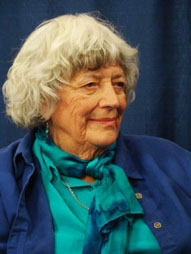
Awakening to Awe: A Book Review

Kirk J. Schneider, Ph.D., is a leading spokesperson for contemporary humanistic psychology and is the editor of the Journal of Humanistic Psychology. He is a pioneer in developing existential-integrative psychotherapy and in the application of awe-based consciousness to existential-humanistic psychotherapy. Awakening to Awe explores the nature and power of awe from Dr. Schneider’s theoretical and therapeutic stance as well as through interviews of people transformed by their experience of awe.

His theoretical and therapeutic stance emphasizes the importance of living life with reverence, respect, humility, wonder, inclusiveness, and uncertainty, yet also with faith and trust. This is a very bold way to live as his stance advocates living one’s life by being open to its mystery and magnificence while simultaneously taking responsibility to live the life that is authentically your own.

The people Dr. Schneider interviewed represent a range of stories demonstrating qualities and experiences of awe. Three examples are:

A woman who grew up with a schizophrenic father in the 1950s and coped with her maelstrom of feelings by opening to the grandeur and danger of nature and by cultivating a strong sense of compassion. She used the realizations gleaned from her experience to become an avid sailor and to develop a thriving career as a professor of psychology who values the importance of the full range of human nature.

An ex-gang member who listened to a stirring from his soul after witnessing the assassination of his younger brother. This stirring encompassed a surrender to a Higher Power and a realization that life is an amazing, unpredictable adventure. He used that experience to become a youth educator providing violence prevention work for elementary school students in an awe-based cultural curriculum.

A professor, who is a Stage 3 cancer survivor and has had heart disease, discovered that by engaging with his chronic illness with an attitude of awe, he also experiences chronic vitality. Awe for this man is a communion and an intimacy into dialogue and participation with the wonders and tempests of existence. He embodies how to embrace the joy and wonder of living within the context of physical suffering and decay.

I feel this book, in conjunction with Dr. Schneider’s Rediscovery of Awe, is ground-breaking. Dr. Schneider’s emphasis on awe-based consciousness derives from his personal philosophy of enchanted agnosticism. I believe the exploration of awe-based consciousness can catalyze a reemergence of a contemporary existential-spiritual movement in much the same way that Abraham Maslow’s exploration of self-actualization catalyzed the human potential movement.

Existential philosophers and psychotherapists have long been at odds about spirituality. On one side of the debate, Soren Kierkegaard emphasized being authentic to your religious values and Paul Tillich emphasized that the holy is a “God-Beyond-God”. On the other side, Albert Camus, Jean-Paul Sartre, and Irvin Yalom all emphasize that we are thrown into being and there is no God to save us, thus we need to make meaning for ourselves. While Camus, Sartre, and Yalom come from an atheistic perspective, they all acknowledge that life is an unknown in which both beauty and horror can happen.

Since a core component of existentialist theory is questioning the meaning of life and not coming up with ultimate answers, both sides of the argument bear examination. The common thread between the two is that in order to live the most fulfilled life as a human being, it is essential to be open to the unknown, the wonder, and the mystery of life in order to take optimal responsibility for ourselves in how we live.

One perception of existential philosophy is that there is nothing more to life than what you experience in the immediate moment. This outlook can be perceived as pessimistic and gloomy. Dr. Schneider emphasizes the spiritual dimension of existence by highlighting it under the symbol of awe. The spiritual dimension celebrates that there is always something more, whether you call this mystery, awe, wonder, God, Higher-Power, or daimon. Bringing awe into the equation emphasizes that our experience also transcends the immediate moment. Our human experience is always evolving. We are always both being and becoming. This can allow for a more positive and hopeful perspective.

In Dr. Schneider’s exploration of awe he emphasizes how awe connotes an openness to life as it is, with its mystery, with its depth, with its pain and joy. It can be “awe-some” or “awe-ful.” It is an invitation to value life as it is. Awe is a meta level which invites us to fully engage in life without knowing how it is going to unfold, even as we intend to impact life as we move towards a specific goal. This implies that spiritual presence is an important part of existence.

Although the book is directed toward a more general audience, it also supports the existential-humanistic psychotherapist to embrace an awe-based dimension of life in working with clients. This allows the therapist to not be conflicted if they are spiritually oriented. It reminds me of the question I asked Rollo May at a conference I attended at the beginning of my career as an existential-humanistic psychotherapist. I asked if one could be both existential and spiritual. He responded that it was essential to be both, and that even atheistic existentialists like Camus and Sartre were spiritual. Having an openness to life with its mystery, from ecstasy to tragedy, is spiritual whether you call it that or not.

I very much value Schneider taking a chapter to explore the qualities which need to be cultivated for awe to awaken in our everyday life. These qualities are transiency, unknowing, surprise, vastness, intricacy, sentiment, and solitude. The embracing of these qualities supports a grounded understanding and experiencing of awe as it applies to daily life. Similarly, Schneider takes a chapter to explore the general conditions favorable for the cultivation of an awe-based society. The conditions for this are presence, freedom, courage, and appreciation. Schneider describes a specific application he’s initiating to bring awe into politics in California. He calls it the Experiential Democracy Project. Thus, I appreciated this book not only for its thorough examination of awe but also for its clear call to take action with an awe-based attitude informing us individually and collectively.

Some of the interviews are rambling and thus were at times hard to follow. I presume this was due to the use of the actual transcripts of the interviews with limited editing. Also, some interviews didn’t strike a strong chord in me. However, I also know, given how the experience of awe is unique to each of us, these same interviews may strike a strong chord in others.

I very much value this book and encourage both professionals and the general public to read it with an awe-based attitude. If you are not sure what an awe-based attitude means before your read it, you will by the time you are finished.

Originally published in the Association for Humanistic Psychology Perspective Magazine Feb/Mar 2011. Reprinted with Permission.
 

Turning Blaming into Confiding in Couples Therapy

The defining task in a Collaborative Couple Therapy session is to create an intimate conversation out of whatever is happening—frequently a fight. Sometimes that means helping the partner who has just been accused deal with the accusation. Sometimes, and this is my focus in this write-up, that means reshaping the accusing partner’s angry statement. I speak as if I were that partner, translating his/her blaming statement into a confiding one, in a method similar to doubling in psychodrama. I show what this partner might be saying if the couple was having a conversation rather than this fight. Here are the principles I use for making these translations.

• Change the tone of voice
• Omit the blaming
• Report the blaming
• Add or substitute heartfelt feelings
• Append a question that turns the monologue into a dialogue
• Acknowledge

1. CHANGE THE TONE OF VOICE. If I can’t immediately think of ways to modify a partner’s angry comment, I repeat or paraphrase it, but now in a nonprovocative, nonaccusing, nondefensive, warm, intimate tone. Of course, if I can think of how to modify what was said, I still change the tone. None of the changes listed below would do much good if they were stated in the partner’s original angry, defensive, arrogant, sarcastic, contemptuous, or distant tone.

2. OMIT THE BLAMING. An important way to turn a partner’s fight-fostering comment into a conversation-fostering one is, of course, to omit (or at least reduce) the blaming, accusations, anger, attack. Lynn says to Fred, “You’re selfish, immature, and totally irresponsible to go out to a bar with your office pals after work, and come home late for dinner. You’re probably flirting with what’s-her-name in the next cubicle.” Moving in and speaking for Lynn, I say, “I’m going to restate what you just said but change the tone in order to help you get your message across to Fred. In my version, Lynn, you’d say, ‘I hope you can understand why I might be upset about your going to a bar and coming home late and why, given the situation, I might be imagining all kinds of things like your flirting with other women’.”

3. REPORT THE BLAMING. Another way to eliminate (or at least reduce) the toxic fight-fostering effect of blaming is to report the anger rather than unload it. Bob says angrily to George, “You’re nasty and mean-spirited and never think of anybody but yourself!” I move over and speak for Bob in an effort to show him what it would sound like if he were to talk about the anger rather than from within it. I say for Bob, “I can’t remember when I’ve felt as angry at you as I do now” or “As you can see, I’m still furious about that comment you made this morning” or “At times like this when I’m really angry at you, I forget all that I like about you and just see you in a super negative way.”

The effect of such reporting is to create a platform, a perch, a meta-level, a vantage point above the fray from which Bob confides being angry. Most of the other interventions on this list create such a platform or vantage point.

4. ADD OR SUBSTITUTE HEARTFELT FEELINGS. In a fight, people lose the ability to make “I” statements. They lose contact with their vulnerable, heartfelt feelings and become “you” statement generating machines. In speaking for a partner, I uncover these vulnerable feelings: the wishes, fears, worries, longings, disappointments, self-reproaches, shame, guilt, self-hate, loneliness, and so on. I reveal the “I” statement hidden in the “you” statement. Here, as in other instances in which I guess what the partner might be thinking or feeling, I use information gleaned from earlier in the therapy, label my comments as speculations (saying, for example, “I give myself about a 30% chance of being right”), and check back to see if my guess was correct (“Where was I right and where was I wrong?”). At times I recast much of the partner’s original statement, changing “you” statements to “I” statements. Sometimes, as in the following examples, I append a vulnerable feeling (an “I” statement) to the partner’s attack.

John snaps at Judy, “You’re being selfish thinking of going back to school when you’ve got our kids to take care of, and in this rotten economy. Don’t you ever think of anybody but yourself?” Moving in and speaking for John to Judy, I append “… and I worry that your going to school might be the first step toward your leaving me.”

Sylvia says to Bob angrily, “I’m tired of always being the one who has to manage the family: schedule everything, make all the phone calls, assign all the chores.” In saying “I’m tired,” her comment appears to be an “I” statement. But implied is: “You don’t do your part,” “You take me for granted,” and “You’re selfish and irresponsible.” Moving over and speaking for her to Bob, I add the following clearer underlying “I” statement to what she just said: “I feel lonely” or “I don’t like the kind of person I’ve become in this relationship.”

5. APPEND A QUESTION THAT TURNS THE PARTNER’S MONOLOGUE INTO A DIALOGUE In an effort to make their cases, partners often give little lectures presenting their evidence, making speeches, pronouncements, or indictments. They deliver monologues. I try to turn these monologues into dialogues by appending a dialogue-creating question. Sue expounds on her knowledge of interior decorating and denigrates Phil’s taste in an attempt to prove to him that she should have the larger say in what furniture to buy. Moving over and speaking for her to Phil, I append to what she just said, “What do you think about what I’m saying?” or “Am I convincing you?” or “You probably disagree with most of what I just said. Am I right?” or “Is there any part of what I’m saying that you agree with?”

6. ACKNOWLEDGE. In a fight, each partner argues his/her case and either ignores or refutes that of the other. Neither acknowledges the validity of any of the other’s points or admits weaknesses in his/her own case. In speaking for partners, I do this acknowledging and admitting for them by doing one or more of the following:

• Acknowledge what the other partner has been trying to say
• Agree with parts of it
• Recognize the other partner’s efforts or achievements
• Appreciate the difficult position the other partner is in
• Admit his/her (the person on whose behalf I’m speaking) own role in the problem
• Confide doubts about the validity or fairness of what he/she is saying
• Express concern about how the other partner might hear what he/she is saying

Acknowledge what the other partner has been trying to say. In a fight, each partner feels too unheard to listen, which is what keeps the fight going. In speaking for a partner, I do the listening for him/her. I demonstrate how it would sound if this person were to do a bit of active listening and acknowledge what the other partner has been trying to say.

Judy complains to Bill, “Are you at all aware that you hardly ever talk to me except to complain about things I haven’t done right.” Bill pays no attention to this and, instead, tells her what is on his mind: “You forgot to lock the front door again.” Judy pays no attention to this and, instead, repeats her concern: “That’s all you care about—the front door. What about the fact that we never talk about anything important, like about us?” Bill says, “Keeping the door locked is important. We’ve got a lot of valuable stuff in here. You’ve got to think about that.” Judy says, “I’ll tell you what you’ve got to think about, and it’s that I’m starting to feel closer to my friends than I do to you.” Bill says, “But this is serious. Half the time you don’t lock the door; it’s just luck that we haven’t been robbed.” Judy says, “Speaking of robbed, I feel totally alone in this relationship.” Bill says, “All I’m asking is for you to be a little more careful when you leave the house.” The partners go back and forth repeating their point (because the other appears not to have heard it), paying little attention to what the other is saying.

Moving over and speaking for Judy, I say, “I know you’re worried about my not locking the door, but I can’t listen to that right now because I’m so frustrated that you won’t listen to my concern, which is that we never have intimate conversations.” I could just as easily have moved over and spoken for Bill, saying: “I know you’re saying that I don’t talk enough, but I can’t listen to that right now because I’m so frustrated that you won’t listen to my concern about locking the door.”

Agree with parts of what the other partner has been trying to say. In a fight, neither partner gets the satisfaction of having the other agree with anything. Each partner rebuts or ignores what the other says. In speaking for a partner, I do the agreeing for him/her. “You have a good point that I…and I have a good point that….” Or, “If we weren’t in the middle of a fight, I’d admit to you that you are making some good points.”

Often I turn to one partner and say, “I’m going to repeat what you just said, but begin by agreeing, which would then put you in a better position to make your point.”

Gloria criticizes Ed for being too harsh with the kids. Ed criticizes Gloria for being too lenient. The argument goes back and forth in this way for some time. Moving over and speaking for Gloria, remembering what she had said in a previous session, I say, “You’re right that I can be too soft with the kids. I need to work on that. My concern right now is to get you to consider that maybe you’re too hard on them.”

Paul criticizes Cheryl for something she did. Cheryl’s justification seems to convince Paul, but instead of acknowledging that, he goes on to make another complaint. I say, “Paul, were you feeling at that moment, ‘Okay Cheryl, you convinced me. But it just reminds me of something else I’m upset about, which is that…’”

Recognize (at times even celebrate) the other partner’s efforts or achievements. Sam proudly describes doing what Ann had asked him to do—pay the bills and clean the bathrooms. Ann replies, “Yes, that’s good. It’s about time. You act like you’re still single. You don’t take responsibility.” Moving over and speaking for her talking to Sam, I say, “You obviously paid attention to what I asked for last time. That’s wonderful! I really appreciate it. I hadn’t thought you would. But—and I’ll make this a multiple-choice question, Ann—A, I don’t want to get too excited about it and get my hopes up that the change is permanent, or, B, it’s too small a part of what I want to be really excited about. Ann, is it A or B. Or is it C, something else entirely?” (When I am uncertain what the person is feeling, I often ask such a multiple choice question.)

In her original statement, Ann skipped over Sam’s achievement. I try to show how it might make sense that she did so and how it would sound if she hadn’t done so.

Appreciate the difficult position the other partner is in. In a fight, each partner feels too unempathized with to empathize, too worn down by his/her own struggle to notice that the partner is caught in one, too. In speaking for partners, I do the appreciating, empathizing, and noticing for them.

Sara says to Ralph, “You never stand up for me when your mother pulls one of her numbers.” Ralph says, “Can’t you just do what everyone else in the family does—just accept that that’s how Mom has always been and realize there’s no way to change her.” Hearing this argument, I look for the right time and moment to say for Ralph, “I feel bad that I haven’t protected you from my mother” and for Sara, “I see how you’re caught in the middle.”

Admit his/her own role in the problem. In a fight, each partner blames the other partner for the problem and denies or minimizes his/her part in it. In speaking for a partner, I do the admitting for him/her. “I came home frustrated and took it out on you.” Or, “I overreacted.” Or “I know it didn’t help that I…” Or, “I’m suddenly seeing you as my father, which I know isn’t fair” Or, “I’m feeling hurt, but you have no way of knowing that, because my hurt is coming out as anger.”

Express concern about how the other partner might hear what he/she is saying. In a fight, partners lower their heads and bull ahead without acknowledging that what they are saying is provocative. In speaking for a partner, I do the acknowledging for him/her, often as a kind of prefacing statement. I say, “I know you never like it when I bring this up, and that’s why I mostly keep it to myself, but it’s been really bothering me lately so I need to say something…” or “I know this is a criticism, but I need to say it anyway” or “I’m angry, so I’m probably not saying this in the best possible way” or “I hope you see my distress peering through my anger,” or “This could get us into trouble, but I want to talk about it anyway” or “I wish I could find a way to say it that wasn’t a criticism because there’s something important here that I want to get you to see.”

Admit doubts about the validity or fairness of what he/she is saying. In a fight, partners focus on making their case. They put aside (and often lose awareness of) any doubts or reservations they might have about what they are saying. In speaking for a partner, I reintroduce these doubts or reservations. I say, “I know this isn’t fair, but it’s on my mind so I want to say it anyway and it’s that…” or “I know I’m on shaky ground here because I do the same thing myself, but…” or “I go back and forth between blaming myself for this problem and blaming you and, as you can see, at the moment, I’m deeply into blaming you” or “For a fraction of a second I was pleased by the lovely thing you did—and began to hope that it meant that you’ve really changed—but then I thought, ‘Wait a minute. I’m not going to get my hopes up just to be disappointed again’” or “I know I’m difficult to live with, so I probably don’t have a right to complain about something you do that’s so minor, but here it is…”

In speaking for partners, I try to make their case more effectively than they had been able to do so themselves. I repeat what they had just said but now in a more disarming, engaging, and heartfelt way. At times, I shorten what they have said and at times lengthen it. At times I reformulate what they have said and at other times append something to it. My effort in each case is to restate what the partners have just said in a way that will give them greater satisfaction and that their partner will be better able to hear.

My purpose here was to list the principles I use for arriving at my statements for partners in an effort to turn their blaming statements into intimate ones.
 

Training in Couples Therapy

Why might a therapist who works primarily with individuals consider studying couples’ therapy? If you work from an attachment perspective, as an increasing number of therapists do, then training in couples therapy may greatly inform and improve your work.

Many clients present to therapy for “relationship problems.” I’m sure all therapists who treat individuals have had the same experience I have of clients who want to spend their therapy hour talking about their spouse. Why do therapy on a relationship without both people present? Our training generally states that individual therapy will build resources in the individual, which they will then use to improve their relationships. But might an individual build resources faster and stronger with their partner present? Is working with the attachment dyad more efficient and powerful than working with the individual?

This hypothesis was presented at a recent training on Emotionally Focused Therapy for couples (EFT), an attachment-based approach developed by Sue Johnson, EdD . The presenters, Scott Woolley, PhD, and Rebecca Jorgenson , PhD, framed this question from an attachment perspective. They suggested that a client’s attachment system is more activated by and responsive to the client’s actual attachment figures than the therapist. Dr. Woolley quoted Dr. Johnson as saying, “As therapists we have 60 watt light bulb to bring light and healing to someone’s life, but the partner has a thousand watt search light!”

Attachment theory proposes that evolution has programmed us to be highly reactive to our partners, positively and negatively. “Relationship skills” learned in the presence of a soothing therapist might be no match for the tinderbox of a primary relationship. Likewise, there are risks in doing individual therapy. John Gottman, PhD, has found that people in individual therapy are much more likely to get divorced.

I emailed Dr. Johnson regarding this question. She replied, “A therapist’s empathy and validation are very useful — but to be really seen and accepted by the most important person in your life — that is transformational. The therapist is at best a surrogate attachment figure who validates.”

Victor Yalom points out that even if you plan to work individually, bringing the partner in for a single session provides invaluable data into the actual (versus reported) nature of your client's primary relationship and their interpersonal functioning, and can help broaden the frame of therapy. (Likewise with bringing in family members.)

Over time I have transitioned an increasing amount of my individual clients who present with relationship problems into couples therapy. Although the work is often harder, the results can come quicker, and I usually feel more confident that the results are lasting and durable.

Lonnie Barbach on Sex Therapy

Early Years of The Human Sexuality Program

David Bullard: Lonnie, as we start this interview I should acknowledge that we’ve known each other a long time as friends and colleagues.
Lonnie Barbach: Well, we met in late 1974 at the Human Sexuality Program at the University of California at San Francisco—that is a while ago!
DB: Yes, and you were one of my post-doctoral instructors, along with Jay Mann, Bernie Zilbergeld, Harvey Caplan, and Rebecca Black. Actually, you all were more important therapist role models to me than anyone I had encountered in graduate school.  And it was an exciting time to see how you all were bringing a kind of San Francisco humanism to sex therapy.
LB: That was an incredibly exciting time in human sexuality research and therapy and it led me to write my first book.
DB: Yes, For Yourself  was your timely and incredibly successful book that empowered women to take charge of their own sexual pleasure.  Not to linger too much in the past, but are there any impressions you can share when you think back to those days of the UCSF Human Sexuality Program, which for awhile was the largest training program in the country for psychotherapists, physicians and nurses in the newly-emerging field of sex therapy, post-Masters and Johnson.
LB: Well, for me, it changed my life; it was a pretty formative and important time. I didn't fully appreciate its significance at the time, but I knew that it was exciting.

DB: You graduated with a doctorate in psychology from the Wright Institute.
LB: I had done everything but my dissertation when I began at UCSF. I ended up designing this format for pre-orgasmic women's groups at UC, Berkeley where I worked with a small group of UC students in women's consciousness-raising groups using masturbation as a learning technique, but no one believed this form of therapy could work with middle-class housewives! So I was challenged and had to find a different environment in which to do my dissertation research.  Jay Mann was a psychologist and director of the HSP at UCSF and he said, “Well, if you pay us rent to use the space, you can run your research groups out of here and be under the umbrella of UCSF.” Then, as part of recruiting subjects, I was a guest on Don Chamberlin’s radio talk show called “California Girls.”  Thereafter, whenever someone mentioned having an orgasm problem, he would refer them to me. Within a few months, I had hundreds of women on a waiting list at UCSF.

Women’s Preorgasmic Groups

DB: So his show really jump-started your work with women’s preorgasmic groups.  Prior to your contributions, the professional diagnostic terms for a woman who had never or rarely had orgasm were “nonorgasmic” or “frigid.” Your use of “preorgasmic” instantly re-set more hopeful expectations and dropped the pejorative labels that almost all women had been oppressed by one way or another.
LB: Yes.  The semantics were oppressive, and we had to push over several years to get the medical and psychological establishment to drop those old labels. 
There was a great need in our society for people to drop shame about their sexuality in order to enjoy it….
There was a great need in our society for people to drop shame about their sexuality in order to enjoy it and for general self-acceptance. I learned a lot from the women in the groups–they were my teachers also. After completing three research groups with great results, I suddenly had this large number of women wanting help, so Jay Mann suggested we do a large group educational program. By then he realized that UCSF would earn more if they hired me and directly took in the money the women were being charged rather than my just paying them rent.  So I was brought on as co-director of clinical training in charge of their first women's program; later they added a men's program that Bernie Zilbergeld headed.
DB: You and I were both in graduate school in that era and I can remember what a powerful idea this was: empowering women to learn to take charge of and enjoy their own sexuality.  
LB: And I didn't realize that at first! All I knew was that I needed a job. It was actually a fluke that I even got into the field of sexuality. A woman came to a volunteer educational program I was leading for Planned Parenthood. At the end she said “you really should apply for my job because I'm leaving a position at UC, Berkeley as a sex therapist.” I was trying to finish my education at that point and really needed to earn some income. Two male colleagues of mine, Jim Purcell and Bob Cantor, both agreed they would do Masters and Johnson couples therapy counseling with me.  In that format, you needed both a female and male therapist for one couple. We got the job and I read the few books that were out and talked to everyone who knew anything about sex therapy, although there weren’t many of them at that time.  Shortly, Jim and Bob told me that they were too involved with their other jobs and graduate work and had no time to do the couples sex therapy. So I had a job I could not do as a single female. 
 
At the same time six women who also had no partners applied for sex therapy at the student health service. Some were single, some had partners but the partner wasn’t willing to come into therapy.  And one woman was faking orgasm and didn’t want her partner to know. Women’s consciousness-raising was really big at the time.  It seemed to me that Lo Piccolo and Lobitz's nine-step masturbation program could be used in a consciousness-raising group format.  So I tried it and led the first group with Nancy Carlson. Our first group was ten sessions long and we only had five weeks in order to fit it in between midterm and final exams! They were all “primary pre-orgasmic” women (never having experienced an orgasm by any means); by the end of this group they were all orgasmic by themselves and most of them were also orgasmic during sex with a partner. That was the beginning…. and if I had been on the East Coast, I probably never would have done anything more because, as I learned later, other professionals couldn't believe what I was doing out here–there was really a negative, critical reaction to working with women in groups and teaching them masturbation. But I was in California! So it all grew and developed.
DB: LoPiccolo and Lobitz had used this behavioral approach only in individual therapy?
LB: Yes. And then Jay Mann said I should write a book about this approach.  “But this stuff is so basic,” I said, and while he agreed, he believed that women needed permission to approach it so simply. So he was entirely responsible for my writing career. 
DB: Well, many therapists have ideas and talk about writing books, but actualizing it is quite a different matter!
LB: The power of the book is that it gives permission to women and to their partners to explore themselves. I did not realize that this was so needed because I did not come from a particularly sex negative or repressive family or religious background, so sex seemed natural and normal to me.
DB: And you were a couple of years ahead of the publication of Jack Annon’s book, in which he spoke about the PLISSIT (Permission, Limited Information, Specific Suggestions, and Intensive Therapy) model. 
LB: Yes, his wonderful book, The Behavioral Treatment of Sexual Problems, came out in 1976.
DB: How many copies of For Yourself have sold and in how many languages?
LB: It has been translated into 8 languages and a couple of million copies have been sold worldwide. I don't keep track of the numbers, but I do know that I’ve sold over 4 million copies of the total of my books in the United States.

A Career in Human Sexuality

DB:  I hope you don’t mind if I repeat a comment made at a professional meeting, when you were introduced as the person who has been responsible for more female orgasms than anyone else in human history!
LB: Yes that was either Bernie Zilbergeld or Jay Mann; it was very funny.
DB: That has led to a long career and interest in couples and sexuality, as well as in individual therapy. You do everything in your private practice.
LB: You can't separate out sex from a person’s life context. So we go into the psychological issues, the relationship issues, and perhaps the medical or physiological and neurophysiological issues.  Half the time it's not just a sexual issue but also a relationship issue. So that is the majority of my work.
DB: I don't imagine you've done a women's group in a long time.
LB: Probably not for 25 years. Group therapy is not as popular as it used to be and it's difficult to get a group together around one particular sexual issue. And it is not as needed. More basic information and permission about sexuality is now out there in every Cosmopolitan issue and in many books and the media in general. The culture is more open to the topic of sex.
DB: It's interesting to see how psychological issues evolve over time as a result of the culture changing, not just from research findings and technical changes.
LB:  
Yes, for example, trans-gendered, gay and lesbian issues are being discussed in high schools and now most people have a friend or cousin in one of these sexual minority groups because people are more open about it so it has become more natural. Look at the opportunities given to all of us to learn about other ways of being human that television and the internet have brought to us.  The culture is more accepting and it's infiltrating into the job market and the military.
DB: You wear several hats that I know of:  you have a partner and colleague of 26 years in David Geisinger, you are a mother of a wonderful daughter, you are a therapist with a private practice, you are a lecturer and workshop leader, and are an author and writer….
LB: And I used to be a producer of educational as well as erotic films.  I was a consultant for K-Y [a manufacturer of personal lubricants]. And a teacher at UCSF and at Antioch West.
DB: You then focused on male sexuality and couples sexuality as well.
LB: One thing just naturally led to another.

Couples Therapy

DB: Switching to your couples work and sexuality, are there any particular influences other than your own ongoing work with clients?
LB: I’m process oriented. For example, there can be a negative kind of power or withholding.
Not wanting sex and/or not having orgasms can be powerful ways of impacting the relationship, especially if there is a power imbalance in the relationship.
Not wanting sex and/or not having orgasms can be powerful ways of impacting the relationship, especially if there is a power imbalance in the relationship. If the man seems more powerful and has a larger personality, this negative withholding may be a way for her to balance out the power. So I tend to look at and work with the system in a relationship although power may be only one aspect of it. If one person is more forward, talking a lot, I may have them talk less and have the partner talk more. You have to move the process of the relationship in therapy. David and I wrote a book together called Going the Distance, Finding and Keeping Lifelong Love and in that we described our theory of working with couples and it has deepened over the years. Since then, other therapists have come up with similar approaches, such as Sue Johnson’s Emotionally Focused Therapy. The main premise is that intimacy is no better than the dialogue between two people and the dialogue has to be one based on vulnerability, so an important task is to help couples learn to be vulnerable and to make it safe to be vulnerable in their relationship. You look underneath anger for the more vulnerable feelings and help them express what's going on at that level so that people can hear each other and really respond without being pushed away and without getting defensive. It works really well.
DB: When you give a talk to graduate students who are interested in couples therapy, what particular ideas do you suggest, especially for dealing with any sexuality component their clients may be struggling with?
LB: One reason I think couples therapy is fascinating is that there are so many parts: each partner has his or her relationship history, each has their own personality issues, and then there are the ways they fit together. This is true for all aspects of their relationship including their sexual relationship. So I would suggest dealing with sex in the same way you deal with other issues: talk about it directly and specifically. See how early history may be contributing; how their relationship dynamics such as power struggles or just plain chemistry may be contributing, in addition to taking in real-life practical constraints such as job stress, children, medical issues etc. So it's wonderfully complicated and you play with that in order to get change and that’s all fascinating to me.
DB: Your enthusiasm and passion for working with couples is evident. I'm glad you also use the word “complicated” to describe couples work.   I have another very successful psychotherapy colleague who has written several books on therapy but doesn’t do couples therapy, saying “They are too complicated.” And you're now saying couples are “wonderfully complicated”!
LB: I have a road map in my head when I'm working with a couple and it’s a lot like writing a book. I know where I’m headed and I’m trying to figure out best how to work with them to get there. I believe that an intimate relationship is really the place where people can be healed most effectively–where emotional wounds are healed. So you are involved in a process where each partner is able to heal the other.
DB: Does that mean you've seen instances where you see an individual as part of a couple who might've been somewhat or completely resistant to individual therapy, but within the couples therapy format, that person was healed and got what they needed? Perhaps they could not have gone to or been successful in individual therapy.
LB: Absolutely! And sometimes with couples I also like to see them individually for a session here or there if there are individual issues that are contributing and both partners are very reactive to each other, and they take the other’s feelings too personally. So the couple dynamic comes into play when the reactivity keeps us from going deeper in the couples work. An individual session with that person may bring some clarity so they may be less reactive to their partner’s words.
 
If I were to speak with graduate students, I would suggest that they not start out with couples. As we’ve discussed, it is very complicated. One of my first internships was working at a Synanon-type program at Oak Knoll Naval Base in Oakland. I was working with drug users who were pretty hardcore. I had standard intern responsibilities and was the only female on the ward. I was also leading a couples group for the men and their wives or girlfriends. I was so lost that the guys kept having to explain to me what was going on! I was so over my head. I loved working with the guys and actually signed up for a second go around–the learning was amazing.  However, I would recommend you learn psychotherapy with individuals first and get comfortable with that before attempting work with couples.
 
When I do individual work, I’m always thinking about what is going on with my client’s partner, presuming innocence about them and not just seeing things from my client’s point of view. Also if you're not comfortable talking about sex, you are really limited in the kind of help that you can give couples because so many couples with relationship problems have sexual problems. I've had people come to see me who say, “I went and saw a couples therapist but when I talked about sexual stuff he said, ‘I don't do that’" and they were referred to me.
You're very limited in the kind of intimacy work you can do if you are not comfortable dealing with sex.
You're very limited in the kind of intimacy work you can do if you are not comfortable dealing with sex. The more depth and breath in your skills, the more you can be of assistance to the people you work with.

Sexual Issues in Therapy

DB: Can you give any advice to graduate students and therapists who may feel they have not had enough sexual experience themselves, or somehow feel that their sexual life is not up to some standard, or are just uncomfortable and may have a taboo sense of talking about sex. Any recommendations?
LB: I would say to people to read the books that are out there to get the basic information. Read Bernie Zilbergeld’s book The New Male Sexuality – still the best male sexuality book that's out there. Read For Yourself and For Each Other. Read a book on menopause, like The Pause. Read The Sexual Healing Journey by Wendy Maltz on sexual abuse and about sex and aging so you know about the changes people experience in their sexuality. 
 
And then explore experiential exercises within a graduate program or workshop, such as sex history giving and taking. It can really help to be in a course situation where students ask each other and inquire into the specifics of someone's sexual history and life. Or just practice taking sex histories with friends or lovers. The idea is to get more comfortable talking explicitly about sex.  Most of us need to get over feelings of shame that we are different or not normal or we may be otherwise anxious because we are comparing ourselves to some mythology about others. The more information we have, the more we realize that sexuality has a huge range. It’s not about right or wrong or better or worse, but what is right for the individual person and how their body functions and how they fit with their partner.
DB: In the beginning of the sex therapy revolution in the 1960s and 70s, the focus was on the sexual dysfunctions: erection problems, orgasm problems, ejaculation problems. Over time, desire problems seem to have become preeminent for couples. Is that what you're seeing in your work?
LB: Every now and then I'll get a rapid ejaculator or someone who's not having erections or orgasms. But the vast majority of the people I see are concerned with their lack of sexual desire. There are so many causes for a lack of desire: relationship and communication problems are the most common cause, then there is menopause, lack of chemistry, poor sexual communication, interfering medications, etc. etc.  Half the problem is figuring out the cause.  For example, psychotherapy won’t work if the problem is caused by low testosterone.
DB: So much of you and your work has been showcased in the media, that I have to ask what it was like for you to be on shows like Oprah?
LB: Well, she was lovely, but the most memorable show I did was the Phil Donohue Show.  Before the show he came and said, “ Look, you're the only guest for this hour but I'll be out there with you. You’re not alone.” It was great to have a whole hour on TV with nothing but questions from the audience that I could address. At one point, Donahue started going off on something and then he stopped, looked at me, and said “Can you help me out here?” So I jumped in.  I figured, you’re going to help me, I’m going to help you. It was such a lovely relationship working with him. The questions from the audience were so real. There was one eight-month pregnant woman who asked about sex during pregnancy, “What can you do?” And I got to talk about oral sex and manual stimulation and all sorts of things on national television. So it was a great educational opportunity.
DB: On regular network television! Was anything bleeped?
LB: No nothing was bleeped at all, and a friend who had seen it called me up later to say, “I can't believe on national television you were talking about hand-jobs and blow-jobs.” Not with that language, but that's what happened. On Oprah, other guests get in the discussion and it goes in different directions so you don't get into the depth of coverage and aren’t able to educate the same way that I was able to with the Donahue show.
DB: I'm thinking of the cultural changes. In 1959 on the Jack Paar Tonight Show, they bleeped the word “pregnant!” And years later you get on television and are able to talk about hand-jobs and blow-jobs! 
LB: I have done maybe 20 book tours over the years, and I still remember that at one live local morning show in Seattle, I think, the interviewer asked me, “How do you have oral sex?” I asked her “Do you want me to describe it right now on the air?”  And she said “Yes, I think that would be educational for our viewers.” So I said,“Okay” and I explained how to have oral sex. I gave a “how to.” So that was the most startling for me. At another show the female host of the program introduced me as being responsible for her own first orgasm.
DB: Wonderful!
LB: Yes, it was very sweet.
DB: Is there a current book project that you're working on?
LB: I may have waited too long to actually put a book together, but I'm working a lot in the area of sex after 60.  Also, David [Geisinger] and I have a second book on relationships that we need to write, but haven’t had the time to get to. 
DB: Speaking in generalities, perhaps, is there one overall sense you have of what helps couples feel better about their sexuality?
LB: Self-acceptance and connection. First, you need to feel connected to your partner, to feel safe with them and cared for by them and turned on to them.  Second, the more compassion you have for yourself and the more self-acceptance, the more comfortable you are with yourself the more comfortable you are likely to be with your partner and the better your sexual relationship is likely to be. It all fits together. 
DB: Do you routinely get detailed sex histories from each person you work with?
LB: I get my own kind of sex history from a person. I don't get a formulaic one, because I think a lot of it's just not relevant. I follow my intuition, but almost always ask about the person’s first sexual experience, relevant previous sexual relationships and look for any kind of molestation or negative sexual experience or trauma. Trauma of any kind can affect a sexual relationship. I also want to know about the initial sexual experiences with their current partner. Absent a history of abuse, if the sex with this person was never good, if there was never any chemistry, I find it very difficult, if not impossible, to create it down the line.
DB: For couples therapy, do you do this sex history individually?
LB: Yes, I find it easier for people to open up completely when I meet with them alone and I may learn about other significant sexual experiences or problems within the current sexual relationship that the person might not be open about in the presence of their partner.

Buddhism and Other Influences

DB:  What aspects of Buddhist psychology and philosophy have you found helpful and intriguing?
LB: I would say that Buddhist philosophy makes sense to me. It’s fairly new to me as I've only been working in a meditation group for 3 years, so I don’t claim to be terribly knowledgeable. Certainly, the Buddhist concept of suffering has been useful in my practice; that we all have to endure suffering but that we actually create suffering through our attachment to impermanent things.  Meditation is very useful with a lot of my clients, especially those who are very reactive. So I teach my clients how to meditate and how to be more in the moment.  Also the importance of compassion for oneself and others. And the necessity of presuming your partner innocent before getting upset at them. I’m not sure this last one is specifically Buddhist in origin, but it seems that way to me. 
DB: How do you approach suggesting meditation techniques?
LB: I just say, “Try this,” then I give them a short hypnotic induction, and have them focus on their breath, especially that peaceful and spacious moment after the exhale and before the next inhale.  I explain how it can help them and work with them on incorporating it into their daily lives. I also find EMDR useful, especially with sexually abused clients
DB: You've also been interested in and studied NLP (Neuro Linguistic Programming).
LB: NLP works very well for me.  NLP and EMDR are both techniques, where as Buddhism is a philosophy and psychology.  I keep a whole store of Silly Bandz, which are these little colored rubber bands which come in different colors and shapes. I have clients put one on their wrist and use it to remind them to practice whatever we have been working on to help them stay aware of.  
DB: They don't have to snap it like the old behavioral aversive technique?
LB: No, it is just an awareness enhancement.  For example, maybe you say “yes” to the requests of others automatically; and since you may not even realize it, it can be hard to break that pattern. The Silly Bandz can help someone in between our sessions to stay conscious of what we are working on.
DB: Is there an overall sense you have of what helps people change in couples therapy?
LB: I believe we can start to move when we have compassion for ourselves, our defenses go down, we can relax, be more ourselves, and be more present in our relationship. Of course, there are also physical issues to stay aware of.  For example, since we've gotten Viagra, Cialis and Levitra, there are a lot fewer erection problems that I see. Sometimes men may have low testosterone and other medical or physical issues. And then we have relationship issues.
DB: No drug for that yet? 
LB: Not yet one for women.  Let’s end with a New Yorker cartoon I’ve seen: A couple is lying in bed, next to each other with their arms crossed. And the woman says, “I wish they would develop a pill for conversation.”
DB: I’ll trade you:  I saw a cartoon with a husband and wife where she has her arm around him, looking at him and she says, “I would agree with you Leroy, but that would make us both wrong.” Lonnie, thank you so much for allowing us to get a sense of what it is like to be doing the kind of work that you have done and are doing. 
LB: The pleasure was all mine.

Training in Microexpressions

There is a growing movement in psychotherapy towards reading clients’ facial microexpressions and body “tells”.  One of the leaders in this movement is Stan Tatkin, PsyD, who teaches a Psychobiological Approach to Couples Therapy (PACT).  I recently talked with Dr. Tatkin about how he uses microexpressions to enhance couples therapy.

Dr. Tatkin uses microexpressions to read subtle shifts in his clients’ moment-to-moment autonomic nervous system arousal.  Using visual cues in the eyes, nostrils, mouth/lips and skin tone, he can tell whether a person is open and receptive (“regulated”) or in a threat-response (“dis-regulated”).  He points out that people often aren’t aware when or why they shift into a threat-response in relation to their partner, because it happens so quickly, and involves parts of the brain that don’t give explicit thoughts as explanations. 

Dr. Tatkin notes that people will unconsciously make up (“confabulate”) reasons for their sudden anger or fear of their partner, based on old stories about themselves and their partner.  He calls this “dirty data."  His therapy down-plays the importance of sorting through narrative in favor of helping couples attend to each other's moment-to-moment physiological arousal level. 

Most therapists focus on narrative content in therapy.  Dr. Tatkin notes that therapy training focuses on narrative, and the human brain tends to get caught up in language, as a function of the left hemisphere.  In contrast, he trains his students to pay close attention to their own bodies and self-regulation; to use themselves as a “tuning fork” to help their clients learn to self-regulate.

Dr. Tatkin uses an innovative teaching approach:  he sits perpendicular to a trainee in a therapy role-play.  This lets him give moment-to-moment instructions on reading and adjusting autonomic nervous system arousal levels.  He calls this “regulating the regulator." 

How can therapists learn to read microexpressions?  Dr. Tatkin recommends the training programs by Paul Eckman.  Advanced training can be found from Erika Rosenberg.  

Dr. Tatkin also suggests that training in drama or psychodrama can be helpful to learn how to read movements from the whole body, and how voice prosody can affect emotions.  Pat Ogden and Peter Levine do body-oriented psychotherapy training.

Additionally, Dr. Tatkin also recommends reading the work of Steven Porges regarding polyvagal theory. 

Dr. Tatkin points out that it is important to remember that all microexpressions are idiosyncratic to the individual, and thus we need to know each individual’s “baseline” in order to know what a specific microexpression means to that person.