
If you were to tabulate the time you spent obtaining your graduate degree, license, continuing education, and specialty training, it would be measured in years or, for some, decades. That’s an enormous amount of time thinking counselor thoughts, speaking counselor words, and problem-solving from a counseling perspective. Certainly, these are the requisite building blocks of a professional career. We wouldn’t want a counselor thinking engineer thoughts, using plumber words, and problem-solving from a chemist perspective. Even so, there is a danger in becoming so enmeshed in our counseling worldview that we lose perspective. I must continually maintain awareness that my clients are coming from a different frame of reference. If I’m not mindful, I may use jargon, aka “counselorese,” which could run the risk that my interventions won’t connect with my clients. I may also disenfranchise and come off as irrelevant to my clients. This is the opposite of what I want. I want my clients to get excited by the ideas discussed in counseling and enthusiastically think about new patterns of behavior. What are some ways of circumnavigating the counselorese problem? In discussion with colleagues about this problem, a number of ideas usually get thrown around, such as matching your language with the client’s, understanding and utilizing the client’s frame of reference, or using movie or sports analogies to explain a concept. All these are great ideas, but it is only on the rare occasion that I hear someone comment about metaphors. Which I think is unfortunate, because I find metaphors especially useful and powerful, and, most importantly, an effective way to mitigate the counselorese problem. When done right, a metaphor relevantly connects with the client’s lived experience. Let’s say you are explaining to your client, who happens to be an auto mechanic, the benefits of self-care and the client just isn’t getting the concept. So you switch gears (did you pick that up?) and compare the client’s implementing a consistent routine of self-care to a car owner’s bringing their vehicle into the shop every six months for routine maintenance. The mechanic will certainly pick up on the logic and urgency of the metaphor. And with your help, they can connect the dots to their life. Specifically as they relate to language, metaphors get you away from using technical jargon. This is important because counselorese can, in the worst-case scenario, disenfranchise the client, and at best, undermine the effectiveness of interventions. For example, with the auto mechanic client, using phrases like “check-up,” “regular maintenance,” or “run diagnostic” relates to the client while achieving a clinical purpose. Finally, metaphors paint a vivid mental picture that allows the client to explore their experience. In other words, a metaphor is a mental picture that you can walk into in order to examine parts of your life that you have never looked at. The auto mechanic client may have never considered self-care as a part of his life, but once considering that his mind and body are kind of like a car, and self-care is kind of like doing maintenance, maybe there’s something else within the metaphor that will help him to examine his relationships, beliefs, or goals. However, metaphors are not perfect and may not work for everyone. You may be working with a client who is very concrete, on whom any kind of imaginative, thought-experiment-type of exercise could be lost. So be sensitive to who your client is and their needs. You will also want to be cautious about over-using or over-relying on metaphors. Furthermore, mixing your metaphors can diminish the power of any one metaphor. Be wary of stretching your metaphor too far—adding more and more to the metaphor could eventually decrease the effectiveness of the technique. Best to keep your metaphors uncomplicated and straightforward. I recall working with a client who had a hard time understanding my conceptualization of their presenting issue. They couldn’t understand how I saw their problem, and therefore, my recommendation on how to treat the issue was going nowhere. I had to try something different. Fortunately, I knew that my client was a runner. So I used a metaphor of a marathon to help the client understand her relationship to her daughter. I shared how she was getting fatigued by sprinting when she had miles and miles before the finish line. It would be better if she conceived of her relationship as a marathon. The client really connected with this idea. She realized had to pace herself when running long-distance, and she needed to “pace” her expectations. We then discussed how the client could make her expectations realistic, how change takes time and patience, and the need for regulating emotion when things get challenging. The metaphor powerfully connected with the client and enhanced our clinical work. As you can see in the example above, I was stuck. Certainly, there were a number of options I could have tried to get things moving in the right direction, but using a metaphor worked for me, and thankfully, it worked for the client. The metaphor provided a story in which the client could evaluate herself and envision new alternatives. It helped her see where she was making mistakes and allowed her to self-correct. It grounded her daily experience where she felt unsure and confused in a narrative where she was confident and knowledgeable. The medium was the metaphor, and the message was changed.
Category: Blog
COVID, Counseling, and Caution: Ethical and Relational Concerns

It was a typical session on a normal day in late September; as typical and normal practicing therapy can be during a global pandemic.
Jonny, a Black male in his mid-50’s who worked in law enforcement, was referred to me by a former client. He was skeptical of therapy and the process. He decided to attend after several years of being cut off from his adult son, after his long-time partner gave him an ultimatum about committing to their relationship, and after his co-worker’s convincing him that the process could be useful for him. On this day in late September, it was our fourth session together.
Like what you are reading? For more stimulating stories, thought-provoking articles and new video announcements, sign up for our monthly newsletter.
I don’t recall anything especially memorable about that session. We explored his beliefs on parenting and delved into some of the history with his son. We paralleled this relationship to the one he had with his own father, discussed the type of relationship he wanted to have with his son and what was holding him back from doing so. Of course, we followed all the guidelines for COVID that we had previously agreed to. Jonny did not sneeze, cough, or exhibit any symptoms of illness during this session.
I have a small private practice in a community where the COVID positivity test rate had been under 3% for about 6 weeks, considered low community spread. The city has a population of 95,000, and the number of people in the city who tested positive had remained at 10-15 cases per day during this timeframe. Despite the low risk of encountering a client who was positive with COVID, all my clients were offered the choice of telehealth or in-person office sessions. Jonny would not have participated in therapy if the only option was telehealth, as he clearly explained to me, because he needed to be able to “read people.” For our office visits, we sat six feet apart and both wore face coverings. I have an air filter to ventilate the air, we keep the office door open for more air circulation, hand sanitizer is located in multiple sections of the office, and there are few other people in the office at any given time. Clients text me from their car when they arrive, and I text them back when it is safe to enter, so that they avoid mingling with anyone in the waiting room. I clean and sanitize the office between sessions, as well as have a weekly cleaning service. Clients and I both agree to inform the other if we are experiencing any symptoms, and they sign a separate COVID informed consent about the risks of conducting therapy in person during a pandemic. It was no different with Johnny.
About five days after that last session, I began to feel poorly. Although I did not experience the signs of COVID that we are generally taught to look out for, such as fever, cough, fatigue, and body aches, I did experience excessive nasal congestion, headaches and a sore throat. A few days after the onset of these symptoms, Jonny sent me a message to let me know that he had tested positive for COVID and was in the hospital receiving treatment. I made an appointment to get tested and learned 48 hours later that I was also positive. I experienced a mild case.
Ethical Dilemmas
The first ethical dilemma I encountered was that I needed to self -disclose my positive status to the clients who had potentially been exposed prior to learning of my status. I also needed to disclose to my other clients that any sessions while I was in quarantine would be done virtually. While therapists range in the amount of disclosure they do with their clients, I would rate my usual disclosure level at less than most therapists. I was fearful of disclosing to a few of them, as their anxiety about COVID had been high, prompting their seeking out services initially. How much information was necessary, and how much was too much? I prepared a basic speech with the facts and the importance of noticing symptoms and getting tested themselves. Some responded well; others less so. How to manage this anxiety? As clients check in with me about how I am doing, how much should I disclose? Will I feel differently towards clients who do not ask?
The second ethical dilemma I experienced occurred when the Health Department contacted me to gather basic information and begin the process of contact tracing. When they asked me to provide the name of the person whom I believed I had contracted the virus from, I was faced with the challenge of whether it was necessary to provide the client’s identifying information. Does this fall into the category of “harm to others,” one of the exceptions to maintaining client confidentiality? As my client was hospitalized, I felt confident that this information had already been sufficiently recorded, so I declined to provide identifying information and maintained his confidentiality. And yet, what if that had not been the case? When does public health outweigh the client’s right to confidentiality about receiving therapeutic services?
Relational Dilemmas and Further Questions
As of this writing, Jonny is still recovering, and I have not yet seen him again. I believe that he was unaware that he had been exposed and that he was in the asymptomatic stage of COVID prior to symptom onset. Due to this, I am not angry with him, I do not blame him for my exposure, and I am concerned about how he is feeling. And yet, what if I were less certain? Would I be able to continue working with him if I believed he suspected exposure or covered his symptoms and attended the session regardless? What if I viewed him as a “risk-taker” outside of our sessions, which prompted his exposure? If he experiences guilt over exposing me inadvertently, would that affect our relationship and work together?
Of the clients I contacted, only one family has tested positive, a 25-year-old daughter and 66-year-old mother who, ironically, were attending therapy because the daughter was concerned that her mother was engaging in too many risky behaviors regarding COVID and her health. Both are currently hospitalized. How will this experience affect our work together? Will they want to continue with me in therapy, assuming their health stabilizes? Although I have no way of knowing that I had been exposed at the time of their last session and was not exhibiting any symptoms, is there anything I could have/should have done differently?
Some of my colleagues believe that we should only be conducting telehealth sessions during this time, and many of them have not yet returned to live sessions. And yet, we are seven months into this pandemic, and the county is in Stage 3 of re-opening. At what point is it considered “safe enough” to resume? How many clients are not seeking services because telehealth fails to appeal to them? Black men as a group can be mistrustful of receiving therapeutic services, so what might be the ethics of refusing to offer these clients other format options? When do the benefits outweigh the risks?
* * *
We are encountering many ethical challenges during this time. As essential mental health workers, we are also on the frontlines of this crisis and play an important role in helping people to get through this time of uncertainty. These situations prompt few answers, only generating more and more questions to ponder.
The Performance Trap

We’ve all been there! You assigned your client some homework to do over the week, and they didn’t do it. You might be like me in that upon learning they didn’t do it, your mind starts racing with thoughts like “There must have been a problem with the homework I gave them” or “The assignment wasn’t a good fit for them; maybe they just need another idea.” At this point, I feel a tremendous pressure to not shame the client by dwelling on what they didn’t do, and to come up with another brilliant homework assignment. I’ll then start generating a new idea that I think will work perfectly for their presenting problem. I’ll put a lot of effort and enthusiasm into describing the idea, how it could help them, and how they can practically apply the concept over the next week. The client agrees to practice the idea, record some reflections, and report the following week how it went. I breathe a sigh of relief that I quickly put that fire out and have full confidence that the client is motivated and will come back next week with a glowing report about how great the homework was… I do this only to be disappointed again.
Like what you are reading? For more stimulating stories, thought-provoking articles and new video announcements, sign up for our monthly newsletter.
So what is the right move at this point? Do I abandon all hope that the client will ever complete a homework assignment and therefore never give out assignments again? Do I make a paradigmatic shift and drop homework altogether from my clinical work? Or do I put my nose to the grindstone and continue generating ideas and homework assignments for the client?
Sadly, I’ve found myself stuck in the performance trap, which is the pressure to wow the client every week with a new idea. However, this option comes with many pitfalls. First, the pressure to wow the client is completely misguided. Rather than wowing the client, I should be holding them accountable. They made an agreement to do the homework, and I need to hold them to that. If the situation were reversed, I would have to be accountable to them. And, in fact, this does often happen in the clinical contexts. The client may want me to fill out some paperwork, forward their notes to another provider, provide them billing information, or email them a resource discussed in session. I agree or not, and then I am accountable to fulfilling my end of the bargain. This makes sense. That seems reasonable.
So why, then, do I drop this standard when it comes to the client? Secondly, moving on to another idea doesn’t provide any information as to why they didn’t do the homework. Maybe there is a clinically relevant reason why they didn’t do it. And, quite possibly, understanding why they didn’t do it could be the secret to unlocking the reason why they are seeing me in the first place. Thirdly, the pressure I felt to come up with great idea after great idea was removing the work from the client and placing it on myself. In essence, I was creating a context where my client was dependent on me, resulting in a situation where they didn’t value the work I was doing. Why should they have to act on an idea I suggested this week, when next week I may have something even better?
I can remember a couple with whom I had been working for a few weeks and found myself stuck in the performance trap. We had spent enough time building trust, gaining an understanding of the problem, exploring their story and relationship history that I thought they were ready to test out a few of the ideas we discussed. So I gave them a homework assignment, taking care to explain how it related to their presenting problems, how it would help them reach their treatment goals, and what the homework would look like using practical examples. The couple wholeheartedly agreed to do the homework, and the session ended with a buzz of excitement. When I asked how the homework went during our next session, they put their palms to their foreheads and said, “Whoops! We forgot.” I said, “That’s okay. No problem. Maybe the homework assignment wasn’t a good idea.” And then I proceeded to explore another idea from my therapist bag that could address the problem and get them closer to their treatment goals. Little did I know that this was the start of a trend that would last session after session. After months of getting nowhere, the couple terminated therapy. They said they liked me and appreciated my efforts, but they just weren’t getting anywhere. I now realize why.
As you can see from this scenario, I was fully engrossed in the performance trap. Sure, I felt like I was working hard for the clients, and they even appreciated my efforts, but that had no effect on their making real, tangible movement towards their goals. And that is the whole point. If my efforts are not getting the client closer to their goals, then that is cause for reflection and re-evaluation. So don’t make the same mistakes I did. Rather, follow these recommendations when giving your client homework: don’t abandon giving your client homework, keep your client accountable, understand the “why” when they don’t do homework, resist the urge to generate idea after idea, and (yes, it’s cliché but true) don’t work harder than your client.
Treating the Narcissistic Injury of a Narcissist

What happens when a narcissist gets fired or loses an election? These are painful experiences for anyone. But for the narcissist, the primary need is to be the center of attention to support their fragile self-esteem. While healthier people are hurt by disappointment, the narcissist feels completely destabilized by it. They cannot easily get “back on the horse.” The narcissist cannot maintain their sense of worth and is dependent upon others for sustenance. If other people mirror the self-aggrandized self of the narcissist, they are included in the narcissist’s idealized bubble. Hence, people may report that their experience of a narcissist was that they were charming and flattering. But disagreement or criticism by another person, a Board of Directors, or an electorate is experienced as a narcissistic injury. Narcissistic injuries do not feel like hurt feelings, they feel like the narcissist’s very self is being attacked. The narcissist needs constant reassurance that they are special and can spin out of control and attack others venomously when feeling unappreciated. Patrick came to see me when he was fired from a large non-profit organization. He was referred to me by another patient, a close friend and who was concerned about his depression. Patrick arrived at the first session dressed in an expensive suit, although he was not working, and explained how unfairly he had been treated. But he wanted to come twice weekly to figure out what he may have contributed to the bad outcome at work. I concurred that it seemed that the process had been unfair and that coming twice weekly was a good idea. When the first session came toward the end, I explained to him that I charge for missed sessions. If I am not given at least 24 hours’ notice, the patient is charged. If I am given more notice, I offer a make-up time, but if the patient does not take the make-up, I charge for the session. I also explained that I give the patient a bill at the end of the month and expect payment the following week in the session. (This was before the coronavirus pandemic!) Patrick said he would not pay for missed sessions twice in a week—only one at most. “There is no way I can do that. What if I have to miss two sessions in a week?” he scoffed. I knew from the referring patient that he had been paid a salary of a million dollars per year and was collecting severance pay. His resistance to paying for missed sessions was not due to financial considerations. It was clear to me that Patrick needed to feel special. He refused to follow my rules because they did not suit him. This was the first diagnostic sign to me that Patrick might have a narcissistic personality. I could have insisted on my terms, but he would not have started the treatment. I decided to accept his modification. During the first month, Patrick vacillated between remorse about some of the decisions he had made before getting fired and rage at the board of directors for accusing him of making bad decisions. Each time I thought he expressed some remorse, he immediately became defensive and expressed contempt for the board. Clients with narcissistic personalities try to build a positively valued sense of self on the illusion of not having any failings. The admission of any wrongdoing exposes unacceptable shame. When the end of the month came, I handed Patrick his bill. He did not give me a check the following week or the week after. I brought up the fact that he had not paid me. He said that he gave the bill to his accountant, and it should be in the mail. I explained that Patrick needed to pay me directly in the session because payment was part of therapy and that the payment was late, but I could not analyze his accountant. “That’s ridiculous!” Patrick exclaimed. “I’ve never heard of such a thing! My accountant pays all my bills.” “I am not Con Edison or a credit card company. I am a psychoanalyst, and part of the therapy involves you paying me directly when I give you the bill.” Patrick laughed. Then he said, “That’s really not convenient for me. I prefer my accountant pay my bills.” “I understand that,” I said. “But that is not acceptable in therapy.” Patrick got up and left the office. I was not sure if he would come back, but he did. “I called my accountant, and she was late in sending you the check.” He handed me the check. “Thank you,” I said. “I don’t know how I will remember to carry my check book all the time…,” he muttered. “You don’t need to carry it all the time, only the session after I give you the bill,” I said. He chortled. “Can you tell me what you’re feeling?” I asked. “I’m annoyed. That’s what I’m feeling. I think you’re making a big deal out of nothing,” he said. “I want to talk about what happened to me and how to get over it, and you keep talking about your damn bill.” “You sound angry.” “I’m not angry. I’m just annoyed that you’re wasting my time on this,” he said. “You’re the one who’s angry because I don’t want to follow your rule.” Narcissistic patients typically idealize or devalue the therapist. It was clear that this patient was going to devalue me. He was trying to maintain his self-esteem and avoid feeling the shame resulting from having been fired. He was projecting his sense of defectiveness onto me. But it was going to be difficult for me to tolerate being devalued. Patrick was struggling with trying to admit some of his mistakes in judgement while he was CEO while maintaining his fragile sense of self. If I concurred in any visible way each time he began to explore an error in judgement, he accused me of blaming him and not helping him move forward. I was careful to stay silent and not show any signs of concurring when he admitted a mistake. But he could not contain the conflict; he kept projecting one side of it onto me. I felt drained and hopeless after sessions in which he blamed me for criticizing him and insisted I was not listening or helping. A colleague pointed out that Patrick was still coming to sessions, so he must have an attachment to me and feel I was helping him. Perhaps, my colleague suggested, his narcissism will not allow him to feel helped because that would shake his self-esteem. It took a while for me to fully take in that insight, but once I did, I was more able to stay connected to Patrick by imagining I was in a playground watching a little boy on a see-saw, teeter-tottering between shame and blame, the core of narcissism. The more I was able to stay removed from it, the more Patrick was able to share regrets with me and tolerate them. After 18 months, Patrick got another high-status job that restored his sense of self-worth. He left treatment still claiming that my payment rules were too rigid. He was going to find another therapist who would accept payment from his accountant and understand him better. At first, I felt defeated, then sad that we were not able to get further. Now I feel that maybe he will eventually recognize the important work we did in his transition period between jobs.
Eating Disorders, Couples, and COVID-19

COVID-19 is a perfect storm for worsening eating disorders. It leaves people with a great deal of anxiety and uncertainty, too much time on their hands, too little support and treatment disruptions. It’s also terrible for couples. Even for the healthiest among us, spending too much time with a loved one is a wonderful way to forget about the reasons you love them. Small issues become big problems, and big problems begin to seem completely overwhelming.
Like what you are reading? For more stimulating stories, thought-provoking articles and new video announcements, sign up for our monthly newsletter.
So, as a therapist who specializes in helping couples impacted by eating disorders, I see that my clients are twice hit. Take, for example, Lyndon and Jamie (not real names, of course). Jamie has been in recovery from anorexia for the past year or so. But when COVID began, her work went virtual. As a fairly efficient employee, she completed her tasks in much less than the assigned time. And then she had a good amount of extra time to think…and worry.
Some of her worry centered on the same anxieties that plague us all. Will I get sick? Will my loved ones get sick? Will we be able to come together as a society to do the things we need to get over this calamity? Some of her worry was an echo of old ways of thinking about herself. Jamie started wondering if, with all this time on her hands, she was being productive “enough.” This led to gut-level doubt about being “good enough”—a question that, for her, often disguised itself as panic about being “thin enough.”
Simultaneously, her treatment team had all gone virtual. She was able to talk to her therapist, but she couldn’t sit in the room and physically feel support and care surrounding her. There was no chance for “limbic resonance.” She was upfront about what she was going through and talked through her fears, but she felt distant and disconnected from her therapist. Her dietician was also no longer able to weigh her in person regularly, and so she had to go for longer periods of time without the “reassurance” that she was not gaining a significant amount.
Without access to the gym classes she regularly attended, Jamie perceived herself as less active than before (although she wasn’t). And so, she started eating “just a little bit less.” And then less, and then less, as the feeling of safety she had been seeking continued to elude her.
At the same time, Lyndon was also dealing with an escalation in anxiety—at the very same moment that he was losing access to his typical ways of dealing with it. His routine was disrupted as he moved to part-time telework. Financial stress mounted as his service-based job was impacted by the virus. He was becoming depressed as he had less structure to his days, and isolated as he was unable to visit friends and family. Worst of all, Jaime—his most important support—was becoming increasingly preoccupied and unavailable.
Because they were cooped up together 24/7, Jamie’s food choices were on full display to Lyndon. He noticed her eating less and working out more. He felt her absence as she pulled away emotionally. Because of the strain he was also under, he dealt with these changes about as poorly as you would expect. When the couple entered therapy, Lyndon was asking Jamie to report all her meal choices to him. It felt impossible for him not to comment as she pushed food around on her plate. He had considered asking her to weigh herself daily to ensure she wasn’t losing too much weight, but luckily had stopped short of that point and gotten himself and Jamie into couples’ therapy.
The couple had entered a fairly typical pattern—Lyndon responded to the eating disorder in some ways that made it worse, and the worsening eating disorder made him double down on these responses. Jamie’s restriction had also come to be representative for Lyndon—a stand-in for all the things in his life he couldn’t control. He felt that if he could just get Jamie to eat better, everything would be okay. But he couldn’t, and it drove him crazy.
Even with all of this going on, the practicalities of COVID were the very first thing we dealt with in couples’ therapy. We identified areas of Jamie and Lyndon’s apartment that would become “private spaces,” where they each could retreat from the relationship. The space was small, so Lyndon ended up taking time for himself on the balcony, while Jamie took long baths. This helped each member of the couple to regulate themselves emotionally. With some breathing space, they were no longer perpetually reigniting conflict.
Then we opened space to talk about the deep anxieties that the couple was dealing with. Jamie was worried that her parents, in a hot zone for the virus, could contract it. When she started talking about these concerns with Lyndon, he was able to contextualize her eating behaviors and understand that they were about fear and uncertainty, not anger and defiance.
With this understanding, Lyndon softened. He was able to acknowledge that his identity was too wrapped up in his professional success, which the fallout from COVID-19 had pumped the brakes on. He was able to notice, and to share with Jamie, how out of control and alone he felt. With support, Lyndon became much better able to sit with his vulnerability. This made him able to sit with Jamie’s vulnerability, too, and ask her about her feelings and experiences when he noticed her having difficulty with food. Feeling more supported at home and much closer with Lyndon, as time went by Jamie felt strong enough to challenge herself to eat more normally.
***
I offer this snapshot of treatment to illustrate the ways in which successful eating disorders treatment often have little to actually do with food. In this instance, food and lack of food represented control and lack of control, safety and lack of safety. Against the backdrop of COVID-19, these fears make a great deal of sense. This treatment also capitalized on the existing attachment relationship between Jamie and Lyndon. Allowing space for the existential and practical vulnerabilities that we are all addressing right now gave them each room to connect with their own humanity, and with each other.
Preserving Connection in the Age of Polarization and Commodification

As a psychotherapist and social worker, I was often uncomfortable while watching The Social Dilemma, a new Netflix documentary (2020).
The film focuses on the challenge and threat of social media to individual mental health, family stability, and to the worldwide social fabric. Featuring interviews with technical experts, innovators, and ethicists from Facebook, Google, Instagram, and Twitter, the film takes a deep dive into the impact and repercussions of contemporary technology. These former employees speak directly to how the industry, which is perceived as serving users, is instead turning them (us) into product, and how the financial success of social media is built around manipulating us into feelings, thoughts, and actions that can be predicted and monetized.
Like what you are reading? For more stimulating stories, thought-provoking articles and new video announcements, sign up for our monthly newsletter.
These Silicon Valley industries originally framed their work around missions of helping people to connect—with each other and the world. Many of their innovators were motivated by desires to increase positive interaction and to encourage networking, facilitate personal expression, and empower underserved and disenfranchised communities. All of which utilizes language virtually identical to the terminology I absorbed as a social work student 25 years ago.
The documentary’s interviews (sporadically interrupted with less effective dramatizations) congeal over the 93-minute running time into a message that reviewers have called “genuinely scary,” “bleak,” “dire,” and “essential.” It speaks to the relationship we have all developed with technology and pointedly distinguishes the current breed of technical innovations from prior technical tools; namely, it emphasizes that a tool is a passive object with which we may choose to engage or not. The current technologies pursue our attention, draw us in, and are motivated to manipulate our usage. The constant pursuit of increasing the user’s online time not only feeds the monetary needs of the industry, but it inevitably reshapes our responses, as patterns of usage evolve into habits, and habits become addictive patterns. They may even be reshaping our world view.
Unfortunately, these arguments are consistent with what we in the mental health field accept as fact, from Skinner’s behavioral principles all the way to contemporary understanding of neuroplasticity and mirror neurons. Our expertise offers no escape hatch, it only reinforces the concerns and leaves us with our own professional dilemma: how then, within our mental health practice, are we to respond?
It’s not my job to give advice. But it is my job to help clients access information and resources that have the potential to empower them in their own pursuits.
I can raise awareness about the power of phone notifications and how they are used to shape responses.
I can repeatedly encourage folks to reach beyond what their internet stream provides them as news, facts, and history, noting that these industries have a bias toward polarization and that the feed you are getting is designed to make you more extremely biased in whatever direction you are leaning.
I can inform parents that middle school suicides have increased over 100% since the availability of cell phones and internet service.
I can affirm my client’s need for connection and a sense of community. I can affirm the ways that Facebook or other social media might serve some of those ends, and I can balance that by raising concerns about how it falls short and has been shown to increase fear of missing out (FOMO), which can create fertile ground for depression to take root.
I can work to demonstrate what human connection looks like. Yes, even on telehealth!
For over six months I had been providing counseling to a couple, both of whom struggled with issues of trust and security stemming from difficult childhood experiences, triggering each other regularly at home and in most of their shared sessions. Progress, however, was being made, and it was evident in a decrease in the severity and duration of conflicts at home. In sessions, they were increasingly capable of tolerating vulnerability with one another, and each had begun to embrace the belief that their partner’s upset was a defensive response rather than an attempt to hurt or control. Each had begun to see the other in a new way: outside of the polarized, good vs. evil worldview generated by injury, betrayal, and rejection. They were learning to accept and consider the ambiguity.
I asked the couple to turn their chairs to face one another and, once I could see they had settled, I asked them both to close their eyes and to focus attention on breath. After guiding them through a simple grounding technique, I directed their attention to their love for each other and, with eyes still closed, encouraged them to feel this love both truly and intensely and to channel it all through their eyes to their partner. I then asked them to open their eyes, to pour their love into the eyes of the other and, simultaneously, to absorb the love being gifted to them as well. After thirty seconds they both laughed, as young children might when delighted. I encouraged them to stay with it, and with broad smiles they beamed at one another. After another thirty seconds I encouraged them to conclude with a hug. The embrace was a long, sustained, fully embodied and clearly emotional connection.
With individuals I have recently begun incorporating Diane Poole-Heller’s Kind-Eyes Exercise, in which the therapist asks a client to close their eyes and imagine the eyes of someone greeting them with warmth and kindness, indicating they are happy to see them and extending enthusiastic welcome. The client is encouraged to hold that gaze and to notice the changes in sensations in their body, including effects on their breathing and heart rate, and then to introduce and try to hold the notion that they are, in fact, deserving of the warmth and kindness seen in those eyes.
Learning to embrace the other or to allow one’s self to feel treasured is learning to accept the premise that love, connection, and joy are found in the ambiguity and nuance of this imperfect moment.
In contrast, The Social Dilemma is, in part, a portrait of the hostile environment in which we all live and work. This environment constantly objectifies us. The exercises I describe here and the way I provide therapy are my attempts to hold true to what we know to be the path to human connection, wellness, and possibility. To adequately offer these services, I need to hold an awareness that the very basics of what therapy has to offer are fundamentally antithetical to many cultural norms.
And if this film has it right—that polarity is intensifying. The type of connection I facilitated and witnessed with this couple may just be an interpersonal means to resist dystopian ends.
2020, The Summer of No

The calendar has turned to September, and leaves have begun to change color, but before completely turning my attention to fall, I want to reflect on how strange a summer it’s been. Due to COVID-19, I have had to grapple with more unwanted changes in my psychotherapy practice than ever before. It is best summarized as the summer of “No.” In an attempt to capture the breadth and depth of my experience, I’ve created a list of the Nos that have been hardest for me.
Like what you are reading? For more stimulating stories, thought-provoking articles and new video announcements, sign up for our monthly newsletter.
No break. As a psychotherapist, summer is typically the time of a reduced schedule for me. Between my own vacation plans and those of my patients, I usually have more openings in my schedule. Typically, the warmer weather also decreases the number of new patient inquiries. For those like me who practice in parts of the country where summer sun invites us to be outside, there is less demand for psychotherapy. In contrast, during the summer of 2020, the demand for psychotherapy increased as people tried to cope with the impact of the pandemic. It was hard to say no to those seeking help when the need was so great.
No office. I, like many other therapists, became a front-line responder even as I moved out of my office and online. The scramble to learn Zoom, fashion a home office offering some semblance of professionalism, and establish new protocols with patients I’ve never met in person was a steep learning curve. Questions about HIPPA and collecting co-pays electronically became a common thread on listservs. As I lost the separation between my private and professional domains, my life became limited by lock-downs. The line between working and not-working was blurred. The dreaded commute looked less awful from the rearview mirror of nowhere to go. Six months out, my beloved office has become a very expensive post office box where I go and collect my mail on a weekly basis. Each time I open the door, I feel a bit like Miss Havisham in Great Expectations—the calendar says March, and the magazines are out of date. The water in the cooler is no longer cool or potable, most likely.
No variety. One of the deep satisfactions of my work is the individuality of my patients. The variability of the human experience set against the sameness of my physical space has kept me engaged in my work. But this summer, each session was characterized by universal angst about the pandemic. The particulars were different—the patient who was stuck in an unhappy relationship versus the mother surrounded by bored children—but the plea for reassurance was similar. Even more striking was the lack of separation between my own worries and those of my patients. I suffered from pandemic dreams and changed my routines to avoid falling ill.
No reset button. Every therapist I know complained of feeling burnt out, with little prospect of finding a way back to equilibrium. With gyms closed, travel out of the question, and social activities greatly curtailed, I found it increasingly challenging to practice self-care. As I lost track of the date and the day of the week, it was difficult to determine how to take care of myself. With no museums, movies, or plays, finding ways to let my mind rest and reset took unusual effort.
No way to meet new people. People struggled with the isolation of living alone. Figuring out how to date during the pandemic made dating apps feel even scarier than usual. Women worried about the window of fertility closing without an opportunity either to find a partner or feel safe to get or be pregnant during the pandemic. All of these fears were real, and trying to sort out how to encourage growth for my patients while respecting the reality of living through a pandemic was painful.
No joy. There was so much loss—deaths unattended, weddings canceled, and newborns not held by grandparents. There were no graduations, no proms, and no parties. Summer holidays were scaled back or nonexistent. It was hard work to find the joy in activities that now required masks and social distancing. Four of my patients, however, did get married this summer. After scaling back their plans, in the end, each celebration was a testament to flexibility and changed priorities.
No faith in our leaders. People searched for answers they could trust. Mask or no mask? Six feet apart or ten? Was flying safe or not? The discouragement and at times outrage about the failure of our leaders to lead kept our sessions focused on current news cycles with an abundance of hopelessness.
No more only pretending that Black Lives Matter. Pretending no longer passed as good enough, and although this was a positive change, the challenge was great. The reckoning of how to understand our country’s long, sordid history of racism was dissected within the safety of the therapy relationship. For many of us, especially those of us who are white, the painful and raw experiences of racist feelings and behavior were relatively new to include in our conversations.
No jobs. As patients were furloughed or laid off, economic worries became paramount. Some careers all but disappeared, such as event planners who found themselves not only without a job, but also without a career future. Recent graduates’ dreams of starting a new life were dashed. Older patients felt the sting of ageism in the workforce. For some people, it became a matter of choosing between their jobs and risking their health.
No end in sight. There was no timeframe I could offer for when things would be better. Future plans remained uncertain, and even now there is still no end in sight. Exploring topics of mortality and challenging our very American notions of invincibility and superiority evoked existential crises about the meaning of life. Patients pleaded with me for assurance that things would be all right. Holding out hope, but not false promises, for the future required striking a tenuous balance.
As I and others steel ourselves for the one-two punch of the pandemic and the election this fall, it is worth pausing and acknowledging the toll COVID-19 has taken on our own well-being, not just that of our patients. It has been exhausting. I am committed to find a way to greet the crisp, cooler autumn air and fulfill my professional responsibilities. For despite all the “Nos,” one thing I do know is that human connections are what make life worth living, especially during challenging times like these.
20 Seconds: Coming Out to a Client

“Were you in the Olympics?”
The statement gave me pause. Just as I was looking to build rapport, my client was earnestly wanting to know more about me. He was, of course, referring to the rainbow rings dangling from my pride necklace.
A delicate moment.
Like what you are reading? For more stimulating stories, thought-provoking articles and new video announcements, sign up for our monthly newsletter.
I’ve been out and proud long enough not to worry too much about casual disclosure. When I was younger, I protected my gender identity, and even my sexuality, as something precious and fragile. Fast forward through a decade of resilience, self-actualization, mindfulness and graduate school. I’m an affirmative therapist with a rainbow necklace.
My client however was a blatantly straight young man. His priorities were football scholarships, drinking buddies and hot babes, in that order. Like a lot of hyper-masculine dudes I’ve worked with in therapy, he was reluctant to tackle his emotions, but self-aware enough to acknowledge his tendency to self-sabotage. Depth was sidetracked by sexual humor, vulnerability was hidden by pride and as our sessions progressed, he liked to deflect from himself by trying to “bro-out” with me. This of course, also revealed his deep desire to connect, as he valued fraternity a great deal. It’s only natural to hunt out similarities and differences in order to relate to someone, and he was doing that now. In his world, colorful rings meant sport.
Typically, I recommend LGBTQ+ therapists tack on a little about themselves in the very first session. A brief statement in your informed consent paperwork describing your office as a safe space can make a natural segue. Cisgender and heterosexual therapists have a unique privilege here, as they need not address issues of gender or sexual orientation with their client on day one. It is largely a non-issue. LGBTQ+ professionals, however; often have to contend with a delicate but necessary balancing act, as not everyone is comfortable having a queer counselor. For some, there may be a moral, religious or cultural objection to our identity. For other prospective clients, our “outness,” which is to say our open authenticity, maybe too challenging for where they’re at in their process, especially if they’re wrestling with issues of denial. Admittedly, this can be disappointing but it’s important to maintain a sense of unconditional positive regard. We have to meet a client where they’re at, which is why I believe in goodness-of-fit, first and foremost. If a client is not comfortable, I find it’s healthier for all parties involved to refer them out.
I usually give a quick twenty second nod to who I am noting how “as a nonbinary person, I understand the importance of confidentiality” or “as an active member of the LGBTQ+ community, I value emotional safety.” This is usually enough, and if I do forget to mention it in our first session, my rainbow necklace is a decent clue. With my young adult clients, a nonbinary pin or a pansexual T-shirt is like carrying a little safe-space bubble with me wherever I go.
Regrettably, I’d missed my twenty seconds in our first session, and now my client thought I was an Olympian.
Having dropped into our first session red hot and fuming, we had to regulate his rage and prioritize his pain. He was angry at his parents, his coach, his ex-girlfriend, himself and that had consumed the hour. Obviously, we addressed safety and confidentiality, but we’ve all had that fiery intro where the paperwork has to be set aside momentarily for crisis management. Addressing the nuances of who I am simply wasn’t relevant at the time, as the only thing that mattered was my ability to hold a safe container for his process. Round one was damage control. We didn’t even identify any long-term therapeutic goals until round two. Now, in round three, he was opening up and showing his curiosity.
Keep in mind, LGBTQ+ therapists don’t go around introducing our sexuality or gender any more than heterosexuals walk around saying: “Hi, I’m Straight Robert but my friends call me Vanilla Bob.” Sure I market myself as a Queer Counselor, and sure I published ACT for Gender Identity: The Comprehensive Guide, but my gender and sexuality aren’t the fulcrum of my identity. Important, yes, but not my every waking thought. So when my client asked about my necklace, I found myself scrambling, for the first time in years.
I have learned that it’s important for LGBTQ+ therapists not to hide who we are as our lived experiences are incredibly valuable to clients in need of personal insight, relational connection or a rainbow role model. These days, because of my reputation, people tend to seek me out when they’re wrestling with genderqueer liminality, transgender self-actualization, shame, shame, and more shame, queer trauma, queer euphoria and the excited limerence of forbidden love. Being out and proud, I kind of expect people to know who I am and that was my mistake.
My client wasn’t the sort to read my website. He was here because his parents—the architects of his academic career—were also the architects of his mental health journey. His mom literally drove him to and from our sessions. To my amazement, he didn’t know anything about rainbows or transgender people, and for a second my closeted inner child wanted to lie. I should just tell him I used to throw the javelin. What am I saying? Just tell him you like gymnastics!
I was finding out first hand how hard it can be to check my own transference as a queer therapist working with a very straight client. In twenty seconds, his inquiry had brought up all my outdated evasion tactics so I answered his question with a question. Rather than simply out myself, I asked if he’d ever been to a pride parade. This roundabout response was a defense mechanism designed to gauge his open-mindedness while shifting myself away from the focal point. If this maneuver seems contradictory to being out and proud, just know that I, like a lot of queer people have spent a lifetime being bombarded by unsolicited opinions and inappropriate questions. When our very existence is deemed politically polarizing, we have to develop little ways to gauge safety and evade conversational traps. On the street, that’s quite easy as we can be fierce and forward, but in professional settings?
We’re ten seconds into this exchange now.
In no uncertain terms he told me about spirit day, back in high school, and how everyone wore colors, because that’s what he thought I meant. School pride.
We’re just getting muddled.
When I finally found my community after years of isolation, I wrapped that sense of belonging around me like a cozy blanket. My social circles marched and still do with me so I honestly hadn’t encountered someone this sheltered in a very long time, nor had I ever had to deal with it in session. My rainbow references had no power here. My wink and nod meant nothing, and in our short back and forth I worried about alienating my client. Would our differences present a divide too vast to bridge? Was our budding rapport doomed from the start? Did he open up to me so readily because, in his eyes, I looked like a man? Would my authenticity jeopardize our ability to work with each other?
So much happens in twenty seconds of conversation. So many thoughts flit by when we have to assess disclosure. My task is not to give my client a crash course on Queer studies, nor counter his views of the world, however contrary they may be to my own. This makes labels and micro-labels tricky, as they can sometimes spur more questions than answers when people have never encountered them before. If I tell him I'm nonbinary, we may spend way too long defining what that means. Yet, as both a person and a professional, my authenticity is paramount, as it is the authenticity within the therapeutic relationship which is so healing.
So as not to get bogged down in lingo, I told him that I never really connected with school pride, and that I was a part of the LGBTQ+ community.
“Oh, so you’re like a fag.”
I corrected this in my ally-trainer voice. If you’re unfamiliar with the tone, pay attention the next time someone asks a diversity trainer a wholly uninformed question and note how diplomatically they answer. My client wasn’t trying to be offensive. In his world that’s what people like me are called, yet I must also humanize myself, so I told him quite simply how disrespectful the term was.
And he apologized. And he flip-flopped. And he gave me his two-cents, telling me about a friend of his who came out last year, but how he was definitely straight himself, in case anyone was wondering. I asked if it would be an issue. He said no. In the long run, the details of my sexual and gender identity were irrelevant to his process, but not the disclosure itself. We would refer back to this moment a few times during the course of our work together, as an example of giving someone the benefit of the doubt, of reaching across the aisle, and of connecting with people very different from ourselves. For my client, struggling with his sense of anger and impulsivity, this brief exchange exemplified compassion, curiosity and how to make amends.
Given all my therapeutic concerns pertaining to disclosure, I sometimes have to remind myself that it’s the authenticity of the therapist that encourages the authenticity of the client. Mental health professionals have to navigate the ethics of disclosure on a case-by-case basis, and there are many effective approaches one can take. I know some masterful person- centered therapists who become pure mirrors for their client, just as I know a few gestalt therapists with very vibrant personalities. In kind, I know a few affirmative therapists who share anecdotal stories to normalize and humanize their client's lived experiences just as I know a few affirmative therapists who prefer a more psychoeducational route so as not to get too personal. Yet regardless of our therapeutic approach, people will inevitably react to who we are whether we like it or not. And in just twenty seconds of disclosure, one can gain a great deal of insight, not just about the client, but about the whole therapeutic relationship itself. Curiosity, distinction, concern, alienation, alliance, amends and acceptance can all happen concurrently just as we may not understand someone, but still like them anyway.
When a Client Resists, I Persist

When it comes to client resistance, I should know better than to blame the client. The burden is on me, the clinician, to adjust my approach, search for my hidden personal biases, repair a therapeutic breach, and empathize more effectively with the client. It is my job to remedy clinical stuckness, to take that responsibility head on, and for good reason. I am the service provider. I am in the position to help. It is not the client’s job to transform my deficiency or blind spot into effective help. I get this on an intuitive level. So why do I get stuck personalizing resistance and harboring secret negative judgements of my clients? Psychiatrist David Burns, author of Feeling Good, suggests that counselors struggle with client resistance because their egos get in the way. He says we are too fragile, therefore strive to protect our pride and identity, forcing us to match the client’s resistance with our own. Thus, to help the client and enhance the clinical work by taking their critical feedback, we must, according to Burns, “put our egos to death.” What he means by this is that I, as a clinician, need to drop my defensiveness so I can truly hear what the client is trying to communicate. Once I am no longer defensive, I am then free to see the client’s resistance for what it really is—information, rather than a personal attack, although it may feel like one. And I can use that information to adjust my approach and hopefully enhance the overall clinical work. In my experience, ego doesn’t go down without a fight; it doesn’t even like surrendering. When I have felt slighted or diminished by a client, my first impulse is to prove them wrong; I want to show them I’m right or that I’m superior, or smarter. This is the dark side of my clinical self. I find it far more clinically useful to expose this darkness to the light. This is no easy task, but the pain of putting my ego to death is worth it. A dead ego means I can engage with the client’s criticism and defensiveness without taking it personally, without being threatened, without having to argue back. The client can no longer offend or wound me. I can harness their criticism and use it as information that changes the therapeutic work. That’s empowering! But this is easier said than done, so below I provide 5 suggestions from my own clinical experience on how to do this: Reframe the client’s criticism/resistance: It is my work to reframe the client’s resistance and criticism as information. They aren’t resisting me; they are, in fact, communicating with me. And what they are saying is valuable information uttered in the hopes of making the relationship better. I try never to ignore this useful information because of my ego. The stakes are too high. Take responsibility: I am the service provider. If the client is resisting, the responsibility falls on me, not them, to remedy the situation. I will not become a defeatist or a helpless blamer of the client. I can make things better. I can directly change the situation. I am not powerless. In order to serve the client, I will own the situation and take concrete steps to address the client’s resistance. The client is a person: The client is in a vulnerable position. They aren’t trained mental health professionals with high-powered degrees, certifications, and letters after their names. How are they supposed to tell me that counseling isn’t working? Their main vehicle for feedback is resistance. Therefore, I strive for compassion for my client and for their need to resist. The client could be teaching me something: It is possible that resistance is the result of venturing into an area of my weakness or ignorance, which is not the client’s fault. I am not all-knowing and comprehensively skilled—becoming a competent clinician is a life-long endeavor. I learn just as much from my clients as they learn from me. Counseling offers me the potential to expose my ignorance. And the possibility of that shouldn’t threaten me; rather, it should excite me. Exposure of ignorance can be gentle; it can also be harsh; but within are lessons that can be used for my growth and the client’s benefit. Modeling: I can demonstrate health to my clients by receiving their resistance in a respectful manner. My goal is leading my clients and modeling healthy give-and-take. The client’s resistance can be a teaching moment where I show them how to offer feedback in a more kind and respectful manner. I recall working with a young man who taught me how to see the benefit of resistance. I remember that anytime we tried to discuss the content of his assigned workbook exercises, he would do everything in his power to change the subject, to mock the content of the workbook, to say it was boring or that it didn’t matter. He would say the exercises were “stupid.” And when he did complete the assigned work, he would write down one-word answers. This always came as a surprise to me, because our conversations at the beginning of sessions were usually engaging and positive. At the beginning of our relationship, we could spend an entire session hour talking about why he didn’t do the homework. I grew tired of the run-around and finally asked if he thought the homework was helpful. He answered honestly. He said doing the homework felt like school. And when it came time to discuss it in session, it ended our positive conversation. He added that I was the only positive male figure in his life. When he was young, his father had abandoned his family, and his mother dated a series of angry and controlling men. All of his teachers at school saw him as the “problem kid.” So it was a huge relief and comfort to be with a man whom he liked and with whom he could have fun, lighthearted conversations. In that moment, I realized that working through the content of a workbook was secondary, and what this young man really needed was a caring relationship from a man with whom he felt safe. I thanked him for his honesty and feedback and adjusted my approach. I focused more on relationship building and made the workbook exercises completely optional. I would only discuss them if he brought it up. From then on, the young man’s resistance was gone, and he voluntarily put more effort into the workbook. Understanding my client’s resistance helped me understand him at a deeper level and, in turn, improved our therapeutic relationship and its outcome. His resistance offered us both the opportunity to grow in our respective roles.
Consigned to Virtual Therapy
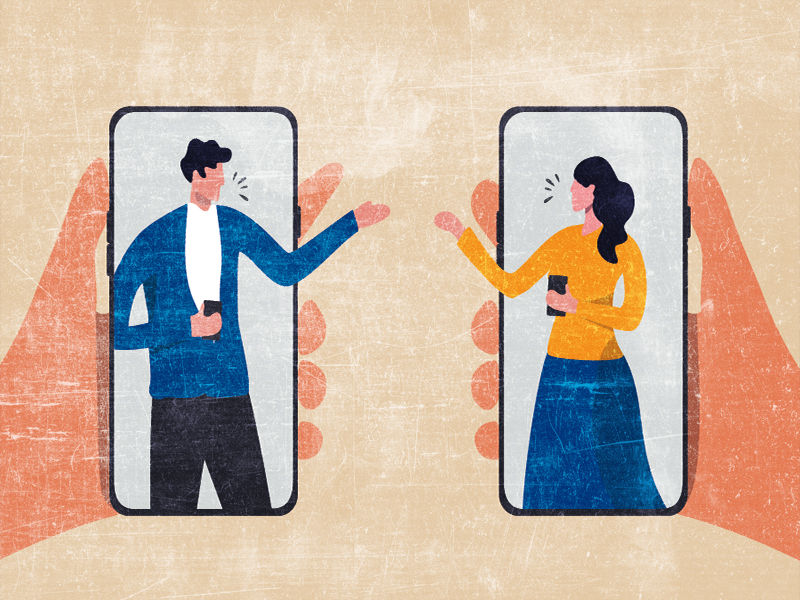
Tensions had been mounting inside and around me. “It is time,” I decreed to no one listening. “I need to call Estelle, it’s time to get back into therapy.” As always, Estelle responded immediately. Always there for me. We traded availabilities and landed on an appointment. I felt an ever-so-faint welling sensation of relief. I couldn’t wait to get back on the couch, both literally and figuratively.
Then came the blow. “I’m seeing clients virtually,” she said.
Like what you are reading? For more stimulating stories, thought-provoking articles and new video announcements, sign up for our monthly newsletter.
I first met Estelle when, nearly three decades earlier, I had, with her help, finally extricated myself from a very painful and self-destructive relationship. Ever since, I have been seeing her on an as-needed basis, during fair and foul emotional weather, for issues great and small, and at times just for a well-check. I have followed her from one location to the next, until she finally landed in a charming little 1920s Florida cracker house in the old-town section of Fort Lauderdale. Aptly named “Serenity Place,” Estelle’s office was inviting and warm, a throwback to a past era. Wood floors, rattan furniture, and that wonderfully perfect, just-short-of-mildew smell of “old” that permeated houses of that period.
It was a comfortable little space where I felt room and permission to spread out in all directions. While Estelle practiced a disarming blend of client-centered, Gestalt, existential, and systemic techniques, she was in essence, an Estellist; competent, genuine, and genuinely caring. She knew my backstory. It was her warm, confrontational, engaged, and creative personae that attracted and kept me coming back to that place of serenity. It was a package deal—therapist and space, inextricably bound. And it was to that space I wanted to return when I reached out to her for an appointment.
But virtually? No Serenity Place? No rattan couch, no creaky wooden floors, no lush foliage vying for my attention just outside her windows? And what about the basket of scarves she would cajole me to choose from to express my feelings? And how would she walk behind me to offer a counterpoint to the self-defeating prattle in my head?
Ironically and in the interim, I had taken on two former brick-and-mortar clients with whom I had worked over the years. COVID and all its related discontents had worn them down. When I first met with each of them, I had, of course, asked them how the transition to the small screen was for them. One, a physician who had expanded his telehealth services, and the other, a university professor granted the privilege of teaching from home during the pandemic, concurred that they were “used to it.”
The small screen had become second-nature to them, as it had for me as therapist, teacher, and editor; for in the latter role, I had and continued to solicit articles for Psychotherapy.net on the transition to virtual therapy. And a reading of the various blogs and essays on this topic indicated that therapists “out there” have, of necessity in many cases, adapted to the many challenges of this new mode of service delivery. For others, it was already a part of their therapeutic tool box. But I don’t think any of those who have written on the transition to telemental health have shared personal experiences of being a client during this new wave. Sure, they’ve shared some of the challenges of working with particular clients online, but that is as far as it has gone.
My hope is that each of them has created the space in their therapeutic work to explore the changed dynamics of intimacy between themselves and their clients, rather than presuming that all clients have adjusted similarly or optimally. The closest any of the therapists has come to addressing this was Matthew Martin and Eric Cowan, who wondered about the I-Thou relationship in the era of telehealth.
So here I am, now at this juncture in my 30+ year relationship with my own therapist, wondering if the “I” of me can still connect as deeply and intimately with the “thou” of her, or even if I want to try. I know the therapy outcome literature, particularly the key roles that alliance, collaboration, congruence, and empathy play; and I embrace the burgeoning literature on the efficacy of teletherapy compared to face-to-face encounters.
I acknowledge the privilege of having my choice of therapists, the money to pay her handsome fee, and the state-of-the-art technology to do so. The double standard is not lost on me, but I want to wail on Estelle’s couch, and I want to stand before her, eye-to-eye, as we role-play, and I want to have the option of refusing those gut-wrenching Gestalt exercises before petulantly conceding.
I wonder what will be sacrificed in that seemingly artificial moment, or what will be lost in the existential “here-and-now,” should I decide to pay a digital visit to Estelle. And along the way, I hope that therapists out there wonder the same.