Dangerous Intimacies: Racism, Risk, and Recovery

I Have These Fantasies

“I have these fantasies,” Ivan told me, his voice low and cold as stone, his eyes sliding away from mine and fixing on the wall behind me. “I wait for one of those women outside the building. I get her alone, and then I strangle her with my bare hands.” As he said this, his hands tensed and grasped, as if wrapped around someone?s throat. “I can almost feel it,” he said.

An African-American man in his early 60s, Ivan (a pseudonym) was in therapy with me for PTSD when he made these statements. I was surprised he expressed these feelings to me. Not because of the intensity or violence of Ivan?s words, but rather by the mere fact that he actually allowed himself to utter them out loud. We had been working together for over two years at that point, and this was the first direct expression of anger he had ever shown in session. Ivan had talked often about feeling angry—stating it in a vague and matter-of-fact way—but he had refused to do more than that. When I would encourage him to elaborate, he would just shake his head, press his lips tightly closed, and wring his hands. As I later learned, this was not resistance in the classic psychotherapeutic sense—it was something altogether different. By the time Ivan finally spoke his anger, I had come to appreciate what was at stake for him in doing so.

Resentment: A feeling of indignant displeasure or persistent ill will at something regarded as a wrong, insult, or injury (Merriam Webster)

Three years before this encounter, Ivan—a thirty-year seasoned social worker and substance abuse counselor who had received numerous commendations—found himself in an unexpected situation. During a session, a client told him she had herpes and was planning to go out to spread it to as many men as she could. Alarmed, Ivan told her that was unacceptable, and that she absolutely could not do such a thing. The client became angry and stormed out. On her way past the front desk, she told the receptionist that Ivan had grabbed her and sexually assaulted her. Rather than come to Ivan and ask him what happened, or asking anyone else if they saw anything untoward during Ivan?s session (he always left the door part way open during sessions with female clients), the site manager broke protocol and went directly to the police. Ivan, unaware of the accusation, went about his day.

The following day, the police came for Ivan, hauled him down to the police station, and harshly interrogated him for four long hours. They pressured him. They threatened him with violence. They yelled in his face. They laughed as they told him they could plant drugs on him and throw him in jail anytime they wanted to, so he might as well just confess to what he had done. This kind of scenario would be a harrowing event for anyone, but for Ivan—a black man who grew up in the inner city—interrogation by the St. Louis police was especially fraught. “I really didn?t know what they would do,” he told me. “”When you grow up in the city like I did, you stay away from the cops at all costs”. I was completely at their mercy. I honestly didn?t know what would happen to me in that room.”

Ivan was eventually released and, following a thorough investigation by both the police and the Department of Mental Health, was completely exonerated of any wrongdoing. Meanwhile, the client in question had recanted, admitting that she made up the allegation because she was angry. But it was too late—Ivan?s life was in tatters. Word had gotten out among both the professional social work community and the neighborhood that Ivan was a “sexual deviant” of some sort, though in typical gossip fashion, the details became contorted. He came home to see “child molester” spray painted on his garage. He had rocks thrown through his windows. Neighbors crossed the street to avoid him, and he was asked to leave neighborhood gatherings. His girlfriend of two years left him because of the rumors.

But worse than all of this were the symptoms of PTSD Ivan developed in the wake of his interrogation at the police station. He had nightmares and flashbacks. He would spontaneously start shaking uncontrollably and pouring sweat. He paced incessantly. He became completely unable to function, let alone work. And most intense and troubling for Ivan was his absolute terror of women. “I can?t be anywhere near women,” he told me. “I?m terrified of what they?ll do, if they might accuse me of something, of what would happen then. I can?t go back to that police station. So, I stay as far away as I can from females.” This might strike you as ironic, as I am a woman, and Ivan was telling all of this to me. In fact, we talked about this often, and I will return to it in a moment.

Ivan, understandably, harbored a great deal of resentment about everything that had happened to him. Notably, however, he was not upset with the client who accused him: “The client is, well, a client. You don?t expect them to act rationally,” he said. Nor was he upset with the police who interrogated him: “The police were doing their jobs. I was just some guy they thought had done this thing.” Rather, his resentment became directed at the coworkers—all of them women—who called in the police rather than following company protocol. “That?s what I don?t understand,” he said. “My coworkers, those women—they knew me. I had worked there for six years. That?s what really gets me.” In other words, Ivan?s resentment derived from the intimacy and vulnerability he had cultivated with the people—women—who then turned on him and put him in danger. The fact that some of these women were Black women particularly upset him. “They know exactly what calling the cops on a Black man can mean,” he stressed. “They put me directly in harm?s way. I can?t believe they did that.”
Re-Sentiment:
To feel something again, to experience the past in the present.

The Burden of Being Black

In contemporary American psychotherapeutic practice, therapy is supposed to be a safe space where clients can connect with and express their deepest and most vulnerable thoughts and feelings. The reigning ideology is that many of the troubles that people experience can be ameliorated by talking through what is bothering them, expressing unexpressed emotions, giving voice to submerged or disavowed feelings. Feeling again—or maybe for the first time—sentiments that have been foreclosed for any number of reasons. This is often a frightening prospect for clients, but for Ivan it took on additional significance.

When we first began meeting, about six months after the incident in question, Ivan insisted we keep the door open—not just a crack, but wide open. He was afraid to be alone with me behind closed doors. As he explained it, “What if you felt uncomfortable or just decided to interpret something some way and accused me of something? The police told me I could get twenty years for sexual assault. Twenty years! I?m 62—that?s a lifetime. If there was another accusation, they would put me away for the rest of my life.”
Given Ivan?s fear of women and his refusal or inability to become angry in session, it quickly became clear to me that the standard therapeutic interventions for PTSD were not going to be helpful. Not because Ivan didn?t have PTSD or that they wouldn?t have helped to relieve the internal push of some of his most troubling feelings, but because these interventions assume that a person is situated in a particular way in the social and relational world… or, rather, NOT situated in a particular way. As a Black man, some of the many harmful stereotypes Ivan had to contend with were that of being construed as scary or threatening, prone to violence or loss of control, hyper-sexed. Not only is it likely that such stereotypes prompted his coworkers to call the police, it affected Ivan?s relationship with his own emotionality, especially his anger.

One day, as he sat in my office trembling and sweating and talking about how his life had become a shambles, I tried to get him to express his anger about what had happened to him. After a few minutes of this, he looked up at me, incredulous. “I?m sitting here in this room with a White woman and you?re telling me to get ANGRY? You?ve got to be kidding me. I can?t do that.” I assured him that it was ok, that this was part of his process of healing, and he just scoffed. “Doc, I know you mean well but seriously, you don?t understand. I just can?t do that. I?m a Black man. You?re a White woman. I can?t get angry around you. I?ve learned my whole life that that?s a dangerous thing to do. I just can?t do it.” Despite my assurances that it really was ok to do so, Ivan was adamant. It was, he said, for my own protection. “Not that he would ever actually hurt me, but, rather, that I might become afraid of him”. And that, he felt, would be its own kind of violence. It could also put him in danger. “What if you get scared? What if you call the cops? I?d be right back down there looking at twenty years.” Anger, in other words, was not a discrete, personal emotion or feeling for Ivan, at least not in the context of his relationship with me and others who look like me. It was part of an interpersonal anger/fear dynamic with deep social and cultural roots steeped in race, gender, and sexual bias that shaped not only how Ivan expressed his anger (or didn?t) but also how he experienced himself as a person and how others experienced him—as a potentially threatening, scary force, regardless of his actions or intentions.
Ressentiment:
The persistent indignation of the historically oppressed
(Nietzsche)

“In Ivan?s case, it was obvious to me that race likely played a role in his coworkers? assuming he was sexually dangerous and calling the police”, and that it also likely played a role in how he was treated at the police station. But Ivan himself did not bring up these issues. I waited for many months for him to do so, but he didn?t. So after about a year, as he became somewhat more stabilized, I did.

One day, as Ivan sat on my couch jiggling his leg and wringing his hands, I said, “I wonder how your being a Black man might have figured into what happened to you. Do you have any thoughts about that?” He immediately stopped jiggling his leg and looked up at me, intently. I worried that perhaps I had offended him. “Doc,” he said. “It has everything to do with it. But I didn?t know if it was ok to talk about that in here.” I assured him that it was, and this opened up a whole new line of exploration in our work together. It was only in the wake of this that he was able to tell me why he was afraid to get angry in session, and for us to work toward making that a safe thing for him to do.

Ivan doesn?t blame racism for everything, though. “I keep thinking I must have done something to bring this down on me,” he said. “I must have. Otherwise, why me?” Though at the same time he is adamant: “If I had to do it all over again, I wouldn?t do anything differently. Not one single thing. You cannot go out and spread herpes to a bunch of people. No! You cannot do that! So, I would tell the client the same thing. I wouldn?t do anything different. That gives me comfort.”

Resentment, Race, and Recognition

We have, then, three facets of the feeling of “resentment” with and within which Ivan is operating (resentment, re-sentiment, and ressentiment), each having to do with his positionality as a Black man in 21st century St. Louis, MO, and each significantly impacted by the relational context of being in therapy with me, a White woman. This reminds us that affects such as anger, fear, and resentment don?t just function in one certain way for all people, at all times—or even the same person at different times. Affects and emotions are not stable, whole, inviolable states that we either have or don?t have, like the flu. They have texture, context, and dynamism. Importantly, how we experience and express affects and emotions is deeply culturally and historically shaped. Therapies that isolate and target them as abstract phenomena (“anxiety,” or “depression,” or “fear”) dislodge these feelings from their lived realities and can, as in Ivan?s case, compound a client?s sense of alienation and disconnect rather than foster recognition and healing.

As I write this now, Ivan is doing well. We are down to one session every three weeks. He still gets triggered and has moments of intense rage or panic, but now he can go to the grocery store and complete a shopping trip without having to leave if a woman walks too close to him, and he can ride the bus without having to sit way in the back to make sure no women are behind him. He?s even considering dating again. “I never would have believed it,” he told me. “When we first met, I thought ?Oh Lordy, how is this White girl going to help me?? I thought, ?God has a pretty sick sense of humor.? But you know what, Doc? I?ve learned a lot; you?ve taught me a lot.”

Perhaps. But Ivan taught me a great deal as well. Among other things, he taught me that, even as we care for our clients, they care for us, too, and often in ways that remain invisible. But more than this, Ivan?s caring for me by “protecting” me from potential fear (and, by extension, protecting himself from the possible consequences of that fear) led me to reflect on the fact that all emotional expression is not created equal, and not everyone has the freedom or the luxury to “get in touch with their feelings” or “use their words to say how they feel.” Affect and emotion are highly racialized in the United States, and for some people, the honest expression of those feelings can be literally—even fatally—dangerous. This understandably can evoke deeply ingrained cultural scripts about who is allowed to feel what feelings and in the presence of whom, which can affect the process and course of therapy in ways that are both subtle and profound. Clients of color, and especially Black clients, carry with them not only their personal histories but also centuries of oppression, racism, and accommodations to White privilege. It?s not enough for a therapist to be informed or to feel they are open-minded and treat all clients equally. Because the world is not an equal place. “Equal” is not what clients of color have grown up with and live on a daily basis. It?s not the world they walk into when they leave the therapy room.

So what to do? Does this mean that clients of color should only see therapists of color, and white therapists should only see white clients? No. But it does mean those of us who are White clinicians are ethically obliged to educate ourselves about racial dynamics and injustices and be prepared to discuss them from a place of respect and openness with clients of color. We need to be willing to take an honest and hard look at our own privilege and how it shapes our beliefs about health and healing. And we must recognize that the theories and interventions we have learned as “best practices” are based on White norms and do not take into account the legacies of bias and oppression that shape Black clients? emotional experiences and expression. This does not make these tools useless or ineffective. But it does make them partial and in need of active interrogation and adjustment (for a collection of excellent resources on where to begin, see Race and Racism: Resources for your Practice).

I am incredibly fortunate that Ivan took a chance on me. He was traumatized and vulnerable and he took an enormous risk working with a woman, and a White woman at that. He says I taught him a lot, but what he has taught me is infinitely more valuable: he taught me to recognize how much I don?t yet know.

References

Merriam-Webster. (n.d.). Resentment. In Merriam-Webster.com dictionary. Retrieved July 7, 2020, from https://www.merriam-webster.com/dictionary/resentment.

Nietzsche, Friedrich. (1989). On The Genealogy of Morals. (W. Kauffman & R. J. Hollingdale, Trans.). Vintage Books. (Original work published 1887)

A Silent Dialogue: Coming Together During Troubling Times

An Unspoken Dialogue

“I’m not really sure why I made the appointment that day. Despite the pandemic, I hadn’t lost much of anything. I was weathering the viral storm and had no significant life ‘problems,’ and certainly none in comparison to the tragic stories I heard and saw in the lives of others. While I was able to remain relatively insulated, I had grown increasingly isolated, so turned more and more to the news and Twitter. But it seemed like a different virus, one far more virulent had taken hold, and I grew angrier with each story of injustice and ignorance. Division, violence, hardship, poverty, and hatred seemed to be competing in a zero-sum, race-driven death spiral. Was there something about those stories of racism that touched a nerve, leaving me looking inward to wonder, ‘Had I been quietly infected early on?’ ‘Was I asymptomatic, and perhaps a carrier?’ ‘Did my privilege cast a white self-blinding light?’ I’m not sure why I went to therapy that day, or why I sought out a Black clinician.”

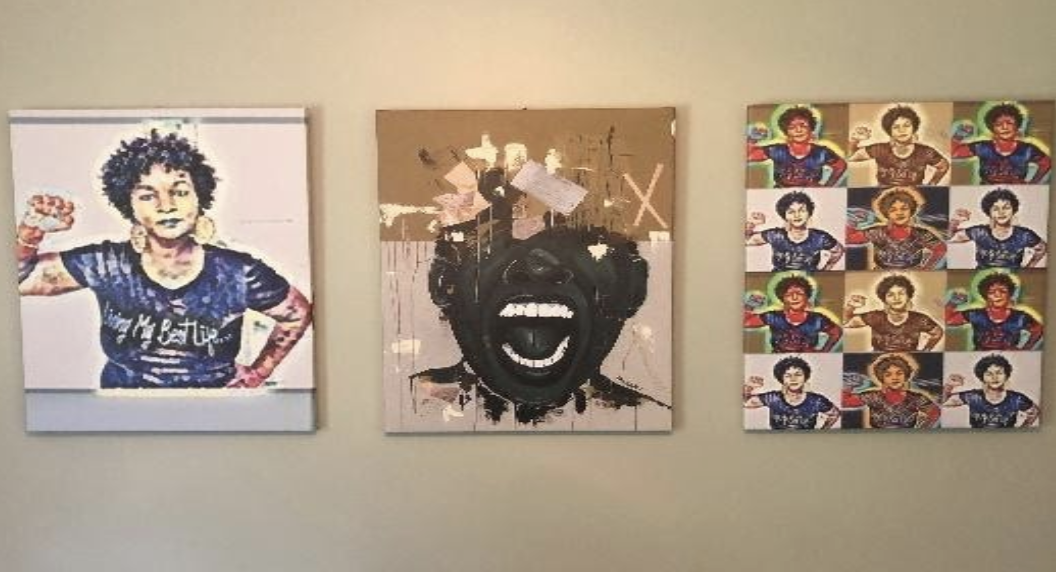
“I have a White client coming today, and what I’ve learned about myself as a person, based on my interactions with both Black and White clients, is that we all have a need for acceptance and power. As a Black therapist, I try to live as a person what I ‘preach’ as a therapist. I acquired the three images that sit behind me as a result of wanting to portray a visual representation of ‘justice for all.’ The photo of the man, I have called Justice, screaming to be heard. The one with me holding up my fist reflects exactly what I feel inside. The photo of multiple ‘me’s’ not only represents my willingness to fight and my desire for universal equity, my own power and strength, but also, the multiple shades of justice.”


“She seems like a confident, no-nonsense, get-right-to-the-point person—refreshing considering the passive clinicians I’ve worked with in the past. Granted, they were White, and this woman is Black, so maybe given what’s going on in the world, she doesn’t have time for the bullshit, but I do feel a bit pressured, although I like her style. I wonder if she has any thoughts about working with a White client. Those pictures she has behind her on the wall are so far from the neutral, Rorschach-esque pastels that other therapists have had scattered around their offices. You know, those faux-art reproductions designed to convey the therapist’s neutrality. These are as about as far from neutral as possible. The ones with the woman holding up her fist even looks like her. Why would she put such seemingly provocative images in plain sight, and are they really her? Isn’t that saying a bit too much about her when this is supposed to be about me? I’m curious, but I don’t want to ask. Is she inviting, or perhaps provoking, a discussion about race?”

A Picture is Worth a Thousand Words

“He seems to be looking at my pictures a lot, so I wonder what is going through his mind. Is he curious about their content and what they might represent? Has he made the connection that the woman in those pictures is me? Does he wonder who the screaming man is? Maybe he is thinking I have shared too much about myself and my beliefs and is intimidated. I’ll let the conversation flow for a while and see if he decides to bring them up. I certainly have had some interesting reactions from other clients, both Black and White. My reason for placing the images directly behind me for clients to see when they look at me, either face-to-face or virtually, is to remind myself and others that we are all in a fight of some kind against an injustice. Some fight for basic human rights, others fight for sobriety, while still others fight to escape the burden of physical, mental, and spiritual inequity. Whatever that thing is…we are all fighting. The pictures also serve as a reminder to not become complacent and comfortable…but to remain aware and educated.”

“Today’s was an interesting session. We talked about my anger over current events and my perception of the fights in the streets around and about racism. I shared a bit of a growing awareness of my own White privilege and a sense of guilt over those privileges that I did nothing to earn except be born. I’m not sure why I feel angry or guilty but wonder if by my silence or unease about entering the fight, I am indeed guilty of closeted racism. I want very much to ask her about the pictures, but that seems intrusive and presumptuous. But then again, why would she so boldly display them, unless they were important to her as a person and as a therapist. Maybe we can connect more deeply through them…but is it my place? Isn’t the stuff in her office supposed to be neutral, so this therapy is about me and not her?”

“I typically explain to my clients, although not all, that the images represent strength, power, advocacy, and fighting for others. I explain the concept of “justice” as it is stated in the ACA Code of Ethics Preamble. I explain my role as a therapist, and why I stand by those who are marginalized, traumatized, victimized, and who are often objectified and seen as little more than their diagnosis or disease. I explain that I live my life fighting for others. I express my belief that they, too, should engage in advocacy, educating themselves and standing up to their diagnosis or disease, or to anything else that has been levied on them. This client seems particularly interested in these issues, so I will take a chance and ask him about his perception of the images. I know this is very directive, but then again, passivity is the enemy of change.”

“‘What the hell,’ I thought. I am here, she is here, we are here working together, and those images strike a chord in me. They make me angry, but not the kind of angry that I take away from the news. It is the kind of anger that makes me want to fight against the unjust way I treat myself, the way I have stifled my voice at work, with my partner, with my friends. They make me angry at my parents for forcing such a passivity on me while growing up. ‘Respect others, don’t raise your voice, don’t ask for what you want, don’t bring attention to yourself,’ was our family mantra. And here I am, in mid-life, still not asking for what I want, what I deserve, still feeling oppressed. No wonder those images are so provocative. While it would be so easy to see them solely through the lens of race and racism, they are universal. That they are of Black people is simply a reflection of this therapist’s beliefs, and she has not tried to foist them on me. She has patiently waited for me to open to them…to myself. Makes sense now.”

“The primary population I work with is comprised of substance abusers. My interactions with both White and Black clients seem to largely be successful. I believe the therapeutic key is seeing and treating them as whole people, regardless of color—leaning into them, talking, laughing, and getting very honest with them—minus all the therapeutic jargon that they do not care about or understand. This client is not of that diagnostic population, but he seems to resonate with the messages of the images. In today’s session, he talked about his family and himself at a deep reflective level, and he was passionate. Although I was not quite sure why he first came to see me, it is making more and more sense. He strives to be heard, for power, for a kind of personal, internal justice. He seems oppressed. He is White and, in many ways, privileged, but he is struggling. Perhaps this is why he is so angered by the racial events around him.”

“That was a hell of a session. I finally came out with the question—‘Am I a racist?’ I finally asked her about the images, and we had a great conversation about race, racism, her life, my concerns. We share much in common, and as it turns out, I have been oppressed, and that is why I have been so angry. I get it! Not because I have been denied access to public places, followed around in a store, profiled or persecuted—at least not by others. But by myself! I’m not a racist, but I get it, I understand racism. I am a self-ist; a one-man militia armed to suppress any rebellion that might arise within me that seeks power, justice, and freedom to live. I have not been physically attacked, verbally harassed, or threatened within an inch of my life. “I haven’t needed external oppressors. I have done quite a good job doing that to myself”.”

“He is making swift progress and putting the pieces together. He is looking deep inside, and it is painful, but he is marching. He finally asked me about the images, and while we spoke about their role in my life, we quickly shifted that conversation to his own. He connects with the anger around racism because he has been attacking himself. While outwardly privileged, he has been inwardly oppressed, and he has been the oppressor, with the help of some lingering childhood scripts. I’m glad he finally asked about the images, and that I have had the courage to display them. I don’t think he is racist, and while he can’t truly feel what I and other Black people feel, he understands oppression. I have had similar experiences with some of my other clients. Positive reflections of my background images have been offered from both Black and White clients. The comments have included, ‘I like your artwork—I have art around my house’ (Black client) and ‘You put pictures up, tell me about these…love the artwork’ (White client). Some have gone deeper, as has this client. Some have been ready to explore, so we have dived deep; others less so.

“I am going to schedule a few more sessions and am no longer calling it ‘therapy.’ It is advocacy. I have joined the fight to liberate myself, and I hope to turn that fight outward to help others who are being oppressed.”

“I just logged on to join my IOP group. One of the clients (White female) who missed the group said—out loud—‘Tori, your picture in the back is so empowering!’ She then said…‘I love it!’ Needless, to say, I was smiling from ear to ear. I’m gratified.”  

Barriers and the Black Experience in Mental Health Care

Initially, I struggled with writing this piece. After a couple of weeks of writing, rewriting and tossing, I finally locked in on my block. The issue is this: it is nearly impossible to write a short blog piece about the black experience in mental health. This goes for both my perspective as a black physician and the perspective of the black patient. I worried about being reductionistic with an incredibly important and deeply layered topic.

Like what you are reading? For more stimulating stories, thought-provoking articles and new video announcements, sign up for our monthly newsletter.

There is no simple way to condense the experience of being black in any context. As I considered the different factors that influence the black experience in mental health care, I realized that the histories of discriminatory practices, unethical research, denial of care, racially biased diagnosis and treatment, and poor representation among mental health care providers each deserve volumes of exploration.

That being said, I know that discussing the foundation of racism and discrimination in mental health care is a start. This is the legacy upon which many black patients sit when they come to our offices each day. Three issues in particular have been substantial barriers to my own patients’ seeking care: lack of resources, distrust, and mental illness stigma.

Lack of resources

Jared, a 20-year-old black male, arrived at my office with his mom. Jared, who was living with his mom and younger sister, was unemployed and spent most of his time in his room. They had traveled nearly an hour to see me, as there were limited mental health resources in their community. Jared wanted to see a black psychiatrist but struggled to find any in his city.

Low-income communities and communities of color typically have the fewest mental health resources. To find care, residents often travel far outside of their communities, creating an unnecessary burden. For those with limited finances, arranging transportation, time off from work, and childcare can make access difficult.

When resources aren’t available, information and education aren’t brought into these communities. Mental health practices and clinics not only provide clinical services, but often are the center of knowledge about mental illness and support for those dealing with these conditions. When those resources are absent, members of a local community may not understand their conditions or their options for care and support.

Also absent from the black community are black mental health professionals with a similar lived experience and background. Many black individuals are interested in working with a black therapist or psychiatrist. However, only 4% of psychologists and less than 4% of psychiatrists are black. Non-black mental healthcare providers are less likely to provide racially sensitive and culturally competent care. Black providers are more likely to understand how blackness has impacted the black mental healthcare experience. There’s no need to explore the racial differences between the provider and patient. The focus can be on the reason the individual is seeking care. More importantly, black providers are more likely to understand and be sensitive to the problems black clients experience accessing mental health services.

For some patients and clients, there is a sense of pride in seeing one’s own people successfully navigate the training and career pathway involved in becoming a therapist or psychiatrist. Many black patients feel strongly connected to the success and accomplishments of other members of the black community.

Distrust

Dustin, a 24-year-old black male, had recently moved to Austin. He had dealt with anxiety since childhood. Now living with his aunt, he struggled to go to work each day and rarely socialized. After a long discussion, we agreed to start a low dose SSRI. He missed his first follow-up appointment. He came to his next appointment only to disclose that he had not started his medication and didn’t believe that it would help.

The history of medicine in the United States is fraught with racially discriminatory practices against black people. From non-consensual sterilization to the syphilis experiments, black people have been dehumanized and harmed by unethical medical practices. On the flipside, more recent medical research often fails to include representative black populations and often underrepresents the impact of disease and treatment in the black community.

In mental health, studies have consistently shown bias in diagnosis in black patients. Black patients are more frequently diagnosed with schizophrenia rather than mood disorders when compared with white patients presenting with the same symptoms. Even when a correct diagnosis is made, black patients are less likely to receive evidence-based care than their white counterparts.

These deeply embedded practices and history have cultivated a mistrust, and at times a fear of health care and mental health care institutions in the black community. There is legitimacy in the black community’s concern about misdiagnosis and inappropriate care. Unfortunately, some have chosen not to seek care when needed.

Mental Health Stigma

Erica, a mid-30’s black woman, presented with depression for most of the past year. Raised by two loving parents, she had attended graduate school after college and now worked as an assistant professor at a local university. She had never sought professional help for her mood symptoms, but worried that they were interfering with her work and home life.

Stigma surrounding mental illness is pervasive in the black community. When Erica opened up to her mother about her mood concerns, her mother advised her to talk to her pastor. She discouraged her from seeking professional help worried that people might think she was “crazy.”

Mental health stigma and misinformation has created a reluctance for many in the black community. Holding shame around mental illness means that individuals are less likely to seek appropriate care. When they do look for help, black individuals are more likely to seek counsel from places of worship or family and friends. Unfortunately, their help-seeking often stops there.

Culturally sensitive care recognizes these issues and makes space within the therapeutic relationship for these issues to be acknowledged honestly to the degree that each individual needs.

***

Consider all the spoken and unspoken concerns that accompany your clients or patients into your office. The basics of accessing care, trusting the intentions and guidance of care providers, and trusting the legitimacy of their own health concerns complicate the black experience in mental health care. Psychiatrists and therapists should examine their own beliefs about and around issues of race. Understand what influences your practice and informs how you bring cultural sensitivity into your patient or client interactions.
 

Beverly Greene on Race, Racism and Psychotherapy

Race, Racism, and Privilege

Lawrence Rubin: At this particularly charged moment in the history of race relations in our country, what is the primary message you want to share with psychotherapists, particularly white psychotherapists working with clients of color?
Beverly Greene: I think one of the charged characteristics of this particular time, and thereʼs a corollary to this in our history, the Civil Rights Movement and the marches during the Civil Rights Movement, is the way technology affects a movement.At that time, it was television. Many people across the country probably didnʼt believe that black people were being brutalized just because they were trying to register to vote until it was in everybodyʼs living room on television and being beamed all over the world. This beacon of democracy, the United States, held a group of its own citizens hostage in terms of civil liberties that are presumably granted to everyone. So I think it pushed some legislation along because it was an embarrassment to the government. It also became undeniable when it became visible over over and over again to people sitting at home in the middle of Paducah or wherever, who were not surrounded by that kind of activity, or hadnʼt previously had contact with black people.

And weʼre in that moment now, in terms of cell phones. Suddenly, if you step outside your house, YOUR privacy is gone. Everybody has a camera, and all these things are recorded. I think the sort of synergistic effect of all these killings and the power of George Floydʼs murder has resulted in an unambiguous, unassailable level of evidence that says, this is a serious problem, and this is real.

One of the challenges that people of color often face is that when they talk about their encounters with racism, theyʼre not believed, or itʼs minimized, even in therapy

One of the challenges that people of color often face is that when they talk about their encounters with racism, theyʼre not believed, or itʼs minimized, even in therapy. Therapists may want to explore all the other things that could have been going on in addition to, rather than race, which may seem so completely foreign in the life of a white therapist. In actuality, racism is an everyday occurrence for a black person or another person of color. The existence of racism is a real social phenomenon and not just something black people make up to make white people feel guilty or uncomfortable.

It is something that is connected to real challenges and obstacles that people of color must negotiate both practically and psychologically. In order to fully understand their patients of color, therapists need to appreciate that racism, as a form of social inequity, may be an unrelenting challenge to that client.

LR: What personal barriers might stand in the way of a white therapist fully grasping the reality of living as a black person in a racist society?
BG: Well, I think that we live in a society that is, in some ways, dominated by race, but also surrounded by a denial of that fact. I still see discussions on news programs in which leaders of various parties and contingencies are asked, “Do you think there is systemic racism in policing? In criminal justice?” Well, if anybodyʼs still asking that question, hello, where have you been?
LR: Theyʼre not getting it.
BG: I think the simple answer is that many people donʼt want to get it because it makes them feel uncomfortable, and this includes therapists. I donʼt know that all institutions do an equally good job at training prospective therapists to have that conversation. It can be highly variable. Even though race is a clear and evident social phenomenon in this country and has been for 400 years, there is a mutual denial of it, and so there is a pressure to not talk about it. Itʼs a difficult dialogue. Itʼs not something people have learned to have conversations about. If anything, itʼs something about which conversations are avoided. And so,

in therapy, many therapists donʼt know how to have that conversation, and are not comfortable with the notion; what if they say something that may be racist?

in therapy, many therapists donʼt know how to have that conversation, and are not comfortable with the notion; what if they say something that may be racist?

LR: Or offensive.
BG: Yes, but those are things therapists need to be addressing in their own professional development. If youʼre not having that conversation, why arenʼt you? What does it mean to the therapist to have that conversation? What if you do say the wrong thing? I mean, as therapists, sometimes we donʼt always get it right. So, what does that mean to the therapist? Itʼs about looking at, as you would many other issues, why would the therapist need to avoid that? Why might the patient have reluctance raising it? Patients may expect that theyʼre going to be told, “Itʼs you. There must have been something else going on. You must have done something wrong because people donʼt behave that irrationally.”Therapists must be able to confront their own reluctance or unwillingness to engage with a patient of color who has had experiences that are very different from their own.

LR: Why is race that much more of a challenging issue than some other ones like sexuality, gender, or religion? They are all important.
BG: I think that for many therapists, discussing matters of sexuality is fraught with challenges as well, but therapy is a place where we discuss difficult things. I mean, we discuss things that one would think are much more emotionally laden than race. Perhaps therapists are afraid of finding something in themselves that they donʼt want to see. Racism, despite its ubiquity, along with racist beliefs and practices, is not something people want to cop to. Even people who in fact are, will say no, theyʼre not racists, they just believe in white supremacy, or that theyʼre some other thing, but no one wants to be considered racist. For the most part, thatʼs not something you want to be. Thatʼs not a positive thing. Thatʼs not a neutral thing. And so, if people are afraid that it may be in them and itʼs going to slip out, what does that make them? Psychoanalyst Kirkland Vaughans observes that race has the capacity to evoke so much anxiety that it blocks the capacity to think. If the therapist is blocked in this way, a productive exploration cannot take place.But again, exploring difficult material like race is part of the work of being a therapist; you do so as you would any other tender or charged issue. We are obliged to ask, what is there that we fear finding in ourselves that is triggered by what the patient is raising? We are responsible for putting our own needs or distress on hold and exploring that which is in the patientʼs interest, regardless of how it makes us feel in the moment. We must ask ourselves, what is there that youʼre afraid of finding in yourself that may be raised by a patient? And some of that gets back to the practice issue. Typically, there isnʼt enough practice in having that conversation.

LR: You have quoted Cornel West who says, among other things, that “The challenge of being elite is to avoid the practice of elitism.” This seems to be related to what youʼre saying now because for a therapist, especially a white therapist, to acknowledge that they are an elite just by virtue of the color of their skin may be very, very difficult and uncomfortable for them; so much so that they avoid the conversations completely, and in turn, minimize their black clientʼs experience.
BG: Well, he was using the terms “elite” and “elitism.” One could say that

no matter what color you are, if youʼre a therapist, youʼve benefited from a level of education and opportunity that probably puts you in a group of, you know, maybe less than 10% of the general population

no matter what color you are, if youʼre a therapist, youʼve benefited from a level of education and opportunity that probably puts you in a group of, you know, maybe less than 10% of the general population. And that is a kind of eliteness, because youʼve had access to things that many people donʼt have access to, some being knowledge, but also just the ability to access certain institutions and the resources of those institutions.

I think heʼs talking about acknowledging having a certain level of privilege, which is the ease of access that one did not deserve, that one acquired by simply having a characteristic that the world values for probably the wrong reasons, but which just makes life easier. I donʼt think that most, not just white therapists, but that most white people donʼt walk around thinking about being white and what thatʼs apt to trigger in someone, and what they may need to do to manage that.

In contrast, people of color have developed an anticipatory intelligence, they are socialized to develop a kind of anticipatory intelligence around being very aware that they are people of color—which may exist at various levels of consciousness. For some people, it may operate on an unconscious level, while for others, itʼs the very conscious and deliberate practice of considering what their skin color is going to evoke when they walk into a room or when theyʼre interacting with white people. What is it your race is going to evoke in someone? What will you have to manage in response to that which gets evoked?

Thatʼs what having “the talk” is about among black families. Itʼs understanding what your children evoke in a police officer that their white counterpart does not evoke. Black children are often socialized around the notion of, “Youʼre as good as anybody, but you canʼt get away with what white kids can get away with, so remember that. If you do something, itʼs going to be seen and judged differently, and the punishment may be much harsher.”

All that highlights the difference between being privileged and not.

If youʼre privileged around something, you donʼt have to think about it

If youʼre privileged around something, you donʼt have to think about it. You donʼt have to think about how thatʼs going to negatively affect something youʼre about to do, or how it could get you hurt, or how itʼs going to transform an understanding of how youʼre responding to something. For example, during the initial COVID crisis back in March, I remember seeing some articles in response to the requirement to start wearing masks. What happens if you are a black person wearing a mask and you go into a store, or youʼre out in the street? How are you going to be perceived? Might you be perceived as suspicious? Might you be perceived as a criminal? Something that in a pandemic is a perfectly appropriate thing to do, may be seen differently if that mask is on a white face or a black face.

Hated, Unsafe, Unprotected

LR: I went into a gas station wearing a mask in a very white North Carolina town a few weeks ago, and the white guy behind the counter raised his hands in mock surrender and said, “Donʼt shoot.” I know he was being facetious, but maybe not. It went right through me in a way that I couldnʼt even comprehend. I knew it was a joke, but there was this bizarre presumption that because I had the mask, I was up to no good. So, I imagine that if I was a black man walking into that same gas station in that same town, I might have carried the additional burden of fear. Thatʼs the closest Iʼve come to being identified in that way.
BG: To being niggerized?
LR: Please say more.
BG: One could say, based on Cornel Westʼs use of that term and definition, that you were niggerized in that moment. You can take a mask off, but you canʼt take your skin off, and skin color for black folks leads to the presumption that youʼre up to no good all the time. You never have the benefit of the doubt. Your skin color says to them, “This is somebody whoʼs up to no good.” So you get followed around stores, or you get treated differently if youʼre asking to see certain merchandise.I think itʼs important to be aware of the intersections of class and other identities around race,
and how it can transform that experience, but the notion that social class and having money means people no longer experience racism is nonsense. Nobody knows how much money you have when you walk into a situation. The first thing they see is your color, and a range of judgments are made about that which supersede other considerations, and which can trigger behavior that you then have to manage, you know, whether you have other resources.

LR: So, what would a white therapist experience working with a black client who has been niggerized have to be aware of and look for, so they can respect and address it?
BG: First, let me explain what I think West meant when he coined that term. He first used that term in the aftermath of the 9/11 attacks, and the way the country was reeling in shock; feeling frightened, taken off balance, feeling unsafe. He said, “America has been niggerized.” Because

to be niggerized is to be hated, to be unsafe and unprotected

to be niggerized is to be hated, to be unsafe and unprotected. But thatʼs the status under which black people have lived in America for 400 years. And suddenly, America was made to feel hated, unsafe, and unprotected. He suggested that America could learn something from black Americans about how you manage being hated, unsafe, and unprotected. Because that is a part of the socialization of black folk, and thatʼs what black families do with their children. Theyʼre teaching them, “Thereʼs this thing youʼre going to have to manage.” Every black parent knows that they cannot protect their child from it, but they teach them how to recognize it, how to manage it, when you do something, when you donʼt, what you can do, and all those things.

But black Americans have survived. I often look at the ways that black people are vulnerable to less than optimal health and mental health outcomes, and I think itʼs important to flip that question and ask, “Why isnʼt that more so?” Because if you look at the kinds of challenges that black Americans face, many of them are the same that were faced in the past. Why are they not more damaged or riddled with problems?

In ʼ68, not long before his murder, Martin Luther King gave the keynote address at the annual meeting of the American Psychological Association, and everything he talked about in that keynote speech in terms of things that we needed to address at that time, a series of social problems, could have been written two weeks ago. On the surface, there is a great deal that has changed, but systemically, many of those things have not changed.

LR: So, when a black client comes into the office of a white therapist, they may carry with them a history of feeling hated, unsafe, and unprotected. Are they at further risk by a white therapist of being pathologized for those very characteristics that are part of having been niggerized?
BG: Well, yeah. Iʼve heard therapists in training incorrectly presume a level of paranoia on the part of the patient, a black patient, who was responding to what it is like to walk around as a black man, in ways that the therapist was clueless about. They werenʼt paranoid, they were appropriately vigilant. There is a difference between fearing something that isnʼt there and being appropriately vigilant about something thatʼs real, that you have to manage, and that your patient has had experience having to manage.I think itʼs also important to not disregard indications of potential pathology, because you donʼt help patients by doing that either. But you also have to look at every patient in terms of the nature of the social milieu that they walk around in. What happens when they walk around your neighborhood, as opposed to when you walk around your neighborhood? Thatʼs something that should be understood before the patient walks through the door.

You donʼt assume that whoever walks into your office is you or a reincarnation of your experiences

You donʼt assume that whoever walks into your office is you or a reincarnation of your experiences.

But when we view a patient, a posture of ignorance is where you should be. You donʼt know this person. You have everything to learn, and the more you assume you know about them or the more you assume you know about their experience, the fewer questions youʼre going to ask. And the questions you ask people are, I think, what is most important in therapy, not the answers that you come up with for them.

Presumptions and Pitfalls

LR: Is that what you refer to as the clinical pitfalls of assuming homogeneity among black clients?
BG: Well, thereʼs an assumption you make about a person when you say they are “overly suspicious.” Compared to what and whom? If you live in a country that is as racist as this one, how much suspicion is warranted? For a therapist to make uninformed assumptions about that, I think, is already an error. It depends on that personʼs life. What is that personʼs milieu like? What is their history? And, in some ways, what is their parentsʼ history? If youʼre dealing with someone whose parents have had really traumatic experiences around racial discrimination, around police brutality, or other kinds of things, we know damn well thatʼs going to affect parenting. So how did it affect the parenting of your patient? What kinds of things or strategies have they internalized that may be useful or may be less useful?Black patients address a real phenomenon in racism. But like any other thing that people address in therapy, some forms of solutions that theyʼve derived can be useful; some may not be. And so thatʼs kind of what youʼre looking at. And good racial socialization in families addresses that. Youʼre helping kids figure out, well, in Situation A, what do you do if that happens? How do you have a template for figuring out when you say something and when you donʼt? What does it mean if you let it go? What is it going to mean if you say something? Who are you saying it to? Does this person, if theyʼre made uncomfortable by your challenging them, do they have the power to hurt you? If itʼs a police officer, they do, so you donʼt challenge them. You become obsequious and compliant.

Thatʼs just one example. But thatʼs what “the talk” is about. Itʼs like in this situation, you may be in the right, but this person has the power to hurt you and, as weʼve seen in the legacy of this country, take your life and get away with it. And I hear that in conversation weʼre having in our family with my fatherʼs great-grandson, that my grandmother had with him. So, even in terms of the post-traumatic stress model of understanding racism, itʼs not post.

Racism is an ongoing stressor and potential trauma for people

Racism is an ongoing stressor and potential trauma for people. Itʼs not like a discrete entity or experience, and now itʼs over, and youʼre not going to have that again. Itʼs part of a way of life. Managing it is part of a way of life.

LR: We started this piece of the conversation around white therapistsʼ assuming a certain level of paranoia in a black client if theyʼre not aware that itʼs frightening and life-threatening to live as a black person in our society. Might a white therapist make similar presumptions around depression or trauma?
BG: Well, you know, I think some of the questions youʼre asking are relevant in terms of what good therapy is, and what is sort of symptom-focused….
LR: Diagnostic?
BG: Reductionist, lazy kind of therapy. I donʼt treat depression. I treat a person who is depressed. And that means learning everything about that person to understand what this means in that personʼs life. Because what it may mean in another patientʼs life may be completely different.
What does it mean to be depressed? When I see black women, for example, who often feel like they have to be ubiquitously strong all the time for everybody—well, you know, if thatʼs kind of their model of what they need to be, then it becomes important to address their depression in that context in order to understand what that means in terms of that personʼs inability to function in their milieu. Itʼs not just, “Okay, youʼre depressed, hereʼs the prescription.”In therapy, Iʼm trying to understand that personʼs experience of the world. What is it like for them to navigate the world every day? To get up, to do whatever it is they have to do, the challenges they face. What do they have to do to negotiate those challenges? To what extent is the external world helpful and supportive? To what extent is it part of the problem? To what extent are familial and community relationships helpful and supportive? To what extent are they part of the problem?

I guess one of the earliest things that I learned in psychology courses, probably before I necessarily thought I wanted to become a psychologist, was that you donʼt analyze behavior outside of understanding its context. Behavior is contextual. And the notion that this thing is a thing thatʼs located in the person and itʼs their defect, I think is the hallmark of what is problematic in what has been the history of institutional mental health.

We problematize the person and fail to try to understand how this person is interacting with the social world at many different levels. And sometimes, what people of color are doing is trying to cope with social pathology. Theyʼre not pathological. Theyʼre trying to cope with pathological situations in which they may have an inadequate range of resources. And so their solutions are not optimal. Or they may be trying to cope with social racism or something in a workplace and have a certain amount of baggage that theyʼve accumulated from a family where they didnʼt really get helpful instruction around how to manage these things and how to recognize them, or they have been complicated by family pathology or dysfunction.

All these things are going on, and they go on differently for every individual. Even when people belong to the same racial group, pretty much any black person I see, I assume theyʼve been confronted with racism at some point. It doesnʼt mean that I know anything about how they experience it, what they attribute it to, how they understand it, what they think theyʼre supposed to do about it; all those things are different for every individual.

Thereʼs no cookie-cutter kind of assumption that you can make that says, “Okay, now I know about that.” You must ask patients about their experiences in that way. Even if youʼre not a white therapist, it is important to ask patients if they think you can understand what the world is like for them? And if they think you can, why do they think you can? And if they think you canʼt, why do they think you canʼt? And itʼs not for the purpose of convincing them that you can because there are going to be things that you wonʼt understand because nobody understands anyone perfectly. But it helps to say, “What is the world like for you? What would having my understanding of that look like? What are the things you think I wouldnʼt understand, and why is that?”

Because the assumption is that a black therapist will ipso facto understand. Well,

if youʼre a black therapist, you understand racism, because youʼve seen it. That doesnʼt mean it gets experienced in the same way in the patient

if youʼre a black therapist, you understand racism, because youʼve seen it. That doesnʼt mean it gets experienced in the same way in the patient. And youʼre trying to understand the patientʼs experience, you do not impose your idea of their experience onto a patient.

LR: So, a black therapist may misread a black client, just as a white therapist may misread a black client, out of failure of curiosity, out of failure of empathy, out of their own internalized messages of racism. It cuts across races.
BG: Yeah. Or a black therapistʼs own internalized sense of what one is supposed to do when one encounters racism. That may range for some people from nothing and just keep moving along to the other extreme, which may be, “Well, you have to confront it every single time.” There is no one size fits all solution to addressing social inequity when you encounter it. It always is situational. It always depends on who you are, what your resources are, what youʼre up against. And at some point, do you want to do this?Itʼs like, okay, how much do you have to do today? Do you want to exert the time and energy on responding to this thing? Because at some point, in any patientʼs life or in any therapeutic moment, you make decisions about what youʼre going to respond to and what youʼre not. This is where location and context are important for someone, letʼs say, who was living or working in a really racist environment. If a person feels compelled to respond directly to every single racist thing that happens in their life, itʼs exhausting. And whatʼs going to be accomplished?

But then, the therapist needs to understand also, what does it mean to that person if theyʼre not responding? Why do they think theyʼre supposed to respond to every single thing? Again, the sense of, well, what do people think theyʼre supposed to do, and why do they think that? Where did they learn that? And if they learned it from family members, you know, was there a discrepancy between what family members told them theyʼre supposed to do and what they saw family members doing? That sort of “Do as I say and not as I do,” as we all know, doesnʼt work so well because kids see what you do before they understand anything you say.

A Way of Knowing

LR: Where do you fall on this so-called debate over whether a white therapist should bring up the issue of race with their black client?
BG: I never get why thereʼs a debate. The question is how you explore it. Because if you were seeing a transgender client, why wouldnʼt you ask any questions about that? Wouldnʼt you think that has some relevance to this personʼs experience? We ask LGBTQ clients about when they first experienced their sexual orientation, what they think it meant. We ask about coming out stories and the like. But

we make the assumptions about race that because people are born black, theyʼre born with a black identity, when in reality, theyʼre born with a black demographic

we make the assumptions about race that because people are born black, theyʼre born with a black identity, when in reality, theyʼre born with a black demographic. Theyʼre not born with a black identity. Identity takes time to develop and does so in interaction with the environment.

I think itʼs appropriate to ask questions like, “What was your earliest experience knowing you were a black person? When did you understand what that meant, and was there a connection between the two? Or do you ever remember not knowing? How old were you? What was the situation? What was the experience? What was the experience that you connected that gave race meaning? This thing, being black, means something. Itʼs connected with, among other things, subordinate social status. That means there are limitations on you in some way. How did you find out? Were you able to talk to anybody in the family about it? What did they tell you? What had their experiences been like? What was the most transformative experience youʼve ever had around race or racial inequity? What encounter really sticks out in your mind in terms of when you were growing up?”

When youʼre taking a personʼs history, itʼs important to be asking questions about family and who the family was, where the family came from, what their experiences were like. I am still an old school therapist who believes you want to understand something about somebodyʼs history and their family before you jump in talking about symptoms and what youʼre going to do ostensibly to address the “problem.” Part of it is understanding the history of the problem. Itʼs understanding the history of the person and how thatʼs related to this thing that theyʼre bringing in as the problem. What, if any, are the connections there? What was the most recent experience or encounter with racism? What was it like for them?

You had asked earlier whether the therapist should raise the issue of race when the patient walks in the door the first time you start talking about it. Well, you donʼt do that with a lot of things that you think are important to raise in therapy. You look for natural openings to do that. Itʼs reasonable to ask those kinds of questions when youʼre doing a history. The notion of whatʼs it like working with a white therapist? Thatʼs not the first question Iʼd ask someone. That may or may not be the issue for them. So you ask a broader question first about being understood. “What things do you think Iʼll understand? What things do you think I wonʼt understand? Would you be willing to tell me at times that you think I donʼt understand, or I donʼt get it?”
The patient may say something about race, and if they do, you can follow that up. And if they donʼt, there may be other opportunities to raise it around the general issue of difference. But I think an important thing is that often

when black people have been asked questions about race and racism by a white person, not just in therapy, but in their life experience, they never know if that person really wants to know the answer, because sometimes the answer is not pretty

when black people have been asked questions about race and racism by a white person, not just in therapy, but in their life experience, they never know if that person really wants to know the answer, because sometimes the answer is not pretty.

If what that person wants is for the black person to say something that makes them feel better about who they are, then if they talk about how painful it is, and it makes them uncomfortable, are they then going to want to argue with you about, “Well, but itʼs really not that…”; are they going to get angry with you? We are often asked this question, but people really donʼt want to hear the answer. Not the truth, anyway. Because the truth is often painful, and it may evoke feelings of guilt or shame. And when people feel guilt or shame, they seek to do what they need to do to get rid of that as quickly as possible. In a therapist, thatʼs dangerous. When these feelings of guilt or shame get evoked in a therapist, it is their job to understand why thatʼs happening. If the white therapist is feeling uncomfortable, they need to figure out why; and not with the patient, but in their own therapy, supervision, consultation, or in other ways.

LR: I was going to ask you about racial countertransference and transference, but as you speak, I realize that whether it is about race, the therapistʼs own discomfort or unresolved issues must be addressed—period.
BG: What youʼre saying is, one of the things you donʼt get to be if youʼre a therapist is lacking in self-awareness. And that kind of goes with the job. If youʼre not willing to do that, then probably another line of work is more suitable for you. Our obligation is to understand how weʼre being affected by the process, what thatʼs evoking in us and why, and to be aware of those things and not just act on them. It involves the capacity for self-reflection and restraint. You donʼt just act on your feelings, but you have to be able to recognize them.Therapy is a complex process. Youʼre monitoring whatʼs going on between, but you also have to monitor whatʼs going on within and have some sense of what can get evoked in you and why it gets evoked, and in this case, it is about race and racism. How much of whatʼs going on is really about a response to the patient or how the patient evoked something in you that you struggle with?

What is often surprising to me is when I started my career, it was around having this discussion. And now, you know, 30 years later, itʼs sort of like weʼre still debating talking about race in therapy? Really? How do you not? It also, by the way, presumes that white patients donʼt have feelings about race. When you ask “What do we do with black patients?” thatʼs important, but I

donʼt think you can assume that white patients donʼt have feelings of all sorts about race, many of which the therapist may not share and may not like

donʼt think you can assume that white patients donʼt have feelings of all sorts about race, many of which the therapist may not share and may not like.

Fishing with a Net

LR: So we canʼt presume that a black patient does have feelings about racism, and we canʼt presume a white client doesnʼt. Just like we canʼt presume a straight person doesnʼt have feelings about homosexuality and vice versa. Itʼs about good solid curiosity, appreciation for context and good tracking, the same basic skills that go into any type of therapy.On a related note, Monica McGoldrick recently interviewed Elaine Pinderhughes, a prominent black social worker, on the intergenerational legacy of slavery. Iʼm wondering whether and how this should be a part of the conversation with black clients.

BG: Well, youʼre talking about history. What is the nature of this patientʼs history? Who is their family? Where did their family come from? Where did people grow up? Something I learned from Nancy Boyd Franklin is that “Who raised you?” may be a more relevant question than “Who are your parents?” “Who did you go to when you were in trouble?” That gets at something more basic than who you were biologically connected to, which is important, but it may not have the kernel of emotional significance for everyone in the same way.Any patient that I see, Iʼm thinking, who was their family? Who were their parents? What kind of struggles did those people have raising them? Did they have enough or sufficient resources? Did they get, when they were growing up, some sense of how to help that patient understand who they are as a black person and what racism looks like; how you determine when itʼs racism as opposed to when itʼs something else? How deeply were they loved and cared for, and by whom…

Again, what do you do in response to encounters with racism? When do you respond? How do you respond? How do you figure all of that out? Well, how those parents were raised and what they experienced is going to affect that. How their parents were raised and where, and what kinds of choices they had or didnʼt have, is going to affect your client as well.

All of that is part of the transgenerational process of racial socialization. But it also includes other kinds of socialization within a family. Were people struggling to barely make ends meet? Because the more tangible tasks a family has to do to have basic resources, the less time and emotional wherewithal parents may have to look at the picture of, “Well, was your teacher mean because youʼre black?” They may respond poorly by dismissing their childʼs concerns, e.g., “I donʼt know. Just ignore it. Go watch TV. Go do whatever.”

So all those things matter. The history of the patientʼs relationships with their parents and other significant figures. Were those generally positive and beneficial connections? Were they fraught with conflict? All those things are part of the picture, and so I would think you donʼt have to ask about slavery.

LR: Itʼll come up.
BG: Yeah, youʼre asking about a familyʼs history, so you will get something that will lead you to ask other questions, or youʼll have the question answered. But you donʼt start there because not every black personʼs family goes back to slaves.
LR: I wonder if white therapists can fumble over their lack of racial awareness by presuming the inevitable presence of niggerization, by presuming slavery, by presuming transgenerational trauma; and in doing so, stack the interview with such racially charged questions that it becomes assaultive and oppressive to the black clients rather than illuminating, safe, and engaging?
BG: Thatʼs why Iʼm saying

you ask about history, not about slavery

you ask about history, not about slavery. Whatʼs your familyʼs history? Of any patient. Because often if you donʼt ask a question you donʼt get an answer, but ask a question, and you get information that you hadnʼt expected to get. At least thatʼs often been my experience. My assumption about what the answer would have been is not what it was. Even with patients who have specifically asked for a black therapist, I ask them why that was important. The reasons that I thought might be? That has never been so.

Once I start exploring that, I learn that sometimes itʼs not really about race per se, thatʼs not where itʼs at. That thing about blackness means something different to different people. It means something different to those who felt theyʼd be better understood. Once weʼre exploring the why, often the why doesnʼt necessarily mean the client feels better understood. The therapist may mistakenly presume that because they and the patient share a skin color that they also share a narrative around blackness. While all black folks share aspects of history and treatment, every personʼs individual narrative is unique. As a therapist, it is the patientʼs unique narrative that you seek to understand.

LR: So a black client might presume a certain level of safety with a black therapist that is as unwarranted, perhaps, as a feeling of unsafety they feel about a white therapist. Itʼs what the black client brings in that the therapist must be curious about, rather than just accept.
BG: You canʼt assume that you know anything. Be curious. I know when patients have asked for a black therapist, thatʼs the route that got them to me. And so I know that was a request, and I can ask about that. But again, it goes back to that question of “Do you think I can understand what the world is like for you? And in what ways, what kinds of things will I understand? What kinds of things wonʼt I understand?”Youʼre getting at whatʼs most important to the patient in terms of how they need to be understood. For some patients, it may not be their blackness that their concerns about being misunderstood are organized around. It could be their sexual orientation. It could be their class background and the way it intersects with their blackness. So you donʼt assume. You ask a question. Itʼs kind of like youʼre fishing. If you just want one fish, you use a line and a pole. If youʼre fishing and you donʼt know what youʼre going to get, but you want to get as much as possible, you use a net, and then youʼll get something. And what you get may then tell you what other kinds of questions you need to ask.

Working with the Family

LR: In working with black families, especially those with young children, how would a white therapist help that family to have “the talk” when the caretakers may not be willing, ready, or able to have that talk?
BG: You start with broader questions. I would ask parents about their relationship with their kids and what they want to see for their children. What are their fears for their kids? What are their concerns about their growing up? What are the things that they think are really important for them to know? How do they communicate that? Have they talked about that? Sometimes parents think they are communicating something to their kids that is not so clear, and sometimes itʼs their discomfort around not knowing how to do it.You can ask, “Do you think your parents had those concerns for you? How did they communicate them with you? Was that helpful? Would you choose to do that in the same way? Or would you think, ʼI need to do this differentlyʼ?” Because everybody has feelings about things their parents did when they were raised that they thought were helpful, or things they thought were less helpful and they thought something else would be more helpful. So you can get at it in that way.

In working with black parents, you do start getting their fears for their kids around race and whatʼs going to happen to them

In working with black parents, you do start getting their fears for their kids around race and whatʼs going to happen to them. For some parents, you may hear, “Well, I donʼt want them ever to use race as an excuse for not being successful.” Thatʼs valid. How might that happen? Letʼs look at that. How might that happen? How would we tell the difference between when itʼs them or when itʼs somebody or something else? Is there a sense of how to do that? How do they do it when theyʼre in the workplace or whatever?

And sometimes what you may hear from some people is their defensive way of managing racism, which is to be in denial about a certain level of it. Well, what is that? Itʼs a defense. So you try to understand what the defense is protecting them from, although in some cases, itʼs fairly obvious. Is it control? If you allow that thereʼs this thing out there that can have such a powerful effect on oneʼs life that you canʼt control, do you assume more responsibility for what happens to you than is necessarily yours because that feels better than acknowledging there are these places where you really donʼt have control? And that depends on who the individual is and what makes them feel more vulnerable. Because we know that certainly in some people who are traumatized or abused, early on in treatment, their understanding is often, “Well, I permitted that to happen. I brought it on myself.” There is a way that they take inappropriate levels of responsibility for something that happened to them. Because that may feel safer than the feeling that you were helpless and you could not have stopped it. But in fact, it highlights a way in which youʼre vulnerable in the world that for some people may be less tolerable than saying, “I was responsible for this bad thing that happened to me.” At least that gives a person a feeling of agency.

LR: You have written about narrative development among black children on their road to becoming adults. What are the therapeutic tasks for helping black families raise their children?
BG: Well, you have to understand how the parents have done that, and what they learned from their own parents about doing that. Did they get the message that this is a crazy world, and sometimes we have to negotiate things that are unfair? But in those moments, we canʼt change that. So the question is, what we do that leaves us with as much agency as possible while also keeping us safe? “Is this a situation that you can leave? Whatʼs the price of leaving? Is this a place that is hostile, but youʼre stuck there? Then how do you figure out how to manage that hostility so that you donʼt internalize it and minimize the injurious effects of it?” And anywhere in between.
LR: And thatʼs a privilege of being a white parent—never having to have those conversations with their kids. Never having to prepare their children to live in a hostile world.
BG: Thatʼs one of the privileges, yes. I read someplace in the family therapy literature that

one of the challenges for black families is to raise their children to live among white people without becoming white people

one of the challenges for black families is to raise their children to live among white people without becoming white people. That theirs is not a dominant cultural narrative, and how to hold both of those narratives in your head but understand and appreciate the difference and hold your own narrative in as high esteem as possible. We know that people who belong to marginalized groups often can see the center and the dominant group more clearly than it sees itself, because itʼs at the center of itself. Itʼs like you donʼt have to think about whiteness if it doesnʼt get in the way for you.

People are more aware of the identities that are apt to cause problems for them when they interact with broader society. Itʼs not unlike the way sexual minority individuals—although they donʼt have the benefit of getting that socialization from their families—understand how to be in a world that has a different narrative than their own. It is about being able to hold on to your own narrative, see the flaws in the dominant cultural narrative, understand when and how to challenge it, and when not to.

But therapists can help black parents who, if they can express trepidation or apprehension or concern about having “the talk,” can have it in therapy with that parent. “What would you want your child to know? What would you say to them? What is it that makes you apprehensive? What is it that somehow you think youʼre not going to get right? What would getting it right look like?”

You can roleplay in those situations. I have a colleague who was working with an adolescent black male and his grandmother. The teen was getting his driverʼs permit, and, of course, she was apprehensive about that but couldnʼt quite articulate that it was about more than just driving. Her unspoken message was that “You can get into an accident if youʼre driving.” It was about now heʼs in the crosshairs of the police. Heʼs out there exposed to danger in a different kind of way.

LR: Vulnerable.
BG: Yes. Some of the challenges for black families are heightened during adolescence, when there is a natural move towards autonomy in children.

Some families, in this instance black families, may appear to be overly protective or intrusive during these periods because theyʼre scared for their children

Some families, in this instance black families, may appear to be overly protective or intrusive during these periods because theyʼre scared for their children. There are realistic dangers out there for their children around which the parent may have apprehensions and fears due to lack of preparation.

That tendency to be seen as overprotective, to be interfering with a normal developmental move towards autonomy, has to be understood in terms of each individual family. For some families, there may be overprotectiveness that has other kinds of dynamics attached to it, but one of the things that happens in black families is that their fears are realistic. There are realistic things that happen to your kids if theyʼre out there driving that have to do with police brutality, that sometimes I donʼt think some white therapists recognize. Having an appropriate level of concern for your children but allowing them age-appropriate autonomy is a difficult balance to strike under normal circumstances. And for black parents, it can be particularly fraught, because there are other dangers out there that are real for black kids because they are seen as older than their chronological age, more aggressive, and possessing other kinds of negative traits that put them at risk.

This colleague of mine asked this grandmother what she was afraid of. I think in this instance she was talking about him getting his driverʼs permit. As the therapist asked what was going on and what were her concerns, the grandmother started to weep and said, “The police.” The therapist then said, “Have you had that talk with him about how to conduct himself when he encounters the police? This is likely to happen. This is something that happens to young black men. It may be that heʼs stopped unfairly…” and she said no. She just didnʼt even know how to approach that. The therapist said, “We can talk about it here. Would you like to have that talk with him here?” So thatʼs also another thing that therapists can do.

LR: So a white therapist might falsely interpret a black parentʼs efforts to protect their children as stymieing their autonomy, and that would not be a sensitive way to make that interpretation.
BG: No, nor is it an accurate interpretation. Itʼs not motivated by an attempt to stymie autonomy. Itʼs motivated by, for some parents that Iʼve worked with, an abrupt realization that when a child is a certain age, itʼs like, “Oh, this is what you look like out in the world, and this is whatʼs going to be made of that, and people are going to try to hurt you.” Particularly as boys move from childhood to adolescence and start looking more like young men than boys. But even as boys, black boys are adultified. In much of the research,

black children tend to be seen as more sexually precocious, aggressive, and older than their chronological age and less worthy of protection

black children tend to be seen as more sexually precocious, aggressive, and older than their chronological age and less worthy of protection.

Training Better Therapists

LR: What must clinical educators of all races do to better prepare therapists to work with black clients…to be better therapists?
BG: I often say to my students that the very thing required of us to reach a high educational/professional status is the same thing that undermines being a good therapist. To get into a clinical Ph.D. program in psychology requires demonstrating how much you know and how smart you are. But in therapy, youʼre not so smart. The patientʼs the one who has all the information about who they are. You donʼt. And

the more you can tolerate your own ignorance, the better the therapist youʼll actually be

the more you can tolerate your own ignorance, the better the therapist youʼll actually be, because youʼll ask questions as part of that process to help give your patient an organized way of understanding things and problem-solving so that they begin to ask themselves those questions.

As therapists, we have to be comfortable not having the answers, not needing to be right. Sometimes weʼll get it wrong. Part of what weʼre also modeling for patients is humility. That none of us gets it right all the time and that they donʼt have to either. There can be self-forgiveness for making mistakes. Thatʼs part of being human. That doesnʼt mean you can just do sloppy half-assed therapy and say, “Oh well, I made a mistake. Thatʼs okay.” We have a certain responsibility to our patients. But the sense that we should have the answers? Well, we donʼt have the answers.

Thriving Through Adversity

LR: It seems that traditional western medicalized psychotherapy is an oppressive ideology, or an oppressive regime designed to subordinate marginalized people.
BG: Historically, if you think about sexual minority group members and African Americans, three of the major institutions in our society have been used to maintain their subordination and to maintain the domination of the groups that are dominant. Thatʼs religion, law, and medicine. In religion, if youʼre deemed a sinner, youʼre regarded as defective or deficient, and itʼs okay for people to ill-treat you. If a person is legally deemed a criminal, then things can be done to that person that canʼt otherwise be done in a civilized society. And medically, when the person is deemed ill, they are pathologized. The illness is in this person rather than in the interaction between the person and society. Often, it is not that the patient is pathological, but theyʼre in an environment thatʼs pathological, and they donʼt always have the resources that they need to fulfill social contracts. By not fulfilling those contracts, then theyʼre seen as defective or pathological in some way.In the history of mental health, those two groups (sexual minorities and African Americans) have been subordinated through each of these dominant institutions. And if you look at immigrants and the history of psychological testing, there is sufficient evidence that they, too, have been marginalized as being intellectually sub-standard. Letʼs not talk about restricted educational opportunities or any of those things. Letʼs just pathologize the person. Itʼs a way of avoiding looking at systemic inequity. Itʼs rather saying, “This person is the problem,” or “The problem is in them.”

LR: It seems that psychotherapyʼs salvation lies in postmodern approaches, narrative approaches, that allow for a real hearing of the clientʼs narrative, the clientʼs history, and how they interact within the contexts of their lives, rather than a top-down reductionistic way of pigeonholing people.
BG: These groups of subordinated people have had to come up with solutions to problems that are very real and make us wonder, “Why isnʼt it much worse than this?” Because

if you look at all the systemic assaults that have taken place on African Americans from the inception of slavery, there was never a respect for the integrity of the African American family

if you look at all the systemic assaults that have taken place on African Americans from the inception of slavery, there was never a respect for the integrity of the African American family. Social policy has been organized around the kinds of practices that are destructive to black families. And so, if you look at slave families, you are compelled to ask, how did they manage to survive in situations in which their children were literally taken and sold, never to be seen again? Well, somehow informal adoption became this thing that black families did to claim children beyond biological ties and protect their groupsʼ children from this practice.

In slavery, the children on the plantation found parents among other slaves whose children had been given away. There have always been these kinds of adaptive mechanisms within African Americans that have never received much attention, that Robert Hill and Nancy Boyd Franklin later studied. Despite all the destruction, they wondered, how was it that African Americans in many cases not only survived but thrived?

I donʼt mean that they were unaffected by the destructive aspects of racism, but despite that, they thrived. Despite prohibitions against learning, people were determined to learn how to read. They were determined that their children would get an education. Why do we see that? That points to understanding the strengths of people as well as understanding their vulnerabilities. Thatʼs important and other groups can learn from it.

LR: Especially white therapists working with black clients.
BG: We can learn something from black clients about how to negotiate hostile environments. Successful black people have negotiated hostile environments. Theyʼve had to get to where they are, for the most part. And so, in terms of mental health as an institution, we might want to understand something about how survivors and thrivers in marginalized groups manage to do that and what the constituents of that were to help other people who have not.

Despite all the assaults, African Americans are not inevitable psychological cripples

Despite all the assaults, African Americans are not inevitable psychological cripples. The question then is, well, why is that? Given everything, why wouldnʼt they be? Why wouldnʼt people have just given up? Why did slaves have hope, for Godʼs sake? What was there to be hopeful about? Certainly there were some who did give up, but for the most part, weʼre all here because mostly they didnʼt. But why didnʼt they? There was no sign that there was any reason to be hopeful.

I think another important piece is, given what weʼre seeing in terms of this movement against police brutality, therapists need to understand this is not new for black folks. This is a long continuation of something, and the constant exposure to this may impact black clients differently than white clients for whom itʼs like, really? This really happens?

Black folks have been living with this interminably. For us, this keeps happening. This is kind of a pile-on, and it might help people to better understand that thereʼs perhaps a different response taking place among black people. This isnʼt new. So why is it that this has come up before, itʼs been discussed before, and itʼs dropped?

And is that going to happen again? Are those new-found coalitions really going to hold when the people who join us in those coalitions become niggerized, when they begin to be treated, you know, in destructive ways, as we are often used to being treated? When they begin to be negated in ways that weʼre used to being negated. Are those coalitions going to hold? Because we know what to expect. We know how bad it can get. People who are just joining these coalitions may not fully appreciate that. Is that clear?

LR: Depending on their history. Depending on how they were raised. Depending on their personal experiences. Yes, it is. Am I hearing you?
BG: This is something black families prepare their children for. This isnʼt new. So, what are the implications of that? Again, when the stress trauma isnʼt post, but itʼs ongoing.
LR: Ongoing. Continual. As we close, I am wondering if I did a good enough job of listening to you? Not as a black woman, not as a psychologist, just as a person in conversation.
BG: Yeah. Do you doubt that you did? Are you feeling reasonably satisfied?
LR: I am. This is so much bigger than I could have imagined. I mean, I havenʼt been a recipient of racism, and I see whatʼs going on, and I want this to be an important conversation, and I want the therapists to really get these messages, so I guess Iʼm carrying the burden, not for white therapists per se, but for therapists in general who arenʼt aware yet. I came into this interview with the greatest sense of burden on my shoulders.
BG: When you say youʼve never experienced racism, youʼve never experienced anti-Semitism?
LR: Perhaps I have somehow skirted it. Maybe one or two comments somewhere. People have told Jew jokes to me. And Iʼve sort of laughed them off or corrected them.
BG: Did you think they were funny?
LR: No.
BG: Then youʼve experienced a microaggression of anti-Semitism. Did you feel you could say, “Thatʼs not funny, and Iʼd rather you didnʼt tell me those kinds of jokes”?
LR: Yes.
BG: Did you feel you could say that?
LR: I did. Because itʼs usually some white person, whom I disregarded because of their ignorance, and I did feel powerful enough to say that. So, I havenʼt felt that I didnʼt have the right to say that.
BG: Well, but that was nevertheless a form of microaggression. That person was in the wrong. But if you were the dominated one, you would have to not say anything because their dominance in some way would be likely to prevail. Theyʼre small examples, but nonetheless, that is a form of anti-Semitism.
LR: Yes. So I have.
BG: And what made it OK for someone to think it was OK to say that to you…?

Whiteness Matters: Exploring White Privilege, Color Blindness and Racism in Psychotherapy

White Therapist as Racial Subject

Our profession is concerned with multicultural competence (I assume readers of this article are as well). Despite that, our canons of psychological theory remain euro-centric, yet are largely assumed to be universal; our assessment and diagnostic systems are biased in the same vein, while they are used as guideposts in courts of law, prison, schools, and medical venues; research largely makes assumptions of universality without qualification that population samples are overwhelmingly white; and our delivery of services, even the “culture” of psychotherapy itself, remains white-centric. Whiteness as the only representation of humanness is in the “air,” so to speak, of Western psychology, something many writers, researchers, and psychotherapists of color have written upon (see end of article for resources), and a few white authors have noted as well, Dr. Gina deArth1 among them.

In my experiences speaking and writing about racial identity and racism as a white person in general, it has most often been challenging creating dialogues with other white people. My experience is not an unusual one. More often than not, when racial identity and racism are discussed among white folks, we primarily focus upon the racial identity and racism outside of ourselves (in others, in institutions, in systems, in history, and so on) while also claiming an individual absolution from racism—well, I’m not racist. The two are contradictory and deny the socialization we have all experienced in the wider community of the United States if not in our families.

No white person can reasonably claim that they do not participate in and are not shaped by racial subjectivity and racism, yet this is one of the more common claims that arise in conversations between white folks. Nadia Bolz-Weber, author of Accidental Saints, and an anything-but-conventional white Lutheran pastor, expresses well how white folks are seduced to hide the influence white supremacy has had on us, and the impossibility of escaping the reality of being formed by that supremacy: “Like so many of us, I was born on 3rd base and told I’d hit a home run . . . the fact is, just because I don’t like racism or agree with it, that doesn’t mean it’s not still part of my makeup.”

There is not enough investigated, discussed, and written in psychology about the racial subjectivity of whiteness, that is, the varied lived experience including experience of privileges and participation in racism on levels varying from the personal to the institutional, as well as the meanings of being white. I am interested in exploring conversations about racial subjectivity and racism. I consider this a lifetime kind of practice, albeit an uncomfortable and certainly imperfect one. Engaging in an ongoing investigation into my lived experience of whiteness both on individual and relational levels is a vital part of being an ally to people of color, and to being a better therapist to all of my clients, akin to how my personal psychotherapy enhances my work with clients generally.

Stating that, past exchanges with white colleagues and friends come to mind—all emotionally charged, sometimes emotionally injurious on all sides, anything but calm. I know how vulnerable and even incendiary talking about white racial subjectivity and racism usually is, how many defenses arise, and how it can be so difficult. I brace myself already for the “review” feedback to this article, for example. I think white folks need more practice in these discussions, including myself.

As a white person, accounting for one’s own racial identity and racism, talking about the larger system of racism bestowing power and privilege, is typically a conversation stopper among white people. Attributing the suspended conversations among white folks to racism is certainly a part of the stagnation (at least in some cases) but does not entirely flesh out the sophisticated psychological dynamics in ways that can loosen up the tightness that chokes off genuine exchange. The obstacles to creating open dialogue seem to be about several factors, among them: white guilt; protecting privilege; the nature of trauma (racism and acts related to it) evoking blaming and shaming; the lack of practice white people have in talking productively to one another about racism; desires to maintain an all-good self; the lack of white racial identity development and awareness; and the significant discomfort of sitting with the realities of and felt gratitude for the enormous privilege and protection light skin brings in our daily lives.

Though white folks today may claim they did nothing to “deserve” this power and privilege, the acknowledgement alone does not give white folks a pass on critically examining our lack of curiosity regarding the lived experiences of whiteness and racism. Curiosity about these facets of our selves is one antidote to unconscious whiteness. My desire in this article is to begin pondering how the conversations about white racial identity, racism, and psychotherapy gets hijacked among white clinicians, and to explore ways I have found (imperfectly) helpful in continuing the conversation. While conversation is not enough in and of itself, it is integral to greater awareness and action.

All Good or All Bad

We cannot get away from messages that being white is not only a universal representation of human experience and authority, but also an idealized one. Even if our white family of origin was anti-racist, larger society and systems socialize us otherwise. Psychologically, this is akin to being raised in an environment where caretakers delight simply in our existence; our attachment is secure while getting bathed in that unconditional love. This becomes our baseline normative experience of relationship and expectations of other people. We know how a childhood environment like that contributes to self-perception in permeating ways that are unconscious and influence life course. White folks have been bathed in unconditional acceptance and idealization for white skin; we have to work to become conscious of how this has shaped our expectations of how we move, interact, and think in the world.

White folks interested in what I am writing about understand that it is good to be anti-racist, and bad to be racist. It’s good to be aware. No white person I know wants to be bad. An entirely individualistic focus on racism, however, essentializes the discussion and understanding of racism, it occludes exploration of white racial identity, and it raises defenses exponentially. While of course there are individual acts of racism, they are occurring within an inherently racist milieu whereby all white people are benefitting, regardless of individual actions. For example, as a profession we do not integrate in every aspect of clinical education—from intellectual inquiry to clinical training—multiple and multicultural points of view on what is pathological, diagnostic, healing, and so on. Other points of view taught in one-off multicultural competency courses are just that—other.

Talking about and thinking about white racial identity and racism as a binary good-bad is a way to ignore the complicated and uncomfortable parts. The African American scholar and filmmaker Omowale Akintunde writes: “Racism is a systemic, societal, institutional, omnipresent, and epistemologically embedded phenomenon that pervades every vestige of our reality. For most whites, however, racism is like murder: the concept exists, but someone has to commit it in order for it to happen.” Racism is not simply individual action, nor is combatting it simply about courses in multicultural competency.

In talking with my white peers as well as in my own self-reflections, the feeling of power due to racial identity is rarely consciously felt. Yet if we wait until we personally feel the social power of whiteness to validate the reality of it, nothing changes. Even if we are white and members of other oppressed groups of people on individual and societal levels such as being working-class, disabled, immigrant, or queer-identified, we may not have social power in the arena of economics, physical ability, native citizenship, or gender and sexual orientation identifications, however we nevertheless carry the robust social power of whiteness. There are studies upon studies validating the power of whiteness, let alone anecdotal evidence.

That it is difficult for white folks to talk with one another about racism or something racist that occurred in the moment (a microaggression, for example) is reflective of the positive reinforcement that silence among white people on the topic receives. The silence on racism is balanced only by the silence of white racial identity. Silence keeps the status quo; it also keeps everyone “comfortable,” and keeps white people connected to one another in “likable” fashion. When one white person breaks the barrier of silence, often he or she is shamed, ostracized, or defensively attacked by other white people. We are ejected from the group, placed in a binary of something like being disruptive, arrogant, myopic, or mean while the remaining silent members rest in being well-mannered (and defended). The white person who speaks up among white folks about racism often becomes the recipient of disavowed racism from other white people, something that has been observed in clinical encounters where white therapists disavowing their racism (and other unwanted characteristics) project them onto their clients of color.

Using Mindfulness to Notice Patterns of Prejudice

An example may help elucidate, and I will give one that begins on the individual level and then includes a group level. If I walk down the street in the evening and see a black man standing at the corner wearing a hoodie with his hands in his pockets and low-slung (sag) jeans, I might wonder about my safety—if even for a split second. That I wonder less, if at all, if it were a white man is not benign—nor is it an egregious act of violence. It is prejudiced, however, and shaped by racist socialization on a level outside of my family of origin. When I catch myself in such a moment of thinking, I don’t spiral into a guilt trip or any other self-critical trip, but rather note the manifold ways racism is part of me even though my parents did not raise me as a racist, and even though I participate in white ally-anti-racism activities, and even though I continue to educate myself about racism and have done so since I was in high school. The practice alone of mindfulness regarding racism makes it easier for me to see its ubiquity, and to talk about it as well since a mindfulness practice is also a practice of non-judgment.

My experience is that some white folks deny this kind of racism, which is impossible given socialization. When I attended a meeting of white therapists focused on racism and our profession, one of the therapists wondered if it would be a good idea for us to out ourselves to one another about racist thoughts and acts in order to reduce shame, build awareness, and enhance conversation.

The room of about 30 white therapists fell silent. After some time of silence, I spoke about a similar kind of story to the one in the example above and reflected that using mindfulness as a vehicle to uncovering racism, to me, is essential to deepening learning about racism and practicing unlearning racism on an individual level. No one else in the room spoke including the person who brought up the idea in the first place. After even more silence, the topic was changed to how “difficult” it is that the larger professional organization of which this group was a part had not considered ever focusing on racism and psychotherapy like “we” were doing, and the remainder of the meeting was a discussion focused on how the organization should change. Racism was located suddenly outside of the group of we white therapists.

DiAngelo describes similar patterns of interactions among whites such that the person breaking silence receives response from other whites ranging from attack to being ignored, and the group shifts focus to racism occurring outside of the group. It is so risky, so emotionally charged, and perhaps even threatening for white people to talk with one another about racism. Even as well intentioned as this group of therapists were, as a group we were not ready to really engage with one another around our racism.

Color blindness and the Costs of Unexamined Whiteness

“If we hold the perspective of colorblindness, it falls to us as individuals to make it on merit, on individual characteristics versus larger forces.” This means that folks who are unemployed and poor are so due to character rather than systems of oppression and the after-effects of transgenerational trauma that are set within those oppressive systems. If subscribing to colorblindness, psychologically we might consider that symptoms of paranoia, depression, and anxiety are universal and not influenced by living in a racist society, nor adaptive and normative, rather than pathological. While intellectually I think most white therapists would understand these concepts, applying them experientially is another matter.

If we are colorblind, we cannot examine both the privileges and the costs of our whiteness. We are literally blinded. Some white folks do not want to be “lumped in” with the white group, and I certainly can identify times when I feel the same, yet as it has been widely noted, regardless of our personal desires regarding white affiliation, we are not granted privileges as individuals but because of the lack of melanin in our skin. The white sociologist Dr. Amanda Lewis reflects that while examining whiteness can be challenging (because whites generally do not understand themselves as being a part of a white group), nevertheless it is vital to explore not only because of the aforementioned, but also because whiteness shapes sociological and psychological imagination.

In writing about whiteness in the psychological imagination, African American psychologist Dr. Jonathan Mathias Lassiter suggests costs of whiteness to white people; heightened defensiveness, emptiness, meaninglessness, disconnection, and loneliness are among them. I can feel all of these to greater or lesser extent along some kind of continuum when I begin to examine how white identity manifests in me moment to moment, and specifically when I am experiencing some privilege, aware of this, and at the same time feel conflicted about it. I find this is primarily a self-focused reflection, and seems wrapped up with the lack of interdependency whiteness rests upon. The maintenance of privileged whiteness requires subjugated “others,” even when we are unaware or unconscious of this. Recognizing the costs of unconscious whiteness is not an exercise of victimhood undermining racism people of color experience; it is a practice of noticing how socialization of privilege also cuts us off from greater meaning, connection, and openness.

Guilt, Shame and Blame

An African American client of mine once remarked on my shoes, more specifically how I maintained them (which is inattentively to say the least), and how if she would do the same thing with her footwear white people would interpret her poor care of her shoes as an example of laziness, as fulfilling stereotypes of African Americans. Immediately I heated up, and thoughts jumped in my head arguing with her point of view—wasn’t she exaggerating?—and then feeling horribly guilty and ashamed that I was thinking these thoughts about my client with whom I have worked and built strong attachment over years of treatment. Initially, I named the racism she was talking about and only because, I think, of our long-term therapy relationship did I feel courageous enough to share with her my internal process, feelings, and how I had to “check” myself before I spoke. It was not the first time the client and I had talked of racism and how it plays out in our relationship, and I know it will not be the last. Coming clean with my client dissipated the guilt and shame I was feeling—as well as the blame toward my client. The conversation also brought us closer together. As she remarked, she always feels she can trust me more when I take a chance in being so honest.

I cannot say that I would take that risk with all my clients of color, most likely due to aspects of my defensive process. Invulnerability is integral to unexamined white identity, and to racism. The wish to remain seen and felt in a “good,” well intentioned way, in a liberal way, in a way that is understood as conscientious, is brittle when we are not willing to also be seen as speaking or acting in a privileged or racist way—or defending and refusing to examine these reflections of self when called upon to do so. This kind of invulnerability, however, cements guilt, shame, and blame in place.

In her article describing psychotherapy with an African American client, Melanie Suchet, a white South African émigré and psychoanalyst in New York City, describes how white guilt, shame, and blame gets in the way of productive therapy with her African American client. As therapists, what is most vulnerable in us with any particular client is frequently where we falter in the process. The faltering can be productive if we can use it, process it and understand it. In terms of white clinicians, our socialized racism and lack of white racial identity development, the vulnerabilities of white guilt, shame, and blame related to privilege, power, and other facets of racism are played out in particular ways with clients of color, and numerous articles, including Suchet’s work, highlight these.

It seems to me that the trifecta of guilt, shame, and blame is also silently played out with white clients and white peers, sometimes voiced with disavowal. Among white folks, what we do with shame, blame, and guilt makes a difference. We may freeze, disengage, become enraged, or use the guilt or shame as defenses too, all allowing us to leave the conversation of racism and white racial identity behind. DiAngelo notes how discussions around racism among whites evoke common responses like anger, withdrawal, freezing, cognitive dissonance, and argumentation—in other words, quite a bit of defensiveness. She calls this white fragility. White fragility is an intimate companion of invulnerability, both inherently defensive, and both soaked in the trio of guilt, shame, and blame.

Continuing Education in Talking about Racism

In mental health professional meetings, I find it curious that white clinicians may not be interested in enrolling in anti-racism seminars such as the one I attended, nor to even take advantage of learning materials. “Some white psychotherapists have explicitly said that this kind of training is irrelevant to psychotherapy, or not concerned enough with emotional safety (of whites), and generally not necessary for therapists who are trained to listen deeply with empathy.”

Recently, a professional organization of which I am a part offered an excellent day-long seminar regarding the psychological pain of people of color. I find these kinds of workshops more or less well attended by white therapists, but they are limited in that they continue to focus on people of color as “the other”—which is more comfortable. It would be so useful for the multicultural competence, let alone for further growth among white clinicians, if we engaged in experiential (not intellectual) seminars on anti-racism such as those offered by StirFry Seminars and Consulting near where I live (I don’t work for them by the way, but offer them up as an example as I have participated in trainings there). I could see from that baseline kind of education, white therapists might develop additional seminars for further training such as countertransference racism, guilt, and shame; how to develop awareness of racism within us and how this impacts the therapeutic relationship, and so forth. If our conversations among all of us about racism are to deepen and widen, if our awareness is to expand outside the binaries of good and bad, continuing education about racism is necessary.

Uncovering White Racial Identity

Of course these stages are not abandoned once we pass through them, or at least that is not my experience. The nature of privilege is that we have a choice to not engage experientially and affectively the work of anti-racism in whatever ways we are able to do so. Our privilege as white folks is that we can dip in and out of this work, and we can choose what aspects in which we want to participate. I know that I dip in and out of the work myself, evidence of privilege and how the stages of identity development are not linear. I do this at times even while intending to further my awareness practices. I am still able to “break away” by choice, and sometimes I do. Inhabiting a sophisticated white racial identity, to me at least, is not a static state; I do not know how it could be as the nature of privilege is constant, whereas awareness tends to vacillate. I think of white racial development as a practice for this reason, and one that involves further dialogue with other white therapists, and ongoing education along the same lines.

Emotional Home

Living and practicing as a white psychologist I grapple with these questions: Have I recognized my privilege today? How have I used my privilege today, and to what do I attribute the privilege received? Psychologically, how do I hold the trauma of current and historical racism without defensively deflecting it? How do I practice daily recognition and understanding of microaggressions in which I participate? How does racism impact my clients and me, regardless of racial identity? How do my favorite psychological theories and practices possess an assumed universality of humanity when actually they are only about one group of human beings? How does my white subjectivity influence and shape my work in general?

There are no clean, clear, sure-fire answers for these ongoing questions of mine. It does seem to me, however, that psychological thinking around dynamics of defense, racial identity development, and trauma (racial, transgenerational, and otherwise), are all useful to such a vast, permeating, and incendiary topic as racism and white racial development. It would be fitting for all of us practicing in this profession of helping humanity to lend our energy to ongoing personal exploration, wider discussion, writing, and speaking publicly about these topics. It is vulnerable, yes, but within the vulnerability as we all well know is the seed of growth.

References

1. Dr. Gina deArth's works can be found here.

2. Dr. Monica Wiliams' blog, "Culturally Speaking" can be read here

Further Reading

Fox, Prilleltensky, and Austin (Eds). (2009). Critical Psychology: An Introduction. California: Sage.

Mesquita, B., Feldman Barrett, L., and Smith, E. (2010). The mind in context. New York: Guilford.

Nelson, J.C., Adams, G., & Salter, P.S. (2013). The Marley Hypothesis: Racism Denial reflects ignorance of history. Psychological Science, 24, 213-218

Phillips, N., Adams, G., & Salter, P. (2015). Beyond adaptation: decolonizing approaches to coping with oppression. Journal of Social and Political Psychology, 3 (1), pp. 365-387.

Salter, P. & Adams, G. (2013). Toward a critical race psychology. Social & Personality Psychology Compass, 7(11), pp. 781-793.

Photo by Gerry Lauzon, some rights reserved.

Walking A Tightrope: Family Therapy with Adolescents and Their Families

Beyond the Comfort Zone

“Clyde is spiraling out of control,” she cried.  “He’s begun to hang out with a bunch of do-no good, do-nothing hoodlums.” She was worried that failure—or worse, tragedy—was aggressively recruiting her only child. “He is a good kid,” she attempted to reassure me, “but I worry about him being in the wrong place at the wrong time.”  Although he’d had no brushes with the law, she was terrified of any potential encounters he might have with the police—an encounter she intuitively knew could be a matter of life or death. 

“Mrs. Gilyard, like so many other parents of color, was raising her child with the police foremost in her thinking.”  While she and her husband enjoyed a solid middleclass lifestyle, both were African American and understood all too well the rules of the streets, especially regarding young black males. Mrs. Gilyard was worried because she understood that the urban streets were unforgiving for many young black males like Clyde. Unfortunately, Clyde, according to his mother, “knows everything and won’t listen to me or his father.”  In fact, Clyde had, in a very short period of time, according to his mother, transformed from a “very respectful young man” to a disrespectful, self-centered, impulsive shadow of the human being he used to be. “He’s moody, often refusing to talk for days, and all he wants to do is sleep, text message, hang out with his friends, and download music.  To be honest with you, Dr. Hardy,” Mrs. Gilyard said, “although he is my God-given son…” She paused. “I am quickly getting to the place where I can’t stand to be in his presence. I am not sure I even like him anymore. I can’t tolerate his nasty attitude. I have no patience with him. I’m worried that I might hurt him, or someone else will, if he doesn’t get some help.”

As our telephone conversation progressed, it seemed to have no end in sight. Mrs. Gilyard needed to vent and was oblivious to time or circumstance. I tried numerous times to gracefully end the phone conversation that was dangerously slipping into a full-blown noncontractual, nonconsensual therapy session, but Mrs. Gilyard was too consumed by her utter sense of desperation, now flirting with panic. 

I commented that although she seemed to have moments where she felt disdain for Clyde’s behavior, her dominant feelings towards him seemed to be worry, fear, and a deep motherly love for him. I went on to suggest that I imagined the situation with Clyde was taking a huge toll on her, as well as the entire family, and although she was seeking treatment for Clyde, I thought it would be helpful for the entire family to attend.  My comment and suggestion apparently surprised Mrs. Gilyard and immediately earned her ire. Her tone and approach to our conversation changed instantly.

“Why do we need therapy?” she demanded.  “I don’t think there is anything wrong with Claude and me, and I honestly don’t know what there is for us to gain from coming into therapy. We will do whatever to help Clyde, but he has to find himself and nobody else can do that for him. As his parents, we have to provide him with love, support, and guidance, but he has to be willing to accept it. Right now, his friends and his music seem to be all he cares about!   I don’t see how us coming to therapy is going to help him get what he needs.”

My interaction with Mrs. Gilyard suddenly shifted from the emotionally intense, unconditionally accepting reflective listening phase of engagement to one of the most delicate and thorny areas of family therapy: problem definition and who should attend the session. These issues are always critical dimensions of family therapy treatment. Mrs. Gilyard and I suddenly found ourselves on a major collision course.  She remained convinced that Clyde was the problem and that whatever was going on with him needed to be fixed inside of him.  In her world, problems were individual and the solutions were simple: you found out what was broken and you fixed it. From her perspective, Clyde was broken, like a malfunctioning carburetor in a car, and in either case the solution was a simple matter of targeting it and repairing it.  She seemed to be oblivious to the fact that even the best mechanic in world could not repair a faulty carburetor without having access to the car! This was where our worldviews collided.

I believe that all problems are essentially relational and that we all are relational beings living our lives in a relational context.  As a family therapist, I believe that problems are delicately and seamlessly interwoven in a nexus of relationships.  “It is difficult for me, if not impossible, to envision any human interaction problem without considering the relational context in which it is embedded.” So, unlike Mrs. Gilyard, I assumed that the problems were embedded in relationships and the relationships were embedded in problems.  In this regard, in cases such as the Gilyards’, it is my contention that family members contribute to the formation of a problem, the maintenance of it, or both. And if problems are embedded in relationships, so are solutions! Thus, having the entire family participate in therapy is essential. 

However, from the perspective of Mrs. Gilyard, Clyde was the problem because it was his behavior that was problematic. It was he who was broken, malfunctioning, or deviating from family and societal norms. Accordingly, Mrs. Gilyard believed that the best solution to the problem was to treat the problem: Clyde! The dilemma was that if I dismissed Mrs. Gilyard’s definition in favor of mine, therapy could not occur. Yet on the other hand, if I abandoned what I believe, how could I possibly assist the family without further problematizing Clyde? Before ever meeting Clyde, it was crystal clear to me that he was considered the problem and would continue to be until his deeds, attitudes, and behaviors complied with his mother’s wishes.  So in a sense, the only problem was the problem that was asserted by the family. And, if I insisted otherwise–i.e. that my definition of the problem should overshadow the family's viewpoint–then that would only result in creating yet another problem! This is the tightrope that all family therapists have to gently and delicately traverse.

            Despite Mrs. Gilyard’s claim that she would do anything to assist Clyde “in getting his life back,” attending therapy with him was not on her immediate list. Because I often believe that a family’s refusal or reluctance to participate in therapy is usually a result of a tendency to think individually and not relationally, and an underlying fear of being blamed and/or exposed, I knew I had to tackle both of these issues with Mrs. Gilyard if family therapy were to ever take place.

I tried to reassure her that a family session would not be about finger pointing or keeping score about who did what to whom. “It will be a place where we can develop a deeper and better understanding regarding how the family operates and how each of you is affected by what everyone does,” I explained over the phone. “You know, families cannot function well when each member attempts to do what they think is right or best without considering how it affects others.”

At this point, although unfazed and unconvinced, she at least seemed willing to listen more carefully.

“You, along with your husband, seem to be concerned, involved, and loving parents. I imagine the two of you have an infinite reservoir of information about Clyde that you have been collecting since his birth. You, quite possibly unlike any other person on the planet, have cherished early life memories of Clyde that you have probably safely tucked away in the secure closets of your mind. I know you and your husband need my help, and I am honored that you are willing to trust Clyde in my hands. But I need you and your husband’s help as well. I need the infinite knowledge and wisdom that you and quite possibly only the two of you have about him as well. My time with him will be limited no matter how much time we have, and it would be great to have the two of you as resources. You know, I am sure you have heard that old African proverb expressed a million times that it ‘takes a village to raise a child.’ Well, if Clyde is struggling as much as you say he is—and I have no reason to believe otherwise at this point—he needs a village. And we will be Clyde’s village!” 

After an impregnated pause and a chilling silence, Mrs. Gilyard, in a much softer voice, said with a slight sigh of relief and perhaps resignation, “Yes, you’re right.  Clyde is a part of me. He is like my third arm or leg. I do know him. Or at least, I used to.  I will talk to my husband. Doctor, I hope you—er, I guess I should say, I hope we can help my son.”

It Takes a Village

Exactly one week later following our phone conversation, Mrs. Gilyard made good on her promise. She, her husband of 30 years Claude, and their son Clyde arrived at my office for our first session. My initial interactions with the family were pleasant and polite as we engaged in light-hearted conversations about the weather and traffic. Throughout it all Clyde remained detached, appearing disinterested but respectful.  There was an understandable tightness to the family. They seemed tense. Mr. Gilyard was noticeably uncomfortable and asked several times in the first few minutes about how long the session would last and how many sessions would it take before they would “see results.”

I thanked the family for coming and their dedication to finding answers to issues that were plaguing them. Then I turned to Clyde. “I’ve talked to Mrs. Gilyard on the phone and know that she is worried a great deal about you.”

He smirked slightly but refused to bite the bait and respond to me verbally. I was encouraged by the smirk because it was a sign of responsiveness to being engaged—a private mental note I made certain to record.  I turned to Mr. Gilyard and asked, “Do you share your wife’s concerns?” Then, turning to Clyde again, “What do you think about all of this?” To increase the probability of participation throughout the therapeutic process, “it is imperative in family treatment to acknowledge all family members as early as possible and to invite their participation even if and when they passionately refuse.”

The room was quickly filled with a breathtaking silence and discomfort. Finally, perhaps as a function of her discomfort, Mrs. Gilyard broke the mounting minutes of silence that must have felt like hours to the family, by inexplicably saying: “You are so much smaller than I imagined you to be. I for some reason expected a bigger, older man.”

After many years of clinical practice, I am seldom surprised by the disclosures that are uttered within the private walls of therapy, but I was surprised by Mrs. Gilyard’s comment and wasn’t immediately sure what to make of it. I simply responded: ‘Oh, well… Thanks for your honesty… I always find it an interesting task to imagine what someone looks like based on their voice and telephone personality.” 

It was of note to me that Mrs. Gilyard elected to make me the focal point at the precise moment that I was attempting to engage Claude and Clyde about their perceptions about the family. Maybe this was coincidental, but I wondered if I was getting a snapshot of how hard Mrs. Gilyard worked in this family.  Since I had spent an appreciable amount of time with her on the phone, I really wanted to make a concerted effort to interact with Claude and Clyde. So I returned to father and son and asked, “What is going on with the family from where you sit?” 

Mr. Gilyard then turned to Clyde and said: ‘The doctor’s talking to you. Tell him what you think. And sit up, please. And Clyde, take off the hat. And put that thing away,” she ordered, gesturing toward his son’s iPod. Clyde sat still and stoically, dressed in a blue-and-white NY Yankee baseball cap that he had on backwards, stylishly coordinated with an elegant blue silk tee shirt, and blue-and-white Jordan sneakers.  He looked at his father and slowly removed his baseball cap, never uttering a single word. 

 Mr. Gilyard, after thinking for a few minutes, said he was worried about Clyde and believed it was getting harder and harder to reach him.  He noted that he didn’t share his wife’s short fuse with regards to Clyde’s antics but was bothered by his son’s lack of direction.  “He doesn’t take life seriously. He thinks it’s a joke, a game!  He has no sense of the sacrifices that his mother and I and many who came before us have made for his benefit.  He is reckless, impulsive, and irresponsible. He thinks only of today, this minute—this second!  He has no goals or interest in anything. He wants to sleep his life away,” observed Mr. Gilyard, his voice rising. “I am so afraid that he is going to wake up one day and suddenly discover that life is indeed short, precious, and waits for no one—a realization that will come much too late for him to do anything about it.” 

As Mr. Gilyard’s lower lip began to quiver, and his right eye began to slowly fill with a single developing tear, I asked him to turn to his son and to tell him that he loved him and that he was worried about him.  The older man seemed stunned and paralyzed by my request.  Obviously overcome and perhaps even slightly embarrassed by his emotions, he could only say to me in a tone slightly above a whisper, shaking his head slowly and affirmatively, that Clyde knew. 

“But can you turn to him and tell him?” I asked again, to which he responded by repeating his earlier refrain: “He knows.” 

A New Conversation

“Once again, Mrs. Gilyard was in her familiar role of working overtime for the family while Mr. Gilyard was working hard to emotionally retreat from the interaction.” Maybe there was something to this dynamic: maybe Mr. Gilyard’s “low pulse” for engagement heightened his wife’s anxiety, which she ameliorated by becoming more actively involved in an interaction.  Her involvement in turn  reinforced his low pulse, and his low pulse heightened her anxiety and so forth and so on. 

Meanwhile, Clyde remained a central but peripheral figure in the family’s interaction.  He was the frequent subject of his parents’ reprimands, criticism, and attempts to speak for him. While it was Mrs. Gilyard’s good intention to make sure that Clyde was reassured of the love that his dad was having difficulty expressing directly, it was nevertheless counterproductive to what I was trying to accomplish with the family at this point. So I decided to re-engage Mr. Gilyard by simply turning my body towards him and pointing to Clyde. 

He started his interaction with Clyde by telling him, critically, why he needed to change. I immediately interrupted him. “I realize this is important fatherly advice you’re offering your son,” I said, “but I want you to suspend the advice giving for a moment and simply tell your son that you love him and that you’re worried about him.” 

For the first time during the session, Clyde looked at me and said, “Boy, you’re a trip! Just give it up. Why keep asking the same frickin’ thing over and over again? I know he loves me. There. Are you satisfied? Now can we move onto something else?” It was striking to me that this one seemingly benign and simple request sent so many reverberations through the family while giving me a front-row seat to the family drama that had necessitated the Gilyards coming to therapy.

I commended Clyde. “I like the fact that you’re so honest and direct. You didn’t feel like you needed to sugarcoat your feedback for me. I think I like you, Clyde!”  I hoped that my feedback would have some resonance with him and provide a small buffer against the barrage of negative feedback he was accustomed to getting from his parents.  Clyde responded with a very faint smile, a slight shrug of his left shoulder, but for the most part he continued to sit motionlessly and without much overt expression.

 The family’s process had been marvelously effective at maintaining their status quo. The climate in the room was much less intense and they seemed more relaxed, at least on the surface. Mrs. Gilyard scanned the room with a sense of anxious anticipation. She looked as if she was wondering, “What’s going to happen next?”  Mr. Gilyard retreated and seemed far away, while Clyde nervously patted his right foot and stared at the ceiling. I sat quietly observing the family as my eyes occasionally connected with Mrs. Gilyard’s. 

After a few minutes of silence, I commented to Mr. Gilyard, “It seemed like it was a little difficult for you to talk directly to Clyde a few minutes ago. Was it difficult?”  

“You know, Doctor,” Mr. Gilyard quickly responded,  “it is not difficult for me to talk to my son and I don’t really have a problem talking to him. It’s just sometimes it seems pointless because Clyde is going to do what Clyde wants to do. I feel like the things his mother and I say to him go through one ear and out the other. So sometimes my attitude is, ‘Why bother!’” 

I noted how frustrating and seemingly futile such a dynamic could be, especially when there are legitimate worries and wishes that they would like to seriously convey to Clyde. Then I made an observation to Mr. Gilyard, trusting that Clyde and Mrs. Gilyard were eavesdropping. 

“My early sense of Clyde so far is that he is self-reflective, contemplative, and a courageous communicator,” I said. “I have noticed the way that he has sat here very quietly but has been very attuned to what is going on here, though his words have been few.  Yet as you observed a few minutes ago, when he had something to say, boy, did he say it with force, conviction, and clarity. I think a good conversation is possible between all of you if you could each attempt to have the conversation differently. Trying to have new conversations the same old way you have been attempting to have them is not working for the family. If you continue to hold onto the old ways you have been trying to engage with each other, this process will take forever and Clyde will turn to his friends for the conversations he should be having with his parents!” 

Mr. Gilyard seemed intrigued, if for no other reason than my oblique reference to the timetable for treatment, which I knew was important to him. I then asked Mr. Gilyard, “So do you think taking a different approach to talking to Clyde is something that you would be willing to try?” 

 “I am willing to do anything that you think will help me reach my son,” he replied.  

“I appreciate your willingness to give this a try,” I responded.  “I would like to return to where we were earlier. When I listen to you, I feel a kind of underlying pain—almost haunt—that you have when you think about Clyde’s life. What I hear and feel from you is worry, fear, and pain, yet what gets communicated to Clyde, and probably what he hears, is criticism, rejection, and anger. I would like for us to try this differently this time around. Can you turn to your son and tell him you love him and that you’re worried about him?” 

Mr. Gilyard looked at me with a slight sheepish grin and nodded.  He then took a minute to collect his thoughts as he stared at something beyond the room in which we are sitting. Mrs. Gilyard fidgeted a bit and nervously rubbed her hands together.  I could tell Clyde was very tuned in, although he outwardly retained his cool pose of detached disinterest. 

The silence built and so did the intensity in the room. After a few more minutes, Mr. Gilyard turned to Clyde.

 “I don’t know why this has been so hard for me,” he said to his son. “I don’t want you to think it had anything to do with not loving you…because I do love you very much, my firstborn son.  I will always love you, and I am sorry if I have somehow ever given you the message that I don’t love you or that my love for you is conditional.”

“Can you also tell him about your worries?” I encouraged him.

Mr. Gilyard sighed. “I do worry about you.”

“Can you tell him about your worries?” I prodded. “The ones that keep you up at night.”

 “I guess I worry all the time. I worry about drugs, although I don’t think you would ever    be stupid enough to do drugs. I worry about you not giving your best in school and the ways that will hurt your future. I worry about…” “Mr. Gilyard’s breathing shifted; his words suddenly seem much harder to find.” His voice was beginning to break and he now seemed more hesitant to continue.

“You’re doing great,” I told him. “This is the type of conversation that you and Clyde have needed to have for awhile now. Please don’t hold back now. Tell him about all of the fatherly worries you have about him.”

 “I worry… I worry…” Mr. Gilyard began to cry. “About something awful happening to you. About you dying, and there is nothing I or your mother can do to protect you. I worry about the damn trigger-happy police. I am worried that life is short and I don’t know what I would do if anything ever happened to you,” he sobbed. “The streets are vicious. People are vicious. And no one seems to GIVE A DAMN about young black boys like you.” He pounded the coffee table with his hand. “I can’t tell you, Clyde, the number of times that I have awakened in the middle of the night sweating from the same bad dream—the same nightmare that you are lying on 22nd Street in a pool of your own blood which is OUR blood too.” He turned to his wife. “Tell him, Geraldine, how many times you have had to comfort me from the same goddamn dream. “ Mrs. Gilyard nodded in confirmation while I gestured to her to refrain from speaking at this point. Both Mrs. Gilyard and Clyde were now beginning to cry as well.

Clyde spoke. “I don’t know what’s wrong with you and Mom. All you do is accuse me of doing bad things and being a bad person. I go to school, I get decent grades, and yet I all I ever hear is, ‘You didn’t do this. You didn’t do that. This is going to happen. That is going to happen.’” Clyde was more animated than I had yet seen him, and his voice was raised; he was crying profusely .

“Clyde,” I said, “I am so glad to hear you say how all of this affects you. I would be surprised if your parents knew that you have been affected so much by their worries and criticism of you. Thank you for again being such a courageous communicator—you know, having the courage to say what needs to be said and not just whatyou think others think you should say. Your tears—who were they for? What were they for?”

 “I don’t know,” Clyde said softly.

“Clyde, honey,” said Mrs. Gilyard, “I am sorry that I have been so caught up in my own worries that I have not taken a second to think about how all of this has been affecting you.” She began to cry even louder as she walked over and draped one arm around Clyde while reaching out with the other for Mr. Gilyard.  As she held Clyde, sobbing, she repeated, “I am so sorry. I am so sorry.” I sat quietly, observing this pivotal and sacred moment for the family, and remained appropriately peripheral for the moment.

Mr. Gilyard broke the momentary silence. “Son, we didn’t mean to hurt you and put so much pressure on you. We don’t think you’re bad. We just worry about you.”

“I honestly don’t know why you are so worried,” said Clyde. “I feel like I can’t breathe without causing somebody—you or Mom—to worry.”

Finally I stepped in. “I want to thank each of you for all of your hard work today, and thank you, Mrs. Gilyard, for your hard work in getting everyone here today. Mr. Gilyard, I am so pleased that you were able to tell Clyde about your worries. Now he knows that there are real heartfelt worries beneath all of the criticism. My hope is that you and Mrs. Gilyard can be more diligent in expressing your worries without the criticism, and that, Clyde, you could remind yourself that somewhere beneath their criticism is an unexpressed worry. By the way, Clyde, I share part of your curiosity regarding the roots of your parents’ worries.” I turned to the parents. “I completely understand your worries about the police, school, and what happens if Clyde ends up in the company of the wrong crowd. I think it’s great that you are concerned and involved parents. But as I mentioned earlier, there seems to be a ‘haunt’ when it comes to your efforts to parent Clyde. It is particularly poignant with you, Mr. Gilyard.”

As I wrapped up our first two-hour session, I reminded the family that I am a firm believer in assigning homework between sessions. “Homework is a wonderful strategy for ensuring that families continue to work together outside of treatment and not rely solely on our weekly two-hour meetings to promote change.” The actual tasks to be completed are seldom as important as the spirit of cooperation, collaboration, and communication that is generated (or not) as a result of the assignment. The Gilyards’ first homework assignment was for each member of the family to generate a minimum list of three beliefs each of them had regarding why there was so much worry in the family. They should generate their respective lists separately and then share their beliefs in a brief family meeting that should be scheduled by Mr. Gilyard and must take place before our next session. Clyde was assigned the task of keeping track of whether all of the rules had been followed by all members of the family, including himself, of course. And finally, Mrs. Gilyard was assigned the task of taking a vacation day from all coordinating tasks associated with the homework assignment.

The Gilyards showed up for our next session on time, and not only had they completed the homework assignment but had done so by rigidly adhering to all of the specified terms. While the assignment failed to produce any revelatory moments for the family, it did lay down some important groundwork for several transformative future sessions.

A Haunted Past

“It was too much responsibility and too big of burden. How can you possibly protect your children from the perils of the world?  My parents were super parents and even they could not protect Clyde and Roger,” he often reflected.  “For many years of my life, the pain of losing my brothers was so painfully gut-wrenching, I couldn’t have imagined any greater pain had they been my children. And then Clyde was born. Everything changed. Suddenly I could imagine a greater pain than what I had already experienced. For a few years, especially the early ones, he actually helped to redirect some of the pain I felt about the loss of Clyde and Roger. Maybe he gave me something else to focus on that my own father never had after losing two sons. I know that both Mom and Dad never ever recovered from Clyde’s murder, and then when Roger was killed, they simply stopped living.” 

Mr. Gilyard’s protracted mourning and shame never allowed him to be honest with his son about his uncle and namesake. He created the story about Viet Nam because it allowed him to recreate his brother in an image that was more positive and less burdened by the all of the familiar stereotypes of black men. This, unfortunately, was a huge piece of his son’s burden—a burden he undoubtedly carried from birth. He was not only his fallen uncle’s namesake, but he was a psychological object of possible redemption for his father. Suddenly all of Mr. Gilyard’s worries made sense to me. How could he not possibly once again find himself facing the dawning of the period of adolescence, without re-living the traumatic loss of his two younger brothers?  How could he not worry about Clyde, the flesh of his flesh, possibly following the pathway of brothers Clyde and Roger? “After all, life had taught him a brutally cold and unforgettable lesson that young black boys don’t live beyond age fifteen”, and Clyde was now fourteen.

As our sessions continued, it was a bit unnerving to discover just how unkind the untimely death of young boys had been in the Gilyard’s family. Mrs. Gilyard also had a younger brother, Will, who was killed at age seventeen in a terrible car accident. Although Clyde knew of his Uncle Will, and the circumstances of his death, he did not know that his uncle was illegally intoxicated at the time of his death. According to Mrs. Gilyard, Will was a passenger in a car that was driven by his best friend who was also intoxicated at the time of the accident. As Mrs. Gilyard told the story of Will’s final moments, she wept as if it had just happened yesterday.  She maintained that had Will not been in a state of an alcohol-induced stupor, he could have possibly survived the tragic accident.  Clyde’s surge into adolescence had been a significant unintended catalyst for re-igniting the unresolved grief that haunted both of his parents. In a strange way, Clyde’s life was a powerful symbolic reminder of the Gilyards’ ongoing struggle to make peace with death and loss.

I continued to see the Gilyards for a total of eleven sessions, and I believe they made tremendous strides, though there was still additional work to be done. As a result of family therapy, the parents had a better understanding of how the tragic losses of their siblings were infiltrating and sabotaging their best efforts to be the type of parents that they ultimately wanted to be.  They were far less critical of Clyde, but still resorted to blame and criticism when they felt anxious about their son’s life.  The Gilyards had made significant progress in granting Clyde considerably more breathing room, and yet this was still a major challenge for them to completely master.  Our work together had also been instrumental in helping Clyde to see and experience his parents with far more complexity. While he strongly resented their “constant nagging,” he also now understood and felt more genuinely their love for him. From our sessions together, “he had the opportunity to experience his parents as human beings with real feelings—hurt, pain, and joy”—and not just as critical, robotic and detached enforcers of the rules. He was able to develop more compassion for his parents and them for him. The family sessions afforded Clyde the opportunity to both fight with them—something that the family excelled at—as well as to cry with them—something they were not very good at. Yet, on the other hand, and in spite of it all, Clyde also continued to live up to his reputation as an adolescent.  His failure to follow through with chores, spending too much time of his cell phone, and his frequent flashes of self-righteousness continued to be challenges for him and his parents. 

Providing the Map

Both Mr. and Mrs. Gilyard terminated therapy with the understanding that the difficulties that brought us together were much bigger and more complicated than what rap music Clyde listened to or “his no-good, do-nothing hoodlum friends.” While Clyde expressed a number of troubling behaviors that at times appeared depression-like, “his” problems were much more complicated and intricately embedded in family dynamics and history than he or his parents realized Clyde’s symptomatic behavior was as much an indication of a family system that was not functioning properly as it was a sign of his individual pathology.

While the issues that constituted the core of Mrs. Gilyard’s early concerns about Clyde were significant issues, they paled by comparison to the complex, systemic, and intergenerational issues that made the Gilyards’ task of parenting so challenging. Through my work with the family, I was able early on to get a poignant snapshot of how the family was organized and how they interacted. I was able to rely more on what I observed than what they told me. There is something powerful and transformative about the process of witnessing—having the ability to experience and re-live the stories of another’s life with them.  Had I complied with Mrs. Gilyard’s request and “treated” Clyde independently of his family, he would have probably continued to live his life in the shadow of his Uncle Clyde without him or the family acknowledging it, while the family simultaneously and unfortunately maintained that the uncle who had been murdered unceremoniously and without distinction on the streets of the inner city, was instead a Viet Nam veteran and hero.  It was interesting and prophetic that Mrs. Gilyard, before our first session, noted passionately that Clyde had “become a shadow of the human being that he used to be.” I guess he had.

During this pivotal moment of therapy, Clyde was able to bear witness not only to his father’s shame, humiliation and hurt, but to his pain and humanness as well.  It changed forever how he saw his father, understood him, and more importantly, experienced and related to him.  Mr. Gilyard, in return, was able to give his beloved son and the namesake of his twin brother a gift of humility and a context for better understanding his father’s worries. And Mrs. Gilyard was finally able to “catch her breath” and exhale. She, for once, would not have to over-function to compensate for Mr. Gilyard’s reticence and emotional blockage. Finding the lovingness in him as a father also allowed her to add depth to the lovingness that she had for him as a spouse, which had the unplanned consequence of further strengthening their marital bond as well. “This is the beauty of family therapy: when it works well, it helps families to recalibrate and to experience reverberations throughout the system even across generations.”  If Clyde someday decides to become a father, I believe that the shifts he experienced in the relationships with his father specifically, and with his parents in general, will impact how he parents.  As a result of the family’s involvement in family therapy, the generational and relational arteries that connected the lives of Clyde, Uncles Clyde, Roger, and Will, as well Mr. and Mrs. Gilyard and many others, have been refreshingly and painstakingly unblocked, but will require ongoing work to remain so. This, too, is part of walking the tightrope: helping families find ways to celebrate newfound highs while simultaneously keeping them grounded enough to confront the next new challenge.

Family therapy, especially with adolescents, is often about walking on a tightrope: dangerously and delicately walking the fine line between hazard and hope. The tightrope is ultimately about encouraging and exploring that undefined, often difficult-to-measure balance between clinically taking positions and imposition, between promoting intimacy and compromising safety, and between increasing intensity and fostering comfort.  Having a willingness to tiptoe along the tightrope often means that in my work with adolescents and their families, I have to stretch myself well beyond my zone of comfort and safety. As a family therapist I have to earnestly and relentlessly push myself in treatment to ask one question more than the question I am comfortable asking, and to take risks that might expose me to failure, while at the same time offering tremendous potential for the promotion of healing and transformation.  

Kenneth V. Hardy on Multiculturalism and Psychotherapy

Trained to be a “pretty good white therapist”

Randall C. Wyatt: Hi Kenneth. Today I want to talk to you about your work in ethnic studies, diversity, and social justice with a particular emphasis on how that impacts the work we do in psychotherapy. But I want to start with something basic: What originally got you into the field of psychology and diversity?
Kenneth V. Hardy: Good to be here Randy. Well, at a very early age I started noticing differences in human beings and mostly my own family. I became intrigued just by how was it that my brother and I could grow up in the same family, two years apart, and yet be so incredibly different. I think some piece of that curiosity extended to things like these broader social concerns. I have vivid memories of going home in Philadelphia and asking my parents and my grandmother why there were so many people sleeping on the streets. Despite their best efforts to provide me with what they thought were pretty cogent answers, the answers they gave me didn’t make much sense. I had this insatiable curiosity about how we ended up in circumstances in life. Long before I even knew what to call it, I had some passion for it. I just knew that I was interested in this unnamed discipline that would help me understand human beings better.
RW: Where did you end up going to school to get your psychology degree?
KH: I did my undergraduate work at Penn State University, a Master’s degree at Michigan State and got my doctorate degree in clinical psychology at Florida State. So I did a little bit of globetrotting.After getting my PhD, I hung around in Tallahassee, Florida for a bit, worked, stayed on at the place where I’d done an internship. Left there, took a job in Brooklyn, New York, at an outpatient psychiatric clinic, and there some of my interests around issues of diversity and race began to crystallize.

I realized after working at the outpatient psychiatric clinic that

my training had prepared me in a way that I was a pretty good, decent white therapist

my training had prepared me in a way that I was a pretty good, decent white therapist. I was in NY and there was great diversity in the clients I was seeing: immigrants, African Americans, poor, and so on. I realized at that point that I was poorly trained and oftentimes challenged very directly by clients of color about the ways in which they felt I was not understanding or appreciative of their experiences; that was very enlightening for me.

RW: Say more about what you mean when you said you were a “pretty good white therapist.”
KH: What I mean is that I had gone to predominately white schools. I struggled with how to take the theories and conceptual models I was exposed to and massage them to apply to individuals and families of color; I was pretty much left to do that myself. There wasn’t someone to oversee, guide, and mentor me for that. I was introduced to ways of thinking, ways of conceptualizing human behavior, problem formation, and solutions from a more Euro-centric point of view. And I don’t think there’s anything necessarily wrong with Euro-centrism. It’s just that not everybody is of European descent.
RW: Much of your career has set out to change that emphasis and broaden what psychologists and psychotherapists study and who they work with. We will get to more of that in a minute. What did you do next in your career?
KH: I left New York and took a faculty position at the University of Delaware for a short period of time, and then I then went to Washington DC to work for the American Association for Marriage and Family Therapy as a senior executive. I also worked rather assiduously there to keep my fingers in academia at Virginia Tech on their campus in Fosters, Virginia. And then after almost ten years at AAMFT, I left to go to Syracuse. There was a program specializing in family therapy and social justice that drew me there. I helped to get the PhD program started and to help solidify the emphasis of diversity and multicultural social justice.I recently moved back to a program in Philadelphia Drexel University where there is a strong emphasis around diversity and social justice. And my last book was on youth and violence (Teens Who Hurt: Clinical Interventions to Break the Cycle of Adolescent Violence) and sadly and unfortunately, Philadelphia has a major problem with violence, in particular, youth violence, and so it’s an important place to continue my research in that area.

Social justice and diversity

RW: How do you describe and differentiate diversity and social justice?
KH: I’m glad you ask because lately in lectures I’ve been suggesting that we as a discipline need to tease out a bit some of the nuances and distinctions that exist between diversity and social justice. I think that they’re first cousins but they have different emphases. With diversity, it means acknowledging and finding ways to appreciate differences. How do we include? How can we be more inclusive?Social justice has more to do with critiques around power and the inequitable distribution of power. The more diversity-oriented orientation would be one that would embrace some piece of the ideology, “I’m okay, you’re okay.” This presupposes that we’re all situated equally. I think a social justice perspective, while it appreciates differences, also attempts to look at the ways in which we are situated differently and the ways in which everyone possesses power but not everyone possesses it equally. Social justice is about, in one sense, rectifying fractures and ills that may be attributable to the inequitable distribution of power. Social justice is about recognizing that some voices are louder than others, that some people have greater access to power than others, and then what do you do about that. What is your resolve to alter that?

RW: Can you give an example of social justice from something that’s happened or that you’ve noticed?
KH: At this workshop I was just doing here in Berkeley on various isms (Building Inclusive and Multi-Culturally Competent Health Organizations: A Healing Approach to Addressing the Isms), we’re thinking about how to bring people together across any kind of divide—whether it’s race or gender, sexual orientation, class, blue states and red states. We are bringing people together to constructively engage and question the conventional wisdom predicated on the notion that everybody has equal opportunity, equal voice, equal power. I think that’s a fundamentally flawed position, because I think when you bring people together, for example, people of color and whites, there’s a way in which people of color and whites are not situated equally in those situations. It may be an equal resolve to have the conversation, but one group historically has had more power, has enjoyed more privileges and had greater access to resources than the other. So to freeze frame it in this moment and treat it as if everyone is equal, I think disadvantages the group that’s been historically disadvantaged.Now, I used people of color and whites in my example, but I certainly could argue that the same would be true if we were trying to cross a gender divide.

RW: How does it take shape with men and women?
KH: Men historically have had more power than women have. And so that if you’re trying to problem solve, it doesn’t make sense to start from the point of view that presupposes that men and women are on equal footing. That is in keeping with what I think the social justice position would be. What it means is that power and distribution of power is being factored into the analysis of relationship dynamics.
RW: I can see what you are saying and it makes sense – the importance of taking power and history into account. How then does an awareness of that different distribution of power make a difference in a conversation between people?
KH: It can play out in many ways, but I think that what the whites would refrain from doing is turning to people of color and asking them in those settings to teach them, forgive them, accept that they’re unique or whatever.
RW: Like, “Hey, accept that I’m the good white guy.”
KH: Yes. What that does is draw upon these narratives from history, which is what the person of color is in—same would be true for a woman—that they almost immediately get into sort of a caretaking role. And so, like what I would expect from you as a conscientious white person, who’s aware, that even if we were in a group together and you saw me beginning to do this thing, which is caretaking of you, that you would have some consciousness about what’s going on and use yourself in a way that you didn’t collude with me around that.I’ve developed this model which outlines what the tasks of the privileged are in these conversations and what the task of the subjugated are.

RW: So let’s hear your basics on what these tasks are.
KH: If you’re in a privileged position—and it doesn’t matter to me by virtue of what race, class, gender, sexual orientation—I find a much more useful way to have these conversations than to get bogged down in the fine distinctions between these issues. The underlying process is the same no matter what the context is, whether I’m in an organization talking about how to bridge the gap between senior management and laborers, it’s the same process. They’re privileged; they’re subjugated.So one task of the privileged, for example, is to make a critical differentiation between intentions and consequences, because I believe that when one is in a privileged position, one almost invariably talks about intentionality.

RW: “I meant well” or “I was trying to help, trying to do the right thing.”
KH: Exactly, that’s right. You can mean well, have pure intentions and still do harm. And so, conversations between the privileged and the subjugated—whether we’re talking about blue states and red states, or men and women, or poor and wealthy, or races—break down when the person or group in the subjugated positions is principally concerned about consequences where the person in the privileged position is concerned with intentionality. And because the person in the privileged position has power, they have a greater opportunity to frame the discussion around the purity of intentions rather than honoring consequences.So for example, if you said something that I considered racist and I said to you, “That upset me, it was racially insensitive, etc…” This type of consciousness about privilege and subjugation from the social justice perspective would hopefully inform you to address the consequences of what you said rather than providing me with an explanation.

RW: Pay attention to how what you did or said affected the other person versus just defending or explaining yourself.
KH: Yes, I understand how it happens to defend and explain but it’s not a useful conversation. It doesn’t allow for a deepening or an advancement of the dialogue. If I’m stating to you an infraction that I have experienced and your retort is about the purity of your intentions and how I’ve misunderstood it, you see, then that conversation becomes a conversation about what your intentions were rather than a harm that I thought was done to me. Does that make sense to you?
RW: Yes it does and it is quite poignant with significant implications for relations between people and in therapy. Can you tell me why you think this is so crucial?
KH: I believe that an explication of these tasks are important and a necessary prerequisite to bringing people together to have these conversations. I think that these issues around theisms are so explosive and so laden with heavy meanings that it doesn’t make a great deal of sense to me that we can simply bring people together who have been in a tense relationship and just suddenly have a conversation because there’s the will to have it.

I think will is important, but I think you have to have will and skill.

I think will is important, but I think you have to have will and skill. And sometimes, even the best of us have will but no skill, or it’s possible to have skill and no desire to do it, a lack of will.

RW: Will and skill, that’s nice. Let’s go back to the consequence and intention. It seems both would have to be attended to for each person to feel it works in the conversation. The person in power that made the offensive comment or unintentionally offensive comment would have to communicate “I didn’t mean to do that and I am sorry that it hurt you.” The person who felt hurt, offended, thought it had to do with race, let’s say, or whatever, would have to know that their pain and hurt was understood and not dismissed or explained away.
KH: I certainly understand what you’re saying with that, but I don’t think it’s necessary in the midst of an infraction or offense for the person in the privileged position to even get into clarifying intentionality, because that’s designed to take care of them. It’s not on behalf of the relationship. And so when I’m in that position, if a woman is saying to me, “You know, you just said this thing, Ken Hardy, and I’m offended. It did not feel good to me as a woman.” What I need to do is rather than say, “Oh, wait a minute. You misunderstood me. That’s not what I meant. You know, I meant this or that.” What I need to say is, “I’m sorry that I said something that was hurtful to you.” I appreciate the conversation because what I believe is that when you’re in a subjugated position, I don’t think it makes much difference whether it’s intentional or not.
RW: Okay, let’s hear why you think that and why this is so important.
KH: Say that in my haste to go to the bathroom, I step on your foot and break your toe. Your toe is broken whether I intended it or not and that what I need to do is to attend to that first and foremost before I get into any explanations. Let me just think about how ludicrous that would be, that I’ve broken your toe and I’m taking the time to explain to you how it was not intentional and that I’ve never done this before, because what I imagine is that what you’d be most concerned about is getting your toe attended and this whole piece about “I didn’t mean to do it” is not attending to you; it’s attending to me.
RW: This example is right to your point, certainly. I would think it does matter a great deal if a person broke my toe intentionally or not but I would say in support of your point that attending to the wound basically shows that you care about the person and implies that it was not intentional. I’ll go with you on that. Historically there has been too much room for explanation of intention and not enough for the consequence. When there is a crisis going on or a person is wounded, such explanations seem almost superfluous or dismissive.
KH: Yes, and especially because of the history of inequities.
RW: So what are some examples of the responsibility or tasks of the subjugated?
KH: One example has to do with reclaiming one’s voice, because I do believe that when one is in a subjugated position, one typically becomes silenced. Say a woman colleague of mine is offended or feels hurt by something I’ve said but she does not say anything to me, and is quietly resentful and that resentment erodes our relationship. So she’s walking around with something that’s developing, swelling up in her for three weeks. Now she is further upset because I am walking around as if nothing happened. Well, from my perspective, nothing did happen. And so she can’t hold me accountable for that, which she hasn’t shared with me. And so, I do think

that part of the task of the subjugated is to give voice to one’s experiences.

that part of the task of the subjugated is to give voice to one’s experiences. The same would go for me if I was offended at something a white colleague said to me. It sounds simple but I think it’s very complicated because I think that the very socialization process of the subjugated is one that orients them toward silence, a kind of voicelessness.

Another task of the subjugated is to really overcome having to take care of the privileged in very sophisticated ways, often involving self-sacrificial behavior. “I’m not going to say what I believe and I am not meaning what I say,” for example, would be a way in which I sort of protect the privileged because I don’t want to be thought of in a certain way, and so that I end up compromising myself.

I always know that if I’m doing a workshop and if there’s what some might call a “radical militant gay person” in the group who’s challenging heterosexism in a way that makes straight people feel uncomfortable. Invariably what happens is, there’s usually another gay person in that group that’s going to challenge the more radical, outspoken gay person.

RW: Interesting. What do you think is behind this reaction and what are you getting at here?
KH: I see it as a very sophisticated form of taking the privilege. I think dynamically that there’s some inherent fear that people in the subjugated position have about the privileged being taken to task. Sometimes bad things happen when the privileged get challenged. I think historically whites have done that with people of color. I think men have done that with the woman who says more than we think she should say. And so it’s not like it’s necessarily something broken in subjugated people; it is a reflex reaction. It is learned behavior that has to be unlearned in order to be able to constructively engage in these discourses in a way that I think is necessary to move forward.
RW: I get how the one gay person may speak their truth, their experiences and…
KH: Can I interrupt you for a second? Because for me, it’s “radical gay” in quotes. It may not be a person I necessarily consider radical but is being perceived in the group that way.
RW: Okay. I would think if the second gay person was trying to help them be more constructive, that would be valuable. But my guess is you are speaking of times when the second person is trying to soften the blow, to make nice, to avoid the issue, so to speak. Is that it?
KH: I am glad you said that, yes. When one person is trying to almost undo what the other subjugated person has said. I do also think that when you are suffering from ways in which your voice has been muted and when you are in a process of coming to have your own voice, that the voice that you are evolving toward is a very primitive unrefined voice. It’s raw.

Silencing rage versus giving voice to rage

RW: That is a powerful distinction, that the person whose voice has been muted, historically silenced, is finding their voice, and an expectation of some super constructive expression is unrealistic and not really looking at the reality of the situation.
KH: And also, in the interest of the relationship, I would hope that the person in the privileged position—in this case, me—would be able to hold that sometimes-belligerent raw voice, to not issue preconditions, because there’s something about the issuance of preconditions that has the net effect of silencing again.
RW: I’m reminded of a client, an African-American male, who came in with his white American wife because their child had been kicked out of school for fighting. And the father had gotten in trouble for spanking his kid, CPS had been called, and they’d been referred to me. The mother came in quite calm, wanting to know what to do differently. The man was quite angry, very angry and the wife was getting very uncomfortable, trying to calm him down: “You’re in a professional office, and CPS is after you. Bring it down.”
KH: That’s a tough situation, what did you do?
RW: Now what I did, and hopefully I was getting at what you are saying, we’ll see what you think. I said to her, “Why don’t he and I meet together for awhile?” Because he was going off and I had not made much of a connection to him yet. And so she left and he kept going on, so I thought I’d kind of join with him instead of trying to silence him, by saying, “It sounds like you’re furious at this situation that’s happened, you’re tired of it.” And trying to get his voice to come out more rather than less.
KH: Right. That’s right. How did he react?
RW: He seemed to appreciate that. I brought up the issue that I was a white male and how he now was sent to see the man. I asked him, “Do you have any thoughts about that?” He said, “You seem okay, but you know, yeah, you’re right. I didn’t want to come here.” And then the third thing I tried to do was kind of even go one more step, which felt a little risky, but I said, “I’m wondering, you know, what’s going on with you disciplining your kid and they’re saying you’re too much, that you’re out of control – I’m wondering if you’re trying to protect your kid from getting in trouble. That’s why you’re doing this. That you see what is happening with so many black kids and you don’t want that to happen to your kid.” And he said, “Yeah, I’m spanking him more for a reason. I don’t want him to get into fights and like a lot of black men end up in jail. I don’t want my kid to go through that, nothing scares me more than that. ” I felt I was out on a limb in a way, but it felt right and he softened and we went deeper in the session.
KH: That is precisely what I’m getting at, with his anger and his rage—it was counterintuitive—that rather than try to cap it, you moved toward it almost implicitly, encouraging him to go there. I think it did a sort of counterintuitive thing for him; he actually calmed down. I think if you tried to suppress that affect by sitting on top of it [pushes hands down] you press down, it goes up.You know, what you did was,

you were able to sort of get him to calm down by basically almost encouraging him to sort of rage in your presence, and that’s precisely what I’m talking about.

you were able to sort of get him to calm down by basically almost encouraging him to sort of rage in your presence, and that’s precisely what I’m talking about.

And I think that that type of intervention or technique if you think of it that way, I think is within the province of the privileged to do that. I think that when I’m situated in interactions where I have the power and privilege to do that I want to do just that.

I would say that I’m not one of these folks who are out trying to eradicate the world of privilege and dismantle all privilege, because I don’t think that privilege in and of itself is necessarily a bad thing in all circumstances. I think what we ultimately do with privilege determines the valence that’s attached to it, and so that I think it’s possible to have privilege and use privilege responsibly. I think it’s possible to have privilege and use privilege abusively.

RW: I like that you don’t divide people into such either/or categories in that it depends on the situation. Would you say that you’re privileged as a therapist, as a professional, a doctor?
KH: Absolutely. As a man, as a heterosexual, in many ways. And so what I hope for myself is that I use the privilege that I have in a very conscientious, respectful way that helps to promote the kind of change that I hope for rather than using it to exacerbate preexisting differences.
RW: Silencing.
KH: Yes.
RW: Now I want to go back to something you said because I want your take on it. You said that what I did was a good technique, how I got him to express his rage and I gave voice to it and it counterintuitively calmed him. I would have to say I thought he had some valid points, and some of his rage was valid, that yeah, “There’s a reason you’re really trying to manage and help your kid. Maybe you’re going overboard at times but I can see how much your care about your kid.” I didn’t think, “Oh, I’m just going to do this to calm him down.” This is not a technique to appease him, it’s vital and real. I meant it.
KH: Right. Yeah, I appreciate that. There’s no way for you to know this, but just yesterday in my workshop, I’m saying to folks what I believe is exactly what you’re saying. That there’s a piece of what I’m suggesting that looks like a technique although I don’t think it is simply exclusive technique. That if that were just a technique for you, it probably wouldn’t have worked. It was as much ideology as it was technique—there was a way in which you looked at the world that helped that technique to be effective. Even to the point where you say, “I wonder if you’re concerned about your son out there.”Now, I’m telling you, any time any white therapist says that to a black male client, it says so much more than those few words state.

If you’re saying that to me and I’m your client, what I’m thinking is, “Damn. He understands. You know, he understands the reality of the world out there.”

If you’re saying that to me and I’m your client, what I’m thinking is, “Damn. He understands. You know, he understands the reality of the world out there.” I mean, you didn’t have to name it anymore explicitly than you did, but if I’m that client, I’m thinking, “He gets it.”

That’s the part that has virtually nothing to do with technique as such. It has to do with a piece of consciousness, a piece of a world view that you have that you bring to this, and I think that, when I talk about the task of the privileged, responsible use of privilege, that that would be the embodiment of it.

Talking about diversity concerns in psychotherapy

RW: Let’s go to psychotherapy specifically. You started out by saying you were trained to be a good therapist for white people. What is the difference between a therapist practicing therapy as usual versus a therapist practicing therapy informed by racial sensitivity and multicultural concerns?
KH: Well, I think the major difference is that psychotherapy as we’ve known it, as we’ve practiced it, has been one where the focus has been around the, for lack of a better term, the psychology of one’s being… to look inside of me and make some broad generalizations, determinations about what’s broken inside of me. The unit of inquiry really centers around the individual, the intrapsychic processes, and maybe one’s interpersonal processes depending on what you’re doing.I think operating from a culturally informed, multicultural perspective is the recognition that psychotherapy is not just about one’s psychology but also, broadly speaking, about one’s ecology. I’m not just concerned about how is it that this person’s family of origin impacts the client you talked about earlier. There’s a difference between looking at how his family of origin impacted his parenting practices and what society would consider abusive discipline habits—that’s one way of looking at it.

The other way of looking at it, for example, would be to raise questions about what impact his lot in life out there in the world as a black man has on his parenting practices, in addition to his family background and inner world. I’m as interested in one’s ecological context broadly defined and how it shapes behavior, as I am about one’s intrapsychic, psychological processes. So I think that the point of examination is a wider lens.

And I also think that the other piece of it is that it’s not just about having capacity to see it and conceptualize it, but also having a requisite skill to talk about it.

RW: In your experience, how does it play out in talking about diversity and culture in therapy?
KH: In any number of ways. I think in having the willingness and the foresight and the skill to name it. I’ve had people watch me do therapy and be very critical of the way I do therapy. Let me give an example from one of the Psychotherapy with the Experts therapy videos1 with an interracial couple. She’s Chicana, he’s African-American and a stepfather to her two boys by a previous marriage, also an interracial marriage. The boys who are his stepsons, are failing in school, and are into rap music. And he really struggles with that. Now part of my hypothesis is that he may struggle with this because they are more identified with urban black hip hop culture than he is comfortable with.Afterwards some of therapists watching this session say, “It seems like there’s a lot of discussion about race and I don’t know why that was necessary.” And so that to me, that’s a difference in their perspectives and I think that’s how it translates in therapy.

There’s a wilderness of creative space in the therapeutic dialogue for the recognition of race and class, how they inform who we are, decisions we make or decisions we fail to make.

There’s a wilderness of creative space in the therapeutic dialogue for the recognition of race and class, how they inform who we are, decisions we make or decisions we fail to make. Because there’s no aspect of our lives that aren’t, I believe, shaped by the nuances of all these issues—race, class, gender, all of those things.

RW: Why not? I mean, you can almost turn it around and say these are part of the fabric of life, the threads, so it would seem unusual or troubling to not be noticing their relevance. Yet, for years we didn’t.
KH: That’s right. And some today still don’t because they don’t see the utility of doing that.
RW: Let’s say, some may not see the utility, but maybe many also think there’s a danger or a fear, or that it could be offensive, or that it could stir up things and cause a greater problem.
KH: Yes, I think that is true. I think that these fears are impediments to talking and yet I think there’s a greater likelihood to be a problem when it doesn’t come up than when it does come up. And I’m not just talking about bringing up race with clients of color. I’m not just talking about discussing gender with women. I mean, I think it’s important for us to have these conversations with clients across the board and have an openness to look at them. See, I guess that’s the difference. I’m keenly interested in knowing how one’s life and relationships are informed by all of these issues, no matter who’s sitting in front of me. Because I think they do inform our lives though we may not always be conscious of it.
RW: If they are brought up in a constructive way, people seem to love to talk about such things and it brings more meaning to the conversations.
KH: That’s right. And particularly people for whom it’s a major core aspect of their identity and their lives, I agree with you. I think, when properly executed, it does provide a deeper level of richness to the conversation and to the relationship.
RW: I mean, I come from an Italian-American background and if my therapist didn’t know that my grandfather came from Italy, I would feel like he didn’t know about me.
KH: That’s right. I, as your therapist, after having that piece of information would then be curious about your name.
RW: My last name is Wyatt, which is my father’s name. His family came out west from Missouri in the dust bowl and he was mostly English and some Cherokee Indian. My mother’s maiden name is Acquistapace which is Italian. So if my name was Acquistapace, people might see me differently.
KH: That’s absolutely right.
RW: So many people say, “You can’t be Italian.”
KH: Right. They’ll tell you.
RW: Which I’m sure comes up even more so for mixed race, black/white or other mixed race folks.
KH: Yeah, it’s the audacity of it that people can make a claim on somebody else’s identity, and that’s why what you said just cracks me up because I’ve heard so many times, “You can’t be that!”

The psychotherapist as the broker of permission

RW: Can you talk about other ways that discussing racial issues can play out in therapy? Let’s say you’re seeing a white client. Usually most of the books on multiculturalism and psychotherapy are written to the white therapist and say how we can be more informed about ethnic minorities. So very few books are written to the black therapist or the Asian therapist or the gay therapist about how that therapist can work with cross-cultural issues. Yet, since people from diverse groups and identities are becoming therapists more often now, that is changing some. What goes through your mind when you see white clients? What issues have come up for you?
KH: First, as you said, there is a dearth of information about therapists of color with white clients, I think that needs to be addressed more. I also think part of the reason is because it’s part of the psychology of being a minority. When you’re a minority, you have to know about the majority group, so I think that’s part of the reason why that gap exists there.
RW: That minorities live in two worlds.
KH: And where your very survival is predicated on your knowledge of the dominant group, to have to know what to say, when to say it, what not to say.But to come back to your question about therapy. My guess would be that you could interview 100 therapists of color and 90 of them would report anxiety and discomfort about that walk to the waiting room for the first time seeing a client—it comes up in workshops all the time. I’ve experienced that when I have white therapists who refer white clients to me they find it necessary to let them know I’m a therapist of color. So they’re forewarned about that.

RW: Before you go on, it’s fascinating that you mentioned that. When I told people I was interviewing you, one person brought up the question of therapists notifying the client about the therapist being Black. I wondered if this was as common as he thought it was.
KH: It happens all the time. For some therapists I know they routinely and naturally describe people that way, their gender, race, etc, which I don’t have a problem with. But, if it is selective for one race that is problematic. I’ve found myself anxious about what reception I will receive and I don’t think that would be true for you. So either the client is already forewarned that they’re going to see a black person: “You need to know this before you go” or they are not told and are surprised to see me.

I’ve watched clients get paralyzed. “I’m Dr. Hardy, your therapist,” and they cannot move; they are so utterly shocked by it, by the whole race thing.

I’ve watched clients get paralyzed. “I’m Dr. Hardy, your therapist,” and they cannot move; they are so utterly shocked by it, by the whole race thing.

I also think that in situations like that, when it’s cross-racial therapy, it’s really important to me to name race very early in the process, which I often do. I’ve written about the importance of the therapist being the broker of permission. And I think that that permission to acknowledge and talk about race has to be given before it ever happens because the rules of race in our society is that we don’t talk about it. So I use myself to do that. I will make reference to myself in therapy. “Well, as an African-American” or “as a black therapist,” which is my way of saying to you, the white client, “I’m okay acknowledging race. I’m even okay if we talk about it.”

RW: The way you introduced it there was in a subtle way, putting it on the table.
KH: I believe that permission granting maneuver requires some subtly.

I don’t agree with the strategy where white therapists ask clients of color, “How do you feel about being in therapy with me?”

I don’t agree with the strategy where white therapists ask clients of color, “How do you feel about being in therapy with me?” I also don’t agree with me asking a white client that because of power. While I believe the white person is generally in the racially more powerful position, in that context of therapy, I’m in a more powerful role. And so I would be asking this person to engage in a level of self-disclosure about a very difficult topic while I’m not revealing anything about myself. And so I think—again, back to social justice—your privilege also brings a greater responsibility.

It’s my job, the way I see it, to put my views out there about it and not require an answer. It’s up to the client if they want to pick it up and go with it. But my putting it out there is not contingent on them picking it up and going with it. So it’s not like a chess game.

RW: It’s an invitation. It doesn’t need a response, but it’s there.
KH: Absolutely.
RW: Your approach adds a different way of looking at why these types of questions often backfire. I’m glad you brought that up because a lot of cross-cultural psychotherapy books and supervisors across the country are saying to their white interns, you know, Ask the client, “How do you feel about me being white?” or “You’re black, and I’m white.” Or “You’re this, and I’m that, how does that make you feel?” I don’t think it works well that way.
KH: To take the race risk, no it does not work well in that way.
RW: It reminds me of former colleague of mine, John Nickens, an African-American man who was going for his postdoc in psychology after a successful career in management. He went for a group interview and the white interviewer said, “Well, we’re wondering how you feel about coming to work here with, you know, mostly white therapists.” And he said, “I want to work here. I’m wondering how you feel about having me here. I’m okay with being here, that’s why I applied.” I think they were trying to be sensitive but it did not make him feel comfortable. John has a way of cutting right to the chase on these matters.
KH: I personally don’t think that it’s a useful strategy where I’m asking a person to disclose to me because I think the conversation’s too volatile that way. There’s an inequity of power. So you were asking earlier about social justice; that would be an example that’s informed by this difference in power between client and therapist.
RW: Can you give an example with a white client when they did talk about it, when a difficult issue came up?
KH: Well, I am reminded of a young nine-year-old white child who I wrote about. He did not want to continue with me because he believed that white therapists were better and smarter than black therapists. He felt like he was being shortchanged by having me as his therapist and essentially told me that. I first tried to deal with it clinically, but it just exacerbated the situation. He became more egregious and more insulting and assaultive in his interactions with me. I think he was pissed off that I wasn’t releasing him from the therapy. And, he had these well-developed emotions about why it was unacceptable to him to have a black therapist. It had to do with somehow he was being disadvantaged by having me as his therapist.Other times issues have come up where I’ve had a client who has used a word like “nigger” for blacks or “spic” to refer to Hispanics, not just Puerto Ricans but Hispanics. When I address that, it’s almost like it’s a wake-up call to them that I’m a person of color. And it’s, “Oh, well…” It’s like they sort of excuse me because I’m a therapist, but I always feel it necessary to raise issues like that anywhere they come up and sort through them.

And then there what I consider subtleties of race, microaggressions, where my clients talk about not wanting their daughter to date a black guy. And they say to me, “It’s nothing personal, Ken. It’s just too hard out there. You know, I worry about her.” So those conversations eek up in therapy a lot, and it’s almost like sometimes with white clients, it comes out before they realize it. And it’s, “Oh my, he’s black…”

Doing work with adolescents, I often get referrals from white families who are referring their children to therapy, mostly boys, because they think they sometimes act too ethnic. They say their white sons act too black, so they send them to me to help them with that.

RW: And how do you think about and approach these situations with clients?
KH: Well, for the family that refers them for acting too black, I’m always curious about what that means. What does it mean to act black? And I have my own thoughts about that, so I don’t pretend. I engage the parents in, “What is the difficulty with some of this behavior that’s being so pathologized?” because I do believe that in our society when kids of color act white, they’re considered good kids, and when white kids act like kids of color, they need therapy. And so, I try to make that part of the conversation.With the father who didn’t want his daughter dating a black guy, my general approach in therapy is to try to open up the conversation and dialogue with him. I think that we often times, in and outside of therapy, so quickly move in ways that we shut conversations like that down when I think we should be opening them up. I try to respond in ways so I don’t go into the challenge of, “Why? Why not? What’s wrong with you!” I try and get into their world and understand how they’re putting all this together that it gets him to this place where he has a well-developed position against his daughter dating an African American.

In working with racial or cultural issues, I think it’s important to create a space for a conversation rather than me issue a cease-and-desist order.

In working with racial or cultural issues, I think it’s important to create a space for a conversation rather than me issue a cease-and-desist order.

RW: Instead of silencing them. Because that person could feel silenced, too.
KH: Absolutely.
RW: I think white people ”I don’t think it’s the same thing as silencing a subjugated group” but I think we should address it. I want to hear what you have to say about the fear of being called a racist. It’s a Catch-22 in society and especially in forums where diversity and racism are discussed. On one hand, let’s be open about racial issues, let’s talk about ethnicity, about that it’s a culture with racism in it, and people should be aware of their own prejudices and privileges. Yet if somebody is defined as being racist, they’ll get really defensive, they may lose their job, other people will see them as really out there.
KH: Well, that’s why I try not to ever use the term “racist” to apply to someone or to refer to someone. I personally don’t find it useful, and I think that it’s a conversation stopper, a conversation blocker. It doesn’t facilitate, because it’s so totalizing in a sense. I was consulting to an organization that was already one year into an anti-racism initiative. I was never quite comfortable with that term because it has a way of implicating people in a way that it doesn’t allow for some wiggle room with people who are trying to find a way to grow. More often than not what I see is that the person who’s been called a racist gets into defensive mode about why they’re not a racist, and that becomes the conversation rather than this belief I have about why my daughter shouldn’t date a black man or whatever.

Of course, white therapists can be challenged with things from clients of color as well. The question is, how to deal with those issues from a curiosity mindset instead of becoming defensive or pathologizing, and how to bring them up in a way that allows for discussion.

RW: I am thinking of one situation where the issue of race came up but in a indirect but powerful way. I remember one time a black woman client of mine was very upset because she was being discriminated against at work, mostly by white supervisors. And she said she felt very angry about white people and saw white people on the train and looked at them very intently as if to look right through them to scare them. So at a certain point, I said, “Well, you know, how does it feel you telling me ”I’m white, you are feeling lots of anger toward white people, how does it feel to tell this to me here?” And she talked about it very freely as we had a strong trusting relationship. In that state of hurt and anger that she was in, she generalized beyond those who had hurt her. She said she struggled with that because it didn’t make sense to her. She didn’t hate white people. She had grown up with many friends that were white and appreciated people of various backgrounds. But in that moment it transferred there.
KH: Yeah, absolutely. Yes, it makes. Where did this lead you in term of your relationship and your work with her?
RW: I saw her for years in therapy and years later she told me, “When I first came to see you, I didn’t think you could understand my culture, my life, but I gave you a try because they referred me to you and I like to give people a chance in life.” She said that over the years her view of me had changed, “First I saw you as a white guy. Then I saw you as a doctor. Then later I saw you as a pretty good doctor. I came to see you as a friendly doctor, and then I saw you as a person and a friend who was a doctor.” And that kind of blew me away and sticks with me to this day.
KH: Wow. That is profound. And it seems to be reflective of just, I mean, the incredible piece of work you’ve done with her, the deepening of the relationship together. I mean, it says it all. You know, you’ve gone from “white person” to “person and friend who happens to be a doctor.” I mean, that’s so amazing.
RW: So much so that when my father died, she wanted to pay her respects to my mother. She said it was just what people did where she was from. She had also heard stories of my father and what a fair man he was. She let me know she was going to contact my mother since my client was in her town on business. At first, I was fairly reticent due to unusual nature of this request in our traditional therapy culture. I consulted with a colleague, raising the questions of her interests, cultural background, and potential therapeutic benefits and drawbacks. After discussing it more with her, I decided to let it take its natural course, since I also trusted both of them implicitly. She then called and visited my mother who is a very warm welcoming person as well. They visited for a bit and hit it off and both appreciated the visit. I was touched myself by her grace in the matter.
KH: Amazing. That’s unbelievable. Did it fit in any way that you understood her background and culture, I am just wondering.
RW: It felt like it was culturally congruent with her background. She was from a big close knit family back east, one of many siblings, the oldest so she had a lot of responsibility. And every year she’d have a pie for a holiday or something for my family. After her visit, there was no fallout. She appreciated and enjoyed paying her respects, honoring what happened, as she called it. She came back and told me the story and then it was part of the background and a good experience.
KH: Perfect. Looks like a match made in heaven. I struggle with this stuff because I just think that somehow, sometimes the work that we do is so incredibly boundaried that it blocks, or at least minimizes our capacity to promote healing in clients. I mean, like who’s to say that her doing that wasn’t as healing, transformative, therapeutic as anything you’ve ever said to her sitting in the office? If she gets to reach out to your mom and felt like she was giving something back, maybe that interaction was transformative for her.I remember I had a client, a poor black woman I was treating, and she had very few marketable skills as society would record them, but she was an avid baker. And I remember I happened to mention in passing one day my love for brownies, and so around the holidays she brought a dozen brownies. And she said,

“I baked these for you,” and her hands were literally shaking because she wasn’t sure about the appropriateness of it and was worried that I was going to reject it.

“I baked these for you,” and her hands were literally shaking because she wasn’t sure about the appropriateness of it and was worried that I was going to reject it. And when I took the brownies and ate one in front of her, her face lit up in a way I’d never seen before and she sat there, teared up, “Dr. Hardy, a doctor eating my brownies…”

You could tell what that meant to her. I thought about the depths of her own sense of devaluation, the fact that this powerful figure in her life could find something valuable that she did, I thought was important to her.

And despite all the worries in psychotherapy and the caution about that, there was no spillage over into other parts of the relationship. I mean, it was, you know, it was simply that she brought in the brownies. I accepted and appreciated them. We moved on. I mean, I thought trust was built in our relationship. It wasn’t anything that I usually read about in books where you take the brownies and next the person brings you a Rolex watch or keys to a Jaguar. The drama didn’t play out that way at all.

Are we not all just basically human?

RW: I teach diversity and clinical psychology myself and a common refrain that’s a challenge to diversity studies is “It’s good to study about ethnicity, race, prejudice and racism, but are we not all just basically human? Shouldn’t we be focusing on what brings us together and makes us all human? Isn’t that the way to bring justice and peace to the world?”
KH: Yes, it’s true, we’re all human. But we are so many more other things than just human, and so, yes, I want us to appreciate and hold our humanness but I also want us to hold all the other threads of who we are. So, no, we shouldn’t take that view. I think that’s something that romance novels are made out of, that belief, that ideology.I don’t know why this is a common belief that our humanness should trump all the other places and spaces where we stand to give meaning to our lives. And even what makes us human. I’m not so sure it is the same thing for each of us. Because I would say that the pain and suffering that I have experienced in my life as an African-American has helped to tremendously, significantly humanize me, that there’s a piece of my humanity that is specifically borne out of my suffering and that piece of suffering is inextricably connected to being black in this society.

I’m not convinced that we could all get together and come up with some uniform answers as to what makes us all human, because I think we’ve all traveled different paths and those paths have been significant.

I’m not convinced that we could all get together and come up with some uniform answers as to what makes us all human, because I think we’ve all traveled different paths and those paths have been significant.

And so I don’t think that the problem is paying attention to differences. I think the problem is that we—as we often do in our society—attach differential values to differences. And so the problem is not with diversity. The problem is with hierarchical dichotomized thinking, I think, that one group of people is somehow better than another based on color, gender and so on.

RW: What about the flipside, which you hear in multicultural studies where it is, explicitly or implicitly, stated that “race, ethnicity or the color of one’s skin is the most important factor and life and power should be always looked at through the lens of race, ethnicity or color.”
KH: I think those issues are contextual. I think that race has greater salience in U.S. culture in particular. But I don’t necessarily agree with that sentiment in totality. I believe that we all have multiple threads of diversity that makes us who we are, that we have to pay attention to all of them. And within any given moment or a freeze frame, it may be that race is more salient than some others. I would say race and gender, women and people of color were the only two groups in our society that historically weren’t born with the right to vote, and other built-in forms of racism and sexism, which elevates those issues to a whole different level of significance.But I generally don’t like to even get in conversations that rank isms. It’s enough to recognize that all these issues are all valuable in their own ways.

RW: You’ve done dozens of diversity trainings and a videos, including Psychological Residuals of Slavery. How do people take to your ideas? What’s your general take about what people take well to and where there’s some resistance or tentativeness or anxiety?
KH: I think that what people generally appreciate is the opportunity to discuss these very complex issues. There are very few venues in society where we can get together in cross-racially, cross-cultural, heterogeneous groups and have open, candid, in-depth conversations about things that really matter.

The anxiety is about having the cross-cultural conversation, so I think people find the greatest gift of it, the greatest attribute, is also the thing that’s most anxiety-producing.

The anxiety is about having the cross-cultural conversation, so I think people find the greatest gift of it, the greatest attribute, is also the thing that’s most anxiety-producing.

RW: Let’s take whites, blacks, Asians, Hispanics. What might their anxieties commonly be?
KH: I think that whites, some whites have anxiety about being blamed, being called racist, saying the wrong thing. Those are always concerns that whites have. They come, but some whites worry that they come to be dumped on. That’s the anxiety of whites. Blacks tend to have anxiety about having wounds reopened, being on display and at the end of it, nothing changes.And I think Asians and Latinos often have had anxieties about the binary notions of race being so rigidified that there’s no place in the discussion for them, that somehow the conversations get calcified, if you will, around black/white issues and they’re left somewhere in between.

And then if they’re Asian or Latinos or others who are not U.S. born, they tend to have some anxiety about where they fit into this conversation because you have people coming here from countries where they were not thought of as people of color and come here and become a person of color.

RW: So it becomes important to facilitate Asians, Latinos and other minority groups to feel they have a voice and are part of the dialogue beyond the white/black focus.
KH: That’s right. And it creates a space for them to externally explore what feels internal, because to express one’s experience and have other people hear it and validate it is liberating and uplifting.

Cultural genogram

RW: Can you talk about the cultural genogram that you’ve developed and the role of that in diversity training and other groups?
KH: I took the standard genogram which is usually a three generational diagram that’s focused around family of origin and modified that to a cultural genogram. And so the way it’s set up is that the therapist, trainees, and participants use colors to depict the various ethnic, racial groups that comprise their family of origin and their three-generational family.You mentioned earlier that you were Italian, and so that you might say, “Well, I’m going to give Italian red.” And then, you know, if your dad was English and Native American, and your mom was Italian, then they would get different colors. So you see all these colors on the genogram, which depicts the various ethnicities that comprise a family.

So if you were doing one, as an Italian, what are the major organizing principles in Italian culture? What are the things that comprise core values for Italians across the board? What makes you most proud as an Italian, what are those things? What are things that make you feel shame about being Italian? List all of these on the board. And so the idea behind it is to help each of us become more acutely acquainted with our cultural selves, what we’re proud of and what we feel shame about. I think that, particularly for us as therapists, when we have parts of ourselves that we attempt to disavow because of shame, they inevitably come back to haunt us therapeutically.

I’m also thinking with the cultural genogram that it’s a way for every trainee to practice talking about race, class, gender, ethnicity, all those things, because all those have to be depicted on the culture genogram. And then, it’s helpful, finally, to help the person trace generational patterns that are informed by culture. So it really is designed to help the person become more knowledgeable of who they are as a cultural being.

The personal and the professional self are one

RW: You make a point in your writing to emphasize the importance of developing skills and ways to approach diversity and social justice concerns, but also personal growth and self awareness. To quote your writings: “It’s hard to separate the personal from the professional lives of the therapist, that the process of becoming sensitive begins with how each therapist lives his or her life. Once change occurs on this level, it will be manifested within the therapy process.” You said it so well there that I don’t know if you can elaborate, but can you?
KH: I solidly reject this notion that this is me out there, this is me in here. I think that we are who we are. I always tell therapists that I’m training and in my role as a professor that what we’re doing here is training you, teaching you how to be a different kind of human being and if we succeed in that, you’re going to be fine as a therapist. And so, it’s how do you embrace your own sense of humanity. Doing that is the beginning of embracing the humanity of others as a therapist and a person.
RW: Indeed, that is a lot of what psychotherapy is about. It really is foundational.
KH: Yes it is.
RW: Kenneth, I want to thank you so much for having this conversation and sharing your ideas and challenging us to go beyond the expected in therapy and life, professionally and personally.
KH: Thank you Randy, it has been a great pleasure. You brought out nuances of these questions that have made me think about them in new ways.