Integrating Generative AI and Digital Play Therapy into Clinical Practice

The Chicken Lady

When my now almost 30-year-old son and his brother were in elementary school, I took on a new role—the Chicken Lady. I didn’t intend to achieve that title, but it is one I hope I always remember because it symbolizes a pivotal moment in my time as a mother and a therapist. May we all have our own Chicken Lady experiences.  

AI generated image of a chicken in armour
Image created by Photoleap

The Chicken Lady was born soon after I realized my children were speaking a language I didn’t understand in the backseat of the car on the way home from school. They were having a very in-depth conversation about a game they had recently started to play—RuneScape, which is classified as an MMORPG (Massively Multiplayer Online Role-Playing Game). It is essentially an expansive fantasy world where players can engage in interactions, quests, combat, and skill-building activities. 

RuneScape emphasizes problem-solving and social interaction within a richly detailed environment. Typically, we would all chat together on the way home from school, discussing things that had happened during the day, what we would be doing over the weekend, and other such family-type things. When I began noticing that the conversations had shifted and I no longer understood the content, I felt a bit of sadness. To be clear, I am quite aware that kids will have their own interests and conversations. Individuation is an important developmental process.

In that moment, I thought about whether or not I would just leave this to them as their brotherly bond. I asked them questions about the game and one of them said, “You should just play it, mom.” And so, I did. This was the birth of my exploration into discovering the therapeutic value within all things digital. I witnessed the connection, the interaction, the executive function engagement (and more) within the play for my children, and I knew there had to be value within my work as a therapist as well.

Artificial Intelligence: A Brief Overview

Artificial intelligence (AI) is a very broad field of computer science focused on creating systems capable of performing tasks that typically require human intelligence, such as learning, reasoning, organizing, problem-solving, and understanding language. The term is attributed to John McCarthy and the Dartmouth Summer Research Project in 1956. As an aside, many people disagree with the term “artificial intelligence,” as they feel it does not accurately describe what this tool and process is. It is unfortunate because the connotation of intelligence that can mimic human processes often diverts conversations in ways that can be distracting. Science fiction writer Ted Chiang offers Applied Statistics as a very viable alternative. I am inclined to agree with him and his proposal of the term. 

Generative AI

Generative AI refers to a type of artificial intelligence designed to create new content such as text, images, stories, and more—to generate content through programs such as ChatGPT. Unlike traditional AI systems that follow predetermined rules, generative AI uses complex algorithms, often based on neural networks, to learn patterns from large datasets. This allows it to generate original and unique outputs that can mimic creativity and problem-solving skills.

It can be used for numerous day-to-day administrative (letters, session notes, treatment plans) and training tasks (learning objectives, quiz questions, slide decks, presentations) to create personalized therapeutic content (images, storytelling) and a variety of interventions and exercises. By integrating generative AI into therapeutic practices, therapists can offer more tailored and personalized experiences for their clients. In this regard, I offer the following table.

Aspect Description Therapeutic Application
AI Learning Process AI learns from large datasets including therapy concepts, psychology texts, articles, and more  Reading and collating large volumes of data 
Text Generation AI creates written content for therapeutic use  Writing personalized stories about overcoming anxiety 
Image Creation  AI produces images based on descriptions  Visualizing a client’s experience 
Language Understanding  AI analyzes and interprets context in communication  Grasping underlying emotions in client responses 
Customization for Therapy  Adapting AI for specific mental health applications  Training on therapy techniques, adjusting vocabulary 
Prompt Creation  Therapists and clients learn to craft effective questions for AI  Components and iterations inform the client’s conceptualizations 
Continuous Improvement  AI refines outputs based on feedback over time  Learning over time provides improved responses 
Multimodal Integration  Advanced AI systems work with text, images, and audio  Combining written responses with generated images 
Ethical Considerations  Prioritizing client privacy and data protection  Ensuring the use incorporates confidentiality, secure data storage, and client protections 

Administrative Uses

AI provides a way to complete administrative tasks quickly in therapeutic practices, streamlining processes such as letter writing, case notes, treatment planning, and business analyses. For instance, AI-powered tools can draft and format professional letters, saving therapists valuable time while ensuring consistency and accuracy, or even help finding a synonym as I have done in this paper from time to time using ChatGPT. APA has even addressed how to cite the use of ChatGPT.

AI can transcribe session case notes, summarize key points, and organize information, allowing therapists to focus more on their clients and less on paperwork. This can also assist in treatment planning, creating templates and formatting documents as desired. Additionally, AI can assist in creating personalized, evidence-based, formatted plans by analyzing sanitized client aspects and suggesting potential interventions. 

For therapists who provide trainings, AI can assist in the creation of required proposal content. If the trainer inputs a description of the training, the slide deck, or any other details, AI can generate elements such as training descriptions of specific lengths, trainer bios, learning objectives, quiz questions, and more. By providing the desired format (APA, multiple choice, true/false), prompts can guide AI to provide the information in ways that will minimize necessary alterations. All material should be evaluated and edited for accuracy. This is an area where the therapist’s expertise is critical to alter, amend, and/or add information. AI is here to format and collate information for the user, not to replace the therapist’s experience, expertise, or knowledge.

The Many Uses of AI in Therapy

Generative AI is transforming therapeutic practices by enabling the creation of personalized and vivid representations of a client’s experiences, narratives, hopes, dreams, fears, and visions. Generative AI can turn descriptive narratives (prompts) into detailed creations, providing a tangible representation of a client’s inner world. These aids are incredibly beneficial in therapy, helping clients articulate and explore complex emotions and thoughts that might be difficult to express verbally. By depicting their personalized experiences, clients can gain new insights and perspectives, facilitating deeper self-understanding and emotional processing.

Images

Visual representations can both represent and communicate important components of a client’s life. AI image generation allows for the creation of personalized images based on descriptive prompts provided by the client or therapist. These images can depict complex emotions, significant life events, or abstract concepts that might be difficult to express verbally. For instance, a client might struggle to articulate feelings of isolation, but an AI-generated image can visually convey their personalized essence of this experience.

By providing a tangible representation of a client’s inner world, these images serve as powerful therapeutic tools. They facilitate deeper emotional exploration and understanding, enabling clients to gain new insights and perspectives. This visual aid not only enhances the therapeutic process but also empowers clients by giving them a new medium to express and process their emotions.

Stories  

AI can create powerful therapeutic stories; it can craft personalized narratives based on a client’s experiences, dreams, or visions, creating rich and immersive stories that resonate deeply. These AI-generated stories can serve as powerful therapeutic tools, allowing clients to see their personalized situations from different angles, have a more objective view of representation, identify patterns in their behavior, and/or explore alternative outcomes. Narrating their experiences through AI-generated stories helps clients externalize and reframe their thoughts, leading to potentially greater clarity and emotional relief. 

Interventions

Generative AI can be invaluable in discovering interventions tailored to individual clients. By analyzing a client’s unique experiences and responses, AI can suggest personalized therapeutic strategies and interventions. These AI-driven recommendations might include specific therapeutic exercises, coping mechanisms, or behavioral techniques that align with the client’s needs and preferences and the therapist’s theoretical foundation. This tailored approach ensures interventions are highly relevant, enhancing the overall therapeutic experience and outcome. Integrating generative AI into therapy not only personalizes the treatment process but also empowers clients by providing them with tools and insights uniquely suited to their personal journey. 

Prompt Creation with AI

Creating effective prompts is arguably the most crucial aspect of integrating generative AI into therapeutic practices, particularly when exploring a client’s experiences, emotions, self-concept, identification, and representation. In the context of generative AI, a prompt is a carefully crafted input or question that guides the AI to produce relevant and meaningful output/responses. These prompts serve as catalysts for AI to generate content that mirrors the client’s inner world, whether through prompt creation, image generation, or narratives.

A prompt can capture the essence of a client’s priorities, experiences, perceptions, thoughts, and feelings. Depending on the client and the therapeutic needs, the client or the therapist could create the initial prompt with iterations and changes guided by the client. Prompts act as powerful projective tools, revealing underlying therapeutic material. As the process unfolds, subsequent iterations allow for deeper understanding for the client and therapist. By refining the initial prompt to more accurately represent their internal landscape, clients engage in a valuable process of self-discovery and expression. 

The iterative nature of prompt creation significantly enhances its therapeutic value. Each refinement can unveil new facets of a client’s self-representation, offering a fluid, dynamic, and evolving view of their inner world. As clients fine-tune their prompts, they embark on a journey of self-reflection, identifying and articulating aspects of their experiences that may have previously been unconscious or difficult to express. This process not only helps clients gain clarity but also allows therapists to track changes in the client’s self-perception and emotional state over time. By engaging with the AI-generated output—accepting, modifying, or rejecting it—clients further refine their self-understanding, benefiting both themselves and the therapeutic process.

The therapist or client, or a combination of both, can lead the prompt generation process. For example, to help a client visualize a calming environment, a therapist may ask the client to “describe a place that feels safe.” This can include colors, items, people, animals, weather, and many other aspects. A client-driven image may include a request for something which depicts “a sad little boy with brown hair, brown skin, and brown eyes who is all alone in a storm.” Aspects which do not fit the criteria can then be changed through iterations, thereby revealing the client’s experience or desired depiction.

Prompt creation can serve as a projective exercise along with the desired creation. Each version of the creation, whether initial or refined, holds valuable insights. The evolving nature of prompts encourages ongoing dialogue between client and therapist, fostering a collaborative and exploratory therapeutic environment. When used skillfully and ethically, it can significantly enhance the therapeutic process, providing both clients and therapists with tools to advance the treatment plan forward.

The Ethics of Using AI in Therapy

The integration of generative AI in therapy presents significant ethical considerations, particularly regarding the protection of personal health information (PHI) and maintaining client confidentiality. Therapists must ensure that any data input into AI systems omits identifiable information as a safeguard of a clients’ privacy. This involves adhering to strict guidelines for data anonymization and being vigilant about the types of information shared with AI tools. Ensuring that all generated content complies with privacy regulations, such as HIPAA in the United States or GDPR in the United Kingdom, is essential to maintaining trust and ethical standards in therapeutic practice.

As mentioned earlier, of key importance is the therapist’s expertise, experience, and training. While AI can provide valuable insights and tools, the therapist must have the final say in what is included and presented to the AI tool, and the decision regarding what type of output is generated within the therapeutic interaction. Therapists need to explore programs in advance and critically evaluate AI-generating programs, ensuring they align with therapeutic goals. This requires an understanding of both the technology and the therapeutic context, emphasizing the importance of ongoing education and supervision regarding the use of AI applications within therapy.

Case Example

Emily is a 16-year-old transgender girl who presented for play therapy treatment during the transitional process of altering her gender identification and representation. She utilized generative AI to explore and articulate her experiences through image and story generation. Emily was assigned male at birth but discovered her identification as female. Among other approaches and interventions, her therapeutic process was enriched by the use of generative AI. She was able to visualize and narrate her journey of self-discovery, family acceptance, and social representation.

Emily began her therapeutic gen AI journey by creating representative therapeutic images. She crafted complex prompts and many iterations that helped her create images which depicted her true identity as a female. Despite being born with male anatomy, these images allowed Emily to see herself in a way that felt authentic and congruent with her internal sense of self. The visual representations were a powerful tool in helping her recognize and affirm her identity, providing a sense of validation and clarity.

“Gay Pride Event Many Happy Teenagers”
(Created with Photoleap, numerous prompt iterations -representations of Emily’s Work)

Therapeutic Outcomes

Through the use of image and story generation, Emily achieved several therapeutic outcomes: 

1. Self-Representation: She was able to see a visual representation of herself that was congruent and customized to her experience.

2. Narrative Creation: Emily created a narrative that represented her journey, helping her process and make sense of her experiences.

3. Sharing with Others: She produced content that could be shared with others, both known and unknown, fostering understanding and support.

4. Prompt Iteration: Emily learned to determine the important components of her experience and represent them accurately through prompt creation and iterations.  

A Beginner’s Guide to Generative Artificial Intelligence

Generative AI is a type of artificial intelligence that creates new content, like text and images, based on patterns it has learned from data. Unlike traditional AI, which follows set rules, generative AI uses complex methods to generate original outputs.

Key Concepts of Generative AI:

1. Neural Networks:

  • Think of neural networks as layers of connected “nodes” that process data, similar to how our brain works.
  • They help the AI learn patterns in data, enabling it to create new content. 

2. Training Process:

  • AI learns from large amounts of data, such as texts and images.
  • AI goes through the data multiple times, adjusting its internal settings to improve accuracy.  

3. Generative AI in Action:

  • Text Generation: AI models like GPT can write coherent text based on a given prompt. They are used in chatbots and content creation.
  • Image Generation: AI tools can create images from descriptions, helping visualize concepts.  

4. Applications in Therapy:

  • AI can create personalized narrative content, like personalized storytelling.
  • AI-generated images can help clients visualize their emotions and experiences.  

Important Considerations:

5. Data Quality: The AI’s performance depends on the quality of the data it learns from.

6. Privacy: It’s crucial to keep client information private and secure.

7. Understanding Limitations: While powerful, these AI models have limitations and can sometimes produce biased and incorrect results.  

Concluding Thoughts

Integrating generative AI into Digital Play Therapy™ marks a significant evolution in the field of mental health care. Through blending advanced technology with psychotherapeutic expertise, therapists can enhance their practice in multiple ways—from creating personalized therapeutic content to streamlining administrative tasks and discovering tailored interventions that resonate with each client’s unique experiences.

Just as I embraced the world of Rune Scape to connect with my children, therapists today can embrace digital tools, including generative AI, to form deeper connections with their clients. This technology offers unparalleled opportunities for creating vivid visual representations, crafting personalized narratives, and developing customized therapeutic strategies that cater to individual needs.

However, the integration of AI into therapy must be approached with careful consideration of ethical responsibilities. Ensuring client confidentiality, maintaining rigorous training standards, and critically evaluating AI-generative programs are essential practices that uphold the integrity of therapeutic work. Therapists must balance innovation with ethical responsibility to protect clients' privacy.

Thoughtful and ethical use of AI can allow therapists to enhance their practices by offering clients more options for engaging, insightful, and effective therapeutic experiences. The future of therapy is bright with the possibilities that generative AI brings. As we continue to learn and adapt, we can utilize these technologies to transform the therapeutic process in profoundly positive ways.  

The Bad and Good Ghosts: A Story of Reauthoring in Narrative Therapy with Children

“There’s a boy, there’s a kid always living in my heart every time the adult shivers he comes and gives me his hand.” Brant and Nascimento [1]  
 

My childhood has been a never-ending playground of theoretical and practical knowledge that has influenced my own evolution as a therapist working with children. In my work with children, I bring my own valuable child-within who leads me through the paths and crossroads of therapeutic work and inspires my imagination and curiosity toward a world to be discovered. Favored by being born into a family where other children arrived year after year, older siblings like me were taught to take care of the younger ones. I was privileged to be raised in a generation where neighborhoods were populated with children and playing in open spaces was imperative. Thus, in my consultations, echoing the lines of Brazilian composer and musician mentioned above, there is a child always living in my heart. 

From this particular cultural heritage, I assumed positions that today I consider foundational for my personal relationships, and fundamental for my clinical practice. I understand that the therapeutic relationship with children requires letting oneself be carried away by playful and creative coexistence, and the belief in a collaborative relationship that transforms unhappy ways of living.

This article was produced because I felt invited to share a reflection on everyday clinical practice, understanding it as a written dialogue between me, the author, and other authors or readers. It involves the work I did with a family consisting of parents and two children ages eight and four. The consultations were mostly made involving the mother and her eldest son, whose main issue was the indomitable spirit that appeared whenever he was contradicted by her, with an abundant flow of anger, accusations, and dissatisfactions arising on his part and paralyzing her. These are therapeutic conversations that took place during the year 2020 and were crossed by the COVID-19 pandemic, which brings as a challenge the development of resources to maintain the therapeutic process.

In the dialogue with the reader, I intend to report fragments of the practice, seeking to give visibility to: 1) externalizing conversations as a ludic dialogical resource and promoter of preferable changes, 2) the production of therapeutic documents in the format of therapeutic chronicles (1, 2), a useful resource for pointing out remarkable moments in the participants’ reauthoring process, and 3) to the share of moments in which the use of online technology helped the co-construction of generative therapeutic relationships, making it possible to move forward in the conversational process.

Chatting with Some Textual Friends Before Entering the Therapy Room

Michael White (3), despite the expressive systematization capacity of his work as a whole, privileged the developments of his practice so that the spirit of narrative therapy could be expanded, without letting it be tied down by any preponderant discourse of this or that therapeutic school. David Epston, echoing this plurality of meanings in narrative therapy, points out both the irreverence, improvisation, and imagination present at the center of everyday life and the indignation with the injustice that generates human suffering (4). Thus, narrative therapy actively questions the individual centralization of human problems and invites one to think about their insertion into the dominant social discourses that configure people’s lives.

As a therapeutic stance, this questioning promotes an egalitarian relationship between therapist and client and denies norms that subject people to standards on how they should be, feel, and act. Such a decentered position of the therapist facilitates a joint construction of choices that clients wish to assume about their problems and difficulties, based on the values and beliefs that guide their lives. Thus, change is built from new shared meanings toward the dissolution of the problem (5).

Narrative therapy discusses the deconstruction of the therapist’s power from a Foucauldian perspective that emphasizes power not as an institutional implementation from the top-down, but as one that develops and refines itself at the local level of culture (6). In other words, people are products and producers of relationships, concepts, and dogmas that shape dominant and socially constructed cultural discourses. Thus, in the therapeutic encounter, we are faced with problem stories that are saturated by culturally-sanctioned master narratives, which objectify people and describe them as problematic, paralyzed, and incompetent in promoting change.

To face the dominant stories that produce this deficit and limited identity construction, the externalization of the problem — later renamed externalizing conversations — was an ethical and creative response developed by Michael White (3,6,7) to counter the power of uniform descriptions about people, which engulfs all the uniqueness that each individual has in facing their difficulties. Such conversations, as a dialogical resource, invite participants to understand that the problem is the problem and not the person; an approach that encourages people to question the oppression that problems acquire over them, as well as to weave the reauthoring of their lives. Michael White says:
 

There is a sense in which I regard the practice of externalizing to be a faithful friend. Over many years, this practice has assisted me to find ways forward with people who are in situations that were considered hopeless. In these situations, externalizing conversations have opened many possibilities for people to redefine their identities, to experience their lives anew, and to pursue what is precious to them.  


This fascinating spirit that rests on what is unique in each person and is so present in working with children is reflected in the enthusiasm of another young client: “I said to my father: ‘There must be some magic here! That cry that I used for everything disappeared!’”

With the inspiration of “as if it were magic,” I will present below the report of the family care on which this article was based. The meetings were mostly attended by the mother (Aurora) and her eldest son (Daniel) since the difficulties described brought many misunderstandings and a feeling of hopelessness in the relationship between them. Since problems organize the system, Leo, the youngest brother, was included when conflicts between children intensified with the social isolation imposed by the pandemic; the father could participate in only a few sessions, when we managed to schedule appointments after his work shift. In these meetings, where the whole family got together, playing freely was the main objective (8).  


A Cry for Help

Even in the first days of the January 2020 holidays, Aurora, the young mother of Daniel (eight years old) and Leo (four years old), was very distressed at not achieving a balanced relationship with her eldest son, who “throws himself at the television” and does not commit to his obligations, from taking care of personal hygiene to school obligations during class time. Born at 7 months of pregnancy, he was assessed during the literacy period and received a diagnosis of Attention-Deficit Disorder (ADD), in addition to living with an uncomfortable dysgraphia and psychomotor immaturity, which forced his mother to follow up on school tasks, correct spelling, and “correct the ugly handwriting.” Always complaining, he got irritated when his mother pressured him: he screamed, cried, and accused her of being a bad mother. It left her “out of her mind,” since she did the best she could. In those moments, anger also dominated her, from which words emerged that she would never have used if she could think before speaking. She therefore felt very guilty and convinced herself that she really wasn’t a good mother.

Aurora was also concerned about her younger son. Like his older brother, he was born prematurely, but perinatal complications and the effects of early birth were more invasive in his development. The parents began to protect him, offering him little encouragement in the autonomy of daily life activities: “He is our baby,” “required a lot of care,” “was always weak,” and “cries to get everything he wants and I end up giving in so as not to get angry anymore,” said Aurora. A kind of vicious circle was established, where Daniel’s defiant attitudes and Leo’s insistent crying resulted in a joint explosion of irritability. In this way, by giving in to her children’s demands, Aurora obtained a moment of peace: “I end up giving them what they ask to put an end to the complaints,” to soon after, be taken by guilt and the uncomfortable feeling of impotence in the face of the conflicts.

The family had moved to the city of the maternal grandparents two years before, in the hopes of receiving family support for the care and treatment of their children. They left behind schools, relationships, friendships, leisure, and professional stability. They faced professional and financial obstacles and the expected help from their family members did not materialize. The couple underwent a reorganization of their responsibilities as family providers, with the children’s father expanding his professional activities, while Aurora saw hers reduced due to the care and education of her children. Thus began a lasting period of frustration, overwhelm, and exhaustion.

“Hello, May I Come In?”: Expanding the Meaning of the Problem

Aurora and Daniel attended the first meeting. Daniel was a silent and observant boy apparently uninterested in participating in the conversation that concerned his failures in everyday life. Aurora spoke about all her disappointments with her son, such as: watching too much television, complaining about everything although she was always helping him, lacking autonomy for schoolwork, avoiding physical activities, and being uncooperative and disobedient to his parents’ expectations. His greatest difficulty, however, concerned the inability to control himself before exploding into fits of rage when contradicted. Uncomfortable, Daniel silent and sad, slowly walked away and disappeared from the room. Another environment was more interesting to him: the playroom. 

I invited the mother to accompany him and, looking for a way to involve him in the issue that brought them to the consultation, I said that many children suffer from all sorts of problems, and that, as if that were not enough, these problems also interfere with the lives of their families. Curious to know the face of the problem, I asked if we could take a picture of it; problems that haunt children’s lives are invisible and we can only get to know them by drawing them. Continuing, I said that a camera has not yet been invented to register the existence of these beings that disturb people so much. The mother looked open and curious; Daniel looked incredulous at what he had just heard. Aurora took the initiative and soon the two of them found themselves sitting on the floor, dealing with paper, brushes, paint, and enthusiasm.

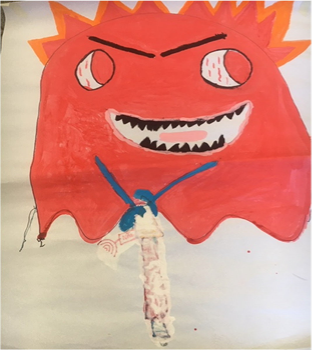
While planning what could be drawn, a different conversation took place. New vocabularies sprouted from a much more collaborative mother-son relationship: “Is it a monster or a ghost? It’s quite big, so it needs a larger paper. It has a skirt, and many teeth in the mouth; the hair is spiked.” Daniel started to see the image of the problem: “Mom, the monster will be red, because red is the color of anger.” The boy, encouraged by the change of direction of the conversation, busied himself in coloring with care and the mother patiently accompanied him in the dance of the brushes. By photographing with paints and brushstrokes, the problem takes on form: “Wow! It’s nice! Mom, you look mean!”


Ghost of Fury

Satisfied with the reproduction, Daniel says: “It is a giant of Fury that torments a lot, attacks the head, and keeps hitting it.” The part of the conversation below illustrates the dialogue that is being woven around the externalized problem (the acronyms T, D, and A, refer respectively to Therapist, Daniel, and Aurora):
 

T: I think he has a jackhammer in his hands and drills holes in your head to get in! (I paint a tool in the hands of the giant). Could we come up with something to let you know when he’s turning on the jackhammer? (I paint a radar that says “No,” when it notices that the giant is approaching).

D: No… it crosses your mind… It’s a ghost.

T: Oh! We are getting to know him better! He looked like a giant, but he’s a ghost!

D: Yeah, he doesn’t drill holes; it goes through the head (erases jackhammer drawing with white paint).  
 

I understand that this attitude of Daniel concerns his authorship, and he gradually builds on his relationship with the problem. It’s like he’s saying, “Hey! This is my problem!” There is a significant change in how he relates to exploring the difficulties that brought him to therapy.

The separation between the person’s identity and that of the problem does not exempt them from facing the damage that this has brought to their lives. According to Michael White, it enables them to assume this responsibility, and, in this way, they are encouraged to establish a more clearly defined relationship, in which a range of alternative possibilities becomes possible. And continuing…

T: And does he take advantage of some “little windows” to get inside your head?

A: I think it’s when he gets jealous of his brother and when we go against him.

An alternative way of talking about the difficulties that permeate family relationships is under construction without, however, pointing out the child’s deficits, and blaming him. Externalizing conversations, by objectifying the problem, offers an antidote to internal and essential understandings of an individual.   

Building an Identity for the Problem

The problem, now named Ghost of Fury, is gradually discovered through a curious investigation where I learn from the clients about their experience. The Ghost of Fury is 1,000 years old and lives in every child’s house for one year. It arrived when the family moved from the city where they lived two years ago, leaving the loving paternal grandparents. He feeds on people’s anger and his favorite food is “rage burger.” He lives in hell and other evil ghosts also live there.

Upon hearing Daniel’s vibrant description, Aurora reported that the parents and children lost their friends. The children separated from their schoolmates, from the playground in the old house, and from the paternal grandparents’ beach house. She says: “Daniel always says it was my fault we moved here. He doesn't like it here.”

D: Yeah, we had to come here because she got a job here…(notices the mother’s tears) Mom, are you crying??!!!!  

T: I think you were all very sad to have moved to another city. Nothing happened as you expected…

A: He says I'm not a good mother, I feel very guilty. I do everything for them, I can hardly even work…

T: Yeah… one of these evil ghosts’ tricks is to make mothers feel guilty. They disrupt the whole family’s life.

D: Not my father’s life! He works and comes home late and just sits on the couch watching TV, right mom? (Aurora laughs).  

Looking for the influence that the problem has on the life of Daniel and his family, I highlight the following excerpt:

T: What does he want for your life?

D: That I become evil? He wants me to be mean!!! (His eyes are wide open, pointed at his mother).

It is important to note here the change in the child’s expression that seems to reflect on the influence the problem has on his life and suddenly discovering his real purpose. And continuing:  

T: And what does he want for your family?

D: He wants us to fight, stay in front of the TV alone, without talking to our mother, without playing… He doesn’t just disturb the family; he also goes to my (maternal) grandparents’ house. The most nervous is my grandfather. He drives my grandfather crazy.

D: Mom, grandpa needs to come here too!  

Michael White says that this type of conversation, through influencing questions, compares to investigative journalism and its first objective is “to develop an exposition of the corruption associated with abuses of power and privileges,” imposed by the problem. Like investigative journalists, therapists are not involved in the domains of problem-solving or engaging in conflict, but, again referring to White, “Rather, their actions usually reflect a relatively ‘cool’ engagement.” In contrast, clients also assume an investigative reporter position, reflect on their experience, and contribute to exposing the character of the problem. They denounce its objectives, purposes, and activities.

This posture reveals the importance of the narrative therapist’s decentered position. It paves the way for the clients to identify and build other plans for their lives, what they value, and contradict the threatening voices of the problem. In other words, externalizing conversations offer a shared island of safety for people to engage in the reauthoring of their lives.

A Story About the Externalized Problem Inspired by the Idea of Poetic Documentation

For White and Epston, the written word is an ideal path for discoveries made during therapy which, like documents, can be evoked, read, and recreated. Written tradition, through “making visible,” highlights extraordinary events, giving prestige to an alternative narrative (9). Still, according to Campillo Rodriguez (1), writing as a therapeutic resource opens up many paths through which people can see themselves through the eyes of the other.

During clinical consultations, therapeutic poems build, in a special way, an opening to new stories, which play with the imagination and give clients the freedom to experience their own images, sensations, and new meanings.

Discussing the usefulness of therapeutic poems in her work, Sanni Paljakka (2) writes:
 

Due to their unusual form (the lack of requirement for the shiny completeness of sentences and ideas in prose text), these poems have opened up a unique way for me to play with ideas. Writing in poetry form allows me to pit the horrors and hauntings of a problem story against a confection of possible counter-story ideas with no regard to orderly sequencing of life experiences or the flow of a therapy conversation.


So, at the opening of the session following the revelation of the Ghost of Fury, I asked Daniel and his mother to sit down comfortably and listen to a text that I wanted to present to them (Although the authors point out that poetic documents should be written exclusively with the words expressed by the client, I took this therapeutic tool as an inspiration, adding a personal way of narrating, to what I preferred to name therapeutic chronicles.):  

It was a problem and it was a gigantic

A giant that was so gigantic, it tormented everyone

It tormented the boy even more
The boy was a child

And he did the worst for the child Just for the kid, he had a jackhammer

He made little holes
In the boy’s head

When he was a child and the boy was a child

Clever
Thoughtful
Observer
And the boy had an artist mother
The child boy had an artist mother!!!
The smart boy and the artist mother took a picture of the giant
Click, Click, Click
Red he was
With funny hair and there was the jackhammer Making holes in the head
And making everyone nervous and quarrelsome and then… Sad
And found out the giant was all Rage Aha!!!
Now we know you!!!

And the smart boy and the artist mother didn’t notice…

The Giant of Rage, that was his name, was very intelligent

In a brush step, zas!!!
Changed to Ghost of Fury
What the hell!!!
Ghosts don't need little holes to get into the heads and families of smart boys and nice moms

Ghosts walk through walls

The smart boy figured out the trick. He found that the ghost goes through his head

And lo and behold! He knows many tricks to do bad things

He is 1,000 years old.  


I recited the chronicle, dramatizing it in such a way that the emphasis fell on the resources and extraordinary events subjugated by the problem (the boy was a child; he was smart, thoughtful and observant; the child had an artist mother; the smart boy and the mother artist took a picture of the giant), as well as the perverse purposes fueled by the problem (the giant that especially affects the boy, who is a child; his evils are preferably directed at him; a very intelligent giant, who magically transforms into a ghost to cross heads). 

As an externalizing conversation, listening to your experiences coming from another person, written in a poetic way, promotes a sense of legitimacy and centers authorship on the person. Afterward, Daniel said he liked it and thought it was funny: “He doesn’t even look that bad!” He still prefers to maintain his version of the problem as a ghost that enters his head without making small holes: “Hey tía, he doesn’t have a jackhammer.” Aurora was touched by the understanding that her son is “just a child” and that, due to so many turbulences in the family, her impatience could be harming him, in addition to expecting him to know how to renounce his place in the family in favor of his younger brother.

It was surprising to her to be perceived as an artist and she reported other craft skills, inherited from her mother. Daniel praised his maternal grandmother’s skills, attentive and creative, and discovered that his mother resembles her. The externalized problem, re-narrated, allowed the emergence of a narrative not subdued by the history of conflicts in the period between the meetings. Aurora says:

A: The giant isn’t showing up much there… he’s only showing up with strength when he’s with his brother. They fight, Leo gets in the way, and Daniel loses his temper (the words giant and ghost will alternate during the course of therapy, as meanings of an entity/problem separate from the child).

T: I think it’s the Giant of Fury’s tricks to keep taking advantage of the fights in your family.

A: He (Daniel) is better than me, calmer than me, he obeys when I speak.  

Despite the influence of the problem having diminished in the family, this meeting addressed many conflicting moments between siblings and between mother and children. Daniel suggests painting the Giant/Ghost again. Very excited, he announces:

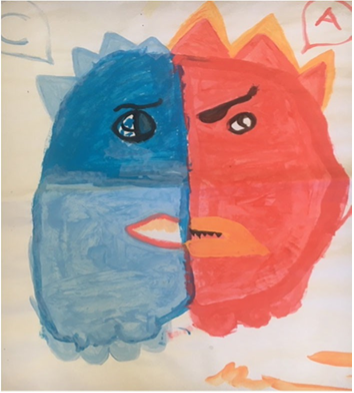
D: Now I’m going to do it! It will have two colors. Half angry and half calm.”

The new image of the problem in metamorphosis was made with four hands, and the child tried to reproduce with his own lines the first form almost entirely created by Aurora (the Giant of Fury). This was explored in its finest details within a loving and respectful dialogue, mostly coming from the child. Everyone looked proud at the end.


Ghost of Fury in Transformation

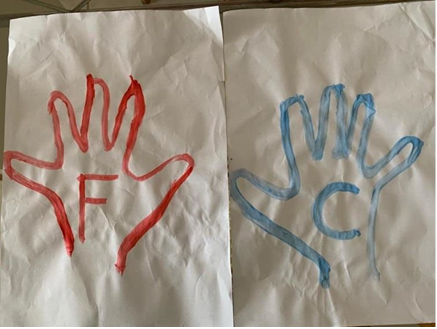
The letters C and A were added to signify the initials for Calm and Angry, English vocabulary learned by the boy at school. Descriptions and facts previously mitigated by the problem populate the conversations, allowing the child to be perceived through his resources (learns another language, likes to paint, collaborates with the mother). Immersed in a dialogical and horizontal relationship, instigated by conversations fueled by painting, I outlined Daniel’s hands on a blank piece of paper, with the letters F (Fury) and C (Calm) to be taken home. They could help them remember that when they manage to stay calm, the Giant weakens.


Drawings of Daniel’s Hands as signalers of emotions in the house

The session that followed this one focused on efforts to distinguish the influences of the Giant/Ghost in the family’s life and the family’s in the Giant's life. The rage attacks are less intense; frustrations are expressed with lamentations. Aurora says:

A: Daniel is more loving, more understanding, helping me to calm down faster. It was a lot of just complaining, now it’s like this, more smiling. Sometimes he is more patient with his brother.

D: I didn’t get angry with Leo crying. I say: ‘Caaaalm down, Leo’.

A: We put the Hands in the room. In a place where everyone can see.

T: If the house is calmer, how is the family?

A: I bought paints, they are painting.

T: It’s a family of artists!  

At this time, they review the contributions of their maternal grandmother, skilled in manual arts. Daniel speaks proudly of his grandmother who draws house plans for engineers. Aurora has the opportunity to reframe her relationship with her parents, with whom she feels hurt by for not receiving the expected support: “My parents are very active, they have a life of their own…”

Daniel is attentive and praises his grandmother’s kindness but claims that his grandfather is very nervous: “The ghost must be living there now.” and continues… “Hey tía, I think next time the Giant of Fury will be all blue!”

From these conversations, another poetic document was presented to them at the next meeting.
It was a giant
Giant?
Not anymore

It wasn’t even a giant. It shrunk

And in its shrinking, OH! Would it also be changing color?
And the giant asked for help

Help! Somebody help me!

I’m shrinking and I’m not even red! Help!
And nobody listens

The artist mother and the smart boy continue their task of transforming him

Now the little giant is red and blue
Half bad, half good. Half angry, Half calm

The smart-mother and the artist-boy continue their work of painting the new little giant red and blue

The Giant of Fury is sneaking out

It no longer fits in that room. It no longer fits in those lives

At the door, already saying goodbye, he looks back and takes with him an image that bothers him. He sees the boy-artist calmly walking around the room, talking to his smart-mother, deciding together on the last brushstrokes.

The image has changed. And the Giant of Fury, sad, decides to leave in search of another place to live.  


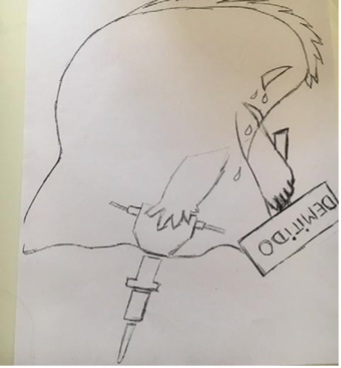
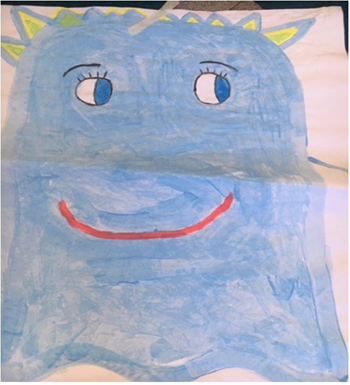
“The Fired Ghost of Fury,” Made by an Artist Upon my Request

When presented with the new image, this time taken by me, the mother laughs at the ghost and its “Fired” sign. Daniel says: “Poor guy,” and, “Mom, we’re firing him from home too!”

With a social constructionist sensibility, narrative therapy assumes that the self is relational. Within the plasticity of relationships, we build reciprocal identities, shaped by contextually-situated linguistic descriptions. Thus, Daniel’s interest and initiative, in a safe and inclusive environment, transform him into a boy-artist, now accompanied by a smart mother who, less confused by her feelings of incompetence and guilt, becomes someone who knows how to take action (welcoming, encouraging, believing, hoping). Therefore, the Giant who abandons that relationship is one of misunderstanding, impotence, and pain.

The self-confident artist-boy prepares to paint another ghost: “I do. It will be all blue. Blue is the color of calmness, right mom?” 


Ghost of Calmness

Since we were at that moment on the verge of social isolation due to COVID-19, we suspended face-to-face meetings and sought to build communication via WhatsApp, through messages and audio, since the video camera sessions proved to be unproductive for the participation of the children. Contacts were more frequently aimed at supporting Aurora’s concerns regarding Daniel’s growing lack of interest in online classes. Still, mother and son agreed that the Ghost of Fury was still diminishing. In this period of confinement, the interaction between the two children deteriorated, slipping easily into conflict. I suggested that Brother Leo be invited to participate in a face-to-face meeting, and we all committed to this meeting, respecting the health standards for disease prevention.

The dialogue below illustrates a remarkable moment from this meeting, where many disputes took place, with Daniel asking for his mother’s interference to calm down and hold his brother who “only gets in the way” an

Effects of Social Media on Child Development: Healthy Strategies

Positive Effects of Social Media on Child Development

As a marriage and family therapist, I have found it essential to recognize the positive — and negative — effects of social media on child development in my therapeutic work with families. Social media platforms offer opportunities for young clients to connect with peers, access educational resources, and explore diverse perspectives. Through online interactions, they can develop social skills, empathy, and cultural understandings, enriching their social development.

Additionally, social media provides a platform for creative expression and self-discovery, allowing them to explore their interests and talents. By engaging with educational content and participating in online communities, children and teens can enhance their knowledge and skills in various areas, fostering intellectual growth and curiosity.

Furthermore, social media can facilitate communication and connection within families, especially in today’s fast-paced world. Platforms such as Facebook and WhatsApp enable families to stay connected, share experiences, and support one another across distances. For families undergoing transitions or facing other challenges that put distance, both physical and emotional, between members social media can serve as a valuable tool for maintaining bonds and strengthening relationships.

By acknowledging these positive aspects of social media, I have successfully incorporated them into my therapeutic work with families, leveraging digital resources to promote healthy development and resilience. Through psychoeducation, communication skills training, and family interventions, I have helped to empower families to harness the benefits of social media while mitigating potential risks.

Here are a few practical strategies I have found to be highly useful:

  • Digital storytelling- encouraging families to use social media platforms as a tool for sharing their stories and experiences. By creating digital narratives, families can express their thoughts, emotions, and challenges in a creative and engaging format. This process can foster self-expression, promote empathy, and strengthen family bonds.
  • Psychoeducational resources- sharing informative articles, videos, and infographics on social media platforms to educate families about child development can provide parenting strategies, and useful mental health guidance and information. Providing accessible and relevant information can empower families to make informed decisions and adopt healthy practices in their daily lives.
  • Online support groups- facilitating virtual support groups or forums on social media platforms can help parents to support their children’s connection with peers, the sharing of experiences, and receipt of support. These online communities provide a safe space for families to discuss challenges, seek advice, and build solidarity in navigating the complexities of parenthood and family life.
  • Collaborative goal-setting- using social media platforms to engage families in collaborative goal-setting exercises and activities can encourage them to set specific, measurable, achievable, relevant, and time-bound (SMART) goals related to their parenting practices, family dynamics, and child development goals. By sharing their progress and achievements on social media, families can celebrate their successes and inspire others to pursue their goals.
  • Digital mindfulness practices- integrating digital mindfulness practices into therapy sessions can help families cultivate awareness and intentionality in their social media usage. Encouraging families to practice digital detoxes is a powerful process that includes setting screen time limits and engaging in activities that promote offline connection and presence. By fostering a mindful approach to social media usage, families can develop healthier relationships with technology and prioritize meaningful interactions with each other.

By incorporating these practical strategies into therapeutic practice, I have helped families to harness the positive potential of social media to support them in productively impacting their child’s or children’s development. Through collaboration, education, and mindful engagement, I have empowered families to navigate the digital landscape with intentionality, resilience, and well-being.

Negative Effects of Social Media on Child Development

While social media offers various benefits, it also presents significant challenges and risks to child development, necessitating careful consideration and intervention in my therapeutic work with families. Research has consistently shown that excessive use of social media is associated with increased rates of anxiety, depression, and low self-esteem among children. The pressure to maintain a curated online persona and the constant comparison with peers can contribute to feelings of inadequacy and insecurity.

Moreover, social media platforms can serve as breeding grounds for cyberbullying and online harassment, posing serious threats to children’s emotional and psychological health. Children may experience harassment, ridicule, or exclusion from their peers, leading to significant distress and trauma. Additionally, exposure to harmful content such as violent imagery, explicit material, and misinformation can negatively influence children’s attitudes, beliefs, and behaviors.

Furthermore, social media can contribute to the erosion of face-to-face interactions and family dynamics within households. Excessive screen time and digital distractions can disrupt communication and bonding among family members, leading to feelings of disconnection and isolation. In some cases, parents may struggle to set boundaries around screen time and monitor their children’s online activities, further exacerbating these issues.

To effectively address these negative effects of social media on their child’s or children’s development, I have implemented targeted strategies and interventions with them. These strategies include:

  • Psychoeducation- providing families with information about the potential risks of social media and how it can impact child development.
  • Communication skills training- helping families develop effective communication strategies for discussing social media use and setting boundaries around screen time.
  • Family interventions- facilitating family sessions to address issues related to social media usage, cyberbullying, and online safety.
  • Collaborative goal-setting- working with families to establish clear goals and guidelines for healthy social media usage within the household.
  • Referral to specialized services- connecting families with additional support resources, such as mental health professionals or digital wellness programs, when necessary.

Strategies for Supporting Healthy Social Media Usage

I have also found it essential to equip myself with practical strategies for supporting healthy social media usage among my clients. These have included:

  • Promoting digital mindfulness practices- integrating digital mindfulness practices into therapy sessions to help families cultivate awareness and intentionality in their social media usage. Teaching mindfulness techniques such as breath awareness, body scans, and mindful scrolling has helped my clients develop a balanced and mindful approach to technology use. By practicing digital mindfulness, they have enhanced their ability to regulate their emotions, manage stress, and maintain healthy boundaries with technology.
  • Encouraging offline activities and face-to-face interactions- emphasizing the importance of offline activities and face-to-face interactions in promoting family bonding and well-being. I typically encourage families to prioritize offline activities such as outdoor play, family meals, and creative projects that foster connection and presence. By balancing screen time with offline experiences, relationships have been strengthened and resilience has been cultivated in the face of digital distractions.
  • Modeling healthy social media usage- leading by example by modeling healthy social media usage in my own professional and personal life. I demonstrate responsible online behavior, such as respectful communication, thoughtful content sharing, and mindful engagement with social media platforms. By modeling healthy habits, I have hoped to inspire families to adopt similar practices and create a positive digital environment within their own households.
  • Providing ongoing support and guidance- offering ongoing support and guidance to families as they navigate the challenges of social media usage. I am available to address concerns, answer questions, and provide resources to help families navigate difficult situations online. By offering personalized support and guidance, I have empowered families to overcome obstacles and thrive in the digital age.

Case Application

Recently, I had the privilege of working with a family who were grappling with the challenges of social media use in their household. James and Keisha, the parents, expressed concerns about their teenage daughter, Jasmine, spending excessive time on TikTok and the toll it was taking on her mental well-being. Jasmine, like many teenagers, was drawn to TikTok for entertainment and connection, but often found herself feeling anxious and inadequate after scrolling through her feed.

During our therapy sessions, we delved into the ways TikTok was shaping Jasmine’s thoughts, emotions, and behaviors. We discussed the importance of digital literacy and critical thinking in evaluating online content, especially on platforms like TikTok where trends and challenges can quickly go viral. Together, we established clear guidelines for healthy TikTok use within the household, including designated screen-free times and open discussions about online experiences.

As part of our therapeutic work, we integrated digital mindfulness practices into our sessions to help Jasmine and her family develop a more mindful approach to TikTok usage. We practiced techniques such as mindful scrolling, deep breathing, and engaging in offline activities to promote presence and connection within the family.

In addition to their digital mindfulness practices, the family began implementing a weekly family game night as a routine offline activity. They set aside one evening each week to gather and play board games, card games, or engage in other fun activities that didn’t involve screens. This allowed them to bond as a family, laugh together, and create cherished memories outside of the digital world.

Over time, I witnessed significant progress within the family as they implemented the strategies and interventions we discussed in therapy. Jasmine became more mindful of her TikTok usage, learning to recognize when she needed to take breaks and engage in offline activities. James and Keisha became more involved in their daughter’s online experiences, providing guidance and support as she navigated the complexities of social media.

During one of our therapy sessions, Jasmine shared a digital story she had created about her journey to finding balance with TikTok. Through a series of videos, photos, and captions, Jasmine expressed her thoughts, emotions, and reflections on her relationship with TikTok and the impact it had on her life. It was a powerful moment of self-expression and growth for Jasmine and her family, as they realized the importance of open communication, empathy, and mindfulness in navigating the challenges of the digital age.

As we concluded our therapy work together, I felt grateful to have had the opportunity to support the Thompson family in their journey towards healthier TikTok usage. Through collaboration, education, and support, we were able to empower them to navigate the digital landscape with confidence, compassion, and resilience. It was a testament to the transformative power of therapy and the positive impact it can have on families in today’s digital world.

***

As a marriage and family therapist, I have found it crucial to advocate for positive digital citizenship and support healthy child development. I have also remained vigilant in educating families about the risks and benefits of social media, while providing them with the tools and resources needed to navigate this complex terrain.

Questions for Thought and Discussion

In what ways do you (or don’t you) resonate with the author’s experiences?

How do you address this issue in your clinical work with teens and families?

Can you think of one particular clinical experience around social media that challenged you?

How to Be Successful in Child Therapy: Lessons From 5 Decades of Practice

The insights I value the most came from direct work with children, adolescents, and families who taught me what is most important and helpful in the work that we do. I learned from children that what is most essential is that we do not give up on them. Embracing unwavering faith in children as they go through the worst times of their lives may prove to be far more important than any technique or intervention we employ.

The Importance of Therapeutic Presence with Children

Repeatedly, my former child clients tell me this when they come back to visit 10, 20, or even 30 years later as they establish themselves in their adult lives. Surprising to me is the fact that at the time I was seeing these former child or adolescent clients, I did not feel that I was particularly helpful. The crises that brought them to therapy were so intense that I was unable to appreciate the power of therapeutic presence and commitment.

One of the most important insights that emerged from my private supervision with the late Walter Bonime, MD, senior training psychoanalyst, has helped sustain me during the most challenging moments of my 55-year career as a clinical psychologist working with children and families. Dr. Bonime taught me that no matter how frustrated, discouraged, angry, hopeless, or impotent the therapist may feel, it cannot begin to match the depth of the same feelings in the child.

Children taught me that sometimes “more is less.” In certain moments what is most important is that we be a caring presence, a trusted witness. The temptation is for therapists to shower intense moments with words that can diminish the transformative potential of a deep encounter with a child.

I’ve met many a “fawn in gorilla suit” during my career. The analogy suggests that the “fawn” as the core self is highly vulnerable — has been hurt too many times! The aggression (putting on the gorilla suit) is intended to protect that vulnerable fawn by keeping people at a safe distance. Yet, the longing for connection burns deeply within.

Another important understanding gained from the decades of work with children is that whenever a youth says, “I don’t care!” we should assume they once cared a lot, but it simply hurts too much, it is too great a risk to care anymore.

I’ve always told my interns and young clinicians, “when you don’t know what else to do, just treat children and families with profound respect and dignity.” They are surprised how far that goes.

Children carry within them powerful narratives that all too often no one takes the time to elicit or hear. The youth, as much as they might avoid it, long to unburden.

The therapist’s willingness to risk themselves in the therapy encounter, and sometimes be wrong, is a “gift” to children by creating a safer context for the child to express what is difficult to put into words.

An 8-year-old boy asked me to explain the initials after my name. This led the boy to say, “Well, you don’t look that smart!” I told him my family tells me the same thing. It reminded me of how important a sense of humility is in working with children. To connect with children, we must be willing to look like fools sometimes. Otherwise, we are no fun at all. Children will only feel free to talk when they feel free to not talk.

Our goal is to honor strengths without trivializing suffering. This is a delicate operation. The work we do is rewarding. We get paid in the currency of the heart. Some of the moments we share with children and families are precious and priceless. But our work is hard. There is an undeniable emotional toll exacted from caring for children with deeply wounded spirits.

Can we hear the hard stories without the hardening of our heart? To do so requires diligent and disciplined efforts to take adequate care of the instrument of healing — our self. As much attention in our field has been paid to the importance of self-care, each child therapist will need to reflect and honestly assess to what degree it is a priority. If we short-change ourselves, it is likely that we are also stiffing our families, and perhaps the children and families we treat as well.

[Editor’s Note: David and I are colleagues and friends, and we are honored to offer his reflection here, which is not about “what to do” with children and teens in therapy, but, “how to be.”]

Questions for Thought and Discussion 

  • In what ways is the author’s orientation to child therapy Similar to your own?
  • What have you found to be the most effective ways to intervene with children and teens?
  • What have you found to be some of the greatest challenges in working with young clients?

Postmodern Play Therapy: Helping a Child Overcome their “Trouble Energy”

When I was deeply entrenched in research, writing, and play therapy practice that incorporated superheroes, I learned about the importance of the origin story — the backstory narrative. It is no different in the context of this article, which is about what I call “postmodern play,” a term I use to describe play-based interventions rooted in Narrative Therapy. As a brief but related aside, I had just finished a book on the use of superheroes in counseling and play therapy when I was contacted by MSNBC to come on air to discuss what they, NOT I, called Superhero Therapy. When I sat excitedly in front of my television that night to watch myself, I noticed a chyron beneath my image that said, “The APA does not endorse Superhero Therapy.” Fifteen minutes of infamy, I guess.

Like what you are reading? For more stimulating stories, thought-provoking articles and new video announcements, sign up for our monthly newsletter.

Ironically, I had never used the term, “Superhero Therapy” in my writing, nor did I profess my clinical work with superheroes to be evidence based. And so, it is here! The APA will never endorse postmodern play, nor will it ever attain evidenced-based status. And I aspire to neither.

But, as Irvin Yalom suggested in his Gift of Therapy, nonvalidated therapies are not (necessarily) invalidated therapies. So it has been for me, and postmodern play. In my child therapy work, particularly involving play, I have noticed that positive changes in the child’s world, both inside and outside of the therapy space, could often be explained by some of the core principles of Narrative Therapy, one of the postmodern approaches to therapy — which also includes Brief Solution-Focused Therapy. These core principles included a(n):

  • Strength-based orientation rather than one based on deficiency
  • Focus on the child as an agent of change
  • Externalization of the problem
  • Collaborative orientation to treatment that includes parents and teachers
  • Author-editor relationship between therapist and child
  • Future orientation that draws upon past successes
  • Articulation of preferred identity through storying
  • Personalization of outcome measures
  • Understanding that children have islands of competence

Channeling Trouble Energy in Play Therapy

As an example, I recall 8-year-old Liam, who came with his parents for help with “his” problems of stealing food, his mother’s jewelry, and temper tantrums — exclusively at home when he was confronted with his misdeeds. Born in Asia, Liam was adopted in early infancy and seemed to be progressing nicely through his developmental journey. But something was happening that was giving rise to this relatively new spate of behavioral problems. During the intake, the parents and I wondered together if the racial/cultural difference between him and his parents was contributing to an emergent and distressing sense of “otherness” — they rarely, if ever, discussed the adoption, Liam’s origin story. We wondered if he was trying to process the loss inherent in the adoptive process, stealing as a way of filling a gap. We wondered if the marital tension between them was creating a bed of unrest and insecurity for Liam. We wondered!

When Liam came to my office the following week, I was met by a very poised, articulate, and interesting child whose vigorously shaking leg suggested that deeper currents of emotions ran just below the surface of this very seemingly contained boy. Drawn in by that current, I wondered aloud about the “energy” in his leg, and asked in what other parts of his body does he sometimes feel such energy. He played right along and said how sometimes that energy goes to his stomach, and sometimes arms, and together, we called it “body energy.” We explored this body energy when it started and whether he liked it, whether it got in the way sometimes and what he typically did with it once it appeared.

From there we launched into a conversation of other possible types of energy that he had, and as I asked him to describe some of his interests, which included history and origami, I asked him if he could label that energy, to which he responded, “art energy and learning energy.” A bit later in the conversation, when our conversation turned to the concerns his parents had around his stealing and angry outbursts, he quite spontaneously came up with the notion of “trouble energy.” I asked him to pick a colored piece of Play-Doh and show me how big trouble energy could be in his life, and he offered an apple-sized ball of Play-Doh in his little hands. That was the sum total of our intake and treatment plan.

The clinical work in the following weeks consisted of:

  • Play therapy with Liam using the sandtray to act out play out scenes of family separations and reunions
  • Playful conversations about trouble energy in his life, and what he wanted to do with it and its influence
  • Liam sharing his vast knowledge of world history and “trying” to teach me origami
  • Discussing simple behavioral methods for the parents to use when Liam expressed anger and took things
  • Collaboration with his teacher around additional sensitivity to his needs, and
  • Occasional family drawing time during which Liam and his parents expressed themselves freely.
  • Referral of Liam’s parents to a marital counselor which they happily agreed to.

I never doubted that Liam was content with allowing trouble energy to rule his life, and I always had confidence that his parents and teacher could and would work together to support him and bring out the best in him. As a tip of my hat to readers who might be wondering, “well, what was your outcome measure(s),” I offer the following which is Liam’s depiction of trouble energy at the time of our last session at right, in contrast to trouble energy at the beginning of our work, at left.

I also offer the words of David Nylund, speaking at the Pan Pacific Brief Therapy Conference in Japan in 2001, regarding outcome measures in a postmodern, narrative play therapy context. He said, “I believe in evidence, but I am more interested in what constitutes evidence, and who gets to decide on what counts as evidence. Is it professionals, licensing boards, researchers, and journal editors? Or is it clients? If a young person is able to reclaim his life from ADHD, for example, and we create and circulate a therapeutic letter about his experience, I consider that just as compelling as a randomized clinical trial.”

***

My work with Liam and his family was complete, satisfactory to all involved. His tantrums subsided, the family re-visited and openly discussed the story of his adoption, and his feelings about it, and the stealing ended. I trust that my description of the work adequately captures the core principles and methods of what I call postmodern play therapy. Chyrons not withstanding!

Questions for Reflection and Discussion

What are your impressions of this author’s work with Liam?

In what ways have you found narrative therapy to be helpful?

What about this approach do you find interesting? Helpful?

Terminally Ill Pediatric Patients and the Grieving Therapist

When asked about the favorite aspect of my (dream) job, I could talk for hours. I feel passionate about working in a pediatric hospital setting with chronically ill children and their families. Each day brings new challenges. I enjoy inpatient and outpatient sessions, parent consultations, family work, collaboration, and advocating for this population any chance I get.

On the contrary, when asked about the least favorite aspect of my job, my response is far less glowing and enthusiastic. I work with children from various departments within the medical center, including oncology, cardiology, trauma, and solid organ transplant. It is inevitable that I encounter children who are terminally ill. I will never understand why children die. Experiencing the death of a child is the most painful part of my job, and it will never make sense to me although logically, I know this happens. On the other hand, I feel honored to be a small part of the most vulnerable time in a family’s life, and to walk alongside them in their journey of grief and loss. Helping a family and their child during end-of-life care is arduous work. It has been impossible for me to not be deeply impacted working in this arena.

I will never forget the first patient with whom I worked that received a terminal diagnosis. I was an intern completing my graduate work. Because I speak Spanish, I was privileged” to work with more challenging cases. I remember sobbing to my mentor at the time, not understanding how a child could die. In response, my mentor neither chastised nor criticized me. She agreed with me and mourned with me. She supported me through that experience and reminds me even to this day that we are human. That support has stuck with me as I continue to mourn the deaths of children with whom I work.

When I was first asked to write a post related to working with terminally ill children and their families, I hesitated, perhaps not wanting to open old wounds and visit the pain that comes with this kind of work. But as I’ve experienced more child deaths over the years, I wanted to share my thoughts and feelings and am humbled to share my stories.

The Dying Child

The dying child has a variety of emotional, physical, and spiritual needs. They have questions and often want information about what is happening to them. The child who is terminal often feels unsafe and understandably anxious. One word I’ve frequently heard, particularly from the parent, is “brave.” In my experience, many parents of terminally ill children find inner strength in the strength of their own children. I remember one child who was aware of her prognosis comforting her parents, reassuring them that she would be “okay.” She arose each morning and worked hard to remain connected with her parents, family, and friends. I also try to remember, even in the face of their strength, that these children are scared. As I have discussed with many families, fear and bravery can, and often do co-exist. For me, bravery is moving forward even in the face of fear.

To Tell or Not to Tell

A glaring ethical question is whether a child should be told they are terminally ill and that they will die. In my experience, many medical providers and members of the psychosocial team believe a child should be informed of the severity of the diagnosis; whereas parents often do not wish for their child to know. Many parents believe children will “give up” if they are aware of the prognosis. To the one, children often know something is very different or not right. They may be confused and desire open communication to understand what is happening within their own bodies. It is my job to provide caregivers with this information and connect them to the Child Life department if they would like guidance regarding how to tell their child. It is not my job, however, to advise them on what to do or impose my own beliefs. The decision is ultimately up to the parents.

The Dying Child’s Family

The families with whom I’ve worked represent a wide range of cultures, faiths, religions, abilities, and beliefs. It has been imperative for me to work with them through a very focused lens of acceptance and understanding of end-of-life issues so that I can be as useful as possible. When learning about a family’s culture, it has been important to know and appreciate the family’s beliefs about the afterlife as this has guided me when discussing their child. Faith can be an important coping skill and protective factor when a family receives news of a terminal diagnosis for their child. However, challenges may arise because of a family’s faith. I have met with Christian caregivers who struggle with the balance of faith and science. Many worry that preparing for end-of-life care, such as transitioning to hospice, considering a DNR, or planning the funeral indicates they are not “good Christians.” Connecting families to spiritual care has been crucial when the family’s faith is important to them.

Families are often faced with challenging decisions regarding end-of-life care. Many parents process these decisions with the child’s therapist. Some parents worry that focusing on the child’s quality of life and reducing seemingly futile treatments will be perceived as “giving up.” I have often worked with caregivers who struggle with the continuation of treatments that are painful, and sometimes even agonizing, for their child. While they want what is best for their child, the decision to extend that child’s life can be tortuous.

Complex and anticipatory grief can make the adjustment to a terminal diagnosis that much more difficult. It is challenging for caregivers to be fully present while still grieving the impending loss of their child. In addition, siblings are often overlooked as a necessity for the dying child’s care. I recall the family of a dying child with whom I facilitated sibling play therapy. My goals during sessions were to connect with each child and help them connect to each other. During those sessions, the child with the terminal illness often felt ill and lethargic. The sibling first requested that the patient play with her in many ways. However, as sessions progressed, the sibling learned to allow her sister to lead. For example, instead of two chefs working at a restaurant, the sibling was the chef who served the tired patron a meal. The ability for families and siblings to find strength to cope always amazes me.

Hope vs. Denial

It is not uncommon for me to receive proclamations from the child’s medical teams that the family is in denial about their child’s diagnosis. I will never forget sitting down with a particular mother to discuss her child and family. She said, “I know what the team thinks. They think I don’t understand what is happening. I understand. I am just choosing to have hope. Hope in a higher power. I know my child’s doctors do not have the last say. I have hope that God will heal my child.” Hope is not denial. Hope is an adaptive and positive coping skill that bolsters a child and family during outstanding hardship.

The Challenges of Working with Dying Children

I was fortunate to be surrounded by deeply empathetic people during my internship, when I first experienced the death of a child patient. Since that time, I have met many medical providers who have been able to build an emotional tolerance for this kind of work out of necessity to care for their patients. I have always been thankful for their skill at addressing the physical and medical needs of these children and their families.

As a therapist, however, my role is to attend to the emotional needs of the family — their strengths and fears along with, of course, their presenting concerns. I have learned the importance of allowing space for all feelings, including my own, when a child’s death is imminent or has occurred. I used to believe I was not able to grieve the loss of a patient. My grief meant nothing compared to the limitless grief of the family, friends, community, and bedside staff. However, I quickly and poignantly came to see the disingenuousness of this belief. I have learned that the only way I can be fully present for the child and their family is by remaining firmly anchored in my own humanity and vulnerability.

I have certainly heard words like compassion fatigue, secondary trauma, contagious emotions, and empathy trauma bandied about, and how any of these experiences can lead to burnout. One extreme challenge I’ve experienced when meeting with a terminally ill child and/or their parents has been the pressure of meeting with a healthier patient immediately afterward. I will never forget receiving news a patient with whom I had worked for years died two minutes before a session with another patient. I still question whether I was able to offer unconditionally positive regard to that second patient as I struggled under the weight of what had happened moments before. Shifting those emotional gears was a challenge.

Over this and related experiences, I have had to learn ways of grieving to avoid burnout. Showing my own humanity and vulnerability within the boundaries of safe relationships and work friendships has made me a better therapist and afforded me an outlet for my own emotions. I remember working with a chronically ill child for over a year who received a terminal diagnosis. As her illness progressed, I transitioned to working with her parents. I learned to never schedule a session with another family or patient directly following these interventions. After these emotionally dense and intense sessions, I would schedule five minutes to cry. I would shut my office door and have a few minutes to allow myself to experience these heavy feelings and an emotional release. I have learned that by allowing myself to grieve, experience, and understand my own humanity, I have become a more empathic person. This has, in turn, allowed me to continue to work with this population and alongside grieving families.

Guilt and Perspective

There are several challenges and, not surprisingly for me, blessings when working with this population. One glaring emotion I often experience is guilt. When leaving the hospital for a vacation or holiday, I must inform the families of newly admitted patients that I will be gone for a few days. Many families say, “Have fun!” or “Merry Christmas!” The typical “you too” does not suffice in this scenario. The extreme guilt I felt as a young therapist was overwhelming. Then, with two healthy pregnancies and subsequent maternity leaves, and now, with two healthy children, I am often surprised by waves of guilt. Over the years, these waves have decreased in size and duration. I know I have a role to fill to support these patients and families, which will be impossible if I continue to focus on the guilt I feel.

On the other hand, I feel deeply grateful to work with these patients and families. Their strength and steadfastness are astounding. In addition, this job fills me with immense amounts of perspective. I recall a mother saying to me, “I don’t know how you do this — choose to come to work with these sick kids every day.” I replied, “I don’t know how you do this — show up for your family every day with vulnerability, strength, and support.”? Small arguments at home or my childrens’ typical tantrums seem so manageable when compared to the hardships families I work with endure. This often leads me back to guilt. It has taken me years to focus on the perspective and honor I feel instead of allowing guilt to overcome me. I realize this helps me be a better therapist for the children and families with whom I work.

Countertransference

Another challenge I’ve encountered when working with this population is countertransference. Loss prompts memories of past losses, with each new one potentially amplifying the pain of those that have come before. This has been extremely challenging for me when working with dying children, especially when I think of my own children. I recall working with a family whose child was nearing the end of her life. The parents and family wanted to make new memories by visiting Disney World, Six Flags, Disney on Ice, and birthday parties. I found myself planning with the parents during parent consultations ways to motivate their child to want to attend these events.

The child wanted none of these outings, instead choosing to remain home and stay close to her parents and siblings. In looking back on that episode, embarrassingly, I wondered if the child was exhibiting depressive symptoms. I naively believed that it would be to everyone’s benefit if she did those things with her family. During a subsequent parent consultation, I suddenly realized I was pushing my own agenda. I mentioned this to parents and that this was not what their dying child wanted. In that moment, I realized the potential power and influence of countertransference when working with dying children and their families. Therapy and supervision are key in instances such as that one.

Boundaries and Self-Care

I’ve always valued the importance and recognized the challenges of maintaining boundaries when working with this population. Our mission at Children’s Health is “making life better for children,” and I genuinely strive for this every day. However, I have encountered specific ethical dilemmas necessitating clear boundary setting. These have included coming in on a weekend or evening when a child is not doing well or nearing the end of their life, wanting to buy gifts or necessities for families who are struggling, attending funerals, crying in front of families, or sharing information with others outside of work. While buying gifts and sharing information outside of work lie within strict ethical parameters, attending funerals, coming to work when not scheduled, and crying with families lie more in the ethics shadows. Attending patient funerals is a particularly challenging ethical domain. Many providers simply do not attend funerals, while just as many others do. It has been important for me to determine if harm might befall the family if I attended their child’s funeral.

Showing emotions to family members is also a sticky issue. Many therapists have been told “don’t cry in front of families!” I have openly teared up with several families.

Therapist as Advocate

Over the years, I have discovered the importance of advocacy. If the patient expresses certain wishes, such as knowing details of their medical/health status or having friends nearby, I share these with the family and medical team when appropriate and after discussing this with the child. My role as advocate has also included helping the caregivers understand their child’s desires. As with the example of the client and her family mentioned above, I helped parents see their child’s perspective and, in turn, meet her needs during the end of her life. We were able to focus on the goal of togetherness and provide her with feelings of safety and connection the way she wanted. This was a difficult shift to focus not only on what the family wants but want the child desired. Legacy building through memory making is yet another form of advocacy, which can be built into the (play) therapy.

Postscript

Working with children who are dying has been emotionally strenuous yet deeply gratifying work for me. Staying present in my feelings while being fully present for the child and family has been particularly challenging. Utilizing rituals to remember and honor a child has been a helpful tool. Our hospital hosts a memorial service each year for employees to grieve patients who have died. Others plant a seed or add a bead to a bracelet for each child who passes. I choose to keep mementos given to me by patients and consider how each child impacted my life and changed me as a clinician. Moving forward is one of the hardest challenges for me as both a clinician and person. I have learned the absolute importance of surrounding myself with others who understand my experiences working with this population.

Coming Full Circle: Helping a Young Couple Through Their Grief

A Matter of Death in Life

After seeing my last patient out, the sun in the back-office windows faded into twilight, darkly illuminating the autumn leaves. I began to feel weekend-ish, looking forward to a long, relaxed walk with Charley in the park, and the single gin and tonic with two limes, which I allowed myself on Friday evenings. As I put the day’s session notes on the desk, I saw the light blinking on the answering machine. One of my grad school colleagues and friend, Ben, sounded mildly upset.

“Hey Liz, I don’t know if you could see someone over the weekend, but a friend of mine just lost a baby to what they think is SIDS. They have a three-year-old son. They’re in shock and want to talk to someone about how to handle it with the kid. I thought of you immediately. It’s kind of urgent. Call me back.”

I sat quietly, letting this request wash over me. Was this a little too close to home, me aged 3 with the dead brother? But this felt urgent to me, as it was my story. Then with certainty and a whole-body-resolve, I thought, I could be of help. I dialed my colleague back.

“Liz? Hey, thanks for calling back.”

“Sure. Give me some details.”

“Upper-middle-class family. Lives on the west side. Dad seriously Type A. Mom too, but she has an arty vibe. The dad, Mark, left early for work this morning and when mom got up later, she thought it was strange her one-year-old daughter Bonny hadn’t woken her up. Claire, the mom, found the baby blue and not breathing in the crib and called 911. Claire tried not to panic, because Angus, the three-year-old, was up. Angus saw the cops and the medics and watched as the baby was taken out of the apartment. I think Claire was really freaking out too. Mark called me — he is a friend of my brother’s — after the baby was pronounced dead at the hospital. He is worried about his wife and his son.”

“I can see them tomorrow morning before yoga. Nine?”

“Sure.”

“Did the father describe the three-year-old’s reaction at all?”

“I think he is usually pretty rambunctious but after it all went down, apparently the kid has refused to talk and is very subdued.”

“Got it. Why don’t you just call them back with the time and give them my name, the office address, and my cell number in case by morning they change their minds. I assume they can afford a full fee?”

“Definitely,” Ben responded. “Great, I knew you were the person for this.”

“Thanks.” I hesitated and then said, “I think I am too.”

Ben was a good guy. We had bonded over leukemia; Ben got sick with it in adolescence and had been able to tell me about that experience. This helped me to know what it may have been like for my brother. Sometimes the universe is a sticky web. We get stuck in with those we need to know.

As I hung up, I realized I was somewhat daunted by the intensity of this referral, but felt it was necessary I take it on. What will I learn by touching the rawest parental grief over a lost child? Would I learn something about what my parents really went through when Jim died, or what I went through then too?  

The weekend feeling vanished, but I was still up to mixing my gin and tonic.

The next morning, I knew I needed to be centered and calm. Before my shower, I breathed in the roses on the terrace and then gave Charley’s belly some extra rubbing. As Charley and I walked to the office, I kept my awareness on what I could take in through my senses: the silver-grey concrete, the smell of traffic, the feeling of my foot hitting the pavement, and the cool morning air. I would have to steady my own feelings, so my own ancient grief did not disrupt what the family needed to bring to me. I had been known to get tears in my eyes when my patients were in pain.

At the office, Charley snoozed under my desk, and I settled into my buttery soft leather shrink chair. I kept working to find the right emotional space to work from — calm, steady, receptive. I didn’t get to stay put long when the outer doorbell rang. Game on.

A Sense of Helpless Defeat

I tried to softly smile as I greeted them. “Hi, I’m Liz Tingley. Please do come in.”

The father shoved out his hand and said, “Mark McNitt. This is my wife, Claire Holm.” They were in their late twenties, both tall, the woman quite thin. She was blond and the man’s hair had a reddish tint. They wore jeans, he with a jacket and button-down shirt. She had on a light-colored linen sweater, her long blond hair held back from her face in a ponytail. Their expressions were somber. Neither looked like they had slept.

I studied her face, pressed lips, red, swollen dull eyes. This plummeted me back to my own mother’s dark hole eyes the morning after my brother died, the look that made me back away so as to not get sucked all the way into her blackness. I felt a muscle in my neck tighten.

Stay in the present, Lizzie.

“Please come in,” I repeated, gesturing toward the adult patient chairs on one side of the room. Mark took his wife by the hand, almost depositing her in the first seat.

Type A alright, but protective too. She needs that now. That memory of my father pulling my mother to him, as we left the hospital where they learned Jim would die, reverberated in my head.

“Ben only told me a bit of what’s happened to you,” I said as I sat back. I made eye contact with each of them slowly, lingering a bit with Claire, her eyes tearing as she met my gaze. “Just tell me where you are.”

Mark reached over to hold Claire’s hand. He spoke first. “In shock, really.” Claire nodded.

“Yes. And it will take a while for that to wear off,” I said softly and paused. “Do you want to tell me about it?”

Claire nodded. “It was a usual morning, except that we had been out late to friends for dinner with both kids the night before. We put the two of them down for bed about an hour or so later than usual. So, in the morning, when I didn’t hear Bonny stirring, I didn’t think anything of it.” She broke down, sobbing. Mark put his arm around her.

She must be feeling guilty, like if she had checked right away, the child might have lived.

“You had no reason to think it wasn’t normal for her to sleep in a little.”

Claire nodded as she sobbed. She pulled herself together. “Angus was playing in his room. I could hear him. So, I put the coffee on first and then went into Bonny’s room. She was lying on her side, with her head in an odd position. When I touched her, I knew something was wrong. She was blue. I screamed, grabbed her up, and called 911. They had me try to clear her airway and do mouth to mouth. When the paramedics got there, they took over. They took her away and I called Mark to meet them at the ER.” She looked down, her voice tapering off to a whisper and then she stopped.

Mark finished the story. “She was already dead,” he said. “The EMTs told me that at the hospital.” In a monotone, he continued, “They let me see her.” He teared up too but bravely went on. “They told me it was an unexplained death and they had to investigate. They called the Agency for Children’s Services and the cops. They’ve kind of been at the house since.”

Claire continued, “They said it’s a ‘SIDS-like’ death, but she was too old for SIDS.” She was trying to hold onto her tears but couldn’t. “She was nearly a month premature, but she had caught up at her one-year check-up. She seemed so healthy.”

“Yeah,” I said, trying to match my tone to hers, this inexplicable crazy fact of her dead baby.

“And Angus,” Claire again began to cry, with a panicked tone.

“That is why we are here, Dr. Tingley, to figure out what to do for him.” Mark sat up straight in his chair, ready for instructions.

Inwardly I groaned. They couldn’t fix this for their son, or for themselves any time soon, and I could see that at least Mark wanted a solution now. They were going to have to live in grief with him and themselves for a long while.

“Yes, let’s do talk about Angus. But let’s not go too fast to him. Before I can share what might help you with him, I want to know more about how you are experiencing today and yesterday. What has this been like for you?”

Claire sat back in her chair, with an air of defeat. “Devastated. And I feel a cascade of things. Exhaustion.”

That’s it, the sense of helpless defeat when you can’t protect your child. Though no one’s fault, it feels like a parental failure. I decided this was not the moment to elaborate this. What agency they had left they needed to carry them through the next few days.

Mark too leaned back in his chair, looked at his wife, and then made piercing eye contact with me. I held his gaze, to reflect the pain I saw on his face. Mark added slowly, “I didn’t know something could feel this bad.”

“Those feelings for you aren’t going away for a long time. And there is a lot to get through,” I replied.

“I know they just have to do their job, but I feel like both the cops and the social workers are very suspicious of us,” Claire reported.

I nodded.

Mark jumped in. “We know we didn’t do anything to cause this. The autopsy will show that. They just have to follow up.” Claire hung her head.

“You want to know how I am?” Mark continued, his tone now angry. “I am so mad. Not at the cops, but this is so unfair. Cosmically unjust. And Angus is suffering.”

Ah, he is trying to protect his son, because he “failed” to protect his daughter. 

“It is,” I said with emphasis, “Completely unfair.”

Mark met my eyes again and a tiny sliver of real connection seemed present, but he was rushing to solve the problem at hand, his son’s trauma from this abrupt death of his sister. “So, what can we do to help Angus?”

I decided to work with his wish for some answers. “What has been his reaction so far?”

Claire grimaced. “I’m not sure what he was doing when I found her, and I was screaming and trying to breathe life into her. He came out into the living room when the EMTs arrived. He looked spooked. And my son is usually a little bit of a tough kid.” Here she smiled just a bit.

Mark added, “He is usually a little bit oblivious and is very active, in his own world.”

Claire went on, “After they took Bonny away, he started to cry and asked where she was going. I feel like I came to my senses then and told him she was sick and going in the ambulance to the hospital and that Daddy would meet her there. He seemed to take that in. I said Sandy, his babysitter, was coming while I went to the hospital too. He asked me to stay with him but then I left him with Sandy. She was reading to him when I went out. We didn’t know what to say when we came back, with Bonny dead.” Claire started to sob uncontrollably.

I sat, looking at them both, trying to generate warmth, allowing her strong affect to flow and for me to receive it. Mark went over to hold Claire, his eyes wet too. Finally, Claire’s sobs receded, and she sat up, grabbed a tissue from the table next to her.

“How does it feel to let it out?” I asked.

She smiled faintly. “It’s not like regular crying. It doesn’t get any better if you let it out or hold it in.”

“Yes, the grief is intense, and it won’t go away altogether, ever. It may, with time, be less intense.”

She nodded, then continued her description of Angus’s reaction to the chaos. “When we got back, Angus was not himself. He clearly knew that something was terribly wrong. He won’t talk now, not a word. And he is not his usual bundle of energy. He kind of just sits there.” Claire paused. “What should we say?”

“It’s hard to know how to explain this to him when you can’t explain it to yourselves,” I replied. Both parents looked so utterly sad, helpless, and young. “I don’t know what you should say exactly, but we can think about it together. It has to be honest. You have to say that she is dead, that her heart and brain stopped working, and that she is never coming back. Do you have any religious views that you want to give him about death?”

They glanced at each other and then said, “No, not really,” simultaneously. That was a good sign; they were attuned to each other. That could go a long way to help them get through this.

“Has he ever stopped talking before?” I asked.

Mark shook his head. “He did have some pronunciation problems and he’s had some speech therapy but no, he’s never stopped talking before. Though he is an action kind of kid usually.”

“How old is he exactly?”

“Three and a half.”

That gave me an idea of how he thought. Concretely. And with probably slightly underdeveloped narrative skills given what else they were saying about his language. It might be hard for him to participate in creating a coherent story about this.

“Okay. Basically, what I said before goes to the main point, to let him know that Bonny is dead.” I watched to see how they would react to this clear statement of the reality. Mark minimally flinched but I went on. “Angus will not understand death at his age. I always recommend the book The Dead Bird by the lady who wrote Goodnight Moon. It is simple and direct. You can read it to him over and over if he wants, to help him understand.”

Mark took out his phone and made a note of the book. “I will order it when we leave.”

I continued, “And even though you tell him once that Bonny is dead, he will likely need to hear it more than once, because he will understand it differently than you think he does. I mean, cartoons make sense to kids; when the guy gets run over and then he pops back up. Permanence doesn’t mean the same thing to preschoolers as it does to us.”

Both parents nodded.

“Don’t force him to talk but keep talking to him. Empathize with his state of shock. Label his feelings, including confusion. Children often regress under stress. His language sounds a little vulnerable. It’s not surprising that he might lose that. He might regress in other ways too, toileting for instance, or not being able to sleep alone.”

Mark almost chuckled. “Claire had him in our bed last night, and he had been in his own room for more than a year.”

“I had to be sure he would make it through the night, Mark,” Claire said, distressed.

“I understand completely,” I replied. “And it was wise. He needs your physical presence more than anything, and to the extent that you can, your emotional presence as well. Children are most reassured by their parents. You need to help him feel safe. Mark, can you be okay with that for now?”

“Of course. Claire, I didn’t mean…” She nodded at him.

Different Ways of Grieving

“One part of this, as you try to manage what Angus needs, is to allow each other to need things that might be different. There is a lot of research suggesting men and women often grieve differently.”

Claire asked, “What do you mean?”

“Let me ask Mark. When are you going back to work?”

“Oh, I’ll want to get back in a couple of days. I can’t imagine sitting around like this for very long.” Claire looked horrified.

“That is what I mean. To feel useful and in the routine can often feel like healing to men. Often, women find they just need more time together. And that conflict can be misunderstood by both. I wonder, Mark, if you really will want to get back to work so soon, and if you will be able to meet your need to do that and balance what Claire and Angus might need.”

Mark looked at his wife. “We can talk about it, of course.” She smiled for the first time.

“When we have the funeral, should Angus be there?” Claire asked.

“Yes, unless there is some compelling reason elsewise. But you need a back-up plan, in case he is disruptive or very upset, or you feel you can’t grieve as you need to with him there. Someone who could take him out and could bring him back. It has to be someone he knows and trusts. Though he won’t understand all the nuances, he will be a part of saying good-bye to his sister, with you and family and friends. That’s what matters,” I said.

I could have cried right then. I had succeeded in pushing my past out during most of the session, but something felt very big, pressing down inside of me, my own emotional exhaustion at trying to hold them and me at the same time. They were hurting and it hurt to see that, to feel the hurt with them, as I suggested what they do for Angus. Why couldn’t someone have said these things to my parents? Why? But I had to push that question away for the moment. I still had work to do.

“This is, not to sound clichéd, a process,” I continued. “It is going to take time. The goal with Angus is to help him have a story to tell himself about this time and about his lost sister, a story that will become part of his life story, that helps him feel that it is coherent and hangs together. To do that, you are also going to have to be willing to be with him over time and to talk about your own sadness and grief and confusion — of course in a modulated way when you can — so that he feels you all together.”

Mark let out a big sigh. “That fits with so much of my gut instinct, but already I can see that Claire’s mother wants to take him out to her house in Westchester, so we have time to cope and make arrangements. But I want him with us. Don’t you Claire?”

“I’m not letting him out of my sight for more than five minutes,” she answered forcefully.

“Is he close to his grandmother?” I asked.

“Well, yes and no. She travels a lot, but when she is around, she is super fun with him.”

Grandparent as playmate. Not what this kid needs right now.

“Some of that will be fine, but more as time goes on. You will deserve breaks sometimes, but now he needs you. As best you can, give him that,” I said softly. Both were quiet for a moment, and I saw Mark disconnect and return to some state of shock.

“I think this is enough for now,” Mark said. “You have given us the start, a preliminary road map. Claire?”

Claire nodded, tearing up slightly, and said, “Thank you Dr. Tingley. I feel like I have some better ideas about helping Angus.”

“I’m glad it feels helpful. It’s going to be a tough row to hoe, but I think you have what it takes to get it done. And remember, like always with parenting, taking care of yourselves is also a way to take care of Angus.” I made full-on eye contact, first with Claire and then Mark. “And remember I am here. Call if you need more.”

Claire bowed her head at me as they stood. Mark shook my hand.

When I returned to my chair, I let the tension of holding myself together through the session evaporate. Silently, I still felt all the same terror, confusion, sadness, helplessness, and anger as Mark and Claire, but I knew I had done decent work with them. I also thought, as Ben had said, that I was the perfect person for this — on many levels. It wasn’t just my 40-plus years in the field, working in childcare with toddlers, where I lived with children’s everyday tears and frustrations, or the career in academic developmental psychology where I learned the research that supported work with young children, or even my time as clinical psychologist, where I found a theoretical frame and the tools to connect with and manage pain and growth. It was all of that combined with my own experience of early loss, that brought me here to be able to do this job, this day. That felt satisfying.

There was another feeling, too. Gratitude. These two grieving people had come to me, trusted me, taken in my empathy and knowledge. I was honored they had let me in at such a time in their lives.

A circle was complete. My career began because I wanted people to take the emotional experience of young children seriously, as my parents had not. I had just done exactly this for Angus. This small child, whom I’d never even meet, allowed me to finish what I started, unconsciously, so very long ago, saving myself, and all the children I had touched in my career, from the denial of their young children’s grief and pain and the aftermath.

A quite different sensation took hold: I am done. I will not be compelled to do this work anymore. My mission is complete. I could work, but I didn’t have to, the compulsion gone. I slumped down, exhausted, and exhilarated. Was there time to get to yoga?

Postscript: I did not see the family again but heard from my colleague that they had relocated to Vermont and had another child. I also did not give up the practice of psychotherapy but now see many more adolescents and adults in my practice.

Using Play Therapy (and Movies) to Heal Attachment Wounds in a Young Child

A Troubled and Troubling History

Peter was four. He had just started Head Start programing when his mother announced she was pregnant. It seemed almost immediately after that Peter became non-compliant with any authority. He experienced a disturbance in sleep and appetite, withdrew socially, refused to wear a seatbelt in the car, and misbehaved in public until his mother had to bring him home. Peter hit, bit, threw things, broke toys, and screamed to get his way, and developed an excessive need to be in control.

Like what you are reading? For more stimulating stories, thought-provoking articles and new video announcements, sign up for our monthly newsletter.

More alarmingly, Peter engaged in harmful behaviors, riding his bike across the street in front of traffic, running over a two-year-old with his bicycle, putting a pillow over his mother’s head telling her to die, and deliberately putting toys on the floor to make his grandmother fall.

Peter’s mother reported that at eight months of age, he had rolled out of the bed, resulting in an ER visit and a report of suspected child abuse. During that ER visit, Peter’s grandmother was asked to help restrain him while they took X-rays, which revealed a broken knee cap. DCFS took custody of Peter and charged the mother with neglect. He spent two days in the hospital and one night in a foster home before being returned to his mother.

I concluded that Peter’s school referral and his mother’s pregnancy had triggered the medical trauma, separation, and attachment issues that were contributing to his behavioral and emotional difficulties. In that assessment, I identified several issues for treatment, including (1) intense fear and anger at separation from attachment figures, (2) inconsistency in setting limits/boundaries and consequences for misbehavior, and (3) the use of behavior, rather than words to express himself. At the time of developing Peter’s treatment plan, I noted that his favorite act of defiance was to run outside in his birthday suit (naked). Our first task in behavior management was to have him put on his underwear before his appointment began!

Growth and Understanding through Play

Peter’s mother and grandmother were nurturing and invested in his growth and development, as well as my support team during our home play therapy visits. Books, toys, and movies were abundant in the home. Working with children, I had come to understand that they find comfort and a sense of security in the predictability in movies. Peter was no exception and movies were frequently playing when I arrived.

Using a client centered approach that incorporated themes from movies his parents had allowed him to watch like, Honey I Shrunk the Kids, Titanic, and Jaws, Peter was able to process his experience and communicate very aptly the chaos he felt both internally and externally. He would play these movies, or parts of the movie during appointments, while he built his creations, including his parents and myself with his toys, and then act out the scenes. I saw the parallels between the movies and his life experiences.

He built an elaborate shrinking machine in the living room which, I believe, reflected his feelings of being totally overwhelmed with his world and the multiple changes he was experiencing. As he adjusted to school and the birth of his sister, his shrinking machine became smaller and disappeared.

Titanic reflected the family’s chaos during the time his mother worked away from home, which took her away for extended periods, and other times resulting in her return home after Peter was in bed. The grandmother was left to assume all parenting and childcare responsibilities. Peter would rewind and replay the moment the ship would break in half and sink into the ocean in a perfect parallel to the absence of his mother. He wore out the tape! His mother quit the job.

The presence of Peter’s grandmother in his classroom as an aide helped to heal the attachment wounds that had occurred during his early infancy. She took him to school, remained in the classroom and brought him home. As Peter adjusted to the structure and routine of school and gained confidence in the return home, he became challenged by the learning process and his desire to learn took precedence over his misbehavior. Both parental figures read to him and the social stories of The Bernstein Bears, and his ability to understand and apply what he heard helped him adjust to new and changing social situations.

Peter became able to verbally express his dislike for his sister but never intentionally attempted to hurt her. He would simply pick her up and move her, even when she would unintentionally destroy one of his play creations. One of my repetitive phrases during appointments was “Use your words!” Feelings of resentment disappeared when he was able to use his words and tell his mother and grandmother he did not like his sister because she was messing up his creations. They in turn made more conscious efforts to keep her away from his projects, and to listen when he used his words.

In his play around the themes from the movie, Jaws, Peter was the captain of an imaginary boat in shark infested waters. He brought all the people and things important to him into the boat, his mother, grandmother, sister, and me to protect us. He acted out the shark attack addressing his fears about his safety and nurturing needs. He would replay this scene many times. As the boat became bigger and bigger, the shark infested waters grew smaller and ultimately disappeared. So did his disruptive and aggressive behavior.

***

Peter was phased out of treatment. His mother and grandmother were learning that withholding his movies could quickly bring misbehavior under control, while their nurturance, consistency, and attention to his safety and security needs helped to strengthen and support his positive and social behaviors. Peter was able to play with new friends and enjoy all of the experiences of school.

How to Use Narrative Therapy to Help Clients Locate Alternate Stories

As a practicing psychotherapist, I hear a lot of stories. These stories are, without fail, complex, nuanced, and multidimensional. But, often, clients come to therapy with a singular focus on only one element of their larger story. In narrative therapy, the term is “problem-saturated” story. Part of my work as a therapist is to guide clients to widen their lens beyond this problem story and recognize that many of their stories are actually a story within a story (within a story). The act of locating these missing story parts and creating an alternate narrative is a way to alter the problem-saturated story and to clear the way for a new, more accurate, and helpful story to emerge. I enjoy little more than when a therapeutic opportunity presents itself — it feels like a gift. So, when John, a 76-year-old gay man, shared his story with me, it came with a giant bow on it: here was a perfect opportunity for a narrative therapy approach. John’s story began like this. It felt as if he had spent his entire life being “sneaky,” and feeling remorseful for what he described as his “untrustworthy ways.” As he began to share his life story, however, a very different story presented itself.

A Secreted Life

Born in the late 1940’s, John grew up in a small rural town where conservative and traditional values around relationships and marriage prevailed. His parents, both uneducated immigrants, neither understood nor accept homosexuality. When John, in his teens, shared his preference for men, his parents agreed that he should not be permitted to remain in their home. Though they apologized years later and expressed regret for rejecting him, John had difficulty letting go of their implicit message that being gay was something to be ashamed of and, therefore, secreted. The telling of this “thin version” of the story, as narrative therapists call it, seemed to offer multiple therapeutic opportunities. First, we could explore where this story originated. In this case, demographics, social norms of the time, and institutionalized beliefs were what Stephen Madigan might term the “undergrowth” of John’s narrative. Next, we could investigate if this was, in fact, John’s narrative or someone else’s. Parenthetically, clients often “inherit” or are burdened with others’ stories which they take on as their own. In this sense, they become colonized. Getting back, it was, without question, a story his parents had told and not necessarily a story John believed, though he had introjected and accepted it. This is, in essence, what narrative therapy is about; an honest investigation of the stories we tell ourselves. Once clients have investigated these narratives, they are free to begin challenging them, updating them, and cultivating new, more compassionate self-stories.

A Therapeutic Path Forward

I saw my role as guiding the investigation into John’s story. In one therapy session, I asked him to tell me about life as a gay man in the mid-1960s, when he was in his twenties. He replied, “well, we had to be careful.” “Even sneaky?” I asked. He smirked, understanding where I was going with the question. “Well, yes, sometimes we had to be sneaky,” he conceded. We began to discuss how that behavior that John had so automatically viewed as “bad” was, actually, a product of the times, the geographical area, and the social climate. John went on to describe how he found community with other gay men and with straight people who were accepting of his lifestyle. Missing story parts were coming to the surface and alternate story was emerging. John’s “problem story,” for a long time, had been: “I was sneaky. That was bad and therefore, I was bad.” It was now morphing to sound more like this: “I had to behave a certain way at a certain time for reasons that were out of my control.” This is the way uncovering alternate stories works. The more he started telling and revising his story, the more he began to recognize that there was far more to his tale than the theme of ‘badness.’ Musing aloud, John drew a conclusion: “so I guess I wasn’t really sneaky. I was just finding a way to live my life.” “The life that was right for you,” I added. Be clear that in this session, John and his story did the bulk of the work, not me. I merely guided the conversation using a narrative questioning approach. Armed with a new story, John slowly shed his previous negative self-label. More than that, he began to view himself as an asset to humanity rather than as a stain on it. He explained that he had discovered a new fondness for sharing his story with younger generations so that they could understand how his generation’s struggles had helped pave the way for the greater level of inclusion that LGBTQIA+ people experience today. The alternate story ended up being much for helpful to John and to those he shared it with than had been the long-standing problem-saturated story. When clients tell me they are “just rambling” or “going off on a tangent,” I often explain that it is necessary for me to understand their story — and all of its elements. What they may see as rambling, I see as vital to my comprehension of their story. The same way I would struggle to understand a novel if I read only a few pages, I would not fully comprehend a client’s life story if I was given only a few facts. Narrative therapy, for me, is an exercise in wholeness; it encourages clients to stand back and look at their lives from an expansive, panoramic vantage point. From a higher plateau, clients begin to identify story parts that had been obscured and to cultivate a more complete telling of their lives. Part of the honor I experience as a psychotherapist is that I am often welcomed into a client’s story. I can give back by helping my clients to see their stories as important, valuable, beautiful, and nuanced…as are they.

Mary Jo Barrett on the Collaborative Treatment of Incest and Complex Developmental Trauma

Lawrence Rubin: Hi, Mary Jo, thanks for joining me today and sharing your clinical expertise in the systemic treatment of incest and complex developmental trauma. Just before we went live, you were sharing an experience you had while giving a webinar this last weekend, and something caught my ear that I wanted to ask you about. You suggested that there is something different between what is currently being practiced in the field of incest and complex developmental trauma, and what, in your experience, is correct, or what should be practiced.
Mary Jo Barrett: That’s a good place to begin. When I first started, which was 45 years ago, I was a worker for the state, basically doing in-home counseling. I discovered that in all these child abuse and neglect cases, there was a significant number of cases involving incest and sexual abuse — whether immediate family members or close family members or clergy or whatever. I would go to my supervisors for guidance, but no one really knew how to treat it.
For example, Minuchin told me that I didn’t need to focus on the incest. I just needed to look at restructuring and building a hierarchy, and that the incest would then be alleviated. Carl Whitaker, who I was madly in love with, basically said, “You know what? I don’t know what to tell you.” At least that was honest. He said, “I do schizophrenia. You better figure out how to do incest.” He was my teacher, so I decided I needed to figure it out.
And so, over the years, I started asking my clients more formally about incest and sexual abuse. I also had my supervisees ask their clients. And whether I was conducting training in Europe or here, I began to ask the clients what the most effective thing about their therapeutic experiences was, and what about the therapy they had received made it “good therapy.”
Basically, nobody said “techniques.” They said what we know they would say and did actually say. It was the relationship between the therapist and client. But they even said more specific things. And of the specific things they said, I narrowed the list down to what I call the five essential ingredients of trauma treatment. But what they said applies to all models of treatment. And as we know, none of these models are better than the other I developed what I call a meta-model that applies to any trauma protocol that exists based on these five essential ingredients. And so, whether you do IFS or CBT or SC or any of the alphabet soup of techniques or protocols that are out there, they will be successful if they have the five essential ingredients.   

The Key to Effective Trauma Treatment is Collaboration

LR: What exactly are these five ingredients for effective trauma treatment?
MB: People, especially those who have been abused, need to feel that they have value, power, control, and connection. So, these “ingredients” include the client:

  • feeling valued
  • learning specific skills in finding resources
  • understanding contextual variables needed for an engaged mind state
  • developing workable realities
  • building a hopeful vision for the future

When a therapist, case manager, or foster care worker gets stuck with a client who has been abused or neglected, I suggest that they don’t go back to the protocol, but instead to the relationship.

LR: Going back to the question that I opened with, how do you see what’s in the zeitgeist now, what’s popular now, as being lacking in comparison to this collaborative model that you developed?
MB: The basic essence is that I go to the client to tell me what to do, versus going to a model or technique to tell me what to do.
LR: Can you think of a recent clinical instance in which the relationship seemed that much more important in the moment than any technique or model?
MB: Larry, every day! That is my model. Every session. In every session when you’re talking about trauma, there will be an impasse. I call it differently. In any moment, there’s going to be what I call a traumatic stress, which means the client, because of their trauma, is going to experience therapy as dangerous.
As we always say, survivors often see danger where danger doesn’t exist. I mean, that’s a standard thing. But that happens in therapy all the time. That’s because the therapeutic relationship is based on hierarchy and attachment. There is a hierarchy, right? I mean the therapist has more power. And the therapist is often controlling the sessions or the direction or what’s going on. And there’s a necessary attachment. There’s going to be an attachment between therapist and client.
Abuse and neglect are embedded in hierarchical attachment relationships. Now, the thing is, every time I say abuse and neglect, people might go, “But we’re talking about trauma.” And I’m saying, again, almost all the trauma cases we talk about revolve around interrelationship violations.
LR: So, if we practice anything other than a collaborative model, then we may in some way be replicating the hierarchical violation in the family that contributed to that abuse.
MB: I’d say that a majority of these clients anticipate and experience, from time to time, that violation in the therapeutic relationship.
LR: So, if the therapist moves too quickly or dives right into the trauma narrative or says, “Tell me about this,” or, “I’d like you to do this,” they are abusing their power? Even using directive words or a tone of voice or body posture can trigger a client so that they feel unsafe. And that’s when you would be cognizant of that, hypersensitive to that, and readjust any of those facets of your approach?
MB: Correct. And the collaborative change model is exactly that cycle. What you just described. And what’s interesting to me is that the collaborative change model is a natural model. And when I describe it, folks at the clinic say, “Oh, my god, yeah!” And the good clinician says, “That’s what I do in my sessions anyway.” And all I’m saying is, make it conscious. It’s a natural cycle of change.
The first phase is creating a context — which is creating refuge, making assessment, figuring out what’s going on — then making a direction, deciding what kind of intervention to use. And then when we start doing our interventions, which is natural, we’re challenging, right? And the relationship becomes embedded in this hierarchy because I’m sort of pushing and challenging by asking them to do something different. And in that moment, the client might experience a moment of fight-flight-freeze-submit. Or fix! And I have to, as a clinician, recognize that.
And in that moment, instead of pushing harder to make an assumption of, “Oh, they can’t tell,” or whatever it is, I need to stop and recreate a context of change. So, at that moment, I stop and say, “What do you need now? What’s going on? How do you feel? Should I slow down? What’s happening?”
I’ll give you an example. I had a client who often during the sessions would say, repetitively, “You don’t get it. You don’t get it. You don’t get it.” And I’d often get defensive. I’d sometimes want to say, “Well, help me understand,” or, “Explain it.” And then one day after the session, I was thinking, “I think that’s a trauma response. So, I said, “I’m wondering if when I’m doing something that triggers you, you experience me as threatening and go into ‘You don’t get it’ as a repetitive response.” And she really thought about it and looked at it and she said, “You know, I’ve often felt there’s things you do that remind me of my mother.”
This client’s mother was like Joan Crawford’s character in Mommie Dearest, and we’re not just talking severely abusive. I asked her what reminded me in those moments of her mother. In response, she said that I talked loudly, and it was the way I dressed in skirts. She experienced me as dressing in a way that was, for her, reminiscent of her mother, which she experienced as provocative. I don’t know that it was, but she experienced it as such, so for her, it was.
So, when we then had that conversation, and from then on, I did consciously change how I dressed on the days I saw her. And I consciously changed my voice. And after that conversation, she never said, “You don’t get it,” again.
LR: So, when she emphatically repeated, “You don’t get it, you don’t get it,” it was metaphoric for something like, “You’re not hearing me, that hurts, stop it, you’re not hearing me, you’re dressing in a way that confuses me. You’re not hearing me. Daddy did this, or Mommy did this, or my brother did this.” It’s like this broad statement of, “I am feeling abused right now.” She may not have been able to put a finger on exactly what element of your relational moment was triggering her, but “You don’t get it,” meant, “I am feeling powerless and unsafe.”
MB: Violated. She was feeling violated.
LR: She was feeling violated. Because you’re much more cognizant about the relationship and the attachment, and breaches in the attachment, you were able to look inward and ask yourself, “What could I be doing? How could how I be talking? What would I be wearing? What might we be talking about? What is it about the way I’m asking questions that could be replicating at some level what happened in her family?”
MB: Yes.
LR: Did I get it right?
MB: You did get it. I should bring up my PowerPoint. You’re doing a very good job. I have three slides that I use in trainings, which I introduce by saying, “These are the three watchwords or phrases of my faith.” The first one is by Mandela that says, “A good head and good heart are always a formidable combination.” The second one was by R.D. Laing who talked about the importance of awareness by saying something like, “If you aren’t aware that you’re not aware, there’s nothing you could do to make change.” And the third one is by Jay Woodman which says that “Life is a series of cycles of getting lost and finding yourself.” And that each time you’re lost, if you look at it as a possibility, then you will find yourself in a new place. And so, my thing is, therapy is a cycle of getting lost and finding yourself again. And once you’re aware of that, you integrate your mind and your brain, your heart, and you’re golden.   

The Healing Power of the Therapeutic Relationship

LR: Is there something about trauma, and incest in particular, that drives clinicians to cleave to techniques and theoretical models; bypassing what they truly know to be effective, with is the relationship?
MB: It’s an integration of the two. When we spoke with these clients, it was clear that they did need new skills. It was the third most important thing, not the first. But the first thing they said was connection. The second thing they said was they had to feel valued, and they had to value the clinician. Then they said they had to feel empowered. And then they said skills.
Everybody that’s developed a protocol model is going to argue with me and say the relationship is the basis of all those protocol models. I would say I got you; I believe you. But if you ask the people who are trained in those models, they will say the emphasis is on the protocol and the interventions.
And they would also say that the difference is that when they’re stuck or a client gets activated, that it’s “go back to the protocol,” versus going to the client to collaborate.
LR: I wonder if there’s something about trauma, and particularly incest, that compels clinicians, especially those who aren’t experienced, to have to “do something.”
MB: A hundred percent! This is actually the new thing that I’ve added to the “fight-flight-freeze” paradigm, which is “fix.” So, I think what happens when a clinician becomes overwhelmed — I call it a place of traumatic stress — fix becomes part of a trauma reaction. The traumatic stress reactions.
When a therapist falls into a “fix-it” state, that should be an indication that they are in the trauma field and are feeling dysregulated. They then have to get re-regulated in order to move to a different place. And it’s the same with the client, who at that moment needs skills to re-regulate themself. I don’t believe when a client or a therapist is dysregulating, that’s the time to automatically use a technique.
LR: So, by jumping in with “a fix,” the therapist might be trying to regulate themselves at the cost of their client’s regulation.
MB: I want to say one other thing which is not going to be popular. I believe that when therapists jump in with a technique, they’re hoping it’s a solution for the consumer of their services.
LR: Giving them something.
MB: Giving them something, which is capitalism. Everything is an agreement in the contract with my clients.

The Importance of Working Systemically with Incest

LR: Someone reading this interview might say, “Well, it sounds like she’s working with the individual,” but I know you’re deeply systemic. So, I’m assuming that this collaborative model infuses your family work around complex developmental trauma?
MB: Yes. Most of the clinical work I do is with couples and families. And this goes back to the research we did with these clients who said that rarely, if ever, did other clinicians include their family. So, what would happen is that after those sessions with the “other” therapists, these clients would go home and have abusive fights or get hit. Or a parent would continue the abuse or violate.
Here, I go back to what I said earlier. Abuse, neglect, and childhood developmental trauma are embedded in a relationship of hierarchy and attachment. So, I believe healing should happen in a relationship.
I want the therapy to recreate some of the crisis right in the room with me. So, if there’s a fight, and dissociation, we all can witness it together and address it in the moment — together. If there’s eyeball-rolling that then triggers the other person, I want it to happen in the room, because those are the cycles that cause the traumatic stress at home.
Everything I’m saying to you here and now is what I say in the first session. When I start a session, I want the safety in our relationship to spill over into their relationship. I want their relationship to be a source of regulation. Not me. I don’t want to be the primary person in their lives.
LR: I can see how this would apply working with intimate partner violence. But are you saying that in cases where there is past or present childhood incest, that you would work systemically with either the current or past family members?
MB: Let me delineate two things. One; when the incest is currently happening and its children, yes, I include everybody. But I have all sorts of rules and boundaries. If it’s currently happening, and in most states, if incest is currently happening, then usually the perpetrator, whether it’s a sibling or a parent or not, is kept away from the child, right?
So, I don’t bring the alleged offender, or the offender, into the room with the victim until they’ve acknowledged facts. So, if they’re denying facts and saying, “She made me do it,” or, “He made me do it,” or, “It never happened,” I don’t do family with them. But I would do family with other family members. But I don’t bring the alleged offender into the room until after they’re no longer denying facts. 
LR: Is that enough? Just getting past the point of denial? Would they have had to have done some significant reparative work of their own before you brought them into the room with the victim?
MB: They are in therapy. Yeah. I mean if it’s currently happening, then the offender is in individual and group therapy, according to how I think good incest therapy should happen. And the rest of the family are either in individual, group, or family treatment for whatever their issues are. And the kids could be in individual concurrently with the family therapy.And then when the violator has met certain criteria, then they can start coming into the sessions.

LR: So, who’s your client? In a case of incest, where it happens currently, or even in the past, who do you identify as the primary client?
MB: The family. But/and my collaboration is with all. It’s a team. I mean it takes a village. Absolutely. When we’re talking incest, it can’t be done effectively by one therapist.
LR: Do you or can you even work effectively with adult survivors of childhood incest?
MB: I’ve developed what I call the “family dialogue program,” which is for adult survivors with their families. And so, I do bring them together but it’s different. I often do it in these intense weekend workshops because if people live all over the country, it depends on if we’re doing therapy about wanting to talk about the abuse and neglect or are we doing what I call the third reality, which is, let’s just focus on the future. Let’s not focus on, did it happen, didn’t it happen, what’s going on? Let’s just focus on, am I going to come to your funeral? Am I going to come to Passover? How can we be in the room together? Am I going to go to my niece’s wedding? Are you going to ever meet your grandchildren? That kind of thing.
LR: That presumes that the perpetrator must take responsibility. They must be willing to listen, at least. Be present and listen. In other words, if you want to ever see your grandkids, you’re going to listen to me. You’re going to hear me. And that perpetrator may leave not feeling very healed, but at least he or she will have given the opportunity to the victim to be heard.
MB: And that’s why I call it the third reality. Because we’re just focusing on, “it’s not about your reality,” it’s about if you want to see your grandchildren. If I want to come to your house, are you going to be able to tolerate me…you know, me believing this and being in the same room as you.
LR: In a sense, it’s a way for the victim to recapture some power.
MB: Oh, absolutely. And that’s what most survivors will say to me. I mean a lot of people have said, “I was in therapy for 10 years, and that weekend with my father was the most important thing in my healing.”

The Gratification of Working with Trauma and Incest

LR: Okay, okay. My guess is that many in private practice would run when they receive a referral for incest. But you seem to run toward it.
MB: I don’t think people in private practice run from the adult survivors, but they run from when it’s currently happening.
LR: Why is that?
MB: Because I think it is one of the greatest taboos. And they never learned how to deal with it. And I think they never learned how to manage. And they often don’t understand how anybody can even want to see their father or their brother or their mother based on what they’ve done to me. Or done to them. Done to the victim. And so, I think a lot of them experience transference and/or feel inadequate.

I don’t know if it was a particular case, and I said to my husband, “What kind of person likes working with sex offenders?”
And in terms of me, Larry, I supposed we could get me on a couch to figure out why. I do remember very distinctly one time bolting out of bed, like sitting up straight. I don’t know if it was a particular case, and I said to my husband, “What kind of person likes working with sex offenders?”
But I would rather work with incest any day of the week over depression because people I work with change. And I see that change. I have seen plenty of sex offenders change. And I’ve had the fortunate experience of being able to follow up on some of my very first cases. I’ve seen one of my first cases 40 years after they stopped. It was an unbelievable experience.
Well, partly it was fun because I got to ask them all sorts of questions. I’ve always been a very creative therapist, where I just make shit up as I go along, that seems to fit. I remember one of my cases — it was incest and domestic violence. The father was in supervision and was told he couldn’t be within 365 yards of his family when he first got out of jail. He actually parked a mobile home 365 yards from the family home. And he was something else.
About a year into it, maybe less, I went back to court to get permission to have him come to family sessions. And he did. And one time, I was doing a good old family therapy looking for strengths, and I said to them, “You’re not always abusing each other. There are times when you’re not. Let’s talk about those times.” And the kids were younger, like 16, 11, and 10. I handed out these little recipe cards where I asked each family member to write down the recipe for nonviolence. Like a cup of this, and 3 tablespoons of that.
I gathered them all and laminated them, and then had them talk about it. The mother said, “It’s half a cup of going to church, and another quarter of a cup is no alcohol.” I mean that kind of stuff. And so literally 30 years later, I interviewed the same family. And the woman, the daughter who was the incest survivor was 40-something. I asked her a couple questions, one of which was whether she had gone to any trauma therapy. She said, “Why would I? I already had it.” So, I asked, “When you were getting married, or dating, what was that like? Were you always anxious? Were you afraid?” She opened her purse and pulled out the laminated card, and said, “I only dated people that had the ingredients.”
LR: Talk about having an impact. Wow, that must have felt great.
MB: I burst into tears. I didn’t do the initial interview, one of my graduate students did. But I was behind a one-way mirror, because who wouldn’t want to see one of their first clients? I went in and I asked them questions. So, in fact, there’s an example of the use of a particular skill. I don’t know that- would it have been the same if it hadn’t really come from them? I don’t know.
LR: Had you not had a relationship, they wouldn’t have taken the cards to begin with.
MB: Right, right.
LR: Do you see yourself in charge of the treatment village when working with the perpetrator?
MB: I have a case right now of sibling incest, and one of the kids is a young adult, but not even, I mean probably a teenager still, 18, 19, who is in individual therapy. I’m trying to do a family session because the parents have two children. So, the parents are involved, and the son who offended his sister. And I’m trying to coordinate. And the sister’s therapist didn’t call me.
LR: What recourse do you have?
MB: Well, the recourse I have is the parents. He is still a teenager. So, the parents can call this person up and say, “Our daughter signed a release, we signed a release. You need to call.” I’m not saying it in a nasty way. But I try to avoid doing that because I don’t need to start an adversarial relationship. But that’s the recourse I have. If the person was an adult, I mean I’d still have the parents to talk to their child and say, “Look, we want to heal this.” As it turned out, the son’s individual therapist calls me and cooperates. We have a great working relationship.

The Complex Arena of Incest Work

LR: Earlier on in one of our conversations, you said, “Incest is virtually neglected in our field.” Clearly, incest hasn’t stopped.
MB: Incest hasn’t decreased at all since I started in the field in ’78.
LR: What do you mean it’s neglected? By clinicians? By researchers?
MB: : I think everybody’s neglecting it. I think that the problem is that we’ve lumped trauma into one thing — complex developmental trauma.

I think that there is something very important to calling violence or violations what they are. Incest is unique. It’s not just a sexual assault. It’s unique because this is often a relationship where the people also have a very positive connection. “This is my parent,” they might say. I had a client way back, I mean again, 30 or so years, who wrote a poem. The one line that sticks out into my head was — and I don’t think she was writing it just to me, it was in general — she said, “I asked you to put an end to the abuse, and you put an end to my family.”

LR: Oh! Did she write the poem to you?
MB: I don’t think it was to me because I asked her. It was to the system. She’s another one that I still have contact with because periodically she’ll write me and say things like, “I just had a baby, just won a marathon.” I mean that kind of stuff. I think professionals feel anxious. I think they feel traumatized. I think it feels like you said. It’s such a moral violation that, as clinicians, we don’t know how to manage. How do I manage that I care about somebody? How do I manage that this woman stayed married to somebody who sexually abused her child?

I just think the taboo is so deeply entrenched that it causes such distress to those who work in this area. I just was working with a family where one of the children was sexually abused. And the other two weren’t. And when I talked to all of them, I said, “All of you were abused. But what happened to Susie is more of a moral violation.” And so that’s why people can’t tolerate it. I think there’s something about not being able to tolerate it. Like I said, I can find something positive. It makes sense to me that someone can be abused by a family member and still care.

LR: The popularity of complex developmental trauma overshadows the clinical attention on sexual assault.
MB: All I know is that so many clients tell me that people either never asked them or understood it. So, it just gets lumped into a category of trauma. And all traumas are not created equal. I’m not saying incest is worse than being physically abused. I’m not saying it’s worse, I’m just saying it has its own unique connected relationship with somebody they cared about who I also had many positives. And it leaves me even in some ways more confused because it isn’t linear or simple. Even if the person was abused by somebody that came and left like a babysitter or Boy Scout leader, with whom they also had an intimate relationship, it’s very confusing. 
LR: The deepest form of betrayal.
MB: Yes. I think sometimes clinicians can’t manage that level of complexity. Which goes back to your question; “Give me some techniques, it makes things less complex. I can feel better about myself if I know how to do this. Do that.” Larry, every single day, I go, “Wait, I don’t know what I’m doing exactly. What do I do now? I just had this explosion.”

I was sitting in the room last week with somebody that got up, grabbed something off my table, threw it on the ground, and smashed it. “I got to go,” they said So, I said, “Wait a minute, okay, let me figure out.” What was I going to say in that moment? “Follow my finger?”

LR: What did you do? How did you handle the moment?
MB: What I did in that moment was said, “I need a drink of water. You need to sit down. I am feeling afraid. And I want to talk about this. But right now, I need to calm down. And you need to. We both need to.” I had been seeing this guy for a while. It made sense to say, “We need to regulate.”

Well, the wife was there, and they have a child. But the child wasn’t there. I had a separate session with the child. And I had a separate session with the wife. I did break them all up. And then I had a session with him, and we just talked about it. And I talked to him. And of course, like every other, he said, “This is what happens when she does blah, blah, blah.” “This is what happens when my child…” And I explained to him that acts of violence are linear. I don’t think I said “linear,” but… “I get it. It is all these other things that activate you. However, you have to make a decision about how you’re going to react to these things.”

LR: I would see where a younger therapist, or a frightened or threatened therapist might have ended the session immediately, out of fear for themselves, out of loss of control of the session. But you saw it as part of the way the system functions, and your role in that moment was to regulate. To me, the external regulator, the governor of sorts. Is apology critical?
MB: Acknowledgment is important, not apology. Because people say they’re sorry very easily.
LR: So, how do you know when an acknowledgment is sincere and productive, moving forward?
MB: So, when somebody is going to make a formal acknowledgment, it’s a planned session where they write a narrative. They write it down, they talk about… Basically, I have them talk about facts, impact, responsibility. So, they’re giving it to me beforehand. And that’s part of the therapy process. They’re writing their acknowledgement as a therapeutic technique. So, they’re writing this, and that’s how I know it’s sincere.
LR: What are some of the common presenting problems that people come to therapy with that raise your incest red flags?
MB: Well, on that level, they probably don’t look any different than any other form of abuse, neglect, or violation. They really don’t. Eating disorders, self-mutilating, suicide. Any of those things. Most of these are symptoms, I think are survival skills. I think they’re skills that people have used over time to survive their abuse and neglect. And now it’s become problematic. The skills themselves are problematic. The skills work. If I drank too much, if I cut, if I was sexually promiscuous, if I was suicidal, if I was dissociating. It might have worked to avoid memory and pain. That’s how I tell my clients; that most of their symptoms are utilized to avoid memory and pain until they don’t.

And now the symptoms themselves are causing the pain. To me, incest doesn’t look any different. What happens is, as I start my sessions by asking people how they heard about me.

If they didn’t know my name, they might have typed in “trauma, abuse, childhood something.” And it’s not just “therapy.” Usually, they got to me, somehow, they typed something else in. Or they got to me through a therapist. And so, when they say trauma, which is usually what it is, I then say, “Look, if we’re going to talk about it, we’re not going to talk about it now. But I need you to know I feel really comfortable talking about incest. I feel really comfortable talking about sibling abuse. I feel comfortable talking if you beat each other up.” So, I’m just saying, down the road, if any of those things come up, I feel comfortable.

LR: Has there ever been an instance where all roads pointed to incest and the person allowed you down that road, right up to the door, and then just closed it in your face?
MB: No. When I take a family history, when I do a genogram, and everything points to incest, I might just say, “You know what? I just need you to know from what you’re telling me; I’m not saying it was incest. But there might be, it could have been. It feels to me like emotional incest at least. Like you are hierarchically your father’s peer. Or it feels like you and your brother turned to each other in ways to get affection that you didn’t get from anyone else or your parent(s).”

So, it doesn’t have to be. And this isn’t your question. But it’s a question people often ask me. Do you need to know all the story to help? And the answer is no. 
LR: And I think clinicians sometimes may forget that incest is a violation of hierarchy. It’s a violation of trust. And not all incestuous relationships are sexual. Are there any questions I could have asked or should have asked?
MB: Well, I mean we have maybe a couple of million. But I think what I would say is, you know, we should talk again.
LR: I would like that. Thanks Mary Jo.