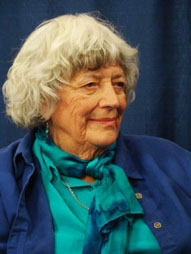
Jessica Stone on Play Therapy in the Digital Age

Crossing the Digital Divide

Lawrence Rubin: Hi, Jessica. Thanks for joining me today. How did you become interested in digital play therapy, which really is cutting-edge and somewhat controversial with children?
Jessica Stone: I kind of straddle a few worlds here. I am a licensed psychologist with a specialty in play therapy. Within it, digital play therapy has become one of those areas of interest over the last 20 years, stemming from experiences with my own kids, who had this whole portion of their world that I didn't really understand, know about, or enter into. It struck me as a little bit ironic and maybe even hypocritical that here I spend my time at work and my energy learning and doing play therapy with children and entering their world, while my own kids have this whole portion of theirs that I was putting no effort into understanding. And so, I kind of had to smack myself upside the head and say, all right, I need to learn more about this. Why is this important to them? Why are they interested in it?

Long story short, I ended up entering into an online game called Runescape that my oldest two (of four children) were both playing at the time. I am no digital native by any means, and I was not very good at these games, but the point was that I was taking interest. I was listening to them. I was asking them questions. We were having conversations about what happened in the game, what quest they were working on; things that were important to them that prior to my entering their world, I couldn't participate in or even understand. I began to see that because this co-play was so impactful with my own children, I needed to incorporate it into my work, which really opened the door to what I have been doing for all these years.
LR: So, you recognized that technology was so important and present in your kids’ life that you would be almost doing a disservice to your young clients if you didn't cross that bridge into their digital world. Tell me, what exactly is digital play therapy?
JS:
I am no digital native by any means, and I was not very good at these games, but the point was that I was taking interest
Digital play therapy is a modality that is based in speaking the client’s language through what I call the four C’s, which are competency, culture, comfort, and capability. These are basic elements of therapy in general, but digital play therapy in particular is couched within the broader context of prescriptive play therapy, which taps into what Charles Schaefer calls the therapeutic powers of play. So the point is that there is a foundation for it. It's not just, oh, let’s just jump on this bandwagon and start throwing these digital things into what we’re doing. We as clinicians need to have a very firm and solid foundation in what it is we’re doing and why we’re doing it regardless of our theoretical foundation, therapeutic modality, and interventions, or whether the platform is virtual or face-to-face. And as in all therapies, we must ground our interventions in solid case conceptualization and treatment planning.
LR: I know that Charles Schaefer co-founded the Association for Play Therapy and has written extensively on play therapy, but can you tell our readers what he means by the “therapeutic powers of play?”
JS:
it's not just, oh, let’s just jump on this bandwagon and start throwing these digital things into what we’re doing
If you can close your eyes for a minute, imagine a graph with four quadrants that represent what he calls the core agents of change. These are facilitating communication, fostering emotional wellness, increasing personal strength, and enhancing social relationships. In turn, each of those quadrants consists of the 20 therapeutic powers of the play. For instance, in the quadrant of “facilitating communication”, we have self-expression, access to the unconscious, direct and indirect teaching. In the quadrant of “enhancing social relationships,” we have the therapeutic relationship, attachment, social competence and empathy, and so on. I think what Dr. Schaefer has done is given us a really amazing foundation from which to then tailor and customize it as fit for whatever our modality and our theoretical foundation would be.
LR: So when working with children, it's important to consider their communication skills, their emotional development, their strengths, and their social connectivity, and then if you choose to work digitally with them using an app, a video game, or even a virtual reality platform, you are doing so from a solid theoretical foundation and justification for that intervention.
JS: Right, and one of the things that I wanted to add was
there are three levels of digital play therapy: at the first level, you are simply open to it, including it in the conversation, and trying to understand why it's important for that client
that there are three levels of digital play therapy. At the first level, you are simply open to it, including it in the conversation, and trying to understand why it's important for that client. The second level would be when someone brings in, for example, a YouTuber that they are interested in, or a game, and they want to show you a video of it, or together you're looking up information about it. So you're using a digital tool, but it's to learn more about it and to share in some aspects of your client’s life. The third level would be all of the above and would also include actually meeting with your client within a game (whether you are with them in the room or virtually) or using an app together. And so, in order to have digital play therapy, you don’t have to be in the Roblox game with them. You could be at level one or level two, talking about it, asking questions about it, or having your client show it to you, or taking a tour of it.

If Not for the Legend of Zelda

LR: And that becomes part of the treatment plan as well. And you may not even know which level you're going to be entering into until you know the child a little better. Can you give an example off the top of your head of a level three experience that you had with a client?
JS: Absolutely, but I’ll sanitize all over the place for obvious reasons. I had a little elementary school age guy who came in to me because he was selectively mute. He didn't speak to any adults, including his teachers. He spoke to his parents, but he didn't speak to any adults outside of his home.

We had this amazingly intricate way of playing the physical game Guess Who, not the digital version. We came up with this whole worksheet with all the different options that he could point to and we were really proud of ourselves for having gotten to that point. But then he wanted to move on and saw that I had a Nintendo Switch sitting on my shelf. He pointed to it, and I said, “Oh, yeah. You know, I have this Switch, and really the main game I have on there is Legends of Zelda.” I listed the other games I had, but the main one that the kids really wanted to play at the time was Zelda: Breath of the Wild, and so he wanted to play it. By the way, I have the “regular” Nintendo Switch, the one with the two removable handset controllers and central viewing screen that both players can see.

We each had a controller, and I said, “But what we have to do now is to figure out how we’re going to communicate, because one of the handsets controls where the person is looking, and the other one controls where the person is walking. So if we’re not communicating, we’re going to go off a cliff, or we’re going to run into an enemy, or, you know, something is going to happen because we’re not explaining to each other what our agendas are, or what our desires are.”

it was a breakthrough that I really don’t know that we would have had it were it not for Legend of Zelda
He also had a tablet that he could type on to communicate so he indicated that he would point because he was the walker, and I would be the looker. As we were playing, we came to this dangerous thing and it became this frenzied moment because we were going to be attacked. All of the sudden, he screams out at me, “Look over there!” While I had never heard his voice before, I didn’t want to make too big of a deal of it.

I was like, okay, play it cool, but inside I was so excited. Out of the corner of my eye, I see his hand fly up over his mouth, like, oh, my gosh, I can’t believe I just did that, right? And I said, “Oh, I’m so glad you said that,” and I looked where he told me, averted the danger and we went on. I said, “You really saved us. I’m so happy that you talked to me to tell me that because we would have totally been attacked.” After that pivotal moment, he would chitchat, and there weren’t any communication lapses. It was kind of like, well, the cat is out of the bag, and I didn't make it an unsafe environment for him to do so, and it was a breakthrough that I really don’t know that we would have had it were it not for Legend of Zelda, the two controllers, and the need to communicate with each other. It's amazing.

The 4 C’s of Digital Play Therapy

LR: That was a breathtaking moment. How does it capture those 4 C’s of digital play therapy you referred to earlier on?
JS: The first three—competency, culture, and comfort really culminate with the fourth, which is capability.

Competency is those core skills that derive from our theoretical beliefs, experience, and continued education, regardless of our discipline of practice. It is within the professional. It is what we bring into the therapeutic space.

Culture is very interesting to me and something that we’ve talked about for decades as being important to incorporate into our clinical work. It has blossomed and expanded from religion, race, and place of origin to include other facets of peoples’ experience, like music, food, and interests, and of course their digital involvement.

A while back, I was invited to speak at a PAX convention, which is like Comic Con but for people who enjoy gaming. There were literally thousands of people there, all of whom shared this common experience and who have historically been characterized as “other,” with all the stereotypes that go along with gamers, like spending days in their mother’s basement playing video games.
LR: They don't fit in.
JS: They don’t fit in. And while I don’t want to perpetuate any of those damaging and non-appropriate stereotypes, there I was with thousands and thousands of people and I was the “other.” I’d never felt like the other in my life, but in that moment, it really struck me that it is such a disservice to think of people who have digital interests as “others.”

First of all, it is quite hypocritical, because at any given moment, most of us have a device near us. We have a phone we don’t leave our house without. We have our computer, and millions of people play very casual games like Bejeweled or Candy Crush on their device. So, it's quite hypocritical for us to say, “Oh, those people are others,” when really, there are simply different levels of gaming. So, the culture piece is really important to me, and we can’t simply reject portions of our clients’ lives—in this case their digital interests.
LR: If technology is so significant a part of our culture, why is there still a seeming reluctance on the part of some clinicians to incorporate it into therapy, and in this case play therapy with children?
JS: That actually brings us into the next C, which is comfort, the importance of which is that we be genuine and congruent within ourselves, and that's something that I think that a lot of therapists don’t have about technology. I talk to people, and they're like, “I don't know how to get my photos off my phone. I don't know where to find them.” So first, I think it's just basic knowledge and comfort. We know that at the beginning of the pandemic, people were freaking out. They didn't know how to use a platform like Zoom or, you know, whatever it is that they're using. Where do I get the link? How do I get into the app? How do I talk to people? What if they can’t hear me? As therapists, regardless of whether we are working with adults or children, we have a lot of things to think about when we’re in session, including, how does this fit into our case conceptualization and align with our treatment goals?
LR: How do I validate it?
JS: So
when a new anything is added into that therapeutic mix, like technology, it throws everything else off kilter a little bit so that we don’t feel secure, we don’t feel congruent
when a new anything is added into that therapeutic mix, like technology, it throws everything else off kilter a little bit so that we don’t feel secure, we don’t feel congruent, and now we are not only worrying about the logistics, but also whether I am doing the right thing for my client. And so when you package all that together, it's like, oh, I don’t even want to touch that because it’s too risky. It's too scary. In my book, Digital Play Therapy, I refer to this as techno-panic. We can point to so many different points throughout history, such as Socrates saying that the written word was going to destroy the oral word. Radios are going to destroy… TV is going to destroy… Video is going to destroy…
LR: So techno-panic results in people, and perhaps in our case therapists, keeping their distance from technology because of anxiety, worry, and insecurity.
JS: Yes, I’m going to keep my distance, because that has enough in it to scare me but not enough to inform me.

And by the way, the fourth “C” is capability—something to bring the other 3 C’s together. Capability means continually striving and reaching forward throughout one's career to embrace, or at least consider new modalities, concepts, and techniques to discover, explore, and practice.

The Virtual Sandtray: Origins

LR: This conversation reminds me of an experience I had a few years back when I encouraged a fellow play therapist, Deidre Skigen, who had been using the SIMS program as a virtual sandtray, to write an article for Play Therapy magazine. Soon after it was published, a veteran sandtray therapist (and purist) sent in a 32-page paper lambasting the idea of using a simulated sand tray. According to your 4 C’s model, this veteran clinician could probably not check off any of the C’s. With that said, please tell us about your groundbreaking app, the Virtual Sandtray.
JS: Sandtray is amazing and has been around for just about 100 years.
Dr. Margaret Lowenfeld started with the World Technique in the 1920s while working with kids after the war
Dr. Margaret Lowenfeld started with the World Technique in the 1920s while working with kids after the war. She really wanted to understand more about their experience and, in particular, their resilience. She understood that the sand tray is a creative, projective way of working with people either nonverbally or verbally. Traditionally, it's a tray with a blue bottom, and depending on the clinician’s theoretical orientation, can be made in different sizes. It can be populated with various objects and figures, which when placed in the sand create a symbolic representation of the child’s external world, their unconscious conflicts, fantasies, and projections.

It can be freeform, and then it becomes the clinician’s job to understand what that client is expressing. Sometimes people will tell a story and narrate it. Sometimes they won’t. There’re so many things that will depend on where someone’s theoretical foundation is coming from with regard to sand therapies. This is the foundation and fundamental aspect of doing sandtray therapy—your client is creating a world, a microcosm right there with you.
LR: And your Virtual Sandtray app?
JS: In 2011, following a devastating tsunami in Japan, my very good friend and colleague, Dr. Akiko Ohnogi, co-founder of the Japanese Association for Play Therapy put out a plea, “Please send us materials. We have all these people.” She and her therapist-colleagues needed materials to work with people impacted by the tsunami.
no matter what you do, sand is bulky and heavy and will escape whatever you put it in, no matter what, so an alternative was needed


I got together a bunch of stuff, and I sent it over feeling quite proud of myself for contributing to all of this but then thought to myself, how are they going to do sandtray without a sand tray? While sand trays are very popular in the United States and come in many varieties, portable kits are clumsy at best, and how were we going to get all the necessary miniatures to them? No matter what you do, sand is bulky and heavy and will escape whatever you put it in, no matter what, so an alternative was needed.

As it happened, I had received an iPad for Mother’s Day that was pretty cool to have, but it wasn’t getting much use until I thought, “It should be on an iPad.” And then I started thinking about how it could be used by clinicians and interns in hospitals and schools, in crisis situations as well as in traditional therapy spaces, whether in-person or online. A virtual sand tray could be used with immunocompromised people and clients who were traumatized and would be triggered by the sensory contact with the sand. Interestingly, my husband had taught himself to program when he was a teenager. He said enthusiastically, “You know, I’m going to start that project for you.” Being married, I had of course heard that line before, but he proudly proclaimed, “Oh, that sand tray project.” It just bloomed from there.

the Virtual Sandtray started out as a touchscreen app so that you could have the kinesthetic experience of the creation of the tray
Dr. Schaefer invited me to his annual retreat/think tank, so I was able to share my thoughts and receive excellent feedback from my play therapy colleagues. And Drs. Linda Homeyer and Daniel Sweeney, who wrote the definitive book Sand Tray Therapy, offered to beta test it and provide additional feedback. So, I was very fortunate to have such amazingly educated and experienced people giving us information, knowledge, and feedback on our app.

The Virtual Sandtray started out as a touchscreen app so that you could have the kinesthetic experience of the creation of the tray. I also did a lot of research and reading into Dr. Cathy Malchiodi’s art therapy work about the inclusion of digital-art representation and symbolism and I am so proud to say that we have recently partnered with the Lowenfeld Trust, who endorsed our product and the way it has stayed faithful to the basic tenets of her original work with the sandtray.

The Virtual Sandtray: Applications

LR: So what exactly can you do with the Virtual Sandtray app, and what clients is it best suited for?
JS: So, I'll say this as a nutshell and then put it to the side. There are a lot of administrative features that we’ve built in for the therapist which are separate from the actual clinical uses. It is also important to note that the app is atheoretical, as is use of a physical sand tray. The Virtual Sandtray app is like all other materials in the playroom, a tool that is adaptable to the clinician and the client, regardless of presenting issues. It is also useful for any age, as is a physical sand tray.

You can dig in the sand. You can build up the sand. You can paint it, add grass, or water, or cobblestone, or you can have it be sand color. You can place 3D models in it, rotate the tray, and navigate at any angle. Like a physical sand tray, it is three-dimensional in every regard.

a happy-go-lucky scene of rainbows, butterflies, and unicorns can be created against a dark and foreboding background


You can make the models bigger or smaller, turn them around, move them, and knock them over. You can blow them up. You can change the background. A happy-go-lucky scene of rainbows, butterflies, and unicorns can be created against a dark and foreboding background. Congruence between the main scene and the background is relative. You can dig down in the sand, paint the inside of the tray blue so that the bottom of the tray is like water.


11 Year-Old: Safety and Security with Unicorns and Fence, but Danger (Dragons) Lurking


Adult: Castle as Calm Space/Sanctuary


You can create a multidimensionality in the sand so that, for instance, two layers would just be sand, but the third layer is liquid. So, in the happy-go-lucky scene I mentioned above, you can change the liquid layer to lava. So now we have a multilevel, multidimensional depiction of this world for this client. We also have camera filters, so you can make it look like it's snowing, or raining, or you can invert the colors. You can do night vision, like it’s seen by aliens or something like that.


9 Year-Old: Red Dragon Scene- Danger, Missing Scary, Unsafe, Trauma


Therapist Process Tray: Sadness Over Missing out On 4th of July Due To COVID

LR: Jeez.
JS: One of my current favorites is this one called “broken,” and there’s a couple different broken varieties, but if you can imagine a scene where the person has created a scene depicting their family and then they use the camera filter so it appears shattered. This might reflect how that client feels about their family.

By the way, you can save trays and load previously saved trays to work on again. The clinician can review and compare/contrast the in-person with the online sessions. In the secure, encrypted remote mode with a free client version, no personal health information is collected, and there are multiple language and accessibility features and well over 7,000 3D models available.

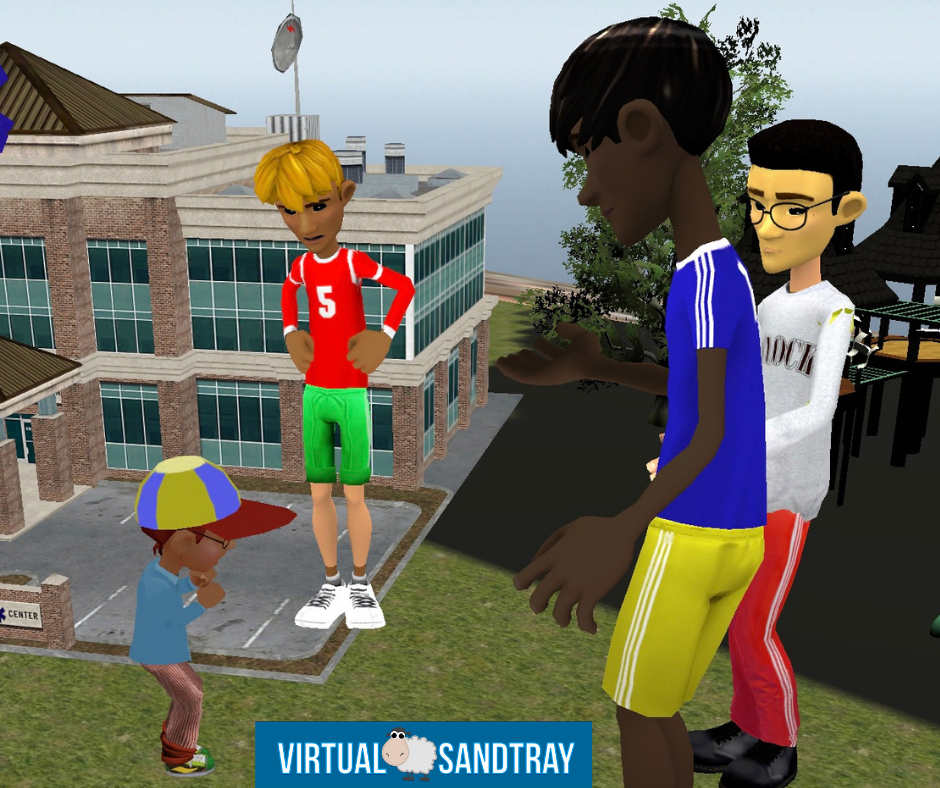
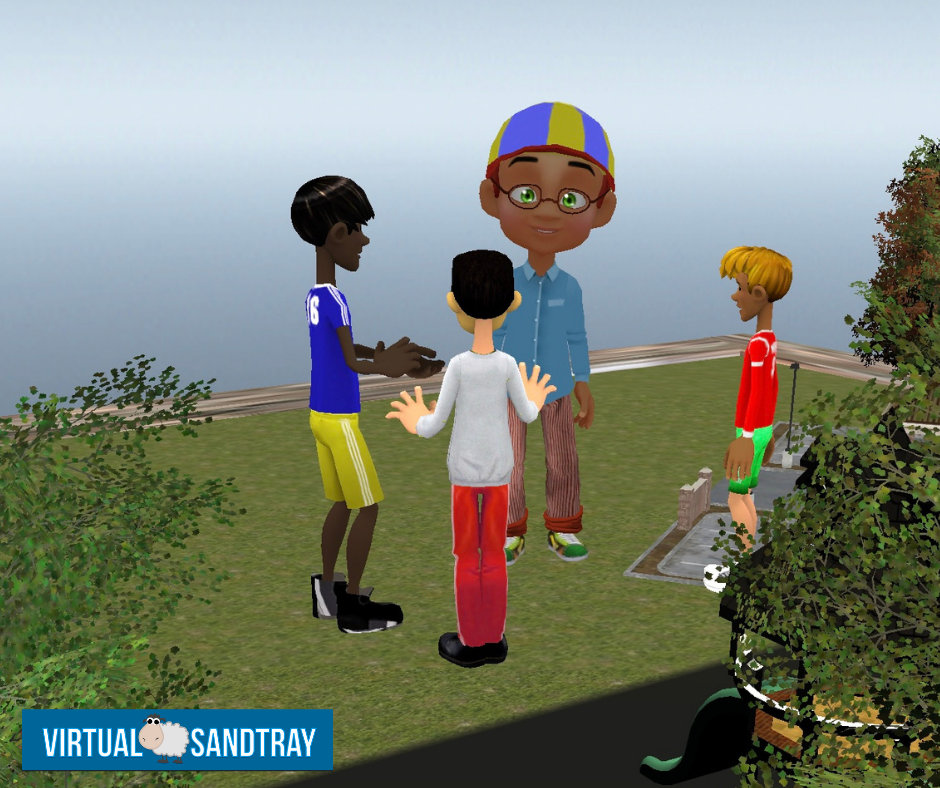
Sandtray with a VR Twist

LR: In your book, you talk about the virtual reality version of your sandtray app.
JS:
In VR with the Virtual Sandtray, you can be either up in what's called God mode, where you're up above the tray, looking down, or you can come down to the level of the sand tray and interact with your creation
In 2016, I started learning more and more about VR. I remember thinking, "Mental health is going to explode with virtual reality." So my husband created a version of the app for virtual reality. In VR with the Virtual Sandtray, you can be either up in what’s called God mode, where you're up above the tray, looking down, or you can come down to the level of the sand tray and interact with your creation. So imagine a child is depicting a theme in which they have been bullied at school, or an adult client is interacting with their spouse and that interaction has been traumatic. Unlike with the Virtual Sandtray app, the client can go right down to the level of the depicted scene to walk and interact within it. It is an entirely different level of immersion. You can certainly crouch down in a traditional tray and become more physically engaged—grab the items and narrate, and move them around and all of that. But in VR, you're staring them in the face. The thing is right there. It's a really powerful, amazing, immersive experience to use the virtual reality version of it, and I’m really proud of that.


Animated Bullies Looking Down on Child Who is Much Smaller/Crying


Bullied Child As He Would Like It To Be—He Is Now Bigger and Talking To Them


VR Version of Sandtray of 11 Year-Old’s Sandtray Scene From Above

LR: Readers may be familiar with the use of virtual reality in cognitive behavioral therapy, in exposure and response prevention. And this isn’t necessarily used for exposure in an anxiety or trauma reduction sense, but it's adding another level of immersion into the play.
JS:
VR could be used in an exposure play therapy format by putting a big spider in the tray or scene
VR could be used in an exposure play therapy format by putting a big spider in the tray or scene. I can make that thing enormous, and then it becomes a challenge to the client, who has to ask themselves, “How do I manage that? How do I keep myself safe? How do I titrate toward, or away, or whatever it is?” I use VR in my clinical practice for a variety of reasons. I’ve used it with adult women for empowering them. I’ve used it with all ages for identifying safe places and spaces.

I even have a job simulator. I have a kid whose life is very regimented, and she comes in, and she just destroys the whole office. She chooses the job of being an office worker, and she goes in and dumps the coffee, and throws things, and just makes this huge mess, and it's so cathartic for her to do this with no real-world consequences.

Synchronicities

LR: What’s the difference, Jessica, between synchronous and asynchronous telemental health play therapy?
JS: This conversation that we’re having right now is synchronous. We’re both here at the same time, speaking to each other, even though we’re in different locations. If you have synchronous learning, it's the educator and the student in the same place at the same time. Asynchronous is when we were emailing back and forth. Or it may be an online platform where the educator and the student are not in the same realm at the same time. In therapy, it would be the therapist and the client were not in the engagement at the same time. So when we give a client homework, or when they're going to draw something or create something, or make a list, or whatever it is, that would be asynchronous.
LR: In face-to-face (live) play therapy, the clinician has all the goodies right there in the room—the drawing materials, blocks, sand tray, clay, papier mâché, and dollhouse, to name a few. How is this done online in a synchronous format?
JS: There are just so many different things that people are doing, and it's just wonderful. The resilience of human beings is amazing. A lot of clinicians have either identified what the client has on their end and what the therapist has on their own end, and then they can each use their materials when they see each other; for example, they could play Uno. And we’re talking about, like, traditional play materials. If we’re talking about digital, there’s a way to do so many things digitally.

Other clinicians have created play therapy kits that the client can pick up or that get delivered, so both have similar materials in their respective spaces. In a sense, it’s parallel play. I’ve had a couple of clients just say, “Okay, let’s draw a whatever-it-is,” and then on my end, I do it, and on their end, they do it, and then I hold it up and they hold theirs up and we show each other. If you’re doing it digitally, you can screen share. What it boils down to is using the tools and materials that have clinical significance and relevance and that meet the needs of the client and their treatment, and that ties into your therapeutic modality of choice.

And this brings us way back to that fourth “C,” capability, because if we really understand what we’re doing and why we’re doing it, then we are able to identify those components and find alternate ways to employ them, but if we don’t have them identified, what the hell are we doing?
LR: What you're describing seems parallel to your experience at the PAX conference where there was this alternate mainstream, and you were the “other.” I imagine that there are some therapists out there who fall into this “other” category, as well as those who are curious and in need of training and exposure, and a third group that has already embraced digital play therapy.

As we come to an end, Jessica, can you name five apps that you have found most useful therapeutically with children?
JS:
I will say that the Nintendo Switch has been an amazing resource for me in therapy, whether through telehealth or in person, and the same goes for my use of virtual reality platforms
Like you said, the Virtual Sandtray would be my tippy top. I have found a lot of therapeutic value in VR programs, and that, again, can open up a whole ‘nother conversation. I will say that the Nintendo Switch has been an amazing resource for me in therapy, whether through telehealth or in person, and the same goes for my use of virtual reality platforms. Underneath that, Roblox. While I know a lot of people who let out a collective groan about Roblox for a number of reasons, I would ask techno-curious readers to watch YouTube videos. Learn more about it. Play some things yourself. It's not as scary and awful as a lot of people think it is. You have to be savvy and have some digital citizenship.
LR: Digital citizenship.
JS: There’s hundreds and hundreds of options to choose from, different varieties and genres that you can then tailor to your client’s needs and interests. It's like Disneyland, you know, for options. Then we have Uno Freak. I mean, that's really basic. We’re just going to play Uno. Like, you put a card. I put a card. You put a card. I put a card. Draw cards. You know, just really basic, fundamental. I actually like the Uno Freak version of Uno better than the card version.

There’s Board Game Arena, and there’s a couple other board game types, as well, traditional games like chess, checkers, Othello. Battleship is a good one, but there are hundreds of other games that you may never even have heard of that you can explore, and they each have little tutorials to walk you through it. So I would say those are really fundamentals that people could start with. Certainly, if people want to know more about some of the other arenas, then I’m happy to do that. Skribbl is there if you want to play something like Pictionary. You both join. You draw. You guess. You laugh. You engage. You learn a lot about people’s frustration tolerance and their coping skills and styles, as well as their interpersonal skills and styles.
LR: Maybe the greatest takeaway from this conversation, Jessica, is that, while this may be scary and new and even evoke techno-panic in those who are probably prone to techno-panic anyway, it really is worth becoming more aware of, because there’s probably not as much of a divide between digital play therapy and nondigital play therapy as people fear or think. Anyway, the real healing comes in the relationship between the therapist and the client and how we use whatever we have or whatever they bring to help them to get where they're going.
JS: I really would like people to think of it as an "and", not an "or". And that we can take all those fundamentals and use them in really powerful ways, whatever the medium is.


LR: And I think, on that note, we’ll stop. Thanks so much, Jessica, for pointing us to the bridge between the digital and non-digital world of therapy and, in particular, play therapy.

Us Versus It: Racism, Family Treatment, and Eco-Systemic Considerations

As an Eco-Systemic Structural Family Therapist (ESFT), I help families establish and learn new patterns of interactions both within and outside of their homes by creating a contextual frame in the form of “Us versus It.” Using this frame, which refers to the family (Us) versus the impacts of racism (It), I attempt to help each member of the family to view their problems and possible solutions in the context of broader issues related to race and racism. Hence, here I will reflect on my work in the therapy room from the perspective of my child client, their caregivers, the therapists, and the ESFT model.

The Child

“It should not be like this; it should not be like, this Miss Paula.” I sat quietly as I listened to my 14-year-old Hispanic client Valentina express her agony over the recent killing of George Floyd, the racially charged incidents surrounding police brutality, and the global protests in support of the Black Lives Matter movement. As I sat quietly, listening to Valentina’s innocence being diminished at this sensitive stage of development where her sense of self, identity, and beliefs about herself and the world are being shaped by the horrific reality of what she described as “not normal,” I began reflecting on my role as a therapist of color. Identifying the truth of Valentina’s distress did not bring me comfort as I realized uncomfortable conversations about race and racism needed to be had.

Not knowing what response I was expecting from this 8th grader who wants to live in a world where she does not have to be “the adult” in her father’s household and where her mother does not have to devote all her time to working multiple jobs in order to take care of her and her younger brother, I asked Valentina, “What do you understand about what is going on in the world today?”

As we discussed the differential treatment of people of color, Valentina began to identify that she herself belongs to a marginalized group. Drawn to tears, I felt empathetic as I heard Valentina describe her hurt over possibly being racially profiled or being told to “go back to her country” because she speaks fluent Spanish. With the decades of individual and systemic racial injustice and inequality that people of color, specifically black people, have experienced in the United States, a significant negative impact on the mental health and wellbeing of the members of this racial outgroup has occurred as well.

From differences in socioeconomic status, to impoverished conditions of living, to discrimination within organizations where there are limited opportunities and resources for African Americans to grow professionally, racism is very much still prevalent today, as affected families are still disproportionately disadvantaged in their access to opportunities for wealth, education, employment, and housing.

As a black female myself, as I reflected on this not-so-surprising inequality and injustice black people are subjected to, I thought about the families who come each week to my therapy office looking to change systems and patterns within their family and establish better attachments with their children. A significant portion of these families are African American, and in one form or another are a representation of the experience of all black people in America. Early in his life, my 10-year-old African American male client learned social cues signaling to him that he was different from his classmates from other racial groups simply because he looked different from them. My 6-year-old female client refers to her mixed-raced skin color as “ugly” and her white mother’s skin and hair as “pretty.”

The Caregiver

The more I have felt challenged to create the space to conceptualize my clients from a broader sociocultural perspective, the more I have acknowledged the “hard truths” that my African American family clients bring into the therapy room every week. Some of these hard truths include my 12-year-old African American male client Andre’s grandmother/legal guardian, who has been raising him since he was a toddler, sharing her fears about raising two African American men from different decades. She experienced the same fears for Andre’s father when she was raising him that she now experiences while raising Andre.

I recall feeling cold as I listened to Andre’s grandmother narrate her feelings as she recalled watching and re-watching the video recording of the killing of George Floyd. I personally could not bring myself to watch the complete video, as I was overwhelmed with sadness and hurt from the injustice and perpetration of violence against black people—especially black men—by the police and criminal justice system. However, I sat in the session hearing my client as she narrated the events that occurred in this video as if it were Andre’s father or Andre. As I heard her, I saw her “hard truth” that she saw Andre’s father and Andre in George Floyd.

Discussing her feelings about raising a young African American male in a world where racism is not only prevalent but inescapable because it is being recorded, she expressed how much effort she has put into raising a “kind, caring, intelligent” young black boy, but also how that is not enough to guarantee his safety or access to the best opportunities. It appears that Andre’s grandmother may have some regret around how she raised Andre’s father, as she recalled “sheltering” him out of fear, which contributed to his not being responsible or self-sufficient.

To understand why Andre’s grandmother felt that it was safer to “shelter” his father when raising him helped me to better understand the connection between impoverishment and segregation, and the high levels of crime, substance abuse, mental illness, and violence that she had attempted to protect Andre’s father from and was now trying so desperately to protect Andre from.

When I think about impoverished neighborhoods, I also think about my 13-year-old African American female client Tracy’s biological mother, who lost her son in a “suspicious” car accident a few years back about which my client reports, “There is more to the story we will never know.” Tracy’s mother, who since losing her son became very active in seeking justice for him and other young black males like him, has also acknowledged that her son often got into trouble and that their “unsafe” neighborhood had a significant impact on how he lived his life.

Although well aware of the effect one’s environment and upbringing can have on them, I still found it difficult hearing Tracy’s mother express the disadvantaged conditions of living she and her family have experienced, and how they cost her the life of her son. Tracy’s mother’s grief sits with her every day, as this was not only her child, but a child whose life she continues to prove to anyone who will listen…mattered!

The Therapist

As the recent racially charged incidents in the country made me reflect, perhaps anew, on what role I am currently playing as a therapist of color in and outside of the therapy room, I went back to the ACA Ethics Code, which says, “The primary responsibility of counselors is to respect the dignity and promote the welfare of clients.” It also directs counselors to actively understand the diverse cultural backgrounds of the clients they serve, and to explore their own cultural identities and how these affect their values and beliefs about the counseling process. These words are the core of competent and compassionate multicultural practice.

In the context of these ethics, “it is even more important for me to see my clients not how I want to see them, but rather how they want to be seen”. If I have a African American single mother of two who is managing two jobs and unable to remember session times, my first conceptualization of that client should not be of her as “lazy” or “forgetful,” because it may just be she is a mother trying to provide for her family and may need a little extra support from me, such as a twice-weekly rather than weekly session reminder.

Former NFL player, motivational speaker, and pastor Miles McPherson believes that every consultation should be a race consultation. The problem comes when you have assumptions based on a social narrative stemming from your own beliefs and upbringing. Putting them aside and having a race consultation allows us to let our clients tell us who they are. I view McPherson’s ideology as a positive and useful one in that it allows me to enter the therapy room viewing it as a “race consultation” with the goal of setting aside my preconceived race-related notions about my clients. This orientation also frees me of the fear of acknowledging my “blind spots” because it gives me room to learn as well as see where I may be falling short. Not acknowledging the racial elephant in the room is like being comfortable doing the wrong thing.

I have come to realize the importance for therapists who belong to non-black racial groups, specifically white racial groups, to be more knowledgeable around the historic and systemic disadvantage African Americans have experienced for decades and how that plays a role on their mental and physical health. Culturally competent therapists who are knowledgeable around the impact of systemic and intergenerational racism may be in a better position to “buy-in” with their clients, that is, to recognize their own privilege and take the extra step, like making an extra phone call to a client when needed, advocating for a client who needs extra resources from the community, or exploring their own cultural identities beliefs as they help their client identify their own.

The Model

The Eco-Systemic Structural Family Therapy (ESFT) framework identifies certain overlapping and interacting individual, systemic, and societal patterns that contribute to the interactions, hardships, and coping strategies of the African American families with whom I frequently work. This framework posits that the symptomatic child is reflective of the breakdown of family life as an adaptive response to hardship. Using this collaborative, strength-based, and trauma-informed model, my work with families applies the four pillars of ESFT—attachment, co-caregiver alliance, executive functioning, and self -regulation—to help develop caregiver-to-child attachment, strengthen the level of functioning and skills caregivers have in order to perform day-to-day tasks for managing their lives and the lives of their child, identify social support systems that help the family build caring and stable environments, and observe how the family makes meaning of and copes with emotional and affective experiences.

Take, for example, my 9-year-old African American male client Tyree, whose “Core Negative Interactional Pattern” (CNIP) includes Tyree’s getting “easily frustrated” and instigating fights with his sister, which leads to Mom yelling, Tyree being punished, and then Tyree’s “shutting down” or engaging in emotional outbursts such as yelling, crying, or screaming.

When I think about what hardship, tragedy, and trauma that may contribute to these presenting problems Tyree exhibits, I think about his witnessing domestic violence between his father and mother on several occasions. Additionally, his father is currently incarcerated, and his mother now occupies the single-parent role and is busy ensuring that she is able to financially provide for Tyree and his siblings. Given these changes in Tyree’s family system, it is useful for me to recognize his interactional pattern within the family as a reaction to the loss of having his father in the home and the burdens on the entire family unit against the racial/cultural backdrop of their lives.

In such cases where caregivers may suddenly take up the role of single parent or have been upholding the role for a very long time, ESFT promotes executive functioning and caregiver-to-child attachment with concepts like “Ennoblement,” where caregivers are able to view themselves as competent, caring, and able to keep their child safe. For instance, my work with my 11-year-old African American male client George’s mother included a consistent level of “Ennoblement,” as she needed a reminder and affirmation that she was competent, caring and able to keep George safe even though she did not currently have the support from his father. Because of the hardships experienced by George and his mother, many sessions with this family included George’s mother expressing the difficulties of being a single mother and lacking a support system.

I have learned that it is essential for African American mothers and their families in particular to be empowered, as research indicates that most African American homes are female-headed homes helmed by mothers, grandmothers, and aunts. According to the United States Census Bureau, the percentage of White children under 18 who live with both parents almost doubles that of Black children. This data is very reflective in my therapy room, as a large proportion of the African American families I see are single-parent families which are female-headed.

***

In thinking about the various children and family members with whom I have and will work and reflecting on my role as a therapist of color using the ESFT model, I aspire to bring deeper and more meaningful racially-informed conversations into the therapy room. I hope to do so by creating a safe space for more racially-sensitive and race-oriented conversations between caregivers and their children. In doing so, I also hope to join more authentically and empathetically with African American families while together we construct more adaptive narratives.

Family Therapy in the Age of Zoom: What a Long Strange Trip It Has Been

If there is no plan, nothing can go wrong
Kim Ki -Taek — Parasite

It’s not the strongest of the species that survive, nor the most intelligent, but the one most responsive to change.
Charles Darwin

It’s recycling day, can’t we just put the kids outside on the curb?
Parent — Pandemic, week five

Dude!…You’re Glitching!
Fourteen year old girl on Zoom session

Long Strange Trip

The pandemic has changed the larger world forever and will forever change the world of therapy. Our therapeutic ecology — how we practice our craft, where and with whom — will never be the same. It’s as if we’ve clicked into a science fiction show and can’t change the channel because we’re in it — clients and therapists have become talking heads, connecting as best we can and collectively feeling the fatigue attrition that accompanies the absence of being in person. The Grateful Dead were right: it’s been a long strange trip, especially for the empaths.

Michael is a single man in his thirties. He’s suffered a lifetime of painful shyness and being overweight. His job requires computer skills, so he spends most of his time in his cubicle, with little socialization on the phone or with co-workers. He’s described breaks and lunch as “torture.” Prior to lunch, he would get revved up with good intentions and then, he said, “I’m like Wile E. Coyote chasing the Roadrunner — I hit the wall.” One time, he got the gumption to attend a meet-up group for shy people, and no one showed. Yet, despite these challenges, he’s determined to be more social. Then, something happened. At our last Zoom therapy meeting, he was more confident and relaxed, like he’d just put on old slippers — smiling and even cracking jokes. For me, it was a kind of optimistic disorientation. At first, I thought that it was the combination of medication, his Wile E. Coyote resolve and hopefully some of the therapy that, like the British Baking Show, had produced a slice of Magic Pie. It wasn’t — it was the pandemic.

Because of “social distancing,” Michael paradoxically experienced being together with people while he was apart. Everyone now shared his life — now he could enter conversations with the knowledge that others also shared the taut, jangled wiring of his interior. It was as if he became an Italian apartment-dweller sheltering in place with his neighbors and singing together with them off their shared community of balconies, everyone listening with hearts joined in the absence of judgement and the voices of hope. Better still, because of the imposed distancing, Michael could now be safely social.

The Zoom Era

And what about therapists — what is this doing to us? Many are working from home. Those of us with children, pets or partners and who don’t have a home office have to find a “quiet space.” Ha! Good luck with that basement, people! Or, if we’re lucky and the landlord isn’t banning entry, we can go into our off-site office space — but that, too, has its own set of Zoomy consequences, not the least of which is “Zoom Fatigue.” By day’s end, sessions can feel like you’re in the front row at a lecture on sofa cushions where the speaker can see you. Just as you start to blissfully nod off, your head suddenly jerks back, and you snort loudly and say something weakly therapeutic like, “really..?” and then wipe the drool onto your sleeve — très embarrassing.

Zooming our client’s home space is not without merit. Back in the day when I was a probation officer in Cabin Creek, West Virginia, and then a social worker doing school evals, and then a research therapist on a project with heroin addicts and their families, I was blessed with being both witness and participant in the amazing diversity of the human condition. You learned to go with the flow and, you swam in the deep end of the family pool — dogs, cats, kids, babies, ferrets, frogs, multiple TV’s, radios blaring, grandparents, people who just showed up whom you didn’t know, dinner on the stove, or a silence that also spoke to you — all this before the age of the Internet. It was so powerful that when I first started my private practice, I would ask families to invite me to dinner and a family session at their home. “Now, we have Zoom — welcome to the shallow end. But we can all still learn to swim.”

You can observe a lot by watching.
Yogi Berra
Peter Lopez, a family therapist on the board of The Minuchin Center for the Family, is a home-based family therapist. On one of his Zoom visits, he wanted to speak to both parents and have an enactment with them that would increase the parent’s executive capacity and demonstrate to themselves and their kids that Mom and Dad were on the same page. In a moment of inspiration spurred by there not being enough headphones for everyone, he asked the parents to “move closer together so you can share…”

Another family therapist, a young woman who works with a diverse population of low-income families and mandated, substance-abusing high-risk teenagers, finds that being “in & not in” someone’s house can diminish her connection and, in some cases, embolden teens to challenge her — like the fifteen year old teenager who greeted her on FaceTime lying in his bed with his shirt off. “Would you do that in my office?!,” she asked, incredulous. “Uh, no, but I’m not in your office….” “Well, when we meet on Facetime, you are in my office!” And then, softer — “So when you put your shirt on we can start, and you can tell me how you’re doing.”

She still delineates the boundaries — for the kids she sees, her office is their safe space. To compensate for the in-person absence, she’s upped the amount of between-session “homework” that she and her clients then share at the next session. Trauma and disconnect are prevalent. A young girl being raised by her grandmother whose mother is absent provided a path in between sessions. Together they came up with an assignment to come to sessions with a weekly playlist of songs that emotionally spoke to the client. The girl picked “How Could You Leave Us?” by NF, which should come with a warning label and tissues — it’s remarkable.
We have to be inter-connected with everyone and everything.
Thich Nhat Hanh

You cannot solve a problem from the same level of consciousness that created it.
Albert Einstein

An informal survey asking therapists to describe their experience of practicing Zoom therapy in the pandemic seems to break into two distinct groups: one, maintaining a kind of Buddhist perspective of acceptance –— that life is suffering and impermanence in which every day is an opportunity to practice mindfully — to another, a bit less accepting — “I fucking hate it!”

A Third Way?

Which begs the question — is there a third way? The short answer is “Yes.” And it’s not without precedent. Einstein’s quote is like learning a brilliant escape trick from a gifted magician. The magic is not what is seen or said but in what he doesn’t say. What he omits is the specificity of consciousness — it does not have to be higher or lower, just different. And we therapists are all about being different. To be effective, we access different aspects of ourselves that then activate different and more adaptive aspects of our clients. It’s what Minuchin described as the “differential use of self.” If we want others to be different, then we have to be different. For systems thinking and for family therapy, in particular, those differences in thinking were already in the works well before the pandemic.

Lynn Hoffman pointed out in Foundations of Family Therapy (1981) that “the advent of the one-way screen, which clinicians and researchers have used since the 1950s to observe live family interviews, was analogous to the discovery of the telescope. Seeing differently made it possible to think differently.” And by circular extension, thinking differently also comes from acting differently.

Up until now, we’ve relied on our in-session felt experience, one-way mirrors and videotaping to guide ourselves as instruments of change. One recursive emotional and visual distinction between the now and the then of the one-way mirror’s transformative introduction, is that families could not see the people behind the glass, nor could the people behind the glass see themselves being seen. Videotaping sessions, however, offered a “third” answer, giving therapists the capacity of “seeing” themselves and the family’s patterns in context. It shined a light on how to experiment with adapting interventions systemically and collaboratively. While inventing Structural Family Therapy, for example, Minuchin, Jay Haley and Braulio Montalvo invited family members behind the mirror. They recognized cultural and class differences between themselves and the “natural healers” from the minority community that they were training to be therapists. Minuchin realized that “in order to join, we needed to change.”

“With Zoom however, there is a binding irony that holds therapists and clients in its’ grasp. It is as if we share front row seats watching a mystery play”. The opening scene’s roiling dense fog and dim lights mask the fullness of detail, so we squint, holding our breath hoping to see what’s really there. We’re doing our parasympathetic best to figure out the plot. It’s the work of it that fatigues us and leaves us wondering if this is as good as it gets.

Therapy is therapy as therapy does, but how we use ourselves in this new environment re-boots an age-old clinical question; what exactly is both necessary and sufficient to produce change? Montalvo called the position from which we work “The possibilistic premise.” Meaning that regardless of the location of the family’s pain, we are still faced with respectfully challenging the system’s homeostatic “stuckness.” We know that we can effect those changes in person. When Zooming, however, it can sometimes feel as if we’re “Major Tom,” floating in space, attempting to weld the hull as we circle the earth.

So, as Bowlby, Susan Johnson, the Gottmans and our own families have shown us, the quality and kind of our earthly and relational attachments are important. While we may feel even more like Russian Dolls, breathlessly stacked within each other’s context and the context of the world writ large, it’s not a question of “if” we adapt and attach in different ways, it’s more a matter of “How?” Perhaps as Theodore Reik suggested, we should listen with greater clarity, not just with a “Third Ear,” but now with ear buds. We are finding ways to compensate for what’s lost with diminished sight and the absence of physical presence. Our adaptive make-up is yielding results. However because we are inherently empaths, we feel the absence of presence. But we shouldn’t feel bad entirely. Rumi’s poem, “Love Dogs,” reminds that “the howling necessity” implores us to “cry out in your weakness,” such that “the grief you cry out from, draws you toward union.”
It’s the end of the world as we know it, and I feel fine.
R.E.M.

Postscript from the Bunker

After not seeing our granddaughters at our house for eleven weeks, my wife and I share a grandparental Folie à Deux — an ache like an old injury that we’d come to accept, now reawakened with every primitively crayoned coloring book that hung on our walls like an in-home Children’s Louvre. As grandparents of a certain age, now when my wife and I see all their stuffed animals in a pile, we silently share the Buddhist themes of impermanence and suffering. It feels like a Christmas Story staging of Toy Story — our precious time together is ghosted in front of us as a reminder to our mortal selves that “this is it.” This perfect time of their lives, full of wonder and imagination, is just another pandemic curtain closing on the “Duck Duck Goose” show. Now our own mortality is awaiting, as quiet mourners do when “joining” family and friends on a Zoom funeral.
Alone together.
Dave Mason

Then there’s this — amidst all the noise, people find themselves and others. I see a recovering alcoholic/substance abuser in his thirties. He’s been in recovery for seven years. He has a great sponsor and a solid home group. As the pandemic continued, he began to miss the in-person connection with his group and his sponsor. So last week, with the intent of doing “Step work,” he and his sponsor sat safely apart on his sponsor’s back porch. As night began to fall, he said that without any cues, they both simultaneously became silent and quietly surveyed the backyard as darkness fell. He said it was one of the best conversations that he’d ever had.

Like the scene from Little Miss Sunshine, when on their way to the “Little Miss Sunshine” contest, Dwayne flips out after finding out that his color blindness has just destroyed his dream of joining the Air Force, getting away from the “fucking losers” that constitute his family and having a life of his own. He’s profanely inconsolable. His mother says, “I don’t know what to do!” Then his stepfather says to Olive, “Olive, do you want to try talking to him?” Without a word or hesitation, Olive gingerly makes her way down the embankment, ignoring the dust scuffing up her red cowboy boots, and squats down next to her big brother. She puts her arm around Dwayne, leaning her head onto his shoulder. She doesn’t say a word. They both sit together as one in the silence. Quietly, as if whispering a confession, Dwayne says, “O.K., I’ll go.” He then helps Olive up the hill and says to his family, “I apologize for the things that I said, I didn’t mean them.” They load in the van and continue on.

“Off in the distance is a billboard, the message faded but visible, “United We Stand.” We can hope”.

The Murder of Hope

Hope

During my short time as a mental health therapist, I have become aware that when a client enters my office for the first time, they are not alone. I am no longer surprised to find that they bring with them a crowd. Sometimes the client is young, as April was, not quite a teenager but perhaps not quite a child anymore either. She brought with her a myriad of people—family members, friends, classmates, crushes, and her abuser. I saw some of them immediately as our eyes first met, and I instantly recognized the power that they held over her, in her consciousness, daydreams and nightmares. They sat down with her and I could feel their grip, I could feel the fear in my own chest over what they had done.

There was another being that I had only recently become acquainted with. Her presence was not quite as potent but was steady from the start. She entered the room as soon as April did and invited me into a dance of both creativity and pain.

“It was not until this presence was murdered that I came to know her as Hope”. In the weeks that passed after April chose to end her life, I got to know the heavy stone of grief that had settled in my stomach. I spent hours resting my hand on chest, on my belly, breathing in this pain that felt more complex than just the loss of April. I turned it over in my hand, wondered what was there, in my grief with her. In the weeks that followed, I realized that this rock was not just holding April, but another being: Hope.

When I look back on my time with April, I can distinctly remember the first time that Hope made herself known. April had come into my office as if it was her own and flung my blanket onto the ground, spreading it flat with the tips of her fingers. She pressed her cheek onto it and traced the shapes below her. “We can lay on it as long as we don’t put our feet on it,” she told me. I laid next to her and she spoke of her dreams. So easily, she named her abuser as he was and told me about her body. As she did, I could feel the terrified child in me reach toward the terrified child in her, and then she was there. Hope made her entrance in this easy connection, breathing into me what could be. I began to feel, in this tangled mess of articulate children, the beginnings of an older woman.

Even before Hope was murdered, I spoke to her. It began in my car, after we met. I left each session and imagined what Hope was like—a bold, creative, quirky teenager who loved her friends ferociously and spoke to her pain with tenderness when it arose. She dressed in ways that made her feel empowered and felt safe to express her creativity, her passion, her fears. I imagined an adult woman who lived her days with gentle passion, unafraid of her desires and longings. A woman who wrapped others in her own sense of embodiment, who believed that healing was possible, who advocated for herself as fiercely as she did for others. It was easy to see the ways that this energetic, playful, imaginative child could become a wildly creative and embodied woman.

I must admit that in many ways Hope was not only made of the girl. She was made of the girl that I once was, who was much more withdrawn and fearful. She was made of some of my creativity, my passion, my wildness. She was made of some of the woman I am and some of the woman that I also long to become. Hope was free and tender in ways that I sometimes am not, and she was made of the sort of reckless dreams that I held around this beautifully courageous child.

Pain

Therapy with children is a wonderfully playful mess composed of hours of Jenga, making houses out of shoeboxes, outbursts, laughter, and moments of stunning articulation. Some children enter therapy tentatively, but for April it was not the case. With April, every activity involved a story, involved imagination and intricate webs spun between characters, both fictional and real. Amidst these stories, she’d tell me her own: about the abuse, and the terror that gripped her at night, and the maddening ways that one tries to make sense of such harm. She wondered about her fear, her desire, and how these things become intertwined. She asked questions that my child-self would have been far too scared to ask: “Am I still loved?” “Do I still belong?” “Is there something wrong with me?” In these questions there was no escaping my own fear, my own history with assault, my own terror that something is wrong with me. Questions I’d asked and supposedly answered as an adult, and yet.

And so, in these ways she began to ask me into her pain and demanded that I also acknowledge my own. As my own therapist put it so clearly, “there are some clients who invite you into more of your own healing.” I felt Hope here, too. As we stood in the lobby and said goodbye, April easily rested her hand in mine. I could feel two children speaking to each other, holding their own pain, holding each other’s pain. I could feel my own, adult hand, and I could feel Hope. I could feel the beginning of an exhale I longed so much for April to have. A type of exhale that is kind and purposeful and full of her own hopes and dreams—what a feeling it would be to witness. I knew, and Hope knew, it would not be easy to get to this exhale. And yet we believed that she was capable of it—perhaps not of entire days or weeks or years of settling into her own breath, but moments. Moments where joy and freedom were allowed.

And perhaps this is where the ache of death was felt the strongest. That when April decided she could not live any longer, she took with her two beings that I had grown to love fiercely. I have spent so much time thinking of the girl who sat in my office, the girl who played and laughed and bellowed at the top of her lungs in the lobby, completely unashamed. I have thought about the girl who spoke with astonishing clarity about those who harmed her, who bravely revealed her fears and her pain without looking away from me. I have thought about her hand in mine and her loudness and her lovely oddities. And I have missed these things fiercely.

As I have sat with my grief, as I’ve held the ache and numbness, I have been angry. I’ve been angry that when she killed herself she also murdered Hope, a being who I needed for April, but who I also needed for myself. As I’ve continued since April’s death, I’ve often wondered about Hope. I’ve wondered if she matters, now that she’s dead. I feel angry that I did not get a say in her departure—perhaps this is unwell of me, to have tangled myself up in April’s Hope so much that now it feels as if a part of me has died, too.

I’m furious because this is not what I signed up for. I signed up for pain, and for a long, difficult battle towards some sort of wellness, but I did not sign up for this. I did not sign up for creating this beautiful being with another person who gets to decide if they want to die and take Hope with them. The tangle of grief becomes nearly unbearable as I think of Hope. The girl and I, “we made her together, we crafted her from laughter and tears and imagination”. She was formed from a goodness I can still feel sitting at the base of my throat, a goodness that I have yet to let go of. As I live and know that she is dead, I want to cling to Hope and ask her to stay somehow, without half of her being. Without the girl, Hope is dead. And with her, the goodness.

It’s been nearly impossible for me to grasp that perhaps the heartbreaking truth is that Hope, for her, is dead. As much as I have taken this rock of grief in my stomach and wanted to smash it into the ground and say, “No! You cannot take Hope with you, too!” it must be true that Hope has also been killed, and there is so much grief in that. Letting go of April and her Hope will perhaps forever be molded into the being of my own Hope; the woman who I am and who I hope to become. Letting go of the girl means that Hope lives in me as an ache. She continues to grieve and rage and long for the goodness that once was. She sits and cries with those who also grieve the loss of the girl, and she keeps going, still holding the ache. In some ways it feels easier to stay in the anger, to argue with the girl, with Hope, to hold them here with my grief. Settling into the despair is harder, is a continuous reminder that yes, she is gone. They are gone.

Risk

Shortly after April’s death, I read these words in a blog by Jerusha Dressel: “Hope is a choice to stay.” The months after her death marked a death for me—in my personal life, and in my work as a therapist. I struggled to believe that I would ever feel connected to another client again. I sat in this feeling of death and wondered, where is Hope? Months after she would begin to make an appearance, for just a moment. I would see her after a productive session, and I would hiss at her: “get out of here.” Connection with my current clients brought a newfound sense of risk and dread: if I care about them, if I love them, they could die. And if they do, a part of me will die again. I wanted to do everything in my power to keep this from happening again. Perhaps if I don’t allow myself to love, to feel deeply connected and hopeful, then therapy will not hurt so much. I will not risk losing a piece of my soul again.

In the same breath that I hated Hope, that I wished I would never see her again, I also longed for her to return. I longed to feel connected again but feared so much the consequence that most of my being would not allow it. When I could not find her in myself I thought back to those words: “Hope is a choice to stay.” In this way therapy feels like a constant entering into the terror of Hope: afraid of the death and the grief that connection might bring, and yet. Hope is a choice. To keep listening, to keep feeling, to keep holding the trauma of our lives and each other’s lives. There is an excruciating beauty in the invitation to enter these spaces of pain and betrayal, and I began to center myself again in that truth. We are wired for connection. Amidst tremendous suffering, we are not required to see the ending—to see Hope of recovery or health or happiness. Somehow, in the despair, we can choose again just to stay. To behold each other’s stories. To feel the pain deeply and fully and remain with each other in it.

Hope and I will continue to be on hiatus. As I grieve and rage, I do not want to see her. And yet I know that every day as I choose to re-enter all that is therapy, she is around. A part of her has died. A part of me has died. And still, we stay.
 

Addressing Common (and Reasonable) Myths About Exposure-Based Therapy for Child Anxiety

Despite prevailing evidence that exposures are an effective (if not, the most effective) component of treatment for child anxiety disorders¹, therapists might reasonably feel reluctant to implement this therapeutic strategy in their practice. “By design, and simply stated, exposures make children with anxiety feel more anxious”. How, then, can they be used to treat anxiety? This seems counterintuitive. I certainly thought so when I first started my training as a doctoral student in clinical psychology, and as a child-anxiety therapist. However, through my training, I learned more about the rationale that underlies the efficacy of exposures, and continuously witnessed the benefits of exposures firsthand through my own clinical work. Through this process, I transitioned from an exposure-skeptic to a strong believer.

Exposures, Anxiety & Children

“Exposures” are clinically created and controlled scenarios that involve introducing an anxiety-evoking image or experience in a graded fashion so that individuals can learn how to regulate and manage their anxiety response to a feared stimulus or situation. For example, if a child has a fear of the dark, then an “exposure” would involve having the child sit in a dark room. Exposures are effective because they allow anxious children the opportunity to learn through their own experience that what they fear will happen (e.g., a monster will pop out from a dark corner) does not actually happen. After repeated practice experiencing the feared event or image while building coping responses, the child learns that the feared situation (e.g., dark room) is no longer associated with danger (e.g., because a monster never popped out of the corner). Some children learn this after only one or two exposures, other children require more practice. Additionally, exposures allow children the opportunity to “sit in” their anxious feelings and learn how to tolerate them by letting uncomfortable, anxious feelings come and go. Many children initially think that if they confront a feared situation, their anxiety levels will skyrocket and never come back down. Exposures allow children the opportunity to learn that although their fear levels will likely increase when confronting a feared situation, over time (i.e., as they learn that nothing “bad” or “dangerous” is happening), their fear levels will eventually come back down—and usually within a few minutes.

In my clinical experience, exposures work best when they are implemented gradually. I wouldn’t have the child sit in a pitch-black room by himself for 20 minutes at the second or third treatment session. This is called “flooding” and may have detrimental effects. Instead, I might start with having the child sit in a room with dim lighting for 30 seconds, and then gradually move up in time and darkness level week-by-week until the child reaches his treatment goal (which in this case, might be to fall asleep alone at night with the lights off).

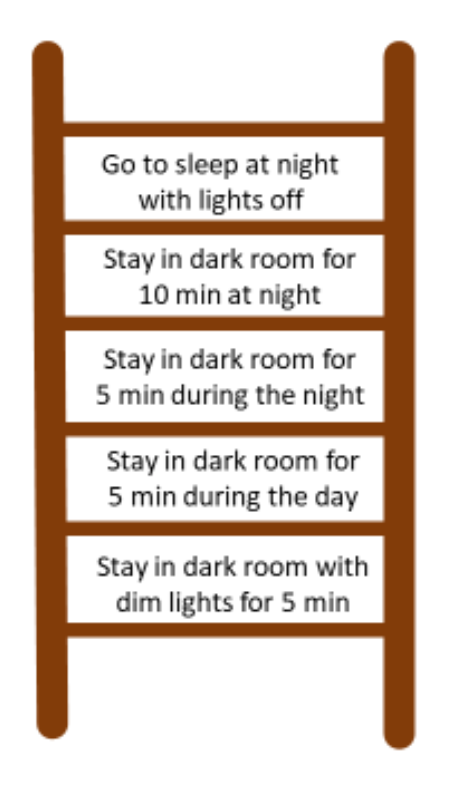
Exposures should also be planned in advance and agreed upon by all parties. The child (and parent) should know what’s coming and should play a collaborative role in planning the exposures. This is often done by creating a “fear ladder” wherein the child, parent, and clinician determine a treatment goal (e.g., to be able to fall asleep alone with the lights off) which is at the top of the ladder, and then plan “steps” to reach that goal (in the form of gradual exposures).

Example fear ladder that I created:

In addition to being gradual and planned, exposures should be frequently practiced. The more practice the child has with exposures, the easier (i.e., less scary) the exposures will get. More practice with the exposures allows for more opportunities to realize that the feared situation is not truly dangerous. Therefore, exposures should ideally be conducted both in-session and at-home as “therapy homework.”

Furthermore, given that one of the main purposes of anxiety treatment is to improve the child’s use of coping skills when facing feared events, exposures should be taught and delivered alongside active coping skills. Other coping skills include relaxation strategies (e.g., slow, controlled breathing; progressive muscle relaxation) and thought switching (i.e., identifying negative, anxious thoughts and switching them to neutral or positive thoughts). These skills should be practiced before and during the exposures, and are meant to facilitate the regulation of the child’s fears as s/he sits through the exposure. Coping skills teach the child that “I have some control of my scary feelings” and exposures teach the child that “Nothing bad happened, even though I thought it would.” Together, these practices work to reduce anxiety in children.

Common (and Reasonable) Myths

The prospect of conducting exposures in treatment sessions can be daunting for therapists, particularly beginning clinicians. At first, I, too, had reservations. What if these exposures make my patients’ anxiety worse? What if my patients despise me for putting them through distress and they never return again? How am I supposed to convince children that confronting the things they’re extremely afraid of will actually help them?

To my relief, I am not alone in having experienced these concerns, as other therapists, according to Stephen Whiteside and his colleagues², have reported feeling reluctant about exposures for similar reasons. Over time, however, I have come to learn that although these concerns are shared and understandable, they are actually myths, or perhaps in the lingo of practice, irrational thoughts.

Myth #1: Exposures Make Anxiety Worse

The proper delivery of exposures involves the following three steps:

  1. The child confronts a feared situation (increase in anxiety)
  2. Nothing “bad” or “dangerous” happens (decrease in anxiety)
  3. The child realizes that what s/he was afraid was going to happen did not end up happening (return to zero anxiety)

Given that proper exposure delivery involves steps 2 and 3, exposures do not make anxiety worse. Rather, exposures help children learn that the feared situation is not associated with real danger, which leads to reductions in anxiety, and often a sense of pride and accomplishment for successfully facing their fears. A potential concern might then be, “Well, what if something bad does happen during the exposure?” This is an understandable concern (one I admittedly had), but perhaps not a reasonable one. For example, let’s say the child with the dark phobia hears a noise while he is in the dark room. At first, he may interpret this as something “scary” happening, which one might reason would lead to an increase in anxiety during the exposure and subsequent maintenance of the dark phobia. However, upon examining the situation more closely, the therapist can guide the child into realizing that even though the child perceived the noise as something “scary” or “bad” happening, nothing bad actually happened. Did the noise itself cause the child any danger? What other (non-scary) thing could the noise have been?

Another important lesson here is that even though something dangerous happening during an exposure is possible, that does not mean that it is probable (this is also a lesson that we teach our patients!). Just like it is possible for us to get into a car accident any time we get into a car, it is not highly probable; therefore, we should not let the possibility of a car accident prevent us from ever getting into a car. This is because the benefits of car transportation (i.e., the ability to get around to wherever we want, whenever we want) outweigh the slight risk involved. Similarly, we should not let the possibility of something bad happening during an exposure prevent us from delivering exposures to our patients. There is a much stronger likelihood that the exposure will be successful, which will lead to major anxiety reductions in our patients. The benefits here outweigh the risk.

Another potential counterargument may then be, “Well, why can’t I just continue to do what I do (e.g., teach relaxation skills and/or teach children to focus on “positive” thoughts), given that these strategies are less risky and are also beneficial to my patients?” This is a great point. Relaxation and other strategies (e.g., changing anxious thoughts to positive thoughts) are important coping tools for anxious children. However, to maximize the effectiveness of our therapeutic work, these strategies should be taught alongside exposures. This allows children to practice such coping tools in real-time while they are doing an exposure during the treatment session. Therefore, instead of telling our patient to “practice slow breathing the next time you are anxious,” we get to witness the patient practicing slow breathing in real time while s/he is anxious. This allows us to provide live feedback on the child’s use of the skills (e.g., “try breathing even slower”) while they are in an anxiety-provoking situation. By receiving such feedback while they are in an anxiety-provoking situation, the skill is more likely to generalize to when they confront anxiety-provoking situations outside of the session (compared to practicing the skills in-session while they are calm/not anxious).

Myth #2: Exposures Damage the Therapeutic Relationship

This one was a big concern for me. I feared that if I pushed children into confronting distressing situations, they would resent me, hate coming to therapy sessions, and then convince their parents to take them out of therapy. However, after conducting hundreds of exposures with my patients, this has never happened. Not even once. In fact, by the end of treatment, many of my patients have reported that they are happy that they completed exposures as part of treatment. They say that they are proud of themselves for completing the exposures, and have reported “feeling brave” after the sessions. I’ve even heard patients say, “I didn’t think I could do it, but I did, and it wasn’t so bad!”

This is not to say that I have never been met with resistance when planning or bringing up the idea of exposures. Usually that is addressed by patiently re-explaining the purpose of why we’re doing the exposures, in a way the child understands. But overall, based on my experience, I believe that as long as the therapist conveys empathy/understanding towards the patient’s fears (e.g., “I understand how scary this might feel for you”), remains consistent in encouraging the patient to face his/her fears (e.g., “It’s okay if that was too hard this time, let’s talk about it and then see if we can try again”) and demonstrates a sense of pride when the patient attempts or successfully completes an exposure (e.g., “Nice job facing your fear! That was so brave!”), the therapeutic relationship tends to stay intact.

But don’t just take my word for it. Research also shows that “introducing exposures into treatment does not damage the therapeutic relationship”³.

Myth #3: Children Are Unable to Foresee the Benefits of Exposures

A third major concern that I had was whether younger children (i.e., as young as 6 or 7 years old) would be able to understand the purpose and rationale for doing exposures. I worried that children would consider therapy a “scary” place and wouldn’t understand why I was asking them to confront their fears.

Contrary to my initial belief, most children can grasp the concept if explained in a developmentally appropriate manner. For example, for younger children, I give an example of a girl named Andrea who is very scared of puppies (first I make sure the child is not scared of dogs or puppies). I ask the kids,
“If Andrea is really, really scared of puppies, will she want to play with puppies, or stay away from them?”

Most will say “Stay away from them.”

“But are puppies actually scary?”

“No!”

“What will probably happen if Andrea goes up to a puppy?”

“I don’t know, maybe it will lick her and want to play.”

“Yes, that’s right, the puppy probably just wants to play. But if Andrea is scared of puppies, what does Andrea think will happen if she goes up to one?”

“She probably thinks it will bark at her or bite her, maybe.”

“Yes that’s probably exactly what she’s thinking! But will it?”

“Probably not.”

“Okay, so let’s say Andrea practices being brave one day, and goes up to a puppy. Like we just talked about, the puppy just licks her on the hand a couple times and maybe brings her a toy. Makes sense, right?”

“Right.”

“So, once Andrea realizes that the puppy didn’t bite her or bark at her, will this make her feel more scared of puppies next time or less scared?”

“Less scared.”

“Yes, less scared! Now Andrea is less scared of puppies. So, the way Andrea became less scared of puppies was by facing her fears, going up to the puppy, and seeing that nothing bad happened (even though she thought the puppy would bark or bite). Does that make sense?”

“Yeah.”

“So in the same way, the work we will be doing together will involve being brave, facing our fears, and learning (like Andrea did) that even though we think something bad will happen, it actually won’t. But we’re going to do this in a slow, step-by-step way to make sure it’s not too scary.”

After this, I present a rationale for why we do it step-by-step, and let the child know that s/he plays a role in deciding which exposures to do. Most of the time, this rationale and an explanation of the up-and-down nature of fearful feelings are enough to help children understand the purpose of exposures.

Tips on Delivering Exposures

There is a right and wrong way to deliver exposures, so here are some (research-supported) techniques on how to reduce the chances of exposures going wrong:

Prior to beginning exposures:

  • Ensure that the child and parent understand the rationale behind exposures

Just like therapists need to know how and why exposures work in order to feel comfortable delivering them, children need to know how and why exposures work so they can feel more comfortable practicing them. See the example above on how to explain the rationale for exposures. Keep in mind that the type of explanation should match the child’s developmental level.

  • Seek child and/or parent input during the construction of the fear ladder

The child and parent should be a part of the treatment planning process. Allowing child and parent input can make exposures seem less intimidating, and allow children a sense of control over their treatment. Work together to determine a treatment goal and ensure that the exposures gradually move toward and reach that goal. “Remind children and parents that the exposures should ideally elicit a moderate amount of fear” (not too little, and not too much).

During exposures:

  •  Track the child’s fear ratings immediately before, during, and immediately after the exposures

Tracking the child’s fears can be done by obtaining a number from a scale of 0-10 of how scared the child is feeling. There are multiple benefits to tracking the child’s fear ratings throughout the exposures. From the therapist’s perspective, tracking the child’s fear ratings can provide helpful insight into whether the exposures are “too easy” or “too difficult.” Fear monitoring can also provide insight into whether the fear is moving in the anticipated direction (with fear ratings highest before the exposure and lowest after the exposure). From the child’s perspective, fear monitoring can provide “evidence” that the anticipation of the exposure tends to make him/her feel more scared than the exposure itself.

  • Try to minimize distractions

In order to maximize the effectiveness of exposures, the child should enter the exposure with some level of fear and anticipation that something negative/dangerous will happen. While in the exposure, the child should still experience some fear and think about what it is s/he is afraid will happen. After the exposure, the child should realize that the feared outcome did not happen.

If the child is distracted during the exposure (i.e., doing anything that would prevent him/her from realizing and s/he is scared and fearful of some outcome), then the effectiveness of the exposure goes down. It is better for the child to confront the anxious feelings and realize that “I was scared and thought something bad would happen, but everything still turned out okay” versus “I wasn’t scared because I was distracted, but yes, nothing bad happened”.

After exposures:

  • Praise the child’s efforts

Given that exposures can be temporarily distressing to children, it is important to “acknowledge the child’s bravery for attempting to face his/her fears”. Praise should be given when the child successfully completes an assigned exposure, or when the child makes any effort to complete the exposure (even if completion of the exposure is unsuccessful). Praising the child allows the child to feel a sense of accomplishment, reinforces continued practice of exposures, and can also aid in maintaining the therapeutic relationship.

  •  Help the child articulate what s/he learned from doing the exposure (i.e., that what s/he feared was going to happen, did not happen)

For exposures to be successful, the child should be able to articulate that the feared outcome did not occur. Therapists can facilitate this conclusion by explicitly asking, “What did you learn from this practice?” For younger children, the question can be framed as, “What did you think was going to happen before you went into the dark room?” “Did that end up happening?” “What actually happened?”

Stephanie’s Messy Hair

Stephanie (name and identifying details changed) was a 10-year old girl who had previously been diagnosed with social anxiety disorder. At the start of treatment, Stephanie and her mother reported that Stephanie avoided asking or answering questions in class, initiating or joining in peer conversations, and speaking to adults (e.g., waiters) because of excessive fear of appearing “stupid” or “weird”. Stephanie’s mother also reported that she took 30 minutes to fix her hair in the morning, which often resulted in arriving late to school and her mother arriving late to work. Stephanie reported that the reason she spent 30 minutes on her hair was because she was afraid other people would make fun of her if her hair was messy.

Stephanie’s main treatment goal was to be able to initiate and join conversations with other kids in school and extracurricular activities. Stephanie and her mother reported that a secondary treatment goal was to decrease the amount of time it took Stephanie to get ready in the morning, so that she and her mother were no longer late to school and work. Stephanie was on board with doing exposures to achieve her treatment goals (although she would initially try to avoid doing them), and demonstrated a good understanding of why we were doing exposures. I devised a “fear ladder” jointly with Stephanie and her mother. The first few weeks of exposure practice involved situations such as Stephanie saying “hello” and introducing herself to another adult and child in the clinic, asking questions to the front desk staff (e.g., “Can I borrow a pen?” and “What time is it?”), ordering for herself at restaurants, and saying “hi” to peers at school. Stephanie also practiced doing presentations in front of an audience of 3-4 people and engaging in back-and-forth conversations with other people for at least 5 minutes. By the ninth session, after completing several steps on the ladder, it was time for her to practice going out in public with messy hair. Here’s how the exposure went:

Therapist (Me): “Alright Stephanie, do you remember what was next up on the ladder for this week?”

Stephanie: “Yes, going outside with messy hair”.

Therapist: “That’s right. And how are you feeling about practicing that today?”

Stephanie: “Do we have to?”

Therapist: Smiles. “What do you think?”

Stephanie: Smiles and looks down. “Ok, I’ll try…”

Therapist: “Ok, wonderful! That’s all I care about, remember? That you try. So, going outside with your hair kind of messy: what makes that scary for you? What do you think will happen?”

Stephanie: “Wait. How messy is my hair going to be?”

Therapist: “We can decide that together. I was thinking of putting your hair in braids and having some hair falling out and sticking out in different places, because your mom told me about how you don’t like that. What do you think?”

Stephanie takes a deep breath and I notice her start to blush.

Stephanie: “Okay…”

Therapist: “I like how you just took a deep breath when you started to notice your fear go up. So now, back to my previous question: what makes this scary for you? What do you think will happen when we go outside?”

Stephanie: “Everyone will stare at me and come up to me and say, ‘Why is your hair so messed up?’”

Therapist: “Has that ever happened before, when your hair has been messed up?”

Stephanie: “No.”

Therapist: “Okay, so what do you think the chances are of that happening today?”

Stephanie: “I don’t know. I’m still scared it will happen.”

Therapist: “Okay, so as always, this will be our experiment. It’s never happened before, but let’s see if it happens this time.”

Stephanie nods.

Therapist: “So what’s your fear rating right now?”

Stephanie: “Seven.”

Therapist: “Ok, and what are some coping skills we can do to prepare us for this practice?”

Stephanie: “Deep breaths and positive thoughts.”

Therapist: “Exactly. What’s a positive thought you can tell yourself to feel more brave?”

Stephanie: “I’ve done this before and nothing’s happened.”

Therapist: “Great! And what if someone does stare at you? What did we talk about last time that you can tell yourself?”

Stephanie: “That I should say to myself, ‘So what?’”

Therapist: “Yes! You can ask yourself, ‘So what if they stare? Will it matter tomorrow that a random person stared?’ And will it?”

Stephanie: “No.”

Therapist: “Alright, let’s go.”

While we walked outside, Stephanie initially walked close behind me, hiding her face. After the first person walked by, I asked Stephanie, “Did that person stare at you?”

Stephanie: “No.”

Therapist: “Okay. Let’s keep experimenting and see what happens.”

As we walked around outside the therapy building, I asked a couple more times if she caught anyone staring. Stephanie reported that her fear rating decreased to a 4 in about 45 seconds. After another minute passed by, Stephanie reported that her fear rating was 2. Once we returned to the therapy room:

Therapist: “You did it! You walked around for 5 whole minutes with your hair messy, even though there were other people around. You stayed in the situation the whole time (even though you didn’t want to do it at first), and I even noticed that you moved from behind me to next to me! How did that feel for you?”

Stephanie: “Good. I was scared at first, but that wasn’t as bad as I thought it’d be.”

Therapist: “Great. So, what are the results from our experiment? Did anyone stare at you or ask you why your hair looked like that?”

Stephanie: “No, nothing bad happened.”

Therapist: “Yes, nothing bad happened. And what did you learn from today’s practice?”

Stephanie: “If I go outside with messy hair, people might not stare at me or come up to me.”

Therapist: “Great. And how do you feel knowing that you just faced your fear on something that was really scary, and stayed with it the whole time? You were at a 7!”

Stephanie: “I feel good, proud.”

Therapist: “Glad to hear it. I feel good and proud, too.”

Closing Comment

At first, I was intimidated by conducting exposures. I worried that exposures might make my patients’ anxiety worse, rupture the therapeutic relationship, and that I would not be able to effectively explain the purpose of exposures to children. Despite these fears, my training experiences have led me to become a strong believer in their effectiveness in treating child anxiety.

Once I “exposed” myself to the delivery of exposures with children and adolescents, I quickly learned that what I was afraid was going to happen (e.g., their anxiety will get worse, the therapeutic relationship will be damaged) did not actually happen. After continuously conducting exposures in treatment sessions with my patients, I learned that exposures do not tend to have negative or dangerous consequences. (It also helps that decades of strong research evidence show exposures do not have negative consequences). So, for any therapists out there who treat children (or adults) with anxiety disorders, especially those new to the field, I encourage you to confront any fears, myths or preconceptions you might have about exposures (gradually, if you must) and join me in this beneficial and therapeutic practice.

Resources

1. Chorpita, B. F., Daleiden, E. L., Ebesutani, C., Young, J., Becker, K. D., Nakamura, B. J., … & Smith, R. L. (2011). Evidence?based treatments for children and adolescents: An updated review of indicators of efficacy and effectiveness. Clinical Psychology: Science and Practice, 18(2), 154-172.

2. Whiteside, S. P., Deacon, B. J., Benito, K., & Stewart, E. (2016). Factors associated with practitioners’ use of exposure therapy for childhood anxiety disorders. Journal of Anxiety disorders, 40, 29-36. https://www.ncbi.nlm.nih.gov/pmc/articles/PMC4868775/

3. Kendall, P. C., Comer, J. S., Marker, C. D., Creed, T. A., Puliafico, A. C., Hughes, A. A., . . . Hudson, J. (2009). In-session exposure tasks and therapeutic alliance across the treatment of childhood anxiety disorders. Journal of Consulting and Clinical Psychology, 77(3), 517-525. doi:10.1037/a0013686.  

Joyce Mills on StoryPlay®, Metaphor and the Enduring Legacy of Milton Erickson

Lawrence Rubin: I've personally experienced you Joyce as an incredibly energetic, playful, creative and imaginative person who also happens to be a therapist. You describe yourself as a clinician who combines metaphors, storytelling and indirect play with the principles of indigenous teachings into your work. So, I'm wondering if we can start by you describing how the person of Joyce Mills has informed the clinician who the world knows as Dr. Mills. 
Joyce Mills: I'm really the same. I think what you see is what you get, and I don't put on different personas for presentations or in my personal life. I see life as a metaphor. I see everything as metaphor and I'm very spiritual. So, I look to see what I am learning from each experience and it doesn't even have to be a big experience. It could be a bird sitting on a window sill or a woodpecker–something small. I really like to see everything that way. It helps me see with the eyes of the eagle instead of the eyes of a mouse. You know, the mouse scrutinizes, what is important and right in front of him because sometimes you have to look closely at a situation. But
to really get our solutions we need to have the eyes of an eagle, to see in all directions
to really get our solutions we need to have the eyes of an eagle, to see in all directions. And I really live in that creative world, like Winnie-the-Pooh or Fred Rogers [Mister Rogers]. I'm very happy I wasn’t born now because I probably would have been labeled and put on some medication.

Ericksonian Roots

LR: An indigo child perhaps.
JM: Definitely. And I love to make things out of nothing.
LR: Can you give me an example?
JM: You know, it's kind of like in the Pooh movie when he said, “I do nothing, and something happens.” When I get bogged down with a client it's usually because I'm too cognitive—I’m getting away from the heart and soul of who I am.
LR: So, when you say for example that you see bird on a window sill, what might that inspire in you and how might that become part of what you do therapeutically?
JM: Well, what I might say to the bird is, “I wonder what you've come to tell me today.” I was working with an adopted biracial boy several years ago who was really shut down. In our session, he was starting to get very angry, which was fine. Not that he was throwing or yelling, but it was difficult for him to talk. So suddenly, right outside my window here in Phoenix, there was a Myna bird that was sitting on a bush. It immediately got my attention because Myna birds talk and the boy was struggling to talk, and I said, “Oh my gosh, look at this! I wonder what he's coming to say.”

I told this boy that I was a little weird because I talk to things, and so I said, “it seems to me like he might have some kind of a message just for you at this time.” And you know, he kind of smiled, turned and kept watching it. And then he turned back around to me and started talking. I had given him an indirect suggestion because I'm very Ericksonian.

Words have tremendous power.
Words have tremendous power. I had planted a seed for ongoing learning as opposed to a quick solution. In that moment with the boy and the bird, you could hear that my voice changed on purpose. As in Ericksonian hypnosis, it becomes normal to shift my voice because when you're in a relationship with the person and their unconscious as opposed to trying to change them, that communication and that relationship are much deeper than simply conscious words.
LR: I noticed that when you started to tell the story about this particular boy, your voice dropped, your tone softened, almost trance-like, and I felt myself relaxing a little bit and opening to the story.
JM: Well, that's the purpose.
LR: So, you were talking to my unconscious too?
JM: Roxanne Erickson, Dr. Erickson's daughter called it conversational trance. It's very relational, so it's very different than in a child-centered model where you're just reflecting back the client’s words. And I'm certainly not minimizing the importance of that, but it takes it a step further because you're not just listening but you're now utilizing what's happening in the moment.
LR: It's almost like whatever words are coming out of your mouth is one level of communication, but the meaning beneath the words is touching a deeper part of the child or the teen that you're working with.
JM: Yes, absolutely.
LR: Two levels of communication going on.
JM: Oh yes, two levels and sometimes three. Dr. Erickson was known for that—
the conscious mind can listen but it's the unconscious mind that is going to absorb and then utilize what it's given
the conscious mind can listen but it's the unconscious mind that is going to absorb and then utilize what it's given.
LR: You've mentioned several times, and I know from your writings, that you were Ericksonian-trained. Can you say a few words about the influence of Milton Erickson and his work by speaking to the conscious part of our audience?
JM: Dr. Erickson's work is monumental to our field but is very much overlooked and used in a very minimal way. We've talked about solution focus, creativity and entering the world of the of the child through a client-centered approach. That is all Erickson! Did you know that he was paralyzed with polio? He had [an incredible] sense of determination to bypass what looked like limitations even though he was in pain. And it wasn't that he was just going to think positive; he was very action-oriented, and he observed everything. And he was able to digest the observation and let it go into his unconscious to be caught, to let it come out in a way where it could create positive change. And I know different authors or people who have studied with him have all garnered different areas of Dr. Erickson's work—some call it strategic or solution-focused or NLP—neurolinguistic programming. But, if you look at almost all the work, there is an influence of Dr. Erickson.
LR: Even something as seemingly concrete and conscious as cognitive behavior therapy, Joyce, has an Ericksonian influence or foundation?
JM: Well, I believe it does because he did give certain living metaphors or cognitive assignments. But he knew the unconscious would absorb it in a much different way. I worked in Hawaii with angry adjudicated teenage boys who had to go through cognitively-oriented anger management training. The cognitive exercises worked only on the surface. For example, when you give a stick to a person and ask them to sand it down—which is analogous to a cognitive homework exercise, you wonder how they are going to use it. That's very different than saying, “I want you to take this stick and sand it down because that's the way life is—rough on the outside. Then you ask them to make five decisions on how they are going to use it tomorrow in their everyday life.
LR: Okay. Let's say I'm an angry teenager saying that the other boys just don't like me. I think everybody hates me.
JM: I'd be listening, and asking “how would you like things to be?”
LR: [in role of teenager] I'd like people to like me and not be so mean, but I just expect everybody is always going to be mean to me. I would like people to be nice to me.
JM: So, you'd like them to be nice to you?
LR: I would.
JM: Yeah. And I wonder if you ever remember anybody at any time who gave you some ice cream or was nice to you or smiled at you. Maybe not now, but maybe from a while ago.
LR: Sure. I remember I had a friend last year for a little bit. He shared his lunch with me.
JM: So how was that for you when he shared his lunch?
LR: I liked it, but you know, then this thought came in my head. What if he really doesn't like me? What if he sees something that's bad about me?
JM: I wonder where you've ever heard that thought before?
LR: Sometimes my brother. Sometimes my dad.
JM: Let's say I'll call you Peter, okay? I don't know about you Peter, but it's interesting. When I want to go to a restaurant, I look at the menu and I try to choose what I want. And now even as we're talking, I'm remembering going into an ice cream store and how I needed to taste different tastes because I knew that I didn't want certain tastes. There are certain things I really don't like. And then there are other things that taste so good, and it's interesting how I really know, as we all really know, what we like, but sometimes those other tastes get in there because someone tells us it's good for us. But in reality, we really know what tastes good and what doesn’t.
LR: I like when people are nice to me.
JM: Yes, and it sounds like you really know Peter, and what a gift that is to know how you want to be treated.
LR: [out of role] It's very affirming, very positive. You didn't harp or dwell on or change the irrational thought but instead honored the thought and then spoke to a deeper part of me.
JM: And there's another part of that Larry, that has to do with recognizing the sensory systems. Some people are very visual, some people are very auditory, and some people are very kinesthetic. When Peter said, “I hear my brother and father telling me this stuff”, that's like a negative hypnosis. He is not consciously processing it—he just thinks it's happening. It is an irrational thought outside of his consciousness. So, when we recognize that someone has an out-of-conscious auditory processing system, we help them to recognize that. So, if someone has that ongoing negative criticism it's like secondhand smoke—you don't see it, but it can kill you.

If a child has witnessed domestic violence, then he or she might unplug the visual channel in their sensory system so that while they are obviously consciously seeing the violence, they are not processing the experience so they may feel safe. 

LR: And that's what you refer to in your writings as sensory synchronicity between the therapist and the client. The therapist must process the client’s experiences with all of his or her senses by attending to the way that the client is communicating—either auditorily, visually or kinesthetically, which is where the different play materials come in. If a child is kinesthetic and likes moving, then you may use a physical or tactile activity or story. You are working with their strength.
JM: I'm always going to go through their strength. Right now what's popular is to become a trauma-informed therapist because trauma sells. Well, I'm not for that. I'm for resiliency-informed therapy to heal trauma.
It's the strength that heals the trauma, not reliving the trauma.
It's the strength that heals the trauma, not reliving the trauma. All the brain research is on trauma and I applaud it, it's wonderful. How could I even say anything else? However, there needs to be equal research on the power of the brain to create resiliency, because we know from case after case after case that, people heal beyond our expectations. And why does that happen? I'm interested in what is it within us that we rise above what's before us?

StoryPlay®

LR: Resilience! Is this what your model is about? 
JM: I think so. StoryPlay® is a resiliency-focused indirective model of play therapy as opposed to directive and non-directive interventions. There are the six roots of StoryPlay® with the taproot being the teachings and principles of Dr. Milton Erickson.
LR: The main root of the tree.
JM: Yes, that's the main root because of his dedication to enter the world of the client. He always said that there's no such thing as resistance. Resistance is on the part of the therapist unwilling to get into the world of the client. It's not the client's job to get into the world of the therapist. That was a big controversy in his years because people studied resistance from all different disciplines.

The second root of StoryPlay® is trans-cultural wisdom and healing philosophy. I had written in my training manuals about Native American and Hawaiian rituals and stories because I spent a lot of years learning directly from these cultures and from these incredibly wise people. If you sat with them, you would think you were in a training. But it's not. It's all conversational and rooted in ritual ceremonies along with very strong principles of healing and spirituality.

The third root of StoryPlay® is real life, myth stories and metaphors. This is important because

stories are everywhere
stories are everywhere. They're in the wind, they're in the sun, they're in the supermarket. If you know stories, you see through the eyes of stories, you just have to be open. Not to try to take something, but to open yourself to receive. What is it that I need to learn from this? And it may not be something that’s comfortable, but it may be a very big teaching such as from mythology, the make-believe stories, and the stories from cultures that really inspire us.

The fourth root of StoryPlay® is play therapy. The theories and principles of play therapy are rooted in the desire to help children and

you don't have to have a playroom, you are the playroom
you don't have to have a playroom, you are the playroom. So, for example, if you're working in an area of disaster, anything that you can use, can create a world of play. 
LR: Can you give me an example.
JM: I lived in Hawaii through the worst natural disaster to hit that island this century which was Hurricane Iniki. The whole island was wiped out—food, water, electricity. I started a program called “Natural Healing” with the community. Most things were broken down, so we gathered pieces of wood and objects like refrigerator doors and tin roofs that were blown off and created earthcrafts. We would use glue and paint—whatever we had. We took old tin juice cans and inner tube tires and cut them in the shape of a circle. We made drums. Stones become playroom-type miniatures, it was all up to the child's imagination. This incredible creativity and the use of the natural world were the fifth and sixth roots (creativity and the natural world) of StoryPlay®.
LR: My very first interview with Psychotherapy.net was with Eliana Gil who has done a considerable amount of work with traumatized and abused children using art and other expressive media. How would you say that StoryPlay® is different in working with traumatized kids?
JM: I can't really compare because she's got her gifts that are so strong. One of the things Dr. Erickson would do when he was training people was to ask if there was a behaviorist in the room. He would then give a demonstration and the behaviorist would say, “Dr. Erickson, what I saw was this.” And they described it in a behaviorist manner and he would say “that's right.” And then a humanistic psychologist would join in and say, “oh, is this what you did? I think this it was humanistic.” And Dr. Erickson would say “that's right.” So, it didn't really matter to Dr. Erickson what people called themselves and what they did. What mattered was kind of like what Fred Rogers said which is to validate the person's perception. It's just a different way we may approach it, that's all.

Fear and Faith

LR: Talking about different models and methods, I think of Narrative Therapy. Practitioners of that model say that the person is not the problem, the problem is the problem. But it sounds like StoryPlay® is based on the notion that the problem is the clinician’s inability to see beyond the problem to see the solution that it presents.
JM: I have this saying that fear is the messenger, but faith is the message.
LR: What's the message?
JM: Fear gets our attention, right? It grabs us. But
faith is the message that I will find a way out of this
faith is the message that I will find a way out of this. It's an action. I teach about the butterfly. Inside the chrysalis is where the magic happens. The caterpillar has a complete breakdown, becomes gooey and soupy, but it's only at the point of the breakdown that these special cells called imaginal discs release, which is what catalyzes the metamorphosis from caterpillar to the gooey soup to the beautiful butterfly. And I think we all have that time when we feel like we are in a chrysalis stage and don't know what's going to happen. And it is faith that something good can happen that leads to our metamorphosis.
LR: What's interesting is that you talk about the difference between fear and faith which seems to parallel the relationship between trauma and resiliency. Trauma is a constant fearful reliving—an open wound, while faith is the belief that the wound will heal, the fear will diminish and something healthier will emerge. It makes me a little sad for therapists out there who are not in touch with their own imaginativeness, playfulness and indigenous stories and mythology. A whole generation of therapists seems to be lost to technique-driven, evidence-based pursuits.
JM: Yeah. They want to fill their dance card with techniques.
LR: Fill their dance card with techniques?
JM: Technique is not substance, it's not process. Certainly, StoryPlay® has techniques that I call story crafts because they connect to the story which indirectly evokes something within the person. If we open that channel for other people, they're going to find what they need. The program we created in Hawaii following hurricane Iniki was very successful. It was funded by the Office of Prevention Child and Family Services. From that program, I was invited to be on a team after 9/11 to work with the community of firefighters, frontline workers, and police, to develop a program for the children and families hardest hit of 9/11 which was through Rutgers and SAMHSA. It was about using creativity, community relationships, whatever materials we could find to build stories of healing and resiliency and of course faith that healing would happen, like the butterfly.

A Place for Spirituality

LR: In StoryPlay®, it's not just about you and a child in a playroom using techniques, it's about looking for resilience wherever it needs to be found. You're almost like a resilience archeologist trusting that the treasures are there, and then supporting your client to take you by the hand and walk through the painful moments in search of strength and healing. But you're really searching within them. 
JM: Can I quote that?
LR: You quote me, I'll quote you.
JM: I don't just do this for work. I live this, and the exciting thing is that StoryPlay® is like a pebble—you throw it in a lake, it ripples. It's the process that helps people find what they need. The other thing is that StoryPlay® is like a circle with four quadrants—mental, emotional, physical and spiritual. And those quadrants resemble a clinical intake in which you are asking the client how they are taking care of themselves in each of these four areas. Spirituality is an intricate part of the program.
I do not believe that any healing can take place without some recognition of a person's connection to their own spirituality
I do not believe that any healing can take place without some recognition of a person's connection to their own spirituality.
LR: Spirituality seems to be the final frontier with evidence-based clinicians. Can you give me an example of a clinical encounter you had with a traumatized child in which spirituality became a part of the work?
JM: Sure! I was working with a 13-year-old boy who others thought was on the spectrum. He was very distant from others, not connected to very much and was very withdrawn. I mentioned to him how interesting it was that seasons changed and how people didn’t really notice those changes. I said, “It's a special place to be out into nature, isn't it? You can hear so many things. We think, oh, it's always green or it's always cold.” Then I asked him, “what's your favorite season?” Suddenly he said, “you know, nobody knows but I play the guitar.” I said, “You do? You play the guitar? Wow. So, did you always know how to play the guitar?” And he said, “Well, I didn't take lessons. I taught myself.” I said, “Oh. you know, some people believe that when a baby is born, they come into this world with all these special gifts, and sometimes they don't find them until they're a little bit older. So maybe this is a gift that you came into this world with.” And then he said, could I bring my guitar next time?” So, he brought his guitar played John Lennon’s “Imagine.”
LR: Your encounter with this boy was deeply spiritual. You started with a simple observation of the seasons, of change and the importance of being open to seeing beauty and possibility and this boy opened himself to you.
JM: Yes, it doesn't have to be religion. It's what we came in with.

Closing Thoughts

LR: Joyce, I need a little help here. I struggle with my counseling graduate students, trying constantly to infuse creativity and imaginativeness into their work. How do you teach counseling students, counselors and therapists to be creative, imaginative and playful if they've arrived at the doorstep of adulthood and it's not something that they've ever valued or felt they needed, and they are now entering a to a field that doesn't openly embrace it?
JM:
My own work is playful but it's deep
My own work is playful but it's deep. Let's say you're my client or let's say I'm with the students and say, “We have two hours today and as we're together in these two hours, what is it that you hope for?” Now there are multiple levels in there. One of them of course is to awaken intention. Why are you here? And the other is the implied message of what they are hoping for. If I encourage them towards creativity, I might ask, “what does creativity mean to you?” I might do a talking circle or pass around a talking stick or some sweet grass. I might then say, “we're sitting in this circle and I hope that we can talk about what you are hoping for in our time together.” I am modeling creativity, teaching it indirectly.
LR: Currently, the east coast of the United States is being battered by Hurricane Florence. I know that you survived and thrived through hurricane Iniki. What advice would you give to clinicians working with children, teens, families, adults and communities in the wake of Hurricane Florence?
JM: After Iniki, we met in the broken-down neighborhood center with whatever materials we had or could find in the rubble, but not to talk! It wasn't directly a debriefing team. We didn’t ask people to draw a picture of where they were during the worst time of the storm. I would always start by talking about comfort helpers, like a favorite teddy bear or a blanket or something they really liked that helped them feel good. In a circle, we would share what made our hearts feel happy. We really wanted to stabilize them, so they could be fortified to go into the storm because you don't want people to battered again. That's how you create more PTSD. The focus was always on PTSH, posttraumatic stress healing. Transforming posttraumatic disorder to posttraumatic stress healing.

We had food and music playing. We created community programs with some of the elders and clergy. They were invited to share what they knew and even the way they cooked. It was right before Christmas, so we gathered all the debris that we could find and the artwork that these kids created out of these broken pieces were incredible. It was about transforming, and they all talked about it so naturally. We created an environment that was a sanctuary, a place to go but not to continue working on the trauma. A place just to just be and to be stronger.

LR: You were feeding them in many ways.
JM: Yes. Feeding them.
LR: Without answering my question about advice to those who will be helping in the aftermath of hurricane Florence, I think you answered my question—indirectly! How fitting.

Joyce, your license is on inactive status and while you are no longer doing therapy, you are now dedicated to training. You are in a state of wonderful metamorphosis. 

JM: Yes, training and writing. I'm very excited.

Counseling Kids: When a Cigar Is Just a Cigar

Nine year old Malcolm was one of the fortunate clients. Because his family had a very modest income a local counseling center with a sliding fee scale was seeing Malcolm on a pro bono basis. Better yet, the agency was providing free transportation for him on a school bus. His emotional difficulties began two years ago after his parents got a divorce. He was now living with his natural father and his new step-mother.

Treatment seemed to be working well. Then it happened and it changed everything. One day while riding to the agency, he pointed out the window at a very upscale, plush shopping center and exclaimed, "My mother owns that shopping center."

The bus driver (who was trying to talk some sense into the young man) said, "Now Malcolm, that's not true. You know your parents don't have a lot of money and they surely do not own that shopping center. You lied. Now you need to admit to the other kids you a not being honest and apologize."

Malcolm began crying and insisting his family really did own this center. The kids on the bus starting yelling at Malcolm and insisted he owed all of them an apology. The incident ended with Malcolm screaming at the top of his lungs at the children who taunted him.

The bus driver dutifully reported the entire incident to the clinical director of the organization who thanked him and swung into massive therapeutic action. They knew Malcolm was depressed since the divorce, nevertheless, the clinicians had never seen anything resembling this seemingly psychotic like break from reality and tendency to lie, combined with extreme hostility.

The treatment plan was stepped up to a whole new level. Instead of Malcolm seeing only an individual counselor, he would also be placed in group counseling and play therapy. He was also referred for an extensive battery of psychological tests, a medical management session with their psychiatrist, and a session with the neurologist at the agency. He was also referred to a therapist specializing in anger management. Malcolm's progress (or lack of it) would be assessed 30 days later at a case conference in which all the aforementioned psychotherapeutic players would be present.

Finally, it was the day of the big staffing but there was one new treatment player on the field. David, a graduate student serving his practicum at the facility.

The meeting began with the clinical director turning to David and asking, "David, this is a fascinated case. How do you think we should proceed with our intervention with Malcolm?"

"Well sir," said David, "since this is my first day here I haven't had time to read the record. Like everybody else, I just recall that his natural mother is filthy rich. I'm sure we can all remember the firestorm of publicity in the newspaper and on television when she built the upscale giant mall down the street from us. Right?"

The room was dead silent for what seemed like eternity. You could hear a pin drop even if you were using construction worker grade ear plugs during the staffing. Score one for Malcolm!

Since Freud was the master of symbolism, the story goes that around 1920 somebody wanted to know about the symbolism of Freud's own propensity to smoke upwards of 20 cigars a day. The Freudian interpretation at the time was that a cigar was a phallic symbol. When confronted by his fellow analysts about his own behavior Freud remarked, "Sometimes a cigar is just a cigar."

As of late, scholars have come to the conclusion that the famous "sometimes a cigar is just a cigar" statement attributed to Freud is false. Or to put it forthrightly, Freud never said it. My humble two-cents regarding Freud is that even if he never said it, he should have!

But here's the point. If 20 years from now Malcolm is lying on an analyst's couch babbling on about his tendency to smoke cigars, the analyst would do well to keep the notion in mind that sometimes a cigar really, truly is . . . well just a cigar.

Anita Barrows on Love, Poetry and Autism

I Have My Very Troubled Childhood to Thank for This Career

Deb Kory: You are a long-time psychotherapist, a well-known poet, social activist and autism specialist. In the interest of full disclosure, I should also mention that you are a former teacher of mine at the Wright Institute in Berkeley, you chaired my dissertation, and are now my friend as well.
Anita Barrows: Indeed.
DK: As a newly licensed therapist who came to the field with a background in journalism and political activism, I’m exploring for myself how to not get compartmentalized in my role as a therapist and to feel integrated in and out of the therapy office.
I wanted to interview you for Psychotherapy.net in large part because you embody many identities. I think most people know you as a poet and a translator of, among others, poet Rainer Maria Rilke’s work, along with your co-translator, Joanna Macy, the environmental activist and Buddhist scholar. Were you a poet before you became a therapist?
AB: Long before. I was a poet from the time I was about six years old. In fact, through my childhood and up through my years in college, there was nothing else I ever thought about doing. Writing poetry was really it. And I was always interested in politics. I was lucky enough to be a teenager in the 1960s and my political identity was also really strong for me at that point, as I was very involved in the Civil Rights Movement and the anti-Vietnam War movement.
But writing was really the only thing I thought I would ever do. After I got out of college and I realized that I had to do something to make a living, I began working with the Poets in the Schools program. I was also working with a radical law students group, placing law students in internships with radical lawyers like the lawyers for Cesar Chavez and the Black Panthers.
DK: But you yourself were not involved in law.
AB: I wasn’t, but I considered it at that time because it had become clear that I couldn’t earn a living writing poetry. I had studied French, Italian, Latin and German in college and did a Masters at Boston University in English literature and creative writing, and was working as a translator when I enrolled in a doctoral program in comparative literature.
DK: So language is a real passion for you.
AB: I just love language.
DK: Language, poetry, radical politics and law—how did you end up becoming a therapist?
AB: I think I have to thank my very, very troubled childhood for this career.
DK: Not uncommon for us therapists.
AB: Not at all. I had a mother who was chronically depressed and a father who was violent, and I did everything I could to escape that household, mostly adopting myself out to the families of friends. I was pretty good at establishing relationships outside of my home, and wrote poetry from an early age, which helped me process some of the pain I was going through, but when I had my own first child, it came back to haunt me.
I essentially had a breakdown. It ended up being diagnosed as autoimmune thyroid disease, but when I look at it now, I think the thyroid disease was a physical manifestation of what was going on inside me emotionally.
I had read a lot of Jung and was interested in Jung’s approach to literature and symbolism and the collective unconscious, and I was lucky enough to be referred to an extraordinary Jungian therapist, Rosamund Gardner, who died about ten years ago. I was in Jungian analysis with her for more than ten years.
DK: So it was your experience of the transformation that occurred for you in therapy that made you want to become a therapist?
AB: It was, yeah.
DK: I think that’s also a pretty common reason that people end up becoming therapists. My own therapy has influenced me enormously.
AB: Frankly, I don’t know who I would be today if it weren’t for the work I did with Rosamund. I can’t even begin to imagine. I was sort of casting about for some kind of work that felt meaningful, and it didn’t feel like teaching poetry at the university level would be enough, and it really came home to me that therapy can be a deep transformation that can liberate people. I remember Rosamund saying to me at one point, “When you have done this work, you will free your energy.” I was not a very energetic person in my 20s. Now, in my 60s, I’m full of energy.
DK: You’re one of the most energetic people I know!
AB: I think I’m making up for lost time.
During the course of that therapy, I began having dreams—and in Jungian analysis, you do a lot of dream work—and my dreams suggested that I might want to do therapy myself. We had to ferret out what was identification and transference and what was a genuine desire to do this work.
DK: Are you transparent about this backstory with your students?
AB: Very much so. I feel like that kind of transparency can be so helpful—especially in a field where there’s so much fear about revealing that you’ve suffered personally. I’m less likely to reveal it to some colleagues of mine, who seem so tight-lipped and collected.
DK: You imagine that they didn’t have such childhoods? Or is it that they just aren’t open about it?
AB: It’s hard to know, but I can’t imagine that the majority of people who come into this field had a Mary Poppins kind of childhood.

What Happened to the Wounded Healer?

DK: I also had that experience going through graduate training. People were really reluctant to share the fact that they had suffered trauma. And if they did, it was often like, “but I’ve done so much work around it and it’s all resolved now.”
What happened to the “wounded healer”? It’s a powerful framework, in my experience. When therapists are willing to be honest and open and not try to come off as “expertly healed,” it can be extremely transformative. Those moments of genuine, mutual vulnerability can be so helpful in diffusing that sense of shame and isolation that brings so many people into therapy in the first place.
AB: I learned it from Rosamund. She was very open about the pain that she had experienced. It would come up in dreams sometimes where I had sensed something about her childhood, and she was very honest about saying, “Yes, in fact this happened,” or, “No, it wasn’t quite like that, but this was the way it was.” Those were moments when I felt like you really can emerge from traumatic experiences, deep losses, and come out as a person who can have a rich and full life and be able to receive other people’s pain. I say that to my students all the time.
I can’t think of anybody in my education at the Wright Institute, anybody who trained me, who was that open about their experience. In fact, I went through several years while I was a student and then shortly after of not wanting to talk to anybody about my childhood.
I was really afraid that if anybody found out some of the things that had happened to me as a child, they would think, “She can’t possibly be a therapist. Somebody with that kind of childhood turns into a Borderline”—or some other Axis II diagnosis.
So I just didn’t talk about it. I didn’t even tell people I was a poet. At that point I had two books of poems published and had won a $20,000 grant from the National Endowment for the Arts for my poetry. And I didn’t tell anybody.
DK: What were you afraid of?
AB: I was afraid that if I was known as a poet, I would have less legitimacy in their eyes as a therapist. It’s kind of amazing when I think about it now. I remember once I was at a party where there were a lot of Wright Institute people, and somebody who wasn’t from the Wright came up to me and said, “Oh, hi, I’m so-and-so. Who are you and what do you do?” I opened my mouth and started to cry because I felt like my real identity was something I had to hide and that if I had something else that I belonged to, it would take away from people’s beliefs that I could really do therapy.
When I went to take my oral licensing exam, I think it was 1990, I had a recurrent dream for weeks before I took the exam. I’ve always worn a lot of rings on my fingers, and in my dream, I had lost all my rings. It
became really clear that I was afraid that assuming the mantle of psychologist meant that I would lose what was different and kind of quirky and colorful about me, and I’d have to become this straight person.
In fact, these much straighter friends of mine had loaned me clothes to wear at the oral exam. I was going to put my hair in some kind of bun, and I was going to wear this tailored suit and a white shirt. In the end, I gave them all back and said, “I’m just going as myself.” And I passed.

Therapist Identity Disorder

DK: This hits on a fundamental problem I’ve been chewing on. You’ve been licensed for 25 years and have reached a place of integration. I’m just starting out on the path and really want to steer clear of the therapist identity box. I like therapists, I am a therapist, but I kind of got the feeling all through my training that we are expected to keep a really low-profile outside of the office. While we’re given the message that being relational or “intersubjective” is a good way to practice, we’re taught to keep a pretty tight lid on our spontaneity. I heard horror stories of people who would bring their session notes into supervision and just get creamed for any hint of getting too conversational, revealing too much about themselves, whatever. Obviously this depends on the theory of the supervisor, but enough of those kinds of stories were going around to give me the notion that all such events should, in fact, be left out of session notes.
My sense was that we were not really supposed to be in the world, that our job is to stay kind of objectified in our therapist role, and that allowing our wounded selves, our writer or activist selves, our real selves into the room or, worse yet, being seen outside of the room, constituted a great risk of some sort. But what exactly is at risk? Our privacy? The projections of our clients? Our professional legitimacy? A case could be made for these things, but I think the balance is way out of whack.
AB: That’s a really good question. At the beginning of my work as a psychotherapist, I kept my identities pushed very far apart, but as I went along, I started to devote more time to my writing. I created a little study downstairs in my house that I just used for writing, and then began to give more public readings, which I hadn’t done for a period of time. There would be fliers around Berkeley saying I was going to read, and sometimes my patients would show up at my readings.
I remember talking about that with some people who were much straighter psychologists than I was, and they were saying things like, “Well, you really shouldn’t publish if you’re a therapist. And you certainly shouldn’t give readings.” My poetry is not confessional poetry. It’s not like I talk about my father’s abuse or my mother’s depression all that much. But it certainly reveals my politics and my sense of engagement in the world and also facts of my life: I am a single person. I have two daughters. I have a granddaughter. They come into my work in one way or another.
So, short of writing under a pseudonym, which I didn’t want to do, there seemed to be nothing I could do to keep them pushed apart if I wasn’t going to stop writing altogether, which I absolutely realized I couldn’t do. If I go for several months without writing, I just don’t feel like myself. I can’t do it. If I have a core identity, if there’s any one thing that’s my core identity, it’s a poet. And being a psychotherapist is the work I do, and it’s work I love, but it’s not my core identity.
When the first translation of Rilke came out in 1995, the Book of Hours, Joanna Macy, my co-translator, and I did a bunch of public readings for that. It says right there on the flap of the book that I am a poet, a translator, and I work as a clinical psychologist and a professor at the Wright Institute. There it was all laid out. And now when I think about it, it feels so clear to me that my life as a poet informs the work I do as a therapist.
DK: How so?
AB: I think I write poetry to document my sense of engagement with the world in whatever form that takes. It may be a poem about the trees outside my window in the morning or my dog sleeping, or it may be a poem about the children in Palestine or Rwanda. Poetry is the best way I know to make sense of the world. The fact that I write and that I see as a poet is the way I make meaning of things.
In fact, I have a patient in his early 30s who is, among other things, a musician. He’s very attuned to anything artistic, although that’s not what he earns his living at, and he teases me sometimes when I say something, “That’s certainly something a poet would say.” He was referred by someone and googled me and there was all sorts of stuff about me online. These days it’s all out there. If you don’t want to go see a poet, don’t come and see me.
DK: Your clients can self-select.
AB: Exactly.
DK: Do you think having a public identity as a poet and activist has changed your work with clients?
AB: I think it has. I gave a reading some years ago as part of a group of Jewish women who were politically engaged. Grace Paley read, and it was the last time I saw her before she died. Someone came up to me afterward and said, “So, you’re really a clinical psychologist? Are you practicing?” I ended up working with her for several years.

On Love (and Torture)

DK: One thing I have appreciated about your work is that you explicitly acknowledge the importance of love in therapy. When I was in graduate school at the Wright, I remember there was a panel discussion with various clinicians on the faculty, and I asked very pointedly, “How come no one ever talks about love?” It was always “countertransference” or “compassion,” but God forbid you mention love. The responses I got were, “It’s not my job to love clients. I respect them.” Another person joked, “What about hate?” and then proceeded to actually put an article in my mailbox about “hate in the countertransference” and how love was some kind of narcissistic fantasy on the part of the therapist. It was so irritating. I wish I could find the article because I remember the author talking about how it was OK to love the theory, but not our clients.
But I think we are engaged in all manner of love. Therapy can be a profoundly loving experience on both sides, and it can be erotic and romantic and mysterious. Sure, there can also be hate, boredom, “negative countertransference,” but the avoidance of any talk about love is phobic in my opinion.
AB: It’s so true!
DK: How do you conceptualize love in psychotherapy?
AB: Wow. What a wonderful question. I’m really glad to have an opportunity to talk about it. I think it’s the basis of all of it. I really do. I think you can’t do this work without love. And I don’t just mean compassion, I mean really loving somebody.
Of course we all have some patients who are more challenging than others. I have one patient who argues with everything I say, and it can be incredibly frustrating, but if I didn’t underneath it all love that patient, I wouldn’t be able to continue doing the work. And I think you’re absolutely right, people in the field are terrified of it.
One of the arguments made by certain psychologists in the APA who justified “enhanced interrogation techniques”—AKA torture—at places like Guantanamo, was that they don’t consider psychology to be a healing profession. For them it’s a profession where one investigates the workings of the human mind and analyzes them. Therefore, one can investigate the workings of the human mind in situations of interrogation. I have a lot of trouble with that on many different levels.
DK: As you know, I wrote my dissertation about the central role psychologists played in the creation of the torture program used under the Bush Administration. Psychologists were given access to the highest levels of power during the “War on Terror,” and they turned out to be very corruptible. One of my conclusions was that this desire on the part of certain elements of the psychology profession to be legitimated through power and “hard science” is fundamentally at odds with the healing, nurturing, soft nature of this work.
AB: Yes, I think there’s a fear of being soft and compassionate and nurturing and sort of what’s traditionally thought of as feminine or maternal. There’s a desire to be taken seriously in this profession, to be seen as a serious science. The insurance companies are also setting the stage for this, with their insistence on quantifiable evidence and “empirically validated” treatments. I’m not anti-science—I love science, but we shouldn’t value it at the expense of love.
I talk to my students about love all the time. They will come to me sometimes very sheepishly and admit that they really love a particular patient of theirs. I’m not talking about them coming to me and saying, “I really want to go to bed with this person,” or, “I’m going to ask him out for coffee as soon as the therapy is over.” We are so reductionist in this culture. It’s a reflection of the incredible lack of imagination that we have reduced the word love to wanting to fuck.
DK: Sing it, sister!
AB: That love wouldn’t be a component of transformation is just unimaginable to me. I think it has to be. In my own therapy with Rosamund, there was a moment that still brings tears to my eyes when I think about it. I was very, very ravaged in the first year that I was seeing her. I had an infant. I had a bad marriage, and I felt really overwhelmed. All of my own mother’s incapacity to care for me flooded back to me and made me terribly afraid that I couldn’t care for my child, my daughter.
There was one day where I didn’t know if I should be hospitalized or locked up or what, but I just felt unable to go on. I hadn’t slept in days, weeks, not just because my baby was waking up at night, but because I was really a wreck. So I called Rosamund on a Friday, and she said, “Come and see me tomorrow morning.” She didn’t see people on Saturday mornings, but I think she could hear how ravaged I was feeling. So I went to see her the next morning, and I was still just exhausted because I hadn’t slept.
And she said, “Why don’t you just lie down on my couch? I have some paperwork to do. We don’t need to talk. There’s really nothing to talk about right now. Just lie down on my couch and see if you can rest a little.” So I lay down, and she covered me with a blanket, and she stayed in the room and did some paperwork or whatever—I don’t know what she did, but I fell asleep. I napped for maybe two, two-and-a-half hours. When I woke up, she was still there in the room, and I was able to go home and feel better. That was a real turning point.

Two Souls Speaking To Each Other

DK: That’s such a profoundly loving gesture. A kind of accompaniment, a being with without having to talk or engage.
AB: It was just that. I felt sheltered and contained and held, and I hadn’t had that in my childhood from my mother—ever probably. Rosamund knew that. We didn’t need to speak about it. There didn’t need to be interpretation. At that moment I just needed some holding, and I knew it came from love. I was then able to go home and take care of my baby.
DK: I can imagine in the hands of another therapist you might have been 5150’d.
AB: I had actually called her the previous day and said, “I think I need to be hospitalized. I am so profoundly depressed—beyond depressed, agitated. I don’t know what’s wrong with me.” Her response was wonderful. She immediately asked, “Who’s going to pick up your daughter from daycare?” And I said, “Well, I am. I actually need to leave to pick her up in a few minutes.” And she said, “You’re far too sane to be hospitalized.” And that was that.
Love means suffering. I say to my students all the time, “You’re going to suffer from this work—if it goes badly, if someone commits suicide or gets ill and dies.” One of my patients died a few years ago. I hadn’t seen her for a few years, and I knew that she was somebody who had a heart condition, but she wasn’t much older than I am. And when I found out just by chance that she had died, I suffered, and there was really no place for my grief. I couldn’t call her family. I had never met any of them.
DK: Because there’s confidentiality after death.
AB: I didn’t even know if they knew that I was her therapist and I couldn’t legally get in touch with them. So I just had to hold it myself. Things like that happen and we’re not automatons, we’re not computers. We’re human beings.
I had one kid whom I saw for 12 years. She came to me when she was five and I was working at Children’s Hospital in Oakland, CA. She was a very intelligent, exceptional child with Asperger’s syndrome.
A year after I started working with her, her mother was diagnosed with a very serious cancer, and she hung in there for another four years, but then she died. So I saw this child from the time she was five through the time she graduated from high school and was getting ready to go away to college, and we were very, very close.
In one of our termination sessions she said, “I still can’t stand it that the person that I feel closest to in the world is my therapist. It just doesn’t feel right. It should be a friend. I should have a friend or a boyfriend or a girlfriend or somebody who’s the person I’m closest to. It shouldn’t be you.” And then she said, “It’s such a weird thing anyway, this whole therapy thing. I sort of wish you had been somebody else in my life.”
So we talked about how, if I had been her next-door neighbor or her auntie or a friend of the family, we probably wouldn’t have been able to see each other regularly. For awhile I was seeing her three times a week, then twice a week for years, and then it became once a week as we were winding down. It never would have been that regular, and it wouldn’t have been just the two of us in the room. Maybe I could’ve taken her out to the movies, but it would’ve been a totally different kind of relationship.
DK: Your attention would have been divided, for one.
AB: Exactly. So she said, “Okay. I get it. In this room, it didn’t really matter that I was your patient and you were my therapist. And it didn’t really matter that, when I met you, I was five and you were 38. And it didn’t really matter that I was diagnosed with Asperger’s syndrome and you weren’t. In this room, we were just two souls speaking to each other.” And I thought, “wow.”
DK: Wow.
AB: That, to me, is the work. Personally, I would so much rather see therapy considered a spiritual discipline than a scientific discipline, because I think that’s really where it is. That’s really where the work happens.
DK: I would agree. She was so articulate about naming the paradox of the therapy relationship. It really is a strange relationship. But at it’s best it’s a sacred relationship. When it works, it really works, and there’s no mistake about it. Unfortunately our culture doesn’t provide many opportunities for the kind of depth and closeness that we get in a good therapy relationship.
AB: And it’s simply not quantifiable. How do you quantify a child who begins at five with Asperger’s Syndrome, never talking to any other children in the school? Then her mother gets sick when she’s six and dies when she’s ten. How do you quantify whether that child got better or not? She says “hello” three times out of five? She makes eye contact seven times out of nine? When I was on insurance panels, those were the kinds of ways I had to report progress.
Yet when she was able to sit there and say what she said, I knew that this child had what she needed to go on with her life.

Autism

DK: This would be a good time to switch over and talk about your work with kids and with autism. I know you’ve always loved kids and been interested in treating kids, but how did you end up being interested in autism?
AB: Well, I started out doing languages and literature, and when I started preparing for graduate work in psychology, I worked with Dan Slobin and Susan Ervin-Tripp, both well-known in the world of child language development. I got very interested in how language develops and how skewed language can develop in some people, including people with autism. Then when I got to the Wright Institute, I joined a study at the Child Development Center at Children’s Hospital in Oakland where, over a period of 18 months, kids with autism were being studied. Half were on a particular medication that was supposed to enhance their social awareness, and half of them weren’t, but it was a double-blind study, so we didn’t know which kids we were working with. I was just fascinated with those kids.
This was 1980, and all of a sudden there was a burgeoning of autistic children, and the director of the Child Development Center asked me if I would be interested in setting up an autism clinic as part of my practicum. I of course said yes, and over that year worked with people on developing diagnostic criteria, and then the following year I did therapy with some kids, including the child I just mentioned. The Interpersonal World of the Infant by Daniel Stern had just come out and I ended up writing my dissertation about Asperger’s Syndrome.
If I dig a bit deeper, though, I think the reason I got involved in autism was my inability all throughout my childhood to reach my mother. She wasn’t autistic, and I wasn’t either, but there was a huge barrier, a huge wall between us.
DK: You felt like you were in a kind of autistic bubble?
AB: Yes. It took me a while to really understand that that was why I was so compelled by it.
The more superficial level was my interest in language development, but looking back, there were eight students involved in that research study, and I’m the only one who wound up seeing autistic kids all through my career. I was drawn to figuring out who is reachable and who is unreachable and how do we find each other as human beings?
DK: So you became an autism specialist.
AB: What’s happened in my practice as time has gone on is that I see children and also adults on the spectrum, mostly on the higher-functioning end, because that’s what the kind of therapy I do can treat. And the adults I see who have autism must have the capacity to take in the kind of weekly, deeply interpersonal therapy that I do. But I also see children and adults who are not on the spectrum and who are coming to explore developmental existential issues in their lives.
DK: Let’s back up for a second. What exactly is autism?
AB: The standard scientific definition is that it’s an impairment involving the child’s cognition, language, and often the child’s intelligence. At the very high-functioning end, I’ve had autistic kids with IQs in the 140s, so intelligence doesn’t always have to be impaired. I haven’t seen a recent statistic, but it used to be that 3/4 of kids diagnosed with autism were also diagnosed with at least mild mental retardation. But some of them, who used to be diagnosed with Asperger’s until the DSM-V got rid of that diagnosis in favor of “Autism Spectrum Disorder,” can be extremely intelligent.
It is essentially a pervasive developmental disability that affects the child’s capacity to function in society. Autism means “in the self,” and so the child has a hard time making attachments. Daniel Stern studied attunement and how in a normal caretaker-infant pair, the caretaker—mother, father, grandmother, whoever it happens to be—attunes to that child incredibly frequently, many, many times a minute in various ways. The baby shifts a little, so the caretaker shifts a little. The baby gets excited about something, and the mother’s voice will mimic that excitement. Generally those kinds of attunements are done cross-modally—so it’s not like the baby flaps her hands, and the mother flaps her hands. Instead he baby will flap her hands, and the mother will say, “Oh, you love these scrambled eggs!” That kind of thing.
But with autistic children, it’s much harder for them to take in information cross-modally, so they don’t feel the parent’s attunement. They don’t get attuned to. And it’s not because they don’t want to.
DK: And it’s not because the mothers are “cold.”
AB: Absolutely not. It’s more like, “this system does not translate what you’re doing into anything I can understand.” When I first started working with autistic kids, a lot of the parents had been called “refrigerator mothers.” It was their coldness or their “death wish” toward the child that was supposed to have caused the child’s autism. That was the standard psychoanalytic understanding of autism. And I think there are some practicing psychoanalysts who still see it that way.
DK: Like the schizophrenogenic mothers of people with schizophrenia?
AB: Exactly. But it’s very clear that both those disorders are biologically-based and that a parent can have a perfectly normal child and then give birth to a child who develops autism or schizophrenia. Does she really love one child and have a death wish toward the other one? I don’t think so.
DK: Do we know yet whether it’s genetic or environmental? I know there’s a theory that environmental toxins play a role. There’s a high prevalence around here in the Bay Area.
AB: When I was first studying autism, the incidence of autism was 1 in 2500. Now it’s about 1 in 66, and in the Bay Area especially there’s a huge prevalence. It’s really burgeoned over the course of my practicing in the field. I’ve watched it carefully and there’s no way that a purely genetic disorder can increase that hugely over such a short period of time. For instance, as long as we’ve been measuring schizophrenia, it seems that about 1% of the population is schizophrenic, and this is across culture, across socioeconomic status, across everything that we know.
It certainly seems as though there are more learning disabilities diagnosed now, too, and more ADHD. Whether that’s a fiction of the pharmaceutical companies remains to be studied. I think that’s certainly something worth looking into.
There’s a pediatric neurologist at Harvard named Martha Herbert who is researching the ways in which all of the neurotoxins in our environment potentiate each other. So it’s not just that there are thousands of neurotoxins, it’s that if you put this one together with these six, you are going to get something that’s way more powerful than any one of them alone.
So it may be that the huge preponderance of neurotoxins is intersecting with some genetic predispositions so that this child will develop autism from these neurotoxins and this other child might develop epilepsy or Tourette’s or anxiety or learning disabilities or maybe nothing. We don’t know for sure, but if I had to stake my career on it, I would say that there’s no question that the environment is involved in this.
DK: I’ve heard a couple of people say that the higher rates of autism in the Bay Area are either due to the fact that people didn’t know about it back when, so it wasn’t being diagnosed, or that this is where the tech boom happened and there’s a huge number of tech geniuses on the autism spectrum here having kids with one another.
AB: Well, the first claim I can throw out immediately. You see a kid who’s flapping his arms and not making any kind of eye contact, and who’s talking in this professorial way and doesn’t care whether anyone is listening or not—don’t tell me that nobody noticed this kid 20 years ago. Maybe they were just called weird kids, but come on, if they were there, they would have been noticed.
The second claim is more compelling. It could be that there are more Asperger types in Silicon Valley. I’ve certainly seen some in my practice who have gone in that direction and are making hundreds of thousands of dollars straight out of an engineering program in a university. They’re drawn to that kind of work. So if indeed there is a genetic component, then a high concentration of these folks all in once place would certainly make having kids on the autism spectrum more likely. But beyond genetics, how are they going to raise their kids? If they can’t relate well with other people, then they’re not going to be super related with their kids. Unless they have partners who are able to compensate for that, the kids are going to be raised with that kind of relational style.
If we think of what we do as a “hard science,” then we’re driven to push these folks into categories. But I think there’s such an intersection of environment—and by that I don’t mean just the physical environment, but the psychological environment that a child is raised in—and the child’s biology. And the family environment is different for each child.
DK: You mean how children develop differently in the same family?
AB: I once saw a family that had eight kids, and I saw several children within the family individually, as well as the family as a whole. The three older ones had been sexually abused by the father, who was in prison, and they had in turn abused the five kids younger than them.
One of those kids developed schizophrenia. I don’t know how much the schizophrenia was triggered by what had happened to him. One of them was so emotionally fragile and had such a severe anxiety disorder that she went to live in a group home. Three of those kids wound up going to college and making really interesting lives for themselves. And one of them had chosen at about 12 to go and live with her best friend’s family, who were highly-functional, wonderful and generous. So she was raised from age 12 on by a good family. She had the resources to go and seek that out and her sibling, a year younger, ended up in a group home. Why? We really don’t know. They both came from the same family environment.
Some things can look neurological and certainly be neurological which then, when the environment shifts, can be lifted. My own granddaughter had tics through her late-middle childhood, and when things shifted in her family, the tics disappeared. So were they neurologically based? They were tics rather than something else, but could they be altered by a better environment and more happiness? It seems to have been the case.
DK: So the environment can both trigger a latent illness and also resolve it.
AB: Right.
DK: Can you describe what standard autism treatment is and what you do that is or isn’t different from that treatment?
AB: Well, in the old days, they used to put an autistic kid on an electrified floor and apply electric shocks until the child performed certain behaviors.
DK: No way. You’re lying.
AB: I’m not kidding.
DK: When was this?
AB: This was in 1950s, and I think it went on for a while. There was a guy named Ivar Lovaas at UCLA who developed it.
DK: It reminds me of the experiments Martin Seligman did with dogs. Shock treatments that created his theory of learned helplessness.
AB: These days standard autism treatment is cognitive behavioral therapy and social skills groups, where you learn particular formulas for social skills.
DK: Like when somebody asks you for something, you say—
AB: “No, thank you” or “Please” or “Hello, my name is Henry. What is your name? What school do you go to?”
DK: So, how to look normal.
AB: Right. What I do with autistic kids instead is I try to enter their world. I try to help them express themselves. I work with my dog in the room, and he is a really good co-therapist, especially with kids whose verbal ability is not so great. They get a lot of physical comfort from holding him.
My work with autistic children is not all that different from the way I work with non-autistic kids, except that it’s harder to reach them and they’re not as reciprocal.

Throwing Marbles

DK: What are some general principles about treating kids on the autism spectrum? How does therapy look with them?
AB: The most important thing for a child on the spectrum is for them to be able to experience that somebody else is sharing their world. The loneliness that they feel, the terrible isolation, and the desperation they feel ends up creating their symptoms. So a parent will bring a child in and say, “He’s shrieking, and he’s up all night long and jumping around the house and repeating learned lines from TV commercials instead of talking about his day at school.”
All of it is the attempt of a child with a big fault in neurotransmitters to reach other human beings, because I think that’s what we all want to do. We all want to be connected. So what I try to do is to enter a child’s world in whatever way I can. Whatever level of functioning they’re at, that’s my biggest guiding principle.
DK: Can you give an example?
AB: I had a woman who brought her 2 1/2-year-old to see me, and she lived somewhere far away like Fresno, so she basically got up at five in the morning and got her kid to my office and then took her home, and that was her day. Because of that, we had agreed that we would only do six sessions. The mother herself was a physician, highly articulate, highly intelligent, highly trained, and she didn’t know what to do with her kid, who was totally nonverbal. She seemed nonresponsive and unable to take in anything that this mother was giving her, and the mother didn’t know whether to institutionalize her or what. She was in a very desperate place when she came to see me.
At the first session I had with this child, I have a basket of marbles, and she took a handful of marbles and threw them across the room. So I did the same thing.
When I work with kids that young, I am constantly trying to interpret to the parent what it is that I’m doing with their child so that the parent can do it, because they’re the one that’s with them all day. And I’m trying to interpret to them also what I see happening with their child, because sometimes they don’t see it.
The kid threw another handful of marbles, so I did too, and after not very long, she began looking at me. And her mother was saying, “She’s making eye contact with you. She never makes eye contact.” And then I thought, let me try to enlarge this a little bit. So I made a little noise while I was throwing the marbles—and she did too. That was session one.
The next four sessions, we continued to do things like that, where she saw that I could enter her world. And I kept saying to her mother, “Look. She does this when I do that. Maybe you could do some of this at home.” We played with different materials. We played with water. We played with sand. I took her into the garden at my therapy office, and she liked playing with the dirt. It wasn’t sophisticated play—we weren’t feeding the baby doll or anything like that. It was sort of infant-level play and infant-level communication, and I just gathered a sense of where she was and what she was feeling and went as close into that as I could.
In our last session, I made a number of recommendations to the mother. I don’t know how much receptive language this child actually had—she certainly had no expressive language—but somewhere in her body she absolutely understood that it was the last session.
So we went out in the garden, and she was sort of recapitulating a lot of the things that we had done together. In the garden outside of my therapy office, there’s a little fountain that doesn’t have any water in it anymore, but has pebbles in it. She took those pebbles and threw them down the path and I went and chased them. She was all excited to make me go do something. And then I did the same for her, and she went and did it. We were doing reciprocal play, where the child had never done anything reciprocal. And the mother was saying that, at home, she was also doing more reciprocal play.
At one point, she did it in a particular sort of winsome way. As she was running, she threw the pebbles and then she made a gesture to let me know that she wanted to go chase them. I thought, “That’s so cool,” and intuitively I just put my hand on her back as she was running, to pat her and say, “Good girl. That’s great.” And for the rest of the session, on and off, this child kept touching the place on her back that I had touched.
As she left and I said goodbye to her and goodbye to her mother, she touched that place on her back, and it was like, “I’m taking you with me. This is how I’m taking you with me. I know this is the last time.” It was so poignant and amazing. The whole thing was as nonverbal as it could get, but it was right there at the level of feeling. It was like letting her know that, regardless of her skewed neurology, it was possible for another person to enter her world, to share her experience, for somebody to touch her back in tenderness and love. It was like we were saying, “I may not see you again, but I know this happened between us.”
DK: That’s such a beautiful story.
AB: It was amazing. The sad thing is I never found out what happened after that.

Parenting Children with Autism

DK: It sounds like you do a lot of work with the parents also. Is that right?
AB: I do a lot of work with the parents. It’s hard to be the parent of an autistic child because you don’t get a lot of the usual rewards. One of the things that makes it possible to be a parent is it’s very rewarding. Sometimes it’s horrible, of course, but it usually becomes rewarding at some point in the not-too-distant future. But with an autistic child, you don’t get a lot of feedback that what you’re doing is working, so a lot of parents lose confidence and they also grieve.
What’s going to happen to their kid when they’re an adult? It’s cute to be an eight-year-old autistic kid; it’s not so cute to be a 27-year-old autistic person. How are they going to make a living? How are they going to survive? What’s going to happen to them when the parents die? I do a lot of work with the parents around their grief over their autistic children and also around accepting that this is the child they have and that he may not be “normal,” he may not do the things that other kids will do, but it’s possible for this child to have fulfillment.
DK: And for the parent to have fulfillment?
AB: Yes, absolutely.
DK: I was just imagining the anxiety and the sense of frustration that the mother must have felt. Driving all the way from Fresno, feeling desperate to make some kind of connection with her child. Finally she makes eye contact with you, makes some emotional contact with you. I imagine that what you were modeling for her was just a profound patience and non-worry, along with a great deal of curiosity.
AB: Right, exactly.
DK: My sense is that that would be so hard for a parent. They must have so much anxiety and shame around their desire for their kids to be different than they are.
AB: It’s a profound, profound feeling of helplessness. I’m actually working on a novel about an autistic child, narrated by her older sister, who isn’t autistic. At the beginning of the novel, the autistic child is quite profoundly autistic, nonverbal. She becomes verbal later, a little bit like the kid I was describing before, but the sister really wishes that her little sister would die. She wishes that she would get lost. The little sister constantly escapes, and the older sister wishes that she would escape one day and never come back. It’s totally understandable, and parents sometimes feel that as well.
It’s so important to legitimize those feelings for parents. When you can’t reach a child and the child is driving you crazy because he is up all night and screaming half the day— it’s so understandable why parents would feel so frustrated and unhappy with their kids.

Deconstructing the American Dream

DK: Autism seems like a disease with a somewhat limited cure rate. There’s of course people like Temple Grandin, who was able to come out of her autistic shell with a great deal of help from her mom, but that’s kind of unusual right?
AB: In some ways that’s true. I see one boy in my practice now who is in his senior year in high school. And when he was a young child, he didn’t have language. It used to be that not having language before five was a pretty bad prognosis. But this kid is amazing. He’s getting straight As in high school. He’s a genius. I’ve never beaten him in a game of Chess or Scrabble. And as a linguist I’m really good at Scrabble!
I think he’s going to have a pretty good life, so the prognosis was wrong. But on the other hand, relationships with other people, fulfillment in any kind of way that is not sort of limited to technology? Probably not. He’ll be better off in that regard than many people with autism, but not like somebody who doesn’t have autism.
DK: So is some of your work with him then about depathologizing this aspect of his reality? Not trying to get him to become “normal” and push him to date and such, but instead redefining a meaningful life in terms that are meaningful to him?
AB: Yes, exactly, and also working with the parents of these kids to help them accept that they are going to have a different way of being happy than their kid who doesn’t have autism, and that it’s really not about following a formula, but about finding what turns them on.
If what turns their kid on is sitting in his room and trying to develop a videogame, fabulous. If he finds joy in that, why not? Why send him out to be on the football team and hold that as the criterion for social success, or having 60 friends? All of us have different ways of being happy. Despite feminism and everything else, there’s still one formula for happiness in this culture that looms above all others.
DK: Married with kids and money.
AB: Exactly. And if you don’t follow that formula, by those standards, you’re a failure. So for the people I work with who have autism, the most painful thing for them is that they don’t have that. They haven’t been able to accomplish the American success formula. It’s important to help them see that despite that, they can have fulfillment in their lives.
DK: In other words, deconstructing the American dream.
AB: Yes!
DK: I don’t treat people with autism, although I’ve worked with a couple of people on the spectrum. But I feel like deconstructing the American dream is standard practice for me. That unattainable, glossy life haunts almost everyone in one way or another.
AB: It’s so true. This is a culture that is so based on the Protestant work ethic and the Calvinist idea of individual responsibility that, if somebody hasn’t “made it,” they believe they are personally responsible.
DK: Particularly since the economy tanked, a lot of people are struggling just to get by and it’s amazing how people personalize failures that are clearly not their fault.
AB: They take it so personally and feel so ashamed. It’s important to say, “Hold on a minute. Take a look at what happened over the last decade, where our tax dollars have gone, who is being bailed out and who is having their food stamps taken away”
DK: But even for people who have a lot of material wealth, they suffer a great deal because they feel that since they have “made it,” they should be happy, because material success brings happiness, right?
AB: I once worked for a couple of years with a person who was going to inherit a huge amount of money and already was living on a trust fund. This person had the kind of money that people dream will make them happy. And I really got an eye into the unhappiness that can exist despite huge amounts of money.
DK: The American dream ain’t all it’s cracked up to be.
AB: It sure isn’t.
DK: Well, it’s been a delight to talk with you today. Thank you so much for sharing your wisdom.
AB: It was my pleasure. Thank you.

Poem

AB: Questro muroQuando mi vide star pur fermo e duro / turbato un poco disse: “Or vedi figlio:/ tra Beatrice e te e questo muro.”

(When he [Virgil] saw me standing there unmoving, he was a bit disturbed and said, “No look, son, between Beatrice and you there is this wall.”)

—Dante, Purgatorio XXVII

You will come at a turning of the trail
to a wall of flame

After the hard climb & the exhausted dreaming

you will come to a place where he
with whom you have walked this far
will stop, will stand

beside you on the treacherous steep path
& stare as you shiver at the moving wall, the flame

that blocks your vision of what
comes after. And that one
who you thought would accompany you always,

who held your face
tenderly a little while in his hands—
who pressed the palms of his hands into drenched grass
& washed from your cheeks the soot, the tear-tracks—

he is telling you now
that all that stands between you
& everything you have known since the beginning

is this: this wall. Between yourself
& the beloved, between yourself & your joy,
the riverbank swaying with wildflowers, the shaft

of sunlight on the rock, the song.
Will you pass through it now, will you let it consume

whatever solidness this is
you call your life, & send
you out, a tremor of heat,

a radiance, a changed
flickering thing?

—Anita Barrows

Philip Kendall on Cognitive-Behavioral Therapy

Working with the Masters

Deb Kory: Hi Philip. You’re a researcher, scholar, clinician, and a professor at Temple University. You’ve done a great deal of seminal work on treating anxiety disorders in children and adolescents, as well as cognitive behavioral theory, assessment and treatment. In doing research for this I opened up your CV and noticed that it was 127 pages long. You’ve been rather prolific over the course of your career and have worked with some of the great masters in the field of cognitive behavioral therapy. This month we’re releasing two DVDs that contain interviews with Albert Ellis and Aaron Beck. Can you tell us how these guys influenced you and what it was like working with them?
Philip Kendall: Tim [Aaron] Beck had an influence because my first job was at the University of Minnesota and I was hired to do research on children and adolescents in treatment and outcome. I worked with Steve Hollon there, whose office was adjacent to mine and he had just finished working with Beck on the first outcome study for cognitive therapy for adult depression. So I was influenced, in part, by Beck through that process.
Years later I now live about 10 or 15 houses from where Tim Beck lives here in suburban Philadelphia. He’s 91 now and moving into a townhouse in the city, but up until a few months ago we were neighbors and I’ve seen him at movies and restaurants and such. But the intellectual influence was the manualization—or manual-based approach—to treatment and its systematic, organized evaluation, which I was doing with kids and he was doing with adults.
DK: And how about Albert Ellis and Rational Emotive Behavior Therapy (REBT)?
PK: A number of years ago I did a paper with Albert Ellis that was intended to correct a slight trajectory difference. Tim Beck had succeeded nicely in pursuing the research side of cognitive therapy, whereas Al Ellis had succeeded beautifully in the practice side of rational emotive therapy, but not quite as much on the research.
So we collaborated on a paper that was intended to outline what was known and what were the next needed studies in REBT to try to correct its trajectory, which didn’t include as much research. I would say the focus is similar. Al Ellis focused more on neurotic styles and Tim Beck focused more on the diagnosis of depression. But, interpersonally Al Ellis was much more the New Yorker and in your face and Tim is not. And so, you have some therapist personality differences.
DK: What was it like working with Ellis?
PK: I guess I would say this: I found him to be very true to his view. His theory would say things, many of which are very insightful and smart, like, “you can’t be liked by everybody,” and “you can’t worry about what someone else is going to say if you say what you think is true.” And I found in my interactions with him around several things that he didn’t pull punches.
DK: He “called a spade a spade,” as he was fond of saying.
PK: Yeah, and I found it a likeable quality. And to be candid, in the paper that I ended up writing, it included some comments that were less than supportive, so we had a little back-and-forth and he accepted my criticisms.
I would say he was a little bit more inclined to want to look at the literature from a view that supported what he thought. I would say he [Ellis was a little bit more inclined to want to look at the literature from a view that supported what he thought.] And I would come from a perspective that says, “let’s look at the literature and think about what we know based on what we found.” That’s a slightly different read on how you process information.
DK: What other major intellectual influences would you cite?
PK: Don Meichenbaum was probably just a few years past his PhD at the University of Waterloo and he was working with kids. He had written some materials and they were literally printed on an old dot matrix printer and when he and I were communicating it was snail mail. So I would get these correspondences in the mail and I would send him our papers. I didn’t realize at the time that he was a leading thinker on this theme and that I was involved early in a major shift in our discipline. Mike Mahoney, Al Kazdin and Ed Craighead were colleagues at Penn State at the time and some of their work was also important and influential.

“These Kids Think

DK: How did you come to psychology and to CBT in particular?
PK: I would say my initial training in psychology was with learning. First with animal learning, where you study the acquisition of behavior patterns in fish, mice, monkeys, white rats, that kind of thing. One of the features that we were studying was called “avoidance learning,” where animals learn to make responses that they think are helpful but, in fact, aren’t. And they just can’t unlearn those unhelpful avoidance responses, which is a very behavioral learning theory view of anxiety.
Then in graduate school, while doing a lot of behavioral work, the animals were no longer the animals. The animals were people. And it became apparent not just to me but to others that these kids think. And how they think alters their behavior. So we started talking about cognitive behavioral therapy as a way to take learning theory and still pay attention to the cognitive processing of the participants.
DK: Did you have any psychoanalytic training?
PK: I never had graduate level psychoanalytic training, but I did have several courses that were psychoanalytic and I remember reading a book that was about children and adolescents that was psychoanalytic, but it kept blaming the parents, and showed no reflection of normal development. It seemed like everything a normal kid would do or say was seen as a symptom, and that’s very disrespectful of the fact that normal development includes times of sadness, times of anxiety, times of conflict. Psychoanalysts didn’t seem to be informed by what we know about human development.
Psychoanalysts didn’t seem to be informed by what we know about human development. So I kind of rejected it, thinking it’s a rich theory and a couple of things seem right about it, but so much of it seems not based on what we already know.I hate to say it, but I think that was in 1974. Oh my goodness.

DK: That was the year I was born.
PK: And I was getting my PhD, oh my God.
DK: Well…and 450 publications later here you are.
PK: Yeah, it seems to have gone by quickly because time does pass quickly as you age.
DK: I’ve noticed that.
PK: But it also seems to have been relatively cumulative. What we know now is informed by studies that were done in the last two decades. And that’s a good feeling.

CBT Then and Now

DK: That leads to my next question. How have you seen cognitive therapy change over that time? Looking at Aaron Beck’s cognitive therapy and what you today call cognitive behavioral therapy, are there any majors differences?
PK: My hunch is it’s very, very similar. For example, in cognitive therapy for depression, even though the word “behavioral” isn’t in the title, it’s in the implementation of the therapy. There’s homework, there’s practice, there’s even scheduling and rewards. Those things are out of the behavioral tradition. In cognitive behavioral therapy there’s certainly practice and reward and homework, but there’s also the cognitive part. It’s just the title that was popular at the time.As far as what’s changed, there’s the good and the bad.

One of the dilemmas is that CBT has become more accepted and more popular—that’s a good thing—but in the popularization, more people seem to misunderstand it than understand it.

One of the dilemmas is that CBT has become more accepted and more popular—that’s a good thing—but in the popularization, more people seem to misunderstand it than understand it. I think our profession is well informed, but people outside the field have some long-standing misconceptions. “CBT—Isn’t that the power of positive thinking?” No, it’s not. “Oh, isn’t that where you tell yourself not to be depressed?” There are these simplistic, if not buzz-word answers that are just wrong and a misperception.

In addition, you have a sort of knee-jerk reaction among some—“Oh yeah, I read about that. I tried it. It doesn’t work.” But when you actually ask them, they didn’t really experience it or try it. Those things are unfortunate.

What’s changed for the better, I think, is the cumulative part. Psychology and clinical psychology is not a breakthrough science. It doesn’t change overnight based on one study. It’s a cumulative process that takes decades, not days, for things to go from point A to B to C to D. And when I see the American Psychiatric Association say they require clinically supported treatments such as CBT taught to their residents, and I see empirically supported treatments reviewed at a government level or by a state like California, and the programs that qualify as empirically supported are largely CBT, it’s showing the positive progress of cumulative knowledge.

DK: You’re being generous in stating that most therapists really know what CBT is. That’s not been my experience. We didn’t get a lot of CBT training in my graduate program. I’ve found in professional circles that CBT is often conveyed as kind of wooden, lacking in spontaneity, not focusing at all on the quality of the relationship, etc. Can you speak to that conception or misconception?
PK: Sure. And I’m kind of smiling. If we were on Skype you’d see a big grin because we just finished two large and, I think, important papers on the role of the relationship in CBT for anxiety in youth. The first is based on 488 kids treated at six different universities by close to 40 different therapists. The supervisors rated the therapists. The therapists had to send us tapes, which we watched and rated. The methodology of the study is really good.The bottom line is that therapists who are “teachy”—as in “Hi, Johnny, you’re anxious about this. Here’s what you should do”—don’t do as well as therapists who are more like coaches.

Therapists who are “teachy”—as in “Hi, Johnny, you’re anxious about this. Here’s what you should do”—don’t do as well as therapists who are more like coaches.

A coach would be more likely to say, “Johnny, you’re anxious about that. Hmm. What are some things we could try? What are some things that might have worked for other kids? Which one of those do you want to try?” And then try it out and say, “Hmm, that one seems to work okay for you. What do you think?” The coach style had better outcomes than the teachy style. Clearly that reflects different therapeutic relationships, different ways of interacting.

When you do an exposure task in treating anxiety, you take an anxious kid and you put them in a situation that makes them anxious. For years people thought, “Oh, that damages the relationship.” But the second study we did, also looking at the relationship, found that conducting exposure tasks does not rupture the therapeutic alliance. The challenges that are brought to a kid in CBT do not damage the relationship. It holds up pretty well. The relationship’s important. There’s variability in the way therapists do treatment. But relationship alone is not sufficient. It may be necessary, but not sufficient.

DK: There’s a lot of emphasis these days on more experiential, emotion-focused therapies that draw upon the adaptive potential of emotions and work to elicit deeply emotional responses within the framework of an empathic therapy relationship. CBT seems to focus primarily on cognitions and behaviors, but there is a fair amount of empirical support for the efficacy of emotion-focused therapies. How does CBT work with emotions?
PK: Again I have a little bit of grin on my face. Although the words are different—“expressed emotions” and “emotion focused” might not be the way we describe it—we’re doing much the same thing. For example, a child says, “I’m afraid to talk to people I don’t know.” So on Thursday at two o’clock, if she has an appointment, we set it up so that there are three other kids who are going to be there and this child is going to have an opportunity to meet one of them and have a conversation.And we say to this child who’s coming for the two o’clock appointment: “We have it set up that you’re going to meet someone else. What do you think is going to happen? How are you going to feel? What happens if you get all nervous? What happens if you feel your heart racing? What are you going to do if you get confusing thoughts? What are you going to do if you have to go to the bathroom? What are you going to do if you can’t think of what to say? What are you going to do if they ask you a question?”

Then we’ll go into the room. We’ll have the child being treated meet a new kid and every minute or two during that experience we’re going to say, “How are you feeling now? What’s your set rating? How anxious are you?” And then we’ll keep those ratings. Then when it’s over we’ll go back to the therapy room and say, “How’d it go? We can talk about it here. That was great! You said you were uncertain about what you were going to say, but you were able to come up with questions and he had the same interests you did in comic books.”

If you were to not call it CBT, you would see that anxiety, which is an emotion, was the primary focus. We were in the experience totally. We were getting their set ratings on a minute or two minute interval and we were very much focused on how he was reacting and feeling. It’s just somebody’s lack of understanding that contributes to the misperception of differences.

DK: So you’re saying there’s not a real split here between CBT and EFT?
PK: Right. There’s a common undertaking with the use of different descriptive language.
DK: Exposure therapy throws you right there into the midst of whatever really intense emotions you have.
PK: Exactly, but with proper preparation.
DK: But there certainly are some real differences in how emotions are conceptualized and responded to. In EFT or psychodynamic or existential therapies, the therapist often will dig into the emotions to better understand the meaning underneath the emotions. Isn’t there a real risk in trying to change the emotional response before it is fully understood?
PK: There are different opinions, with many folks saying that there is a degree of understanding within CBT, but in other schools of thought, the understanding alone is not enough. I would fall in this group.
DK: What about the unconscious? We certainly have plenty of empirical evidence that there is much outside of our conscious awareness, and as you know, in psychodynamic therapies excavating and bringing to light our unconscious beliefs, desires, drives, etc. is seen as an essential part of healing and becoming an integrated person. How does CBT conceptualize or make use of the unconscious—if at all?
PK: When asked if I believe in the unconscious, I answer “Not that I am aware of.” Kidding aside, the “underlying cognitive beliefs” are exposed as part of CBT. But, again, simply getting this to be more aware is not the end point, only a part of the goal.

CBT with Kids

DK: You’ve done a tremendous amount of research over the course of your career. In fact, you are one of the most frequently cited individuals in all of the social and medical sciences. I noticed that pretty much all of your research has been with children and adolescents. What’s the name of the clinic you founded and is that where the majority of your research is done?
PK: It’s called the “Child and Adolescent Anxiety Disorders Clinic” and I started it in 1985. Every child or adolescent who comes into the clinic pays a fee, but it’s a reduced fee. In exchange for the reduced fee, they agree to participate in research and complete all of the measures. So literally every child who comes through our clinic is a participant in research. And that allows for them to get carefully monitored services, including very detailed analysis of what’s going on and what happens in the end and pre- and post- and follow-up measurement and things like that. But it also allows us to have real clinical data with real patients. We have a small group of graduate students who are doing their master’s or their dissertation with funding we receive from NIMH, who are able to do a lot of pretty sophisticated work. So I think that helps the research productivity a great deal to have external funding, a real clinic, and bright, motivated staff and colleagues and graduate students.
DK: What was it about working with children that appealed to you?
PK: There’s a professional answer and then there’s kind of a silly one. The professional answer is that if you’re going to have an impact on how someone experiences life and thinks about the world, if you wait until they’re 20 or 30 or 40 years into it and have established biases and perceptions, your task is quite daunting and challenging.If you get to them early you can prepare them for these life experiences and catch—if not correct—some of the potential misperceptions when it’s developmentally appropriate. A first sleepover at age 12 is a meaningful social event; a first sleepover at age 30 is a different thing, you know.

DK: Indeed.
PK: The silly answer—and I have to be careful how I use the word patience here—is that I lose patience with adults. They can be rigid, misguided, less motivated and not quite as willing to try things. And I find with kids, they’re more willing to try things when they’ve got an adult who’s giving them some confidence to give it a try. And then it’s their own experiences that convince them to go forward. With adults there’s a lot of interference and baggage.
DK: I don’t automatically think of kids as having a lot of meta-consciousness around their thoughts and ideas. I think of therapy with children as being play therapy, where the therapist is making meaning of symbols and introducing ideas and concepts through a reparative relationship based in play. Do you still play with kids in CBT therapy? How do you incorporate concepts like homework and exposure into the play? Do they get homework?
PK: I’m going to do the homework part of the question first. We definitely have homework. Kids are accustomed to workbooks at school. They have math problems or other homework. So they also have homework in the “Coping Cat” workbook we developed, which they use as they go through their anxiety treatment.Rather than making treatment complicated and difficult, I try to make it acceptable to kids. So we’ll talk about a cafeteria of things like relaxation or talking back to your anxiety or trying things out to see how they work. You kind of walk through the treatment as a cafeteria, where you don’t have to eat everything that’s offered.

At first the homework is easy: remember your therapist’s name; write down a time that you had fun; write down a TV show that you’ve watched and enjoyed. You know, simple things.

But gradually that homework becomes the very challenge they need to do to overcome their anxiety. So homework later on in treatment, let’s say after 14 weeks, might be to enter a new group at school. Join the drama club, join the chess club, try out for a play, start a club with remote control cars. The aim is to do something that’s an initiation that might have been something they were so afraid of even thinking about months before.

So the homework becomes the practice of the skills that we teach them. It’s a very important part of CBT, because one hour a week sitting with us in a safe environment isn’t the real world.

So the homework becomes the practice of the skills that we teach them. It’s a very important part of CBT, because one hour a week sitting with us in a safe environment isn’t the real world. But if they’re out there doing what they’ve learned with us multiple times a week in the real world, that’s got some punch.

The other half of it you mentioned was play. And I have to be careful how I say this because I often put my foot in my mouth, meaning I misspeak. We do play with kids. But play is not the goal or the vehicle that’s crucial. Play is just part of what you do with kids to communicate with them. It’s more the context of building a relationship onto which you’re then going to add the challenges.

So as an example, if we’re talking about a misperception, a social misperception or a probabilistic misperception—and I wouldn’t use these words with kids—but the kid will think, “Oh, I can’t do that because lightning will strike me.” We might say, “Oh, yeah, lightning. What would happen if you got struck by lightning? Let’s look it up on Google or let’s do some homework. What are some things that increase the chances? What are the things that decrease the chances? Holding a metal rod increases the chance. Golfers hold golf clubs. Let’s see how many people play golf, how often, that have how many clubs,” and then you’re playing. But in the game you come up with the conclusion that it’s one in 64 million people who might get a bolt of lightning on a golf course with a golf club. The probability isn’t that high.

DK: So you’re disconfirming the fear.
PK: Right. And again it goes by that coach notion. When a kid comes in and says, “I can’t call a friend on the phone. I don’t interact with peers at school. I don’t raise my hand. I’m scared of what’ll happen,” we think of it as, okay, in 16 weeks we want the kid raising his hand, calling a friend to ask about homework and having a sleepover.In other words, the things that are difficult are the things we’re going to do. And how would a coach get there? A coach wouldn’t say, “You have to do it today,” because you haven’t taught them how. Just like a piano teacher wouldn’t say, “Perform your recital” the first day of your lessons. You have lessons, you practice and then you have the recital at the end.

So in our 16 weeks we’ll have lots of practice at pretend-calling people, at pretend-raising your hand, actually raising your hand in front of a staged audience, having catastrophes happen and helping you deal with them. So that when the kid goes to school and part of their homework is to raise their hand and ask a question, they’re kind of into it and practiced and know what to do. And that’s part of that coach notion that we allow them to have practiced at the things that may or may not happen so that they know how to deal with them if and when they do happen and it’s no longer so frightening or new or novel, it’s, “I’ve done that before.”

DK: Well that sounds different from one of the conceptions or misconceptions that people have about CBT, which is that the therapist is the “expert”–as opposed to, say, a more non-directive Rogerian approach or even the semi-directive approach of motivational interviewing, which guides clients with open-ended questions and seeks to “meet clients where they are.”
PK: In our approach we look at it a little differently. We say, “You’re the expert on you, Johnny. I’m sort of the expert on what other kids have tried and learned from. But I can’t do it without you and maybe you can’t do it without me. So we have to really collaborate on this. And I can give you some ideas for you to try out, but you have to tell me what works and what doesn’t work.”
DK: These approaches certainly make a lot of intuitive sense, especially when there is some clear behavioral change that is desired. But how does CBT think about situations where the emotional response of the clients seems appropriate—e.g. a girl is understandably distressed about her parents’ divorce, and she really just needs someone to talk to and work through her own feelings. Does CBT have anything specific to say about a situation like this?
PK: In general, the goal of “treatment” is to remediate an identified problem. For emotional disorders, for example, there may be irrational thinking or illogical processing that is interfering and maladaptive. These problems need to be treated.In cases where someone has a “genuine and real” reaction to a real situation that is not excessive (though reasonably distressing), the rationality isn’t faulty nor is the thinking illogical. Rather, these are relatively normal processes that don’t meet criteria for disorder and don’t necessitate treatment.

If someone wants to have “personal growth” and learn about their thoughts, feelings, and behavior, that’s fine, but it’s not the same as effective treatment for an identifiable problem.

“I Must Be Doing Something Right”

DK: Of your many roles—teacher, researcher, writer, clinician—what’s your favorite?
PK: How do you pick a favorite child?
DK: Well, parents usually secretly have one….
PK: I don’t think I can pick a favorite. I can maybe rank them on different dimensions. I get a great deal of satisfaction from mentoring and seeing people go on and have their own careers flourish. I get a great deal of pleasure out of kids who were scared shitless (pardon my language) when they came in, going on to do things and 16 years later we’re in touch with them and they’re doing well. I like that stuff. That’s very satisfying. And then professionally I like doing good research and publishing it in good journals because I feel like that communicates to my colleagues, even though I recognize that the impact takes a long time.
DK: Okay, final question. I’m just starting out. I’m about to get licensed and I’m just wondering what advice you have for new therapists in the field.
PK: Every happily married person had been turned down prior when asking for a date. Every successful book author has had a proposal not go perfectly well. Every successful scientist has had a paper not accepted on first submission. And the best basketball player on the planet, Michael Jordon, shot 49.9 percent for his career. So having things not go well should be expected. And doing the best treatment you can might mean four or five out of ten get better. And if you do that, you’re doing better than most. Our profession is such that we remember the ones that don’t work and we blame the treatment we’re doing for its failures, rather than an objective view which states that this treatment response rate of 60 percent is 20 percent better than anything else, so I must be doing something right.
DK: That’s lovely. Thank you.

Violet Oaklander on Gestalt Therapy with Children

An Unorthodox Notion

Rafal Mietkiewicz: Violet, what makes me curious is that you are trained as a Gestalt therapist and people connect you with Gestalt therapy, but Gestalt therapy was mainly considered, at least here in Europe, to work primarily with adults. How did you find your way to do Gestalt therapy with the kids?
Violet Oaklander: I was already working with emotionally disturbed children in the schools when I got interested in Gestalt therapy. One of my children became very ill and died. I was very depressed. My friend was going to Esalen Institute to be in a group for a week with Jim Simkin, so I went with him, and I was so impressed with what happened to me. It made such a difference for me that when I came back, I started training in the Los Angeles Gestalt Therapy Institute, and while I was training, I thought, “How could I apply this to children?”It seemed very organic to me. Fritz Perls talked about the body and senses and all of that. I found that it fit my work with children and child development. And of course, over the years, I started using a lot of creative media, like drawing and clay and puppets and music, because that’s the only way it would interest children. But behind that, the basis of my work was Gestalt therapy theory and philosophy. And I developed it more and more as time went by. That’s how it got started.

RM: That’s what you wrote in your book—that children already know, but they are wearing special glasses, so you just take the glasses off?
VO: Yeah. I have many stories working with kids. I’m trying to think of when I first started. When I first began, I was working in the schools with maybe a group of 12 children. And they were older—maybe 12 and 13 years old, all boys. These were kids that didn’t make good contact; they didn’t connect very well with other children.I started doing things that were sort of different. I would have them finger paint. I’d line up the desks so it was like a table, and they’d stand around the table finger painting. At first, they didn’t want to do it. “It’s for babies.” But while they were finger painting, they would talk to each other, make really good contact. And of course it was important to establish boundaries—what they could not do and what they could do. So that was very clear.

Another thing I started doing was bringing in wood, and they would build things. These were children who weren’t allowed to hold a hammer or a saw because they were very disturbed children—it was dangerous. But I saw other classes had wood and got to build things, so I got that. And they had rules: they couldn’t swing the saw or the hammer, or else they had to sit down that day.

I wouldn’t let them build guns, but they could build boxes and birdhouses, and they would work together because they had to share the tools. You would not believe they were emotionally disturbed children. They were making such good contact and really enjoying this. I did many things like that.

RM: You look like you really enjoy your work.
VO: Oh, yeah. I even had the old empty chair. I had two chairs in the front of the room, and when a kid would get really upset and angry, I would have him sit in the chair and talk to the empty chair.And the child that he was angry at might be in the room there, but he would be talking to the empty chair. And then I’d have him switch and say, “Well, what do you think he would say back to you?” and it was so amazing because he would realize that he was projecting. They didn’t know that word—they didn’t have that insight. But they could see that they were projecting their own stuff on the other boy.

It would be so amazing. They would come into the room and say, “I need the chairs.” They would talk to a teacher who had yelled at them outside. They would talk to that teacher, and then they would begin to see that the reason the teacher yelled at them is because they did something they weren’t supposed to do. They knew this, but when they sat in the empty chair, they’d say, “Well, I yelled at you because you hit this other boy!” And then I’d say, “Now, what do you say to that?” They’d say, “Yeah, I guess I did. I did do that, yeah.” It was just little things like that that I began to do, to experiment with some of the techniques.

After I left teaching and I was in private practice, I thought a lot about what I was doing, and I started developing a therapeutic process that was based on Gestalt therapy, beginning with the “I-thou” relationship, and looking at how the child made contact, and then building his sense of self and helping him to express his emotion.

RM: It seems like you combine a bunch of techniques and approaches in your work—like expressive art therapy or child group therapy.
VO: Yeah. We do a lot of sensory work. I mentioned finger painting—anything they can touch. Clay is incredibly sensory and evocative. If it seems like they need to do some movement, we do that. Sometimes we play creative dramatics—charades—because to show something, you have to really be in touch with your body. We might start with fingers: “What am I doing? Now, you do something.” And they think of something and they have to use fingers to act it out.And then maybe we do a sport—they have to show with their body what sport they’re playing, and I have to guess. It might be obvious, but they enjoy doing that anyway—maybe catching a ball or hitting with a bat or tennis racquet. They have to get in touch with their body to do that.

The projective work with drawings and the clay is also very important, because this is how they can project what’s inside of them and then own it. One example is a boy who had a lot of anger but he kept it inside. He presented himself as just very nice and sweet, and nothing was wrong with his life. It was only after I asked him to make something, anything—I usually say, “Close your eyes and just make something, and then you can finish it with your eyes open”—he made a whale, and told a whole story about how the whale had a family—a mother and a father and sister.

What I always do after they tell the story is try to bring it back, so I said, “Well, does that fit for you? Do you have a family like that?” He said, “No, my father lives far away because he and my mother don’t live together. I never see him.” “Well, how do you feel about that?” And then we started talking about his father, which he would never have mentioned, and all this feeling came up. It’s very powerful.

The First Session

RM: How do you approach the first session with a child?
VO: I always meet, if possible, with the parents and the child the first session, because I want the child to hear whatever the parents tell me. I don’t want the parents to tell me things and have the child not know what they told me.Even if the parents are saying bad things about the child, the child needs to hear what I hear from the parents.

Usually in the first session, I have a checklist, and very often I would put it on a clipboard. First I would say, “Why are you here?” and all that. Then I would ask the child these questions. “Do you have a good appetite? Do you have bad dreams?” A whole list of questions.

Sometimes the parent would chime in, but mostly it’s to the child. It was a way of really making a connection with the child. Of course, if they were very, very young, four years old, maybe I’d still ask these questions, but not everything—and use language they could understand.

That’s always pretty much the first session. But if there are no parents involved—because I saw many kids who were in foster homes or group homes—the first session is an important one to establish some kind of connection or relationship. Sometimes I’d ask the child to draw a picture on that first session. I’d ask them to draw a house-tree-person. But I wouldn’t interpret it. It’s not for interpretation. It was to say to them when they were done, “Well, this picture tells me that you keep a lot of things to yourself. Does that fit for you?”—because maybe they wouldn’t draw many windows. And they usually would say “yes.” Or, “This picture tells me that you have a lot of anger inside of you. Does that fit for you?” If they’d say, “No, I’m not angry,” I’d say, “Oh, okay. I just need to check out what I think it tells me,” and we would have that kind of a session.

I did that once with a very resistant 16-year-old girl who at first said she wouldn’t speak to me. And when we finished, she wanted her sister and her mother to come in and do that drawing. So it’s a way of connecting.

But we don’t always do that. If it’s a child who is very frightened—I had a girl, for instance, who was very severely sexually abused for many years, and it finally came out when she was about 11, and she was removed from the home. So she was in a foster home, but the foster mother was very devoted to her and came in, too.

But she was very, very frightened and didn’t want to talk to me. So in the beginning we would take a coloring book, and we’d both color in the book. And we wouldn’t really talk about anything. I’d say to her, “Should I use red for this bird? What do you think?” and just begin to connect with her that way. Pretty soon I was asking her, “Well, what do you think the bird would say if it could talk?”—that kind of thing.

Pay Attention

RM: It’s my guess that you don’t really diagnose kids in clinical terms.
VO: No. I mean, sometimes I would have to for an insurance company. But it’s a matter of seeing where they’re at, where they’re blocked. I had one boy who walked very stiffly all the time. He was 11 years old. And I thought, “Maybe we need to do something to help him loosen up before we even talk about his feelings”—that kind of diagnosis.
RM: So, you don’t find clinical diagnosis useful in therapy?
VO: Not very much, no.
RM: You trust in what you see and what you feel about the kid.
VO: What I see, yeah.If, for example, the child has a lot of difficulty making a relationship with me, that’s what we have to focus on, because I can’t do anything unless we have that relationship. Sometimes children have been very hurt and damaged so early, they have trouble making a relationship. So we have to figure out how we could do that.

I used to see a lot of adolescents who were arrested by the police because they had committed a crime. I was involved in a program where they would send these children to counseling. It was a special program they were trying. So this one girl came in. She had to come—she had no choice. She was 14. She wouldn’t look at me, she wouldn’t talk to me. She just sat there. Naturally when a child does that, it makes you have to come forward more. Well, it didn’t work. So I thought, “Maybe I cannot see this girl. Maybe I have to refer her to another person.”

I went out into the waiting room the next time she came, and she was reading a magazine. I sat down next to her and I said, “What are you reading?” She flashed the cover at me. I said, “I didn’t see it,” so she held it up.

RM: And that was the beginning of contact.
VO: Yeah. Already we were making contact. And it was a music magazine about different groups. I said, “I don’t know anything about that. Could we look at it together?” So we went into my office and looked at the magazine, and she was telling me about the different groups. It was mostly heavy metal. And she was all excited, telling me about the groups and which ones she liked.We tried to find the music on the radio because I said, “I don’t know what it sounds like.” We couldn’t find it, so she said she would bring in a tape. The next week, she brought it in and we listened together. Some of the songs were so amazing—all these feelings and anger. So we just started working with that. And we had a relationship.

But we need to do that—start with where they are. Pay attention. I wasn’t paying attention in the beginning. It was only when I thought, “What am I going to do?”

RM: So apparently the child therapist must be very in touch with his own senses. I guess it’s more important than clinical knowledge.
VO: I think you’re right. You have to know things, but that’s most important—to be in touch with yourself. It’s not easy to be a child therapist. An adult comes in and says, “This is what I want to work on,” or, “This is what’s happening.” When a child comes in, she doesn’t have a sense of what she needs to do. And you have to talk to parents, and you have to talk to teachers, and that kind of thing, too. So it’s different.
RM: Do you do something particular to help bring each session to an end—to help bring the child back to “regular life?”
VO: I think the job of the therapist is to help the child express what’s going on inside. But I notice that most children will only express what they have the strength to, and then they get resistant or they close down. They take care of themselves better than adults that way.But if they do open up a lot, we have to pay attention to what I call “grounding” them. I have a policy that children have to help me clean up whatever we’ve used. So we start cleaning up and then I’ll say, “Well, that was hard. Maybe we’ll talk some more about it next time, but where are you going now?” or “What are you having for dinner?” or “What did you have for dinner?” We talk about regular things to help them come back to ground.

RM: I know that Gestalt therapists hate “shoulds,” but using a paradox, are there any “shoulds” that a good child therapist should obey?
VO: Nothing comes immediately to mind, other than things I’ve already said. But speaking of “shoulds,” it’s worth noting that children have a lot of “shoulds.” People don’t realize that, but children are very hard on themselves. They’re split—there’s a part of them that’s very critical of themselves and then a part of them that, of course, rebels against that. Sometimes we help them understand that, especially if they are adolescents.
RM: Do you touch or hug your clients?
VO: Sometimes, but I’ll always ask them. I might say, “Can I give you a hug?” I don’t just do it. I have to ask them. Or I might put my hand on their shoulder. I can tell if they pull away that that’s not a good thing to do. Or sometimes we shake hands. We do a little bit—not a lot.

Working with Parents

RM: Do you often talk to parents?
VO: Oh, yes. This girl that I just mentioned, she lived in a foster home, and they didn’t care about her, so they weren’t interested. They just did what they had to do. But yes, parents come in. Every three or four weeks they have to come in with the child. Sometimes we just have a family session and I don’t see the child individually. It depends. You have to just decide which is the best way to go.
RM: We have agreed that it’s important for therapists to be in touch with their own feelings. What other qualities should one have to be a good child therapist?

VO:

You have to understand child development so you have a sense of if the child is not at the level she needs to be at. You have to understand the process. You have to be in touch with yourself. You need to know when your own buttons are being pressed—in psychoanalytic vocabulary, they call it transference. You have to understand when you have some countertransference, and to deal with that and work with that.

RM: In your Child Therapy Case Consultation video, a therapist is presenting a case of a child who is acting aggressively. You state at one point that kids can’t change their behavior with awareness. Is this why you often use art or have kids smash clay or other activities, versus just talk therapy?
VO: Yeah. What I mean is children don’t say, “This is what I’m doing to keep me from being happy or satisfied.” Even adults have trouble being aware of what they do to keep themselves stuck. So, with children, these drawings and clay are powerful projections. And it’s the way they can articulate what’s going on with them, without bypassing the intellect, but coming out from a deeper place. And at some point, they will own it. They will say, “Oh, yes, that fits for me.”When children feel stronger about themselves and they express what’s blocking, their behaviors change without having to force it or say anything. I mean, what makes children do what they do? All the behaviors that bring them into therapy are really ways of not being able to express what they need to express—of not being heard or not feeling good inside themselves.

RM: How do you measure progress in your work with children?
VO: It’s important to help the parents see the small changes, and not to expect complete reversal. And, of course, we have to work with the parents, too. Often the parents have a lot of difficulty with their own anger, and we have to work to help them understand how to express these feelings without hurting people around them. We can often do that in family sessions—help them to express what they’re feeling and what they’re wanting and what their sadness is about.One of the things I’ll say to parents is that I don’t fix kids. But what I do is I help them feel better about themselves. I help them express some of their deeper feelings that they’re keeping inside, and help them feel a little happier in life. We do many things to make this happen. And that’s what you have to look for. So when a parent comes in a month later and I say, “How are things going at home?” and the father says, “I think he’s a little happier,” then I know that this father has got it, and he’s seeing some progress here.

I am thinking of this was a boy of maybe 14 who was stealing, and the father wanted to send him to a military school because he couldn’t control him. There was a lot of reason the boy was like that, but that doesn’t help to understand the reason. It’s good to understand the reason why he’s like that, to help him change and be different.

So that’s how I look at progress. When they’re doing better out in life, they’re going to school and have some friends, and doing some of the things they have to do at home, and doing their schoolwork, then you’re seeing progress. They may not be altogether different, but they’re functioning in life.

The other thing that’s important is that it has to be at their level. Children can’t work everything out. They have different development levels. So the girl who was very severely sexually abused, we did a lot of work about that. But when she was 13, she had to come back into therapy for more work—things came up. They reach plateaus. They have to go out and be in life, and then maybe more things come up.

Becoming a Child Therapist

RM: Does it happen often that, when therapists work with a kid, the therapists’ trauma from childhood appears?
VO: Absolutely. That’s something one has to really know about—be in therapy, have a therapist. I have several people who come to me for supervision who are very experienced therapists, and that’s the reason they come. I think it’s really good for a child therapist to have somebody to talk to and consult with because it’s very difficult sometimes. You can’t always see what’s going on.
RM: How long does it take to be fully trained as a child therapist?
VO: Oh, gosh. For many years, I did a two-week training. People would come from all over the world. And sometimes they would get it in those two weeks, and other times they didn’t, so I don’t know. Two weeks is not enough, but it was the most that people could give of their time. Sometimes they’d come back two or three times to the training, but those were people who actually got it the most, because they were so committed to learning more.I can’t define a time. They have to have the experience of working with children first, I suppose, and understand about children. You have to have patience when you work with children. If one thing happens in a session—if they say, “I’m like that lion. I get so angry, just like that lion,” or whatever—if they say one thing, sometimes that’s it for a session. You have to be patient.

RM: What are the most frequent mistakes that therapists make when they work with kids?
VO: Usually what happens is therapists get stuck. They don’t know where to go next or what to do next.
RM: But why do they get stuck?
VO: Maybe they’re just not able to stand back and look. Sometimes, in a supervision or consultation, I’ll give a suggestion, and they’ll say, “Oh, of course, why didn’t I think of that? Of course, I know that.” They get too close to it and worry about doing the right thing. They’re afraid to make mistakes, really. I always tell them, “No matter what you do, you can’t really go wrong.”
RM: If you were to give the best advice to the young therapists about working with children, what would be this advice be?
VO: I might say if you’re working with children, you have to like children!

If you’re working with children, you have to like children!

What Keeps Me Going

RM: My last question is personal. How do you manage to keep so vital?
VO: You know, I’m 84.
RM: You don’t look it.
VO: I don’t know. I am who I am, I guess. I’m still working some. I have this foundation (The Violet Solomon Oaklander Foundation), and we’re having a conference this weekend at a retreat center, and I’m going to do a keynote. So every now and then I still do something like that, or conduct a supervision. That’s what keeps me going. I do a little writing. I read a lot.I lived in Santa Barbara, California, for 21 years. And my son, who lives in Los Angeles, decided I was getting too old to live there by myself. So he tore down his garage and he had a little cottage built, and that’s where I live now, in this little cottage behind their house.

I miss Santa Barbara. I had a lot of friends. I’d be more vital if I was back in Santa Barbara. But I am getting older, and I had a little heart attack this year—little. I’m okay. But I was in the hospital a few days. So it’s good that I’m near my son and my daughter-in-law.

RM: It is obvious for me that you, at 84, have still have so much to give to the others.
VO: Thank you very much for those nice words. I will, as long as I can.That’s what keeps me vital: just doing as much as I can, as long as I can. I just have to learn to take it easy.