Need Management Therapy: A Clinical GPS for Couples Work

A new couple enters my office, and instantly I sense a faint but still discernible vestige of feelings dating to my early years as a fledgling psychologist. In those days, couples therapy struck me as overwhelmingly rife with complexities and sundry conundrums, all charged with intense, volatile emotion. Like the wild, erratic dance of a fallen power line, couples would fling verbal darts and threatening accusations at each other. On too many occasions, I felt stunned and intimidated under the full, onerous weight of my inexperience.

The Woes of Being Novice

My novice, impoverished clinical efforts were wobbly, halting and stumbling. I confess, there were moments where, not knowing how to helpfully involve myself, I froze in a stasis I called “interventional paralysis.” Even more regrettably, there was that notorious—and seemingly inevitable—disastrous session where, failing to harness the couple’s rage, both partners bolted inconsolably from my office, leaving me in their frenzied wake feeling deeply discouraged and clinically impotent.

Notwithstanding, these haunting professional nightmares ultimately proved to be de facto growing pains that richly informed me in crafting a treatment approach to couple’s therapy, a new GPS for navigating the craggy but fulfilling landscape of the couple relationship.

Too often, it’s been my experience that distressed couples present to treatment desperately teetering on a precipice of separation and divorce, compelling me to make a quick, hopefully effective “first-responder” application of treatment an urgency. But even under ordinary, non-emergency circumstances, it has become increasingly evident to me that the intimate relationship delivers a steady supply of challenges, some of which are Sisyphean-like in difficulty. Arguably, intimacy is in a league of its own, no other relationship compares in complexity, difficultly, nor fulfillment. Yet oddly, there are no formal institutions that prepare us for it, nor are there standardized marital manuals offering precise, dependable, science-based guidelines.

Nevertheless, despite its predictable ruggedness, intimacy still promises us life’s loftiest personal rewards and its greatest joys. The question is, what are the best tools for harvesting them? Both personally and professionally, I feel there’s a glaring need for a reliable GPS for navigating a successful, emotionally safe therapeutic route through intimacy’s uneven, often hazardous terrain, which is characteristically pocked with conflict, frustration, and disappointment. So, out of arguable necessity, this proposed GPS is intended to serve the practicing clinician, their couple clients, and, for that matter, anyone partnered within an intimate relationship.

A New, Brighter Day

Fortunately, things are much different for me today. Now, when couples present for treatment, my overriding feeling is best described as clinical self-assuredness, born, no doubt, of greater experience. However, I’m convinced the lion’s share of it derives from my growing confidence in the new couples therapy model I’ve added to my clinical tool belt. With equal portions of relief and gratitude, I’m now more prepared to helpfully intervene. Perhaps just as importantly, my clinical confidence is transmissible, that is, it can be emotionally infectious, like a positive contagion that boosts a couple’s confidence in the therapy process. Amusingly, Bruce Wampold alleged that the clinician’s conviction of the efficacy of their treatment strategies is, in itself, therapeutically powerful, likening it to a witch doctor’s “curative” influence. Similarly, at the risk of sounding clinically omniscient or lacking in humility, neither of which embraces scientific objectivity, I have come to feel especially prepared and confident in this approach. This GPS, as I’ve nicknamed it, was born largely of my earlier feelings of being lost and in need of firm grounding and direction when working with couples struggling with intimacy and embroiled in conflict.

If you were to join me in my office, looking over my shoulder, you’d see that I’m especially watchful of a common tendency among partners to target one another with vilifying, non-specific complaints and vague, undefined references to their cripplingly poor communication habits. Commonly, couples seem all too happy to showcase their partner’s faults, foibles and imperfections, but rarely their own. And the accuser’s finger-pointing is typically served up with an accompanying plateful of insinuations that their relationship would be better if only their partner were to change. Of course, this change is often defined exclusively by the partner making the allegation. Obviously, the couple’s ranting indictments of each other typically fail to bring significant, durable change, and finally out of growing despair and necessity, they drag their wounded relationship, kicking and screaming, into treatment.

So, frequently and to the couple’s surprise, I explain that they probably would not be at loggerheads with each other if either or both of them had brought invalid needs to the other. After allowing a moment for this thought to percolate, couples, almost without exception, accept the cogency of this premise, which, as can often be predicted, effectively prompts partners to ask themselves, “Why are we fighting, then?”

Next, with some active nudging, I encourage each partner to look below the attention-consuming mismanagement of their own need to their need’s deep taproot of legitimacy. For example, partners need to be heard in a respectful, sensitive way, which is without question valid, even sine qua non, but can easily be mismanaged, e.g., “You never listen to me!” Here, attention is drawn to the critical, judgmental tone of the complaint, which then mobilizes the taunted partner’s defenses, thus turning their attention away from the validity of their partner’s need to be heard.

Conversely, if the need to be understood were effectively managed, it would sound more like this: “When I feel heard, I feel respected, cared for, and I’d sure welcome your understanding now.” Clearly, there’s less economy of time and energy in the latter example, but its payoff is great and can be measured by increases in self and partner respect, and even an elevated probability of need gratification that rewards the added efforts of the need manager. I’ve found that partners who respect one another are more likely to gratify the other’s needs.

Need Management Therapy

Before I continue unspooling the specific steps of this model, be reassured that it has evolved over years in practice and flows from the work of pioneers in the field of couples therapy, including Aaron Beck, John Gottman, Sue Johnson, and Leslie Greenberg. My use of the acronym GPS is metaphorical, designed to be a catchy, descriptive epithet for the model, whose formal name is Need Management Therapy (NMT).

Theoretically, or perhaps ideally, a couple is composed of two individual selves. While this may seem obvious, what is not so clear is the very concept of “the self,” which is up for definitional grabs; it’s a theoretical construct, and there are several competing versions of it lining the shelves of the scientific and self-help marketplaces. So, cautiously exercising my own theoretical prerogative, I’ve stepped out on a limb and defined the self as a composite of circulating needs of varying types and magnitudes. Further, by my calculations, human needs are self-defining, self-constructing psychodynamic entities that require active management, including the management of the feelings orbiting about them. These concepts have significant diagnostic and therapeutic implications, especially within the rigorous context of the intimate relationship. Convincingly, optimal individual and couple health can be realized by the effective management of both individual and shared needs and feelings.

In its simplest, most encapsulated form, NMT teaches the couple the tools necessary for the effective management of their needs and feelings. So, here’s a brief preview, a quick synopsis of NMT punched out in a one-to-three stepwise form. Later, I’ll further flesh out the model’s three lynchpin steps while fitting each one to a concrete couple example for a clear demonstration of how the steps are applied.

Step one is “need identification,” which endows partners with the Socratic “know thyself” advantages of self-delineation and self-cohesiveness. Step two is “need legitimization,” which assumes that partners bring fundamentally valid needs to one another and encourages partners to actively represent them. Step three, “need representation,” centers around creating and preserving self and partner esteem—legitimate needs must be given voice along with the feelings associated with them. This expression of the emotions encircling a partner’s needs amplifies the personal meaning of the need, and more, creates a deep connection within individual partners, predisposing a better quality of connection between partners.

Need Identification: The NMT therapist encourages the couple to identify the personal needs that each partner brings to the other, especially those that ignite conflict. To illustrate, consider the case of Justin and Stephanie. What ignited their most recent skirmish and finally drove them into treatment was Justin’s non-negotiated demand to purchase a mountain bike—his identified need. Stephanie had other plans. Her identified need was to replace the family’s aging car, which she thought ought to top their list of spending priorities. At this point, both partners identified their manifest needs.

Despite its propensity for generating couple conflict, this active process of need identification effectively constructs the self, and again, a well-constructed self bodes well for personal mental health and the health of the partnership. Poorly defined needs are more difficult to manage. Moreover, the intimate relationship confers immeasurable benefits upon its constituents, but it can also be notorious for its ability to dismantle personal identities, as partners often under-manage or fail to adequately manage their own needs. Sadly, these failings can occur for reasons related to a partner’s lack of self-acceptance and/or for understandable but misguided attempts to preserve couple peace and harmony by dodging conflict and reducing friction, which is always ill-advised.

Need Legitimization: NMT trumpets this bold presupposition: most, if not all, individual needs are fundamentally legitimate at their most basic, irreducible level; therefore, they cry out for active, effective expression and management. For example, partners have a deep-seeded need for sensitive, respectful understanding of their needs and feelings regardless of the nature of the need or the inevitable surface-level disparities between their own and their partner’s needs. Moreover, a partner’s failure to adequately imbue their personal needs with this fundamental legitimacy predisposes the non-or-undermanagement of their needs, creating a potential breeding ground of self and partner resentment. For example, if I fail to manage the valid needs I bring to my partner, this self-imposed forfeiture of my needs diminishes my self-respect. I’ve become someone less than I optimally ought to be, or who I fully am. Now, as a lessor presence in relation to my partner, a chink develops in my personal identity armor, and as a consequence I don’t like who I am vis-a-vis my partner. Conversely, by deliberately imbuing my needs with positive status, I elevate the probability of their active management. And, perhaps of greater value, I simultaneously spawn self- and even partner-respect as I bring a more defined, fuller version of myself to my partner that also ferries the additional advantage of invigorating and nourishing my relationship.

Referring back to the example of Justin and Stephanie, each partner brings a valid need to the other, and therefore each one ought to legitimize the others need, as opposed to entrenching themselves in a competitive or adversarial argument in which one partner’s need is pitched as more important than the other’s. When couples purposely legitimize their own and their partner’s needs, they create a mutuality of respect that can be immediately conflict-preemptive and even lay down a longer-term prophylaxis against future couple warfare. Moreover, this atmosphere of mutual respect paves the way for the usual problem-solving conventions of compromise, negotiation, bargaining or other quid-pro-quo options for resolving differences. A qualifying caveat to this is that all too often, partners rightfully assume their need is valid but wrongfully assume it should be gratified on the spot because of the legitimacy it holds for them. This all-to-common need mismanagement pitfall fails to calculate the fundamental validity of one’s partner’s needs and can thus seed couple conflict.

Partners could conceivably lock horns in perpetuity because each, at least from their own perspective, brings a valid need to the table. Do couples fight for reasons that are not valid? Not likely. Partners believe and, more importantly, feel their individual needs have importance, or else why express them, much less defend them, or worse still, launch their version World War Three over them? Couples fight not because they bring illegitimate needs to one another but rather because they fail to effectively manage their own basic needs and adequately validate those of their intimate other. According to NMT, poor personal need management is the crucial point d’origine, the epicenter of couple rancor, dispute, and conflict. And when couple dissension is relentless and protracted, the accumulation of the toxic emotional by-products of poor personal need management—frustration, hurt, betrayal, anger, confusion, disillusionment, depression, to name a few—disease the relationship, until it can become moribund and dies. Extending this NMT logic, could every heated argument, or every fight, be framed as an instance of poor individual need management? If so, in a perfect couple-world, where needs are well-managed, fighting would be nonexistent.

Need representation: After greasing the wheels of communication by respectfully requesting a dosing of their partner’s time and understanding—a necessary preliminary—each partner is then encouraged to express their needs in clear, understandable terms. But with even greater emphasis, couples are strongly coached to express the emotions whirling about their needs. A need’s personal “weight of meaning” is conveyed through this accurate expression of the feelings connected to it. As needs and their related feelings are expressed with sufficient depth and accuracy, partners achieve a profound connection within themselves, which, in turn, serves as a precursor to a deeply emotional connection between partners. In briefer terms, “I can be no closer to my partner than I am first close to myself.”

Lastly, partners are taught to prioritize the effective management of their needs over their gratification. To be sure, I’m all in favor of need gratification, but it should come via the steps of effective need management and therefore be of secondary importance. NMT holds that it is in the effective management of our needs, and not their gratification, that we develop our emotional maturity. In stark contrast, like an untamed and feckless reflex, the pursuit of immediate personal need gratification can harm partners, as it puts one partner’s need above the another’s, thus risking the moment-to-moment health of the relationship.

Returning once more to the case of Justin and Stephanie, the third and final step of the model begins with a respectful investiture of partner respect prior to the expression of the need. For example, Justin might say to Stephanie, “Could I get a moment of your time?” or, “Are you real busy right now?” This common courtesy is a small investment in respect for Stephanie which literally credits Justin with a commensurate or reciprocating return of respect that can start the communicative ball rolling productively. Next, Justin makes plain his need for a mountain bike but, more importantly, he very purposely expresses the breadth and depth of his feelings related to his anticipated use of the bike. Lastly, and very importantly, Justin must strive to prioritize the management of his need for the bike over the immediate personal gratification of actually purchasing it. Challenging! But Justin’s goal is to learn that it’s the effective management of his need and not its gratification that ensures his maturation and growth and the preservation of the moment-to-moment health of his most prized relationship. The same exact process of effective need representation is repeated with Stephanie.

Adherence to this stepwise, simple orthodoxy of the NMT model can ensure growth in self and partner esteem as well as enhance the health of the relationship, meeting the highest needs of the individual. And, as an added incentive, good need management elevates the probability of personal need gratification.

A Personal Addendum

I have been deeply gratified and often immediately rewarded in “psychic dollars” as I’ve observed couples respond positively to NMT. Many times, within as few as one to five sessions, couple change occurs as partners learn to identify and validate the legitimacy of their needs by the deliberate, purposeful crowning of their needs with positive status. This process of self-generated validation of one’s needs can, and often does, encourage their active representation, and with it the door to a more fulfilled and maturing self is flung open.

Importantly, NMT theorizes that the intimate relationship is incomparable, like no other relationship because it creates the conditions by which the fullest maturation of the self can be realized. Outside its context, the same optimal emotional development may not be realizable. This is because of intimacy’s matchless features, chief of which is the endless stream of opportunities for personal growth through the development of effective need management skills.

By incorporating these simple, but compelling, principles into my treatment repertoire, I have been served a savory, delightful helping of clinical self-assuredness. But more importantly, I’ve witnessed the efficacy of this approach first-hand in the lives of the couples with whom I’ve worked. No more interventional paralysis, no more stumbling or bolting clients, and no more clinical nightmares!


The Secret to Successful Couples Therapy: Empathy Over Doubt

I sometimes forget that the work that I do with couples is actually effective.

Despite having seen many successful outcomes over the decade or so I’ve been doing this work, I can’t help but feel skeptical about the possibility of success in the face of challenging client situations. In part I think it’s due to sporadic bouts of impostor syndrome, which I have struggled with in small and big ways; and in part I think it’s just that on its face it sometimes just seems so unlikely that a couple can bridge the giant gap that separates them when they come in.

Take Molly and Grant. Molly wanted another child. Grant did not. When they came in for couples counseling, they were both pretty despondent about the possibility of working things out. Theirs was a stark difference of opinions to overcome, not to mention the impact of months of intensifying arguments over that difference which had left them frustrated, angry, spent, and dejected.

I doubted myself, but I plunged ahead with what my training, experience, and instinct told me: let’s build empathy, and then take a second look at the problem afterwards through a new lens. My style looks a little bit like Imago, a lot like Relationship Enhancement Therapy, and a bit like everything else too. (I tend to think that there are strengths in many different modalities, and I like to keep a variety of tools in my belt.)

Molly and Grant had one child so far, a mischievous and often oppositional three-year-old girl named Haley. They had their fair share of struggles with her, but both of course loved her deeply. Grant, however, had never really expected to be a father and still grappled with how exactly to fill the role; he had no need to double down on it. Moreover, he was afflicted with a physical disability that made him earnestly question whether he could physically handle parenting twice as many children as he was currently attempting to manage.

Molly’s emotional yearning for another offspring was diametrically opposed to Grant’s disinclination. She wanted it, needed it, pined for it. She considered leaving the marriage over it (knowing, of course, that at her age that would certainly not increase her chances of having another child).

Over the course of our sessions, we were able to illuminate (at least partly) the source of her powerful desire; it was no small matter. Her wish for a second child related to her worth as a woman, to her fraught family history, to the untimely death of her own sister years earlier, and perhaps most strongly, her profound wish to give Haley someone to rely on through thick and thin.

Whenever they began to cycle through the arguments for and against, we got nowhere. Instead, I guided them to focus on their feelings, their experience of life as parents, as spouses, as a man or woman, and to share those in a safe and structured space with each other.

Grant was skeptical. Molly was hopeful, and also doubtful, and kind of both at the same time. But they tried. They really tried. They failed a lot; then they tried again. I taught them to listen to each other. I taught them to talk to each other (rather than at or around each other). And soon each began to understand where their partner was really coming from. From there it was a short distance to caring about where their partner was coming from, and then to expressing that caring. I taught them to reconnect with their empathy.

It was somewhat astounding to me that after five sessions, they were savoring their connection once again. They thanked me for literally saving their marriage. They left with a deep commitment to each other and to the process. I trust that these will be assets they will use to continue the discussion around having further children. It reminded me of my own commitment to the process as well.

My work with couples, challenging as it often is, continually reminds me that relationships are never about the what, but about the how. When couples interact with each other on the basis of empathy, there is virtually nothing that stands in the way of deep connection (even in situations where the best thing really is to break up). Couples like Molly and Grant remind me of this truth. They give me something to hold onto when my impostor syndrome strikes. Like my clients, I’m not perfect. I don’t always say the right thing. I don’t always know the right answer. But I am pretty sure that empathy is the right way.

But I have no idea what, or if, they decided about having another child. After all, that was never truly the problem.

Feedback-Focused Couples Counseling

In couples counseling, I often share with clients that feedback functions like a two-way street in intimate relationships. There’s a steady flow of information traveling in both directions. If that flow of information were to stop and the cars metaphorically crashed, it would be cause for concern and immediate redress. Therefore, in order to maintain the vitality of their intimacy, each partner must be open to feedback and willing to give it. Most importantly, the goal of feedback is to positively and constructively share needs, requests, desires, and observations for the benefit of the relationship. Yes, there is an element of influence taking place, but it's important to distinguish influence from manipulation. The simplest way to draw a line between these two concepts is by pointing out that influence comes at a cost. To influence your partner, you must, in turn, be willing to be influenced.

Like what you are reading? For more stimulating stories, thought-provoking articles and new video announcements, sign up for our monthly newsletter.

Some time ago I was texting back and forth with a prospective client on whether or not he should engage in counseling. He didn’t see the need for sessions but was willing to do so in order to prove to his wife that he didn’t have a problem. Great reason for counseling, right?! I texted him, “If it matters to the ones who matter to you, then it’s worth doing.” I think the candidness of my message and the practical wisdom behind it caught him off guard. He quickly texted me back and said that was reason enough to try.

Intimate relationships can be catalysts for personal growth. We develop as a people and attune to the rhythm of our partners to greater and greater degrees. Certainly, there are limits to this idea—if your spouse is asking you to become a drug dealer, terrorist, or contract killer, then yes, maybe rethink the relationship. However, couples often get stuck and struggle to really listen to each other when there is a request for change on the table. At these stuck points, I purposely slow the pace of conversation and ask my clients to boil down what their partner is saying. If someone can get past their defensiveness, they realize their partner is, in actuality, asking them to be more consistent, be a better listener, follow a budget, back them up on parenting choices, or equally contribute to household chores. When blame is removed and defensiveness is quieted, partners are typically offering genuine feedback and making reasonable requests of each other. I remind couples that feedback is offered with the intent to make the relationship better, not subordinate one partner to the whims of the other.

Back to the story of the client I was texting. His wife wasn’t willing to continue the relationship because she viewed his behavior as abusive. He strongly disagreed. If he wanted to keep his marriage, he was going to have to reevaluate his behavior. This, as you can imagine, would be a difficult and or challenging thing to do. He asked again why he should do this. I repeated what I said to him in the text: “If it matters to those who matter to you, then do it.” My text exchange was enough to intrigue him, and his wife was impressed with his openness to my challenges, so they decided to come in for a “trial run.”

Sitting down with the two of them, I made the case that out of all people we have to change for, why not your spouse? Every day, we make constant adjustments and changes to our behavior and routines for co-workers, bosses, family members and friends, but when it comes down to spouses, we throw a fit? How does that make sense? I went on to say to the husband, if you aren’t going to receive your wife’s feedback, then who are you going to listen to? She of all people he should trust, especially since she had his best interests in mind. He struggled to receive what she said not because of what the feedback was or who it was from, but because he perceived her feedback as a threat and attack, which always put him on the defensive. He couldn’t hear what she was trying to say. He couldn’t understand the intent behind her words. She gave the feedback that he was not a good listener and it hurt her when she felt unheard. Instead of trying to understand, he’d argue that was actually an excellent listener and it was her fault they couldn’t communicate. That, in fact, she was the problem, not him. His comments betrayed his underlying, hidden assumptions. He did not believe that his relationship was an opportunity for growth, or that he had anything to improve upon. He did not think feedback was necessary for a vital relationship. He could not see the noble intent behind his wife’s feedback. Sad to say, their relationship did not survive.

I keep this unfortunate case in mind when I work with couples. It serves as a real-life example of how important feedback is to the vitality of an intimate relationship. This case motivates me to impress upon my clients early in the therapy process the absolute necessity of feedback.

Some Thoughts on What Makes A Relationship Successful

It’s distressing when a patient tells me that they have never observed nor experienced what they would define as a successful romantic relationship. Statements like “Maybe good relationships just don't exist” or “No one in my family ever had a good relationship” usually follow. Many of my patients enter psychotherapy because of relationship-based difficulties, and some of them eventually feel that they are doomed to continuously have trouble or fail in their efforts to enjoy a successful romantic partnership.

Like what you are reading? For more stimulating stories, thought-provoking articles and new video announcements, sign up for our monthly newsletter.

I am often told by clearly disheartened patients that the trajectory of their romantic lives has been downhill. Frustrations and disappointments are said to develop as early as a few years, sometimes even a few months—after the honeymoon ends and “normal life” resumes. One patient told me that he and his wife suffered from the marital equivalent of a “postpartum depression that never ended.” Frequently, to comfort themselves, they suggest that this downward trajectory is “standard,” “everyone's experience.” These assertions, I fear, while primarily designed to self-soothe, also seem to firm up the belief that any long-term romantic relationship is likely to be a doomed enterprise. When I comment that while relationships may change over time, that change does not necessarily imply that a relationship turns from positive to negative, or when I mention that some relationships have been known to deepen and improve with age, some patients look at me in disbelief.

Through my work, I have had the satisfaction of seeing positive outcomes when two people work hard at relationship self-improvement. This enables me to work with a perspective and a conviction about what may be possible that patients in distress—especially in the beginning of the therapeutic process—often lack.

The following are some of the ingredients that I believe help to make and sustain a positive and successful romantic partnership, and that I have sampled in my clinical work.

Handling anger and avoiding arguments: One of the major problems with anger and the arguments that result is that neither partner does much, if anything, to avoid them. Perhaps motivated by the need to prevail or be “right” about the conflict-arousing issue, one or the other person in the couple “takes the bait” and gets hooked into an argument that could have been avoided if one of them had seen to it that the conversation—however emotionally-charged—had remained conversational or been postponed until calm was restored. This is not always easy, but certainly possible.

Listening to each other: Couples in conflict often are so busy preparing their indictment of the other person or their defense of themselves that they simply do not listen and hear what is being said. Thus, their responses are often not responses at all, but their next statement—perhaps entirely unrelated to what was just said to them. This is one of the main reasons, I believe, why too many couples recycle the same issues and arguments over and over and rarely if ever feel as though any conversation (or “attack and defend” exchange) accomplishes anything. Couples often need help to learn to listen to each other so that the dynamic between them changes to one that is productive. That is the goal of good therapy to which I aspire in my couples work.

Saying “I'm sorry”: I continue to be amazed at how difficult this is for so many of the people with whom I have worked both in and out of romantic partnerships. I often hear statements like “I know it's the right thing to do, and I feel sorry…I just can't say it!” Such responses suggest the likelihood that the person might feel “weak” or “defeated” if they publicly acknowledge their sorrow or regret.

Expressing Gratitude: When partners in a couple feel and express their gratitude or appreciation for each other, each of them feels cherished and valued, and it enhances the relationship. Expressions of appreciation do not have to be confined to major gestures or actions. “Thank you, honey, for feeding the dog” or “I really appreciate your picking up my prescription” can be just as meaningful as a thank you for a monumental gift or kindness.

Changing: By this I am referring to what might be considered the “little things” that become big when they persist over time. These are the kinds of changes that, with some effort, might be easy to accomplish with far greater dividends than the investment required to achieve them. If a wife tells her husband, for example, that she really appreciates getting a greeting card on her birthday and her anniversary, I am bewildered by the husband’s seeming refusal to gratify her, regardless of whether it means anything to him. If a husband informs his wife that he would not like to be interrupted by phone calls during his gym workout unless there is an emergency, I am similarly bewildered by her not cooperating and calling about nonessential matters during that time. When people feel ignored or, worse, devalued by their partners, resentments develop that can become toxic to the relationship.

Treating each other as special: A wife with whom I worked complained that upon leaving a party, her husband helped every other woman guest with her coat—except her. When she questioned him about this, his reply was “Well, that's because you're my wife!” Her response: “That's the point!” That she felt taken for granted was not surprising. Moments like this may be insignificant if they are infrequent, but if they typify an attitude or are common in the relationship, they have the potential to cause diminished regard and affection for the offending partner.

Hurting with words: The damage potential of comments made in the heat of battle is extremely high. There is a tendency on the part of the offending partner to dismiss or trivialize those remarks afterwards. Saying “I didn't really mean it, I was just angry,” often makes things worse, especially if there is no sincere apology attached. Words can cause wounds and may not easily heal when calm is restored. They are often referenced when a subsequent argument occurs, i.e. “I'll never forget the time you told me to ‘drop dead.’”

***


In my work with couples, these are but a few of what I consider to be “ingredients” of a successful romantic relationship—aspirational for some couples, attainable for others, and sadly out of reach for still others. I have worked most successfully when some or all of these ingredients have been utilized by both partners and when they remember that the person with whom they are having conflict may be the very person whom they love the most, and who loves them similarly.
 

The Therapist and the Marriage

A Marriage Fable

One bright morning, as the therapist was sitting by his window watching the clouds, in walked a marriage. It had one body with two heads. This was not the first marriage the therapist had seen, as he had been working at his craft for some time and had met many marriages with many different forms.

“Hello,” he greeted the marriage, inviting it to sit, watching as it shifted in its seat, straining to get comfortable. “What brings you in?”

One of the marriage’s heads mumbled under its breath, sighed, and then the other one began to talk. Moments later, the marriage became distraught, each head trying to speak over the other.

The therapist reminded himself that these marriages will devour anyone who tries to fix them or tell them what to do. They are sensitive in that way.

Each of the heads began to blame the other, asking how they could get the other to change, declaring what the other did wrong… As it argued with itself, the marriage kept growing and growing, beginning to press against the therapist.

The therapist wanted to push the marriage away, tell it to stop. But he knew that doing so would only make it grow larger, and that he would then be lost forever.

He anchored himself to his own thoughts, to his curiosities about the marriage, and raising his inquisitive pen, said, “I have a question.”

The marriage shrank slightly at the sound of his voice, allowing him to take a deep breath. He recalled everything he knew about the origins and histories of marriages, and he focused on it.

“Was there ever a time,” he asked one of the heads, “when you had your own body?”

The other head jumped in immediately and started to speak, and the marriage started to grow again. But the therapist spoke up, “Actually, I was speaking to this head, and would like to hear what they have to say.”

As the one head began to talk, the marriage shrank again, further this time. Then the therapist spoke to the other head. And as the therapist addressed each head, one at a time, the marriage began to shrink, until it was smaller than the form with which it entered. As the therapist stood, the marriage noticed for the first time since the day it was born that it had two bodies as well as two heads.

“Well,” said the therapist, “it was nice to meet you.” He brushed off some of the dust that had fallen from where the marriage had earlier scraped against the ceiling.

“Goodbye,” said the marriage, “Goodbye.” And, noticing its separateness, the marriage felt closer and more open than it had ever been.

The therapist smiled and went to write down his latest encounter with a marriage.

A Bowenian Paradox

In the emotional closeness of marriage, the two partial “selfs” fuse into a common “self.”
 Kerr & Bowen, 1988, p.473

A marriage with one body and two heads is a marriage where each person has lost “self” to the relationship.

But what is self? Let’s begin by saying what it’s not. It is not rugged individualism, nor is it isolation or being an island; it is not denying connections to others or to one’s environment, nor is it selfishness. The idea of “self” has more to do with the ability to stay in your own skin while being connected to important others. None of us are as good or adept at this as we think we are. We all fall prey to relationship pressures, which are ever-present and in constant operation. When confronted with the pressures and tensions inherent in all relationships, we tend to react in automatic ways to alleviate those very pressures and tensions. The irony is that those automatic reactions serve as fuel that helps drive the pressures they are attempting to relieve.

So the problem is that the things we do to relieve relationship tensions often exacerbate them. This happens because our automatic reactions emerge from the instinctual part of us, with little to no clear thinking attached to them. Those reactions are driven by emotions and feelings. In fact, much of the time we will tell ourselves we are thinking clearly, when in actuality we are thinking the thoughts our emotions and feelings suggest. In other words, it is often our emotions and feelings that drive and guide our thinking, rather than our thinking governing our emotions and feelings. When we react emotionally, guided by feeling, it tends to add to the relationship pressures to which others are equally reactive. Both people end up reacting to the pressures and tensions each helps to create. The more intimate the relationship, the more potential for intensity to increase and stimulate our reactivity. This happens because human relationships are reciprocal; each person contributes to what happens, as each person influences and is influenced by others.

The degree of our reactivity is connected to the degree to which we are able to be a self in relationship. The less defined we are as a self, the more reactive we tend to be. The more defined we are as a self, the less reactive and more thoughtful we can be.

Being a self in a relationship has little to do with what you say, i.e. communication, and has a lot to do with your ability to separate your clear and principled thinking from thinking clouded and governed by the emotionality of the moment. The ability to be a self will be communicated by what you do, not what you say. If you can work on being clear, calm, and thoughtful in the intensities of a relationship, the other person will respond to that. Reciprocity works in both directions; it can work to increase tensions, or it can work to calm things down.

The less defined we are as a self, the more of ourselves we trade in relationship to others. Borrowing and trading of self is a way people adapt to each other to reduce anxiety. In a marriage, people tend to be in relationship to those of the same emotional maturity, and so each has about the same amount of self to give up to the relationship. That giving-up, however, is not a thoughtful and principled support of the other, but is, rather, a reactive attempt to mitigate the anxiety generated by relationship pressures and tensions. That giving-up is automatic and reactive. This is not to say that people do not thoughtfully support their spouse in certain ways, but that much of what we do in relationships is more automatic and driven more by our reactions to perceived pressures than we think.

This is how a marriage can become a monster with one body and two heads. It happens slowly over time, as two people give up more and more self to the relationship through their automatic reactions, which begin as attempts to stabilize the relationship tensions and manage their own anxiety. This process can begin with people in radiant love and end with people feeling war-torn and distant. This has less to do with whether the marriage is “the right one” or whether it’s “good or bad,” and more to do with how each person has managed the tensions and anxiety that are present in the relationship. The more of the self that people give up in reactive ways to the relationship, the less flexible and adaptable they will be, and the more rigid and inflexible the relationship will become.

People are drawn to the comfort, support, and affection of intimate relationships. The desire for closeness pulls us together. That togetherness can be the source of both satisfaction and anxiety. We desire closeness and togetherness with others but can be allergic to too much of it.

For instance, in the beginning of the marriage, one spouse was viewed by the other as a good listener, but over time, that “listening” becomes viewed by the other as passivity, and the “listener” begins to be pressured to talk, to say something, anything. Perhaps they will be accused of never having an opinion. What the “listener” does not realize is that a large part of their listening was emotional distance they employed to manage their own anxiety over the relationship intensity. What the “talker” does not realize is that their intensity had more to do with the off-loading of anxiety than about thoughtful sharing with the other. In the beginning, this off-loading of anxiety, and the listener’s passively distancing from it, managed the intensity of the relationship. It was the desire for closeness in the relationship that enabled the pattern to be successful for the length of time it was. Thank goodness it happens that way, or we might never enter into marriages. Over time, however, the initial pattern becomes less effective. Neither partner has an awareness of this deeper emotional process of off-loading and distance. What drew them toward a comfortable togetherness in the beginning, now pushes them apart.

This couple will often come to therapy each believing the other is the problem. One thinks the other is passive, while the one labeled “passive” believes the other is too “intense” and needs to calm down.

The reality is that each person is overly sensitive to the emotional state of the other and is reacting to the pressures of the relationship by automatically focusing more on the other. Under stress and pressure, our focus shifts toward others because we are threat-assessing creatures. This can be useful if it is used to plan and adapt to difficulty. It becomes problematic when our thoughtfulness is overrun by our emotions. It loses its adaptive quality and will inevitably exacerbate the issue that makes us anxious. When we react automatically to relieve the anxiety of the moment, we further entrench ourselves in problematic patterns.

In the example above, each partner reacted to relationship pressures by off-loading on one side, and distancing on the other. Initially this process managed the anxiety, but over time it added to the degree of anxiety in the relationship.

A marriage with one body and two heads is an instinctual creature, tuned in to threat, and ready to react by fighting, running, or becoming static. Each person has become absorbed in their reactivity to the other, and neither is doing any clear thinking for self. Because the marriage has two heads, each person believes they are thinking clearly, but they do not realize the degree to which they are bound-up and fused emotionally as one body.

“Fixing” a Marriage

As a therapist, you cannot do surgery. It is not your job to try to pull each person back into their own body. That attempt will surely end up in the marriage’s absorbing you. Nor does improving communication fix the issue; rather, this enables two heads to talk about their one body more efficiently without anything changing.

So what can you do? I believe that question begins with thinking differently about who is in your office. When you are sitting with a marriage, are you finding yourself siding with one spouse over another? Do you see the “problem” as being isolated within one individual? If so, you are thinking in a cause-and-effect framework and not in terms of reciprocity. Cause-and-effect thinking will inevitably lead a therapist to the position of “fixing” a marriage. At best, a cause-and-effect framework keeps the therapist focused on behavioral dynamics. But helping people shift their behavior or dynamics doesn’t address the emotional process underlying a relationship issue. When the therapist is bound up in cause-and-effect approaches, the end result will always be an involvement in the dynamics the therapist is trying to help the couple shift.

Thinking reciprocally means leaving cause-and-effect behind when it comes to relationships. Reciprocal thinking means seeing the mutual influence of the relationship; that each person contributes to the creation of a relationship atmosphere to which both respond or react. This isn’t just about behavior. Behaviors are only markers of a person’s degree of self. Behaviors point to an underlying emotional process. That emotional process is not isolated within the individual, it is alive in the interactions between people. We are born into a multigenerational emotional process, and each time we enter a relationship, we carry that inheritance with us as we attempt to define ourselves in that relationship. Our inheritance determines the baseline of our ability to define a self in those relationships.

Thinking in terms of reciprocity is a broad-view perspective in which the therapist is focused on the interactions between people rather than what occurs within an isolated mind.

From that perspective, a therapist can ask questions about the interactions, helping people to think about what they are doing rather than to react to the emotions generated by the other. Getting people to think about their contribution to the reciprocity in a relationship is perhaps the most important step toward making a deep and lasting functional shift in that relationship. That shift however comes from observing, focusing on, and managing one’s self, not the other. Helping people think reciprocally presents the idea that improving a relationship comes from improving one’s own functioning in that relationship, regardless of the other. If one person in the relationship takes on the challenge of defining their self more thoughtfully, they will begin the process of separating themselves emotionally from the fusion in the relationship. That definition is not emotional distance, nor is it selfishness. It allows one person to be more thoughtful about what they do in that relationship. In fact, a marriage with two heads and two bodies means each person is thinking and acting for self in ways that improve and grow the relationship. That marriage will be more open, flexible, and equal, each person free to be themselves and bring their thoughts and feelings to the other.

In order to help people think reciprocally, the therapist must maintain a broad view of whomever is sitting with them. If the therapist can maintain that perspective and focus on reciprocity, they will be of more use to their clients. From that position, the therapist is less likely to get caught up in the emotional dynamics of the relationships that walk into their office and will have a greater freedom and openness in their position to ask questions that help others think about their part in the relationships that make up their life.

Working on self is an idea that translates to all relationships. Just as working on the marriage means working on one’s own part, being effective therapeutically increases with the ability of the therapist to manage themselves.

References

Kerr, M. & Bowen, M. (1988). Family Evaluation. NY: W. W. Norton & Co.  

Coping with Infidelity in Professional Couples

Couples seek therapy for many reasons, but among the thorniest issues are those involving infidelity. Of course, circumstances vary widely, so it’s difficult to isolate causes that are equally relevant for all. Given that, I’ll focus on themes that have emerged with some professional couples with whom I have worked that have been married for some time (10+ years), with demanding careers, and for whom these issues arise after having children.

Like what you are reading? For more stimulating stories, thought-provoking articles and new video announcements, sign up for our monthly newsletter.

They may have met in college or graduate school. They became fast friends first, and they never imagined that would change. Both were career-minded and imagined living a life of significance, healthier and happier than that of their parents. They recognized one another as good, bright and hard-working persons. They felt heard, understood, and supported. They shared a vision of life.

Then, as the demands of their careers pulled them into individual tracks of ambition and responsibility, and as they began to have children, their friendship suffered—intimacy too. It wasn’t fully conscious yet, but they had become rutted in role-based “necessities” of duty and obligation. A shift occurred from a vital pursuit of happiness to accountabilities to children, home, and career—life felt burdensome.

The Sources of Disenchantment

The relative ease with which life’s demands were managed in the early, pre-parental years were gone. Back then, there was more time, unpressured and less distracted opportunities to talk. Everything was easier then, even though financial resources were limited. So, what had their success really purchased?

The couple was left feeling that life had somehow gotten away from them. They were overwhelmed and learning that feelings are a complex and nuanced form of meaning, confusing enough to experience let alone to articulate. It was easier when there was more breathing space, when they could get away for a weekend of hiking or big-city stimulation. Sometimes that alone, without talk was enough.

Taking on work-related duties, struggling to realize career aspirations, life became more serious. Then, with kids and parenting added to the mix, along with the financial demands of mortgage, child care, and interruption to a second income; it all added up to a loss of the enchanted vision of life they had in the beginning. Exchanges became strained. Soon they decided it just wasn’t worth the effort to argue.
They began wondering “is this all there is?” Exhausted by work strain, stressed by unrelenting demands, and lacking the friendship they once provided one another, they began to foreclose on the possibility of making things better. But settling is not very satisfying is it? Thus, arises the restless yearning.

Desperate Delusions

For these couples there is seldom a desire to abandon one’s partner. Very few had seriously considered divorce even as they began to look elsewhere for affection. Intact bonds remained that coexisted with urgent needs for emotional intimacy. They could not see a way to reconnect within the marriage. It’s a cognitive, emotional, and moral quandary that they’re unable to resolve, it looks impossible.
That’s where the desperation comes in. It may be equally felt by both members of the couple. But neither is able to frame the issues, broach the conversation, and make them “discussable.” They’ve learned (come to believe) that contentious tones, demanding voices and fault-finding quickly follows. So, they conclude, “I can’t meet my needs here; the situation won’t allow it.”

What they believe they cannot achieve in reality, they seek to address through fantasy and delusion, or perhaps more benignly framed—wishful thinking. Yes, there’s also the sense that they deserve something more and better given how hard they’re working. So, they seek “justice” through a kind of “let’s pretend.” They want to believe that there’ll be no harm as long as no one finds out. Sometimes drinking helps contain the cognitive dissonance. It’s regression in service of play, to invoke Freud, and a symptom of arrested development in the marriage.

The Bubble Bursts, Work Begins

When the truth comes out, a period of crisis ensues. Soon it becomes clear that the act of infidelity only ruptured a relationship that was already suffering from deep, long-standing strains. Upon reflection, both knew things were not going the way they wanted them to. In some cases, partners had even taken separate bedrooms, started vacationing separately, becoming more roommate than spouse.
But the initial disclosure brings jolting pain. Anger, embarrassment, and betrayal are only a few of the emotions that should be expected. It’s not a victimless act. The aggrieved party is deeply hurt. And the unfaithful party frequently suffers a different shame and loss of self-respect that he or she must endure without much sympathy while seeking redemption and forgiveness.

The saving grace for many of these couples is that they usually have reason enough to at least attempt reconciliation and repair. And if they seek help soon enough, before acting out their emotions in ways that make their problem even more difficult to address, their odds improve immensely. Because they are bright and hard-working, they may be able to use that ethic to persevere with the task at hand in some or all of the following ways.

Containment. The couple must have a safe place to process their feelings, and therapy must help them learn how to do even more of this outside the consulting room. Initially, they’ll struggle with managing the intensity of their exchanges outside of therapy.

Learning. The couple must now acquire the interpersonal communications skills to navigate emotionally charged conversations that they had earlier concluded were not possible. They will learn that doing good in their relationship requires knowing how to do good.

Forgiveness. Learning that infidelity is at least partly attributable to arrested development as a couple, a lack of insight, knowledge, skill, and hope concerning what was missing and how to correct it, helps both find a way to forgive.

Forgiveness is something we do for ourselves as much as for our partner. When we lose our capacity for the love, openness, and honesty to discuss the divide that is growing between us, it is not because we willfully intend to do harm to one another. We fail due to our fears and ignorance, our desperation and loss of hope. We lose the ability to focus more on coulds than shoulds.

This is what they learn in therapy.  

Therapy with a Condom On

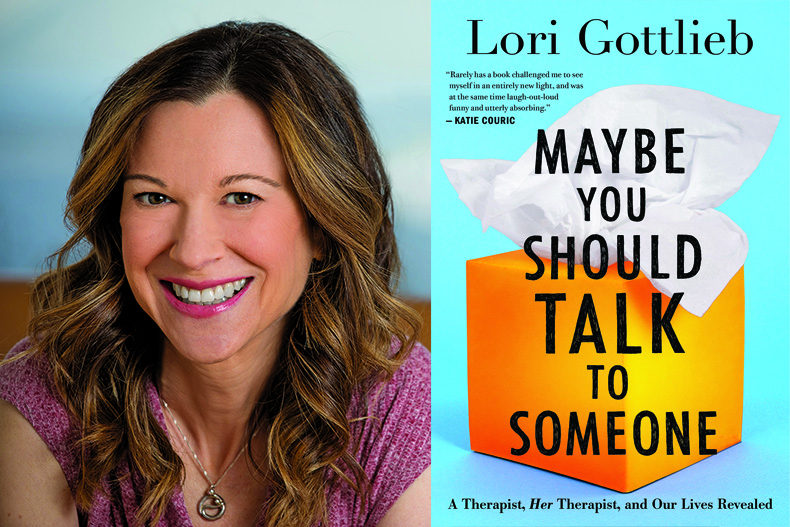
Editor's note: The following is an excerpt taken from Maybe You Should Talk to Someone: A Therapist, Her Therapist and Our Lives Revealed, by Lori Gottlieb, published by Houghton Mifflin Harcourt © 2019 and reprinted with permission of the publisher.

Shall We Skype?

“Hi, it’s me,” I hear as I listen to my voicemails between sessions. My stomach lurches; it’s Boyfriend. Though it’s been three months since we’ve spoken, his voice instantly transports me back in time, like hearing a song from the past. But as the message continues, I realize it’s not Boyfriend because (a) Boyfriend wouldn’t call my office number and (b) Boyfriend doesn’t work on a TV show.

This “me” is John (eerily, Boyfriend and John have similar voices, deep and low) and it’s the first time a patient has called my office without leaving a name. He does this as if he’s the only patient I have, not to mention the only “me” in my life. Even suicidal patients will leave their names. I’ve never gotten Hi, it’s me. You told me to call if I was feeling like killing myself.

John says in his message that he can’t make our session today because he’s stuck at the studio, so he’ll be Skyping in instead. He gives me his Skype handle, then says, “Talk to you at three.”

I note that he doesn’t ask if we can Skype or inquire whether I do Skype sessions in the first place. He just assumes it will happen because that’s how the world works for him. And while I’ll Skype with patients under certain circumstances, I think it’s a bad idea with John. So much of what I’m doing to help him relies on our in-the-room interaction. Say what you will about the wonders of technology, but “screen-to-screen is, as a colleague once said, “like doing therapy with a condom on.””

It’s not just the words people say or even the visual cues that therapists notice in person–the foot that shakes, the subtle facial twitch, the quivering lower lip, the eyes narrowing in anger. Beyond hearing and seeing, there’s something less tangible but equally important— the energy in the room, the being together. You lose that ineffable dimension when you aren’t sharing the same physical space.

There’s also the issue of glitches. I was once on a Skype session with a patient who was in Asia temporarily, and just as she began crying hysterically, the volume went out. All I saw was her mouth moving, but she didn’t know that I couldn’t hear what she was saying. Before I could get that across, the connection dropped entirely. It took ten minutes to restore the Skype, and by then not only was the moment lost but our time had run out.

I send John a quick email offering to reschedule, but he types back a message that reads like a modern-day telegram: Can’t w8. Urgent. Please. I’m surprised by the please and even more by his acknowledgment of needing urgent help–of needing me, rather than treating me as dispensable. So, I say okay, we’ll Skype at three.

Something, I figure, must be up.

At three, I open Skype and click “call,” expecting to find John sitting in an office at a desk. Instead, the call connects and I’m looking into a familiar house. It’s familiar to me because it’s one of the main sets of a TV show that Boyfriend and I used to binge-watch on my sofa, arms and legs entwined. Here, camera and lighting people are moving about, and I’m staring at the interior of a bedroom I’ve seen a million times. John’s face comes into view. “Hang on a second” is how he greets me, and then his face disappears and I’m looking at his feet. Today he’s wearing trendy checkered sneakers, and he seems to be walking somewhere while carrying me with him. Presumably he’s looking for privacy. Along with his shoes, I see thick electrical wires on the floor and hear a commotion in the background. Then John’s face reappears.

“Okay,” he says. “I’m ready.”

There’s a wall behind him now, and he starts rapid-fire whispering.

“It’s Margo and her idiot therapist. I don’t know how this person has a license but he’s making things worse, not better. She was supposed to be getting help for her depression but instead she’s getting more upset with me: I’m not available, I’m not listening, I’m distant, I avoid her, I forgot something on the calendar. Did I tell you that she created a shared Google calendar to make sure I won’t forget things that are ‘important’”—with his free hand, John does an air quote as he says the word important—“so now I’m even more stressed because my calendar is filled with Margo’s things and I’ve already got a packed schedule!”

John has gone over this with me before so I’m not sure what the urgency is about today. Initially he had lobbied Margo to see a therapist (“So she can complain to him”) but once she started going, “John often told me that this “idiot therapist” was “brainwashing” his wife and “putting crazy ideas in her head.”” My sense has been that the therapist is helping Margo gain more clarity about what she will and will not put up with and that this exploration has been long overdue. I mean, it can’t be easy being married to John.

At the same time, I empathize with John because his reaction is common. Whenever one person in a family system starts to make changes, even if the changes are healthy and positive, it’s not unusual for other members in the system to do everything they can to maintain the status quo and bring things back to homeostasis. If an addict stops drinking, for instance, family members often unconsciously sabotage that person’s recovery, because in order to regain homeostasis in the system, somebody has to fill the role of the troubled person. And who wants that role? Sometimes people even resist positive changes in their friends: Why are you going to the gym so much? Why can’t you stay out late—you don’t need more sleep! Why are you working so hard for that promotion? You’re no fun anymore!

If John’s wife becomes less depressed, how can John keep his role as the sane one in the couple? If she tries to get close in healthier ways, how can he preserve the comfortable distance he has so masterfully managed all of these years? I’m not surprised that John is having a negative reaction to Margo’s therapy. Her therapist seems to be doing a good job.

“So,” John continues, “last night, Margo asks me to come to bed, and I tell her I’ll be there in a minute, I have to answer a few emails. Normally after about two minutes she’ll be all over me—Why aren’t you coming to bed? Why are you always working? But last night, she doesn’t do any of that. And I’m amazed! I think, Jesus Christ, something’s finally working in her therapy, because she’s realizing that nagging me about coming to bed isn’t going to get me in bed any faster. So, I finish my emails, but when I get in bed, Margo’s asleep. Anyway, this morning, when we wake up, Margo says, ‘I’m glad you got your work done, but I miss you. I miss you a lot. I just want you to know that I miss you.’”

John turns to his left and now I hear what he hears—a nearby conversation about lighting—and without his saying a word, I’m staring at John’s sneakers again as they move across the floor. When I see his face appear this time, the wall behind him is gone, and now the star of the TV series is in the distant background in the upper-right corner of my screen, laughing with his on-camera nemesis along with the love interest he verbally abuses on the show. (I’m sure John is the one who writes this character).

I love these actors, so now I’m squinting at the three of them through my screen like I’m one of those people behind the ropes at the Emmys trying to get a glimpse of a celebrity—except this isn’t the red carpet and I’m watching them take sips from water bottles while they chat between scenes. The paparazzi would kill for this view, I think, and it takes massive will-power to focus solely on John.

“Anyway,” he whispers, “I knew it was too good to be true. I thought she was being understanding last night, but of course the complaining starts up again first thing this morning. So I say, ‘You miss me? What kind of guilt trip is that?’ I mean, I’m right here. I’m here every night. I’m one hundred percent loyal. Never cheated, never will. I provide a nice living. I’m an involved father. I even take care of the dog because Margo says she hates walking around with plastic bags of poop. And when I’m not there, I’m working. It’s not like I’m off in Cabo all day. So, I tell her I can quit my job and she can miss me less because I’ll be twiddling my thumbs at home, or I can keep my job and we’ll have a roof over our heads.” He yells “I’ll just be a minute!” to someone I can’t see and then continues. “And you know what she does when I say this? She says, all Oprah-like”—here he does a dead-on impression of Oprah—“‘I know you do a lot, and I appreciate that, but I also miss you even when you’re here.’”

I try to speak but John plows on. I haven’t seen him this stirred up before.

“So, for a second I’m relieved, because normally she’d yell at this point, but then I realize what’s going on. This sounds nothing like Margo. She’s up to something! And sure enough, she says, ‘I really need you to hear this.’ And I say, ‘I hear it, okay? I’m not deaf. I’ll try to come to bed earlier but I have to get my work done first.’ But then she gets this sad look on her face, like she’s about to cry, and it kills me when she gets that look, because I don’t want to make her sad. The last thing I want to do is disappoint her. But before I can say anything, she says, ‘I need you to hear how much I miss you because if you don’t hear it, I don’t know how much longer I can keep telling you.’ So I say, ‘We’re threatening each other now?’ and she says, ‘It’s not a threat, it’s the truth.’” John’s eyes become saucers and his free hand juts into the air, palm up, as if to say, can you believe this shit?

“I don’t think she’d actually do it,” he goes on, “but it shocked me because neither of us has ever threatened to leave before. When we got married we always said that no matter how angry we got, we would never threaten to leave, and in twelve years, we haven’t.” He looks to his right. “Okay, Tommy, let me take a look—.”

John stops talking and suddenly I’m staring at his sneakers again. When he finishes with Tommy, he starts walking somewhere. A minute later his face pops up; he’s in front of another wall.

My Idiot Therapist?

“John,” I say. “Let’s take a step back. First, I know you’re upset by what Margo said —.”

“What Margo said? It’s not even her! It’s her idiot therapist acting as her ventriloquist! She loves this guy. She quotes him all the time, like he’s her fucking guru. He probably serves Kool-Aid in the waiting room, and women all over the city are divorcing their husbands because they’re drinking this guy’s bullshit! I looked him up just to see what his credentials are and, sure enough, some moron therapy board gave him a license. Wendell Bronson, P-h-fucking-D.”

Wait.
Wendell Bronson?
!
!!
!!!!
!!!!!!!

Margo is seeing my Wendell? The “idiot therapist” is Wendell? My mind explodes. I wonder where on the couch Margo chose to sit on her first day. I wonder if Wendell tosses her tissue boxes or if she sits close enough to reach them herself. I wonder if we’ve ever passed each other on the way in or out (the pretty crying woman from the waiting room?). I wonder if she’s ever mentioned my name in her own therapy— “John has this awful therapist, Lori Gottlieb, who said . . .” But then I remember that John is keeping his therapy a secret from Margo—I’m the “hooker” he pays in cash—and right now, I’m tremendously grateful for this circumstance. I don’t know what to do with this information, so I do what therapists are taught to do when we’re having a complicated reaction to something and need more time to understand it. I do nothing—for the moment. I’ll get consultation on this later.

“Let’s stay with Margo for a second,” I say, as much to myself as to John. “I think what she said was sweet. She must really love you.”

“Huh? She’s threatening to leave!”

“Well, let’s look at it another way,” I say. “We’ve talked before about how there’s a difference between a criticism and a complaint, how the former contains judgment while the latter contains a request. But a complaint can also be an unvoiced compliment. I know that what Margo says often feels like a series of complaints. And they are—but they’re sweet complaints because inside each complaint, she’s giving you a compliment. The presentation isn’t optimal, but she’s saying that she loves you. She wants more of you. She misses you. She’s asking you to come closer. And now she’s saying that the experience of wanting to be with you and not having that reciprocated is so painful that she might not be able to tolerate it because she loves you so much.” I wait to let him absorb that last part. “That’s quite a compliment.”

I’m always working with John on identifying his in-the-moment feelings, because feelings lead to behaviors. Once we know what we’re feeling, we can make choices about where we want to go with them. But if we push them away the second they appear, often we end up veering off in the wrong direction, getting lost yet again in the land of chaos.

Men tend to be at a disadvantage here because they aren’t typically raised to have a working knowledge of their internal worlds; it’s less socially acceptable for men to talk about their feelings. While women feel cultural pressure to keep up their physical appearance, men feel that pressure to keep up their emotional appearance. Women tend to confide in friends or family members, but when men tell me how they feel in therapy, I’m almost always the first person they’ve said it to. Like my female patients, men struggle with marriage, self-esteem, identity, success, their parents, their childhoods, being loved and understood—and yet these topics can be tricky to bring up in any meaningful way with their male friends. It’s no wonder that the rates of substance abuse and suicide in middle-aged men continue to increase. Many men don’t feel they have any other place to turn.

So, I let John take his time to sort out his feelings about Margo’s “threat” and the softer message that might be behind it. I haven’t seen him sit with his feelings this long before, and I’m impressed that he’s able to do so now. John’s eyes have darted down and to the side, which is what usually happens with someone when what I’m saying touches someplace vulnerable, and I’m glad. It’s impossible to grow without first becoming vulnerable. It looks like he’s still really taking this in, that for the first time, his impact on Margo is resonating.

Finally, John looks back up at me. “Hi, sorry, I had to mute you back there. They were taping. I missed that. What were you saying?” Un-fucking-believable. I’ve been, quite literally, talking to myself. No wonder Margo wants to leave! I should have listened to my gut and had John reschedule an in-person session, but I got sucked in by his urgent plea.

“John,” I say, “I really want to help you with this, but I think this is too important to talk about on Skype. Let’s schedule a time for you to come in so there aren’t so many distract —”

“Oh, no, no, no, no, no,” he interrupts. “This can’t wait. I just had to give you the background first so you can talk to him.”

“To . . .”

“The idiot therapist! Clearly he’s only hearing one side of the story, and not a very accurate side at that. But you know me. You can vouch for me. You can give this guy some perspective before Margo really goes nuts.”

I Won’t Do It!

I noodle this scenario around in my head: John wants me to call my own therapist to discuss why my patient isn’t happy with the therapy my therapist is doing with my patient’s wife.

Um, no.

Even if Wendell weren’t my therapist, I wouldn’t make this call. Sometimes, I’ll call another therapist to discuss a patient if, say, I’m seeing a couple and a colleague is seeing one member of the couple, and there’s a compelling reason to exchange information (somebody is suicidal or potentially violent, or we’re working on something in one setting that it would be helpful to have reinforced in another, or we want to get a broader perspective). But on these rare occasions, the parties will have signed releases to this effect. Wendell or no Wendell, I can’t call up the therapist of my patient’s wife for no clinically relevant reason and without both patients signing consent forms.

“Let me ask you something,” I say to John. “What?”

“Do you miss Margo?”

“Do I miss her?”

“Yes.”

“You’re not going to call Margo’s therapist, are you?”

“I’m not, and you’re not going to tell me how you really feel about Margo, are you?” I have a feeling that there’s a lot of buried love between John and Margo because I know this; love can often look like so many things that don’t seem like love.

John smiles as I see somebody who I assume is Tommy again enter the frame holding a script. I’m flipped toward the ground with such speed that I get dizzy, as if I’m on a roller coaster that just took a quick dive. Staring at John’s shoes, I hear some back-and-forth about whether the character—my favorite!—is supposed to be a complete asshole in this scene or maybe have some awareness that he’s being an asshole (interestingly, John picks awareness) and then Tommy thanks John and leaves. To my amusement, John seems perfectly pleasant, apologizing to Tommy for his absence and explaining to him that he’s busy “putting out a fire with the network.” (I’m “the network”). Maybe he’s polite to his coworkers after all.

Or maybe not. He waits for Tommy to leave, then lifts me up to face level again and mouths, Idiot, rolling his eyes in Tommy’s direction.

“I just don’t understand how her therapist, who’s a guy, can’t see both sides of this,” he continues. “Even you can see both sides of this!”

Even me? I smile. “Was that a compliment you just gave me?”

“No offense. I just meant…you know.”

I do know, but I want him to say it. “In his own way, he’s becoming attached to me”, and I want him to stay in his emotional world a bit longer. But John goes back to his tirade about Margo pulling the wool over her therapist’s eyes and how Wendell is a quack because his sessions are only forty-five minutes, not the typical fifty. (This bugs me too, by the way). It occurs to me that John is talking about Wendell the way a husband might talk about a man his wife has a crush on. I think he’s jealous and feels left out of whatever goes on between Margo and Wendell in that room. (I’m jealous too! Does Wendell laugh at Margo’s jokes? Does he like her better?) I want to bring John back to that moment when he almost connected with me.

“I’m glad that you feel understood by me,” I say. John gets a deer-in-the-headlights look on his face for a second, then moves on.

“All I want to know is how to deal with Margo.”

“She already told you,” I say. “She misses you. I can see from our experience together how skilled you are at pushing away people who care about you. I’m not leaving, but Margo’s saying she might. So maybe you’ll try something different with her. Maybe you’ll let her know that you miss her too.” I pause. “Because I might be wrong, but I think you do miss her.”

He shrugs, and this time when he looks down, I’m not on mute. “I miss the way we were,” he says.

His expression is sad instead of angry now. Anger is the go-to feeling for most people because it’s outward-directed—angrily blaming others can feel deliciously sanctimonious. But often it’s only the tip of the iceberg, and if you look beneath the surface, you’ll glimpse submerged feelings you either weren’t aware of or didn’t want to show—fear, helplessness, envy, loneliness, insecurity. And if you can tolerate these deeper feelings long enough to understand them and listen to what they’re telling you, you’ll not only manage your anger in more productive ways, you also won’t be so angry all the time.

Of course, anger serves another function—it pushes people away and keeps them from getting close enough to see you. I wonder if John needs people to be angry at him so that they won’t see his sadness.

I start to speak, but somebody yells John’s name, startling him. The phone slips out of his hand and careens toward the floor, but just as I feel like my face might hit the ground, John catches it, bringing himself back into view. “Crap–gotta go!” he says. Then, under his breath: “Fucking morons.” And the screen goes blank.

Apparently, our session is over.

Ethics Over Coffee

With time to spare before my next session, I head into the kitchen for a snack. Two of my colleagues are there. Hillary is making tea. Mike’s eating a sandwich.

“Hypothetically,” I say, “what would you do if your patient’s wife was seeing your therapist, and your patient thought your therapist was an idiot?”

They look up at me, eyebrows raised. Hypotheticals in this kitchen are never hypothetical.

“I’d switch therapists,” Hillary says.

“I’d keep my therapist and switch patients,” Mike says. They both laugh.

“No, really,” I say. “What would you do? It gets worse: He wants me to talk to my therapist about his wife. His wife doesn’t know he’s in therapy yet, so it’s a non-issue now, but what if at some point he tells her and then wants me to consult with my therapist about his wife, and his wife consents? Do I have to disclose that he’s my therapist?”

“Absolutely,” Hillary says.

“Not necessarily,” Mike says at the same time.

“Exactly,” I say. “It’s not clear. And you know why it’s not clear? Because this kind of thing NEVER HAPPENS! When has something like this ever happened?”

Hillary pours me some tea.

“I once had two people come to me individually for therapy right after they’d separated,” Mike says. “They had different last names and listed different addresses because of the separation, so I didn’t know they were married until the second session with each of them, when I realized I was hearing the same stories from different sides. Their mutual friend, who was a former patient, gave both of them my name. I had to refer them out.”

“Yeah,” I say, “but this isn’t two patients with a conflict of interest. My therapist is mixed up in this. What are the odds of that?”

I notice Hillary looking away. “What?” I say.

“Nothing.”

Mike looks at her. She blushes. “Spill it,” he says.

Hillary sighs. “Okay. About twenty years ago, when I was first starting out, I was seeing a young guy for depression. I felt like we were making progress, but then the therapy seemed to stall. I thought he wasn’t ready to move forward, but really I just didn’t have enough experience and was too green to know the difference. Anyway, he left, and about a year later, I ran into him at my therapist’s.”

Mike grins. “Your patient left you for your own therapist?”

Hillary nods. “The funny thing is, in therapy, I talked about how stuck I was with this patient and how helpless I felt when he left. I’m sure the patient later told my therapist about his inept former therapist and used my name at some point. My therapist had to have put two and two together.” I think about this in relation to the Wendell situation. “But your therapist never said anything?”

“Never,” Hillary says. “So, one day I brought it up. But of course, she can’t say that she sees this guy, so we kept the conversation focused on how I deal with the insecurities of being a new therapist. Pfft. My feelings? Whatever. I was just dying to know how their therapy was going and what she did differently with him that worked better.”

“You’ll never know,” I say.

Hillary shakes her head. “I’ll never know.”

“We’re like vaults,” Mike says. “You can’t break us.”

Hillary turns to me. “So, are you going to tell your therapist?” “Should I?”

They both shrug. Mike glances at the clock, tosses his trash into the can. Hillary and I take our last sips of tea. It’s time for our next sessions. One by one, the green lights on the kitchen’s master panel go on, and we file out to retrieve our patients from the waiting room. 

Doctors Are People, Too

John and Rebecca (pseudonyms) came into my office in tears. They were struggling with how to maintain a commitment to their medical careers while continuing to commit to their relationship and future as a married couple. They were both successfully completing their training as physicians and had promising career opportunities in their fields of speciality.

Like what you are reading? For more stimulating stories, thought-provoking articles and new video announcements, sign up for our monthly newsletter.

What was unusual about this couple was their ability to articulate exactly what “The Question” is for many professional couples: Now that we know what the future holds and how much investment of time will be required of us in this profession, we feel like we may have to choose between a healthy marriage and a healthy career. In fact, that same afternoon, I had just seen another couple with completely different careers asking almost precisely the same question, but they had some trouble putting their concerns into words. John and Rebecca nailed it. In fact, they almost whispered it, leaning tentatively toward me in my softly-lit office, divulging what they both said was pretty risky to even think about, much less say out loud.…and if we have to choose, well, we don’t know if we want to do this medical thing anymore.

What I have learned about the personalities of individuals who pursue medicine as a career is that, like those in most caregiving professions, a physician’s own self-care can be last on their list. The hours, the intense fields of study, the great responsibility and risk involved in treating other human beings—these are all are ways in which the physician can potentially be set-up to fail in their personal lives. The training requires intense scheduling, curtailing and even significantly limiting social outings, and the need for sleep contributes to putting off cherished open-ended talks with a partner.

Pursuing a medical career requires sacrifice, and as a patient, I’m glad; the more well-trained my physician is, the better I feel I can rely on her assessment and treatment recommendations. At the same time, this particularly poignant and relevant discussion in my office brought up some concerns for me, first, as a couples counselor: my desire to be empathic and validating; and secondly, in a broader sense, concerns about this couple as part of the community. I want my treating physician to be not only clinically on-point but emotionally healthy. As a therapist who has counseled many people over the past decades, it has become clear that whatever one’s profession, the healthier the personal life, the more readily one can face and overcome the enormous challenges that arise in one’s professional life. If we have healthy personal relationships, someone to talk to who can be present and comfort us in times of distress, the challenges we have outside the home seem at least somewhat more tolerable.

So, in this session, I found myself experiencing a bit of an internal quandary: How much do I empathize, or do I even encourage they choose their marriage over the intense career paths that they are sure to pursue next? Knowing what I know as a couples therapist, I can guess that the road ahead will continue to be challenging, no matter what, but the fewer external pressures, the better, right? I confess a part of me wanted to jump in and champion their relationship above all else (their upcoming job offers were appealing, but would readily require at least 50-60 hour weeks). But I also was aware that their professional dreams had been hard-won (non-stop schooling since age six; postponing having children to focus on career; hundreds of thousands of dollars in student loan debt).

What I wound up doing next was listening to their concerns, their thoughts, and especially the emotions underneath, both secondary and primary emotions, and guiding them through conversations that could draw them closer together, instead of further apart. I didn’t try to change the subject or make it all better or tell them what to do but encouraged the experience of these concerns in session. Over time, they did the hard work necessary to reach their own conclusions about their career choices (they did remain in medicine), and their relationship. They risked being vulnerable with me and with one another around their feelings about choices made and unrealistic expectations. Over time they worked their way slowly back toward one another. They reached conclusions about their careers that met their own personal sweet spot: a balance between work and home that secured one another as their source of comfort and support at the end of the day.

Not all of my clients have been this “lucky.” Of course, that sweet spot can wobble a bit: misunderstandings and arguments happen. Those nagging internal questions about self-worth and existential questions about the purpose of our lives don’t magically disappear. That’s the nature of life, relationships, and making choices about our work. Physicians can often have a greater challenge, as the nature of their work requires an extraordinary commitment, along with a very small margin for error in the many decisions they make each day. But as so many of my physician-client couples have taught me, the need for their primary relationship to come “first” when it counts, serving as a source of security, comfort, and trust, means just as much—and often much more, than their medical careers.

John and Rebecca also learned that they didn’t have to choose one over the other. What they did needed to choose were ways in which they could learn to be more intentional about their relationship, building resilience to buffet the stressful nature of their work, and learning not to “use up” all of their emotional energy in the workplace. They took a risk by coming to see me; they could have been overwhelmed with the effort it took to focus on their relationship and decided not to call my office. I’m so glad they took that risk. They had the courage to admit that, as brilliant as they were, when it came to their relationship they needed a little support and guidance along the way. After all, doctors are people, too.
 

I Dont Know How To Be Sorry

In my last blog post, I wrote about shame-proneness, the propensity to experience shame in response to ambiguous situations that elicit self-evaluation. For example, if Patrick failed a test and he thought “damn, I didn’t study hard enough; I’ll study more for the next one,” this would suggest that he felt guilt. But if he thought “damn, you really are a loser; you’ll never be able to do this,” this would suggest that he felt shame. When internal narratives of shame are not transient; when feeling small, worthless and insignificant permeate all experience, this is shame-proneness, which has long term adverse consequences.

When Mark and Claire came into session, I felt the tension immediately. I gave them each an opportunity to share why they had come in. Both described a history of explosive arguments and interpersonal volatility followed by calm reconciliations, then a rise in tension, then another eruption filled with angry tirades and verbal assaults.

“When he says he’s sorry I always want to believe him. He seems so sincere, but it never sticks. And I never know when things will explode again. Coming to couple’s therapy is our last chance.”

Like what you are reading? For more stimulating stories, thought-provoking articles and new video announcements, sign up for our monthly newsletter.

Mark looked down the whole time Claire spoke, then with his face tight he said, “What do you want me to say. I tell you I’m sorry and it’s never enough. Nothing is ever enough and it’s your fault too. This isn’t all me.”

As I listened to their interaction, and assessed their interpersonal dynamic, I heard statements of blame thrown back and forth, which is common early in couple’s therapy, but I also heard Mark’s failure to empathize.

The ability to follow through on “I’m sorrys” implies guilt, because genuine guilt indicates the desire for reparation. In emotionally abusive relationships, such as Mark and Claire’s, what looks like contrition (which implies guilt) is really the voice of shame. If Mark had truly been able to experience Claire’s feelings (empathy), he’d feel guilty. He’d be able to tolerate the painful introspections that often lead to repair.

But their cycle continued, over and over, even after Mark said he was sorry. When this happens, it means that shame is masquerading as guilt. Shame undermines the ability to empathize with another’s emotions. Empathy requires transcending the interpersonal boundary and experiencing the emotions of another. Because shame is so painful, it disallows this from happening and instead, when the self-evaluative discomfort comes, it gets projected back onto the other; so, instead of seeing the other as the victim, they are seen as the perpetrator and hence the cycle continues.

While studying the relationship between shame, guilt and empathy, I found that there were two categories of empathy. Shame-empathy, which looks like empathy, but isn’t, because it’s not motivated by the pain of hurting someone else, but rather by the distress and fear of losing the other. It’s a self-focused experience, not an interpersonal one. Guilt-empathy, (what we think of when we think of empathy), on the other hand, leads to feeling the others pain and not wanting to do it again.

I heard Mark projecting blame. I watched his discomfort when Claire voiced her concerns. I noticed that he quickly retaliated for the smallest slight. I knew then that this was going to be a huge challenge. Empathy is fundamental to healthy relationships. When I work with couples where one has underlying shame, I know the only way it will heal is if empathy can be garnered, which means the shame needs to be processed. That type of examination is a slippery slope, because any introspection can cause more shame and more defensiveness.

I asked Mark, “What are feeling right before you respond to Claire?”

“I – I. Angry.”

“Can you say more?”

“Angry that she says those things to me. What does she want from me. If she’s going to blame me for everything, why are we even here.”

“I didn’t hear her blame you for everything.”

He folded his arms. “You’re taking her side.”

“There are no sides. My job is look at what’s happening and help you both communicate better. I have a feeling that the things Claire says make you feel bad about yourself.”

“That’s right. She’s always making me feel bad about myself.”

“I don’t mean to do that,” Claire said. “I have to be able to tell you how I feel and whenever I do, you get angry.”

“That’s not true,” Mark raised his voice. “You don’t tell me how you feel. You tell me about all of the shitty things I’ve done. What about all of the good things I do for you.”

“What do you imagine Claire is feeling right now?” I asked Mark.

“Satisfied that she got me to show you my angry side.”

“She looks like she’s about to cry. Do you see that.”

“She does that to make me feel bad.”

“You can’t see that she’s also hurting?”

“That’s because she always makes everything about her. I’m so sick of it.”

Tears rolled down Claire’s cheeks.

“Stop it,” he said. “You’re making me feel bad.”

I let this go on for a few more minutes and then I explained that I needed both of them to enter individual therapy and offered referrals.

Mark insisted that there was nothing wrong with him and that therapy took up too much time. I told them both that we weren’t going to be able to move forward in couples work unless they dealt with their individual issues.

Mark looked furious.

With some trepidation, I said, “I’m thinking that people have said things that made you feel bad as a kid. That’s not your fault, but it’s making everything you hear Claire say feel like the same harsh words. And Claire, without intending, the constant focus on what’s wrong with Mark is emasculating and evoking shame. I want you both to speak with your own therapists, otherwise this is never going to stop.”

They both conceded.

We agreed to continue our couple’s therapy, which I knew would be a difficult journey. It’s hard to get to the shame, but without doing so, empathy will remain compromised. The more Mark understood his shame, the greater his ability would be to recognize and experience Claire’s emotions within the context of their relationship. And the more he could empathize, the more Claire would feel her emotions were heard and valid. The more she felt that she had a right to her feelings the less likely she would be dissatisfied.

* Claire and Mark are amalgamates created to show the relationship between shame, guilt and empathy.  

Jill Scharff on Object Relations Therapy with Couples

What is Object Relations Therapy?

Rafal Mietkiewicz: Jill, you are a renowned psychiatrist, psychoanalyst and object relations therapy expert. You’ve written and edited many books on object relations therapy so I’m wondering if we can start with just a basic overview of what object relations therapy actually is. It can seem like rocket science to beginning therapists.
Jill Savege Scharff: It’s an unfortunate term, “object relations,” but it was chosen in deference to Freud’s use of the term “object,” which refers to the object that the drive to be in relationship attaches to. Freud talked about the sexual and aggressive drives later in his life, the life and death drives. Fairbairn, who introduced the term “object relations theory,” talked about people’s main motivation being to be in relationship, not only for love an security, but also for a sense of meaning. Giving meaning to existence.

It’s not just the mother who gives meaning to the baby, but the baby who gives meaning to the mother, who becomes a mother because she has the baby to relate to and care for. Object relations refers to the internal psychic structure that develops from these early experiences.

RM: And as therapists our job is to search for these internal structures in our clients?
JS:
Intimate relationships provide an opportunity to rediscover the internal object relations in a new dimension—one that may help it grow and change.
You don’t have to search very far because that internal structure is written large in external, current relationships. The internal relations operate as a kind of design that leads people to repeat it in their current relationships—partly because it’s familiar, and they want to recreate what they know, and partly to have new experiences that, if they’re healthy and interesting and challenging may encourage new learning so that modifications in the original object relations can be made. Intimate relationships provide an opportunity to rediscover the internal object relations in a new dimension—one that may help it grow and change. Same is true in therapy. Does it still sound like rocket science, Rafal?
RM: Yes, a little bit. It seems like it would take a long time to unwind these long-term patterns, and that the therapy would go quite deep.
JS: It does take time to create deep character change. It can take a couple of years with couples.
RM: I am a working therapist, and I have my own experiences in both individual and marital therapy, but the idea of working with a couple for a couple of years sounds challenging, to be honest.
JS: Well, that’s more for couples who are looking for radical change. Some couples come in and just want a little adjustment. They want to settle a fight, or they want to decide whether or not to have a child, and it’s just a developmental intervention. A developmental challenge has got them stuck, and after few sessions they’re on their way. But others who have tremendous difficulties relating, communicating, establishing an intimate sexual relationship—these therapies take longer.
RM: So you distinguish between a developmental intervention and deep therapy.
JS: Well, you never want to do too much. You just want to do what people are looking for and what they need. With an object relations approach, which does operate in depth, even in a few sessions you can show a couple what that approach could offer them if they chose it, if they chose to invest in something more substantial.
RM: When you see a couple, what are the initial stages?
JS: First we do a consultation—not therapy—because I want to give the couple a chance to decide if they think we’re a good match, and I want to show them my style of working. Not every couple chooses to work in an object relations framework, which is basically psychoanalytic framework. Some are looking for a shorter-term approach, or a more structured approach, or a more direct of approach, in which case I’ll refer them.
RM: So the first stage is consultation.
JS: Yes, I’ll meet for maybe two or three sessions. Some people will meet with one partner once, the other partner once, and the couple once. But unless there’s a specific indication to do that, I usually prefer to just work with the couple.
RM: What would be the special indication?
JS: If there is an autonomous individual psychiatric problem, such as a deeply established substance abuse problem, I might want to meet with that individual to assess the extent of it and decide if individual treatment is a better option, maybe even a rehab program. Another indication is the wife or husband of a therapist. Sometimes, you’ll find that non-therapist is so far behind the one who is trained as a therapist, in terms of communicating emotional experience, that they sometimes need an individual session away from the therapist-partner in order to find the words to speak to the therapist partner.
RM: Can a couple’s therapist join these two functions, and do individual therapy with one person from a couple, while also doing therapy for the couple?
JS: That can happen as long as you’re very aware that your commitment is to the couple and that anything you do with the individual comes back into the couple meeting. That the confidentiality, for instance, pertains to the couple, not to the individual member of the couple. So let’s say the individual tells you about an affair that they haven’t told their partner, you would not reveal that personally, but you would suggest they bring it up in couples therapy. If they can’t do it, you probably find yourself unable to work with the couple because if you have a piece of information that you can’t use, it blocks you from being able to respond to all the clues that lead to that conclusion, which you can’t then make.
RM: You also can’t free associate, because you’re blocked from going in certain directions.
JS: You’re absolutely right. I was in Poland last week, and I heard that the Family Therapy Association is working on a statement about confidentiality and how it pertains to couple and family therapy.

The Couple’s Unconscious Life

RM: How do you assess whether a couple is suitable for object relations therapy.
JS: I’m looking for how they respond to any interpretations I make, to my overall presentation, to any links I make between the current struggles and the past. If I get someone who doesn’t want to deal with the past, who says “The past is the past and I don’t want to think about it,” they aren’t likely a good candidate for therapy with me.
If I get someone who doesn’t want to deal with the past…they aren’t likely a good candidate for therapy with me.
So I might say, “Well, okay, I can try to work with you just on the present, but I know that everything that happens now is informed by what happened before, so I don’t think that this kind of therapy will suit you. Do you want to try it and see it what it can do for you, or would you prefer something else?”

I always like to work with couples who can work with their dreams, but not all couples are willing to do that. Some think their dreams are very private to the individual. To me, once an individual tells a dream in couples therapy, it becomes a dream of the couple that the couple has shared with me and that helps me have access to the couple’s unconscious life. The whole of object relations therapy is geared to getting access to the impact of the unconscious on the relationship.

RM: What’s your technique for working with a couple’s dream?
JS: Well, first of all, I listen to the dream from the individual. Then I ask the individual what has occurred to them about the dream. Then, I ask the partner what comes up for them in relation to the dream. Then, as a couple, they’re now talking about this dream, and I look for their associations, my own associations, the feelings it elicits in them and myself, and I construct an interpretation of the dream and what it conveys about the current of their relationship and what they hope for, what they wish for, for themselves in the relationship.
RM: I have always found that working with dreams is great in individual therapy, but this opens a new ocean of possibilities working with couples. Once you’ve done the consultation sessions, and you’ve got the couple on board for treatment, what next?
JS: We agree on the frequency of therapy, which will be once or twice a week. I like my sessions to be 45 minutes, but for couples who come a long distance, we might work for an hour or an hour and a half, whatever suits them. But by arrangement, not just running over time; we agree ahead of time what will be the best format. I don’t do questionnaires. I just ask them to come into the room. They sit.

Can you see my room? [Interview is being done via Skype]

RM: Of course, I see two armchairs.
JS: There are two red chairs over there. They sit in those chairs. I sit back here near the desk. There is a couch down that wall, past the printer. Some couples will sit together on the couch. Sometimes one will sit on the couch in a rather narcissistic way while the other will perch on the chair. However they sit, it’s of interest how they relate themselves to me, how they relate to each other, in spatial terms.

And then I just ask them to say whatever they want to say. Just come in and start. I don’t ask questions. I just listen, and I respond. I think my manner is sort of socially appropriate, unobtrusive, nondirective. It’s not remotely analytic as we’ll sometimes imagine analysts to be. And I’m not saying all the time, “And what do you think about that?”

A Couple's State of Mind

RM: You’re not?
JS: “And how does that make you feel?” No, it’s more that we’re just having an open space conversation, really. And then, every so often, I’ll arrive at a construction of what I think has been happening and show them their repeating patterns of interaction and how they connect to their early experiences. How they treat each other as people from the past were treated or treated them. I’m very interested in helping them as a couple to develop what Mary Morgan calls “a couple’s state of mind.”

You get some couples who used to think as a couple, plan as a couple, and who, because of the strains and stresses of their life and the emergence of negative aspects of their characters, have lost that ability. And then other couples come in who have never actually had it.
You get some couples who used to think as a couple, plan as a couple, and who, because of the strains and stresses of their life and the emergence of negative aspects of their characters, have lost that ability. And then other couples come in who have never actually had it. They come as two individuals. Each one thinking what he or she is doing and not understanding that the marriage is a thing in and of itself that they each contribute to the shaping of, the nurturing of, the maintenance of. If they can learn to do that, then the marriage offers them a great deal.

It’s not just that the partners take care of and love each other, but also the partnership or marriage that they construct. I’m not saying they have to be married in a church or anything, but if they made a commitment to be together, and they nurture that relationship, it will then nourish them and support them through the life cycle and through the various challenges of having the first child, the first child leaving home, retirement—whatever comes through life.

RM: Is one course of therapy enough for a couple or do they tend to come in and out over time?
JS: I think most couples, if they work for a couple years and get to the appropriate developmental level, then they have the tools they need when challenges come up. But you can never predict what life will throw in the way of a couple, and some things might overwhelm their capacity to adapt. If that’s the case they may come back for another session or series of sessions.

The Death of the Couple

RM: What techniques do you use? Do you give interpretations?
JS: I’m a little bit allergic to the term “techniques.” It sounds like they’re little things you apply in various circumstances.
I tend to think of technique more generally as a way of listening, observing, waiting, holding anxiety, not jumping to action, not becoming directive, of always following the affect.
I tend to think of technique more generally as a way of listening, observing, waiting, holding anxiety, not jumping to action, not becoming directive, of always following the affect. It’s very important to always be listening for the feeling behind the words. We do that by listening to the tone, the rhythm of the speech, the hesitations in speech, pauses, slips of the tongue, of course. I’m always interested in any dream material that comes up that will give more access to the unconscious. Then we look for repeating patterns of interaction. We name them and ask the couple to think about why they need this particular pattern. In other words, what defensive function does this pattern serve and what is the anxiety that lies behind it? And there’s always another anxiety that lies behind the most conscious anxiety—fundamentally, the main anxiety is death of the couple. That is the main anxiety.
RM: Death of the couple?
JS: Yes.
RM: Can you say a bit more about that?
JS: Couples are usually not consciously thinking about it, but fundamentally it’s what every couple is worried about. The individual worries that his or her pathology will destroy the couple.
Every couple tries not to remember that one of them will die first.
They consciously worry that they’ll be left, abandoned, rejected, tossed aside, but fundamentally they’re worried that the couple will be destroyed. Every couple tries not to remember that one of them will die first, and no couple knows which one will die first, and no couple knows which one will be left when that happens.
RM: It’s frightening, of course.
JS: It’s very, very frightening when it begins to come to consciousness. As people, maybe in their 40s, they start to maybe lose one friend, or they’ll lose a parent, and they see what happens to the one who is left, then it starts to bear in on them, and they become conscious of that fundamental worry.
RM: How do you work on developing the couple’s state of mind?
JS: The therapist must develop the capacity to be impartial to each individual—or to be equally partial to both of them—but with an overarching commitment to the couple relationship. It’s keeping that in mind that marks the more advanced couple therapist. Someone who isn’t pulled to take sides but who remains neutral, or, if pulled to take a side, latches onto it and can interpret what has just happened. Name it as a skewing of the original intention that reflects a characteristic of the individual who initiated it and the partner who allowed it to happen—since it will likely be a pattern that happens in the relationship. And there you have it, in the laboratory of the couple therapy, where you can see it, examine it in relation to yourself, a couple therapist who doesn’t have all the investment of being a life partner.
RM: Do you have all these concepts in your head when you talk to a couple?
JS: No. I think we do all that theory as background, and if we get stuck in our work with a couple, then we pull out the theory and see if it can help us. But, there’s something very important that you haven’t asked me about, which has to do with sexuality.
RM: By all means….
JS: I’ve found that a lot of couples—or rather couples therapists—don’t actually ask about the couple’s intimate relationship. If a couple presents with a sexual problem they’ll respond to it of course, but they don’t always ask about it as part of the assessment, and I think it’s important to do that, and to not be inhibited about it. It’s just part of the couple’s life and should be considered along with all other aspects. Now, if there is a specific sexual problem, then the object relations approach, which is analytic primarily, has to include a behavioral component.
RM: I know this is hard to quantify, but can you talk about one of your biggest successes and one your biggest failures as a therapist?

JS: That’s really hard to do off the cuff. I mean, there are couples that break up—and in one way, that’s a failure of the couple therapy. In another way, that is a recognition of their differentiation and that the therapy has helped them to reach this very painful decision. Whether you call that a success or a failure is really debatable.
The couple that quits in a rage at you or in disappointment with you—that feels like a failure.
The couple that quits in a rage at you or in disappointment with you—that feels like a failure. It’s also a tremendous loss because you didn't get the opportunity to work with them on these intense feelings which, had they come back to work on them, could have been very useful to their relationship. As it is, they just go off with an idea of putting the bad object into you as if it will stay there, and they’ll be relieved of it. Of course, the bad object always returns, and they won’t have had a chance to really work on it. That feels like a failure to me.
RM: It’s painful, yes.
JS: Success is any couple that goes off, and you never hear from them again because they’re coping. You hope that is a success, but you never really know because part of our policy is not to do follow-up, not to intrude on people’s lives after they have ended their contract with you. That’s one of the sad things about being a couples therapist, is not knowing what happens with them—unless you hear about a couple by chance or unless they return as parents of a child, and they want you then to see their child. They’re doing okay as a couple, but because of the period that they went through when they weren’t doing okay as a couple, their child has built in certain personality characteristics that are hampering that child. So you see the residue of the couple problem in the child.

You can work with the child to get them back on developmental track, but at the same time, you see the couple as parents and how well they are doing both as a couple and as parents, and that’s very gratifying. You could call that a success.

RM: What’s your advice to new therapists?
JS: Get into treatment.
RM: Get into treatment.
JS: And get supervision. And then you can study and take courses. It’s constant work. And if you find a couple daunting, you are not alone. Couple therapy is the hardest work we do because a couple has such a tight bond. They are together because they fit at conscious and unconscious levels.

Success is any couple that goes off, and you never hear from them again because they’re coping.
As the couple therapist, you often feel either you’re breaking a boundary by entering the bedroom, as it were, as if you were a child in an Oedipal situation, or you feel terribly excluded because you can’t get in. You feel guilty about trying to get in. You feel confused, puzzled, rejected. It can be very uncomfortable working with a couple, and this is the reason many people don’t do it, I think. That’s why I say get into therapy and supervision. It takes a lot of personal therapy on the part of the therapist to understand how their own personality is constructed and how they tend to express themselves not only in their personal relationships, but in relation to the couples and families they work with.
RM: Jill, thank you very much.
JS: You’re so welcome. Delightful talking to you.