Insight into the Clinical Challenges of Adoption

What does it mean to truly embrace the journey of families made by adoption? This question has both intense personal and professional significance for me. I am both an adoptive parent of BIPOC children and a play therapist who has taken the journey with many adoptive families as my practice has moved into the worlds of complex trauma and attachment issues. Adoption has long been seen as a solution—the miracle, that solves the problem of child abuse, neglect, and abandonment. During the era in which my husband and I were building a family, it was our solution to pregnancy loss and challenges to fertility. The miracle version of the story has inspirational, even profoundly spiritual overtones in many families. The idea of bringing together caring adults who want to be parents with children who have lost the care of their first parents through some version of tragedy and harm is an inspirational narrative. To the degree that it replaced the secrecy and shame of earlier decades’ approach to child placement and adoption, or overtaxed, harmful group institutional care, it represents a significant step forward in the lives of children and families.

Beyond Happily Ever After

Despite being a child mental health professional, I was not well prepared as a parent for the “what’s next” part of the adoption journey. However, neither was I alone. Many of the families that I have come to work with over the years have struggled to balance their own “miracle” language with the realities of the trauma and attachment loss for the child, even when placement and adoption occur early in life, before the so-called “age of memory.”

Thanks to Bessel van der Kolk and others, we are increasingly aware of the importance of somatic memories built implicitly in the earliest months of life, even in utero. When the preverbal or early in life trauma experiences compound with attachment loss and disruption, it make the realities of emotional and behavioral regulation deeply challenging. Parents, like myself, struggle to respond adequately to a day-to-day reality quite different from “the happily ever” after version of the adoption miracle story.

In this space, a trauma and attachment-focused play therapist who enters the family system can have such a profound impact. We have to be ready to challenge the miracle narrative and, in its place, use the best clinical tools we have to help the child feel supported in the unfolding of their own true and three-dimensional story. This story includes a recognition of the emotional, and often cultural, dislocation and disruption that is at the core of this adopted child’s life journey.

It also must address an understanding of the messages from the most fragmented parts of the self that are communicated through the body. Attempts to deny, dress up, or over-soothe these losses and disruptions can land badly. When loss and adversity are left unprocessed and unresolved, this can lead to the intense emotional dysregulation some children display, and for others, can lead to a ticking time bomb for a crisis of worthiness, belonging, and the capacity to form deeply satisfying attachments over the life span.

For children with multiple disruptions as they moved through the foster care system, the complicated wounds to their attachment exact a painful and complex cost, as there are so many missed opportunities for adults to keep their part of the attachment bargain—that every little human born into the world deserves to have their basic needs met, to be enjoyed and nurtured. By the time the adoption happens, these forever caregivers may have a lot to prove and the negative energy they get from the child is the cumulative effect of others’ failures.

Many of my clients’ parents with whom I’ve worked have despaired that their efforts to connect with, and shape, the behavior of their dysregulated and insecurely attached adoptive child(ren) are met with rage and rejection, instead of responsiveness. Often, I have felt those impulses as well, during struggles to make the child’s response make sense in a cause-and-effect, logical consequence version of the parent-child relationship. For a child who missed out on the basic building blocks of the serve and return part of secure attachment, consequences are perceived as threats, and may work to grow the most defensive and rageful parts of the child’ personality.

A Layer Cake Metaphor for Adoption-Based Therapy

One of the attachment concepts I find so useful in these moments is based on the notion of mentalization, and the ability of caregivers to create and sustain an attuned mental map of what is going on inside the child. Peter Fonagy and others have been writing for many years about mentalization and the impact on reflective functioning in the attachment between parents and children. In my own experiences, I have come to realize that clinging to the “miracle” narrative can sabotage mentalization.

Why does this happen? So often the impulse to spare children the hard parts of their own story or soothe away uncomfortable information leads to a real phobia of their own child’s distress and the resulting failure of mentalization. The answer to this challenge is for therapist—and the adoptive parent—to help the child make sense of their story, including the hard parts; expand the family system’s capacity to hold the distress without minimizing it, and do this work with the parent as an active participant, with support from the therapist.

In attempting to teach a group of clinicians about weaving together of all the things that seem important in therapy with families, I came up with the metaphor of the layer cake. Play therapy, trauma/attachment work, dissociation theory/parts work and family therapy are all a part of this multi-layered work, even as we try to help our clients eat the “whole thing,” bite by bite.

I think of my work with a child who was adopted from an orphanage in the developing world as a preschooler, and the complicated, but beautiful layers of how the therapy unfolded for him a few years after his adoption in the US.

Play Therapy Layers

Like many children, offering open and child-centered play in the playroom, led to the emergence of post traumatic play narratives, giving clues or hints to the preverbal experiences. One example was many narratives around characters fighting over scarce resources, as well as abandonment stories played out with dinosaurs, video game characters, and superheroes.

Dissociation/Parts-Work Layer

Dissociation is the infant/child’s solution to the unbearable threat of betrayal by the original caregiver whether through overt abuse, neglect, sexual exploitation, or attachment loss. To fragment and isolate that chain of painful associations and emotional/somatic stress is a very adaptive way to cope. By the time this child entered therapy, these dissociative patterns had resulted in some fragmentation, including rageful episodes and “baby” parts who were almost incapable of receiving soothing from the parent. The parent admitted to a lot of dysregulation herself in the early months after placement and compounded the effect with threats, yelling, spanking. It was clear that we needed to playfully befriend these dissociated parts through some expressive work. Using a lot of drawing and flexible sand tray creations, we involved the parent experientially in play scenarios apologizing to the hurt parts of the child that she had frightened.

The EMDR/Trauma Protocols Layers
Bridging from trauma content held implicitly in play into first person narrative work, while staying grounded in the present is a tricky business. I used a flexible and playful approach to adding EMDR processing in the playroom for short periods, especially when the adoptive parent was able to support and bear witness to that work. This often served an additional purpose of shifting angry and embittered caregivers into empowered and compassionate ones.

As they come to see their child’s story through their eyes, it increased their reflective capacity and attunement. This parent struggled at times with her own impulse to soothe—she and I talked of her desire to “put a bow on it” and keep the child from feeling the intensity of his losses and rejection as he grew older, and became more aware by following my lead in the playful EMDR sessions.

Anti-Racist, Anti-Bias Icing on the Cake

This is an area of great challenge for adoptive parents who may have limited experience with the day-to-day realities of being Black or Brown, especially in the White majority spaces where many adoptive kids are growing up. In this case, the parent had really minimized the impact of cultural dislocation for her child, but as I insisted on broaching the subject directly, we discovered a lot of distress for him around looking different from her, navigating racial/cultural groups of peers, and as we began to work through the hard parts of his own story, anger at the birth country for “throwing away children” arose.

Permission to feel big feelings was needed throughout that work, and collateral work with the parent on her own biases and perceived need to soothe and minimize these experiences of microaggressions was crucial. Given the polarization and negative narratives in the wider culture, this work will likely be ongoing throughout his development, but the work so far has helped them both to have a framework in which to stick together, and build the parent’s capacity to move past the “miracle” of coming together into the power of growing together through adversity.

***

As my own children have moved from adolescence into young adulthood, I continue to marvel at how unfolding layers and the expanding capacity hold the hardest parts of their stories. I never cease to be humbled by my own invitation to that process, in my own family, as well as in my psychotherapy work, and even the potential to act in a wider culture that needs that capacity now more than ever.

The Challenge of Therapy During War: Psychotherapy in Ukraine

The Emotional Ravages of War

The ongoing crisis in Ukraine has placed immense psychological strain on its population, creating a heightened need for mental health support amidst war, displacement, and uncertainty. Therapists working in Ukraine face unique challenges requiring resilience, adaptability, and innovative approaches. The war has caused massive, widespread trauma with millions displaced and exposed to violence. Therapists working either face-to-face or remotely with their clients encounter acute and chronic PTSD symptoms, anxiety, depression, and grief due to loss of loved ones, homes, and stability. There is also considerable intergenerational trauma in families with histories of oppression.

While Ukrainians have a history of resilience, the impact of intergenerational trauma and mental health stigma persists. Many of my clients attempt to minimize emotional distress or express it through physical symptoms. They have historically hesitated in seeking help, viewing it as a sign of weakness. However, online therapeutic platforms like Soul Space, the one through which I work, offer easily accessible and safe resources for support and self-help tools that empower these individuals.

The Challenge of Therapy During War

Therapists, such as myself, often face secondary traumatic stress (STS) from absorbing clients’ pain, leading to symptoms similar to PTSD. High caseloads also contribute to burnout and emotional exhaustion. Therapists often work with limited supervision, professional development opportunities, or access to private therapy spaces. Displaced populations pose additional logistical challenges to on-ground clinicians. Balancing professional neutrality with personal feelings about the war, while addressing clients’ immediate needs and maintaining a therapeutic frame, are frequent concerns that challenge clinicians under these circumstances.

While teletherapy has been invaluable to Ukraninans under seige, and has allowed me to support more clients than had I been on the ground, power outages, poor internet connections, and client inexperience with technology often impede its effectiveness. It has also been critical for me to prioritize self-care, emotional hygiene, peer support groups, and supervision to process my own emotional experiences as I serve those devastated by the war. I have also found it useful to limit daily trauma-focused sessions to prevent emotional fatigue. Techniques like grounding and meditation have helped me to maintain strength and clinical endurance.

I have learned to respect clients’ cultural coping mechanisms in order to build trust and support empowerment, resilience, and self-efficacy. I have relied on trauma-informed approaches that begin with safety and stabilization techniques such as grounding exercises and psychoeducation about trauma, while also processing with practical problem-solving to meet clients’ immediate needs. Soul Space provides psychoeducational workshops to maximize reach, provide structured, and self-guided mental health resources.

Case Example

A displaced family of four sought therapy after relocating from a war-affected region. The parents reported anxiety, irritability, and hypervigilance; while the children displayed regressive behaviors and nightmares. My approach required the establishment of safety and routine in therapy, psychoeducation to normalize trauma responses, and activities that built resilience and mutual support. Nighttime relaxation rituals helped the family with wartime-related sleeplessness, while gradually igniting bonds of trust and security due to invasive interruptions of regular routines. The parents practiced simple grounding techniques to contend with their own anxieties.

The parents learned about trauma responses in adults and children, and were increasingly able to reframe the children’s behaviors as survival mechanisms instead of simply seeing them as defiance. Several grounding exercises were also introduced to the children utilizing sensory modalities by asking them to say five things they see, hear, or touch when feeling overwhelmed.

To strengthen family bonds, I introduced therapeutic play and storytelling to allow the children to articulate issues of fear in a safe and imaginative way. The parents were given the chance to have planned conversations to foster emotional conversations and model healthy expressions for fear and grief. We also created a “Family Strengths Tree” where they could record examples of salvaged resilience to remind themselves of their survival capacities.

The family finally began processing their experiences. The children created a storybook representing their journey, necessitating a shift in the focus from fear to resilience. The parents explored their guilt and grief using cognitive processing techniques, reframing self-blame into self-compassion. Throughout the intervention with this family, and as with other wartime displaced clients, I integrated formal online training available through Soul Space with my direct face-to-face work.

During our work together, the family experienced reduced anxiety, improved communication, and renewed hope. The mother’s panic attacks became less frequent, and the father started to emotionally reconnect with his children. The daughter began socializing again, and the son had a drastic decrease in nightmares and bedwetting. Coping mechanisms and family bonds improved. Working with this family, as with others, I have come to rely upon additional training courses in trauma-informed interventions, networking, and the importance of adapting my therapeutic techniques to meet the realities of life in conflict zones, including shorter sessions or combining therapy with referral for humanitarian aid.

Questions for Thought and Discussion

Whether or not you’ve worked with clients in war-torn areas, how do you resonate with the author’s sentiments?

Which of the challenges raised by the author are similar or different from those you have experienced with traumatized clients?

What are some of the core techniques that you have found successful in working with traumatized clients?

Michelle Jurkiewicz on Gender-Affirming Psychotherapy with Children, Teens and Families

Lawrence Rubin: Thanks so much for joining me today, Michelle. You are a psychotherapist in private practice in Berkeley, where, among other things, you specialize in gender-affirming mental healthcare for children, teens, and their families. Did I get that right? 
Michelle Jurkiewicz: Yes, you did.
LR:
we have the gender affirmative model, and then we have gender-affirming care
What exactly is your gender-affirming model as applied to clinical work with kids and teenagers? What does that mean?
MJ: We have the gender affirmative model, and then we have gender-affirming care. The gender affirmative model is a way of thinking about and understanding gender diversity, which applies to everyone. It’s based on the premise that gender diversity is a normal and healthy human variation, that people have the right to live in the gender that feels most true to them, without criticism and discrimination. And it’s also based on the idea that there’s not a preferred outcome in terms of a young person’s gender, whether that’s transgender or cisgender. There’s not one that’s preferred.

Gender-affirming Mental Health Care with Children and Teens

LR: And you said that’s different than gender-affirming care.
MJ: Gender-affirming care is informed by the gender affirmative model. When we talk about gender-affirming care, especially when you hear about it in the media, it’s often referring to medical care. But gender-affirming care often takes place amongst an interdisciplinary team.

So, if you’re talking about puberty blockers and gender-affirming hormone treatment, then that is something that even as a psychotherapist, you would be working in conjunction with an endocrinologist or pediatrician, likely a social worker. There are various members of the team.

The main way the gender affirmative model works with children and teens is the way that the therapists themselves are holding the space for a child to be able to explore who they are and be who they are, as well as increase what we call gender literacy. In the most basic sense, gender literacy is increasing an understanding of the sociocultural norms of gender roles and stereotypes, and what potential consequences there are if you step outside of those boxes.

We want children to be able to be themselves and explore who they are while also—in age-appropriate ways—making sure that they understand the world that they live in and that not everyone necessarily understands gender diversity.   

LR:
the main way the gender affirmative model works with children and teens is the way that the therapists themselves are holding the space for a child to be able to explore who they are
What is your particular role in that network of professionals that converge in working with a kid or a family around gender and gender transition?
MJ: There’s not as much need to be in contact with young children before puberty unless there’s something else going on. Then, of course, like any child, we would be in touch with pediatricians and other relevant professionals.

But when a child enters puberty, and there is the question or desire for puberty blockers or later for gender-affirming hormone treatment, the gender centers require an assessment from a mental health provider, which they take into consideration. It’s one piece of the whole picture of whether this is the right thing for the child. The psychotherapist’s job in those instances is to share your thoughts about whether, in your professional opinion, that is the best next step for this child and family.   

LR: So, they will take your input, based on your observation and your work with the child and family, into consideration before the team decides, although I imagine it’s ultimately—hierarchically—it is the physician who makes the decision.
MJ: Well, the parents ultimately, but yes.
LR: Is this evaluative process with pre-pubertal clients what you refer to as your holistic evaluation?
MJ: We typically think of the holistic evaluation even prior to that. But in terms of specifically with pubertal kids who are seeking gender-affirming medical care, we’re referring to taking everything that we possibly can into consideration. And that means that we work very closely with parents as well.

So, we’re looking at all aspects of their history. We’re looking at how parents feel about it because it’s important that if this goes forward, we have the parents’ full support.   

LR: While we’ll chat about the family a bit later, I would imagine at this juncture that dealing with parental ambivalence would be an important part of that holistic evaluation.
MJ: I think oftentimes, parental ambivalence is addressed and worked with even prior to this evaluation. 
LR:
the gender affirmative model does not advocate for specific psychological testing
I would hope so. For those psychometrically driven clinicians out there, are there specific inventories or questionnaires, psychological tests, so to speak, that would be part of an evaluation?
MJ: The gender affirmative model does not advocate for specific psychological testing. Prior to the gender affirmative model, the child had to undergo a whole battery of psychological tests. We don’t do that anymore.

There are various screeners and batteries, and things like that that some clinicians use to help them get a child’s gender into focus. I personally am not using those so much because I feel like I’m well-trained and I have a lot of experience, and that, through my conversations with children and their families, I get a very good picture and don't need those batteries.

I will say, though, that I am an advocate for more research in that area. I think there are some people that are working on a more standardized evaluation process, of course. But I have not found that useful in my own work.   

LR: I guess when you’re talking about gender-affirming care, you are already outside of standardized notions. You’re already considering not just the psychological makeup of the child, but the whole ecosystem. To then try to empower some instruments to carry the burden of decision making almost seems antithetical. 
MJ: I agree. I think the tension is around insurance companies.
LR: And then there’s the issue of liability. If the clinician is going to be called into court, psychometrics may be desired, or even demanded. In the course of your typical evaluation, what are you looking for historically, developmentally, in a teenager? In other words, what are some of the markers you are looking for that give you a sense that this child has always been on this path?
MJ: That’s a good question because I think what we’re seeing is shifting, and it used to be that the kids that we were working with came out when they were very tiny, and they maintained that identity until puberty, and then they accessed gender-affirming medical care.

I think now we’re seeing more and more kids come out later, in which case, when we’re looking at their history, we’re not necessarily looking for stereotypes, such as they played with stereotypical toys of the other gender, or they wore clothes of the other gender—although we do gather that information, but it’s not a required piece of their history.

If we’re going to introduce gender-affirming medical care, we’re looking for some sort of sense that this has been a consistent and persistent identity, especially once we’re talking about gender-affirming hormones. Because puberty blockers have not been shown to have long term adverse effects once they’re stopped, that could happen potentially more quickly if a child is in a lot of distress and puberty is right then and there. But that doesn’t mean then that that child would necessarily go on to gender-affirming hormones.

We are looking for some sort of consistency in their identities. We’re developing this pathway in conjunction with medical providers, which requires that the child is, at the same time, learning about the risks and benefits in a developmentally appropriate way. In some ways this is asking them to take on something we don’t typically ask of cisgender kids in terms of their medical care, but it does mean that a lot of times these kids know a lot.   

LR:
if we’re going to introduce gender-affirming medical care, we’re looking for some sort of sense that this has been a consistent and persistent identity, especially once we’re talking about gender-affirming hormones
They’re informed.
MJ: They’re very informed, and that’s a necessary piece of the process.
LR: Why does WPATH (World Professional Association for Transgender Health) recommend that while evaluating these kids, you look for, if not rule out, autism spectrum disorder? What's the link that they think must be examined there?
MJ: If a child is on the spectrum, it does not disqualify them from gender-affirming care. However, what WPATH is addressing, and what I’ve seen in my own practice, is that there is a huge correlation between gender diversity and being on the autism spectrum. The most recent statistic I’ve heard is that about 10 to 12% of gender diverse children are also on the spectrum. That’s huge compared to the regular population of kids.
LR: As a clinician, and perhaps intuitively, what do you think the connection is?
MJ: I don’t know, but my best guess, and the way I think about it as of this moment, is that a necessary piece of being diagnosed on the spectrum has to do with social differences, the way that one reads cues, the way that one responds to others and interacts with others. And so, I wonder if children who are on the spectrum feel less inhibited by social norms around gender, so they have naturally more freed up space to take it up. 
LR: Do you have to sort of screen for, if not rule it out before proceeding with transitioning?
MJ: We don’t inhibit a child from proceeding because they’re on the spectrum. But what we do need to be screening for is the hyper-focusing and rigidity that often accompanies spectrum-related behavior. We need to make sure that that’s not what’s going on with gender.
LR:
here is a huge correlation between gender diversity and being on the autism spectrum
Are there any myths you’ve come across about these gender diverse kids who are searching—and is ‘searching” a good enough word? 
MJ: Gender exploring! I think that there are many myths, and one of the ones that comes to my mind immediately is the idea that kids can’t know their gender if they’re gender diverse. They’re likely to change their minds later, so we should not really be listening too much to what they’re saying. We have to wait a while. I think that’s a big myth.

I think another myth, which is part of our bigger culture, and we all hold it and have to work on it, is that being transgender or gender diverse in some way is less ideal than being cisgender. And that’s a big shift in thinking. That’s something that I am monitoring within myself. Oh, and then there’s the myths of the gender affirmative model, that it’s just a fad or a kid might say they’re transgender because they're trying to fit in with peers, or that being a gender-affirming therapist means that if a kid says they’re transgender, the therapist is going to immediately write a letter and say yes, puberty blockers. Yes, hormones. In reality, these are decisions that are very carefully sorted through and that take time.   

LR:
another myth, which is part of our bigger culture, and we all hold it and have to work on it, is that being transgender or gender diverse in some way is less ideal than being cisgender
Is that second myth related to what you refer to as quieting the gender noise in the clinician’s head?
MJ: We all have a gender. We all grew up with expectations. We all hold biases about gender. And that’s what we think of as gender noise. Gender noise, the myth that I was talking about, was the myth that somehow being cisgender was preferred or more ideal, and that’s just been stated as fact, basically, for as long as we’ve known in Western culture. That’s a more difficult one for some people to really shift around. And even when we shift around it, I think if we’re really not paying attention, it can be easy to slip out of that. This is especially so if I’m not monitoring my countertransference, monitoring my own biases about gender.
LR: Makes me think that gender noise is on one end of the spectrum of therapists’ presence with these kids, and severe unchecked countertransference is all the way at the other end, and there are so many points in between where that noise can impact the therapeutic relationship.
MJ: I want to make one more point about gender noise based on something I’ve noticed in my practice with cisgender people. I’ve had several cisgender male clients who have expressed a lot of stress and even angst around masculinity with questions like, “Am I measuring up?” or “Am I too masculine?” Does that mean they’re aggressive? Just trying to sort out for themselves what it means to be a man and what is okay and not okay. And I would say even that is gender noise.
LR: What is that male bashing concept typically attributed to the dangerousness of hypermasculinity? 
MJ: Oh, toxic masculinity?
LR: Is that what you refer to when you say a cisgender male might come in worrying that they’re just a little too beefed up emotionally? 
MJ: Some of them worry if they’re even doing masculinity correctly. Like, are they masculine enough? There’s such mixed messages out there right now and I don’t know that historically, I have had so many male clients talking about these issues as I have in the last couple of years.
LR:
we all have a gender. We all grew up with expectations. We all hold biases about gender. And that’s what we think of as gender noise
I wonder if the males who come in worrying about their masculinity is more of a function of their education level, their intelligence, their sensitivity, and if they are sensitive to ‘am I being too masculine,’ then that sort of answers its own question.
MJ: Exactly, exactly. And I think the Me Too Movement, along with toxic masculinity, has brought these topics to the forefront.
LR: Not to mention the politicization, but we’ll save that for another conversation. How does gender stress differ from gender dysphoria? 
MJ: It’s a good question. When I think about gender dysphoria, in the most basic sense, it’s the distress that someone feels when their gender identity does not match the gender designated to them at birth. And gender dysphoria, often, but not always, can show up around their body, like, not wanting certain body parts they have, or wishing they had body parts they don’t have. Feeling like their face, or their bone structure, or body shape, or genitals are wrong. The distress is very internal.

You don’t have to be gender dysphoric to experience gender stress. You could feel very comfortable with your gender identity and your body and all of that, but on a regular basis, encounter situations based on your gender that cause stress. For example, if you’re a trans girl, and have to choose between men’s or women’s bathroom, the very process of going to the bathroom can become stressful. That would be gender stress even if you’re okay with who you are, and your body, and everything.  

LR:
when I think about gender dysphoria, in the most basic sense, it’s the distress that someone feels when their gender identity does not match the gender designated to them at birth
How have the gender issues that have been presented in your practice changed over the last 20 years?
MJ: They’ve changed quite a bit! Early on, most of the children that were brought to me around gender were assigned, or designated male at birth and were wanting long hair and to wear dresses and play with dolls, and they were saying that they were girls. Their parents wouldn’t really know what to do at that time. They would have questions like, “Is it bad to let my little boy wear a dress or play with dolls?” or “Do we affirm that and say it’s fine,” or “Do we change pronouns or a name?”

These were little kids that usually ranged in age from 3 to 6. But sometimes they were older, but almost always they were quite young. Early on in this work, I didn’t really ever have a parent bring a child who was designated female at birth when they were little. The way I understood this was that the girl box, so to speak, is a lot bigger than the boy box. It was, and maybe still is okay for little girls to cut their hair short and play with the boys and be good at sports. But it was not seen as okay for a little boy to wear a dress.

Over time, this has shifted. And as I touched on a little bit earlier, while we still see those young kids, they’re not coming to our offices as frequently. I think because parents have more awareness out there and perhaps parents aren’t as worried when the kids are little and they’re going to kind of see what happens and support their kid in the meantime. Parents might only bring their kids into therapy when that kid is nearing puberty and they’re starting to sense stress in the child about a changing body.

The other difference that we’re seeing is that kids come out later. I have many families that bring a teenager to me who has come out as transgender, post puberty. We never used to see that, and now we’re seeing it more and more. I see that pretty equally among “designated male” at birth or “designated female” at birth. But when we start to talk about who is showing up for medical treatment, there is a greater number of designated female teens showing up for hormones than there are designated male teens.    

LR:
parents might only bring their kids into therapy when that kid is nearing puberty and they’re starting to sense stress in the child about a changing body
Before we shift gears, is there anything else I should ask about the kids?
MJ: Not so much specific questions, but I guess what I would say about the kids themselves is that some of these kids absolutely know who they are. Regardless of how certain or sure they are of their identity, what we know these kids need is family acceptance, and family acceptance does not necessarily mean, “oh, my kid’s trans, so let’s go get hormones.” They need to know that families have their back, and ideally that communities, teachers, churches, have their back and love them no matter who they are.
LR: In your book, you said that if depression and anxiety develop, it’s likely due to negative social responses, so treatment should be aimed at helping and healing the surrounding environment. Are you saying that effective intervention for the child or teen means that the clinician must work with the family?
MJ: We do help the child, too, but I feel like the root of it is not necessarily about their child’s gender as much as it is about the parents’ response to their child’s gender expression. If we think about just anxiety and take away the gender piece when we’re working with an anxious child, we often find that we have to work with the parents as well. You know, there’s something going on at home, or there’s ways the parents can do things differently to help work with us, to help treat the anxiety. We were not just treating that in isolation.

So, in that way, it’s not that big of a leap to think about it as you’re starting with the family. And somebody doesn’t have to be out there being super politically active if that’s not what they want to do. But the way that they are holding gender in mind and interacting in the community, in their own communities, for example, and raising awareness, I think is huge.   

LR: Do you go to the school in the course of working with a particular child and family? Do you go to churches? Do you go to community centers? What is the extent is your work outside of the therapy office?
MJ: I think gender-affirming care is a team effort. We’re lucky here because we have people at UCSF’s Child and Adolescent Gender Center, where there’s an educational specialist. And if the family wants, that person will go with the family to the school and advocate on the child’s behalf.

If the family doesn't want to bring in an educational specialist, I know about creating a gender and educational gender plan. I can offer information to the family if they feel like they can address the school themselves.

That’s basically about having a discussion with administrators about whether there is a safe person for this child to go to if something were to happen. What bathroom is this child going to use? Do they have access to one that feels safe and comfortable to them? Whether teachers are informed or not, whether the kid is out to peers or not, those sorts of things are talked about amongst the adults to create a plan to support the child at school, for example.   

LR:
I  think gender-affirming care is a team effort
So basically, extending the office to include all possible support members to extend the safety of the office into the world that they actually have to live in.
MJ: Exactly.
LR: What about the kids who express gender stress, even gender dysphoria, but don’t want to, or aren’t committed to chemical intervention? 
MJ: We’re seeing this a lot. I think this is one of those myths out there that transgender and gender diverse children and teens necessarily are seeking out medical intervention. Because that’s not true. It’s a subset that wants medical intervention, and even within that subset it has to be determined to be the right next thing for them.

There are many, many young people who identify as gender queer, non-binary, or even as a trans girl or a trans boy who have no desire for medical intervention. They love their bodies the way that they are. And so, there’s that piece, and then in terms of the journey piece like we talked about in the book, is that gender journeys are something we’re all on throughout our life, right!?

Even as a cisgender woman—and being a woman has been an important identity of mine—but how I experienced being a woman, and thought about being a woman, and expressed my femininity or lack thereof at 20 years old is very different than how I do it now in my 40s. So, there can be shifts in how we express gender, experience it, and then there can also be shifts in identities.

That happens over time, and so we don’t think of there ever necessarily being an end point in terms of a gender journey, although there may of course be an end point in therapy when kids are doing well, and they’re not needing that level of support.   

Gender-affirming Work with Families and Beyond

LR: What are some of the clinical challenges that the parents have brought to you, or the families? Because it’s not just parents, it’s also siblings, maybe even the extended family.
MJ: There are so many if we got into specifics! But I’ll start general first. When a child comes out as transgender or gender diverse in some way, it impacts the entire family, especially the family unit living together. And siblings have a range of experiences. Sometimes it’s not an issue, and everything’s fine, but other times, the sibling may go to the same school. This sibling may either feel they are a target, or they may actually experience being a target, like being teased for who their sibling is, or they may fear that that is going to happen, even if perhaps it doesn’t. Siblings might not understand and might need support in even understanding what this means.

However, I think parents struggle more than siblings do, partly because we’re finding that young people just tend to have more flexible minds around gender than us adults. One particularly difficult thing is that every parent has dreams for their children and ideas about who their child is, who their child is going to become. When they realize that there’s an aspect of their child where their gender is something different than they’ve imagined, there has to be a reworking of those dreams and expectations. Oftentimes, there has to be a lot of grieving and mourning for what they thought that they would experience with their child, or what their child would experience in life.

There’s often anxiety for parents about how the world is going to accept their child. They may ask, “Is my child going to be hurt in this world because of who they are?” Then there’s the stress of extended family. I’ve worked with families where things are going really well within the nuclear family, but the thought of telling grandparents feels really dicey out of fear that the grandparents aren’t going to understand.

Or I’ve worked with families who are religious, and their particular church or synagogue is not supportive of gender diversity. This is a community that the family loves and relies on, and they’re having to face the harsh reality that they may need to move out of or disconnect from this community in order to support their children. Or they wonder if there is a way for them to bring education to those communities and to help them to grow and expand to accept their children for who they are. So, it's a lot of pieces that parents are holding.   

LR:
here are many, many young people who identify as gender queer, non-binary, or even as a trans girl or a trans boy who have no desire for medical intervention
What family factors have you experienced that might undermine successful intervention with the child, or do those families simply not come to therapy?
MJ: Rejection is the biggest thing. If parents are absolutely like, “this is not true, it’s not real, I’m not even going to discuss this with you,” that is the worst-case scenario, and we see those children do very poorly. That’s where we’re seeing the highest rates of suicide. The highest rates of runaways. And once these children run away, they’re at greater risk of victimization than their cisgender homeless peers. So, we know that the biggest protective factor is family acceptance.
LR: Are the transgender kids accepted in the broader LGBTQ community, or do you find it depends on the community? 
MJ: It’s actually kind of complicated. In my experience, some older adults or adults in general‚ not young adults, but middle age and older in the LGBT community can be quite non-accepting and surprisingly dismissive that these identities are real, coupled with the belief that it’s sexual orientation and not gender identity.

I would say that we see less of this within the younger members of the LGBT community, like adolescents and young adults. I think there’s still some cases

Successful Use of Haleys Strategic Model of Family Therapy

As a marriage and family therapist, I often find myself drawn to the road less traveled. In a field dominated by well-known approaches like Cognitive Behavioral Therapy and psychodynamic therapy, I’ve discovered the beauty and power of a model that, while rarely discussed in contemporary literature, possesses a distinctiveness that sets it apart: Haley’s Strategic Model.

Challenging the Traditional Model of Therapy

At first glance, this approach might seem unconventional, even daring. Its directive nature challenges the traditional therapeutic stance of non-directiveness, opting instead for a proactive, solution-focused approach. This alone makes it a rarity in today’s therapy landscape. But it’s precisely this departure from the norm that makes it so intriguing and, in my experience, incredibly effective. This therapeutic method stands out for its bold departure from traditional therapeutic approaches as it challenges the status quo of non-directiveness and passive exploration. Numerous clients shared with me the allure of a solution-focused approach, which they did not think was possible given the passive exploration they had come to expect from psychotherapy. What truly sets this model apart is its emphasis on strategic interventions. Rather than probing into the depths of past traumas or exploring abstract concepts, this model is all about pinpointing the problem, devising a plan of action, and executing it with precision. It’s like a finely crafted puzzle, where each intervention is strategically placed to unlock the path to change. But make no mistake — this approach isn’t for everyone. It takes a certain type of therapist, one who isn’t afraid to roll up their sleeves and dive headfirst into the complexities of family dynamics. It requires a keen eye for patterns, an intuitive understanding of systems, and a willingness to challenge conventional wisdom. More importantly, it takes a deep sense of empathy and compassion. Despite its directive nature, Haley’s model is rooted in collaboration and understanding. It’s about meeting clients where they are, acknowledging their struggles, and empowering them to take control of their own narratives. Using this therapeutic method isn’t just about following a set of techniques; it’s about embodying a mindset — a mindset that sees problems not as obstacles, but as opportunities for growth and transformation. It’s about embracing the uncommon, the unconventional, and the uncharted territory. In this model, two key techniques stand out: strategic interventions and paradoxical techniques, each serving as powerful tools in the therapist’s toolkit. So, what does it take to steer the ship in Haley’s Strategic Model? Effective implementation hinges on a blend of qualities and skills that go beyond the traditional therapist toolkit. Patience, creativity, and adaptability are essential, as is a keen understanding of family dynamics and systems theory. Being able to think on your feet and pivot strategies as needed is crucial, especially when faced with complex and ever-changing family dynamics. Balancing the directive nature of Haley’s approach with collaboration and empathy requires finesse. While strategic interventions are at the core of the model, it’s equally important to create a safe and supportive environment where clients feel heard and understood. I’ve found that taking the time to build rapport and establish trust lays the foundation for successful therapy. It’s about finding the delicate balance between guiding clients toward change and empowering them to take ownership of their journey.

Clinical Application of Haley’s Model

Strategic interventions are precisely targeted actions designed to disrupt dysfunctional patterns and facilitate change within the family system. I recall a client, let’s call her Sarah, who sought therapy for her strained relationship with her teenage daughter. Sarah felt overwhelmed by her daughter’s rebellious behavior and constant defiance. During our sessions, I introduced a strategic intervention by prescribing a specific communication exercise for Sarah and her daughter to complete together. This task aimed to improve their communication skills and foster a sense of understanding and connection. As they engaged in the exercise, Sarah and her daughter began to open up to each other in ways they hadn’t before, leading to a breakthrough in their relationship dynamics. Paradoxical techniques, on the other hand, are seemingly counterintuitive strategies used to evoke change by embracing resistance or amplifying symptoms. In another case, a couple, let’s call them Mark and Lisa, sought therapy for their constant arguing and power struggles. Despite their initial reluctance, I introduced a paradoxical technique by prescribing a “fight schedule” where they were only allowed to argue at certain times of the day. This approach initially seemed absurd to Mark and Lisa, but as they adhered to the schedule, they began to realize the futility of their constant arguing and started to communicate more effectively outside of their designated “fight times.” Of course, navigating the directive approach isn’t without its challenges. Resistance from clients can arise, whether it’s skepticism about the effectiveness of strategic interventions or discomfort with the idea of change. In these moments, patience and perseverance are key. I’ve learned to approach resistance with curiosity rather than confrontation, exploring the underlying fears or concerns that may be driving it. One striking example of overcoming resistance involved a young boy, let’s call him Max, who was brought to therapy due to behavioral issues and defiance at school. Max had a history of pushing back against authority figures and was initially resistant to the idea of therapy. He viewed it as just another attempt by adults to control him. Instead of adopting a traditional authoritarian approach, I decided to honor Max’s self-determination and autonomy. I engaged him in collaborative discussions, allowing him to voice his opinions and preferences. Together, we set goals for therapy that aligned with Max’s interests and values, empowering him to take an active role in his own treatment. As therapy progressed, I introduced strategic interventions tailored to Max’s unique needs and preferences. For example, instead of prescribing specific behaviors for Max to follow, I invited him to brainstorm alternative solutions and encouraged him to take ownership of his choices. Over time, I witnessed a remarkable shift in Max’s attitude towards therapy. His resistance softened, and he became more open to exploring new perspectives and strategies for managing his behavior. By honoring Max’s self-determination and empowering him to be an active participant in his therapy, we were able to achieve meaningful progress and foster a sense of agency and empowerment within him.

***

From its directive nature and emphasis on brief interventions to its strategic focus on systemic change, Haley’s model has provided me with a refreshing alternative to traditional therapy approaches. By harnessing the power of strategic interventions and paradoxical techniques, I have been able to navigate complex family dynamics with precision and creativity, fostering meaningful change and empowering my clients to lead more fulfilling lives. While a bit intimidating earlier on in my career, I have enjoyed, and my clients have benefitted from embracing the innovative and the unconventional and daring to explore new horizons in my practice. With this therapeutic method as my guide, and of course, my clients’ willingness to trust me and enter into new territory with me, new opportunities for growth and transformation have revealed themselves. Questions for Reflection and Discussion In what ways have you traveled unfamiliar roads as a therapist? What model of family therapy works best for you and why? What do you find most rewarding and challenging in doing family therapy?

Reflecting on Domestic Violence: How One Therapist Made a Difference

I loved my work in community mental health, but I hated office politics—the best way to avoid them was to spend as much time outside the building as possible. I accomplished this for over 10 years by providing in-home services.

Like what you are reading? For more stimulating stories, thought-provoking articles and new video announcements, sign up for our monthly newsletter.

Making a Mental Health Impact in the Community

My very favorite program under the in-home umbrella was referred to as “Mother House.” It was a joint program between a Christian based church that wanted to make a difference in the community and the child & family team of the community mental health center (CMHC) where I worked.

The church owned and maintained a four plex, two-bedroom apartment building, the purpose of which was to provide safe shelter for women with children leaving domestic violence relationships. To qualify for the housing, they required the mother and a child to have a diagnosable mental illness and to be receiving treatment for that illness. They asked the CMHC and particularly the child/family services program to provide mental health treatment.

The CMHC where I worked was very traditional in their orientation to service programs; separating adult services from services for children. An adult parent needing mental health services was seen in the adult division, while the child was seen in children’s services. Never the two should meet. “It can’t be done” they said. “One therapist cannot work with both adult and child service programs at the same time.”

By that point in my career, I had worked in every type of mental health program you could imagine—inpatient, outpatient, day treatment, rehab, adult and child case management, and crisis intervention. By then I was the senior clinician in the agency. I was a perfect fit and said, “Watch how it can be done.”  

Making a Domestic Violence Shelter Work

Over the course of the project, I had anywhere from four mothers, and 8 to 11 children of all ages in treatment under one roof at any time. Mothers were occasionally asked to leave the program when they could not honor the rules. One parent and one child in treatment and no men were permitted to live in the building. I had the independence to do whatever I needed to do keep them functioning; grocery shopping, bill paying, doctor’s appointments, school meetings, and therapy.

I loved the constant challenge and the variety of individual, family, or group therapy. I loved the unplanned picnics, holidays, water balloon fights, family feuds, wars with the neighbors, and the continual challenges of keeping men from moving in on the women. I did not care for the police calls. When the police did come, they sent four squad cars and for hours they screwed up what I could have settled in 30 minutes. Things ran far more smoothly when I was in the building.

One of my first families was a mother with a severe mental illness who had lost or given up custody of her four children. The first to come home was her 13-year-old daughter, Wendy. She came home angry, defiant, and rebellious. She had a lot to be angry about and a right to be angry. She was not a bad child, just an angry one. I did not think therapy was successful for her, but she had her anger to keep her going.   

The mother had to leave the program after the fourth child came home because the apartment was not big enough. We lost touch clinically but through sources in the system, I continued to hear of what was happening in the mother’s life and those of her children.

Fast forward to 2021. The picture of a young woman came through my Facebook page, and although the last name was different than I remembered it when working with the mother and four children, I knew it was Wendy. That 13-year-old girl, now in her thirties, was married, a mother, and looking to connect. I responded to her, and she replied. While she had created that post over two years before, we decided to meet at a local restaurant—she, her mother, and me.

When I arrived, she greeted me as soon as I walked through the door, jumping up from the table to wrap me in a big warm hug before I could even sit down. She did not bring her mother because she wanted to let me know personally and privately that she was sorry for the horrible way she treated me while they were living in the apartment. “I was so angry.” I respond, “You were, but you had a lot to be angry about.”

Wendy shared her story, and what a story it was! She had experienced her share of struggles and challenges, several of which I had heard through my mental health grapevine. She was happily married to a good man and together they had a huge family of “his, mine, and ours.” She had turned out to be a wonderful mother, and a loving and caring daughter to her mother.

***

I subsequently reconnected with Wendy’s mother with whom I met occasionally for lunch. Surprisingly, she recalled that her time at Mother House with her four children, and when she later came home with them, was one of the best times of her life. She said, “We were all like family in that building and you were part of the Family!”

Questions for Reflection and Discussion

What are your impressions of the Mother House project?

What challenges might you experience working with this population?

How might you have worked differently with Wendy under similar circumstances?    

The Bad and Good Ghosts: A Story of Reauthoring in Narrative Therapy with Children

“There’s a boy, there’s a kid always living in my heart every time the adult shivers he comes and gives me his hand.” Brant and Nascimento [1]  
 

My childhood has been a never-ending playground of theoretical and practical knowledge that has influenced my own evolution as a therapist working with children. In my work with children, I bring my own valuable child-within who leads me through the paths and crossroads of therapeutic work and inspires my imagination and curiosity toward a world to be discovered. Favored by being born into a family where other children arrived year after year, older siblings like me were taught to take care of the younger ones. I was privileged to be raised in a generation where neighborhoods were populated with children and playing in open spaces was imperative. Thus, in my consultations, echoing the lines of Brazilian composer and musician mentioned above, there is a child always living in my heart. 

From this particular cultural heritage, I assumed positions that today I consider foundational for my personal relationships, and fundamental for my clinical practice. I understand that the therapeutic relationship with children requires letting oneself be carried away by playful and creative coexistence, and the belief in a collaborative relationship that transforms unhappy ways of living.

This article was produced because I felt invited to share a reflection on everyday clinical practice, understanding it as a written dialogue between me, the author, and other authors or readers. It involves the work I did with a family consisting of parents and two children ages eight and four. The consultations were mostly made involving the mother and her eldest son, whose main issue was the indomitable spirit that appeared whenever he was contradicted by her, with an abundant flow of anger, accusations, and dissatisfactions arising on his part and paralyzing her. These are therapeutic conversations that took place during the year 2020 and were crossed by the COVID-19 pandemic, which brings as a challenge the development of resources to maintain the therapeutic process.

In the dialogue with the reader, I intend to report fragments of the practice, seeking to give visibility to: 1) externalizing conversations as a ludic dialogical resource and promoter of preferable changes, 2) the production of therapeutic documents in the format of therapeutic chronicles (1, 2), a useful resource for pointing out remarkable moments in the participants’ reauthoring process, and 3) to the share of moments in which the use of online technology helped the co-construction of generative therapeutic relationships, making it possible to move forward in the conversational process.

Chatting with Some Textual Friends Before Entering the Therapy Room

Michael White (3), despite the expressive systematization capacity of his work as a whole, privileged the developments of his practice so that the spirit of narrative therapy could be expanded, without letting it be tied down by any preponderant discourse of this or that therapeutic school. David Epston, echoing this plurality of meanings in narrative therapy, points out both the irreverence, improvisation, and imagination present at the center of everyday life and the indignation with the injustice that generates human suffering (4). Thus, narrative therapy actively questions the individual centralization of human problems and invites one to think about their insertion into the dominant social discourses that configure people’s lives.

As a therapeutic stance, this questioning promotes an egalitarian relationship between therapist and client and denies norms that subject people to standards on how they should be, feel, and act. Such a decentered position of the therapist facilitates a joint construction of choices that clients wish to assume about their problems and difficulties, based on the values and beliefs that guide their lives. Thus, change is built from new shared meanings toward the dissolution of the problem (5).

Narrative therapy discusses the deconstruction of the therapist’s power from a Foucauldian perspective that emphasizes power not as an institutional implementation from the top-down, but as one that develops and refines itself at the local level of culture (6). In other words, people are products and producers of relationships, concepts, and dogmas that shape dominant and socially constructed cultural discourses. Thus, in the therapeutic encounter, we are faced with problem stories that are saturated by culturally-sanctioned master narratives, which objectify people and describe them as problematic, paralyzed, and incompetent in promoting change.

To face the dominant stories that produce this deficit and limited identity construction, the externalization of the problem — later renamed externalizing conversations — was an ethical and creative response developed by Michael White (3,6,7) to counter the power of uniform descriptions about people, which engulfs all the uniqueness that each individual has in facing their difficulties. Such conversations, as a dialogical resource, invite participants to understand that the problem is the problem and not the person; an approach that encourages people to question the oppression that problems acquire over them, as well as to weave the reauthoring of their lives. Michael White says:
 

There is a sense in which I regard the practice of externalizing to be a faithful friend. Over many years, this practice has assisted me to find ways forward with people who are in situations that were considered hopeless. In these situations, externalizing conversations have opened many possibilities for people to redefine their identities, to experience their lives anew, and to pursue what is precious to them.  


This fascinating spirit that rests on what is unique in each person and is so present in working with children is reflected in the enthusiasm of another young client: “I said to my father: ‘There must be some magic here! That cry that I used for everything disappeared!’”

With the inspiration of “as if it were magic,” I will present below the report of the family care on which this article was based. The meetings were mostly attended by the mother (Aurora) and her eldest son (Daniel) since the difficulties described brought many misunderstandings and a feeling of hopelessness in the relationship between them. Since problems organize the system, Leo, the youngest brother, was included when conflicts between children intensified with the social isolation imposed by the pandemic; the father could participate in only a few sessions, when we managed to schedule appointments after his work shift. In these meetings, where the whole family got together, playing freely was the main objective (8).  


A Cry for Help

Even in the first days of the January 2020 holidays, Aurora, the young mother of Daniel (eight years old) and Leo (four years old), was very distressed at not achieving a balanced relationship with her eldest son, who “throws himself at the television” and does not commit to his obligations, from taking care of personal hygiene to school obligations during class time. Born at 7 months of pregnancy, he was assessed during the literacy period and received a diagnosis of Attention-Deficit Disorder (ADD), in addition to living with an uncomfortable dysgraphia and psychomotor immaturity, which forced his mother to follow up on school tasks, correct spelling, and “correct the ugly handwriting.” Always complaining, he got irritated when his mother pressured him: he screamed, cried, and accused her of being a bad mother. It left her “out of her mind,” since she did the best she could. In those moments, anger also dominated her, from which words emerged that she would never have used if she could think before speaking. She therefore felt very guilty and convinced herself that she really wasn’t a good mother.

Aurora was also concerned about her younger son. Like his older brother, he was born prematurely, but perinatal complications and the effects of early birth were more invasive in his development. The parents began to protect him, offering him little encouragement in the autonomy of daily life activities: “He is our baby,” “required a lot of care,” “was always weak,” and “cries to get everything he wants and I end up giving in so as not to get angry anymore,” said Aurora. A kind of vicious circle was established, where Daniel’s defiant attitudes and Leo’s insistent crying resulted in a joint explosion of irritability. In this way, by giving in to her children’s demands, Aurora obtained a moment of peace: “I end up giving them what they ask to put an end to the complaints,” to soon after, be taken by guilt and the uncomfortable feeling of impotence in the face of the conflicts.

The family had moved to the city of the maternal grandparents two years before, in the hopes of receiving family support for the care and treatment of their children. They left behind schools, relationships, friendships, leisure, and professional stability. They faced professional and financial obstacles and the expected help from their family members did not materialize. The couple underwent a reorganization of their responsibilities as family providers, with the children’s father expanding his professional activities, while Aurora saw hers reduced due to the care and education of her children. Thus began a lasting period of frustration, overwhelm, and exhaustion.

“Hello, May I Come In?”: Expanding the Meaning of the Problem

Aurora and Daniel attended the first meeting. Daniel was a silent and observant boy apparently uninterested in participating in the conversation that concerned his failures in everyday life. Aurora spoke about all her disappointments with her son, such as: watching too much television, complaining about everything although she was always helping him, lacking autonomy for schoolwork, avoiding physical activities, and being uncooperative and disobedient to his parents’ expectations. His greatest difficulty, however, concerned the inability to control himself before exploding into fits of rage when contradicted. Uncomfortable, Daniel silent and sad, slowly walked away and disappeared from the room. Another environment was more interesting to him: the playroom. 

I invited the mother to accompany him and, looking for a way to involve him in the issue that brought them to the consultation, I said that many children suffer from all sorts of problems, and that, as if that were not enough, these problems also interfere with the lives of their families. Curious to know the face of the problem, I asked if we could take a picture of it; problems that haunt children’s lives are invisible and we can only get to know them by drawing them. Continuing, I said that a camera has not yet been invented to register the existence of these beings that disturb people so much. The mother looked open and curious; Daniel looked incredulous at what he had just heard. Aurora took the initiative and soon the two of them found themselves sitting on the floor, dealing with paper, brushes, paint, and enthusiasm.

While planning what could be drawn, a different conversation took place. New vocabularies sprouted from a much more collaborative mother-son relationship: “Is it a monster or a ghost? It’s quite big, so it needs a larger paper. It has a skirt, and many teeth in the mouth; the hair is spiked.” Daniel started to see the image of the problem: “Mom, the monster will be red, because red is the color of anger.” The boy, encouraged by the change of direction of the conversation, busied himself in coloring with care and the mother patiently accompanied him in the dance of the brushes. By photographing with paints and brushstrokes, the problem takes on form: “Wow! It’s nice! Mom, you look mean!”
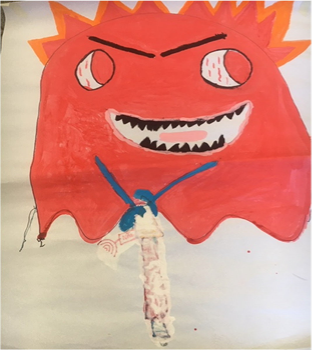

Ghost of Fury

Satisfied with the reproduction, Daniel says: “It is a giant of Fury that torments a lot, attacks the head, and keeps hitting it.” The part of the conversation below illustrates the dialogue that is being woven around the externalized problem (the acronyms T, D, and A, refer respectively to Therapist, Daniel, and Aurora):
 

T: I think he has a jackhammer in his hands and drills holes in your head to get in! (I paint a tool in the hands of the giant). Could we come up with something to let you know when he’s turning on the jackhammer? (I paint a radar that says “No,” when it notices that the giant is approaching).

D: No… it crosses your mind… It’s a ghost.

T: Oh! We are getting to know him better! He looked like a giant, but he’s a ghost!

D: Yeah, he doesn’t drill holes; it goes through the head (erases jackhammer drawing with white paint).  
 

I understand that this attitude of Daniel concerns his authorship, and he gradually builds on his relationship with the problem. It’s like he’s saying, “Hey! This is my problem!” There is a significant change in how he relates to exploring the difficulties that brought him to therapy.

The separation between the person’s identity and that of the problem does not exempt them from facing the damage that this has brought to their lives. According to Michael White, it enables them to assume this responsibility, and, in this way, they are encouraged to establish a more clearly defined relationship, in which a range of alternative possibilities becomes possible. And continuing…

T: And does he take advantage of some “little windows” to get inside your head?

A: I think it’s when he gets jealous of his brother and when we go against him.

An alternative way of talking about the difficulties that permeate family relationships is under construction without, however, pointing out the child’s deficits, and blaming him. Externalizing conversations, by objectifying the problem, offers an antidote to internal and essential understandings of an individual.   

Building an Identity for the Problem

The problem, now named Ghost of Fury, is gradually discovered through a curious investigation where I learn from the clients about their experience. The Ghost of Fury is 1,000 years old and lives in every child’s house for one year. It arrived when the family moved from the city where they lived two years ago, leaving the loving paternal grandparents. He feeds on people’s anger and his favorite food is “rage burger.” He lives in hell and other evil ghosts also live there.

Upon hearing Daniel’s vibrant description, Aurora reported that the parents and children lost their friends. The children separated from their schoolmates, from the playground in the old house, and from the paternal grandparents’ beach house. She says: “Daniel always says it was my fault we moved here. He doesn't like it here.”

D: Yeah, we had to come here because she got a job here…(notices the mother’s tears) Mom, are you crying??!!!!  

T: I think you were all very sad to have moved to another city. Nothing happened as you expected…

A: He says I'm not a good mother, I feel very guilty. I do everything for them, I can hardly even work…

T: Yeah… one of these evil ghosts’ tricks is to make mothers feel guilty. They disrupt the whole family’s life.

D: Not my father’s life! He works and comes home late and just sits on the couch watching TV, right mom? (Aurora laughs).  

Looking for the influence that the problem has on the life of Daniel and his family, I highlight the following excerpt:

T: What does he want for your life?

D: That I become evil? He wants me to be mean!!! (His eyes are wide open, pointed at his mother).

It is important to note here the change in the child’s expression that seems to reflect on the influence the problem has on his life and suddenly discovering his real purpose. And continuing:  

T: And what does he want for your family?

D: He wants us to fight, stay in front of the TV alone, without talking to our mother, without playing… He doesn’t just disturb the family; he also goes to my (maternal) grandparents’ house. The most nervous is my grandfather. He drives my grandfather crazy.

D: Mom, grandpa needs to come here too!  

Michael White says that this type of conversation, through influencing questions, compares to investigative journalism and its first objective is “to develop an exposition of the corruption associated with abuses of power and privileges,” imposed by the problem. Like investigative journalists, therapists are not involved in the domains of problem-solving or engaging in conflict, but, again referring to White, “Rather, their actions usually reflect a relatively ‘cool’ engagement.” In contrast, clients also assume an investigative reporter position, reflect on their experience, and contribute to exposing the character of the problem. They denounce its objectives, purposes, and activities.

This posture reveals the importance of the narrative therapist’s decentered position. It paves the way for the clients to identify and build other plans for their lives, what they value, and contradict the threatening voices of the problem. In other words, externalizing conversations offer a shared island of safety for people to engage in the reauthoring of their lives.

A Story About the Externalized Problem Inspired by the Idea of Poetic Documentation

For White and Epston, the written word is an ideal path for discoveries made during therapy which, like documents, can be evoked, read, and recreated. Written tradition, through “making visible,” highlights extraordinary events, giving prestige to an alternative narrative (9). Still, according to Campillo Rodriguez (1), writing as a therapeutic resource opens up many paths through which people can see themselves through the eyes of the other.

During clinical consultations, therapeutic poems build, in a special way, an opening to new stories, which play with the imagination and give clients the freedom to experience their own images, sensations, and new meanings.

Discussing the usefulness of therapeutic poems in her work, Sanni Paljakka (2) writes:
 

Due to their unusual form (the lack of requirement for the shiny completeness of sentences and ideas in prose text), these poems have opened up a unique way for me to play with ideas. Writing in poetry form allows me to pit the horrors and hauntings of a problem story against a confection of possible counter-story ideas with no regard to orderly sequencing of life experiences or the flow of a therapy conversation.


So, at the opening of the session following the revelation of the Ghost of Fury, I asked Daniel and his mother to sit down comfortably and listen to a text that I wanted to present to them (Although the authors point out that poetic documents should be written exclusively with the words expressed by the client, I took this therapeutic tool as an inspiration, adding a personal way of narrating, to what I preferred to name therapeutic chronicles.):  

It was a problem and it was a gigantic

A giant that was so gigantic, it tormented everyone

It tormented the boy even more
The boy was a child

And he did the worst for the child Just for the kid, he had a jackhammer

He made little holes
In the boy’s head

When he was a child and the boy was a child

Clever
Thoughtful
Observer
And the boy had an artist mother
The child boy had an artist mother!!!
The smart boy and the artist mother took a picture of the giant
Click, Click, Click
Red he was
With funny hair and there was the jackhammer Making holes in the head
And making everyone nervous and quarrelsome and then… Sad
And found out the giant was all Rage Aha!!!
Now we know you!!!

And the smart boy and the artist mother didn’t notice…

The Giant of Rage, that was his name, was very intelligent

In a brush step, zas!!!
Changed to Ghost of Fury
What the hell!!!
Ghosts don't need little holes to get into the heads and families of smart boys and nice moms

Ghosts walk through walls

The smart boy figured out the trick. He found that the ghost goes through his head

And lo and behold! He knows many tricks to do bad things

He is 1,000 years old.  


I recited the chronicle, dramatizing it in such a way that the emphasis fell on the resources and extraordinary events subjugated by the problem (the boy was a child; he was smart, thoughtful and observant; the child had an artist mother; the smart boy and the mother artist took a picture of the giant), as well as the perverse purposes fueled by the problem (the giant that especially affects the boy, who is a child; his evils are preferably directed at him; a very intelligent giant, who magically transforms into a ghost to cross heads). 

As an externalizing conversation, listening to your experiences coming from another person, written in a poetic way, promotes a sense of legitimacy and centers authorship on the person. Afterward, Daniel said he liked it and thought it was funny: “He doesn’t even look that bad!” He still prefers to maintain his version of the problem as a ghost that enters his head without making small holes: “Hey tía, he doesn’t have a jackhammer.” Aurora was touched by the understanding that her son is “just a child” and that, due to so many turbulences in the family, her impatience could be harming him, in addition to expecting him to know how to renounce his place in the family in favor of his younger brother.

It was surprising to her to be perceived as an artist and she reported other craft skills, inherited from her mother. Daniel praised his maternal grandmother’s skills, attentive and creative, and discovered that his mother resembles her. The externalized problem, re-narrated, allowed the emergence of a narrative not subdued by the history of conflicts in the period between the meetings. Aurora says:

A: The giant isn’t showing up much there… he’s only showing up with strength when he’s with his brother. They fight, Leo gets in the way, and Daniel loses his temper (the words giant and ghost will alternate during the course of therapy, as meanings of an entity/problem separate from the child).

T: I think it’s the Giant of Fury’s tricks to keep taking advantage of the fights in your family.

A: He (Daniel) is better than me, calmer than me, he obeys when I speak.  

Despite the influence of the problem having diminished in the family, this meeting addressed many conflicting moments between siblings and between mother and children. Daniel suggests painting the Giant/Ghost again. Very excited, he announces:

D: Now I’m going to do it! It will have two colors. Half angry and half calm.”

The new image of the problem in metamorphosis was made with four hands, and the child tried to reproduce with his own lines the first form almost entirely created by Aurora (the Giant of Fury). This was explored in its finest details within a loving and respectful dialogue, mostly coming from the child. Everyone looked proud at the end.
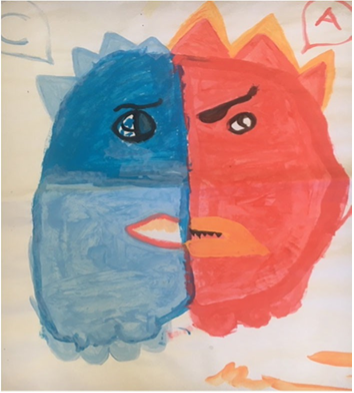

Ghost of Fury in Transformation

The letters C and A were added to signify the initials for Calm and Angry, English vocabulary learned by the boy at school. Descriptions and facts previously mitigated by the problem populate the conversations, allowing the child to be perceived through his resources (learns another language, likes to paint, collaborates with the mother). Immersed in a dialogical and horizontal relationship, instigated by conversations fueled by painting, I outlined Daniel’s hands on a blank piece of paper, with the letters F (Fury) and C (Calm) to be taken home. They could help them remember that when they manage to stay calm, the Giant weakens.

Drawings of Daniel’s Hands as signalers of emotions in the house

The session that followed this one focused on efforts to distinguish the influences of the Giant/Ghost in the family’s life and the family’s in the Giant's life. The rage attacks are less intense; frustrations are expressed with lamentations. Aurora says:

A: Daniel is more loving, more understanding, helping me to calm down faster. It was a lot of just complaining, now it’s like this, more smiling. Sometimes he is more patient with his brother.

D: I didn’t get angry with Leo crying. I say: ‘Caaaalm down, Leo’.

A: We put the Hands in the room. In a place where everyone can see.

T: If the house is calmer, how is the family?

A: I bought paints, they are painting.

T: It’s a family of artists!  

At this time, they review the contributions of their maternal grandmother, skilled in manual arts. Daniel speaks proudly of his grandmother who draws house plans for engineers. Aurora has the opportunity to reframe her relationship with her parents, with whom she feels hurt by for not receiving the expected support: “My parents are very active, they have a life of their own…”

Daniel is attentive and praises his grandmother’s kindness but claims that his grandfather is very nervous: “The ghost must be living there now.” and continues… “Hey tía, I think next time the Giant of Fury will be all blue!”

From these conversations, another poetic document was presented to them at the next meeting.
It was a giant
Giant?
Not anymore

It wasn’t even a giant. It shrunk

And in its shrinking, OH! Would it also be changing color?
And the giant asked for help

Help! Somebody help me!

I’m shrinking and I’m not even red! Help!
And nobody listens

The artist mother and the smart boy continue their task of transforming him

Now the little giant is red and blue
Half bad, half good. Half angry, Half calm

The smart-mother and the artist-boy continue their work of painting the new little giant red and blue

The Giant of Fury is sneaking out

It no longer fits in that room. It no longer fits in those lives

At the door, already saying goodbye, he looks back and takes with him an image that bothers him. He sees the boy-artist calmly walking around the room, talking to his smart-mother, deciding together on the last brushstrokes.

The image has changed. And the Giant of Fury, sad, decides to leave in search of another place to live.  
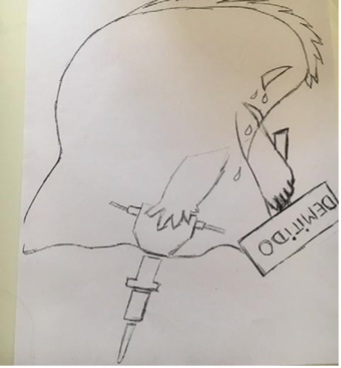

“The Fired Ghost of Fury,” Made by an Artist Upon my Request

When presented with the new image, this time taken by me, the mother laughs at the ghost and its “Fired” sign. Daniel says: “Poor guy,” and, “Mom, we’re firing him from home too!”

With a social constructionist sensibility, narrative therapy assumes that the self is relational. Within the plasticity of relationships, we build reciprocal identities, shaped by contextually-situated linguistic descriptions. Thus, Daniel’s interest and initiative, in a safe and inclusive environment, transform him into a boy-artist, now accompanied by a smart mother who, less confused by her feelings of incompetence and guilt, becomes someone who knows how to take action (welcoming, encouraging, believing, hoping). Therefore, the Giant who abandons that relationship is one of misunderstanding, impotence, and pain.

The self-confident artist-boy prepares to paint another ghost: “I do. It will be all blue. Blue is the color of calmness, right mom?” 
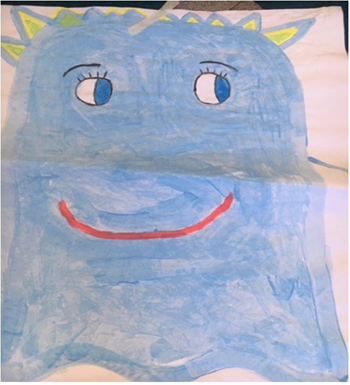

Ghost of Calmness

Since we were at that moment on the verge of social isolation due to COVID-19, we suspended face-to-face meetings and sought to build communication via WhatsApp, through messages and audio, since the video camera sessions proved to be unproductive for the participation of the children. Contacts were more frequently aimed at supporting Aurora’s concerns regarding Daniel’s growing lack of interest in online classes. Still, mother and son agreed that the Ghost of Fury was still diminishing. In this period of confinement, the interaction between the two children deteriorated, slipping easily into conflict. I suggested that Brother Leo be invited to participate in a face-to-face meeting, and we all committed to this meeting, respecting the health standards for disease prevention.

The dialogue below illustrates a remarkable moment from this meeting, where many disputes took place, with Daniel asking for his mother’s interference to calm down and hold his brother who “only gets in the way” an


Sasha McAllum Pilkington on Grace and Storytelling at the End of Life

Lawrence Rubin: (LR): Sasha, thanks so much for joining me today. I was drawn to the narrative stories you’ve shared through your hospice work in New Zealand and the incredible way you help the dying and their families. But before we begin, I know you had something you wanted to say about your work with these clients. 
Sasha McAllum Pilkington: (SP): Kia ora, Lawrence. Thank you very much for having me. Tēna koutou katoa. Hello, everybody. My name is Sasha, and I work as a counselor for Harbour Hospice. We provide specialist palliative care for people in the community and have an inpatient unit. I work mainly as a counselor in the community. I just wanted to say that sometimes when I’m talking about practice, I use stories to illustrate what I mean, and I wanted people reading this to know that I do that with the consent of the people that I’m speaking about and with respect to their confidentiality. So, thank you. 

Meaning Making in the Shadow of Death

LR: I'm glad that you started right there, Sasha, because my very first question is, what does your way of co-creating stories with dying clients say about what you believe works in therapy or consultation?
SM: I think being alongside people who are dying, and their loved ones, is very important. When I speak of being “alongside,” I am referring to supporting a person to reflect on their experience and what matters to them in ways where they experience themselves as worthy of respect and holding knowledge about their own life. I think recognizing our shared humanity is significant in working with people who are seriously ill and approaching death. We are all mortal beings with bodies that can become unwell, and we can all suffer. I am no different in this regard from the people whom I meet in my work and keeping that idea forefront in my mind allows me to see the person beyond the illness and whatever changes that imposes. Change is a shared endeavor and, in my view, takes place in the relational space. So, the stories I have co-created with the people I have met show, I hope, a spirit of collaboration and the importance of the therapeutic relationship in generating change. It can be very hard living with a life-ending illness so I hope the writing acknowledges that while showing what might be possible for both the person who is unwell and the therapist.

You might notice that I use some unusual language constructions as we talk. My use of language reflects some particular understandings that I think are important therapeutically. For example, I speak of “the person who is dying” rather than “the dying person” to acknowledge that people are more than the illness they live with. They are more than the problems they live with. As a narrative therapist, I think identity descriptions are important as they influence how we think of ourselves, what we think might be possible for us, and then how we might respond. The identity of “dying person” can limit how the person sees themselves and then influence how they might respond and act.   

LR:
I speak of “the person who is dying” rather than “the dying person” to acknowledge that people are more than the illness they live with
Some might say that hospice work, at the very end of someone's life, either by natural causes or an illness, is the end of a story. But I'm hearing you say something that suggests that the storytelling that you co-create is not simply about an end.
SM: Relationships endure beyond death, don't they? One of the opportunities I get is to talk to people about the kinds of stories that they might like to endure and to meet with families and ask them what kinds of stories they might tell about that person after they have died. This puts me in mind of a family meeting I was part of that took place on a rural property with a farming family. The men were sitting around in their gumboots — big blokes who probably had never spoken to a counselor in their life, let alone been anywhere near one. I was asking the person who was dying how they would like to be remembered, and then the family what stories they'd be telling about their loved one.

At first, the family were shy and hesitant to talk. But as they warmed up, they started to tell some really funny farming stories, which were brilliant. One was about how the man fell out of the tractor and just lay there because he couldn't stand up but had insisted that he go on working. And these men started to laugh as they were sharing these stories from their lives, and then one of them said to me, “Oh, I thought you counselors were meant to make us cry, not laugh.” It was quite delightful. Talking about such stories not only can nurture the relationship with someone after they have died, but they can also make it grow. The written stories we co-create therefore often reflect not just how a person has died but what might endure from the relationship family members have had with them. For example, the published story called “A Small Hope,” which illustrated how a therapeutic conversation brought forward some beautiful memories two young children had of their father, and then how they were developed into legacy stories they could carry with them throughout their lives.   

LR: And perhaps that flies in the face of what the uninitiated believe counseling in hospice to be, which is about sadness, crying, and lamenting. But it sounds like the storytelling that goes on in these last days, or weeks, or months of your clients' lives are not just about sadness and grieving and saying goodbye, but almost like living eulogies.
SM: I think the work really reflects the richness of life and what people have to lose. There are stories of both great sadness and also the savouring of life, and what has been most precious. There is a lot of crying, but there is also a lot of laughter. People walking past my room sometimes wonder what on earth’s going on when they hear all the laughing coming out, and it can change from moment to moment. So, yes, the conversation can reflect what and who has mattered most to a person, the real richness in their life, and ways of living, as well as losses they may be experiencing. 
LR:
I'm always listening for the beauty in people's lives, the stories, the nested stories within whatever we're talking about
Has this particular way of working with the dying and their families over the years changed the way that you ask questions?
SM: Yes, writing collaboratively has changed my questioning. I've been writing therapeutic letters and collaborative notes for decades now and writing stories that illustrate practice over the last 10 years. It has changed both my way of questioning and what I’m listening for, as well.

If I'm looking back on conversations, say, in a transcript, it gives me the chance to really look closely at my questions and to think, “How could I have asked them better? What work is that question doing? Has it been helpful?” That constant examination and thinking about questions has really allowed me to be a lot more intentional and be more skillful in my questioning. At the same time, I think my listening has changed. I'm always listening for the beauty in people's lives, the stories, the nested stories within whatever we're talking about. Just the other night, someone was talking to me about accompanying a family member who was dying and said, “You know, the job of the family is to deeply love,” and it just really struck me. I heard that clearly and in a way, perhaps, that I wouldn't have prior to doing all this writing.  

LR: So, the stories, the notes, that flow from these interviews are, in a sense, love stories, stories of love, and how that's permeated the lives of the dying and their families?
SM: Yes, sometimes. I’m very much listening for expressions of Aristotelian goodness such as love and kindness, compassion, courage, determination, and because I'm listening for it and inquiring into those spaces, it very much comes forth. I was just thinking of your use of love. I mean, it is a form of love, doing this work, I think, isn't it?
LR:
there is an idea that the work is all sad, and what I would say is that it can be both sad and uplifting and enormously meaningful
Well, it certainly is, in my mind, the ultimate act of giving. And if love is defined in part or in whole by giving, then when you are sitting with a dying client and their family, it is, I think, the deepest form of giving. So, yeah, I think it is about love the way you describe it. What have you learned from working with the dying and their families that may encourage others, perhaps those who are sheepish, to venture into this particular domain? 
SM: I really hope that the stories I’ve published will encourage those who are interested in this work, and support them in gaining some confidence and feeling prepared for what they might encounter. I think, as we were saying previously, there is an idea that the work is all sad, and what I would say is that it can be both sad and uplifting and enormously meaningful. This work does require me to be present for suffering and to be able to enter some of the taboo areas of life. But having said that, when people are approaching death, there are also stories of what's been important and what's been good about living, and they can be incredibly rich. For me, I think there's something also about working with problems that can't be solved, that can't be fixed, and being alongside a person and making sense of what's happening… Conversations that generate helpful meaning making, that are transformative perhaps, or reveal the extraordinary in the taken-for-granted. For me, anyway, that's enormously rewarding. 
LR: So, because their futures are so foreshortened and their death is so inevitable, it's not like looking forward to alleviating depression or looking forward to lessening anxiety. It's looking forward to an absolute end and helping them to prepare for that end with the greatest sense of meaning they can.
SM: Yes, indeed. Meaning making is a significant part of the conversation I have with people. Making sense with people about what is currently happening to them as they live with the illness and also reflecting back on their lives. Having a sense of living meaningfully is very important to most people at the end of their lives. Every person's life is different and people bring different things to their dying. However, while our conversations talk about dying and perhaps what they might be afraid of, or what dying means to them, we also talk about living. We may spend time speaking about how they might like to spend the last phase of their life and what is precious to them, for example. 

Narrative Therapy: Discourses Around Death and Dying

LR: Your clinical work is grounded in the Narrative Therapy tradition of Michael White and David Epston, so I’m wondering what are some of the dominant discourses around death and dying that may actually be unhelpful to clinicians working with the dying and their families?
SM: When I first started working in palliative care, I noticed that there were many cultural messages about a “right” way to die and a “right” way to live with an illness that were highly influential in shaping people’s experience of the end of their lives. I learnt that dominant cultural discourses could be helpful for some people whereas for others they positioned them as not getting it right in some way.

One cultural idea that springs to mind is the idea that death is a bad thing to be fought. If you have a curable illness or apply this idea to your experience in particular ways it can be very useful. However, for many people living with an incurable illness, the idea of a fight can start to become unhelpful. It might lead to them fighting the illness at any cost, for example, forgoing quality of life in pursuit of more and more treatments to avoid dying. Or it may position them as either winning or losing a battle, which can be a very unhelpful and limited description for someone who is dying.

Part of my role is to create a space for people to reflect on how they are going about living with the illness and approaching death so they can examine whether they are doing it in ways that fit with their values and what matters to them.

I've illustrated therapeutic conversation with people who have taken up a fighting stance against an illness with different consequences in some of my papers. For example, in the first story that I ever wrote, I met with a man who refused to acknowledge he was dying and was fighting by continuing to work rather than spending time with his family, and that didn't fit with his values. For him, the meaning of fighting his incurable cancer was not abandoning his wife, and he decided to have some enormous experimental surgeries. It was a really important thing for him to do. A fighting stance can work for someone. I can think of another person who had a really traumatic childhood, as did his wife. They had found each other at a young age, and it had been a very happy relationship. And for him, the meaning of fighting his incurable cancer by having some enormous experimental surgery was not abandoning her. It was a really important thing for him to do. The cultural idea of fighting can be both unhelpful and helpful. Dominant ideas aren’t usually good or bad in themselves. However, if they are guiding a person’s life, are unexamined, and don’t fit with their values, they can be problematic. It's more important how particular cultural ideas are applied, the way that they affect people’s relationships with themselves and their experiences, and the meaning they hold as a way of approaching death.   

Another dominant Western idea that can have unintended consequences is the message that we should be positive. In fact, Carla Willig describes the pressure to be positive as a cultural imperative in Western societies. At the end of life, the idea that we must be positive can shut down talk of our mortality and of suffering leaving people alone in their experience. Part of what I do is to listen and be present for stories that are often silenced. They may be experiences of suffering or fears about dying for example. There are few relationships where people can speak of such things. The idea we “must be positive” affects health professionals, family, and friends as well. It may have family members and visitors trying to cheer people up rather than acknowledging what a person is going through. So, at times, it can be a very persuasive and unhelpful idea.  

There are many cultural discourses that can cause people distress when they are approaching death. The idea that relationships end with death, and we have to “move on” rather than that relationships continue beyond death. And then there are some of the individualistic discourses; Western discourses such as “the reason that I've got cancer is because I didn't eat right, exercise enough,” and so on, right? People are often made to feel they are to blame and individually responsible for the bad things that have happened in their lives even when they are societal issues. Those are just a few examples. I find Narrative Therapy helpful in untangling ideas so that the people I meet with can examine them more closely.  

LR:
another dominant Western idea that can have unintended consequences is the message that we should be positive
What is it about Narrative Therapy that helps you to untangle some of those dominant but unhelpful discourses with the dying and their families?
SM: Narrative Therapy has encouraged me to be curious about another person’s world and to use questioning practices to inquire about ideas that a person raises in conversation. This allows the ideas to be brought forward so the person can examine them and reflect on their influence on their life. The dominance of certain discourses or ideas can mean they are taken for granted as “truth” and unexamined. Narrative Therapy has trained me to pull apart the threads of an idea in collaboration with the people I meet with and to look for how that idea impacts on different groups of people with the workings of power in mind.

Hope is an experience that I commonly examine with the people I meet with. Hope can mean many things to many different people, and I can't assume that I know the meaning of it in a particular person’s life. I might ask, “What does hope mean for you?” There’s an example of such a conversation about hope and the questioning I might use in the story “A Small Hope.”

I think Narrative Therapy really lends itself to assisting people at the end of life to reflect on the cultural ideas that are shaping their experience and then choose and think about how they want to go about the end of their lives.   

LR:
Narrative Therapy has encouraged me to be curious about another person’s world and to use questioning practices to inquire about ideas that a person raises in conversation
And that sort of brings us back full circle to our opening when we talked about storytelling, co-creating stories, co-creating notes. You've said in your writing that in working with the dying, you try to bring forward identities other than illness. What did you mean by that?
SM: We're more than the problems that we live with, aren't we? We're more than an illness that we have, but when we're unwell with a serious illness that's perhaps kept us from doing what we normally do over a period of time, the idea of being a sick person, the sick identity, if you will, can really take over. And identities matter. They don't just speak to our past and to who we think of ourselves being, they really influence our decision-making and what we think is possible for us. So, the idea of being a sick person, if it takes over, can be quite limiting in what a person thinks is possible for them, and it can lead to ideas such as a person thinking that they're a burden or that they've got no way of responding to what's going on with them.

I, for instance, can think of a person I saw who didn't feel that his life was worth living because he thought he was a burden to others. When I met him, one of the things I noticed was that despite this man being unused to living with other people and describing himself as a bit of a hermit, the carers kept coming into the room. I asked him about this and the relationships with the carers and discovered he actually learned all about their families and the countries that they'd come from.

I discovered that he was someone who was deeply respectful of others and who was able to get on and make the people around him feel really good about themselves. And through exploring this, we were able to expand his possibilities by bringing forth identities of him as a person whom others liked, as someone who cared about other people and so on. I guess we were able to bring forth a sense of living meaningfully for him. The identity we brought forward of him as someone who could give to others and make them feel valued was really helpful in starting to push the idea that he was a burden out the back door.   

LR: And you wouldn't have known that had you not been at his bedside to actually see the community in action.
SM: Exactly, it was very helpful. In fact, people would be knocking on the door when I'd be seeing him. It was really quite something, and he was very surprised. He hadn't actually noticed how many people liked and cared about him until I began to ask him about all the visitors and what might lead them to want to spend time with him. 
LR: And that's one of the essences of Narrative Therapy, which is looking to take what they call the thin story and add depth and richness. So, I can see how someone approaching the end of life can become overly focused on that singular event, which you, through your storytelling, expand and enrich.
SM: Yes. The idea of a person being just sick or dying is a thin story of who a person is. Bringing forth the depth and richness of who they are can be enormously therapeutic. As I get to know people, I am listening for who and what matters and has mattered to them in their life and how they have gone about their life. As they share these details, I particularly listen for Aristotelian virtues that are expressed in how they have lived. The themes of virtues give rise to the possibility of rich identity descriptions for the person — them being a compassionate or kind person for example. Such identity descriptions are very helpful for someone who is unwell, as it is possible to enact them with a sick body. If someone’s been a great sportsman, that’s not going to be such a useful identity going forward even if it is something pleasurable to remember. Let me share an example of how these rich descriptions of a person can give rise to sometimes transformative responses.

I was once asked to see a man who was living with a number of very serious conditions. He was refusing to speak about his dying even though he was in the last few weeks of his life, and was insisting on having resuscitation even though it would be hopeless and at the same time very traumatic for his family. He was self-medicating to the point where there was real concern that he might accidentally kill himself and wouldn’t discuss his future care needs. It had come to a critical point, especially for his family. When any of our staff tried to speak with them about any of these matters, he became angry. After an incident where he shouted at one of our doctors, I was asked to go out and see him.

I went out and met him and his wife, and as is common practice for me, I began by asking him about himself and his life aside from the illness. As we discussed who and what was important to him, I was listening for Aristotelian virtues that he had expressed in the way he went about his life. I learned that he dearly loved his family. They were incredibly important to him, and he was very concerned about their well-being. I learned that he was a really considerate employer who knew all about the families of his employees. He personally bought them Christmas presents. He was a very kind man. And I also learned, in his early life, that he was a courageous person. He was an adventurer. He had been involved as a bystander in a very violent and frightening incident and had behaved with incredible compassion and courage. So, these are identities that I sought to bring forward through inquiry as I hoped that they might be helpful to him.

After nearly an hour, he said to me suddenly, “Sasha, you've got it.” And I said, “Oh, may I ask what is it that you think I've got?” And he said, “You get why I want to live. You get why I don't want to die. You will be my death philosopher, and I will talk about dying with you.” We were then able to talk about his dying and how resuscitation would be hopeless and traumatic for his family to witness. Remember, family really mattered to him, and that value was very present in the conversation. We were able to talk about his hopes in taking the medication, that it was harmful, and also about what he might want for the end of his life. I don't think it was just that he felt seen and heard, which was so important, but also that he was able to access parts of himself that he needed to have those conversations. The conversation and the two we had following this one allowed us to plan for him to have a dignified peaceful death with his family nurtured as well.  

Building Meaning at the Threshold of Death

LR: Well, it sounds like you're giving these folks an opportunity to contribute to the narrative rather than being a passive recipient of the traditional story of the dying person and giving them a sense of agency, and utility, and value. This makes me wonder, based on something you said in one of your wonderful writings that working with the dying is sacred. What did you mean?
SM: I meant that I think it needs to be revered, that we need to give every respect to the people we're talking to, that I need to give every respect to the person I'm talking to. I'm entering the most tender areas of a person's life. They may not have been able to share their fears, their experience, with anyone prior to that moment, sometimes because they want to protect those they love most, sometimes because it is taboo to go into these territories, and no one has been able to ask or even wonder.

I might be talking with a person about what their fears are about dying. What part of dying are they most frightened of? Just recently, I was talking with someone about her deep shame at the thought of other people seeing her naked body. Another was frightened about incontinence, and how would she maintain her dignity? These people are worthy of my every respect, and when they're able to share some of those fears or losses, it's the gift, and it's a gift to be honored, I think.  

LR:
these people are worthy of my every respect, and when they're able to share some of those fears or losses, it's the gift, and it's a gift to be honored
So, you don't use the word “sacred” necessarily in a spiritual or religious context.
SM: No, I'm using it just in the sense of to be revered but perhaps a bit more than that. The hospice has a Māori name called karohirohi, which means where the light hits the water, the liminal space, the space between living and death, and perhaps there is something about that space that's sacred, something that’s out of the ordinary. It's something to take great care of.
LR: By virtue of it being a liminal space, it is out of the realm of day-to-day experience. It really pushes one to be somewhere they've never been before. And to have the courage to do that, whether we call it heroic or sacred, special, unique — there may simply not be a word — but I do love the word “sacred.” Sasha, can you give an example of having worked with a client who, in spite of your best efforts, was not able to embrace meaning, was not able or even willing to take you up on your invitation to write a story that their survivors could have?
SM: I think you raise an important point. I adjust what I do according to the person or family I am meeting with and what it is that they want and works for them. I don't write stories with everybody as it’s not right for everyone for lots of reasons. I think that there is almost always the possibility for assistance, and supporting people to have a sense of living meaningfully if they are willing to have a conversation. Some people have more to grapple with than others and I may not be the best person for them to talk to. Someone else might be a better fit. I think it is for me to adjust and try and discover what works for each family. People have different ways of approaching death and living with illness. Talking may not be their preferred option or what is best for them. I respect their knowledge of themselves and what they want.  
LR:
I think that there is almost always the possibility for assistance, and supporting people to have a sense of living meaningfully if they are willing to have a conversation
They're very lucky then. What lessons about death and dying have you learned from working with the Māori?
SM: Many. I read Michael White's paper, “Saying Hello,” and learned about the idea of relationships continuing beyond death, but Māori, who are the indigenous people of Aotearoa New Zealand, have held that idea for 1,000 years or more. Māori incorporate their tipuna, their ancestors, into daily rituals. The idea that those who have died are part of our lives is a taken-for-granted idea within their culture and is a powerful example for me.

When I was learning all of this in the ‘80s, family therapy, thinking systemically, wasn't necessarily the usual way of thinking. Whereas, again, for Māori, thinking systemically, meeting as a group and working things out, was, again, a practice that they had done for 1,000 years. And I think the other thing is that the way that they mourn is, in my mind, very enlightened. For example, a tangi or tangihanga, which is a funeral, takes place over days rather than in an hour, giving meaningful time for connecting and expressions of grief. Such a practice has influenced the time my family and many others give to mourning. And I believe that New Zealanders touch their dead more than any other culture in the world, and perhaps this is part of the legacy and influence of Māori. I feel I’ve benefited from the influence of Māori processes.   

Ethics or Protocol: Children Must Take Priority

A friend offered me the opportunity to join her in her practice, which I gladly did based on my knowledge of her values, beliefs, my love of what I do, and awareness of my weaknesses in marketing and billing. I brought my 20-plus years of clinical experience across inpatient, outpatient, and community mental health settings, which included my skills in assessment, documentation and play therapy into practice.

Like what you are reading? For more stimulating stories, thought-provoking articles and new video announcements, sign up for our monthly newsletter.

I was happy as a clam doing the clinical work, receiving a regular paycheck, and leaving behind the hassle of finding clients for myself. In terms of emotional demands on my employer, I was a non-complainer, and my needs were few. I asked for little and consulted enough to keep her informed of significant treatment issues.

An Ethical Dilemma Arises

As the practice grew, so did my employer’s need to be outside the office, and in her place, there were protocols. One of them was that no written document was to leave the office without her review, which included all letters, reports, and clinical summaries. Clinicians had deadlines and due dates on the documents which left the office, which did not always coincide with her ability to review and approve them. I understood the need for this system with new employees and interns, and that with multiple employees, that was a lot of reviewing. After all, that is what supervisors are for! But as a seasoned professional, I was not new to the field, and I knew my way around documentation and ethics.

I was treating a court-related, post-divorce father with three children, who traveled out of state for visitation with their mother. It was a 10-hour drive. A Guardian Ad Litem, who also happened to be an attorney, was assigned to the case.

The mother had been asked/ordered to participate in treatment and met once with me along with the children. In that meeting, she expressed her resentment and never returned. The father, nanny, and I were sure that the children were being abused and neglected. The children were telling the father, nanny, or myself stories of inconsistent care with meals, medications, sleeping arrangement, and transient care and supervision outside of their mother with other extended family members.

We were documenting the children’s emotional state and physical condition prior to, and after their visits with the mother. I was working with the children individually, as a group, with the father, and/or the nanny, after visitation with the mother to further support the need for intervention to stop the visitation. The judge continued to order the visits for lack of evidence and threatened the father with jail time if he didn’t comply.

We were documenting signs of abuse and neglect; refusal to give medication for a documented health condition, untreated medical illness, injuries, abnormal bruising, weight loss, sleep disturbance, and neglect. The children were scheduled to travel out of state for an extended three week stay. The father was under a court order to send them and severely stressed by the prospect.

In my clinical opinion the children were in danger if they were sent out of state for an extended visit like this. I felt the need to inform the Guardian Ad Litem. The deadline for the childrens’ next departure was rapidly approaching.

At that moment in time, my employer was consulting out of state and not due back until after the children’s impending departure. I fully understood the importance of protocol that the employer had set in place, but there was so much more at stake here than protocol. There was the children’s safety, health, and wellbeing, not to mention my legal liability, that of the agency, and my ethical reporting responsibility. While many reports had been filed in the past, there was not enough hard evidence to file a DCFS report or stop the visit.

I had prior authorization to communicate with the Guardian Ad Litem. I wrote the letter to the Guardian Ad Litem expressing my concerns, and the reasons. Based on experience, I knew my employer would not review the letter before the deadline for the visit, even if I sent it through email. The internal debate was emotional but brief. I sent the letter to the Guardian Ad Litem, and put a copy in the file, knowing it could cost me my job. The children needed to come first.

Because of the court order, the father sent the children to their mother. I did not hear from the Guardian Ad Litem, who did receive it via email, before the scheduled departure. The children survived the visit. Shortly after their return, one of the children disclosed sexual abuse, giving the court enough legal grounds to end visitation. The mother’s parental rights were terminated. The father re-married, and all three children have been formally adopted by his new wife. The children are thriving and progressing developmentally, despite their challenges.

As for my employer and I; we parted by mutual agreement.  

A Foster Child’s Painful Visit with his Mother

The Child’s Family Visit through the Therapist’s Eyes

His eyes widened with welcome, and a quick smile flashed across his face when he saw me pull in. From that moment, Jason was a 55-pound human-guided missile speeding out the door when I came to transport him and his sister for their weekly family visit.  

Like what you are reading? For more stimulating stories, thought-provoking articles and new video announcements, sign up for our monthly newsletter.

Today he is dressed in a royal blue, short, sleeveless shirt rimmed with white. His shiny new soccer shoes and short white socks are in sharp contrast to his small, skinny, naturally honey-brown arms and legs which have been tanned an even darker color by the sun. His straight jet-black hair falls in a circular pattern around his face. He has a child’s small mouth and nose set in a fragile face. It is his enormous, soft, brown eyes fringed with long, black, velvety lashes that tell his story. His eyes are the mirror of the words his lips will not speak.

Jason is silent on the short drive to the office until he suddenly blurts out that he has lost a tooth as he proudly displays its previous location. I respond with excitement and ask if the tooth fairy paid him a visit. He is silent. When we reach the office, he is the first child out of the car, into the agency, and up the stairs to the therapeutic playroom where his mother is waiting.

He comes to a standstill in the doorway of the room. His eyes reach across the sea of two brothers and two sisters to connect with his mother. Helplessly, they look at each other, and with their eyes, express the pain they feel in separation, without words or touch. After a moment, Jason tenderly greets each of his brothers and sisters with a kiss and a hug. He receives no display of affection in return. There is no expression in his eyes or on his face when he has finished.

Jason doesn’t play with any of the toys but spends the precious minutes of his visit as a helper and a nurturer. He begins by straightening the toy closet. Standing on tiptoe, he arranges the toys, games, and puzzles. When he is finished, he sits with his hands folded and his little legs dangling over the sofa, watching his brothers and sisters play. When the visit is over, he helps them pick up the toys. Jason is a little old man in a little boy’s body at the tender age of 7.

Jason is the first child to hug and kiss his mother goodbye. His arms tighten around her neck as he buries his face in her shoulder. He lingers in this position until his siblings push him out of the way demanding their hug.

Jason steps back fighting off his tears. In the end he succumbs to his feelings. He turns his head to the side to hide the tears as he wipes them from his eyes with the back of his hand. Jason is the only child who cries when the visit is over.

Jason is quiet in the car on the way back to the foster home. He sits with head bowed so I cannot see the tears flowing. When we arrive at the foster home, he is the first child out of the car. He gives me a brief glance as he looks back on his way to the door. His eyes flicker for a moment with pain.

The Family Visit through the Child’s Eyes   

I saw my mom and brothers and sisters today. When Vicki came in her little red car, I called to my sister, “Hurry, Christie, time to go see Mom. Race you to the car!”
I beat her to the car by a long shot. Girls are so slow! I jumped in the car. I got the front seat! I buckled my seat belt. I wished Christie would hurry!

During the ride to the visit, I had so many questions I wanted to ask, “Why can’t I live with my mom? Why am I in foster care? What did I do wrong?” I did ask Vicki, but she said she didn’t know. I thought she just wasn’t telling.

I had a lot to tell mom. I couldn’t keep my surprise inside any longer, so I told Vicki. “See what I did! I lost my tooth!” I held my mouth open with my fingers so she could see the big hole where my tooth had been.

She had to look quick cause she was driving. She laughed and her eyes got really big. She asked me if the tooth fairy left me any money. I had never heard of a tooth fairy.

I wondered if mom would be there. She didn’t come last week. Nobody told me why. They said, “Ask mom!” Funny how grownups never give you a straight answer when you ask them questions!

I jumped out of the car when we got to the office. I ran up the steps to the playroom. I ran to the room and stopped really quick in the doorway. Mom was there! She got tears in her eyes when she saw me. I cried too, I was so happy to see her! I wanted her to kiss me and hug me. She couldn’t because she was holding a baby. She said his name was Adam, and he was my new baby brother! Daina, Katie, Jeff, and Christie came charging into the room. The moment was gone. There was no time for me. I was too late.

I love my brothers and sisters. I missed them, so I hugged them to let them know how much I missed them. They didn’t hug back. They didn’t know how because mom didn’t have time to teach them once the babies started coming. She was always too busy or too tired. I had to teach them hugging. I didn’t mind because I liked hugging. It only hurt a minute because they didn’t hug back. I am used to it by now.

I cleaned out the closet this week, like every week, hoping mom would notice me. Vicki noticed me and said something, then mom said something. I felt really special for a minute. The feeling would have lasted longer if mom had said something first.

When I finished, I went to sit by mom. I wanted her to ask me about school. She didn’t because she was too busy playing with Adam. She wasn’t supposed to be playing with Adam all the time. This was MY visit. I was mad and no one noticed but Vicki.

I got down on the floor to play with my brothers and sisters. There wasn’t anything else to do. Just when I started playing, Vicki said it was time to pick up the toys and say goodbye.

I helped put the toys away and turned to my mom. I put my arms around her neck and hugged her as hard as I could. I hoped if I held on long enough, they would let me go with her, or she would say something. Then the little ones pushed me out of the way to get their goodbye hugs and kisses. I gave up! I decided being the oldest meant being last, even if I was only 7!

I fought really hard to keep from crying on the way to the car and back to the foster home. I tried to hide my head when those dumb tears started falling. Vicki saw my tears. She reached over and stroked my head and neck. Her hand felt soft, and I felt better for a little bit. She said it was OK to be hurt and to cry. I wanted to ask if it had to hurt this much, but I didn’t.

When we got to the foster home, I beat Christie out of the car again. It felt good to be first. I’m not first very often. Vicki was watching me when I ran into the house. For a second, I couldn’t keep back my tears. I guess it was OK to let someone know I was a little boy inside, after all.  

A Small Hope: Co-creating a Narrative of Grief – Part II

Bringing Memories to Life

“I want to remember the precious times we had together in those last weeks but already they are fading and I am forgetting,” Claudia said with resignation. It was now a month after Tom had died and the conversation had just shifted from the challenges of getting through each day.

“Is gathering up memories of the precious times something that you might like to do in this conversation?” I checked.

“Yes, those last four weeks,” Claudia said through tears. “From when we were told in the hospital Tom was dying and decided to come home. In the hospital, I asked one of the nurses, ‘How long does he have?’ and she replied, ‘Maybe a week.’ As you know, however, he lived for four weeks… Tom didn’t ask how long he had to live but I wanted to know.”

“Would it be OK to ask… what was important to you that you asked for the nurse’s guess as to how long he had to live?” I added the word “guess” as no one ever definitely knows and that uncertainty is often unfamiliar to people.

Claudia’s voice broke, “I just wanted to know how long I had with him. I think I was just trying to get a clear view of the future.”

“Did you have any hopes for what a clear view might provide you and Tom?”

“I was thinking this is valuable time. It clarified that we wanted him to come home,” Claudia affirmed.

“In this decision to go home, what kind of valuable time were you and Tom hoping for?” (22)

“It meant he could see the changes in the girls. They are so young they change rapidly, especially Libby who develops in small ways every week. I knew that visiting in hospital is just not the same. Everything is different, distorted and not in their natural state,” she explained. Visions of hospital rooms with their lack of privacy and noisy nights floated through my mind. I tried to imagine visiting such an unfamiliar environment frequently with a baby and young child.

“What does it say about Tom’s relationship with Imogen and Libby that he prioritised noticing small changes in them even when he was dying?”

Claudia smiled. “He treasured and valued every little thing about them. He’s been quite good at appreciating small things for a very long time,” she answered, speaking of Tom in the present.

“Could you tell me a story of Tom appreciating Libby and the small changes in her perhaps? And then Imogen and what he enjoyed about her?” I was aware that I was collecting memories, not only for Claudia, but for her girls as well. Together we would build a document of memories she could keep. (23)

After Claudia had shared some stories, I became aware we had diverged from what she had originally said she wanted to discuss. “I notice we have moved away from speaking about the four weeks you said you wanted to focus on. Would you like to continue on this track or would you like to spend some time talking about the last weeks of Tom’s life? What would you like to do at this point?” (24)

“The last four weeks. It’s fading so fast. I’ve even forgotten subtleties that were routine to me, like giving him his morning wash, and that was something I treasured doing,” Claudia stated. I was glad I had checked. I didn’t want the conversation to end without it having been what she wished.

“Would asking you about treasuring his wash be a good place to begin?” Claudia nodded and sat back on the sofa. “Would you like to walk me through how you went about giving him his wash?”

Claudia began to recall previously unspoken details of the daily routine with me, inquiring into their meaning. Towards the end of collecting as many details as I could I asked, “When you were washing him, was there a particular way you touched him?”

“Yes. When he was moving less, I would give him a little massage, or I’d move his legs around. I could tell he liked it. After his massage, we’d put frankincense on his palms and the soles of his feet and he’d go, ‘Oh, Frank!’ and wiggle his fingers making a joke!” Claudia laughed.

“Did he keep his sense of humour even…”

Claudia’s words tumbled out in her enthusiasm. “Always, right up until that last night. A carer came for the night to help. When she saw Tom she said, ‘Still unresponsive,’ so he wriggled his eyebrows at me. It was our little joke! Frequently through the day I would wash his face and I’d say, ‘Would you like a cool flannel or a hot flannel to wash your face?”

“When you were giving him that choice… what was your intention?”

“He had very little control over his life. He deserved respect,” Claudia explained.

“What did you want him to know by giving him that choice and respect…and control?” In tender tones Claudia answered, “He was still just as valuable. Even though he couldn’t move or see much, he was still my Tom, he was still the same to me.” Moved by her love and respect I responded, “May I ask, what would have Tom noticed that would have told him it was you washing him rather than someone else and that he was still the same to you?”

“He would have felt my love in the way I washed him. I was given a choice of washing him or having a carer do it. There was no way I was going to let someone else do such a personal, private thing for him,” Claudia stated, flicking her hair behind her. (25)

“What were you valuing, do you think, when you prioritised this loving moment with him and protecting his privacy even as you were parenting two small children and doing everything else that was required of you?” I reflected on the exhaustion that comes with parenting very young children. Such a choice was not right for everyone. Claudia lowered her voice, leaning towards me as she spoke, “I wanted to protect his dignity and have that intimate time with him.”

“May I ask, what did you experience as meaningful in the relationship when you managed to get that time together and share love and intimacy?”

“It felt like this was why we had him at home. It meant I was the one changing his nappy… And I did feel proud and honoured that I could do that for him. It’s not something a wife normally does for a partner, but I guess it was a new intimate thing we could do where there were precious few of those new things.”

Struck by her ability to generate such a deeply loving experience in something so far from what couples ordinarily do together, I responded, “What does it say about you that you felt proud and honoured to do that care for Tom … that you could find intimacy in changing his nappy for him rather than seeing it as a chore?” (26)

Thoughtfully Claudia answered, “I think I understood what he needed. I understood the best way to do that for him.”

“What was it that you understood about Tom in those last weeks that was important to you both?” Claudia pondered. “We were able to slow things down a bit.”

“How did you do this slowing?” I wondered. Claudia spoke slowly as she considered, “Just focusing on little things. I’d go and get him milkshakes and I’d say, ‘So what flavour milkshake do you want today and where do you want me to get it from?’ It was treasuring very small decisions. I got great pleasure from him eating or drinking something and he got to make decisions and think about that milkshake and what he wanted. Life zoomed in and focused on those nice moments.”

“What did you know, Claudia, perhaps about living with such a serious illness, or about Tom, that had you recognising that making a decision about the flavour of a milkshake was worth treasuring?” I couldn’t help but notice her extraordinary sensitivity to Tom’s experience and I hoped that my questions might draw Claudia’s attention to her wise and gentle care.    

Claudia laughed. “Tom knew his own mind. I would never make that decision for him, particularly around food,” she said, reminding me that Tom was a skillful and passionate cook. “Choices in his life were dwindling. He didn’t have a lot of control.” She dropped her head for a moment, reflecting. Tears glistened in Claudia’s eyes as another thought occurred to her. “Tom knew how much it would hurt me when he went.” The tears gathered and a sob escaped but she went on speaking. “He didn’t want to go but most of all he was worried about me…” Claudia started to cry unreservedly. Her face reddened as more of her body joined the experience of grief. Rather than a break in the conversation, it was as if these tears spoke what words couldn’t as we reflected on Tom’s love for her even as he was dying. (27)

Quietly, I eventually asked her, “What were these worries Tom held for you?”

Claudia was barely able to speak yet she persevered, wanting to express what the emotion meant in words. “He just knew how hard it was going to be… he cared enormously about me being alone.”

We were quiet for a time as Claudia continued to weep.

“He was sad for himself and the girls, but he was really sad for me,” she eventually explained.

I thought about Tom worrying about Claudia even as he lay in bed so sick. “What does Tom’s compassion mean to you? …. that he couldn’t bear to think of you being on your own…that he cared so much about what might happen to you…?”

“It was a demonstration of how much he loved me,” Claudia choked out. “I usually cried,” she explained, smiling at herself through the tears. “I felt guilty every time I cried and got comfort from him but he’s the person I turned to when things were wrong. He said comforting me was something he could do.” She stared at me with her eyes wide waiting for my response.

“Do you have a sense of what it was to Tom that you chose him to seek support from?”

Claudia exhaled, “I think he was thinking about the time when he wouldn’t be able to support me, and he was doing what he could.”

“How would Tom have understood the way you saw him when you sought comfort from him?”

Claudia considered, speaking what seemed like newly formed thoughts. “He was my best friend, and we were there for each other. It didn’t change when he was sick. I think it was hard but very important for him. It allowed him to show support for me, I guess. He saw it as something he could do for me when he could do so little, when I was doing so much for him. I didn’t feel the need to protect him.”

“What do you know about Tom that you knew you didn’t need to protect him?”

“He was strong. He said he wasn’t scared of dying.” Claudia let out a big, long sigh collapsing in on herself in seeming resignation.

“Would it be OK to ask you one more question about the way you shared your grief together?” Claudia nodded.

“What did you know about the relationship that told you that talking would be best for it?” I wanted to bring forward Claudia’s knowledge of their particular relationship because I knew that this kind of talking wasn’t best for everyone.

“It’s what we’ve always done,” she readily replied.

Our time was coming to an end. After I summarised what we had been discussing, I checked with Claudia, “How has our conversation gone today? Has the experience of reflecting on the last four weeks connected you with anything that is helpful or important to you?” (28)

“I think it’s highlighted how we did it according to our values. That’s incredibly important to me. It eases the pain just a little to know that,” Claudia responded.

“How might you carry that knowledge do you think? That you did it according to your values?”

“I guess by carrying on doing that with the girls,” she replied thoughtfully.

“Perhaps we might come back to that next time if it interests you…. but could I ask you something else? As you reflect on the last weeks of Tom’s life, was there anything that happened that moved you a little closer to being the person you want to be?”

With some energy and perhaps surprise in her voice, Claudia answered, “Now that I talk about it, lots of things. Doing it our way and speaking up to make that happen. The way I was able to show him how much I love him through what I did. It was so hard, but I was there to support him die the way he wanted to do it. I hadn’t really thought about it before.”

Turning Towards Pain

Claudia and I met each week until I was scheduled to be away on leave. (29) Before I left, we planned who Claudia might turn to in difficult times for support and what she might do. Not long after I returned, we were once again sitting in her home. After greeting each other warmly, Claudia brought her cup of tea into the living room, and we sat down.

“We had a fortnight gap this time, how did that go?” I inquired.

Claudia let a rush of air out. “My sister said, ‘Have you seen your counsellor this week?’ And I said, ‘No we couldn’t make it. Sasha was away.” And she said, “I always know when you haven’t seen her.” I thought I’d be fine, but I’ve had a really awful fortnight.”

“What is it that you do differently in the week when you’ve had a chance to talk?” I inquired, but I was off track. (30)

“I was thinking about what it was that changed. You know how I was feeling numb? Well, I’m raw now. I can’t seem to stop crying…” Claudia’s voice broke, and she could no longer speak. The pain gathered and eventually she sobbed, “It’s all the time… just crying all the time. I’m right back to raw and where is he? And how can this be happening?”

I listened, feeling the echoes of her pain. (31)

Claudia bowed her head and tightly wound her arms around her body. It was as if she was holding herself together. “I’m right back there… and that lovely numbness… that I was feeling has just gone,” she stuttered through the sobs. “It’s horrible… just that relentlessness… And I went to see a clairvoyant and she was just ghastly. I think that tipped me over the edge a bit. I realised I had a lot of hope riding on it.” She looked up at me with wet eyes.

My voice was soft. “May I ask …what were your hopes in seeing the clairvoyant?” I wasn’t surprised Claudia had visited a clairvoyant. Many people search for connection with someone who has died through spiritual understandings they hold.

“I didn’t realise until afterwards that I was hoping that it would be for real. I would have got a feeling of peace knowing that he is somewhere and can be with us. I didn’t get that at all. I just felt duped. I was already feeling quite low but hopeful, I realised afterwards.”

“Would it be okay if I ask a bit more about these hopes?” Claudia nodded as she blew her nose. “Would you mind speaking a little about what you were hoping for?”

“That he’s somewhere…And he’s not just puff gone. That he is somewhere and sometimes, somehow, he is around…that’s what I really want to believe…I need a message to say, ‘I’m OK, I can never see you again but I’m OK…and I know you are OK.” It is one of the hardest things I think, the not knowing.” I reflected on how much not knowing there could be surrounding illness and death.

Claudia’s anguish layered her words as she again tightly encased herself with her arms. “I’m stuck in this awful hole…I don’t know how to go on. I just don’t know how to hold on. I feel like I’m clinging on to a ledge. I have to but I don’t know how to keep going and going and going…” (32) I tried to imagine the relentlessness of continuing on. Her words created a vivid picture of the ledge. I made sounds of empathy as I listened, a witness to her pain and sorrow. “How important was knowing where Tom is in this holding on?” (33)

“Very important,” she cried.

“Yeah… yeah…,” I replied, almost crooning in my compassion for her. “What would it have given you in the holding on?”

Claudia cried, hiccupping as she answered, “Some sort of peace that he’s OK…that he’s with us…and that I might see him again…It’s so hard. It’s not like breaking up with someone and you know they’re OK. Somewhere they’re alive…”

“Completely different,” I affirmed.

Claudia voice was husky, “I just can’t get my head around it. It’s the absolute worst that could happen to me…I’m really struggling…” Her tears took over and we paused, neither of us hurrying or censoring her expressions of grief. “…and I’m sure having less help this week is making a difference. The family have been away. I’ve actually been feeling OK with my parenting.”

My ears pricked up. “Yeah…?” We had talked a lot about the impact of grief on her parenting as Imogen and Libby were Claudia’s top priority. However, I didn’t want to move Claudia away from her talk of the struggle sooner than she wanted so I resisted asking a question and kept my query very small.

“We’ve found a routine and I’m not shouting. I’m not feeling desperate about those times,” Claudia told me with an energy that conveyed to me she might have a possible interest in speaking further about her parenting.

“Is this something you would be interested in talking about?” When Claudia indicated, she would like to follow this direction I continued, “What’s allowed you to be OK with your parenting especially when there is so much struggle?”

“I think routine has helped. It’s soothing. And I’ve got really, really good at filling in the time now. Those girls are bloody tired by the end of the day because I’ve worn them out. Like last Sunday, we went to the markets and met a friend for breakfast, then we went to a school children’s art exhibition which was a couple of hours and then we went out west to see another friend. We got home at 6 P.M.” Claudia sighed, sounding exhausted even by the thought of what she had just relayed to me.

While being so busy was not Claudia’s preferred way of parenting prior to Tom’s death, this was a survival strategy she was using. “I’m really tired but that’s how I cope. Just fill in every hour possible. It’s not because I don’t want to think because I like to think about him. It’s just the only way I can cope with the kids. It’s helped.”

I returned to the aspect of parenting Claudia was feeling good about and, remembering Tom’s belief in Claudia’s parenting, decided to bring him into the conversation. (34) “And what would Tom make of you doing your parenting in a way that you felt good about? Finding a routine and being more how you want to be with the girls. What would he be thinking about that?”

“He’d be saying, ‘I knew you could. I’m proud of you.’”

We both smiled. With a lighter voice I asked, “What might Tom have known about you that allowed him to know you could do it?”

“That I put them first…,” she replied as tears trickled down her face. “…That I’ll always look after them…” Intensity and what sounded like determination entered her tones of sadness “…and I’ll hold onto that ledge for them…hard as it is…”

“Is Tom under your feet helping to hold you up a bit too?” I asked, wanting to add his support if it was there.

“I don’t know…I hope so…He would if he could…if he can he will…I forgot about the rawness. It’s so horrible.” I nodded.

“It’s only three months since he died,” Claudia told me with emphasis.

“No time at all and yet perhaps a long time too. How would you describe it?” I reflected, slowly waiting for what else she might be about to share. Claudia replied, crying as if her heart would break, “No time and yet forever. It’s part of why I hurt so much. How’s three years going to feel since I saw him? And thirty years? I feel like I’m only living for my girls…to give them a good life…and not enjoying any of it myself. The hole just keeps getting bigger.”

“Is it hard to imagine that the hole might stop expanding and steady a bit? That it might be less gaping one day?” I said, offering a future possibility.

“I can’t…”

I nodded.

“Is your wanting to parent the girls so they have good lives…” I began to ask as I looked to connect Claudia to parts of her life that might help support her keep holding on. Her virtuous desire to care for her children in spite of the pain of living stood out to me.

Claudia interrupted me, staunch as always in her love of her girls. “I want them to have good happy lives, absolutely.”

“How would you describe a good, happy life for your girls?” I invited, seeking to connect her with a future for them that might be possible to envisage.

“Doing things that stimulate them and interest them with me…positive times with me and …being strong in themselves…able to weather some storms… and get enjoyment out of things…and finding passions. I want that for them but not for myself. I don’t believe in having that for myself. I can’t see it again. It feels like it’s all gone…”

We paused together for a time and Claudia wept. (35) “I feel like something in my soul has gone… an intrinsic part of me.” Her description touched me as I murmured a quiet acknowledgment. After a pause I added, “May I ask what part of your soul would that be?”

“All of my adult self…is connected to Tom. Everything I do and think is influenced by him and our relationship. All my memories of being an adult…are with him. The way I view things is because of him. It is lovely and I’m very glad. But it’s such a wrench.”

“Was your soul entwined with his?” I wondered. Claudia nodded. “And was his entwined with yours?”

She nodded vehemently. “I don’t know where he is! It’s just so hard.” Claudia’s body shook and she put her head in her hands. It was my turn to nod as we both acknowledged the hardness. It was so hard (36). As we sat there for a time, I considered Claudia’s disappointment with the clairvoyant and how it had made the pain worse.

“I wonder if we can think about that a little bit…if we could figure something out, away from the experience you had with that particular clairvoyant…”

Claudia laughed heartily through her tears, “…Who believes in herself even if she is a complete fraud. I can’t accept that he’s not somewhere or not existing.”

“What are your understandings of possible places or ways that Tom could be existing?” I asked. People I meet with often have very different ways of understanding death even if they identify as belonging to a well-known faith tradition. They also often re-evaluate beliefs they’ve held for a lifetime in moments of illness and loss. I can never assume I know what someone believes.

“That he is part of the energy, the finite energy of the universe… that’s scientific,” Claudia explained to me. I listened attentively as she continued, “Or he could be in a different realm or a different world which is potentially scientific as well.”

“… like a parallel universe?” I inquired, noting her tears had stopped. “Yes. Or in some heavenly place, someplace souls go where there’s peace. I’m sure there are other frontiers but those are the ones I think of…I want him to be conscious somewhere and aware of us. If I think about another world or a heavenly place, he would be conscious of us.” She stared at the sky out the window. “What would a sense of Tom’s presence give you?” Claudia returned her gaze to me. “I would know he’s with us, present in our lives”.

“Do you think you have any impact on that sense of presence or how that presence could be felt?” I inquired. Claudia looked at me quizzically. “Clairvoyant people say we do, don’t they? If we can be open to it or not open to it.”

“I don’t know…Can you influence the way you feel Tom?” I wondered curious.

“I don’t know. I’d like to,” she affirmed. I cast my mind back to a previous conversation. “When we met last time, you mentioned you had felt him.”

Claudia confirmed, “I felt him really strongly.”

“May I ask what you were doing at the time?”

“I wasn’t doing anything out of the ordinary. I was probably having a laugh which was unusual as it was maybe two or three weeks after he died. The girls were playing around so a bit of a lighter moment and I was laughing with Libby playing peek-a-boo.”

“Would it be possible for you to have faith in yourself even if you can’t have faith in the clairvoyant you met?” (37)

“I’ve tried very hard to separate those two. It’s where I came to on Saturday. I didn’t have a very good experience with her but that doesn’t mean it’s all out. I didn’t pin my hopes on just one person. I booked two clairvoyants. I’ve booked the other one for August and I’ve heard she is authentic and very good. I’ll keep that booking. I’m not giving up on it altogether.” Claudia sounded calm.

Laughing, she added, “I can spare another $120! If she’s good!” I laughed in response before inquiring, “What about your own experience of feeling Tom was with you?”

“It was very strong. But it’s very easy to doubt myself. That’s what’s hard I think,” Claudia explained. “I had another experience where I was looking for a necklace and I felt Tom very strongly. I was looking and looking and then I found it one day and I had a very strong feeling that Tom had helped me find it. I know that sounds strange. But it was such a strong feeling that I said, ‘Thank you Tom! That’s for Imogen.’ It just came out. I need more! Greedy, greedy!”

“When you feel Tom with you, what does that feel like?” I asked curiously.

“Normal! The old normal,” she explained with energy.

“How do you know he’s there? When he helped you find the necklace, what happened that told you that?” I wondered, keen to learn more.

“It just felt like everything’s OK again.”

“Ah.” I sat back in my chair.

“And I don’t have to have this new normal. Both times I just felt lighter and happier. This nightmare is over or maybe not what it seems.”

“If you met with another clairvoyant whom you did or didn’t find authentic, could anyone take away those experiences that you’ve had?”

“No. They’re authentic to me,” Claudia stated.

“You said you want more of them…”

In a sing-song voice Claudia interrupted, “I do!” She was grinning.

I returned her grin. “On demand!” I echoed in the same sing-song tones. Claudia laughed. (38)

“They felt authentic to me and I’m a big believer in going with your gut instinct. I’m quite in tune with those things. They felt real.” Claudia sat back looking steady.

"I drove back to the hospice some time later reflecting on the many understandings people hold about what happens to a person after they die." (39)

New Understandings

Claudia returned to work and, as the routine settled and time passed, the pain of Tom’s death intensified. As Claudia explained to me, “It is now not just days or weeks since I last saw Tom, but six months. The longer it is since I last saw my Tom, the more I miss him.” I wasn’t surprised as many other people have described a similar experience to me.

It was a rainy day. Claudia had finished breastfeeding Libby and had returned from laying her down to sleep. She walked up the stairs with a heavy tread and sat down. “It feels like we are now in a new normal. The new normal makes me so sad. I don’t want a new normal. I want the old normal. I’m feeling guilty; sad and guilty.”

I made a few acknowledging sounds as she talked, “It is so tough. Who would want this normal when comparing it to having a partner they loved alive?” I paused a moment as I looked at Claudia’s drawn face. “Would it be helpful to share with me some more about this sadness and guilt?” I continued, wondering if it might be useful to get to know th