The Anxiety Disorder Game

The Anxiety Disorder Game

What causes someone to commit so strongly to the need to avoid doubt and distress?

Imagine a man standing in front of an audience and suddenly being unable to think clearly enough to speak his next sentence, finally stumbling through, putting a quick death to his speech and walking out of the room in humiliation. It would be expected that he would worry about how bad the next time might be, even envisioning himself in a repeat performance. Picture a woman on a bumpy flight, unexpectedly becoming terrified of deadly danger, and not being able to calm herself until the turbulence ended. It would be no surprise if she avoided future flights anytime the weather seemed less than ideal. Consider a father suffering from obsessive-compulsive images of choking his infant daughter. That graphic horror would compel any loving parent to avoid being alone with his child.

An almost instinctive reaction to these traumatic events is adaptation, however not all adaptation is psychologically healthy. Unhealthy adaptation could include exaggerated worries, anxiety, and inhibition of the capacity to act on their environment in an attempt to create a feeling of safety or avoid these threats in the future. If these maladaptive responses continue then the person will develop an anxiety disorder. If we look more closely, it seems that many of these same people begin to develop a general maladaptive framework for operating in the world. Safety becomes of paramount importance. The person with an anxiety disorder believes that losing control of their feelings or circumstances can come quickly and easily. Given that belief, avoidance is an easily adopted strategy. When the person with an anxiety disorder avoids, vigilance becomes their primary safety behavior. Once they recognize a potentially troubling situation, they want to end it immediately. If their heart starts racing and their head gets woozy, they fight to get rid of that discomfort as fast as they can. If the discomfort cannot be stopped by escaping, then they begin what they think is a problem-solving process, however this is not problem-solving but only excessive worry.

The goals of worry make perfectly good sense given the crippling anxiety people have experienced. The problem is that this strategy only serves to increase the problems that they are designed to prevent. When we resist the physical symptoms of anxiety, we ensure that anxiety will continue. The adrenals secrete that muscle-tensing, heart-racing epinephrine through the body, the brain matches it, and we will become more anxious.

Using worry to solve problems will backfire. Worry is a problem-generating process since it causes people to think more about how things might go wrong than about how to correct difficulties. “The human mind is built to worry. Worry helps us to prioritize our tasks, and provides us drive to get each task done by kick-starting the problem-solving process.” People who are prone to anxiety doubt that they have the inner resources to manage their problems, so they use worry to brace for the worst outcome in an erroneous belief that they are productively preparing for the negative event.

Two other tendencies contribute to their struggles. Anxious people don’t want to make mistakes, believing they will have dire consequences. They also don’t want to feel any distress, and the goal of the worry is to stop or avoid uncomfortable symptoms as soon as they arise. That message—“don’t get tense!”—is a sure way to create a self-fulfilling prophecy.

All these tactics together become a powerful force structured within a powerful fortress that drives the decisions of anxious people. They follow a belief system—a schema—that tells them how they should respond to doubt and distress. The belief systems of some clients are so strong that they ride roughshod over the therapeutic strategies we employ. No matter what instructions and techniques we give clients, their overriding unconscious and usually conscious, goals are to end the doubt and distress.

Much of my understanding of these drives, to avoid discomfort and seek certainty at all costs, grew out of years of failures. If I began treatment by teaching someone brief relaxation skills, they would incorporate those skills into their strategy of trying to keep the anxiety at bay. If I offered assignments counter to their defensive belief system, clients would not follow-up on the homework, or they would become confused after leaving a session. If I were especially effective in persuading them of the importance of practicing skills, they would simply drop out of treatment.

For over twenty-five years I have gradually modified cognitive-behavioral treatment that included relaxation training, breathing skills, cognitive restructuring and exposure strategies, to address the special issues created by anxiety disorders. By 1992, for instance, I drew on dozens of discrete techniques, some old standards along with some new procedures, to help my panic disorder clients alleviate distress. But as the years passed, I felt that technique alone was insufficient. My experience taught me that if we focus on techniques without first challenging their beliefs, then their fear-based schema will overpower our suggestions.

Personifying Anxiety

Anxiety disorders have a clear strategy to dominate. They condition the person to three contexts: the situation that stimulated their fear, the fear reaction itself, and their use of avoidance as a coping mechanism. The person creates a defensive relationship with each of these: to become doubtful and anxious when approaching that situation, to feel threatened by their anxiety and want to get rid of it, and to avoid when necessary to stay in control. These strategies are incorporated both into the neurology and the belief system of the person. Each interpretation and behavior in response to anxiety is directly linked to this frame of reference. I use a cognitive approach in which most of the therapeutic time is spent addressing clients’ relationship towards the anxiety, not the anxiety itself. My goal is to teach clients therapeutic principles powerful enough to offset their faulty beliefs that they must battle anxiety and must become relaxed again quickly. Clients learn to mentally step back, away from a poor quality interpretation of the situation (“this is a threat”) and a failing strategy to respond to it (“I must stop it”).

In most ways, this approach matches the standard cognitive-behavioral protocol. However, this is also where I begin to diverge from some standard CBT strategies. To win over fearful anxiety, I believe the therapeutic strategy must meet the following conditions.

1. It must be able to compete with the power of fear and distress. This includes creating an emotional shift that is strong enough to match the drama of anxiety.

2. It needs to have a simple frame of reference that makes sense to the client. My most consistent task with anxiety clients is to keep a clear-cut message at the heart of our discussions. The sharper I am about a few points, and the more emphatic I am about using them as guiding principles, the more successful I am at influencing the client’s point of view.

3. It needs to provide a clear system to follow, with simple rules that guide their actions during fearful anxiety. Otherwise, consciousness gets swallowed up by the fortress of conditioning.

4. It needs to permanently influence neurology or, said another way, their physiological reaction to anxiety.

5. It needs to involve tasks that they feel are within their skill set.

6. It needs to help them feel in control instead of out-of-control. Anxious people regard themselves as victims of the anxiety condition. I want clients to feel in charge, to see themselves as the subject, not the object.

7. It needs to be simple enough and available enough for them to utilize during a confusing, anxiety-provoking situation.

Shifting the Client’s Game Plan

Anxiety disorders play a mental game and they create a game board with rules stacked in their favor. Anxiety wants to distract us by getting us to focus on the content and then to attempt to prevent problems being solved within that content area. For instance, in OCD the content is the possibility of causing harm to self or others through carelessness. In generalized anxiety disorder, it is worry about health concerns, money, relationships or work performance. In social anxiety it is the fear of criticism or rejection from others. This is a clever misdirection, since the true nature of the game is the struggle with the generic themes of doubt and distress. The end result is that the actual problems and solutions to the problems that drive the anxiety are not clear to the client.

The disorder only wins if clients continue to play their expected role. If instead they can see the pragmatic opportunities for viewing their anxiety as a mental game, then we can begin to generate a framework to manipulate. Early in treatment I want to accomplish two goals. First, I want clients to recognize this distinction between the content they have been focusing on and the actual issues of doubt and distress that they must address. Second, I want them to take a mental stance and take actions in the world that are the opposite of what anxiety expects of them. “Anxiety wins when clients seek certainty and comfort. “My goal is to persuade clients to go out into the world and purposely look for opportunities to get uncertain and anxious in their threatening arenas.

For instance, learning the skills of relaxation can be a great asset to recovery. But in training to win against anxiety, it is counter-productive to try to stay relaxed. It is best to seek out discomfort. This is one of the biggest early struggles for clients in treatment: to honestly take the stance of wanting to face the symptoms.

Fortunately, I wasn’t alone in creating such a new strategy. In addition to Eastern philosophy and principles of Zen Buddhism, my guides were Victor Frankl’s paradoxical intention, Paul Watzlawick’s reframing, which stems from the Mental Research Institute’s concept of second order change, and Milton Erickson’s fractionation and pattern disruption. Frankl’s work encourages the client to generate the physical symptoms he most avoids. Watzlawick and his colleagues were the first to define reframing as altering the perception of the problem, the solutions and client resources in such a way as to reinforce therapeutic interventions. Erickson’s fractional approach and pattern disruption aim to make small changes in the pattern of client behavior and the external circumstances instead of opposing the behavior and circumstances.

The Moves of the Game

There is an existential game to learn when dealing with anxiety symptoms. People make a judgment that the symptoms of anxiety are unwanted intruders and threatening enemies and they want the trouble to end. They keep hoping that one day they won’t experience any of these symptoms. Thus, they become trapped by their expectations. Existentially, there is no need for such judgment. The symptoms of anxiety disorders can simply exist, without being deemed good or bad. The anxiety disorder wins when clients judge the symptoms to be wrong and to be banished. In order to win over anxiety, they need to start by stepping back from their current experience, observing it and labeling it as acceptable to them in the present moment. Sounds simple enough in theory, and in the end, clients who recover will master this skill. They learn to stop playing the game by anxiety’s rules. But initially it takes all the clever persuasion a therapist can muster to unhinge clients from their old frames of reference.

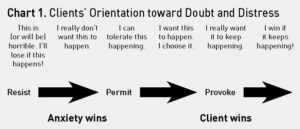
In Chart 1 you will see some possible responses to the symptoms of doubt and distress. Clients enter treatment in the position of resistance. In their most resistant position they say, ‘This is horrible. I’ll lose if this happens.” Even the stance of “I don’t want this to happen” gives anxiety the upper hand, because the mind and body will move into battle mode. Ideally, if clients can respond by saying “yes” to the encounter, and accept exactly what they are experiencing in that moment then they will be back in control.

But for many, the anxiety disorder has become so dominant that the client cannot make such a shift directly. As they attempt to accept their doubt and distress, they do so in order for that discomfort to go away. They are still oriented in their natural position of resisting the symptoms. They are more likely to say, “Let me try relaxing into this situation, and I hope this works, because I’ve got to get rid of this feeling.” The skills associated with permitting the symptoms to exist often allow the client to slide right back into resisting.

For those cases, the game takes a different tact. We re-direct the attention of clients away from fighting the symptoms and purposely toward encouraging them. They choose to act as though the symptoms are good instead of bad, and something to be held onto, even encouraged instead of rejected. As clients master this game and learn its lessons, they develop the insights needed to shift toward a non-attached relationship. If they can endure the discomfort, they can learn. I created this framework of a game to help them endure and to teach them three overarching goals.

1) Step back and identify it as a game
The first critical move is to step away from the drama, observe the event and name it. In meditation and in moments of relative quiet mindfulness, when the struggle isn’t great, you simply “step back.” You let go of your attachment to the thoughts. With anxiety disorders, in order to step back, clients must be able to label the event as one in which the anxiety is trying to dominate their mind. During threatening times, the drama is often too enticing to easily drop. They have already generated an automatic and rigid label that identifies the situation as one in which they should become aroused and worried, for example, “This is a true threat to me.” I encourage them to replace this with any message resembling: “OK, the game’s on: anxiety’s trying to get me to fight or avoid now.”

This is one of the advantages of the game. By training clients in a specific protocol and by strongly reinforcing that protocol, they begin to look for opportunities to practice and they become more astute observers of these moments.

2) Stand down 
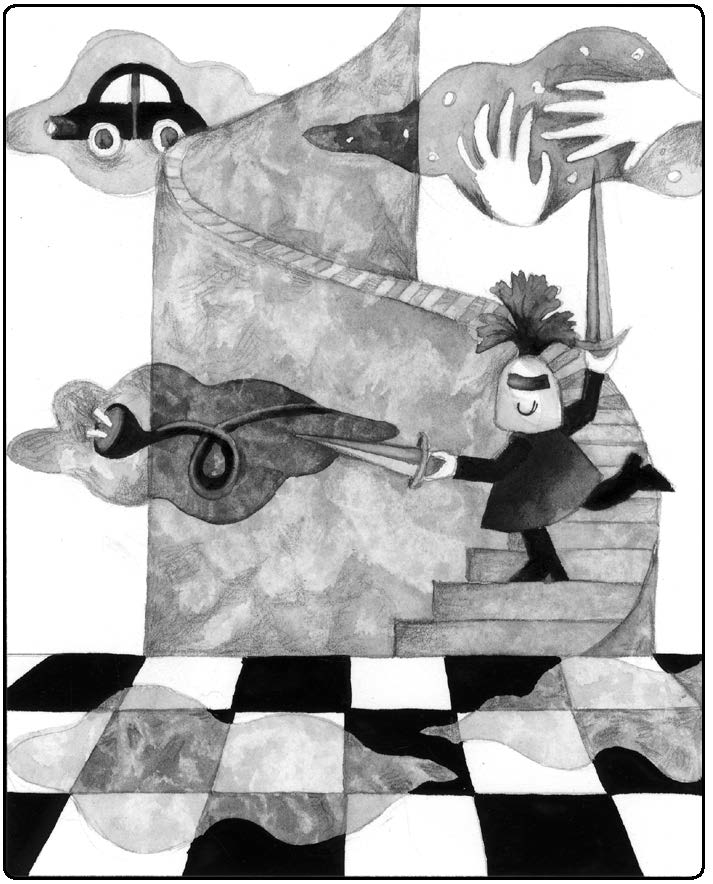
Once they step back, they need to engage in a strategy to convey to their mind that it is time to “stand down.” The body and mind need help in backing away from the fight-flight mode. If, in the face of a threatening situation, they attempt to say, “I want this experience,” then the mind begins to have a choice other than battle stations.
Clients also need to stand down from the ego’s archetypal win-lose predisposition—winning by domination—and replace it by a more paradoxical strategy of winning by manipulating the challenger’s moves instead of blocking them.
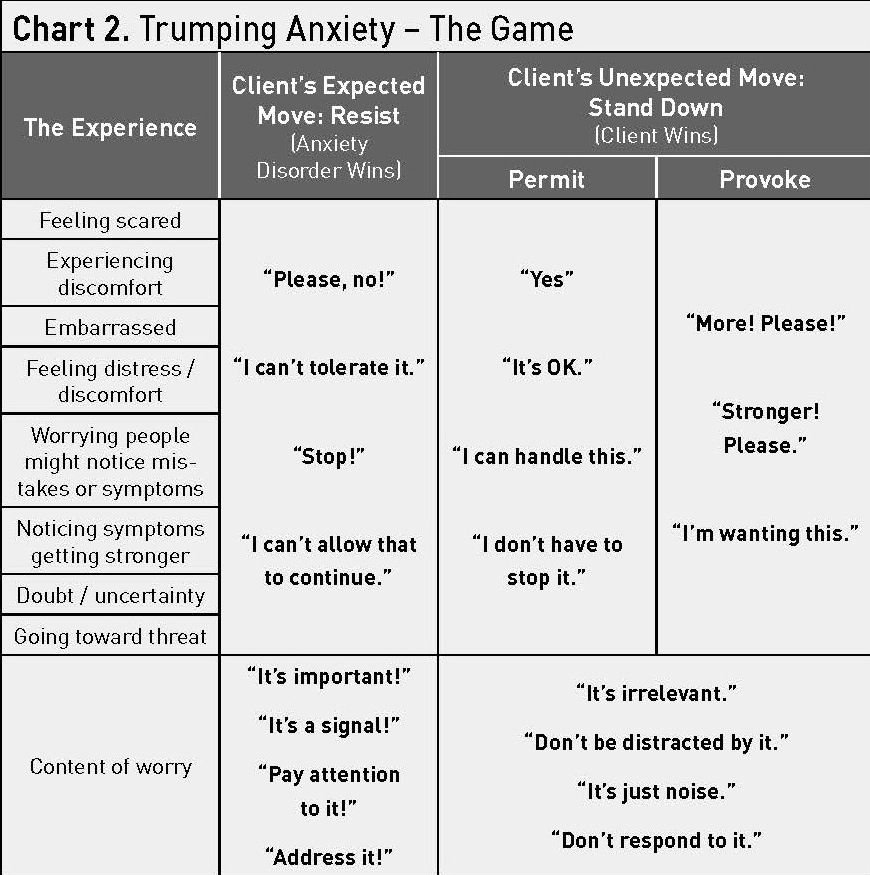
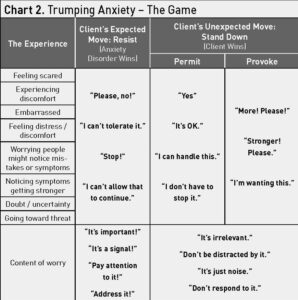
Chart 2 details this next set of moves in the game. Resisting will play right into anxiety’s hands as the expected move. Instead, clients begin the process of standing down by using one of two strategies. Each move is designed to embrace doubt and distress instead of pushing them away.

Standing Down–The Permissive Skills

The first level of the game is to allow the anxiety to continue instead of trying to stop it.

This is manifested in the supportive statements, “It’s OK that I’m anxious,” “I can handle these feelings” and “I can manage this situation.” This approach has a paradoxical flair to it that people often miss. You take actions to manipulate the symptoms while simultaneously permitting the symptoms to exist. With physical symptoms you are saying, “It’s OK that I am anxious right now. I’m going to take some Calming Breaths and see if I settle down. If I do, then great. But if I stay anxious, that’s OK with me too.” We attempt to modify the symptoms without becoming attached to the need to accomplish the task. This is a critical juncture in the work and the therapist must track closely the client’s expected move of, “I’m going to apply these relaxation skills because I need to relax in this situation.” No! While it is fine to relax in an anxiety-provoking situation, it is not OK to insist that you relax. That’s how anxiety wins.We reverse a common American catchphrase by saying, in the face of anxiety, “Don’t just do something, stand there!” When enough epinephrine pumps through the body then the brain yells, “Run!” Consciously overriding this impulsive message takes great courage, but pays great dividends. It differs from desensitization where we help the client gradually approach the feared situation under relaxed conditions. Here we confront their instinct to seek out comfort and encourage them to remain physically anxious and mentally as calm as possible. Instead of believing that there is something broken, they simply accept the status quo.

Going Toward–The Provocative Skills

Many people consider acceptance a weak strategy in the face of the fortress of fear that has been built in the mind. They need to shift from the permissive stance (“It’s OK this is happening”) to the provocative stance (“I want more of this discomfort!”). Here they learn to encourage the symptoms instead of just accepting them. This strategy is extreme and can be thought of as fighting fire with fire. Fear is intense and acceptance is soft. Fear will trump calmness and acceptance every time. I help clients shift to an attitude of provocation that is equally as powerful as, and can compete with, fear. I teach them to use their willpower and conscious intention to seek out an even more rapid heartbeat, to encourage their feeling of contamination to grow even stronger, or to hope someone will notice their hands shaking.

Why this line of attack? Because we want to interrupt the dysfunctional pattern in the most effcient way possible. The straightforward way, using acceptance, is not necessarily the most effcient way because it tends to be susceptible to the clients’ dominant paradigm of resistance, for example, “Let me try to relax here and I hope this works, because if I panic that will be awful!” Consciousness only has so much attention at any given moment. During an anxious moment, I encourage clients to commit themselves to play the game, and to focus their limited attention on following the rules: try to get anxious on purpose by encouraging symptoms. If they will bring their attention to the task of encouraging, even cajoling symptoms to become more uncomfortable, or for doubt to grow exponentially, then they automatically withdraw attention from their fearful goal of ending the doubt and distress.

When I suggest homework activities to clients, I use expressions like, “how about playing with this move?” and “perhaps you can fool around with these responses.” I imply that these strategies are malleable and temporary: “What do you think about just experimenting a few times with this move and see what happens? We can talk about it next time.” For some, we will literally play a game in which they score points for various types of responses to their worry or anxiety, or they will have to pay a consequence when they avoid or engage in some ritual to help themselves feel safe instead of threatened. An example of this strategy can be seen in the case of Samuel. One of Samuel’s fears was that he might unknowingly have cuts around his fingernails and cuticles that would expose him to the AIDS virus while shaking hands at work. Throughout the workday he conducted brief checks of his ?ngers. I gave him the following assignment:

  • Go to the bank and get 40 fresh one-dollar bills.
  • As you leave home in the morning, fold them and place them in your left pocket.
  • Each time at work that you compulsively check your fingers you are to move a bill from your left to your right pocket.

This is a simple intervention, but I gave it to someone who was already oriented to the game. He knew that the only way to keep those dollars in his left pocket was to go toward his distress of not knowing if he was being exposed to AIDS. As he began the game, a typical email from him would say, “By the end of the day, I only had $10 in my right pocket!” There was something about adding that “game” that refocused his attention just enough to lower his struggle and raise his success rate.

I hear this from clients time and again: when they focus on scoring points, or avoiding a therapeutic consequence that we create together, they notice that they become less attentive to fighting the symptoms. When they disrupt their on-going relationship with anxiety by struggling to play the game, they spontaneously become more tolerant of the situation and their distress diminishes. Over time, as they learn the surprise benefits of this pattern disruption, they can congruently adopt the permissive style.

As you might imagine, these people are not easily persuaded to really want this experience. However, this is not the point of the exercise. The point is that they try to associate themselves to the task even if their initial attempts are clumsy. Clients can be encouraged to pretend to want their anxiety, like a role in acting class. This is a cognitive skill, so the work is directed to what they are mentally saying during practice. As they try to subvocalize as if they want to increase their doubt or discomfort, they will automatically dissociate from their typical negative interpretations.

If a client has trouble encouraging the physical symptoms, for example, “I can never want my hands to sweat,” then I suggest a minor shift in their focus. Instead of directly requesting physical symptoms to increase, I ask them to request that the anxiety disorder make the symptoms stronger. Instead of saying, “Come on! I really want to faint right now!,” they say, “please, anxiety, make me more dizzy.” This seems to be just enough misdirection and dissociation to make it tolerable to them, and accomplishes the same goal of competing with their resistance.

The central strategy of the game is for clients to want to embrace whatever the anxiety disorders want them to resist. One of the primary ways I convey the logic behind this wanting is by first defining the process of habituation: prolonged exposure to a feared situation, bringing about a significant decrease in fear.

Wanting Habituation

Habituation requires three elements: frequency, intensity and duration. You have to expose yourself to your feared situation often enough or you won’t progress. When you practice, you need to get up to a moderate level of distress. Practicing while you try to keep yourself calm actually slows your progress. Practicing between 45 to 90 minutes seems to be the ideal amount of time according to the research. These three components of habituation guide all homework assignments.

I think there is a fourth element missing: the spirit of wanting to experience what you need to experience. Clients progress much more rapidly when they desire to have the habituation experience. Unless they are seeking and wanting frequency, intensity and duration as they go toward fear, then by default, they will be trying to do the opposite. They hope they don’t get anxious, that the symptoms don’t get very strong and distress doesn’t last very long. This makes no logical sense to me. If frequency, intensity and duration of exposure to distress and doubt are needed for me to get better, then I want to stumble upon a situation which stimulates my anxiety. I want to do that often, and I want my distress to last, and I want the sensations to be strong. These elements create habituation and habituation is my ticket out the door away from suffering.

Cognitive-behavioral therapy does not teach this specific orientation to clients, although I think it should. If it did, it would alter clients’ disposition toward the problem, help to guide their practice, give them motivation and I’ll bet that it would alter neurochemistry as well. Analogously, if we are receiving chemotherapy for cancer treatment, it would be poor therapeutic form to go to each appointment dreading it, despite the fact that the side effects can truly be dreadful. Instead, you should see the chemotherapy as your friend, augmenting your body’s natural ability to heal. That’s good placebo.

The most important benefit of applying the skill of wanting is that it speeds healing by truncating the habituation process. Clients learn rather quickly that if they invest in the stance of wanting, it returns to them the gift of a rapid reduction in their anxiety. They gain insight sooner in the process, after fewer practices and after fewer minutes within each practice. When they apply the skills of the game during practice, they actually have quite a hard time keeping their distress high (try as they might) or having it linger around for those 45 minutes. By paradoxically applying the orientation of wanting, clients have an “aha” experience during practice that brings freedom.

3) Master the skills of the game through applying technique and practicing (or being a “good student of the work”)
I discuss with my clients the idea of “being a good student of the work.” Good students, of course, are clients who commit to following through on a homework assignment, and then work hard to keep their commitment.

One of Moira’s many OCD compulsions involved her needlepoint work. Frequently she felt compelled to tug on the thread ten times as she tightened a stitch. I offered her a new ritual to adopt. Each time she tugged more than once, on that next stitch she was to tug ten-plus-two times (12). The next stitch she had to subtract three to the number, tugging nine times. Ten on the next stitch, add two, and so forth, until she reached one tug. Her ten-tug stitch became a ritual involving 113 tugs in the next seventeen stitches. She hated that! But she did it, because she was a good student of the work. By forcing herself to stick with our little game, she increased her conscious awareness of her thoughts, feelings and urges during the moments just prior to her compulsive action. At the moment of the urge to pull more than once, she became alert to the punishing consequence. This strengthened her ability to turn away from it. Within a week, that compulsion was of her list of troubles.

Skills Meet Challenge

Doubt relates to clients’ perception that their skills won’t match the challenges they face. If their assignment is within their skill level, then they will be more willing to go forward. This usually means we must lower the challenge and offer them a performance goal within their perceived skill level.

If I am an OCD checker, and I think I have just run someone over, I may yet have the skill to resist my urge to turn the car around and check the highway again. But how about pulling over and running around my car one time before I turn around? I can do that. And now I have interrupted the pattern, which provides me an opening for further changes. One day, as I am having the urge to check, remembering that I now must pull the car over and run around it (again), I might spontaneously decide that that is simply too much effort. At that point I will drive on, and thus experience, with little suffering, exposure to my feared outcome without engaging in my ritual.

Score Points! Win Prizes!

The assigned tasks can be so challenging, so threatening to clients’ frame of reference that they refuse to practice. Even if they do practice, their early efforts may give them only small gains. I mentioned earlier that I create a frame of reference of addressing anxiety as a game in which you can score points. For some clients I create prizes as extrinsic rewards in the early learning phase. Sometimes I offer them metaphorical images, for example, “Imagine that if you walk all the way to the back of the store and stay there 10 minutes that I will magically transfer $10,000 into your savings account. Could you do it then? Play to win, as though your life depends upon it.”

Currently, I have a large woven basket full of prizes, wrapped as gifts. In my anxiety group I bargain with clients: “Anyone who completes three practices this week can draw from the basket.” I have been hiding a $5 bill within two of the prizes as an extra incentive. Last month I rewarded the group member who earned the most points over the previous week with her choice among 12 new self-help books.

Recently I have generated a competition in the group during a several-week period. I agreed that for each member who practices at least 3 times I would contribute $5 into a weekly “pot” of money. I devised a point system to be used for every practice session. Each person decides where and how he or she will practice. Whoever scores the most points, wins the pot. The winnings can grow to be $90.
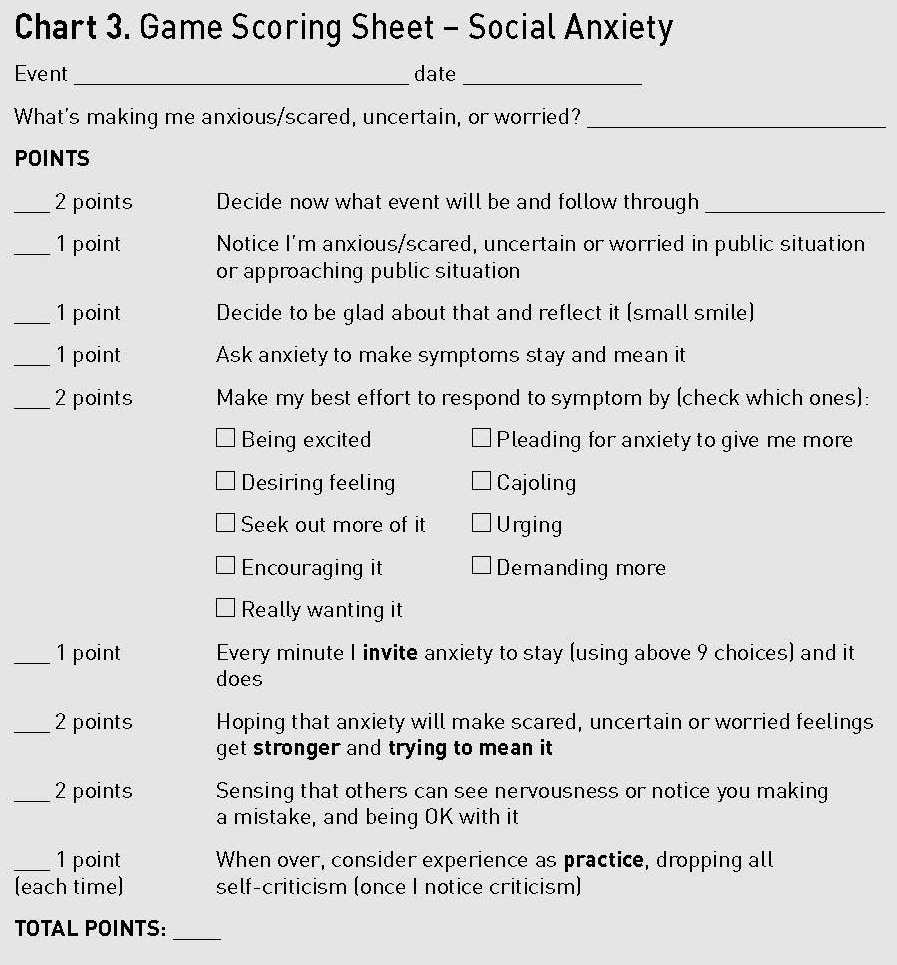
As you review Chart 3, you can see the essence of the provocative game and the weight of each type of activity. These illustrate the goals I want them to set during practice. They reflect the essence of paradoxical action in fearful situations:
In a threatening situation, step back and become an observer of your process, not be 100% the actor in the drama. Decide to be glad about having the doubt or distress. Put a little light smile on your face or in the back of your mind to reflect it. Then, invite whatever struggle you are having, whether physical symptoms or worries, to stay. Work on trying to mean it. If possible, try to strengthen your move by intensifying your reaction. [For example, I offer nine different choices, such as the previously discussed demand that anxiety make the symptoms stronger.] No matter how strong the doubt and distress becomes, you should treat it as if it is never enough. Reward yourself for every minute you actively invite the symptoms to stay or to get stronger. Accept that other people might notice some problem you are having and for extra credit: hope that they do! Then, when you are done with the practice, learn to support yourself. Drop that critical, disappointed voice.Creating the point system has a number of benefits. The client and I establish a broad strategy together that is manifested through specific actions during practice times. But they pick the practice times to apply the skills. They answer the question, “What can I do today to create some strong uncomfortable feelings for a while?” As they act on this choice, they are empowered and feel a sense of control. Once they are in the anxiety-provoking moment, the point system directly guides them to the therapeutic action.

It is poor strategy to get into a threatening situation and then decide how to act. In that setting, they are competing with a well-habituated set of instructions (“brace, worry, and avoid if necessary.”) Clients are much more likely to regress back to their safe actions, or inactions. When they understand the rules of the game and commit themselves to follow those rules, then recall them as they face threats, they have the best chance of winning

Social Anxiety Strategies

Social anxiety disorder gives clients shaky hands, a quaking voice and worry about the critical judgments of others. Here is the role that it expects of the client: to not want the experience, to avoid it when possible, and to try to get rid of it. When choosing to play the game they ask for the opposite of what anxiety expects: they want anxiety to make their hands shake, their voice quake and their sense of threat heightened. Not only do they request those experiences, but they want them to stick around as long as possible! The clients then attempt to exaggerate their wanting of this experience, and might “desperately plead” for social anxiety to generate shaky hands, or to “cajole” the anxiety to make the experience stronger. They can increase their score by hoping that people will criticize their boring talk or question their shaky handwriting. Earn enough points, win a prize! They refuse to play the game that the anxiety disorder expects. They take charge and push that game board away and pull up their own game board of seeking out doubt and distress when anxiety wants them to defend or run.

Julie

Julie decides to practice facing her social anxiety by eating lunch out alone. She walks onto the lunchtime crowd of “Moe’s Southwest Grill” and is instantly greeted by the cooks and other staff. “Hello! Welcome to Moe’s!” they yell, and the other patrons turn to see who’s entered. Julie begins to feel the flush of red rise in her face as she smiles and nods her head in acknowledgement. Then inwardly she smiles and says to herself, “Yes! Another point.”

Here she describes the process. I’ve added my comments in brackets to her key statements.

“I was really nervous walking in there. I felt like everybody noticed that I was by myself. But that was OK, because that was the point of the whole practice. [She is listening in to her inner conversation and she is permitting her feelings instead of blocking them.] Then having to find a place to sit and making that conscious decision: Am I going to sit with my back facing everyone? Am I going to sit and actually have to look at everybody while they look at me? I made the choice to sit and look at everybody while they looked at me. [She is taking control of the situation by listening in on her process and choosing the more intimidating option.] …I reminded myself that the longer I could stay and the longer I could be nervous and be OK with it, then the better it would be for me. [She has adopted a new belief system about her goals in the fearful situation: stay anxious to win.]

“I thought about how I could make it stronger. I thought that facing everyone while I ate would keep the anxiety going. I was just trying to think of ways to keep the anxiety going. [She is actively strategizing how to provoke symptoms as a powerful way to help her stop resisting.]

“I’m not as afraid of social anxiety as a word because I’ve taken social anxiety and I’ve turned it into a person instead of a condition. It’s not a mother, it’s not a father, it’s just this person or this entity and she wants me to take care of myself. She doesn’t want me to be embarrassed. When I do something that she thinks I could not do, she is impressed. I really like that because it is not a judgmental thing. It is like someone saying, ‘You really should wear a jacket, it’s going to rain.’ But you go out there without a jacket and it doesn’t rain, and they say ‘OK, you did it; you’re still a good person.’ So that’s how I’m thinking about it. [She now comprehends that those ogres, worry and anxiety, have been in her life to help her. They just do it in a clumsy way and she has found a better way. Julie will win this game for good.]”

OCD Strategies

OCD wants the person to try to get rid of any doubts about safety and to take any actions necessary to remove distress. Many OCD clients who fear contamination really do believe that at the moment of exposure they must repeatedly wash to save their life or the life of someone they love. Personifying OCD, I emphasize how it needs them to believe the specifics of their fears. Clients who win over OCD will hold fast to the belief that this is an anxiety disorder. As such, their battle should be with the physical symptoms of anxiety and the urge to end doubt. They should by no means battle with the content of the obsessions. It is never about germs or rabies or salmonella. It is always related to the fear of feeling distressed about threat. To play the OCD game clients set the overarching goal of seeking out doubt and distress.

Eventually, everyone in OCD treatment will do exposure (of the feared stimulus) and ritual prevention, which is the standard treatment for this disorder. But modifying the ways clients obsess or how they perform the ritual is the most efficient starting point for many. Starting with small, lower-threat changes allows clients to practice their new skills and experience early success. Instead of not washing their hands at all after they feel contaminated, clients can change how they wash, where they wash, or what they are doing mentally while they wash.

Jai

Jai was living in a residential program for teens. He struggled with about a dozen different types of washing and cleaning rituals, especially when it was his turn to handle the after-meal cleanup. One ritual required that after he was finished with his (thorough) cleaning of the kitchen, he was to squeeze the sponge ten times while rinsing it under running water.

In our first treatment assignment I asked him if he would fool around with the ritual by switching hands each time he squeezed. In this case, Jai got to keep squeezing and keep counting. He simply altered hands, and switching hands was only a minor threat to him. This is what I call throwing the symptom cluster a bone. You leave in place major components of the ritual or obsession, thus lowering the threat level. However, it is still a change that begins to erode the original fortress of symptoms. He agreed to the assignment, and returned the next week to report how easy that task was. I then suggested this further revision: would he be willing to explore his ability to toss the sponge in the air and catch it with the other hand for each switch? Again, he agreed to this small, silly shift and returned the next week reporting no problems with the task. The following week, he simply squeezed one time and set the sponge down without struggle.

Jai’s playful approach to modifying his ritual became a relatively painless means to arrive at exposure and ritual prevention. It served as a building block for some of his more difficult later encounters with OCD.

Jordan

Jordan, a physician, feared contamination with germs that might come in contact with her clothes during the workday at her medical practice. One of her primary rituals was to spray the entire front of her body with ammoniated Windex® as she left work. She used that same Windex® throughout her home when she felt threatened by germs. Ironically, while Jordan obsessed about becoming sick, her husband, who was also a physician in her practice, was developing serious respiratory problems from inhaling the ammonia. Over months, Jordan worked hard to tolerate switching the Windex® to vinegar-based, then to dilute it to a 50% solution and finally to a 33% solution. Each of these steps increased her doubt just enough that she could tolerate it and experiment with the change. Once she implemented the change, she incorporated it into her routine without much struggle.

But we could progress no further with this or the other safety rituals she performed. Jordan was stuck on the content of her obsession: things had to be clean enough. I failed to persuade her that her attention actually needed to be focused on the strategy of confronting doubt and uncertainty.

Vann

Vann came into treatment struggling with OCD checking rituals that lasted up to five hours a day. Often his concern was that he had missed seeing something he should have noticed: new scratches or dents on the trash can, dust particles under the telephone, an inappropriate item in the basement. Other times he checked as a way to prevent a disaster: an electrical cord will be wrapped around the trash can; his son will trip over some item on his bedroom floor; a fire will start in the kitchen or a flood will occur in the basement. Some days Vann would check a particular item over a hundred times.

Our first ploys involved gently modifying his relationship with his symptoms. For instance, he would check the trash can, but only in slow motion, ever so gradually picking it up and unhurriedly rotating it in his vision. Or he would study the telephone, but not allow himself to touch it. These were his first playful explorations into uncertainty and distress. By the sixth session we added a strategy of postponing. OCD would give him the impulse to check the basement immediately. He would choose to wait thirty minutes before he acted on that urge, again learning to tolerate his discomfort. Through this gradual exposure to the principles, by session nine he was able to avoid locking his house for five days.

Here is how he described his progress by session 10:

“In the past I would pull out the backseat of the car, and if there were dirt there, I would have to clean it up. If a bolt was there I would look at it and get stuck on the backseat, focused on that bolt. Now I do this intentionally. I lift up the backseat and try to make something really bother me, try to feel anxious. I feel that anxiety, replace the backseat, shut the back door of the car and walk away.

When I first started walking away I felt really anxious. I wanted to go back and look at something under that seat again. I felt as though I didn’t look at it hard enough and I’d want to look at it again. I would sweat a little bit, my heart would beat faster, I’d become very irritable and I felt very compulsive. I wanted to go check again! But I just decided I wasn’t going to do it. Sure enough, about two hours later the desire went away.”

Vann completed his treatment in eleven sessions over 5 1/2 months. In a follow-up twelve years later, he remained symptom-free and medication-free.

Conclusion

I began this conversation saying that when I work with anxious clients, I keep my points broad and simple and I focus on them repeatedly. My goal is to influence clients’ perspectives and shift their orientation. I encourage you to try the same.

Help clients to turn away from the content of their fears whenever possible. You cannot always ignore content, because clients will be wrapped up in it. But get past content as soon as you can and move into the core themes of people with anxiety disorders: their struggle with doubt and distress.

The central strategy is for them to want to embrace whatever the anxiety disorders want them to resist. They have two choices. They can “stand down” by choosing to let go of their fearful attention and accept the reality of the current situation. This is the permissive approach. When they have completed treatment, this will be their most common response: to say, “I can handle this situation” and to allow their body and mind to become quieter. The other option is to choose to stay aroused on purpose and actually encourage anxiety to dish them more trouble. This provocative choice is an excellent option during treatment, because choice number one is so difficult to embrace during early encounters. Conditioning and a set of false beliefs are calling the shots; they cannot simply relax on cue. Some treatment protocols will suggest that you help them expose themselves to the fearful stimulus and learn that they can tolerate it. I am suggesting that you put a twist on that set of instructions. Help them to take actions in the world that are opposite of what anxiety expects of them. Persuade them to go out into the world and seek out opportunities to get uncertain and anxious in their threatening arenas. This is a shift in attitude, not behavior. The behavioral practice is not to learn to tolerate doubt and distress, it is to reinforce the attitude of wanting them.

Our ultimate goal is to teach clients a simple therapeutic orientation that they can manifest in most fearful circumstances. Early in treatment, however, you will also need to provide a specific system to follow, with simple rules that guide their interactions with fearful anxiety. Using behavioral practice, encourage them to repeat this new interaction again and again, in all their fearful situations.

You can assume that one of the biggest obstacles to success will be poor planning just moments before the encounter. Whenever they wait until they are scared before deciding the best course of action, then conditioning and faulty beliefs will dictate that they struggle or avoid. In that setting, they are trained by fear to mindlessly seek safety and comfort. Before they enter any situation that is potentially threatening, they should review their objectives and remind themselves of their intended responses.

Thinking of their relationship with anxiety as a mental game offers both a broad therapeutic point of reference and specific actions that manifest it. Initially, your skills of persuasion and their belief in you will push them to challenge their faulty beliefs. After that, experience will be their greatest teacher. Once they have acted on these beliefs and gotten feedback during the fear-inducing event, that learning will put the power in their new orientation and it will be self-sustaining. They will then have a set of instructions, such as “anxiety, please give me more” or “I’m looking for opportunities to get distressed” that will point them toward simple choices during difficult times. And they will have a skill set (that I laid out in Charts 2 and 3) that they believe will match the challenge of the situation.


Is it Ethical to Use ChatGPT for Diagnosis and Treatment Planning?

When questioning your work with a client, ever consider consulting Artificial Intelligence (AI)? Have you considered the ethical and legal implications?

A supervisee of mine recently introduced AI into our supervision sessions. My supervisee explained how they came to see the treatment plan development in relation to the feedback received through consultation with AI. In examining a specific client case my supervisee felt they were stuck with, we delved into exploration of AI professional relevance. Below is an excerpt reflective of one of our sessions:

Bringing AI into the Supervisory Conversation

Supervisee (SE): I am really struggling to understand why my approaches with the client do not seem to be resulting in the client’s therapeutic progression. Supervisor (SP): Tell me about some of the interventions you have used and how you came to establish their appropriateness for this client.

SE: I have tried cognitive restructuring first. AI suggested the intervention.

SP: Let’s start here. Help me understand how AI prompted the recommendation for cognitive restructuring.

SE: I asked AI, “what counseling interventions would help an adolescent female overcome social anxiety?” AI stated cognitive restructuring has been found to be helpful.

SP: What evidence did AI offer concerning the interventions’ effectiveness?

SE: No specific study was shared, just general feedback.

SP: When you say general feedback, do you mean reports from clinicians or clients?

SE: I don’t know.

SP: Did AI offer any scholarly sources?

SE: I did ask for resources to help me implement the intervention and some websites were shared. I read a few of them to see how cognitive restructuring has been used in sessions. Some of them had scholarly sources. I feel some of the resources were helpful for this client.

SP: I see that in your last session’s progress note for this client, you mentioned in the assessment that your client meets criteria for the diagnosis of social anxiety disorder and cited AI.

SE: Yeah, according to AI, my client meets the criteria.

SP: Are the criteria reflective of the DSM-5-TR?

SE: They should be.

SP: For billing purposes, you will be required to provide the appropriate DSM diagnosis. You will need to ensure the client’s symptoms meet the DSM criteria. Share with me how you found AI to account for your whole client. For instance, some of the information you gathered from the intake, and you learned through your sessions thus far.

SE: Well, I couldn’t share some of that information due to the client’s right for privacy and confidentiality, so I had to just generalize to populations like her being an adolescent female.

SP: Knowing these limitations, the need to research AI for sources and then research the sources’ relevance, why not just search for scholarly sources first?

SE: Open AI is easy and accessible with my phone so I can complete my notes on site between clients.

SP: Do you have your phone with you now?

SE: Yes, why?

SP: Would you be open to trying something using your phone?

SE: Yeah

SP: Please type in Google scholar in your browser and click on the link to open it.

SE: Okay, got it.

SP: Complete the same search here in Google scholar that you did previously with AI.

SE: Got it.

SP: How are these results compared to what you received in AI?

SE: Some of the relevant sources shared by Open AI came up. A lot of research-based articles came up in Google scholar.

SP: I want to take a moment to pause and offer some reflection on your experiences thus far with AI, progress notes, diagnosis, scholarly sources, and search for appropriate client interventions in general. Imagine going to court based on your work with a client and they claim you engaged in malpractice and unethical business practices based on your diagnosis, would you feel confident in sharing with the judge your current process in working with your clients?

SE: Not really to be honest. I feel like I am a bit overwhelmed, and AI has been a great tool to help me not stay at the office for hours after working with clients to complete documentation, but I am not always confident in what I am doing.

SP: Remember that confidence comes with time and this is why you have built in parameters right now to support… required supervision, open consultation hours with numerous senior clinicians, required team meetings for case conceptualization.

SE: I am a bit fearful people will not think I am good at my job and will no longer send me clients.

SP: What are your thoughts about a few clients that you feel confident in working with versus many you are unsure how to effectively support?

SE: I would rather feel confident, but I do not want to loose my job.

SP: First and foremost, thank you for your honesty. My role is to also support you to grow as a clinician and aid you with your development. Let’s agree for the next month, we will keep your caseload where it is at and revisit later to grow again.

SE: Thank you; I just don’t want my colleagues to think I can’t do my share.

SP: We all have seasons of life where we may need to provide best practices with our clients.

SE: I know.

SP: Remember, your ethical obligation, as well as mine, is to the welfare of theclients first and foremost. What would you rather tell the judge you used to guide your work and decisions with the client, AI or Scholarly resources?

SE: Scholarly resources.

SP: So why use AI? You shared the ease of access. Something to consider is also how you use it. I am not going to say all AI is bad, because there is also a great deal of research highlighting the benefits of AI. However, engaging with AI considering your compliance with HIPAA as well as your professional standards of practice is essential.

I proposed to you earlier about the client consideration and the credibility of the responses. There is a free training course I would suggest you complete that examines AI implementation for mental health providers. Here are the objectives for the course [shares screen]… how do you feel about this course being able to support your confidence with client work with use of AI?

SE: The course seems to cover many areas I am struggling with and supports the use of AI, which I like, so it may be a good fit for me.

SP: Instead of completing the three additional intakes assigned for you this week, would you be open to completing the three-hour training by our next supervision session next week?

SE: I think that is doable.

Final, but not Last Considerations

Lesson here, as a professional counselor navigating ethical best practices, you are encouraged to seek guidance from scholarly sources. If you don’t feel comfortable bringing your documentation in front of a judge, it is probably not the most ethical decision you can make. Applying ACA’s step 6 of the Practitioner’s Guide to Ethical Decision-Making model, application of the test of publicity, can further highlight if the choices you are making in the work with your client are choices you would be proud to stand by.

With AI specifically, we understand our world is consistently increasing its embrace. In healthcare alone, numerous AI platforms have been developed with the intention of supporting clinicians with their work with clients from advertising, intakes, platform capabilities, and even documentation. However, understanding how to distinguish between tools that align with your professional standards of practice is essential to not only protect the clinicians but also the clients. Furthermore, understanding how to implement the tools appropriately for your role with compliance to your profession’s ethical and legal parameters is critical.

In the Therapist’s Chair and at the Kitchen Table: Juggling Personal and Professional Struggles

Imagine a therapist, trained to help others navigate the darkest moments of their lives, who, despite years of expertise, finds herself unable to ease her family’s suffering regarding the mental health challenges of one family member.

Most of us know someone whose family is touched by mental illness or addiction; it’s a sad reality of modern life. When a therapist has a family member with mental illness, people might find it interesting, but most understand that no one is immune. But when a seasoned psychotherapist—armed with knowledge and resources—cannot help their child, that’s an eyebrow raiser.

That therapist is me!   

Therapists are expected to have answers, engage in stable relationships, make good decisions, and be overall healthy people. With all the education, training, supervision, and consultation, others often assume that we are equipped to pinpoint problems when they arise and have solutions. I remember how shocked I was to see my gynecologist, who delivered each of my children, walk out of a convenience store with beer and cigarettes. It’s normal to hold healthcare workers to a higher standard.

Nobody cautions us that training and education do not prepare us for the jerky rollercoaster ride of living with a child with mental health challenges. We do not get a map to navigate the bumpy roads of fear, anxiety, worry, and sometimes, shame. And we cannot be therapists to our children—emotion, protectiveness, and maternal instinct muddy the waters.

Being a therapist while also having significant personal problems at home is an isolating experience. A decade ago, shortly after achieving my goal of private-practice ownership, conflict drastically arose at home; I did not understand the severity of one of my children’s mental health challenges. I had difficulty responding to her behaviors, identifying effective resources, and taking care of myself. My self-talk was bleak. Am I hearty enough to handle all this?   

Anxiety invaded my family exponentially throughout this unpredictable period. It inflicted headaches, stomachaches, heart palpitations, and insomnia. I was dominated by fear and agony about how my problems affected my work with clients, even though the feedback I received from clients was positive, and they were unaware of my problems. I considered exiting the profession completely. I daydreamed about a far simpler job to make work life easier.

I was unaware of any other therapists going through the same thing. I kept my despair to myself. During consultation groups or supervision, I politely discussed cases with colleagues, and occasionally mentioned something trivial from my personal life, but nothing that risked judgment from other professionals. I felt alone.   

Shame was present in both roles: as a mother who failed to help her child, and as a therapist whose guidance for others did not work for herself. My heart ached with sadness. Intellectually, I made sense of my shame, but social stigma around mental health and self-imposed pressure to live up to a parenting and professional standard kept me quiet.

On one occasion, I was around other mothers of peers in my child’s grade who were celebrating their children’s college acceptances and decisions. Shame and sadness flooded my body when they talked about their child’s exciting plans. Was my child’s inability to achieve these milestones a reflection on me? Was her condition an indicator that I had failed as a parent and therefore could not possibly be successful as a therapist?  

Sometimes on social media, I saw posts by therapists who showcased pictures of their happy families and children with smiles on their faces. Sadly, I thought, Not my family. You might be wondering, What did you do?

Perhaps it was the years of effort to establish my dream-come-true therapy practice, recalling the original reasons for choosing this work, or the long-standing student loan debt—I decided to learn to cope, for my sake and that of my family, and to continue delivering quality care to clients. You ask, How did you do that?  

My answer: Focusing on three core areas—my relationship with myself, others, and work—helped me cope most effectively. Little by little, prioritizing these foundations built my confidence, strengthened my judgment as both a mother and a therapist, and guided me through difficult times. This is how I made it. 

Relationship with Myself

Finding a Therapist, or Two or Three

Therapy became my cornerstone for coping. I have engaged in psychotherapy throughout adulthood—not only in crisis but as steady support for daily life. For therapists, therapy isn’t just wise; it’s essential, especially when personal struggles feel overwhelming. I relied on my therapist’s insight, warmth, and the comfort of her office. She helped pull me out of the trap of relentless self-blame and anger. What did I do wrong? I’ve done everything I can to help my child; why isn’t she better?  

My therapist, a seasoned clinician of many years, has told me more than a handful of times that she has not known a mother to seek out and identify as many resources as I have. She helped smooth my tumultuous feelings and showed me that my efforts as a mother matter. The therapy process served as a continual resource for me. Over time, it helped me cultivate a belief that I was capable and resilient.

Throughout this journey, I addressed traumatic experiences during family conflict, so I started seeing an Eye Movement Desensitization and Reprocessing (EMDR)-trained therapist. Those sessions freed me from negative patterns and boosted my confidence as a mother. I sought out an EMDR certified therapist who identified as a parent in her profile on her website. It was important to me to work with someone who I thought might understand that aspect of my turmoil.

I consulted a Bowenian family systems coach and immersed myself in seminars to understand my role in family dynamics. The work helped me focus on my influence—how changing my actions or words impacted my entire family system. Studying my family diagram deepened my understanding of generational patterns. Learning about triangles in my family made me more focused on my behaviors and thoughts.

I began to see the role of chronic anxiety and started to change the way I contributed to it. As an added benefit, my new understanding of Bowen theory directly informed my clinical work, allowing me to help clients break free from unwanted patterns. Sharing aspects of my Bowenian family systems journey with clients created a sense of common humanity and made me a more relational therapist.

Getting a Hold of Myself

At the peak of my anxiety, I joined a 10-month fellowship cohort to learn a specialized bottom-up modality, called Acceptance and Integration Training (AAIT), developed by Melanie McGhee. At first, the learning was personal. The experience was transformative—using sequenced protocols that addressed thoughts, images, emotions, and body sensations brought real relief. Taking responsibility for my inner state became the priority, with becoming a skilled therapist as a welcome side effect. The cohort and the program restored my confidence. I practiced daily: on my walk to the office, between clients, and before bed. When self-doubt or fear hit, I had tools to find relief. Calming my body cleared my mind, leading to better decisions for myself, my family, and my work. Once proficient, my clinical skills were sharper, and I utilized the approach with clients.

Seek Purpose, Find Perspective

Tunnel vision blinded me. Worries crowded my head, leaving little room for anything else. I lost a sense of purpose. Is this what my life amounts to? There were infinite ways to engage with life beyond the problems in front of me. I gave time to volunteering through my church to missions that reminded me of what existed beyond my small orbit of issues and privilege. I chaperoned a service trip with my youngest child. These experiences were doses of humility that filled me with a refreshing view of all the things that are important in this world. Perspective helped ease the self-imposed urgency to be a good mother and a successful therapist. 

Relationship with Others

Boundaries and Discernment

Personal, family, and professional boundaries begged my attention. They needed a reset. Stress often caused me to mask my feelings or censor content, leaving me uneasy with my dishonesty. When I did speak up—commonly out of anxiety—I’d instantly regret it. The unpredictability of others’ reactions left me powerless. Many people think they have a solution for you, even though they have not experienced the same thing, and the consequence for me was believing I was a bad parent.  

I learned how to discern between what I felt comfortable sharing and what to keep to myself. My usual discernment process did not apply. For example, I would typically tell my closest friends everything. Yet, I found that I needed to be more conservative about what I shared for two reasons. First, some friends lacked the capacity or interest to listen to chronic problems. As much as they cared about me, some could not tolerate the negativity. Second, nobody wanted to talk about the same conflict over and over. My “fixer” friends and protective friends seemed to find this difficult. To mitigate frustration, I said less.

I also needed to be cautious about what I told family members. I learned that some family members did not keep private information to themselves. Some family members spewed “you should just” while not understanding that those solutions had been tried and failed. Sometimes, telling family members reinforced the reality that while many people understand the difficulty of having a family member with mental health issues, most do not.

The boundary work of Julianne Taylor-Shore revamped my relationships so that I wasn’t as reactive or affected by others’ opinions. Taylor-Shore wrote about different types of boundaries. Her concept of the psychological boundary is the one that helped me the most. It is an invisible boundary that separates your thoughts and feelings from others. It’s a process by which I respect and allow others to have their thoughts and opinions while I have mine. The psychological boundary says that it’s okay for us to think differently about something, and when we do this, we reduce the risk of feeling offended or hurt by others’ words. We also develop more compassion for ourselves and others when we practice this boundary.   
  
When I communicated with a professional or teacher about my child, I tried to be factual and general. If I made mistakes in oversharing, the result was feeling ashamed and guilty for not protecting my child’s dignity and privacy. Learning how to be more discerning eliminated this risk.

After a few discouraging family trips, I realized things needed to change. One solution was to stop traveling as a family of five. My family and friends were confused. They said, “That’s sad that you are not all going together.” It’s sometimes hard for others to understand how setting personal boundaries, protecting my time and space for the sake of sanity, is non-negotiable. Once I practiced my psychological boundary, I understood that they had their opinion based on their own experiences, and I had mine. And that is okay. Instead of ending the conversation annoyed, I could say, “It’s complicated, but what works best for us.” The “it’s complicated” remark validated their question or confusion about not vacationing as a whole family, and the latter declared that my family values were not up for scrutiny.   

Support Groups

Parent support groups were trying for me. I was ashamed as a therapist who couldn’t “fix” my life, and I was frustrated by weak group facilitation, whether it was a professional or a volunteer. The solution came unexpectedly: I reached out to three colleagues who had mentioned having family struggles. I proposed we started a private, self-led support group to share our challenges. They all agreed without reservation. Now, we meet monthly, deepening our connection and trust with one another.

I joined a second support group with some hesitation—this one led by Judith Smith, author of Difficult: Mothering Challenging Adult Children through Conflict and Change. Dr. Smith’s serious, supportive style fostered a safe space. For the first time, I was among mothers who understood the pain of struggling with an adult child’s challenges, and I was moved to tears in our first session. After the formal group ended, a small group of us continued meeting every other week. We remain the only women in each other’s lives who truly get what it means to face these struggles.

Being in support groups eliminated frightening feelings of isolation. With two groups of compassionate and understanding women, the crazy-making thoughts of wondering if what I said or did was right or wrong do not exist. I talk about it with my understanding group members, who give honest and caring feedback.

Focusing on Other Relationships

Parenting stress strained my marriage, so my husband and I started therapy to improve our communication and work better together as parents. When I met my husband, I was ecstatic to be a mother. I wanted my kids to feel important, so I prioritized them over everything else. Our child’s mental health and the way it affected our family system often became a divisive topic, and our marriage needed attention. Having a therapist guide us through those rough conversations made all the difference.

Attuning to my other two children was also an intentional tactic to focus on the joy that was right there in front of me. I celebrated their milestones and made space for enjoyment with them. It was difficult at times when my head was fuzzy with fret and tension. Making myself available to them despite the family problems laid the foundation to open communication as they got older.

After my father passed away, I responded to my longing for connection with my cousins and relatives on his side of the family and initiated spending more time with them. Our visits filled me with love and laughter. Even though they only knew small portions of the challenges in my personal life, and despite differences in lifestyles, connecting with my family roots was grounding and important to me.   

Relationship with Work

Spotlighting Blind Spots

With so much stress related to my problems at home, my skills as a therapist dulled. Some days, I sat in my therapist chair, mind foggy from overthinking, and an undercurrent of anxiety coursing through me. I was listening, but not with curiosity. I was compassionate, but my capacity was too weak. Under those circumstances, I did not realize how susceptible I was to countertransference and vicarious trauma.

Countertransference is the therapist’s unconscious reactions, feelings, and attitudes that stem from personal experiences and unresolved issues. It is ubiquitous in therapy and might erode our well-being if ignored. It is a common topic in clinical training, supervision, and consultation groups. Certain clients evoked strong responses in me, such as disgust, anger, or anxiety. Raising my awareness of this dynamic and addressing it was crucial to the integrity of my work as a therapist. I processed countertransference in individual therapy, supervision, peer consultation, and in my small therapist support group.   

Vicarious trauma is the negative impact on us when we are exposed to other people’s suffering. For several months, I worked with a client who had a trauma history. I began experiencing bad dreams, difficulty falling and staying asleep, and intrusive images in my mind. I dreaded sessions with this client. I discovered that my empathy and imagination were overloaded, and I was absorbing too much of the client’s story.

A colleague referred me to an experienced psychologist who works with therapists. The therapist created a supportive space and listened to all of my symptoms. He helped me tune into my reactions and develop a plan to have more psychological boundaries in sessions with clients. My work with the psychologist liberated my mental and emotional space, so I was more available for my family instead of being consumed by someone else’s trauma.

Taylor-Shore’s boundary work also strengthened my ability to separate from clients’ stories. Taylor-Shore suggests creating an imaginary boundary (she calls hers a Jell-O wall) between yourself and the other person to filter what comes in and what stays out. The visual image of a slightly porous wall helped slow the intake of information, both content and emotion.

Somatic work from Acceptance and Integration training helped me identify my bodily responses to various feelings. Practicing mindfulness and breathwork signaled my nervous system to stay calm.

Reworking Work

I adjusted my work schedule—specific days and hours—to accommodate my family’s needs, prioritize my family, and continue working. Scheduling consistent days and hours for business-oriented tasks helped minimize anxiety about the business. I moved my office to be closer to home so I could get there quicker if a crisis arose.

Deciding who I want to work with and whom to refer out was a practice I developed over time. I eventually proved to myself that I had a choice. I learned to say no to some referrals. All therapists probably have a list of issues or populations that they would rather not work with. I clarified my list and stuck with it. Having a long list of reputable therapists to refer to was key to my confidence in saying, “No, I believe I am not the best fit for you, but I have trusted referrals for you, and I will be happy to connect you.”   

At last, I needed a major change. After reflection and discussion with trusted colleagues and family, I closed my private practice. Freed from business ownership, I sought employment with an established group practice. It was hard to say goodbye after fulfilling my dream of running my practice. That decision ultimately alleviated stress, added financial predictability, and brought greater stability to my life. I found that I thrive in a group among other clinicians. It is comforting to know others are around to consult with or say a friendly hello to. Being in a group practice affords me more time to take care of myself and my family.

Summing Up

Years of stress from raising a child with mental health challenges permeated every area of my life, including my professional work. Missteps and a lack of self-awareness about how this conflict affected me became a turning point, prompting me to seek change. When self-doubt and exhaustion overwhelmed me, I reached out for support, accessed helpful resources, and leaned on trusted individuals until balance was restored. This process enabled me to approach my clients with clarity and my family with openness. By strengthening my skills and understanding within each relationship, I became better equipped to continue practicing as a therapist and to be a more relaxed, present, and supportive mother for my family.  

On the Therapeutic Power of Presence

I’ve been a psychologist for almost 40 years, and I am constantly amazed at just how much neuroscience research is enhancing my clinical understanding of what psychotherapy clients may really need most. What I would like to talk about here is how the concept of presence—a state of grounded awareness of the present moment—can inform clinical practice and enhance the everyday lives of our clients.

Why Presence Is Important

Presence is a state of mind of selective and sustained attention where one is intentionally and nonjudgmentally receptive to one’s own senses, is active in reflecting on them, and is consciously directing their awareness to the present moment (1, 2). Presence first requires an awareness that we have, a capacity to experience it, and second, it requires the skills to make it happen. All clients—and clinicians—are on a continuum of both, so each client requires interventions tailored to their individual level of awareness and skills. But I am discovering more and more just how crucial it is to help clients learn how to be present with both difficult and life-affirming emotions. That is, how to sit with, better tolerate, and more fully embody those moments without reactively fighting them, distancing themselves from them, or becoming frozen by them.

Psychotherapy interventions are almost always chosen in the moment, because the timing of them is believed to be most helpful to the client. Cognitive-behavioral therapists may highlight a cognitive distortion, like all-or-none thinking; psychodynamic therapists may bring attention to a protective defense, like projection; Gestalt therapists may suggest the use of an I-statement to replace impersonal or blaming language. Even though the clinician’s application of their theoretical approach may be executed with textbook precision, the intervention can fall short.

For example, if a client repeatedly returns to a conditioned or protective response to difficult situations by jumping to unwarranted conclusions, by blaming themselves or others, or by characteristically pushing away or distancing themselves from their feelings, the best interventions of the clinician may not be enough. This is particularly true if developmental trauma or significant episodic injuries have occurred. When a client has difficulty taking in, processing, or applying the clinician’s intervention, or when emotional underpinnings of their symptoms may be so severe that access to the resources needed to make use of the clinician’s interventions are not available, building skills of presence may be needed.

The concept of presence is foundational to all psychotherapies but especially to somatic psychotherapies. From the early developers like Wilhelm Reich’s Orgone Therapy, Thomas Hanna’s Hanna Somatics, Alexander Lowen’s Bioenergetic Analysis, Moshé Feldenkrais’s Feldenkrais Method, and Ron Kurtz’s Hakomi Method to more modern approaches like Lisbeth Marcher’s Bodynamic Analysis, Pat Ogden’s Sensorymotor Psychotherapy, Peter Levine’s Somatic Experiencing, Raja Selvam’s Integral Somatic Psychology, and from the diverse work of Bessel van der Kolk, clinical practitioners have learned that using mind-body practices opens up new ways to strengthen their effectiveness—particularly for clients with chronic, unresponsive, recurrent, or refractory symptoms.

The Physiology of Presence

Modern neuroscience has provided a wealth of understanding of how presence operates and how it can be fostered. Being present in the moment causes neural and biochemical changes in the visual and prefrontal regions, causing increases in alpha and theta brainwave activity, reductions in autonomic nervous system activation, and changes in how information is processed and monitored. Research has shown that presence causes a cascading series of interactions between several identifiable regions of the brain, which sets in motion the activation of neurological and neurochemical changes that induce felt states of well-being.

More specifically, by setting our intention to be present, we activate a top-down process beginning in the dorsolateral pre-frontal cortex, which causes changes in two organizing cortical and subcortical superstructures known as the Default Mode Network (3) and the Salience Network (4). These superstructures coordinate distinct regions of the brain that are responsible for decreasing emotional arousal, reducing unpleasant self-referential thinking, and more effectively tolerating painful affect.

Merely intending to be present facilitates greater calm. When we begin to exercise greater presence, the Default Mode Network slows response reactivity. Additionally, substructures within the Salience Network (the anterior insular cortex and the anterior cingulate cortex) work synergistically with the Default Mode Network to a) detect mind-wandering to distressing thoughts and b) bring us back to a greater felt sense of calm and physiological homeostasis.

If our focus wavers, the Salience Network helps sustain our attention; it filters distractions; it slows our heart rate and breathing and decreases blood pressure and muscle tension; it increases heart rate variability; it downregulates the activation of our amygdala; and quite critically, it enhances our ability to monitor affective body states relative to actual occurrences in our external world. Stated somewhat differently, the neural circuit between the Salience Network and the amygdala allows us to accurately monitor the functional and dysfunctional interpretations we make about our outer world. For example, if we become frightened for no rational reason, presence triggers the Salience and Default Mode Networks that help bring us back to center.

Inducing Presence

There are literally hundreds of ways to induce presence in ourselves and in our clients. There may be several techniques that stand out and really work well for a particular client, and other clients may prefer using a wider variety of methods. Here are a few examples of ways clinicians have helped clients manage their physio-affective arousal by helping them make more consistent contact with the present moment.

Geller and Greenberg (5) believe that therapeutic presence is foundational to the therapeutic relationship, where the therapist’s whole self invites the client to become their whole self. The authors suggest the acronym P-R-E-S-E-N-C-E to organize a series of methods, where the client is asked to:

PAUSE (P)—stopping and creating a moment of stillness

RELAX/REST (R)

EMPTY (E) their mind of thoughts and judgements

SENSE (E) their physical and emotional state

EXPAND (E) their awareness of their external environment

NOTICE (N) the relationship or the connection between their inner and outer worlds

CENTER (C)—reconnecting with their core self and bodily groundedness,

ENTER (E) back into their immediate space or resume their actions or intentions prior to inducing the state of presence.

A method like this can be especially useful as an introduction to the notion of presence, as some clients may be quite unfamiliar with self-reflective and interoceptive processes.

In Somatic Experiencing (6), presence is induced when the clinician encourages the client to notice, observe, and become a witness to attendant body sensations, images, actions, impulses, emotions, or movements. If a calming or relaxing state is needed to temporarily offset the client’s overwhelming level of arousal, SE practitioners are encouraged to invite their client to slowly vocalize the sound “voooo,” which is reported to vibrate the vagus nerve, activating the parasympathetic (rest and digest) nervous system, and deactivating the dorsal vagal freeze response (7).

In addition to activating parasympathetic activity, the practitioner is also instructed to induce presence by prompting their client to notice their belly vibrating, to feel it do so, and to observe their overall physical reaction to making the sound. Levine also describes the use of Jin Shin Jyutsu, a Japanese mind-body system of self-regulation, where stronger states of presence and relaxation occur from better “energy flow” after performing a sequence of three body holds—placing one hand under the opposite armpit and placing the other hand over the opposite outer arm below the shoulder, placing one hand on the forehead and the other on the chest, and finally placing one hand on the chest and the other on the stomach.

For clinicians and clients who may be more familiar with interoception, Raja Selvam (8) highlights eight techniques for tolerating unpleasant emotions that also can enhance the experience of pleasant emotions. Each technique fosters greater presence with oneself and with one’s emotions:

a) breathing into and with the emotion

b) resonating with the emotion

c) heightening awareness of the emotion

d) visualizing the emotion dissipating, spreading more evenly in the body

e) vocalizing sounds that are congruent or resonant with the emotion

f) using self-touch to both support and make deeper contact with the emotion

g) enhancing one’s intention to make contact with, expand, or support the emotion

h) making very small body movements to release felt stuckness of the emotion

Applying these methods of presence to address an unpleasant emotion softens it and helps to better tolerate it. For clients with low tolerance for unpleasant emotions, the method is used in very shorts durations. At some point in the process, the client becomes aware they are tolerating the targeted emotion, when, at that point, they are prompted to notice the relief of having achieved it. Through the continued use of focused awareness and presence, the client is then guided to expand and make deeper contact with their relief. This typically results in a greater openness to and eventually a welcoming acceptance of the difficult emotion.

Other commonly employed presence inducing methods include inviting clients to:

a) name several things in their environment they can see, hear, smell, taste, and physically feel

b) scan and bring awareness to different parts of their body

c) take a long and audible sigh

d) gently stretch any part of their body

e) to look at something pleasurable in their environment and then to soften their eyes—relaxing their eyelids and facial muscles—while looking at it

f) simultaneously observe objects in their peripheral vision while focusing on a fixed point

g) toggle back and forth between looking at an object at a far distance—becoming curious about its nature, its history, its function—and then to notice how they are feeling about observing the object

Presence can also be fostered using the many forms of pranayama—a yogic breath control technique—an example of which is the mantra meditation So’ham, where on each in-breath one visualizes taking in all the positive energy of the universe and on each out-breath imagining expanding that positive energy to every part of the body. The very act of observing and reflecting on one’s internal states without judgement quiets the mind. Eastern philosophies and practices that emphasize living in the present moment are central to the many forms of meditation practiced throughout the world, which neuroscientific studies have shown similarly affect the brain superstructures discussed earlier (9).

As clinicians monitor their clients’ presence in sessions, they may already be well acquainted with when and how it fluctuates, and they may already be creatively using effective but less structured methods than those I have suggested. For example, I recently observed one of my client’s arousal level waxing and waning throughout a session, influenced by small things that were said by either them or me. By tracking these remarks along with correlated changes in their breathing, movements, and muscle tension, I was able to get subtle clues about what may be fostering or inhibiting presence. Monitoring my client’s real-time physio-emotional arousal, I was able to determine when the client was sufficiently present or needed support to do so—that is, whether they needed to build tolerance for a difficult emotion, rest from the unpleasant emotion, better regulate their arousal level, or expand their resources to address the emotion.

Lin: A Case Study

Lin had been my long-time client, who experienced significant developmental trauma from his father. At one point in our work together, he went through an extended period of unemployment in a vapid job market. Despite his considerable insight about his father’s impact on him and the substantial progress he had made with this issue, the stress of his unemployment was producing exacerbated and pronounced anxiety, which had brought him to the point of helplessness, exhaustion, and withdrawal. Lin’s precipitous overwhelm was also making it extremely difficult to calm him in the sessions, as he became more prone to unending ruminations about his difficulties, almost as if I were invisible to him. He was intellectually aware that his pondering was crippling him, but he could not relent from compulsively engaging in it while shaming himself for doing so. Despite my best efforts and those of his psychiatrist, something more was needed.

I decided to better employ the methods I have been discussing here to enhance Lin’s self-attunement. Although some aspects of what I was witnessing in Lin were related to his childhood, he was not in a resourced enough state of mind at that time to process interpretations about it. He was also not resourced enough to process feedback about cognitive distortions he was caught in, so I proceeded to address his immediate moment-to-moment, physio-emotional dynamic. He needed to become better present with how he was fanning his own flames, shutting me out as a support, and cutting himself off from his own psychic resources.

Because Lin seemed to need the simplest, most easily understood and tolerated intervention, I decided to begin the next session by encouraging him to take his time and look around the room, letting his eyes move the way they wanted to. . . and name five things he could see, then asking him to name two things he could hear, then one thing he could smell. Then I asked him how it felt to do so, to which he responded, “a little better.” I said, “That’s good, Lin.” He then quickly changed the focus and began characteristically ruminating on his troubles.

After empathizing with how tough a time he was having, I asked him how it felt at that moment in the session, and he responded, “Upset.” I then asked him if he noticed the shift he made, which he was able to acknowledge. I replied to him, “It’s excellent that you observed that, Lin.” Then I asked him to take a long, slow, audible sigh, where I could see him begin to settle. I could also feel myself settle a bit, which, in the resonance, helped me confirm I was on a good path in that moment with him. Although he soon began to agitate himself again with self-shaming accusations, it took him a little longer to start doing so. I’ve seen these delays occur with other clients, so it confirmed my intuition that his resilience for, and tolerance of, his troublesome emotions were growing.

I try to continuously monitor in real time my clients’ presence and their tolerance for unpleasant feelings. I think it helps me make better decisions about whether I should help them better tolerate their arousal or help them become better aware that they are tolerating it on their own. Sometimes clients need us to be their resource when they are having trouble maintaining access to their own inner resources. Sometimes it’s more important for them to see and feel our pride in them when they are handling their arousal just fine without us.

Gale: My Experience with Therapeutic Presence

This essay would not be complete without discussing the variety of ways clinicians wax and wane in maintaining their own steady presence with clients. Every day I work on learning how to be with my clients—to be awake, to how I repeatedly lose and regain attunement to them, to vacillations in my own internal emotional and physiological states, and to the subtle effects my degree of presence has on them. Being present is relationally essential: it facilitates empathic resonance, it prevents interpretive and empathic errors, and it makes my work and my life more enjoyable.

Like many, I grew up without being taught about emotions. It wasn’t until my late thirties that I realized I had feelings that I could identify and discuss. Through the study of academic psychology, through my clinical practice, and through my personal psychoanalysis, I have met many emotional mentors, some of whom, paradoxically, have been my clients.

Gale was a middle-aged, divorced client of mine, who regularly attended his sessions but who was highly reactive and talked incessantly without reflecting on his words or actions. Managing my own unpleasant internal reactions to him took some time. Although I recognized my countertransference reaction was stemming from my relationship with my father, this insight alone didn’t provide enough real and lasting emotional relief.

To regroup, I decided to take my own advice—that is, to apply to me and my own process with Gale, the recommendations I was making to my clients. In fact, this essay is a reaffirmation of what I continue to learn—how to authentically embody a better moment-by-moment attunement to “me” when being with my clients;how to give myself flashes of time to breathe, a moment to be with myself, to attend to me, to care for me, and to have an instant where I can honor and affirm my own existence.

As I permitted myself to focus on my needs while with Gale, a variety of methods to be more fully present spontaneously emerged. My next thought with Gale was to experiment with my own movement, so I consciously authorized myself to change my posture. Because I was so intent on focusing my attention on Gale, I realized that I wasn’t aware enough of my muscle tension and joint discomfort. As I crossed my legs, stretched my back, shifted my weight, I found myself quietly sighing. At first, it felt like a release, but it soon evolved into a wondrous return to a safe and grounded place—a place where I could give myself room to be with Gale’s loquacious tangentiality, without judging it or reacting to it.

From this place of peaceful inner calm, I started feeling more genuinely grateful for the relational space Gale and I were co-creating, and with it arose a greater sense of compassion and appreciation of his struggle. As I described in the earlier section on the physiology of presence, I could experience my arousal level diminishing, my dysfunctional interpretations of my outer world with Gale quieting, my capacity to accurately monitor my own body states increasing, and my tolerance for enduring my illusion that I was being ignored strengthening.

As if divinely inspired, my brain’s higher-order functions suddenly kicked in, and I realized at a visceral level that, not unlike myself growing up, Gale had no one in his childhood he could talk to about the things he wanted, for as long as he wanted. He never had anyone who wanted to be with him in the way he needed, to play with him on his terms, who conveyed to him that he was important, that he mattered. So, I sat with Gale, sometimes for whole sessions at a time, intently listening, staying present, breathing with intention, unobtrusively sighing, shifting my posture. . . until one day he began to slow and settle and finally voice, “I’ve had a lot to say,” to which I simply smiled and nodded.

At that moment, I could feel the resonance of his attunement with me and mine with his. Paradoxically, I became aware of what I believed I really wanted with Gale all along—not only for him to be aware of himself, but for me to be truly present with him, to connect with him, and to feel his connection with me.

References

(1) Kabat-Zinn, J. (2003). Mindfulness-based interventions in context: Past, present, and future. Clinical Psychology: Science and Practice, 10, 144–156. https://doi.org/10.1093/clipsy/bpg016

(2) Koch, C., & Tsuchiya, N. (2007). Attention and consciousness: Two distinct brain processes. Trends in Cognitive Sciences, 11, 16–22. https://doi.org/10.1016/j.tics.2006.10.012

(3) Malinowski, P. (2013). Neural mechanisms of attentional control in mindfulness meditation. Frontiers in Neuroscience, 7, Article 8. https://doi.org/10.3389/fnins.2013.00008

(4) Philip, N. S., Barredo, J., van ‘t Wout-Frank, M., Tyrka, A. R., Price, L. H., & Carpenter, L. L. (2017). Network mechanisms of clinical response to transcranial magnetic stimulation in posttraumatic stress disorder and major depressive disorder. Biological Psychiatry, 83, 263-272. https://doi.org/10.1016/j.biopsych.2017.07.021

(5) Geller, S. M., & Greenberg, L. S. (2012). Therapeutic presence: a mindful approach to effective therapy. American Psychological Association. https://doi.org/10.1037/13088-000

(6) Levine, P. A. (2010). In an unspoken voice: how the body releases trauma and restores goodness. Berkeley, CA: North Atlantic Books. https://www.northatlanticbooks.com/shop/inanunspoken-voice

(7) Porges, S. W. (2011). The polyvagal theory: neurophysiological foundations of emotions, attachment, communication, and self-regulation. New York: W. W. Norton & Company. https://wwnorton.com/books/9780393707007

(8) Selvam, R. (2022). The practice of embodying emotions: a guide for improving cognitive, emotional, and behavioral outcomes. Berkeley, CA: North Atlantic Books. https://www.penguinrandomhouse.com/books/673734/the-practice-of-embodying-emotions-by-raja-selvam-phd

(9) Bauer, C. C. C., Cabral, J., Stevner, A. B. A., Kirchhoff, D., Sousa, T., Violante, I. R., … & Kringelbach, M. L. (2022). Mindfulness meditation increases default mode, salience, and central executive network connectivity. Scientific Reports, 12, 13219. https://doi.org/10.1038/s41598-022-17325-6

Nancy Haug on Psychedelic-Assisted Psychotherapy

Lawrence Rubin: Hi Nancy, thanks so much for joining us today. You are a professor in the department of psychology at Palo Alto University, and an adjunct clinical professor in the department of psychiatry and behavioral sciences at Stanford University School of Medicine. You have ongoing collaborations with and a teaching role in the Stanford Psychiatry Addiction Medicine Program, where your current research interests include implementation of evidence-based practices in addiction treatment, harm reduction for substance use, cannabis vaping, and psychedelic-assisted psychotherapy. Welcome!
Nancy A. Haug: I would add to that that I do have a small private practice where I treat clients, some for addictive disorders, but I am mostly a generalist.
LR: I didn’t know that you also have a private practice. Do you practice psychedelic assisted psychotherapy?
NH: I do a little bit of that work, but it’s a very small percentage of my clients, and it’s mostly limited to the preparation and integration phases of psychedelic therapy. I’m not doing any kind of administration of psychedelics in my office or in my practice. My clients will get that elsewhere. And then I’ll help them integrate the experience into therapy. We can get more into that later.I’d like to start by acknowledging the indigenous peoples and practices, because many psychedelics are derived from sacred plant medicines that have been used for millennia by many cultures. This isn’t something new, because much of the work we’re doing with psychedelics comes from thousands of years of cultural shamanic traditions.

Psychedelics as Medicine

LR: Thank you for that acknowledgment. I think it’s important that clinicians appreciate the broader cultural and historical context of psychedelic use.So, there are practitioners of psychedelic medicine, and there are practitioners of psychedelic assisted psychotherapy—two distinct but overlapping applications.
NH: Sure. I think the medicine piece would be more in the context of something like Ketamine treatment and/or the administration of psychedelics in a more medicalized setting. Clinical trials are being conducted right now that are looking specifically at psychedelics as medications. But as a psychologist, I’m more focused on the therapy piece which I really believe is an important component. It is about the way that psychedelics can be therapeutic for psychological healing.
LR: much of the work we’re doing with psychedelics comes from thousands of years of cultural shamanic traditionsSo, you might have a client presenting with symptoms of depression or anxiety or trauma going exclusively to a medical professional and receiving one of the psychedelics, but not necessarily being referred to a mental health professional for integration into therapy?
NH: Exactly.
LR: Is there a turf battle between medical and mental health practitioners in the realm of psychedelics over who gets ownership over their use? A battle in which psychotherapy is considered a diminutive form, and the integration of psychedelics into therapy as an encroachment of sorts?
NH: I believe that a lot of the providers of Ketamine treatment would support integration into psychotherapy as part of that workIt depends on who you talk to. We can certainly get into the differences between the various psychedelics, but at this point, there are many clinics where people can receive Ketamine infusions for various conditions that don’t involve psychotherapy. But I believe that a lot of the providers of Ketamine treatment would support integration into psychotherapy as part of that work. I actually work with a psychiatrist who runs a ketamine clinic, and he is always asking me if I’m taking referrals or if I can give him referrals to other therapists. He does have some therapists built into his clinic, but there’s not enough of them to meet the patient needs. So, I think there is recognition that the therapy component is helpful and that it can improve outcomes.
LR: Which chemicals are most often used in this line of research and intervention?
NH: Ketamine was used as an anesthetic in veterinary clinics and given to soldiers in Vietnam in the 1970s as a field anesthetic. It’s also been used off-label for the treatment of refractory depression and suicidality.The classic psychedelics are LSD, psilocybin, DMT, which is dimethyltryptamine, ayahuasca, and mescaline, which comes from the peyote cactus. Of the hallucinogens that have been studied and are in current trials, I would say psilocybin has probably been looked at the most. And then we have MDMA––ecstasy or Molly, methylenedioxymethamphetamine, which is a serotonin, dopamine, or epinephrine agonist, It’s sometimes called empathogen or enactogen, which produces a heightened sense of connectedness or openness. It’s characterized by the person becoming very empathetic and compassionate. MDMA has stimulant properties, but it’s different from classic psychedelics, which affect more perception, cognition, mood, and sense of self.
LR: if someone is going to do this work, it’s very important to be familiar with the different compounds, their effects, and what conditions they’ve been applied toI would think that mental health professionals would really need to know their way around pharmacology to venture into this realm of practice.
NH: I really agree that if someone is going to do this work, it’s very important to be familiar with the different compounds, their effects, and what conditions they’ve been applied to—just knowing the research. Most training programs for therapists who are interested in integrating psychedelics into their work will include the history of psychedelics, and then there’s always a psychopharmacology piece that is addressed. I don’t really endorse one or the other training programs, but I think most of the established ones are pretty good. Psychedelics are classified as Schedule I drugs by the FDA, meaning they do not have an accepted medical use.Some states, including Oregon and Colorado, have initiatives supporting psilocybin use in therapy, but they do require therapists to go through training programs. I think they get certified or licensed somehow as being psychedelic providers, which I think is a good thing—just to put some controls around it. And this isn’t just limited to psychologists. Anyone who’s a licensed therapist can do this work and can get training. That includes licensed marriage and family therapists, and clinical counselors.
LR: Is there a national certification that is available, or is it currently a state-by-state affair?
NH: Not that I’m aware of. I think a lot of the training programs developed in the context of clinical trials, and now pharmaceutical companies that are doing drug development, like Compass Therapeutics, have developed their own kind of training protocols for doing this work, and there are a few manuals, like Deliberate Practice in Psychedelic Assisted Therapy, which is one of the volumes in APA’s Essentials of Deliberate Practice series.

Integrating Psychedelics into Psychotherapy

LR: Is there a standard definition of psychedelic assisted psychotherapy?
NH: psychedelic medicine may or may not involve therapy as it’s more focused on the administration of the psychedelic. I do have a definition of psychedelic assisted psychotherapy that I like to use which I pulled together for a presentation with one of my colleagues. Psychedelic assisted psychotherapy is a clinical intervention that combines preparation, psychedelic administration, and integration of experiences to facilitate psychological healing in the context of a therapeutic environment.All of these pieces are important components of psychedelic assisted psychotherapy. There’s also an umbrella term called psychedelic medicine, which you’ll also hear a lot, and that I simply define as applications of psychedelics or hallucinogenic drugs to the treatment of psychological conditions or psychiatric disorders. Psychedelic medicine may or may not involve therapy as it’s more focused on the administration of the psychedelic drugs. But I know you wanted to talk about the therapy piece.
LR: Am I correct in assuming that there are randomized controlled trial studies comparing psychological treatment with Ketamine alone and psychotherapy with a psychedelic?
NH: We’re still in the early stages of this work. There was a review paper that came out recently looking at the different types of therapy that have been implemented, but there’s not a gold standard at this point.
LR: if I’m going to do this work, I’m working closely with a physician or a psychiatrist who’s administering the medication in a controlled settingWould a psychologist need prescription privileges if they wanted to use psychedelics independent of a licensed physician?
NH: I don’t think that would really be part of our domain as psychologists. Our role is to provide the therapy! It’s important to work with other providers, so if I’m going to do this work, I’m working closely with a physician or a psychiatrist who’s administering the medication in a controlled setting. There is a treatment model where the patient will be prescribed sublingual Ketamine lozenges that they can take at home and then work with a psychologist or licensed clinician to do the therapy.
LR: I don’t know anything about half-lives of the various psychedelics, but must the client be in an active substance-induced state, and how do you know if they are?
NH: I think again it depends on which psychedelic medicine and on the particular model of treatment. With the IV Ketamine infusion, the person typically isn’t conscious, so you couldn’t really be doing the therapy while they’re under the influence. But you could afterwards, because there’s research suggesting that because of the brain’s plasticity after psychedelics, the patient may be more receptive to therapy within 24 to 48 hours after they’ve ingested the medication.Like I said, we really don’t have a gold standard. And I think there’s been some challenges in disentangling the effects of the psychedelic drugs from the therapy itself. Some trials have tried to incorporate evidence-based treatments like Cognitive Behavioral Therapy or Acceptance and Commitment Therapy. There is some evidence that this might promote better clinical outcomes. I think ACT specifically, and mindfulness therapies lend themselves really well as interventions because of the psychic or psychological flexibility that they target. So, combining that with the psychedelic might create synergistic effects. But again, we haven’t standardized it, so it’s really hard to even compare across studies. You asked earlier what I thought the mechanism of action was, so I did want to say that we really think that it’s a result of the interaction between the medicine, the therapeutic setting, and the mindset of the participant. People might take psychedelics like ecstasy at a rave, or mushrooms at a festival; but that doesn’t necessarily lead to them being cured of their trauma or depression. Because it’s a different setting that is not necessarily a therapeutic context, they don’t have a guide with them really exploring underlying processes. We really want to help the patient become clear about their intention, such as addressing their fixed beliefs or getting more in touch with certain emotions. The therapy can help loosen some of that up, which will allow for greater flexibility.
LR: there’s been some challenges in disentangling the effects of the psychedelic drugs from the therapy itselfWhat do you hope to tap into or capitalize on when applying psychedelic assisted psychotherapy?
NH: I think it’s different for each patient and depends on what they are coming in with. Are they coming in with an unresolved trauma? Are they coming in with existential depression? I try to determine where they’re stuck and what it is that they’re trying to get insight about. And if they have cognitive expectancies, which refers to what they expect might happen during the psychedelic experience, or their mindset. And that does require some preparation work.One of the things I would want to be clear about with my patients is what they are looking for and not overselling this therapy as a magic bullet or that they’re going to be cured of their depression. That’s not how it works, and so I would actually be hesitant to do this work with someone who came with the notion that psychedelic therapy is the end all, be all, and that they’re going to be fixed. That’s probably not going to be helpful for them. I might even want to temper those expectations by providing a more realistic picture of what could happen, which starts to get into some of the ethical issues around this, particularly with informed consent, because we don’t know what’s going to happen. How do we obtain informed consent when we can’t even explain the psychedelic experience? I can’t tell what’s going to come up, and sometimes there are even personality changes where the person becomes more open or has altered metaphysical beliefs. So, it’s important to provide a lot of education and information about what could happen, including some of the subjective effects. There are just so many possible outcomes.
LR: one of the things I would want to be clear about with my patients is what they are looking for and not overselling this therapy as a magic bulletIs there any solid research about how the brain actually changes under the influence of psychedelics that make it easier for the clinician to access conflicts, or to get through resistance, or for the clinician to more directly intervene on a particular issue? In other words, is there anything proven about what happens in the brain that allows for that?
NH: Absolutely. Psychedelics enhance neural plasticity. One model that’s been put forth is the REBUS model by Robin Carhart-Harris, which is about relaxed beliefs under psychedelics. The idea is that the psychedelics relax what they call priors, or prior beliefs, or assumptions to allow bottom-up processing in which information flows more freely, where the mind can really open. Psychedelics have also been referred to as “disruptive psychopharmacology” because they disrupt boundaries among brain networks, allowing for greater communication across the whole brain.Psychedelics are also considered nonspecific amplifiers of human experience. In other words, whatever the person is going into the experience with – their particular mindset and setting – is going to be amplified during the psychedelic-induced state of consciousness.
LR: one model that’s been put forth is the REBUS model by Robin Carhart-Harris, which is about relaxed beliefs under psychedelicsHave there been any randomized controlled trial studies involving the use of placebos?
NH: It’s really hard to come up with a placebo that is comparable to psychedelics because people usually know when they’ve been given a placebo. That’s actually been one of the most difficult pieces of doing this research is that we can’t actually blind people. I know with some of the Ketamine studies they’ve tried to use Midazolam, which is a benzodiazepine. Usually, people know the difference.
LR: Circling back a bit; you mentioned that ACT lends itself particularly well to psychedelic integration.
NH: I think that because ACT emphasizes mindfulness, anything–psychedelics in this instance– that allows for fuller contact in the present moment, can help the client more fully and deeply navigate the therapeutic experience including any states that may arise. As another example, I believe they’ve used Internal Family Systems model in the MAPS (Multidisciplinary Association for Psychedelic Studies) trainings; and while I’m not trained in IFS, some people report that it’s useful because it helps the person look at different parts of themselves that they might not otherwise.In general, I would say that the therapy that occurs while the person is under the influence of the psychedelic tends to be more nondirective. In this context, the clinician and the client can respond in the moment to what is coming up. If the clinician is using a somatic tool or some other type of cognitive reprocessing, you don’t want to try to direct them in a particular way. It is important that the client’s inner wisdom, rather than the clinician or any particular technique, be the guide.
LR: it is important that the client’s inner wisdom, rather than the clinician or any particular technique, be the guideYou describe the presence of the psychedelic drug or experience as a co-therapist; a therapeutic ally or resource. The disinhibiting or loosening helps the person to get more in touch with their somatic experience. Whatever intervention you use may be enhanced, accelerated, or deepened. So, the therapist is a facilitator or guide.
NH: Exactly! You’re a facilitator or guide. In the MDMA trials through the MAPS program, they actually have two therapists, male and female. They have various reasons for doing it that way, one of which is perhaps to facilitate projection that could take place as the client reflects on their relational experiences. But it gets very expensive to have two therapists in the room for eight hours doing this work. I’m not sure how they could scale that.
LR: we have a lot of evidence that MDMA really does work with veterans who have been in combat; but also with survivors of sexual abuse and traumaYou mentioned that Ketamine has been successfully used for clients with depression. Do you have a sense of what the mechanism of action is in this case as well as with PTSD?
NH: Typically, MDMA is going to be the psychedelic of choice for PTSD. My understanding is that it promotes emotional processing, and reprocessing of the memories in a way that the person feels safe, less threatened by the memories or the images which allows to experience a deeper contact with those emotions or memories so can work through them.We have a lot of evidence that MDMA really does work with veterans who have been in combat; but also with survivors of sexual abuse and trauma. MDMA was recently reviewed for approval by the FDA but was rejected for various reasons including lack of supportive research. It’s hard to quantify and standardize psychedelic therapy, and since the FDA is not in the business of approving therapies, more research will have to be done. I do know that this outcome was very disappointing to the psychedelic community because we’ve been working hard at this for a long time and thought there was sufficient evidence, especially with PTSD, where clients with PTSD improve more with MDMA than with other behavioral therapies.
LR: I’ve seen an acceleration in progress for those clients who try psychedelic therapiesSince you spoke earlier about the role of client expectancy in treatment outcome, I’m wondering if you’ve noticed a difference in your own therapeutic presence or expectancy when doing psychedelic assisted therapy?
NH: I think I am more optimistic because I’ve seen clients who’ve really benefited from this work. I am hopeful that they will have breakthroughs because I’ve seen an acceleration in progress for those clients who try psychedelic therapies. They kind of get to the heart of their issues and dig into the meat of where they’re stuck a lot faster than they would with regular psychotherapy. I try to go in without any expectations and just let it unfold like I have no idea what’s going to happen.
LR: There’s so much research these days comparing the efficacy of various therapies, but I wonder how much emphasis you place on the role of the relationship in therapy outcome, especially when psychedelics enter the frame? Are you a technique-oriented person or relationship-oriented person, if such a simple binary even makes sense?
NH: I think I would call myself both, but it’s a really interesting question. I recently had an expert speaker come into my class to talk about CBT for addiction. He was talking about how we have all of these branded therapies, but that all good therapy really comes down to common factors and the therapeutic alliance. We need to foster a sense of safety and trust with clients, irrespective of intervention. In using psychedelics, a lot of fear can emerge, so they really need that safe space, which is where the therapeutic relationship becomes all the more important.

A Few Challenging Issues

LR: I’d like to circle back to the beginning of our conversation where you mentioned the importance of psychedelics with indigenous cultures. I don’t know the extent to which indigenous people reach out to traditional [white] therapists, but is there research on the use of psychedelic assisted psychotherapy within specific cultures?
NH: I don’t know that we’ve done enough of this. There’s a movement to try to be more inclusive, particularly in developing our approaches by consulting with indigenous communities. MAPS was doing some training to be more inclusive of therapists and clients of color. There was a paper published suggesting there are very few therapists of color or researchers in the field who are doing this work, so there’s definitely a need for more of this. We do know that MDMA and other psychedelics can be helpful for racialized trauma. Monnica Williams has done some of this important work.I have a student who did a dissertation on this topic where she interviewed clinicians in the community who were administering psychedelic assisted therapy. She asked them about motivations and workplace values in serving diverse communities. She had therapists of color and from marginalized groups, including one indigenous therapist. It was a qualitative study, and she had some interesting findings around the values that were being incorporated into their training, their identities, and then in their work with clients, and how countertransference reactions came into play. We definitely need to do more of this kind of research and perhaps even studies that look at therapy performed by clinicians who are given the option to use psychedelics like Ketamine so they can understand what the experience is like, although there would be challenging legal parameters there, especially around some of the Schedule I psychedelics.
LR: we do know that MDMA and other psychedelics can be helpful for racialized traumaAre there any counter indications for the use of psychedelics in psychotherapy?
NH: Absolutely! I would say clients who experience depersonalization, derealization, and intense existential struggles. There can be personality changes and long-term negative effects. I think it’s a small percentage, but there’s always a risk. I would say the same risks you would have with other medications and with therapy, right? There’s a percentage of people that can be harmed in some way, or for whom it can make their symptoms worse. It’s not going to be a positive experience for everyone.I think particularly along the lines of existential struggles. Some people might even encounter a higher consciousness or spiritual or mystical experiences that they weren’t expecting which can be disturbing. A person’s outlook on the world can change or they can wind up with a totally different perspective. For some people, that can be helpful, especially around end of life anxiety, where they can begin to feel more connected and safer around their own death. But sometimes, people can feel like they’ve died when using psychedelics, and that can be very unsettling. It can take a long time to integrate these kinds of experiences and to process things they didn’t necessarily want to see.
LR: some people might even encounter a higher consciousness or spiritual or mystical experiences that they weren’t expecting which can be disturbingSort of seeing someone for good old cognitive behavioral therapy and ending up at some existential cliff, looking at an abyss that they didn’t anticipate.
NH: Exactly! There’s another model I wanted to mention called the FIBUS model, or the False Insights and Beliefs Under Psychedelics. We know that psychedelics can promote therapeutic insights, but a person may experience misleading beliefs and insights that feel like they’re profound and true but might actually not be. So, one role of a therapist would be to help guide them in distinguishing what’s helpful, what’s harmful, what’s real, and what’s not.
LR: In that vein, I can see that psychedelics might not be useful with clients experiencing dissociative disorders, delusions, or cognitive impairment where they can’t rely on their own cognitive processing.
NH: Right, right! So, this isn’t for everybody. I think the clinical trials have done a really good job screening people by using strict inclusion and exclusion criteria. But in clinical practice, we could do a better job at looking at who might and who might not benefit from this, such as a person with a history of serious mental illness like schizophrenia or bipolar disorder.
LR: Are there any particular resources that you would direct readers to if they wanted to learn more about psychedelic assisted psychotherapy.
NH: There are some professional practice guidelines for psychedelic assisted therapy, like the American Psychedelic Practitioners Association and the Ketamine Research Foundation. There was also a paper published on ethical guidelines for Ketamine clinicians. I know the VA provides Ketamine therapy for treatment resistant depression in some of the Ketamine clinics they’ve set up where they have established protocols. Yale University has a program for psychedelic science and published an article on the use of ACT with psychedelics. But, I would say the training piece is always of critical importance.
LR: many of my students come into the program really clear that they want to be psyche

A More Compassionate Approach to Juvenile Evaluations

During a recent question-and-answer panel discussion I was asked, “What do you consider the most important qualities for therapists entering the forensic field?” It dawned on me that, while providing psychotherapy is in stark contrast to performing forensic evaluations, in terms of requisite clinical skill, it’s not so different.

Sure, it’s quite a change going from a therapy dynamic to meeting strictly for assessments. Then, of course, there’s the weight of your work having legal consequences. And the work is pretty sedentary and often solitary, as a lot of time is spent sifting records and writing long evaluations. However, if you can perform therapy well, and you’re open to learning to navigate the mental health/legal nexus and style of writing it demands, you’re more than halfway there.

I’ve worked in the forensic arena for 22 years, which is the bulk of my career. My graduate school internship was at a local house of correction, which attracted me because it sounded much more interesting than doing therapy in an outpatient office or inpatient unit. Within the correctional environment, I was quickly immersed in performing crisis assessments, psychotherapy, and diagnostic assessments. Coupled with the fact that many inmates suffered from chronic and severe mental illnesses presented significant characterological disturbances. It was a baptism by fire.  

After nine years of the correctional work, and moonlighting in my private psychotherapy practice, an opportunity arose for me to apply my enjoyment of assessment work within the forensic arena I had developed quite an interest in. In 2012, I had the good fortune of transitioning to the juvenile courts where I went on to provide psychological evaluations that help the court work more effectively with troubled kids and their families.

From their inception in Victorian era England, juvenile courts have viewed children as more malleable and therefore more “correctable.” Before there were mental health courts, and even mental health care in jails, juvenile courts maintained a focus on rehabilitation while also holding children accountable.  

Juvenile Court Evaluations

In juvenile courts, psychologists provide competency to stand trial and criminal responsibility evaluations, while master’s level clinicians perform a range of diagnostic assessments. In this case, diagnostic doesn’t necessarily mean providing a DSM or ICD diagnosis, though that is not unusual when second opinions are requested, but rather diagnostic in terms of understanding the dynamics that contribute to the child’s problematic behavior and what might help remedy them. Other evaluations might be for aid in sentencing, such as suggestions the judge might consider for the type of setting best suited for rehabilitation while holding the child accountable.

Still other evaluations could regard specific dangerousness assessments, such as when problematic sexual behavior or fire setting is involved. There is also the occasional psychiatric crisis assessment a judge may order, like if a child unravels in the court, is presenting acute symptoms, or makes threats during the proceeding. Evaluations for involuntary commitment for substance abuse treatment, known in Massachusetts as “section 35,” also arise.

All evaluations have similarities, but eventually veer into their respective, specific territory. There are always interviews with the kids and parents/guardians, about not only the present concern, but developmental matters, family, mental health, medical, substance abuse, educational history, and current mental status. The court clinician then collects data from collateral sources like mental health and medical providers, schools, and social service agencies. Years worth of these documents are reviewed, their information added to the material from the interviews, and recorded into a document wherein the information is first categorically organized, then synthesized into the evaluator’s clinical formulation/opinions and recommendations to the court.  

How this all gets pulled together relies on skills any good therapist is familiar with, as it involves solid rapport building, interviewing and listening skills, and a great dose of curiosity.

A considerable hurdle to overcome for some therapists entering the forensic evaluation arena is that, unlike practicing therapy, there’s not a lot of time to develop a relationship with interviewees. Breaking the ice and getting to business happens quickly when you only have a couple of hours, but it can’t be too businesslike. We want an interview, not a regimented interrogation that’ll leave the person feeling defensive. Keeping it business-casual and starting with a social tone is likely to build faster rapport, like with Danielle (conglomerate identity), whom I visited in a juvenile detention facility for her evaluation.

Danielle’s Interview

“Did you have to wake up early for this?” I asked Danielle as she entered the interview office.

“Nah,” she clucked, looking me over.

“I’m Tony, from the Court Clinic. Did anyone tell you I’d be coming to see you?”

“You’re the guy for my psych eval?”

“That’s me.”

“Cool. My lawyer said you’d be coming. It might help me get out of here.”

“Well, I can’t really speak for that. That’s up to your attorney and the judge to work out, but the good news is you have court again next week, so you’ll find out soon. Is this your first time in a place like this?” Danielle, forlornly, said it was. “Wow. Must be quite a change. How have you been managing being away from home like this?”

Danielle explained she kept it together knowing she could talk to home on the phone, and she was to get a visit from her grandmother and sister that weekend.

Edging towards the more formal interview, I transitioned with, “It sounds like you’re in pretty good shape for the shape you’re in for such a big shift from home,” I smiled at her.

Then, I explained to her that the evaluation was meant to help the court effectively work with her and her family, and not because she was in any extra trouble, as some have wondered. Danielle nodded her understanding.

“Danielle, before we really jump in, there’s a few things I need to fill you in on, so I’m going to ask you to listen carefully, and then to repeat back to me your understanding of some of the stuff, OK?”  

She was then provided with details about how the information would be used, along with her right to refuse to participate and matters of confidentiality. Specifically, confidentiality is not the same as in a therapy relationship, as the purpose is to inform the judge, attorney, and probation officer so they can better work with the kid/family. Also, given the pretrial nature of the case, I informed her not to give me details about the current accusations.

“Do you have any questions about all that?”

With a shake of her head, Danielle fired the starting gun for the evaluation.   

Like most initial meetings, it makes sense to start slow, asking basic information to keep the tension down. Sitting in front of a therapist for the first time can be nerve-racking for anyone, never mind when someone is evaluating you for the court. Picking up where the small talk left off to merge into the interview more naturally, I began, “Earlier we were talking about it being your first time in a place like this. Tell me about where you were living before you got here.” Leaving the questions as open ended as possible makes for a more comfortable conversation where someone doesn’t feel interrogated, and I’ll likely get a more detailed picture.

Danielle laid out a complicated history, bouncing between her parents’ respective houses early on, then, for the past couple of years, in residential programs after her mother’s whereabouts were unknown and her father relapsed. Danielle revealed that she was “always pissed” during this time because her mother would be high, and her father would say he’d come get her and half the time he didn’t. Danielle recently landed at her grandmother’s house, with whom she always got along, and who was now retired and had the time to help.

“How was it being able to live with your grandmother after all that moving?” I asked. Danielle explained that she felt more connected to someone, but that her grandmother couldn’t handle her.

“Couldn’t handle you, like . . .”  

“Look, she’s old and just retired. She dealt with my mom’s shit all these years. She deserves a break. I know I’m not an angel and she worries about me.”

“Fill me in about that last part, not being an angel and she worries about you.”

Looking away, Danielle revealed she is prone to getting in trouble at school.

“The school calls her very time I fart because the school hates me. Yup, I might have a fight or be mouthy with a teacher sometimes, but they just remember my mother who was worse than me. One even says, ‘apple didn’t fall far’ when they accuse me of ‘acting up.’ I hate it. I’ve got enough to deal with, so I just leave sometimes.”

“What do you do when you get home?”

“Not much. I might call my friends when school gets out and they come over.”

“Do you ever go out into the community with them, or to their houses?”

“Sometimes. I’d rather be home.”   

After some probing, it came to light that last school year her grandmother fell and damaged a knee, requiring serious surgery and a long recovery. Danielle shared that she was worried about her and did everything she could. At the same time her mother, in a period of sobriety, visited off and on, and she enjoyed getting to know her mother in a different light. Unfortunately, Danielle’s mother began stealing her grandmother’s pain pills, and once outed, was not welcomed back.

“Ouch,” I sympathized. “This might sound like a silly question, but how did that affect you? What did it mean to you?”

“It seemed I might have a relationship with my mother, and I lost my chance.”

“I couldn’t help but notice the way you worded that. ‘I lost my chance,’ makes it sound like how it played out was somehow your fault.”   

Danielle, in an air of confession, reflected, “I was the responsible one for my grandmother. I should’ve been watching her medications. I knew my mom was an addict, but I didn’t know those pain pills were almost the same as heroin. If my mother couldn’t have gotten to them, she wouldn’t’ve have relapsed, and she maybe would still be OK.”

“Thanks for explaining,” I went on. “I’m not clear how that has to do with why you’d rather stay home now, though.” 

“Ugh. I don’t know. I don’t like leaving her. What if she falls again, or my mother comes around looking for pills? She threatened my grandmother when she was kicked out. I don’t think she would do anything, but, like, what if she did come around?”

“Correct me if I’m wrong, but what I’m hearing is you feel like you need to protect her?”

“I guess,” said Danielle.

“It’s sort of like if you get sent home you can be there for her, and if you don’t get sent home, you can send yourself by walking out?”

“I never thought of it that way, but I feel a lot less nervous when I’m home with her. I also don’t have to feel like an idiot trying to concentrate and not get anything done.”

Somewhat ironically, given her wish to protect an elderly person, Danielle was in a juvenile detention facility for shoving a teacher over 60 years old who tried to get in her way as she exited the classroom. It was noted in the police report that the teacher felt the full load of an incensed, athletic-statured teen’s shove, and sustained injuries. When the police caught up with Danielle as she walked home, she was arrested and charged with assault and battery on 60+ with bodily injury. The school also filed a child requiring assistance (CRA) habitual truancy petition as her unexcused absences were piling up since the start of the new school year. In Massachusetts, a CRA, a civil matter, renders a child to have court oversight to get them back on track.  

At the time, Danielle was accused of being a delinquent and assumed to be an “angry kid with problems at home,” but school is where Danielle’s story became more three-dimensional, delivering just the kind of information that can get overlooked in helping a troubled child.

“Danielle, part of what I like to know about is peoples’ learning experience in school. You mentioned you can feel like an ‘idiot’ about academic work. Without talking about the incident that got you here, tell me about your general school experience.”

“Not great,” she replied. “I mean, I like my friends, and even some classes, but doing the work isn’t my thing.”

“Not your thing? Like keeping up with class lessons or homework, or . . .”

“Yeah. All of the above.”

“How so?”

Danielle answered, “I get irritated because I can’t remember the lessons well, then I don’t do great on homework. I used to get good grades, but the past couple of years, 7th and 8th grade, I just don’t focus.”

We talked about a variety of other topics, including any history of mental health care. Danielle said she took an antidepressant from her pediatrician, which seemed to just help with sleep. Her only other treatment was a dialectical behavioral therapy (DBT) group her grandmother enrolled her in at the school’s urging and she was on a wait list for an individual therapist for the past couple of months.   

Upon review, Danielle’s academic records indeed reflected better grades. The picture became clearer, however, about what was contributing to her global downfall.

Collateral Information

Danielle’s grandmother, Emma, was a gracious lady and eager to help.

“The girl has had her share of difficulties,” said Emma. “Even though I’ve not always had custody of her, I’ve been there for just about everything.”

Emma was able to give me details about Danielle’s gestation and birth, early development and family dynamics. “Despite her parents’ neglect, she actually seemed OK until the last couple of years,” Emma reflected.

“What do you think accounted for that earlier resilience?”

“Well, I can’t take all the credit,” Emma laughed, “but she looked up to me and I encouraged her to be educated. She used school as a respite from that house. She got praise from teachers for being a bright kid. Danielle got the good attention she wasn’t getting at home.”

“So, what happened?” I wondered aloud. “Did she start really struggling when she was removed and placed in residential settings?”

“It certainly correlates,” Emma replied. She detailed how Danielle was placed in settings where she had to be around other troubled kids, couldn’t stay after like she had been because of the program’s transportation schedule, and didn’t have as much access to Emma.

“Emma, Danielle described that you got hurt last summer and needed surgery, and her mother came around at the same time. What can you tell me about that?”

Emma replied, “I did take a spill tripping on a low branch in the yard. It was two months of getting back on my feet after the knee surgery. Her mother got wind of it and wanted to visit. I saw she was clean; she came after work, wearing her uniform. She seemed OK.”

“How did Danielle get along with her?”  

“It had been some time since she saw her mother stable, and I could tell she was trying to forgive her and finally have something with her,” said Emma, her tone trailing off in a pregnant pause. “Danielle probably told you, however, that her mother discovered the pain pills I was prescribed, and she couldn’t resist. I told her to never come back around us.”

“What was her mother’s reply?”

“I know she was high and would never hurt me, but she said, ‘You’re killing my relationship to my daughter. Maybe I’ll kill you someday.’ Danielle heard it.”

As we talked further, I asked if, given Danielle’s abrupt downturn in performance with everything going on if the school ever provided psychoeducational testing or if Danielle had an individualized education plan (IEP).

“No. Her mother had that years ago, so I asked if the school could do it for Danielle. They said, ‘Look at her achievement history. She’s too smart. She doesn’t have a learning disability. She just doesn’t want to cooperate these days and would rather walk out.’”

Upon obtaining records from the school and talking to personnel, the sentiment was indeed that Danielle was smart and given to “acting out” as she aged. Because Danielle was understandably defensive, she was stubborn and didn’t talk to the counselor or administrative staff; Danielle thus remained a bit of an enigma.

Emma unfortunately didn’t know that she could request psychoeducational testing and that the school legally had to oblige. Some school districts, struggling with resources, may keep mum on making suggestions that could increase their workloads in the areas they are lacking. Knowing the struggles this district experienced over the years, I suspected that was the case. Nonetheless, they also were likely making things more difficult for themselves. An IEP could improve Danielle’s outcomes and de-escalate her challenging activity.  

The Clinical Formulation

As readers are probably seeing in the case of Danielle, more often than not, there is more to it than a kid simply trying to be a problem. It is a court clinician’s job to illustrate this not only for specific recommendations to help keep them court-free, but helping tell the child’s story can be conducive to generating an empathic lens through which the court decides to work with them, whereas they may just know the child otherwise through school rap sheets and parental or police complaints.

To provide such a three-dimensional experience of the child to the court, evaluations are written in a data and formulation section, similar to an “intake” form at a provider’s office, but more detailed. While documenting data to inform clinical decisions is generally important, in a legal arena, which operates on evidence, communicating data collected is a particularly meticulous process. In Massachusetts, court clinicians undergo two years of training, complete with supervision, mentoring, and an exam, to master collecting and conveying data and creating effective clinical formulations and recommendations to satisfy the court’s needs to better work with the child/family.

The court clinician creates a detailed narrative, drawing from, and referencing, the data, which helps answer the question(s) the court poses about the child’s psychological profile, behaviors, needs, or other opinion requests. Cour clinicians then pull all of this information together in as ordinary a manner as possible given the vested parties requiring it are not going to be psychology. While in general clinical settings a formulation may be a large paragraph or two, usually to justify a diagnosis/treatment plan within that clinical setting, court clinic clinical formulations are pages long given the need to clearly explain, cite data, and paint the bio-psycho-social-legal nexus picture.

In this case, it was explained to the court that Danielle’s attachment anxiety made it hard to be at school. Add to this that she felt stupid given that the anxiety pervaded her and she couldn’t focus, and that some staff compared her to her mother––what incentive did she have to attend? Being at home assuaged her separation anxiety. For Danielle, her mental resources were spread thin tending to everything else going on outside of school, and clearly she didn’t have the ability to apply herself.  

Acting out and walking out sheltered her from tasks that reminded her she wasn’t as academically capable as she once was, and once she was off school grounds, she could avoid being compared to her mother which, while not to justify her violent reaction to the teacher, is what led to her court clinic evaluation.

The court was informed that Danielle required psychoeducational testing to work towards accommodations that could help her successfully learn despite her emotional impairments. It is a fact that children can receive an IEP not only for specific learning disabilities like dyslexia, but also for social-emotional complications that make learning difficult. Further, it was recommended that Emma reach out to an educational advocate to help navigate any challenges the school might present along the way. Lastly, suggestions were made for specific therapists that might work well with Danielle, so she was not beginning work with one only find out it was not a good fit and have to move to another––never good for a child with attachment complications.   

The Effects of Court Clinic Evaluations

Being neither loyal to prosecution nor defense, court clinicians provide an unbiased opinion that can provide another level of intervention for more thorough growth, to both to the child/family and the community. The uniqueness of court clinicians is not only in them being mental health professionals that provide assessments for legal proceedings, but also that help expose barriers that community providers, including schools, may not have realized or acknowledged. This could be due to anything from it being impossible for therapists to review years’ worth of records and interview other parties to sift for details for missing links, or because of schools towing the district’s agenda and walking careful lines with budgetary and staffing matters.

Understanding these limits, court clinicians sometimes suggest, in the recommendations, that the evaluation be released to a certain provider or school if they feel it will help accelerate the child/family’s gains. While I can only speak for Massachusetts, providers, if they are aware of a court clinic diagnostic evaluation, can request a copy from the court if they feel it might help in treatment or education. While the evaluations are HIPAA protected, they are also considered legal documents and thus owned by the state. Therefore, parents/guardians cannot simply sign a release of information form or provide a “third party release” of the document if they happen to have a copy.

Providers seeking copies must contact the clerk’s office or judges’ lobby of the particular juvenile court and completed paperwork as to the reason they want to review the document. This in turn is reviewed by a judge, who, if they feel it is appropriate for the requesting party to read the evaluation, may order portions redacted, and send other instruction such as forbidding third party release, that it cannot be copied, and/or ask for its return to the court after a certain amount of time. 

***

Danielle’s case may seem starkly in contrast to popular culture ideas of court psychology work, full of interrogations and profiling ostensibly for maximum accountability. The truth is, even the criminal allegation-related evaluations such as for competency and responsibility have a human side. They’re meant to understand the accused three-dimensionally and what struggles may have contributed to the allegation(s) or what struggles might keep them from participating in their own defense. 

Courts aren’t only judicial, but part of the correctional system. Without evaluations to understand the dynamics of the accused, whether civil or criminal, there would only be punishment and no corrections. Consequences alone do not serve to correct. Without addressing the issues that kindled the court involvement, and providing guidance on resolving those issues, there would be no rehabilitation.

Imagine if Danielle was before the court, accused by finger wagging officials about struggles that she didn’t even understand and being expected to somehow learn to act more constructively by being told to “behave, or else!” She would be back in the same classrooms without special education accommodations, utilizing the same defenses, for that’s all she knows. The same behaviors would continue, creating a revolving door of “bad kid” accusations, reifying her already poor image, potentially leading to dropping out or self-medicating, and the inherent complications of each.

If that was to occur, what’s the real crime?

Ultimately, court involvement can truly be an opportunity as there is not only more understanding of dynamics and what’s needed, but with court oversight, steps to obtain what is needed are more likely to be carried out.  

A Day in the Life of a Very Old Therapist

The day had not started well. I woke at 3:00 a.m. with leg cramps that wouldn’t go away. I quietly got out of bed, careful not to disturb my wife, Marilyn, sleeping deeply next to me. To relieve the pain, I took a hot shower until it turned lukewarm, then dried myself and returned to bed. The heat had soothed my muscles, and the cramps had subsided somewhat. I tried hard to go back to sleep. But when it comes to sleep, “trying hard” is always doomed to failure. Insomnia has been my kryptonite for decades. I had been tapering down my use of sleeping pills, reluctantly, as my doctor suspected they were accelerating my memory loss. I tried some breathing exercises. Time after time I inhaled, whispering “calm,” and exhaled, whispering “ease,” a meditation practice I’d learned years ago. But it was to no avail—the slight calming brought on by the utterance of “ease” soon morphed into anxiety, another old nemesis. I shifted my attention and focused on counting my breaths. A couple of minutes later I realized I had forgotten about counting and my ever-restless mind had wandered elsewhere. A year earlier Marilyn had been diagnosed with multiple myeloma, an insidious cancer of the blood plasma. She was in the midst of a series of chemotherapy treatments, which had yet to result in any significant improvement. Her warmth and the sound of her breathing were so familiar, my beloved bedmate for many decades. But now something new had joined us, this sinister illness, doing battle within her. I was pleased to see her resting peacefully that night and gently traced the lines of her face in the dim light. We’d been together, inseparable, since middle school. Now I spent the majority of my days worrying about her and trying to enjoy the time we still had together. Nights I spent worrying about a life without her. How would I pass the time? With whom would I share my thoughts? What loneliness awaited me? Noticing that my mind had strayed so thoroughly, I gave up the idea of getting back to sleep. I checked the clock and noted, to my surprise, that it was already 6:00 a.m. Somehow, when I wasn’t paying attention, I must have nodded off for a couple of hours.

Jerry: What’s Not to Like?!

After breakfast, I looked at my schedule. I had only two appointments that day. The first was a termination, the final session with Jerry, a patient whom I’d been seeing for one year. Jerry was a successful lawyer in his 40s who had come to therapy seeking answers after his girlfriend of two years had left him, the third in a string of failed relationships. “I can’t see why,” he’d said during our first meeting. “I’ve got a great house, a great job, tons of money. What’s not to like? I mean look at me.” He’d gestured at the well-tailored, clearly expensive suit he was wearing. Jerry was not what you’d call warm or reassuring. He was demanding, and often critical. He groused about my fee, suggested I get a better gardener to tend the plants along the walkway to my office, and, once inside, disparaged the artwork on the walls. He had come to me, he told me repeatedly during our first few meetings, because he’d heard I was the best, and he deserved the best. This was soon accompanied by a look of disappointment in his eyes that I hadn’t swiftly cured him of his troubles. Clearly, that look said I wasn’t the best after all. And yet, over time, we’d had success. What had worked? We had two important factors going for us. First, Jerry was highly motivated to make change in his life. Despite his prickly exterior he realized that he was in some way contributing to his relationship problems, and he was eager to put in whatever work was needed to address this. I had to slow him down, let him breathe, and see that part of the problem was the immense demands he placed on himself and me to magically “fix” him. “Imagine being your girlfriend for a few minutes,” I suggested. “What if you weren’t ‘the best,’ if your garden path weren’t expertly tended, if you didn’t look perfect on Jerry’s arm? Would Jerry love you and support you nonetheless?” “I doubt it,” he said. “Instead he would criticize you constantly, and you’d end up feeling crappy about yourself and your relationship. And . . . ?” I left the question hanging in the air. Jerry considered for a moment. “And you probably wouldn’t stick around,” he said finally. This realization, that being demanding and often unkind severely impacted his relationships, clicked for him. He could see the role he was playing and started to change. In the weeks that followed, he set about in earnest to improve. He began to catch himself whenever he was overly critical of me and whenever he complained that others in his life were inadequate. He took more responsibility for the way people, especially potential romantic partners, responded to him. And he set about curbing his sharp tongue. Jerry’s fierce drive to change himself was essential to the progress he made, but it was not something I could control. I could influence another factor, however: the powerful relationship he and I developed. From the beginning, Jerry had tested me: Why wasn’t my taste in art better? Where was my fancy car? Why hadn’t I been able to fix him all the way yet? Through all these barbs, I’d stayed in there with him. I’d been empathetic and warm, and also willing to push back when it seemed a challenge would do him some good. Gradually he softened up and stopped competing with me. As our relationship grew, his bristles felt less like attacks and more like witty, playful jabs that I could parry or call him out on. Little by little we built a strong connection, a “therapeutic alliance” as we call it in the field. This alliance, building it and using it, is the most important factor in my therapeutic approach. In what now seem like countless lectures, and numerous writings, I’ve stated that “it is the relationship that heals.” What drives change is not a worksheet that the patient fills out, a brilliant question the therapist poses, or a behavioral change the patient must chart daily. In my approach to therapy the honest connection between the therapist and the patient is the medium through which we discover, learn, change, and heal. Jerry and I had made excellent progress using that relationship over the course of the year we had together. He became friendlier, and when he occasionally still snapped at me with a disapproving comment, I would point it out. He learned to apologize and then, bit by bit, catch himself before saying something acerbic, and often, quite endearingly, replace such comments with attempts at compliments: “The lemon trees beside the path are looking much better this week” or, “You know, that statue of Buddha on your bookshelf is actually more interesting that I thought.” I looked forward to our weekly meetings and would be sad to say goodbye when today’s session ended at 11:50. But, for reasons that will become clear, we had agreed upon a one-year time frame at the beginning of his therapy. He had certainly made the most of it, and we were both hopeful that his future relationships, romantic and otherwise, would be richer and more satisfying.

Born of Necessity: One-Session Therapy

The second session on my schedule that day would be very different. It was with a woman named Susan, whom I planned to see only once. Only once!? How could I do anything resembling effective therapy in a single session? And why would I want to try? To explain, I need to rewind my timeline a bit to provide context. About five years before this, when I was in my early eighties, I noticed that my memory was starting to fail. I had always been a bit forgetful, misplacing my appointment book, glasses, or car keys with regularity. This was something different. I began to encounter people I recognized, only to have their names elude me. Occasionally I’d stop in the middle of a sentence, stuck searching for a familiar word. And, more and more frequently, I would lose track of the characters in movies Marilyn and I were watching. As this progressed, I began to think that, perhaps, I was no longer able to offer the long-term therapy I had for nearly 60 years. Instead of open-ended therapy that sometimes lasted three or four years, I decided to set a 12-month time limit, agreed upon in advance, for all new patients, hence my agreement with Jerry. I approached this new framework with some sense of loss, as it represented a major shift in my work, one derived from necessity, not desire. But soon curiosity, and my wish to continue being helpful, won out. Ultimately, I found this to be an agreeable solution. If I chose my patients carefully, I was almost always able to offer a great deal during our year’s work together. With some patients, in fact, there was an increased sense of urgency, and thus motivation, thanks to the time limitation. This had worked well, both for me and for my patients, for the last five years. Then around the time I was 87, I started to find I was more and more reliant on the summaries I recorded after each session to remember the details of my patients and that, even with these notes in hand, their faces and problems occasionally seemed alien. I was faltering, and I began to question the value of the care I was able to provide. I felt I still had much to offer, but it was clear that I could not, in good conscience, engage in ongoing work with patients, even limited to one year. And yet, and yet . . . the thought of no longer practicing was dizzying. Sharing with my patients, aiding them through their darkest thoughts, and joining them on journeys of discovery—for the majority of my life this had been my daily work and my calling. Who would I be, if not a psychotherapist? Truth be told I was angry and deeply frightened. I was not ready to feel this old, this useless. The thought of leaving therapy behind felt like resigning myself to rapid decline, followed soon after by my inevitable death. I pondered this dilemma. I had to put my patients’ needs first, so doing long-term therapy was out. But after so many decades of practice and research, I knew I had developed levels of insight and expertise that were rare, and still potent. Plus, I felt the personal need to continue contributing in some way. How could I offer something—enough to be helpful to patients, enough to keep myself engaged in the world—while also not endangering anyone? I came up with an unconventional idea. Perhaps I could meet with people for one-time, one-hour, consultations. During that hour I would offer everything I could—insight, guidance, a warm accepting presence—and then, if appropriate, refer them to a colleague who seemed well attuned to their particular challenges for ongoing treatment. The idea of such short-course therapy was profoundly foreign to me. I have always seen therapy as a longer-term endeavor—not the endless years of old-school psychoanalysis, but often several years, long enough to help patients search for better understanding of themselves and make meaningful change in their lives. The question of how I might be effective in single sessions could be an interesting experiment, if nothing else. For some time after coming up with this idea I vacillated between skepticism—Was this just a way of forestalling my own decline rather than offering anything truly beneficial to the patients?—and excitement—I knew I had skills honed to an uncommon degree and had been helpful to many, many struggling people, which undoubtedly had some value. I took the time to stare carefully at my own feelings. It was possible my pride would resist accepting this lessened importance. And yet I knew that, at some point, I would need to accept my decline and pass the torch fully to the next generations. I honestly did not know what this experiment would yield, which itself was intriguing. Thus, I began a new adventure of short therapeutic encounters, and investigation of what might be most helpful in a far briefer time frame for creating change than I had ever before conceived as effective. I announced my retirement from ongoing therapy, and my offer of these single-hour consultations—either in person in my Palo Alto office, or online—on my Facebook page. Within hours, requests for appointments started to pour in, far more than I’d expected. They came from all over the world, English-speaking countries of course, but also many other places, too—Turkey, Greece, Israel, Germany—as Zoom had collapsed the barrier of space. And they came from people in many stages, and to some extent many walks, of life. This single-session format, I quickly realized, would allow me to work with many people I had never been able to reach otherwise, people for whom ongoing therapy with me was prohibitively expensive. It was clear this would be a very interesting shift from the relatively traditional private practice I’d led from the lovely Spanish-style cottage in our backyard over the previous 20 years, and for decades before that working in the psychiatry department at Stanford University. Would it be effective for the patients? Would it feel satisfying for me? Only time would tell. It would certainly be new, and at my age, newness was nothing to scoff at. This, then, was how I found myself on that particular morning contemplating my first single-session consultation with Susan. I was excited yet concerned. I am not always filled with second-guessing, but after a restless night spent with my darker thoughts about Marilyn’s failing body and my own weakening mind, I had my doubts. How much good would I be able to do, really, in these short encounters? I had several things going in my favor, I reminded myself. First, my particular therapeutic approach has always been heavily focused on using what I refer to as the here and now. By this I mean that the interactions the patient and I have in the moment are the essential tools of change. Whatever problematic tendencies a patient has—their insecurities, their neuroses, the things they do that get in the way of their relationships with others—these are all likely to show up in the therapy sessions, through their interactions with me. Jerry, who had to have the best therapist, is an excellent example. Even though he came to me for help, and thus presumably began our work with a positive opinion of me, he constantly criticized me in many ways. Time and again I brought his awareness to this tendency. At first, he attributed the comments to my inadequacies, that I was overly sensitive and jealous of his financial success. But little by little Jerry began to see that he behaved this way elsewhere in his life as well, and that it impacted his relationships, and his happiness. This here-and-now approach is largely ahistorical, meaning that it does not rely a great deal on patients’ personal histories. Rather than spend great amounts of time digging through patients’ backstories, time which I would not have in these single sessions, I focus on the present, tuning in closely to every word and gesture they offer, as well as those that they omit. I was confident this approach would allow us to get into the serious work quickly. It also had the great benefit of dove-tailing nicely with the limited capacities of my faltering mind: remembering the past was increasing challenging, and recalling copious details about each patient was beyond me. But being present right here and right now, I could do very well. A second thing I had going for me was that nearly all of the people who requested consultations had some knowledge of me in advance. Over six decades I have written many books, including influential textbooks for student therapists, philosophical novels, and books of stories like this one that aim to demystify the process of therapy. Through these I have had the good fortune to become a well-known figure in the field, and most of the people who had requested consultations thus far had mentioned reading at least one of my books. It was clear from most of their emails that they saw me as having some amount of wisdom and power. I took this with more than a few grains of salt, knowing that we all sometimes seek reassurance from silver-haired elders. In fact, there was a small voice inside me, adolescent and rebellious, that wanted to shout out “I’m not that old yet!” and cancel this whole undertaking. But for the most part I was happy to play the role of guru on the mountaintop, realizing that I might be able to use the wisdom with which people imbued me and leverage that power to help them change.

Susan: Trying Out My New Strategy

Such was my state of mind as I settled into the chair in my office and opened a Zoom window to speak with Susan, a 50-year-old schoolteacher from Oregon who was deeply depressed. We quickly greeted each other, and I explained that I would only be able to see her one time, as noted in the Facebook posting, and that I hoped to be as helpful as possible. It felt very strange saying all of this, and I think I was laying out the groundwork as much for myself as for her. She nodded, then launched into her tragic story. Two years ago, at about 10:00 on a Thursday night, she had opened the refrigerator and noticed that the large cherry pie she’d made was nearly gone. She had planned to serve it the following evening to close friends who were coming over for dinner, but now it was reduced to a sliver of crust oozing deep red filling. What had happened to the pie? It was no mystery: no doubt Peter, her husband, must have eaten it. It wouldn’t have been the first time. “That gluttonous slob!” she exclaimed, bursting into tears. The fate of her cherry pie was too much. The last straw. She had to be at work until 5:30 the next day, an hour before her dinner guests would arrive. She would barely have enough time to get dressed and set the table, let alone bake another pie. The disrespect! Brimming with anger, she’d stomped upstairs and confronted her husband, who was already in bed. They argued for 10 minutes. Tempers and voices rose. He told her he had always been the main support for the family (not true! she protested) and that he’d eat any pie he damn well pleased. She retorted that he was an obese hog who was going to gorge himself to death. He told her to sleep on the couch and pushed her out of the bedroom, slamming and locking the door. “Fine,” she yelled. “The last thing in the world I want to do is to share the bed with a selfish glutton.” The next morning, her hard knocks on the bedroom door and loud calls to her husband were returned with silence. Finally, she and her two daughters broke into the room to find him lifeless in bed. They called emergency services, and when the medics arrived, they declared he had been dead for several hours. When police officers arrived, they sealed off the house and searched every room. Susan and her daughters were interviewed at length—clearly the police were considering the possibility of foul play, going so far as to infer that the pie might have been some sort of weapon. “How awful,” I said. “And how much have you recovered from your husband’s death?” “I’d say zero,” Susan replied. “No recovery. None at all. Perhaps I’m getting worse. I miss him so much, and I am racked with guilt about what I said to him that last night. And I’m also mad at him for leaving me. I cry all the time and now I’m the one who can’t stop eating and I’ve gained 60 pounds. I saw a psychiatrist here recently and he said that I was, in some way, identifying with my husband. What help was that? I’ve developed terrible skin problems and I can’t stop scratching myself. I can barely sleep, and when I do, I keep dreaming of Peter. When my daughters leave for college in a month, I’ll eat by myself in restaurants and people will look at me and, I’m sure, pity the dumpy fat woman eating all alone.” She caught her breath loudly, perhaps holding back tears. “That’s it, Dr. Yalom, I’ve unloaded on you. That’s everything. I don’t know what else to say.” She slumped back in her chair. “You know, Susan, I’ve worked a lot with women who have lost their husbands and your account of what you’re going through is not unfamiliar to me. Let me ask you something. You say your husband died over two years ago. Can you compare your condition now with a year ago? Is it different? Is it less painful?” “No. Just the opposite. That’s what torments me; I think of him more and more, and when I’m alone in the house I’m terrified of being sad and lonely forever. Damnit. It’s not fair.” “Grief always lessens, but it takes time. Usually, the course of grief goes through a predictable cycle. It’s most keen the first year when you experience the first birthday, the first Christmas or New Year’s Eve, without your spouse. But then, as time passes, the pain lessens. And later, when you go through the cycle of the special days for the second time, it becomes markedly less painful. But that isn’t happening for you. Something’s blocking you and I have a hunch it’s related to your anger.” Susan nodded vigorously and I asked, “Can you put that nod into words?” “I have no words for it, but I feel you’re right. It’s confusing. I’ll be drowning in sadness and then, suddenly, all I feel is intense anger.” “Let’s focus there, on your anger,” I said. “Just let your mind go there and for just a couple of minutes please share your thoughts with me. In other words, think out loud.” She looked puzzled and shook her head. “I don’t know how to start.” “It might be easiest to start at the beginning. Think out loud about your very first encounter with anger.” “Anger . . . anger. The first time I felt anger was with my first breath—at my birth.” “Keep going, Susan.” “There was anger when I was born. My mother’s anger. I remember her saying time and time again that she wanted a boy and if I had been a boy, she would have stopped there. She just wanted one child, and it wasn’t me. She let me know about it over and over.” “So you spent some of your early childhood hearing about how your birth, your very existence, inconvenienced her?” “Oh God, yes, she made me feel it all the time. Damn her for that!” “And your father?” “Worse. Sometimes even worse. His favorite joke, which he never tired of telling, was that the nurse made a mistake when I was born and brought the family the afterbirth instead of the baby.” “Ouch. Oh, Susan, how dreadful to have your father joke you’re not a person, that you’re a placenta.” “He thought that was such a funny joke. And my mother agreed. I’ll be honest with you. I know it’s unnatural, but I hated them. Both of them. My father especially. He wouldn’t pay for my college. He wanted me to work as a secretary in his store instead. So, I left home early and had to work my way through school.” She paused, letting these deep emotions swirl through her. After a moment, while she was still in that open tender place, I pushed her to go deeper. “And the anger toward your husband? Tell me about that.” “It wasn’t like my anger toward my father. Certainly not at first. I met Peter after I left home, when I was in college. We were sweethearts and he was good to me. His parents were well off, and he always had money. Whenever I was strapped, he’d help pay my rent or buy groceries. And I’d never had that kind of help or affection before. “Peter’s father was a politician and wanted him to follow in his footprints. Peter had the charisma—he could be incredibly charming and fun. But he was lazy, a poor student who gambled whenever he could, and eventually flunked out of school. He became a guard at a local bank, a job his father got him. He never made enough to support us or, if he did, he secretly gambled it away. Either way, he made it clear that I always had to work. I never took time off, except three-month maternity leaves when I had our daughters. I could never become myself, never be the kind of mother I wanted to be for my girls. Instead, I worked, worked hard. And you know what? Just a few days before he died, he told me he’d gotten too heavy to be a bank guard, and they’d moved him to office work, which meant a pay cut. He said it wasn’t a big deal, and I got so mad at him because he didn’t even care about his health. And probably I would have to find a second job to pay our bills.” “I hear lots of anger rumbling, Susan,” I said. “A husband who never recognized all the work you did, who never valued your needs and wants. A cruel father who saw you as either a problem or a punch line. And a callous mother who never wanted you, never offered love. Now they are all gone— mother, father, husband—all gone. And a good bit of your life has gone by as well. Oh, Susan, no wonder you’re angry. Who in your situation wouldn’t be enraged? I know I would be.” She nodded as I spoke. “How does it feel to hear me say that, Susan?” “Hard. Right. But hard.” “I want to take a moment to look at all you’ve accomplished in spite of them: two loving children, a valuable teaching career, and so much more. You’ve done so well, Susan.” She swallowed, taking that in. “I haven’t really been able to talk to anyone about this,” she said. “Everyone wants to remember Peter as a good person, remember us as a good couple. No one wants to talk about the darker side.” “Thank you for sharing it with me. Your anger is only human. Yet I suspect it presents a big problem. We feel we should never speak ill of the dead, that it’s wrong or somehow disrespectful. Does this ring true for you?” She nodded, tearing up. “Well, I disagree. Anyone in your situation, with the experiences you’ve lived, would have the angry feelings you’re experiencing. You’re judging yourself far too severely.” Susan was sobbing now, and I waited for her to calm down and breathe. “I don’t know what to do, how to stop it,” she said finally. “I’d like to remember so many other things about our life together. I really did love him. But now I’m just so mad.” “I suspect that as you accept your anger, accept that it is appropriate and you have good reason for it, those other memories will return. But it will take time.” “Maybe.” She nodded. “I hope so.” Then, in my most solemn voice, I continued. “Susan, I’ve listened carefully to everything that you’ve told me, taken it all in and pondered it carefully. I want you to know that I pronounce you innocent. Please hear that: I pronounce you innocent! You deserve a good life. You’ve worked hard, you’ve been a good mother, a good wife, and you deserve some happiness now.” She smiled through her tears, and I finished the session with a keen sense of having been helpful. I gave her the name of a therapist with whom she might continue. Clearly this old man still has something to offer, I thought on reviewing our meeting! I received a follow-up email from her a couple of weeks later which confirmed this. She thanked me for helping her, writing:

I won’t forget the moment when you said something like “apparently your mother and your father were not good parents, but even so you’ve done extremely well in life . . . I admire you for that.” You gave me a warm feeling of being seen and respected and supported at the same time. Also your pronouncing me innocent. I will never forget that remark, and the smile on your face as you said it. I will keep the sound of your voice in my mind and my heart.  

Thinking about it later that night, I felt this was one of my best therapy hours ever. I resolved to keep offering these unusual one-hour sessions, to see whom I could help and to glean as much as I could from the process. Equally important, I would share what I learned. Earlier, speaking of my desire to help patients, I left out the other major aspect of my professional life, that of teacher. Most of my work as a writer has been in the service of teaching young therapists and others practicing, or entering, therapy. Furthermore, many of my thoughts have gone against the grain, countering major trends in the field. While psychiatry has increasingly pushed medication as the solution to mental illness, I have championed human connection; while psychotherapists have increasingly been taught approaches that aim at symptom reduction, like cognitive behavioral therapy or solution-focused therapy, I have embraced curiosity and deep personal exploration. This dedication to sharing what I’ve learned has always been a powerful force driving me forward, and I began to feel that impulse again when thinking of Susan and imagining many rich brief encounters ahead of me. I would undertake this project not only to help those who seek consultation and to remain engaged myself, but also to pass on what I learn. Full book available here. From the book HOUR OF THE HEART by Irvin D. Yalom and Benjamin Yalom. Published on December 10, 2024 by Harper, an imprint of HarperCollins Publishers. Reprinted with permission.

Finding Healing Through Art: A Case Study in Art Therapy

Art Therapy is a powerful form of psychotherapy that uses creative expression to help individuals explore emotions, process trauma, and find pathways to healing. Unlike traditional talk therapy, Art Therapy offers a non-verbal outlet, allowing clients to express feelings that may be difficult to articulate. By tapping into the subconscious, art can reveal hidden emotions, facilitating self-discovery and growth. In this case study, I’ll explore how art therapy transformed the life of Julia, a young woman struggling with anxiety and self-doubt.

Julia’s Journey to Art Therapy

Julia, a 28-year-old woman, came to therapy seeking help for anxiety. She described herself as “constantly on edge,” plagued by feelings of inadequacy and fear of judgment. She had tried various coping mechanisms, but none provided lasting relief. When talk therapy didn’t yield the progress she hoped for, Julia decided to explore art therapy as an alternative. Although Julia had no formal art background, she had always been creative. As a child, she enjoyed drawing and painting but had abandoned these hobbies as her responsibilities grew. During our initial session, Julia was open but hesitant. She expressed concerns about her lack of artistic skill, unsure if she could convey her feelings through art. I reassured her that Art Therapy wasn’t about creating “good” art, but rather, about expressing oneself freely and authentically. Together, we embarked on a journey to explore her inner world through colors, shapes, and symbols.

Session One: Laying the Foundation

To ease Julia into the process, I introduced her to a simple exercise called “Art for Emotion.” She was given a set of colored pencils and paper, and I asked her to draw how she felt at that moment. Julia chose dark, muted colors—black, gray, and navy. She created a swirling, chaotic pattern, which she described as a “storm” in her mind. This storm, she said, represented the anxiety that constantly loomed over her, making it difficult to focus and connect with others. As we discussed the drawing, Julia began to open up about the ways anxiety affected her life. She described feeling as though she were “drowning” in her responsibilities and unable to meet her own high standards. She admitted that she was often overly critical of herself, which only fueled her feelings of inadequacy. Together, we explored how these swirling emotions manifested in her daily life, from her job to her relationships.

Session Two: Exploring Symbols

In the second session, I introduced Julia to clay. Working with clay allows clients to engage with tactile sensations, which can be grounding and soothing. I encouraged her to create a symbol that represented her anxiety. After some thought, she molded the clay into a small, tightly-wound spiral. The spiral, she explained, was a representation of her tendency to overthink and get trapped in cycles of self-doubt. As we discussed her creation, Julia had an insight: she often felt like she was “spiraling” out of control when faced with uncertainty. By externalizing this feeling through clay, she was able to examine it more objectively. We talked about how anxiety is a natural response, but when it becomes too intense, it can feel like being caught in a relentless loop. Julia began to see her anxiety not as a personal failing, but as a reaction to stressors in her environment.

Session Three: Redefining the Self

By the third session, Julia seemed more comfortable with the process. She was starting to embrace the therapeutic benefits of creative expression, and her initial reluctance had faded. This time, I suggested a self-portrait exercise, asking her to draw herself as she currently saw herself. Julia spent a long time working on this piece. When she was finished, she showed me a drawing of a woman standing on a cliff, looking out over a vast, empty sea. The woman appeared small and vulnerable, dwarfed by the landscape. Julia described the scene as representing her feelings of isolation and uncertainty. The cliff, she explained, symbolized the constant pressure she felt to maintain control and avoid falling into despair. Through this self-portrait, Julia was able to articulate her fear of failure and the pressure to keep up appearances. She expressed how exhausting it was to always be “on guard” and how much she longed for peace. In our discussion, we explored the symbolism of the cliff and the sea. Julia admitted that the sea, while initially representing emptiness, also held a sense of possibility. She recognized that the vastness of the ocean could symbolize potential rather than just fear. This shift in perspective marked a significant turning point. For the first time, Julia began to see her anxiety not as an insurmountable obstacle, but as something she could navigate and overcome.

Session Four: Reclaiming Inner Strength

By this session, Julia had begun to show a marked improvement. She appeared more relaxed, and there was a newfound sense of confidence in her demeanor. For this session, I introduced a collage exercise. Julia was provided with magazines, scissors, glue, and a canvas. I asked her to create a collage that represented her ideal self—a version of herself free from anxiety and self-doubt. Julia took her time with this exercise, carefully selecting images that resonated with her. Her final piece was vibrant, filled with images of nature, people laughing, and symbols of strength like lions and mountains. She explained that the collage represented the qualities she wished to embody: resilience, joy, and courage. We discussed each element of the collage, and Julia shared how creating it made her feel empowered. By envisioning her ideal self, she began to see her potential beyond the limitations of her anxiety. She acknowledged that while she might always face challenges, she could choose how to respond to them. This realization helped Julia redefine her relationship with anxiety, no longer seeing it as a defining characteristic, but as one part of her broader experience.

Session Five: Reflecting and Moving Forward

In our final session, Julia and I revisited her earlier pieces. We discussed her journey through the Art Therapy process, from the initial storm of emotions to the empowered collage. Julia reflected on how far she had come, expressing gratitude for the opportunity to explore her feelings in such a unique and transformative way. She described how the process helped her develop a greater sense of self-compassion, allowing her to accept her imperfections without judgment. Through art therapy, Julia found a new way to manage her relationship with anxiety, one that didn’t involve fighting or suppressing her emotions. Instead, she learned to embrace her feelings, understanding that they were a natural part of her experience. She left therapy with a renewed sense of self, ready to face the challenges ahead with resilience and creativity.

***

Art Therapy offers a unique path to healing, one that goes beyond words and taps into the power of the creative mind. For Julia, the process of expressing herself through art provided insights that traditional talk therapy hadn’t been able to access. By working with symbols, colors, and textures, Julia was able to confront her anxiety in a safe and supportive environment, ultimately reclaiming her inner strength. Her journey is a testament to the transformative power of art and the human spirit’s capacity for growth and healing. [Editor’s Note: Please see our interview with Judith Rubin, Bringing (Art) Therapy to Life: An Interview with Judith Rubin, the preeminent pioneer in the field of Art Therapy.] 

When Symptoms Overshadow a Diagnosis: Psychotherapy as Archeology

When a prospective client makes an appointment to “work on my anger,” I can never be sure what other, deeper issues might lie beneath that common presenting concern. In my clinical experience, anger rarely exists in a vacuum, leaving me to wonder if it is driven, for instance, by personality pathology, trauma reactivity, or rooted in a specific mood disorder that will also need addressing. The person might hyperbolize or downplay their anger problem details during the phone screening. I have also come to wonder if their anger could fuel hair-trigger sensitivity and reactivity, which might add an element of danger to the therapeutic relationship.

Early in my career, I worked in a jail where I intervened with many acutely angry individuals. I knew my way around potentially dangerous people. While their anger required more immediate address, often with solution-oriented methods, what had always interested me more deeply was discovering the person beneath the anger. However, given the nature of corrections, inmates frequently moved for programmatic and security reasons, so my time with them was short, and my interventions were symptom- and situation-focused.

An existentialist at heart, I always wondered about peoples’ internalized experiences. What kind of meaning do they assign to phenomena? What defenses are at play? How does that all affect the clinical picture and what kind of material is in there to work with for better gains? Thus, what I later came to appreciate about working in private practice rather than institutional settings was spending more time with people and really getting to know them. I was better able to contextualize and understand symptom functions and help clients learn about themselves and to relate more effectively with others — especially when anger entered the clinical frame.

Robbie Needs Anger Management

When Robbie’s mother, Jane, called for an appointment for him, I was expecting him to be a child, perhaps even a teen as opposed to being in his early 20s. “He lives with me and is doing OK, but he’s been diagnosed with ADHD for years and can get rageful. He’s got to clean this up and stop living in the fast lane if he hopes to hold a job,” she shared.

I learned that at one time Robbie was on ADHD medication, but discontinued it after he completed high school, and had no interest in restarting it. Jane shared that it was questionable whether the stimulant medication had much of an effect, anyway. She was hoping that meeting with a male therapist, someone he might relate to, who encouraged exploring his emotions and aspirations, would prove more effective.

For his first appointment, Robbie arrived with Jane. They sat next to each on the couch across from me and seemed to interact amicably, something that didn’t always happen when family members arrived together. Robbie nodded along to Jane’s historical details about his development and family matters. He sometimes reminded her of a detail or filled in a blank with his personalized recollection. While Robbie was fidgety at times, he did not exude a hyperkinetic or inattentive vibe. Throughout, he maintained a bit of brightness, as if there were some contained excitement, but it was too early to explore deeply.

At first glance, I considered the possibility of ADHD. Clients I’ve worked with who have been diagnosed with ADHD have low frustration tolerance that often led to angry outbursts. Further, like the prototypical class clown who has that ever-present grin, Robbie had an ongoing light smile of sorts, and he could be a little interruptive and fidgety. “Perhaps, if he indeed has ADHD, he’s just learned to manage well,” I thought as the interview went on.

Therapy with Robbie Begins

On the day of our first therapy appointment, I heard a motorcycle pull up out front, and a second later, in walked Robbie with his helmet. “What a day for riding,” he beamed, taking off his jacket and making himself comfortable on the couch. “What do you enjoy most about being on your motorcycle?” I asked.

“It’s the thrill,” replied Robbie. “King of the road! Just taking off and maneuvering. It’s harder for a cop to get you, too!” he laughed.

Settling into the session, I said, “I wanted to ask, how was it for you last week when we met for the first time with your mom here?” “It’s all good,” said Robbie. “We have a great relationship. She told you everything.”

“She gave me a lot of information, for sure. Given it’s your time to meet with me, I was hoping to hear more of your thoughts about what you’d like to get out of coming here.” Robbie admitted he wasn’t sure.

He explained he knew he was directionless, watching friends finish college or settle into long-term relationships and jobs. Nonetheless, he said he felt free and like he was having a good time and that it would all work out. “Maybe I’m a ‘live fast, die young’ kind of guy. My mother always tells me I can’t last if I don’t get some direction,” he finished, rolling his eyes.

Clasping his hands behind his head and looking about the room, Robbie circled back to my question. He wondered out loud what one does in therapy. “I mean, I do get frustrated easily, and bored quickly. Those medications I took way back didn’t do much. Maybe I focused a little more in school, which was cool, but, you know, this is me. Why do people get frustrated with me if I get frustrated or want to do something? That’s ADHD, right?” he grumbled.

“What can you tell me about people getting frustrated with you for getting frustrated?” I asked.

“People can get under my skin. It’s not just my mom about ‘getting direction.’ She just wants me to be successful. I’m not too irritated with her. I get it. But other people, it’s like they can’t keep up with me or something. I’ve had girlfriends say it, and when I get people together for ski trips or rock climbing, they can’t keep up. If I want to have fun, it seems it’s got to be on my own. I get pissed off. I don’t want to, but people come with me, know I go all out, then complain I’m wearing them out when we’re skiing at first light until dusk. I don’t want to waste time, you know? Make use of time on that vacation!”

“What exactly happens?” I asked.

“Err, I got really pissed one time last year and smashed my GoPro camera as I let my friend know what I thought about his whining,” Robbie said, irritably. “I mean, c’mon, you come on a ski trip and don’t want to ski? Then I’m like, ‘f*&k it, I’m still gonna have a good time,’ and skied off.”

Robbie quickly lit back into a bright expression.

“Are you still friends?” I continued.

“Yeah, he knows it’s just me. He’s seen it before. I guess I’m an acquired taste,” laughed Robbie.

Throughout, Robbie could veer off course, getting distracted by a topic that seemingly popped into his head. It never seemed he had much attachment to the discussion.

Over time, I learned more about other relationships, such as when Robbie told me that dating was tough. It wasn’t because of aggression, but rather he felt he burned out girlfriends. “I’ll find a girl who I really vibe with, and we’re climbing and stuff, and hanging out a lot at the start. A lot of energy, you know? But then, like this one girl, she wanted to do more chill stuff like typical dates to movies and dinner and family events. I really tried to accommodate. I liked her a lot. I tried to have my cake and eat it too by getting together during the week for after work cycling or going to the climbing gym. She told me she just couldn’t handle that activity load. We’re still friends though.” Robbie’s brightness flattened.

I replied, “I can’t help but notice your expression changed, Robbie.”

“Hell, I do get lonely,” he admitted. “I want someone to do stuff with! I like sex and all, but I can get that on demand with girls I’ve known over the years. Chicks dig me, haha! But those girls don’t have to deal with me like a relationship girl would, I guess.”

“What more can you tell me about this loneliness?” I followed.

Robbie explained that he never quite felt “full.” On one occasion when he seemed dull compared to his usual energized self, I acknowledged that I noticed he did not seem the usual Robbie. He said it was one of the “not full periods.” Robbie was able to liken it to a silo that gets filled with grain but has a leak, emptying it again, then hearing an echo within. After some exploration, it seemed that Robbie’s activity level was the grain, keeping him feeling full, but even that had its limits when he couldn’t keep up with it.

“What happens on the occasions you encounter the echoing silo? What’s it like? How long might it stay empty?” I inquired.

“Dang,” began Robbie, looking away. “I lose my excitement vibe, you know?” He continued that he force feeds himself activity to try and get back the momentum and fill the silo, but it’s a trudge. He might have days of feeling apathetic and stuck in his head, thinking too much. He described how he can get to belittling himself for probably being a disappointment to his mom, who had it tough and had dreams for him. “It’s all kind of exhausting,” he finished. With half of his usual energy, he grinned and said, “But I’ve learned to accept myself.”

It sounded to me that Robbie was prone to crashes into depression and that he had a polarized self-concept.

Between sessions, I found myself realizing Robbie’s restlessness and impulsivity weren’t so ADHD-like afterall. When I combined this with how Jane denied any clear early history of typical ADHD symptoms in Robbie, and that she denied having any perinatal ADHD risk factors, I began drawing a different conclusion.

A Hypomanic Personality Dynamic

Robbie was clearly a depressed young man, and it seemed he had a sort of “keep active” or “moving target defense.” He was living a duality—a depressed inner world that he kept suppressed with a hypomanic defense. Perhaps the ultimate denial!

I didn’t realize it at the time, but Robbie was exhibiting what some have called a hypomanic personality, sometimes referred to as a hyperthymic temperament. While not included in the DSM or ICD, the hypomanic or hyperthymic personality are nothing new, and, in fact, have remained of interest to various personality experts (see references).

Millon provided descriptions of this personality style from historical giants. Kraepalin, for instance, said that these are patients who, “…throughout their entire lives display a ‘hypomanic personality’ pattern without severe pathogenic developments [i.e., crashes into full affective disorder episodes].” Schneider wrote, “hyperthymic personalities are cheerful, kindly-disposed, active, equable, and great optimists. Often, however, they are shallow, uncritical, happy-go-lucky, cocksure, hasty in the decision, and not very dependable.” McWilliams, perhaps the modern authority on this personality 100 years later, provides similar descriptions.

A movie character fitting a hypomanic personality that readers may be familiar with is Paul Mclean, played by Brad Pitt, in A River Runs Through It. Also, the portrayal of Scott Scurlock, an infamous 1990s bank robber, featured in the recent Netflix show called How to Rob a Bank, exemplifies a more intense case in that Scurlock’s personality also entailed sociopathic characteristics.

In time, I learned that those with what could be considered a hypomanic/exuberant personality may feel more alive chasing rainbows than the idea of long-term success, for this would require a type of settling, and thus, stagnation in their eyes. This is dangerous because they depend on being a moving target, lest their depressive ghosts catch up with them. Unfortunately, while an immediate salve, this perpetual motion encourages the cycle, for lack of success engenders a sense of failure, feeding depression, which the hyperthymic activity defends against.

Their solution to troubling emotions is the problem. As described by McWilliams, living this energized, unstable existence can become exhausting. Thus, the defense becomes weakened enough that the suppressed internal depressive experience crashes the gate until the energized state reconstitutes and corrals the depressive escapee back to the sidelines where it can only shout insults, which the guard ignores via enthusiastic distraction once again.

The Therapeutic Work with Robbie Deepens

After spending numerous sessions learning about Robbie and encouraging him to engage in sharing/self-revelation, we began more pointed work.

“Robbie,” I began, “from what you shared, correct me if I’m wrong, but it seems like that ‘being active’ protects you from having to deal with that hollow feeling?”

He agreed that it’s the pattern. “It seems like, if you really look at it, life has become a defensive act against feeling that hollowness,” I continued.

“I’m curious,” I began again, “have you ever thought about what life would look like when it’s really going your way?”

“Yeah, not having this moody stuff. Finishing things.”

I asked, “When can you recall that you weren’t moody?”

“I’m not sure. Maybe when I was pretty little. I remember playing and being happy with my dad and brother, the whole family.” Robbie had shared that his father eventually cheated on his mother and left, and she had to work, so wasn’t around as much. Eventually she got a divorce settlement and was able to stay at home more.

It became clear that Robbie harbored a lot of feelings of rejection and subsequent sadness; he was living two sides of the same coin with the ever-present sadness being defended against by an exuberant denial.

In order to stop this rollercoaster, since the hypomanic defense was a product of his bleak internal world, therapy would need to resolve his feelings of rejection that encourage the sadness.

“Like I said, I want a steady girlfriend,” explained Robbie.

“You’d like a meaningful relationship, some real intimacy?”

“Of course.”

“Strictly romantically, or?”

“I don’t want to have arguments with people like what happened with my friend, either.”

As if Jokey Smurf entered the room, Robbie laughed about breaking the Go-Pro camera and the horrified look on his friend’s face. “It’s crazy! I’m like some f**ked up movie character sometimes. But that’s being human, right?”

“Humans can act f**cked up sometimes, for sure, but I recall you saying you really didn’t want it to keep happening for you. I’m curious about what’s behind the laugh about it,” I inquired.

“Man, you therapists find stuff under every rock, don’t you?” asked Robbie, trying to evade my question.

“Hey, you told me you want to learn to make some changes, so it’s my job to notice things that might get in the way. To me, if someone has a contradictory response, it tells me they could be struggling to be real with themselves. Make sense?”

“So, what, I can’t laugh at myself?” he followed.

"Not taking oneself too seriously can ease the pain, can’t it?” I continued.

“It’s the best medicine!” Robbie added.

“Robbie, what are you medicating?”

With that, Robbie said he can’t escape some frustrations so laughs about them. Upon examination, his frustrations were rooted in painful ruminations, coupled with the exhaustion inherent in not being able to stop running if he is to “deal” with them. Distraction was corroding him, but admitting he had little steam left made Robbie feel vulnerable. He would often run on fumes, only to discover some psychological alchemy that provided fuel for the escape rides, which, over time, we saw were getting shorter, almost episodic. Whether this was the result of something therapeutic, such as feeling there was someone to help him manage what lay beneath, incrementally lowering his defenses, or a natural dip in childish energy that occurs as one eases into adulthood, it is hard to say. Regardless, Robbie’s more frequent low points were taken advantage of, where he would become more revealing of his years-long festering conflicts.

Effecting Deeper Therapeutic Changes

In months that followed, Robbie continued with an almost cyclothymic presentation. But the nature of the moods changed. There were peeks at more vulnerable parts of him. He kept up an energetic cheerfulness, but it wasn’t so charged. There were often peeks at actual lamentation and sadness that accented what was left of the hypomanic demeanor. At times, it was more of a reactive, temperamental mood. This seemed corollary to being more in touch with the depressive foundation; making contact with painful memories can be anger-provoking, and great therapy material.

There was still restlessness at times, but not in the old hypomanic sense. It was rather a more nebulous anxiety as Robbie edged into being more self-revealing and exposing his internal landscape. We seemed to be contacting bedrock issues, which, like in geology, would seem like stable turf, but if there are nearby fault lines, that could all change.

But Robbie learned more about the language of emotions and being real with himself. He realized that under it all, he hoped someday to discover it all never happened, but eventually accepted the idea he can’t somehow have a better best. With the disintegration of the denial, the smoke screen of exuberance he made for himself continued to lift. Relationships improved. When he felt more in them, he related better, leading to people being able to have more constructive, stable relationships with him and his fear of rejection no longer had a leg to stand on.

Over this two-year span of meeting with Robbie, I was never sure of how tenuous progress was. Would his psychological fault lines quake? He was invested, rarely missing an appointment, and had made strides in reducing the initial concerns and being more real. It often felt like skiing in avalanche country where anything could upset the delicate structure of snowfall and off it goes, taking everything established in its path with it.

As we wrestled with his long-simmering conflicts and learning to better understand himself and relate to others, Robbie began taking non-matriculated college classes to see what school was like. This was good grist for the therapy mill. Productive, real-world structure. In the meantime, Robbie still enjoyed his interests. Along came a part time job, then a girlfriend. Then the end of our sessions. Sometime after, Robbie left a voicemail asking for a letter about his having been in therapy and if he was ever a danger to anyone. Apparently, he was moving in with his girlfriend, who had a child whose father was contentious and heard Robbie had been in mental health care for being explosive in the past.

Postscript

I can’t help but feel that Robbie wouldn’t have reached this stage if his encounter with mental health care continued to see him as having ADHD, or as having problems with anger control. Some people say diagnoses don’t matter, that “we treat symptoms and not diagnoses,” which has the implication that symptoms can always be treated similarly. This can be a specious and dangerous outlook. Symptoms may occur across diagnoses, but that doesn’t mean they’re treated similarly. This diagnostic consideration of hypomanic personality, despite the debates about its legitimacy, allowed me to contextualize the nature of Robbie’s symptoms, which guided my approach to intervening with him. If merely addressing symptoms was sufficient, it wouldn’t have mattered if Robbie’s presentation was chalked up to ADHD or a hypomanic personality. The ADHD medications in theory would’ve fixed him.

We generally never know how our patients fare in the long term. Robbie’s hypomanic presentation was deconstructed, and an honesty about his life settled in. Consistent structure followed, highlighted with the activities he’d escape through, but now in more moderation. A semblance of a well-balanced interaction with himself and the world took form. Chances are, spot-reducing symptoms wouldn’t have allowed such a rich experience. Symptom reduction is great, but how does the person now live with their newfound experience? Does it have stability?

Personality is important, whether it’s pointedly treating personality disorders or helping someone integrate updated parts of existence into their being and work that into the world around them. Hopefully, Robbie is a reminder about the intricacies of therapy. It certainly was to me! It’s more than what’s observable, and what’s observable isn’t always what it seems.

References

Akiskal, H., Placidi, G., Maremmani, I., Signoretta, S., Liguori, A., Gervasi, R., Mallya, G., &Puzantian V.R. (1998). TEMPS-I: Delineating the most discriminating traits of the cyclothymic, depressive, hyperthymic and irritable temperaments in a nonpatient population. Journal of Affective Disorders (51),1, 7-19.

Jamison, K. (2005). Exuberance: The passion for life. Vintage.

McWilliams, N. (2011). Psychoanalytic diagnosis: Understanding personality structure in the clinical process. Guilford Press.

Millon, T. (2011). Disorders of personality (3rd ed). Wiley.

Oser, D. (2019) Hyperthymic temperament. Psychiatric Times, 36(9). https://www.psychiatrictimes.com/view/hyperthymic-temperament  

Facing the Fear of Flying Together: Reconsidering Exposure Therapy

Beyond Resistance to Exposure Therapy

Exposure therapy for anxiety and related problems gets a bad rap. It is often seen as mechanistic, simplistic, unimaginative, and even cruel. The suggestions that “coaches” or AI could do as good if not a better job with exposure treatment, compared to well-trained therapists, only reinforce these beliefs. This contrasts with the treatment outcome research studies that show it as one of the most effective approaches in psychotherapy.

During my early years of practicing in a CBT-focused clinical psychology program, we were taught and expected to use exposure therapy. Soon, I found that I was not looking forward to the sessions that included exposure, and I abstained from volunteering to take on new clients whose presenting problems indicated that they could benefit from exposure therapy. I viscerally understood why studies have also shown that a majority of therapists, even those who identify as cognitive behavioral, shy away from exposure therapy.

My supervisor was certain that my and my classmates’ feelings were related to what he believed was at the core of the exposure underutilization: Therapists are, by and large, very empathetic people and thus we hate “making” our clients suffer. If we only realized that a compassionate approach sometimes requires short-term pain toward long-term gain, it would lead to an exposure therapy renaissance — or so he believed.

His contention resonated with me. I certainly was concerned when witnessing my teen client’s face turn pale and eyes water while touching the floor, doorknob, and trash can in our clinic bathroom while engaging in exposures for contamination fears. And I deeply felt the anguish of a middle-aged mother trembling as she held a knife and recounted the obsessive fears of hurting her daughter. But very few worthwhile things come easily, without pain attached to them. With my supervisor’s help, I started paying attention to the uncomfortable emotions and physical sensations that were coming up for me during exposures and worked on accepting them in the service of helping my clients.

It was a long journey, but I slowly improved, vowing that the avoidance of my distress was not going to be the reason for the avoidance of exposure therapy. This was my way of bucking the trend — much more pronounced these days — in which therapists lean into validating, complimenting, and colluding with clients’ defenses at the expense of challenging, probing, and having difficult conversations with them. A majority of therapists I know have become very good at accepting clients and being liked by them, but not great at actually helping them change in meaningful ways. But exposure therapy is far from the only approach that can be challenging to do and can lead to heightened distress in the short-term. I would argue these conditions are true for any good therapy.

Another observation my supervisor made was that many therapists were afraid of “pushing clients too far,” potentially leading to crying, hyperventilating, or even decompensating. “First,” he stated impatiently, with a hint of agitation, “no client will decompensate because of heightened anxiety — this fear only mirrors unfounded fears that clients often have, and it needs to be dispelled through psychoeducation.” He then assured us that we would become better at knowing how quickly to go up the exposure hierarchy (constructed at the beginning of treatment to guide exposures) with experience. Over time, he insisted, good therapists get a sense what the optimal dose of exposures is. Like Goldilocks, we learn that it needs to be strong enough to cause significant anxiety, but not too overwhelming to paralyze the client. That was, in his view, the art of exposure therapy.

Over the years, I did become proficient in the practice of exposure therapy, even penning a Washington Post article extolling its virtues. I have witnessed the transformation of people’s lives with the help of imaginal, in-vivo, virtual reality, and interoceptive exposures. And, yet, I have felt that by focusing on doing the exposures, we are missing crucial elements that could help more clients decide to take the leap and keep them engaged until they improve.  

Most people are deeply ambivalent about change, especially the change that requires hard work and invites distress. When some realize that anxiety is contracting or even ruining their life, but they are not sure how to muster the courage to do something about it, internal (and sometimes external) conflicts ensue. Leveraging the therapeutic relationship to work with clients on these conflicts and on finding a way to integrate the parts of themselves pulling them in different directions is at the heart of what I do. In this process, my clients and I have come face-to-face with what it means to be human — to struggle with uncertainty, isolation, death, and the search for meaning. As Irvin Yalom suggested, all our fears emanate from trying to deal with these givens of the human condition.

Flying with Rick: A Case Study

“I don’t think I can get on that plane, I’m sorry,” said my client as we lined up to embark on a flight to Charlotte. He exited the queue and started walking away from the gate. When I saw him slowing down and stopping about 100 feet away, still facing away from me, I gave him a few minutes and then approached.

His face was contorted with fear and apprehension. I was concerned that he felt he needed to fly to be a “good client,” despite multiple discussions we had about him taking the pilot seat in his exposure therapy journey.

“I’m not going to ask you to get on the plane,” I said. “This is your choice.”  

Rick had contacted me a few months before and said he was in his late 20s, suffering from flying phobia. In our initial meeting, I explained how I practice Cognitive Behavior Therapy (CBT) with an existential slant. We discussed what our work might look like, including the exposure therapy part, in which one gradually confronts one’s fears. “So, you’ll fly with me?” asked Rick, with a nervous half-smile. “If need be?”

I hesitated uncharacteristically. Being a nervous flyer myself had never stopped me from visiting my family overseas, traveling, or doing exposure therapy with previous clients. But abstaining from flying during the pandemic had increased my apprehension. Still, how could I expect my clients to face their fears if I was not prepared to do the same? “Of course!” I said, before I could change my mind. I wanted to model the courage that is one of my strongest-held values.

We first explored Rick’s history. He’d been uncomfortable in planes for as long as he could remember. His mother was a very nervous flyer, so Rick’s family rarely flew. When they did, his mom looked petrified and once even dug her nails into his skin during turbulence. So, he came to his flying anxiety by both nature and nurture. As an adult, Rick continued to avoid flying, and the less he did it, the more afraid he became. He still felt tremendous guilt about bailing the night before the flight that was supposed to take him to his best friend’s wedding. 

Then, just before the pandemic, Rick was offered a dream job. Although it required frequent air travel, he decided it was too good a career opportunity to pass up. “I figured this would be exactly the kind of push I needed to get over my fear of flying,” he said. But the pandemic curtailed his new team’s travel, and Rick got few opportunities to fly. Later, when the U.S. reopened, he needed to be ready to fly anytime. He endured a business flight to Colorado with the help of Xanax but felt so miserable before the trip and after the medicine wore off, that he realized he needed to seek therapy.

We started by watching videos depicting a wide variety of flights, including turbulent ones, followed by vividly visualizing flying scenarios. I guided him to engage his imagination, focusing on all aspects of the experience, as if he were in a movie. When the imaginary exposures raised Rick’s anxiety, we practiced “sitting with” the anxious thoughts, feelings, and physical sensations. For example, I asked him to mindfully scan his body to notice where the uncomfortable sensations were showing up. Rick described his throat drying up and chest constricting, and he learned to allow them to be as they are, without judgment or suppression.  

We also practiced observing the stream of anxious thoughts and imagining “placing” them on, for example, leaves in a stream or clouds in the sky — thus letting them continuously come and go. We discussed how this acceptance approach works best in the long run. We also practiced several breathing and muscle-relaxation techniques to be used only occasionally when anxiety becomes paralyzing. I warned Rick against using these “quick fix” techniques habitually, as they could become another kind of counterproductive avoidance. After a few months, Rick said he wanted to try “the real thing.”

At the airport, Rick blurted out, “I really, really want to do this, but I think I’m getting a panic attack!”

“Let’s breathe together like we’ve practiced,” I said. “Inhale for four, hold for four, exhale for eight though the nose…And repeat.”

Soon, Rick appeared more resolute and started heading back toward the gate. As I walked beside him, I felt my own anxiety bubbling up, but I kept a calm demeanor. Just before joining the line of boarding passengers, Rick stopped again. “It’s like I want to go, but some invisible hand is not letting me,” he said.

It seemed like he still was not accepting his ambivalence. How much easier it is for all of us to externalize what we don’t like about ourselves!

“Perhaps the hand is also a part of you,” I said. “There seem to be two parts of you.”  

“Yes, it does feel like that.”

“What is each one saying?”

“One says, ‘You can do this, you’re strong, you’re not going to let the fear boss you around.’ And the other says, ‘You’ll faint or have a stroke if you get on that plane. If the plane doesn’t crash first. This is too much for you to handle!’” he said.

I waited, curious to see what he’d do with these two parts.

Rick asked for reassurance: “But it’s not going to crash, right?”

“Neither of us has a crystal ball,” I said with a slight smile, because Rick had been emphatic about his disdain for anything superstitious or new-agey.

He smiled back before his face turned solemn.

“I see more emotions coming up for you,” I said.

“A lot of irritation. Frustration with myself that I can’t be the person I want to be, that I am torn between these parts.”

“Is either part helping you expand or contract? Makes you larger or shrinks your world?”

“The first one makes me larger, but how do I make that one win?”

“It’s not about winning or losing. Only you know which one you’ll choose to listen to,” I said softly.

“I’m choosing to listen to the brave Rick, but the other part is still there…” his voice trailed off.

“That anxious Rick might always be a part of you. Can we just take him along for the ride?”  

The gate attendant announced the last call for passengers heading to Charlotte. My stomach began to ache. We might never get on this flight, I thought with mixed feelings. A part of me felt disappointed with my ineffectiveness as a therapist. And another part was relieved that I might be spared flying today. It was then that I decided that self-disclosure might be helpful to get us past this impasse — after all, we were in this together.

“The truth is, I’m not a fan of flying either, especially after a long hiatus. I haven’t flown since the pandemic began, and my hands are sweating.” I turned my palms around for him to see. “But I don’t want to look back on my life with regret for not taking a chance, the regret that I so often hear from my elderly clients.”

Encouraged by the look of grateful surprise that flashed across Rick’s face, I continued. “Imagine sitting with your grandkids on your 80th birthday. What would you like to tell them about how you approached this short and precious life?”

Rick’s eyes brimmed with tears. He rushed toward the attendant, but quickly turned around. “You’re coming?” he asked.

I followed him swiftly, letting my legs carry me and my anxiety. I was thankful he led us to the plane.

Once in the air, Rick was surprised that he was not as anxious as he thought he’d be. “Anticipatory anxiety is always the worst,” I said. When the plane started to shake and both of us noticed our anxiety rising, we practiced the acceptance strategies. The majority of the flight was smooth, and each of us enjoyed a soda and flipped through a magazine. On our descent, the plane shook slightly and moved from side to side as we went through a thick layer of stormy clouds. Rick’s face turned pale and he murmured, “What now?”

“You know what to do,” I said.   

Rick led us though some breathing exercises, and as his body relaxed a bit, he joked pointing out the window: “I am working hard to put my catastrophic thoughts onto these dark clouds!”

When we touched down, Rick turned toward me and mouthed, “Thank you.”

Now it was my turn to tear up. “Thank you. It was my honor to join you on this journey,” I said. 

***

I was grateful that we were able to find strength in vulnerability and face the fear together. When we own all parts of ourselves, we can come to terms with the existential givens in unison. Approaching each therapeutic encounter as an opportunity to delve into the fundamental challenges of human existence, we enable our clients to grow stronger in the face of life’s uncertainties. Rather than offering them absolute solutions aimed at minimizing their anxiety, we can join them in embracing the existential realities, along with the unease these bring. And confronting the core realities of our existence is essential for leading rich and purposeful lives.  

Exposure therapy is not about conquering anxiety but about finding a way to live authentically despite it. Instead of being technocratic cheerleaders, therapists using exposure have an opportunity to accompany clients on some of the scariest and most profound literal or figurative quests of their lives and witness the transformation that happens when we stop avoiding what matters.

“Have you decided how you’re coming back to D.C.?” I asked Rick as we exited the plane.

“I’m going to fly by myself!” he said with a smile. “And bring nervous Rick along.”  

Questions for thought and discussion

What were your impressions about this therapist’s approach to exposure therapy?

In what way or ways do you think the client benefited from her intervention?

In what ways have you found exposure therapy to be useful in your practice? Not useful?