The Wisdom of Therapist Uncertainty

“Uncertainty is your space for growth.” – Angela, psychologist

Work hours for many are unpredictable. Political divisions, pandemics, and extreme weather add further unknowns to daily life. In an era that challenges mental health, it’s easy to assume that therapists should be pillars of all-knowing sureness.   

One Fear to Rule them All

But growing evidence suggests that practitioners can benefit from leaning into their uncertainty in times of flux. Skillfully accepting and even embracing not-knowing is linked to better mental well-being and improved decision-making in both clinicians and their patients. “We need to help psychologists view uncertainty not as a horrible thing you need to minimize, but as an opportunity to learn and grow,” says Elly Quinlan, a senior lecturer in psychology at the University of Tasmania and a leader in the study of uncertainty in clinical practice.

How humans contend with the unknown is a topic attracting attention in clinical psychology. This critical capacity is measured by gauging people’s “intolerance for uncertainty,” or the degree to which they view unknowns and the unsureness they spark as threatening or merely challenging. (Sample assessment component: “Unforeseen events upset me greatly.”) (1) Importantly, being intolerant of uncertainty is now recognized as a transdiagnostic vulnerability factor for a range of disorders, including anxiety, depression, and obsessive-compulsive disorder. (2) As Canadian researcher Nicholas Carleton writes, this trait (and state) may be the “one fear to rule them all.” (3)

As a result, leading psychologists are targeting uncertainty intolerance as a promising new way to treat many mental disorders. By taking on more unknowns in daily life, patients gain skill at meeting life’s twists with a curious, open mind, rather than fearfully racing to eliminate uncertainty through denial or snap judgment. During one intervention, young adults tried answering their phones without caller ID. (4) An adult learning uncertainty tolerance in therapy challenged himself to delegate more at work. (5) Results are encouraging: in one recent study focused on bolstering uncertainty tolerance, worry and anxiety in people with generalized anxiety disorder fell after treatment to levels experienced by the general population. (6)

Now Quinlan and others increasingly see uncertainty tolerance as a needed skill for psychologists themselves to practice. Psychologists interviewed for a small quantitative study led by Quinlan reported primarily negative responses to situations filled with unknowns, such as an ethical dilemma or the challenge of selecting treatment for a high-risk patient. (7) The psychologists, who had diverse levels of experience, reported anxiety, feeling inadequate, frustration, and anger. Some avoided complex, ambiguous cases or left a client in order to escape uncertainty. “I actually could not resolve that uncertainty, so I shifted the client to another clinician,” said one.  

Such markers of an inability to manage uncertainty are associated with both anxiety and with burnout, conditions that undermine well-being and decision-making skill. In one study of 252 psychologists, their uncertainty intolerance in client care and in daily life predicted burnout (8), a form of exhaustion that up to 40 percent of mental health providers experience today. (9) Uncertainty intolerance is also linked to overtesting, according to studies in primary care medicine. (10)

The Importance of Uncertainty Tolerance

In contrast, psychologists who accept the intrinsic uncertainty of their work and see not-knowing as an opportunity for learning, as discomfiting as that may be, tend to have higher mental well-being. Angela, a psychologist who participated in another of Quinlan’s qualitative studies, advises younger peers to “treasure the darkness a bit. Uncertainty is your space for growth.” (11) Uncertainty-agile clinicians ask, “What is this ambiguity or my uncertainty telling me?” instead of rushing to bury or eradicate the unknown, says Quinlan, whose research has inspired her to assure her trainees that it's okay, and even helpful, to not know.

By recognizing uncertainty as a path to wisdom, providers gain time and space to consider nuance and alternative perspectives. In a speed-driven world where experts are expected to be all-knowing and ultra-decisive, psychologists often “long for the magic wand” of the quick, clear answers, observes educational psychologist Daniela Mercieca of the University of Dundee. But “it is only by allowing ourselves to be uncertain that we are open to shock and surprise … and complexity.” (12)

How can psychologists learn to recognize unsureness as an opportunity? Efforts to map uncertainty tolerance are so new that interventions to teach this skill set to practitioners are sparse in both psychology and in general medicine. One intervention found that training in non-judgmental mindfulness helped trainee psychologists become less stressed by uncertainty. (13) Other studies have shown that exposure to the visual arts or the humanities can boost uncertainty tolerance in medical students. (14) Quinlan plans to begin formally testing uncertainty-tolerance strategies for trainee psychologists in a few years. 

There may come a day when healthcare practitioners will be routinely taught to manage uncertainty as a way to improve their well-being and their efficacy. But until that time, perhaps clinicians can learn from the peers and patients around them who find wisdom in accepting life’s inherent unpredictability and in realizing that at any one moment they might not know.

Recently, two young practitioners found that openly admitting uncertainty in their practice felt unexpectedly liberating. The opportunity arose in 2020 as cognitive behavioral therapist Layla Mofrad and psychologist Ashley Tiplady worked with Mark Freeston of the University of Newcastle to develop a group intervention to teach uncertainty tolerance to patients just starting to receive care for a range of disorders. (15) To model the intervention’s content, they explicitly talked to one another and to patients about the program’s unknowns, ranging from outcomes of this novel treatment to how a tech outage might affect the day’s schedule.   

Most patients who completed the “Making Friends with Uncertainty” intervention showed significant improvements in their anxiety and depression and nearly half became more tolerant of uncertainty. Moreover, the facilitators themselves found that working with, not hiding from, uncertainty improved group solidarity and their own ability to be partners in care. “It’s easy as a therapist to jump into trying to make things feel more certain … we tried to hold back from that,” says Mofrad, adding that this approach returns therapy to its ideals. “The best therapy will always have an uncertain element, and the best therapists are those who will ask questions, be curious, and not stick to a rigid framework.”

Note: All quotes are from interviews with the author unless otherwise noted. Due to an editing error the references below have been updated as of 4/24/2024


Questions for Thought and Discussion

1. What were your impressions of the author’s premise about certainty and uncertainty?
2. How comfortable are you with uncertainty both professionally and personally?
3. In what ways might you carry forward the author’s research in your own clinical work?  


References

(1) Carleton, R. N.; Norton, P. J., & Asmundson, G. J. G. Fearing the unknown: A short version of the Intolerance of Uncertainty Scale. Journal of Anxiety Disorders, 21, 105-117.

(2, 15) Mofrad, L., Tiplady, A., Payne, D., & Freeston, M. (2020). Making friends with uncertainty: Experiences of developing a transdiagnostic group intervention targeting intolerance of uncertainty in IAPT: Feasibility, acceptability, and implications. The Cognitive Behaviour Therapist, 13 (49), 1-14.

(3) Carleton, R. N. (2016). Fear of the unknown: One fear to rule them all. Journal of Anxiety Disorders, 41, 5-21.  

(4) Unpublished material shared with the author by Stephanie Gorka and Nicholas Allan of Ohio State University’s College of Medicine.

(5) Keith Bredemeier Assistant Professor at the University of Pennsylvania Perelman School of Medicine Center for the Treatment and Study of Anxiety, in discussion with the author, September, 2023.

(6) Michel Dugas et al. (2022). Behavioral Experiments for Intolerance of Uncertainty: A Randomized Clinical Trial for Adults with Generalized Anxiety Disorder. Behavior Therapy, 53 (6), 1147-1160.

(7) Quinlan, E., Schilder, S., & Deane, F. P. (2021). `This wasn’t in the manual’: A qualitative exploration of tolerance of uncertainty in the practicing psychology context. Australian Psychologist, 56 (2), 154-167.

(8) Malouf, P., Quinlan, P., & Mohi, S. Predicting burnout in Australian mental health professionals: Uncertainty tolerance, impostorism, and psychological inflexibility. Clinical Psychologist, 27 (2), 186-195.

(9) O’Connor, K., Muller Neff, D., & Pitman, S. (2018). Burnout in mental health professionals: A systematic review and meta-analysis of prevalence and determinants. European Psychiatry, 53, 74-99.

(10) Korenstein, D., Scherer, L. D., Foy, A…Morgan, D. J. (2022). Clinician attitudes and beliefs associated with more aggressive diagnostic testing. American Journal of Medicine, 135 (7); also Lam, J. H., Pickles, K., Stanaway, F. F., & Bell, K. J. L. (2020). Why clinicians overtest: development of a thematic framework. BMC Health Services Research, 20 (1011),

(11) Fewings, E., & Quinlan, E. (2023). ‘It hasn’t gone away after 30 years.’: Late-career Australian psychologists’ experience of uncertainty throughout their career. Professional Psychology: Research and Practice, 54 (3), 221-230.

(12) Mercieca, D. (2009). Working with uncertainty: Reflections of an educational psychologist on working with children. Ethics and Social Welfare, 3 (2), 170-180.

(13) Pickard, J. A., Deane, F. P., & Gonsalvez, C. J. (2024). Effects of a brief mindfulness intervention program: Changes in mindfulness and self-compassion predict increased tolerance of uncertainty in trainee psychologists. Training and Education in Professional Psychology, 18 (1), 69-77.

(14) Patel, P., Hancock, J., Rogers, M., & Pollard, S. R. (2022). Improving uncertainty tolerance in medical students: A scoping review. Medical Education, 56 (12), 1163-1173.   

Mapping the Heart Of OCD: Going Beyond the Conditions We Know

“The heart has its reasons of which reason knows nothing.” —Blaise Pascal

Capitalizing on Empathy in OCD Treatment

Some diagnoses are no-brainers when it comes to treatment. Poll any therapist with a pulse and ask them what’s the best intervention for OCD, and you’ll get the same answer: Exposure Response Prevention (ERP).

ERP is a cognitive-behavioral technique whereby OCD sufferers stare down their biggest fears and learn not to blink. Intending to conjure up their personal worst-case scenarios — the terror of harming a newborn child, the yuck factor of hands submerged in an overflowing trash can in Times Square, or entertaining the possibility that they just might be a psychopath — ERP performs an unusual sleight of hand. By leaning into rather than avoiding anxiety, sufferers break OCD’s unruly spell.

Although highly effective at providing relief for symptoms, ERP is a mind and behavior-oriented approach that misses the most astounding feature of the OCD tribe: their enormous hearts. People with OCD are amongst the kindest and loveliest clients with whom I’ve worked.

And it’s not just my own bias, research confirms this big heart. Recent studies found that individuals with OCD show higher empathy levels compared to healthy controls. They shared the suffering of others in both self-reports and in a naturalistic task designed to test empathy in real time. They also reported more distress over their heightened empathy and are more emotionally responsive and attuned to others compared to healthy controls.

Such responsiveness is at the core of what makes therapists so effective, and yet for those with OCD, it misses two crucial pieces: the self-compassion and self-advocacy to counterbalance a weighted-down heart. Therapist burnout shows it’s possible to be too empathic, but have we ever looked at OCD from this perspective? Maybe we should!

A behavioral approach gives little room to map this expansive OCD heart, and it’s a real turnoff. Like the Grinch, many OCD sufferers don’t want to touch ERP with a 39-and-a-half-foot pole. Between one quarter and one half of people with OCD decline ERP, in some cases even before it begins.

I regularly take on the challenge of asking myself as a therapist: what more can I learn about this condition by entertaining something completely different? In the spirit of punk rock, what can I glean if I rebelliously take on the mainstream? With its one gold standard treatment, OCD begs the question: isn’t there more we can do to help OCD sufferers find their voice? Perhaps ERP is so popular that few have the audacity to question it. Maybe, as Pascal instructs, the heart has its own reasons. Such was what I learned with and through Kate.

Kate’s Therapeutic Journey

“I almost cried when I read your blog post,” Kate confessed during our first zoom meeting. A cinematographer based in LA, Kate was fast losing hope that she’d ever get past severe OCD that only relented, ironically, when she was on set. “I always thought that I was failing at OCD treatment, not doing it right. Like, why aren’t I strong enough to just sit through the anxiety? But when I read your work, I felt like treatment was failing me.”

Kate read my unconventional theory that OCD arises from an empathic and existential sensitivity that goes unnoticed and unsupported, and turns in on itself. That enlarged heart capable of so much love is also keenly aware of the chasm of loss set before us all. Is it any wonder that the majority of OCD sufferers worry that death might befall themselves or someone they love? Or that the ritual du jour might somehow stave off what we all wish to control? At its root, OCD is a keen awareness of the fragility of life and the myriad spells and incantations we use to hold on to it at all costs, even if we must lose ourselves first.

“My parents and siblings used to poke fun when I was little when I wasn’t ready to let go of my teddy bear like they all did when younger. I carried her everywhere; she was the sensitive heart nowhere to be found in my house. I hated that I couldn’t let her go, and even until recently, I felt that way about my OCD treatment. Why couldn’t I be fiercer and face my fears and just grow up? Why can’t I even do this ERP thing right?”

Kate felt guilty in therapy, too. She admired the OCD specialist who first gave her a diagnosis and regaled her with the promise of ERP. Finally, there was hope that OCD didn’t have to rule her world. If he had saved her — as she so often felt — why wasn’t she more appreciative?

As we talked together, it became clearer: feeling wasn’t on his radar. Her therapist didn’t listen or seem to care about all that sensitivity, and she felt rejected yet again alongside her teddy bear. “What does it matter what your obsessions mean?” he’d shoot back, as if to say, “get with the program, this approach isn’t going to get you anywhere.”

In conventional OCD treatment, obsessions are just noise in the system trying to distract from the most significant mission: full acceptance of uncertainty and ambiguity. While Kate always wanted to make meaning and find ever more intricate forms for her feelings, her therapist just wished she’d keep working hard and be satisfied with her progress. There was little room for her own authoritative and unique voice, all that good fire in her heart.

Kate could also detect something unspoken in her therapist’s heart: how much his identity seemed tied to one singular truth and how it rattled him to entertain otherwise. She vaguely knew something about herself — how she existed in the world — hurt him. But she never put those feelings into words. Instead, they metastasized into self-doubt, self-recrimination, and shame.

It clocked Kate in the face when she recognized her therapist’s philosophy in a meme widely circulating and praised on Instagram in the OCD recovery world: “OCD is just sound and fury, signifying nothing.” Borrowed from Macbeth’s famous line when the walls are closing in on his murderous exploits and he learns of his wife’s death (ironically, Lady Macbeth with her “out-damned spot!” is one of the most famous contamination OCD cases in literature), Macbeth’s phrase is one of horror, lamentation, and hopelessness. The world is a meaningless, obsessional march of tomorrow and tomorrow and tomorrow, a tale told by an idiot.

“What is wrong with me?” Kate wondered. “I’ve always been a failure in treatment just as in life.”

The middle daughter of a highly educated and successful family of Chinese immigrants to California, Kate constantly found herself on the outside. Family members pegged her as unable to let things go, and though they’d never outright say it, weak for not being able to be more driven and hardworking like the rest of the clan. “Even your work is all just fantasy,” her mother complained.

Kate’s sister had already long moved out of the parents’ house at 25 and was now in medical school, setting sights on buying her first home. Her brother, an IT specialist, always seemed to be able to fix just about anything. Kate was the anomaly, still living at home with her parents and never quite fitting into the alpha-driven landscape of her family’s California dreams.

“Why couldn’t she just enjoy the promise of all that beautiful California sunshine?” her father protested. Kate was always adrift in the riptides of her obsessions, what if she forgot the stove was on, burned the house down, and killed everybody’s nascent dreams along with it?

“It’s like I can never do what the mainstream wishes for me. Maybe that’s why I’ve gravitated to indie films so much. It’s my only refuge.”

“I’d reverse that. The mainstream has never really witnessed your profound heart. You have always tried to accommodate the mainstream — your family, your therapist, the world — but it has come at the price of who you really are. Your sensitivity has always been a part of what has made your vision so clear and full. It’s no accident that your OCD largely vanishes when your sensitivity is prized, as it is when you are working on films and the director gives you the go ahead to command what you need to get the right shot.”

Kate always had a whimsical and keenly observant view of the world, and it showed in her cinematography. She always knew which way to angle the camera not just to get the right light or best composition, but somehow, she evoked things out of objects and people that were somehow right there, but beyond them as well. Her prodigious talent landed her on projects that she most dreamed of; it was also one of the few places where she felt free from obsessional doubt.

“Because your parents didn’t see your sensitivity as a gift, it got housed in your own mind, and you had to protect yourself and them from its power. You sensed so much of what was happening in your environment but there wasn’t a place to communicate that. It becomes wild in our own minds, but we need relationships — and art — to tame it.”

Kate is in Good Company

Together, we joked about how many artists and innovators shared OCD and this unique sensitivity, if you were lucky, found a place to give it creative form. How Greta Thunberg, herself an OCD sufferer, marshals her profound sensitivity to the neglect of an entire planet into fierce advocacy to save us all from extinction. How young adult author and OCD sufferer John Green chronicles teenagers staring down their own cancer diagnosis in The Fault in Our Stars and writes of Aza Holmes, the greatest young adult character with OCD in American literature, in his novel Turtles All the Way Down.

Like Kate, Aza seeks her own center. Is she just a fictional character without any volition of her own? Is the 50 percent of the bacterial microbiome that makes up the human body in control of her? Aza constantly digs her thumbnail into her middle finger to see if she really exists. But no sooner has she found herself than she is lost again, spiraling about the possible infection she now has unleashed. Compelled to drain the pus and blood, Aza is a hostage of her own self-enclosed system of fear, love, and unboundedness.

The heart figures prominently in Aza’s story too. Her father, also a sensitive soul and unrepentant worrywart, mysteriously drops dead of heart attack while mowing the front yard lawn. Just as Kate is so aware of killing everybody’s dreams and truths in her life, Aza shares a moment of clarity with her boyfriend about the root of her OCD: “When you lose someone, you realize you’ll lose everyone. And once you know, you can never forget it.”

“OCD is a sensibility of sensitivity, one that has an exquisite flame for creative possibility but when traumatically misunderstood and misdirected, it burns the house to the ground. If Gabor Mate specialized in OCD (Kate was a huge fan of this rock-star sage) he’d appreciate it with us too. OCD is more than just a biological glitch; nature and nurture are always in conversation, whether we choose to listen. OCD is trying to tell us more than even therapists are ready to hear. There’s interesting music in all that noise.”

Kate was accustomed to having her true interests and concerns fall on deaf ears. Her relationship with this therapist and with cognitive-behavioral therapy itself echoed her ambivalent relationship to her parents: while she was grateful for having been raised and financially supported by them, they minimized her interests as foolish and viewed her obsessions as just more evidence of her immaturity and self-absorption. Without a clear and secure sense of support from these relationships — her parents or her therapist — Kate relied on her own thoughts and rituals to hold her up.

And yet here was the rub! Untempered by any human relationship, these thoughts quickly became savage and cruel, expecting her to be able to live up to what her perfectionistic imagination could dream up: a world of all-or-nothing purity.

Kate suffered from paralyzing obsessions when out in public places, fearful that the looks of others somehow might cause her to implode. Triggered on subways, Kate left the NY film scene for California where she had more freedom to drive solo. But Kate never quite understood why her obsessions centered around this particular theme and not something else.

“It doesn’t really matter,” her old therapist used to say. That’s the trap of it. It wants you to give it attention and believe it has meaning so you’ll keep on going down the rabbit hole. It’s not to be trusted as your friend.”

But Kate, ever-so-fascinated by the motivations of the characters she tracked in the movies she made, knew there must be more. Obsessions had a funny way of both distracting and focusing us on the things we most feared and desired for a reason. Kafka’s Gregor Samsa didn’t turn into a bug just because he had some tic of the mind, but rather because he felt the alienation, oppression, and depersonalization of his family life and modern society combined.

Successfully Addressing the Heart of Kate’s OCD

We worked on a new kind of exposure response prevention, one that dialed down into all of her feelings and associations with her obsessional fear. As we did, Kate became a more sharply drawn character: she was terrified of being intruded upon, judged, and taken over by the needs of others around her. With her big heart, she was so tuned into the unexpressed fears and desires of everyone that there wasn’t enough room for herself. She sensed the fatigue in her parents, their loneliness for their home country, and their overcompensated worries about surviving. They had no idea that internally she was feeling for them, unconsciously trying to imagine every way she could help them control their fate.

She was compelled to avoid any places which might afford too much scrutiny — subways, planes, trains, long car rides— and wisely found the safest place to exist with complete freedom: behind the camera. There, she no longer was the stage for all the unexpressed feelings of others; she could now orchestrate them for her own artistic purposes.

I knew Kate was making progress in our treatment one day when she started our session rather abruptly, “I know you might want to talk more about what we only half-completed last week, but I don’t want to do that. This is what I need today.”

My heart swelled. I loved the grit, fire, and healthy aggression that I knew she needed to have to own herself, even if she risked temporarily losing me. When I expressed this, she was a bit dumbfounded, “You mean, it’s okay for me to ask this? I’m not screwing up your plan?”

“Kate, it’s always puzzled me why Aza Holmes needed to pick at her finger, but only now do I get it. It wasn’t just any finger; it was Aza’s middle finger. She needed to say a healthy ‘fuck you!’ to the people she loved — her mother, her best friend, even her own OCD — and trust that she was entitled to it. That’s what you’re doing now, and I love it.”

For the first time, Kate began seeing something strong and interesting inside her OCD, like the amethyst crystals spied inside a rock kicked to the side of the trail. She wasn’t broken inside, after all. New facets that other treatments said didn’t exist came into view.

Together, we found the heart of it, the mystery that constantly hovers somewhere between life and death, love and hate, and disaster and possibility. Like Aza Holmes, who had lost her father, her boyfriend, and her beloved Toyota Corolla Harold, Kate recognized the biggest truth of all: “To be alive is to be missing.” And yet, it’s in that unexpected place where Kate was found again.

Awareness: Attunement, Access, and Affirmation

The key is to focus in on the intuition you do have, to pay attention to ways that you may be using it in your life, in your profession, in your interests, and in your dreams….
—Mona Lisa Schulz

Flowing into the Psychic Mind

Awareness of the diamonds contained in the psychic mind allows you to affirm its vital resources and attune to its ongoing flow of information. As Dr. Milton Erickson taught, we all have the ability to access and utilize the resources of the unconscious mind. The first step is to understand how to tune in and recognize the precious gems of intuitive wisdom. In understanding the use of the ACE schema, it’s important to remember that each step contains dynamic concepts made up of ideas and processes, characteristic phenomena that you can come to understand and learn to develop. Let’s start with the phenomenology of the first concepts of the schema:

A: Access, Attune to, and Affirm your natural psychic gifts.

I have identified six key phenomena of the first “step” of the ACE schema: accepting, absorbing, dissociating, listening/sensing, receiving, and interpreting, aka “reading.” As you study and use ACE, you may identify even more phenomena. I suggest that these features, although presented as linear, will overlap as you develop your intuitive skills. Let’s start with awareness and acceptance that psychic ability is part of our human makeup — that it is a valid way of receiving knowledge, and that it can make you a better clinician.

Becoming absorbed into the inner mind is something we all do on a regular basis. Absorption is as natural as spacing out in front of the TV, intently focused on playing a game on your computer, or relaxing in a hot tub. Meditation, progressive relaxation techniques, prayer, and hypnosis all involve the quieting of the mind, a kind of “zoning out” that creates entry to a state of inner awareness. When thus absorbed in a state of mindfulness, one is somewhat dissociated, less consciously aware of what is going on in the outer environment, more deeply and narrowly focused on one’s chosen object, and more deeply attuned inside.

Although this type of deeper attunement often happens spontaneously, you can actually learn how to become more consciously tuned to your inner world by practicing the felt experience of being in a receptive state. Your preferred method of stilling your mind can be a practical and useful way to enter a state of receptivity; however, a relaxed state is not mandatory for accessing intuitive knowing. Intuition can also be available when you are in a state of sympathetic arousal due to some exciting situation, positive or otherwise, including the variables of a therapy session when intuition may be extremely helpful. As will be demonstrated shortly in the case of Tom, access to intuitive knowing can be a go-to consultant when you are immersed in the variations and variables of a clinical experience.

Listening, Sensing, Receiving, and Interpreting

Take a moment to think about a time when you “just knew” the right thing to say or do in a session. Was it a fleeting thought of intuitive wisdom that helped you formulate an effective intervention, or a hunch about a correct diagnosis? Can you recall times when after following a gut feeling, you congratulated yourself on the way your clinical acumen could just “sense” what was needed?

As a therapist you probably already have a pretty good sense of how to “read” people, how to interpret and be guided by minimal cues. You may be adept at imagining contextual aspects of others’ lives by noticing small details of word choices, postures, and expressions. Observations such as these and similar experiences of knowing are examples of sensing, listening, receiving, and interpreting, some of the phenomena of attunement and access that are pivotal to the magick of clinical creativity.

Consciously putting yourself into a receptive state for intuitive knowing can make clinical insights, ideas, and interventions more available, and make you more creative. As you become familiar with the way your mind receives information and what related sensations occur in your body, you can memorize and anchor the felt experience of cognitive, emotional, and sensate phenomena of your receptive state. Practicing in this way will help you develop psychic “muscles” that you can flex with fluidity and authority. You will become better equipped to help clients access their own unconscious resources with greater trust and comfort, and less guilt and shame.

Welcoming Wisdom with Easy Attunement

If you choose to use your psychic wisdom to improve your clinical work, you may or may not hang out a flashing neon hand at an amusement park. However, after reading this book, you might decide to try your hand (or your mind) at an intuitive consultation, also known as, a psychic reading. In fact, doing intuitive readings can be fun and, as I have found, can also be very useful for certain clients and certain situations.

In whatever way you choose to utilize your intuitive ability, the following short script can be used to practice attunement and access. This can be done anywhere, and with practice you will become adept at recognizing and welcoming the way psychic knowing emerges into the wisdom of your conscious mind.

Choose a comfortable spot. Close your eyes if you wish or gently let them go out of focus or be blurry.

Gently breathe and when your mind is quiet in the right way for you, take a little deeper breath and count down slowly from 10 to 1. By inhaling gently and exhaling smoothly, you can realize how easily your body can settle and your mind can be free to roam into the unconscious mind and receive guidance.

Pay gentle attention to your breathing, feeling tension leaving your body, and in whatever way feels right to you, notice the way your mind is becoming receptive to images, ideas, and sensations. Good.

If unwelcome thoughts come in, return attention to your breathing or counting, continuing to pay attention to what comes in and give yourself permission to let go of what is not welcome. Very good.

As you continue to breathe normally and rhythmically, you can trust that you are entering a receptive state that is just right for you.

Now, without struggling or attempting to reach a conclusion, you can imagine allowing your senses to receive information as thoughts, feelings, impressions, somatic sensations and intuitive hunches enter your mind. Affirm that you will realize which ideas will be most useful. All you need to do is to notice. Good.

If there is a specific issue you wish to resolve, you can project your problem onto your mental screen. Visualize possible courses of action and potential outcomes. Allow your mind and body to imagine scenarios and metaphors that later you can consider for possible solutions. Excellent.

When you are ready, reorient your senses to your current circumstances. Affirm that your psychic mind has intelligence you need for all situations. You can remember whatever needs to be remembered or forget what needs to be forgotten.

When you’re ready, take a gentle breath and come back feeling refreshed all over. As you go forward, your psychic mind can offer continuing intelligence that may come as a subsequent hunch, a feeling, a metaphor or in some other form that you will realize. Affirm that this is so. Good job.

When we include guidance from our intuition during a therapy session, we are better able to help the patient attune to the unique resources of their own psychic mind. The case of Tom offers an example of the way in which insight from the psychic dimension gave me access to an idea for utilizing Tom’s intuitive potentials for neurobiological and physiological shifts, and actual somatic and emotional improvement.

The Doctor Makes a House Call: The Case of Tom

A grandfather and a retired businessperson living with HIV, Tom is down-to-earth and practical. While he might not appear on the surface to be a candidate for a psychic healing session, Tom’s health issues, his familiarity with my integrative, intuitive work, and our solid therapeutic alliance opened an opportunity to help Tom with his anxiety.

Having seen Tom through HIV diagnosis, stabilization on medical protocols, and successful recovery from several other serious health issues, I was only mildly surprised when he announced: “My doctor found bleeding during the sigmoid exam. I’m doing my best to manage the anxiety, but I’m scared, and there are a few weeks before the definitive procedure. I’m keeping busy, taking care of the grandkids, and going to the gym, but I can’t shake the feeling that this might be it.”

Given Tom’s ongoing health issues, I realized that his “This might be it” was very frightening. It was not my job to provide concrete answers or reassurance, so where would I go with “It?” At moments when there are complex intricacies, such as in Tom’s situation, I think of Dr. Erickson’s permission to utilize everything. Or as Jeff Zeig says to be in a “state of readiness” to use whatever the client brings as well as what comes into the therapist’s mind.

In what seemed like only seconds, my mind was filled with ideas. I could not give concrete information, but could I offer Tom something to relieve his anxiety, to tamp down his sympathetic nervous system? It occurred to me to venture outside the traditional box. If not specifically curative, the approach might be soothing for Tom. In the intuitive flow, memories of my great uncle came to mind.

Handsome and over six feet tall, with a strong jaw and a steady, reassuring stride, Uncle Abe had been a doctor in the city where I grew up. When I was a little girl, Uncle Abe made house calls, arriving confident and authoritative with his stethoscope and his otoscope (and a cache of lollipops tucked into his black bag). When deep in diagnostic considerations, Abe’s cheek muscles gave a teeny twitch. Uncle Abe’s presence, his gentle, caring reassurance, and our knowing we would get to pick a lollipop left my sister Gini and me feeling better and trusting we would get better.

Over the many years since Uncle Abe had been gone, I had often channeled him as a healing spirit guide. Now, perhaps a psychic visit from Abe could help Tom. Because Tom was aware of my psychic work, I felt fairly sure he would be open to having my uncle make a channeled house call. I hoped that an uplifting experiential moment might provide an alternative mental and emotional focus that could comfort Tom and replace any obsessive thinking about this latest health issue.

I asked Tom if he would be open to a visit and a healing from Uncle Abe. Intrigued, he agreed and settled into the couch as I induced a gentle hypnotic trance. Seeing Tom responsively absorbed, I said:

“I am inviting my spirit guide Uncle Abe to join us now.

“I welcome you to picture him in your own way, and when ready, imagine Uncle Abe gently placing his hands on your shoulders. As you feel his touch in your way, you may notice a shift in your breathing and a deepening awareness of sensations in your body.”

“I feel warm all over,” Tom responded. “I feel something like a gentle pressure around my pelvic area. It’s comfortable, healing, and warm. It’s okay.”

“Good,” I affirmed. “Now you can continue to breathe normally, just noticing this warm, healing sense of Uncle Abe’s presence and his placing his hands on you. Spend a few moments imagining and sensing in your body the way Uncle Abe’s hands can elicit feelings of comfort that can spread into any part of your body. In a few moments I will welcome you to return gently from trance, coming back refreshed and able to remember these feelings. You can memorize the way it feels to have healing hands laid upon you, and you can bring back these impressions any time later, as you desire.”

Coming back, Tom reported his anxiety to be relieved and his sense of hope improved. I asked him to call me after his procedure.

When the call came, Tom’s bright “Hello” said it all.

The doctor, actually somewhat surprised, had found no evidence of bleeding or pathology. He had pronounced that Tom was fine.

“I think it was that session we had with your uncle!” Tom asserted.

And I’m not sure I would disagree. Who knows really? Was Uncle Abe really there or was it the psychic wisdom in Tom’s own mind that could feel the healing power of imaginary hands the way you can taste an imaginary lemon?

I explained it this way to Tom: “Uncle Abe served as a channel for the psychic, somatic intelligence inside of you. Your body and your mind were the real medicine men. With your psychic mind allowing the felt sense of Uncle Abe’s touch, your body experienced whatever healing was in the imaginary hands, drawing on your body’s innate capacity and intelligence for improvement. Now as you absorb the memory of this experience into your mind/body, you can call upon Uncle Abe’s psychic medicine as many times as you wish.”

Dynamic Magick: Putting Ideas Together

Whether the vast resources of the inner mind are called the unconscious mind, the wise mind, the intuitive mind, or the psychic mind, the mind-that-knows is a font of wisdom and a vital feature of your enterprise as a clinician.

By listening, sensing, receiving, and reading you will have greater insight about what is going on with the client, what is happening within yourself, and how to best intervene in a given session. You will become more effective at helping clients choose more effective coping options, increase stress management capacity, experience problem-solving epiphanies, find relief from self-defeating patterns of thinking and behaving, and increase creativity.

Herb Dewey taught me to use psychic ability as part of counseling skill. Herb loved the drama of the magick, which he called the shmaltz or the pizzazz. And he was serious about the counseling, about helping others in an accepting, non-threatening, and non-shaming way. Similarly, Milton Erickson put great value on respecting all messages from the client and never taking away choice.

My intention is to utilize everything I have as a therapist, including aspects of psychic arts along with clinical skills in every session, based always on the needs, beliefs, and personal maps that a client brings in. Whatever your objectives may be, utilizing your intuitive abilities can empower the therapeutic magick that will motivate your clients to heal from inside out.

If it is your goal to help clients use their own inner resources for mental, emotional, or behavioral healing, why would you not want to attune to and access the healing wisdom available from your own intuitive mind? And why would you not want to use everything you have available to help yourself be more therapeutically effective and help your clients feel better?

As you affirm and access the breadth and depth of your psychic knowing, you will become more attuned to the unique personalities, personal world views, and therapeutic needs of your patients as they absorb and integrate the wisdom you offer. The following short excerpt from the case of Emily presents another example of utilization of the psychic mind.

Emily Tunes In

Trying to manage a large men’s store while dealing with a variety of personal health and family issues, Emily had been in a chronic state of high velocity distress. However, on this particular day she surprised me, coming into the office with light and lively steps. And she was laughing.

“I was at my wit’s end last week at the store,” Emily reported. Remember how we channeled my mother when my husband was sick? Well, I decided to channel you! I imagined sitting with you here in the office, but I switched it. I made me you and you me. Then I put you into that place in the inner mind where you, or I, or both of us could just let it all go, like we do when we have a good laugh together. So, what I am saying is that it was just like the time when John was in the hospital. Remember how we pictured him having no blood clots — and the doctor was surprised that the ones they thought he had had gone away? Remember how upset I was? You had me channel my mother and she told me that I was going to be able to handle everything — and I did handle it.

“Well, this time when the store was crazy, I channeled you and you said I could handle it. And it worked, I handled it all — and I feel great!”

***

Intuitive attunement and receptive access each have a particular phenomenology. In the same way, conscious contemplation of unconscious resources and cultivation of the experience of receptivity will make you even more adept at tuning into and accessing the virtually limitless flow of information that comprises your psychic mind — and your own brand of magick.

This essay appears as chapter 7 in, Other Realms, Other Ways: A Clinician’s Guide to the Magick of Intuition, published by Iantella books, and reprinted with the permission of its author, Bette Freedson.?  

Providing Culturally Sensitive Narrative Therapy and EMDR to Original Peoples

Finding Strength through Connection in Counselling

We hope to help the reader understand one attempt of working in the most non-colonial way possible with the Onkwehonwe. In this story, playing a minor role, is how a settler of Irish heritage, Linda, committed to honouring the Onkwehonwe. Linda was assisted in her understanding of the Kanien'kehá:ka (Mohawk People), and in how to be helpful, by Juliette, playing the major role. Linda was Juliette’s helper/psychologist and Juliette was consulting with her.

Juliette: When I reflect on the beginning of our sessions doing NT/EMDR, I remember feeling that I would always suffer. I was unclear as to what might come of this type of therapy.

Linda: I was trying to integrate EMDR (1) into Narrative Therapy (NT) to work in a non-colonial way. EMDR uses bilateral movements to change the way memories are stored in the brain, allowing one to restructure trauma memories.

(In the work with Juliette, I asked her to reprocess negative memories and how they made her feel while trying to help her realize differences — for example, if she felt unsafe, she could try remembering experiences of feeling safe).

I tried to let you lead the way with EMDR and then answer NT questions to highlight non-problem stories. With NT (2, 3) the ethics provide a non-colonial way of working by flattening the hierarchy and being non-judgemental.

(NT works with the way people make sense of their lives with stories. Narrative therapists help people be other than what the problem stories would describe. These stories determine how we see ourselves. Narrative therapists believe that stories aren’t fixed. Problem stories pretend to be the truth, but they are not, as Maggie Carey, shared with me in a personal communication in 2018).

I am expected to write an evaluation for Kahnawà:ke Shakotiia’takehnhas Community Services-KSCS) when they refer someone to me. I use special knowledges discovered from the Tree of Life or Journey metaphor (4) as my report. People consulting can thus realize that they are not only their negative stories, but that their life stories can be retold in ways to transform their experience of life, understanding there ARE also non-problem stories.

Juliette: This experience with you would be the very foundation to what gave me the strength and encouragement to push through whatever came my way. Your compassion and technique allowed me to open to you. I could feel the beauty of your spirit.

Linda: I appreciate your comment about spirit.

Juliette: Everything happens for reason I believe. I know in my heart that the Great Spirit sent such a loving and gentle person as yourself to me. I honestly think he hand-picked you for me, since I had so much hurt and pain. I needed a sensitive, well experienced human-being.

Linda: I am drawn to NT because it suits MY spirit. It helps me be a sensitive human being for you.

Juliette: I felt very connected to you, considering your background of living off the land. We may be from diverse cultures and generations, but in some sense, we are the same.

Linda: I feel humbled that someone with your capacity to relate to nature, animals, and spirit could feel such a connection with me.

Juliette: I am the product of multi-generational trauma. With that comes many co-existing disorders. I felt no judgments with you. I could speak about my visions, dreams, and animal experiences. You were interested to hear about it. In the past we were not allowed to speak of such things for fear of being arrested or terminated. Blood memory is important in my People. Even though some of us have not directly experienced certain traumas, it is in our DNA.

Linda: I wonder if the words torture or violence might be more fitting than trauma, (inspired by Cathy Richardson’s work, [4]). If torture is in our DNA, are non-torture stories too?

Juliette: I found NT/EMDR to be immensely helpful in lifting the dark cloud that was hanging over me. It helped to open me up to even further healings. Most of all I think the way you did it and gave feedback, writing what came out of the sessions, was helpful. Three years later, I still have these notes to help me look back on how far I came.

Linda: I write notes for you to have nothing hidden. I give everyone my notes.

Juliette: I cherish the letter you gave me when we finished our sessions.

Linda: Therapeutic letters are a huge part of my work. They help consultees notice their revelations (5). I summarize changes noted in therapy. Now I often co-write letters with the person consulting, to co-construct counter-stories (6).

I love that you wrote back. I appreciate you describing me as medicine woman, mentor, and healer.

Juliette: I think what you are trying to do for Indigenous people is honourable. It is not an easy task to take on collaborating with people who have been so greatly affected by colonialism. I wonder if your background of living a simple life had anything to do with the paths you chose to take on helping people like me. I found you educated and knowledgeable in your field. You are hardworking and always striving to help others. That is a commendable characteristic to have. These qualities remind me of the seven grandfather teachings to live by: to have love, respect, truth, wisdom, honesty, bravery, and humility. You have all those qualities in your healing practices.

Linda: Wow! Thank you.

Juliette: Medicine people come in all forms with each bringing something that the client might need at that time. You were the first I had seen.

In June of 2019, three months after our sessions ended, my grandmother passed. I lost my Stepmother in a tragic accident. We lost our family pets. On July 4th, I had a hard delivery with an emergency C-section. I know that without our work, those hardships might have broken me for good.

I continued to see healers and came to terms with the fact that this will be a lifelong endeavour, considering what I have gone through.

Linda: If I could be considered to have contributed to the beginning of such a lifelong healing journey, I would feel fulfilled.

Juliette: I appreciated and found helpful that you shared some of your life story with me. That made me feel a connection. I felt I was not so alone in some life experiences. From the eating disorder I had, one thing stood out in my mind. You said, “bulimia seems a form of self-punishment.” That one sentence made me think twice about ever doing that again. Why punish myself for what others had done to me? Why give them that power? So, I never did it again.

Linda: I felt the unfairness of this.

Juliette: NT/EMDR is powerful. That helped me relook at my traumas in a different light, helping heal the little girl in me. Since then, I’ve been raising my three children. My son is now three. His name is Keenai (meaning black bear) and his Kanien’keha name is Takarihóntie (news travels fast). I was cleansed by a healer as I was under spiritual attack, which helped. I enrolled to become a traditional healer in mental health and Indigenous addictions counseling. We learn different resources and ways to help my people. We do land-based teaching where we take part in sweat ceremonies, singing our songs, making drums, etc. I kept a consistent A+ average. I am learning what was taken from my people.

Knowing who you are and where you belong is medicine. The more I learn and heal the better my confidence gets and the less the anxiety comes. I am no longer on medications.

Occasionally I need to take an anti-anxiety medication as the course can be heavy, speaking about residential schools and the many injustices that led to the situation we are in today. I have come a long way from where I was. I AM immensely proud of myself. I was told I am the medicine for my family and people.

So many people I met through this journey are medicine for the people. I consider you to be one of them. You gave me that encouragement to keep healing and advocating for my people. For that I will be forever grateful.

Linda: What you just said made me remember questions in the letter I sent you. “if we could invite your welcoming ancestors and your Creator here to be with us and we could have a conversation, how do you think they might express their pride in you?"

Juliette: They would give me a great big smile.

Linda: How would they want you to feel about the way that you were an advocate with me and about the way you have turned your life around?

Juliette: I think they would be so proud and hopeful that things are changing.

Linda: Do you think that they would be honoured?

Juliette: I know I am honouring them by healing and acknowledging their hardships, changing whatever I can to bring back what was taken from them/us.

Linda: I wonder if they might have advice about how to be even more of an advocate for your people and the land.

Juliette: I think they would tell me to be a warrior and to keep fighting for the ones who cannot.

Linda: Do you think that if you continue to speak out and be an advocate to those of your people in need, regarding how to transform a life from one of drugs and alcohol and violent partners like you have done, they would be happy to stand by your side?

Juliette: They are always by my side. I know they are happy with what I try to do.

Linda: Do you think they were at your side every day when you kept yourself safe?

Juliette: They guide me always.

Linda: Now, do you think they would be even prouder by your decision to become an Indigenous healer to those having challenges with mental health and addictions?

Juliette: They ARE proud. They guided me. They want me to help others. It is a part of our ways that if we are well, then we help those who are not so well. If I have a full plate of food and see someone with nothing, then I give them half of mine. That is the concept. Don’t let others suffer if you have the means to help; take my struggles and heal so I have that empathy to help others.

Linda: Interesting. My mother taught me with privilege comes responsibility to help those with less privilege.

Juliette: I have questions to ask. What drew your attention to helping my people and other people who have endured a terrible history?

Linda: Perhaps my mother’s teaching. Also, the stories my grandfather told of how the Irish were mistreated as they were colonized. It might be my wonderful experiences as a child and adult living on a farm and receiving community healing. Maybe, the appreciation I have of your culture bringing back community with the passion to get back to your cultural roots.

Juliette: Was there any moment in your work where you just knew you were doing what you needed to do and were in the right place?

Linda: Every day. Especially after this conversation with you. If any of the work we did together played even the smallest part in where you stand today, can you guess how proud I might feel of the work I do? I believe that you will help your people remember their roots, their strong culture, and what they can teach us non-indigenous people. If I played even the smallest part in this journey you have taken, I would know I am in the right place, doing what I need to do.

References

(1) Shapiro, F., Kaslow, F. W., & Maxfield, L. (2007). Handbook of EMDR and family therapy processes. John Wiley & Sons.

(2) White, M., & Epston, D. (1990). Externalizing the Problem In (Eds.). Narrative means to therapeutic ends. W.W. Norton & Company.

(3) Freedman, J., & Combs, G. (1996). Narrative therapy. The social construction of preferred realities. Norton.

(4) Richardson, C. (2021). Facing the Mountain: Indigenous healing in the shadow of colonialism. Charlton Publishing,

(5) Denborough, D. (2014). Retelling the stories of our lives: Everyday narrative therapy to draw inspiration and transform experience. W.W. Norton & Company.

(6) Ingamells, K. (2016). Learning how to counter-story in narrative therapy (with David Epston and Wilbur the warrior. Journal of Systemic Therapies, Vol. 35, No. 4, 58–71.

(7) McAllum Pickington, S., (2018) Writing narrative therapeutic letters: Gathering, recording and performing lost stories. Journal of Narrative Family Therapy: Special Release 20-48.  

Using Common Sense Problem-Solving and Worry Containment to Subdue Ruminations

The Devil of Rumination and Obsessional Thinking

I often wonder how I as a therapist can best help clients who torture themselves by overthinking and over-analysing in a cyclical manner that essentially gets them nowhere. If it is not possible to help them purge themselves of such burdensome thoughts, is it at least possible to help them make peace with the “unwelcomed devil” of rumination?

I’ll start by reframing rumination as the devil we know, which may still remain a devil, but maybe less scary than the devil we don’t know.

Rumination is a form of obsessional thinking characterized by excessive, usually unwanted, and repetitive thoughts or themes that hijack other mental activity and it is a common feature of obsessive-compulsive disorder and generalized anxiety disorder. It is also dwelling on negative feelings and distress, and their possible causes and consequences. Furthermore, the repetitive, negative aspect of rumination can contribute to the development of depression or anxiety and can worsen pre-existing conditions.

Ruminative states, even for non-depressed people, are directly associated with negative affect. In fact, the more clients ruminate, the more they are likely to throw fuel on the cognitive fire, so to speak, and become entrapped in a vicious cycle, making them feel even worse. My experience with these clients has been that they ruminate in all three time zones of their lives — past, present, and future — on events of both real significance and seeming significance.

A method for tackling rumination that I have found to be particularly useful with these clients is to use problem solving, pondering, and positive reflection. If rumination is overthinking a problem and worries related to that problem, it makes sense to take a positive stance and use problem-solving skills to find the optimal solution that rumination seems to seek, and that could put it to rest. Furthermore, problem-solving strategies can be even more effective when they actually aim to resolve the problem the rumination seeks to magically dispel.

Classic problem-solving models in organizational psychology suggest a series of stages in problem solving culminating in the implementation of action, which can help individuals to either confirm that they are moving in the right direction or think about what changes they need to make in their plans — the verification stage. I also believe that linking problem solving and positive reflection with the specific actions can help to enhance clients’ confidence and sense of efficacy and help them to break the repetitive cycle of rumination.

Applying a Solution Focus

Integrating the above perspective into Cognitive-Behavioral Therapy and Solution-Focused Therapy, I may ask my client to identify and engage in a (small and feasible) first task related to the content of their rumination and plan to complete it as soon as they realistically can. For example, if an individual ruminates about their upcoming “job performance,” they could identify one or two minor work-performance-related tasks and aim to complete them initially.

This first step would not necessarily mean that they have found all the answers to their worries, but it would help them feel that they have at least done something, even quite small, which brought them closer to the achievement of their goal (a positive job performance review in this example). Moreover, from a positive reinforcement perspective, they could also plan to reward themselves with something enjoyable that they “deserve to do” (since they will have managed to take some action, instead of overthinking or freezing).

For certain types of rumination (such as work-related stress or perfectionism), I have found this approach particularly useful as my clients find it easy to find a series of actions or tasks that help them develop a sense of moving forward — and slowly moving away from the gravitational pull of rumination. However, there are other frequent types of rumination that, by their nature and content, do not lend themselves directly to interlinked specific actions, such as “is this the right job for me or not?” or for those clients who don’t have the practical or mental resources at a given time to explore how their rumination could be translated to any specific plan.

In such cases, I invite them to “take a break” from their laborious, constant effort to find a “solution,” which would cease the seemingly incessant pressure to ruminate. This suggestion, of course, is often challenging for them as it directly opposes the very nature of rumination — the underlying implicit, irrational belief that “I need to keep analysing a specific concern, until I find an answer or a solution that I am completely happy with.”

The client’s resistance to pause their overthinking may be underpinned by another implicit belief that “there is no way I will be able to relax and find mental peace until I get everything outstanding done and dusted.” This notion is sometimes effective to help clients increase their motivation to fight procrastination and eventually solve problems and achieve their goals. Nevertheless, at other times, it will just not be possible to solve something as soon as possible, nor to even envision the solution — leaving the client feeling even more frustrated, anxious, and predisposed to continued rumination.

In these situations, the biggest trap is not that they will still have “unfinished, disturbing (pragmatic or emotional) business,” but that they will have trained their brain to believe that it is possible not to have any unfinished business, not to have any more intrusive worries and that “when there is a will, there is always a way.”

However, this otherwise helpful and motivating attitude can often just fuel further excessive worry and rumination. The curious question then becomes, “how can the normally reasonable aim to solve problems as quickly as possible become a problem on its own?”

A Pragmatic Approach to Rumination

In my experience, western culture values a proactive, problem-solving approach that rewards and encourages taking responsibility, a sense of agency, and ownership of our lives, as opposed to being passive and reactive. My aim here is not to explore this cultural notion as such (which would entail a much broader philosophical discussion), but rather to highlight its limitations and to reflect on the ways that we can contain our excessively proactive stance, and the worries and perpetuated rumination that often accompany it.

I have come to believe that as important as it is to be proactive and to take responsibility, it is equally important to fundamentally acknowledge that we only have certain emotional and pragmatic capacity at any given time to deal with our goals and our relevant worries. Thus, we may need to decide that we can only deal with just one of our concerns at a time, while we may also endeavour to teach ourselves to tolerate and bracket all other ones.

Rumination by nature “demands” immediate answers and solutions. In contrast, I encourage my clients to allow their intrusive thoughts to emerge and claim their space, while at the same time, challenge them to fight their urge to engage thoroughly with them in-the-moment (which only fuels further and futile rumination). I encourage them to slow down and allow some time to observe their worries as they emerge naturally and unfold in their mind. At the same time, I ask them to make an “appointment” with that urge a few days later, at which time they can, if they choose, respond to their demand for their attention. During that appointment, they can calmly reflect on which of their worries really matter, which ones require more time to ferment, and whether there is any proportionate course of action they can take (or not?) in response to them. When they manage to gain some distance from the urge to ruminate, or from the rumination itself, they may find out that — not surprisingly — several of their worries no longer claim much of their attention.

Of course, this is much easier said than done. Worries are unrelenting. They have their backhanded way of persevering and drawing clients into their dark, seemingly bottomless pit without offering even a glimmer of light or hope that might otherwise offer a solution that feels “good enough,” and without offering the slightest means of escaping their gravitational pull.

An additional strategy I have found useful to help my clients with rumination has been to invite them to implement an easy, positive distraction at the time when their urge to ruminate emerges. This is indeed one of the common techniques, along with other ones such as mindfulness. However, positive distractions seem to be most useful when they are combined with a “reassurance” to our worries that we will indeed come back to them at a more appropriate time, when we will be better prepared and have the mental space to deal with them.

In this context, I have had clients set an appointment with their worries and I actually encouraged them to take this appointment quite seriously. Thus, when clients actually engage in these appointments, they often find that some of these worries have been impatiently awaiting their arrival and are still adamantly demanding their attention, while others have not. At that point, and only at that allotted time, the client is better prepared to address those worries, having built the patience and mental space to do so. As therapy itself is an ongoing process as is problem resolution, clients come to appreciate that it is not necessary to respond to the siren call of worries when they first arise. Pandora’s box will always be there waiting for them in the therapy room, and they will choose when to open it or not.

Most of the above points were at play in the work I have done with one of my favorite and long-term clients. Stuart, as I will call him, was ruminating equally about “small things,” like the slight slope on the floor of his Victorian-age house; and big things, like the dilemma of whether he would ever find a more meaningful job and career. I knew that saying to Stuart something like, “don’t think about this,” would just make him think about these concerns even more.

Instead, I said to Stuart, “you can think about this as much as you want, but could you possibly give up on finding an answer to your worry in-the-moment? And maybe, as you will still be thinking about it, could you also try to do surface research online about any jobs that are out there, that could potentially be meaningful for you in the future?’’ This intervention was a combination of a positive distraction, patience, and looking forward. When Stuart came back for his next session, he told me that even though his ruminations were still there, he was much more able to contain them. Was he then able to “become friends” with them? Well, not necessarily, but by practising to sit with them, slow down, and possibly add a positive distraction in the mix, his ruminations certainly became a more familiar, less scary, and more tolerable devil.

Stuart was a willing worker, as are many of my clients. But it was as important to build a relationship of trust and hope with him as it was to help him build a sense of hope and confidence that he could eventually subdue his ruminations and live freely.

How To Map the Toxic Impact of Social Media on Families in Therapy

Learn how to see. Realize that everything connects to everything else

— Leonardo Da Vinci

The internet in the late 1990s was exciting because you could research topics including sports, education, and entertainment and stay in contact with old friends. In retrospect, however, when working with adolescents at a local PHP and IOP, I/we ignored the impact of Myspace and other social media websites that encouraged cutting and suicide. We attributed the increase in behavior to peer influence and the impact of dysfunctional family relationships.

Today, social media’s algorithms and influencers have more of an impact on the family than we are willing to acknowledge. It has been argued that social media’s algorithms entice family members who use social media to spend more time on the app than with their own family or friends. As a clinician who works with families in private practice and schools, it has become increasingly clear to me that social media’s algorithms and influencers often occupy the “empty chair” in the family sessions.

The “Therapeutic” Power of Influencers on Family Systems of Care

It was evident to me while watching the hearings in Washington, DC a year ago that social media companies will not change their algorithms and will not share them for everyone to understand. The Netflix documentary The Social Dilemma had many former social media employees expressing eye-opening concerns. The film revealed how tech companies hire psychologists to make a persuasive algorithm to increase the appeal and use of their apps.

Unfortunately, Congress appears powerless, unwilling, or both, to make changes due to the powerful lobbying groups. Some have said that Congress is waiting for the UK’s Parliament to take the lead in regulating this industry.

Social media makes money by showing images or comments that their algorithms “say” are interesting and encourage consumers to “like,” “comment,” or “share.” Social media companies have also learned the more divisive and inflammatory the post, the more views and money there is to be made.

Well-designed apps continually boost the user’s connection by showing information, comments, or images that they have discovered are of interest. Showing an opposing view or people from a different “virtual tribe” will decrease the views/time spent on the platform and decrease money for the makers of the app. The app creates a virtually closed system that does not allow any “disliked” information or contradictory views.

If different members of a family “like” different apps, or different posts on the same app, each member of the family may conceivably align with a virtual presence against their actual brick-and-mortar kin or friend. As a result, algorithms have the power and potential to intensify the already-present pattern of conflicts within a family system or relational circle. Disconnection, chaos, conflict, and exacerbation of individual and/or family pathology may follow.

Influencers have always been present in our society. For many years, our influencers were teachers, family members, neighbors, friends, supervisors, actors, news anchors, and other people in our community. We would ask our immediate community personal and embarrassing questions. Many times, adolescents and young adults would get personal and difficult questions answered by building up the courage to approach someone face-to-face in their community.

Building up the courage to ask questions taught us how to manage our fear and anxiety. Navigating face-to-face relationships also teaches us how to manage embarrassment, frustration, anger, resentment, and rejection which is an important step in our development. Non-virtual relationships also allow us to feel emotional and physical closeness that is missing in social media/virtual relationships.

Today, our society is teaching the belief that anxiety is a bad thing that needs to be kept at bay. We in the field know that anxiety is not the problem. Arguably, anxiety is a result of the person’s core belief and/or what is going on in a relationship that will not change for the better. Because of this, adolescents and young adults are narrowing their non-virtual relationships because it is the path with the least amount of risk.

When asking intimate or difficult questions face to face, we learn how to manage proximity and closeness in our family and friend groups. We learn who in our family and friend groups has earned the privilege to be asked these intimate questions. We learn who can keep our personal life private and who may have the better answer, which builds friendships and family relationships.

Social media triangulates family and friends to find the immediate answer and connects people to a tribe that challenges them the least. Many believe decreasing their non-virtual relationship decreases their anxiety, but it actually increases their isolation from their community and increases their anxiety when meeting someone face-to-face. Also, virtual relationships give the illusion that all of these important ingredients are present on social media.

Family members are turning to influencers as if they are therapists/experts with answers (good therapy doesn’t give answers.) Or they are turning to politicians that they must blindly follow (good politicians allow debate.) We know the politicians who are at the extreme right or left posting inflammatory statements get the most views.

These influencers are making statements encouraging family members or friends to pick sides, skipping the process of face-to-face discussion with follow-up questions or reflection that occurs in non-virtual relationships. When a person stops exchanging ideas with their family members or friends, it creates a dangerous virtual closed system.

During my training at the Minuchin Center for the Family, I was always asked, “Whose shoulders is the adolescent standing on?” One year, a family I was working with agreed to meet with Dr. Minuchin for a consultation. Dr. Minuchin said to me after the consultation, “You will fail because the system of care erodes the boundaries of the family.” It became evident that each of the six members of the family relied on their own individual therapists to reinforce their view of how everyone else in the family was toxic.

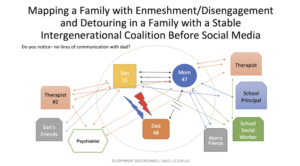
This taught me the importance of understanding the family map in addition to evaluating if different family members were in coalitions with other therapists, social workers, and/or even agencies. It was an important step to understanding the map and identifying where the coalition(s) across generational boundaries occurred with the family and larger system.

In many of the sessions, other families were able to overcome their symptoms once they began to work on their relationships and change their relationships with the systems of care. It was exciting to see when the system of care noticed their triangulation with the family. Other times it was sad to see how systems of care did not see how they were triangulated against family members.

Today, influencers are present in the family session as seen by the virtual coalitions that the member(s) must maintain as if they were their closest friends in order to be a part of their tribe/team.

The Impact of Social Media on Family Relationships

Families are always ahead of the researchers and therapists, but do we listen to the pieces together as therapists? The following are the themes/symptoms families have discussed in my own family therapy sessions as well as those of colleagues in the wider clinical world. Each of these impacts adolescents, and, in turn, how they impact the adults in their home. On both sides of the relational equation, social media has a powerful impact, and not always for the good of individual and shared relationships.

When one or more family members are engaging in excess screen time from two to sometimes more than six hours a day on social media, the research shows there is an increase in symptoms of depression and/or anxiety. If someone has this much daily screentime, they are displacing healthier activities or hobbies such as walking, sleeping, drawing, painting, mindfulness, and gardening, to name but a few. And this displacement impacts the interactions in the family and community by isolating them.

Algorithms encourage constant social competition and comparison, and as such function as social currency between peers and family members. Adolescents typically feel that they are on stage competing to increase their position in the “hierarchy” with peers and/or parents. They continually compare themselves to peers at school and other families.

The algorithms that draw them in make it difficult for them to turn off the social app and get away from the stresses of adolescence. Jockeying for competition and comparing their lives to others may at times backfire, leaving them feeling poignantly and painfully alone. Again, this constant competition and comparison mirrors similar interactions in the family that can contribute to increased anxiety and depression.

The adolescents I’ve worked with discussed how they feel lonely and alone. They feel lonely when they are not supported or perceive they are not supported by family or friends, and feel alone when they have little face-to-face contact with peers like we all experienced during COVID.

The two-dimensional views people experience when using Zoom as the primary source of connection do not “feed the soul.” There is no substitute for good eye contact and close physical proximity. The irony is social media was created to decrease feeling lonely and alone but actually amplifies it. In family sessions, many, if not all, talk about how they feel lonely and hoped that social media would fill this void but were unsuccessful.

Adolescents typically think they are invisible or always on stage. These polar positions can occur on the same day for any adolescent. They think they are invisible when they are spending more time on their phones not getting enough likes and/or views, whatever that means to them.

This causes them to work harder on their online stories and identities, decreasing the proximity with their non-virtual friends. Many adolescents begin to look for the “genuine” or “real” friends, determining they are only present in social media and not in their own hometown or within the family walls. In the family, these themes are very common when there is already a pattern of disengagement (invisible) or enmeshment (always on stage).

The adolescent also thinks their peers are waiting for them to make a mistake so it can be posted online. This position makes them feel as though they are always walking into the cafeteria for the first time as a freshman in high school. Adolescents are supposed to make mistakes, struggle, learn about relationships with typical external distractions (friends, family, media, work, and politics). But does social media fill the lonely times when the adolescent and young adult are reflective and recoup?

Being invisible or always on stage prevents the adolescent from developing close connections with peers, teachers, coaches, or other family members. This results in adolescents seeking temporary relief from asking a “person” and instead getting information from social media.

Information on the app is monitored by the algorithm and is not as embarrassing or stressful as asking a family member, friend, or teacher. This is where social media begins to enter the family, impacting the adolescent development and challenging their family’s belief system.

The algorithm also motivates the adolescent to seek select information that aligns with their narrow/closed view about politics, friendship, religion, sexual identity, sexuality, gun laws, suicide, mental health, or any other hot topic.

The Atlantic, 60 Minutes, Pew Research, the New York Times, and the Wall Street Journal have done a great job discussing all the different ways social media has triangulated members of our families. The New York Times article on suicide, “Where the Despairing Log On and Learn Ways to Die,” by Megan Twohey, or The Wall Street Journal essay, “TikTok Diagnosis Videos Leave Some Teens Thinking They Have Rare Mental Disorders,” by July Jargon are exemplars.

Social media focuses on the “person” and navigating them to topics they are interested in and picking what tribe to belong to. The information is flowing into one part of the family system and not to the whole family which triangulates family members against virtual friends or influencers. This occurs if the family is already in a state of constant conflict or conflict avoidance. A recent 60 Minute piece discussed how China does not allow TikTok to bring up divisive topics to their children or adolescents.

For the adolescent to decrease feelings of anxiety and depression, they must work for the “likes” and “views.” They will be trying to affirm their sense of self, but many times they will be accused of bragging and will feel they are not good enough when comparing or competing with others.

Body image and feeling unattractive are especially amplified by social media’s filtering app. Many plastic surgeons are reporting an increase in adolescents wanting to get surgery to look like their filtered self. Current data shows that 55% of surgeons report seeing patients who request surgery to improve their appearances in selfies, up from 42% in 2015. They want fuller lips, bigger eyes, and smaller noses. “This is an alarming trend because those filtered selfies often present an unattainable look and are blurring the lines of reality and fantasy.” (1)

When I’ve met with families and these themes come up, I have encouraged them to discuss these themes which have allowed me to see the systematic position of each family member, system of care and the influencer/algorithm.

Every family has its struggles and at times feels out of control when it goes through a stage of what Monica McGoldrick calls its family life cycle. I have seen this especially when a family enters my office as it is attempting to (re)adjust to the needs of their childhood, adolescent, or young adult. Now add the influence of social media to one or all members of the family, the spiraling becomes more intense.

Crisis of Voluntary Play for Children

The importance of free and voluntary play with children to teach them how to give and take has been well documented. There is no substitute for non-virtual relationships in the early stages of childhood. Antithetical to this, algorithms require constant attention, taking the time away from connecting with others face-to-face.

Whether it is the child who requests to go on the smartphone or the parent who gives the child a cell phone in social situations (i.e., play dates, restaurants, long car rides, it decreases the opportunity to negotiate, argue, entertain themselves, compromise, and resolve conflict. This “tech choice” leads to delaying the development of the family and prevents them from moving to the next stage of a family with an adolescent.

Children Entering Adolescence Have Not Learned to Play

There comes a point in families when adolescents are told they are no longer a child, yet neither are adults. For some adolescents, not knowing the initial stages of voluntary and free play puts them into limbo looking for answers. The adolescent and family know on some level they are missing the tools for non-virtual relationships.

First, this is where the social media’s algorithm and influencers potentially intensify the family’s struggle. When the adolescent looks to social media for the answers, this intensifies conflict. Naturally, the adolescent wants to grow away from the family. They want to connect more with peers.

The adolescent in families with intense enmeshment/disengagement and different forms of coalitions struggle the most. This is where social media’s algorithms direct the adolescent to find a group. The algorithm pulls the adolescent in to spend more time on their app, resulting in the app making money and the adolescent searching for connections separate from the family.

However, virtual connections encourage the same patterns of enmeshment/disengagement and the different forms of virtual coalitions. These intense virtual connections are sometimes in opposition to the non-virtual relationships of the family and/or community.

Secondly, this social media generation has grown up learning to communicate more virtually and less in person, especially during COVID. Many adolescents have decided that they would rather communicate virtually. It is hard for some adolescents to look into someone’s eyes, read body language, and feel the energy of being in proximity because it makes them anxious. Look at any lunchroom at any local high school. If the school allows students to be on their phones during lunch, adolescents prefer to spend time on their phones working to maintain a social virtual hierarchy.

Social media offers a prime context for navigating these tasks in new, increasingly complex ways: peers are constantly available, personal information is displayed publicly and permanently, and quantifiable peers’ feedback is instantaneously provided in forms of ”likes” and ”views.” (2). Many of us who grew up before social media can only imagine if our mistakes were on a permanent record and followed us around for the rest of our lives, never allowing us to move forward.

Thirdly, the family does not have a chance to limit the adolescent’s time on the apps because the social media’s algorithm encourages constant attention, reinforces isolation from family and non-virtual friends.

Many parents have approached me saying, “The phone is their lifeline to manage their anxiety,” or, “The phone is the only way they connect with their friends.” During these moments, I have found it useful to explore how the whole family has come to the belief that the social app has become a way to maintain the homeostasis of the family.

A Non-Virtual Family Map

I often ask families about their virtual and nonvirtual family maps. I think it is important that we ask the family about their social media involvement to understand the virtual map of the family. Do families understand the impact of the social media algorithm? Do families know how to get out of the social media web? Do we ask each member of the family who they talk to virtually or non-virtually when they are struggling?

In initial evaluations, I often explore if the family is aware of how many hours they are spending on the social media apps. It is important to assess if the family is aware of how much social media raising/influencing is involved in the marriage, parenting, and sibling subsystem. Some providers want to focus on social media addiction, but the algorithm is not like any other “addiction.”

The algorithm allows many of the family members to covertly — and sometimes overtly — bring influencers into conflict with different members in the family. These virtual relationships amplify the family’s symptoms, and unfortunately today’s therapists use the medical model to diagnose the adolescent symptoms, further pathologizing and pushing the relationships in the wrong direction. This narrow view further sets the enactments, reinforcing the enmeshment, disengagement, and coalition patterns.

Non-Virtual Family Map

It is hard to shift our medical model training from a focus on the individual’s (child, parents, siblings) deficits to one that acknowledges strengths and competencies within individuals and the family system. When individual therapy does not make significant change, families often turn to family therapy as a last resort.

After experiencing this different approach, they often express frustration that they were never given the opportunity to move forward together, instead deferring to the experts for the correct intervention and diagnosis.

Structural Family Therapy was so different in the 1970s and 1980s; it was transcendent. While many new theories of family intervention have reached the mainstream, so too have many reverted to focusing on the individual. When starting individual therapy with the adolescent, I have found it important to ask the adolescent to overcome the algorithm on their own without their parents’ involvement. As family practitioners, we need systemic thinking more now than ever to approach the intense cultural impact of algorithms and influencers.

Below is a “traditional” family map that does not consider social media. It represents a compilation of families I’ve seen in therapy, rather than any one family. The symptoms include those typically seen in family practice — poor school performance, school avoidance, vaping, drinking, and using drugs.

From a system’s orientation, the symptoms are a result of the functional and dysfunctional interactions within the family system.

It’s hard for me to understand how therapists begin assessment and treatment without considering or involving the whole family. Some clinicians might say the conflict is too high, and it would only impact the adolescent negatively. Others might assume from the start that one or both parents are not willing to work or are too busy. Some might even be unaware of the importance of beginning from the position that families do not have the strength to make change.

Sometimes therapists and school staff buy into and reinforce the belief that the child or teen is the problem. In the case of this particular map, Mom “reportedly” goes to her private therapist while the son sees his own therapist. Mom and son separately complain about dad to their respective therapists and to the school staff. When mom and son voice frustration about dad and each other in the individual therapy session, disengagement with dad is reinforced. Mom and son are trying to get the type of connections from the system of care that they cannot get with Dad.

While this disengagement takes place, the son turns to his peers, attempting to pull away from mom’s enmeshment, activating her to pursue more. At home, Dad complains that his wife and son always bring up their therapist who agrees that he is unavailable and/or flawed. When this occurs, Dad becomes more distant and angrier, feeling like he is the odd person out.

When Mom gets angry at dad, she turns to her son and vents to him which activates him to challenge his father about money, drinking, and the way he treats her. At other times, the son may jump into the conversation when the parents interact about money, drinking, or the way he treats Mom.

When I attended graduate school, the common exercise was to map the triangles in the family system. Based on the above map, there are at least 24 triangles that are activated in the family-school-mental health system. The 24 triangles are:

  • The mom, son, and dad
  • The mom, son, and school social worker
  • The mom, son, and principal
  • The mom, dad, and school social worker
  • The mom, dad, and principal
  • The mom, dad, and school social worker
  • The mom, dad, and school principal
  • The mom, son, and mom’s friends
  • The mom, dad, and mom’s friends
  • The mother, dad, and dad’s friends
  • The mom, son, and son’s friends
  • The mom, son, and son’s therapist
  • The mom, son, and son’s psychiatrist
  • The mom, dad, and son’s psychiatrist
  • The mom, son’s therapist, and psychiatrist
  • The mom, dad, and son’s therapist
  • The mom, school social worker, and mom’s therapist
  • The dad, son, and son’s therapist
  • The dad, son, and son’s friends
  • The mom, son, and mom’s therapist
  • The mom, dad, and mom’s therapist
  • The son, son’s therapist, and school social worker
  • The son, son’s therapist, and psychiatrist
  • The son, school social worker, and principal

These 24 triangles are at the same time difficult for adults in the family to appreciate, even harder for an adolescent, and deeply challenging for the clinician to manage. In those triangles within the family where cross generational coalitions are activated, the symptoms in the family increase. I have often been challenged whether to discuss the impact of all these cross generational interactions with the family and whether it is important to differentiate the healthy, less healthy, and unhealthy ones from each other

On top of the above complexity, other questions arise like “where did the boundaries go?” The therapist must keep in mind how the boundary between the family and the outside world becomes invisible and the symptoms become more intense, to the point more professionals are recruited to “fix the dysfunction.”

I have also had to maintain awareness of how managed care’s enforcement and reinforcement of the medical model has influenced me and other members of the community of care, including other therapists, psychiatrists, physicians, and schools. This reinforcement has an impact on the family’s interaction with the son focusing only on his diagnosis and the correct medication, while failing to address the family relationships.

As mom turns to the school and the system of care for answers, things are not changing. She reports that her son is getting worse. Mom blames dad’s aloofness and dad blames mom’s overindulgence. Mom increases calls to the psychiatrist. The psychiatrist adjusts the medications frequently. The frequency of crises increases and the boundaries between the family and the outside world are dissolving due to the interaction between the family and the system of care.

The number of alliances increases between different family members and different professionals as more professionals/agencies are pulled into the drama. Professionals unintentionally begin to write/rewrite the individual’s and/or family’s stories, especially when utilizing the medical model.

With more stories, there are more opposing interests for each family member. This phenomenon between families and agencies is a result of a collision when both parties collaborate to uphold sociocultural trends. The goal is not only to interrupt multiple unhealthy alliances with existing professionals/agencies, but to also prevent new transactions from developing. (3)

This phenomenon was usually seen when the system of care worked with economically challenged families. We now see this also occurring with families of significant means because they can afford an individual therapist for each family member and psychiatrist(s) if needed.

As we look back at the map, it is now easier to understand that because the family has already identified what they think is the problem, it really needs to address the triangle between mom, dad, and son. It doesn’t really matter where to begin. A clinician can enter through mother-son enmeshment and coalition, father-son disengagement, or parental/marital disengagement.

It might also be useful to address the system of care coalitions between the therapist and school with the mom and son. Having the family identify how to change the interaction between the whole system allows them to move forward. It may be a challenge because getting directives from an expert, rather than looking within their own system, is what they have come to expect.

Using a Virtual Family Map to Identify Issues in Families

Before talking about the influence of social media on the family, it is important to acknowledge some of the “players” in social media. The system of social media has many parts. Social media success is dependent on an algorithm, which encourages frequent interactions by virtual and non-virtual friends.

The frequent interactions result in the shareholders receiving monetary return on their investment, the employees maintaining their jobs and bonuses, and the advertisers increasing the visibility of their product resulting in increased sales. The influencers are dependent on social media to reach as many people as possible to receive income from the app. There is a lot of pressure to have an effective algorithm to support social media.

As you next look at a map depicting the interactive nature of the family and social media, it is important to keep in mind that the 24 triangles from the non-virtual map are still present, and the family boundary is already disintegrating with the school workers, friends, and therapists to seek help with the identified patient.

Now in addition to these non-virtual professionals and friends, the family is inviting social media’s virtual friends and influencers to seek help with the identified patient. Clients (and non-clients) often turn to virtual friends and influencers to provide the same connection as non-virtual friends, but these connections are void of physical closeness. Children and adolescents believe a virtual relationship can replace a non-virtual relationship. But all virtual relationships are void of physical closeness in which touch, eye contact, and a warm smile can feed the soul.

The family can turn on a social media app at any time of the day or night and the outside world is invited into the family, increasing the number of triangles exponentially. From the clinical perspective, it is critical to examine what actions (social competition, social comparison, loneliness, etc.) in the family trigger a member(s) to invite social media into the family. The therapist must also discuss how social media algorithms are activating/triggering the member(s) of the family to turn to an app to surf or post an event. This increases the time spent on the smartphone to maintain these virtual friends, non-virtual friends, and influencer relationships.

At times, social media decreases connection with non-virtual relationships and increases the connection with virtual friends and influencers. In the therapy session with this particular family, some members discuss how they rely on virtual friends and influencers more because “they understand me more than the friends in my own town/school.”

The adolescent believes these virtual figures want to listen to them more than family and non-virtual friends. It is important to ask the family what influencers and virtual friends provide that their own family members or non-virtual friends cannot. This allows the clinician to address the patterns and interactions in the family.

In the map below, I do not draw the number of different social media apps, influencers and virtual friends who are involved with the family. However, I do recommend when meeting with families, to draw each app, virtual friend, and influencer to show the number of triangles the family is managing or attempting to manage. For simplicity’s sake, I use one (black) box to represent all the social media apps and one box for all influencers and separated mom and son’s virtual friends.
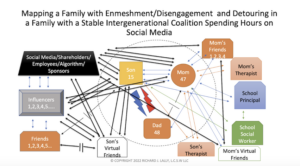
 

Husband, Wife, and Social Media Triangle

What is the impact of social media on marriage? The wife turns to social media and influencers to figure out how to “fix” her marriage. The wife tries to talk to her husband about what she has learned about marriage on social media. The husband discounts the wife’s attempts to “educate him about marriage.” She eventually gives up on the marriage and “wants to focus more” on her son. She also tries to connect with previous friends and boyfriends from past life because she feels lonely and alone “looking for a connection.”

What you will see in this triangle, and all the triangles which involve social media, is a substitution of a virtual relationship for a non-virtual relationship whose connections are full of conflict or conflict avoidance. The virtual relationships convey an illusion of meaningful connection, but the person(s) feels alone and lonely because it lacks the important ingredients for a fulfilling relationship.

Mother, Father, and Social Media Triangle

Now the wife stops working on the marriage and focuses on parenting. The husband is not aware of this decision, focusing on “making money to provide food, clothing and shelter.” The father continues to feel alienated, disconnected, and disempowered, becoming angry towards the mother and son. The mother turns to school staff, therapists, non-virtual friends, virtual friends, and influencers for ways to “fix her son.”

This fosters more of an enmeshment with son, and disengagement with Dad. The son turns to school staff, his therapist, non-virtual friends, virtual friends, and influencers. Each family member describes a feeling of disconnectedness trying to overcome the feelings of being lonely/alone. Dad voices his frustration, complaining that he is “old school,” and they are “hypnotized by that damn phone.”

Mother, School, and, Social Media Triangle

In this triangle, mom calls the teachers and guidance department for support. She has frequent phone calls with the guidance counselor because the guidance counselor “is an expert with adolescents.” As you can see, dad is left out of the interactions with the school.

After a few months, her son’s behavior is not changing, and mom is frustrated with how the school is not helping her son. Mom begins to turn to social media looking for answers. Mom spends hours on the app talking to non-virtual friends, virtual friends and reading/commenting on influencer’s posts. Mom displaces healthier activities with time spent on social media. Mom begins to complain that the school is not meeting the goals set out by the Individualized Education Plan (IEP). Mom cites information from influencers from social media and the internet. The tension rises between the school and mom.

Schools today are under tremendous pressure to perform. Schools are understaffed, and do not have the mental health training or support to bring in a countercultural systemic approach into the schools despite the money being put into schools after COVID-19.

Parents, Son, and Social Media Triangle

Mom is spending hours on social media looking for answers to why her son is struggling. She also spends time looking for connections. The son also spends hours on the app interacting with non-virtual friends, virtual friends and reading influencers’ posts.

Mom pursues the son, but he only is aligned with her to challenge dad’s limit setting. When the parents attempt to be aligned, the son acts out more. We see the son increase his conflict with parents, who struggle due to their enactment/conflict avoidance with each other on how to help their son. This results in the father leaving and the mother turning to social media to find answers or overcome feelings of loneliness.

When the family interactions are in intense conflict or conflict avoidance, many children, adolescents, and young adults get most of their answers from non-virtual friends, virtual friends and influencer’s posts. The son is seeking temporary relief by getting information and trying to affirm a sense of self.

The non virtual, virtual relationships, and influencers introduce beliefs that are the opposite of the family’s beliefs and further impact the self-esteem of the adolescent. The son discusses what he learns from social media of what “real parents are like.” The decrease in face-to-face communication with family increases his anxiety, depression, irritability, and intrusive thoughts. This also confuses the family of how their family member can “think so differently.”

Son, Non-Virtual Friends, and Social Media Triangle

The son in the session discusses constant social competition/comparison, working for social currency, and thinking he at times is invisible to his non-virtual friends. The son gradually believes his non-virtual friends “don’t understand.” He believes he cannot turn to his parents because “What do they know?!”

The son begins to engage in the same interactions with his peers as his parents and avoids turning to his peers for support. The son begins to spend more time on social media with virtual friends and influencers to seek select information that matches a narrow/closed view, hoping to avoid conflict/interaction. The son then turns more to virtual friends and influencers for answers. Again, this increases his time on his smartphone and increases the family’s sense of not being good enough for each other.

Remember, the son believes there is “less stress” getting information from a stranger, pop culture icon, or a virtual friend than an enmeshed mom, disengaged father, or face-to-face with a peer(s). However, the decrease in face-to-face communication with family and non-virtual friends increases his anxiety, depression, irritability, and intrusive thoughts.

Despite the time spent on social media, the son feels alone/lonely, looking for emotional, face-to-face and physical connection, but does not have the words to express these thoughts to each other.

Mom, Therapist(s), and Social Media Triangle

Dad continues to be absent from the triangle that involves the therapist. The mother attends her own therapy and attends her son’s sessions to discuss what new information she has seen on social media.

She reviews with both therapists what she has learned on social media about new treatment, new medication, and new diagnoses. She advocates with all providers that her son is incorrectly diagnosed, hoping that would help him with his symptoms. The quality of training of the therapist determines their response to entertaining or challenging mom’s research. This may result in mom seeing a new therapist.

The individual therapists and psychiatrists are not looking at how the parents avoid “getting on the same page.” They are reacting to reports by mom about the son’s behavior. Mom and dad are unable to interact differently because they have not figured out how to work together to decrease their son’s phone usage to increase his time with non-virtual friends. The professionals are avoiding addressing the parent’s avoidance!

Mom, Psychiatrist, and Social Media Triangle

Dad is absent from the triangle that involves the psychiatrist. Mom becomes disgruntled with the psychiatrist. She begins to challenge the psychiatrist’s diagnosis and medication recommendation. The psychiatrist recommends if mom is not satisfied with his assessment, she seek a second opinion. Mom begins to look for a psychiatrist who agrees with what she has read on social media.

Son, System of Care, and Social Media

The son is seeing his individual therapist 1-2 times a week and his psychiatrist once a month. He is also spending 2-8 hours on his social app each day. The therapist has not assessed the hours the son is spending on his phone. The app is only showing views/opinions/likes/images that interest him.

The son begins to complain that the therapist does not understand him and challenges his therapist saying, “This doesn’t help.” When the therapist explores the son’s statement, he begins to discuss information from “reliable sources” from social media and influencers. He too begins to diagnose himself and discusses medication that can help. When the system of care discusses reliable sources such as universities and professional journals, the son becomes irritated saying “I don’t want to read them.”

Son, School Staff, and Social Media

Not only does the system of care increase their sessions, but the school staff increase their time with the students. The number of triangles with the son in the school increases between the child study team, teachers, and administration.

The teachers are pursuing him to get his work done — offering to meet him before school, lunchtime, and after school to complete his work. He never shows. The son is seen in class on his phone. Some teachers ignore him, and others nag him. When a teacher challenges the time he is on his phone, he tells the teacher other instructors let him do it.

The social worker is calling him down to discuss his avoidance of work and disruptive behavior in the classroom. Only when the son becomes overwhelmed, he discusses with the school social worker his home life and that medication is not working. The vice principal is meeting with him to give him detentions. The son feels frustrated with the school stating, “They are only doing this because it is their job.”

Son, Non-virtual Friend #1, Non-virtual Friend#2 with Social Media

The son leaves school to go home to continue to work on his non-virtual relationships on social media. It becomes evident that in social media apps, the same social stressors occur online like in school. It is exhausting to navigate being included and avoid being excluded at school and online. The son and non-virtual friends are jockeying for social currency and social position, never getting time off to charge their own social battery.

The son and non-virtual friends stress about the images they post. They are anxious about what the image means to them and others. The son is trying to understand the unspoken rules for posting and the reaction by his peers regarding the image. The son worries if the image appears “authentic” and will help him maintain his position inside the social media group or if a new group be formed without them.

Son, Non-virtual Friend(s), and Virtual Friends

The son struggles connecting with his non-virtual peers. He is not getting feedback from his non-virtual friends about his art and his physical appearance and finds out they have different chat rooms that do not include him. (Remember, he does not want feedback from an overly involved mom or detached father.)

He begins to look for feedback about his art and physical appearance from virtual friends. When looking for connection outside the non-virtual friend group, he states he is looking for virtual friends who are nonjudgmental.

But as time went on, it began to mirror the non-virtual group. Some of his virtual friends on social media become competitive and attempt to increase their social currency on this platform. They do this by making fun of his physical features and his art. This mirrors some of his non-virtual friends’ behavior. The son frantically searches for another virtual peer group that he believes will not activate anxiety by not challenging his views, providing a stress-free venue.

As the son increases his time searching for virtual peers and influencers over non-virtual friends — reinforcing a closed system, increasing isolation at school, and decreasing time to sleep at home. His virtual relationships are now more important — increasing time spent on the app and continuing to strive for more likes and views.

Lack of face-to-face contact with family and non-virtual friends fosters more of a virtual enmeshment with virtual friends. He describes them as “nonjudgmental” and “more accepting.” This further increases his self-doubt and increases his feelings of loneliness and creates a virtually closed system (Virtual Enmeshment).

Son, Virtual Friends, and Influencers

The virtual group is important to maintain when avoiding contact with his parents and non-virtual friends. The son describes his virtual friends as more “authentic” and describes his non-virtual friends as “fake” and “not genuine.” However, some of his virtual friends on social media become competitive and attempt to increase their social currency.

The son frantically looks for another group that is an anxiety and stress-free venue. This further increases his self-doubt and increases his feelings of loneliness. This increases the symptoms of anxiety and depression when waiting for approval from virtual friends saying, “They are the only ones who understand me.”

As the son looks for new virtual friends, he and his virtual (and non-virtual) friends look to influencers for answers on how to portray themselves. Influencers work hard to establish and maintain their position in their virtual community. The influencers are working hard to make money and increase their viewership. The influencers often ask adolescents to agree with their beliefs and recommend products they are selling. The influencers work hard to appear on the “right side” of an issue.

As the son tries to replicate the beliefs of his preferred influencers, he looks for fellow virtual friends that have done the same “research.” They notice the more they make comments in opposition to a belief, it increases their views and likes.

As the symptoms in the family increase in intensity, the members increasingly must decide who to align themselves with in the virtual and non-virtual triangle. The therapist highlights this and encourages the family to discuss and identify the boundaries of virtual and non-virtual triangles that maintain these alliances/symptoms. This allows a family to discuss non-virtual triangles that are underutilized, which reinforce healthy boundaries that benefit the family.

Using Exploring Questions to Make Circular Statements

Much has been written about joining, unbalancing, and mapping in SFT. One of the beautiful ways Structural Family Therapy (SFT) uses language is by employing circular statements to connect the family member’s behavior in the system. When SFT enters the family, the systems therapist uses the family’s own observations to connect their interactions.

It is important today to make a circular statement to widen the lens in which the family sees how all virtual and non-virtual relationships impact the relationship in the family. Below are some examples of circular statements using the words used by each family member.

I agree with you, Mom, that as long as you do not have a voice with Dad and work together, your son will not stop posting explicit images on Snapchat

Dad, as long as you sound like a drill sergeant, Mom will not find her voice as a woman and work with you as a wife and mother of your son who will continue to believe he must mirror images on Instagram

Mom, I agree that the harder you work, the less Dad helps you with parenting your daughter— your daughter will have to turn to influencers about how a woman should look and act

Peter (son), as long as your mom is worried about the frontstage appearance, she will fight with your father who is more concerned about your backstage struggles with you and your mother

What do your virtual friends give you that you cannot get from Mom, Dad, or your non-virtual friends?

Conclusion

Many are worried about the continued increase in suicide, suicide attempts, and mental health issues in the family and how Congress is powerless to challenge these companies. Many providers are not looking at what has changed in our lives in the past 25 years.

Relationships are becoming more complicated than ever. Many families and therapists are unaware of the impact of the system of care and less aware of the impact of the ubiquitous “algorithm.” It is hard to understand how the algorithm works because it is important for these companies to keep the algorithm secret for fear of losing profit.

We must also remember that each influencer, virtual friend, and nonvirtual friend has their own family map. Just as many professionals do, influencers understand how their stories, views, and images echo in the family.

Are families aware of the alliances that occur with virtual and non-virtual friends and influencers? Are we aware that when more virtual influencers and friends enter the family, more alliances increase establishing social hierarchy, increasing social competition and social currency? Are we, the clinicians, aware that influencers and virtual friends unintentionally/intentionally begin to write/rewrite stories in the family and permanently on the internet?

We must begin to understand that with more stories, there are more opposing interests for each family member. This phenomenon between families, virtual friends, nonvirtual friends, and influencers (social media) is a result of collusion when all parties collaborate to uphold their preferred sociocultural trend.

The goal is not only to highlight and interrupt the multi-alliances with existing social media but to highlight the transactional pattern in the home that maintains this pattern. Remember, a virtually closed system impacts all family members, whether one or all are using these platforms excessively.

References

(1) Susruthi, R., Myara, Maymone, B. C. & Vashi, N. Selfies-Living in the era of filtered photographs. JAMA Facial Plastic Surgery. 2018 20:6, 443-444.

(2) Nesi, J. (2022) The impact of social media on youth mental health: Challenges and opportunities. North Carolina Medical Journal, 81(2), 116-121.

(3) Colapinto, J. (1995) Dilution of family process in social services: Implications for treatment of neglectful families. Family Process. 34:59-74.

Questions for Reflections and Discussion

How has social media influenced your personal and family life?

How does the author’s premise resonate with you and the way you practice family therapy?

How have you integrated social media and app use into family therapy?

In what ways do you agree or disagree with the role of social media in family systems?

© Psychotherapy.net 2023

Krista Tippett on the Immensity of Our Lives

Dignification of the Person

Lawrence Rubin: Over these last two decades, your always fascinating and deeply provocative interviews on your show, On Being, have spanned the disciplines from genetics to cosmology. And despite the similarly broad range of thinkers and doers who have represented these disciplines, you’ve never strayed in your attempt to provide your global audience with answers to three seemingly simple questions: What does it mean to be human? How do we want to live? And who will we be to each other?Our readership is comprised largely of psychotherapists of varying disciplines, theoretical orientations, clinical specialties, and populations served, all of whom I think are attempting to help their clients, trainees, and students answer similar questions. My guess, however, is that most of them have not followed your podcast.

With that said, how do you think that your attempts to answer these three questions can guide psychotherapists in their clinical work? Sort of an open letter to psychotherapists.

Krista Tippett: I’ve heard a lot across the years from psychotherapists and from people who are in therapy, that therapists often recommend that people listen to On Being. I’ve been so honored by that, and I’ve also wondered about it. I’m told that some of the ways I listen and construct my conversations are in sync with things that one learns as a therapist, so that’s just kind of intriguing to me.I guess what I’m saying to you is that I’ve always been intrigued by the fact that my work does seem to be valuable for some people. What I’ve heard even from young journalists — which feels a little bit to be part of kind of a kindred phenomenon — is that I’m talking about things in a way in public that that kind of honors and elevates the basic struggles and challenges that we must figure out as we seek to understand what it means to be human, and then how that takes so many distinctive forms in any given life.

I also think that I try to have a conversation with the whole human being. So, I interview people who may be very well known, maybe not, but are just incredible influences and mentors in their disciplines or in their communities. And sometimes, these people who I interview are renowned for what they do or what they’ve done. I always try to get at the full dimensionality of who they are as a person and how they’ve learned and grown through these things that they know. I’m also as interested in the questions that they hold and the questions that keep emerging for them, as I am in the answers and the certainties and the knowledge that they possess.

I think the interviews I’ve had also model the reality and integrity, as well as the dignity and beauty of the adventure of being human. And isn’t this like the adventure that people are on in an individual way when they’re working with a therapist?

LR: As I’m listening to you and the way that you work with your interviewees, I recall a word invented by David Epston, the co-creator of Narrative Therapy — “dignification”. It is the process of seeking out and validating the dignity of the person on the other end of either the microphone or the couch. You are also intrigued by those that you interview which resonates with the work of good therapy — along, of course, with good listening. The last thing you said is that irrespective of how famous they are or how much they’ve contributed, you value the whole person. You seem to have this wonderful skill of finding the deep threads of humanity that run through all the people you’ve worked with. And I think that’s important for therapy as well.Ok, I’ll stop the shameless fawning and ask the next question. Existential psychotherapy attempts to help clients address fundamental issues related to being alive, to being human. What do you regard as some of the core existential challenges that we face as a species?

KT: What’s interesting as I’m letting that question kind of sink into my body, is how differently I think I would answer it right now, both in terms of where I am in my life now in my early sixties, but also where we are in the life of the world in 2023. So obviously sometimes — not always, but sometimes — at the very end of my interviews, my final question — and this kind of emerged a few years ago, this wasn’t always true — is “given this life you’ve lived and these particular fascinations you have, how would you begin to talk about what you’ve come to understand about what it means to be human?”But anyway, the thing is, as I said, it’s going to be a very partial answer because it’s vast. But the two things that come to mind to me, this time, is that the older I get, the longer I live, the more fascinating and perplexing the question of ‘what it means to be human’ becomes. I know that the discipline of psychotherapy understands this — how the crucible of our lives — our origins and original experiences and family lives so profoundly influence us. But also, that imprint doesn’t have to mean that they were shaped in a certain direction. Because there’s so much that can happen, with what that becomes, and what we do with it.

I think it’s fascinating that we’re in this century and at this juncture as a species where it becomes clearer and clearer to me that this matter of origins and telling the truth about the story of where we came from, and what we went through, and what our shadows are, and what we struggled with as individuals is also reflected in our national life, right? So, I think there is this never-ending dance with where we started, where we began, and what we do with that and make of it that defines our humanness. And there’s so much drama to that, and there’s so much possibility in it, but it never ends.

Getting back to this century and the post 2020 world we live in, I don’t know if it’s harder to be alive now as a general statement, or that we’re in a greater state of distress in 2023 than we were in 1918 or 1945. But the challenges before us, certainly our ecological one which gets at our bodily origins, is about being human in its most primal sense. Our challenges are truly existential.

And so, I actually have this feeling in myself, and I see it and others at this time, that the question of how to be present to the world has similarly become this existential question at an individual level. But I don’t think that we know what to do with it, but I think it’s become implicated kind of in the personal journey in a way that may be new.

Certainly, people before us have lived in times of war and genocide and holocaust, right? But now, in so many profound ways, we’re faced with those three questions both at the individual and societal level of what it means to be human, how we want to live, and who we will be to each other. And the answers to these questions get reflected at the personal and individual levels in how we behave, what we do, and how we orient ourselves in order to make the difference between surviving or finding a way to flourish.

The Science of Awe

LR: I think that “good therapy” is about helping clients understand and live in their stories, but to survive in society, I think it’s important to help them connect their stories to those of others. Instead, we isolate and divide ourselves along racial, cultural, age, and gender lines. I also think that your three existential questions might aid clients in this quest. From among the folks you’ve interviewed, which of their disciplines seem to be most closely related to the practice of psychotherapy?
KT: I always find it very hard when people ask me to think about a favorite interview, or even an example, because I’m usually very steeped in the most recent conversations I’ve had. So, what comes to mind is a conversation I had with a social psychologist, which is going to be featured in our first podcast of our new season.I’m not sure this is what you’re looking for, but there’s a lot of direct application of what I sometimes think of as spiritual technologies, like meditation, to mental health and to psychological growth. And I’ve seen that accelerate in these 20 years, in a way that is completely fascinating.

Dacher Keltner is a social psychologist who also works in neuroscience at Berkeley. He’s not a psychotherapist, but what strikes me is an offering towards vitality. He’s been working on the science of awe and wonder, and the neurophysiology and the immunological boost that we’re learning of experiences of awe and wonder, and kind of breaking that down.

They interviewed 2,600 people in 60 countries, around the range of the human experience of awe related to being in the natural world. It is very importantly about what they ended up calling our perceptions of moral beauty, which is the single most common thing that gave people a sense of awe. These researchers were blown away by the courage and resilience or acts of other human beings.

LR: Moral acts.
KT: Moral acts, right? But it’s also what they call experiences of “collective effervescence.” And it can be a sports event, or it can be singing in a choir. But it’s these experiences when we just know ourselves connected to other human beings, when we have this experience of being part of something larger than ourselves.

I’m completely fascinated by how science is taking aspects of human flourishing into the laboratory

And all these things I’m describing are aspects of psychological health and well-being, right? And so, I’m completely fascinated by how science is taking aspects of human flourishing into the laboratory. And what I love about this, this practice of awe is that we’re taking seriously an aspect of human experience and naming it as something that we can actively seek out. And that when we actively seek it out, we are investing in greater vitality.

I think you’ve alluded to this a little bit and it’s something we are in our time are filling out or correcting, is this bias towards attending to dysfunction and not attending to greater vitality and greater health. And what I love about the science of awe is that even the spiritual technologies, like meditation, that people have turned to in droves, also have physiological and psychological effects.

There’s so much being used remedially in lives of incredible stress, to get calm, to get grounded, to make it through the day, so what this other kind of science is doing is giving us tools for expanding, for not just getting calmed down, but planting the right life-giving kind of energy in ourselves.

A Place at the Table

LR: I love the idea of connecting with a sense of awe — a fascination with something so small as the heartbeat to the way the stars seemingly line up in the sky. I think you’ve answered that question quite nicely, without directly answering it. Krista, that’s the beauty of conversation, as opposed to just formulaic interviewing. Something new always happens, and I appreciate you for your willingness to be interested enough and awed enough in our conversation to make it grow.What have you taken away from your interviews with faith leaders and healers that might be useful for psychotherapists who traditionally have not incorporated faith or spirituality or religion into their practice?

KT: This was my big focus when I first started this work in the early part of this century. One of the things that’s been really fascinating in these decades is how this human experience of faith identity, religious identity, has been so rapidly evolving from something that not that long ago was just a given — you know, people were born into this. And it could be good, bad, or different, but depending on the tradition and the context, it was almost like genetic inheritance, right? This identity, these rituals, these communities.And especially in the US and in Western Europe — not everywhere in the world in the same way — but that’s just fallen away in such a short period of time. I think that’s one of the things that keeps rising in my conversation and then reintroduces the question of, “if this container for spiritual experience, for the human religious experience, is completely shape-shifting and falling away, then is there anything left? And I think the answer is yes that even the containers, the forms, the inherited identities don’t mean what they once did.

Then there’s this freshness to the question of, “what is this religious part of us?” And the experience of awe is one of those things that points people back to the notion that life is mysterious. I think mystery is a common human experience. And in some ways, we’re not as connected to the traditions that gave names to that and ritual to that, but that experience doesn’t diminish. I think to me the interesting question that we’re now able to pick up is, what is human wholeness, right? And this is an aspect of human wholeness. There is a lot of dysfunction in terms of official religion or the religious voices that are in the news or that become….

LR: Politicized?
KT: Right, what gets politicized, like the violence that is done in the name of religion. And that tends to be what people think of. And that is what respectable fields and intellectuals have distanced themselves from. But what I have sought out across the years are people who live this with deep integrity.In my mind, these traditions that have carried across time and generations are essential human experiences that we need, like rituals, like sacred stories. Stories that make sense. Community song. And really these traditions are a conversation across generations. And also, I think there is a deep, deep intelligence in this part of the human enterprise. Religion is a part of the human enterprise just as science is a part of the human enterprise. There’s a deep intelligence in language and practices around language, that we simply don’t have in other parts of our life together, that to me has never felt more relevant. Language like repentance, confession, lamentation, repair, mindfulness, and other language that emerges from religious and spiritual tradition.

And so, I’ve seen this fascinating thing happen. That even as these forms and the institutions are in total flux, there is essential intelligence, there’s essential vocabulary, and spiritual and social technologies that absolutely have their place in life together, in being fully human. And yeah, in living into the challenges before us, kind of communally as well as individually.

LR: I think that while the field of psychotherapy has evolved, there has been a reluctance to embrace spirituality and religion, aided perhaps by the polarizing effects of politicization. I think good psychotherapy, like if I can say good religion, is about going back to those basic existential and transcendent issues related to your three questions, what does it mean to be truly human? So, I’m hoping that some of the psychotherapists who are reading this interview will look a little bit more differently or openly into the possibility of seeing that psychotherapy is just one branch of knowing, one way of knowing the experience, and it really is diminished if it excludes others like religion and spirituality.

In COVID’s Wake

LR: In addition to the medical, of course, what does the field of psychotherapy need to focus on when it comes to the epidemic of anxiety and depression that has arisen and continues in COVID’s wake?
KT: As you were saying just a minute ago about, all our disciplines have kind of walled themselves off from each other others, right? And psychotherapy, the Academy, and journalism have been suspicious of religion for all kinds of good reasons that we can name. And those separations have been made culturally over the last few hundred years. What has intrigued me, and what I feel COVID has kind of called us to — a track we were already on — is for these disciplines to all agree that the other one is wonderful, and that we need them to be in conversation with each other. Each of these disciplines are essential aspects of this human enterprise. What I’ve become aware of in my investigations across these years of COVID, as I try to use my interviews, not just to be offering something up that would be helpful for my listeners, but even for me to investigate what was going on in my own body, my own psyche; is how there are these fields that have offered new insight about the human nervous system. All this wonderful research has been happening about the fear response, and the vagus nerve, and the stress response. And this is despite this being a little off to mainstream medicine, and I suspect a bit off to psychotherapy.

And yet I think when we’re talking about anxiety in this time, there’s as much that has happened in our bodies below the level of consciousness, below the level of anything that we know is happening — much less could talk about — that is interacting with what we can in a more traditional way identify as aspects of mental health. So, I think to me that’s felt like an urgent call. We’ve lived through this period where the ground shook beneath our feet. And we’re learning about the effects of uncertainty, which is as stressful for us as when something goes wrong.

All of this is happening inside our bodies, and some of it comes out and expresses itself psychologically. Additionally, we are not in the natural world, we are of the natural world. And I think that the ecological disarray of the natural world, of our planet, is something that we feel at a cellular level.

What we need in this time regarding anxiety is a whole analysis and for our disciplines to be talking to each other. We need to gather this scattered intelligence because there is so much coming together that can be healing in a broader way than we’ve been able to do. So, I mean, that’s what this time has surfaced for me.

On Death and Dying

LR: One way or another, clinicians, either explicitly or implicitly, address issues of death, dying, and mortality. Is there hope that we will get better as a society at allowing death inside our lives? And what can psychotherapists do to open the door to these universal concerns?
KT: I absolutely agree that that is imperative, and I am finding in new generations a real openness to this — a kind of insistence. All our disciplines in the West have bought into this weird idea of “up, up, up.” And with this came the idea that we were on this track of always forward progress, which meant denying that things end, and that we are so fragile. And along the way, we seem to have developed a very brittle understanding of human strength and success.I think that illusion just doesn’t hold anymore. And younger people, even pre-COVID — but Covid has certainly just intensified this big reality check. There are these things called “death cafés.” Have you heard about this?

our religious traditions have been the only place — again, in the human enterprise — that addressed mortality and finitude

There’s a movement that was led by people in their twenties who are now in their thirties called the “Dinner Party,” which is all about people bringing death and dying and grief, like, wearing it on their sleeves. That this is something that happens. Yeah, it’s absolutely fascinating. And our religious traditions have been the only place — again, in the human enterprise — that addressed mortality and finitude.

LR: And we’ve excluded them.
KT: And we’ve excluded it, right? We said, ‘no, we don’t want that, and we will pretend like it’s not true.’ So, there’s health in returning to this reality and honoring it. I do see new generations doing that because it’s just the truth. There are certain lies we’ve told in the name of progress that are exposed as fallacies now.
LR: Based on that, Krista, what advice would you give to therapists who work with clients whose focus on happiness comes at the expense of acknowledging their brittleness, their vulnerability, their mortality, and their limited time in this universe? Or am I being too morbid?
KT: No, I mean, again, it sounds paradoxical, but acknowledging fragility and things failing, as much as our strengths and things that go well, is how we become whole. This is how it works. I think one thing I’ve really been privileged by has been interviewing tremendously wise people. I think about somebody like the late Desmond Tutu, who absolutely had seen the worst of humanity, right? He knew what it was to suffer and lose, many times along the way to achieving something astonishing.It’s not like people who become wise and whole have it better than the rest of us, or had it easy, right? Like, hadn’t had the adversity? It’s what we do with that. It’s not about overcoming it so much as …

LR: Integrating it.
KT: Yes, how you walk with it and through it, and integrate it into your wholeness on the other side. I’ve seen that over and over and over again. I think about this Buddhist monk who actually started out his life as a scientist, a molecular biologist. He’s French, and his father was one of the great atheist philosophers of France. He’s talked a lot about happiness, this notion of happiness, and how in spiritual perspective — I would say in an enlightened spiritual perspective — happiness is not a state of being that you achieve, sustain, or return to. It is a way of moving through whatever happens, which will include sadness, loss, and failure. It’s an orientation. And you know, I think the language of flourishing is much more useful than that. I think, really, we have so many pathologies as a nation that are just out on the surface now, but I think it was probably a real tragedy for us, that the pursuit of happiness was given to us as a right when we don’t have…

LR: Tools?
KT: Yeah, and we don’t even have a working definition of happiness that is actually good for us. But psychotherapists and spiritual teachers owe it to each other to formulate that meaningful definition of what happiness can be.
LR: And it’s not just happiness — it’s not just about more.
KT: It’s not just about more.
LR: It’s not just about better.
KT: It’s not a mood. It’s not just about something you can achieve and then you have it forever. What a recipe for always being depressed and anxious if that’s what you think life is going to be like.
LR: The recipe that life begins when your symptomatology ends, as opposed to life is in part built on the stories that carry with them symptomatology. What tips would you offer psychotherapists, based on your intimate interviews with these people like Desmond Tutu that you’ve described as “wise.”
KT: I feel so humbled to be telling psychotherapists to do anything. But here’s what I want to say. I wrote an entire book called Becoming Wise, and I realized after I finished that I had not ever defined what “wisdom” was. So, when I went out talking about the book, people have asked me, “So what’s your definition of wisdom?”Achieving a state of wisdom is different from, say, becoming knowledgeable or accomplished. A wise person might be both knowledgeable and accomplished. Whereas I think the measure of a wise life starts with the imprint they’ve made on other lives around them. And if that is the measure of a wise life, then people who are wise are also at home in themselves, in their bodies, and their experiences. I never met a wise person who doesn’t know how to laugh and smile. And that’s not because everything is funny or they’re always happy in that simplistic way, but they understand that the capacity for humor and joy is actually part of our birthright. It’s part of resilience. It’s life giving, its resilience-making, and it belongs in a life alongside all the other things.

So, if that is a good life, then how do we talk and work towards that? Is it a different direction from feeling better every day? Or how do you accomplish your goals? I’m not saying those things become unimportant, but this is a different orientation, and it’s more fulfilling and grounding than much of what we aspire to and are better at training in each other. But it does not take us where we want to go.

My definition of spirituality at its best is befriending reality, and surely that’s also a goal of psychotherapy. But I don’t know if it’s what people come to psychotherapy for, so there’s a there’s a little challenge for your profession.

LR: Thank you so much, Krista. I can’t wait to share your wisdom with my colleagues.

A Powerful Therapeutic Tool for Defeating Negative Self-Talk

A client of mine, let’s call her “Jill,” got nervous for business meetings no matter what they were about. She often worried, daydreamed, and lost sleep the night before meetings. Afterward, she typically acknowledged something to the extent of, “It wasn’t as bad as I thought.”

Like what you are reading? For more stimulating stories, thought-provoking articles and new video announcements, sign up for our monthly newsletter.

This was an exhausting strategy. Jill was convinced that her stream of hyperactive self-talk was preparing her for what was to come, but the amount of bandwidth chewed up by worry undercut her ability to plan well, if at all. On the day of the meeting, Jill presented as anxious, at least at first, until she realized that all was well. Fear of the moment was worse than the moment itself.

Sound familiar? Many of our clients experience similar struggles with anxiety and negative self-talk.

Eventually, Jill enlisted a strategy called WBL. Instead of steering her away from negative thinking (which would have felt precipitously close to telling her ‘How to feel’), we tapped into her brain’s natural predisposition to predict and created some parameters around it. It proved to be a powerful tool in our work.

A Cognitive Behavioral Intervention: The WBL Strategy

I adapted the WBL model from core CBT principles and have found it useful while working with clients like Jill. At the beginning of our work together, Jill and I defined the specifics of situations that aroused her anxiety. Often when anxious a set of varied concerns coalesced and appeared as one item. We combatted this generalized anxiety through a process called “unbraiding,” wherein we specified one particular concern from among the many. When her concerns appeared tangled, we pulled at only one thread.

Despite her competence and high level of achievement, Jill had grappled with imposter syndrome in the past, and at each new meeting, was inclined to “prove” her professional value.

After identifying the concern, we began the WBL process. The W stands for Worst. Jill was asked to imagine the worst possible scenario, with two limits: 1) take notes; and 2) keep time. We did this with pen and paper handy. The task was to write the ideas down and, importantly, to be honest. This was an important phase for multiple reasons.

First, we honored the inclination of her mind at that moment. In a recent incident, Jill was afraid of being shouted at. She said she did not want to feel powerless. She recounted her journey to achieve her position in the company and was terrified of losing that status. Once this worst-case scenario had been named, we were able to create space for it and distance from it. By talking through the W, we determined that it was not the business meeting that was bothering her, but the fear of feeling inadequate.

Together we agreed not to focus on the W for too long. We set a timer for five minutes and stuck to it. Importantly, Jill was the one who physically set the timer on her phone. She owned the duration; she set a barrier around the time we were allowed to spend considering the W. Before we started this process, Jill spent too much time contemplating the worst possible outcome.

The longer she sat in that hypothetical, negative situation, the more she colored her mind with negativity. Prior to beginning the WBL process, she would enter business meetings in that hyper-negative state, and as soon as she sensed that the meeting felt “off,” she would interpret it as a confirmation.

Therefore, the immediate next step, B, asked her to consider the Best possible outcome of the situation. Entertain the idea that the meeting will be full of praise, ending in a big promotion. What would that look like? Would it come with more free time? More money? More travel? It took considerable effort for Jill to allow herself to consider such a positive outcome. This phase of our work was not about considering what was “pretty good,” but instead, what the best could look like.

Jill had trouble getting to this place. She was hesitant to think big. She had no trouble going to the W but believed that the wonderful reaches of the B were not likely, so she talked herself out of them. Over time, we worked together to understand that the best was, by definition, just as likely as the worst — they were two ends of a hypothetical spectrum that she created.

Once we identified those two poles, we found a spot in between (it can be helpful to draw out the continuum on a piece of paper). In the L phase, which stands for Likeliest, we took a moment to be truly sensible. The outcome of Jill’s upcoming meeting was not likely to be at the worst pole, and, unfortunately, not likely to be at the best pole.

So where was it most likely to be? At this point, she tended to lean back toward the W side of the spectrum. It was important that she catch herself leaning into that negative default and do the work to stay centered. I encouraged her to, if anything, lean toward the B and let her mind be colored by positive thoughts, as they would have an impact on her interactions.

Once we did the work of naming the concern, then working through the WBL model, we put it all together. She had the power to influence the direction of the meeting through the energy she would bring to it.

Cognitive Strategies Lead to Successful Outcomes

Cognitive strategies like CBT did not rid Jill’s professional life of challenge but improved her approach to challenges. Jill was successful and driven. She was accomplished and continued to move in a positive direction. She credited taking control of her self-talk as an important step in the future she imagined for herself.

Deliberately cultivating Jill’s mindset was not a soft, feel-good skill (though it did feel good). It positively impacted outcomes. We call those positive outcomes feedback. The more positive feedback she received, the more confidence was built, and the less likely she would default the next time around toward a worst-case scenario. The more we repeated this process, the more we shifted the default positions away from the worst and toward the best.

The brain is, first and foremost, a prediction machine. The WBL tool helped us get behind the wheel of that machine and steer it. The difficult journey for Jill turned out to be well worth the effort.

In the Shadow of COVID, It’s Play Therapy to the Rescue

Kevin’s Worried Parents

In March of 2021, families were emerging from almost a year of isolation due to the COVID pandemic. As a Licensed Professional Counselor Supervisor and Registered Play Therapist Supervisor in private practice specializing in children, I was flooded with requests for services.

During one particular intake interview, the parents of a four-year-old boy I’ll call Kevin asked me a fair question. “How will our son’s development and mental health be impacted by this year of isolation?” I immediately reflected their feelings with, “You are really worried about the long-term impact on your son.”

Their worry was understandable given the emerging research showing increases in children’s anxiety and depression since COVID began. Yet, multiple factors of genetics, parents’ behavior, peer interaction, and available resources contribute to children’s developmental and mental health trajectory after a crisis. To respond to their fair question, I needed more information from them.

I asked, “What is concerning you the most?” Both parents had college degrees and were well read so they had valid concerns in mind. “Our son has not seen, much less interacted with, another child for over a year. He is our only child. Even though we took him to the public playground, as soon as another child got within 20 feet of us, we would leave quickly.” I thought to myself, risk factor one — no peer interaction during a critical developmental period.

Preschool is when children learn to tune into peer facial cues, scaffold their own physical and cognitive learning by watching other children, negotiate sharing, and so on. I needed to provide some hope to the worried parents, so I tried to normalize the fact that most of his peers had a similar experience. I replied, “Some children’s social, physical, and cognitive development may be a bit delayed during COVID. Fortunately, children are resilient and can learn together, starting from where they left off.” They nodded with seeming understanding.

Then Kevin’s parents said, “Our son could tell we were stressed when we were working from home and paying bills with less money. We tried to play with him, but we had many conference calls. He didn’t understand and thought that we were ignoring him. He became clingy and we became irritated, occasionally speaking to him more harshly than we desired.”

I thought to myself, risk factor two — parent behavior that was interpreted by the son as anger, resulting in increased anxiety. Being a parent myself of an only child who also has ADHD, I empathized and normalized with a compassionate groan. “I get it. I experienced something similar with my child.

We can feel so disheartened, trying our best to juggle it all, and losing our temper more than we want. We are human, not superheroes. We need self-compassion. That’s why I go by the 80-80 rule of parenting. About 80 percent of the time, I try to do about 80% of what I know to be helpful. But during COVID, I lowered my standard to 70-70 because that is passing.” They laughed!

The parents added with a heavier tone, “We are also concerned about his anxiety because we both suffered with anxiety during our childhoods.” I thought to myself, risk factor three — genetics. Research shows a strong genetic influence on the development of childhood anxiety disorders. Again, the parents needed some hope. I reflected, “You both know the pain and struggle as a child with anxiety. You love your son so much that you want to intervene as early as possible. You are wise to do so. I can help with that. Research shows that play therapy can decrease children’s anxiety. Together, we can work to build those limbic system neural networks toward calmness rather than fight or flight.”

Yes, the risk factors for this child were compounded during COVID. He had no peer interaction for a year, stressed and distracted parents, and a genetic predisposition toward anxiety. Yet, he also had the biggest protective factor we could hope for — caring and proactive parents. This plus mental health treatment, interventions of parent guidance, twelve sessions of Child-Centered Play Therapy (CCPT), and psychoeducation could shift this boy’s development and mental health toward a more positive path.

Prior to beginning my work with Kevin and his parents, and to gauge the level of his behavioral and emotional difficulties, I sent his parents a link for the web-based child version of Achenbach’s System of Empirically Based Assessment (ASEBA) Child Behavior Checklist for ages one and a half to five. The results revealed a pattern of emotional reactivity, anxious and depressive symptoms, and sleep problems. While Kevin’s scores on the DSM-related scales for Autism and ADHD were in the normal ranges, his other scores were consistent with DSM anxiety and depressive symptomatology. These results corroborated his parents’ concerns.

The parents’ main goal was to decrease Kevin’s anxiety so that he could calmly engage with others without clinging to his parents. Their prior attempts to reassure him through reason were ineffective. Using Daniel Siegal’s Hand Model of the Brain, I explained strategies to calm the lower regions of the brain through deep breathing, rocking, and soft voice rather than trying to reason with his prefrontal cortex, which was “offline” during his anxious times.

To reinforce these concepts, I asked Kevin’s parents to watch a parenting video by Tina Payne Bryson called 10 Brain-Based Strategies: Help Children Handle Their Emotions, and to read Siegal and Payne Bryson’s No Drama Discipline. These two resources helped them improve their ability to calm their own anxieties so their son would co-regulate with their calmness. To deal specifically with anxiety, I also recommended Calming Your Anxious Child: Words to Say and Things to Do by Kathleen Trainor to guide them in the step-by-step process of systematically desensitizing his fears.

A World Opens

In the waiting room prior to his first play therapy session, I greeted Kevin, commented on his red tennis shoes and matching shirt, and said, “It is time to go to the playroom. Your mom will be waiting right here.”

I smiled with friendly confidence, moving toward the door, and gestured for him to follow me. “We have lots of toys there.” His curiosity was stronger than his anxiety, so, he followed me. Kevin’s eyes opened wide seeing my play therapy room filled with carefully selected toys for nurturing (dolls, doctor’s kit), creativity (puppets, paints and easel, dress-up clothes), real-life mastery (kitchen, tool bench), and aggressive release (swords, bop bag, army men). As we entered, I said, “In here you can play with all the toys in most of the ways you like.”

Kevin was hesitant and stood near me, asking questions. “What do I do first?” Given his anxiety, this was not surprising. “In here you can decide.” He moved his eyes but not his body. I view this as a “freeze” state, a survival response for people perceiving threat and feeling overwhelmed. The threat was not necessarily coming from the playroom but from being separated from his parents or close family members for the first time in over a year. I reflected his feeling with reassurance, “You are a little scared being in a new place,” and role modeled taking a deep breath. I waited patiently so he could sense my calmness and confidence, thereby communicating this was a safe place.

Kevin moved toward some small cars on the shelf and pushed them along the floor. This action with familiar toys gave him a sense of security and mastery. I reflected his feelings by saying, “You enjoy seeing how far you can push those cars.” My statement reassured him that he really was welcome to play and built his confidence. He said, “Yes, I have a blue and red one at home that I like to race.” I gave him credit for his skills, “You are an experienced car racer!” He smiled and pushed the cars toward the four-foot red bop bag, named “Bobo.” Kevin lightly pushed on it to see how quickly it moved. “What’s this for?”, he asked. I returned responsibility to him with “You are curious what you can do with that. In here, you can play with it in most of the ways you like.”

Little by little, he courageously experimented with different actions from punching it, sitting on it, hitting it with a sword, and shooting at it with a dart gun. With each step, his sense of power grew. Toward the end of the session, he expressed creativity by painting a picture of the bobo. I ended the session with 10 minutes of psychoeducation on managing stress. I demonstrated and guided him through deep breathing, progressive muscle relaxation, and a self-soothing butterfly hug. After walking Kevin back to the waiting room, I prompted him to demonstrate his new skills for his parents and asked them to practice at home each day.

Bugs All Over You

In the fourth session, Kevin began with rolling cars again followed by punching Bobo, providing him with a familiar rhythm and routine. Once he established his sense of mastery and power, he collected toy spiders, snakes, and bugs and put them on my legs, hands, and shoulders. “You have bugs all over you. You can’t move.” I stated, “You are showing me it is scary to have bugs on me and not be able to move around.”

He exclaimed, “Yes, you are going to be stuck there forever.” I responded, “It seems like it will never end!” Eventually, Kevin decided to rescue me by knocking off the bugs with a sword. His symbolic play reflected his experience during the pandemic of feeling scared and trapped. Yet now he was in charge, rather than being the one trapped. He was gaining an emotional understanding to master his traumatic experience of COVID isolation.

At the end of the session, I engaged him in a children’s book that illustrated listening to his body to notice when he may need to take deep breaths and seek soothing sensations such as rubbing his hands and legs. This combination of child-led restorative play reenactment plus the intentionality of anxiety management skills strengthened his ability to emotionally self-regulate.

Mommy Dies

By the sixth play session, Kevin had gained enough comfort in the playroom that he was ready to play out a hidden fear — mommy dying. He approached the playhouse and put the “daddy doll” upstairs in the office to do his work. The “boy doll” was downstairs by himself watching TV. The mommy doll ran out of the house to go to a work meeting on a nearby table. Kevin drably said, “Mommy went out of the house, got COVID and died.” I reflected, “Super scary and so sad she died.” Kevin quipped, “Yup. Now who’s going to make dinner? Daddy is busy working.The boy will have to go out and hunt for food.”

I responded, “The boy feels all alone AND he knows how to get some of what he needs.” Eventually, Kevin brought in the army to help him hunt for food. I facilitated understanding: “There were strong people out there who could help the boy when he needed it. They kept him safe.”

Underlying Kevin’s fear of his mother dying was the basic existential question of “Will I survive?” Through play, Kevin created his answer — letting strong people help him. During the last 10 minutes of the session, I facilitated psychoeducation by playing a detective game with Kevin. “Let’s list lots of things many kids are worried about these days.” Kevin said, “Losing their favorite toy and their dog running away.” I added, “Family members getting sick, going to the hospital, and dying.”

Then I challenged his all-or-nothing thinking. “There are 100 kids. One kid loses their toy. Does that mean every kid loses their toy?” “No.” “There are 100 dogs. One dog runs away, does that mean everyone’s dog will run away?” “No.” “There are thousands of people. One person may get sick from COVID and die. Does that mean everyone will?” “No. If someone gets sick, they go to the doctor and the doctors do their best to help them.” “Let’s think about all the kids who are playing with their toys, dogs, and family members. What would they be doing?” “Playing fetch.” “Yes! I love to play fetch with my dog.” Since Kevin was calm, he could engage in basic reasoning that most people will be OK and the importance of focusing on the positives in the here and now.

Doctor Superhero

In the tenth session, Kevin walked in with confidence. He rolled the cars, punched the Bobo, and took the baby to the doctor. “Your baby is sick. I am the doctor.” He used the stethoscope, took the temperature and blood pressure, and gave the baby a shot. I reflected, “You knew how to doctor the sick baby and get the baby better.” He got the cash register and declared, “That will be $10,000.” I paid up — a small price for his victory.

Then Kevin put on the Superman costume and flew around the room “saving everyone.” I enlarged the meaning: “You are an important, powerful person who can help so many — even yourself.” With his chin tilted up, he said, “Yup, I’m not scared anymore!” Indeed, his parents had confirmed that he was no longer sleeping with them, and he was willing to stay with a babysitter for them to have a date night.

Reflections

From a Child-Centered Play Therapy perspective, Kevin was experiencing incongruence between his ideal self as a confident, engaging boy, his current self as an anxious boy, and his experiences of isolation and fear during the COVID pandemic. He was not accurately symbolizing the behavior of his parents and other adults in that he interpreted their cautions as a lack of confidence in him. Over months of physical and emotional isolation, his self-concept was of a timid, weak child who was unable to move forward in his world.

Kevin’s time in the playroom with me along with his parents’ support provided him with a developmentally appropriate intervention in a safe playroom with an empathic play therapist, representing a microcosm through which he could master his world. He was able to come to an emotional understanding that his past anxious experiences were about an illness doctors were trying to heal and not about him. His self-concept strengthened to see himself as a strong, powerful boy who knew how to get help, help others, and help himself. Parent consultation, Child-Centered Play Therapy, and psychoeducation were the healing components of treatments that showed such love to this family. Kevin emerged from his isolation and anxiety. He flies like Superman toward a more positive developmental trajectory.

Parents and children experienced suffering during COVID. Many experienced existential anxiety from recognizing mortality, confronting pain and suffering, and struggling to survive. Mental health professionals were trained to support people in crises such as COVID. Yalom and Josselson remind us, “No relationship can eliminate existential isolation, but aloneness can be shared in such a way that love compensates for its pain.”

Reference

1. Yalom, I. D., & Josselson, R. (2011). Existential Psychotherapy. In R. Corsini & D. Wedding (Eds.), Current psychotherapies (9th ed., pp. 310–341). Brooks/Cole, Cengage Learning.  

Critical Counseling Tips for Guiding Parents of Gifted Children

Jimmy is seven. He started reading on his own when he was 4 and is now devouring the Harry Potter books. He asks his parents questions about death they cannot answer. He knows the states and their capitals and the differences between dinosaurs. He loves numbers. In second grade, they are teaching addition and subtraction while he is already multiplying and dividing. Jimmy loves learning but is disappointed in schooling. While he was so excited to start school, he now comes home feeling angry and defeated. Jimmy is longing for friends, but the other boys are not interested in his love of the dictionary. He is very sensitive, empathetic, emotional, and lonely. He is showing signs of anxiety and having meltdowns after school. Jimmy is gifted. His teachers do not know what to do with him. His concerned parents are anxious and do not know where to turn. They come to you. What do you tell them?

The Drama of the Gifted Child

I have been working with gifted children and adults since the mid-1970s, first in education and now as a psychotherapist. Starting as a teacher of middle school gifted kids in a pull-out program, then providing classes for teachers and parents, I have learned over the years that these kids and their families often have certain traits and experiences in common. Certainly, there are many differences and much complexity among the gifted. There is even very little agreement over what giftedness actually is and how to define it.

Even so, there are some obvious characteristics we can identify and specific ways to help parents navigate the school system and negotiate life while raising a gifted child. These parents are struggling and feel misunderstood by a world that assumes having a gifted child makes parenting easy. It doesn’t. If you have some basic knowledge of the needs of these children and their families and can provide specific resources, clinicians can have an important impact on a population that is often overlooked and surprisingly underserved.

The controversy over how to define giftedness has existed since before I entered the field in the 70’s and it continues to this day. For our purposes here, I will briefly share my understandings based on my years working with these students and clients, and also share details of a recent case.

We might all agree that giftedness in children starts with advanced intellectual capacities. This is often measured by an IQ score but there are other, sometimes more reliable, clues. Usually, these kids reach typical milestones early. The easiest developmental step to notice is early verbal ability and an advanced vocabulary. Parents often report these children learn to read before school starts. The kids are extremely curious, ask complex questions, and are eager learners.

Typical gifted children also have many sensitivities, a range of intense emotions, creative thinking skills, and deep empathy. You see many of them speaking out at an early age for fairness, justice, and environmental issues. These children may feel pressure to be very high achievers if they have been praised too much for their “smartness.” A paralyzing perfectionism can then become an issue. They may never feel good enough or smart enough if they keep raising the achievement bar to not disappoint parents and teachers, or if parental expectations are inappropriate. Even if they are not over-praised, they may naturally set high standards for themselves. This intrinsic desire for excellence is not always problematic or unhealthy. It can be what provides our world with its symphonies and cathedrals. But if the drive comes with too much self-criticism, it can become problematic.

Granted, not all gifted children fit this description. Some are linear-sequential thinkers, and some are highly competitive. There are gifted children who perform well in school and others who don’t. Not all of them deal with perfectionism. Some gifted children have what is called “twice exceptionality”, which means they have learning differences or disabilities along with the giftedness, which adds to the complexity of parenting, teaching, and helping them in counseling. The concerns parents of younger gifted children bring to me are usually around schooling, anxiety/emotional regulation, and finding meaningful relationships.

The Case of Jimmy

There is so much pressure on teachers these days and so many needy children in the schools. It was easier to be an educator back when I was in the field. So how can we, as clinicians, both understand the stresses teachers and parents experience while also finding ways to provide an appropriate education and home environment for gifted children? As you can imagine, these kids are often sitting in their classes being taught material they already know. In many cases, this is true day after day and year after year. The expectation is often that these children will be fine on their own because they are “so smart,” but inappropriate schooling experiences can have long-lasting serious consequences.

Jimmy’s mother, Joan, contacted me because her son had been identified as gifted in first grade and she was noticing some issues with increasing anxiety, emotional regulation, self-esteem, and difficulty making friends. She was wanting to find solutions and learn how to approach his teacher because Jimmy would come home from school agitated and complaining of boredom and loneliness. His frustrations would often be expressed in emotional outbursts at home.

Jimmy was already reading in first grade, and in second grade enjoyed chapter books. His math abilities were also quite advanced. They were teaching addition and subtraction while he was excited by division and fractions. Like many educators, his teacher was not trained in differentiating instruction for gifted children and so Jimmy was made to complete the same assignments as his classmates. In the beginning, he was compliant and completed the required work, but the tension he felt in school would explode at home.

Jimmy also had trouble finding friends who had similar interests. No one else in his class was reading the books he loved or had the interests in astronomy, mathematics, and so much more. Luckily, he did have some athletic ability so he was able to find other boys to play with at recess and could experience the joys of teamwork on an after school soccer team. But his anxiety and emotions were getting harder to handle, and his sense of being inadequate and an outcast were growing.

What I suggested to his mother, Joan, will hopefully be helpful to clinicians working with parents of gifted children:

1. Look for the teachers who are more sensitive, flexible, and creative. Ideally, they have some training in gifted education. But even if they don’t, some will teach in ways that work better for these kids. Methods that work better? Project-based learning. Independent reading programs. Interdisciplinary approaches. Open-ended assignments. Acceleration. Flexible deadlines.

2. Volunteer in the classroom if you can. Be supportive of the teacher and share your concerns directly. Offer to work with a small group of the more advanced kids. Run a book club in the class or after school. Start a chess club or find one in the district. When he is older, debate is often an activity these kids love where they can find others like them.

3. Suggest to the school administrator which teacher is the best fit for your child, and that you will be a very agreeable and grateful parent if your child gets placed there. It is good educational practice to match a child with a particular teacher. Get support from the school or district gifted coordinator.

4. Learn about curriculum compacting, which is a way to allow a child who already knows the material to test out of or skip the regular assignments and work on projects that are more appropriate for his rate and level of learning. Look into teaching materials designed for gifted kids in the classroom. Prufrock Press is one publisher of curriculum. Gently suggest his teacher check them out. Provide samples.

5. Suggest to the school administrator that they use cluster grouping. This is the practice of placing the gifted children of a certain grade together in one class. This gives the kids a chance to find intellectual peers and provides them with a buddy so that they are not off alone doing a different assignment. It also allows the teacher to design curriculum for more than one student so it will be easier to plan.

6. Consider acceleration to the next grade level or for a particular subject. If your child is extremely advanced, consider home schooling.

7. Look for friends outside of school in different activities if there is no one in his class. Friends can be older or younger. Arrange play dates with potential friends and get together with the families.

8. Find mentors who have interests similar to your child. Mentors can be high school students, neighbors, and family friends. A good mentor will be an important support for developing his interests. Parents may not have the same interests or abilities to answer the many questions these kids ask.

9. Teach him self-soothing techniques such as deep breathing, visualization, drawing, exercise, and mindfulness. Tapping or Heartmath can also be useful. Remind him that his deep, intense feelings are a wonderful part of who he is and learning how to manage them in certain situations will help him in his relationships and in life.

10. Use active listening to validate his feelings. Reflect what you hear so he feels understood. This will reduce the intensity of a meltdown. Once he is calm, problem solve with him. Brainstorm solutions together. His frustration in school is real. It makes sense he will feel angry some of the time. Let him know you are working on solutions. Thank him for his patience.

11. Explain to him what it means to be gifted, including the fact that it does not mean advanced in all areas all the time. Talk about his strengths and weaknesses. He may feel rejected or like something is wrong with him, so these conversations are important. Help him understand that other kids may not have similar interests or abilities, but they all also have strengths and weaknesses. Include explaining sensitivity and empathy. Understanding giftedness won’t make him arrogant. It will help him feel more comfortable in his own skin.

12. Role play how to make friends. You may need to give him some basic skills for talking to other kids. He is more likely to tell you how he feels if you are doing an activity together, using puppets/artwork, or if you are in the car. He may be very smart in certain areas but need lots of guidance in others.

13. Take time for yourself and your partner. Find good childcare and take breaks from parenting. Make time to rest, relax, and pursue your own interests.

14. Find a therapist for yourself if parenting is bringing up your own unresolved issues. If you are also gifted, how did your parents understand or misunderstand you? What was school like? How are you similar or different from your child?

Joan met with the classroom teacher and the district specialist in gifted education. It took a few meetings, but the school made accommodations for math with a third-grade teacher who was warm and welcoming. Although the scheduling was not ideal and the math was still too easy, Jimmy was happier at first. A sensitive and creative teacher can make a big difference even if they do not make big changes in the curriculum. That said, Jimmy was uncomfortable leaving his class to go to the third grade. This is often the dilemma for these kids. They need advanced material but going to another class can result in bullying or missing more appealing subjects. I was hoping Jimmy might just move to the third grade full time since the teacher was better equipped to handle gifted children, but Joan was concerned about friendships, which is also a real issue. It is important to consider multiple factors with acceleration.

Joan planned to get to know more of the teachers at the school and started doing research in other schools to see if there would be a better fit for the next year. She volunteered in the classroom and started a book club for interested students. Jimmy began to find a few friends for recess and after school activities. His mom arranged play dates with a couple of boys who had some similar interests. She continued to look for a mentor for his science and math interests and a reliable babysitter so that she and her partner could get time away.

To manage Jimmy’s anxiety and emotional outbursts, Joan started practicing active listening and teaching him some self-soothing techniques. I think she was surprised at the positive impact. I often explain this tool to parents, and they can be skeptical at first. They may think that they are already deeply listening! But this method which we all know as counselors may still not be understood well or practiced by many parents.

Joan began to feel some relief when Jimmy was less reactive at home. I continued to support her as she navigated the school system. For these parents, being engaged in the schooling process is necessary throughout the child’s K-12 education. This is often exhausting and discouraging. Getting support is critical. Along with this support, we also began to look at her own experiences as a gifted child and the effects of her family of origin on her own sense of self. Often giftedness has a genetic component, and it can be quite therapeutic for parents to examine their own experiences of growing up gifted.

***

Parenting gifted children brings a particular set of challenges that are often misunderstood or overlooked by educators, therapists, and the general public. If therapists understand the complexities that come with giftedness and provide guidance for these parents and families, it can make a big difference. Not only for your clients, but really for us all.

Resources

Bright and Quirky

Empowering Gifted Families

National Association for Gifted Children

Northwest Gifted Child Association

Your Rainforest Mind