When the Therapist Shares Too Much 

Claire was working on her licensure, and she asked that I supervise her throughout the process. I’ve been lucky to have strong clinical mentors across my career, and so it felt like an honor to be asked for help. I was surprised to receive a text message from her first thing on Monday morning, “Can we touch base soon? I think I really messed up.” 

My stomach tightened. I wondered how badly things could have really gone. Claire was a new therapist, but she had strong clinical skills. I hadn’t expected the urgency of this request. Soon after, she came into my office holding back tears. “I’m too close to one of my clients,” she spoke in low volume. “I don’t know how it happened. It’s not romantic, but I’ve told him about my family and my own problems. Now when we talk… it feels like a friendship. He’s been giving me advice. I screwed up and I don’t know what to do.” 

I took a breath, “You made the right choice.”  

“I know,” she said. She mistook my response for sarcasm. “I don’t know how I let this happen.”  

“No. That’s not what I meant. You had a choice between embarrassment or secrecy. To share this with me or keep it to yourself. It’s a hard choice, but you made the right one.” 

We explored the reasons why the relationship with her client had changed and what to do next. Her willingness to feel embarrassed, and to admit her mistake, was the first step towards repair. It was the first of many such conversations I’ve had since, both with new therapists and advanced ones, too. It’s also a conversation I’ve had with myself. 

Leaving Our Post: Why Unskillful Self Disclosure Occurs 

Unskillful self-disclosure is common; probably more common than we think when considering how many clinicians choose the path of secrecy over embarrassment. Choosing embarrassment by admitting our mistakes means walking against the wind, and so many therapists choose to have the wind at their back.  

But how does this happen? Despite our good intentions, why do we leave our therapeutic post? There are probably many reasons, but the first is that the rules of healthy relationships are broken in good therapy. These are the rules of give-and-take, or reciprocity. When reciprocity is absent in our personal relationships, we tend to conclude these relationships aren’t desirable. Whether giving without receiving, or receiving without giving, these are usually signs that something has gone terribly wrong. If someone talks about themselves but never asks a question in return, we notice it. Somewhere in the back of our mind there’s an accountant who keeps tabs. And if this accountant doesn’t count every penny, they help us determine if our relationships are in general balance. 

In therapy, our job is to fire the accountant. While reciprocity is beneficial in personal relationships, in therapy it undermines our ability to maintain focus on a client’s problem. So, we learn new conversational habits. We temporarily adopt a non-reciprocal style of relating to help our clients. It’s strange to acknowledge, but dysfunctional behavior outside of therapy is useful behavior within it. 

Of course, some therapeutic approaches do emphasize mutuality and appropriate therapist disclosure. But even within these frameworks, disclosure serves therapeutic goals, not the therapist’s emotional needs. This distinction matters. If good therapy requires temporarily implementing this imbalanced dynamic, it shouldn’t be surprising that we struggle to make this adjustment. We’re asked to do something that, at its core, just feels wrong. Our inner accountant balks.  

A second reason unskillful self-disclosure occurs is connected to the first, and it can relate to the problem of therapist loneliness. We are not like other professionals and therapy is not like other jobs. While our individual temperaments vary, most of us become therapists because we’re drawn to people for one reason or another. This draw towards others might seem like a good fit for a career in therapy, and sometimes it is, but other times, therapy can be a lonely place. Back-to-back appointments in empty office buildings or remote work from available bedrooms can bring with it a great silence. 

And this silence isn’t only environmental. In our conversations with clients, we’re required to strategically deprioritize many of our reactions. This doesn’t mean these relationships are insincere, but that large parts of ourselves don’t participate in our discussions. When personal reactions aren’t in service to a client’s goals, we do our best to restrain them. We ask them to hide. 

While we all have a strong interest in human connection, we’re met with more environmental and relational silence than expected. Loneliness is what happens when longing meets absence, and in therapy, there can be a great amount of both. 

Returning to Our Post: The Art of Repairing Unskillful Self Disclosure 

Understanding how unskillful self-disclosure happens is only half the task. The harder part is knowing how to return to the therapeutic framework without damaging the relationship. Once we’ve come to the realization that a clinical relationship has lost its professional shape, what can be done? This problem is difficult because while solving it, we simultaneously introduce three new risks into the therapy. 

The first is that many clients enjoy having insider knowledge about their therapist. They may feel this is the basis of their rapport. To have insider knowledge is to feel special, and to lose access means losing this feeling of specialness. With open doors now closed, the sound of turning locks can create feelings of rejection. Feeling pushed away can damage the therapy, even while we’re trying to repair it. 

Another risk is introduced when clients are more comfortable with the reciprocal dynamic. They may prefer to share the spotlight rather than feel its bright circle pointed at them alone. Reducing self-disclosure will increase the number of empty spaces in the conversation. There will be more silence, and with more silence, more discomfort. When we start walking back to our clinical post, new intensity emerges. 

The last risk is that a client might decide that they’re to blame. They might conclude there’s something uniquely wrong with them if their therapist behaves differently with them than with other clients. Sensing that they lie at the center of their therapist’s dilemma, they might experience shame. It’s a shame that tells them that somehow, they’ve hurt their helper. 

Whatever steps allow us to walk back to our clinical post, it’s important to think about managing the risks of rejection, new intensity, and shame. There’s no perfect script for this conversation, each therapeutic relationship requires its own approach, but one framework I’ve found useful centers around four steps: 

Step 1: “I haven’t done a great job protecting your therapy…” 

Expressing this step demonstrates that our aim is to protect their therapy, and to implicate ourselves at the heart of the problem. To name that we’ve failed to guard their therapy lessens the chances the client will blame themselves. 

Step 2: “and so I’m going to pull back on how much I talk about myself…” 

This signals the incoming adjustment. This statement is directive in nature as we’re not asking the client for permission with this new course of action. We’re telling them it’s happening. This is the first act of stepping away from the reciprocal dynamic, and instead, returning to the clinically imbalanced one. 

Step 3: “but I want to let you know how to interpret this change.” 

This step is particularly important because it helps reduce, though not eliminate, the new intensity that can emerge in the therapy. The client is being prepared to understand what new interactions mean, but also what they don’t. 

Step 4:  “The truth is that my enjoyment of our work hasn’t decreased, but my investment needs to increase.” 

This final phrase reiterates that our adjustment reflects a stronger commitment to the client, not a weakened one. We’re disengaging in the wrong areas and reengaging in the right ones. We’re subtracting non-clinical interactions to deepen the clinical purpose. By expressing that our enjoyment hasn’t lessened, we maintain the appropriate degree of specialness that exists in every meaningful relationship. 

Conclusion: The Ongoing Practice of Returning 

Addressing unskillful self-disclosure isn’t a single moment but an ongoing practice. After we’ve initiated the repair, it’s important to continue monitoring our own pulls toward reciprocity. The loneliness that may have contributed to the initial drift doesn’t disappear simply because we’ve named the problem. 

This is where consultation, supervision, and our own personal relationships become essential. We need spaces where we can acknowledge our humanity: our loneliness, our need for connection, our own vulnerability to unskillful self-disclosure. When Claire came into my office, she made the right choice because bringing it forward made the repair possible. 

I’ve learned that therapeutic work isn’t about being perfect. It’s about being honest enough to recognize when we’ve drifted and courageous enough to find our way back. Every time we effectively manage our need for reciprocity and our loneliness, we strengthen our capacity to help our clients. Even when we don’t prevent unskillful self-disclosure, if we practice repair, we remind ourselves that while we may fail at our post, we’re still worthy of returning to it. 

The Anxiety Disorder Game

The Anxiety Disorder Game

What causes someone to commit so strongly to the need to avoid doubt and distress?

Imagine a man standing in front of an audience and suddenly being unable to think clearly enough to speak his next sentence, finally stumbling through, putting a quick death to his speech and walking out of the room in humiliation. It would be expected that he would worry about how bad the next time might be, even envisioning himself in a repeat performance. Picture a woman on a bumpy flight, unexpectedly becoming terrified of deadly danger, and not being able to calm herself until the turbulence ended. It would be no surprise if she avoided future flights anytime the weather seemed less than ideal. Consider a father suffering from obsessive-compulsive images of choking his infant daughter. That graphic horror would compel any loving parent to avoid being alone with his child.

An almost instinctive reaction to these traumatic events is adaptation, however not all adaptation is psychologically healthy. Unhealthy adaptation could include exaggerated worries, anxiety, and inhibition of the capacity to act on their environment in an attempt to create a feeling of safety or avoid these threats in the future. If these maladaptive responses continue then the person will develop an anxiety disorder. If we look more closely, it seems that many of these same people begin to develop a general maladaptive framework for operating in the world. Safety becomes of paramount importance. The person with an anxiety disorder believes that losing control of their feelings or circumstances can come quickly and easily. Given that belief, avoidance is an easily adopted strategy. When the person with an anxiety disorder avoids, vigilance becomes their primary safety behavior. Once they recognize a potentially troubling situation, they want to end it immediately. If their heart starts racing and their head gets woozy, they fight to get rid of that discomfort as fast as they can. If the discomfort cannot be stopped by escaping, then they begin what they think is a problem-solving process, however this is not problem-solving but only excessive worry.

The goals of worry make perfectly good sense given the crippling anxiety people have experienced. The problem is that this strategy only serves to increase the problems that they are designed to prevent. When we resist the physical symptoms of anxiety, we ensure that anxiety will continue. The adrenals secrete that muscle-tensing, heart-racing epinephrine through the body, the brain matches it, and we will become more anxious.

Using worry to solve problems will backfire. Worry is a problem-generating process since it causes people to think more about how things might go wrong than about how to correct difficulties. “The human mind is built to worry. Worry helps us to prioritize our tasks, and provides us drive to get each task done by kick-starting the problem-solving process.” People who are prone to anxiety doubt that they have the inner resources to manage their problems, so they use worry to brace for the worst outcome in an erroneous belief that they are productively preparing for the negative event.

Two other tendencies contribute to their struggles. Anxious people don’t want to make mistakes, believing they will have dire consequences. They also don’t want to feel any distress, and the goal of the worry is to stop or avoid uncomfortable symptoms as soon as they arise. That message—“don’t get tense!”—is a sure way to create a self-fulfilling prophecy.

All these tactics together become a powerful force structured within a powerful fortress that drives the decisions of anxious people. They follow a belief system—a schema—that tells them how they should respond to doubt and distress. The belief systems of some clients are so strong that they ride roughshod over the therapeutic strategies we employ. No matter what instructions and techniques we give clients, their overriding unconscious and usually conscious, goals are to end the doubt and distress.

Much of my understanding of these drives, to avoid discomfort and seek certainty at all costs, grew out of years of failures. If I began treatment by teaching someone brief relaxation skills, they would incorporate those skills into their strategy of trying to keep the anxiety at bay. If I offered assignments counter to their defensive belief system, clients would not follow-up on the homework, or they would become confused after leaving a session. If I were especially effective in persuading them of the importance of practicing skills, they would simply drop out of treatment.

For over twenty-five years I have gradually modified cognitive-behavioral treatment that included relaxation training, breathing skills, cognitive restructuring and exposure strategies, to address the special issues created by anxiety disorders. By 1992, for instance, I drew on dozens of discrete techniques, some old standards along with some new procedures, to help my panic disorder clients alleviate distress. But as the years passed, I felt that technique alone was insufficient. My experience taught me that if we focus on techniques without first challenging their beliefs, then their fear-based schema will overpower our suggestions.

Personifying Anxiety

Anxiety disorders have a clear strategy to dominate. They condition the person to three contexts: the situation that stimulated their fear, the fear reaction itself, and their use of avoidance as a coping mechanism. The person creates a defensive relationship with each of these: to become doubtful and anxious when approaching that situation, to feel threatened by their anxiety and want to get rid of it, and to avoid when necessary to stay in control. These strategies are incorporated both into the neurology and the belief system of the person. Each interpretation and behavior in response to anxiety is directly linked to this frame of reference. I use a cognitive approach in which most of the therapeutic time is spent addressing clients’ relationship towards the anxiety, not the anxiety itself. My goal is to teach clients therapeutic principles powerful enough to offset their faulty beliefs that they must battle anxiety and must become relaxed again quickly. Clients learn to mentally step back, away from a poor quality interpretation of the situation (“this is a threat”) and a failing strategy to respond to it (“I must stop it”).

In most ways, this approach matches the standard cognitive-behavioral protocol. However, this is also where I begin to diverge from some standard CBT strategies. To win over fearful anxiety, I believe the therapeutic strategy must meet the following conditions.

1. It must be able to compete with the power of fear and distress. This includes creating an emotional shift that is strong enough to match the drama of anxiety.

2. It needs to have a simple frame of reference that makes sense to the client. My most consistent task with anxiety clients is to keep a clear-cut message at the heart of our discussions. The sharper I am about a few points, and the more emphatic I am about using them as guiding principles, the more successful I am at influencing the client’s point of view.

3. It needs to provide a clear system to follow, with simple rules that guide their actions during fearful anxiety. Otherwise, consciousness gets swallowed up by the fortress of conditioning.

4. It needs to permanently influence neurology or, said another way, their physiological reaction to anxiety.

5. It needs to involve tasks that they feel are within their skill set.

6. It needs to help them feel in control instead of out-of-control. Anxious people regard themselves as victims of the anxiety condition. I want clients to feel in charge, to see themselves as the subject, not the object.

7. It needs to be simple enough and available enough for them to utilize during a confusing, anxiety-provoking situation.

Shifting the Client’s Game Plan

Anxiety disorders play a mental game and they create a game board with rules stacked in their favor. Anxiety wants to distract us by getting us to focus on the content and then to attempt to prevent problems being solved within that content area. For instance, in OCD the content is the possibility of causing harm to self or others through carelessness. In generalized anxiety disorder, it is worry about health concerns, money, relationships or work performance. In social anxiety it is the fear of criticism or rejection from others. This is a clever misdirection, since the true nature of the game is the struggle with the generic themes of doubt and distress. The end result is that the actual problems and solutions to the problems that drive the anxiety are not clear to the client.

The disorder only wins if clients continue to play their expected role. If instead they can see the pragmatic opportunities for viewing their anxiety as a mental game, then we can begin to generate a framework to manipulate. Early in treatment I want to accomplish two goals. First, I want clients to recognize this distinction between the content they have been focusing on and the actual issues of doubt and distress that they must address. Second, I want them to take a mental stance and take actions in the world that are the opposite of what anxiety expects of them. “Anxiety wins when clients seek certainty and comfort. “My goal is to persuade clients to go out into the world and purposely look for opportunities to get uncertain and anxious in their threatening arenas.

For instance, learning the skills of relaxation can be a great asset to recovery. But in training to win against anxiety, it is counter-productive to try to stay relaxed. It is best to seek out discomfort. This is one of the biggest early struggles for clients in treatment: to honestly take the stance of wanting to face the symptoms.

Fortunately, I wasn’t alone in creating such a new strategy. In addition to Eastern philosophy and principles of Zen Buddhism, my guides were Victor Frankl’s paradoxical intention, Paul Watzlawick’s reframing, which stems from the Mental Research Institute’s concept of second order change, and Milton Erickson’s fractionation and pattern disruption. Frankl’s work encourages the client to generate the physical symptoms he most avoids. Watzlawick and his colleagues were the first to define reframing as altering the perception of the problem, the solutions and client resources in such a way as to reinforce therapeutic interventions. Erickson’s fractional approach and pattern disruption aim to make small changes in the pattern of client behavior and the external circumstances instead of opposing the behavior and circumstances.

The Moves of the Game

There is an existential game to learn when dealing with anxiety symptoms. People make a judgment that the symptoms of anxiety are unwanted intruders and threatening enemies and they want the trouble to end. They keep hoping that one day they won’t experience any of these symptoms. Thus, they become trapped by their expectations. Existentially, there is no need for such judgment. The symptoms of anxiety disorders can simply exist, without being deemed good or bad. The anxiety disorder wins when clients judge the symptoms to be wrong and to be banished. In order to win over anxiety, they need to start by stepping back from their current experience, observing it and labeling it as acceptable to them in the present moment. Sounds simple enough in theory, and in the end, clients who recover will master this skill. They learn to stop playing the game by anxiety’s rules. But initially it takes all the clever persuasion a therapist can muster to unhinge clients from their old frames of reference.

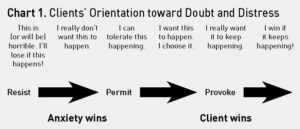
In Chart 1 you will see some possible responses to the symptoms of doubt and distress. Clients enter treatment in the position of resistance. In their most resistant position they say, ‘This is horrible. I’ll lose if this happens.” Even the stance of “I don’t want this to happen” gives anxiety the upper hand, because the mind and body will move into battle mode. Ideally, if clients can respond by saying “yes” to the encounter, and accept exactly what they are experiencing in that moment then they will be back in control.

But for many, the anxiety disorder has become so dominant that the client cannot make such a shift directly. As they attempt to accept their doubt and distress, they do so in order for that discomfort to go away. They are still oriented in their natural position of resisting the symptoms. They are more likely to say, “Let me try relaxing into this situation, and I hope this works, because I’ve got to get rid of this feeling.” The skills associated with permitting the symptoms to exist often allow the client to slide right back into resisting.

For those cases, the game takes a different tact. We re-direct the attention of clients away from fighting the symptoms and purposely toward encouraging them. They choose to act as though the symptoms are good instead of bad, and something to be held onto, even encouraged instead of rejected. As clients master this game and learn its lessons, they develop the insights needed to shift toward a non-attached relationship. If they can endure the discomfort, they can learn. I created this framework of a game to help them endure and to teach them three overarching goals.

1) Step back and identify it as a game
The first critical move is to step away from the drama, observe the event and name it. In meditation and in moments of relative quiet mindfulness, when the struggle isn’t great, you simply “step back.” You let go of your attachment to the thoughts. With anxiety disorders, in order to step back, clients must be able to label the event as one in which the anxiety is trying to dominate their mind. During threatening times, the drama is often too enticing to easily drop. They have already generated an automatic and rigid label that identifies the situation as one in which they should become aroused and worried, for example, “This is a true threat to me.” I encourage them to replace this with any message resembling: “OK, the game’s on: anxiety’s trying to get me to fight or avoid now.”

This is one of the advantages of the game. By training clients in a specific protocol and by strongly reinforcing that protocol, they begin to look for opportunities to practice and they become more astute observers of these moments.

2) Stand down 

Once they step back, they need to engage in a strategy to convey to their mind that it is time to “stand down.” The body and mind need help in backing away from the fight-flight mode. If, in the face of a threatening situation, they attempt to say, “I want this experience,” then the mind begins to have a choice other than battle stations.

Clients also need to stand down from the ego’s archetypal win-lose predisposition—winning by domination—and replace it by a more paradoxical strategy of winning by manipulating the challenger’s moves instead of blocking them.
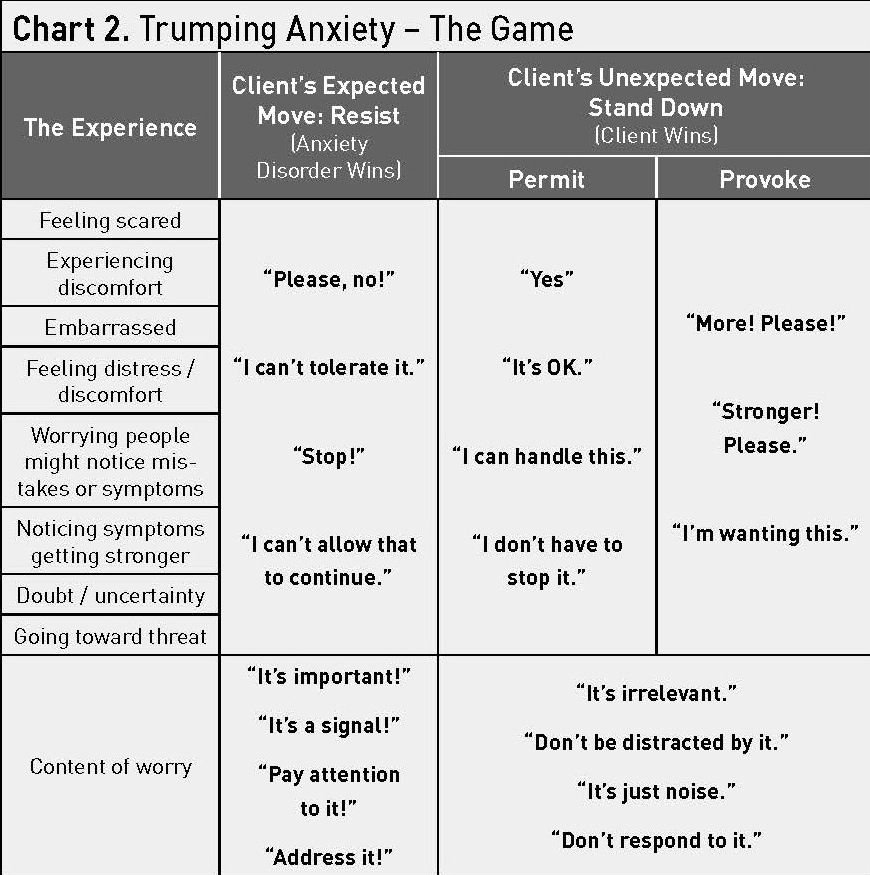
Chart 2 details this next set of moves in the game. Resisting will play right into anxiety’s hands as the expected move. Instead, clients begin the process of standing down by using one of two strategies. Each move is designed to embrace doubt and distress instead of pushing them away.

Standing Down–The Permissive Skills

The first level of the game is to allow the anxiety to continue instead of trying to stop it.

This is manifested in the supportive statements, “It’s OK that I’m anxious,” “I can handle these feelings” and “I can manage this situation.” This approach has a paradoxical flair to it that people often miss. You take actions to manipulate the symptoms while simultaneously permitting the symptoms to exist. With physical symptoms you are saying, “It’s OK that I am anxious right now. I’m going to take some Calming Breaths and see if I settle down. If I do, then great. But if I stay anxious, that’s OK with me too.” We attempt to modify the symptoms without becoming attached to the need to accomplish the task. This is a critical juncture in the work and the therapist must track closely the client’s expected move of, “I’m going to apply these relaxation skills because I need to relax in this situation.” No! While it is fine to relax in an anxiety-provoking situation, it is not OK to insist that you relax. That’s how anxiety wins.We reverse a common American catchphrase by saying, in the face of anxiety, “Don’t just do something, stand there!” When enough epinephrine pumps through the body then the brain yells, “Run!” Consciously overriding this impulsive message takes great courage, but pays great dividends. It differs from desensitization where we help the client gradually approach the feared situation under relaxed conditions. Here we confront their instinct to seek out comfort and encourage them to remain physically anxious and mentally as calm as possible. Instead of believing that there is something broken, they simply accept the status quo.

Going Toward–The Provocative Skills

Many people consider acceptance a weak strategy in the face of the fortress of fear that has been built in the mind. They need to shift from the permissive stance (“It’s OK this is happening”) to the provocative stance (“I want more of this discomfort!”). Here they learn to encourage the symptoms instead of just accepting them. This strategy is extreme and can be thought of as fighting fire with fire. Fear is intense and acceptance is soft. Fear will trump calmness and acceptance every time. I help clients shift to an attitude of provocation that is equally as powerful as, and can compete with, fear. I teach them to use their willpower and conscious intention to seek out an even more rapid heartbeat, to encourage their feeling of contamination to grow even stronger, or to hope someone will notice their hands shaking.

Why this line of attack? Because we want to interrupt the dysfunctional pattern in the most effcient way possible. The straightforward way, using acceptance, is not necessarily the most effcient way because it tends to be susceptible to the clients’ dominant paradigm of resistance, for example, “Let me try to relax here and I hope this works, because if I panic that will be awful!” Consciousness only has so much attention at any given moment. During an anxious moment, I encourage clients to commit themselves to play the game, and to focus their limited attention on following the rules: try to get anxious on purpose by encouraging symptoms. If they will bring their attention to the task of encouraging, even cajoling symptoms to become more uncomfortable, or for doubt to grow exponentially, then they automatically withdraw attention from their fearful goal of ending the doubt and distress.

When I suggest homework activities to clients, I use expressions like, “how about playing with this move?” and “perhaps you can fool around with these responses.” I imply that these strategies are malleable and temporary: “What do you think about just experimenting a few times with this move and see what happens? We can talk about it next time.” For some, we will literally play a game in which they score points for various types of responses to their worry or anxiety, or they will have to pay a consequence when they avoid or engage in some ritual to help themselves feel safe instead of threatened. An example of this strategy can be seen in the case of Samuel. One of Samuel’s fears was that he might unknowingly have cuts around his fingernails and cuticles that would expose him to the AIDS virus while shaking hands at work. Throughout the workday he conducted brief checks of his ?ngers. I gave him the following assignment:

  • Go to the bank and get 40 fresh one-dollar bills.
  • As you leave home in the morning, fold them and place them in your left pocket.
  • Each time at work that you compulsively check your fingers you are to move a bill from your left to your right pocket.

This is a simple intervention, but I gave it to someone who was already oriented to the game. He knew that the only way to keep those dollars in his left pocket was to go toward his distress of not knowing if he was being exposed to AIDS. As he began the game, a typical email from him would say, “By the end of the day, I only had $10 in my right pocket!” There was something about adding that “game” that refocused his attention just enough to lower his struggle and raise his success rate.

I hear this from clients time and again: when they focus on scoring points, or avoiding a therapeutic consequence that we create together, they notice that they become less attentive to fighting the symptoms. When they disrupt their on-going relationship with anxiety by struggling to play the game, they spontaneously become more tolerant of the situation and their distress diminishes. Over time, as they learn the surprise benefits of this pattern disruption, they can congruently adopt the permissive style.

As you might imagine, these people are not easily persuaded to really want this experience. However, this is not the point of the exercise. The point is that they try to associate themselves to the task even if their initial attempts are clumsy. Clients can be encouraged to pretend to want their anxiety, like a role in acting class. This is a cognitive skill, so the work is directed to what they are mentally saying during practice. As they try to subvocalize as if they want to increase their doubt or discomfort, they will automatically dissociate from their typical negative interpretations.

If a client has trouble encouraging the physical symptoms, for example, “I can never want my hands to sweat,” then I suggest a minor shift in their focus. Instead of directly requesting physical symptoms to increase, I ask them to request that the anxiety disorder make the symptoms stronger. Instead of saying, “Come on! I really want to faint right now!,” they say, “please, anxiety, make me more dizzy.” This seems to be just enough misdirection and dissociation to make it tolerable to them, and accomplishes the same goal of competing with their resistance.

The central strategy of the game is for clients to want to embrace whatever the anxiety disorders want them to resist. One of the primary ways I convey the logic behind this wanting is by first defining the process of habituation: prolonged exposure to a feared situation, bringing about a significant decrease in fear.

Wanting Habituation

Habituation requires three elements: frequency, intensity and duration. You have to expose yourself to your feared situation often enough or you won’t progress. When you practice, you need to get up to a moderate level of distress. Practicing while you try to keep yourself calm actually slows your progress. Practicing between 45 to 90 minutes seems to be the ideal amount of time according to the research. These three components of habituation guide all homework assignments.

I think there is a fourth element missing: the spirit of wanting to experience what you need to experience. Clients progress much more rapidly when they desire to have the habituation experience. Unless they are seeking and wanting frequency, intensity and duration as they go toward fear, then by default, they will be trying to do the opposite. They hope they don’t get anxious, that the symptoms don’t get very strong and distress doesn’t last very long. This makes no logical sense to me. If frequency, intensity and duration of exposure to distress and doubt are needed for me to get better, then I want to stumble upon a situation which stimulates my anxiety. I want to do that often, and I want my distress to last, and I want the sensations to be strong. These elements create habituation and habituation is my ticket out the door away from suffering.

Cognitive-behavioral therapy does not teach this specific orientation to clients, although I think it should. If it did, it would alter clients’ disposition toward the problem, help to guide their practice, give them motivation and I’ll bet that it would alter neurochemistry as well. Analogously, if we are receiving chemotherapy for cancer treatment, it would be poor therapeutic form to go to each appointment dreading it, despite the fact that the side effects can truly be dreadful. Instead, you should see the chemotherapy as your friend, augmenting your body’s natural ability to heal. That’s good placebo.

The most important benefit of applying the skill of wanting is that it speeds healing by truncating the habituation process. Clients learn rather quickly that if they invest in the stance of wanting, it returns to them the gift of a rapid reduction in their anxiety. They gain insight sooner in the process, after fewer practices and after fewer minutes within each practice. When they apply the skills of the game during practice, they actually have quite a hard time keeping their distress high (try as they might) or having it linger around for those 45 minutes. By paradoxically applying the orientation of wanting, clients have an “aha” experience during practice that brings freedom.

3) Master the skills of the game through applying technique and practicing (or being a “good student of the work”)
I discuss with my clients the idea of “being a good student of the work.” Good students, of course, are clients who commit to following through on a homework assignment, and then work hard to keep their commitment.

One of Moira’s many OCD compulsions involved her needlepoint work. Frequently she felt compelled to tug on the thread ten times as she tightened a stitch. I offered her a new ritual to adopt. Each time she tugged more than once, on that next stitch she was to tug ten-plus-two times (12). The next stitch she had to subtract three to the number, tugging nine times. Ten on the next stitch, add two, and so forth, until she reached one tug. Her ten-tug stitch became a ritual involving 113 tugs in the next seventeen stitches. She hated that! But she did it, because she was a good student of the work. By forcing herself to stick with our little game, she increased her conscious awareness of her thoughts, feelings and urges during the moments just prior to her compulsive action. At the moment of the urge to pull more than once, she became alert to the punishing consequence. This strengthened her ability to turn away from it. Within a week, that compulsion was of her list of troubles.

Skills Meet Challenge

Doubt relates to clients’ perception that their skills won’t match the challenges they face. If their assignment is within their skill level, then they will be more willing to go forward. This usually means we must lower the challenge and offer them a performance goal within their perceived skill level.

If I am an OCD checker, and I think I have just run someone over, I may yet have the skill to resist my urge to turn the car around and check the highway again. But how about pulling over and running around my car one time before I turn around? I can do that. And now I have interrupted the pattern, which provides me an opening for further changes. One day, as I am having the urge to check, remembering that I now must pull the car over and run around it (again), I might spontaneously decide that that is simply too much effort. At that point I will drive on, and thus experience, with little suffering, exposure to my feared outcome without engaging in my ritual.

Score Points! Win Prizes!

The assigned tasks can be so challenging, so threatening to clients’ frame of reference that they refuse to practice. Even if they do practice, their early efforts may give them only small gains. I mentioned earlier that I create a frame of reference of addressing anxiety as a game in which you can score points. For some clients I create prizes as extrinsic rewards in the early learning phase. Sometimes I offer them metaphorical images, for example, “Imagine that if you walk all the way to the back of the store and stay there 10 minutes that I will magically transfer $10,000 into your savings account. Could you do it then? Play to win, as though your life depends upon it.”

Currently, I have a large woven basket full of prizes, wrapped as gifts. In my anxiety group I bargain with clients: “Anyone who completes three practices this week can draw from the basket.” I have been hiding a $5 bill within two of the prizes as an extra incentive. Last month I rewarded the group member who earned the most points over the previous week with her choice among 12 new self-help books.

Recently I have generated a competition in the group during a several-week period. I agreed that for each member who practices at least 3 times I would contribute $5 into a weekly “pot” of money. I devised a point system to be used for every practice session. Each person decides where and how he or she will practice. Whoever scores the most points, wins the pot. The winnings can grow to be $90.

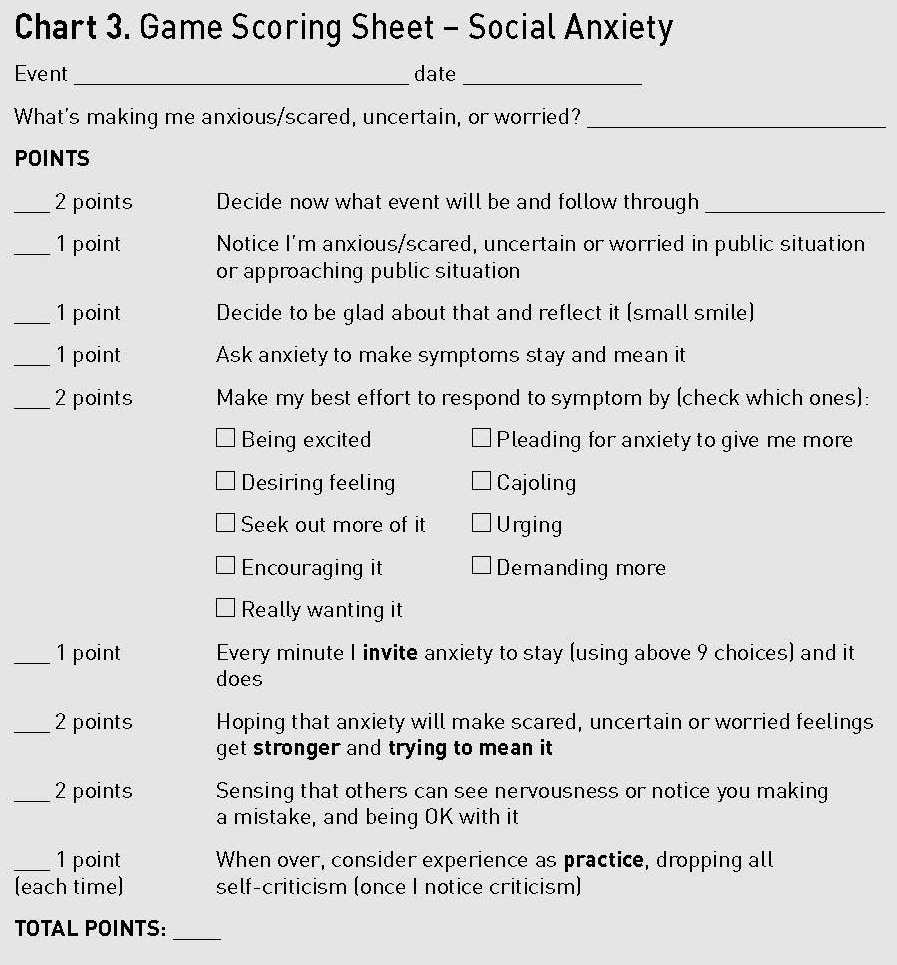
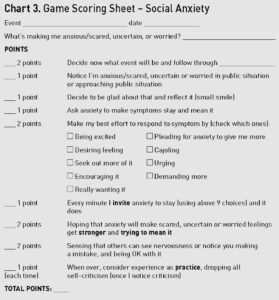
As you review Chart 3, you can see the essence of the provocative game and the weight of each type of activity. These illustrate the goals I want them to set during practice. They reflect the essence of paradoxical action in fearful situations:

In a threatening situation, step back and become an observer of your process, not be 100% the actor in the drama. Decide to be glad about having the doubt or distress. Put a little light smile on your face or in the back of your mind to reflect it. Then, invite whatever struggle you are having, whether physical symptoms or worries, to stay. Work on trying to mean it. If possible, try to strengthen your move by intensifying your reaction. [For example, I offer nine different choices, such as the previously discussed demand that anxiety make the symptoms stronger.] No matter how strong the doubt and distress becomes, you should treat it as if it is never enough. Reward yourself for every minute you actively invite the symptoms to stay or to get stronger. Accept that other people might notice some problem you are having and for extra credit: hope that they do! Then, when you are done with the practice, learn to support yourself. Drop that critical, disappointed voice.Creating the point system has a number of benefits. The client and I establish a broad strategy together that is manifested through specific actions during practice times. But they pick the practice times to apply the skills. They answer the question, “What can I do today to create some strong uncomfortable feelings for a while?” As they act on this choice, they are empowered and feel a sense of control. Once they are in the anxiety-provoking moment, the point system directly guides them to the therapeutic action.

It is poor strategy to get into a threatening situation and then decide how to act. In that setting, they are competing with a well-habituated set of instructions (“brace, worry, and avoid if necessary.”) Clients are much more likely to regress back to their safe actions, or inactions. When they understand the rules of the game and commit themselves to follow those rules, then recall them as they face threats, they have the best chance of winning

Social Anxiety Strategies

Social anxiety disorder gives clients shaky hands, a quaking voice and worry about the critical judgments of others. Here is the role that it expects of the client: to not want the experience, to avoid it when possible, and to try to get rid of it. When choosing to play the game they ask for the opposite of what anxiety expects: they want anxiety to make their hands shake, their voice quake and their sense of threat heightened. Not only do they request those experiences, but they want them to stick around as long as possible! The clients then attempt to exaggerate their wanting of this experience, and might “desperately plead” for social anxiety to generate shaky hands, or to “cajole” the anxiety to make the experience stronger. They can increase their score by hoping that people will criticize their boring talk or question their shaky handwriting. Earn enough points, win a prize! They refuse to play the game that the anxiety disorder expects. They take charge and push that game board away and pull up their own game board of seeking out doubt and distress when anxiety wants them to defend or run.

Julie

Julie decides to practice facing her social anxiety by eating lunch out alone. She walks onto the lunchtime crowd of “Moe’s Southwest Grill” and is instantly greeted by the cooks and other staff. “Hello! Welcome to Moe’s!” they yell, and the other patrons turn to see who’s entered. Julie begins to feel the flush of red rise in her face as she smiles and nods her head in acknowledgement. Then inwardly she smiles and says to herself, “Yes! Another point.”

Here she describes the process. I’ve added my comments in brackets to her key statements.

“I was really nervous walking in there. I felt like everybody noticed that I was by myself. But that was OK, because that was the point of the whole practice. [She is listening in to her inner conversation and she is permitting her feelings instead of blocking them.] Then having to find a place to sit and making that conscious decision: Am I going to sit with my back facing everyone? Am I going to sit and actually have to look at everybody while they look at me? I made the choice to sit and look at everybody while they looked at me. [She is taking control of the situation by listening in on her process and choosing the more intimidating option.] …I reminded myself that the longer I could stay and the longer I could be nervous and be OK with it, then the better it would be for me. [She has adopted a new belief system about her goals in the fearful situation: stay anxious to win.]

“I thought about how I could make it stronger. I thought that facing everyone while I ate would keep the anxiety going. I was just trying to think of ways to keep the anxiety going. [She is actively strategizing how to provoke symptoms as a powerful way to help her stop resisting.]

“I’m not as afraid of social anxiety as a word because I’ve taken social anxiety and I’ve turned it into a person instead of a condition. It’s not a mother, it’s not a father, it’s just this person or this entity and she wants me to take care of myself. She doesn’t want me to be embarrassed. When I do something that she thinks I could not do, she is impressed. I really like that because it is not a judgmental thing. It is like someone saying, ‘You really should wear a jacket, it’s going to rain.’ But you go out there without a jacket and it doesn’t rain, and they say ‘OK, you did it; you’re still a good person.’ So that’s how I’m thinking about it. [She now comprehends that those ogres, worry and anxiety, have been in her life to help her. They just do it in a clumsy way and she has found a better way. Julie will win this game for good.]”

OCD Strategies

OCD wants the person to try to get rid of any doubts about safety and to take any actions necessary to remove distress. Many OCD clients who fear contamination really do believe that at the moment of exposure they must repeatedly wash to save their life or the life of someone they love. Personifying OCD, I emphasize how it needs them to believe the specifics of their fears. Clients who win over OCD will hold fast to the belief that this is an anxiety disorder. As such, their battle should be with the physical symptoms of anxiety and the urge to end doubt. They should by no means battle with the content of the obsessions. It is never about germs or rabies or salmonella. It is always related to the fear of feeling distressed about threat. To play the OCD game clients set the overarching goal of seeking out doubt and distress.

Eventually, everyone in OCD treatment will do exposure (of the feared stimulus) and ritual prevention, which is the standard treatment for this disorder. But modifying the ways clients obsess or how they perform the ritual is the most efficient starting point for many. Starting with small, lower-threat changes allows clients to practice their new skills and experience early success. Instead of not washing their hands at all after they feel contaminated, clients can change how they wash, where they wash, or what they are doing mentally while they wash.

Jai

Jai was living in a residential program for teens. He struggled with about a dozen different types of washing and cleaning rituals, especially when it was his turn to handle the after-meal cleanup. One ritual required that after he was finished with his (thorough) cleaning of the kitchen, he was to squeeze the sponge ten times while rinsing it under running water.

In our first treatment assignment I asked him if he would fool around with the ritual by switching hands each time he squeezed. In this case, Jai got to keep squeezing and keep counting. He simply altered hands, and switching hands was only a minor threat to him. This is what I call throwing the symptom cluster a bone. You leave in place major components of the ritual or obsession, thus lowering the threat level. However, it is still a change that begins to erode the original fortress of symptoms. He agreed to the assignment, and returned the next week to report how easy that task was. I then suggested this further revision: would he be willing to explore his ability to toss the sponge in the air and catch it with the other hand for each switch? Again, he agreed to this small, silly shift and returned the next week reporting no problems with the task. The following week, he simply squeezed one time and set the sponge down without struggle.

Jai’s playful approach to modifying his ritual became a relatively painless means to arrive at exposure and ritual prevention. It served as a building block for some of his more difficult later encounters with OCD.

Jordan

Jordan, a physician, feared contamination with germs that might come in contact with her clothes during the workday at her medical practice. One of her primary rituals was to spray the entire front of her body with ammoniated Windex® as she left work. She used that same Windex® throughout her home when she felt threatened by germs. Ironically, while Jordan obsessed about becoming sick, her husband, who was also a physician in her practice, was developing serious respiratory problems from inhaling the ammonia. Over months, Jordan worked hard to tolerate switching the Windex® to vinegar-based, then to dilute it to a 50% solution and finally to a 33% solution. Each of these steps increased her doubt just enough that she could tolerate it and experiment with the change. Once she implemented the change, she incorporated it into her routine without much struggle.

But we could progress no further with this or the other safety rituals she performed. Jordan was stuck on the content of her obsession: things had to be clean enough. I failed to persuade her that her attention actually needed to be focused on the strategy of confronting doubt and uncertainty.

Vann

Vann came into treatment struggling with OCD checking rituals that lasted up to five hours a day. Often his concern was that he had missed seeing something he should have noticed: new scratches or dents on the trash can, dust particles under the telephone, an inappropriate item in the basement. Other times he checked as a way to prevent a disaster: an electrical cord will be wrapped around the trash can; his son will trip over some item on his bedroom floor; a fire will start in the kitchen or a flood will occur in the basement. Some days Vann would check a particular item over a hundred times.

Our first ploys involved gently modifying his relationship with his symptoms. For instance, he would check the trash can, but only in slow motion, ever so gradually picking it up and unhurriedly rotating it in his vision. Or he would study the telephone, but not allow himself to touch it. These were his first playful explorations into uncertainty and distress. By the sixth session we added a strategy of postponing. OCD would give him the impulse to check the basement immediately. He would choose to wait thirty minutes before he acted on that urge, again learning to tolerate his discomfort. Through this gradual exposure to the principles, by session nine he was able to avoid locking his house for five days.

Here is how he described his progress by session 10:

“In the past I would pull out the backseat of the car, and if there were dirt there, I would have to clean it up. If a bolt was there I would look at it and get stuck on the backseat, focused on that bolt. Now I do this intentionally. I lift up the backseat and try to make something really bother me, try to feel anxious. I feel that anxiety, replace the backseat, shut the back door of the car and walk away.

When I first started walking away I felt really anxious. I wanted to go back and look at something under that seat again. I felt as though I didn’t look at it hard enough and I’d want to look at it again. I would sweat a little bit, my heart would beat faster, I’d become very irritable and I felt very compulsive. I wanted to go check again! But I just decided I wasn’t going to do it. Sure enough, about two hours later the desire went away.”

Vann completed his treatment in eleven sessions over 5 1/2 months. In a follow-up twelve years later, he remained symptom-free and medication-free.

Conclusion

I began this conversation saying that when I work with anxious clients, I keep my points broad and simple and I focus on them repeatedly. My goal is to influence clients’ perspectives and shift their orientation. I encourage you to try the same.

Help clients to turn away from the content of their fears whenever possible. You cannot always ignore content, because clients will be wrapped up in it. But get past content as soon as you can and move into the core themes of people with anxiety disorders: their struggle with doubt and distress.

The central strategy is for them to want to embrace whatever the anxiety disorders want them to resist. They have two choices. They can “stand down” by choosing to let go of their fearful attention and accept the reality of the current situation. This is the permissive approach. When they have completed treatment, this will be their most common response: to say, “I can handle this situation” and to allow their body and mind to become quieter. The other option is to choose to stay aroused on purpose and actually encourage anxiety to dish them more trouble. This provocative choice is an excellent option during treatment, because choice number one is so difficult to embrace during early encounters. Conditioning and a set of false beliefs are calling the shots; they cannot simply relax on cue. Some treatment protocols will suggest that you help them expose themselves to the fearful stimulus and learn that they can tolerate it. I am suggesting that you put a twist on that set of instructions. Help them to take actions in the world that are opposite of what anxiety expects of them. Persuade them to go out into the world and seek out opportunities to get uncertain and anxious in their threatening arenas. This is a shift in attitude, not behavior. The behavioral practice is not to learn to tolerate doubt and distress, it is to reinforce the attitude of wanting them.

Our ultimate goal is to teach clients a simple therapeutic orientation that they can manifest in most fearful circumstances. Early in treatment, however, you will also need to provide a specific system to follow, with simple rules that guide their interactions with fearful anxiety. Using behavioral practice, encourage them to repeat this new interaction again and again, in all their fearful situations.

You can assume that one of the biggest obstacles to success will be poor planning just moments before the encounter. Whenever they wait until they are scared before deciding the best course of action, then conditioning and faulty beliefs will dictate that they struggle or avoid. In that setting, they are trained by fear to mindlessly seek safety and comfort. Before they enter any situation that is potentially threatening, they should review their objectives and remind themselves of their intended responses.

Thinking of their relationship with anxiety as a mental game offers both a broad therapeutic point of reference and specific actions that manifest it. Initially, your skills of persuasion and their belief in you will push them to challenge their faulty beliefs. After that, experience will be their greatest teacher. Once they have acted on these beliefs and gotten feedback during the fear-inducing event, that learning will put the power in their new orientation and it will be self-sustaining. They will then have a set of instructions, such as “anxiety, please give me more” or “I’m looking for opportunities to get distressed” that will point them toward simple choices during difficult times. And they will have a skill set (that I laid out in Charts 2 and 3) that they believe will match the challenge of the situation.

Unburden What Has Been

It was like most mornings; a brisk walk in the local nature preserve, downing the last drop of coffee, and heading off on whatever adventure I could create for myself before settling in for the day.

On the way out of the preserve is a very homemade road sign, one I pass so frequently it has blended almost imperceptibly into the surroundings. I remember questioning its purpose the first time I saw it, saying something to myself like, “gotta be a religious statement.” It checked all my boxes for a roadside reminder of God’s ubiquitous presence in our lives: simple statement, homemade sign, profound deeper meaning (if a passerby chose that option)—check, check, check!

Unburden What Has Been

“Unburden What Has Been,” it boldly proclaimed, standing out in sharp contrast to its brown wintery surround. For whatever reason, on that particular penultimate day of the year, I looked down (instead of up to the heavens), and boy howdy was I surprised by what was holding up that sign. A portable commode! A damn potty chair.

Unburden what has been! Donning my clinician’s cap, I thought, “so simple in theory, but so hard in practice,” regardless of which side of the couch you are on. Although for now, I’ll position myself on the clinical side of that couch and ask myself—and you—to look beneath the common factors that undergird successful psychotherapy for the ur-factor, that one therapeutic ring to rule them all. Yes, yes, perhaps a bit reductionistic, but no more so than that fateful sign that birthed this musing.

The goal of psychoanalysis is to penetrate the unconscious and its myriad of defenses to free repressed thought and emotion so the patient can have full insight into and resolve conflict. Unburdening in its fullest form.

The goal of Cognitive-Behavior Therapy is to release the client from the torturous grip of self-defeating thoughts and repressive behavioral patterns, so the client can finally achieve freedom (and dignity?!). Unburdening, once again.

The goal of Rogerian treatment is to use the presence and person of the therapist to close the gap between the client’s ideal and actual self so they may become more fully functioning. I imagine there is no better state of unburdened(hood) than that.

And what about the goal of Narrative Therapy? Isn’t it to unburden the client from the pre-scripted demands of their self-defeating stories that were often created in systems of oppression? And then of course, there are the Systemic Therapies, a more challenging venture, where the goal is to cancel out the noise, empty out the closets, and shoo away the ghosts, so couples and family members can peacefully, safely, and lovingly co-exist. A shared unburdening project.

I could go on. . . but in short, we clinicians, regardless of therapeutic orientation and methods, are all in the business of helping our clients, our patients, or in the words of Irvin Yalom, fellow travelers, to slow down, take a breath, look inside and around, and unburden themselves.

A worthy goal, not one so easily achieved, but definitely one worth the journey—one I’m reminded of every time I walk through that nature preserve.

Questions for Thought and Discussion

  • Can you think of an incidental inspiration such as this one that has impacted your clinical thought or practice?
  • What do you think are some of the common factors in therapy that drive your own practice?
  • Can you think of a client with whom you’ve worked that has deepened your appreciation for the power of unburdening in therapy?

Lessons in Tough Compassion and Male Resistance to Therapy

As a counselor and educator, I often find myself reflecting on representations of therapy in popular culture. One film that has stayed with me over the years is Good Will Hunting. While the movie is celebrated for its exploration of genius, trauma, and relationships, what stands out most to me is the character of Sean Maguire, the therapist played by Robin Williams. Sean’s approach to therapy, particularly with a resistant male client like Will Hunting, is a masterclass in what I call “tough compassion.”

The Unsung Hero

Sean Maguire is a humble community college professor and clinician. He is a quick-witted, grounded therapist who connects with Will person-to-person. His approach is in sharp contrast to the two other high-profile therapists Will is forced to see, who never get on Will’s level. Sean is the kind of professional whose impact might never make headlines but is deeply felt by the individuals he helps. How the film represents Sean’s work really resonates with me as a counselor. While we may not gain the accolades of more visible professions, or write noteworthy, high impact therapy texts, get featured on TV shows, and so forth, our work of helping individuals confront their pain, realize their potential, and find healing—is no less meaningful.

Sean’s humility and commitment remind me why I chose this path in the first place. The scene where Sean and Will end their time together with a hug speaks volumes of the positive impact that Sean had on Will, that Will can’t even begin to articulate. And Sean knows it. The two men say so much without saying anything; the impact the relationship had on both men on such a deep level is clear. While this particular element of the movie inspires me, it is the way in which the movie demonstrated male resistance to therapy, and Sean’s tough but compassionate approach with Will that I love.

Male Resistance to Therapy

We can see in Will’s interactions with the other two therapists that he made outrageous comments and disingenuous intimate disclosure meant to derail the session and throw the counselor off his game. But with Sean, he is able to roll with the resistance (in a very Milleresque manner). He doesn’t get offended or distracted by the resistance, but continues to redirect with humor and direct questions back to Will (except for when Sean choked Will out on their first session, we’ll ignore that for now). This approach, over time, with some vulnerable disclosures from Sean about his life, losses, and relationships, eventually get through to Will.

Will starts opening up and letting Sean into his inner world. He begins to trust Sean. Will’s reluctance to engage with Sean reflects a broader societal issue, and one that I have often noticed in my practice: men struggle to open up about their emotions or seek help. Cultural expectations of toughness and self-reliance can make vulnerability feel like weakness. Sean understands this resistance, and rather than forcing Will to conform to a traditional therapeutic model, he meets Will where he is—both emotionally and relationally.

Tough Compassion in Action

Sean’s approach is what makes him so effective. He doesn’t back down when Will tests his boundaries. In their first session, Will mocks Sean’s deceased wife, pushing him to the edge. Rather than retaliate or shut down, in a manner of speaking, Sean asserts his boundaries with firmness (although I don’t endorse choking out your client). “You ever disrespect my wife again, I will end you,” he says. This moment is not about anger or dominance; it’s about authenticity. Ultimately, it is what earns Sean respect and credibility in Will’s eyes.

Sean’s tough compassion also shines in his willingness to challenge Will. He sees through Will’s intellectual defenses and calls him out on his fear of vulnerability. In another memorable scene, Sean tells Will, “you’re terrified of what you might say. Your move, chief.” This balance of empathy and accountability is a cornerstone of effective therapy, especially with male clients who may be guarded or skeptical of the process.

The Impact of Authentic Connection

The turning point in the film—and in Will’s therapy—comes when Sean shares his own vulnerabilities. By revealing his grief, regrets, and imperfections, Sean shows Will that strength and vulnerability can coexist. This authenticity creates a safe space for Will to confront his own pain and begin to heal. For me, this aspect of Sean’s character underscores the importance of being real with male clients. Therapy is not about having all the answers or maintaining a perfect façade. It’s about creating a relationship grounded in trust, respect, and genuine care—a relationship that can serve as a foundation for growth — and being willing to change up one’s approach to therapy with male clients, using a tough technique that’s counterbalanced by compassionate.

Lessons for Counselors

As I reflect on Good Will Hunting, I’m reminded of several key lessons for working with male clients:

  • Meet Clients Where They Are: Understand their resistance and adapt your approach accordingly. Resistance to therapy among males is not the end of the road, but a bump. So, roll with the resistance, and redirect back to the client with honesty, empathy, directness, and humor.
  • Balance Empathy and Accountability: Build trust through compassion while challenging clients to confront their fears and defenses.
  • Be Authentic: Share enough of yourself to foster connection without overshadowing the client’s journey.
  • Value the Quiet Impact: Recognize that our work, though often unseen, can change lives in profound ways.

Sean Maguire may not have had the fame of his academic peers, but his influence on Will Hunting’s life was transformative. As counselors, we may not always see the ripple effects of our work, but Good Will Hunting reminds us that our presence, compassion, and persistence can make all the difference.

Good Will Hunting is more than just a story about genius and redemption; it’s a testament to the power of connection in therapy. Sean Maguire’s approach—grounded in tough compassion and authenticity—offers a blueprint for counselors striving to make a meaningful impact, particularly with male clients. The film is a poignant reminder that while we may not always receive recognition, the relationships we build with our clients can be life changing.

If you’ve ever wondered about the quiet yet profound impact of counseling, Good Will Hunting is a must-watch, and if you’re a counselor, it’s a call to embrace authenticity, persistence, and the transformative power of tough compassion.

Questions for Thought and Discussion

  • In what ways do or don’t you connect with the therapeutic concept of “tough compassion?”
  • What movie featuring a therapist has inspired you, and why?
  • What emphasis do you place on connection in your therapeutic encounters, particularly with male clients?

How Do You Maintain Compassion and Respect for Your Clients?

Compassion is the basis of morality.
—Arthur Schopenhauer, The Basis of Morality  

Should you have to treat people who have assaulted or murdered others? What about working with clients who hold hateful beliefs or taboo fantasies or act in ways that directly contradict your moral standards? What if they’re blatantly sexist, racist, homophobic, or transphobic? How do you know what your role is when you feel disgusted or angry or upset by how a client lives their life?

All humans are unquestionably shaped by their values. No matter how much you try to embrace your open mind, some implicit biases are inescapable. Everyone has preconceived criteria for which behaviors feel acceptable or unacceptable.

Therapists often work with people the rest of society often belittles, misunderstands, and ostracizes. When a client sees only the bad in themselves, you reach in and find all the good. You hold a light in a place that can feel so dark.

But what if you don’t like the client? What if you not only disagree with their values but find their personality annoying or obnoxious? What if some or all of their mannerisms irritate or upset you? What if you find yourself feeling agitated during your work together?

Let’s slow down here. We invite you to spend a moment thinking about a value you hate. Hate is a heavy word; we chose it because it triggers strong emotions. For example, maybe you hate self-centeredness or people acting like they know everything. Now imagine you have been assigned to work with a client who holds or embodies these specific traits. They show no interest in changing, but they’re in a state of distress, they need help, and you have the expertise to help them.

Could you do the work? Could you genuinely support this client, find their goodness, and be on their team? In everything you do with them, could you commit to caring about their well-being?

Feelings of dislike exist on a large spectrum. Unfortunately, you may not be prepared to manage it when it happens. Negative countertransference arises when we experience conscious or unconscious negative reactions toward a client. Despite the word negative, these feelings are not good, bad, right, or wrong. But we must be mindful of how they can affect treatment. Acting out as a result of negative countertransference can include:

  • Rejecting your client
  • Offering unsolicited advice
  • Avoiding certain topics because they make you feel uncomfortable or unsafe
  • Openly disapproving of your client’s choices
  • Withdrawing from emotional connection
  • Being defensive or dismissive of your client’s feedback
  • Demonstrating inconsistent boundaries throughout treatment
  • Trying to overcompensate for your dislike by being overly agreeable or passive
  • Prematurely abandoning a client due to your own frustration or hostility

Negative countertransference sometimes happens when a client inadvertently knocks at unresolved parts of your own life. Maybe their anger reminds you of your father’s anger, and you have a contentious relationship with him. Maybe their passivity speaks to your own difficulty asserting yourself, and you resent having to be the strong communicator in the relationship. Perhaps you’re an unpaid intern and aren’t sure if you can make rent this month and your wealthy client is lamenting about their next real estate venture. Because you are a human and not a robot, it would make sense if you felt agitated by these circumstances.

There are no bad clients. But some clients may feel bad for you. In addition to unpacking personal reactions in therapy and supervision, here are some guidelines for managing your emotions and offering helpful and ethical care to your clients. We explore them in more depth in the subsequent sections.

Managing Your Emotions in Therapy

Leaning deeply into unconditional respect: Deliberately choosing to respect your clients for who they are, where they are, and what they bring to you

Deliberately searching for the good: Intentionally finding and holding on to your clients’ strengths and virtues

Embracing empathy as a nonnegotiable: Prioritizing a warm, empathic approach with your clients regardless of your similarities or differences

People are just as wonderful as sunsets if you let them be. When I look at a sunset, I don’t find myself saying, “Soften the orange a bit on the right-hand corner.” I don’t try to control a sunset. I watch with awe as it unfolds. Carl Rogers, A Way of Being 

Respecting clients means fully accepting them for who they are and where they came from. It entails honoring where they stand in their current journeys.

Respect moves into valuing autonomy. Clients have the right to live their own lives and make their own choices. You can have your opinion, but you do not live in your client’s body, reside in their home or community, or manage their relationships. Respect is the prerequisite for unconditional love. And love can be such a rich part of therapy, even if you don’t identify with loving your clients in the specific sense of that word. Respect is also a catalyst for helping you release rigid expectations about how a client should think or behave. This opens deep space for curiosity and connection.

Respecting clients does not mean condoning problematic behavior. We’re not advocating clients harming others or themselves. We absolutely want to see people make optimal choices in their lives.

However, respect means seeking to connect with the context and motive driving someone’s behavior. As a species, each person’s way of being is influenced by so many factors, including their culture, geography, upbringing, family influence, neurobiology, trauma, and genetics. It is especially important to remember this when working with clients you find challenging.

Respect can get muddled if you struggle with believing your clients owe you something. For example, therapists sometimes believe that clients owe them:

  • Complete honesty
  • A desire to do deep work
  • The belief that therapy is a worthwhile investment
  • Motivation for growth
  • Insight into their current needs or problems
  • A full understanding of therapeutic boundaries
  • A willingness to integrate feedback
  • Socially acceptable behavior
  • Measurable progress

Having some parameters for treatment is reasonable. You are hired to support your clients to achieve specific mental health treatment goals. This work should adhere to certain protocols; deviating too far from the basic structure of therapy can create problems. However, treatment in the real world does not exist in a predictable cut-and-paste formula. Clients come to therapy with unique personalities, unmet needs, and distinct behavioral patterns. Many arrive in a state of crisis when other resources have proven to be unreliable or unavailable. If they are mandated to therapy, they might resent having to meet with you altogether. In almost all cases, clients are juggling numerous stressors, and they want relief from their distress.

Respect helps therapists mitigate the risk of inappropriately generalizing or stereotyping clients. For example, let’s say you conduct an intake with someone who discloses a horrible experience they had with another therapist in the past. They express their anger toward the healthcare system and tell you they have doubts that you can help them. Some therapists would flag this client for being “too difficult,” or even, “treatment resistant.”

Respect means you give the client the benefit of the doubt. You listen to what they have to say about those past experiences. You care about their pain, and you emphasize that you care about that pain because you value their wellness.

As a therapist, respect means you hold the CHAIR (consistency, hope, attunement, impact, and repair) model as much as possible. You strive to convey a positively consistent presence for your clients. You find and hold on to hope for change in every way you can. You seek to attune to their emotions and needs. You look for opportunities to impact them and help them experience their world differently. And if and when conflict occurs, you take the lead in repairing that discourse.

Respect also means truly owning what lies in your locus of control. This, too, is covered by CHAIR. Ultimately, you can control the knowledge you obtain, the therapeutic actions you take, and the presence you exude. You control the boundaries you set, how you advocate on behalf of your clients, the referrals you provide, and the way you acknowledge making a mistake. Depending on your specific workplace setting, you may also control many logistics, including your fees, documentation protocol, after-hours contact, intake paperwork, and the arrangement of furniture in your office.

In reality, however, you can do everything you’re clinically supposed to do, and you still can’t control your client’s reactions. You aren’t in charge of deciding whether you have rapport. You can’t fix whether a client’s partner loves them or whether their boss perceives them to be incompetent. You can never control what a client does or does not do within the context of therapy itself.

The good news is that the more you can respect your clients, the more meaningful this work feels. This is because when you have a foundation of respect, you can lean more deeply into the caring part of this work.

We believe it’s impossible to care too much about a client. To care is to be invested in someone’s well-being. When you care, your heart and soul come into this work. It is one of the most beautiful traits you can bring to clients. As for us, we care about our clients immensely and wholeheartedly. We also have no qualms about telling them we care. We want them to know they are worthy of being cherished because they are. Holding this privilege gives our work such vitality.

Caring is not the same as enabling, overextending, or breaking therapeutic boundaries, however. Those specific actions often come from a place of caring, but they might speak more to unchecked countertransference when therapists lose professional objectivity and presence.

Caring lends a hand to respect, allowing you to detach your compassion and tenderness from expectations. Within this state of respect, you genuinely want what feels best to your clients without defaulting to an assumption that you know what’s best for them. You can value rapport and connection without ever demanding it. Most of all, you can and should care without conditions.

From this lens of respect, therapists can trust how the process of therapy organically unfolds. The freedom lies in the flexibility. It is the balance of accepting clients for exactly who they are while holding on to the hope that change can always happen.

Therapy, from this framework, bursts with possibilities. Embracing radical curiosity sets the stage for holding unconditional positive regard for your clients.

You won’t agree with or like every client you work with, but respect means trying to understand that most everyone is doing the best they can in a given situation. People want to secure their survival. Clients seek to avoid pain, even when that means hurting themselves or others.

How You Cultivate Deep Respect for Clients

Prioritize curiosity at its utmost capacity: What past circumstances led this client to make the choices they made? How, in every moment, are they seeking to minimize pain? Which behaviors have become solutions to temporarily cope with distress? Who hurt them and created those unhealed wounds in the first place? How are they trying to do the best they can with what they have?

Check in with yourself when you think a client owes you something: Be mindful of the tendency to assume your client inherently owes you something. If you find yourself struggling with this, ask yourself, Why do I find this so important? If you’re struggling to let go of this expectation, practice saying to yourself, How can I meet this client exactly where they are? 

Focus more on what you owe your clients: You owe consistency, hope, attunement, impact, and repair. You can’t control how your clients respond to what you offer. Leaning into your locus of control may help release the demands you feel toward clients or the treatment itself.

Pay attention to your countertransference: Countertransference is not good, bad, right, or wrong. It exists and can’t be avoided. But you can be mindful of how you orient treatment when it arises. Remember that your client, even if they remind you of someone or something you dislike, is a whole person with a distinct personality. Remind yourself often of this aspect of therapy.

Commit to neutralizing your values within therapy: In your personal life, you are entitled to orient yourself in ways that honor your values. But your job as a therapist is to show up and support your clients with respect, compassion, and professionalism.

Allow yourself to care tremendously: You are allowed to care about your clients. You are allowed to have feelings of protectiveness, adoration, warmth, delight, and closeness with the people you work with. Deep care, of course, should not justify consistently breaking therapeutic boundaries.

Have a plan if you simply cannot set your negative reactions aside: Sometimes this happens. You may not be able to work with certain clients because their content is too triggering to you. This does not make you a bad therapist. However, it’s in your client’s best ethical interests to refer them to a provider who can competently treat them. If this isn’t possible, focus on getting quality supervision, consultation, and/or personal therapy to address your issues.

Deliberately Searching for the Good in Clients

As therapists, we are called to search for the good, even when the good feels buried or insignificant compared with other traits we see in our clients.

It is also imperative to remember that no value is unanimous. As the philosopher Friedrich Nietzsche said in his book Beyond Good and Evil, “There is no such thing as moral phenomena, but only a moral interpretation of phenomena.” Humans have decided on some parameters of good and evil, but a choice that feels boundlessly immoral to one person may be entirely warranted to someone else.

If you assume a stance of moral superiority, you risk operating from a “me-versus-you” mindset. This mindset can create competition, and competition erodes the fabric of the relationship you’re trying to build. If you aren’t on the same team, you unknowingly risk becoming opponents. You may feel irritated, offended, and riled by your client. Your client may feel judged, condescended to, or unsupported. You both are apt to move into defense stances—and this defensiveness may prevent the crucial scaffolding of emotional intimacy from developing.

Your work as a therapist means signing up to care about people who think and act differently than you do. Biases are inevitable, but you must be able to examine inward and dismantle feelings of superiority. You are not a savior. You are not the all-knowing expert. You have simply been invited into a sliver of your client’s life. You owe it to them to witness their pain and understand the gravity of their life story.

Searching for the good means assuming a stance of giving clients the benefit of the doubt. This becomes especially important when working with clients who feel challenging. When you can pause and drop into a client’s pain, when you can land into the rawest feelings and deepest wounds, you soften. There are many ways for therapists to soften, but it happens when the therapist can truly land and sit with someone else’s emotions, no matter how big, heavy, or confusing they are.

Softening is the catalyst for opening. Opening emotion, opening trust, and opening connection. Everyone needs a soft place to land, and you have the opportunity to create this place for your clients. Not all will take you up on it. But many will.

Your expertise isn’t what makes therapy meaningful. Your courage to move beyond societal constraints and listen to another person is part of your impact. It’s a deliberate choice. But in our judgmental world, you are privileged to make this choice every session.

It is tempting to find out what is wrong with your clients. The reward of this work comes from uncovering what is wholly good.

Embracing Empathy as a Nonnegotiable

Empathy refers to the capacity for relating and sharing feelings with another person. It means being able to sense what someone might be experiencing and hold space for that experience. When someone feels empathic, they feel warm, and people tend to be drawn to the energy of warm people.

What person comes to mind when you think of the word warmth? It may or may not be a therapist, but it’s certainly someone who feels highly approachable and friendly.

Those who exude warmth demonstrate how much they care about people, and this care is felt through their words and actions. They tend to be optimistic without being overly positive. They remember details and they understand pain. They know how to hold emotions without overreacting or underreacting. You want to be around them because they feel safe, and that safety feels good.

Some people mistake empathic therapists for naive therapists. This, however, is rarely the case. Truly holding empathy without constraints means understanding and making space for all the mistrust, skepticism, and shame that people who walk into therapy carry.

Instead of condemning or withdrawing from those barriers, empathic therapists simply make space without any pressure or judgment. They respect the client’s defenses for their necessary function. Empathy is patient, and empathy doesn’t have an agenda.

We encourage therapists to self-assess their empathy by ranking themselves on a scale from 1 to 5 for each of the statements listed below:

1 = almost never

2 = rarely

3 = sometimes

4 = often

5 = almost always

1. I seek to understand a client’s pain deeply.
2. I consider the context of why someone might think or act in a certain way.
3. I can imagine what life feels like in my client’s shoes.
4. I am told I am a great listener.
5. I am told I am warm or kind.
6. I consider myself to be exceptionally compassionate.
7.When I think about my most difficult clients, I would rank myself as having an extraordinary amount of empathy for them.
8. I do not expect people to change on my behalf.
9. I am patient with relapses, regressions, and setbacks.
10. I believe I can genuinely sit with another person’s emotions well.

You want to strive for a score of 40 or more. If it’s lower than that, consider deliberately practicing more empathy in your work or asking for help if you are struggling with a particularly challenging client. Like any muscle, our capacity for empathy needs to be worked out regularly to build strength. But the stronger it is, the more you will connect with your clients and respect them for exactly who they are.

Guidelines for Softening and Finding the Good

Imagine your client’s younger self: Your client’s present self is a product of millions of interactions and experiences. The “challenging” clients are often the ones who have experienced extreme hardship earlier in their lives. When you can drop into noticing their younger state, you will likely find it easier to hold empathy. For instance, instead of solely seeing a client as an angry, self-righteous man, you can also see the part of him who is a fearful and helpless little boy.

Look past diagnoses and symptoms: Diagnoses are theories that summarize a given set of presenting behaviors. Even if you accept a diagnosis, everything is subject to scrutiny and change as humanity evolves. It is imperative to push past limiting thoughts such as believing that someone with panic disorder or someone with schizophrenia automatically behaves a certain way. Diagnosing can be a helpful starting point, a tool, but it is never an end point. It does not paint the full picture of who someone is, what they struggle with, and what they need to move forward.

Practice more mindfulness: Slow down in session. Be more deliberate with how you listen and understand your client. If it’s helpful, consider entering a potentially challenging session with the intention, I will look for what’s wonderful in this person. When this notion is your compass, you seek to find strength and goodness.

Remember, everyone is trying to survive: This stance can’t be emphasized enough. Recognizing this truth is not the same as condoning any specific behavior. Rather, it offers an understanding of why people develop certain patterns, no matter how destructive.

Prioritize empathy: Although empathy is often taught as a preliminary skill in graduate school, it’s not a pervasive trait among all therapists. If you struggle with experiencing or manifesting empathy, focus on what might be in the way and, over time, prioritize implementing more empathy in your work.

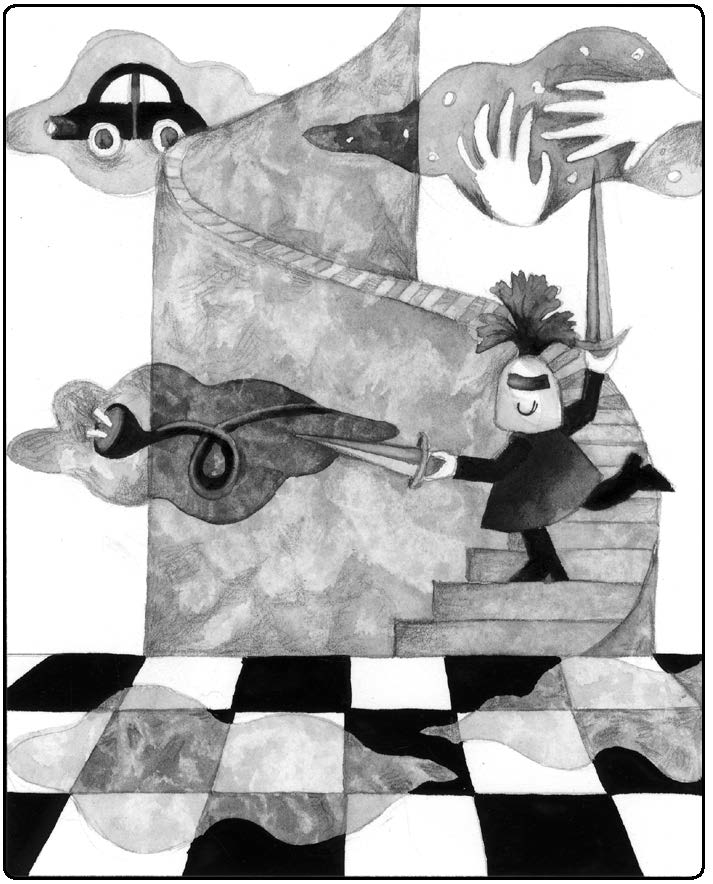
The Importance of Being Heard: When Clients Need Us to Listen

“I feel completely useless to him. I feel like I could fall into a coma mid-session, and he wouldn’t even notice. He’d just keep jabbering away.”

Like what you are reading? For more stimulating stories, thought-provoking articles and new video announcements, sign up for our monthly newsletter.

Navigating Challenging Therapeutic Waters

I spoke these words to my clinical supervisor, Ari. I had been a therapist for just a few months and had no idea how to help one of my clients. Tony, I told Ari, had arrived early to our first session, and before I could even ask, he began telling me his goal for therapy. “I need to learn how to cope with things, especially my girlfriend. When we get into a fight, all I can do is obsess over her. I can’t function at work; I can’t even get myself to do the laundry. I just sit there, looking at my phone, waiting for her to text me.”

I had initially found Tony’s volubility refreshing. Unlike those one-word-answer clients with whom I was struggling to connect, he would answer each question with enough detail to obviate my follow-up questions. Everything about him seemed expressive, even his thick, shape-shifting mop of black hair seeming to change each session as though reflecting his current mood.

Week after week, month after month, he shared his story, telling me about the father who had always seemed intent to one-up him and the mother who would drunkenly come into his room at night and, through tears, complain about her marriage. I started to see how he replicated these childhood conditions in his romantic pursuits, choosing self-involved and emotionally unavailable partners.

Some weeks, his hair spikier than normal, he would describe the wonderful weekend he’d had with his girlfriend—going rock-climbing, going to fancy restaurants—and wonder if she might be the one. Other weeks, his hair noticeably droopier, he would recount with tears in his eyes how she hadn’t once over the past week shown any interest in him. “It might seem like I’m playing a game, but I’m just trying to gather information. Every night last week, I asked about her day, and I’d listen and ask more questions as she went on and on about her horrible coworkers. All the while I’m waiting for something, for anything, for just one question, one piece of evidence that she’s interested in me.”   

When Tony would say that he was going to start looking at engagement rings, I would feel my muscles tense and tell myself to keep my opinion to myself. When he would describe yet another way she had mistreated him—“She gets jealous if I’m on the phone with my sister too long, but like every day she’s texting her old boyfriend”—I would ask what he wanted in this relationship and what he believed he deserved. I would sometimes try to explore the similarities between his girlfriend and his parents, but he never seemed interested in that inquiry.

I initially felt such a strong connection with him, I was now telling Ari, but then something seemed to change. It now felt like it didn’t matter if I was even there, like it wouldn’t make any difference if he spent the hour talking to my plant. He would just go on and on without even pausing. If I wanted to ask a question or share an observation, I would have to interrupt him.

Ari asked some questions and then fell silent. Ari does not have expressive hair, but I’ve noticed that sometimes his brow will reveal his emotional state, and just then his forehead lines deepened. “It sounds like you’re doing good work with him,” he finally said. But I wasn’t doing any work with him, I countered; that was the problem. “When I was starting out as a therapist,” he said, “I felt a lot of pressure to say the right thing and make the right interpretation, but that’s not always what our clients need.”

Ari said that there was probably a reason Tony kept coming to see me. I thought about this and realized that he never came to sessions late, and if he ever needed to cancel a session, he would always make sure to reschedule that same week.   

“You’re listening to him,” Ari continued, “you’re paying attention. It doesn’t sound like his parents ever really listened to him. It doesn’t sound like his girlfriend really listens to him.”

When Tony entered my office later that week, I felt, for the first time in several weeks, excited about our session. Moreover, my changed mindset caused me to see him differently. I still saw the energetic 30-something with ever-evolving hair — today’s style making him resemble Rob Lowe from The Outsiders—but as I looked into his eyes, I also saw the little boy he’d once been. I saw his excitement and fear, his longing to be heard and loved.   

The session itself felt different. I had wanted to help Tony all along, but it took Ari to help me see what type of help he really needed. I had wanted to make life-transforming interpretations, but I could now see that he was not yet at a place where he could receive such interpretations.

Tony first needed the corrective experience of being heard. He needed to know that I cared enough to give him my complete attention and move at his pace without forcing my own agenda upon him. There might be time later for interpretations, but that’s not what he needed now, and understanding that made all the difference, for him and for me.   

Questions for Thought and Discussion

In what ways are the author's experiences like those of your own?

What are some of the methods you found effective for working with Clients like Tony?

What have you found to be some of the more effective uses of supervision?  

Balancing Between Creative and the Clinician: Reflections on Self-Integration

I was only 100 hours away from finishing my registrar program to be endorsed as a clinical psychologist when I confessed to my clinical supervisor:

Like what you are reading? For more stimulating stories, thought-provoking articles and new video announcements, sign up for our monthly newsletter.

“I don’t think I can do this anymore. I want to quit being a psychologist.” The pressure of clinical work was all too much. But let’s start at the beginning, a few years before that confession. Now, burnout is an experience all too familiar to psychologists, particularly early career psychologists. The insurmountable weight of emotional involvement, the pressure to provide “effective” therapy, and the complexity of cases can lead to a sense of fatigue and sometimes even disillusionment. I was no stranger to this experience. Just a few months into my clinical registrar program, working in a group private practice, I found myself teetering on the crispy edge of burnout. With what felt like the weight of the profession on my shoulders, I began to question my career choice. The disconnection from the passion that once drove me was almost too much to bear. In a bid to relieve some of the pressure, I went into solo private practice. At least then, I could practice in a way that worked for me.

Exploring a Non-Clinical Business

Unfortunately, the relief from burnout was fleeting. In another desperate bid, I explored a non-clinical creative venture. This creative detour in writing allowed me to show up as my full self, not having to hold back aspects of my personality and mask as a “professional.” The creative work also rekindled my love for helping others in a different capacity. As I helped businesses find their writing voice, I started to find mine again. Just as I thought I had found the answer in creative work, a new challenge emerged.

How could I work as both a psychologist and a creative? At the heart of my issue was a paralysing fear of stepping out of my traditional clinical role as a psychologist. I feared potential repercussions, repercussions from my peers for doing work that was wildly different from what my university degrees were in. I also feared repercussions from the psychology institution. This internal conflict made me feel like a tug-of-war rope being pulled in too many directions. I was trying to balance both worlds without breaking apart.

The Importance of Supervision and Therapy

Thankfully, clinical supervision and my own psychotherapy were stabilising forces throughout this inner turmoil. Supervision provided an open space to explore my fears, rage, and uncertainties without being shut down. My supervisor’s questioning led me to realise it was possible to have the two roles without compromising my professional integrity.

Psychodynamic psychotherapy played an equally supportive role. It helped me explore the underlying causes of my anguish, and the deeper, unconscious conflicts that were contributing to my struggles. I discovered that my fear of being a regulated professional was actually a manifestation of an unconscious fear of authority.

Supervision and therapy helped me to see this internal conflict had latched onto my professional identity as a psychologist because it felt safer than confronting the real, underlying fear. As I faced that underlying fear, my inability to see a future in the profession lifted. With space to think outside of myself, I then wondered how many other professionals were in similar situations. Turns out, there are many health professionals with non-clinical or creative businesses. Many were also silent about their non-clinical ventures for similar reasons to me.

With grief in my heart, I wished I had known how many other professionals were doing non-clinical or creative stuff at the start of my journey. It would have made holding the two jobs and two professional identities that much easier.

***

Returning to psychotherapy, I felt like I had come home. But this time, home felt like a space where I could be open, confident, and creative. For the past few months, I’ve had my biggest caseload with the most complex patients, and I am nowhere near that crispy shell of a therapist I once was. I can now channel my angst into my creative work, and as a result, I have a newfound flexibility and creativity in my therapeutic practice.

Sitting back on my supervisor’s couch with only a few hours left in my program, I reflect on my initial confession of wanting to quit psychology. I now see that it wasn’t about the profession, but about finding a way to integrate all aspects of myself.   

The Healing Power of Therapeutic Presence

I was driving to my therapist’s office and listening to an audiobook when I started to cry. I wasn’t even sure why I was crying. Once in my twenties, I went several years without shedding a tear, but now, in middle age, two years since becoming a therapist, one year since starting psychoanalysis, I was doing this weekly.

Like what you are reading? For more stimulating stories, thought-provoking articles and new video announcements, sign up for our monthly newsletter.

“What were you listening to?” Laura asked once I sat down in her office.

“It’s actually a children’s book. It’s this scene where nobody believes this girl, and she feels all alone. But then her brother,”—and now I felt the tears again welling up—“her brother tells her that he believes her. And she’s not alone anymore. It’s not even a sad scene,” I sniffled. “I don’t know why it gets to me.”

The Power of a Therapist’s Self Awareness

Earlier that week, I had been in my own office, sitting across from my own client. Rachel, a 10-year-old girl, who had started meeting with me to process her father’s alcoholism. She had been vivacious and funny during our first several sessions, causing me to wonder whether she even needed therapy. I kept listening, asking about her father’s drinking but not pushing too hard for her to talk. And then the previous day, seemingly out of the blue, she started recounting some painful memories of her father, one in which he called her mother some horrible names and blamed her for ruining his life.

Rachel had always had a manufactured exterior, a smile usually on her face, but as she shared these memories, I could see tears filling her big blue eyes. “When he blamed your mom for ruining his life,” I said, “I wonder if you thought he was maybe talking about you.” She slowly nodded and then bit her lower lip as though hoping this would stanch her tears.

I felt at that moment inadequate as her therapist. I didn’t know what to say. I wanted to tell her that everything would be okay, but I didn’t know if that was true and didn’t want to lie to her. I tried recalling some clinical vignettes I’d read in different psychotherapy textbooks, trying to remember the life-altering words that those master clinicians had spoken in similar situations. Nothing came to me.   

I realized that I was matching Rachel’s pained expression with one of my own. “It’s good that you’re talking about these things,” I finally said. “I wish that talking would make them better.” She kept looking at me. “But that’s not how it works.” I again tried to imagine what a master clinician would say. My mind again drew a blank.

I suddenly flashed to a time in my early thirties when my paternal grandmother had unexpectedly died. I immediately called my mother, and as soon as I began telling her what had happened, I started to cry. She drove over to my apartment and sat with me for several hours. I don’t remember her saying anything especially profound, but she made me feel less alone, and that was what I most needed.

Now sitting in Laura’s office, having told her about the audiobook, I started to talk about my session with Rachel and my flashback to that day with my mother. “Part of me felt I was giving Rachel what she needed, but another part kept thinking there was something I should be saying to her. I felt like such a failure.”   

I then told Laura that when I’d been listening to the audiobook, she herself had come to mind. “This probably doesn’t make sense, but as I think about it now, it’s like I suddenly realized that you’ve been here all along. It’s like I’ve in some sense, not recognized your full humanness and presence in these sessions. I’ve always respected your skills as a clinician, but I think I’ve seen you as this impersonal instrument or tool that I could use to learn how to gain personal insight.”

The tears were again coming. “But you’re not a tool. You’re a person who listens to me and cares about me. When I’m sad, you feel sad with me. When I’m happy, you’re excited for me. You’ve been here all along, and I think I’ve been afraid to truly acknowledge that.”

Laura and I talked some more, and I eventually thought back to Rachel. There would be times when the words I spoke to her would matter, when I would need to ask the right question or make the right interpretation, but I now saw that I had not failed her during that last session. I had been there with her, allowing her to share her pain and feeling her pain with her. I had given her what my mom had given me that day years earlier and what Laura was now giving me every week. I had given Rachel my full humanness and presence, and that had been what she most needed.   

Psychodynamic Therapies: How Did We Get Here & Where Are We Going?

I just finished reading Our Time Is Up, a wonderful combination of novel and memoir authored by the talented psychoanalyst and writer, Roberta Satow. Dr. Satow has created the most vivid description I’ve ever read of what real psychotherapy actually feels like — from the very different perspectives of the patient, the therapist, the supervisor, and the trainee. Most books on psychotherapy either miss its elusive magic or overplay its drama — this one has perfect pitch and puts you right there in the room.

Throughout my career, doing psychodynamic psychotherapy was always the part of my week I most enjoyed. Satow’s book both recalled many fond memories and inspired me to pull together what will likely be my final thoughts on what is wonderful about dynamic psychotherapy, and what are its limitations.

Psychodynamic Therapy’s Checkered Past

I’ll start with the checkered past — especially paying tribute to Sandor Ferenczi, the master clinician who was the underappreciated father of psychodynamic therapies. Next, I’ll evaluate the much reduced, but still crucial, role of dynamic techniques among the current chaotic and bewildering array of therapies. Finally, I’ll try to predict the future — what is the best-case final fate of psychodynamic therapies?

[Full disclosure] I graduated from Columbia University’s Psychoanalytic Center and taught its Freud course for 10 years. But I never was much of a fan of 4/5 times a week, on the couch, traditional, regressive psychoanalysis — regarding it as unnecessary and impractical for almost all patients and wasteful of resources better allocated to once a week, sitting up, long- or short-term dynamic therapies. While best at psychodynamic therapy, I also learned and integrated cognitive, behavioral, interpersonal, and family approaches. I think Freud was greatly overvalued in his own time and is greatly undervalued in ours — and I equally oppose blind Freud worshipers and blind Freud haters.

Freud: Great Model Builder, Lousy Clinician

Having invented psychoanalysis (in collaboration with his mentor, Joseph Breuer, and their shared patient, Berthe Pappenheim), Freud divided it into three separate endeavors: 1) research tool; 2) model of the mind; 3) clinical treatment.

Psychoanalysis as a research tool was at the outset enormously exciting — uncovering basic aspects of human nature that informed not only psychology, but also the study of myth, anthropology, sociology, art, and literature. But most new insights into the unconscious were made early on, and nothing really novel has emerged from the couch since Freud’s death.

Much more enduring has been the psychoanalytic model of the mind. Here Freud sat on Darwin’s shoulders — applying Darwin’s revolutionary, but generalized, discoveries in evolutionary psychology to the specifics of human behavior and symptom generation.

Freud borrowed from Darwin three crucial insights: 1) human mental functioning is just as derivative from our primate ancestors as is our bodily morphology; 2) much of our behavior derives from inborn motivations that reside outside our conscious awareness; and 3) these have been shaped by natural and sexual selection.

Freud filled in Darwin’s general outline with exquisitely detailed and specific analyses of the form and content of the unconscious and how one’s past experiences powerfully influence current hehavior. Freud’s model of the mind contained some bad (but then plausible) guesses which are the source of current ridicule — but the main concepts hold up extremely well and remain important in understanding people and treating them.

Freud never claimed to be a great therapist, or even to having much interest in psychoanalysis as a clinical art. He saw himself much more as an adventurer using psychoanalysis as a research tool in the scientific exploration of how the human mind works — awake and in dreams. Descriptions by Freud’s patients describe him as highly intellectual and patriarchic in his approach, using the therapeutic encounter to formulate and test his theories of how the unconscious works.

Ferenczi: Master Clinician

Sandor Ferenczi, Freud’s student & analysand, was the great clinician of early psychoanalysis and by far the most powerful influence in how psychodynamic therapies have since evolved and are practiced today. He was responsible for defining its healing qualities, introducing many major innovations, and adapting esoteric psychoanalytic theory to real world practice.

Here’s a summary of Ferenczi’s clinical contributions:

Therapeutic Alliance: Ferenczi emphasized the importance of negotiating a strong collaborative relationship with the patient, established on more equal terms, characterized by shared goals, and with mutually agreed upon roles and division of labor.

Interpersonal/Relational Therapy: Ferenczi was much more alive than Freud to the power of the healing relationship and the importance of establishing a strong affective bond with the patient. As his student, Sandor Rado, put it, “Insight never cured anything but ignorance.” The relationship is more curative than specific interpretations, however brilliant or accurate they may be.

Empathy: Ferenczi regarded therapist empathy as an essential tool in promoting change. Sharing feelings and feeling understood facilitates change as much as does gaining specific insights.

Here-and-Now: Freud mainly used psychoanalysis as a research tool to determine how past experiences shaped the unconscious and influenced current behavior. Ferenczi did this too, but also brought more focus to the triggers of present problems and how best to solve them.

Therapist Activity: Freud aspired to (but never really achieved) being a passive “blank screen” upon which patients could project their fantasies. Ferenczi was much more active and real in the sessions.

Patient Activity: Patients don’t get better just through free association and the insights gained in the therapy sessions — they must also widen their experiences and get out of repeated behavioral ruts. What happens between sessions is at least as important as what happens within sessions.

Corrective Emotional Experience: This was best stated by Ferenczi’s student, Franz Alexander, who said, “The patient, to be helped, must undergo a corrective emotional experience suitable to repair the traumatic influence of previous experiences. It is of secondary importance whether this corrective experience takes place during treatment in the transference relationship, or parallel with the treatment in the daily life of the patient.”

Psychodynamic Therapy: Regressive psychoanalysis was originally a great research tool but has never been a practical treatment — it is way too resource wasteful, suitable only for pretty healthy patients, and risks creating excessive dependence and hiding in the treatment. Ferenczi’s innovations allowed psychodynamic theory and technique to be flexibly applied in less intensive, but very effective, sitting-up psychodynamic therapies occurring usually once a week.

Time-limited Focused Therapy: Ferenczi and Rank realized that long-term therapies were too intense and inefficient to treat the many people who needed help. They developed a remarkably useful brief dynamic therapy (currently much underutilized) that focuses only on understanding and changing the most pressing presenting conflict.

Self- Disclosure: Ferenczi was not shy about revealing information about himself if this would further the relationship or provide a useful model for the patient.

Role of Childhood Traumas: Freud’s first theory of neurosis attributed it exclusively to early childhood sexual traumas. But he abruptly and completely abandoned this causal theory in the early 1890s because such childhood sexual experiences were so commonly reported by his patients. Freud then assumed the reported experiences existed only in fantasy, rather than having actually occurred in reality. Ferenczi had the more balanced view that real childhood traumas do sometimes play a contributory, but not exclusive, role in producing adult symptoms and that they are not exclusively sexual.

Treating More Difficult Patients: Many classic psychoanalysts were often so picky about selecting patients that only the people who didn’t really need treatment would qualify for it. Ferenczi adapted psychodynamic understanding and techniques so that they could be usefully applied to the more severely ill.

In summary, Ferenczi, not Freud, was the clinical father of psychodynamic psychotherapy and his innovations shaped how it is still practiced today.

Psychodynamic Therapy’s Current Status

My previous essay; Psychotherapy Status Report offered a report card on the current status of psychotherapy. It nicely provided context for the more specific question of where psychodynamic therapies fit in. The short answer is that all psychotherapy practice is fragmented and chaotic — and that psychodynamic training and practice add to the confusion.

There is little integration among the more than 50 different named forms of psychotherapy. These are often seen as competing; most trainees receive instruction in just one narrowly focused method and many practicing clinicians identify with just one form of therapy. “CBT” is the most popular brand name, followed by “psychodynamic,” and “trauma-informed” which is becoming increasingly popular. There is also an age and gender disparity. Older therapists are more likely to identify with psychodynamic; younger with CBT; women with trauma-informed.

Training in psychodynamic psychotherapy is also chaotic. There are hundreds of different programs varying greatly in theoretical model, prerequisites, intensity, techniques, and accreditation. At one extreme are the traditional psychoanalytic institutes which are more selective, require many years of intense didactic and clinical training, often still use of the couch, and require personal analysis. At the other extreme, there are now psychodynamic training programs that are open to all and, remarkably enough, completely online.

There is very little research on psychodynamic psychotherapy because it does not conform easily to standardized clinical trial research designs and only a handful of its practitioners are research trained. The few scattered research studies suggest that psychodynamic therapies are equal in efficacy to better studied psychotherapies.

Dynamic therapy is gradually declining in influence. Most psychiatric residency programs now provide little or no training in psychodynamic therapies — even though such training is still often desired and sought after by some residents. Young therapists in other disciplines are less and less likely to be trained in dynamic techniques. And insurance companies are less likely to fund dynamic as opposed to other techniques that are less intense and better studied. The average age of dynamic therapists is rising, and its cultural relevance is diminishing. The future does not seem bright.

Future Directions

Will Psychodynamic Therapy Continue as a Separate Profession?

I hope not. Psychodynamic therapy was always my favorite technique, but only if combined with cognitive behavioral, interpersonal, and family techniques. Similarly, the training programs I created were based on the integration of psychotherapies, not their separation into separate silos.

I have long felt that psychoanalysis is too important to be left to the psychoanalysts. They have maintained an unfortunate rigidity in technique and teaching; have been resistant to innovation; and missed opportunities to expand their purview and influence. Their biggest mistake was rejecting Aaron Beck’s CBT. Beck was a trained analyst who originally conceptualized his innovations as an expansion of psychodynamic techniques, not a replacement. Had the psychoanalysts been wise, they would have embraced CBT as an extension, rather than rejecting it as a competitor. I don’t think that psychodynamic therapies should be taught in institutes that specialize in it. Similarly, I don’t think that “CBT” or “DBT” or any of the other 50 alphabet denoted therapies should be taught or practiced as a separate discipline distinct from other psychotherapies.

Instead, I think psychotherapy should be considered a unified therapy which includes within it a wide variety of techniques. And training programs should no longer brand themselves narrowly. Narrowly trained therapists become hammers looking for nails, rather than flexibly responding to patient need. Psychodynamic techniques should be highly valued because they are very valuable- but they should be valued as a component of psychotherapy, not as a separate specialty.

Will Psychodynamic Therapists Be Replaced by Computers?

I’ve written an entire blog on the history of computers delivering psychotherapy: their current role and their future potential. Bottom Line — there is nothing humans do that computers won’t eventually do better.

One small consolation is that computers will have more trouble and take longer replacing psychodynamic therapists than almost any other type of professional. More than most human endeavors, uncovering someone’s unconscious motivations and facilitating corrective emotional experiences are intuitive and inferential processes that don’t easily lend themselves to the number-crunching powers of machine learning. But given enough data and enough time, even these most human of skills may be mastered by artificial intelligence.

Should this pessimistic prediction discourage people from entering the field? I think not at all. First off, psychodynamic psychotherapy is a better hedge against computer replacement than almost any other career choice. But more important, doing psychodynamic psychotherapy is one of the most rewarding ways of spending one’s time on earth. You have the immense satisfaction of understanding and helping others, with the valuable added bonus of learning from your patients how to become a better person.

***

Which brings us back to where we started. Roberta Satow’s book is a great introduction for new psychotherapists and a great refresher for experienced ones. No manual of psychotherapy, and no textbook, can ever capture the special healing ambiance of the therapist/patient relationship. Only the lived experience of someone who has been a patient, been a therapist, been a supervisor, been a trainee — and can write really well — can bring therapy alive in a way that inspires and educates.

Questions for Thought and Discussion

In what ways do you concur or disagree with the author’s assessment of dynamic psychotherapy?

Would you consider training in psychodynamic therapy?

What kind of client would you refer to an analytic therapist and why?

Advice for Young Therapists: A Long View

I am in my 70’s and still working full time as a psychotherapist. Psychotherapy has been my career, and never simply a job. It represents who I am and has never simply been a way of making money.

Like what you are reading? For more stimulating stories, thought-provoking articles and new video announcements, sign up for our monthly newsletter.

The world in general is always confounding, and the field of psychotherapy can be perplexing as well. There are so many schools of thought, treatment approaches, new ways of practicing therapy, and the potential of radically new types of intervention on the cultural horizon. I have become increasingly interested in how beginning clinicians feel that they fit in, and where and how they develop their personal and professional skills.

A Veteran Therapists Offers Wisdom to a New Generation

As I approach the late phase of my career, I feel a desire to share viewpoints and learned lessons with beginning therapists, regardless of their age. As a veteran therapist, I think it is important to pass the baton, and share key concepts that might clear some of the potentially confusing path forward.

As a therapist, I have strived to help my clients strengthen and broaden the range and the quality of their personal relationships and their active involvement in the world. Too often in therapy, the arrow of attention points inward on the individual, assisting them to forge their own way through the challenges of life. While that is often a right and necessary focus, it is not a complete view of the role, or the potential, of therapy.

I have learned to help clients focus that arrow outward towards relationships, skill acquisition, the assuming of roles, and building up the clients’ productivity and sense of purpose. It has never been solely important for me to help the client be better within, but also better with others, and better able to effectively contribute themselves to the wider world.

In writing this, I hope that early-career therapists participate in the development of psychotherapy, not simply in their own practice. Learning new techniques along the way is certainly important, but I have always valued the importance of filtering their value through tried-and-true perspectives and approaches.

I can’t overstate the important contributions of three particular therapists. Carl Rogers (On Becoming a Person: A Therapists’ View of Psychotherapy), Viktor Frankl (Man’s Search for Meaning), and Erik Erikson (Life Cycle Completed) have provided me with a firm foundation for a therapy career, and a yardstick against which to measure the value of newly emerging ideas.

Carl Jung suggested the therapist should learn everything, then forget it when they sit down with the client, but that learning should not be limited to the theories and history and techniques of psychotherapy. I have come to appreciate the importance of mythology, religions, folklore, theater, poetry, and literature — each of which have become resources in my personal and professional development. Absorbing the wider context of art and culture through history has helped me to view the client and their relationships in new ways. Yes, the dynamics of the psyche are important, but so too is the client’s (and therapist’s) place in the dynamics of a long and vibrant history of human culture and creativity.

The great 13th century Italian poet Dante, wrote the three-volume masterpiece “The Divine Comedy: Inferno, Purgatorio, and Paradiso.” At the beginning of the first volume, Dante becomes lost in a dark wood, midway through life’s journey. He was guided and tutored in his subsequent trek by the ancient Roman poet, Virgil, who is said to have represented human reason.

Lost in a dark wood during one’s journey. Talk about a universal experience! Life can be so complex, and so difficult at times — both client and clinician can find themselves lost on their respective journeys. Many of my clients have come to me for guidance and tutoring in their journey through the thicket of their hardships.

I have come to seek wisdom in my work as a therapist, as someone able to blend art and reason in my effort to accompany others through the descents and ascents of life. As a psychotherapist, I aim to guide and educate others through their darkest troubles, and towards recovery, and/or attainment of their fullest capacity for love and a purposeful place in this wide world.

Questions for Thought and Discussion

What impact does this author's words have on you as a person and as a clinician?

What have you learned thus far in your professional journey that you might want to pass on to others?

In looking back, what life's lessons have you brought into the therapy space?