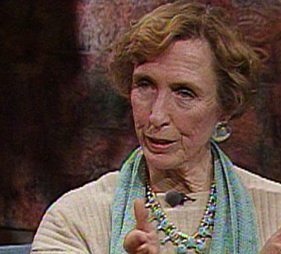
Anita Barrows on Love, Poetry and Autism

I Have My Very Troubled Childhood to Thank for This Career

Deb Kory: You are a long-time psychotherapist, a well-known poet, social activist and autism specialist. In the interest of full disclosure, I should also mention that you are a former teacher of mine at the Wright Institute in Berkeley, you chaired my dissertation, and are now my friend as well.
Anita Barrows: Indeed.
DK: As a newly licensed therapist who came to the field with a background in journalism and political activism, I’m exploring for myself how to not get compartmentalized in my role as a therapist and to feel integrated in and out of the therapy office.
I wanted to interview you for Psychotherapy.net in large part because you embody many identities. I think most people know you as a poet and a translator of, among others, poet Rainer Maria Rilke’s work, along with your co-translator, Joanna Macy, the environmental activist and Buddhist scholar. Were you a poet before you became a therapist?
AB: Long before. I was a poet from the time I was about six years old. In fact, through my childhood and up through my years in college, there was nothing else I ever thought about doing. Writing poetry was really it. And I was always interested in politics. I was lucky enough to be a teenager in the 1960s and my political identity was also really strong for me at that point, as I was very involved in the Civil Rights Movement and the anti-Vietnam War movement.
But writing was really the only thing I thought I would ever do. After I got out of college and I realized that I had to do something to make a living, I began working with the Poets in the Schools program. I was also working with a radical law students group, placing law students in internships with radical lawyers like the lawyers for Cesar Chavez and the Black Panthers.
DK: But you yourself were not involved in law.
AB: I wasn’t, but I considered it at that time because it had become clear that I couldn’t earn a living writing poetry. I had studied French, Italian, Latin and German in college and did a Masters at Boston University in English literature and creative writing, and was working as a translator when I enrolled in a doctoral program in comparative literature.
DK: So language is a real passion for you.
AB: I just love language.
DK: Language, poetry, radical politics and law—how did you end up becoming a therapist?
AB: I think I have to thank my very, very troubled childhood for this career.
DK: Not uncommon for us therapists.
AB: Not at all. I had a mother who was chronically depressed and a father who was violent, and I did everything I could to escape that household, mostly adopting myself out to the families of friends. I was pretty good at establishing relationships outside of my home, and wrote poetry from an early age, which helped me process some of the pain I was going through, but when I had my own first child, it came back to haunt me.
I essentially had a breakdown. It ended up being diagnosed as autoimmune thyroid disease, but when I look at it now, I think the thyroid disease was a physical manifestation of what was going on inside me emotionally.
I had read a lot of Jung and was interested in Jung’s approach to literature and symbolism and the collective unconscious, and I was lucky enough to be referred to an extraordinary Jungian therapist, Rosamund Gardner, who died about ten years ago. I was in Jungian analysis with her for more than ten years.
DK: So it was your experience of the transformation that occurred for you in therapy that made you want to become a therapist?
AB: It was, yeah.
DK: I think that’s also a pretty common reason that people end up becoming therapists. My own therapy has influenced me enormously.
AB: Frankly, I don’t know who I would be today if it weren’t for the work I did with Rosamund. I can’t even begin to imagine. I was sort of casting about for some kind of work that felt meaningful, and it didn’t feel like teaching poetry at the university level would be enough, and it really came home to me that therapy can be a deep transformation that can liberate people. I remember Rosamund saying to me at one point, “When you have done this work, you will free your energy.” I was not a very energetic person in my 20s. Now, in my 60s, I’m full of energy.
DK: You’re one of the most energetic people I know!
AB: I think I’m making up for lost time.
During the course of that therapy, I began having dreams—and in Jungian analysis, you do a lot of dream work—and my dreams suggested that I might want to do therapy myself. We had to ferret out what was identification and transference and what was a genuine desire to do this work.
DK: Are you transparent about this backstory with your students?
AB: Very much so. I feel like that kind of transparency can be so helpful—especially in a field where there’s so much fear about revealing that you’ve suffered personally. I’m less likely to reveal it to some colleagues of mine, who seem so tight-lipped and collected.
DK: You imagine that they didn’t have such childhoods? Or is it that they just aren’t open about it?
AB: It’s hard to know, but I can’t imagine that the majority of people who come into this field had a Mary Poppins kind of childhood.

What Happened to the Wounded Healer?

DK: I also had that experience going through graduate training. People were really reluctant to share the fact that they had suffered trauma. And if they did, it was often like, “but I’ve done so much work around it and it’s all resolved now.”
What happened to the “wounded healer”? It’s a powerful framework, in my experience. When therapists are willing to be honest and open and not try to come off as “expertly healed,” it can be extremely transformative. Those moments of genuine, mutual vulnerability can be so helpful in diffusing that sense of shame and isolation that brings so many people into therapy in the first place.
AB: I learned it from Rosamund. She was very open about the pain that she had experienced. It would come up in dreams sometimes where I had sensed something about her childhood, and she was very honest about saying, “Yes, in fact this happened,” or, “No, it wasn’t quite like that, but this was the way it was.” Those were moments when I felt like you really can emerge from traumatic experiences, deep losses, and come out as a person who can have a rich and full life and be able to receive other people’s pain. I say that to my students all the time.
I can’t think of anybody in my education at the Wright Institute, anybody who trained me, who was that open about their experience. In fact, I went through several years while I was a student and then shortly after of not wanting to talk to anybody about my childhood.
I was really afraid that if anybody found out some of the things that had happened to me as a child, they would think, “She can’t possibly be a therapist. Somebody with that kind of childhood turns into a Borderline”—or some other Axis II diagnosis.
So I just didn’t talk about it. I didn’t even tell people I was a poet. At that point I had two books of poems published and had won a $20,000 grant from the National Endowment for the Arts for my poetry. And I didn’t tell anybody.
DK: What were you afraid of?
AB: I was afraid that if I was known as a poet, I would have less legitimacy in their eyes as a therapist. It’s kind of amazing when I think about it now. I remember once I was at a party where there were a lot of Wright Institute people, and somebody who wasn’t from the Wright came up to me and said, “Oh, hi, I’m so-and-so. Who are you and what do you do?” I opened my mouth and started to cry because I felt like my real identity was something I had to hide and that if I had something else that I belonged to, it would take away from people’s beliefs that I could really do therapy.
When I went to take my oral licensing exam, I think it was 1990, I had a recurrent dream for weeks before I took the exam. I’ve always worn a lot of rings on my fingers, and in my dream, I had lost all my rings. It
became really clear that I was afraid that assuming the mantle of psychologist meant that I would lose what was different and kind of quirky and colorful about me, and I’d have to become this straight person.
In fact, these much straighter friends of mine had loaned me clothes to wear at the oral exam. I was going to put my hair in some kind of bun, and I was going to wear this tailored suit and a white shirt. In the end, I gave them all back and said, “I’m just going as myself.” And I passed.

Therapist Identity Disorder

DK: This hits on a fundamental problem I’ve been chewing on. You’ve been licensed for 25 years and have reached a place of integration. I’m just starting out on the path and really want to steer clear of the therapist identity box. I like therapists, I am a therapist, but I kind of got the feeling all through my training that we are expected to keep a really low-profile outside of the office. While we’re given the message that being relational or “intersubjective” is a good way to practice, we’re taught to keep a pretty tight lid on our spontaneity. I heard horror stories of people who would bring their session notes into supervision and just get creamed for any hint of getting too conversational, revealing too much about themselves, whatever. Obviously this depends on the theory of the supervisor, but enough of those kinds of stories were going around to give me the notion that all such events should, in fact, be left out of session notes.
My sense was that we were not really supposed to be in the world, that our job is to stay kind of objectified in our therapist role, and that allowing our wounded selves, our writer or activist selves, our real selves into the room or, worse yet, being seen outside of the room, constituted a great risk of some sort. But what exactly is at risk? Our privacy? The projections of our clients? Our professional legitimacy? A case could be made for these things, but I think the balance is way out of whack.
AB: That’s a really good question. At the beginning of my work as a psychotherapist, I kept my identities pushed very far apart, but as I went along, I started to devote more time to my writing. I created a little study downstairs in my house that I just used for writing, and then began to give more public readings, which I hadn’t done for a period of time. There would be fliers around Berkeley saying I was going to read, and sometimes my patients would show up at my readings.
I remember talking about that with some people who were much straighter psychologists than I was, and they were saying things like, “Well, you really shouldn’t publish if you’re a therapist. And you certainly shouldn’t give readings.” My poetry is not confessional poetry. It’s not like I talk about my father’s abuse or my mother’s depression all that much. But it certainly reveals my politics and my sense of engagement in the world and also facts of my life: I am a single person. I have two daughters. I have a granddaughter. They come into my work in one way or another.
So, short of writing under a pseudonym, which I didn’t want to do, there seemed to be nothing I could do to keep them pushed apart if I wasn’t going to stop writing altogether, which I absolutely realized I couldn’t do. If I go for several months without writing, I just don’t feel like myself. I can’t do it. If I have a core identity, if there’s any one thing that’s my core identity, it’s a poet. And being a psychotherapist is the work I do, and it’s work I love, but it’s not my core identity.
When the first translation of Rilke came out in 1995, the Book of Hours, Joanna Macy, my co-translator, and I did a bunch of public readings for that. It says right there on the flap of the book that I am a poet, a translator, and I work as a clinical psychologist and a professor at the Wright Institute. There it was all laid out. And now when I think about it, it feels so clear to me that my life as a poet informs the work I do as a therapist.
DK: How so?
AB: I think I write poetry to document my sense of engagement with the world in whatever form that takes. It may be a poem about the trees outside my window in the morning or my dog sleeping, or it may be a poem about the children in Palestine or Rwanda. Poetry is the best way I know to make sense of the world. The fact that I write and that I see as a poet is the way I make meaning of things.
In fact, I have a patient in his early 30s who is, among other things, a musician. He’s very attuned to anything artistic, although that’s not what he earns his living at, and he teases me sometimes when I say something, “That’s certainly something a poet would say.” He was referred by someone and googled me and there was all sorts of stuff about me online. These days it’s all out there. If you don’t want to go see a poet, don’t come and see me.
DK: Your clients can self-select.
AB: Exactly.
DK: Do you think having a public identity as a poet and activist has changed your work with clients?
AB: I think it has. I gave a reading some years ago as part of a group of Jewish women who were politically engaged. Grace Paley read, and it was the last time I saw her before she died. Someone came up to me afterward and said, “So, you’re really a clinical psychologist? Are you practicing?” I ended up working with her for several years.

On Love (and Torture)

DK: One thing I have appreciated about your work is that you explicitly acknowledge the importance of love in therapy. When I was in graduate school at the Wright, I remember there was a panel discussion with various clinicians on the faculty, and I asked very pointedly, “How come no one ever talks about love?” It was always “countertransference” or “compassion,” but God forbid you mention love. The responses I got were, “It’s not my job to love clients. I respect them.” Another person joked, “What about hate?” and then proceeded to actually put an article in my mailbox about “hate in the countertransference” and how love was some kind of narcissistic fantasy on the part of the therapist. It was so irritating. I wish I could find the article because I remember the author talking about how it was OK to love the theory, but not our clients.
But I think we are engaged in all manner of love. Therapy can be a profoundly loving experience on both sides, and it can be erotic and romantic and mysterious. Sure, there can also be hate, boredom, “negative countertransference,” but the avoidance of any talk about love is phobic in my opinion.
AB: It’s so true!
DK: How do you conceptualize love in psychotherapy?
AB: Wow. What a wonderful question. I’m really glad to have an opportunity to talk about it. I think it’s the basis of all of it. I really do. I think you can’t do this work without love. And I don’t just mean compassion, I mean really loving somebody.
Of course we all have some patients who are more challenging than others. I have one patient who argues with everything I say, and it can be incredibly frustrating, but if I didn’t underneath it all love that patient, I wouldn’t be able to continue doing the work. And I think you’re absolutely right, people in the field are terrified of it.
One of the arguments made by certain psychologists in the APA who justified “enhanced interrogation techniques”—AKA torture—at places like Guantanamo, was that they don’t consider psychology to be a healing profession. For them it’s a profession where one investigates the workings of the human mind and analyzes them. Therefore, one can investigate the workings of the human mind in situations of interrogation. I have a lot of trouble with that on many different levels.
DK: As you know, I wrote my dissertation about the central role psychologists played in the creation of the torture program used under the Bush Administration. Psychologists were given access to the highest levels of power during the “War on Terror,” and they turned out to be very corruptible. One of my conclusions was that this desire on the part of certain elements of the psychology profession to be legitimated through power and “hard science” is fundamentally at odds with the healing, nurturing, soft nature of this work.
AB: Yes, I think there’s a fear of being soft and compassionate and nurturing and sort of what’s traditionally thought of as feminine or maternal. There’s a desire to be taken seriously in this profession, to be seen as a serious science. The insurance companies are also setting the stage for this, with their insistence on quantifiable evidence and “empirically validated” treatments. I’m not anti-science—I love science, but we shouldn’t value it at the expense of love.
I talk to my students about love all the time. They will come to me sometimes very sheepishly and admit that they really love a particular patient of theirs. I’m not talking about them coming to me and saying, “I really want to go to bed with this person,” or, “I’m going to ask him out for coffee as soon as the therapy is over.” We are so reductionist in this culture. It’s a reflection of the incredible lack of imagination that we have reduced the word love to wanting to fuck.
DK: Sing it, sister!
AB: That love wouldn’t be a component of transformation is just unimaginable to me. I think it has to be. In my own therapy with Rosamund, there was a moment that still brings tears to my eyes when I think about it. I was very, very ravaged in the first year that I was seeing her. I had an infant. I had a bad marriage, and I felt really overwhelmed. All of my own mother’s incapacity to care for me flooded back to me and made me terribly afraid that I couldn’t care for my child, my daughter.
There was one day where I didn’t know if I should be hospitalized or locked up or what, but I just felt unable to go on. I hadn’t slept in days, weeks, not just because my baby was waking up at night, but because I was really a wreck. So I called Rosamund on a Friday, and she said, “Come and see me tomorrow morning.” She didn’t see people on Saturday mornings, but I think she could hear how ravaged I was feeling. So I went to see her the next morning, and I was still just exhausted because I hadn’t slept.
And she said, “Why don’t you just lie down on my couch? I have some paperwork to do. We don’t need to talk. There’s really nothing to talk about right now. Just lie down on my couch and see if you can rest a little.” So I lay down, and she covered me with a blanket, and she stayed in the room and did some paperwork or whatever—I don’t know what she did, but I fell asleep. I napped for maybe two, two-and-a-half hours. When I woke up, she was still there in the room, and I was able to go home and feel better. That was a real turning point.

Two Souls Speaking To Each Other

DK: That’s such a profoundly loving gesture. A kind of accompaniment, a being with without having to talk or engage.
AB: It was just that. I felt sheltered and contained and held, and I hadn’t had that in my childhood from my mother—ever probably. Rosamund knew that. We didn’t need to speak about it. There didn’t need to be interpretation. At that moment I just needed some holding, and I knew it came from love. I was then able to go home and take care of my baby.
DK: I can imagine in the hands of another therapist you might have been 5150’d.
AB: I had actually called her the previous day and said, “I think I need to be hospitalized. I am so profoundly depressed—beyond depressed, agitated. I don’t know what’s wrong with me.” Her response was wonderful. She immediately asked, “Who’s going to pick up your daughter from daycare?” And I said, “Well, I am. I actually need to leave to pick her up in a few minutes.” And she said, “You’re far too sane to be hospitalized.” And that was that.
Love means suffering. I say to my students all the time, “You’re going to suffer from this work—if it goes badly, if someone commits suicide or gets ill and dies.” One of my patients died a few years ago. I hadn’t seen her for a few years, and I knew that she was somebody who had a heart condition, but she wasn’t much older than I am. And when I found out just by chance that she had died, I suffered, and there was really no place for my grief. I couldn’t call her family. I had never met any of them.
DK: Because there’s confidentiality after death.
AB: I didn’t even know if they knew that I was her therapist and I couldn’t legally get in touch with them. So I just had to hold it myself. Things like that happen and we’re not automatons, we’re not computers. We’re human beings.
I had one kid whom I saw for 12 years. She came to me when she was five and I was working at Children’s Hospital in Oakland, CA. She was a very intelligent, exceptional child with Asperger’s syndrome.
A year after I started working with her, her mother was diagnosed with a very serious cancer, and she hung in there for another four years, but then she died. So I saw this child from the time she was five through the time she graduated from high school and was getting ready to go away to college, and we were very, very close.
In one of our termination sessions she said, “I still can’t stand it that the person that I feel closest to in the world is my therapist. It just doesn’t feel right. It should be a friend. I should have a friend or a boyfriend or a girlfriend or somebody who’s the person I’m closest to. It shouldn’t be you.” And then she said, “It’s such a weird thing anyway, this whole therapy thing. I sort of wish you had been somebody else in my life.”
So we talked about how, if I had been her next-door neighbor or her auntie or a friend of the family, we probably wouldn’t have been able to see each other regularly. For awhile I was seeing her three times a week, then twice a week for years, and then it became once a week as we were winding down. It never would have been that regular, and it wouldn’t have been just the two of us in the room. Maybe I could’ve taken her out to the movies, but it would’ve been a totally different kind of relationship.
DK: Your attention would have been divided, for one.
AB: Exactly. So she said, “Okay. I get it. In this room, it didn’t really matter that I was your patient and you were my therapist. And it didn’t really matter that, when I met you, I was five and you were 38. And it didn’t really matter that I was diagnosed with Asperger’s syndrome and you weren’t. In this room, we were just two souls speaking to each other.” And I thought, “wow.”
DK: Wow.
AB: That, to me, is the work. Personally, I would so much rather see therapy considered a spiritual discipline than a scientific discipline, because I think that’s really where it is. That’s really where the work happens.
DK: I would agree. She was so articulate about naming the paradox of the therapy relationship. It really is a strange relationship. But at it’s best it’s a sacred relationship. When it works, it really works, and there’s no mistake about it. Unfortunately our culture doesn’t provide many opportunities for the kind of depth and closeness that we get in a good therapy relationship.
AB: And it’s simply not quantifiable. How do you quantify a child who begins at five with Asperger’s Syndrome, never talking to any other children in the school? Then her mother gets sick when she’s six and dies when she’s ten. How do you quantify whether that child got better or not? She says “hello” three times out of five? She makes eye contact seven times out of nine? When I was on insurance panels, those were the kinds of ways I had to report progress.
Yet when she was able to sit there and say what she said, I knew that this child had what she needed to go on with her life.

Autism

DK: This would be a good time to switch over and talk about your work with kids and with autism. I know you’ve always loved kids and been interested in treating kids, but how did you end up being interested in autism?
AB: Well, I started out doing languages and literature, and when I started preparing for graduate work in psychology, I worked with Dan Slobin and Susan Ervin-Tripp, both well-known in the world of child language development. I got very interested in how language develops and how skewed language can develop in some people, including people with autism. Then when I got to the Wright Institute, I joined a study at the Child Development Center at Children’s Hospital in Oakland where, over a period of 18 months, kids with autism were being studied. Half were on a particular medication that was supposed to enhance their social awareness, and half of them weren’t, but it was a double-blind study, so we didn’t know which kids we were working with. I was just fascinated with those kids.
This was 1980, and all of a sudden there was a burgeoning of autistic children, and the director of the Child Development Center asked me if I would be interested in setting up an autism clinic as part of my practicum. I of course said yes, and over that year worked with people on developing diagnostic criteria, and then the following year I did therapy with some kids, including the child I just mentioned. The Interpersonal World of the Infant by Daniel Stern had just come out and I ended up writing my dissertation about Asperger’s Syndrome.
If I dig a bit deeper, though, I think the reason I got involved in autism was my inability all throughout my childhood to reach my mother. She wasn’t autistic, and I wasn’t either, but there was a huge barrier, a huge wall between us.
DK: You felt like you were in a kind of autistic bubble?
AB: Yes. It took me a while to really understand that that was why I was so compelled by it.
The more superficial level was my interest in language development, but looking back, there were eight students involved in that research study, and I’m the only one who wound up seeing autistic kids all through my career. I was drawn to figuring out who is reachable and who is unreachable and how do we find each other as human beings?
DK: So you became an autism specialist.
AB: What’s happened in my practice as time has gone on is that I see children and also adults on the spectrum, mostly on the higher-functioning end, because that’s what the kind of therapy I do can treat. And the adults I see who have autism must have the capacity to take in the kind of weekly, deeply interpersonal therapy that I do. But I also see children and adults who are not on the spectrum and who are coming to explore developmental existential issues in their lives.
DK: Let’s back up for a second. What exactly is autism?
AB: The standard scientific definition is that it’s an impairment involving the child’s cognition, language, and often the child’s intelligence. At the very high-functioning end, I’ve had autistic kids with IQs in the 140s, so intelligence doesn’t always have to be impaired. I haven’t seen a recent statistic, but it used to be that 3/4 of kids diagnosed with autism were also diagnosed with at least mild mental retardation. But some of them, who used to be diagnosed with Asperger’s until the DSM-V got rid of that diagnosis in favor of “Autism Spectrum Disorder,” can be extremely intelligent.
It is essentially a pervasive developmental disability that affects the child’s capacity to function in society. Autism means “in the self,” and so the child has a hard time making attachments. Daniel Stern studied attunement and how in a normal caretaker-infant pair, the caretaker—mother, father, grandmother, whoever it happens to be—attunes to that child incredibly frequently, many, many times a minute in various ways. The baby shifts a little, so the caretaker shifts a little. The baby gets excited about something, and the mother’s voice will mimic that excitement. Generally those kinds of attunements are done cross-modally—so it’s not like the baby flaps her hands, and the mother flaps her hands. Instead he baby will flap her hands, and the mother will say, “Oh, you love these scrambled eggs!” That kind of thing.
But with autistic children, it’s much harder for them to take in information cross-modally, so they don’t feel the parent’s attunement. They don’t get attuned to. And it’s not because they don’t want to.
DK: And it’s not because the mothers are “cold.”
AB: Absolutely not. It’s more like, “this system does not translate what you’re doing into anything I can understand.” When I first started working with autistic kids, a lot of the parents had been called “refrigerator mothers.” It was their coldness or their “death wish” toward the child that was supposed to have caused the child’s autism. That was the standard psychoanalytic understanding of autism. And I think there are some practicing psychoanalysts who still see it that way.
DK: Like the schizophrenogenic mothers of people with schizophrenia?
AB: Exactly. But it’s very clear that both those disorders are biologically-based and that a parent can have a perfectly normal child and then give birth to a child who develops autism or schizophrenia. Does she really love one child and have a death wish toward the other one? I don’t think so.
DK: Do we know yet whether it’s genetic or environmental? I know there’s a theory that environmental toxins play a role. There’s a high prevalence around here in the Bay Area.
AB: When I was first studying autism, the incidence of autism was 1 in 2500. Now it’s about 1 in 66, and in the Bay Area especially there’s a huge prevalence. It’s really burgeoned over the course of my practicing in the field. I’ve watched it carefully and there’s no way that a purely genetic disorder can increase that hugely over such a short period of time. For instance, as long as we’ve been measuring schizophrenia, it seems that about 1% of the population is schizophrenic, and this is across culture, across socioeconomic status, across everything that we know.
It certainly seems as though there are more learning disabilities diagnosed now, too, and more ADHD. Whether that’s a fiction of the pharmaceutical companies remains to be studied. I think that’s certainly something worth looking into.
There’s a pediatric neurologist at Harvard named Martha Herbert who is researching the ways in which all of the neurotoxins in our environment potentiate each other. So it’s not just that there are thousands of neurotoxins, it’s that if you put this one together with these six, you are going to get something that’s way more powerful than any one of them alone.
So it may be that the huge preponderance of neurotoxins is intersecting with some genetic predispositions so that this child will develop autism from these neurotoxins and this other child might develop epilepsy or Tourette’s or anxiety or learning disabilities or maybe nothing. We don’t know for sure, but if I had to stake my career on it, I would say that there’s no question that the environment is involved in this.
DK: I’ve heard a couple of people say that the higher rates of autism in the Bay Area are either due to the fact that people didn’t know about it back when, so it wasn’t being diagnosed, or that this is where the tech boom happened and there’s a huge number of tech geniuses on the autism spectrum here having kids with one another.
AB: Well, the first claim I can throw out immediately. You see a kid who’s flapping his arms and not making any kind of eye contact, and who’s talking in this professorial way and doesn’t care whether anyone is listening or not—don’t tell me that nobody noticed this kid 20 years ago. Maybe they were just called weird kids, but come on, if they were there, they would have been noticed.
The second claim is more compelling. It could be that there are more Asperger types in Silicon Valley. I’ve certainly seen some in my practice who have gone in that direction and are making hundreds of thousands of dollars straight out of an engineering program in a university. They’re drawn to that kind of work. So if indeed there is a genetic component, then a high concentration of these folks all in once place would certainly make having kids on the autism spectrum more likely. But beyond genetics, how are they going to raise their kids? If they can’t relate well with other people, then they’re not going to be super related with their kids. Unless they have partners who are able to compensate for that, the kids are going to be raised with that kind of relational style.
If we think of what we do as a “hard science,” then we’re driven to push these folks into categories. But I think there’s such an intersection of environment—and by that I don’t mean just the physical environment, but the psychological environment that a child is raised in—and the child’s biology. And the family environment is different for each child.
DK: You mean how children develop differently in the same family?
AB: I once saw a family that had eight kids, and I saw several children within the family individually, as well as the family as a whole. The three older ones had been sexually abused by the father, who was in prison, and they had in turn abused the five kids younger than them.
One of those kids developed schizophrenia. I don’t know how much the schizophrenia was triggered by what had happened to him. One of them was so emotionally fragile and had such a severe anxiety disorder that she went to live in a group home. Three of those kids wound up going to college and making really interesting lives for themselves. And one of them had chosen at about 12 to go and live with her best friend’s family, who were highly-functional, wonderful and generous. So she was raised from age 12 on by a good family. She had the resources to go and seek that out and her sibling, a year younger, ended up in a group home. Why? We really don’t know. They both came from the same family environment.
Some things can look neurological and certainly be neurological which then, when the environment shifts, can be lifted. My own granddaughter had tics through her late-middle childhood, and when things shifted in her family, the tics disappeared. So were they neurologically based? They were tics rather than something else, but could they be altered by a better environment and more happiness? It seems to have been the case.
DK: So the environment can both trigger a latent illness and also resolve it.
AB: Right.
DK: Can you describe what standard autism treatment is and what you do that is or isn’t different from that treatment?
AB: Well, in the old days, they used to put an autistic kid on an electrified floor and apply electric shocks until the child performed certain behaviors.
DK: No way. You’re lying.
AB: I’m not kidding.
DK: When was this?
AB: This was in 1950s, and I think it went on for a while. There was a guy named Ivar Lovaas at UCLA who developed it.
DK: It reminds me of the experiments Martin Seligman did with dogs. Shock treatments that created his theory of learned helplessness.
AB: These days standard autism treatment is cognitive behavioral therapy and social skills groups, where you learn particular formulas for social skills.
DK: Like when somebody asks you for something, you say—
AB: “No, thank you” or “Please” or “Hello, my name is Henry. What is your name? What school do you go to?”
DK: So, how to look normal.
AB: Right. What I do with autistic kids instead is I try to enter their world. I try to help them express themselves. I work with my dog in the room, and he is a really good co-therapist, especially with kids whose verbal ability is not so great. They get a lot of physical comfort from holding him.
My work with autistic children is not all that different from the way I work with non-autistic kids, except that it’s harder to reach them and they’re not as reciprocal.

Throwing Marbles

DK: What are some general principles about treating kids on the autism spectrum? How does therapy look with them?
AB: The most important thing for a child on the spectrum is for them to be able to experience that somebody else is sharing their world. The loneliness that they feel, the terrible isolation, and the desperation they feel ends up creating their symptoms. So a parent will bring a child in and say, “He’s shrieking, and he’s up all night long and jumping around the house and repeating learned lines from TV commercials instead of talking about his day at school.”
All of it is the attempt of a child with a big fault in neurotransmitters to reach other human beings, because I think that’s what we all want to do. We all want to be connected. So what I try to do is to enter a child’s world in whatever way I can. Whatever level of functioning they’re at, that’s my biggest guiding principle.
DK: Can you give an example?
AB: I had a woman who brought her 2 1/2-year-old to see me, and she lived somewhere far away like Fresno, so she basically got up at five in the morning and got her kid to my office and then took her home, and that was her day. Because of that, we had agreed that we would only do six sessions. The mother herself was a physician, highly articulate, highly intelligent, highly trained, and she didn’t know what to do with her kid, who was totally nonverbal. She seemed nonresponsive and unable to take in anything that this mother was giving her, and the mother didn’t know whether to institutionalize her or what. She was in a very desperate place when she came to see me.
At the first session I had with this child, I have a basket of marbles, and she took a handful of marbles and threw them across the room. So I did the same thing.
When I work with kids that young, I am constantly trying to interpret to the parent what it is that I’m doing with their child so that the parent can do it, because they’re the one that’s with them all day. And I’m trying to interpret to them also what I see happening with their child, because sometimes they don’t see it.
The kid threw another handful of marbles, so I did too, and after not very long, she began looking at me. And her mother was saying, “She’s making eye contact with you. She never makes eye contact.” And then I thought, let me try to enlarge this a little bit. So I made a little noise while I was throwing the marbles—and she did too. That was session one.
The next four sessions, we continued to do things like that, where she saw that I could enter her world. And I kept saying to her mother, “Look. She does this when I do that. Maybe you could do some of this at home.” We played with different materials. We played with water. We played with sand. I took her into the garden at my therapy office, and she liked playing with the dirt. It wasn’t sophisticated play—we weren’t feeding the baby doll or anything like that. It was sort of infant-level play and infant-level communication, and I just gathered a sense of where she was and what she was feeling and went as close into that as I could.
In our last session, I made a number of recommendations to the mother. I don’t know how much receptive language this child actually had—she certainly had no expressive language—but somewhere in her body she absolutely understood that it was the last session.
So we went out in the garden, and she was sort of recapitulating a lot of the things that we had done together. In the garden outside of my therapy office, there’s a little fountain that doesn’t have any water in it anymore, but has pebbles in it. She took those pebbles and threw them down the path and I went and chased them. She was all excited to make me go do something. And then I did the same for her, and she went and did it. We were doing reciprocal play, where the child had never done anything reciprocal. And the mother was saying that, at home, she was also doing more reciprocal play.
At one point, she did it in a particular sort of winsome way. As she was running, she threw the pebbles and then she made a gesture to let me know that she wanted to go chase them. I thought, “That’s so cool,” and intuitively I just put my hand on her back as she was running, to pat her and say, “Good girl. That’s great.” And for the rest of the session, on and off, this child kept touching the place on her back that I had touched.
As she left and I said goodbye to her and goodbye to her mother, she touched that place on her back, and it was like, “I’m taking you with me. This is how I’m taking you with me. I know this is the last time.” It was so poignant and amazing. The whole thing was as nonverbal as it could get, but it was right there at the level of feeling. It was like letting her know that, regardless of her skewed neurology, it was possible for another person to enter her world, to share her experience, for somebody to touch her back in tenderness and love. It was like we were saying, “I may not see you again, but I know this happened between us.”
DK: That’s such a beautiful story.
AB: It was amazing. The sad thing is I never found out what happened after that.

Parenting Children with Autism

DK: It sounds like you do a lot of work with the parents also. Is that right?
AB: I do a lot of work with the parents. It’s hard to be the parent of an autistic child because you don’t get a lot of the usual rewards. One of the things that makes it possible to be a parent is it’s very rewarding. Sometimes it’s horrible, of course, but it usually becomes rewarding at some point in the not-too-distant future. But with an autistic child, you don’t get a lot of feedback that what you’re doing is working, so a lot of parents lose confidence and they also grieve.
What’s going to happen to their kid when they’re an adult? It’s cute to be an eight-year-old autistic kid; it’s not so cute to be a 27-year-old autistic person. How are they going to make a living? How are they going to survive? What’s going to happen to them when the parents die? I do a lot of work with the parents around their grief over their autistic children and also around accepting that this is the child they have and that he may not be “normal,” he may not do the things that other kids will do, but it’s possible for this child to have fulfillment.
DK: And for the parent to have fulfillment?
AB: Yes, absolutely.
DK: I was just imagining the anxiety and the sense of frustration that the mother must have felt. Driving all the way from Fresno, feeling desperate to make some kind of connection with her child. Finally she makes eye contact with you, makes some emotional contact with you. I imagine that what you were modeling for her was just a profound patience and non-worry, along with a great deal of curiosity.
AB: Right, exactly.
DK: My sense is that that would be so hard for a parent. They must have so much anxiety and shame around their desire for their kids to be different than they are.
AB: It’s a profound, profound feeling of helplessness. I’m actually working on a novel about an autistic child, narrated by her older sister, who isn’t autistic. At the beginning of the novel, the autistic child is quite profoundly autistic, nonverbal. She becomes verbal later, a little bit like the kid I was describing before, but the sister really wishes that her little sister would die. She wishes that she would get lost. The little sister constantly escapes, and the older sister wishes that she would escape one day and never come back. It’s totally understandable, and parents sometimes feel that as well.
It’s so important to legitimize those feelings for parents. When you can’t reach a child and the child is driving you crazy because he is up all night and screaming half the day— it’s so understandable why parents would feel so frustrated and unhappy with their kids.

Deconstructing the American Dream

DK: Autism seems like a disease with a somewhat limited cure rate. There’s of course people like Temple Grandin, who was able to come out of her autistic shell with a great deal of help from her mom, but that’s kind of unusual right?
AB: In some ways that’s true. I see one boy in my practice now who is in his senior year in high school. And when he was a young child, he didn’t have language. It used to be that not having language before five was a pretty bad prognosis. But this kid is amazing. He’s getting straight As in high school. He’s a genius. I’ve never beaten him in a game of Chess or Scrabble. And as a linguist I’m really good at Scrabble!
I think he’s going to have a pretty good life, so the prognosis was wrong. But on the other hand, relationships with other people, fulfillment in any kind of way that is not sort of limited to technology? Probably not. He’ll be better off in that regard than many people with autism, but not like somebody who doesn’t have autism.
DK: So is some of your work with him then about depathologizing this aspect of his reality? Not trying to get him to become “normal” and push him to date and such, but instead redefining a meaningful life in terms that are meaningful to him?
AB: Yes, exactly, and also working with the parents of these kids to help them accept that they are going to have a different way of being happy than their kid who doesn’t have autism, and that it’s really not about following a formula, but about finding what turns them on.
If what turns their kid on is sitting in his room and trying to develop a videogame, fabulous. If he finds joy in that, why not? Why send him out to be on the football team and hold that as the criterion for social success, or having 60 friends? All of us have different ways of being happy. Despite feminism and everything else, there’s still one formula for happiness in this culture that looms above all others.
DK: Married with kids and money.
AB: Exactly. And if you don’t follow that formula, by those standards, you’re a failure. So for the people I work with who have autism, the most painful thing for them is that they don’t have that. They haven’t been able to accomplish the American success formula. It’s important to help them see that despite that, they can have fulfillment in their lives.
DK: In other words, deconstructing the American dream.
AB: Yes!
DK: I don’t treat people with autism, although I’ve worked with a couple of people on the spectrum. But I feel like deconstructing the American dream is standard practice for me. That unattainable, glossy life haunts almost everyone in one way or another.
AB: It’s so true. This is a culture that is so based on the Protestant work ethic and the Calvinist idea of individual responsibility that, if somebody hasn’t “made it,” they believe they are personally responsible.
DK: Particularly since the economy tanked, a lot of people are struggling just to get by and it’s amazing how people personalize failures that are clearly not their fault.
AB: They take it so personally and feel so ashamed. It’s important to say, “Hold on a minute. Take a look at what happened over the last decade, where our tax dollars have gone, who is being bailed out and who is having their food stamps taken away”
DK: But even for people who have a lot of material wealth, they suffer a great deal because they feel that since they have “made it,” they should be happy, because material success brings happiness, right?
AB: I once worked for a couple of years with a person who was going to inherit a huge amount of money and already was living on a trust fund. This person had the kind of money that people dream will make them happy. And I really got an eye into the unhappiness that can exist despite huge amounts of money.
DK: The American dream ain’t all it’s cracked up to be.
AB: It sure isn’t.
DK: Well, it’s been a delight to talk with you today. Thank you so much for sharing your wisdom.
AB: It was my pleasure. Thank you.

Poem

AB: Questro muroQuando mi vide star pur fermo e duro / turbato un poco disse: “Or vedi figlio:/ tra Beatrice e te e questo muro.”

(When he [Virgil] saw me standing there unmoving, he was a bit disturbed and said, “No look, son, between Beatrice and you there is this wall.”)

—Dante, Purgatorio XXVII

You will come at a turning of the trail
to a wall of flame

After the hard climb & the exhausted dreaming

you will come to a place where he
with whom you have walked this far
will stop, will stand

beside you on the treacherous steep path
& stare as you shiver at the moving wall, the flame

that blocks your vision of what
comes after. And that one
who you thought would accompany you always,

who held your face
tenderly a little while in his hands—
who pressed the palms of his hands into drenched grass
& washed from your cheeks the soot, the tear-tracks—

he is telling you now
that all that stands between you
& everything you have known since the beginning

is this: this wall. Between yourself
& the beloved, between yourself & your joy,
the riverbank swaying with wildflowers, the shaft

of sunlight on the rock, the song.
Will you pass through it now, will you let it consume

whatever solidness this is
you call your life, & send
you out, a tremor of heat,

a radiance, a changed
flickering thing?

—Anita Barrows

Complex PTSD: From Surviving to Thriving

Editor’s Note: Following is an adapted excerpt from Pete Walker’s latest book, Complex PTSD: From Surviving to Thriving—A Guide and Map for Recovering from Childhood Trauma. For more information about treating Complex PTSD (CPTSD) and managing emotional flashbacks, read a previously published article by Pete Walker here

Attachment Disorder and Complex PTSD

Many traumatologists see attachment disorder as one of the key symptoms of Complex PTSD. In the psychoeducational phases of working with traumatized clients, I typically describe attachment disorder as the result of growing up with primary caretakers who were regularly experienced as dangerous. They were dangerous by contemptuous voice or heavy hand, or more insidiously, dangerous by remoteness and indifference.

Recurring abuse and neglect habituates children to living in fear and sympathetic nervous system arousal. It makes them easily triggerable into the abandonment mélange of overwhelming fear and shame that tangles up with the depressed feelings of being abandoned.

A child, with parents who are unable or unwilling to provide safe enough attachment, has no one to whom she can bring her whole developing self. No one is there for reflection, validation and guidance. No one is safe enough to go to for comfort or help in times of trouble. There is no one to cry to, to protest unfairness to, and to seek compassion from for hurts, mistakes, accidents, and betrayals. No one is safe enough to shine with, to do “show and tell” with, and to be reflected as a subject of pride. There is no one to even practice the all-important intimacy-building skills of conversation.

In the paraphrased words of more than one of my clients: “Talking to Mom was like giving ammunition to the enemy. Anything I said could and would be used against me. No wonder, people always tell me that I don’t seem to have much to say for myself.”

Those with CPTSD-spawned attachment disorders never learn the communication skills that engender closeness and a sense of belonging. When it comes to relating, they are often plagued by debilitating social anxiety—and social phobia when they are at the severe end of the continuum of CPTSD.

Many of the clients who come through my door have never had a safe enough relationship. Repetition compulsion drives them to unconsciously seek out relationships in adulthood that traumatically reenact the abusive and/or abandoning dynamics of their childhood caretakers. For many such clients, we are their first legitimate shot at a safe and nurturing relationship. If we are not skilled enough to create the degree of safety they need to begin the long journey towards developing good enough trust, we may be their last.

Emotional flashback management, therefore, is empowered when it is taught in the context of a safe relationship. Clients need to feel safe enough with their therapist to describe their humiliation and overwhelm. At the same time, the therapist needs to be nurturing enough to provide the empathy and calm support that was missing in the client’s early experience.

Just as importantly, the therapist needs to be able to tolerate and work therapeutically with the sudden evaporation of trust that is so characteristic of CPTSD. Trauma survivors do not have a volitional “on” switch for trust, even though their “off” switch is frequently automatically triggered during flashbacks. In therapy, the therapist must be able to work on reassurance and trust restoral over and over again. I have heard too many disappointing client stories about past therapists who got angry at them because they would not simply choose to trust them.

As the importance of this understanding ripens in me, I increasingly embrace an intersubjective or relational approach. That means that I believe that the quality of the clients’ relationship with me can provide a corrective emotional experience that saves them from being doomed to a lifetime of superficial connection, or worse, social isolation and alienation.

Moreover, I notice that without the development of a modicum of trust with me, my CPTSD clients are seriously delimited in their receptivity to my guidance, as well as to the ameliorative effects of my empathy. In this regard then, I will describe four key qualities of relating that I believe are essential to the development of trust, and the subsequent relational healing that can come out of it. These are empathy, authentic vulnerability, dialogicality and collaborative relationship repair.

1. Empathy

I used to assume that the merits of empathy were a given, but I have sadly heard too many stories of empathy-impoverished therapy. In this regard, I will simply say here that if we are hard and unsympathetic with our clients, we trigger the same sense of danger and abandonment in them that they experienced with their parents.

In terms of a definition, I especially like Kohut’s statement that: “Empathy involves immersing yourself in another’s psychological state by feeling yourself into the other’s experience.”

When I delve deeply enough into a client’s experience, no matter how initially perplexing or intemperate it may at first seem, I inevitably find psychological sense in it, especially when I recognize its flashback components. In fact, I can honestly say that I have never met a feeling or behavior that did not make sense when viewed through the lenses of transference and traumatology.

Empathy, of course, deepens via careful listening and full elicitation of the client’s experience, along with the time-honored techniques of mirroring and paraphrasing which show the client the degree to which we get him.

Noticing my subjective free associations often enhances my empathic attunement and ability to reflect back to the client in an emotionally accurate and validating way. When appropriate, I sometimes share my autobiographical free associations with the client when they are emotionally analogous. I do this to let her know that I really empathize with what she is sharing.

Following is an example. My client tells me with great embarrassment that she stayed home all weekend because she had a pimple on her nose. She is ashamed of the pimple and of her “vanity’’ about it. She moans: “How could I be so stupid to let such a little thing bother me?” I suddenly remember cancelling a date once when I had a cold sore. At the time, I also got lost in a toxic shame attack. I share this with her, minus present day shame about it. She tears up and then laughs, relieved as her shame melts away. Months later, she tells me that her trust in me mushroomed at that moment. Guidelines for being judicious about this kind of self-disclosure will be discussed below.

Of the many benefits of empathy, the greatest is perhaps that it models and teaches self-empathy, better known as self-acceptance. To the degree that we attune to and welcome all of the client’s experience, to that same degree can the client learn to welcome it in her- or himself.

2. Authentic Vulnerability

Authentic vulnerability is a second quality of intimate relating which often begins with emotionally reverberating with the client. I have found that emotional reflection of the client’s feelings is irreplaceable in fostering the development of trust and real relational intimacy.

Emotional reflection requires the therapist to be emotionally vulnerable himself and reveal that he too feels mad, sad, bad and scared sometimes. Modeling vulnerability, as with empathy, demonstrates to the client the value of being vulnerable and encourages her to risk wading into her own vulnerability.

I came to value therapeutic vulnerability the hard way via its absence in my own therapy with a therapist who was of the old, “blank screen” school. She was distant, laconic and over-withholding in her commitment to the psychoanalytic principle of “optimal frustration.” Therapy with her was actually counter-therapeutic and shame-exacerbating for me as we reenacted a defective child/perfect parent dynamic.

Therapeutic Emotional Disclosure
Thankfully, I eventually realized that I had unresolved attachment issues, and sought out a relational therapist who valued the use of her own vulnerable and emotionally authentic self as a tool in therapy. Her tempered and timely emotional self-disclosures helped me to deconstruct the veneer of invincibility I had built as a child to hide my pain. Here are some examples that were especially helpful. “God, the holidays can be awful.” “I get scared when I teach a class too.” “I’m so sorry. I just missed what you said. I got a little distracted by my anxiety about my dental appointment this afternoon.” “I feel sad that your mother was so mean to you.” “It makes me angry that you were so bullied by your parents.”

“My therapist’s modeling that anger, sadness, fear, and depression were emotions that could be healthily expressed helped me to renounce the pain-repressing, emotional perfectionism in which I was mired.” With her, I learned to stop burying my feelings in the hope of being loved. I renounced my just-get-over-it philosophy and embraced vulnerability as a way of finally getting close to people.

I needed this kind of modeling, as so many of my clients have, to begin to emerge from my fear of being attacked, shamed or abandoned for feeling bad and having dysphoric feelings. In order to let go of my Sisyphean salvation fantasy of achieving constant happiness, I needed to experience that all the less than shiny bits of me were acceptable to another human being. Seeing that she was comfortable with and accepting of her own unhappy feelings eventually convinced me that she really was not disgusted by mine.

The therapist’s judicious use of emotional self-disclosure helps the client move out of the slippery, shame-lined pit of emotional perfectionism. Here are some self-revealing things that I say to encourage my clients to be more emotionally self-accepting. “I feel really sad about what happened to you.” “I feel really angry that you got stuck with such a god-awful family.” “When I’m temporarily confused and don’t know what to say or do, I…” “When I’m having a shame attack, I…” “When something triggers me into fear, I…” “When my inner critic is overreacting, I remind myself of the Winnicottian concept that I only have to be a ‘good enough person.’”

Here are two examples of emotional self-disclosure that are fundamental tools of my therapeutic work. I repeatedly express my genuine indignation that the survivor was taught to hate himself. Over time, this often awakens the survivor’s instinct to also feel incensed about this travesty. This then empowers him to begin standing up to the inner critic. This in turn aids him to emotionally invest in the multidimensional work of building healthy self-advocacy.

Furthermore, I also repeatedly respond with empathy and compassion to the survivor’s suffering. With time, this typically helps to awaken the recoveree’s capacity for self-empathy. She then gradually learns to comfort herself when she is in a flashback or otherwise painful life situation. Less and less often does she surrender to an inner torture of self-hate, self-disappointment, and self-abandonment.

My most consistent feedback from past clients is that responses like these—especially ones that normalize fear and depression—helped them immeasurably to deconstruct their perfectionism, and open up to self-compassion and self-acceptance.

Guidelines for Self-Disclosure
What guidelines, then, can we use to insure that our self-disclosure is judicious and therapeutic? I believe the following five principles help me to disclose therapeutically and steer clear of unconsciously sharing for my own narcissistic gratification.

First, I use self-disclosure sparingly.

Second, my disclosures are offered primarily to promote a matrix of safety and trust in the relationship. In this vein my vulnerability is offered to normalize and de-shame the inexorable, existential imperfection of the human condition, e.g., we all make mistakes, suffer painful feelings, experience confusion, etc.

Third, I do not share vulnerabilities that are currently raw and unintegrated.

Fourth, I never disclose in order to work through my own “stuff,” or to meet my own narcissistic need for verbal ventilation or personal edification.

Fifth, while I may share my appreciation or be touched by a client’s attempt or offer to focus on or soothe my vulnerabilities, I never accept the offer. I gently thank them for their concern, remind them that our work is client-centered, and let them know that I have an outside support network.

Emotional Self-disclosure and Sharing Parallel Trauma History
Since many of my clients have sought my services after reading my somewhat autobiographical book on recovery from the dysfunctional family, self-disclosure about my past trauma is sometimes a moot point. This condition has at the same time helped me realize how powerful this kind of disclosure can be in healing shame and cultivating hope.

Over and over, clients have told me that my vulnerable and pragmatic stories of working through my parents’ traumatizing abuse and neglect gives them the courage to engage the long difficult journey of recovering. But whether or not someone has read my book, I will—with appropriate clients—judiciously and sparingly share my own experiences of dealing with an issue they have currently brought up. I do this both to psychoeducate them and to model ways that they might address their own analogous concerns.

One common example sounds like this: “I hate flashbacks too. Even though I get them much less than when I started this work, falling back into that old fear and shame is so awful.”

I also sometimes say: “I really reverberate with your feelings of hopelessness and powerlessness around the inner critic. In the early stages of this work, I often felt overwhelmingly frustrated. It seemed that trying to shrink it actually made it worse. But now after ten thousand repetitions of thought-stopping and thought-correction, my critic is a mere shadow of its former self.”

A final example concerns a purely emotional self-disclosure. When a client is verbally ventilating about a sorrowful experience, I sometimes allow my tears to brim up in my eyes in authentic commiseration with their pain. The first time my most helpful therapist did this with me, I experienced a quantum leap in my trust of her.

3. Dialogicality

Dialogicality occurs when two conversing people move fluidly and interchangeably between speaking (an aspect of healthy narcissism) and listening (an aspect of healthy codependence). Such reciprocal interactions prevent either person from polarizing to a dysfunctional narcissistic or codependent type of relating.

Dialogicality energizes both participants in a conversation. Dialogical relating stands in contrast to the monological energy-theft that characterizes interactions whereby a narcissist pathologically exploits a codependent’s listening defense. Numerous people have reverberated with my observation that listening to a narcissist monologue feels as if it is draining them of energy.

I have become so mindful of this dynamic that, in a new social situation, a sudden sense of tiredness often warns me that I am talking with a narcissist. How different than the elevation I sense in myself and my fellow conversant in a truly reciprocal exchange. Again, I wonder if there are mirror neurons involved in this.

I was appalled the other day while perusing a home shopping catalog to see a set of coffee cups for sale that bore the monikers “Designated Talker” and “Designated Listener.” My wife and I pondered it for a few minutes, and hypothesized that it had to be a narcissist who designed those mugs. We imagined we could see the narcissists who order them presenting them to their favorite sounding boards as Christmas presents.

In therapy, dialogicality develops out of a teamwork approach—a mutual brainstorming about the client’s issues and concerns. Such an approach cultivates full exploration of ambivalences, conflicts and other life difficulties.

Dialogicality is enhanced when the therapist offers feedback from a take-it-or-leave-it stance. Dialogicality also implies respectful mutuality. It stands in stark contrast to the blank screen neutrality and abstinence of traditional psychoanalytic therapy, which all too often reenacts the verbal and emotional neglect of childhood. I believe abstinence commonly flashes the client back into feelings of abandonment, which triggers them to retreat into “safe” superficial disclosure, ever-growing muteness and/or early flight from therapy.

Meeting Healthy Narcissistic Needs
All this being said, extensive dialogicality is often inappropriate in the early stages of therapy. This is especially true, when the client’s normal narcissistic needs have never been gratified, and remain developmentally arrested. In such cases, clients need to be extensively heard. They need to discover through the agency of spontaneous self-expression the nature of their own feelings, needs, preferences and views.

For those survivors whose self-expression was especially decimated by their caretakers, self-focused verbal exploration typically needs to be the dominant activity for a great deal of time. Without this, the unformed healthy ego has no room to grow and break free from the critic. The client’s healthy sense of self remains imprisoned beneath the hegemony of the outsized superego.

This does not mean, however, that the client benefits when the therapist retreats into extremely polarized listening. Most benefit, as early as the first session, from hearing something real or “personal” from the therapist. This helps overcome the shame-inducing potential that arises in the “One-seen (client) / One-unseen (therapist)” dynamic. “When one person is being vulnerable and the other is not, shame has a huge universe in which to grow.” This also creates a potential for the client to get stuck flashing back to childhood when the vulnerable child was rejected over and over by the seemingly invulnerable parent. Consequently, many of my colleagues see group therapy as especially powerful for healing shame, because it rectifies this imbalance by creating a milieu where it is not just one person who is risking being vulnerable.

In this regard, it is interesting to note a large survey of California therapists that occurred about fifteen years ago. The survey was about their therapy preferences, and upwards of ninety percent emphasized that they did not want a blank screen therapist, but rather one who occasionally offered opinions and advice.

For twenty-five years, I have been routinely asking clients in the first session: “Based on your previous experiences in therapy, what would you like to happen in our work together; and what don’t you want to happen?” How frequently clients respond similarly to the therapists in the survey!

Moreover, the next most common response I receive is that I don’t want a therapist who does all the talking. More than a few have used the exact phrase: “I couldn’t get a word in edgewise!” “How I wish there was a way that our qualification tests could spot and disqualify the narcissists who get licensed and then turn their already codependent clients into sounding boards.” This is the shadowy flipside polarity of the blank screen therapist.

Psychoeducation as Part of Dialogicality
Experience has taught me that clients who are childhood trauma survivors typically benefit from psychoeducation about Complex PTSD. When clients understand the whole picture of CPTSD recovery, they become more motivated to participate in the self-help practices of recovering. This also increases their overall hopefulness and general engagement in the therapeutic process. I sometimes wonder whether the rise in the popularity of coaching has been a reaction to the various traditional forms of therapeutic neglect.

One of the worst forms of therapeutic neglect occurs when the therapist fails to notice or challenge a client’s incessant, self-hating diatribes. This, I believe, is akin to tacitly approving of and silently colluding with the inner critic.

Perhaps therapeutic withholding and abstinence derives from the absent father syndrome that afflicts so many westernized families. Perhaps traditional psychotherapy overemphasizes the mothering principles of listening and unconditional love, and neglects the fathering principles of encouragement and guidance that coaching specializes in.

Too much coaching is, of course, as counter-therapeutic and unbalanced as too much listening. It can interfere with the client’s process of self-exploration and self-discovery as described above. At its worst, it can lure the therapist into the narcissistic trap of falling in love with the sound of his own voice.

At its best, coaching is an indispensable therapeutic tool. Just as it takes fathering and mothering to raise a balanced child, mothering and fathering principles are needed to meet the developmental arrests of the attachment-deprived client.

The sophisticated therapist values both and intuitively oscillates between the two, depending on the developmental needs of the client in the moment. Sometimes we guide with psychoeducation, therapeutic self-disclosure and active positive noticing, and most times we receptively nurture the client’s evolving practice of her own spontaneously arising self-expression and verbal ventilation.

Once again, I believe that in early therapy and many subsequent stages of therapy, the latter process typically needs to predominate. In this vein, I would guess that over the course of most therapies that I conduct, I listen about ninety percent of the time.

Finally, I often notice that the last phase of therapy is often characterized by increasing dialogicality—a more balanced fluidity of talking and listening. This conversational reciprocity is a key characteristic of healthy intimacy. Moreover, when therapy is successful, progress in mutuality begins to serve the client in creating healthier relationships in the outside world.

Dialogicality and the 4F’s (Fight/Flight/Freeze/Fawn)
Because of childhood abandonment and repetition compulsion in later relationships, many 4F types are “dying” to be heard. Different types however vary considerably in their dialogical needs over the course of therapy.

The Fawn/ Codependent type, who survived in childhood by becoming a parent’s sounding board or shoulder to cry on, may use her listening defense to encourage the therapist to do too much of the talking. With her eliciting defense, she may even invoke the careless therapist into narcissistically monologuing himself.

The Freeze/Dissociative type, who learned early to seek safety in the camouflage of silence, often needs a great deal of encouragement to discover and talk about his inner experience. Psychoeducation can help him understand how his healthy narcissistic need to express himself was never nurtured in his family.

Furthermore, freeze types can easily get lost in superficial and barely relevant free associations as they struggle to learn to talk about themselves. This of course needs to be welcomed for some time, but eventually we must help him see that his flights of fantasy or endless dream elaborations are primarily manifestations of his dissociative defense.

“Freeze types need to learn that emotionally disconnected talking is an old childhood habit that was developed to keep them buoyant above their undealt with emotional pain.” Because of this, we must repeatedly guide them toward their feelings so that they can learn to express their most important concerns.

The Fight/Narcissistic type, who often enters therapy habituated to holding court, typically dodges real intimacy with her talking defense. Therapy can actually be counterproductive for these types as months or years of uninterrupted monologuing in sessions exacerbate their sense of entitlement. By providing a steady diet of uninterrupted listening, the therapist strengthens their intimacy-destroying defense of over-controlling conversations. Sooner or later, we must insert ourselves into the relationship to work on helping them learn to listen.

As I write this, I remember Harry from my internship whose tiny capacity to listen to his wife evaporated as my fifty minutes of uninterrupted listening became his new norm and expectation in relationship. I felt guilty when I learned this from listening to a recorded message from his wife about how therapy was making him even more insufferable. I was relieved, however, a few years later when a different client told me that Harry’s wife eventually felt happy about this “therapeutic” change. Her husband’s increased self-centeredness was the last straw for her and she finally, with great relief, shed herself of him.

“A therapist, who is a fawn type herself, may hide in a listening and eliciting defense to avoid the scary work of gradually insinuating herself into the relationship and nudging it towards dialogicality.” If we do not nudge the client to interact, there will be no recovering.

The Flight/Obsessive-compulsive type sometimes presents as being more dialogical than other types. Like the freeze type, however, he can obsess about “safe” abstract concerns that are quite removed from his deeper issues. It is therefore up to the therapist to steer him into his deeper, emotionally based concerns to help him learn a more intimacy-enhancing dialogicality. Otherwise, the flight type can remain stuck and floundering in obsessive perseverations about superficial worries that are little more than left-brain dissociations from his repressed pain.

It is important to note here that all 4F types use left- or right-brain dissociative processes to avoid feeling and grieving their childhood losses. As dialogicality is established, it can then be oriented toward helping them to uncover and verbally and emotionally vent their ungrieved hurts.

4. Collaborative Relationship Repair

Collaborative relationship repair is the process by which relationships recover and grow closer from successful conflict resolution. Misattunements and periods of disaffection are existential to every relationship of substance. We all need to learn a process for restoring intimacy when a disagreement temporarily disrupts our feeling of being safely connected.

“I believe most people, if they think about it, realize that their best friends are those with whom they have had a conflict and found a way to work through it.” Once a friendship survives a hurtful misattunement, it generally means that it has moved through the fair-weather-friends stage of relationship.

Synchronistic with writing this section, my son uncharacteristically got into a conflict at school. During third grade recess two of his good friends, also uncharacteristically, started teasing him, and when they would not stop he pushed each of them. This earned them all a trip to the principal’s office. The principal is a strict but exceptionally wise and kind woman. My son’s offense, using physical force to resolve a conflict, was judged as the most serious violation of school policy, but his friends were also held responsible for their part and given an enlightening lecture on teasing.

My son, not used to being in trouble, had a good cry about it all. He then agreed that a one-day loss of recess plus writing letters of apology to his friends were fair consequences. Two days later, I asked him how things were going now between him and the two friends. With a look of surprise and delight, he told me: “It’s really funny, daddy. Now it feels like we’re even better friends than we were before.”

Rapport repair is probably the most transformative, intimacy-building process that a therapist can model. I guide this process from a perspective that recognizes that there is usually a mutual contribution to any misattunement or conflict. Therefore, a mutually respectful dialogical process is typically needed to repair rapport.

Exceptions to this include scapegoating and upsets that are instigated by a bullying narcissist. In those situations, they are solely at fault. I have often been saddened by codependent clients who apologize to their bullying parents as if they made their parents abuse them.

In more normal misattunements, I often initiate the repair process with two contiguous interventions. Firstly, I identify the misattunement (e.g., “I think I might have misunderstood you.”) And secondly, I then model vulnerability by describing what I think might be my contribution to the disconnection.

Abbreviated examples of this are: “I think I may have just been somewhat preachy…or tired…or inattentive…or impatient…or triggered by my own transference.” Owning your part in a conflict validates the normality of relational disappointment and the art of amiable resolution.

Taking responsibility for your role in a misunderstanding also helps deconstruct the client’s outer critic belief that relationships have to be perfect. At the same time, it models a constructive approach to resolving conflicts, and over time leads most clients to become interested in exploring their contribution to the conflict. This becomes an invaluable skill which they can then take into their outside relationships.

As one might expect, fight types are the least likely of the 4F’s to collaborate and own their side of the street in a misattunement. Extreme fight types such as those diagnosed with Narcissistic Personality Disorder have long been considered untreatable in traditional psychoanalysis for this reason.

With less extreme fight types, I sometimes succeed in psychoeducating them on how they learned their controlling defenses. From there I try to help them see how much they pay for being so controlling. At the top of the list of debits is intimacy-starvation. Consciously or not, they hunger for human warmth and they do not get it from those whom they control. Victims of fight types are too afraid of them to relax enough to generate authentically warm feelings.

Finally, I believe one of the most common reasons that clients terminate prematurely is the gradual accumulation of dissatisfactions that they do not feel safe enough to bring up or talk about. How sad it is that all kinds of promising relationships wither and die from an individual or couple’s inability to safely work through differences and conflict.

Earned Secure Attachment
In therapy, clients get the most out of their session by learning to stay in interpersonal contact while they communicate from their emotional pain. This gradually shows them that they are acceptable and worthwhile no matter what they are feeling and experiencing.

As survivors realize more deeply that their flashbacks are normal responses to abnormal childhood conditions, their shame begins to melt. This then eases their fear of being seen as defective. In turn, their habits of isolating or pushing others away during flashbacks diminish.

Earned secure attachment is a newly recognized category of healthy attachment. Many attachment therapists believe that effective treatment can help a survivor “earn” at least one truly intimate relationship. Good therapy can be an intimacy-modeling relationship. It fosters our learning and practicing of intimacy-making behavior. Your connection with your therapist can become a transitional earned secure attachment. This in turn can lead to the attainment of an earned secure attachment outside of therapy. I have repeatedly seen this result with my most successful clients, and I am grateful to report that my last experience with my own therapy lead me to this reward.

Violet Oaklander on Gestalt Therapy with Children

An Unorthodox Notion

Rafal Mietkiewicz: Violet, what makes me curious is that you are trained as a Gestalt therapist and people connect you with Gestalt therapy, but Gestalt therapy was mainly considered, at least here in Europe, to work primarily with adults. How did you find your way to do Gestalt therapy with the kids?
Violet Oaklander: I was already working with emotionally disturbed children in the schools when I got interested in Gestalt therapy. One of my children became very ill and died. I was very depressed. My friend was going to Esalen Institute to be in a group for a week with Jim Simkin, so I went with him, and I was so impressed with what happened to me. It made such a difference for me that when I came back, I started training in the Los Angeles Gestalt Therapy Institute, and while I was training, I thought, “How could I apply this to children?”It seemed very organic to me. Fritz Perls talked about the body and senses and all of that. I found that it fit my work with children and child development. And of course, over the years, I started using a lot of creative media, like drawing and clay and puppets and music, because that’s the only way it would interest children. But behind that, the basis of my work was Gestalt therapy theory and philosophy. And I developed it more and more as time went by. That’s how it got started.

RM: That’s what you wrote in your book—that children already know, but they are wearing special glasses, so you just take the glasses off?
VO: Yeah. I have many stories working with kids. I’m trying to think of when I first started. When I first began, I was working in the schools with maybe a group of 12 children. And they were older—maybe 12 and 13 years old, all boys. These were kids that didn’t make good contact; they didn’t connect very well with other children.I started doing things that were sort of different. I would have them finger paint. I’d line up the desks so it was like a table, and they’d stand around the table finger painting. At first, they didn’t want to do it. “It’s for babies.” But while they were finger painting, they would talk to each other, make really good contact. And of course it was important to establish boundaries—what they could not do and what they could do. So that was very clear.

Another thing I started doing was bringing in wood, and they would build things. These were children who weren’t allowed to hold a hammer or a saw because they were very disturbed children—it was dangerous. But I saw other classes had wood and got to build things, so I got that. And they had rules: they couldn’t swing the saw or the hammer, or else they had to sit down that day.

I wouldn’t let them build guns, but they could build boxes and birdhouses, and they would work together because they had to share the tools. You would not believe they were emotionally disturbed children. They were making such good contact and really enjoying this. I did many things like that.

RM: You look like you really enjoy your work.
VO: Oh, yeah. I even had the old empty chair. I had two chairs in the front of the room, and when a kid would get really upset and angry, I would have him sit in the chair and talk to the empty chair.And the child that he was angry at might be in the room there, but he would be talking to the empty chair. And then I’d have him switch and say, “Well, what do you think he would say back to you?” and it was so amazing because he would realize that he was projecting. They didn’t know that word—they didn’t have that insight. But they could see that they were projecting their own stuff on the other boy.

It would be so amazing. They would come into the room and say, “I need the chairs.” They would talk to a teacher who had yelled at them outside. They would talk to that teacher, and then they would begin to see that the reason the teacher yelled at them is because they did something they weren’t supposed to do. They knew this, but when they sat in the empty chair, they’d say, “Well, I yelled at you because you hit this other boy!” And then I’d say, “Now, what do you say to that?” They’d say, “Yeah, I guess I did. I did do that, yeah.” It was just little things like that that I began to do, to experiment with some of the techniques.

After I left teaching and I was in private practice, I thought a lot about what I was doing, and I started developing a therapeutic process that was based on Gestalt therapy, beginning with the “I-thou” relationship, and looking at how the child made contact, and then building his sense of self and helping him to express his emotion.

RM: It seems like you combine a bunch of techniques and approaches in your work—like expressive art therapy or child group therapy.
VO: Yeah. We do a lot of sensory work. I mentioned finger painting—anything they can touch. Clay is incredibly sensory and evocative. If it seems like they need to do some movement, we do that. Sometimes we play creative dramatics—charades—because to show something, you have to really be in touch with your body. We might start with fingers: “What am I doing? Now, you do something.” And they think of something and they have to use fingers to act it out.And then maybe we do a sport—they have to show with their body what sport they’re playing, and I have to guess. It might be obvious, but they enjoy doing that anyway—maybe catching a ball or hitting with a bat or tennis racquet. They have to get in touch with their body to do that.

The projective work with drawings and the clay is also very important, because this is how they can project what’s inside of them and then own it. One example is a boy who had a lot of anger but he kept it inside. He presented himself as just very nice and sweet, and nothing was wrong with his life. It was only after I asked him to make something, anything—I usually say, “Close your eyes and just make something, and then you can finish it with your eyes open”—he made a whale, and told a whole story about how the whale had a family—a mother and a father and sister.

What I always do after they tell the story is try to bring it back, so I said, “Well, does that fit for you? Do you have a family like that?” He said, “No, my father lives far away because he and my mother don’t live together. I never see him.” “Well, how do you feel about that?” And then we started talking about his father, which he would never have mentioned, and all this feeling came up. It’s very powerful.

The First Session

RM: How do you approach the first session with a child?
VO: I always meet, if possible, with the parents and the child the first session, because I want the child to hear whatever the parents tell me. I don’t want the parents to tell me things and have the child not know what they told me.Even if the parents are saying bad things about the child, the child needs to hear what I hear from the parents.

Usually in the first session, I have a checklist, and very often I would put it on a clipboard. First I would say, “Why are you here?” and all that. Then I would ask the child these questions. “Do you have a good appetite? Do you have bad dreams?” A whole list of questions.

Sometimes the parent would chime in, but mostly it’s to the child. It was a way of really making a connection with the child. Of course, if they were very, very young, four years old, maybe I’d still ask these questions, but not everything—and use language they could understand.

That’s always pretty much the first session. But if there are no parents involved—because I saw many kids who were in foster homes or group homes—the first session is an important one to establish some kind of connection or relationship. Sometimes I’d ask the child to draw a picture on that first session. I’d ask them to draw a house-tree-person. But I wouldn’t interpret it. It’s not for interpretation. It was to say to them when they were done, “Well, this picture tells me that you keep a lot of things to yourself. Does that fit for you?”—because maybe they wouldn’t draw many windows. And they usually would say “yes.” Or, “This picture tells me that you have a lot of anger inside of you. Does that fit for you?” If they’d say, “No, I’m not angry,” I’d say, “Oh, okay. I just need to check out what I think it tells me,” and we would have that kind of a session.

I did that once with a very resistant 16-year-old girl who at first said she wouldn’t speak to me. And when we finished, she wanted her sister and her mother to come in and do that drawing. So it’s a way of connecting.

But we don’t always do that. If it’s a child who is very frightened—I had a girl, for instance, who was very severely sexually abused for many years, and it finally came out when she was about 11, and she was removed from the home. So she was in a foster home, but the foster mother was very devoted to her and came in, too.

But she was very, very frightened and didn’t want to talk to me. So in the beginning we would take a coloring book, and we’d both color in the book. And we wouldn’t really talk about anything. I’d say to her, “Should I use red for this bird? What do you think?” and just begin to connect with her that way. Pretty soon I was asking her, “Well, what do you think the bird would say if it could talk?”—that kind of thing.

Pay Attention

RM: It’s my guess that you don’t really diagnose kids in clinical terms.
VO: No. I mean, sometimes I would have to for an insurance company. But it’s a matter of seeing where they’re at, where they’re blocked. I had one boy who walked very stiffly all the time. He was 11 years old. And I thought, “Maybe we need to do something to help him loosen up before we even talk about his feelings”—that kind of diagnosis.
RM: So, you don’t find clinical diagnosis useful in therapy?
VO: Not very much, no.
RM: You trust in what you see and what you feel about the kid.
VO: What I see, yeah.If, for example, the child has a lot of difficulty making a relationship with me, that’s what we have to focus on, because I can’t do anything unless we have that relationship. Sometimes children have been very hurt and damaged so early, they have trouble making a relationship. So we have to figure out how we could do that.

I used to see a lot of adolescents who were arrested by the police because they had committed a crime. I was involved in a program where they would send these children to counseling. It was a special program they were trying. So this one girl came in. She had to come—she had no choice. She was 14. She wouldn’t look at me, she wouldn’t talk to me. She just sat there. Naturally when a child does that, it makes you have to come forward more. Well, it didn’t work. So I thought, “Maybe I cannot see this girl. Maybe I have to refer her to another person.”

I went out into the waiting room the next time she came, and she was reading a magazine. I sat down next to her and I said, “What are you reading?” She flashed the cover at me. I said, “I didn’t see it,” so she held it up.

RM: And that was the beginning of contact.
VO: Yeah. Already we were making contact. And it was a music magazine about different groups. I said, “I don’t know anything about that. Could we look at it together?” So we went into my office and looked at the magazine, and she was telling me about the different groups. It was mostly heavy metal. And she was all excited, telling me about the groups and which ones she liked.We tried to find the music on the radio because I said, “I don’t know what it sounds like.” We couldn’t find it, so she said she would bring in a tape. The next week, she brought it in and we listened together. Some of the songs were so amazing—all these feelings and anger. So we just started working with that. And we had a relationship.

But we need to do that—start with where they are. Pay attention. I wasn’t paying attention in the beginning. It was only when I thought, “What am I going to do?”

RM: So apparently the child therapist must be very in touch with his own senses. I guess it’s more important than clinical knowledge.
VO: I think you’re right. You have to know things, but that’s most important—to be in touch with yourself. It’s not easy to be a child therapist. An adult comes in and says, “This is what I want to work on,” or, “This is what’s happening.” When a child comes in, she doesn’t have a sense of what she needs to do. And you have to talk to parents, and you have to talk to teachers, and that kind of thing, too. So it’s different.
RM: Do you do something particular to help bring each session to an end—to help bring the child back to “regular life?”
VO: I think the job of the therapist is to help the child express what’s going on inside. But I notice that most children will only express what they have the strength to, and then they get resistant or they close down. They take care of themselves better than adults that way.But if they do open up a lot, we have to pay attention to what I call “grounding” them. I have a policy that children have to help me clean up whatever we’ve used. So we start cleaning up and then I’ll say, “Well, that was hard. Maybe we’ll talk some more about it next time, but where are you going now?” or “What are you having for dinner?” or “What did you have for dinner?” We talk about regular things to help them come back to ground.

RM: I know that Gestalt therapists hate “shoulds,” but using a paradox, are there any “shoulds” that a good child therapist should obey?
VO: Nothing comes immediately to mind, other than things I’ve already said. But speaking of “shoulds,” it’s worth noting that children have a lot of “shoulds.” People don’t realize that, but children are very hard on themselves. They’re split—there’s a part of them that’s very critical of themselves and then a part of them that, of course, rebels against that. Sometimes we help them understand that, especially if they are adolescents.
RM: Do you touch or hug your clients?
VO: Sometimes, but I’ll always ask them. I might say, “Can I give you a hug?” I don’t just do it. I have to ask them. Or I might put my hand on their shoulder. I can tell if they pull away that that’s not a good thing to do. Or sometimes we shake hands. We do a little bit—not a lot.

Working with Parents

RM: Do you often talk to parents?
VO: Oh, yes. This girl that I just mentioned, she lived in a foster home, and they didn’t care about her, so they weren’t interested. They just did what they had to do. But yes, parents come in. Every three or four weeks they have to come in with the child. Sometimes we just have a family session and I don’t see the child individually. It depends. You have to just decide which is the best way to go.
RM: We have agreed that it’s important for therapists to be in touch with their own feelings. What other qualities should one have to be a good child therapist?

VO:

You have to understand child development so you have a sense of if the child is not at the level she needs to be at. You have to understand the process. You have to be in touch with yourself. You need to know when your own buttons are being pressed—in psychoanalytic vocabulary, they call it transference. You have to understand when you have some countertransference, and to deal with that and work with that.

RM: In your Child Therapy Case Consultation video, a therapist is presenting a case of a child who is acting aggressively. You state at one point that kids can’t change their behavior with awareness. Is this why you often use art or have kids smash clay or other activities, versus just talk therapy?
VO: Yeah. What I mean is children don’t say, “This is what I’m doing to keep me from being happy or satisfied.” Even adults have trouble being aware of what they do to keep themselves stuck. So, with children, these drawings and clay are powerful projections. And it’s the way they can articulate what’s going on with them, without bypassing the intellect, but coming out from a deeper place. And at some point, they will own it. They will say, “Oh, yes, that fits for me.”When children feel stronger about themselves and they express what’s blocking, their behaviors change without having to force it or say anything. I mean, what makes children do what they do? All the behaviors that bring them into therapy are really ways of not being able to express what they need to express—of not being heard or not feeling good inside themselves.

RM: How do you measure progress in your work with children?
VO: It’s important to help the parents see the small changes, and not to expect complete reversal. And, of course, we have to work with the parents, too. Often the parents have a lot of difficulty with their own anger, and we have to work to help them understand how to express these feelings without hurting people around them. We can often do that in family sessions—help them to express what they’re feeling and what they’re wanting and what their sadness is about.One of the things I’ll say to parents is that I don’t fix kids. But what I do is I help them feel better about themselves. I help them express some of their deeper feelings that they’re keeping inside, and help them feel a little happier in life. We do many things to make this happen. And that’s what you have to look for. So when a parent comes in a month later and I say, “How are things going at home?” and the father says, “I think he’s a little happier,” then I know that this father has got it, and he’s seeing some progress here.

I am thinking of this was a boy of maybe 14 who was stealing, and the father wanted to send him to a military school because he couldn’t control him. There was a lot of reason the boy was like that, but that doesn’t help to understand the reason. It’s good to understand the reason why he’s like that, to help him change and be different.

So that’s how I look at progress. When they’re doing better out in life, they’re going to school and have some friends, and doing some of the things they have to do at home, and doing their schoolwork, then you’re seeing progress. They may not be altogether different, but they’re functioning in life.

The other thing that’s important is that it has to be at their level. Children can’t work everything out. They have different development levels. So the girl who was very severely sexually abused, we did a lot of work about that. But when she was 13, she had to come back into therapy for more work—things came up. They reach plateaus. They have to go out and be in life, and then maybe more things come up.

Becoming a Child Therapist

RM: Does it happen often that, when therapists work with a kid, the therapists’ trauma from childhood appears?
VO: Absolutely. That’s something one has to really know about—be in therapy, have a therapist. I have several people who come to me for supervision who are very experienced therapists, and that’s the reason they come. I think it’s really good for a child therapist to have somebody to talk to and consult with because it’s very difficult sometimes. You can’t always see what’s going on.
RM: How long does it take to be fully trained as a child therapist?
VO: Oh, gosh. For many years, I did a two-week training. People would come from all over the world. And sometimes they would get it in those two weeks, and other times they didn’t, so I don’t know. Two weeks is not enough, but it was the most that people could give of their time. Sometimes they’d come back two or three times to the training, but those were people who actually got it the most, because they were so committed to learning more.I can’t define a time. They have to have the experience of working with children first, I suppose, and understand about children. You have to have patience when you work with children. If one thing happens in a session—if they say, “I’m like that lion. I get so angry, just like that lion,” or whatever—if they say one thing, sometimes that’s it for a session. You have to be patient.

RM: What are the most frequent mistakes that therapists make when they work with kids?
VO: Usually what happens is therapists get stuck. They don’t know where to go next or what to do next.
RM: But why do they get stuck?
VO: Maybe they’re just not able to stand back and look. Sometimes, in a supervision or consultation, I’ll give a suggestion, and they’ll say, “Oh, of course, why didn’t I think of that? Of course, I know that.” They get too close to it and worry about doing the right thing. They’re afraid to make mistakes, really. I always tell them, “No matter what you do, you can’t really go wrong.”
RM: If you were to give the best advice to the young therapists about working with children, what would be this advice be?
VO: I might say if you’re working with children, you have to like children!

If you’re working with children, you have to like children!

What Keeps Me Going

RM: My last question is personal. How do you manage to keep so vital?
VO: You know, I’m 84.
RM: You don’t look it.
VO: I don’t know. I am who I am, I guess. I’m still working some. I have this foundation (The Violet Solomon Oaklander Foundation), and we’re having a conference this weekend at a retreat center, and I’m going to do a keynote. So every now and then I still do something like that, or conduct a supervision. That’s what keeps me going. I do a little writing. I read a lot.I lived in Santa Barbara, California, for 21 years. And my son, who lives in Los Angeles, decided I was getting too old to live there by myself. So he tore down his garage and he had a little cottage built, and that’s where I live now, in this little cottage behind their house.

I miss Santa Barbara. I had a lot of friends. I’d be more vital if I was back in Santa Barbara. But I am getting older, and I had a little heart attack this year—little. I’m okay. But I was in the hospital a few days. So it’s good that I’m near my son and my daughter-in-law.

RM: It is obvious for me that you, at 84, have still have so much to give to the others.
VO: Thank you very much for those nice words. I will, as long as I can.That’s what keeps me vital: just doing as much as I can, as long as I can. I just have to learn to take it easy.

Emotional Flashback Management in the Treatment of Complex PTSD

Early in my career I worked with David,* a handsome, intelligent client who was a professional actor. One day David came to see me after an unsuccessful audition. Beside himself, he burst out: "I never let on to anyone, but I know that I'm really very ugly; it's so stupid that I'm trying to be an actor when I'm so painful to look at."

David's childhood was characterized by emotional abuse, neglect and abandonment. The last and unwanted child of a large family, his alcoholic father repeatedly terrorized him. To make matters worse, his family frequently humiliated him by reacting to him with exaggerated looks of disgust. His older brother's favorite gibe, accompanied by a nauseated grimace, was, "I can't stand looking at you. The sight of you makes me sick!"
“David was so traumatized by the contempt with which his family had treated him that he was easily triggered by anything but the most benign expression on my face.” If he came into session already triggered, he would often project disgust onto me, no matter how much genuine goodwill and regard I felt for him at the time.

I have come to call these reactions, typical of David and of many other clients over the years, emotional flashbacks—sudden and often prolonged regressions ("amygdala hijackings") to the frightening and abandoned feeling-states of childhood. They are accompanied by inappropriate and intense arousal of the fight/flight instinct and the sympathetic nervous system. Typically, they manifest as intense and confusing episodes of fear, toxic shame, and/or despair, which often beget angry reactions against the self or others. When fear is the dominant emotion in an emotional flashback, the individual feels overwhelmed, panicky or even suicidal. When despair predominates, it creates a sense of profound numbness, paralysis, and an urgent need to hide. Feeling small, young, fragile, powerless and helpless is also common in emotional flashbacks. Such experiences are typically overlaid with toxic shame, which, as described in John Bradshaw's Healing The Shame That Binds, obliterates an individual's self-esteem with an overpowering sense that she is as worthless, stupid, contemptible or fatally flawed, as she was viewed by her original caregivers. Toxic shame inhibits the individual from seeking comfort and support, and in a reenactment of the childhood abandonment she is flashing back to, isolates her in an overwhelming and humiliating sense of defectiveness. Clients who view themselves as worthless, defective, ugly, or despicable are showing signs of being lost in an emotional flashback. When stuck in this state, they often polarize affectively into intense self-hate and self-disgust, and cognitively into extreme and virulent self-criticism.

Numerous clients tell me that the concept of an emotional flashback brings them a great sense of relief. They report that for the first time they are able to make some sense of their extremely troubled lives. Some get that their addictions are misguided attempts to self-medicate. Some understand the inefficacy of the myriad psychological and spiritual answers they pursued, and are in turn feel liberated from a shaming plethora of misdiagnoses. Some can now frame their extreme episodes of risk taking and self-destructiveness as desperate attempts to distract themselves from their pain. Many experience hope that they can rid themselves of the habit of amassing evidence of defectiveness or craziness. Many report a budding recognition that they can challenge the self-hate and self-disgust that typically thwarts their progress in therapy.

Emotional Neglect: A Primary Cause of Complex PTSD?

Early on in working with this model, I was surprised that a number of clients with moderate and sometimes minimal sexual or physical childhood abuse were plagued by emotional flashbacks. Over time, however, I realized that these individuals had suffered extreme emotional neglect: the kind of neglect where no caretaker was ever available for support, comfort or protection. No one liked them, welcomed them, or listened to them. No one had empathy for them, showed them warmth, or invited closeness. No one cared about what they thought, felt, did, wanted, or dreamed of. Such trauma victims learned early in life that no matter how hurt, alienated, or terrified they were, turning to a parent would actually exacerbate their experience of rejection.

The child who is abandoned in this way experiences the world as a terrifying place. I think about how humans were hunter-gatherers for most of our time on this planet—the child's survival and safety from predators during the first six years of life during these times depended on being in very close proximity to an adult. Children are wired to feel scared when left alone, and to cry and protest to alert their caretakers when they are. But when the caretakers turn their backs on such cries for help, the child is left to cope with a nightmarish inner world—the stuff of which emotional flashbacks are made.

Because of this, “emotional flashbacks can best be understood as the key symptom of Complex Post-Traumatic Stress Disorder, a syndrome afflicting many adults who experienced ongoing abuse or neglect in childhood.” As described by leading trauma theorist Judith Herman (Trauma and Recovery) and renowned PTSD researcher Bessel van der Kolk, Complex PTSD is caused by "prolonged, repeated trauma" and "a history of subjection to totalitarian control" such as happens in extremely dysfunctional families. It is distinguished from the more familiar type of PTSD in which the trauma is specific and defined; because of the prolonged nature of the trauma, Complex PTSD can be even more virulent and pervasively damaging in its effects. (Complex PTSD has not yet been included in the DSM.)

Ongoing experience convinces me that some children respond to pervasive emotional neglect and abandonment by over-identifying or even merging their identity with the inner critic and adopting an intense form of perfectionism that triggers them into painful abandonment flashbacks every time they are less than perfect or perfectly pleasing. When I encourage such clients to free-associate during their emotional flashbacks, I frequently hear a version of this toxic shame spiral: "If only I were perfect. If only I were an ‘A' student . . . a baseball hero . . . a beauty queen . . . a saint. If only I weren't so stupid and selfish, then maybe they'd love me. But who am I kidding? I'll never be anywhere near that, because I'm just a piece of shit. Who in the world could ever care about someone so pathetic?"

Responding Functionally to Emotional Flashbacks

Emotional flashbacks strand clients in the cognitions and feelings of danger, helplessness and hopelessness that characterized their original abandonment, when there was no safe parental figure to go to for comfort and support. Hence, Complex PTSD is now accurately being identified by some traumatologists as an attachment disorder. Emotional flashback management, therefore, needs to be taught in the context of a safe relationship. Clients need to feel safe enough with the therapist to describe their humiliation and overwhelm, and the therapist needs to feel comfortable enough to provide the empathy and calm support that was missing in the client's early experience.

Because most emotional flashbacks do not have a visual or memory component to them, the triggered individual rarely realizes that she is re-experiencing a traumatic time from childhood. Psychoeducation is therefore a fundamental first step in the process of helping clients understand and manage their flashbacks. Most of my clients experience noticeable relief when I explain Complex PTSD to them. The diagnosis resonates deeply with their intuitive understanding of their suffering. When they recognize that their sense of overwhelm initially arose as a normal instinctual response to their traumatic circumstances, they begin to shed the belief that they are crazy, hopelessly oversensitive, and/or incurably defective.

Without help in the midst of an emotional flashback, clients typically find no recourse but their own particular array of primitive, self-injuring defenses to their unmanageable feelings. These dysfunctional responses generally manifest in four ways: [1] fighting or over-asserting oneself in narcissistic ways such as misusing power or promoting excessive self-interest; [2] fleeing obsessive-compulsively into activities such as work addiction, sex and love addiction, or substance abuse ("uppers"); [3] freezing in numbing, dissociative ways such as sleeping excessively, over-fantasizing, or tuning out with TV or medications ("downers"); [4] fawning codependently in self-abandoning ways such as putting up with narcissistic bosses or abusive partners.

I find that most clients can be guided to see the harmfulness of their previously necessary, but now outmoded, defenses as a misfiring of their fight, flight, freeze, or fawn responses. In the context of a secure therapeutic alliance, they can begin to replace these defenses with healthy, stress-ameliorating responses. I introduce this phase of the work by giving the client the list of 13 cognitive, affective, somatic and behavioral techniques (listed at the end of this article) to utilize outside of the session. I elaborate on these techniques in our sessions as well.

As clients begin to respond more functionally to being triggered, opportunities arise more frequently for working with flashbacks in session. In fact, it often seems that their unconscious desire for mastery "schedules" their flashbacks to occur just prior to or during sessions. I recently experienced this with a client who rushed into my office five minutes late, visibly flushed and anxious. She opened the session by exclaiming, "I'm such a loser. I can't do anything right. You must be sick of working with me." This was someone who had, on previous occasions, accepted and even been moved by my validation of her ongoing accomplishments in our work. Based on what she had uncovered about her mother's punitive perfectionism in previous sessions, I was certain that her being late had triggered an emotional flashback. In this moment, she was most likely experiencing what Susan Vaughan's MRI research (The Talking Cure) describes as a gross over-firing of right-brain emotional processing with a decrease in cognitive processing in the left brain. Vaughan interprets this as a temporary loss of access to left-brain knowledge and understanding. This appears to be a mechanism of dissociation, and in this instance, it rendered my client amnesiac of my high regard for our work together.

I believe this type of dissociation also accounts for the recurring disappearance of previously established trust that commonly occurs with emotional flashbacks. This phenomenon makes it imperative that we psychoeducate clients that flashbacks can cause them to forget that proven allies are in fact still reliable, and that they are flashing back to their childhoods when no one was trustworthy. Trust repair is an essential process in healing the attachment disorders created by pervasive childhood trauma. PTSD clients do not have a volitional "on" switch for trust, even though their "off" switch is frequently automatically triggered during flashbacks. “The therapist therefore needs to be prepared to work on reassurance and trust restoration over and over again. I have heard too many client stories about past therapists who got angry at them because they would not simply choose to trust them.”

Retuning to the above vignette, I wondered out loud to my client, "Do you think you might be in a flashback?" Because of the numerous times we had previously identified and named her current type of experience as an emotional flashback, she immediately recognized this and let go into deep sobbing. She dropped into profound grieving that allowed her to release the flashback—a type of grieving the restorative power of which I have witnessed innumerable times. It is a crying that combines tears of relief with tears of grief: relief at being able to take in another's empathy and make sense of confusing, overwhelming pain; and grief over the childhood abandonment that created this sense of abject alienation in the first place.

My client released some of the pain of her original trauma and of the times she had previously been stuck in the unrelenting pain of flashing back to her original abandonment. “As her tears subsided, she recalled to me a time as a small child when she had literally received a single lump of coal in her Christmas stocking as punishment for being 10 minutes late to dinner.” Her tears morphed into healthy anger about this abuse, and she felt herself returning to an empowered sense of self. Grieving brought her back into the present and broke the amnesia of the flashback. She could then remember to invoke the self-protective resources we had gradually been building in her therapy with role-plays, assertiveness training and psychoeducation about her parents' destruction of her healthy instinct to defend herself against abuse and unfairness. The ubiquitous childhood phrase of "That's not fair!" had been severely punished and extinguished by her parents. She reconnected with her right and need to have boundaries, to judge her parents' actions unconscionable, and to fiercely say "no" to her critics' subsequent habit of judging her harshly for every peccadillo. Finally, I reminded her to reinvoke her sense of safety by recognizing that she now inhabited an adult body, free of parental control, and that she had many resources to draw on: intelligence, strength, resilience, and a growing sense of community. She lived in a safe home; she had the support of her therapist and two friends who were her allies and who readily saw her essential worth. I also observed that she was making ongoing progress in managing her flashbacks—that they were occurring less often and less intensely.

Managing the Inner Critic

In guiding clients to develop their ability to manage emotional flashbacks, my most common intervention involves helping them to deconstruct the alarmist tendencies of the inner critic. This is essential, as Donald Kalshed explains in The Inner World of Trauma, because the inner critic grows rampantly in traumatized children, and because the inner critic not only exacerbates flashbacks, but eventually grows into a psychic agency that initiates them. Continuous abuse and neglect force the child's inner critic (superego) to overdevelop perfectionism and hypervigilance. The perfectionism of Complex PTSD puts the child's every thought, word or action on trial and judges her as fatally flawed if any of them are not 100-percent faultless. Perfectionism then devolves into the child's obsessive attempt to root out real or imagined defects and to achieve unsurpassable excellence in an effort to win a modicum of safety and comforting attachment.

The hypervigilance of Complex PTSD is an overaroused sympathetic nervous system fixation on endangerment that comes from long-term childhood exposure to real danger. In an effort to recognize, predict and avoid danger, hypervigilance develops in a traumatized child as an incessant, on-guard scanning of both the real environment and, most especially, the imagined upcoming environment. Hypervigilance typically devolves into intense performance anxiety on every level of self-expression, and perfectionism festers into a virulent inner voice that manifests as self-hate, self-disgust and self-abandonment at every turn.

When the child with Complex PTSD eventually comes of age and launches from the traumatizing family, she is so dominated by feelings of danger, shame and abandonment that she is often unaware that adulthood now offers many new resources for achieving internal and external safety and healthy connection with others. She is unaware that a huge part of her identity is subsumed in the inner critic—the proxy of her dysfunctional caregivers—and that she has had scarce room to develop a healthy self with an accompanying healthy ego.

This scenario arises frequently in my practice: A client, in the midst of reporting some inconsequential miscue of the previous week, suddenly launches into a catastrophizing tale of her life deteriorating into a cascading series of disasters. She is flashing back to the danger-ridden times of her childhood, and her distress sounds something like this: "My boss looked at me funny when I came back from my bathroom break this morning and I know he thinks I'm stupid and lazy and is going to fire me. I just know I won't be able to get another job. My boyfriend will think I'm a loser and leave me. I'll get sick from the stress, and with no money to pay my medical insurance and rent, I'll soon be a bag lady on the street." “It's disturbing how many catastrophizing inner critic rants end with the bag lady on the street. What a symbol of abandonment!”

Teaching such clients to recognize when they have polarized into inner-critic catastrophizing, and modeling to them how to resist it with thought stopping and thought substitution, are essential steps in managing flashbacks. In this case I reminded my client of the many times we had previously caught the inner critic laundry-listing every conceivable way a difficult situation could spiral into disaster, and I invited her to use thought stopping to refuse to indulge this process. I suggested that she visualize a stop sign and say "no" to the critic each time it tried to scare or demean her. I reminded her that she had learned to catastrophize from her parents, who noticed her in such a predominantly negative and intimidating way. I also reinvoked the thought substitution process we had practiced on numerous occasions, encouraging her to remember and focus on all the positive things she knew about herself. Finally, I reminded her of all the positive experiences she had actually had with her boss, and I listed the essential qualities and accomplishments we were working to integrate into her self-image: her intelligence, integrity, resilience, kindness, and many successes at work and school.

Rescuing the Wounded Child

Over the course of a therapy, I often reframe emotional flashbacks as messages from the wounded inner child designed to challenge denial or minimization about childhood trauma. It is as if the inner child is clamoring for validation of past parental abuse and neglect: "See this is how bad it was—how overwhelmed, terrified, ashamed and abandoned I felt so much of the time."

When seen in this light, “emotional flashbacks are also signals from the wounded child that many of her developmental needs have not been met. Most important among these are the needs for safety and for Winnicottian good-enough attachment.” There are no needs more important than those of a parent's protection and empathy, without which a child cannot own and develop her instincts for self-protection and self-compassion—the cornerstones of a healthy ego. Without awakening to the need for this kind of primal self-advocacy, clients remain stuck in learned self-abandonment and rarely develop effective resistance to internal or external abuse, and seldom gain the motivation to consistently use the 13 tools for managing emotional flashbacks at the end of this article.

When clients recognize that their emotional storms are messages from an inner child who is still pining for a healthy inner attachment figure, and when they are able to internalize the therapist's acceptance and support, they gradually become more self-accepting and less ashamed of their flashbacks, their imperfections and their dysphoric affective experience. When the therapist repeatedly models feeling-based indignation at the fact that the client was taught to hate himself, the client eventually feels incensed enough about this experience to begin standing up to the inner critic and of investing in the extensive work of building healthy self-advocacy. When the therapist consistently responds compassionately to the client's suffering, the client's capacity for self-empathy and self-forgiveness begins to awaken. He gradually begins to desire to comfort and soothe himself in times of cognitive confusion, emotional pain, physical distress, or real-life disappointment, rather than surrender to an inner torture of self-hate, self-disappointment, and self-abandonment.

Around this time in therapy, the client also solidifies her understanding that the lion's share of the energy contained in her intense emotional flashbacks are actually appropriate but delayed reactions to various themes of her childhood abuse and neglect. Gradually—often at the rate of two steps forward and one back–-she is able to metabolize these feelings in a way that not only resolves her trauma, but builds new, healthy, self-empowering psychic structure as well. This, in turn, leads to an ongoing reduction of the unresolved psychic pain that fuels her emotional flashbacks, which subsequently become less frequent, intense and enduring. Eventually, a person experiencing an emotional flashback begins to invoke a sense of self-protection as soon as she realizes she is triggered, or even immediately upon being triggered. As flashbacks decrease and become more manageable, the defensive structures built around them (narcissistic, obsessive-compulsive, dissociative and/or codependent) can be more readily deconstructed.

Moving through Abandonment into Intimacy: A Case Study

A sweet, middle-aged male client of mine from an upper-middle-class family had suffered severe emotional abandonment in childhood. Both parents were workaholics and therefore unavailable; as the youngest of five children, my client was hamstrung in the sibling competition for scarce parental resources. His adulthood reenacted the relational impoverishment of childhood. He was hair-triggered for retreat and isolation. He had never experienced an enduring relationship. As a result of our long-term work, however, he became more motivated to seek a relationship, and successfully dated a healthy and available partner. For the first six months of their relationship, her kind nature, along with my coaching, enabled him to show her more and more of himself, and he was rewarded by increasing feelings of comfort and love while relating with her.

When he accepted her request to move in together, however, it became harder to hide his recurring emotional flashbacks to the overwhelming anxiety and emptiness of his childhood. He was more convinced than ever that the abandonment melange of fear, shame and depression at the core of his flashbacks was the most despicable of his many fatal flaws. As we worked with this belief in therapy, he remembered many times when even the mildest dip in his mood triggered his psychotherapist mother to turn her back on him and flee to the inviolability of her locked room. He saw that the occasional utility his mother found in him depended on his keeping her buoyant and lifting her spirits. He was traumatized into a staunch conviction that social inclusion depended on his manifesting a bravura of love, listening and entertainment. A codependent defense of fawning and performing had been instilled in him. Now he could not shake off the fear that if he ever deviated from being loving, funny and bright, his new partner would be disgusted and abandon him. He reported that, in fact, his flashbacks at home had increased, provoking a desperate need to isolate and hide. His freeze response was activated and he increasingly disappeared from her into silence, the computer, excessive sleeping, and marathon TV sports viewing. “During his most intense flashbacks, his fear and self-disgust became so intense that his flight response took over and he invented any excuse to get out of the house. He was besieged by thoughts and fantasies of being single again.” His inner critic was winning the battle; he was sure his partner was as disgusted with his affect as his mother had been. He was on the verge of a full-fledged flight response into the old habit of precipitously ending relationships, as he always had in the past when the brief infatuation stages of his few previous relationships came to an end.

We spent many subsequent sessions managing these emotional flashbacks to his original abandonment. He understood more deeply that his silent withdrawals were evidence that he was flashing back, and he committed to rereading and using the 13 steps of flashback management at such times. With my encouragement and gentle nudging, he grieved over his original abandonment more deeply and more self-compassionately than ever before in our work together. Over and over, he confronted the critic's projection of his mother onto his partner. He practiced grounding himself in the present, and at home began talking to his girlfriend about his experiences of flashing back into the abandonment melange. A crowning achievement occurred when he was finally able to disclose to her that talking vulnerably made him feel even more afraid and ashamed—and deserving of abandonment.

To his great relief, he was rewarded not only by her empathic response but also by her gratitude for his vulnerability, and she began to share an even deeper level of her own vulnerability. For the first time, he began talking to her while he was actually depressed. Their love then began to expand into those special depths of intimacy that are only achieved when people feel safe enough to communicate about all of their cognitive, emotional and behavioral experiences—the good and the bad, the gratifying and the disappointing, the loving and the mad. (One of the great rewards of this kind of recovery work is that the individual achieves a depth and richness of communication and contact that many non-traumatized people miss out on because wider social forces have scared and shamed them out of ever sharing anything truly vulnerable.) As my client became more skilled at being vulnerable, he was rewarded with the irreplaceable intimacy that comes from commiseration—another gift that many less-traumatized members of our culture never get to discover. The degree to which two individuals mutually share all aspects of their experience is the degree to which they have real love and intimacy.

“As clients learn to identify flashbacks as normal responses to abnormally stressful childhood conditions, they become free of the fear and shame that have made them isolate, overreact, or push others away at such times.” Most clients experience tremendous relief when they learn to interpret their overwhelming or excessively numbing experiences as emotional flashbacks, rather then as proof that they are bad, defective, worthless or crazy. Such realizations—as rapidly evaporating as they can be in early recovery—heal the fear and shame so central to emotional flashbacks. As clients learn to stay in contact and communicate functionally from their pain, they begin to heal their core abandonment depression; they gradually discover that they are not detestable but lovable and acceptable in their deepest vulnerability. This begins to heal their attachment disorders, the most deleterious part of Complex PTSD. It allows them to evolve toward what some traumatologists call an earned secure attachment. For many people this first secure attachment is achieved with the therapist, which in turn allows the client to know that such an invaluable experience is possible. With ongoing psychoeducation and coaching from the therapist, this first safe-enough relationship can become the launching pad for seeking such a relationship outside of therapy. The ending phase of therapy is typically characterized by the client building at least one good-enough, earned secure attachment outside of therapy—one relationship where she has learned to manage her flashbacks without excessively acting out against others or herself.

Challenges and Rewards for the Therapist

What I find most difficult about this work is that it is often excruciatingly slow and gradual. Nowhere is this truer than in the work of shrinking the toxic inner critic. Progress is often beyond the perception of the client, especially during a flashback, and flashbacks are unfortunately never completely arrested.

“The hardest thing of all is getting the client to see that emotional flashbacks, a bit like diabetes, are a lifetime condition that will always need a modicum of management.” Good-enough management creates a good-enough life—one where flashbacks markedly and continually decrease but inevitably recur from time to time. Failure to accept this reality typically causes the client to reinvoke her old reactions to flashbacks, which in turn cause her to get lost in the self-abandonment of blaming and shaming herself.

What I love most about this kind of trauma work is seeing clients with a long history of developmental arrest, as well as feelings of helplessness and hopelessness, begin to become empowered. I am delighted every time a client responds to her own suffering with kindness or reports an action of self-protectiveness in the world at large. I love witnessing the gradual growth of self-confidence and self-expression in my clients. This inevitably seems to grow out of their recovered ability to get angry about what happened to them in childhood and to use that anger to empower and motivate themselves to face the fear of trying on new, more assertive behavior. I am also especially moved when a client learns to cry for himself in that fully functional, unabashed way where tears release fear and shame. In my experience, nothing catharsizes fear and catastrophizing obsessiveness like egosyntonic tears. I have, on thousands of occasions, witnessed clients grieving in a way that resurrects them from a flashback, back into their growing self-esteem and resourcefulness.

Another highlight of this work for me comes in the early and middle stages of therapy. I like to call it rescuing the client from the hegemony of the critic. I believe there is an unmet childhood need for rescue that I help meet when I "save" my client from the critic—unlike Mom who didn't save him from his abusive dad, or unlike the neighborhood that didn't rescue him from his alcoholic family. Decades of trauma work have taken me to a place where my heart no longer allows me to be silent, and hence tacitly approving, when clients verbally and emotionally abuse themselves in a gross overidentification with the inner critic. I am additionally motivated to do this because of the failure of my own first long-term experience of psychoanalytic therapy, where my "blank screen" therapist let me flounder and perseverate in endless iterations of my PTSD-acquired self-hate and self-disgust. Never once was it pointed out that I could and should challenge this anti-self behavior. UCSF trauma expert Harvey Peskin would call this a failure to bear witness to the traumatization of the child. I have learned to take this a step further by not only vocally witnessing the client's flashback into the helplessness of his original abandonment, but also giving him a hand to climb out of that abyss of fear and shame.

The term rescuing and what it represents has become a taboo in the 12-Step Movement (e.g. Alcoholics Anonymous, Adult Children of Alcoholics, Incest Survivors Anonymous, etc.) and many psychotherapy circles. The word is often used in such an all-or-none way that any type of active helping is pathologized. However, I think helping clients out of the abyss of emotional flashbacks is a necessary form of active helping, or rescuing. The rescuing I refer to is different from the kind that many therapists correctly view as disempowering and unhealthy for the client. One example of this type of countertherapeutic rescuing is inappropriate or excessive advocacy. Colluding with or encouraging personal irresponsibility, such as exonerating a client's regressed or infantile acting out without steering him towards learning to interact more responsibly and salubriously with himself and the world is also a common type of problematic rescuing.

A final great reward I experience in helping clients manage their emotional flashbacks is witnessing the development of their emotional and relational intelligence. At the risk of sounding Pollyannaish, I believe Complex PTSD actually has a silver lining: the potential to reconnect with these intelligences at much deeper levels than those who are not traumatized in the family, but who suffer a truncation of their emotional self-expression and relational capacity. Wider social forces can strand individuals in the loneliness of superficial relating and can cause them to hide significant aspects of their emotional experience. A number of my clients in the later stages of recovery work have built and earned relationships that exhibit a depth of intimacy I rarely see in the general population.

*All names and identifying information have been changed to protect client confidentiality.

Managing Emotional Flashbacks: A Handout for Clients

1. Say to yourself: "I am having a flashback." Flashbacks take us into a timeless part of the psyche that feels as helpless, hopeless and surrounded by danger as we were in childhood. The feelings and sensations you are experiencing are past memories that cannot hurt you now.
2. Remind yourself: "I feel afraid but I am not in danger! I am safe now, here in the present." Remember you are now in the safety of the present, far from the danger of the past.
3. Own your right/need to have boundaries. Remind yourself that you do not have to allow anyone to mistreat you; you are free to leave dangerous situations and protest unfair behavior.
4. Speak reassuringly to your Inner Child. The child needs to know that you love her unconditionally—that she can come to you for comfort and protection when she feels lost and scared.
5. Deconstruct eternity thinking. In childhood, fear and abandonment felt endless—a safer future was unimaginable. Remember the flashback will pass as it has many times before.
6. Remind yourself that you are in an adult body with allies, skills and resources to protect you that you never had as a child. (Feeling small and little is a sure sign of a flashback.)
7. Ease back into your body. Fear launches us into "heady" worrying, or numbing and spacing out.

  • Gently ask your body to relax. Feel each of your major muscle groups and softly encourage them to relax. (Tightened musculature sends unnecessary danger signals to the brain.)
  • Breathe deeply and slowly. (Holding the breath also signals danger.)
  • Slow down. Rushing presses the psyche's panic button.
  • Find a safe place to unwind and soothe yourself: wrap yourself in a blanket, hold a stuffed animal, lie down in a closet or a bath, take a nap.
  • Feel the fear in your body without reacting to it. Fear is just an energy in your body that cannot hurt you if you do not run from it or react self-destructively to it.

8. Resist the Inner Critic's catastrophizing.

(a) Use thought-stopping to halt its exaggeration of danger and need to control the uncontrollable. Refuse to shame, hate or abandon yourself. Channel the anger of self-attack into saying no to unfair self-criticism.
(b) Use thought-substitution to replace negative thinking with a memorized list of your qualities and accomplishments.

9. Allow yourself to grieve. Flashbacks are opportunities to release old, unexpressed feelings of fear, hurt, and abandonment, and to validate—and then soothe—the child's past experience of helplessness and hopelessness. Healthy grieving can turn our tears into self-compassion and our anger into self-protection.
10. Cultivate safe relationships and seek support. Take time alone when you need it, but don't let shame isolate you. Feeling shame doesn't mean you are shameful. Educate those close to you about flashbacks and ask them to help you talk and feel your way through them.
11. Learn to identify the types of triggers that lead to flashbacks. Avoid unsafe people, places, activities and triggering mental processes. Practice preventive maintenance with these steps when triggering situations are unavoidable.
12. Figure out what you are flashing back to. Flashbacks are opportunities to discover, validate and heal our wounds from past abuse and abandonment. They also point to our still-unmet developmental needs and can provide motivation to get them met.
13. Be patient with a slow recovery process. It takes time in the present to become un-adrenalized, and considerable time in the future to gradually decrease the intensity, duration and frequency of flashbacks. Real recovery is a gradual process—often two steps forward, one step back. Don't beat yourself up for having a flashback.

The Path to Wholeness: Person-Centered Expressive Arts Therapy

When art and psychotherapy are joined, the scope and depth of each can be expanded, and when working together, they are tied to the continuities of humanity’s history of healing. —Shaun McNiff, The Arts and Psychotherapy

Part of the psychotherapeutic process is to awaken the creative life-force energy. Thus, creativity and therapy overlap. What is creative is frequently therapeutic. What is therapeutic is frequently a creative process. Having integrated the creative arts into my therapeutic practice, I use the term person-centered expressive arts therapy. The terms expressive therapy or expressive arts therapy generally denote dance therapy, art therapy, and music therapy. These terms also include therapy through journal writing, poetry, imagery, meditation, and improvisational drama. Using the expressive arts to foster emotional healing, resolve inner conflict, and awaken individual creativity is an expanding field. In the chapters that follow, I hope to encourage you to add expressive arts to your personal and professional lives in ways that enhance your ability to know yourself, to cultivate deeper relationships, and to enrich your methods as an artist, therapist, and group facilitator.

What is expressive arts therapy?

Expressive arts therapy uses various arts—movement, drawing, painting, sculpting, music, writing, sound, and improvisation—in a supportive setting to facilitate growth and healing. It is a process of discovering ourselves through any art form that comes from an emotional depth. It is not creating a “pretty” picture. It is not a dance ready for the stage. It is not a poem written and rewritten to perfection.

We express inner feelings by creating outer forms. Expressive art refers to using the emotional, intuitive aspects of ourselves in various media. To use the arts expressively means going into our inner realms to discover feelings and to express them through visual art, movement, sound, writing, or drama. Talking about our feelings is also an important way to express and discover ourselves meaningfully. In the therapeutic world based on humanistic principles, the term expressive therapy has been reserved for nonverbal and/or metaphoric expression. Humanistic expressive arts therapy differs from the analytic or medical model of art therapy, in which art is used to diagnose, analyze and “treat” people.

Most of us have already discovered some aspect of expressive art as being helpful in our daily lives. You may doodle as you speak on the telephone and find it soothing. You may write a personal journal and find that as you write, your feelings and ideas change. Perhaps you write down your dreams and look for patterns and symbols. You may paint or sculpt as a hobby and realize the intensity of the experience transports you out of your everyday problems. Or perhaps you sing while you drive or go for long walks. These exemplify self-expression through movement, sound, writing, and art to alter your state of being. They are ways to release your feelings, clear your mind, raise your spirits, and bring yourself into higher states of consciousness. The process is therapeutic.

When using the arts for self-healing or therapeutic purposes, we are not concerned about the beauty of the visual art, the grammar and style of the writing, or the harmonic flow of the song. We use the arts to let go, to express, and to release. Also, we can gain insight by studying the symbolic and metaphoric messages. Our art speaks back to us if we take the time to let in those messages.

Although interesting and sometimes dramatic products emerge, we leave the aesthetics and the craftsmanship to those who wish to pursue the arts professionally. Of course, some of us get so involved in the arts as self-expression that we later choose to pursue the skills of a particular art form. Many artist-therapists shift from focusing on their therapist lives to their lives as artists. Many artists understand the healing aspects of the creative process and become artist-therapists.

Using the creative process for deep inner healing entails further steps when we work with clients. Expressive arts therapists are aware that involving the mind, the body, and the emotions brings forth the client’s intuitive, imaginative abilities as well as logical, linear thought. Since emotional states are seldom logical, the use of imagery and nonverbal modes allows the client an alternate path for self-exploration and communication. This process is a powerful integrative force.

Traditionally, psychotherapy is a verbal form of therapy, and the verbal process will always be important. However, I find I can rapidly understand the world of the client when she expresses herself through images. Color, form, and symbols are languages that speak from the unconscious and have particular meanings for each individual. As I listen to a client’s explanation of her imagery, I poignantly see the world as she views it. Or she may use movement and gesture to show how she feels. As I witness her movement, I can understand her world by empathizing kinesthetically.

The client’s self-knowledge expands as her movement, art, writing, and sound provide clues for further exploration. Using expressive arts becomes a healing process as well as a new language that speaks to both client and therapist. These arts are potent media in which to discover, experience, and accept unknown aspects of self. Verbal therapy focuses on emotional disturbances and inappropriate behavior. The expressive arts move the client into the world of emotions and add a further dimension. Incorporating the arts into psychotherapy offers the client a way to use the free-spirited parts of herself. Therapy may include joyful, lively learning on many levels: the sensory, kinesthetic, conceptual, emotional and mythic. Clients report that the expressive arts have helped them go beyond their problems to envisioning themselves taking action in the world constructively.

What Is Person-Centered?

The person-centered aspect of expressive arts therapy describes the basic philosophy underlying my work. The client-centered or person-centered approach developed by my father, Carl Rogers, emphasizes the therapist’s role as being empathic, open, honest, congruent, and caring as she listens in depth and facilitates the growth of an individual or a group. This philosophy incorporates the belief that each individual has worth, dignity, and the capacity for self-direction. Carl Rogers’s philosophy is based on a trust in an inherent impulse toward growth in every individual. I base my approach to expressive arts therapy on this very deep faith in the innate capacity of each person to reach toward her full potential.

Carl’s research into the psychotherapeutic process revealed that when a client felt accepted and understood, healing occurred. It is a rare experience to feel accepted and understood when you are feeling fear, rage, grief, or jealousy. Yet it is this very acceptance and understanding that heals. As friends and therapists, we frequently think we must have an answer or give advice. However, this overlooks a very basic truth. By genuinely hearing the depth of the emotional pain and respecting the individual’s ability to find her own answer, we are giving her the greatest gift.

Empathy and acceptance give the individual an opportunity to empower herself and discover her unique potential. This atmosphere of understanding and acceptance also allows you, your friends, or your clients to feel safe enough to try expressive arts as a path to becoming whole.

The Creative Connection

I am intrigued with what I call the creative connection: the enhancing interplay among movement, art, writing, and sound. Moving with awareness, for example, opens us to profound feelings which can then be expressed in color, line, or form. When we write immediately after the movement and art, a free flow emerges in the process, sometimes resulting in poetry. The Creative Connection process that I have developed stimulates such self-exploration. It is like the unfolding petals of a lotus blossom on a summer day. In the warm, accepting environment, the petals open to reveal the flower’s inner essence. As our feelings are tapped, they become a resource for further self-understanding and creativity. We gently allow ourselves to awaken to new possibilities. With each opening we may deepen our experience. When we reach our inner core, we find our connection to all beings. We create to connect to our inner source and to reach out to the world and the universe.

Some writers, artists and musicians are already aware of the creative connection. If you are one of those, you may say, “Of course, I always put on music and dance before I paint.” Or, as a writer, you may go for a long walk before you sit at your desk. However, you are not alone if you are one of the many in our society who say, “I’m not creative.” I hope this book entices you to try new experiences. You will surprise yourself.

I believe we are all capable of being profoundly, beautifully creative, whether we use that creativity to relate to family or to paint a picture. The seeds of much of our creativity come from the unconscious, our feelings, and our intuition. The unconscious is our deep well. Many of us have put a lid over that well. Feelings can be constructively channeled into creative ventures: into dance, music, art, or writing. When our feelings are joyful, the art form uplifts. When our feelings are violent or wrathful, we can transform them into powerful art rather than venting them on the world. Such art helps us accept that aspect of ourselves. Self-acceptance is paramount to compassion for others.

The Healing Power of Person-Centered Expressive Arts

I discovered personal healing for myself as I brought together my interests in psychotherapy, art, dance, writing, and music. Person-centered expressive therapy was born out of my personal integration of the arts and the philosophy I had inherited. Through experimentation I gained insight from my art journal. I doodled, let off steam, or played with colors without concern for the outcome. Unsure at first about introducing these methods to clients, I suggested they try things and then asked them for feedback. They said it was helpful. Their self-understanding increased rapidly and the communication between us improved immensely.

The same was true as I introduced movement, sound, and freewriting for self-expression. Clients and group participants reported a sense of “new beginnings” and freedom to be. One group member wrote: “I learned to play again, how to let go of what I ‘know’—my successes, achievements, and knowledge. I discovered the importance of being able to begin again.” Another said: “It is much easier for me to deal with some heavy emotions through expressive play than through thinking and talking about it.”

It became apparent that the Creative Connection process fosters integration. This is clearly stated by one client who said, “I discovered in exploring my feelings that I could break through inner barriers/structures that I set for myself by moving and dancing the emotions. To draw that feeling after the movement continued the process of unfolding.”
It is difficult to convey in words the depth and power of the expressive arts process. I would like to share a personal episode in which using expressive arts helped me through a difficult period. I hope that, in reading it, you will vicariously experience my process of growth through movement, art, and journal writing in an accepting environment.

The months after my father’s death were an emotional roller coaster for me. The loss felt huge, yet there was also a sense that I had been released. My inner feeling was that his passing had opened a psychic door for me as well as having brought great sorrow.

Expressive arts served me well during that time of mourning. Two artist-therapist friends invited me to spend time working with them. Connie Smith Siegel invited me to spend a week at a cottage on Bolinas Bay. I painted one black picture after another. Every time I became bored with such dark images, I would start another painting. It, too, became moody and bleak. Although Connie is primarily an artist, her therapeutic training and ability to accept my emotional state gave me permission to be authentic.

Also, I went to a weekend workshop taught by Coeleen Kiebert and spent more time sculpting and painting. This time the theme was tidal waves—and again, black pictures. One clay piece portrays a head peeking out of the underside of a huge wave. My sense of being overwhelmed by the details of emptying my parents’ home, making decisions about my father’s belongings, and responding to the hundreds of people who loved him was taking its toll. Once again, my art work gave free reign to my feelings and so yielded a sense of relief. Coeleen’s encouragement to use the art experience to release and understand my inner process was another big step. I thought I should be over my grief in a month, but these two women gave me permission to continue expressing my river of sadness. That year my expressive art shows my continued sense of loss as well as an opening to new horizons.

As is often true when someone feels deep suffering, there is also an opening to spiritual realms. Three months after my father’s death, I flew to Switzerland to cofacilitate a training group with artist-therapist Paolo Knill. It was a time when I had a heightened sense of connectedness to people, nature, and my dreams. Amazing events took place in my inner being. I experienced synchronicities, special messages, and remarkable images. One night I found myself awakened by what seemed to be the beating of many large wings in my room. The next morning I drew the experience as best I could.

One afternoon I led our group in a movement activity called “Melting and Growing.” The group divided into pairs, and each partner took turns observing the other dancing, melting, and then growing. Paolo and I participated in this activity together. He was witnessing me as I slowly melted from being very tall to collapsing completely on the floor. Later I wrote in my journal:

I loved the opportunity to melt, to let go completely. When I melted into the floor I felt myself totally relax. I surrendered! Instantaneously I experienced being struck by incredible light. Although my eyes were closed, all was radiant. Astonished, I lay quietly for a moment, then slowly started to “grow,” bringing myself to full height.

I instructed the group participants to put their movement experiences into art. All-encompassing light is difficult to paint, but I tried to capture that stunning experience in color.

Reflecting on these experiences, it seems that my heart had cracked open. This left me both vulnerable and with great inner strength and light. A few days later another wave picture emerged. This time bright blue/green water was illumined with pink/gold sky.

These vignettes are part of my inner journey. I share them for two reasons. First, I wish to illustrate the transformative power of the expressive arts. Second, I want to point out that person-centered expressive therapy is based on very specific humanistic principles. For instance, it was extremely important that I was with people who allowed me to be in my grief and tears rather than patting me on the shoulder and telling me everything would be all right. I knew that if I had something to say, I would be heard and understood. When I told Paolo that I had the sensation of being struck with light, he could have said, “That was just your imagination.” However, he not only understood, he told me he had witnessed the dramatic effect on my face.

Humanistic Principles

Since not all psychologists agree with the principles embodied in this book, it seems important to state them clearly as the foundation for all that follows:

  • All people have an innate ability to be creative.
  • The creative process is healing. The expressive product supplies important messages to the individual. However, it is the process of creation that is profoundly transformative.
  • Personal growth and higher states of consciousness are achieved through self-awareness, self-understanding, and insight.
  • Self-awareness, understanding, and insight are achieved by delving into our emotions. The feelings of grief, anger, pain, fear, joy, and ecstasy are the tunnel through which we must pass to get to the other side: to self-awareness, understanding, and wholeness.
  • Our feelings and emotions are an energy source. That energy can be channeled into the expressive arts to be released and transformed.
  • The expressive arts—including movement, art, writing, sound, music, meditation, and imagery—lead us into the unconscious. This often allows us to express previously unknown facets of ourselves, thus bringing to light new information and awareness.
  • Art modes interrelate in what I call the creative connection. When we move, it affects how we write or paint. When we write or paint, it affects how we feel and think. During the creative connection process, one art form stimulates and nurtures the other, bringing us to an inner core or essence which is our life energy.
  • A connection exists between our life-force—our inner core, or soul—and the essence of all beings.
  • Therefore, as we journey inward to discover our essence or wholeness, we discover our relatedness to the outer world. The inner and outer become one.

My approach to therapy is also based on a psychodynamic theory of individual and group process:

  • Personal growth takes place in a safe, supportive environment.
  • A safe, supportive environment is created by facilitators (teachers, therapists, group leaders, parents, colleagues) who are genuine, warm, empathic, open, honest, congruent, and caring.
  • These qualities can be learned best by first being experienced.
  • A client-therapist, teacher-student, parent-child, wife-husband, or intimate-partners relationship can be the context for experiencing these qualities.
  • Personal integration of the intellectual, emotional, physical, and spiritual dimensions occurs by taking time to reflect on and evaluate these experiences.

The accompanying figure shows the Creative Connection process and principles, using expressive arts therapy. It shows how all art forms affect each other. Our visual art is changed by our movement and body rhythm. It is also influenced when we meditate and become receptive, allowing intuition to be active. Likewise, our movement can be affected by our visual art and writing, and so forth. All the creative processes help us find our inner essence or source. And when we find that inner source, we tap into the universal energy source, or the collective unconscious, or the transcendental experience.

Come with me, if you will, on a journey of inner exploration to awaken your creativity. Perhaps you are a writer who shies away from visual art, or an artist who says,”I can’t dance,” or a therapist who would like to discover methods for enhancing the counselor-client relationship. I invite you into your own secret garden.

Shades of Gray: When a therapist and her client are survivors of child abuse

Not a case to wow you with

This story is about humanness, grayness, and uncertainty in practicing psychotherapy. It's not about the times I've wowed a client with my perceptiveness and incisive interpretations. Neither will I focus on times when I've made a clear misstep, like mixing up two clients' stories. This is about intentionally making an imperfect decision to accept a college student as a client who was suffering from the effects of severe childhood sexual and physical abuse, while I at the same time was dealing with my own similar past. In the case I will present, it later became clear that Callie was living with significant dissociation and identity confusion.

My decision to work with her was based partly on the difficulty of finding a better alternative. But I can now say, in retrospect, that underlying this decision was my own difficulty in acknowledging the power of my past and the strength of my defenses. In the end, did I make the right decision? I must admit the results were mixed. Like a swirling mixture of white paint with distinct flecks of black, a picture emerges for me that now, from the distance of time, reads as gray.

I've seen many times over (on both sides of the couch) this insidious grayness seeping into therapeutic relationships. My first therapist took a position that suddenly put him in frequent contact with all my peers in my graduate program—the very people I had been talking to him about. His decisions and handling of the matter brought about multiple problems involving boundaries, trust and our alliance which were painful for me and ultimately interfered in our relationship and the work.

I, too, have found that in my current position, working at a counseling center in a small, rural university, unavoidable boundary questions pop up regularly. “Do I allow a client to join a student project I'm running at the university? Do I attempt to prevent a former client from later working as a graduate assistant at our center?” When I present to a class, will clients be in the audience? I imagine most therapists unwittingly find themselves in uncertain ethical waters from time to time and that guidelines for dealing with such matters offer no off-the-shelf solutions. Instead, they must be worked through taking into account the people involved and the risks and benefits of the available options.

In this article I will examine just one type of ethical dilemma, but one that any therapist with a traumatic past must face: “When are we far enough down the path of our own healing that we can safely go back and help someone else along?” To what extent are we actually in a better position to help our fellow survivors because we can relate to their pain and have a burning desire to help them? Or are we so familiar with the client's pain that it triggers our own pain and the ensuing defenses? Or is it a little of both, and if so, what then?

Tragic life story

Callie1 first became known to me through Ella, an experienced counselor I was supervising during her doctoral internship at our center. Callie was a plucky woman in her early twenties who was referred by one of her professors. His class was working on a project that had sexual abuse as its theme, and the professor sensed from Callie's reaction that it was raising some emotional issues for her. At first, Callie denied any emotional difficulty with the project. But this stoicism proved to be a thin veneer covering a deeply wounded individual. Her life story, as she related it over the course of one and a half years of treatment with Ella and me, was the most tragic I have heard.

Callie was bounced from caretaker to caretaker from the time she was six months old until she was eight years old. At four years old, she was repeatedly sexually abused by her mother's boyfriend, causing permanent damage to her uterus. The perpetrator went to jail. Her mother, who knew about the abuse and didn't prevent it, also abused her both physically and emotionally. Indeed, Callie recalled how on her fifth birthday her mother had taken away an unopened present she had bought for her because Callie had let child protective workers into the house. Callie recalled other punishments, such as being burned with cigarettes and being locked in a room for a week.

One of the most horrific abuses occurred after a teacher told her mother that Callie preferred to write with her left hand, but should be encouraged to use her right hand. “Her mother brought Callie outside and told her to hold her left hand behind the tire of their car while she drove over it, crushing the bones.” Verbal abuse included her mother calling her vulgar names and telling her that she had never wanted Callie, and in fact hated her.

Callie was also abused by another of her mother's boyfriends. Over the years, he broke approximately eight of her bones. Once he dropped her head-first off a balcony. After the injuries, she was driven to far-away hospitals so that no one would suspect abuse.

In therapy with Ella, Callie reported that she experienced recurring depression with occasional suicidal thoughts. She had been cutting herself off and on for about seven years. Significantly, she also stated she felt different than others. This hint at identity problems would prove to be a huge understatement.

Introducing Stacie

Callie let Ella know that she trusted her, and opened up to her about these very painful past and present difficulties. “In her tenth session, Callie arrived in fancier clothes and, to Ella's surprise, referred to herself as "Stacie."” Rather than question it, Ella decided to "go with it." Realizing this as an opportunity to understand a normally hidden part of Callie, Ella asked Stacie questions about herself. Stacie, she said, protects Callie. Stacie saw herself as different from Callie. For instance, Callie didn't like her live-in boyfriend, but Stacie did and worked to keep him around. Stacie showed up again the next session. She stated that she first appeared on the scene when Callie had been sexually abused at age four. In Stacie's mind, Stacie herself was never abused. In fact, she didn't even have the same mother or last name as Callie. Stacie asked Ella not to mention her existence to Callie because Callie would "freak" if she knew about her.

Ella agreed to this request, but disclosed in supervision that she was not sure if this was the right decision or not. We discussed Callie's ultimate need to know about Stacie, but decided not to push the issue at that time. We wanted to give Stacie a chance to express herself without fear of overwhelming Callie.

It was Callie who showed up for the following session. Although she talked of forgetfulness, she didn't see it as a real problem. “If she saw books around her apartment that she didn't recognize, she would simply think to herself, "I must have bought them."”

Ella's internship was coming to an end, and the termination with Callie was not a smooth one. Two months before Ella's departure, Callie called her in crisis. Walking to her off-campus apartment the night before, Callie had been raped by a stranger. For many subsequent weeks, Callie naturally felt terrified, and would sometimes even hide in her closet at night. Although she continued to present herself as Callie during these sessions, during one session she said she felt like a child, and during another she described feeling like she was in a dollhouse with others controlling her. Her depression and cutting behaviors increased, and she hinted at feeling suicidal. Ella spent the last sessions continuing to help Callie cope with the rape, and processing her sadness about friends graduating and their therapeutic relationship ending.

Unspeakable, unthinkable and unknowable

The decision about where Callie should be seen next for therapy was not taken lightly. Ella suggested the possibility that I take her on as my client. This option made sense for several reasons: I had supervised Ella over the previous six months, so I was familiar with the case; Callie did not have transportation, money or insurance, so a workable off-campus referral would have been difficult to arrange; and, with Callie's permission, I would be able to continue consulting with Ella while working with Callie. While a referral to another therapist in our center would normally be a possibility, our center only employs one other psychologist. Callie had expressed fear of the other psychologist because she looks similar to her mother. The reasons for me to see Callie were stacking up, but the idea made me anxious.

This is where my own past enters in. Like Callie, I was sexually abused as a young child on multiple occasions. For me, it was by my father. Here, the "un" words best describe my reaction: The terror was unspeakable. The sinking feeling I felt upon realizing that my own father was capable of hurting me in that way was unthinkable. In fact, the whole experience was unknowable. It was too much to take in, too much to remember. A severing process began taking place in my brain. I now believe I would actually forget the abuse between episodes. But when the circumstances that led to abuse would recur, I would remember. In my child mind I would plan how to keep myself safe. Unfortunately, my army of stuffed toys, oversized nightgown, and tucked-in pajama shirt were surprisingly poor defenses. This thing that was too much to know would happen again. By middle school, I feared I was becoming insane because I spent so much time out of my body and things felt unreal. For instance, I would be engaged with others at school and then suddenly feel as if my connection to both myself (my identity, body and past) and my surroundings had been severed. I felt more like a consciousness than a person. I would try to behave as normally as possible until the episode passed, but it was hard.

Today, I function well. I have come a long way through my own psychotherapy. In fact, it's easy to be lulled into a sense of having made it, having survived and moved on. Occasionally, something will trigger my memories, and my defenses will rush to the rescue, warping my sense of time, place, and self. It's hard to process information at those times, which I suppose is the point of dissociation. But that state is transient and I understand it. That said, I do sometimes wonder if what seems normal to me, like episodes of dissociation, may be more abnormal than I can appreciate.

At first, I declined to take on Callie as a client, but offered to meet with her temporarily while we worked out a more appropriate referral. Soon after termination with Ella, Callie cut herself deeply enough to require hospitalization. She did not remember making the cuts. I realized that, ideally, Callie should receive treatment from an agency that had emergency back-up and a specialist in Dissociative Identity Disorder (DID). I referred her to a crime victim's center in the nearest town that specializes in trauma treatment. However, I was surprised to find that the therapist assigned to Callie was less qualified to take her on than I was. In fact, I learned that no one at the agency had experience working with DID. Although the nearest city had appropriate referrals, it was an hour and a half away.

Soon after her release from the hospital, Callie cut herself again, and was again hospitalized. Like the last time, she did not remember making the cuts. As the only therapist currently connected with her, and with an obligation to manage our students' mental health crises, I continued seeing her for crisis management.

Entering the grayness

Over these sessions, I started gaining confidence in my ability to meet with Callie. I felt like my interventions were helpful. I revisited the idea of taking her on myself. I considered the facts: By default and necessity, I had already established a therapeutic alliance with Callie; I had an understanding of her past and current difficulties; I was knowledgeable about the psychological effects of childhood trauma; and I wanted to help her. I decided to take the plunge. I offered Callie regular psychotherapy sessions and she agreed. I looked into the possibility of consulting with a DID specialist for supervision over the phone and was able to set this up. I assured myself that if I ran into personal problems doing this work, I would process them with this DID supervisor or with my informal peer supervision group. I would like to announce that I opened up and worked through my past fully in this case, but in reality, I never found the courage to do this. Although I discussed my work with Callie, along with my less-private reactions toward her, I avoided anything that had to do with my own abuse. The anxiety that would get triggered when I contemplated bringing up my past felt insurmountable.

Callie was open and disclosing with me but also seemed a bit distant. I wondered if she was reacting to my own sense of uneasiness. I was aware of an internal sensation of steeling myself when she talked. I wanted to be receptive to her, but I could feel that I was also being self-protective. I was slightly unnatural with Callie, always trying to work against my instincts to defend myself.

Nonetheless, we were making progress. “At the suggestion of my supervisor, I began to talk to Callie about her alters.” She was resistant, so I proceeded cautiously. She admitted that her boyfriend would tell her that she was other people sometimes. He told her that she would occasionally drink from a baby bottle. When he would report on her strange behaviors, she would cover her ears and start humming. She also disclosed that she stopped reading her journal because she would read things she didn't remember writing, such as entries about her mother, but from a younger perspective. At times, she would get fuzzy in session and dissociate. She would say that she did not feel she was fully in her body. We would stop and do grounding work.

One evening I received a crisis call from Callie. Her boyfriend told her she had just pulled a knife on him in a threatening manner. Despite her objections, I called an ambulance to pick her up so she could be evaluated at a hospital. She did not remember this incident either, and I suspected involvement of the alters. In fact, there was accumulating evidence that the alters were "out" quite a bit of the time.


A gift to the therapist from Stacie upon termination of therapy.
This painting depicts Callie and the alters in front of the house in which they live.

A turning point in our sessions came when, again at the suggestion of my supervisor, I asked Callie, "Is there a Stacie there?" She paused. She said that she would find things with the name Stacie around her apartment. Also, her foster mother had given her a red-haired doll named Stacy, and she had always liked that name. I explained she had presented herself as Stacie to Ella.

The next session, Callie showed up looking differently. She wore make-up, fancier clothes and smiled a lot. I asked if she was Callie. She said, "No, I'm Stacie." For the rest of the school year, until Callie graduated, I would see Stacie often. Stacie knew all about the others.

“In all, Stacie told me about all 11 different parts or alters, including herself and Callie, ranging in age from 4 to 22” (Callie's age). In Stacie's mind, they all lived in a house where they each had their own room. In addition to Stacie, I also saw the four-year-old, Tracy, who missed her "mother" (actually, Callie's elderly relative who took care of her for several years). Jenna, who was sad, angry, and wanted to die, presented herself as well. Jenna called one day to tell me that her ribs hurt and she didn't understand why no one would take her to the hospital.

By the time of graduation, evidence of improvement came when Stacie started whispering things to Callie. Callie was apprehensive, but also intrigued at the prospect of getting in touch with another part of herself.

The silver lining

As we came to the end of the school year and were facing termination due to Callie's graduation, we talked about our relationship. She told me that she liked me and that I was one of only five people she trusted. However, she also disclosed her initial reactions to me that confirmed some of my fears. “She said that in our early sessions she felt I didn't like her because I tend to sit back in my chair and talk in the lower range of my natural voice.” She initially reacted to this, she said, by not liking me either, so she wouldn't get hurt. Also, she said that she did not find me as warm and open as Ella. However, she reported that her feelings changed over time and she grew to like and trust me. Because this feedback was different than any of the feedback I've received over the years, I assume that I was, indeed, somehow different with Callie.

Those words were hard to hear, but they also gave me a great opportunity. Callie had some borderline tendencies, and not surprisingly, in her relationships with others, she tended to split. I pointed out that she seemed to put people into two camps: perfect people who she saw as her saviors, and others who she viewed as "all bad." She immediately accepted this observation, and added that saviors who fail her fall right down into the "all bad" category. I told her that I hoped that our relationship helped her to see that there's actually gray in the world. I had my imperfections, but she had found that she could still like me, trust me, and connect to me overall.

And so, out of the gray imperfect mismatching of a wounded therapist with a wounded client, came a lesson that I hope has staying power for Callie. Sometimes gray is what we get, and sometimes gray is enough.

I will never know if I made the right decision in accepting Callie as a client. Healing from early trauma is a process with no definite end point. I do know that the timing was not ideal. I had not fully appreciated the power of my past, and was too ashamed and avoidant to seek out more intensive supervision when I suspected it was interfering. Indeed, based on my experience in working with Callie, I have become even more convinced of the value for therapists who are survivors to explore their past in supervision when working with client survivors. When ready to do this, I believe he or she will be in a more powerful position to help his or her fellow survivors.

Perhaps most therapists are never fully trained or completely ready to work with such overwhelming stories of child abuse, but certainly getting extra support for myself would have eased the burden. Perhaps if I had disclosed to my supervisor my concerns about taking on Callie due to my own past, she could have helped me talk through the pros and cons and we could have made a decision together. If we decided that I should go ahead and work with Callie, which I suspect would have been the case, I would have felt supported and therefore more confident in my decision. I believe this would have made me more confident in sessions with Callie.

Mostly though, I simply needed to express to someone the emotional hurt I felt—for the both of us—when Callie talked about the abuse and her longing for a loving parent. Her therapy was emotionally difficult for me, as well as for her. With more support, I believe I could have been less self-protective and more open to her pain.

It's been a year since Callie graduated from college. She has contacted me sporadically over the course of the year. After graduating, she moved away to live and work in the post-academic world—a heroic but ultimately shaky endeavor. She had searched for a therapist in her new city, but no one would take her on due to liability concerns. At her new job, coworkers began telling her that she seemed like different people at different times. Her thoughts turned to suicide. She moved back to her college town and was taken in by a middle-aged couple who had helped her through her college years.

By coincidence, after not hearing from Callie in months, I ran into Stacie last week. Smiling and radiant, she gave me a big hug. Her hair color had changed since I last saw her; she had added a reddish hue. She said she had dyed it on impulse the night before. I thought of her beloved Stacy doll. I wondered what Callie would think of it.

Thunderclouds, weapons and armor

Gray is the color of thunderclouds, weapons, and armor. We often use the word gray to describe situations of uncertainty. A blending of black and white, it represents a mixture of good and bad, right and wrong, danger and safety. It's harder to take a stand on gray areas. It's often not clear if we should turn back or soldier on. Ironically, gray is also a red flag. It warns us that if we decide to soldier on, we must go forward with humility and support, things which could have helped me to face myself more fully as a person and as a therapist. Whereas the basic supervision and consultation I received was quite invaluable, I was often left adrift and rudderless without the support and resources that I wish I would have engaged.

Just as Callie struggled to understand the gray areas in life, so did I. Gray is not something we choose, but so often something we get anyway. Gray was what I gave to Callie. I hope it was enough.

In such moments of hope paired with self-doubt, I remind myself what I told Callie: Sometimes we must accept a level of disappointment in order to take in the positives. We are called to accept our limitations, and do what we can do, even with the messiness and inherent contradictions life offers us. On one hand, my own childhood trauma offered me a way to understand and connect to Callie and her house full of alters; on the other, it kept me from being fully present with myself and Callie.

“Grayness is real, so running from it does little for those like Callie or for our own growth as therapists and human beings.” Perhaps in the meeting of my grayness with hers, some meaningful realness was forged that can sustain her in the roughest of times. Remembering that gray truth helps to sustain me, as well.

Notes

1 Names are changed to pseudonyms throughout the article, including the author.