Nordstrom: Psychotherapy Lessons From The Cathedral Of Commerce

Let's get something straight right from the get-go. I don't work for Nordstrom, nor am I am affiliated with them in any way, shape, or form. I've never spent a dime there. Truth be told, the only time I ever set foot in a Nordstrom was to walk from the mall to the parking lot. (Elapsed time: one minute and forty-five seconds.)

But I do know this. Nordstrom has become the darling of the customer service movement. If you are searching for the prime example of the customer-is-always-right philosophy, trust me when I say, you just found it. The stories are legendary, such as the time during the mid-1970's when a customer returned a set of snows tire to Nordstrom. Yes, the customer received a cheerful refund. The only wrinkle was that Nordstrom didn't sell snow tires. Then there's the saga in which an unhappy customer returned a set of ice skates. Here again, Nordstrom took them back. Never mind that Nordstrom didn't carry ice skates.

Historians and business scholars who have investigated these transactions are still debating how much is myth and how much is fact. I don't pretend to have the answer and indeed will let the MBA's battle it out on their own turf. Nevertheless, there is no doubt that Nordstrom is the poster child for the customer is always right, even when the customer is wrong philosophy.

But do we, as helpers, always abide by this stance or do we hide behind our favorite technique, what helped us when we were wounded warriors, or what the latest evidence based practice literature tells us?
A well-known dyed-in-the-wool behaviorist once gave me an excellent clue. The therapist noted that he was seeing a client whom he was treating with behavior therapy and behavior modification techniques. But there were two problems with this approach. First, was simply that the behavioristic modalities did not seem to be working. Second, was that the client kept insisting he wanted classical psychoanalysis. This went on for a significant period of time until one day when the therapist was so frustrated he threw in towel and agreed to provide classical analysis.

The situation became a tad more bizarre when the therapist explained to the client that he was sure psychoanalysis would not work. He thus created a behavioral contract stating if the analysis didn't work in six weeks, the client (excuse me, I mean the analysand), would agree to give behavior therapy another whirl. Since a course of analysis usually runs approximately three to five years this contract was about as paradoxical, if not downright silly, as it gets! Moreover, the use of a behavioral contract in psychoanalysis is little like trying to mix purified water and used motor oil!

For the next six weeks the client made the couch his new psychotherapeutic home as he babbled on about his childhood and his dreams, while the his behavior therapist, turned Freudian analyst, sat out of his sight and took copious notes.

In less than six weeks the client reported that he had overcome his symptoms and was feeling well enough to terminate treatment. No doubt somebody had to pinch the therapist to make sure he wasn't dreaming.
So, the next time your client makes a treatment suggestion, my advice is to listen very carefully. You might just catch a rare glimpse of the path less traveled from the annals of Nordstrom.

Conduct Therapy Sessions Like Ellis Or Rogers In 7 Days Or Your Money Back!

Okay Rosenthal, tell me something about psychotherapy I don't know. Fine: I will! If you've read all the textbooks, analyzed the classics, and been to enough workshops to receive frequent flyer miles, I've got something new to teach you so put down the managed care forms, and pay attention.

My secret weapon for improving your psychotherapy sessions comes from the field of copywriting. That's correct, I said copywriting. Copywriting is the act of creating written documents that persuade customers to reach into their wallet or your purse, and hand over some greenbacks, a plastic card, or simply click that familiar Paypal button.

When you receive a letter trying to sell you Ginsu knives or the latest Ab blasting exerciser, that's copywriting. Ditto for those letters begging for a contribution for your Alma Mater. According to many experts, the greatest copywriter of our time was an upbeat fellow named Gary Halbert. Now according to Gary Halbert (aka "the Prince of Print"), one of the fastest ways to become a master copywriter is to take samples of the best ads ever written and simply copy them in your own handwriting. Rumor has it that Gary did this himself for hours, if not days on end, when he first entered the business. The result was that he transformed himself (and later many of his students) into consummate professionals in weeks, rather than years, using this paradigm.

Along those same lines, I would urge you to select a well-known therapist you believe in and copy their therapy dialogues in your own handwriting. Better yet, since psychotherapy is a verbal pursuit, read the helping sessions aloud. In fact read the session (or portions of the session) again and again. Notice, I said "believe in" inasmuch as Rogers would certainly conduct a therapy session with a given client in a different manner than Ellis. O'Hanlon would no doubt rely on an intervention that bears little or no resemblance to either of the aforementioned luminaries.

When you get to the point that you can guess with a high degree of certainty what the world class therapist will say next you are well on your way to becoming an accomplished practitioner in that particular psychotherapeutic modality.

Will I really give you your money back if this strategy doesn't transform you into a world-class therapist in 7 days? Hey, I'll let you know. I'm still copying a master's ad and I haven't reached the small print section yet.
 

The God of Hellfire Will See You Now

The Crazy World of Arthur Brown

On a number of occasions in the late 1960s, an exceptionally gangly gentleman made up in skeleton face paint would affix what has been described as a metal plate to the top of his head with a leather strap and commence singing a song called “Fire” to assembled crowds in a dark, cramped Paris nightclub. The song begins with the spoken/shouted intro, “I am the God of Hellfire and I bring you…FIRE!” The key to making this routine particularly dangerous (rather than just slightly odd) was the fact that the plate, probably more of a shallow bowl, contained gasoline, which would be set aflame as the performer took the stage. The showman in question would cavort about the stage in an approximation of a cross between a witch doctor’s contortions and the popular ’60s novelty dance, the Frug. Not surprisingly, his ill-designed headgear would tip and spill varying amounts of flaming liquid on his body and brightly-colored stage costume, turning the already smoky club even more so. Fortunately for him, his bandmates quickly became adept at performing as an ad hoc fire brigade.

While the DSM may not have a particular diagnosis for such behavior (yet), a casual observer might be forgiven for assuming that the sort of person who would behave in such a manner might be more likely to be a recipient of psychotherapy rather than a provider. The fact that in this instance the reverse is true provides one of the more interesting chapters in the annals of mental health practice. Arthur Brown, the pop singer who gave new meaning to the term “smoldering stage presence,” followed a long and unusual path from performing rock and roll in the psychedelic sixties to performing psychotherapy in the early 1990s in Texas.

Brown was born in England on June 24, 1942. Like many artistically inclined young Englishmen of his generation, Brown went away to college and ended up in a band. But unlike ersatz “art” students Mick Jagger and John Lennon, despite his keen interest in music, Brown stayed the course and graduated with a bachelor’s degree in philosophy.

Soon after, music became his full-time vocation, and his band, The Crazy World of Arthur Brown, released their eponymous debut album in 1968. Their single, the aforementioned “Fire,” reached number 1 in the UK charts and number 2 in the States. Their failure to follow up this initial success marks Brown and company as one of the benighted breed popular culture terms “One-Hit Wonders.” Despite their lack of chart success, Brown, with his band and later as a solo artist, continued to work steadily well into the 1970s. His greatest contribution to music history, however, may be the influence he wielded through his choice of material and stage persona. Brown may today be viewed as a clear link on the continuum from Screamin’ Jay Hawkins in the 1950s to artists like Alice Cooper in the 1970s and Marilyn Manson today. You may or may not have heard of Brown or his most famous song, but his Goth-before-Goth-was-cool style has influenced just about every bombastic and excessively theatrical heavy metal/progressive rock act you’ve ever seen.

By 1980, his career as a musician was at such a low ebb that Brown and his then-wife decided to make a fresh start in America. They chose as their destination “the live music capital of the world,” Austin, Texas. Willie Nelson had famously retreated there for similar reasons a decade earlier with productive results, and Brown found amiable company in a number of other expatriates from the world of rock stardom. Brown kept at the music but soon found himself working as journeyman carpenter and the proprietor of a house painting business. While the work was rewarding enough financially, it did little to satisfy the creative muse. Brown found himself ready for another change but unsure what it was to be.

From Rockstar to Masters Student

Then in 1989, Vincent Crane, former keyboardist in The Crazy World of Arthur Brown and Brown’s longtime friend and bandmate, lost his long battle with bipolar illness, committing suicide. Whether this tragedy was the catalyst for Brown’s next move is open to speculation. But not long after returning to Texas from the funeral in Britain, Brown enrolled in the Masters in Counseling program at Southwest Texas State University (today known as Texas State University).

Such an endeavor may seem to be a truly unexpected left turn in the life of an avant-garde artiste. However, there were portents aplenty in Brown’s past which indicated an interest in helping others and exploring personal growth. In a period when it seemed almost de rigueur for pop stars to explore Eastern religion, Brown took a shine to Sufism. Other religions had been a fascination as well, as he studied formally and informally with everyone from practicing Druids to priests of the Greek Orthodox Church. Moreover, Brown seems to have delved deeply into the primordial soup of the ’70s self-actualization/encounter ethos, taking a self-guided tour of the “Me” decade. A trip to Israel during the Yom Kippur War to entertain wounded soldiers (presumably he spared them the flaming hat) inspired in him a keen interest in the healing properties of music.

But perhaps the biggest giveaway to his future career was the b-side of “Fire,” a song called “Rest Cure.” While the term is now archaic, it refers to a discreet stay in a sanitarium of the sort described by Simon and Garfunkel in “Mrs. Robinson”—a getaway to nice, quiet facility to collect one’s nerves. The lyrics reveal that Brown seems even then to have seen himself as able to provide a cure for the ills of modern society.

When the world is getting you down.
And nothing is in its right place;
Your friends are letting you down.
And you can’t seem to find the right face.
All you want is me,
All you need is me to give you,
Rest cure for all your ills,
Rest cure to make the world stand still.
Rest cure and the world won’t bring you down no more.

Brown was an able and ardent non-traditional student, making the 60-mile round trip from home to school each day, and he rapidly established positive relationships with classmates and professors alike. It was at a party on campus one day at which both groups mixed that Brown performed a light-hearted impromptu tune, name-checking all present. This so impressed one of his professors that she was moved to suggest he find a way to blend his musical gifts with his newly minted learning.

Brief Atypical Music Therapy

Shortly after picking up his diploma, he set up a counseling practice with a fellow alumnus to do just that. They named their venture “Healing Songs Therapy,” and in this context Brown and his cohort introduced a new therapeutic form.

As described in various media outlets, the session began much like a normal 50-minute hour. Brown’s partner would allow the client to describe his or her concerns and issues offering feedback in the normal therapist-client interaction as Brown sat to the side of the room with notepad and guitar at hand. Following the cessation of the first portion of the session, Brown would then perform an original song in which he brought forth insights and reflection about things he believed he had heard in the client’s narrative. The client would be given an audiotape of the song and be sent on his or her way, having completed a course of what might be called Brief Atypical Music Therapy.

In 1992, not long after Healing Songs had opened up shop, a feature reporter from the Austin daily paper came to Brown and his partner ostensibly seeking help with a mild phobia of driving in rush hour highway traffic, and more to the point, for a story. Following her hour with the duo, she reported coming away with her trepidations at least somewhat alleviated, along with a personalized song on cassette which she could pop into her stereo the next time she was caught in traffic. Evidently from the snippet of lyrics she published of her seven-minute personalized “healing song,” Brown saw in her presenting problem echoes of deeper existential issues.

I have a dream that I am keeping,
And I will not let it surface,
For the fear that rules my life
Has taken me and chained me to my own
Image of reflecting everything,
That I can’t hold onto.

A certain amount of notoriety followed as the fledgling practice grew. Other news outlets across Texas began to feature stories, as did People magazine with a story entitled “The Singing Shrink.” Of these stories, the early reporter/client from Austin offered one of the few independent reviews of Brown’s new therapy technique. Most of the accounts are long on Brown’s unmistakable enthusiasm for his latest venture and favorable words from experts about the broad efficacy of more traditional forms of music therapy, but very short on any sort of objective examination of the Healing Songs modality. The rejoinder from more knowledgeable quarters (such as representatives of the duos’ alma mater) was less than favorable, however. In response to the mostly positive article in the Austin paper, a professor from the Southwest Texas counseling faculty took exception in a letter to the editor decrying the inference that the university in any way endorsed or even recognized the potential validity of Brown’s approach.

The perturbed prof seemingly didn’t need to worry so, as what might one day have developed into a new therapeutic discipline seems to have fallen by the wayside when Brown’s music career began to heat up once again, probably due in part to the sudden spate of publicity regarding his side venture. Just when Brown put aside the formal role as a budding psychotherapist is hard to ascertain. The state credentialing board offers no record of Brown ever actually obtaining licensure as a Professional Counselor or Music Therapist. However, it’s safe to assume he gave up formal counseling at some point after departing Texas for a European tour with his new band in late 1992. Given Brown’s interest in his own inner world as well as that of other human beings, it seems likely that he still, shaman-like, exerts whatever healing powers he believes are in his possession from the stage. However, office hours are a thing of the past.

In the end, one has to wonder about the great unreleased Arthur Brown album. Ballads and Poems of Fin-de-Siècle Problems of Living, it might be called, or Arthur Brown Makes Your World Not So Crazy. According to the account in People, Brown and his partner had reached a height of 20 sessions a month at the time of writing. Thus, there could well be as many as hundreds of unknown Arthur Brown compositions out there in the world. While cassette tapes are today an almost forgotten technology, surely a personalized song dealing with a deeply personal issue and written by an erstwhile rock star is the sort of thing more than just a few people might have held onto. Secreted away in junk drawers and the back of closets, they await a 21st-century John Lomax to bring them to light once more.

Sleep and the Therapist: A Poem

Most times it is courteous
Sending notice of its pending arrival
Yawns that begin tiny, politely, and gradually stretch the jaw
Blinks that seem to beat in slow motion to some unknown tune and then even slower to some unheard command
This time, however, its approach was one a stealth bomber would envy
A stealth attack if there ever was one and in the most inconvenient place . . . a therapy session

It was not that I was bored or even distracted
Looking at the clock in disbelief that what I knew was half an hour
was in fact just five minutes
Just seconds before, I had been attentive, present when suddenly, sleep descended
Seductive, irresistible, folding me in soft arms
And I was in trouble
Struggling to contain jaw splitting yawns in the twin caves of my cheeks
Changing positions frequently as if the chair's cushion was suddenly holding the heat of a Texas summer day
or had morphed into its cousin, holding pins
Crossing first the right knee over the left
Then the left over the right
Crossing the ankles in similar fashion
Trying to do all this with style and nonchalance

Usually I value eye contact but now I am grateful for the seconds my client looks down or away
Shutting my eyes quickly for sweet relief
Hoping I can open them before she looks up again
But desperation sets in when I see three identical clients where there is only one
Prayers ascend rapidly and fervently
"God, please don't let me fall asleep." "Please help me stay awake." "Please, God, please!!"
"Just for a few more minutes, help me keep my eyes open"
And I almost believe that I hear sleep's soft laughing whisper, "Stop fighting and embrace me."
My prayers are now one word, "Help!" "Please!"
Then finally, it is time to end and if I was ever happier to see quarter or ten till the hour
I cannot recall it

The 7 real reasons why psychotherapists flunk their licensing and certification exams

A friend of mine (let's call him Kurt to preserve confidentiality and perhaps more importantly not to embarrass him) told me was gearing up to take his state licensing exam. Had he prepared for the exam?
 "Come on Rosenthal, I just spent two of the best years of life in grad school and another three or so in supervision. I think I know this stuff by now."
 "Really," I remarked. "Who is the father of rational emotive behavior therapy?"
"Come on dude, that's easy, "Glasser is the father of REBT."
"Sorry, my friend, but that distinction, belongs to Albert Ellis.  Glasser created reality therapy with choice theory."
"Hey, look, I said I was prepared, I never said I was a psychotherapy savant."
 I continued, "What was REBT called before it was REBT?"
"Alright Rosenthal, so I would have missed two questions on the exam. Big deal."
I challenged him once more. "Who was the father of guidance?"
"Duh, it's Freud, any first year psychology student has committed that one to memory."
"Sorry, but Freud was the father of psychoanalysis. The name they will be looking for on your exam would be Frank Parsons."
"Say what? Frank who?"
As the author of licensing and certification exam preparation materials I am often asked why therapists don't pass their tests. Here, on the head of a pin, are the top reasons.
1. A little bit of knowledge is a dangerous thing. Hmm? Somehow the name Kurt is ringing a bell. Thinking Ellis is Glasser or Glasser is Ellis . . . well you get the point.
2. Waiting until the eleventh hour to crack a book or a study guide. "Can you send the material overnight Dr. R., I'll be taking the test in 48 hours?"  Oh sure, maybe the Air Force would let us borrow an F-15 fighter plane to make certain you receive your materials at Mach speed. Is this insane or what? Imagine if this therapist had a client who was taking the Bar Exam. Would he or she advise the client to wait two days before the test to begin preparation? I'd say six months or more would be a tad more realistic.
3. Believing in the psychotherapeutic exam prep tooth fairy.  You scan the Internet and discover a card deck which takes just 15 minutes to read for just $29.95 or whatever. Most serious complete exam prep packages will set you back a bare minimum of $150 or $200. Sorry, but that's the truth, the whole truth, and nothing but the truth. In fact, in some disciplines like psychology the price tag can soar over the $1000 mark.  Just for the record, I speak with thousands of folks who have taken these exams and have never conversed with a single individual who only used a bargain basement card deck as his or her sole method of preparation. If you do use one and pass then you are probably the one person in 500 who didn't need a study guide anyway.
4. Relying on marathon study sessions. These folks boast that they plan to lock themselves in a vault with a seven foot stack of text books, enough exam prep guides to capsize a small battleship, and a case of diet soda. Moreover, folks of this ilk won't come out until they study all areas on the exam. To be sure, they may come out bloated due to the excessive diet soda intake, but there is little, if any, chance they will remember much of anything. Keep your study sessions short. Twenty minute study sessions are good, but fifteen minutes is even better.
5. Failing to use simple memory devices. How do you remember that stationery is spelled "ery" and not "ary" when it means a letterhead? Simple. The word letter has an "e" and so does stationery when it means letterhead. How do you remember that in Pavlov's famous experiments with dogs that the conditioned stimulus (CS) comes before the unconditioned stimulus (US)? Simple: C comes before U in the alphabet. How can you recall what the meat was in the experiment? That's easy, because in the US we eat a lot of meat. When you see the meat in the experiment in will be the US. Memory devices only need to make sense to you and sometimes the crazier they are, the better they work.
6.  Giving up during the actual exam.  You wouldn't believe some of the horror stories I have heard. I remember a woman who told me she bolted out of the exam site because just before she finished.  Why? Simply put, because she was certain she had already missed 40 or more questions and failed the test. The amazing thing is that on her particular exam, 40 items were not being graded. These questions were used to test their suitability on future exams. Thus, instead of telling herself she was failing, she should have told herself that if she really only missed 40 or so items, she might be flirting with a perfect score.
7.  Cheating We all know that cheating is morally and ethically wrong, but did there is another reason not to cheat that never occurs to most people.  At most test sites you can't see the paper or computer screen next to you, so that's not an issue. But let's say you've been struggling with question 143 dealing with Wolpe's systematic desensitization. You don't have a clue what the answer is. Nevertheless, as you stroll over to the drinking fountain your eyes accidentally glance at another test taker's computer screen and you see "d" as the answer. Now, needless to say, you would never do this, but our hypothetical examinee goes back to his computer terminal and clicks "d" as his answer. There is just one problem. The person he copied off of was taking the cosmetology exam and was answering a question on administering a permanent wave!
I rest my case.

Couch Fiction

Couch Fiction

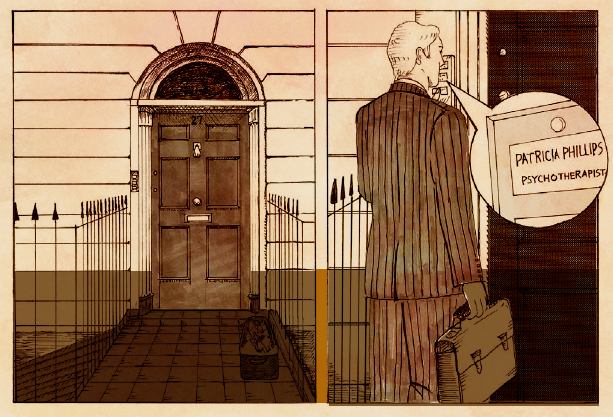
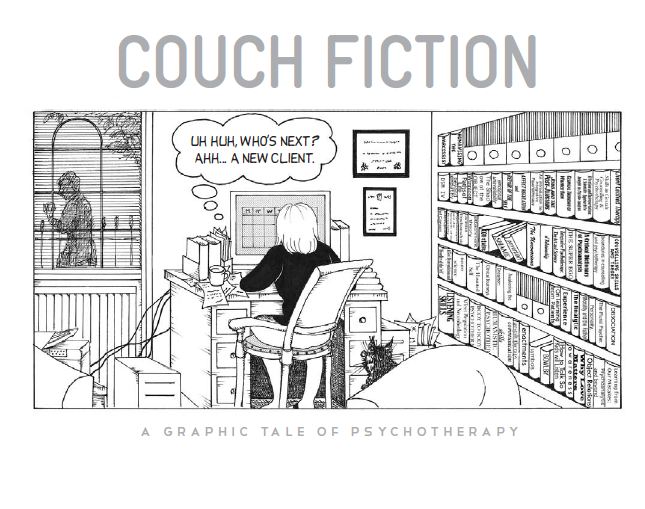
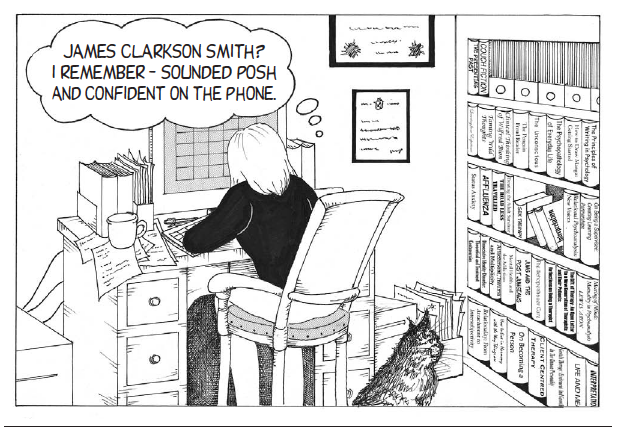
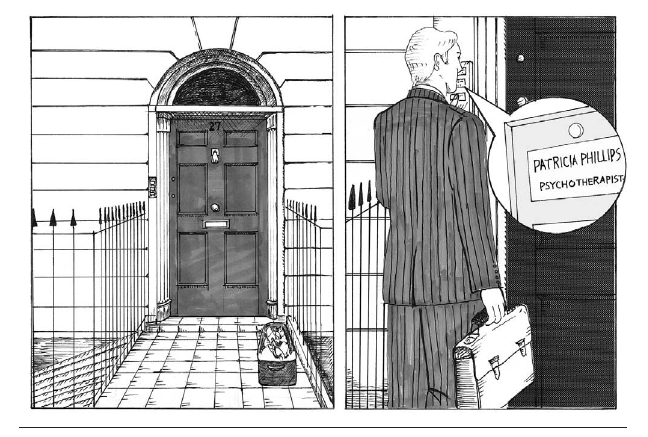
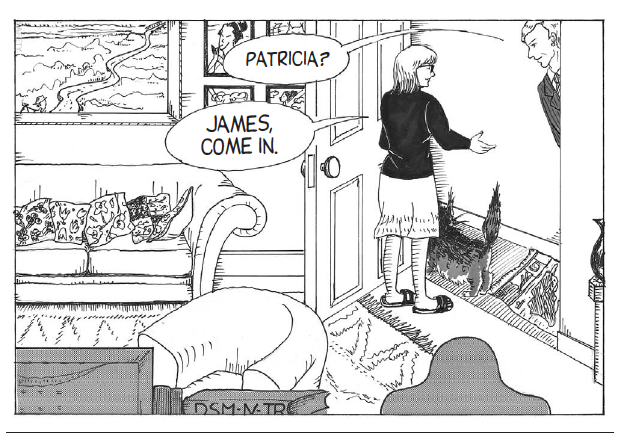
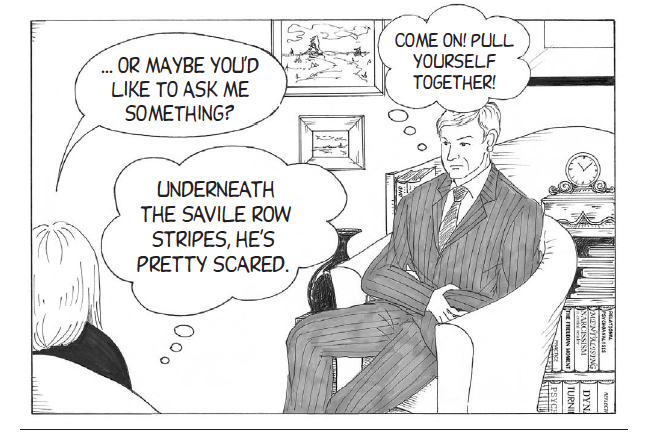
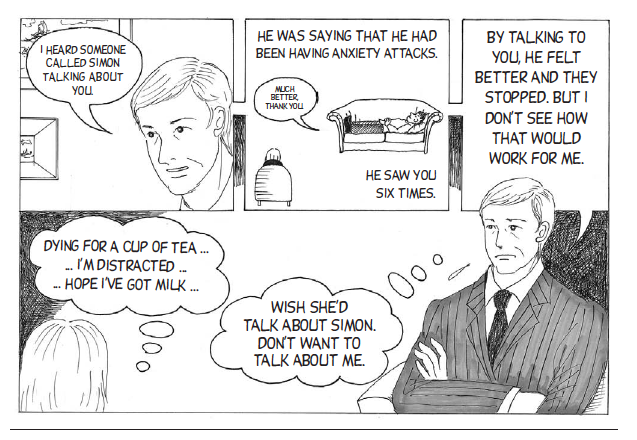
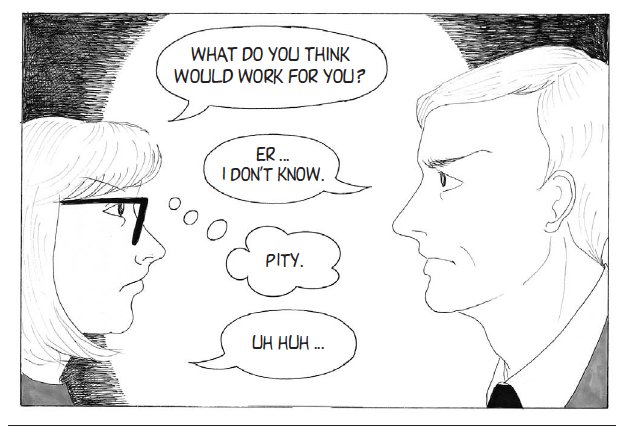
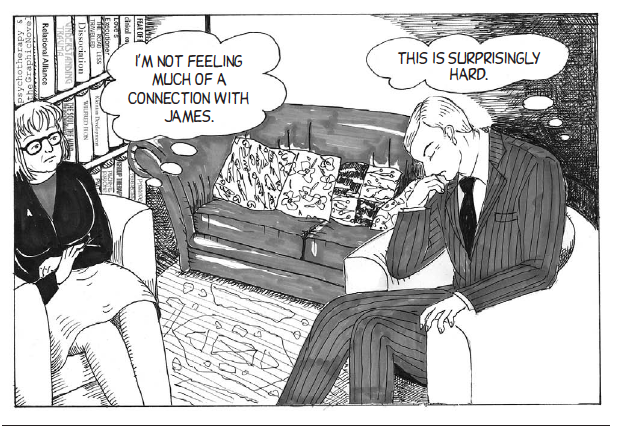
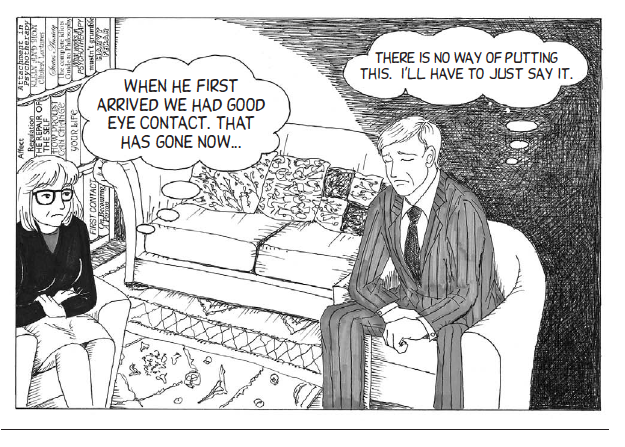
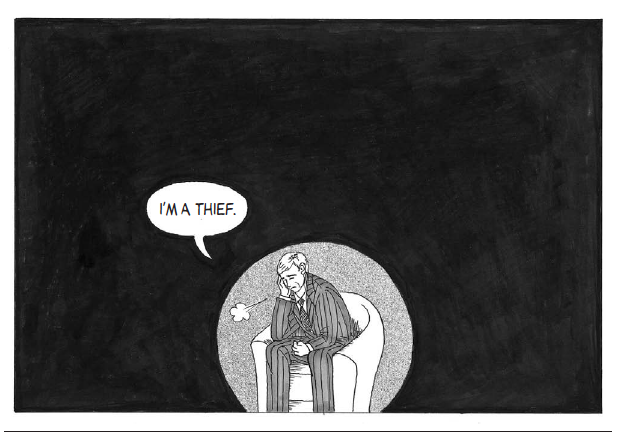
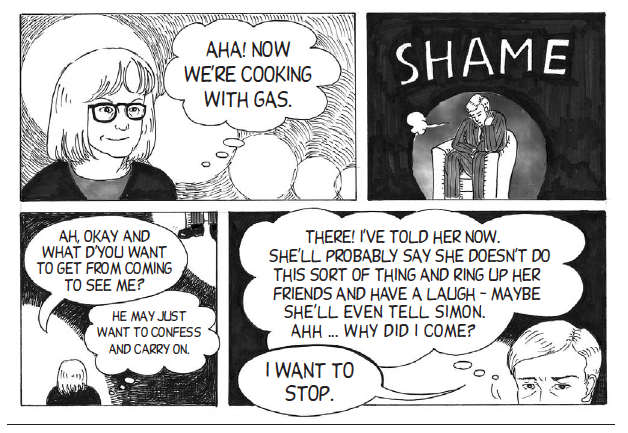
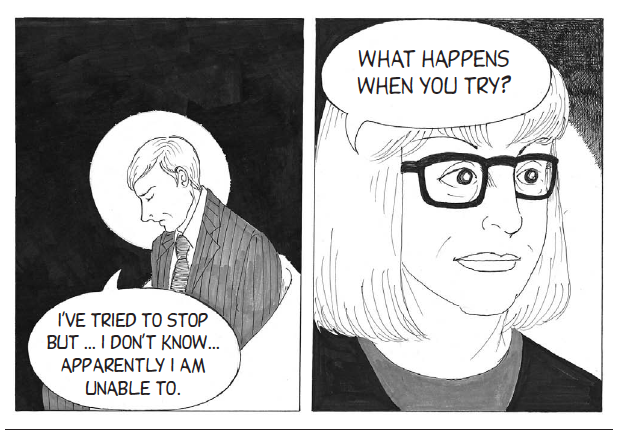
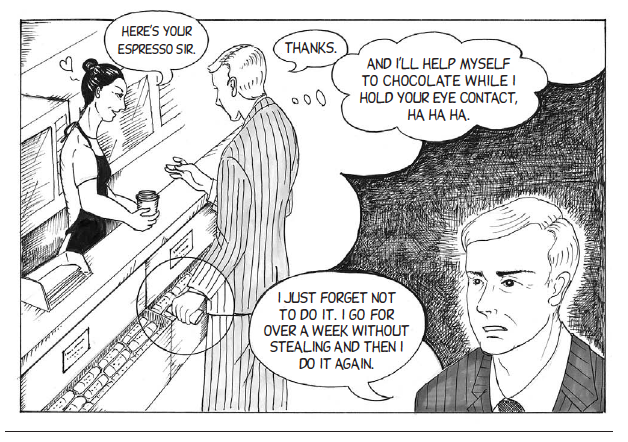
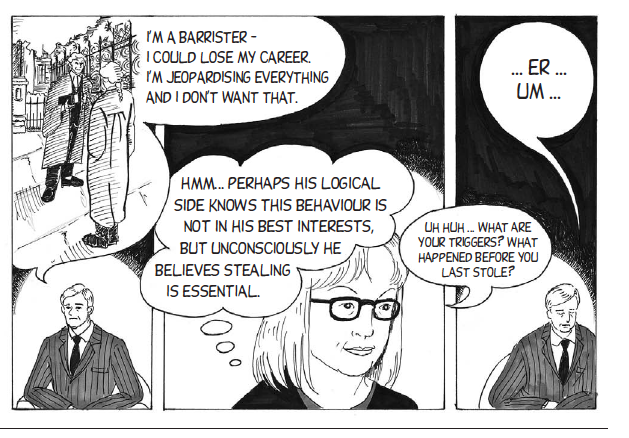
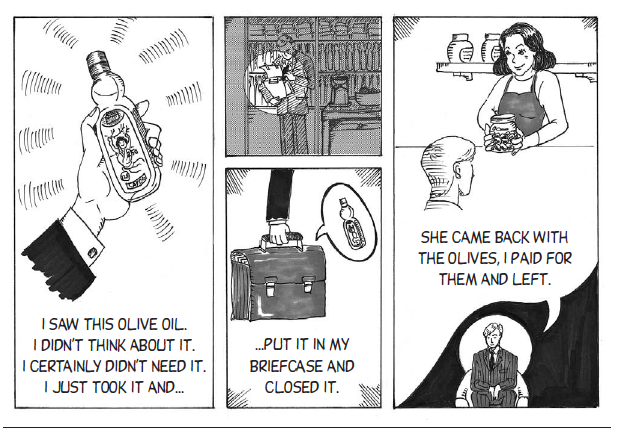
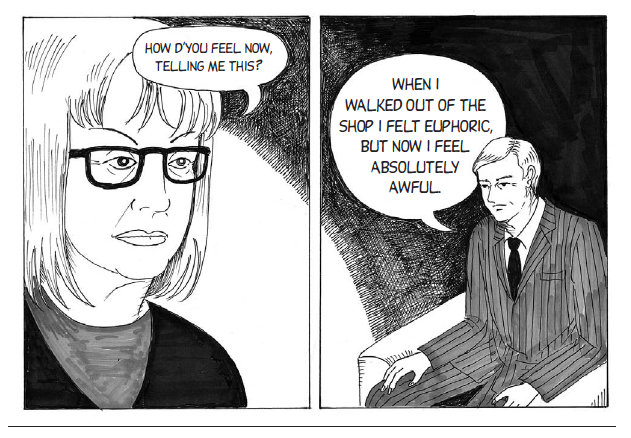
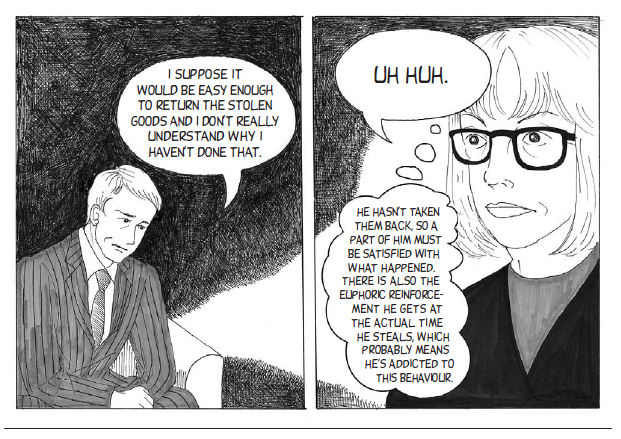
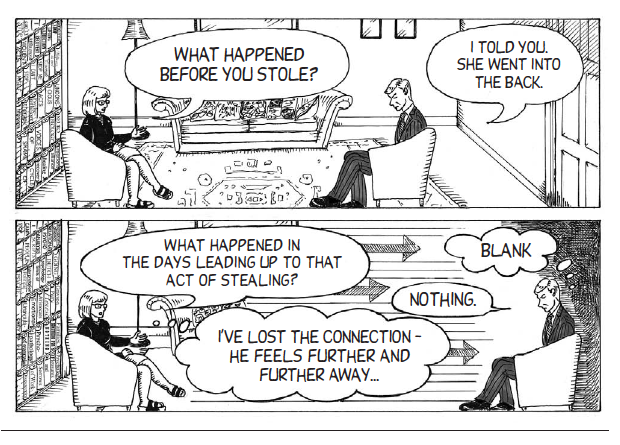
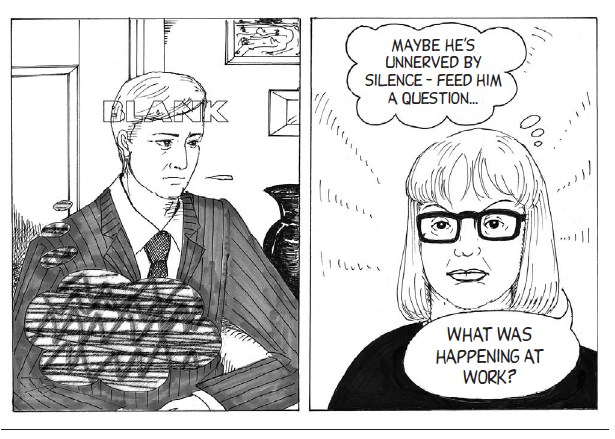
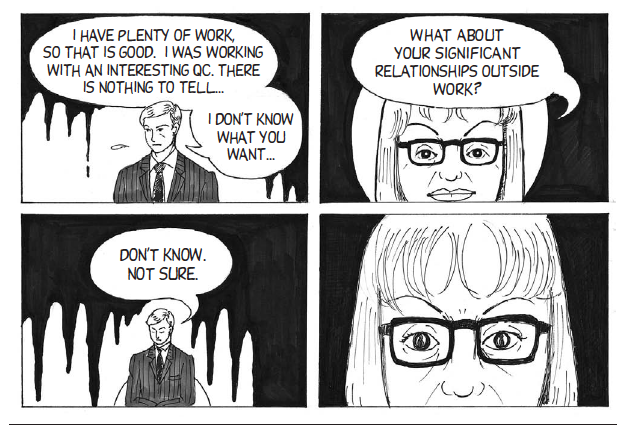
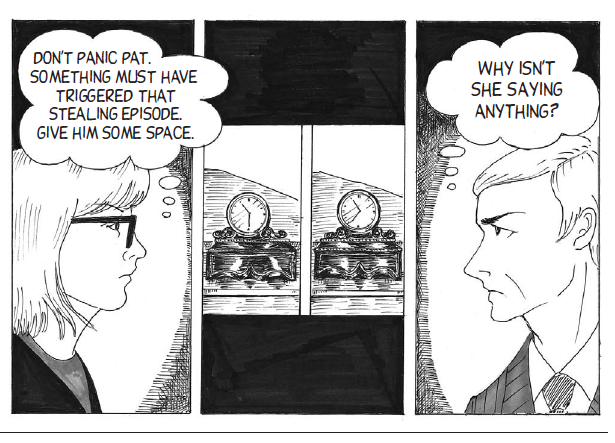
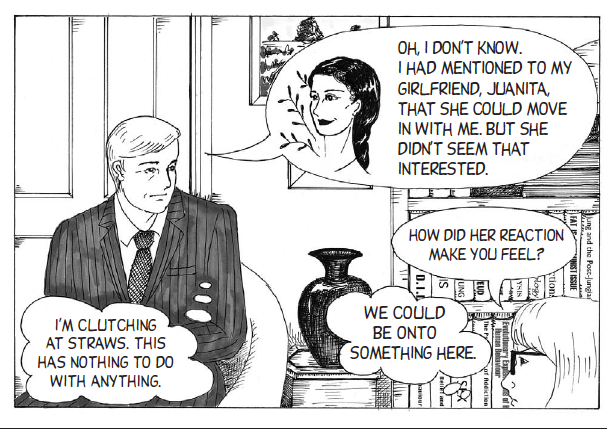
This is an excerpt of a beautifully illustrated  graphic novel based on a case study of Pat (a sandal-wearing, cat-loving psychotherapist) and her new client James (an ambitious barrister with a potentially harmful habit he can't stop).  The succinct footnotes offer a witty and thought-provoking exploration of the therapeutic journey. If you are curious of how Pat and James carry on this therapy, you can buy the book here .

Nobody's Perfect

Some schools of psychotherapy suggest that prior to a session, a therapist should empty themselves of preconceptions in order to maintain the openness of mind necessary to be aware of the nuances of the encounter. The psychoanalyst Wilfred Bion said that the therapist must prioritise perception and attention over memory and knowledge as the practitioner’s most basic working orientation. This position is almost always adhered to by the most experienced therapists (occasionally due to dementia rather than a rigid adherence to theory). The therapist in this story is not rigidly adhering to this theory. She is not a perfect therapist and there is no such thing.


I wonder how much research has been done on the impact of recycling bins and their contents on the doorsteps of therapists’ premises? I would be especially interested to know of their impact on the first-time client.


 Many psychotherapists do not worry about the impression that their appearance makes on their clients*; some have a habit of wearing open-toed orthopaedic sandals whatever the weather. Footwear can give an idea of whether a therapist is working from home or renting a room – slippers or open-toed sandals in winter are a sure sign they are home based. *This is either because they have worked through their own narcissism issues or they are inherently unstylish, or both.


Truth

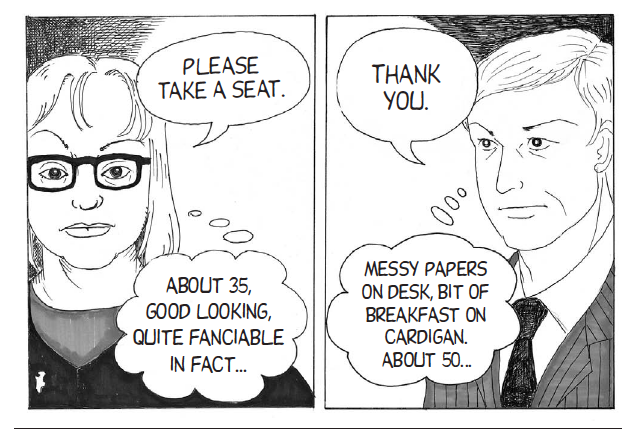
We can never assume that the absolute truth in and of another person can ever be completely known. It is, however, important in psychotherapy to strive for that truth. Whether Pat clocking that she finds James attractive can be seen as striving for absolute truth is debatable.


In the past, unlike Pat, many therapists didn’t ask questions in order to be a blank screen onto which the client then projects. Projection is when instead of having pure contact with another, we project a part of ourselves onto the other person and relate to our own projected part, rather than, or as well as, to the person before us. It is now recognised that a practitioner who says nothing is anything but blank and, however talkative or silent she is, the client will still react to her as she is in the present (with her funny sandals and her recycling). Nor will failing to remain silent prevent projection or transference. Transference is when we make subconscious assumptions about the person before us in the present, based on our experience of people we have known in the past. For the record, countertransference is what therapists call the feelings that the client causes to emerge in the therapist. It is desirable that therapists recognise their countertransference so as not to complicate an already complicated matter.


 By talking about Simon, James is avoiding the subject it would better serve him to talk about – himself. Pat appears to be experiencing a countertransferential parallel process to James, as she too is finding it hard staying with the business in hand. Possibly, due her distraction, Pat has missed the clue that James ‘heard’ Simon talking about her, rather than James reporting having a conversation he had with Simon. It is as though he has taken the information from Simon by stealth. She missed this. It does not matter. If it is important that a behavioural pattern is addressed, the client will invariably either demonstrate it again, or bring it up later on.


Research has shown that clients are most likely to make positive changes in therapy when the therapist uses the client’s own theory of change, or when the therapist’s own ideas about change coincide with the client’s previously held psychic beliefs. This is why Pat asks James what would work for him.


Success

The highest indicator for a successful outcome for therapy is the client’s expectations, motivation and hope. The second is the relationship between the client and the therapist. Neither area seems to be thriving for Pat and James at this stage in the therapy.


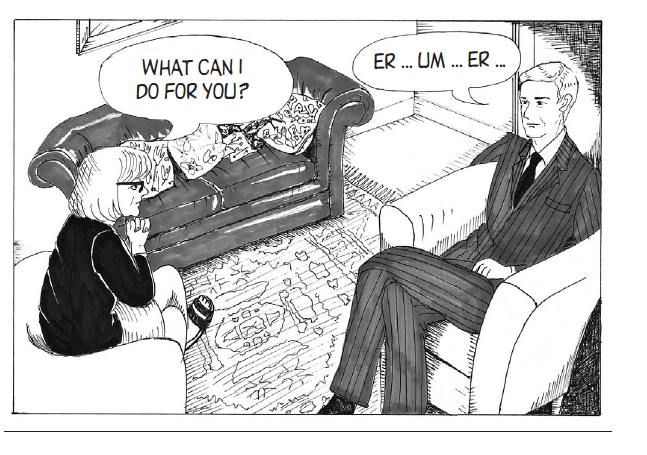
Many clients report that naming the issue that brings them to therapy out loud for the first time can be a powerful experience, even overwhelming.


Psychotherapists are often asked whether it is boring listening to people talk about themselves all day long. The answer is no, not when they are really talking about themselves. If the therapist does feel bored, she will be interested in that feeling because it will be telling her what needs to be addressed in the session is probably not being attended to. Therapy can break down if client and therapist have not agreed goals. By asking James what he wants, Pat is beginning to negotiate a potential contract for their work together. She is also checking out whether she would be willing to work with James. Not many therapists want to act just as a confessor.


Many people consider undergoing therapy only as a last resort. They have usually tried various strategies to change or to feel better before getting help. Pat would not want to suggest something James has already tried, hence her line of enquiry.


Although kleptomania isn’t a particularly common compulsion amongst people in a position to afford private psychotherapy, it is not unusual in that most of us continue with a habit we would rather we didn’t. For example: procrastination, smoking, eating too much, being over critical, over-reacting, acting shy, getting drunk… the list goes on.


Inevitably when a therapist looks back over a session, there is always something she could have done more sensitively or intelligently. Here, Pat is going too fast for James in looking for triggers for his behaviour. It would serve him better at this stage if she empathised with him more. The idea, though, is not to be perfect. The idea is to remain authentic while striving for the unknowable truth.


If this was an ordinary conversation and not a therapy session, Pat would probably go into raptures about the combination of pitted black olives in chilli oil with pickled garlic available at the nearby Spanish deli. But this isn’t an ordinary conversation and so she does not share her passion about olives with James. Although James is relating a story about buying olives, olives are obviously not the subject here.


The process of telling the story and the relationship of the teller to the story is of more interest to a therapist than the content of the story itself. The content is the icing but the process is the cake itself. This is why therapists will often ask a client how they feel about the story they’ve just told. It is another of the differences between a normal conversation and a therapy session.


Pat is formulating theories about James’ behaviour that she is choosing not to share. Therapists commonly refer to this process as ‘bracketing’. Pat does not know James very well yet, so she is unsure about what he can and cannot tolerate hearing at this stage. Possibly it would serve James better if she also bracketed her line of enquiry about triggers, as her inability to let go of the trigger theme is in danger of rupturing their relationship. Bracketing is more complex than just withholding information. It actually means suspending judgment. To understand this thoroughly one has to study the philosophy of Husserl. He talked a lot about how seeing a horse qualifies as a horsiness experience irrespective of whether the horse appears in reality, in a dream or hallucination. He also talked about the very essence of how you experience the phenomenon of horse essence, but I’ll bracket that.


Pat continues to pursue her trigger theory. Her speed here means that she doesn’t stay in contact with James. In her enthusiasm, she appears to have forgotten her early counselling training on closely tracking the client and going at the client’s pace. James is being pushed not only to where he does not want to go, but where his body is unwilling to go, and so he goes blank. Going blank, or dissociating, is not an act of will but an automatic response to certain stimuli. Some people are more prone to this response than others, especially if they started to do it at a very young age. You might assume – and perhaps this is Pat’s mistake – that James being a highly educated professional person would be able to follow Pat’s simple questioning. But all of us have the potential to be highly functioning in some areas and relatively immature in others.


In most people’s lives, there are three main areas: what we do, where we live and who we live with. Pat has tried the first area, what we do – work, in other words – and did not come up with anything. She’s moved on to the people in his life to see if anything untoward is happening there.


Therapy is not like a normal conversation in that there can be long silences in order to give things time to emerge from the unconscious mind into awareness. Although unless this has been previously negotiated between the parties, what is likely to come up is,‘Why isn’t she saying anything?’ or ‘What am I supposed to do now?’


As either a client or a therapist, if something pops into your mind, it may be worth sharing. Even if, on your own, you cannot see its relevance.

If you are eager to know the end of the adventures of Pat and James, you can purchase Couch Fiction here  and benefit from a 25% discount on this and all other psychology books from Palgrave Mcmillan. Please click here, select the book of your choice, and enter promocode PSYCH2011 at checkout.

Duped and Recouped

A Business Venture

As a young therapist in a solo practice, I routinely met a colleague for breakfast and peer supervision. I arrived at the neighborhood deli to find my former group therapy instructor waiting for me; his broad, toothy grin and Pacific-blue eyes were electric with anticipation. We had met during my doctoral studies.

I laughed. “What’s up?” “I thought you’d never ask!” blurted a very excited Jeffrey Kottler.

He then proceeded to explain that he had answered an ad for a clinical therapist. When he went to the interview, he convinced the clinic owner to sell him two-thirds of a Blue Cross–approved outpatient psychiatric clinic (OPC). Jeffrey and another therapist/ friend would operate its satellite, located in a busy Detroit suburb. This was a rather significant coup since there was a moratorium on the opening of any new clinics and the only way to own one was to purchase an existing clinic for a great deal of money.

“What?” I screamed. “Why didn’t you ask me to be your partner?” “I thought you were so happy in your little practice that I didn’t think you’d consider…” “Well, I do consider,” I interrupted petulantly. “Your other friend’s out; I’m in!” I declared.

And in that split second, Jeffrey and I committed to each other with complete trust and confidence to be partners in this venture. Were we merely trusting souls by nature, or was there something in our training as therapists that encouraged us to blindly trust people without reservation? Perhaps it was a shared personality trait that drew us into the profession originally and, likewise, into this partnership wherein we simply trusted what others say and how they characterize themselves.

There we were, Jeffrey and I, about 30 years old, masquerading as businesspeople, skipping due diligence, moving the satellite to new digs, signing a lease, buying furniture, hiring support staff, and interviewing dozens of therapists for positions in our new enterprise. We decided to hire only those professionals who seemed to be not only good clinicians but also fun people to hang out with at work.

We each paid a significant amount for our share of the business and began billing Blue Cross and other insurance companies for services rendered. Eventually we hired close to two dozen other therapists to work with us, all of whom met our criteria. In purchasing the clinic, we also inherited a few therapists and Dr. Jolly, our medical director. Dr. Jolly seemed competent enough and awfully amiable. What did we know?

Two months later, Dr. Jolly was caught soliciting sex in an airport men’s room. That was obviously the end of him! But the euphoria of owning our own business carried us through that initial setback. We justified our lack of judgment by claiming that we didn’t actually hire Dr. Jolly. And there were certainly other concerns to distract us.
The most pressing concern was the apparent snag in the money flow from Blue Cross to our third partner and then to us. With each passing week, we became increasingly more anxious about our bottom line.

Our daily calls to the partner, who was handling our billing, were met with sympathy and reassurance that these delays were quite normal in the industry. That seemed logical to us. After three months without payment, we suggested to him that we meet with Blue Cross to try to expedite the cash flow. “No!” he stressed emphatically and cautioned us that contact with Blue Cross would trigger an unwanted audit, which typically resulted in disastrous consequences. He asked us just to remain patient because his bookkeeper was receiving treatments for a brain tumor, immediately eliciting our sympathy.

At the end of the fifth month without payment, Jeffrey and I decided to take decisive action and confront this man who sold us the clinic. Alas, we discovered that all along he had been billing Blue Cross fraudulently. It also turned out that he didn’t actually own the clinic he sold us! It had all been a scam. We poured our hearts out to the executive at Blue Cross who agreed to hear our case, admitting that we had been duped but convincing him that we were honest and trustworthy professionals who were only trying to help people. Much to everyone’s surprise, he rewarded our honesty by assigning the provider number to Jeffrey and me. We were the first recipients of a new authorized clinic in many years.

Trusting souls that we were, we got back on our horses and rode into the sunset believing that enough had happened to us for a lifetime. At last we must be safe from all future peril. And now that we had lost our innocence, we were much better prepared for dealing with unexpected chaos running and operating a clinic. Little did we realize that our innocence and gullibility to deceit had only just begun.

Over the next year, we fired another medical director for inappropriate sexual conduct with his patients. Our part-time book- keeper was caught in a sting operation soliciting sex in a freeway men’s rest stop. One therapist went to jail for fraudulently billing Blue Cross; another therapist went to jail for practicing with a forged license and the malpractice insurance of a dead person; and still another therapist made an out-of-court settlement with a female patient with whom he had been having sex in the clinic after hours.

As therapists, Jeffrey and I erroneously thought that because we were skilled diagnosticians and experienced clinicians, we were inherently good judges of character. Yet time and again, we were duped by people we trusted. In truth, I think we projected onto everyone we encountered our own need to believe that all people are basically good. We refused to imagine that we were actually vulnerable.

It took at least three earth-shattering fiascos before I actually began to consider that I was somewhat responsible for the series of misfortunes that were raining upon us. For a while I became hypersensitive because I no longer trusted myself. I was suspicious of everyone around me, fearing that there were secrets lurking behind the facades of those I thought were loyal friends and colleagues. I was actually paranoid waiting for another shoe to drop. It was like walking through a minefield every day. I hated the feelings and retreated to my office where, ironically, I felt safe in interactions with my patients. After all, I expected them to have secrets under the surface and to be less than authentic with me since they were struggling to be authentic with themselves.

I had a very difficult time accepting that I was unable to fore- see the consequences of my gravitational pull toward people who would eventually fail my litmus test. My rose-colored glasses now had a double edge: While it had been wonderful to always see the good in people, I realized that I had been ignoring signs of trouble to preserve my need for everything to be okay. Challenging my inner belief system shocked me to the core. I had to ask myself, What am I supposed to be learning from these painful and frightening experiences?

To make sense of this episode in my life, I resorted to the only path I thought would yield any answers, self-exploration. And the first question to ask myself was, “What am I getting from this turmoil?” In every fiber of my being, I know that in all of us a self-healing power exists. I just had to figure out why it was so important for me to be telling myself that everything will be okay. After a rather difficult and circuitous route, I realized that the childhood trauma of having a terminally ill mother was the motivation to adopt the mantra everything will be okay. No matter what happened in my life, during childhood or during the years as a clinic owner, I had to believe that everything would eventually be okay. So when each betrayal occurred, I quickly resumed my position as sentinel for my inner belief system and continued to guard the hell out of it.

The personal lesson in all of this is not in the failings of judgment but rather in the repetition of the failings. If I had ruminated on each betrayal and become stuck in the quagmire of details, I would not have heard my inner voice beckoning me to attend to a significant piece of unfinished business. My echoing mantra held the key to the reason for it all. I was duped over and over because I needed to find my own place in the drama.

Once I acknowledged my role, I no longer felt vulnerable or paranoid. My trust in the basic goodness in people returned. I was again unafraid of the goodness of my own heart. In truth, I have made only a very slight change in myself; I am no longer surprised when my expectations for others are dashed. But I consciously refuse to surrender my eagerness to seek the best in people. In the end, I would rather suffer the occasional betrayals than cut out my own heart.

The many episodes of being duped during my ownership of the clinic resulted in an amazing gift to me as a therapist. I learned to help my patients honor their own inner voices. I became better able to observe the ways they guard their inner beliefs and became better skilled at diagnosing why. Ultimately, I learned that, inherent in the repetition of turmoil and struggle, there is always an unfinished piece; when addressed, confronted and honored, calm and balance can be restored.

Jeffrey’s Personal Commentary

Reading Nancy’s story about the trials and tribulations we experienced during our sojourn as clinic directors reminded me of how deeply I buried this chapter in my life. Over the years I’ve talked about the incredible lies, deception, manipulation, intrigue, and immorality that took place under our roof. Like Nancy, I blamed myself for my naïveté and innocence, and for our collective inclination to believe the best in people, even in the face of contradictory evidence. As psychologists, we deluded ourselves into thinking that because of our sensitivity, caring, and clinical acumen, we could tell when people were trying to fool us.

I felt both surprised and moved by Nancy’s confession and acceptance of responsibility for our plight. Nancy describes what she considers “the key to the reason for it all,” as if there was a single mistake or misjudgment on her part that led to the debacle and serial betrayals. Yet in my version of the narrative, or at least my remembrance of what happened, I have also accepted full responsibility for our innocence and misplaced trust in others. Like Nancy, I also found it easy to be forgiving, not only of those who crossed the line, but mostly of ourselves. We were inexperienced in the domain of business. We applied the trusting attitude that serves us well as therapists to another context in which different rules operated—and I see that as our biggest error.

Speaking for myself, I learned some hard lessons about the limits of my ability to read people and uncover so-called truth. Yet these therapists were our friends; they were people we trusted; they were professionals with track records and sterling reputations among their colleagues. Even more disturbing, they were also good therapists and had very successful practices.

Whereas Nancy talks about this repeated deception as a gift, an important lesson learned, it took me many years to come to terms with my lapses in judgment. Eventually, I did rekindle trust, enough so that I still prefer to give people (clients and colleagues) the benefit of the doubt.

As I read over Nancy’s version of the story, and then consider my own narrative, I find it interesting that each of us blames ourselves (instead of the other) for the crazy things that took place under our watch. We mistakenly assumed that because we operate from a position of transparency and honesty, that our colleagues, whom we carefully screened and supervised, would do so as well. That was a huge mistake, one that changed the way I function in some arenas in that I am more cautious and skeptical at times. Yet I think we have both been able to maintain a deep faith in the ability and willingness of most people to do the right thing.

Why a Therapist Should Care About a Clients Favorite Brand of Shampoo

When I was a youngster my father owned a company that manufactured shampoos and hair conditioners.  His bestseller was the original Rum & Egg Shampoo, a product he invented himself.  Now here’s where the story gets a little humorous (or perhaps not so humorous depending on your vantage point).  We would routinely receive correspondence from folks who just loved the Rum & Egg . . . heck, they thought it was the best darn shampoo on the face of the planet.  In fact, they’d go a step farther and trash another brand or two of Rum & Egg and say something like, “Why can’t Brand X or Brand Y make Rum & Egg like yours? The product they manufacture is pure junk.”

These folks wanted the original Rum & Egg. Anything else was a poor copy of the real thing. Now you might be thinking that we were patting ourselves on the back for making such a great product. Well if that’s what you thought then hold onto your horses because I haven’t gotten to the punch line yet.  Moments after the first call we receive another telephone message. This time it would be from an irate customer who would be ranting and raving about how inferior our product was, “Why in the heck can’t you guys make a decent Rum & Egg Shampoo like Brand X or Brand Y?  I’ll even send you a bottle of their brand so you can see how good the competition’s product really is.” 

These folks had invariably seen the Brand X or Brand Y advertisements that stressed that their rum and egg products clearly surpassed the original formula. And send us a bottle, they did!  Now what the aforementioned dummies (um excuse me, I mean customers) didn’t know was that most of the time it was the exact same stuff!  Let me put it in a different way.  We’d fill a thousand bottles to the brim with Rum & Egg and some bottles would get our label, others Brand X, and others Brand Y, Z or whatever.  We never had a clue which bottles received which labels. Hello folks: you’re all buying the same stuff . . . it's called a private label product. Often the same shampoo or conditioner would even be made under the same name with ten different colors, ten different brand names and ten different perfumes.  (Sorry to disappoint you, but in cosmetics generally the most expensive part of the product is the package and the perfume, in that order.)

But this principle goes way beyond hair care products. At one time made in Japan meant junk, but that’s hardly been the case for the last twenty years.  Now Japanese always stands for superior quality . . . or does it? A few years back researchers took models of automobiles and VCRs that were sold either with US nameplates (Dodge or RCA) or Japanese badges (Mitsubishi or JVC).  Like the shampoo saga, the products were actually identical. Customers were given the Japanese brand and the American issue and told to rate them. Perhaps you’ve already guessed that the products sporting a Japanese label – never mind that in reality they were the same – were rated much better.  Consumers made comments like, “The Japanese model just rode quieter,” or “the picture and the sound were markedly better.” Had you performed the experiment in the early 1950s the products with the US nameplate would surely have won by a landslide. 

Now what does all this have this do with the art and science of psychotherapy?  I thought you would never ask. A number of years ago I was at a conference where one of the top-guns in the world was not only lecturing but was going to perform therapy with a real client for the audience. Since I was the program coordinator for an agency I brought several of my therapists with me. Anyway, Mr. Hot Shot top-gun therapist was kind enough to perform a therapy session for the audience. He spent most of the session yelling and screaming at the poor client. One of my therapists leaned over and said, "You'd fire us if we ever talked to a client like that. Well, wouldn't you?" I didn't answer.

When the brief session ended a counselor in the audience raised her hand and asked the client a question, "What would you think if you walked into an agency or private practice and the therapist treated you like this?" "Well," the client admitted, "I would think it was a bit odd or perhaps totally crazy." The counselor in the audience was now extremely perplexed. "But I don't get it. You seemed perfectly happy and even impressed when Dr. so and so just did it." "Oh that's different," replied the client. "I know he's one of the greatest therapists in the world. He did it for some complex theoretical reason. He knows what he's doing."

I leaned toward the therapist at my agency and whispered, "Yes, I would have fired you." So here's the quintessential question: If you said exactly (I mean precisely word-for-word) what a well-known therapist said to the same client would you get the same results? Since a world famous therapist is one heck of a placebo the best answer is: not on this planet.  Therapists, quite frankly, are a lot like brands of shampoo, electronics, and  automobiles.

Its the Psychiatric Meds, Stupid!

I was getting ready to close up shop and leave my practice for the day when my secretary announced that one of my clients was in the waiting room in a hysterical panic pleading for a session with me. This came as somewhat of a shock to me inasmuch as I felt this client was actually progressing quite well.  I told my secretary to send her right in.

The client was crying so hard I could barely understand her verbalizations, but strangely enough the precipitating incident was a visit to her psychiatrist's office. As she calmed down I got the gory details. The client told her psychiatrist that she was doing extremely well.  That's a good thing, right? She then went on to explain that her therapy sessions with me were very helpful and thus she had turned her life around.

Her psychiatrist responded with a sinister chuckle and told her in no uncertain terms that her that the therapy sessions with me had done nothing. Instead, he suggested, she had been the victim of a nasty chemical imbalance and that the psychiatric medicines he prescribed had made all the difference. My client balked at the idea, stating that she made some cognitive and behavioral changes as a result of the psychotherapy and that his biochemical explanation was totally negating her work in the process. The psychiatrist's anger then began to escalate and he became louder and more belligerent. He insisted that the therapy and the client's volition had nothing to do with it.

The session reached a point of no return when the psychiatrist took her chart and physically hurled at her (wasn't that professional?) as he yelled, "If you really believe it was the therapy and not the psychiatric medication then go find yourself another psychiatrist." He then stomped out of the room. Since I'm a card carrying therapist in good standing please indulge me as I paraphrase the good doctor, "It's the psychiatric meds stupid!" This served as the trigger for my client breaking down and coming to see me. (Hmm? If you have a gander at one of your behavioral science dictionaries, I've got this uncanny notion the term iatrogenic illness will ring a bell here.)

I agreed with my client that counseling and therapy had been very valuable to her. Nonetheless, since I was the therapist at the center of this battle royale I just I had to know how she knew for sure—I mean 100% sure—that the medicine didn't make all or part of the difference.

"Oh that's easy," said the client as her face instantaneously blossomed into an ear-to-ear grin, "he's been giving me those pills for three years and I've never swallowed a single tablet."

Gottman and Gray: The Two Johns

Walk into any bookstore in America —perhaps the world—head for the psychology shelves, and there bound together until sales do them part are the two gurus of relationships, John Gottman and John Gray.

John Gottman virtually invented the science of observing behavior in relationships and can predict future happiness with scary accuracy from groans and grimaces we're scarcely ever aware of. He's a very prolific writer, but most of his work appears in the academic literature. A couple of years ago he penned a popular book, Why Marriages Succeed or Fail. It sells respectably.

Of course, nothing like the books by John Gray: at last count six million copies of Men Are from Mars, Women Are from Venus. Even his several other books— his latest is Mars and Venus on a Date—sell in the hundreds of thousands. Hey, why save a hot concept for married folks, or even adults? The Mars/Venus juggernaut is readying a kids' version. We haven't even talked about the audiotapes. A run on Broadway. Celebrity Line cruises. CD-ROMs. Seminars, and now the first franchise deal to hit psychotherapy. For a few thousand dollars, plus a yearly renewal fee, you too can buy the right to call yourself a Mars/Venus counseling center. You lack the professional credentials to practice? Don't worry—so does Gray. For somewhat less, anyone with a pulse and a purse can buy the right to lead Mars/Venus groups in the nabe.

John Gottman and John Gray, side by side. The placement invites—no, commands—a comparison of the two. How does their information and advice stack up? The short answer is that Gottman is the gold standard while Gray is the gold earner. Gottman creates top psychology, while Gray mines pop psychology: Even that he's turned into "poop psychology," in the words of one Psychology Today reader. We've extracted the pith from their writing and sayings to compile a handy crib sheet. Judge for yourself.

 A Tale of Two Relationship Gurus

Issue John Gottman John Gray
Chief Motivating Force Research Revenge (first wife Barbara de Angelis taught him seminar biz then ditched him).
Formal Research Naturalistic observation of couples living in apartment laboratory, plus video and physiological monitoring. None.
Number Of Couples Actively Studied 760 0
Longest Period Of Follow-Up 14 years 0
Academic Credentials Ph.D., University of Illinois Ph.D., Mail order, Columbia Pacific U. (unaccredited institution).
License Psychologist Driver
Number Of Journal Articles Written 109 0
Cardinal Rule Of Relationships What people think they do in relationships and what they do do are two different things. Men and women are different.
Defining Statement The everyday mindless moments are the basis of romance in marriages. Before 1950 men were men and women were women.
What Makes Marriage Work Making mental maps of each other's world. Heeding gender stereotypes.
What Makes Marriage Fail Heeding gender stereotypes. Misunderstanding gender differences in communication style.
Heroes Men who put the toilet seat down Men who escape to their cave
Role Of Gender Differences Mark of an ailing relationship. Recipe for success in relationships.
View Of Intimacy Comforts men Scares men
View Of Humor Right up there with sex; communicates acceptance. "Men will tolerate humor. Women won't."
Signs Of Marital Apocalypse Criticism, contempt, defensiveness, stonewalling. Arguing
How Spouses Do Best Accepting influence from one another. On separate planets.
Key Gender Difference Men's and women's bodies respond differently to conflict Women talk too much about feelings.
Why Men Withdraw Their stress systems are over-activated during marital conflict. They can only tolerate so much intimacy.
Cause Of Conflict Virtually inevitable between two people. She hates Super Bowl Sunday.
Men's Big Mistake Failing to deep breathe during conflict. Solving her problems.
Women's Big Mistake Stating complaints with criticism. Giving advice.
Why Men Don't Help More at Home Their brain cells were not trained to notice domestic themes. They give their all at the office.
Marriage Math There must be 5x as many positives as negatives in marriage. Men and women keep score differently.
What They Say About Each Other "I envy his financial success." "John who?"

This article was previously published in Psychology Today, November 1997 (Vol. 30, No. 6), © Hara Estroff Marano. Reprinted with permission