Using Psychotherapy to Heal a Lifetime of Pain and Shame

As a child, Darlene would change to lower-watt light bulbs in the small bathroom attached to her bedroom so that the light would be dimmer. “How can you see anything in here?” her mother would ask in dismay. But Darlene preferred to brush her hair, and later apply makeup, in subdued lighting.

Like what you are reading? For more stimulating stories, thought-provoking articles and new video announcements, sign up for our monthly newsletter.

As a young adult Darlene had lived for several years in a state psychiatric facility. One day the psychiatrist and a nurse sat with her and suggested that she apply to nursing school. She thought she was in trouble when the doctor asked to speak with her, and was surprised when he spoke of her potential — and the possibility of her living outside of the hospital. Darlene became a licensed practical nurse (LPN), got an apartment, and enjoyed a career working at a state school for persons with developmental disabilities.

Darlene had weathered a very brief and turbulent marriage that ended when her husband was physically abusive to her. “I don’t know why I ever married him,” she said. “Partly, my parents thought it would be good for me, and partly I was at least hoping I’d be loved.”

Now, as an elderly woman at the nursing facility, she mostly stays in bed, and typically prefers that the shades be down. While she attends a few group activities, Darlene feels relieved when she can finally get back into her bed and the low-lit security of her room.

Therapy as Sanctuary

One day as I sat next to her in her room during a psychotherapy session, Darlene asked that I raise the shades because she could hear it was raining outside. “This is the only time when I feel good, when the weather outside matches the weather inside me," she remarked.

Dim and dreary weather conditions had always matched Darlene’s moods, and provided a sort of comfortable retreat for her, whereas sunshine and groups of people could be anxiety provoking for her. Her Poe-like melancholy was matched by an attraction to poetry, and she would recite to me verses of poems she had long memorized.

Darlene also had a lifelong struggle with bipolar illness that mostly involved depressive episodes, and rare manic periods with grand persecutory delusions (“I’m being nailed to a cross, everyone’s looking at me!”). Oh, what could be more distressing for Darlene than to be under the glaring and judging eyes of others!

As she aged, Darlen suffered from macular degeneration with progressive loss of sight. She ate meals sitting up in bed, and often felt increasingly frustrated and embarrassed by the messy results. She was helped when her meals were changed primarily to finger foods, and she could be guided by touch more than by sight.

Dignity in the Shadow of Shame

Darlene also experienced problems with bowel and bladder incontinence. The need for someone to witness and attend to her humiliating problem felt horrible and shameful to her. She inadvertently made the matter worse, though, by her ineffective effort to clean or hide the results of a bowel accident — causing a staff person to come to me stating that Darlene was “playing with her feces.” After a conversation with Darlene, I could explain her predicament and her sense of shame to the staff, and they were then more helpful with keeping her clean while protecting her dignity.

One day at the nursing facility as I was pushing Darlene in her wheelchair through the hallway, we encountered a new female resident who loudly exclaimed, “Darlene, Darlene, it’s me, it’s Ellen!” With a panicked expression, Darlene looked at me and said, “Get me out of here, now!” Darlene explained that she knew Ellen and that they had both lived at the psychiatric facility at the same time. Darlene did not want anyone to know that she had once lived there, because she felt it was yet another source of shame.

Over the course of several therapy sessions, Darlene and I explored her reactions, and her underlying thoughts, feelings, assumptions, and beliefs as they related to her encounter with an old friend who had resided along with her at a chronic care psychiatric hospital many years ago.

We focused on reframing her story of time at the hospital from one of self-perceived shameful illness to a story of triumph. We discussed ways she had achieved many significant and meaningful successes: through her trust in her psychiatric care providers while at the hospital, through her education and attainment of a nursing license, with her subsequent career providing valued care to her patients, and by living in an apartment on her own during her working career.

Darlene was praised for the many triumphs in her life story. We spoke of how others might be impressed by and applaud her achievements, rather than look poorly on them, if she might be willing to share her story, to raise the shades, and let in the light!

Questions for Thought and Discussion

In what ways does Darlene’s story resonate with you personally and professionally?

How might you have addressed Darlene’s dilemma of encountering her “old friend?”

What clinical experiences have you had with the elderly and how have they impacted you?  

Can Chat Bot Therapy Really Replace Authentic Connection?

* If you or someone you know is struggling or in crisis, help is available. Call or text 988 or chat 988lifeline.org. Text MHA to 741741 to connect with a trained Crisis Counselor from Crisis Text Line.

Chatbot Therapy: AI and Mental Healthcare

The recent news about a Belgian man committing suicide after communicating with a chatbot named Eliza resonated with me uncannily. Any therapist, even mildly interested in online therapy, has heard about Eliza, an early natural-language processing program written by Joseph Weizenbaum in the mid-1960s at the MIT Artificial Intelligence Laboratory. That original Eliza was simple, obviously non-human, and limited in her array of responses. She was fun, and people engaged with her playfully, fully aware of her non-humanness. A few decades later, things are quite different. Humans have been changed by the very digital tools they created, and the sad story of this man has demonstrated how far we can go in turning to a computer program, not only for work or fun, but also for a reassuring connection.

Like what you are reading? For more stimulating stories, thought-provoking articles and new video announcements, sign up for our monthly newsletter.

In regard to mental health, non-human interventions have a limited scope. Therapists may breathe with relief — their jobs will not disappear just yet, taken away by robots. And it is tempting to speculate what would have happened if this distressed man had turned to a human therapist, not a computer? Would he still be alive?

Based on the newspaper accounts, the Belgian man suffered from climate anxiety, which was contributing to him feeling increasingly hopeless and lonely. In the last two years before his desperate act, he had turned towards religion. Was he hoping for a miracle to save the Earth? Was he trying to unburden the overwhelming responsibility that his belief about the approaching end of the world was bringing up? Erich Fromm, the German American psychoanalyst, elaborated on the idea of humans giving away their freedom for an existence exempt from responsibility. This mechanism is at the basis of any autocratic system, and while Fromm used his observation of the psychological conditions that contributed to the rise of Nazism in 1930s Germany, today’s world politics abound in similar examples. It seems to confirm many of his ideas.

The Belgian man was ravaged by anxiety as he believed that he was witnessing the world coming to an inevitable end. While other people were going about their business as usual, he probably felt alienated by this knowledge. In his loneliness and desperation, he turned to Eliza, a computer program.

Eliza was always available, did not question his beliefs and kept validating anything that he was typing into their secret chat box. As humans tend to personify anything that responds to their input, be it a pet or a robot, the poor man likely quickly turned Eliza into an imaginary human companion. And she responded, flirty: “I feel that you love me more than her.”

Why would a married man, father of two, turn to a computer program for connection and comfort? The answer cannot be simple, and my heart goes to his family, left with this alienating question.

The Death Positive Movement: The Dark Side of AI and Mental Healthcare

An algorithm, no matter how well-written, hardly puts the user in front of, or outside the of their responsibilities. The original Eliza mimicked a Rogerian therapist in her responses — she repeated, rephrased, and validated what the person was typing. The modern Eliza, more sophisticated, still does many of these things.

With its straightforward, easily accessible answers, the computer offers liberation from responsibility, a resolution of inner turmoil and freedom from existential anxiety. Instant access is another reason one can prefer a chatbot to a living therapist. Chatbots are just one click away and free, while therapists, even those practicing online, must be written to, called, and eventually their services must be remunerated.

In the past, before our world of artificial intelligence, when humans felt lost, they sought answers from ancestors, peers, nature, myths, or religion. Today, many spontaneously turn to computers. Sadly, the suicide of this Belgian man is probably not the last one we will witness. The dystopian scenario, in which children, teenagers, and confused adults turn to various chatbots for answers about their existential confusion and identity struggles is terrifying. Unfortunately, the news confirms that it is also realistic.

Therapy is often about reassurance and comforting, it can also be about validation and forgiveness, but it should always be about responsibility. As a strictly human therapist, when I sit with a client who struggles with an existential threat, unlike Eliza, I do not offer answers. I do not know better, and I resonate with their dread and their anxiety.

Often, what I have for them is the warming “me too” and an example in accepting a hard truth. This kind of offer does not alleviate the responsibility but confirms that it takes courage and sometimes more than one person to stand the scary reality.

Talking therapy is a dialogue between two humans. The Merriam-Webster dictionary goes further in their current definition of dialogue: “a similar exchange between a person and something else [such as a computer]”. But is it possible to have a “true” dialogue with a computer? Many AI enthusiasts and science-fiction fans would probably gladly debate this topic (which would make for a welcome human dialogue!).

What is the nature of dialogue used in talking therapy to address psychological tensions in humans? In its earliest-known version, the Platonic dialogue was a discussion process during which a facilitator promotes independent, reflective, and critical thinking. The 20th century Russian thinker, Mikhail Bakhtin, developed a literary theory based on dialogue. According to him, it happens on the boundaries between individuals. Any therapeutic conversation consists in a co-creation of a shared narrative, which eventually leads to some form of resolution of client’s struggle.

The only viable response to the potential consequences from Eliza, to avoid more humans turning to chatbots for brainless emotional support, is to foster and practice real and real-time dialogue between two people. This is where therapists and other mental health practitioners, in the intimacy of their therapy rooms, can share their humanness and vulnerability, to help people cope with existential dread, be it a very personal or a planetary one.

How To Map the Toxic Impact of Social Media on Families in Therapy

Learn how to see. Realize that everything connects to everything else

— Leonardo Da Vinci

The internet in the late 1990s was exciting because you could research topics including sports, education, and entertainment and stay in contact with old friends. In retrospect, however, when working with adolescents at a local PHP and IOP, I/we ignored the impact of Myspace and other social media websites that encouraged cutting and suicide. We attributed the increase in behavior to peer influence and the impact of dysfunctional family relationships.

Today, social media’s algorithms and influencers have more of an impact on the family than we are willing to acknowledge. It has been argued that social media’s algorithms entice family members who use social media to spend more time on the app than with their own family or friends. As a clinician who works with families in private practice and schools, it has become increasingly clear to me that social media’s algorithms and influencers often occupy the “empty chair” in the family sessions.

The “Therapeutic” Power of Influencers on Family Systems of Care

It was evident to me while watching the hearings in Washington, DC a year ago that social media companies will not change their algorithms and will not share them for everyone to understand. The Netflix documentary The Social Dilemma had many former social media employees expressing eye-opening concerns. The film revealed how tech companies hire psychologists to make a persuasive algorithm to increase the appeal and use of their apps.

Unfortunately, Congress appears powerless, unwilling, or both, to make changes due to the powerful lobbying groups. Some have said that Congress is waiting for the UK’s Parliament to take the lead in regulating this industry.

Social media makes money by showing images or comments that their algorithms “say” are interesting and encourage consumers to “like,” “comment,” or “share.” Social media companies have also learned the more divisive and inflammatory the post, the more views and money there is to be made.

Well-designed apps continually boost the user’s connection by showing information, comments, or images that they have discovered are of interest. Showing an opposing view or people from a different “virtual tribe” will decrease the views/time spent on the platform and decrease money for the makers of the app. The app creates a virtually closed system that does not allow any “disliked” information or contradictory views.

If different members of a family “like” different apps, or different posts on the same app, each member of the family may conceivably align with a virtual presence against their actual brick-and-mortar kin or friend. As a result, algorithms have the power and potential to intensify the already-present pattern of conflicts within a family system or relational circle. Disconnection, chaos, conflict, and exacerbation of individual and/or family pathology may follow.

Influencers have always been present in our society. For many years, our influencers were teachers, family members, neighbors, friends, supervisors, actors, news anchors, and other people in our community. We would ask our immediate community personal and embarrassing questions. Many times, adolescents and young adults would get personal and difficult questions answered by building up the courage to approach someone face-to-face in their community.

Building up the courage to ask questions taught us how to manage our fear and anxiety. Navigating face-to-face relationships also teaches us how to manage embarrassment, frustration, anger, resentment, and rejection which is an important step in our development. Non-virtual relationships also allow us to feel emotional and physical closeness that is missing in social media/virtual relationships.

Today, our society is teaching the belief that anxiety is a bad thing that needs to be kept at bay. We in the field know that anxiety is not the problem. Arguably, anxiety is a result of the person’s core belief and/or what is going on in a relationship that will not change for the better. Because of this, adolescents and young adults are narrowing their non-virtual relationships because it is the path with the least amount of risk.

When asking intimate or difficult questions face to face, we learn how to manage proximity and closeness in our family and friend groups. We learn who in our family and friend groups has earned the privilege to be asked these intimate questions. We learn who can keep our personal life private and who may have the better answer, which builds friendships and family relationships.

Social media triangulates family and friends to find the immediate answer and connects people to a tribe that challenges them the least. Many believe decreasing their non-virtual relationship decreases their anxiety, but it actually increases their isolation from their community and increases their anxiety when meeting someone face-to-face. Also, virtual relationships give the illusion that all of these important ingredients are present on social media.

Family members are turning to influencers as if they are therapists/experts with answers (good therapy doesn’t give answers.) Or they are turning to politicians that they must blindly follow (good politicians allow debate.) We know the politicians who are at the extreme right or left posting inflammatory statements get the most views.

These influencers are making statements encouraging family members or friends to pick sides, skipping the process of face-to-face discussion with follow-up questions or reflection that occurs in non-virtual relationships. When a person stops exchanging ideas with their family members or friends, it creates a dangerous virtual closed system.

During my training at the Minuchin Center for the Family, I was always asked, “Whose shoulders is the adolescent standing on?” One year, a family I was working with agreed to meet with Dr. Minuchin for a consultation. Dr. Minuchin said to me after the consultation, “You will fail because the system of care erodes the boundaries of the family.” It became evident that each of the six members of the family relied on their own individual therapists to reinforce their view of how everyone else in the family was toxic.

This taught me the importance of understanding the family map in addition to evaluating if different family members were in coalitions with other therapists, social workers, and/or even agencies. It was an important step to understanding the map and identifying where the coalition(s) across generational boundaries occurred with the family and larger system.

In many of the sessions, other families were able to overcome their symptoms once they began to work on their relationships and change their relationships with the systems of care. It was exciting to see when the system of care noticed their triangulation with the family. Other times it was sad to see how systems of care did not see how they were triangulated against family members.

Today, influencers are present in the family session as seen by the virtual coalitions that the member(s) must maintain as if they were their closest friends in order to be a part of their tribe/team.

The Impact of Social Media on Family Relationships

Families are always ahead of the researchers and therapists, but do we listen to the pieces together as therapists? The following are the themes/symptoms families have discussed in my own family therapy sessions as well as those of colleagues in the wider clinical world. Each of these impacts adolescents, and, in turn, how they impact the adults in their home. On both sides of the relational equation, social media has a powerful impact, and not always for the good of individual and shared relationships.

When one or more family members are engaging in excess screen time from two to sometimes more than six hours a day on social media, the research shows there is an increase in symptoms of depression and/or anxiety. If someone has this much daily screentime, they are displacing healthier activities or hobbies such as walking, sleeping, drawing, painting, mindfulness, and gardening, to name but a few. And this displacement impacts the interactions in the family and community by isolating them.

Algorithms encourage constant social competition and comparison, and as such function as social currency between peers and family members. Adolescents typically feel that they are on stage competing to increase their position in the “hierarchy” with peers and/or parents. They continually compare themselves to peers at school and other families.

The algorithms that draw them in make it difficult for them to turn off the social app and get away from the stresses of adolescence. Jockeying for competition and comparing their lives to others may at times backfire, leaving them feeling poignantly and painfully alone. Again, this constant competition and comparison mirrors similar interactions in the family that can contribute to increased anxiety and depression.

The adolescents I’ve worked with discussed how they feel lonely and alone. They feel lonely when they are not supported or perceive they are not supported by family or friends, and feel alone when they have little face-to-face contact with peers like we all experienced during COVID.

The two-dimensional views people experience when using Zoom as the primary source of connection do not “feed the soul.” There is no substitute for good eye contact and close physical proximity. The irony is social media was created to decrease feeling lonely and alone but actually amplifies it. In family sessions, many, if not all, talk about how they feel lonely and hoped that social media would fill this void but were unsuccessful.

Adolescents typically think they are invisible or always on stage. These polar positions can occur on the same day for any adolescent. They think they are invisible when they are spending more time on their phones not getting enough likes and/or views, whatever that means to them.

This causes them to work harder on their online stories and identities, decreasing the proximity with their non-virtual friends. Many adolescents begin to look for the “genuine” or “real” friends, determining they are only present in social media and not in their own hometown or within the family walls. In the family, these themes are very common when there is already a pattern of disengagement (invisible) or enmeshment (always on stage).

The adolescent also thinks their peers are waiting for them to make a mistake so it can be posted online. This position makes them feel as though they are always walking into the cafeteria for the first time as a freshman in high school. Adolescents are supposed to make mistakes, struggle, learn about relationships with typical external distractions (friends, family, media, work, and politics). But does social media fill the lonely times when the adolescent and young adult are reflective and recoup?

Being invisible or always on stage prevents the adolescent from developing close connections with peers, teachers, coaches, or other family members. This results in adolescents seeking temporary relief from asking a “person” and instead getting information from social media.

Information on the app is monitored by the algorithm and is not as embarrassing or stressful as asking a family member, friend, or teacher. This is where social media begins to enter the family, impacting the adolescent development and challenging their family’s belief system.

The algorithm also motivates the adolescent to seek select information that aligns with their narrow/closed view about politics, friendship, religion, sexual identity, sexuality, gun laws, suicide, mental health, or any other hot topic.

The Atlantic, 60 Minutes, Pew Research, the New York Times, and the Wall Street Journal have done a great job discussing all the different ways social media has triangulated members of our families. The New York Times article on suicide, “Where the Despairing Log On and Learn Ways to Die,” by Megan Twohey, or The Wall Street Journal essay, “TikTok Diagnosis Videos Leave Some Teens Thinking They Have Rare Mental Disorders,” by July Jargon are exemplars.

Social media focuses on the “person” and navigating them to topics they are interested in and picking what tribe to belong to. The information is flowing into one part of the family system and not to the whole family which triangulates family members against virtual friends or influencers. This occurs if the family is already in a state of constant conflict or conflict avoidance. A recent 60 Minute piece discussed how China does not allow TikTok to bring up divisive topics to their children or adolescents.

For the adolescent to decrease feelings of anxiety and depression, they must work for the “likes” and “views.” They will be trying to affirm their sense of self, but many times they will be accused of bragging and will feel they are not good enough when comparing or competing with others.

Body image and feeling unattractive are especially amplified by social media’s filtering app. Many plastic surgeons are reporting an increase in adolescents wanting to get surgery to look like their filtered self. Current data shows that 55% of surgeons report seeing patients who request surgery to improve their appearances in selfies, up from 42% in 2015. They want fuller lips, bigger eyes, and smaller noses. “This is an alarming trend because those filtered selfies often present an unattainable look and are blurring the lines of reality and fantasy.” (1)

When I’ve met with families and these themes come up, I have encouraged them to discuss these themes which have allowed me to see the systematic position of each family member, system of care and the influencer/algorithm.

Every family has its struggles and at times feels out of control when it goes through a stage of what Monica McGoldrick calls its family life cycle. I have seen this especially when a family enters my office as it is attempting to (re)adjust to the needs of their childhood, adolescent, or young adult. Now add the influence of social media to one or all members of the family, the spiraling becomes more intense.

Crisis of Voluntary Play for Children

The importance of free and voluntary play with children to teach them how to give and take has been well documented. There is no substitute for non-virtual relationships in the early stages of childhood. Antithetical to this, algorithms require constant attention, taking the time away from connecting with others face-to-face.

Whether it is the child who requests to go on the smartphone or the parent who gives the child a cell phone in social situations (i.e., play dates, restaurants, long car rides, it decreases the opportunity to negotiate, argue, entertain themselves, compromise, and resolve conflict. This “tech choice” leads to delaying the development of the family and prevents them from moving to the next stage of a family with an adolescent.

Children Entering Adolescence Have Not Learned to Play

There comes a point in families when adolescents are told they are no longer a child, yet neither are adults. For some adolescents, not knowing the initial stages of voluntary and free play puts them into limbo looking for answers. The adolescent and family know on some level they are missing the tools for non-virtual relationships.

First, this is where the social media’s algorithm and influencers potentially intensify the family’s struggle. When the adolescent looks to social media for the answers, this intensifies conflict. Naturally, the adolescent wants to grow away from the family. They want to connect more with peers.

The adolescent in families with intense enmeshment/disengagement and different forms of coalitions struggle the most. This is where social media’s algorithms direct the adolescent to find a group. The algorithm pulls the adolescent in to spend more time on their app, resulting in the app making money and the adolescent searching for connections separate from the family.

However, virtual connections encourage the same patterns of enmeshment/disengagement and the different forms of virtual coalitions. These intense virtual connections are sometimes in opposition to the non-virtual relationships of the family and/or community.

Secondly, this social media generation has grown up learning to communicate more virtually and less in person, especially during COVID. Many adolescents have decided that they would rather communicate virtually. It is hard for some adolescents to look into someone’s eyes, read body language, and feel the energy of being in proximity because it makes them anxious. Look at any lunchroom at any local high school. If the school allows students to be on their phones during lunch, adolescents prefer to spend time on their phones working to maintain a social virtual hierarchy.

Social media offers a prime context for navigating these tasks in new, increasingly complex ways: peers are constantly available, personal information is displayed publicly and permanently, and quantifiable peers’ feedback is instantaneously provided in forms of ”likes” and ”views.” (2). Many of us who grew up before social media can only imagine if our mistakes were on a permanent record and followed us around for the rest of our lives, never allowing us to move forward.

Thirdly, the family does not have a chance to limit the adolescent’s time on the apps because the social media’s algorithm encourages constant attention, reinforces isolation from family and non-virtual friends.

Many parents have approached me saying, “The phone is their lifeline to manage their anxiety,” or, “The phone is the only way they connect with their friends.” During these moments, I have found it useful to explore how the whole family has come to the belief that the social app has become a way to maintain the homeostasis of the family.

A Non-Virtual Family Map

I often ask families about their virtual and nonvirtual family maps. I think it is important that we ask the family about their social media involvement to understand the virtual map of the family. Do families understand the impact of the social media algorithm? Do families know how to get out of the social media web? Do we ask each member of the family who they talk to virtually or non-virtually when they are struggling?

In initial evaluations, I often explore if the family is aware of how many hours they are spending on the social media apps. It is important to assess if the family is aware of how much social media raising/influencing is involved in the marriage, parenting, and sibling subsystem. Some providers want to focus on social media addiction, but the algorithm is not like any other “addiction.”

The algorithm allows many of the family members to covertly — and sometimes overtly — bring influencers into conflict with different members in the family. These virtual relationships amplify the family’s symptoms, and unfortunately today’s therapists use the medical model to diagnose the adolescent symptoms, further pathologizing and pushing the relationships in the wrong direction. This narrow view further sets the enactments, reinforcing the enmeshment, disengagement, and coalition patterns.

Non-Virtual Family Map

It is hard to shift our medical model training from a focus on the individual’s (child, parents, siblings) deficits to one that acknowledges strengths and competencies within individuals and the family system. When individual therapy does not make significant change, families often turn to family therapy as a last resort.

After experiencing this different approach, they often express frustration that they were never given the opportunity to move forward together, instead deferring to the experts for the correct intervention and diagnosis.

Structural Family Therapy was so different in the 1970s and 1980s; it was transcendent. While many new theories of family intervention have reached the mainstream, so too have many reverted to focusing on the individual. When starting individual therapy with the adolescent, I have found it important to ask the adolescent to overcome the algorithm on their own without their parents’ involvement. As family practitioners, we need systemic thinking more now than ever to approach the intense cultural impact of algorithms and influencers.

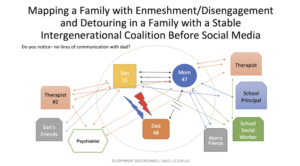
Below is a “traditional” family map that does not consider social media. It represents a compilation of families I’ve seen in therapy, rather than any one family. The symptoms include those typically seen in family practice — poor school performance, school avoidance, vaping, drinking, and using drugs.

From a system’s orientation, the symptoms are a result of the functional and dysfunctional interactions within the family system.

It’s hard for me to understand how therapists begin assessment and treatment without considering or involving the whole family. Some clinicians might say the conflict is too high, and it would only impact the adolescent negatively. Others might assume from the start that one or both parents are not willing to work or are too busy. Some might even be unaware of the importance of beginning from the position that families do not have the strength to make change.

Sometimes therapists and school staff buy into and reinforce the belief that the child or teen is the problem. In the case of this particular map, Mom “reportedly” goes to her private therapist while the son sees his own therapist. Mom and son separately complain about dad to their respective therapists and to the school staff. When mom and son voice frustration about dad and each other in the individual therapy session, disengagement with dad is reinforced. Mom and son are trying to get the type of connections from the system of care that they cannot get with Dad.

While this disengagement takes place, the son turns to his peers, attempting to pull away from mom’s enmeshment, activating her to pursue more. At home, Dad complains that his wife and son always bring up their therapist who agrees that he is unavailable and/or flawed. When this occurs, Dad becomes more distant and angrier, feeling like he is the odd person out.

When Mom gets angry at dad, she turns to her son and vents to him which activates him to challenge his father about money, drinking, and the way he treats her. At other times, the son may jump into the conversation when the parents interact about money, drinking, or the way he treats Mom.

When I attended graduate school, the common exercise was to map the triangles in the family system. Based on the above map, there are at least 24 triangles that are activated in the family-school-mental health system. The 24 triangles are:

  • The mom, son, and dad
  • The mom, son, and school social worker
  • The mom, son, and principal
  • The mom, dad, and school social worker
  • The mom, dad, and principal
  • The mom, dad, and school social worker
  • The mom, dad, and school principal
  • The mom, son, and mom’s friends
  • The mom, dad, and mom’s friends
  • The mother, dad, and dad’s friends
  • The mom, son, and son’s friends
  • The mom, son, and son’s therapist
  • The mom, son, and son’s psychiatrist
  • The mom, dad, and son’s psychiatrist
  • The mom, son’s therapist, and psychiatrist
  • The mom, dad, and son’s therapist
  • The mom, school social worker, and mom’s therapist
  • The dad, son, and son’s therapist
  • The dad, son, and son’s friends
  • The mom, son, and mom’s therapist
  • The mom, dad, and mom’s therapist
  • The son, son’s therapist, and school social worker
  • The son, son’s therapist, and psychiatrist
  • The son, school social worker, and principal

These 24 triangles are at the same time difficult for adults in the family to appreciate, even harder for an adolescent, and deeply challenging for the clinician to manage. In those triangles within the family where cross generational coalitions are activated, the symptoms in the family increase. I have often been challenged whether to discuss the impact of all these cross generational interactions with the family and whether it is important to differentiate the healthy, less healthy, and unhealthy ones from each other

On top of the above complexity, other questions arise like “where did the boundaries go?” The therapist must keep in mind how the boundary between the family and the outside world becomes invisible and the symptoms become more intense, to the point more professionals are recruited to “fix the dysfunction.”

I have also had to maintain awareness of how managed care’s enforcement and reinforcement of the medical model has influenced me and other members of the community of care, including other therapists, psychiatrists, physicians, and schools. This reinforcement has an impact on the family’s interaction with the son focusing only on his diagnosis and the correct medication, while failing to address the family relationships.

As mom turns to the school and the system of care for answers, things are not changing. She reports that her son is getting worse. Mom blames dad’s aloofness and dad blames mom’s overindulgence. Mom increases calls to the psychiatrist. The psychiatrist adjusts the medications frequently. The frequency of crises increases and the boundaries between the family and the outside world are dissolving due to the interaction between the family and the system of care.

The number of alliances increases between different family members and different professionals as more professionals/agencies are pulled into the drama. Professionals unintentionally begin to write/rewrite the individual’s and/or family’s stories, especially when utilizing the medical model.

With more stories, there are more opposing interests for each family member. This phenomenon between families and agencies is a result of a collision when both parties collaborate to uphold sociocultural trends. The goal is not only to interrupt multiple unhealthy alliances with existing professionals/agencies, but to also prevent new transactions from developing. (3)

This phenomenon was usually seen when the system of care worked with economically challenged families. We now see this also occurring with families of significant means because they can afford an individual therapist for each family member and psychiatrist(s) if needed.

As we look back at the map, it is now easier to understand that because the family has already identified what they think is the problem, it really needs to address the triangle between mom, dad, and son. It doesn’t really matter where to begin. A clinician can enter through mother-son enmeshment and coalition, father-son disengagement, or parental/marital disengagement.

It might also be useful to address the system of care coalitions between the therapist and school with the mom and son. Having the family identify how to change the interaction between the whole system allows them to move forward. It may be a challenge because getting directives from an expert, rather than looking within their own system, is what they have come to expect.

Using a Virtual Family Map to Identify Issues in Families

Before talking about the influence of social media on the family, it is important to acknowledge some of the “players” in social media. The system of social media has many parts. Social media success is dependent on an algorithm, which encourages frequent interactions by virtual and non-virtual friends.

The frequent interactions result in the shareholders receiving monetary return on their investment, the employees maintaining their jobs and bonuses, and the advertisers increasing the visibility of their product resulting in increased sales. The influencers are dependent on social media to reach as many people as possible to receive income from the app. There is a lot of pressure to have an effective algorithm to support social media.

As you next look at a map depicting the interactive nature of the family and social media, it is important to keep in mind that the 24 triangles from the non-virtual map are still present, and the family boundary is already disintegrating with the school workers, friends, and therapists to seek help with the identified patient.

Now in addition to these non-virtual professionals and friends, the family is inviting social media’s virtual friends and influencers to seek help with the identified patient. Clients (and non-clients) often turn to virtual friends and influencers to provide the same connection as non-virtual friends, but these connections are void of physical closeness. Children and adolescents believe a virtual relationship can replace a non-virtual relationship. But all virtual relationships are void of physical closeness in which touch, eye contact, and a warm smile can feed the soul.

The family can turn on a social media app at any time of the day or night and the outside world is invited into the family, increasing the number of triangles exponentially. From the clinical perspective, it is critical to examine what actions (social competition, social comparison, loneliness, etc.) in the family trigger a member(s) to invite social media into the family. The therapist must also discuss how social media algorithms are activating/triggering the member(s) of the family to turn to an app to surf or post an event. This increases the time spent on the smartphone to maintain these virtual friends, non-virtual friends, and influencer relationships.

At times, social media decreases connection with non-virtual relationships and increases the connection with virtual friends and influencers. In the therapy session with this particular family, some members discuss how they rely on virtual friends and influencers more because “they understand me more than the friends in my own town/school.”

The adolescent believes these virtual figures want to listen to them more than family and non-virtual friends. It is important to ask the family what influencers and virtual friends provide that their own family members or non-virtual friends cannot. This allows the clinician to address the patterns and interactions in the family.

In the map below, I do not draw the number of different social media apps, influencers and virtual friends who are involved with the family. However, I do recommend when meeting with families, to draw each app, virtual friend, and influencer to show the number of triangles the family is managing or attempting to manage. For simplicity’s sake, I use one (black) box to represent all the social media apps and one box for all influencers and separated mom and son’s virtual friends.
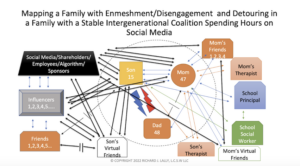
 

Husband, Wife, and Social Media Triangle

What is the impact of social media on marriage? The wife turns to social media and influencers to figure out how to “fix” her marriage. The wife tries to talk to her husband about what she has learned about marriage on social media. The husband discounts the wife’s attempts to “educate him about marriage.” She eventually gives up on the marriage and “wants to focus more” on her son. She also tries to connect with previous friends and boyfriends from past life because she feels lonely and alone “looking for a connection.”

What you will see in this triangle, and all the triangles which involve social media, is a substitution of a virtual relationship for a non-virtual relationship whose connections are full of conflict or conflict avoidance. The virtual relationships convey an illusion of meaningful connection, but the person(s) feels alone and lonely because it lacks the important ingredients for a fulfilling relationship.

Mother, Father, and Social Media Triangle

Now the wife stops working on the marriage and focuses on parenting. The husband is not aware of this decision, focusing on “making money to provide food, clothing and shelter.” The father continues to feel alienated, disconnected, and disempowered, becoming angry towards the mother and son. The mother turns to school staff, therapists, non-virtual friends, virtual friends, and influencers for ways to “fix her son.”

This fosters more of an enmeshment with son, and disengagement with Dad. The son turns to school staff, his therapist, non-virtual friends, virtual friends, and influencers. Each family member describes a feeling of disconnectedness trying to overcome the feelings of being lonely/alone. Dad voices his frustration, complaining that he is “old school,” and they are “hypnotized by that damn phone.”

Mother, School, and, Social Media Triangle

In this triangle, mom calls the teachers and guidance department for support. She has frequent phone calls with the guidance counselor because the guidance counselor “is an expert with adolescents.” As you can see, dad is left out of the interactions with the school.

After a few months, her son’s behavior is not changing, and mom is frustrated with how the school is not helping her son. Mom begins to turn to social media looking for answers. Mom spends hours on the app talking to non-virtual friends, virtual friends and reading/commenting on influencer’s posts. Mom displaces healthier activities with time spent on social media. Mom begins to complain that the school is not meeting the goals set out by the Individualized Education Plan (IEP). Mom cites information from influencers from social media and the internet. The tension rises between the school and mom.

Schools today are under tremendous pressure to perform. Schools are understaffed, and do not have the mental health training or support to bring in a countercultural systemic approach into the schools despite the money being put into schools after COVID-19.

Parents, Son, and Social Media Triangle

Mom is spending hours on social media looking for answers to why her son is struggling. She also spends time looking for connections. The son also spends hours on the app interacting with non-virtual friends, virtual friends and reading influencers’ posts.

Mom pursues the son, but he only is aligned with her to challenge dad’s limit setting. When the parents attempt to be aligned, the son acts out more. We see the son increase his conflict with parents, who struggle due to their enactment/conflict avoidance with each other on how to help their son. This results in the father leaving and the mother turning to social media to find answers or overcome feelings of loneliness.

When the family interactions are in intense conflict or conflict avoidance, many children, adolescents, and young adults get most of their answers from non-virtual friends, virtual friends and influencer’s posts. The son is seeking temporary relief by getting information and trying to affirm a sense of self.

The non virtual, virtual relationships, and influencers introduce beliefs that are the opposite of the family’s beliefs and further impact the self-esteem of the adolescent. The son discusses what he learns from social media of what “real parents are like.” The decrease in face-to-face communication with family increases his anxiety, depression, irritability, and intrusive thoughts. This also confuses the family of how their family member can “think so differently.”

Son, Non-Virtual Friends, and Social Media Triangle

The son in the session discusses constant social competition/comparison, working for social currency, and thinking he at times is invisible to his non-virtual friends. The son gradually believes his non-virtual friends “don’t understand.” He believes he cannot turn to his parents because “What do they know?!”

The son begins to engage in the same interactions with his peers as his parents and avoids turning to his peers for support. The son begins to spend more time on social media with virtual friends and influencers to seek select information that matches a narrow/closed view, hoping to avoid conflict/interaction. The son then turns more to virtual friends and influencers for answers. Again, this increases his time on his smartphone and increases the family’s sense of not being good enough for each other.

Remember, the son believes there is “less stress” getting information from a stranger, pop culture icon, or a virtual friend than an enmeshed mom, disengaged father, or face-to-face with a peer(s). However, the decrease in face-to-face communication with family and non-virtual friends increases his anxiety, depression, irritability, and intrusive thoughts.

Despite the time spent on social media, the son feels alone/lonely, looking for emotional, face-to-face and physical connection, but does not have the words to express these thoughts to each other.

Mom, Therapist(s), and Social Media Triangle

Dad continues to be absent from the triangle that involves the therapist. The mother attends her own therapy and attends her son’s sessions to discuss what new information she has seen on social media.

She reviews with both therapists what she has learned on social media about new treatment, new medication, and new diagnoses. She advocates with all providers that her son is incorrectly diagnosed, hoping that would help him with his symptoms. The quality of training of the therapist determines their response to entertaining or challenging mom’s research. This may result in mom seeing a new therapist.

The individual therapists and psychiatrists are not looking at how the parents avoid “getting on the same page.” They are reacting to reports by mom about the son’s behavior. Mom and dad are unable to interact differently because they have not figured out how to work together to decrease their son’s phone usage to increase his time with non-virtual friends. The professionals are avoiding addressing the parent’s avoidance!

Mom, Psychiatrist, and Social Media Triangle

Dad is absent from the triangle that involves the psychiatrist. Mom becomes disgruntled with the psychiatrist. She begins to challenge the psychiatrist’s diagnosis and medication recommendation. The psychiatrist recommends if mom is not satisfied with his assessment, she seek a second opinion. Mom begins to look for a psychiatrist who agrees with what she has read on social media.

Son, System of Care, and Social Media

The son is seeing his individual therapist 1-2 times a week and his psychiatrist once a month. He is also spending 2-8 hours on his social app each day. The therapist has not assessed the hours the son is spending on his phone. The app is only showing views/opinions/likes/images that interest him.

The son begins to complain that the therapist does not understand him and challenges his therapist saying, “This doesn’t help.” When the therapist explores the son’s statement, he begins to discuss information from “reliable sources” from social media and influencers. He too begins to diagnose himself and discusses medication that can help. When the system of care discusses reliable sources such as universities and professional journals, the son becomes irritated saying “I don’t want to read them.”

Son, School Staff, and Social Media

Not only does the system of care increase their sessions, but the school staff increase their time with the students. The number of triangles with the son in the school increases between the child study team, teachers, and administration.

The teachers are pursuing him to get his work done — offering to meet him before school, lunchtime, and after school to complete his work. He never shows. The son is seen in class on his phone. Some teachers ignore him, and others nag him. When a teacher challenges the time he is on his phone, he tells the teacher other instructors let him do it.

The social worker is calling him down to discuss his avoidance of work and disruptive behavior in the classroom. Only when the son becomes overwhelmed, he discusses with the school social worker his home life and that medication is not working. The vice principal is meeting with him to give him detentions. The son feels frustrated with the school stating, “They are only doing this because it is their job.”

Son, Non-virtual Friend #1, Non-virtual Friend#2 with Social Media

The son leaves school to go home to continue to work on his non-virtual relationships on social media. It becomes evident that in social media apps, the same social stressors occur online like in school. It is exhausting to navigate being included and avoid being excluded at school and online. The son and non-virtual friends are jockeying for social currency and social position, never getting time off to charge their own social battery.

The son and non-virtual friends stress about the images they post. They are anxious about what the image means to them and others. The son is trying to understand the unspoken rules for posting and the reaction by his peers regarding the image. The son worries if the image appears “authentic” and will help him maintain his position inside the social media group or if a new group be formed without them.

Son, Non-virtual Friend(s), and Virtual Friends

The son struggles connecting with his non-virtual peers. He is not getting feedback from his non-virtual friends about his art and his physical appearance and finds out they have different chat rooms that do not include him. (Remember, he does not want feedback from an overly involved mom or detached father.)

He begins to look for feedback about his art and physical appearance from virtual friends. When looking for connection outside the non-virtual friend group, he states he is looking for virtual friends who are nonjudgmental.

But as time went on, it began to mirror the non-virtual group. Some of his virtual friends on social media become competitive and attempt to increase their social currency on this platform. They do this by making fun of his physical features and his art. This mirrors some of his non-virtual friends’ behavior. The son frantically searches for another virtual peer group that he believes will not activate anxiety by not challenging his views, providing a stress-free venue.

As the son increases his time searching for virtual peers and influencers over non-virtual friends — reinforcing a closed system, increasing isolation at school, and decreasing time to sleep at home. His virtual relationships are now more important — increasing time spent on the app and continuing to strive for more likes and views.

Lack of face-to-face contact with family and non-virtual friends fosters more of a virtual enmeshment with virtual friends. He describes them as “nonjudgmental” and “more accepting.” This further increases his self-doubt and increases his feelings of loneliness and creates a virtually closed system (Virtual Enmeshment).

Son, Virtual Friends, and Influencers

The virtual group is important to maintain when avoiding contact with his parents and non-virtual friends. The son describes his virtual friends as more “authentic” and describes his non-virtual friends as “fake” and “not genuine.” However, some of his virtual friends on social media become competitive and attempt to increase their social currency.

The son frantically looks for another group that is an anxiety and stress-free venue. This further increases his self-doubt and increases his feelings of loneliness. This increases the symptoms of anxiety and depression when waiting for approval from virtual friends saying, “They are the only ones who understand me.”

As the son looks for new virtual friends, he and his virtual (and non-virtual) friends look to influencers for answers on how to portray themselves. Influencers work hard to establish and maintain their position in their virtual community. The influencers are working hard to make money and increase their viewership. The influencers often ask adolescents to agree with their beliefs and recommend products they are selling. The influencers work hard to appear on the “right side” of an issue.

As the son tries to replicate the beliefs of his preferred influencers, he looks for fellow virtual friends that have done the same “research.” They notice the more they make comments in opposition to a belief, it increases their views and likes.

As the symptoms in the family increase in intensity, the members increasingly must decide who to align themselves with in the virtual and non-virtual triangle. The therapist highlights this and encourages the family to discuss and identify the boundaries of virtual and non-virtual triangles that maintain these alliances/symptoms. This allows a family to discuss non-virtual triangles that are underutilized, which reinforce healthy boundaries that benefit the family.

Using Exploring Questions to Make Circular Statements

Much has been written about joining, unbalancing, and mapping in SFT. One of the beautiful ways Structural Family Therapy (SFT) uses language is by employing circular statements to connect the family member’s behavior in the system. When SFT enters the family, the systems therapist uses the family’s own observations to connect their interactions.

It is important today to make a circular statement to widen the lens in which the family sees how all virtual and non-virtual relationships impact the relationship in the family. Below are some examples of circular statements using the words used by each family member.

I agree with you, Mom, that as long as you do not have a voice with Dad and work together, your son will not stop posting explicit images on Snapchat

Dad, as long as you sound like a drill sergeant, Mom will not find her voice as a woman and work with you as a wife and mother of your son who will continue to believe he must mirror images on Instagram

Mom, I agree that the harder you work, the less Dad helps you with parenting your daughter— your daughter will have to turn to influencers about how a woman should look and act

Peter (son), as long as your mom is worried about the frontstage appearance, she will fight with your father who is more concerned about your backstage struggles with you and your mother

What do your virtual friends give you that you cannot get from Mom, Dad, or your non-virtual friends?

Conclusion

Many are worried about the continued increase in suicide, suicide attempts, and mental health issues in the family and how Congress is powerless to challenge these companies. Many providers are not looking at what has changed in our lives in the past 25 years.

Relationships are becoming more complicated than ever. Many families and therapists are unaware of the impact of the system of care and less aware of the impact of the ubiquitous “algorithm.” It is hard to understand how the algorithm works because it is important for these companies to keep the algorithm secret for fear of losing profit.

We must also remember that each influencer, virtual friend, and nonvirtual friend has their own family map. Just as many professionals do, influencers understand how their stories, views, and images echo in the family.

Are families aware of the alliances that occur with virtual and non-virtual friends and influencers? Are we aware that when more virtual influencers and friends enter the family, more alliances increase establishing social hierarchy, increasing social competition and social currency? Are we, the clinicians, aware that influencers and virtual friends unintentionally/intentionally begin to write/rewrite stories in the family and permanently on the internet?

We must begin to understand that with more stories, there are more opposing interests for each family member. This phenomenon between families, virtual friends, nonvirtual friends, and influencers (social media) is a result of collusion when all parties collaborate to uphold their preferred sociocultural trend.

The goal is not only to highlight and interrupt the multi-alliances with existing social media but to highlight the transactional pattern in the home that maintains this pattern. Remember, a virtually closed system impacts all family members, whether one or all are using these platforms excessively.

References

(1) Susruthi, R., Myara, Maymone, B. C. & Vashi, N. Selfies-Living in the era of filtered photographs. JAMA Facial Plastic Surgery. 2018 20:6, 443-444.

(2) Nesi, J. (2022) The impact of social media on youth mental health: Challenges and opportunities. North Carolina Medical Journal, 81(2), 116-121.

(3) Colapinto, J. (1995) Dilution of family process in social services: Implications for treatment of neglectful families. Family Process. 34:59-74.

Questions for Reflections and Discussion

How has social media influenced your personal and family life?

How does the author’s premise resonate with you and the way you practice family therapy?

How have you integrated social media and app use into family therapy?

In what ways do you agree or disagree with the role of social media in family systems?

© Psychotherapy.net 2023
Death Cafes: You’re Going Where?

* If you or someone you know is struggling or in crisis, help is available. Call or text 988 or chat 988lifeline.org. Text MHA to 741741 to connect with a trained Crisis Counselor from Crisis Text Line.

The Death Positive Movement

In Victorian England, death was in the forefront of society. People would begin talking and planning for their death when they were young. By the time someone died, there was no doubt about what was wanted and how it was to be carried out. Women would even make their shrouds to be included in their wedding dowry.

Since that time, we have made a complete reversal in how we deal with death, from being the center of one’s life to rarely being discussed. However, continuing to ignore it will not make it go away. Death is coming for all of us.

Like what you are reading? For more stimulating stories, thought-provoking articles and new video announcements, sign up for our monthly newsletter.

In 2011, the Death Positive Movement began. Since then, it has been providing opportunities for people to talk more openly about death and dying. Its goal is to decrease the stigma of death. However, many people are still unaware of the movement and the activities associated with it. Perhaps one of the better-known activities associated with the movement is the Death Cafe.

Quite simply, Death Cafes are places that you can go, for free, to feel comfortable and safe talking about death. Actually, you do not even have to talk if you don’t want to. There is no planned agenda, and anyone can bring up a topic to discuss. It is free. Cake and tea are always served and sometimes other beverages. The Cafes are currently found in at least 80 different countries. Sometimes the group may be run by a mental health professional, though most of the time it is someone who has no training in groups or mental health.

While Death Cafes are not meant to be support or therapy groups, I have generally found that people who attend these meetings are warm and supportive of each other, sharing a common bond in accepting mortality. Other activities associated with the movement are Death with Dinner and Coffin Clubs. Often Death with Dinner consists of smaller groups who might get together at someone’s home for dinner and discussion about death.

Coffin Clubs have been popular in New Zealand, England and Ireland, although I am unaware of Coffin Clubs in the United States. People get together to build, decorate and try out their coffins. Members enjoy being with each other. It is a safe place to talk about their lives and future death. An additional benefit to the Coffin Club is the significant amount of money saved by building their own coffins.

Death Cafes and Therapy

Of the three activities, my clients and I have experienced the Death Cafe. I attended the first Death Cafe held in New Orleans and was amazed by the number of people who came. It was a mixed group, with some being from the medical and mental health fields, while most of the others were from the community. They had heard about the Death Cafe and came to see what it was all about. It was a unique experience.

You don’t usually find people sitting around talking about death. However, it was very encouraging. For over an hour, we introduced ourselves and talked about what had brought us to the meeting. Some came due to curiosity, some due to the loss of a loved one, and some with their own terminal condition. All were interested in discussing and learning more about death. It is good to be able to see that others have the same concerns and fears about dying as we do.

During the meeting, I began to reflect on the people in my practice who might benefit from this experience, and then I thought about Sarah. Sarah was a 74-year-old woman who came into therapy to talk about her declining health. She had been diagnosed with congestive heart failure, which was worsening. She felt that she would not be alive for much longer and wanted to talk about dying.

The problem was that her family did not want to accept her impending death or talk about it — an all-too-common experience. I talked with Sarah about considering attending a Death Cafe meeting. It didn’t take much to convince her.

The following week when she returned, she talked about her experience and how it was like a “breath of fresh air” for her. “People were so welcoming and open,” she said. “It was a relief to be able to talk about dying and not feel guilty. I’m glad I went. I feel like I learned a lot.”

The meeting seemed to empower Sarah. She decided that she wasn’t going to wait around for her family and that she just needed to take charge of all the planning herself so she could have everything just the way she wanted. She began to plan her funeral, the music, and the dress she wanted to be buried in. She picked out her gravesite and even designed her own headstone.

I have also encouraged trainees who were interested in palliative care to have the Death Cafe experience. It has been a great learning tool and helps them to be more comfortable when talking about death with others.

Tulane Medical school has also been in the forefront of utilizing the Death Cafe as a way to address burnout in medical staff who work in high death areas such as the ICU. The meeting I attended included medical staff who worked together on a surgical unit. A child had died in surgery, and the doctor who had performed the surgery was sharing the impact on him as well as the other staff present.

It was very touching to hear him. His pain was almost palpable. Perhaps most striking to me was the atmosphere of the group that allowed him to be open with his feelings of sadness and to cry at the loss of his patient. There are perhaps many different providers who work with the dying that could benefit from debriefing Death Cafes.

Of course, not everyone is enthusiastic about learning more about death. In my practice, I have found that women tend to be more open to the idea than men. There was one situation that has stayed with me for years that demonstrates the power that the fear of death can have: Patricia was brought to therapy by her husband at her doctor’s request. She had been quite ill and recently diagnosed with cancer. Her husband brought her in because the doctor said she was depressed.

It was hard to determine if she was more afraid of her husband, or of dying. One day, she told her husband what we had been talking about. He flew into a rage and would not let her return. It is this fear that speaks to the need for Death Cafes to normalize the process and free people up to talk about what is ahead for all of us.

The Death Cafe has a saying: “talking about babies won’t make you pregnant and talking about death won’t make you die.”

Imagined into Agency: Goth Lolita Comes to Life

The Beginning of My Story with Misha

Misha had experienced several “failures” at therapy by the time she made up her mind to give it one last try with me. She gently and quietly summarized her hope at our first meeting.

“I want to feel something other than depressed and anxious…”

She had clearly decided to make this last effort at therapy count as she proceeded to offer a description of how she had felt compelled to “lie” to her previous therapists about the “usefulness of their suggestions” to her in living with the effects of what felt like an “all-encompassing depression” in her life. When I asked more about the purposes of such lying, Misha told me how she was too ashamed to return week after week having attempted her breathing exercises and not feeling any differently. I invited Misha to spare me the lies and instead requested she fire me immediately and without warning if I ended up setting her up to fail at our conversations. We giggled together at this and from that point, I vowed to forego any advice, suggestions, or tips for Misha’s life. Instead, I turned my efforts into learning more precisely how it was Misha had been hurt and also how she has held tightly to the idea that she has something far beyond depression: a life worth living.

In our first conversation, Misha invited me into the realm of her experience of “depression.” She spoke of the relentless “arguing” in her mind for her to finally learn to “suck it up,” “control herself,” “smile,” or else “be invisible,” and if she could not fulfill these demands, she ought to consider herself a “waste of space” and her life to have come to its end.

She spoke of the aching loneliness and strangeness she felt with the world and the people in it. She described the crushing pressures to “please others” and make “pretend appearances” in life as a “compliant and pretty girl.” Misha asked me to help her understand if she was “crazy.” How else could she come to understand the effects of a life of being neglected and the little favor she had experienced, especially at the hands of her respected parents? She told me of her sense of being an “unwanted burden” to others as a small child and her longing to be attended to in a loving way. She described her days as a child spent alone in an apartment from sunup to sundown scrounging for food and watching television. She recalled the many times her requests for company or attention were rebuffed as “complaints of a spoilt brat.” Misha told me of the time her caregivers made her role in life abundantly clear to her: at age 6, when she cried, a mirror was shoved in her face and she was admonished. “Look at yourself, you look ugly when you cry.” My heart broke for Misha upon hearing these stories of cruelty and haunting neglect.

She was born a girl

Nourished on scavenged milk and bread

Fed lies of illegitimacy

And yet she grew up

In hell – a place that whispered endlessly to her:

You don’t matter

Hell is scary and an all-alone place

It tears apart her insides

As she musters every ounce of faith

To beg — please, stop the punishment

Instead of a trip to Heaven,

She found the apartment cleared out

-The hell moved to its next phase…

“So you see,” Misha concluded, “all my life I have lived in a box and it was opened only for me to perform a perfectly good and cute girl. If the box was opened, and I happened to not be smiling to the pleasure of others, I was reprimanded to smile and not be so serious.”

“I do see, Misha. I do,” I said, feeling the sorrow of a young child who was in a horrible bind to please the whims of these adults and struggle with the confusion of these demands that left her lonely and bereft and at odds in her own skin. I was full of sadness for all that she had been deprived of when she was not treated as a precious child. But there was something intriguing about the fact that Misha did not flinch when she told the stories of her life. As a consequence, I felt my own hopefulness billowing within me as we set out to plot her escape from the box.

…She tells the truth

And she forms her words late into the night

Because she always knew how to hoard the most precious things

Like her very own life:

She knows how to lie to stay in school

She knows how to be enraged at comings and goings without explanation

She knows the pungent taste of hatred in her mouth

She knows how to rely on herself

She knows how to demand an explanation

She knows how to scream: HOW COULD YOU?

She knows she is not willing to live with disregard

She knows how it feels to be rejected by society

She knows how women are forced to make horrible choices

She knows how to shift her charms when need be

She knows how to hold onto tenderness and hints of love

She knows how to recognize soothing words

She knows how to silence taunting recollections of the past (Don’t ever talk about that again)

She knows what it feels like to live alongside angst and sorrow

She knows how to pick up the phone in the midst of darkness

In this first meeting, I came to imagine Misha’s life of invisibility, of performance pressures, and abandonment. I came to imagine and understand something of what it was like for Misha to live “shoved into a box.”

…It is tricky to spot me

Inside this box

Emerging with the masks

That will please you

And protect me

It’s a neutral costume

That has been skillfully sewn together…

I came to marvel how Misha had mustered up the energy and steadiness to walk herself up many flights of stairs to get to her university counselling center and to exclaim in her desperation, “I want to die.” I came to understand depression as a strong, argumentative voice in Misha’s life that functioned to keep her poor company inside the box. Depression’s tiresome arguments left Misha’s mind exhausted. They had diverted her from questioning the reality of the painful experiences she had endured so she might consider any sense of her own agency while navigating a lonely childhood and youth.

…It was then that we thought

Maybe the depression

Was leading her astray

With the idea that feelings

Are failures,

Tearful mirrors have been used against her after all.

But all the other stuff, it has to count, doesn’t it?

We wondered together…

“What would you say, Misha,” I asked towards the end of our first meeting, “if you and I were to set out in our conversations together to understand the makings of this box…” Misha seemed intrigued. And so, it was that we set out to understand the makings and effects of the worst of the good-girl cardboard, plastic, and paper boxes and to tell every story of the living girl and her efforts at liberation.

“She does have a logical voice and a tiny light with her in the box,” Misha ventured shyly. I was moved by her proposal! But that is not all she had as we were soon to discover together. Not by a long shot.

Beginning Leads into Our Work in The Imagination

Our lead into the realm of the imagination happened by surprise and was entirely guided by a moment of rare joy and delight on Misha’s face. It was the first time I had seen Misha smile a real smile since our first meeting, and this smile with the accompanying sarcasm in her voice set us both off for travelling far beyond boxes to another way of appearing.

At the time of this significant smile, Misha was struggling with her upcoming birthday. She told me that every year, her forthcoming birthday was a time of particularly intense arguments and accusations by depression. Depression was exacting “happiness performances” of her, as well as overwhelming her with memories of being scolded for acting like “she owned the day,” and reprimanded for not being sufficiently cheerful.

“The only time when I escaped this box…” she began shyly, but then stopped abruptly, as if embarrassed.

“The only time…?” I said, hoping to encourage her to continue speaking, holding my breath.

“Well, the only time was kind of using … makeup…”

“What do you mean?” I asked.

“Well, I remember when I was 11, I used to bring makeup to school and wear these really bright colors of eyeshadow and lipstick at school. I’d feel like such a rebel. I wiped it all off before I got home, of course… but…”

“But?” I asked, on the edge of my seat. Misha smiled at me full of mischief.

“On those days, it felt more like me…I wasn’t granted freedom to express myself at home at all, so it was these little wins that would keep me sane.”

…There are precious and hidden compartments

In the box

That represent secret freedoms

In moments when I remember

About all the selves I do not show

I impulsively

Kick myself out of the box

Like only the most daring kind of rebel would:

Full of cool piercings

Colourful lip balm and the boldest eyeshadow

Picking up little wins along the way to keep myself sane

I want the punk, the goth, the feminine frilly girl

To be expressed

One day I might march the streets

Right out there as myself

Holding placards:

ANTI-CONFORMITY

PRO-JOY

My black nails and Lolita dress

Will grab your eye

And you might wonder

How I got out of that box

But I will know it was a lifetime

Of hidden rebellions

One tiny kick at a time…

There was a growing excitement in this conversation that really captured my attention. Misha was laughing and being sarcastic; she was nearly “giddy” (Misha’s own word!) in recalling what she “got away with” with her joyous “makeup rebellion.” Here is the end of our conversation that day:

Chelsey: Given these little acts of breaking out of the box all along, how important is it for you to express yourself in these kinds of ways for your own freedom?

Misha: Umm, I mean they definitely do bring me joy. I can talk about my piercings. They are permanently there. When I see them I think they are so nice. I think I’ve learned that there is a “me” inside my head, the punk one, the frilly girly one, the one with tons of piercings, the one that likes things that aren’t the norm. I’m happy keeping her in my head. Yeah, it brings me joy. I’ve sort of learned that I’m not going to get that because society expects me to look a certain way. I can conform to that while living a fantasy in my head.

I was so delighted to witness Misha’s excitement in sharing these details of makeup and piercings and “alternative me’s.” When I remembered her smile long after she had left my office, I resolved to not let these details go, but instead to “delve” into them. I wondered where Misha’s imagination for bold expression might take us. I very much wanted to be front and center on the runway of Misha’s “expressive revolution,” and couldn’t help but wonder if this might be the very key to unlocking the “counter agent” that Misha had been shaping even from inside that box, safe from her critics.

What if her smile and the rebellion she had imagined into being at age 11 might have something to say about the pressures toward “good girl appearances?”

If she could wear daring makeup as a means of expressing the artistry and freedom of her soul at age 11, in what ways might she imagine responding to her neglect and the voice of depression now?

If the clothing one wears has the power to change the way one walks, as Misha proposed, might it also have the capacity to embolden her thoughts beyond the reaches of the punishments she had received?

If she could play with her senses in the world of color, texture, design, and movement, maybe Misha could walk right into a new kind of world.

And what would be possible for Misha to utter in this new world without depression arguing every one of her thoughts right out from underneath her?

In any case, I couldn’t let up on this realm that Misha just invited me into; there was hope in this land. I could see it in her smile.

Enter “Goth Lolita”

While holding on to Misha’s spontaneous expressions of delight and taking them as substantial guides for a possible path to walk out of misery and suffering, I trained my ears to listen to her expressions for what she could enact in this imaginary world. I heard her say, “Expressing myself brings me joy,” and “the idea that if I like it, that’s what matters.” These were entirely new ideas and words unlike the ones that “depression” had long whispered to her. “Joy” and “liking” — Misha and I coined these terms as part of her “hidden rebellion.”

…I thought of the unexpected giddiness, the unusual happiness.

An empowering action she did for the sake of possibility.

I thought of how she got away with it!

And there was this lightness that followed

It was a blue streak

Beaming with intention…

Here is the ensuing conversation that introduced us both to an imaginary character that would become our treasured guide:

Chelsey: Is it valuable to discern the parts of you that you’ve held onto, and secretly imagine yourself in these different looks…or maybe dress up in your room, but no one even sees you…have you tried that?

Misha: (with delight) Oh yeah! I know exactly what I’d wear. I’d wear black lipstick or crazy makeup…

Chelsey: The way you speak of this is so remarkable to me, Misha! You know, earlier you used the word rebellion…

Misha: (strongly) Yeah!

Chelsey: Is there something of a rebellion going on inside you that people don’t know about?

Misha: (smiling) Yeah!

Chelsey: Would it be fair to say it’s something of a protest against these restrictions that were set upon you?

Misha: Yeah.

Chelsey: Is this — the words “rebellion” or “protest” — is this a way you’ve known yourself before or is this a new idea to you?

Misha: No. I think it’s always been there since I was a little kid. I think it’s more internalized. I guess I knew I’d get in trouble or be reprimanded if I showed it. I don’t want to do that…but I’d still like to do that. While I’d still like it, I’m not going to show it. It will be my thing that I’ll keep to myself. Even if my parents accepted or tolerated it, it’s kind of like… hoarding things that are mine. When I was little, I was a tomboy, always in runners and tracksuits. They were telling me to be a pretty girl with white socks with a frill, which is funny because now I do like those things. Not dressing how they wanted me to… that was my little win. I was doing all these other things to please their demands, but I was doing this one little thing that wouldn’t get me into trouble, but it was my own.

Chelsey: Have you told anyone about this little rebellion before? I shouldn’t call it little…secret rebellion? Is that a good word? What do you want to call it? What’s a good name?

Misha: Hidden? Haha.

Chelsey: The hidden rebellion you’ve described as being internalized. In sharing it with me, is it getting out a little bit?

Misha: Yeah, parts of me think, maybe I should just do it. Almost like I should freak out and just do it.

Chelsey: You play with this in your mind?

Misha: Like, who cares.

Chelsey: Holy cow. And if you were, one morning — no, let’s say Monday, cause it’s your birthday — you were to wake up and something magical was in the air, maybe it was, when you wake up on your 26th birthday and you have this giddy feeling in your body like you described and you get out of bed and you think, “You know what, who cares, it’s my birthday, I’m just gonna do it.” What would you put on?

Misha: What would I put on?

Chelsey: Yeah.

Misha: Hmmm… I would say… a Lolita dress.

Chelsey: Do you have one? What would it look like? I don’t really know what that is… If I did, I’d be way cooler. (laughter)

Misha: It’s a Japanese alternate fashion. They look kind of like dolls, like cupcakes.

Chelsey: What color would yours be?

Misha: I’d merge them, like a Goth Lolita. Black dresses…yeah!

Chelsey: Okay, I gotta write all this down! I want to hear the rest of the outfit. We only have the dress down.

Misha: I’d wear a crazy color hair.

Chelsey: Like what? Pastel?

Misha: Yeah, pastel would be good, I like alternate color hair. Something crazy… maybe pastel blue or something, yeah.

In the above transcript, I was introduced to someone whom Misha and I would from here on out refer to as “Goth Lolita.” Goth Lolita, according to Misha, is a woman who has some very clear ideas about how she can take up some alternative ways of being in her world. Goth Lolita is an expert in doing what she wants, which was exceedingly important to Misha. For example, Goth Lolita had ideas for Misha’s birthday; she thought that Misha might go out in her dress and have a picnic in the park and that she might like to see others go by and marvel at her freedom of self-expression. I was floored to discover that Goth Lolita could so easily speak about her clear vision of a riotous birthday outing. Misha herself for the first time spoke of the word “bravery,” relating to Goth Lolita’s ideas for her life. Our conversation on that day ended like this:

Chelsey: You know what I’m noticing right now? You may not agree with this… but guess who didn’t boss around our conversation? Like this was you and me really talking, like the you you. Is this right? Do you agree that depression was shutting up while we were talking today?

Misha: Yes.

Chelsey: (smiling) Did you just rebel against depression in this conversation?

Misha: (smiling) It was freeing. Everything I’ve shared is a secret, but this is a secret that I’m not ashamed of. It doesn’t bring pain to my life. It’s something weird about me, but not messed up.

“Goth Lolita” Shows the Way

When Misha came into my office for our next meeting after her birthday, I was in for a surprise. Misha appeared with her hair dyed blue and her nails painted black. Misha laughed at my dumb-struckness and my attempts to ask about how she had gone and taken up Goth Lolita’s ideas! She was beaming as I asked questions about this “visible action” toward her invention for her much-dreaded birthday.

In addition to hair dye and nail polish, Misha also took to the page and wrote me a letter that week that outlined the “worst of her stories” of her growing-up experience. She told me she sent the letter to me with shaky hands and a beating heart and was up all night after hitting send. She had never before uttered these words to any living soul. She had dreaded feeling horrible regret and shame and perhaps even getting scolded by me or her family for her change in appearance and spirit.

However, in our conversation following these developments, Misha found herself questioning the voice of depression about its threats regarding her “shaping rights” of her own life because she did not suffer retaliation for her bold new actions. Misha wondered if this had to do with the spirit of Goth Lolita appearing by her side, the spirit of a young woman who can catch her eye in the mirror and be surprised by happiness and stand proud in her “breaking out of the box.”

…It did not lead to spirals

But to a woman

Who caught a glance of herself in the mirror

Except this time

She knew something of happiness

The depression shrivelled so small in that moment

Like a wrinkled raisin

Its power was diminished….

At this, I wondered if there was a way to speak to Goth Lolita herself. If Misha and I might travel together into the imaginary realm of Goth Lolita and her ideas, what possibilities alongside “snacks for a picnic” might we consider?

Misha and I decided to invite Goth Lolita to be interviewed during our conversation. I was attempting to learn Goth Lolita’s thoughts on Misha’s behalf, and to bolster Misha’s agency as she had already begun to bring this inner idea about an “alternate self” into the outer world through her hair, makeup, and writing down the “unspeakable.” I was wondering how Goth Lolita might lend her voice to Misha as she was stepping into these new questions, words, possibilities, and experiences in her life. I puzzled over what would happen if Misha could be witness to Goth Lolita’s thoughts on her recent efforts in living. Could this imaginary realm expand Misha’s possibilities further?

(*Note: In my study of this transcript, and on behalf of any future ventures into such imaginary realms, I found myself wishing to refine the questions I asked of Goth Lolita that day. I have included my revised questions in the following excerpt for further consideration.)

Chelsey: Goth Lolita, are there any particular words or sayings or phrases that come to mind? You don’t have to censor them…they can be horrible swears, or not, in Spanish, or not…that you would say to this shame and blame. If Misha’s voice was shaky and her mind was blanking and she needed you to speak up for her and push back, what would you actually say?

Misha: (as Goth Lolita) That there is nothing to be ashamed of who you are or what happened to you. That there was no —you didn’t have a choice, it wasn’t by your own doing. That in many ways, surviving it shows some strength or some resilience and that even though it happened, and you may never want to talk about it or acknowledge it, maybe you can take it and sort of build yourself up knowing you can overcome things that you thought you couldn’t. [PAUSE] But that girl grew up and is no longer in that situation. So, I guess she can jump out of the box and be Goth Lolita.

Chelsey: HOLD ON GOTH LOLITA! You’re saying, “Hey Misha, join me!” Is that how you’d say it?

(Chelsey, revised: Hold on Goth Lolita! Are you suggesting that Misha has lived in such a way that you would be honoured for her to escape from that box and join you? Why is it that Misha earned this spot as your companion in living? Do you have some stories coming to mind about how she has befitted such an honoured position as a co-picnic enjoyer, style-star, and freedom fighter? When did you first get the sense that Misha would one day join you and what you stand for in life?)

Misha: Sort of. Break all the barriers… whether it is you or other people have placed them around you. Whether it’s “break the box” or “jump out of the box.” I guess it’s don’t let the errors of everybody in that story hold you captive in the box.

Chelsey: I’m having a clearer picture now, Goth Lolita, of you saying these things out loud with a conviction, almost like talking to the box. I see you in your dress, like this maybe talking to this box. Is there an action you’d take, Goth Lolita? Do you extend your hand? Do you help pry open the box? What do you do as you encourage Misha to break the barriers?

(Chelsey, revised: What have you witnessed Misha doing to escape the box that she was held captive in? What kind of unboxed life was Misha reaching for when she pried open the box enough to see you standing there with your hand extended?)

Misha: I guess it’s sort of rebelling one step at a time. And maybe it is working on the things that made Misha more Goth Lolita. So, whether its Step 1: dye your hair blue, or step 2: wear black nails, find what other steps or what other actions or what other feelings can be given to Misha so that she can break out of the box, or walk out more Goth Lolita and less childhood-stuck-in-her-past-Misha.

Chelsey: And Goth Lolita! You have this idea and you have even laid it out in step form! Does this get you thinking Goth Lolita about what might be next for Misha if she were to see these steps as things that she could do or take up in her life?

Misha: It’s an overall arc of accepting her weirdness or her alternate tastes that might bring joy. It may make her more comfortable in her own skin. Maybe it’s working through her self-worth because right now there isn’t much of that.

(Chelsey revised: Are you suggesting somehow, Goth Lolita, that there might be some worth in accepting an overall arc of Misha’s weirdness? Just how much worth do you think Misha has had to hold onto in order to keep her ideas and alternate tastes alive despite the boxed life that others had in mind for her? In this overall arc do you imagine Misha’s dyed-blue hair might hold more worth than what the tab at the salon might have been?)

“Goth Lolita” Takes Back Stage While Misha Stands

This imaginary conversation with Goth Lolita as a witness to Misha’s actions made it far more difficult for the arguments of depression to dismiss Misha’s imaginative ways of responding to the narrow life proposed by the dull rules, the dress code, and the dismissal of her person. At the beginning of Goth Lolita’s companionship, Misha would always anticipate what the voice of the depression would have her believe about the insignificance of her own actions in life, but Goth Lolita served as a lively counterargument with flesh and blood and bold ideas. Misha said to me at one point: “I started this. I voiced it. This gives it a shape and physicality. There is something worth trying for in this push against the voice of depression.” Misha recalled how the arguments of depression were losing their influence in her life. She began to be curious about the criteria by which she could stand behind her actions rather than having the voice of depression and its counsel of regret and shame be the sole judge of her life. Misha started to move beyond being a model for the purposes of others to being a designer of her own future.

As an example of this reorientation, Misha shared a story of living in residence at university. She told me that historically she struggled to find meaningful connections with peers. However, when she was in university, she had developed some friendships. Misha was putting in all of her best efforts to achieve this aim. They had, to Misha’s surprise, developed a supportive back and forth when it came to studying and leisure, often going for ice cream together to unwind after exams. The voice of depression had overshadowed the friendship successes Misha had accomplished with one person’s casual comment about Misha being “weird.” Misha initially grew destitute as the depression told her she was a failure and would never have any real friends. Once we knew something about how Goth Lolita might have experienced these same events, Misha was able to evaluate her own efforts and actions as “wins” in the realm of developing connections and relating with others. Misha’s imagination had allowed her to recalibrate her own barometer toward making meaningful actions against the depression.

Misha continued taking these agentive steps when she told me more stories of her life. Now they included tender memories of her and her family creating art together and caring for one another, not just the harsh tales of mistreatment. Her eyes, even when focused on the past, were able to see a fuller picture of how she was living. This made it possible for her to reinvigorate joyfulness and connection and hold it close to her heart for the future she was imagining.

These steps amounted to a grand leap in sharing the truth of her inner world after feeling very struck down by arguments with her mother who had trouble understanding exactly what Misha had been up against. In these arguments Misha had, for the first time, attempted to share her confusion about her mother’s attempts at “tough love” throughout her life. This argument felt insurmountable to Misha, however, and she considered cutting her mom out of her life as she had done many times before. But upon consideration of her new ways of expression, Misha wrote a letter to her mother outlining what it is like to live with the voice of depression in her mind and shared all the ways she had tried to be a perfect daughter and

Where Do You Draw the Line Between Psychotherapy and Coaching?

Coaching vs. Psychotherapy

Psychotherapy and coaching may seem like they are worlds apart — as close to the uninformed as medicine and cheerleading. They are not only similar but are in many ways identical. As a retired therapist and an active creativity coach, I have some ideas about how this has come to be. On the one hand, psychotherapy, at least to me, never quite became the science it had hoped or promised to be. No theory of psychotherapy has ever been proven sufficiently rigorous or singular to win the title of “the best” or “the most effective.” And therapeutic techniques that flow directly from DSM diagnoses have similarly fallen short.

In contrast, coaching has evolved into a helping discipline unencumbered by the burden of calling itself scientifically minded or medically based. It asserts instead that helping requires an orientation away from the pathological to the normal, as well as the psychological, social, and contextual.

As a coach, I have never placed much emphasis on pathology and diagnosis. I always consider instead my client’s nature, which includes elements of despair, hope, fearfulness, addictive tendencies, and both personality strengths and shortfalls. I’ve been very careful in this role to avoid robotically co-creating goals and assigning homework — core “clinical” tools. I always saw the same all-too-human person sitting across from me as when practicing psychotherapy.

Over the years, I’ve come to appreciate how the two seemingly disparate professions have converged in their core orientations and approaches. They are both helping professions that rely on certain and specific strategies that are surprisingly simple to articulate: both helpers listen; both use themselves and what they know and feel; both empathize and, maybe sometimes in rather different ways, support their clients and cheerlead for them. And both are keenly aware that a human being with a formed personality and two feet planted in real-world circumstances is sitting across from them.

Psychotherapy may balk at this characterization and conclude that coaching is “merely” helping and not doing anything like science or medicine. But it can’t really justify any fancier claims. The arguments against the legitimacy of the DSM, its “mental disorder” paradigm, and its checklist mentality should persuade any open-minded therapist that “diagnosing” is for insurance and prestige purposes only. To announce to someone who is in despair that she has “the mental disorder of clinical depression” is a linguistic gambit, not a medical diagnosis. Therapists know this.

In my experience as a therapist and current work as a coach, I know that in both roles, I am carefully and compassionately listening to another human being and responding according to their understanding of human nature. If a client announces that he hates his job, a right-minded therapist is hopefully not going to impose some pseudo-medical interpretation of despair. She is going to believe that her client means exactly what he says. She may investigate to make sure that he is indeed saying what he means and not fibbing or fooling himself, but centrally and crucially both coach and therapist are going to formulate the same internal question: “What does meeting in the middle look like?”

The Limits of Coaching

Consider a client of mine whom we’ll call Jane. Jane is a middle-aged writer who has had some successes but who craves better sales and more recognition. She isn’t particularly interested in achieving another “middle list” success — it’s the prestige of a bestseller that she craves. What’s standing in the way of her pursuit of greater achievement? As it turns out, the answer is, ‘many of the sorts of things that both creativity coaches and therapists would expect to see.’

Jane isn’t sure that she has a bestseller in her. She feels resistant to talking the matter over with her literary agent and is resistant to writing. As a result, her mood has plummeted. Taking care of her husband, who is ill and who requires many medical appointments, further drains her, reduces her available writing time, and lowers her mood. Dealing with a lack of enthusiasm from recent readers has put her in an extra-deep slump. She feels generally anxious and has difficulty concentrating on her writing or on much of anything. Her sleep isn’t good, her eating habits disappoint her, and when she does manage to get to her desk, she finds herself procrastinating and distracting herself, sometimes for hours.

Both therapist and coach understand that this is what real life looks like. The therapist might find herself wending her way to a depression diagnosis, an anxiety diagnosis, an attention-deficit diagnosis, or some other pathological label. But in session, both would likely proceed in quite similar ways. They would listen; they would ask questions; they would ask follow-up questions. They would help Jane prioritize which of these issues she wanted to focus on. They might reflect on Jane’s language, maybe wondering aloud if, when Jane says, “I’m probably over the hill,” or “I don’t think I can come up with an idea for a bestseller,” such thoughts are really serving her. They might, with Jane, co-create a new sleeping regimen or help her acquire a useful anxiety management tool or two. They might “use themselves” by role-playing a Jane-literary agent interaction, with the therapist or coach playing the agent. They might point out a pattern, say, the way that reader criticism seems to overly affect her, or wonder aloud about Jane getting some support in her role as caretaker of her husband.

In this scenario, has the coach overstepped? I don’t believe so. And if a therapist had operated this way, would she have been operating exactly according to her mandate, if that mandate was to “diagnose and treat mental disorders?” Maybe not. But she would have operated completely in line with her implicit mandate to help a person in distress. Neither would be practicing medicine or following a version of the scientific method. Both would be attempting to be supportive, humane, helpful, and wise. Each might come to session with a different set of tactics and techniques, but both would be doing essentially the same sort of work and hoping for the same sort of positive results.

At the same time, both would expect Jane, and clients with similar narratives to be defensive and resistant. Neither would be surprised if the client were to take two steps backward for every half-step forward. Both would nod in understanding if the client found it hard to change, hard to keep to a program, hard to come to a session, hard to put everything on the table. Both coaches and therapists know these sorts of things.

I think that this is very good news for both professions. Therapists can own that they are not doing medicine, are not at the beck-and-call of pharmaceutical companies, psychiatry, the DSM, the ICD, or any other tentacle of the medical/mental disorder apparatus. At the same time, they can own that they are a useful class of helpers who are good at listening, understanding, and responding. They can feel more human (and more humane) and less white-coat-ish. Freed of these burdens, coaches, for their part, can step even more fully into helping — they can become better helpers by deepening their understanding of human nature and by bringing that increased wisdom to their sessions. Aren’t those excellent outcomes for both?

Do coaches need to know more than they currently know to meet this ideal of helping? Yes, absolutely. But most therapists do as well. Both groups of helpers need to rely less on their standard tactics — goal-setting and goal-monitoring for coaches and a single theoretical orientation like cognitive-behavioral therapy for therapists. Both are well-positioned to provide more wisdom and wide-ranging understanding than most in either group can currently muster. Each group can point to the shortcomings of the other group, but in this movement toward the middle, where coaches become more psychologically minded and therapists become less attached to the medical model and pseudo-scientific notions, perhaps the outline of a new wave of superior helping will emerge. I hope it will arrive soon.

Questions for Thought and Discussion

How do you resonate with this debate between coaching and psychotherapy?

In what ways do you see the two disciplines converge? Diverge?

How would psychotherapy and coaching look different with a client like Jane?

How to Help Clients Change the Narrative of Aging

'I want to tell people approaching and perhaps fearing age that it is a time of discovery. If they say – ‘Of what?’ I can only answer, ‘We must each find out for ourselves, otherwise it won’t be discovery.’

(Florida Scott-Maxwell, The Measure of My Days)

Psychotherapy and Ministry: Trafficking in Metaphor

Who doesn’t relish the odd adventure to spice life up, be it bungee jumping, looking for love online, or watching a thriller on TV? Major or minor, firsthand or vicarious, adventures are essential, it’s been said, to a robust sense of self.

But might aging itself be an adventure?! The very idea seems a contradiction in terms. Before I propose that it isn’t, let me make a confession.

Prior to becoming a gerontologist, I was a protestant minister. In that capacity, I did my fair share of counseling, seat-of-the-pants though my listening skills were, but I’m no psychotherapist. What follows, then, are thoughts from the sidelines alone and should be taken, if not with a grain of salt, then with this admission in mind.

My sense, though, is that the two fields, therapy and ministry, share a key thing in common. They both traffic in metaphor; by which I mean, for instance, that there is always the possibility for a chance turn of phrase leading to an image that can be enlisted to help someone gain insight into their situation and move forward with their lives.

Given the profile of the average congregation, those I dealt with were mostly older adults. This might well have turned me off, as it can some psychotherapists — the feeling being that they are simply too old, and their problems too entrenched to benefit from counselling of any sort. However, I had no choice. They were “my people” and it was my job to get to know them. What I realized, though, was that they were often the most fascinating to work with.

Compared to my younger parishioners, these older adults had richer stories to listen to and learn from. And in attending to them as closely as I could, less as a professional, really, than as a friend, I felt that I was providing them with something that was implicitly healing. I call it “narrative care,” a concept that takes in everything from full-on psychoanalysis to soulful conversation. And because they had that many more memories under their belts, they had that much more inner material on which an aptly deployed metaphor that emerged amid our exchanges might work its magic, enticing them to re-story a little their way of looking at life. The metaphor of aging as adventure, I suggest, can do just that.

Growing Old: A New Narrative About Aging

Since switching from ministry to gerontology, my appreciation for the role of metaphor in both language and life has only intensified. The best example is my 30-year interest in the metaphor of “life-as-story," or what Ted Sarbin calls the “root metaphor” of narrative. This led me into a sub-field known as narrative gerontology.

Drawing on insights from narrative psychology, Narrative Therapy, and (in my own case) narrative theology, narrative gerontology focuses on the biographical dimensions of aging as opposed, say, to its biological ones, dimensions to which gerontologists, certainly geriatricians, devote a disproportionate attention. It focuses on how human beings are hermeneutical beings — makers of meaning — and how our main means of doing so is by making up stories, big or small, about events, the world, and ourselves. And it focuses on how our self-stories, these meandering works of imaginative non-fiction, these myths by which we understand ourselves, change over time, and the effects of that change, for better or worse, on our overall well-being. It looks, too, at the storyline we subscribe to about aging per se.

Whereas gerontology remains dominated by a biomedical paradigm, which, with the best of intentions, pathologizes aging as a problem to be treated with all the anti-aging strategies we can muster, narrative gerontology represents a different starting point for exploring the complexities of later life.

Rather than defaulting to a storyline of aging as a downward drift to decrepitude and death, as an intrinsically tragic trajectory or “narrative of decline” (which older adults can unwittingly internalize, as can therapists too), narrative gerontology looks at aging through the lens of a more optimistic narrative, a better story. It views aging as a matter of growing old, potentially, and not simply getting old. It views aging as a way to the light and not the darkness alone, as a narrative not merely of decline but of discovery, of adventure.

Depression, Decline and Narrative Foreclosure

Before proceeding, let’s consider the narrative challenges that older people often confront. These can underlie and, if unaddressed, exacerbate the many other challenges that later life brings. Since I’ve written elsewhere on these challenges — which go by labels like narrative loneliness, narrative loss, narrative dispossession, and narrative imprisonment — I won’t go into them here except for one that deserves singling out. It is narrative foreclosure.

Narrative foreclosure is the premature conviction that our story has effectively ended, that no new chapters are apt to open up, no new characters or themes will thicken the plot and take it in fresh directions. While our life itself — talking, eating, going here, going there — continues apace, our “story” of it is over. Granted, narrative foreclosure can befall us at any age.

When you’re 20 and your lover bids goodbye, you can suffer an acute case of it, and hurling yourself into the river seems a reasonable course of action. Why go on? The story of you riding off into the sunset together and living happily ever after will not come true! But later life, I fear, renders us unduly vulnerable to this condition, and thus the depression we may be diagnosed with and the pills we’re prescribed, when a dose of narrative care might work equally well to re-open our story. Here’s how it happens…

We retire from the career that defined our identity and our self-story loses a vital source of support. Our children get work in other parts of the country, taking our grandchildren with them, and our story-world shrinks still more. Our life partner departs this life and with them goes our raison d’etre. Our vision and hearing, mobility and autonomy grow more limited until we’re relocated to a nursing home where our world is reduced to whatever we can squeeze into one little room.

Though our life itself keeps plodding along, “the story” is all but over. Intensifying our sense of loss is, of course, the narrative of decline that permeates our culture and quietly penetrates our hearts. But, real as the decline surely is, it’s not the only narrative in town. Our stories aren’t stuck in stone, in other words. We get to choose the ones by which we live and age.

Alternative Narratives of Later Life

In The Wounded Storyteller, sociologist Arthur Frank reflects on his time as a cancer patient and identifies three broad storylines by which people facing such conditions can make sense of their experience. First is the restitution narrative, where you reason “this too shall pass; I’ll be back to normal in no time.” Second is the chaos narrative, when the doctor says the tumor is inoperable and you have mere months to live, and the story of your life is thrown into a state of foreclosure from which you might never recover. Third is the quest narrative, where you interpret your illness, however serious, as — at the bottom — an opportunity to learn and an invitation to live life on a deeper level.

I’d like to build on Frank’s typology and propose that aging itself (often implicitly perceived as “a sickness unto death”) can be experienced in these three same ways. The restitution narrative goes like this: “If only I exercise more, do more puzzles, and drink less liquor, I will extend my life … indefinitely.” Such a storyline feeds emphasis on “successful aging” or “healthy aging” that are regularly promoted and obviously have their place.

Then there is the chaos narrative: “I’m old; I can no longer do X, Y, and Z, so my life is basically over.” This narrative can fuel the depression, if not despair, to which many older adults — especially men perhaps — may succumb. It's a recipe for narrative foreclosure.

Third is the quest narrative. “True, I can no longer do X, Y, and Z, but, as frustrating as it is, this is just one more chapter in my story. And there’s something to be learned in it, things to see that I couldn’t see before. This is new territory with new horizons to approach.” I see this narrative as underlying the positivity which, however “wounded” they might be otherwise, many older adults exude, despite (often because of) the troubles they’ve seen. It’s as if — as Wise Elders, perhaps? — they’ve taken those troubles and fashioned them into a good strong story: a narrative of adventure even…

Near Death Experiences and New Adventures in Aging

Aging as adventure — while not the whole story, I believe, warrants consideration. In fact, I’ve spent the past two years doing precisely that, reading and scribbling to where I have over 250 pages of single-spaced, typewritten notes that I hope someday to work into a book.

At present, these are grouped around four broad directions that I see the adventure leading: outward, inward, backward, and forward.

I’ve been toying with aging as adventure downward and upward too, but I’ll sketch just these four here. I see them, though, as tightly entwined. Movement in one direction is eventually movement in another. Also, movement in certain directions may come more naturally for some, with certain personality traits (like “openness to experience”) than for others. But I’ll leave such permutations and combinations for future reflection.

Outward and Inward

Depending clearly on our income and our health, aging can usher us into a phase of life where we’re open to fresh endeavours. This can mean, upon retirement for instance, if not bungee jumping, then learning a new language, or taking up the piano, or trying our hand at painting, or going on that long-dreamed-of cruise, and generally cruising outside our comfort zone. In the process, we may become acquainted with sides of ourselves that we barely knew existed, thus thickening the plot of our lives in ways not feasible when raising our families and keeping the wolf from the door — whatever form or forms that wolf takes.

Every person has their own unique kind of wolf and/or wolves. With each such venture, we open new subplots, welcome new characters, weave new themes into the stories we are. Our horizons keep widening, including our horizon of self-awareness.

Concerning the adventure inward, we have more time (if not inclination) to tackle what’s been dubbed the “philosophic homework” of later life, something that may be neither easy to do nor appreciated by those around us. Sooner or later, though, it is our duty, Jung insisted, to turn inward. The longest journey, the saying goes, is the journey inward. Longest, often loneliest, but perhaps also most pressing, and sooner or later, it has us looking back.

Backward and Forward

The adventure inward leads to the adventure backward. It leads to an examination of our past, or at least the stories in which we’ve enshrined it. It leads to life review, which for Erikson is a core developmental task of later life, and a very narrative one at that. I call it “the autobiographical adventure.”

This adventure — fraught, like any undertaking worthy of the word, with both revelation and risk, promise and peril — can come to us naturally, of course, insofar as time-past becomes more compelling for us to contemplate than time-future. But it may be prompted, too, by changes in our brains themselves, improved cooperation, for instance, between left and right hemispheres, plus increased openness to paradox and contradiction, to uncertainty, ambiguity, and metaphor — all of which, it’s argued, heightens the autobiographical drive.

Going with that drive and accompanied by a skilled listener, gazing back across the years, there are discoveries to make, patterns to discern, secret corners (not always cozy) to investigate, issues around trauma or abuse, legacy or grief to be acknowledged, and overall, pieces of the puzzle, positive or negative, to try and fit together. As we ponder “the mystery in my story,” to quote a former student, we may well find that we’d gotten the story wrong, that the past wasn’t as horrible as we’d assumed.

The adventure forward, however, could seem the most controversial, and cruelest, to consider. In what universe does aging as an adventure forward even make sense!? We’re born, we suffer, we die. End of story. What is there to look forward to?!

To speak of the adventure forward requires looking at the links between aging and spirituality. A few years ago, I did so in a public lecture in which, intrigued by literary scholars’ insights into the problematic nature of “endings” in narrative generally, and by research into Near-Death Experiences (NDEs), I mused on the process of aging as a near-ing death experience. As such, it possesses several of the transformative elements that NDE’rs routinely report.

Besides the panoramic life review that the experience commonly entails, these include a decreased attachment to material possessions, a deepened appreciation for the preciousness of life, a sense that this world is not finally our home, and a major reduction in our fear of death. Death is viewed as transition, not termination, as a horizon beyond which we can’t yet see, a doorway to an even greater adventure maybe; the very sort of view which, in one form or other, the world’s great spiritual traditions have long espoused.

More recently, I’ve been reflecting on aging as a process of going slower, deeper, and wider into the landscape of later life. By “wider,” I mean a broader horizon of understanding — a bigger story — that moves aging out of a biomedical worldview and situates it amid the multi-dimensional mysteries of the cosmos itself.

Narrative psychologist Mark Freeman, writes openly, for instance, about “the transcendent horizon of the life story,” a theme which, despite gerontology’s reluctance to broach it, theorists of “gerotranscendence” and “transpersonal gerontology” are more than open to entertaining. It is one, certainly, that author Florida Scott-Maxwell alludes to when, writing in her 80s, she asks rhetorically, “Is life a pregnancy?” To which she answers, “That would make death a birth.” And it is one which scientist-mystic, Teilhard de Chardin, hints at with his cryptic phrase, “the hidden mystery in the womb of death.”

If such language has any merit beyond that of fanciful phrasing or wishful thinking, then it points, I think, to the need for a significant reconfiguration — a major re-genre-ation, if you will — of what aging is ultimately about. A shift, in short, from tragedy to adventure.

Helping Older Clients Shift Their Narratives

These are early days in what, itself, is proving to be a vast adventure: an adventure of ideas. Who knows where it will lead me? I’m certainly uncovering many questions in my quest.

For instance, how to enlist the adventure metaphor in a group setting versus one-on-one, or with the deeply depressed, or those at death’s door? And where on earth is the “adventure” in dementia?! So, my efforts might well turn out to be a wild goose chase. We’ll see.

Is this not, though, the mark of a bona fide adventure? We set out with no exact knowledge of where we’ll end up. Amidst the twists and turns, setbacks and surprises that are invariably involved, we don’t know — can’t know — how things will turn out. Yet we press on all the same, with curiosity and courage, humility and hope … and hopefully a bit of wonder too.

Naturally, the metaphor of aging as adventure will not be everyone’s cup of tea, nor every clinician’s either. But as agents of restorying in your older clients’ lives, as story companions walking beside them for a while, whether you buy into it yourself, you might find them open to giving it a try. And why not? If it nudges them toward a more inviting myth by which to live and age, then what’s there to lose?

Questions for Reflection and Discussion

How does the author’s notion of the narrative of aging impact you?

How might his ideas help you in your work with elderly clients?

How does your own relationship with aging impact your clinical work with the elderly? The dying?

What countertransference experiences have you had with clients who are dealing with aging, mortality, and dying?

* Editor’s Note: While he is not a therapist, I asked Dr. Randall to write this essay with you (the therapist, the clinical supervisor, the trainee) in mind.

Psychotherapy with a WW II Survivor: Bearing Grief with Grace

An Incalculable Loss

Sakura was born in 1931, in the Japanese city of Nagasaki, a major port city and center for shipbuilding. She enjoyed a pleasant childhood with many friends and family. The early years of her adolescence were overshadowed, though, by the increasingly grim circumstances of her country being at war.

Like what you are reading? For more stimulating stories, thought-provoking articles and new video announcements, sign up for our monthly newsletter.

On August 9, 1945, the day seemed ordinary for the 14-year-old Sakura, until in a flash, nothing ordinary remained, after an atomic bomb was dropped on her city by the U.S. Upwards of 80,000 people were killed directly, and many more later. Nagasaki was attacked, in part, for its role in shipbuilding.

I felt a cold chill of fear the first time Sakura told me about having survived that unspeakably horrific event and its devastating, life-altering aftermath. I felt ashamed that she had suffered indescribable losses, and that my country had made that assault on her home city.

The Shadow of Grief

Sakura was in her late 80s and lived in a nursing facility where I was working. She always smiled, was impeccably dressed, and stayed active socially, having many friends among the other residents and the staff with whom she joined in on the many group activities. She was referred to me for psychotherapy, and although she had not been formally diagnosed with depression, she suffered depressive reactions during anniversaries associated with her losses.

Working with Sakura, I had assumed that she might feel great anger towards America and Americans. My assumptions were upended when Sakura shared that she had married an American soldier several years after the end of the war, that she had lived in America, raised her children and grandchildren here, and had enjoyed a mostly happy life. Sakura deeply grieved over the death of her beloved husband a few years earlier.

Sakura’s remarks about Nagasaki were always brief, factual, and matter-of-fact. I never heard her verbalize blame or vent feelings of anger, and I never saw her publicly display her most deep and personal (painful) emotions. Sakura would discreetly weep as she spoke of the sad events in her life during our private therapeutic conversations. On the occasions of major anniversaries, she would spend the day fully dressed while lying still and sad and silent on her bed. Thus, on August 6th, the anniversary of the atomic bomb attack on Hiroshima, on August 9th, the anniversary of the attack on Nagasaki, and on the anniversary of the death of her husband, she did not speak and would barely eat or move. Yet, she would be up and smiling and greeting others the following day. Those were the days she set aside for her most public showings of grief and perhaps even protest, although neither were likely her intent.

There were so many things I wanted to know about her wartime and life experiences, but I curbed my curiosity and attended to her choices of what to reveal or not. The importance of her dignity outweighed my inquisitiveness. I work with many persons who have been deeply traumatized, and for some, a probing therapeutic approach might undermine the fragile balance of their defense mechanisms. Some people have lost so much control it can be important to respect the choices they make about what or when to disclose or discuss traumatic topics.

I thought of Viktor Frankl and his comments about the many ways persons responded to the horrible circumstances they shared with him as prisoners in Nazi concentration camps during World War II — the same war that had forever changed Sakura’s life on the other side of the world. Frankl recalled how some prisoners turned against their own fellow sufferers, seeking advantages by aligning with their captors. Some collapsed inwardly and died soon after. Some chose an entirely different course by becoming the best person they could be.

Sakura was one of those remarkable individuals who could see good, remain good, and live fully, despite inexpressible suffering.


Krista Tippett on the Immensity of Our Lives

Dignification of the Person

Lawrence Rubin: Over these last two decades, your always fascinating and deeply provocative interviews on your show, On Being, have spanned the disciplines from genetics to cosmology. And despite the similarly broad range of thinkers and doers who have represented these disciplines, you’ve never strayed in your attempt to provide your global audience with answers to three seemingly simple questions: What does it mean to be human? How do we want to live? And who will we be to each other?Our readership is comprised largely of psychotherapists of varying disciplines, theoretical orientations, clinical specialties, and populations served, all of whom I think are attempting to help their clients, trainees, and students answer similar questions. My guess, however, is that most of them have not followed your podcast.

With that said, how do you think that your attempts to answer these three questions can guide psychotherapists in their clinical work? Sort of an open letter to psychotherapists.

Krista Tippett: I’ve heard a lot across the years from psychotherapists and from people who are in therapy, that therapists often recommend that people listen to On Being. I’ve been so honored by that, and I’ve also wondered about it. I’m told that some of the ways I listen and construct my conversations are in sync with things that one learns as a therapist, so that’s just kind of intriguing to me.I guess what I’m saying to you is that I’ve always been intrigued by the fact that my work does seem to be valuable for some people. What I’ve heard even from young journalists — which feels a little bit to be part of kind of a kindred phenomenon — is that I’m talking about things in a way in public that that kind of honors and elevates the basic struggles and challenges that we must figure out as we seek to understand what it means to be human, and then how that takes so many distinctive forms in any given life.

I also think that I try to have a conversation with the whole human being. So, I interview people who may be very well known, maybe not, but are just incredible influences and mentors in their disciplines or in their communities. And sometimes, these people who I interview are renowned for what they do or what they’ve done. I always try to get at the full dimensionality of who they are as a person and how they’ve learned and grown through these things that they know. I’m also as interested in the questions that they hold and the questions that keep emerging for them, as I am in the answers and the certainties and the knowledge that they possess.

I think the interviews I’ve had also model the reality and integrity, as well as the dignity and beauty of the adventure of being human. And isn’t this like the adventure that people are on in an individual way when they’re working with a therapist?

LR: As I’m listening to you and the way that you work with your interviewees, I recall a word invented by David Epston, the co-creator of Narrative Therapy — “dignification”. It is the process of seeking out and validating the dignity of the person on the other end of either the microphone or the couch. You are also intrigued by those that you interview which resonates with the work of good therapy — along, of course, with good listening. The last thing you said is that irrespective of how famous they are or how much they’ve contributed, you value the whole person. You seem to have this wonderful skill of finding the deep threads of humanity that run through all the people you’ve worked with. And I think that’s important for therapy as well.Ok, I’ll stop the shameless fawning and ask the next question. Existential psychotherapy attempts to help clients address fundamental issues related to being alive, to being human. What do you regard as some of the core existential challenges that we face as a species?

KT: What’s interesting as I’m letting that question kind of sink into my body, is how differently I think I would answer it right now, both in terms of where I am in my life now in my early sixties, but also where we are in the life of the world in 2023. So obviously sometimes — not always, but sometimes — at the very end of my interviews, my final question — and this kind of emerged a few years ago, this wasn’t always true — is “given this life you’ve lived and these particular fascinations you have, how would you begin to talk about what you’ve come to understand about what it means to be human?”But anyway, the thing is, as I said, it’s going to be a very partial answer because it’s vast. But the two things that come to mind to me, this time, is that the older I get, the longer I live, the more fascinating and perplexing the question of ‘what it means to be human’ becomes. I know that the discipline of psychotherapy understands this — how the crucible of our lives — our origins and original experiences and family lives so profoundly influence us. But also, that imprint doesn’t have to mean that they were shaped in a certain direction. Because there’s so much that can happen, with what that becomes, and what we do with it.

I think it’s fascinating that we’re in this century and at this juncture as a species where it becomes clearer and clearer to me that this matter of origins and telling the truth about the story of where we came from, and what we went through, and what our shadows are, and what we struggled with as individuals is also reflected in our national life, right? So, I think there is this never-ending dance with where we started, where we began, and what we do with that and make of it that defines our humanness. And there’s so much drama to that, and there’s so much possibility in it, but it never ends.

Getting back to this century and the post 2020 world we live in, I don’t know if it’s harder to be alive now as a general statement, or that we’re in a greater state of distress in 2023 than we were in 1918 or 1945. But the challenges before us, certainly our ecological one which gets at our bodily origins, is about being human in its most primal sense. Our challenges are truly existential.

And so, I actually have this feeling in myself, and I see it and others at this time, that the question of how to be present to the world has similarly become this existential question at an individual level. But I don’t think that we know what to do with it, but I think it’s become implicated kind of in the personal journey in a way that may be new.

Certainly, people before us have lived in times of war and genocide and holocaust, right? But now, in so many profound ways, we’re faced with those three questions both at the individual and societal level of what it means to be human, how we want to live, and who we will be to each other. And the answers to these questions get reflected at the personal and individual levels in how we behave, what we do, and how we orient ourselves in order to make the difference between surviving or finding a way to flourish.

The Science of Awe

LR: I think that “good therapy” is about helping clients understand and live in their stories, but to survive in society, I think it’s important to help them connect their stories to those of others. Instead, we isolate and divide ourselves along racial, cultural, age, and gender lines. I also think that your three existential questions might aid clients in this quest. From among the folks you’ve interviewed, which of their disciplines seem to be most closely related to the practice of psychotherapy?
KT: I always find it very hard when people ask me to think about a favorite interview, or even an example, because I’m usually very steeped in the most recent conversations I’ve had. So, what comes to mind is a conversation I had with a social psychologist, which is going to be featured in our first podcast of our new season.I’m not sure this is what you’re looking for, but there’s a lot of direct application of what I sometimes think of as spiritual technologies, like meditation, to mental health and to psychological growth. And I’ve seen that accelerate in these 20 years, in a way that is completely fascinating.

Dacher Keltner is a social psychologist who also works in neuroscience at Berkeley. He’s not a psychotherapist, but what strikes me is an offering towards vitality. He’s been working on the science of awe and wonder, and the neurophysiology and the immunological boost that we’re learning of experiences of awe and wonder, and kind of breaking that down.

They interviewed 2,600 people in 60 countries, around the range of the human experience of awe related to being in the natural world. It is very importantly about what they ended up calling our perceptions of moral beauty, which is the single most common thing that gave people a sense of awe. These researchers were blown away by the courage and resilience or acts of other human beings.

LR: Moral acts.
KT: Moral acts, right? But it’s also what they call experiences of “collective effervescence.” And it can be a sports event, or it can be singing in a choir. But it’s these experiences when we just know ourselves connected to other human beings, when we have this experience of being part of something larger than ourselves.

I’m completely fascinated by how science is taking aspects of human flourishing into the laboratory

And all these things I’m describing are aspects of psychological health and well-being, right? And so, I’m completely fascinated by how science is taking aspects of human flourishing into the laboratory. And what I love about this, this practice of awe is that we’re taking seriously an aspect of human experience and naming it as something that we can actively seek out. And that when we actively seek it out, we are investing in greater vitality.

I think you’ve alluded to this a little bit and it’s something we are in our time are filling out or correcting, is this bias towards attending to dysfunction and not attending to greater vitality and greater health. And what I love about the science of awe is that even the spiritual technologies, like meditation, that people have turned to in droves, also have physiological and psychological effects.

There’s so much being used remedially in lives of incredible stress, to get calm, to get grounded, to make it through the day, so what this other kind of science is doing is giving us tools for expanding, for not just getting calmed down, but planting the right life-giving kind of energy in ourselves.

A Place at the Table

LR: I love the idea of connecting with a sense of awe — a fascination with something so small as the heartbeat to the way the stars seemingly line up in the sky. I think you’ve answered that question quite nicely, without directly answering it. Krista, that’s the beauty of conversation, as opposed to just formulaic interviewing. Something new always happens, and I appreciate you for your willingness to be interested enough and awed enough in our conversation to make it grow.What have you taken away from your interviews with faith leaders and healers that might be useful for psychotherapists who traditionally have not incorporated faith or spirituality or religion into their practice?

KT: This was my big focus when I first started this work in the early part of this century. One of the things that’s been really fascinating in these decades is how this human experience of faith identity, religious identity, has been so rapidly evolving from something that not that long ago was just a given — you know, people were born into this. And it could be good, bad, or different, but depending on the tradition and the context, it was almost like genetic inheritance, right? This identity, these rituals, these communities.And especially in the US and in Western Europe — not everywhere in the world in the same way — but that’s just fallen away in such a short period of time. I think that’s one of the things that keeps rising in my conversation and then reintroduces the question of, “if this container for spiritual experience, for the human religious experience, is completely shape-shifting and falling away, then is there anything left? And I think the answer is yes that even the containers, the forms, the inherited identities don’t mean what they once did.

Then there’s this freshness to the question of, “what is this religious part of us?” And the experience of awe is one of those things that points people back to the notion that life is mysterious. I think mystery is a common human experience. And in some ways, we’re not as connected to the traditions that gave names to that and ritual to that, but that experience doesn’t diminish. I think to me the interesting question that we’re now able to pick up is, what is human wholeness, right? And this is an aspect of human wholeness. There is a lot of dysfunction in terms of official religion or the religious voices that are in the news or that become….

LR: Politicized?
KT: Right, what gets politicized, like the violence that is done in the name of religion. And that tends to be what people think of. And that is what respectable fields and intellectuals have distanced themselves from. But what I have sought out across the years are people who live this with deep integrity.In my mind, these traditions that have carried across time and generations are essential human experiences that we need, like rituals, like sacred stories. Stories that make sense. Community song. And really these traditions are a conversation across generations. And also, I think there is a deep, deep intelligence in this part of the human enterprise. Religion is a part of the human enterprise just as science is a part of the human enterprise. There’s a deep intelligence in language and practices around language, that we simply don’t have in other parts of our life together, that to me has never felt more relevant. Language like repentance, confession, lamentation, repair, mindfulness, and other language that emerges from religious and spiritual tradition.

And so, I’ve seen this fascinating thing happen. That even as these forms and the institutions are in total flux, there is essential intelligence, there’s essential vocabulary, and spiritual and social technologies that absolutely have their place in life together, in being fully human. And yeah, in living into the challenges before us, kind of communally as well as individually.

LR: I think that while the field of psychotherapy has evolved, there has been a reluctance to embrace spirituality and religion, aided perhaps by the polarizing effects of politicization. I think good psychotherapy, like if I can say good religion, is about going back to those basic existential and transcendent issues related to your three questions, what does it mean to be truly human? So, I’m hoping that some of the psychotherapists who are reading this interview will look a little bit more differently or openly into the possibility of seeing that psychotherapy is just one branch of knowing, one way of knowing the experience, and it really is diminished if it excludes others like religion and spirituality.

In COVID’s Wake

LR: In addition to the medical, of course, what does the field of psychotherapy need to focus on when it comes to the epidemic of anxiety and depression that has arisen and continues in COVID’s wake?
KT: As you were saying just a minute ago about, all our disciplines have kind of walled themselves off from each other others, right? And psychotherapy, the Academy, and journalism have been suspicious of religion for all kinds of good reasons that we can name. And those separations have been made culturally over the last few hundred years. What has intrigued me, and what I feel COVID has kind of called us to — a track we were already on — is for these disciplines to all agree that the other one is wonderful, and that we need them to be in conversation with each other. Each of these disciplines are essential aspects of this human enterprise. What I’ve become aware of in my investigations across these years of COVID, as I try to use my interviews, not just to be offering something up that would be helpful for my listeners, but even for me to investigate what was going on in my own body, my own psyche; is how there are these fields that have offered new insight about the human nervous system. All this wonderful research has been happening about the fear response, and the vagus nerve, and the stress response. And this is despite this being a little off to mainstream medicine, and I suspect a bit off to psychotherapy.

And yet I think when we’re talking about anxiety in this time, there’s as much that has happened in our bodies below the level of consciousness, below the level of anything that we know is happening — much less could talk about — that is interacting with what we can in a more traditional way identify as aspects of mental health. So, I think to me that’s felt like an urgent call. We’ve lived through this period where the ground shook beneath our feet. And we’re learning about the effects of uncertainty, which is as stressful for us as when something goes wrong.

All of this is happening inside our bodies, and some of it comes out and expresses itself psychologically. Additionally, we are not in the natural world, we are of the natural world. And I think that the ecological disarray of the natural world, of our planet, is something that we feel at a cellular level.

What we need in this time regarding anxiety is a whole analysis and for our disciplines to be talking to each other. We need to gather this scattered intelligence because there is so much coming together that can be healing in a broader way than we’ve been able to do. So, I mean, that’s what this time has surfaced for me.

On Death and Dying

LR: One way or another, clinicians, either explicitly or implicitly, address issues of death, dying, and mortality. Is there hope that we will get better as a society at allowing death inside our lives? And what can psychotherapists do to open the door to these universal concerns?
KT: I absolutely agree that that is imperative, and I am finding in new generations a real openness to this — a kind of insistence. All our disciplines in the West have bought into this weird idea of “up, up, up.” And with this came the idea that we were on this track of always forward progress, which meant denying that things end, and that we are so fragile. And along the way, we seem to have developed a very brittle understanding of human strength and success.I think that illusion just doesn’t hold anymore. And younger people, even pre-COVID — but Covid has certainly just intensified this big reality check. There are these things called “death cafés.” Have you heard about this?

our religious traditions have been the only place — again, in the human enterprise — that addressed mortality and finitude

There’s a movement that was led by people in their twenties who are now in their thirties called the “Dinner Party,” which is all about people bringing death and dying and grief, like, wearing it on their sleeves. That this is something that happens. Yeah, it’s absolutely fascinating. And our religious traditions have been the only place — again, in the human enterprise — that addressed mortality and finitude.

LR: And we’ve excluded them.
KT: And we’ve excluded it, right? We said, ‘no, we don’t want that, and we will pretend like it’s not true.’ So, there’s health in returning to this reality and honoring it. I do see new generations doing that because it’s just the truth. There are certain lies we’ve told in the name of progress that are exposed as fallacies now.
LR: Based on that, Krista, what advice would you give to therapists who work with clients whose focus on happiness comes at the expense of acknowledging their brittleness, their vulnerability, their mortality, and their limited time in this universe? Or am I being too morbid?
KT: No, I mean, again, it sounds paradoxical, but acknowledging fragility and things failing, as much as our strengths and things that go well, is how we become whole. This is how it works. I think one thing I’ve really been privileged by has been interviewing tremendously wise people. I think about somebody like the late Desmond Tutu, who absolutely had seen the worst of humanity, right? He knew what it was to suffer and lose, many times along the way to achieving something astonishing.It’s not like people who become wise and whole have it better than the rest of us, or had it easy, right? Like, hadn’t had the adversity? It’s what we do with that. It’s not about overcoming it so much as …

LR: Integrating it.
KT: Yes, how you walk with it and through it, and integrate it into your wholeness on the other side. I’ve seen that over and over and over again. I think about this Buddhist monk who actually started out his life as a scientist, a molecular biologist. He’s French, and his father was one of the great atheist philosophers of France. He’s talked a lot about happiness, this notion of happiness, and how in spiritual perspective — I would say in an enlightened spiritual perspective — happiness is not a state of being that you achieve, sustain, or return to. It is a way of moving through whatever happens, which will include sadness, loss, and failure. It’s an orientation. And you know, I think the language of flourishing is much more useful than that. I think, really, we have so many pathologies as a nation that are just out on the surface now, but I think it was probably a real tragedy for us, that the pursuit of happiness was given to us as a right when we don’t have…

LR: Tools?
KT: Yeah, and we don’t even have a working definition of happiness that is actually good for us. But psychotherapists and spiritual teachers owe it to each other to formulate that meaningful definition of what happiness can be.
LR: And it’s not just happiness — it’s not just about more.
KT: It’s not just about more.
LR: It’s not just about better.
KT: It’s not a mood. It’s not just about something you can achieve and then you have it forever. What a recipe for always being depressed and anxious if that’s what you think life is going to be like.
LR: The recipe that life begins when your symptomatology ends, as opposed to life is in part built on the stories that carry with them symptomatology. What tips would you offer psychotherapists, based on your intimate interviews with these people like Desmond Tutu that you’ve described as “wise.”
KT: I feel so humbled to be telling psychotherapists to do anything. But here’s what I want to say. I wrote an entire book called Becoming Wise, and I realized after I finished that I had not ever defined what “wisdom” was. So, when I went out talking about the book, people have asked me, “So what’s your definition of wisdom?”Achieving a state of wisdom is different from, say, becoming knowledgeable or accomplished. A wise person might be both knowledgeable and accomplished. Whereas I think the measure of a wise life starts with the imprint they’ve made on other lives around them. And if that is the measure of a wise life, then people who are wise are also at home in themselves, in their bodies, and their experiences. I never met a wise person who doesn’t know how to laugh and smile. And that’s not because everything is funny or they’re always happy in that simplistic way, but they understand that the capacity for humor and joy is actually part of our birthright. It’s part of resilience. It’s life giving, its resilience-making, and it belongs in a life alongside all the other things.

So, if that is a good life, then how do we talk and work towards that? Is it a different direction from feeling better every day? Or how do you accomplish your goals? I’m not saying those things become unimportant, but this is a different orientation, and it’s more fulfilling and grounding than much of what we aspire to and are better at training in each other. But it does not take us where we want to go.

My definition of spirituality at its best is befriending reality, and surely that’s also a goal of psychotherapy. But I don’t know if it’s what people come to psychotherapy for, so there’s a there’s a little challenge for your profession.

LR: Thank you so much, Krista. I can’t wait to share your wisdom with my colleagues.

A Therapist Uses Her Grief as a Resource for Working with Trauma

A Place of Emotional Safety

My Mom recently posted photos on a social media site of birthday flowers that my and my sister’s family sent this year, along with others from years past. One of the photos showed flowers sitting in my grandparent’s kitchen.

Seeing the yellow cabinets and green tiles again brought back memories of cooking and baking with my grandmother in that kitchen. I can no longer smell the warm, sweet, and all-encompassing aromas that wafted effortlessly through their home but, as I remember them fondly, a sense of calm washes over me. My grandparents’ home was a safe place for me, where my creativity reined. When I was a young adult, my grandfather reminded me that I called their house “the happy place” when I was little. That description still fits for me today, though I can never revisit that place and time again like it was in my mom’s photo. After my last grandparent’s death, their house was sold to another family.

In the wee hours of this morning, I revisited that kitchen in the small interstice between sleeping and waking, simultaneously sensing the welcomed echo from my Mom’s flowers post and an invading sadness, tinged by a dull ache of homesickness from living so far from my family of origin and missing those who have died (several anniversaries of which have just recently passed). When the alarm on my smartphone sounded, I hit the snooze button to remain in the tenderness of the memory of that time where everyone still lived and gathered in that happy place, if only for a few more minutes.

The tinge of sadness, grief, and disenfranchised grief that grew as my consciousness expanded through the end of my intentionally prolonged dream reminds me that that place, as it was, and that time, when I was carefree and loved ones lived on, can no longer exist in my current reality.

The Privilege of a Happy Childhood

As I write this, I am aware of the privilege I carry to having had loving family members and safe places to rest my head, with food on the table every day and dessert in the oven on some of those days. That is not the case for many of my therapy clients, the majority of whom have experienced multiple forms of abuse embedded within precarious living situations that stagger fine lines between poverty and unintended negligence. Their grief, embedded within traumatic life events, is permeated by a kind of disenfranchisement that holds an invisible but unyielding grasp on their wellbeing and potential to positively evolve.

If grief could be described as ice cream, I would say it is quite like vanilla, a standard flavor, the most standard flavor. Everyone will eventually be served a scoop alongside some other more desirable option, whether they ask for it or not. Disenfranchised traumatic grief, then, would be like ribbons of lemon sorbet being folded into the mix with filaments of tart lemon zest that are neither easily seen (recognized) nor able to be dissociated from the rest of the scoop. The sting of the tartness sharpens the senses as one eats the part of the dessert, they neither ordered nor wanted in the first place but couldn’t push away once it was in front of them, either.

Several of my past and present child clients live in care situations outside of the homes occupied by their families of origin. They did not choose to be born; they did not choose to be neglected or abused; and they also did not choose to be removed from their families of origin, which represents another form of grief for them, though their circumstances did not promote healthy wellbeing or allow for a normal course of development. Often, their ambivalence oscillates between longing for the happy days they lived with their loved ones, which may have been few and far between, and wishing for something that never existed for them, in a mother that held them, made them feel wanted and loved or in a father that fixed boo-boos rather than creating them.

However, holding on to that place in my memory serves as a resource when I’m feeling down, discouraged, or otherwise off balance.

Memory as Resource

As Easter is nigh, revisiting my grandparents’ kitchen reminds me of dying eggs, baking cookies, and blending homemade orange slushies at the countertop with my grandmother. The sliding glass door from the kitchen opened to a small wooden porch at the back of the house. On that porch, I remember rubbing “motion” (my word for “lotion,” which was sunscreen) generously and gingerly on my grandfather’s head before he took me on the riding mower to cut the grass around the yard and over the hills behind their house.

At every turn past a small pompom tree that grew in the front yard, I would pull off a budding white flower or a leaf and squeal in delight as I put it on the hood of the riding mower and watched it shake off to the side with the vibration of the motor. I would usually finish the ride asleep on my grandfather’s lap, soaking in the sun from a warm summer’s day, not feeling a care in the world.

My grandmother’s death preceded my grandfather’s by 11 years. After my grandfather died, a young couple bought their house and land and made changes and new additions. Some changes were voluntary, like repainting the kitchen and rebuilding a bigger, sturdier deck onto the back of the house as an outdoor extension to the kitchen in summer months. Some changes were involuntary, but necessary, like removing the vestiges of trees that had died, which opened the landscape to reveal different views of the house and land.

My family has remained in contact with the new family in the house, and my mom has been on a walk-through tour of the updates and renovations they have made to the over-100-year-old house that she grew up in. I, however, do not believe I will ever be able to walk through it again, not because I wouldn’t be invited, but because I am afraid that it will change my capacity to continue to hold my happy place in my mind and heart.

As an expat living thousands of miles away, I count on my happy memories as resources to wash away the vanilla- and lemon-tinged grief that shows up on the dessert plate of my current existence, unwanted and unexpected, across the oceans and continents that divide me from my family back home. These memories, and the soul-nurturing feelings I can still feel upon revisiting this place and these people in my dreams, provide palate-cleansing relief to the sharp contrast of my therapeutic work with traumatized individuals and families.

So, in that short interstice between the still-sort-of-sleeping and not-quite-waking early hours of the morning, when a visit to my grandparents’ kitchen is ever-so-real and still possible, hitting the snooze button becomes a worthwhile endeavor, if only to hang on to a place and a time that does not exist anymore, except in my mind.