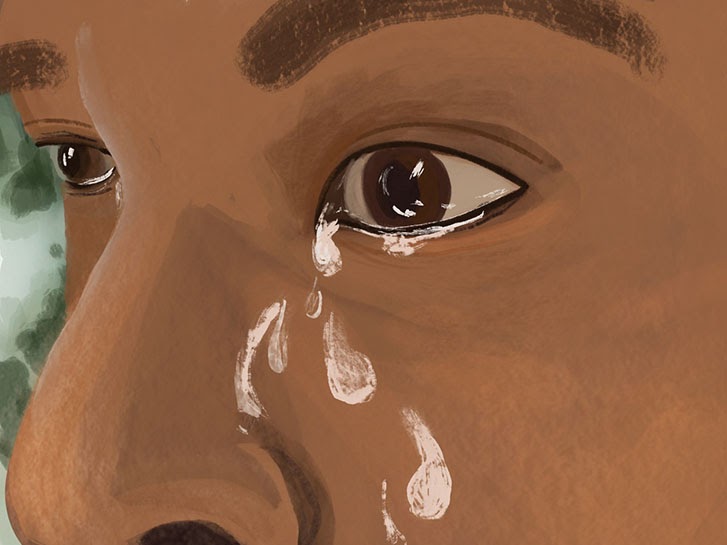
Where Do the Therapist’s Tears Come From

I would like to think that as a psychotherapist, I know where the tears of my clients come from. Perhaps, in the moment, they are experiencing an emotional breakthrough, an encounter with an estranged part of themselves, which has come into consciousness. Or perhaps they are bravely reliving a past trauma, which will hopefully result this time in a different, less painful imprint on their soul. But at the same time, moments like these have also been important ones for me, as I witness this cathartic unfolding in the safe space that I have helped craft, in which the client can face and express some of their most difficult feelings. And in that shared moment, I encourage the client not to hold back, not to feel embarrassed, but to acknowledge their tears and allow their emotion to spring to the fullest. But could it also be that such special moments have also elicited powerful emotions in me? Is it my role to simply welcome them in the context of the healing relationship, or is there something more in it for me, more personal and sensitive in what I feel in these moments? Most of us have watched films where the therapist dives headlong into the emotional wave of their client’s story. In the film Good Will Hunting, we witness a heart-warming scene in which the misty-eyed, unconventional psychologist, Sean, played by Robin Williams, embraces young, delinquent but traumatised Will, played by Matt Damon, when the latter sobs after a profound emotional breakthrough. How often do we encounter something like this in “real” practice? Probably not that often. Indeed, the landmark TV series In Treatment takes an approach that arguably resembles much more the “real” practice of psychotherapy. The series takes us through the sessions of the protagonist-psychotherapist, Paul who practices from a psychodynamically-informed, relational therapeutic model. Even though Paul does indeed connect with his clients in a deep way, and even if many of their struggles trigger strong emotional reactions in him, he never lets them become too visible, nor does he allow himself to become tearful. Instead, following “standard” professional practice, he brings his reactions and feelings to his own personal therapist or to his supervisor, whose validation seems quite important to him. So, are the therapist’s tears “allowed” in front of clients or not? What does psychotherapy research actually say about this? Not much, actually! Even though there has been a good amount written on how to manage the client’s tears within the therapeutic encounter, the therapist’s tears—in the presence of their clients—have until recently been almost entirely ignored in the literature. Could this be because this is such a rare phenomenon that is not even worth investigating? Maybe, but then again, maybe not, as one of the few studies addressing this issue revealed that a large number of the surveyed psychologists and trainees reported having cried at some point with their clients, and almost a third of them had experienced this within the last four weeks. An interesting related finding was that crying in session did not actually correlate with the therapist’s personality, gender, or with other demographic factors, except for that older and more experienced practitioners seem to become tearful in therapy more often as compared to their younger colleagues. And these more senior therapists exhibited a lower frequency of crying in their daily lives, which discredits the assumption that their in-session tears more likely reflected a generalized increased emotionality, or even psychological instability. In any case, such feelings seem to be important for a great number of therapists, as approximately half of them bring this topic to their supervisors and possibly even more are concerned about but never discuss them, as they are among the “most-avoided” topics in supervision. So it seems that while many therapists have dealt with this issue of crying in session with their clients, very few actually talk about it, and even fewer researchers and authors write about it. Could this be because we still largely view this phenomenon as a weakness, as an embarrassment for a healing profession, and we would much rather not expose this weakness to others and to the public in general? But is it really a weakness? Does it happen just because we are unable to control our emotions, and does it really harm clients when they witness it? Would it make sense then to ask the clients themselves how they actually perceive it? As it turns out, a survey was performed on clients, indicating that the way they perceived their therapist’s tears depended on their overall perception of the therapist. For example, a client may already view their therapist as empathetic and sensitive, so would perceive emotional displays such as tears as being related to these qualities of caregiving. But if the clinician spontaneously bursts into tears in response to an otherwise neutral narrative, the client might understandably associate this reaction with something very personal to the therapist which may be largely irrelevant to them. In this latter scenario, this seemingly unrelated emotional display on the part of the therapist could compromise the client’s confidence in their clinician or might even activate feelings of guilt for causing them psychological distress. It seems fair to conclude that clients do not necessarily interpret their therapist’s tears as “this is too much for me to handle,” but may also interpret them as “I can feel how sad this is for you.” As a therapist, tears rarely come to my eyes in session. Usually I can hold them back, especially if the client is already too emotional. But I may occasionally allow myself to become misty-eyed if I feel they could use some non-verbal encouragement to visit a difficult area of their lives. However, the last time I experienced this, it actually reflected a mix of sadness, release, and contentment—sadness about the painful feelings my client was expressing, release about the arrival of their realization and insight, and contentment for the opportunities for their future that came with this insight. I had been working therapeutically for some time with a couple. Despite their challenges and their somewhat turbulent relationship history, they did love each other, wanted to live together, and discussed a shared future. However, something invisible was getting in the way that prevented this from happening. Towards the end of one particular session, one of the clients was talking about his persistent worries of being inadequate, should he and his partner decide to live together. I suggested that this worry might be getting in the way of committing to her and that perhaps he believed that no matter what and regardless of how much he tried, he would once again and eventually let her down, that she would never really accept him for who he is, and that he would ultimately be rejected. I wondered aloud if this fear was coming from a different place, perhaps earlier attachments which stopped him from giving himself into this relationship? This client became emotional and began sobbing as his girlfriend embraced him, saying, “I love you and accept you as you are, I don’t expect you to change anything, I know you are not perfect, but I have chosen you.” In that moment of his emotional release, I experienced a sense of vicarious catharsis as I re-experienced the familiar feeling of letting out a hidden, inner burden from a space deep inside of me, where it had resided for far too long. Once liberated, that painful feeling leaves room for an even deeper sense of trust in the other and openness to merging. As if sitting front row in an ancient Greek drama and experiencing by proxy the protagonist’s catharsis, the essence of drama, according to Aristotle. My eyes welled up with tears, and my clients, upon seeing my emotions laid bare, said, “we better go now, otherwise we will make Nicholas cry, too!” As they said that, I happily left them with each other and said goodnight, closed the lid of my laptop, and stared at the English rain outside of my window.

***

So, where do therapists’ tears come from? It seems as if they are coming from so many different places that trying to track and trace their roots could just end up in drying up their wellspring… they may not always be so welcomed or comfortable, by either the therapist or client, but they do carry something rich, deep, and ineffable that words possibly cannot express.

Thinking of You Too

I don’t typically assign homework to patients, at least not in the traditional sense. But when patients ask for something to work on during the week, something that would help maintain the momentum they’ve gathered in resolving distress, I suggest they think about our work—to reflect on the themes we’re uncovering and how they apply to their current experiences. I emphasize that while growth starts in session, it is a process that continues after.

Like what you are reading? For more stimulating stories, thought-provoking articles and new video announcements, sign up for our monthly newsletter.

The work of therapy is not limited to 50-minute sessions every week; it’s happening during all that time in between, too—for both patients and therapists. I think about my patients after sessions as well; it is only natural when we’re working persistently, week after week, to understand sources of distress and facilitate change. Some of my own insights about my relationships with patients occur when I’m off the clock. And in the same way I ask patients to make sense of their thoughts, it’s equally important that I do the same.

The Regulars

While picking up the living room the other night, it suddenly occurred to me: my patient earlier in the day had spent the entire session attempting to get my approval in the same indirect way he tried to engage with his mother in the past. Amaan* and I had been working together for almost two years, and a large theme in our work has been recognizing his mother’s limited capacity for offering emotional support and the impact this has had on his efforts in current relationships. Amaan has made great progress in integrating his experiences of his mother, coming to terms with what she may never be able to give him; I realized suddenly that he was trying to cast me in that now-vacant role. In session, he had listed the areas in which he felt he had grown, the insights he had fostered about himself, and the clarity with which he felt he could move forward. I actually agreed entirely with him, but there was something about the way he expected me to corroborate his own opinions, as though anything but clear agreement on my part would undermine all his progress.

I thought about why this did not occur to me during session; after all, this is someone I’ve come to know very well, and was part of a conversation related to the exact theme we’ve been identifying for quite some time. I’ve gathered that at times, my patients’ ways of relating directly complement my own—I enjoy validating their experiences and highlighting progress we’ve made together. Recognizing Amaan’s progress would also mean an opportunity in recognizing my own as his therapist, but I have to remind myself this is not about my own ego. With this discovery, I can return to future sessions with even more awareness of what Amaan is attempting to reconstruct in our relationship and identify his efforts in real time. More importantly, I can encourage him to take faith in his own progress as he recognizes it, not through me.

Realizing blind spots are not the only reasons I find myself thinking about patients, though. Sometimes I find myself thinking about them out of genuine care, concern, and curiosity for what they are going through. Did their husband take the news well? They were grappling with whether to call their mom—what did they decide? Did our session help provide any clarity? When I find myself wanting to know more, I think about what this says of the patient more than it says of me. Perhaps the patient’s general motivation is to keep others engaged by employing a “stay tuned” attitude—and it certainly works. Maybe it is unlike a patient to attract this much concern, which is even more telling of the gravity of their distress.

Other times, a patient stays with me in a gnawing way, long after the session is over. I wonder if they’re feeling it, too. This feeling lingers after sessions where it felt like a patient was not feeling something enough. These moments feel like a dramatic irony, in which I see the whole story but they’re not yet ready to. Depending on the patient, I may use these thoughts to motivate an intervention—point out distorted thinking or question their assumptions. But if it feels so strong, I may realize that this patient needs me to hold on to the feelings they cannot yet own until they are fully capable of doing so. And that guides our work—preparing them for a realization instead of directly handing them one.

The Absentees

What about the patients who regularly cancel or forget? The patients who are ambivalent about therapy, saying that they really want to be here, but their attendance say otherwise. How is it that the patients we see less often seem to take up the most space in our minds? I’ve gathered that they use their absence to communicate something to me—to shake things up, to make me feel more toward them, to get me more engaged, only for them to walk away. When patients cancel repeatedly, or even no-show, I’ve learned that rather than take feelings toward them at face value, it’s more beneficial to use these feelings as a cue to their ambivalence about treatment.

Melanie* is a newer patient of mine, unknown to therapy in the past. In session she would often say she wasn’t sure if therapy would be helpful and was confused as to why she was here in the first place. After her initial distress regarding her relationship with her father had subsided, she grappled with how to use the space, minimized other stressors, and looked to me for direction. Her anxiety about being in therapy but not knowing how to make use of the time likely explains her frequent cancellations without request to reschedule.

Initially, I offered to reschedule and was usually met with the impossibility of doing so. Over time, I began to feel resentful of the way in which she treated our relationship and disappointed in being more interested in her experience than she was. These feelings stayed with me, and I wondered for a while how to make sense of them. Why did I seem to care more than she did? I remembered how she had a “one foot in, one foot out” attitude at the start of most sessions but eventually warmed up after a few minutes. Her ambivalence made sense all of a sudden—she needed validation for the pain she felt so deeply before being able to commit to the space and herself.

The Graduates

And then there are the patients I’ve worked with in the past. I wonder so often how they are doing—if they ever married that guy we spent so many sessions talking about, if they ever found what they were looking for that we could not seem to find together, if they think about the relationship we shared at all. For some time in both our lives, we were constants for each other. For as much as I was a part of their lives, they were a part of mine. Therapeutic relationships coming to an end means coming to terms with possibly never hearing from our patients again. But I still let myself wonder how they’re doing. When I think of these patients, I am reminded of what seemed to be most helpful, what wasn’t, what they learned, and what I did. I think about how much I’ve grown and changed because of every relationship I have had with a patient and how to make meaning of this growth for myself and other patients.

From time to time, I have run into some previous patients. Pauline* stands out to me, since I ran into her at a time when I was going through some personal life transitions and was caught off guard in seeing her. But in the few minutes we spoke, she shared that she had made many steps forward in ways we hadn’t even spoken about but in ways she was very proud of. And I was so proud of her, too. I remember when our work ended, I wondered if I could have done more to foster more insight and self-compassion. She had not accomplished her goals in the ways she intended at the start and our work had to end abruptly. In running into her, I learned that even if our relationship ended, the work continued. She too was changed because of it, and it continued to impact her motivation to take steps toward herself.

***

Patients wonder if we think about them just as they are thinking about us. When I tell patients that I think of them or disclose that something they said has stayed with me since the last session, I can detect both surprise that they are remembered and relief for finally being seen. We want our patients to make meaning of therapy and take in the work. I think that when they realize we’ve internalized them, they’ll finally do the same.

A Revealing Moment

Each week, my interns submit a summary of their clinical hours along with a “process note,” pretty standard training fare. These notes are supposed to document their internal ups and downs; the good, bad, and ugly of their week with clients whose challenges and pathologies are probably a bit above their current pay grade. Good learning opportunity, I often rationalize, especially since they have competent on-site supervisors who are there to teach, train, and support their burgeoning yet fragile clinical identities.

Like what you are reading? For more stimulating stories, thought-provoking articles and new video announcements, sign up for our monthly newsletter.

If the academic/clinical interface were a bit tighter, I would have these folks work their way up from simple and acute disorders to the more severe and chronic pathologies as they evolved through their training. But such is not always possible. So, for most of my trainees, this entails some arduous hikes on those steep and unmarked learning curves that we more seasoned clinicians have experienced—and still may.

Sure, we process some of the more complex clinical challenges in class, and they are in resource-rich learning environments at their sites, but for the most part this is boots-on-the-ground OJT-101. Such was recently the case, when one of my interns wrote in his process note, “I find myself dealing with [a] therapeutic boundary [with a client who] was giving signals of perversion [related to] the dress code. I felt uncomfortable and reported [this] to my supervisor, and the client was confronted. I felt supported and protected.”

I was curious about what he actually meant by the word “perversion,” given the loaded and historically pejorative nature of the term. Upon follow-up, I discovered that in this intern’s culture, women are quickly and quite aggressively shamed and oftentimes punished by family and community if they act or dress in a way that is considered immoral and violates biblical principles.

The client was a 32-year-old female attendee in a day-treatment program who, in the intern’s words, had chosen to wear “a cut-off shirt without a bra and see-through sport leggings without panties.” In that moment of discomfort, my intern abruptly ended the session by telling the client that he had to attend an intake session. He then went to his supervisor for guidance. While I was very glad that the intern took this immediately to his supervisor who gave him the support and protection he needed at the time, I was dismayed that in that very uncomfortable moment, perhaps understandably, he simply told the client that he had an intake to perform and abruptly ended the session. He lied to her.

Apparently, this was not the first time this client had approached therapy with a male clinician in this manner; she was subsequently transferred to a seasoned female clinician after her brief visit with my intern.

In retrospect, my intern understood that this might not have been the best way to handle the situation, but he had clearly been taken off guard by this “attractive woman,” was intensely uncomfortable, and expressed concern that if he did not act immediately that his “imagination” might get ahead of him. While he momentarily considered the possible role of transference in this client’s wardrobe choice, he was even more relieved that his supervisor and the clinical director handled the situation “sensibly and professionally.”

This scenario brought me back to an incident during my own training when, during a practicum placement in a state psychiatric hospital, my supervisor decided it would be instructional to set up an intake for me with one of the “chronic” patients. Soon after being ushered into the seclusion room with me—a strange choice of setting—the patient sat down facing me with her bathrobe open and nothing underneath. All I remember about that tortuous moment in time was that I froze. As then, as if from thin air, my supervisor emerged from behind the one-way mirror and into the room. Upon my supervisor’s entry, the patient immediately sat erect, closed her bathrobe, and had the most delightful conversation with my supervisor, who later said to me, “I can write a book about any patient after meeting with them once.”

In retrospect, I believe, knowing what I later learned about this man, that it was an exercise designed to humor him and shame me. After my initial embarrassment and sense of ineptitude receded, the shame set in.

Getting back to my own intern, I was very aware of not wanting to shame him and wanting his own moment of torture to be a learning opportunity for him and the rest of the class. So I asked them all to consider what they might have said in that moment, while my intern listened in and then reflected upon their responses. These included, “I probably would have done something very similar,” “I would have told her about boundaries and that I was not comfortable continuing the session,” and “I would have ended the session and rescheduled after telling her that her attire was inappropriate for the setting.”

Each of their responses was appropriate given their level of experience, but in retrospect, I was a bit disappointed, perhaps unrealistically, that none of them had considered the possibility that this client’s choice of attire might actually not have been a choice, at least not a conscious one. So, I wondered out loud with them about the possibilities that she had been sexually assaulted or trafficked or both, and/or had come to rely on seduction to navigate relationships of power imbalance, particularly with men. It might have been erotic transference. Or perhaps, it might have been none of these, and she was simply proud of her body, and had chosen not to heed past messages around the inappropriateness of this behavior.

***

As I write this, I am an hour out from my supervision class in which I hope the incident will come up again; if it doesn’t, I will bring it back into focus. I’ll be most interested to know what about that client’s behavior triggered my intern to consider it a “perversion.” Hopefully, he will not feel the shame I did many years ago, and we will have a rich discussion.

What would you have done?
 

Successful Intervention with a Family Impacted by Treatment-Resistant BPD

Borderline Personality Disorder (BPD) is one of the most difficult psychiatric disorders to treat, the main reason being that it affects the entire family. Thus, effective treatment requires working with as much of the family as possible in a coordinated effort. Multiple professionals are also often involved, which adds to the need for coordination of resources. Further adding to the complexity of intervening with families impacted by this disorder is the fact that there is usually significant resistance to the treatment by one or more parties.

Treating families impacted by BPD also requires specialized therapeutic skills. I have found that many techniques that are effective with other diagnostic groups are not only ineffective with BPD, but may actually make the disorder worse. This is why most of the families who present themselves to me have already been exposed to numerous therapists and treatment modalities by the time we meet, leaving them exhausted and disappointed. In many cases, large amounts of money and other resources have already been spent, also leaving them jaded and skeptical. These families are very often on the brink of their breaking point.

Am I expected to produce a Hail Mary, or am I just another soon-to-be-discarded and/or disappointing clinician in their minds? This is a very high-pressure situation for a clinician, and for this reason I suggest that colleagues only take on such situations if they have specialized skill in treating this disorder or other debilitating personality disorders. A full illustration of all of the specialized skills needed to work with these families is beyond the scope of this paper. For expediency, I will focus first on four tools that I have crafted and found to be highly useful in treating families impacted by this disorder. These tools are described below and will be illustrated in a case study that follows.

Useful Tools

Manage Expectations

This applies to the patient, the family, the other professionals, and yourself. Healing and growth are processes and not singular, disconnected events. All participants in the intervention should be told overtly that this process will take months, if not years, to reach an optimal outcome. I generally tell patients and their families, “Things will most likely get worse before they get better.” This prepares everyone for the inevitable resistance while creating a future milestone measured by increased cooperation.

Protect, Protect, Protect

You must protect the patient, the family, the process, and yourself. A key, and possibly the most disruptive, feature of BPD is the client’s lashing out at others when frustrated. Many families allow this behavior to provoke them into participating in disruptive behavior by shouting back or threatening. The therapist must provide some basic level of safety to the process and all who are involved in order to avoid disruption of the therapeutic work, often manifested by one or more parties’ walking out.

As a therapist in this situation, you are at very high risk for being triangulated into the family dysfunction, in which case this lashing out may be directed at you. Your chair should be the closest to the door, and you need to prepare to split up the group if you cannot deescalate conflicts with all present.

Modeling

You have to teach the family how to cope with disruptive behaviors such as lashing out, triangulation, codependency, and self-mutilation that are common with BPD and rare in other disorders. This is where the specialized skills come in. Each of these disruptive behaviors requires its own set of coping mechanisms. This is where conventional methods can backfire. For example, healthier families can share diverse opinions without the divisive effects of triangulation. In families with BPD, encouraging sharing of diverse opinions is likely to lead to further polarization and increased conflict, thereby worsening rather than improving the situation.

Starve, Do Not Feed, the Monster

The monster is the disorder, the BPD, not the sufferer. The family must bond together with the sufferer and the professional team to fight it. While traditional therapeutic methods encourage compromise and flexibility as solutions to conflict, these methods may feed the monster or make the disruptive and disturbing nature of the disorder worse in families with BPD. The emotional dysregulation caused by the BPD often escalates into rapid, impulsive acting out towards self and others. Introducing compromise, flexibility, or, worse, compliance, reinforces that lashing out will get at least some of what you want. This will increase the frequency and intensity of the lashing out. Conversely, withholding all possibility of acquiescence because of the lashing out starves the monster and sets the stage for the introduction of more socialized, and hence more successful, strategies. This is consistent with basic behavioral principles.

Case Study

The following is based on a real case, but with many details changed in order to protect identity.

Mary Zohn called me about her 19-year-old daughter, Rosa. She had been referred to me by her therapist because although her daughter was in treatment with a therapist, things were getting much worse at home and the family was in crisis. I agreed to meet with her and her husband Charlie for an intake.

The Zohns showed up at my office with two thick files that documented difficulties with Rosa since the beginning of high school. Since that time, Rosa had experienced steady deterioration despite multiple treatments with several different professionals. They explained that although she was intelligent, she had ongoing difficulty functioning in a school environment. She often missed classes and rarely completed assignments on time, if at all.

In her frustration with school, Rosa began engaging in other less productive and more self-damaging activities such as sexual promiscuity, substance abuse, and excessive computer video gaming. She began staying out late, and then overnight. Her room was dirty and her hygiene was regressing.

The Zohns began confronting her about her poor school performance and unhealthy habits. They tried to set limits. This was associated with screaming conflicts that ended up with her sometimes leaving for days at a time, and often included self-destructive behavior such as cutting and going days without food and water in protest. Her parents were becoming increasingly concerned about her health.

They were also becoming increasingly concerned about her influence on her younger sister. Rosa was the middle child of three girls. Her older sister, Wilma, did very well in school and had a good job. She was self-supporting and lived in her own apartment about an hour away from the family residence. The younger sister, Bertha, was in middle school and struggling with a learning disability and social issues at school. The Zohns were very concerned about how Rosa’s behavior would affect Bertha’s struggles.

Initial Interview

What precipitated their reaching out to me was that Rosa had been arrested with her boyfriend for possession and distribution of narcotics. Following are some excerpts from my initial interview with the Zohn’s:

Dr. Lobel: What is Rosa’s current legal status?

Mary: She is out on bail.

Dr. Lobel: What is she doing with her days?

Charlie: Supposedly she is in school.

Mary: She is enrolled in college but we think that she does not attend classes.

Charlie: She leaves every night pretending to go to school but she goes to see her boyfriend instead.

Dr. Lobel: How do you know that?

Charlie: Because she is getting incompletes in all of her classes and she doesn’t come home until 4 AM.

Dr. Lobel: How does she get to school?

Mary: She drives herself.

Dr. Lobel: She has a car?

Charlie: We got her a car so that she can go to school.

Dr. Lobel: But she is not going to school, right?

Mary: We don’t know for sure.

Charlie: Yes, we do. This is the 3rd semester I am paying for, and she hasn’t even earned two credits.

Dr. Lobel: So, you pay her tuition and buy her a car to go to school. She doesn’t go to school and you continue to pay her bills?

Mary: Are you suggesting that we should cut her off?

Charlie: I can’t do that to my daughter.

Dr. Lobel: You mean stop enabling her?

Charlie: What do you mean?

Dr. Lobel: Under the guise of paying for school you are enabling her to engage in unhealthy and illegal activities with her boyfriend.

Mary: We have discussed this before, but her therapist has recommended that we try not to stress her out; that we should give in to the small stuff so that she does not get dysregulated.

Dr. Lobel: How is that working for you?

Charlie: Not good.

The Zohns left the initial consultation a bit shaken by my recommendations. Up until this point, therapists had recommended walking on eggshells around their daughter by reasoning with her, trying to be flexible and forgiving, and overlooking Rosa’s outbursts and acting out.

Second Consultation

Three months later, the Zohns contacted me again. Rosa had been arrested. This time she had been driving while intoxicated and crashed. The car was totaled, and she was charged with driving under the influence (DUI). Fortunately, she was not significantly injured.

They came in for another consultation. They explained that they had come to realize that they were indeed enabling her, feeding her monster, and that they needed guidance. They didn’t know how to say no to her and follow through consistently. We agreed that we would meet with her together in order to help them to set up some healthier boundaries. Most notably, this included the plan that resources such as money and transportation would only be available for the pursuit of healthy activities.

I asked the Zohns whether they were on the same page regarding what was right for Rosa. They shared that they often argued about whether or not to be “strict” with her and how strict to be. I told them that they must be united in the setting and reinforcement of boundaries and that I would help them with this. They agreed. I suggested that I see Rosa individually before we again met as a family so that she would not feel ganged up on. They agreed, but she did not.

First Family Meeting

When the three arrived for our first session together, I asked Rosa to come in by herself for a few minutes, and she agreed. Here is an excerpt of our meeting.

Dr. Lobel: Do you know why your parents asked you to meet with me?

Rosa: They just want to control me. They irritate me constantly.

Dr. Lobel: How do they do this?

Rosa: They are constantly on my case. I don’t do anything right. They want me to be like Wilma. They have always favored her. I can’t be Wilma so I am a disappointment to them.

Dr. Lobel: In what way do they want you to be like Wilma?

Rosa: Smart, beautiful, and successful. That is not me.

Dr. Lobel: What do you think prevents you from being successful?

Rosa: Them. They nag me all the time and then I can’t concentrate on my studies.

Dr. Lobel: That’s why you don’t go to class?

Rosa: Yes. I get so upset I just want to get high. I would rather be with my boyfriend.

Dr. Lobel: What does your therapist suggest?

Rosa: She has tried to get them to back off, but they can’t stop themselves.

Dr. Lobel: What would you do if they were not bothering you?

Rosa: I would get a job.

Dr. Lobel: Have you ever had a job?

Rosa: Yes. Several.

Dr. Lobel: How did that go?

Rosa: I usually work for a while and then they start hassling me.

Dr. Lobel: At work?

Rosa: Yes.

Dr. Lobel: Out of the blue.

Rosa: They get all upset if I am late once or twice or if I call in sick.

Dr. Lobel: And then you get fired.

Rosa: Yes. But the reason I am late or sick is because of my parents!!

We brought the parents in. We all agreed that Rosa needed to take a leave from college while she resolved her legal issues and living situation and began to more directly address her mental health challenges. We then introduced the idea that Rosa’s access to resources, such as a car and money, would be contingent on her manifesting healthy behaviors. Her parents agreed to support healthy behaviors rather than unhealthy ones. Rosa began yelling at her parents and at me, stating that this was little more than additional control and would make things worse. She stormed out of the meeting. As she came in the car with her parents, we were confident that she would not be able to go far, so we finished the hour by offering suggestions as to how to respond to her agitation. We reviewed the “form before content” tool. This basically required that Rosa speak in civil tones, or the conversation would stop.

Dealing with Resistance from Rosa’s Therapist

The following Monday morning, I received a call from Rosa’s therapist, Ms. Hartman, who wanted to know what was going on in our meetings that was so upsetting to her patient. She expressed that Rosa was “triggered” by the meeting and it was making her sicker. I was expecting this call. Here is an excerpt of our conversation:

Dr. Lobel: What about our meeting did Rosa find triggering?

Ms. Hartman: She felt ganged up on.

Dr. Lobel: Which part made her feel ganged up on.

Ms. Hartman: You and her parents trying to control her.

Dr. Lobel: Did she give you any specifics?

Ms. Hartman: No. She just said that she was so triggered she had to leave.

Dr. Lobel: She appeared to get agitated as soon as I said that her parents would support healthy activities and not support unhealthy ones. Does this contradict what she told you?

Ms. Hartman: No.

Dr. Lobel: I imagine you must be working with Rosa on increasing her tolerance for frustration and difficult situations.

Ms. Hartman: Yes. I specialize in Dialectical Behavior Therapy (DBT). I think she also takes medication.

Dr. Lobel: We are trying to help Rosa take responsibility for her choices and behaviors and she is having difficulty tolerating it. Can you help her accept that she has to accept responsibility for herself while giving her the confidence that she can do so in a healthy way and grow from the experience?

Therapy Begins

Several meetings with the Zohns followed, in which we created a contract through which Rosa could benefit from all of the resources her parents had to offer if she used them for healthy pursuits. She got a job and prepared to resume her studies. She agreed to maintain sobriety. The sticking point was the parents not wanting her to be alone with her boyfriend, as they felt his influence corrupted her. We agreed that he could visit her at the family residence but that the Zohns refused to have their vehicle or their financial support to be used to spend time with him. She very reluctantly agreed.

I also inquired as to the status of her pharmacotherapy. She apparently had a psychiatrist who prescribed a combination of medications that included psychostimulants for attentional difficulties, a mood stabilizer, and an antidepressant. She refused to take the mood stabilizer and antidepressant but wanted to continue with the psychostimulants. The psychiatrist refused to treat her under these circumstances, so she was getting Vyvanse prescriptions from her pediatrician. I suggested that she consult with another psychiatrist, as I thought that the stimulant alone was adding to her emotional dysregulation. She saw a psychiatrist and agreed to work with her on a more therapeutic regimen.

Rosa seemed to stabilize for a few months and was moving forward on our plan, until, that is, when the testing began. Her parents noticed that she was not always at work when she said that she was at work. They suspected that she was seeing her boyfriend. They also found evidence in her bedroom that she was vaping marijuana again.

Mary and Charlie met with me to discuss their fear, apprehension, and guilt at holding to their boundaries. They feared confronting Rosa, which they knew they needed to do, and they feared for Rosa as well. They did confront Rosa, who denied everything. Then Rosa disappeared.

She went to work one day and did not return. The Zohns contacted her employer the next day, who confirmed that she had not shown up for work. They tried to contact her via cell phone, but she “ghosted” them (refused to answer). They were pretty sure that she was with her boyfriend, most likely using drugs and engaging in other unhealthy and risky behaviors.

I met with the parents a few times over the next few days. They were very frightened and questioned our plan. They contemplated texting her and allowing her to do whatever she wanted if she just returned home. I discouraged this and explained that this would be a major setback. I told them that she and her boyfriend did not have the resources to survive on their own and that she would have to return home eventually. She had nowhere else to go.

We began preparing for her return with the understanding that the Zohns’ home was not viable as a therapeutic environment for Rosa and that she was in need of inpatient treatment. I encouraged the Zohns to research options and prepare to have her admitted promptly when she returned.

It took about a month. Rosa missed one of her court appearances and was again arrested. She called from the police station. The Zohn were prepared and let her know her options. She had no choice but to agree.

She was admitted to an inpatient facility that specialized in BPD and substance abuse. She stayed for three months and then transitioned to a sober living residence near her parents. She stayed there for six months, during which time she got a job, resolved her legal issues and embraced sobriety with the help of a Twelve-Step Program and a good sponsor. She went from sober living to the university.

Conclusions

In this case, BPD had not only metastasized throughout the family, but also infected the professionals involved. Approaching Rosa’s treatment from an individual perspective was not successful, because her disorder caused her to manipulate her environment into a codependent mess that enabled her to stay sick and get sicker. The only way for her to recover was to assemble a team that included her entire family and all providers working together and consistently.

Intervening in a system impacted by BPD, as in this case, required specialized skills and the willingness to confront all aspects of the patient’s treatment, including enabling providers. This was often like stirring up a bee’s nest. Great care had to be taken to protect these providers by not making them feel negligent or naïve while at the same time engaging them in a consistent therapeutic process. It was critical to anticipate resistance, even by the professionals who attacked me for challenging them. I didn’t take it personally and haven’t, which has proven to be an effective tactic. I explained to them my process and expectations in non-accusatory terms and showed them their value in the coordinated healing process.

In looking back over the case, I knew I was going to be seen as a snake-oil salesman, met with skepticism and doubt. I had to effect a paradigm shift. I also expected things to get worse before they get better. And they did. I reminded myself that as a clinician. I had to stick with what I knew: with the treatment plan, with the best techniques at my disposal.

I also knew that if this approach failed, there would probably not be another chance. Rosa would lose her only lifeline, and the family would all suffer. I reached the point of no return. I was fully committed and I had to see this case through, no matter what. I have treated families like this countless times over the years, but each case is different and each path its own.

If you are going to venture into this challenging treatment domain, conviction is critical, and still there will be no guarantees.

Ancestral Narrative Building: A Path to Healing Generational Trauma

“I am so afraid to be like the men in my family when I am angry. I find myself holding in so much rage because I do not want to be like my dad or my grandfather. I also refuse to be part of the angry Black man stereotype.”
“What didn’t you like about their rage?” I ask my client to examine his narrative of his ancestors’ rage in order to understand his own.
“The way it was framed in my family is that it got them in trouble. It got them both killed.”

Like what you are reading? For more stimulating stories, thought-provoking articles and new video announcements, sign up for our monthly newsletter.


We take time to process these situations about the men in my client’s lineage. Both his father and grandfather had been killed at the hands of the state, and my client began to believe at an early age that if he had less rage inside of him, he would live longer and safer.

I tell him I am not convinced that their rage was unwarranted, knowing that the United States has unjust systems that impact the lives of Black and Brown people daily. I believe that micro- and macro-aggressions pile up and that our reactions, or non-reactions, to them can be survival tactics or indications of insidious trauma. And we can still create new narratives around their deaths and “rage.” We have to understand the social and physical contexts they were born into and living in, to make sure we can make these claims about their rage, since it is coming up in therapy. Although I can guide him through it, my client needs some deep ancestral healing, and he has to do it himself. He has to be the one who is committed to researching, asking questions, and making meaning.
 

I start by creating a reading list for the client. I read the books, too. At first, he doesn’t quite see the point. I explain that we have to study the time and place in which both of these ancestors lived. We read Isabel Wilkerson’s The Warmth of Other Suns, Langston Hughes’ The Ways of White Folks, James Baldwin’s The Fire Next Time, and Zora Neale Hurston’s Their Eyes Were Watching God in order to get a sense of the time periods his family lived through. We research articles from the relevant time periods in the cities his family resided in and take a deep look at the cultural climate of the cities. We find research about the impacts of Jim Crow laws, the GI Bill, and redlining, policies that impacted his family directly and indirectly.

“I have only heard the stories and the warnings from my mom, aunts, uncles, and grandma. Stay inside! Stay calm! Don’t be too forward! Don’t speak up! We don’t want you to get killed out there! Reading about other people from the same time period gives me more information than what was passed down to me. Black people were unsafe even if they did stay calm and remained inside. My family was so fearful of more death that they played into the respectability politics—‘Be good and nothing will happen.’ But the truth is, things still happened.”

This kind of ancestral digging creates a new narrative that allows the client to build, expand, and contextualize his sense of self. Prior to our research, he had limited information from which to make sense of his childhood and the messages he received both implicitly and explicitly. The messages he received growing up are important and tell him a lot about his lineage, but he needs to do more digging to get a fuller story. Intentionally getting new information about people similar to him and his generational trauma allows him to make space for new framing of his paternal lineage.

“I learned about the political climate my grandfather was living in. I saw an article about a man killed for looking at a White woman the wrong way in the city we lived in. I realized that my grandfather might not have been angry, he might have been just living his life, and that there are not actually any stories about him being angry or reactive at all.”

Though he has limited people alive to discuss this with, we create a list of questions he has for his extended family. My client is able to make new meaning about his father by doing some interviewing of distant family members. He asks about the time periods, the rituals they had in their family related to his Black American culture, and anecdotes about his grandfather and father. He records their responses to his questions in order to keep a record of what he found for his future son. He reckons with the fact that after his grandfather was unjustly killed by the county police, his father became an advocate to make changes in his community. His father became an activist and fought for the rights of Black Americans in his city.

“My mom always made it sound like when we speak up we are likely to be hurt, because we are putting ourselves at risk, but that is because she had trauma from my dad’s dying during a protest. She always seems so strong, but my aunt told me she was different after my dad died. She didn’t want him to go that day, and he told her he had to make a better life for his kids. Understanding that my father was fighting for what is right has totally changed what I understand about my anger.”

***

The old adage of becoming your parents is more than just a saying. Clients and therapists alike carry forward and live ancestral history and messages that have the power to impact and influence triggers. We may find ourselves reacting similarly to our ancestors, or reacting completely opposite from the way they did, without a lot of knowledge about why they acted the way they did in the first place.

Ancestral trauma impacts us in ways we don’t realize, and we need to investigate our lineages, whether we have direct access or need to gain access through texts and articles, to make sense of who we are and who we want to become. And therapists, along with developing an anti-racist framework that appreciates the racial climate of the country in which the client resides, must guide the ancestral trauma towards ancestral resilience when the client is ready to do their deep exploration.

That Tipsy Session: The Power of Self-Disclosure

“This is the first time in years that I am feeling proud of myself,” Chris announces with a timid smile. His eyes are unusually bright, his pale face beaming with a new energy.
He has not been drinking for a month, his longest stretch without alcohol in almost a decade. His words trigger the memory of a year-old incident that still sends waves of shame through my body.

A Sudden Loss

That day, Paris was just opening after its very strict first lockdown, and I had lunch with a friend. We sat at the newly-created terrace of a restaurant just behind the Palais Royal. My beautiful friend had already ordered drinks. “Just one glass,” I thought to myself. We sipped the crisp white wine, a well-deserved celebration under the shining sun of that spring as she recited her lockdown poems.

Two hours later, I was back to my office, covered with sweat and dreading the session to come. With a bitter taste in my mouth, I was appreciating the particular irony of the situation: getting tipsy just before the session with Chris, my alcoholic client. As his familiar face appeared on my screen, a fleeting thought popped into my mind about one advantage of online therapy—at least he could not smell the alcohol on my breath.

“I hate being stuck in this place,” he offered immediately, skipping the usual icebreaker about the weather with which my British clients often begin their sessions.

His company had switched to remote work, and Chris had fled London for his parents’ home in Spain. They had acquired the house a couple of years earlier. Their move to Spain had been hastily decided without consulting their son; seemingly out of the blue, they had swiftly sold their home in England, along with almost every belonging that had been part of Chris’s childhood.

“Why did they have to go?” Chris had wondered many times, struggling with this sudden loss. His parents’ decision had seemed senseless at the time, inexplicable. Chris’s previously unremarkable drinking then spiralled out of control. Freshly graduated from college, unemployed, and lonely, Chris had simultaneously lost his home and his family following the crazy self-exile of his parents. At that point, his life seemed to come to a halt; his drinking slowly but surely replaced everything that he was missing—friends, career, and any challenge that could have given him an opportunity to feel good about himself.

Locked-down in Spain, Chris complained: “It is so weird to be here, locked down in this dreadful villa… it feels surreal.” Every time he spoke about his parents, he looked confused, his grey eyes wandering, slipping away from my gaze. Chris was spending all of his time with his parents, something that had not happened since he had left home for college. Outside and all around the otherwise beautiful Spanish villa-turned-prison, there was a foreign town, blindingly bright under the scolding sun, a town in which he knew no one.

“In the evening they just sit in front of the television, staring at some random Spanish talk show… I feel like an idiot. I have no clue what it is about,” he grumbled, more puzzled than ever.

“Do your parents speak Spanish?”

“No, they don’t, apart from a few basic words. This freaks me out… I simply feel like I am playing a part in a bad movie,” he shared, his eyes filled with loss.

“Is this feeling something you have experienced being around your parents before?”

“I am not sure… I don’t have much recollection of my childhood… at least not about my feelings… my parents were working a lot. I was spending most of the time at school, or at my friends’ places.”

In our previous sessions we had tried to make some sense of his confusion, but something seemed to be missing, a piece of information without which we could not move forward. We stumbled, and Chris was drinking in his usual solitary and well-controlled manner.

“I think I am fine,” he reassured me (or himself) every time I inquired about the approximate amount of alcohol he had drunk during the week.

“Fine? What do you mean by ‘fine’?” I would stubbornly ask, reminding him that at the age of thirty-two he had no close friends, no experience of romantic relationships, and no exciting career, despite his reasonably successful studies.

After a year of weekly conversations, we were stuck in a dynamic that had left us both steaming with frustration. This is when that dreadful “tipsy session” happened.

That Tipsy Session

I was sitting in front of my screen, fighting the dizziness from my drink at the Palais Royal, when Chris delivered the piece of information we had been missing: “My father spilled everything out,” he announced without noticing my discomfort.

The previous evening, his mother had been down with a migraine, and his father had brought him to a nearby recently-reopened eatery. He had ordered a bottle of wine and emptied his glass immediately. Then he explained: back in the UK, Chris’s mother had had an affair with the local pub landlord. This was the only reason for their sudden decision to expatriate. This had been his ultimatum, and the only way they felt they could keep their relationship together.

As I was doing my very best to focus on Chris’s words, his face magnified by my screen, I was painfully aware of failing him. I knew that his father’s telling this difficult truth might open a window for Chris to share his own. But could he use it? After all, shame had been keeping him silent. The window of possibility was closing quickly, as Chris’s return to London was planned for a few days later.

“How do you feel about what your father has disclosed to you?”

“I didn’t know what to say… I couldn’t imagine anything like this was going on… they are too old for that!”

“This must have been difficult for your father to open up about…”

“So awkward… We sat there, drinking and trying to avoid each other’s eyes… He never told me anything this private before,” Chris admitted, fidgeting uneasily in his chair.

“So, you were not the only one withholding something important from your family?” My own allusion to his drinking resonated with an obvious irony.

“What do you mean?” he hissed, pretending that he had no idea about what I was speaking about.

“Maybe this was an opportunity for you to talk to your father openly about your struggles with alcohol?” I made another desperate push.

Chris shook his head with resolve. He had been keeping his drinking problem for himself for years, and the shame he had accumulated in the process was an obstacle he could not overcome. Not yet.

I sighed and let him go with a certain relief. Even if I made it through the session without a major blow, by the end of it I was exhausted and, for the first time, wished to be elsewhere, not in front of my screen with Chris.

For the full week following that session, Chris stayed on my mind. To tell or not to tell? I was not sure whether a self-disclosure would break the brittle trust we had both worked hard to establish. The next time Chris appeared on my screen, I plunged in first.

“Before we start, I have to share something with you,” I announced, and his face dropped in response, preparing for bad news. “During our last session… you may have noticed that I was not fully present,” I stumbled forward, and he nodded. “I thought you were distracted for some reason… but it was ok,” he added generously.

“No, it wasn’t ok,” I sighed and stumbled further. “Just before our session, at lunch, I had a glass of wine. It was a mistake, and I have to apologize.”

“So, you were drunk?” he giggled, and I could not figure out whether there was more confusion or relief in his voice.

“Well, a little tipsy, I guess,” I nodded, trying not to avoid his eyes.
We stayed silent for a minute before he asked, perplexed, “Why are you telling me this today? You didn’t have to…”

“No, I didn’t… but I value our relationship, and owe it to you to be honest… but I was too ashamed to tell you last time,” I shared, hoping that we could capitalize on this example of self-disclosure.

“I know what you mean…” he sighed and looked sideways.
From that point on, Chris finally started opening up. Instead of endlessly complaining about his mother’s misstep and other misfortunes, he now talked honestly about himself.

“I actually know exactly when this whole ridiculous affair started… I got really drunk one evening at the pub, and the landlord had to call my parents to fetch me. My mother came, and this is when they took it off…”

Chris’s discovery that his drinking was somehow at the root of what he saw as his family’s downfall added a new dimension to the shame he was constantly feeling about his unfulfilled life. It took us much longer, of course, to realize that his mother had other reasons to cheat on her husband which had nothing to do with her son but rather with her husband’s very quiet but steady drinking, which had been going on unnoticed for years.

“This was probably his one and only way to relax…” Chris had always seen his father returning from work and pouring himself a large glass of whisky, calling it his “medicine.”

***

Through our increasingly honest conversations, Chris was slowly learning the power of vulnerability. After several months he became strong enough to tell his parents about his own struggle with alcohol. Initially, his father met his honesty with defiance. Chris’s admission put him in an uncomfortable place where he had to face his own addiction. In the weeks that followed that confrontation, from a distance I witnessed their family stumbling through an uneasy change of dynamics. They talked more openly about the drinking issue that had run in the family for a few generations, and Chris eventually opened up about his therapy work. The change was slow, but with each passing week, he felt stronger about his decision to quit alcohol and soon started experimenting with sober days, then weeks… Today he has not had a drink in a month.

“I am really proud of you today, what a journey,” I say, and then I finally ask the burning question that has been on my mind since that dreadful session: “Did my telling you about that drink I had before our session play any role in your recovery?”

“I was first shocked that you would tell me… then I felt angry about it… but somehow this helped me feel less ashamed about my own drinking… I remember thinking that if you didn’t die from shame when you told me, then I wouldn’t die either if I told my parents,” he admitted.

Through his further conversations with his mother, we have now learned that her affair had been a desperate attempt to recover the intimacy she had lost with her husband. My turning up tipsy for the session was probably a similar kind of act. That incident, or rather what we were able to make out of it, strengthened our therapeutic bond. On a more immediate level, by self-disclosing, I demonstrated to Chris in the here-and-now of the session that shame does not kill you.

Thinking back, I am still bewildered by that shameful drink, which fortunately became a step on Chris’s path towards pride.

When Psychotherapist and Client Share Similar Crises

It’s been almost nine months since I found out that my husband has been unfaithful, and my life and world have been turned upside down and inside out. It has been almost nine months of being in a seemingly unrelenting state of shock, disbelief, distraction, exhaustion, and overwhelm. From the start, sitting in my psychologist chair and doing my psychologist thing have felt fraudulent. How can I listen, really listen and comfort another, when I am in this raw and vulnerable place? I can’t say for sure, but I have been. In fact, my job has been the one consistent thing in my life that hasn’t really changed. It has been a welcomed distraction to focus on others rather than spending all of my waking hours being lost in my thoughts and the vast array of emotions that I feel on a daily basis.

Like what you are reading? For more stimulating stories, thought-provoking articles and new video announcements, sign up for our monthly newsletter.

I am an empathic, highly sensitive person who also happens to be a psychologist who can become engrossed in the feelings and pain of others. This is likely why I was drawn to the field. Over time, however, I have learned how to create boundaries between myself and those for whom I care so that I don’t burn out. Yet as a caretaker, the potential for burnout remains ever-present.

Let’s take this one step further. In the midst of learning what the red flag signs were and are and understanding what my legal rights are as a divorcing parent, I recently began working with a woman who is slowly awakening to her sense of unhappiness in her marriage—a woman whose story is eerily familiar to my own. In one breath, it is difficult to reflect back on all of the accusations, fights, and sequences of events that she is facing, and that I have faced and continue to. In another, I can judiciously share some insights with her that I’ve gained in hopes of helping to foster her sense of self, her self-confidence, a trust in her instincts, and to acknowledge and respect her feelings of marital dissatisfaction.

Just as I was met with scare tactics and threats about my own marital relationship and its dissolution, she is too. Rather than becoming intimidated, my hope is to help her find her strength to do her own research and gain her own information to help reach her own conclusions.That is because if her story is anything like mine, she may be thrown off by inaccurate information that will disempower and wear her down.

These sessions have not been easy. On some days, they’re painful, as I listen to her story and feel the visceral reactions that I have and still experience and that she is having now. I experience flashbacks after the sessions, but my hope continues to be to try to change her story in an effort to process my own. On the flip side, I have found that being able to help another person in a similar position is cathartic and empowering for me. If I am able to give another woman a little bit of direction so that she is not blind-sided by the upcoming phases she may pass through, I can begin to find solace in my horrific experience.

Although I am still in the midst of the divorce and grieving process, there are a few things that are helping to keep me chugging along.

Self-Care

As a psychologist, I continually reflect on the need for self-care. However, it didn’t really click with me until I arrived in this very place. Self-care means different things for me right now:
It’s okay if I don’t cook dinner every night
It’s okay if my house is not as neat as it usually is
It’s okay to want to sleep more
It’s okay to want to be left alone
It’s okay to give myself a break and not beat myself over it
It’s okay if I didn’t accomplish as much as I intended because I’m fatigued
It’s okay to cry often

Self-care has also taken on the additional meaning of being forgiving and stopping when I think I should keep going on my to-do list. My sense of self-care has taken on the additional and much-welcomed elements of self-compassion and self-forgiveness for the upheaval that is now my and my children’s life. Self-care is the growing understanding and appreciation that this won’t be forever, but it is for now.
Self-care, at a more basic, moment-to-moment level is also:

Drinking enough water to stay hydrated on the days when I don’t wish to eat or drink
Getting enough sleep
Taking my vitamins
Exercising—walking, jogging, lifting weights, stretching, yoga
Taking a shower
Changing out of my pajamas even on the days when I’m not seeing patients in person or virtually, and accessorizing too
Dying my roots and getting a haircut
Scheduling a manicure and/or pedicure
Scheduling a massage and/or facial

Know When to Take a Break

I like to consider myself a diligent, persevering individual who can push beyond fatigue for the sake of learning something new or helping another person to find emotional relief. That high level of motivation and ability to delay gratification is what helped me to get through earlier challenges, including comprehensive exams, dissertation, licensing exam, post-doctoral training, and all of the other intensive training we psychologists have completed. The downside, if there is one, to my diligence is that I haven’t always acknowledged the importance of slowing down, pausing, putting on hold, rescheduling, or just stopping. My personal and professional experiences have centered around the axiom, “Keep on going until I reach the finish line.”

One thing I’ve learned is that I need—I mean really need—breaks on a daily basis. I need time to stare out my window or sit in the sun. I need to sometimes leave my desk and work on something monotonous like laundry because it’s a welcomed break from thinking so much. It’s okay to take that break even when there are phone calls, emails, texts, case notes, and invoices to prepare. That list will never be short, nor will it ever be “all done.” I’m embracing the unfinished nature of my work and realizing that it’s okay to walk away from my desk or office.

Grieving, Boundaries and Growth

Logically, I know that divorce is a loss, a huge loss. Now that I’m in it, I deeply understand that it is the true death of the life that I thought I was going to have, the life I thought I had, and the loss of the family unit that we created together. The sadness that I feel is quite unbearable on certain days and it drains my energy and results in physical pain (i.e., headaches, stomachaches, joint pain, muscle soreness). This experience gives me a new perspective on having a broken heart. Not only in divorce, but in loss by death and break-ups for people of all ages. Loss is loss.

And now, more than ever, in the shadow of this immense sense of loss and emotional exhaustion, it is an incredibly important time for me to set boundaries around when I start my work day and when I will end it. I am a bit of a workhorse, and I balance my practice with my three children and home life by keeping a hand in all three arenas—all day long. I can’t do this right now. I’m learning to understand that if I invest a few hours into a work project, then I won’t get to the items for my home. I need to let it go for another day or enlist the help of my children. And vice versa; if I invest a few hours into a project in my home, I will not be able to also accomplish work tasks.

This also means saying no to social plans or volunteer opportunities for my children’s school or activities. It means prioritizing what I need to get done and what I have energy for.

***

As a psychologist, I, like many of my professional colleagues, believe that I need to “pull it together,” because that’s what we do and because that’s the implicit expectation our clients have. We are “available” to others, and sometimes, that means our “stuff” has to take the side or perhaps even the back seat. However, what happens when personal issues and conflicts take over? It has and will continue to happen, because we are all humans, and psychologists are no different
 

Finding a New Normal in the Era of COVID

As I scrolled through the cartoons on our website, an image flashed through my mind. A therapist sits pensively across from their patient, framed by a newspaper caption on the wall behind which proclaims, “The pandemic is receding!” The therapist says to the patient, “OK, let’s talk about your new normal,” to which the patient laments, “But Doc, I didn’t even have an old normal.”

Like what you are reading? For more stimulating stories, thought-provoking articles and new video announcements, sign up for our monthly newsletter.

I am fully aware of the dangers and COVID-related challenges that linger, so am not proclaiming the pandemic’s recession, nor its end. However, I have directly experienced and am aware of the many ways in which the world is attempting to right and re-balance itself—from individuals to institutions to cities, states, and countries. People seem desperate to throw off the oppressive cloak of darkness and fear that the pandemic ushered in, as well as the emerging threats on all fronts, both medical and non. At the same time, people seem a bit less resistant to feeling their way down unfamiliar corridors, both public and private, even in the shadow of lingering uncertainties and elusive futures. We seem to be at an inflection point, or perhaps a liminality—a time of existential crisis on scales both small and large, not just for our patients and trainees, but also for ourselves as healers.

In a recent blog entitled Fellow Travelers During the Coronavirus Pandemic, Victor Yalom wrote, “There is nothing like a pandemic to put us on equal footing with our clients! To even pretend otherwise, to not acknowledge to our clients that we are living on the same planet, that we are going through this epic crisis along with them, seems to me entirely disingenuous.” He couched this statement in the context of his father, Irvin Yalom’s notion that we, along with our patients, are fellow travelers. And as fellow travelers, I think that we have a two-fold obligation to find our way to a new normal, whether or not we or our patients had a firm grasp on an old one.

I like the idea that we and our patients are fellow travelers; however, the roads we travel may be very different from theirs, especially so for those who struggle day-to-day around the basics and don’t enjoy the privileges familiar to many of us and our professional colleagues. I have no doubt that COVID has been merciless for many of us and our colleagues, requiring adaptation and forcing upon us losses at many levels. But, as Roberta Satow said in The Uneven Effects of the Pandemic, “there is a great divide in this country in terms of race and class that has been exacerbated by the coronavirus…[and] as therapists, we must keep sight of the unevenness of the effects of the pandemic, empathizing with those who are suffering and encouraging those who are thriving (even ourselves) to not feel guilty.” So, as we return to a previous normal or attempt to construct a new one both for ourselves and our patients, I think it important to take this opportunity to explore deeply exactly what that means.

One of the more common return-to-normal phenomena that clinicians face is how to re-balance their therapeutic relationships between face-to-face and virtual interactions. From the perspective of the clinician, Matthew Martin’s The I-Thou Relationship in the Age of Telehealth- Part II suggests that “teletherapy holds the potential for new horizons for therapeutic gain. However, client and therapist must both be willing to cultivate the process of being together in authentic relation for these gains to find fruition.” Here, Martin addresses the seeming inevitability of telehealth as a newly-ubiquitous mode of psychotherapy delivery, and how, perhaps, it can evolve into a meaningful bridge for connection with our clients despite the geographic separation. This directly challenges the fear (or concern) therapists have historically and more recently voiced about telehealth’s inability to create real connection with clients or, as Lori Gottleib described it, of “doing therapy with a condom on.”

From the other side of the couch, Martin, in The Quarantine Void: A Reminder of the Central Role of Being, asks us to consider how COVID has forced many of his clients to reconsider the balance between “being” and “doing.” He says, “How my clients and I choose to respond to this new normal has the power to restore the centrality of being, along with our shared humanity, or bring us back into the dizzying energy of a doing-centered world.” Will we, as citizens both of the world and shepherds of our patients’ well-being, consider that balance alongside our clients as the shroud of COVID slowly lifts?

And what of our patients who entered the pandemic already struggling for balance in their lives, such as those whose lifelong relationship with introversion in a society that values its opposite left them feeling alone, different, alienated? While they may have struggled less than extroverts during the pandemic, many may have and are still struggling for the new balance that accompanies re-entry. In Pandemic Lessons for Introverts (and their Therapists), F. Diane Barth reflected on her clinical work with Melissa and shared, “the gradual ending of the isolation resulting from the pandemic has brought on some concerns, including what Melissa and several other clients call ‘fear of re-entry,’ that is, fears about returning situations in which interpersonal interactions stir up discomfort and anxiety.” How will we help those Melissas out there whose pre-pandemic normals were elusive?

Then there are clients whose pathologies and challenges were more unsettling and disruptive, not only for themselves, as they struggled for balance and normality, but for their intimates, who were often at a loss in the turbulent wake of their loved one’s personal battle. In a thought-provoking essay by Dana Harron, Eating Disorders, Couples, and COVID-19, we met Jamie, who had long struggled with Anorexia, and her partner Lyndon, who had become increasingly aware of Jamie’s disordered eating because of the forced isolation. With the aid of couples therapy, Lyndon became better “able to notice, and to share with Jamie, how out of control and alone he felt [and, with therapeutic support] became much better able to sit with his vulnerability [which] made him able to sit with Jamie’s vulnerability, too, and ask her about her feelings and experiences when he noticed her having difficulty with food.” In this case, it took a village to help Jamie and Lyndon wrestle a new normal from COPVID’s grip.

***

For some of us and our patients who have been fortunate, or perhaps privileged, enough to sidestep COVID’s unswerving trajectory, we have experienced an unavoidable and involuntary inflection point. Whether this inflection point was or has become an opportunity for growth, self-awareness and change certainly depends upon the way it has landed in our and their lives. Whether for better or worse, new normals await…hopefully!

A Path Towards Self-Compassion and Healing

Foundations of Relationship

To be in an intimate and interdependent relationship with another person is one of the most challenging endeavors in life, which is why conflict in relationships is one of the major reasons many come to me for therapy.

Clients often reach out to me because they are in pain and struggling with a significant relationship break-up. It is particularly difficult for my clients to be in a close relationship with others if they do not have a conscious relationship to their own self. Thus, an important task in therapy is to identify what it means for them to first be in an intimate relationship with themselves. This may include learning how to sit with their feelings of emptiness, being present with their bodily sensations and emotions, and examining their past. Therapy can be challenging, but it also offers clients the opportunity to heal wounds and to reclaim the forgotten and disconnected parts of themselves that may be unconsciously re-enacted in current relationships.

Many women come into my office suffering with low self-esteem, depression, and anxiety. They feel isolated, alone, and long for a sense of purpose in their lives. They long for connection and believe that closeness with another will help them feel complete, that being in love will alleviate their emotional pain. Close contact with others in reciprocal and enduring relationships is both a biological and psychological need, which increases their urgency to be in close partnerships with others.

Many of the relationship problems I work with are fueled by the belief that another person can fill their emptiness and replace the pain with feelings of love and passion. However, as my very wise mother once said, “we fall in love to the same degree that we are lonely,” fall being the operative word. In this context, if a client falls in love out of distress, to fill a void or erase the emptiness, there is a good chance it will lead to more distress. Family therapist John Fogarty asserts that our emptiness and pain are related to our relationship to our most distant parent. If that is accurate, then healing comes when we can help clients reclaim the hurt child of the past and repair their wounds there. If not, they are at risk of getting trapped in the past and replaying their early stories in adult relationships. To help ensure that dysfunctional patterns of the past do not get re-enacted, unlocking and facing the past becomes an important goal in therapy.

The Case of Alana

Alana was referred to me by a clinician from an inpatient substance abuse program who had diagnosed her with Post-Traumatic Stress Disorder (PTSD) and a severe Cannabis Use Disorder. Her clinician explained to me that since Alana entered the program and stopped using marijuana, she had become flooded with horrific memories of child abuse. The referring therapist was concerned that Alana would be at risk of relapse if her PTSD symptoms, which included flashbacks, were not addressed. I have found that it is not uncommon for people to turn to the use of substances to manage their PTSD symptoms of flashbacks and hypervigilance.

When Alana walked into my office for our very first session, her fragility was immediately apparent. She was small in stature, five-feet tall and thin. Her head was down, her shoulders drooped, and she did not make eye contact. She talked softly, almost inaudibly, and had long pauses between sentences. She was easily startled, and when she heard the door in the waiting room close, she jumped, and her body tightened. This was certainly a shaky start for this fragile and uncertain woman.

A year into treatment, Alana entered one particular session smiling and happy. She had had a lunch date with someone she had met through a friend. During lunch they discovered they had a number of commonalities: they both loved animals and had dogs, they loved to hike and travel, they were both teachers and enjoyed working with young children. At the end of lunch, they exchanged numbers and he “promised” he would be in touch. Alana was happy, and I was happy for her. She had worked hard in therapy and was gaining a stable foundation in her life without the use of substances. I interpreted her desire to reach out and make a connection with another person as a sign that she was moving forward in her recovery. Four days after this particular session, I received a call from Alana who asked for an “emergency session” because, in her words, “I am not doing well.” During the session, Alana was shaking and could not stop crying. She said she felt she was going down a dark abyss and was fearful she would never return. She had reached out to me because she was desperately trying not to “spiral out of control.” She was afraid she was going crazy. Contacting me for that emergency session was her attempt to anchor and ground herself. Alana explained the trigger that brought her into the emergency session was that Michael, the man with whom she had been on a lunch date, had “promised” he would be in touch with her but she had not heard from him. In the four days since they had lunch, Alana texted him and tried calling him a number of times, but he was not responding. She drove to his house to check if his car was there and if he was home. The lack of contact with Michael was bewildering, and Alana began to doubt if the positive feelings she experienced during lunch were “one way” and “all in my head.”

Alana’s levels of fear and anxiety were high. In general, I have found that when a client’s feelings are exaggerated and seemingly out of proportion to the current situation, it is a signal that their emotional response has roots in unresolved experiences from the past. When these clients are in a highly emotional, reactive, and anxious state, a rational response actually raises their level of apprehension and serves to exacerbate the client’s sense of disconnection from the therapist. With this in mind, I asked Alana if she was willing to slow down, breathe more deeply, and focus her awareness inward on her body. We had done similar exercises in the past, and Alana was not new to this type of therapeutic inquiry. However, familiarity does not always make this journey any less challenging. It takes courage to sit with and explore the bodily sensations and feelings that are experienced as overwhelming.

I was aware of Alana’s abuse history and her terror associated with feeling abandoned and alone. As a result, I used phrases like “You are not alone—we can take a look at this together.” I could see she found these words soothing and the words helped her to self-regulate. Her face relaxed, her breathing became easier, and her words and the quality of her voice softened. The following is a segment from the session (C represents client and T represents therapist):

T: Is it okay to take a few moments to breathe and go into your body?
C: Yes.
T: What part of your body wants to talk now?
C: My stomach and throat.
T: How do you know your stomach and your throat want to talk?
C: My stomach and throat feel tight.
T: Anything else?
C: My stomach feels tight, like it wants to throw up, and my throat feels like it is hot and on fire.
T: Your stomach feels tight like it wants to throw up, and your throat feels tight like it is hot on fire—anything else?
C: No.
T: Which do you want to take a look at first—your stomach or your throat?
C: Stomach.
T: Is it okay to stay with the sensations in your stomach?
C: Yes.
T: Your stomach is tight and wants to throw up. If you could give it a feeling, what would the feeling be?
C: I don’t know.
T: Breathe… What would tight and wanting to throw up be—mad, sad, glad, or scared? Breathe into the tightness in your stomach, just for a moment. Can you give the tightness in your stomach permission to relax? Then it can tighten up again.
C: It feels scary.
T: Can you stay with scary?
C: Yes—I am alone, and it’s dark.
T: Is it okay to give room for scared and alone in the dark?
C: [With eyes closed she nods yes]
T: Breathe… I am right here with you. What might happen if you let yourself feel scared and alone in the dark?
C: I would disappear and never come back.
T: What would happen if you disappeared and never came back? Breathe and stay with the tightness in the stomach.
C: I would never be able to find my way out of the darkness.
T: What would happen if you could not find your way out of the darkness?
C: I would disappear and be lost forever—I would not know how to find my way back.
T: Can we go into the nausea?
C: [Nods. After a few moments] The tightness and nausea help keep me in my body.
T: So the tightness and the nausea in your stomach protects you and keeps you connected to your body so you do not get lost in the darkness?
C: Yes.
T: Is it okay if we go to the sensations in your throat?
C: Yes—It is tight and hot like it’s on fire.
T: If tight and hot like it's on fire could talk, what would it say?
C: There are no words—just a sound.
T: What sound would it make?
C: A long, wailing cry.
T: Can we stay there?
C: Yes—the wailing cry is the sound of all the fear and pain in my stomach.

Alana started to sob. She was finally able to put words to her visceral experience which, until this moment, was out of her awareness. As the session continued, Alana was able to explore the childhood event that was fueling her current experience with Michael.

C: For as long as I can remember, my father would beat me and pushed away my attempts to get close to him.
T: When was the first time you can remember being pushed away from your father when trying to get close to him?
C: I can remember when I was three or four years old and my father was sitting in the living room chair watching television, sipping on what I know now was a glass of scotch. I was staring at him from across the room. I knew I needed to be quiet and almost invisible so as not to get him upset. While sitting on the floor, I slowly and quietly moved closer and closer in proximity to where he was sitting. I just wanted to be near him and hear him breathing. I wanted some kind of connection. When I finally got close to him, he stood up from the chair, and without a word he kicked me and I curled up in pain. I could hear the door slam behind him as he left our apartment.

Alana was able to stay with the bodily sensations that eventually led her to this memory. As the session continued, Alana made the link between her past and the pain and fear she felt when Michael did not contact her. Over time, Alana came to understand that her relentless and arduous pursuit to contact Michael served as a protective function—to avoid the pain associated with the memory of her father’s abuse. Michael’s lack of contact triggered the despair that she struggled with in dealing with her most distant parent—her detached, angry, cold, and physically abusive father. Alana had spoken about this emptiness and pain in previous sessions. She was keenly aware that her substance use that began at the age of 11 was a way to soothe the pain of rejection and abuse from her father. At these crossroads, when the present felt like the past, Alana was at risk of relapsing and resorting to past mechanisms to self-soothe. For Alana, this included drinking alcohol and using substances.

In later sessions, Alana named this trigger as “wanting connection and being kicked by my father.” Naming the trigger allowed Alana to achieve awareness and take control of her emotions and behaviors when she perceived a disengagement from others. The awareness allowed her the space and time she needed to self-regulate, re-evaluate, and think of more appropriate and rational responses to perceived rejection.

When Alana finally heard from Michael, he explained that he had not been in contact because his father had a heart attack and Michael was called home to be with family. Michael also explained to Alana that he did not think this was a good time for him to begin a relationship, because his free time would be spent with his parents during his father’s recovery. I also assumed that Michael was overwhelmed by Alana’s frantic attempts to get in touch with him. Alana’s desperation had its origins in her early life experiences. Michael became an object of Alana’s distress, which was manifested in the barrage of compulsive texts and phone messages. This objectification contributed to the rupture in their relationship—a rupture that occurred soon after meeting one another, when the lack of a strong relational history did not promote efforts towards a possible repair.

As with most of my clients who experience trauma-related distress, Alana expressed a desire for a secure, comforting, and safe relationship. Despite this desire, Alana’s connections with others could be depicted as highly dysregulated, frantic, and fraught with friction and misunderstanding. Many of the women I have worked with who have histories of trauma are more likely to undergo autonomic nervous system (ANS) responses of fight/flight and/or shutdown/collapse. These physiological states are mechanisms that assisted them in surviving overwhelming physical and/or emotional experiences. However, over a long period of time, after the threat passed, these states no longer served a protective function. Instead, fight created more animosity, flight kept them running in fear, and collapse didn’t allow them energy to live life fully. Eventually, these protective states interfered with their ability to think clearly and make thoughtful decisions. In Alana’s situation, the lack of response from Michael put her in a hyper-aroused state, causing her to be vigilant and unable to maintain calm, think about consequences, and come up with alternative solutions. From this hyper-aroused position, Alana misinterpreted Michael’s distance as rejection and responded with a high degree of emotional intensity and pursuit behaviors. Her attempts to restore the connection was her misguided approach of trying to soothe the feelings of terror associated with being kicked and rejected by her father. Alana believed (just as her three-year old self had) that her only relief from the pain and emptiness was through reconnecting with Michael.

My goal with Alana and clients with similar challenges is to bring the unconscious to conscious awareness by remembering and examining the early experiences and emotions that fuel their current reenactments. One method I have used in many cases is exploration of core beliefs, which creates a psychic prism from which all experiences and relationships are perceived. In therapy, I explore core beliefs with my clients, the feelings attached to each belief, the origins of the belief, and how the belief and feelings are exhibited in present-day behaviors and one’s worldview. Beliefs often include, but are not limited, to such thoughts as “I am defective,” “unlovable,” “a misfit,” “alone,” or “a failure.” The associated feelings are just as varied and include feelings of grief, sadness, loneliness, shame, anger, and fear. If an individual’s core beliefs and the source of those beliefs remain out of awareness, then the person is at risk of reenacting the past in the present, always with the hope of a different and more affirming outcome. The chronic, painful, and recurring patterns of our lives can be reframed as our younger and fragmented parts of self that are calling out for attention.

The child in all of us hopes to be seen and heard, yearning to be found and reclaimed. This can be framed as a call to bring us back to ourselves. It is in reclaiming our earlier selves that our emancipation and release from the past begins, and that we can start our journey toward rebuilding lives that resonate with our authentic intentions, desires, and values.

Clients with complex and relational traumas share stories of unthinkable acts of abuse that they experienced as children. For many clients, the therapeutic process challenges what they have learned in order to defend, protect, and keep themselves safe and, for some, to stay alive. The therapeutic journey requires the client to expose their vulnerability, fragility, and imperfections. For survivors of trauma, to be vulnerable is equivalent to being weak and at risk for being hurt. Thus, to allow themselves to be vulnerable takes great courage. Courage is the place where they confront fear, anger, sadness and/or shame. However, clients also bring hope—hope that somewhere, in all the confusion, desperation, and negative internal dialogue, life can be different, and that on the other side awaits a better way of being and living in the world. When the client doesn’t have hope, the therapist can hold it for them.

***

The women I interviewed for my book on survivor moms emphatically stated that their relationships to their therapists served as the model they used to develop healthy relationships. The therapist and the therapeutic process taught them how to effectively communicate. In therapy, they learned how to listen, ask questions, talk about feelings, solve problems, tolerate strong emotions, and stay composed when engaging in difficult conversations. Their therapists offered the means to increase feelings of self-worth, enhance self-care, and create a compassionate connection to themselves. This fostered inner confidence and the capacity to develop healthy and intimate relationships with others. Their therapists’ abiding presence offered them an opportunity to sit with, feel, and explore their deepest wounds in a safe and contained relationship. The therapeutic process also afforded the opportunity to become more deeply attuned to themselves and others and enabled an understanding of both the vulnerability and resilience of being human. The knowledge, tools, and wisdom that comes from one’s own healing could then be transferred to the ways they interacted and responded in their relationships with intimate partners, family, friends, and, as importantly, with children—the next generation.

Russell Ramsay on Attending to ADHD in Adulthood

Three Avenues to ADHD

Lawrence Rubin:  Hi, Russell. Can you tell us about the typical clinical presentation of someone who has either been diagnosed with or is a good candidate for the diagnosis of ADHD in adulthood?


Russell Ramsay: Well, there’s a couple of different avenues.

If there is a history of ADHD or suspected ADHD they may think, 'All right, I’d better see somebody about this for managing adult life.'
The first is exemplified by somebody who may have been diagnosed in childhood or adolescence and is seeking out continuity of care in adulthood. They may not have come to us right out of high school but are usually making a transition, when all of a sudden and with increased chronological age, there are increased demands for self-regulation and self-management. Waking up and getting to class in college, managing homework, getting to a job on time, things like that. Usually, these clients will say things like, “You know what? I struggled with the same things over several years as I am right now and I keep starting anew, but I’m not making progress.” If there is a history of ADHD or suspected ADHD, they may think, “All right, I’d better see somebody about this for managing adult life.”

This may sound much more pessimistic than I actually intend, but there’s no end of the school year in adult life. You keep going, unless you're a teacher, whereas for children and adolescents, not that it’s any easy go, but if they can hang on until summer, everything stops. And then they can start over in the fall with a fresh slate—which also keeps some people from getting diagnosed until they move into adulthood. Maybe they can hold it together until the end of the school year when they say something like, “I should probably get an assessment,” followed by, “All right, I got through. It was okay and I started off the new school year okay. So maybe it was just last year.” But that gets repeated, and it becomes a continuity of care issue, with some people saying, “Okay, I had treatment in high school, and now I need some help in college.”

For people who do not come to us until adulthood and weren’t diagnosed in childhood or adolescence, we call them late-identified, not late diagnosis. With a full and thorough evaluation, we can usually confirm that there was emergence of symptoms in childhood or adolescence, even if they weren’t diagnosed at that time. And so people will come to us saying, “I’ve tried to make changes. I’ve made adjustments.” We’ve actually had college students who quit a sports team saying, “I have more time, but I’m not getting any farther ahead.”

a client may present in adulthood with repetitive difficulties managing what previously seemed to be manageable affairs
Or a client may present in adulthood with repetitive difficulties managing what previously seemed to be manageable affairs. And it is not all or nothing. It’s not like, “I never go to class. I never hand in homework.” The frustrating thing is, it’s something within reach, or there’s some documented evidence that “I know I can do this. The admission committee let me in the school. I did well in this class or I did well through midterms, but then I lost it later on.” That consistent inconsistency.

And that sort of drives some of the self-mistrust that can develop within these individuals. So, the second avenue is people saying, “I’m not fulfilling my potential.” We could have a philosophical argument about whether there is such a thing as potential, and if we’re not reaching it, is it reachable? But usually what people mean is, “I’ve done it well, but I don’t sustain it.” There are often college-related difficulties, dropping classes due to falling behind. And it’s not necessarily due to trying to be a physics major, then just finding out you’re not wired for physics.

In managing workplace affairs, even if it’s not a performance improvement plan, people might say, as one of my colleagues so insightfully described, that they’re “working twice as hard for half as much.” Or they might say, “People think I’m so dedicated because I stay late, but that’s how long it takes.” Or they do a lot of extra work on the weekends, which we are all familiar with, but it’s not because they are trying to get ahead so much as they are saying, “No, this is not me going above and beyond. This is me trying to catch up before Monday comes.”

The third avenue, which has recently gotten more clinical and research attention, is people experiencing the effect of ADHD on relationships, be it committed romantic relationships, parenting, or just keeping up with friendships. We see this occurring a lot after college, where people lose touch with people because it takes more maintenance to keep up with friends, as does scheduling and coordination.

We really need to think about ADHD as a problem of self-regulation
From the diagnostic standpoint, ADHD, the name, is probably not going to change. It’s a brand. The A and the H of ADHD are really red herrings. A friend and colleague, Russell Barkley, who is probably a leading, if not the leading figure in ADHD and other matters, has a great line for it. He says, “Calling ADHD an attention problem is like calling Autism eye gaze disorder or saying, ‘Oh, their eye contact seems to be okay, so it’s not autism.’” Some people, whether diagnosed with Autism or ADHD, can perform well in some circumstances. We really need to think about ADHD as a problem of self-regulation. How efficiently do you do what you set out to do?

And without diving too deeply into that, these folks can function pretty well some of the time, but there are enough recurring areas of difficulty. These include difficulties following through, usually towards deferred goals that take sustained effort to reach. And this could be retirement funds, papers for school, organizing behavior across time towards these ends.
LR: So ADHD, whether first recognized as an adult disorder or a continuity of a child/adolescent disorder, is a life management disorder based in part on continuous and pervasive deficits in self-regulation and executive function.
RR:
we’re probably not treating the symptoms of ADHD, we’re treating the life problems associated with ADHD
Right. As psychologists, we understand that medication use is evidence-based and that it can be very helpful, like prescription eyeglasses. And whether we’re speaking of medication or eyeglasses, some people will say that’s all they need. This is just like cognitive therapy for depression. I’m sure this isn’t empirically accurate, but the rule of thirds applies. One-third of people do well with meds only, one-third with therapy only, one-third with combined. A lot of people can do fine with medications alone. But even with a positive medication response, many people will say, “Yeah, but I still procrastinate,” or “I still don’t look forward to reading Beowulf or working on my income taxes, so I still put it off, but I can really pay attention to the sports page or whatever I’m reading.” So we’re probably not treating the symptoms of ADHD, we’re treating the life problems associated with ADHD.

Psychiatric Comorbidities

LR: You say in your writing that psychiatric comorbidity is the rule rather than the exception. What type of psychiatric syndromes or symptoms have you noticed in your work with this population?

RR: Well, both from my noticing it, and also from what has been found in the literature, the top three in ascending order are anxiety, depression, and substance use or addiction problems. And with that, we can probably even bundle in dealing with technology as a distraction.

Now, comorbidities are always interesting because anything could be a comorbidity, really. It makes sense that among these top three, anxiety, which we often see even in subthreshold form, is number one. I think that in the DSM-IV, this particular subthreshold phenomenon was relegated to the “not otherwise specified” domain. Now, in the DSM-5, it’s “other specified” or “unspecified.” In adult-identified ADHD, this anxiety is related to that consistent inconsistency, that uncertainty which is often associated with underlying fear and risk.

uncertainty creates the apprehension, and creating uncertainty is exactly what ADHD does. “I know I can do it, but I don't know if I’m going to be able to make myself
Uncertainty creates the apprehension, and creating uncertainty is exactly what ADHD does. “I know I can do it, but I don't know if I’m going to be able to make myself. I did fine on the midterm exam, but am I going to be able to study and retain and test well enough on the final to get a decent grade or pass the course?” Domains of difficulty can be layered with that uncertainty.

In some ways, anxiety is adaptive because it makes somebody pay attention more and focus on it, like gasoline on fire. But it can also lead to avoidance. And then depression is a sense of loss, so that can lead to disappointment. And that can create a cycle of avoidance, and then comes the self-fulfilling prophecy of, “Oh, you see, it didn’t work out well.” Or, “I tried my therapy and it’s not working, so nothing works for me.” And then comes disengaging.
LR: Hopelessness?
RR: And there’s hopelessness. And then the substance use problem seems to be tied in with the need to self-medicate or self-soothe or, in other cases, it’s maybe related to early initiation due to poor impulse control.
LR: So when you see these comorbidities like anxiety, depression, or substance abuse, is it more helpful for a clinician to conceptualize those as sequelae, with ADHD as the foundational deficit? Or can depression or anxiety or substance abuse lead to symptoms that mimic ADHD? Seems to be a nuanced differential diagnostic issue.
RR: Right. Taking that last point first, absolutely! And even going back to the executive functioning model or that self-regulation model, which addresses the importance of organizing behavior across time towards a delayed goal. We all have executive functions. Going back to Walter Mischel’s marshmallow study, we saw kids who were sitting on their hands during the study so they could earn the second marshmallow—that’s self-regulation. At age eight, sitting on your hands is self-regulation. Just like if those kids had marshmallow issues later on in life, not bringing marshmallows into the house so they weren’t tempted to snack on them would be an example of how this self-regulatory skill followed them forward in life.

So, just like attention problems are ubiquitous in the psychiatric emotional disorders, they’re also a symptom of pretty much every one of the disorders. If you’re in the midst of a major depressive episode, your executive functioning will go down. In the midst of an anxiety disorder, executive functioning goes down. If you have a sleep disorder, executive functioning goes down. In tracking these generally episodic conditions, it becomes important to ask these clients if these executive functioning problems or ADHD predate their emergence?

asking people later on in life which came first, the symptoms of ADHD or the trauma, can be a very difficult discrimination for them to make
One of the tricky ones is when there’s an early childhood trauma. Asking people later on in life which came first, the symptoms of ADHD or the trauma, can be a very difficult discrimination for them to make. Problems with attention and dissociation can both look very ADHD-like. They can also coexist, or the persisting executive functioning problems can exist and endure outside of specific triggering situations or a year with a teacher who might have been abusive and not effective in working with that client when they were younger. Experiences that occurred outside of the triggering situation and outside of any other explanation would warrant further follow-up about the possibility of ADHD.

Then there’s a second conceptualization, where we are simply seeing true coincidental disorders. This would be a clinical scenario where the disorders don’t necessarily or typically overlap, like panic disorder and ADHD, or maybe obsessive-compulsive disorder and ADHD. Social anxiety is another one, because sometimes the ADHD difficulties are very public, like the uncertainty and fear accompanying being called on in class.
LR: When evaluating a client for anxiety, depression, or substance abuse, would a clinician be well advised to also consider some sort of ADHD questionnaire, just to get a sense of executive functioning capacity and the possibility of a more pervasive underlying ADHD?
RR:
there are some good screening scales in the public domain for assessing the components of ADHD
I can be very liberal with heaping more work on some hard-working therapists out there, but there are some good screening scales in the public domain for assessing the components of ADHD. It’s important to remember that screening scales are designed, both for psychological psychology and medical practice, to cast a little bit of a wider net, trying to reduce some false negatives and maybe tolerate some false positives. But in order to identify potential follow-up as a differential diagnosis, sure, they can be helpful.

ADHD as Executive Dysfunction

LR: Okay. Let me drop back a step, Russell, because you’ve used a couple of terms that a lot of therapists out there may be familiar with but haven’t really connected to other disorders. You say that ADHD is an executive dysfunction disorder and a deficit in self-regulation?
RR: Executive functions pretty much are self-regulation, and as an umbrella term within the neuropsychology literature, they generally cluster around one factor. How efficiently do you do what you set out to do? And a lot of this comes right from some of the research of Russ Barkley, Martha Denckla, Tom Brown. There are several executive functioning scales out there, and they generally cluster around goal-focused behavior, referring to goals that we want—we have skin in the game.

Executive functions include task initiation, time management, organization, problem solving, motivation, impulse control, and emotional regulation. We now know that difficulty with emotional regulation within the domain of executive functions is a core feature of ADHD, even if it’s not in the DSM. And it’s not necessarily a mood or anxiety disorder itself. It’s managing the same frustrations and stressors in day-to-day life that we all face, but they just tend to be more disruptive and distracting for individuals with ADHD. And they have a harder time rebounding from them.

I use the example of taking your car in for an oil change, finding out that you need a whole new transmission, and having to decide whether or not to get a new car. Yeah, that’s going to be a little bit distracting, but most people can say, “You know what? When I get home, I’ll talk it over with my partner, and we’ll decide.” While somebody with ADHD may be more prone to say, “I have to look up things now and figure this out now and skip class or lose half a day at work.”
LR: Along these lines of executive dysfunction, which is associated with the frontal lobe, what are the implications of calling ADHD a neurodevelopmental disorder?
RR: I think it draws on evidence, on one of the more consistent findings, that within that particular category, there is a high genetic loading for ADHD. Whether or not genetics are destiny, the unfolding of that predisposition has a lot to do with environmental influences.

there is a high heritability rate in ADHD, which is tied with several interdigitating brain networks, particularly the prefrontal cortex, where the executive functions are housed
We also know there is a high heritability rate in ADHD, which is tied with several interdigitating brain networks, particularly the prefrontal cortex, where the executive functions are housed. It’s not a matter of justifying it one way, as genetic or environmental. I think where we are going with this is that there is going to be a predisposition, and these disorders that emerge in childhood might require some form of lifetime management. This would be similar to the case of diabetes in the medical model, which requires ongoing insulin or paying attention to one’s diet.

We all do that to some degree in the event of more chronic or lifelong conditions, but with ADHD, there might be more specific domains, a little different for each person, that require ongoing, intentional management. Another term in the literature related to this discussion is that ADHD is a quantitative difference, not a qualitative difference, particularly with regard to executive functions. The difference with somebody who, for lack of a better phrase, has intact executive functions is that they have a relatively consistent baseline, while that baseline for someone with ADHD is more variable.

'Well, if you’ve seen one person with ADHD, you’ve seen one person with ADHD.'

It’s almost like the baseline for the ADHD client is a moving target, that consistent inconsistency. And there can be different domains of the executive functions, each of which has its own developmental timing and unfolding. In this sense, different people can have different rabbit holes that can pull them down. One of the lines in my field is, “Well, if you’ve seen one person with ADHD, you’ve seen one person with ADHD.”

Culture and Society

LR: Contemporary clinical practice revolves around an increasingly diverse client base. Does ADHD target any one culture, SES, or race more than it does others?
RR: From the available evidence, it seems like ADHD is equal opportunity. Wherever there are human brains, the risk factor for ADHD is probably around 1 to 3%. Now, what we will see is in terms of identifying ADHD and seeking help specifically for it, that can be where we will hear people of a certain age say, “I grew up in the ‘70s or ‘80s. We didn’t have ADHD back then.” Actually, we did, but it probably just wasn’t as recognized. Or somebody will come from a different country, culture, or family system where they say that mental health issues were not first on people’s minds in terms of looking at what could be helpful.

I think there was an international study conducted around 2001 with college students. They might have found that there were zero Italian women with ADHD, but that was probably more of a cultural difference at that time. They couldn’t determine the differences in prevalence were culturally bound or related to gender. So, I think it would be safe to say that wherever there’s a brain, or a population of people with brains, there’s probably roughly the same prevalence of ADHD. But then there is a difference in rates of help-seeking behavior.
LR: Before we shift into some questions about treatment, Maggie Jackson’s book, Distracted, came to mind. Is the prevalence of ADHD somehow related to the complex, increasingly technology-dependent, fast-moving pace of our society? Or has it always been there, just waiting to come out, as would a previously latent viral threat?
RR:
even though ADHD is not environmentally caused, it is environmentally bound
You know what? It has always been there, because we see early accounts in the literature going back to the early 1700s. Even William James talked about attention and what grabs it. Now that said, even though ADHD is not environmentally caused, it is environmentally bound.

People say, “What about the anxieties and uncertainties in hunter gatherer or farming societies,” like forgetting to close a fence or things like that. When you start looking, there are different manifestations of it. But I would say from a diagnostic standpoint, and in the past 18 months or so of COVID reactions and working from home, there may be more people who are struggling with executive functions now than in the past. And where we rely on environmental scaffolding, like something as simple as going to the office, we can otherwise spend all day not working. But there’s limitations on what we’re going to do. Actually, there’s a term for that. It’s called presenteeism.
LR: Presenteeism?
RR: You’re at work but are nonproductive. This kind of phenomenon might be part of a thorough developmental review of different levels of academic achievement. Whether somebody was valedictorian of their high school class or, on the other hand, struggled with low or mediocre grades, people might have said, “You’re not fulfilling your potential.” You might even hear the class valedictorian say, “Well, my parents had to sit with me every night, even through high school.” Or somebody might have had mediocre grades whose parents said, “You’re not fulfilling your potential,” and they responded with, “No, I can do it. I choose not to. And I can pull it together, and I know what I am doing. And I do enough to stay on my sports team.”

we’re probably going to see some research on how this access to technology affects brain functioning for kids compared with other people
Bringing this back to issues like managing technology and whatnot, you’re right. The advent of digital technology is a unique watershed event in human history, this jump—I mean, humans have always had tools, but nothing like this. And so, that is part of the assessment. And even developmentally, children now have access to smartphones and tablets early on. And I think we’re probably going to see some research on how this access to technology affects brain functioning for kids compared with other people. Going back to self-regulation, there can be a lot of distractions, so it becomes important to ask about screen time and how much they are actually getting done. On the positive side, technology can help us to be more efficient and get more done in less time.

And then, somebody might say, “Yeah, I binge watched the show, I did all this, but when I was at work, I also got all my work done. And I’m on top of things. I clean up the kitchen when I say I’m going to.” It comes down to looking at that executive function. Someone might be struggling, and it could be ADHD that pre-dated COVID. And it’s just that the pandemic kicked it over in terms of their holding it together. But even in that case, they might say things like, “You know what? It was hard enough before. I was staying at work late and all these things. And now that I’m at home and have to make sure my kids are doing classes and things like that, that was the proverbial straw that broke the camel’s back.”

Shifting Focus to Treatment

LR: Russell, I’d like to shift gears a bit and chat about treatment by asking, what is it about CBT that lends itself so well to the treatment of ADHD in adulthood?

RR:
the initial and immediate appeal of CBT was its structured orientation and focus on performance and implementation outside of the session
I think the initial and immediate appeal of CBT was its structured orientation and focus on performance and implementation outside of the session. And not that other good therapies don’t do this, but that initial appeal came from the behavioral side and then along the way, seeing the role that cognitions play. And then we found that the emotional part, anxiety or discomfort, for example, were related to that “ugh” feeling. It’s like, “Ugh, I don’t feel like doing the lawn right now.”

It became important to help these clients to put words on the emotion. The cognitive piece plays a role in follow-through and emotional management. So, I think it started with the structure and the focus on behavioral follow through, setting up the environment differently, and then it became more nuanced over the past couple decades, including expanding into focusing on strengths and making the most of those as well.
LR: In what way does CBT specifically address the cognitive and emotional components of ADHD, including cognitive schema?
RR:
From the behavioral side, CBT’s value comes in helping these clients with engagement versus avoidance, because avoidance is probably the number one problem with adult ADHD
From the behavioral side, CBT’s value comes in helping these clients with engagement versus avoidance, because avoidance is probably the number one problem with adult ADHD. It’s not from a lack of caring, but instead they might say things like, “These things are difficult. It’s easy not to do them.” Their challenges can come from feeling overwhelmed or mismanaging time. There are a lot of ways that we don’t budget ourselves and end up spreading ourselves out.

From the emotional side, there is no single theme, but I think the main emotional task is avoidance and managing discomfort. The “ugh” feeling. Addressing the discomfort is very similar to progressive exposure for anxiety. We ask them, “How can you handle the discomfort by changing your relationship with it?” And we remind them that the discomfort doesn’t have to stop them and that they can then follow through with a plan for engagement and, by engaging, have the discomfort diminish. This is the proverbial, “Once I get started, it’s not as bad.” And then, hopefully, they can access their skills.

It’s not that they can simply think themselves into it. So much of it is about things we want to do and achieve, even if it’s stuff like homework that we just want to get out of the way so we don’t have to think about it anymore. But it can also be things that we want to do, like following through on an exercise plan or being able to play a sport.

it is important to remind them that even if ADHD is not their fault, it is their responsibility
If ADHD gets in the way of these goals, it may lead to disappointments and frustrations, and those then get turned back on the self in the form of negative self-talk and low self-esteem. One of the early popular books on adult ADHD was called You Mean I’m Not Stupid, Lazy, or Crazy? I think that’s very often the attribution that people have. While it is important to help these people with this negative attribution, it is important to remind them that even if ADHD is not their fault, it is their responsibility.

So we look towards coping strategies for ADHD that include reframing the mindset. That involves an understanding of ADHD, why things were difficult, and why some of the setbacks happened, and trying to set up systems and expectations moving ahead so that people feel more efficacious. I use that term decidedly because within cognitive therapy, different disorders have different themes. In depression, the cognitive theme centers around loss—loss of esteem, loss of opportunity. With anxiety, it’s dealing with uncertainty and the threat or risk that comes from that.

I landed on the recently-deceased Albert Bandura’s notion of self efficacy, which initially seemed too general. But in going through some of his writings, I came across the concept of “self-regulatory efficacy,” which is about one’s ability to stick through with all the dirty work that you have to do for those outcomes. I’ve got to sit down, I’ve got to study. I’ve got to write the paper. I’ve got to do something I don’t feel like, and that sort of gets to that emotional “ugh” feeling. It was virtually a rewording of the executive functions, without ever using that word.

And my sense of Bandura’s writings was that this capacity is assumed to be intact for most people. If somebody’s depressed and they have problems with efficacy, it’s more at the depression level. But I saw that as more of a fundamental feature for folks with ADHD. They know at some level that “I know I can do it, but I’m not sure I can get myself to do it when I have to do it.” And I think that’s what goes into the thoughts of procrastination: “I’ll do it later, and hopefully, at that time, then I’ll be ready to do it.” Interestingly, some of my colleagues have developed an ADHD cognition scale that actually includes distorted positive thoughts which lead to avoidance.
LR: Distorted positive thoughts?!
RR: They are permission-giving beliefs. A non-ADHD example is, “You know what? I’m going to have a second scoop of ice cream, and I’ll work out twice as hard tomorrow.” And if they do it, that’s fine. But these distorted permission-giving beliefs are things like, “I know this usually sucks me in, but I’ll just do it for a minute. Being impulsive is a big part of who I am. I work best waiting until the last minute.” Or these self-justifications for not now, later. And I think it is coming from that point of, “All right, I’m not feeling up to this now, but maybe I will be later.” But later then becomes now. What did George Carlin say, “‘Now’ is the only word in the English dictionary that changes definition every time it’s used?” But there’s always that “I’ll do it a little later, a little later, a little later” that then comes back to bite them.

Intention to Action

LR: Is this why you say that one of the core elements of CBT treatment with ADHD adults is converting attention into action?
RR:
we CBT psychologists are pretty good at helping people understand how they don’t do things
People say, “I know what I need to do, but I just don’t do it.” And there’s no trade secret about the strategies. I mean, it’s useful having different reframes or different ways to approach it, but we generally know what we need to do. And so, people say, “I know exactly what I need to do. If I could do all these things, I wouldn’t need you, psychologist. So what good is talking with you going to do about it?” And my answer to that is that we CBT psychologists are pretty good at helping people understand how they don’t do things.

Almost like a reverse engineering of the executive function. If we’re talking about procrastination, I’ll tell my clients, “You know what? You really need to start earlier.” Please, sue me for malpractice. But if we look at situations, and this is cognitive behavioral therapy in general, “Let’s reverse engineer it to understand how you procrastinated, because it could be a planning issue.”

If they say, “All right, I knew I had to do it, but I never made an appointment or told myself, ‘I really should do this Saturday at 10:00,’” in this instance, it could be organization. If they say, “I had the plan, but I lost it or didn’t check it,” it could be that they had the plan but didn’t feel up to it at the time and thought themselves out of executing it. The “ugh” feeling. Or they may say, “I just didn’t feel right, it was too uncomfortable or overwhelming,” or “I saw something else that needed to be done. Tell you what, let me clean up the kitchen, then I’ll be in the mood to work on taxes.” In actuality, they probably weren’t. If they were, that’s great.

I’m a big believer in the idea that there are multiple ways to do things well, which is what I mean by helping these clients to convert intention into action
I’m a big believer in the idea that there are multiple ways to do things well, which is what I mean by helping these clients to convert intention into action, by following our grandmothers’ rule of breaking it down into manageable tasks. But it is also sitting with somebody and being able to work through it. Like, how do I do that with this task to get to the point that they can say, “I can get started with that. This is manageable. It’s some sort of bounded task. I can see the end point and then I can work from there, reach the next end point, and then do it again and again.”
LR: Is this self-regulatory efficacy or lack of self-regulatory efficacy what you might consider a core schema underlying ADHD? And how do you address such an embedded belief system that is so potentially debilitating?
RR:

Core ADHD Schema

Right—that is my clinically informed hypothesis. And with that theme, within cognitive behavioral therapy, there’s the automatic thought, so we might ask the client, “What thought went through your mind at 10:00 on Saturday that led you to go mow the lawn rather than work on homework, or whatever it may be?” That’s like Freud’s notion of the preconscious, which is that there is a flow of thoughts or self-talk that we have going through our head. And if we pay attention to it—and that was one of Aaron Beck’s revolutionary ideas—then people can catch themselves thinking in this way and change it. You know, sort of promoting efficacy.

As the field of cognitive therapy for depression went forward and we saw that some people did really well, while others who didn’t had these core beliefs, it became clear that these nonconscious beliefs were probably being encoded emotionally. We could help people to become more aware of this process and catch themselves. This might sound something like, “You know what? If I feel okay, if it feels good, I can do it. Or if it’s interesting, I can do it.” This is the conditional rule. Or another version of that rule might be, “But if it doesn’t feel good, it must be bad, or I don’t do this.”

What we’re really doing is putting words on emotions. At the level of automatic thought, it becomes more about semantics. If we say the person has self-distrust thoughts, then it is a more localized process, as opposed to the embedded schema or global belief system around the notion of self-mistrust, which is more pervasive. They are related to each other.

in two studies of schema in adult ADHD, failure was the number one schema endorsed in both
In the case of ADHD, some people may say, “Hey, I know I’m good. I know I can do it, but it’s just, I really struggle in this specific domain at work.” Here, it’s relatively circumscribed, while for others, it extends beyond the workplace and is more pervasive. These people might believe, “I’m a failure. I’m no good.” Actually, in two studies of schema in adult ADHD, failure was the number one schema endorsed in both.

This makes sense, tying in with the efficacy. All the have-tos and many of the want-tos in adult life feel like, “I haven’t achieved as I ‘should.’” But when dealing with schema, we’re recognizing them—“All right, let’s put words on the old belief or the old frame.” And very often, it could be a failure belief of, “I haven’t done, and I can’t do, what I need to do, and nothing is ever going to work out.” That may be so, but it’s only one view.

Is there evidence to the contrary? And even if you say, “Well, no, I dropped out of school, did whatever”—all right, well, what do you want to do now? With getting treatments, medications, whatever it is for ADHD, what would you like to re-approach? And is there a different view you can have that’s like, “Okay, this has been difficult for me before, but I can at least give it a try and maybe put forth a better effort now that I have these supports and see what happens.” There may not be any guarantees, but it’s worth the try.

The Power of Framing

RR: There is support for this thinking from research on the power of framing. Just having a counterpoint of, “Is there something else I’m working towards or a different way of looking at this?” Even if we don’t buy it yet. It can feel like being an actor learning lines when the other ones had a head start. But at least now you doubled your options. There’s the, if you will, the failure outcome of this. But let’s come with at least, at the very least, the possibility view and consider how to manifest that. And then, nothing convinces like experience. Emotional, cognitive, behavioral—and each of them can change the other two.
LR: I can imagine, then, that a clinician can also draw on some of the techniques of Solution Focused Brief Therapy and Narrative Therapy to help a person draw out success experiences that they’ve had as a foundation for building future successes. How did you get yourself to class? How did you get that work done?
RR:
that’s the insidious thing about ADHD. It can overgeneralize and contaminate everything
Robert Brooks and Sam Goldstein talk about islands of competence. Sometimes, that’s the insidious thing about ADHD. It can overgeneralize and contaminate everything. It might be helpful to ask somebody who is really good at getting to the gym or really good at a sport, “How do you practice all the time?” or “How do you get yourself at the gym?” Or you might point out to them, “There’s got to be plenty of days you don’t feel like doing it. Is there any way you can translate that into getting started on whatever chore it is or homework? Just as an analogy, just have that mode that you go to.” And they may respond with, “All right, here’s something I can try, and this can be like the first 10 minutes on the treadmill. Where it’s like, okay, it’s not my workout yet, but I need to break a sweat. So, I can give myself 10 minutes to break a sweat on homework or something like that.” I think the restorying that happens with narrative therapy is relevant here.

As an aside, I did my doctoral dissertation on personal narratives, so that’s near and dear to my heart. The thing about editing a story in the here-and-now is equivalent to saying, “Okay, this is sort of like there’s been a plot change, with the diagnosis of ADHD. What do I want to do with my character now?” It can be very useful to build on positives and things that might have gotten short shrift, either projects or wishes, or passions abandoned prematurely at the first sign of trouble, before the knowledge of ADHD was there. Or maybe it’s about things that somebody previously said “I can’t do.” And I might offer something like, “You know what? I can’t guarantee anything. That might be true, but is that something you’re willing to give a chance or give a try? And what does that look like, and how can you do it differently now?”
LR: As we wind down, Russ, I wonder if some of the symptomatology—the behavioral, emotional, and cognitive patterns that you described in folks with ADHD—also complicate treatment by leading to treatment resistance or avoidance or not following through outside of session?
RR:
therapeutic alliance plays a big part, because the therapist who is familiar with ADHD can validate the difficulties and setbacks, but also the successes
I think this is why we try to set up early success experiences, which also comes from the change literature and specifically the stages of change model. It’s sort of like building up momentum or getting a running start. If somebody has some big issues, like a performance improvement plan at work or getting ready for a final exam, there may be smaller examples from their day-to-day lives, like unloading a dishwasher or submitting their room application for next semester, that also have to be done. In these instances, my line for that is, “We procrastinate on the small stuff the same way we do the big stuff.” So it’s not like we have to go through every single thing, like, “Okay, here’s how you procrastinate on income taxes. Let’s talk about how you procrastinate on your local taxes.” No, we can take some of those elements and then adapt them, they can generalize to other things. And that’s similar to what we were talking about before, the solution focused, “All right, what can you use here over there for help?” So we try to have some success experiences. I think this is where the therapeutic alliance plays a big part, because the therapist who is familiar with ADHD can validate the difficulties and setbacks, but also the successes.

And it’s important that the clinician focus on normalizing by saying, for instance, “You know what? As we move ahead, there will be areas of difficulty. But that’s the name of the game.” So two things are at play which go back to the cognitions. People with ADHD tend to compare themselves unfavorably to others, thinking that everybody else has it so much easier. It becomes therapeutically important to validate that taxes and homework, especially writing assignments, can be very challenging.
LR: For everybody.
RR: Actually, writing assignments among college students, ADHD or not, are the number one procrastination target. People procrastinate on writing assignments because writing is hard. And even that reframe of, “Okay, this is hard for everybody” can be empowering, because we know that misery loves company, and we can point out that it’s a matter of degree. ADHD makes it harder, but can we get in there and then, you know, tolerate the discomfort that may be associated with that?

most people just want a clearer, more consistent sense of cause and effect. 'If I put in the effort and the time, then I’ll be able…'
And there can be this overgeneralization. “If I can’t do this, then there are other things I can’t do.” We want to ask, ”Let’s find out what you can do. And can you do this better? And it still may be difficult.” Most often, people say, “If I can just get the assignment done, if I get a B, I’ll take it.” And it gets back to that notion of efficacy, in that most people just want a clearer, more consistent sense of cause and effect. “If I put in the effort and the time, then I’ll be able…” to submit the homework, finish my classes by the end of the semester, whatever it is. It may not be “I have to be the CEO of some Fortune 500 company.”

But it’s just attending to the more immediate cause-effect relationships, like, “Okay, I did the work and I got the outcome, and now it’s gone. I did it. Now I don’t have to worry about it anymore.” And that’s just a nice starting foundation for people finding out that they can do the things that they want to do, and then maybe even start to expand beyond that more.

We can almost look at this process through a medical lens. There’s “rehabilitation,” and that is getting back to a baseline, such as rehabilitating a knee. Then there is “habilitation,” which is making the most of it with whatever resources we have. Here, someone might say, “I don’t have dyslexia or anything, but I’m just a slow reader. I have to read things a couple times.” Whatever it may be. It’s like, okay, how are you going to work with that?

So there are ways that you can play to their strengths and things like that. And my own cutesy line is “abilitation.” Like, after you take care of managing the problems with ADHD, are there some things, maybe some newfound directions that you can go in?

It’s like, “Hey, maybe I can try this.” It could be going back to school. It could be trying a new endeavor. It could be somebody saying, “No, I don’t want to go back to school and read textbooks. But if I read a biography of my favorite athlete, maybe I can get back to pleasure reading.” Whatever, however people define it. And that’s how newfound avenues get unlocked.
LR: I think that’s a good note to stop on. I want to thank you so much, Russell, for sharing your wisdom and your experience with our readers who may be struggling to succeed with their adult ADHD clients.
RR: Sure thing. You’re welcome.