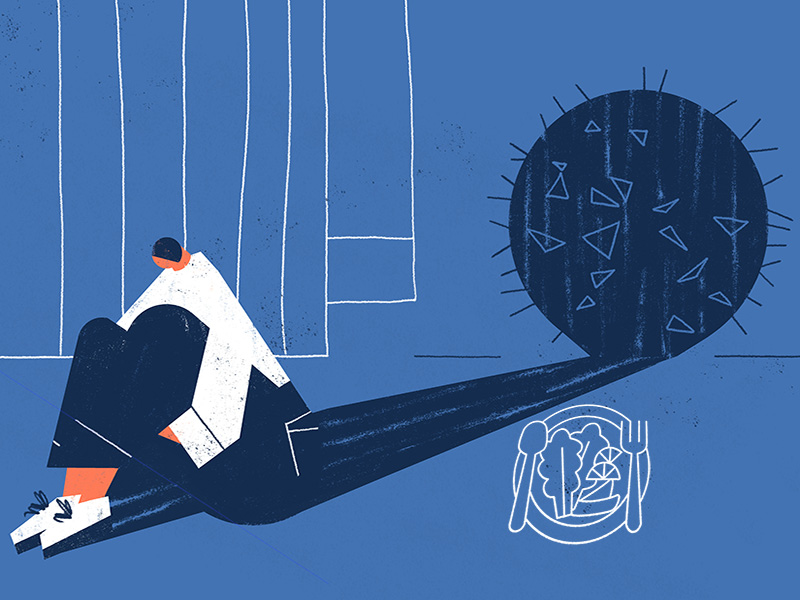
How an Anti-Tech Group Therapist Became a True Believer

Therapists’ offices have always intrigued me. Much like the artwork on the jackets of old vinyl records, they secure my memories with pleasing visual touchpoints. Pre-and post-session rituals marked my weekly appointments: stopping off at the same deli for a coffee, sitting on a park bench, browsing the poetry section in the corner bookstore; such places served as footholds for the different phases of my psychological awakening.

First Wave

After twenty-three years in my own cozy therapy office, it was time to say goodbye. The downtown institute that housed my practice went bust, and the landlord heaved dozens of veteran therapists out onto the cold winter streets of Manhattan.

As I packed up my books, rolled up my oriental rug and wall tapestry, and wrapped my Buddhist knick-knacks in newspaper, everything in my office took on meaning; the spider-cracks in the plaster ceiling that I had planned to paint, the well-worn grooves in the carpet from my trusty Aeron chair, the slight sag in the center of the couch that held so many stories.

I considered my attachment to my cozy therapy office as I closed the door behind me for the last time. Walking home that night, I realized that all my personal therapists and their offices were gone too. Soon after, the pandemic hit.

Second Wave

When New York City shut down, I thought that I had no choice but to shut down, too. As a group therapist, I couldn’t see how my groups could survive. Individual patients would have phone sessions—but therapy groups? Over the years, I had amassed ten weekly, ninety-minute groups, consisting of over 100 individuals. What would happen to them?

So I phoned a fellow group therapist and asked if she planned to shut down. She guffawed:

“Why on earth would I do that?”

“But how will your groups meet?”

“I moved them to Zoom.”

I paused and asked in all earnestness: “What’s a ‘Zoom?’”

When Worlds Collide

Could therapy exist without walls? Would I be able to sense unspoken feelings from patients from a flat two-dimensional image? Could a screen transmit subjective and objective countertransference, induced feelings, subtle body movements, and the endless emotional tics and hiccups that appear in face-to-face sessions? I bristled at the thought of moving my practice online. But the pandemic forced me to face a stark reality: evolve or face extinction.

When I told my group members that we were moving online, their reaction was mixed. The older patients responded with cranky disapproval.

“How could you degrade the group in this way?” one asked me.

“I share your concerns, Alan. Let’s give it a try and see how it goes.”

I left out that I had two college tuitions to pay, a home mortgage, elderly in-laws to support, insurance premiums, and countless other monthly expenses that the pandemic wasn’t shutting down. To my great relief, the younger people accepted the proposal enthusiastically. “What’s your URL?” they asked.

“I’ll get it to you soon,” I replied. I immediately searched “URL” on the internet and discovered that it meant “uniform resource locator.” What the hell was that?

Boomer to Zoomer

With the help of my teen daughters and a nine-year-old MacBook crammed full of family vacation photos, I learned the basics of Zoom and patched together a weekly schedule.

Next, I had to consider the background for my sessions. Visually, my home presented a minefield of challenges. Every wall and bookcase overflows with family pictures, children’s artwork, and cardboard boxes containing my old office and my daughters’ dorm rooms. So, I dragged an old film projector screen out of storage, erected it behind me, and turned on my computer video camera.

It was my first visit to my cyberspace office—me floating in a wall-less white space.

The big day finally arrived. I sat in front of my computer, took a deep breath, and logged on to Zoom. My anxiety kicked in, and I found myself forgetting nearly everything my daughters taught me. Messages like “Samantha is in the waiting room” popped up, and I clicked. One by one, group patients began to appear in their square “Brady Bunch” boxes.

“It’s so good to see everyone.”

“I missed group!”

“I’m glad we can still meet.”

I immediately pleaded for patience with my computer skills; the group members delighted in my vulnerability. “Don’t worry, we’ll get you through this.” Soon everyone was chatting and catching up like old friends.

To my surprise, the group was flowing—disjointedly, yes, but flowing. I discovered that many members were scattered throughout the country, unable to travel back to the city. One woman was participating from the Czech Republic, which wasn’t allowing flights in and out of the country. I marveled that online sessions make it possible for members to attend from nearly anywhere.

“Hey, where’s Steven?” a younger group member asked. “He never misses group.”

Steven, a grey-bearded father figure with a sunny disposition, was the oldest and longest-running group member. Anxieties about his health were being expressed when a message popped up: “Steven is in the waiting room.” I clicked on it quickly. I was getting good at that.

When Steven’s gaunt face appeared, group members gasped; his eyes were sunken, and his usually bright outlook was dimmed beyond recognition. He had COVID.

“I’m so…happy…to see you all,” Steven wheezed. As he related his journey from a mild cough to high fevers and the ER, the group hung on his every word. “I’m so scared, Stephen said, “I don’t want to die. Not now.”

Soon tears were flowing, and cyber hugs were being dished out. By the end of the session, Steven managed to smile again. “You guys…are a…miracle, ” he said as he gulped air, “This is the first time I felt hope since…this nightmare…began. Thank you. Thank…you all.”

As we signed off, another miracle occurred: I had become a true believer.

New Standards

After a few weeks, I could feel the online groups start to lose vitality. Immediacy, the beating heart of group, was waning. Instead of an exhilarating experience that challenged ingrained characterological traits and inspired emotional intimacy, the online groups devolved into lackluster support sessions. Members stopped relating to one another and were monologuing about themselves. Energy dwindled, attendance ebbed, and newer members dropped out.

My office was gone, and my groups would be, too, if I didn’t take action. To succeed in cyberspace, I had to reinvigorate my leadership skills and set new standards. I needed more energy, focus, and clarity.

I launched an entirely new set of pre-group rituals. Thirty minutes before every session, I set aside time to review each group members’ development. I reviewed their histories, revisited their goals, and considered new ways of challenging them. I even incorporated group members into my daily Buddhist practice. Every morning, I reviewed my groups, targeted each group’s member’s emotional growth in my daily meditation, and considered new ways to engage them.

I became determined, from the moment I signed onto Zoom, to hit the deck running. I pushed members to take more risks and focus. I scanned their faces constantly for any emotional shifts and evidence of unexpressed feelings. I confronted any signs of repression.

“Samantha, what was that thought?”

“Steven, you seem distracted.”

“Alan, can you put that frustrated look into words?”

No sooner had my groups slowly jump started to life than I realized that they were suffering from another problem: a loss of boundaries. Group members became voyeurs. During sessions, members gave tours of their homes and showed off their living spaces, partners, pets, or children. Such distractions ran wild and fueled resistance to relating. During the first few weeks, members also signed into the group while snuggling in bed, eating meals, feeding their dogs, smoking cigarettes, baking bread, or casually sipping a tumbler of whiskey.

One young woman greeted her group from her bathroom, fresh from a shower. As she towel-dried her hair, her bathrobe fell open, revealing her bare shoulders and the tops of her breasts. “Oops! Sorry!” she crooned as group members ogled her.

It was time to reassert boundaries. I firmly reminded everyone that the group rules applied online: no eating, no walking around, no texting. Anything that distracted from relating to one another was banned. I also instructed members to pick a spot in their homes and sit for the entire group, no more multitasking.

And finally, I requested that every member prepare for group by revisiting their intentions and considering the following three questions.

  • Why did I join the group?
  • What are my feelings toward my therapist and fellow group members?
  • What emotions am I holding back?

To my surprise, group members expressed relief. The reassertion of boundaries lowered everyone’s anxiety and quickly brought the relationships in the group back into play.

A Cure Through Love

As of this writing, it has been ten months since my groups began meeting online, and I’m delighted to report that they are bustling with new members. Yes, my cyberspace therapy office isn’t cozy, but I have learned that therapy isn’t about places—it’s about relationships. As long as relationships remain the central focus, therapy can thrive nearly anywhere.

Freud suggested that in essence, psychoanalysis is a cure through love. The pandemic continues to test my mettle as a psychotherapist but doesn’t quell my love of the work, a love that I’ve learned can transmit through a computer screen. Not only is love limitless—it’s officeless, too.
 

Standing Up to Microaggression: A Clinician’s Experience

Microaggressions (noun)—Definition: Everyday verbal, nonverbal, and environmental slights, snubs, or insults, whether intentional or unintentional, which communicate hostile, derogatory, or negative messages to target persons based solely upon their marginalized group membership. (1) Looking back, a racial enactment between myself, a person/clinician of color, and my white therapist seemed inevitable. In our very first session, my therapist made some statements that revealed what I perceived to be her “White Savior” complex. I was taken aback by my therapist’s apparent lack of awareness of her own racism, as she had explicitly advertised herself as working through a critical post-colonial lens, and so I called her out on it. My therapist was quick to own her racist statements and take full responsibility. Despite the initial wounding and because of the subsequent repair, I continued to work with her because she did model a good relational and clinical holding style in following sessions, and I felt that she was helping me with the issues for which I was seeing her. Towards the end of our sixth session, I was sharing with my therapist how someone had explicitly sought me out for clinical supervision, mentioning familiarity with some of my work and writings, and how that had filled me with professional pride and confidence. My therapist’s exact reply is now hazy, but she said something along the lines of, “I think they chose you to be their supervisor because, as a white person, they can learn how it is for you—from your experiences as a person of color”. These words landed on me like a bolt out of the blue, and I instantly felt objectified. My therapist had unnecessarily racialized my experience, my whole identity reduced to that of “a person of color.” I had a vivid mental image of Black and Indigenous people literally being put in cages and zoos to be “observed,” and another of a laboratory rat being poked and probed—an object to be studied, “an other” whose experiences (painful or not) were being observed. A part of me still wanted to deny that it was I who was feeling the pain—to mask it as simply identifying or empathizing with those who have suffered racism. My heart began to beat fast, while my mind was trying to digest what I had just heard. Knowing very well that I have historically tended to minimize or deny micro-aggressions committed against me in the past, I resolved to be present to this current painful experience. Curiously, my heart wasn’t pounding but rather flapping—like a weak fledging trying desperately to fly away, but not having the strength or ability to do so. Instinctively, I put my hand to my heart to calm and hold the young, hurt thing, a part of me afraid that it was actually going to fly away. Anger has always been easier for me to own, so I told my white therapist with visible anger, “I am trying to calm myself before I speak.” My heart was ready to flee—and escape the pain—the pain of the blow which was multiplied in its effect, having come so hard and unexpectedly in a place that was supposed to be safe. The rest of my body, however, was ready for a fight—“I will not back down!” For the whole week, I allowed myself to fully stay and experience what had occurred in that painful therapy session. Paradoxically, this experience of staying with the pain of the micro-aggression pushed me into a spiral of transformative growth and healing, with the words of Rumi now resonating with me:

“If you desire healing, let yourself fall ill let yourself fall ill.”

It broke through my thick wall of defenses which had protected me from feeling or expressing my painful feelings in the past—especially those feelings when I had been “put down” or been the target of hate. Until then, I had vehemently denied and protested ever being cast in the role of a “victim.” Now I owned and allowed myself to feel them ALL—the feelings of indignity, humiliation, sadness, hurt, and fear—some of which were being held by very young parts of me. I became my own therapist, healing these young parts, unburdening them from the pain and hurt they had carried for years—simply waiting to finally feel acknowledged and validated, but more importantly, to be held and healed with self-compassion.

“We are healed of suffering only by experiencing it to the full.” Marcel Proust

In the next session, I clearly let my therapist know how her racist words and projections had negatively impacted me. To her credit, she took full responsibility for her racist remarks without trying to defend them in any way. This time we agreed that this was not a rupture that could be “worked through” or repaired to allow the therapeutic relationship to survive or grow stronger. Basic trust and safety had been violated by my therapist’s unexamined racist views and beliefs, and we agreed to terminate our relationship. However, having my therapist witness and listen to the impact of her words on me and take full responsibility for it was healing to me, and I did communicate that to her. In those moments, I recognized that as a therapist, irrespective of race, I have an ethical obligation not to perpetuate individual and systemic modes of oppression and racism, especially with my clients, and to pay attention to asymmetric power dynamics and intersecting identities to provide a safe relational context in therapy. I see how I have been guilty of protecting the status quo of white supremacy in my defensive denial of acts of aggression towards me (within and outside therapy settings) in the past. I have now vowed to directly challenge and dismantle oppressive thoughts and systems of power by speaking up against such micro-aggressions. Here is a list of defenses based on Internalized Racial Oppression from the People’s Institute for Survival and Beyond workshops shared with me by Nalini Kuruppu, LCSW, that I have found useful in my own self-reflections. My own defenses are highlighted. Defenses of Internalized Racial Superiority (for white-identifying people): White = Normal (unconscious understanding that white is the standard of humanity), White Denial, Intellectualizing, Individualism, White Distancing, Perfectionism, Entitlement, “Professionalism”, Expect Comfort, Rationalize, Minimize, Dominance, Demanding, Tokenism, White Saviorism, Self-Congratulations, Appropriation/Theft, Color Blindness, Addictive Behaviors, Defensive White Anger, Paternalism, White Tears, Dismissive, Arrogance/Expertism, Silence, Indifference, Need to be in control Defenses of Internalized Racial Inferiority (for Black-Indigenous-Persons-of-Culture BIPOC): Distancing (from race/ethnicity), Mimicking, Assimilation, Code Switching, Denial, Shame, Worthlessness, Fear/Hypervigilance, Guilt, Self-hate, Hopelessness, Ethnocentrism, Colorism, Protectionism (of whites), Tokenism, Invisibility, Exaggerated visibility, Addictions, Tolerance, Avoidance, Exceptionalism (the “model minority” myth). What about you? Do you directly speak to the asymmetry in power and the dynamics due to intersecting identities in sessions? Can you identify how you may be perpetuating oppression and racism? References: (1) Sue, D. W. (2010). Microaggressions in everyday life: Race, gender, and sexual orientation. John Wiley & Sons Inc.

Snatching Defeat from the Jaws of Victory

After several tries, Jim, age twenty-five, was finally accepted into a prestigious bank management program. Once in the program, however, Jim found it difficult to make time to study. Assignments were handed in late, if even completed at all, and Jim developed severe headaches, all of which eventually led to his being the only trainee to leave the program, just days before he would have been forced to withdraw.

Alice, a first-year student in the Ph.D. program in psychology at a northern university had a similar experience. An otherwise unusually hard working and effective person, she found it easier to help others than to help herself. A cherished friend, colleague, and fellow student, Alice consistently failed to handle the demands of the graduate program, despite a well-demonstrated ability for academic work. While ably helping fellow students with their work, she neglected or mishandled her own papers, and her presentations were neglected to the point where her status in the program became jeopardized.

Like what you are reading? For more stimulating stories, thought-provoking articles and new video announcements, sign up for our monthly newsletter.

Both Jim and Alice exhibit a pattern of self-defeating behaviors—clusters of thoughts, ideas and actions that sabotage success at work and in relationships. Self-defeating behaviors include a broad spectrum of self-imposed handicaps and other ploys and tactics that may suggest emotional trouble. Simply stated, a self-defeating behavior is any behavior that keeps someone from reaching their goals or sabotages their ability to be successful in ways that matter to them.

The obvious questions that arise in situations like these are “Why exactly do these people become their own worst enemies?” and “What would make bright, upwardly mobile, and ambitious individuals self-sabotage?”

Many explanations have been proposed for these behaviors. The most traditional analysis claims that people who repeatedly “shoot themselves in the foot” fear success, feel guilty about their behavior, or simply suffer from low self-esteem. Other explanations include the possibility that self-defeatists have inflated opinions of themselves, and that they use self-defeat to take control of a fear of failure. Perhaps Jim had serious doubts about his ability to successfully make it through the bank management program, so his being “too busy” to find the time to study, as well as his headaches, provided excuses that justified his exit without having to risk failing in the actual program.

Alice might have been handling her anxieties about the graduate program by developing a praiseworthy excuse for her own self-doubts and conflicts about her performance. If her sacrifices on behalf of her fellow students led to her inability to successfully complete the program, she could take comfort in the belief that she would have succeeded if only she would have finished. Her self-defeating handicap protected her from the risk of failure.

I have had success working with self-defeating individuals like Jim and Alice by helping them to learn to reflect rather than react and by identifying the negative self-beliefs that were partly responsible for their propensity to self-sabotage. With Alice, these beliefs caused low expectations for success and, hence, little motivation to try for better performance in future endeavors. This precipitated additional failure and helped to create a cycle of self-defeating behaviors for which she constructed defenses (e.g. rationalization) as her only means of coping. Therapy consisted of eliminating the irrational negative beliefs associated with self-defeat and replacing them with positive and rational alternative ones that she could gradually accept as valid. In addition, Alice was encouraged to consider alternative explanations for her failures. This was accomplished by considering hypothetical explanations for various events in which she was unable to succeed. With Jim, we were able to shift his attribution for failure from his claim that he lacked the ability to succeed to the realization that his failure in the bank management program had more to do with his insufficient effort. This enabled him to develop an expectation of possible success and helped him to imagine that he could, in fact, succeed if he was willing to try, and try differently, a second time.

A question that has had a great deal of traction with clients like Alice and Jim has been, “If you could do this over again, what would you do differently?” This helps them to begin a conversation that allows them to consider a different pathway, one that takes them to success rather than defeat.The satisfaction I was able to enjoy with both Jim and Alice had a great deal to do with their ability to tolerate the insights that illuminated their histories of self-defeat.

Gradually, they were able to relinquish the distorted beliefs and rationalizations that camouflaged and perpetuated their self-sabotage. Both of them were good examples of how insights become a blueprint for change in the course of a psychotherapeutic experience. Too often, the people I work with become "insight rich and change poor," which is why, for some, therapy feels moderately helpful, but not sufficiently productive and fulfilling. Good therapy has both therapist and client keeping a careful eye on the extent to which insights are implemented and identifiable and measurable change is able to occur.
 

Working Towards Therapeutic Solutions with Men

In my experience, men typically and stereotypically really don’t like opening up about their feelings and prefer not to admit there’s a problem in the first place. So how to help get them into therapy becomes a compelling challenge.

Like what you are reading? For more stimulating stories, thought-provoking articles and new video announcements, sign up for our monthly newsletter.

Many years ago, I read a report that found that one in three of the young men polled within it would rather smash things up than talk about their feelings. It was a tad extreme, I thought, but there you go. Thankfully, things have moved on a bit since then. However, men are still reticent. For instance, it turns out that they would rather talk to their barber about their problems than talk to their doctor, which is why the Lions Barber Collective exists. An international organisation that recognises the unique bond formed between a man and the bloke who clips his hair, it trains members up as mental health first aiders. Not only do they listen to the guys who sit in their chairs, but they can also spot the early warning signs of a developing mental health condition and then point them in the right direction for help. This usually means a psychotherapist. Which means we are back to talking about feelings. Which, as we know, men are not wont to do.

The problem is complex. But a big part of it is that talking about their feelings is still seen as a sign of weakness among many men. And despite the prevalence of metrosexual men in our media, the strong and silent male myth still pervades. Also, when men do talk, because of said stereotypes, what is more than likely depression can often be written off as a “bit of a low mood” instead.

Another problem, to my mind at least, is that when a man who doesn’t like talking about his feelings goes looking for a therapist, he goes looking online. And practically every single therapist’s opening statement will say something along the lines of “I offer a safe and non-judgemental space in which to explore your feelings.”

Egad!, as the exclamation goes. Are you trying to scare them away? Do you want men to come to see you for help? And, if you do, how do you reel them in? (Big hint: male-orientated metaphors help.) Enter then, any form of solution-oriented therapy.

I’m a rational emotive behaviour therapist (REBT) and have found that as a form of cognitive behaviour therapy (CBT), its philosophy and structure are easily explained and understood. As an active and directive approach, it offers me a way of being actively involved in the therapeutic process rather than sitting back and offering a safe space in which my client can talk whilst I sit passively by. As a form of solution-oriented therapy, I can even discuss SMART goals from the outset. And, before it starts exploring all the emotional consequences of a person’s dysfunctional beliefs, REBT can challenge them empirically, logically, and pragmatically.

I explain REBT to prospective clients in a very matter-of-fact way. My webpage is plain and straightforward. It attracts a large proportion of potential clients (including men) who want their therapy delivered in a similar style. This has been very helpful to anybody who is nervous about, or unable to, talk about their feelings.

Many years ago, a highly anxious man was brought to my clinic. In fact, he was so anxious that he was having a panic attack in the waiting room and was breathing deeply and slowly into a brown paper bag. It wasn’t having much effect, and it was clear his anxiety was not going to go away any time soon. I brought him into my clinic room anyway.

“Would it help if you just sat there breathing into the bag while I explain what this therapy is all about?” I asked.

He nodded. And so I discussed both REBT and the ABCDE model of psychological health, as well as the roles played by dysfunctional and functional belief systems. After a while, I simply asked him if he had noticed anything. He nodded slowly.

“What have you noticed?” I asked.

“I’ve stopped panicking,” he said.

I asked him why that was.

“Because I can see a way out,” he replied. “I’ve not been able to see one before.”

Fast forward a few years to a man who came to see me for psychosexual dysfunction, a tricky subject at the best of times. In my initial telephone consultation, before I engaged with him for therapy, this man described himself as a typical alpha male type who didn’t like all that touchy-feely stuff. He’d been living with his particular form of anxiety for over five years, hadn’t had any form of sexual contact with his wife for over three years, and was only speaking to me because his wife had delivered him an ultimatum. He’d had several courses of therapy already, including sessions with a sex specialist.

“I didn’t like it,” he said. “They were all sympathetic, but I wasn’t looking for sympathy. And they were all trying to get me to open up about my feelings, but I either couldn’t or didn’t want to.”

“So, what’s going to be different this time?” I asked.

“I really liked your website,” he said. “It was very direct. I know I will have to speak about how I feel at some point, but there’s a format there that appeals to me.”

Studies have shown that men aren’t averse to therapy per se, but they are averse to therapy that is loose, conversational, and exploratory. One study found that the best treatment styles for engaging the menfolk were, “collaborative, transparent, action-orientated, goal-focused” (Seidler, 2018).

When delivered in the correct way, I have been able to encourage men to talk about their feelings. I haven’t had to get all stoic and blokey myself, I just have to explain myself in a clear and concise way, preferably without mentioning either safe spaces or feelings. In my experience, if a man phones me up for therapy and I ask him what his goal is, he will usually commit to the process. And together, we venture forward on a journey of change

References

Seidler, Z. E., Rice, S. M., Ogrodniczuk, J. S., Oliffe, J. L., & Dhillon, H. M. (2018). Engaging Men in Psychological Treatment: A Scoping Review. American journal of men's health, 12(6), 1882–1900. https://doi.org/10.1177/1557988318792157 

Eating Disorder Triggers and COVID-19: A Guide for Psychotherapists

“I don’t know why, I just feel more like using symptoms lately. There’s no particular reason,” Margaret said*. “Um…,” I ask, endeavoring and likely failing to keep my tone neutral, “…can you brainstorm anything that might be contributing?”

“Well, I haven’t seen my friends in several months. I’m not working right now. I don’t have anything to do all day. Except check Insta, where everybody’s on some kind of weight loss or exercise plan. I can’t go anywhere or do anything, and I have no idea how long this is going to last. It’s not too far-fetched to wonder if we’re all going to live in some horrible Mad Max dystopia. And, oh yeah, I might contract a lethal virus and die.”

Chris had a similar dissociative response to our collective trauma: “Ever since March or April, I’ve been really dissatisfied with my body. Maybe because of springtime, with the beach season on the way? Except of course this year I won’t be going to any beaches…so there’s that whole thing.”

Like what you are reading? For more stimulating stories, thought-provoking articles and new video announcements, sign up for our monthly newsletter.

Acknowledging Eating Disorder Triggers

As therapists, our job is often to connect dots that aren’t readily apparent to our clients. It might seem obvious that they will be affected by the events in the world but, as one of my clients put it, “It’s hard to remember that you’re actually human sometimes, and that you’re vulnerable to the same stuff everyone else is.” And so, when working with people who have eating disorders it is important to know that almost every aspect of this pandemic is rife with potential triggers. By understanding the multiple ways in which COVID-19 can affect our clients with eating disorders, we can help them to plan for healthier ways to make sure that their needs get met in this difficult time.

Dealing with Unstructured Time

Many of my clients with eating disorders have the sense that they just don’t know what to do with themselves. Without normal routines to rely on, the days have begun to feel like an endless void. For these clients, eating disorder symptoms offer a way to be engaged in something. For some, this might mean over-exercise and calorie counting. For others, overeating. Still others will cycle between back and forth between overeating and attempting to “compensate” for the intake. One college student I am working with has been using food to break up the time to give it more structure by eating on a very rigid schedule. Unfortunately, for her this means getting out of sync with her natural body rhythms and being able to listen to her hunger and fullness cues.

Helping clients to schedule their day can give them a sense of groundedness and prevent filling up the time with unhealthy behaviors. With Sara, we sat down with her day calendar and plotted out a week’s worth of activities. Sometimes the structure was as loose as “Thursday morning—TV in the living room”; “Thursday afternoon—reading in the bedroom.” Other times when she was really struggling, we went hour by hour—including meals. If you do this, be sure to include changes in location as a part of the schedule, and outside time if at all possible.

Addressing Role Overwhelm

For many other clients, unstructured time is not a problem at all. In fact, there may be a sense that there is no time at all. This is particularly true for parents who will no longer have the support of the school environment and are being asked to take a role in their child’s education that is outside of their expertise. Many are also attempting to care for their children while working from home, guaranteeing that they will be able to do neither effectively—a client of mine recently described a morning in which her three-year-old emptied all her kitchen cabinets while she was on a Zoom meeting. When she was done with the meeting, she had 8 or 9 follow-up tasks—plus an entire kitchen to sort out, all while entertaining her child. While moving quickly from meeting to caretaking to schooling and back, clients with eating disorders may leave their own needs on the back burner, forgetting to eat, cook nutritious foods, or take time for themselves.

Fighting Toxic Cultural Expectations

In our compulsively productive culture, having some time on your hands mandates you to do something with it to “improve yourself.” More benign manifestations of this drive include educational tasks such as reading the classics or learning to knit. For our clients with eating disorders, though, this train typically runs down the “perfect your body” track. They are reinforced by a spate of “COVID workout plans” and a social media frenzy of fears about the COVID-19 (as in, the nineteen pounds one can supposedly expect to gain during quarantine). “If I’m not getting thinner, I’m not getting better,” one client said to me. As therapists we can provide a counterpoint to toxic cultural messaging—by what we say, and through what we do.

Addressing Perceived Lack of Activity

Perceived lack of physical activity is very triggering for lots of people with eating disorders. They worry that if their routines change, they might gain weight. This in turn is correlated with immense shame and fear of being unlovable, lazy, or worthless. Some with eating disorders will restrict their food intake to supposedly “make up” for lack of activity, often wildly overestimating how much caloric cutting back would be equal to the actual amount of energy unspent. Others, because of black and white thinking, will begin to have difficulty caring for themselves in any way if they are not able to follow their previous routines. Helping clients to reality-check how inactive or active they really are can be tremendously helpful, as can helping them to sit with and manage the anxiety it brings up.

Avoiding Isolation

It’s difficult for anyone not to have access to their support systems. For people with eating disorders, this includes access to a treatment team and peer network that help to fight the eating disorder “voice” by providing context, reassurance, and normalization. Without this support it can be easy for someone with an eating disorder to be overwhelmed by their own thoughts. As therapists, we can provide an important counterbalance, but it’s also more important than ever that we encourage our clients to participate in healthy groups and online forums.

Ameliorating Anxiety

Whether or not somebody qualifies as having an anxiety disorder, this is a time of heightened anxiety for everyone. None of us knows whether we or our loved ones are going to get sick. None of us knows how this will affect our society or how long it’s going to last. Many people with eating disorders deal with anxiety by converting it—rather than feel uncertainty and dread about things that are outside of their control, they channel their uncertainty into worrying about food and body issues. Helping clients with concrete tools such as diaphragmatic breathing and progressive muscle relaxation can help them to better cope with these uncomfortable feelings and distressing concerns.

***


COVID-19 is very triggering for everyone, but our clients with eating disorders will be triggered in specific ways. By keeping this in mind we can help them to maintain their gains, avoid or minimize relapse, and continue to learn to nourish their bodies and spirits.


*All names are changed, all quotes are compilations 

COVID-19 and the De-Stigmatization of Therapy

“This is my first time in therapy,” Sean tells me in our first virtual session. He is among the many who have come into therapy for the first time with the onset of the COVID-19 pandemic.

Coming from parents who suffered from alcoholism and depression for his entire childhood, he is no stranger to mental illness. Growing up, however, therapy was looked down upon as something only “broken” people do—he was one of the many recipients of the damaging fallacy that strong people solve their problems on their own and seeking help means weakness. Fortunately, many of the clients with whom I work have made the decision to fight against the silent stigma against therapy. Clients like Sean are breaking the therapy stigma in the face of the COVID-19 pandemic for several reasons.

Like what you are reading? For more stimulating stories, thought-provoking articles and new video announcements, sign up for our monthly newsletter.

The Normalization of Therapy

Sean is seeing me for help with depression, which he says began right around the onset of the pandemic. COVID-19 left him unemployed and unable to see his friends, not unlike many others who have found themselves out of work and isolated. I have seen a rise in those seeking mental health services at this time, especially among first-time therapy go-ers! As Sean takes the leap with me to finally start working on his mental health, he is helping break the stigma against therapy simply by growing the population of therapy-consumers, making therapy more commonplace. He has also encouraged his sister, who has battled depression for years, to see a therapist. By doing so, he sends the message to his sister, “It’s ok to talk to someone. I do.”

Acceptance of Vulnerability

Although Sean usually doesn’t tell others in his life about his painful emotions for fear that they will reject him or he will make others feel badly, he tells me that he has been able to open up to his roommate and father like never before. Because they have also been struggling with the emotional consequences of the pandemic, Sean and those close to him have been having deeper conversations about what's really going on with them emotionally and behaviorally.

With so many others facing similar struggles, Sean has gained confidence that he will be understood and heard when he reveals what he has been experiencing. Because others in his life are more aware of the fact that many people around them, both near and far, are struggling, he feels safer to disclose his emotions and life struggles and has received an unprecedented level of acceptance and support. Sean is more emotionally open and aware of hardship in others’ lives, thus allowing him to risk being more vulnerable with others about his deeper feelings. And because he is feeling safer in expressing this vulnerability, Sean was able to come to therapy, knowing that he could expose his deeper feelings to a therapist without feeling “weak” or being judged for seeking help.

Realization of a Common Humanity

Like others who have visited with me, Sean has come to accept that he is not isolated in his suffering. Because those in his life are beginning to express similar vulnerability, Sean is beginning to realize the reality that life is hard for everyone. Instead of feeling isolated in his suffering, Sean is more in touch with a sense of common humanity. Knowing that he is not the only one who is facing a hard time, Sean felt increasingly connected and was able to take the leap to book his first therapy appointment with me. He continues to fully express his emotions without feeling that he is the only one who struggles in life.

***
 

Sean has learned that it is ok to not be ok and that it is ok to get help. In taking care of his mental health during this time, he, like others with whom I have worked, is becoming an advocate for therapy and breaking the stigma.  

Healing the Authoritarian Wound Through Writing: 8 Writing Exercises to Share with Clients

A Therapeutic Place for Writing

Therapists endeavor to help clients handle life’s problems and their particular difficulties, including those that have come about because of the way they were treated as children, adolescents, and adults. We deal with people, and we need tools that actually help people grow, heal, and change. One great tool at our disposal is inviting clients to write.

One of the areas that interests me is the consequences of authoritarian wounding, those wounds created by prolonged contact with a family bully, like a father, mother, or sibling, with a bullying mate, authoritarian mentor, teacher, clergyman, boss, or co-worker, or with any other authoritarian who is operating in one’s sphere. I’ve written extensively on this in Helping Survivors of Authoritarian Parents, Siblings and Partners (Maisel, 2018) and in scores of blog posts for Psychology Today and The Good Men Project.

A second area that interests me is the value of writing as a useful tool that therapists and coaches can use with their clients and offer to their clients. I’ve advocated for the wisdom of inviting clients to write, most recently in Transformational Journaling for Coaches, Therapists, and Clients (Maisel, in press). In this piece, I’d like to share with you eight writing exercises that I use in my work with survivors of authoritarian wounding.

I think you’ll see how these exercises can also be used with all clients, either as is or with some tweaking. I hope that your main takeaway from this piece will be that clients can make tremendous strides in self-awareness and in healing when they write in a focused way about what matters to them. These aren’t the “describe a tree” or “describe a sunset” writing exercises that you might encounter in a writing workshop. These are therapeutic exercises that invite clients to face their experiences, learn from their experiences, and move past their experiences.

Maybe you don’t currently invite clients to write between sessions or assign any homework. You might want to rethink that a bit. Many psychotherapy clients are smart, articulate, sensitive folks who may well already keep a journal or engage in some other reflective writing or who, even if they aren’t journal-keepers, are likely to be receptive to the idea of doing some writing. If you do decide that providing writing exercises might prove a valuable therapeutic tool, here are a few points to consider:

  • I let clients know that if a given exercise doesn’t speak to them, they can write on a prompt of their own choosing or, of course, not write at all. It’s wise to give clients who’ve been wounded by an authoritarian this sort of instruction and permission, since they will have had a long, difficult history with rules and especially with the consequences of violating or ignoring rules.

  • I explain to clients that perfect knowing isn’t the goal. If they increase their awareness a little bit or heal a little bit, that is a victory and a blessing. We all have the wishful hope that we can get from a muddy understanding of something to a crystal-clear understanding of it, but perfect understanding is more than elusive, it is unattainable. I remind clients that if they get even just a little something of benefit from the exercise, that is a welcome outcome.

  • I warn clients that the exercises may well prove provocative and emotionally difficult, and I give them real permission to stop if the going gets too hard or painful. You can tie this instruction to several of the tips in the tip box provided below, for instance to the ideas of creating a support system and staying alert for triggers. Clients should be helped to understand that this work is not easy and that stopping should be viewed as a self-care strategy and not a defeat.

Before I describe exercises I have found useful with clients who have been impacted by authoritarian relationships, I would first like to describe some of the long- and short-term impacts of authoritarianism on the individual. These include (but are certainly not limited to) lifelong relationship difficulties (including serially choosing authoritarian mates); existential despair rooted in feelings of worthlessness; a pessimistic, critical attitude that makes it hard to give life a thumbs up or people the benefit of the doubt; an anxious nature that plays itself out as indecision, confusion, and an inability to make clear or strong choices; a felt lack of safety, including in the therapy session; obsessive worrying and powerful feelings of overwhelm; and a pull toward addictive behaviors.
 

Eight Writing Exercises

Here are the eight writing exercises. Each comes with three prompts, as I find it useful to provide clients with choices.

Exercise 1. This really went on (you weren’t crazy)

We can almost believe that what happened to us didn’t happen to us, maybe because we did a lot of dissociating, because other people saw the authoritarian in a different light, because we wished so hard that it wasn’t true or that bad, or for some other reason. But it did happen. Please pick one of the following three prompts to write on (they are written from your point of view):
 

1. What exactly went on? Let me pick one experience that still deeply affects me and try to describe it as carefully as I can. I do want to know for certain that what I believe went on actually did go on!

2. I want to think a little bit about how it might be to remember some of those terrible experiences without having to re-experience them and without having to be flooded with bad feelings. Can I see a way to do that?

3. I have long thought that I must be a little crazy to believe that such awful things could possibly have gone on. But they did go on. So how can I completely let go of that feeling that I was “a little crazy” for believing what, it turns out, was completely appropriate to believe?

Exercise 2. You didn’t have a choice (you didn’t choose it)
 

If your experience of dealing with an authoritarian happened in childhood, it should be clear to you that you didn’t choose to experience that wounding. But as clear as that truth may be, it’s still easy to feel complicit or as if you deserved what happened to you, maybe because you weren’t “perfect.” Now is a good moment to get clear on the fact that you didn’t choose to be abused by that authoritarian. Please pick one of the following prompts to write on: 
 

1. Is there some part of me that still thinks that I did choose my situation? How can I still be thinking that? And what can I do to stop thinking that?

2. If I’m still dealing with an authoritarian today, do I have new choices to make? Different choices to make? After all, I’m not that child any longer!

3. Because I didn’t really have a choice in the matter, I think I may have gotten it into my head that I’m not entitled to make strong choices or maybe that I’m not equal to choosing. I think I’d like to do some reflecting on that possibility.

Exercise 3. You didn’t have allies (you had to go it alone)

It is hard to overestimate the extent to which you had to go it alone. Authoritarians can’t function if everyone around them says “No!” For the authoritarian to bully others, those others must be staying silent, not fighting back, tacitly accepting the situation, or even defending the authoritarian. Maybe you were lucky to have an ally in an aunt, a sibling, or someone else, but basically you had to go it alone—the proof is that no one ever successfully stopped the bully’s behavior. Please pick one of the following prompts to write on:


1. Did I or didn’t I have any real allies during those bad times? What was the exact nature of my situation with respect to allies and/or a lack of allies?

2. If I did have a real ally during those times and he or she is still living, do I want to reach out and say something to him or her? Or maybe say something to him or her even if he or she is deceased?

3. I wonder, what are the consequences of having had to go it alone? Did that make me independent or dependent? Did it make me love solitude or recoil from solitude? Let me do a little writing and tease out those consequences.

Exercise 4. You didn’t have power (you couldn’t fight back)

Grown-ups possess all the power. Children can dream about being powerful, fantasize about being powerful, and engage in small acts of strength, but they are essentially powerless in the face of adult abuse. This true powerlessness can produce lifelong feelings of powerlessness, even though you are now an adult with all the powers of an adult. Please pick one of the following prompts to write on:

1. I want to think clearly about the ways in which I was powerless in those terrible times, primarily for the sake of making absolutely certain that I do not blame myself for not taking actions that were just not available to me.

2. How would I describe the power I now possess? Surely, I do possess some adult powers! How would I describe them? And how do I use them?

3. What would it take to transform myself into a “real life superhero?” And what would I be able to accomplish then?

Exercise 5. You couldn’t possibly understand (how could you?)

You may blame yourself for not understanding what was going on, for being too innocent, for missing what was right in front of your nose. But how could you possibly have understood? Feeling that something was seriously wrong and fully understanding the complicated dynamics of the authoritarian personality are two different things. Really, how could you have understood? Please pick one of the following prompts to write on:

1. What do I understand now that I couldn’t possibly have understood back then?

2. What intuitions that I had back then about my situation and about what was going were actually accurate? Did I maybe have some understanding of the situation that I couldn’t quite access then?

3. What additional understanding is available to me now? Is there more for me to understand?


Exercise 6. You were genuinely afraid (of course you felt scared)

Authoritarians scare us. You may have spent much of your childhood terrified. Of course you were afraid. The question to grapple with now is, do you still have to be afraid today? Please pick one of the following three prompts to write on:
 

1. I want to remember what it was like to be frightened as a child, to validate that experience. I am going to go back in memory, remember what I felt, and honor that I had those terrible experiences. But I am going to go back very carefully.

2. I know that I’ve lived in a fearful way and that I’ve been scared a lot in life. What can I do to feel safer now?

3. I want to live differently. How can I live more bravely? What would such a life look like?


Exercise 7. You were truly harmed (there were real consequences)
 

To say that you were wounded isn’t to speak metaphorically. Something in you got seriously injured. Maybe it was your willingness or your ability to deal with conflict. Maybe it was your self-image, your self-esteem, or your self-trust. Maybe it was your ability to trust others or to deeply care about others. The list of possible injuries is long. Please pick one of the following three prompts to write on:
 

1. I want to calmly and patiently identify the consequences of that wounding. That’s the important writing I’m going to undertake.

2. I think it might pay off to describe some of the ways that those consequences played themselves out. This won’t be easy, but I think that drawing a direct line between the wounding and the things I’ve done in life might prove eye-opening—and maybe I can forgive myself a little in the process.

3. I want to write about my strengths, too. I think it might be a good idea to spend as much time writing about my strengths as my injuries.


Exercise 8. Healing is possible (in part, through writing)

You may have gotten into the habit of thinking that nothing can really change in life, including, and maybe especially, your own personality. But healing, change, and growth are possible. Use your reflective writing practice to help you make the changes you identify ought to be made. Please pick one of the following three prompts to write on:
 

1. I think I’d like to describe some daily practice that will serve me as I try to shed the psychological and emotional baggage of the past.

2. I want to create some firm-but-gentle action plans that support my intention to heal, grow, and live well.

3. I want to write about a better, brighter future, one where I feel less burdened by the past and more optimistic and passionate about the future. Let me write about that.


Eight Helping Strategies

In addition to inviting clients to write, you can also make the following suggestions and work with clients on the following issues:

1. Creating physical separation

Survivors of authoritarian wounding regularly report that only physical separation between them and the authoritarian in question allowed them to feel safe and provided them with the opportunity to heal. And the wider the separation, the better! You can have very productive conversations about the need for physical separation and the practical details of such separation.

2. Creating psychological separation

Survivors are likely to still love, or feel that they ought to love, their parents; be pressured by other family members to continue to deal, psychologically and emotionally, with their parents; and never quite be able to get their parents out of their head. You might try a guided visualization where your client is invited to escort the perpetrator out of her head once and for all.

3. Ventilating and eliminating feelings of guilt

Survivors typically experience guilt. Some feel guilty about not protecting their younger siblings from the family dictator. Some feel guilty about having failed themselves or not having lived up to their potential. Some feel guilty about physically or emotionally separating from their authoritarian parent. You can help your client ventilate these feelings and begin to think thoughts that serve them better, thoughts like, “This guilt isn’t serving me.”

4. Creating a support system

My client Maria explained, “I have to be able to handle things on my own because, growing up, I lost so much power and so much self-confidence that my goal for myself is to be powerful and self-confident. However, that doesn’t mean that I have to handle every single thing alone. So I’ve created a kind of informal support team. I don’t turn to them first thing—first, I want to trust my own resources. But I’m not stubborn, and I do turn to them just as soon as I understand that I could use some help!”

5. Staying alert for triggers

In the language of the 12-step recovery movement, a trigger is an internal or external cue that is likely to cause a person in recovery to relapse and resume the addictive behavior. A trigger might be the appearance of a certain feeling, like feeling overwhelmed, seeing someone in a film or a television show in a similar situation, relationship events that mimic family-of-origin events, or encountering a certain smell (like an aftershave lotion) or a certain sound (like a door slamming). You can help your clients identify their triggers and create a plan of action to deal with those triggers.

6. Communicating with and enlisting “healthy” family members

Survivors often express that maintaining contact with family members who saw the situation the same way that they did was their number one healing and survival strategy. A client and her sisters might support one another in validating their memories (“Yes, Anna, it was that bad!”) and standing together in mutual defense and in ongoing defiance of the authoritarian parent. You can help your client identify allies and begin the process of reaching out to allies.

7. Not accepting the vision of family members who do not see the situation as your client sees it

Other family members may have had a very different experience of Mom and Dad from your client’s experience. They may have entered the family later than your client did; maybe the authoritarian had mellowed by that time, and the younger sisters and brothers did not receive the same authoritarian wounding as your client did. Maybe her siblings were in fact just as abused and traumatized as she was, but they are currently in denial about their experiences or have followed in the authoritarian’s footsteps. You can help your client deal with her siblings’ demands that she be “nicer” to the authoritarian parent and with their accusations that your client is being disloyal or ungrateful.

8. Limiting contact

Your client may still be living with the family tyrant or may have returned to live with that parent, perhaps because the parent has become infirm. If complete physical separation is out of the question and complete psychological separation is unlikely, the questions you can pose to your client are “What’s the least amount of contact that you can have with your mom?” or “How can you stay out of your dad’s way most of the time?” You can help your client think through the practical details of limiting contact and the emotional consequences of remaining in contact.

Clinical Case Applications

Let me briefly describe two client situations where reflective writing helped my clients grow in awareness and make important life changes.

One client, John, a British professor of history, had never finished writing any of the many books that he’d begun. I invited him to get some thoughts down on paper about why this might have been the case. He shared the following journal entries with me:
 

I grew up with mean parents. After years of therapy, I think I’ve come to identify a kind of demon who comes into my consciousness and does not want me to be productive or successful. That demon was born in childhood. It somehow has to do with safety. It did not feel safe living with my parents, plus they told us that the world wasn’t a safe place. They filled our lives with continual anxiety and catastrophizing.

Here’s how that all plays out now. My creativity starts to flow and then anxiety floods in. I tear up the work, I tear myself down, and I abandon the project as no good. I’m also flooded with feelings of intense dread all the time, especially at night; and during the day, I’m always finding ways of avoiding entering my writing space. And my writing space is easy enough to avoid, as I have classes to teach, committee meetings, a bit of a commute, and all the rest. It’s supremely easy to avoid my study. And my study is so lovely. I wanted to write, ‘lovely and inviting,’ but it never does invite me.


In another session, he shared the following journal entries:
 

Those demons. The demons have made it harder for me to keep meaning afloat in my life, they’ve made it harder for me to keep despair at bay, they’ve made it harder for me to live my life purposes, and they’ve contributed to my anxiety and depression diagnoses. It’s all a piece. I’ve come a certain distance in all this and I can function, but I’m still searching for answers and I’m still wanting to finish some damned book.

I think that the bottom line for me is that the demon just won’t budge, because it is about core safety. Maybe I have to celebrate lesser forms of creativity where the emotional stakes and pressures are lower. An article, maybe, though articles aren’t easy either! I haven’t found ways to conquer the demons of darkness, but I do intend to continue to work on this block through some kind of inner demon work. I haven’t quite given up. Not quite!


John and I worked together for the next three years, chatting via Skype once a month. There were many downs, but also enough ups that John did manage to finish a draft of a book, deal with its several revisions, send it on its journey into the world of academic presses, tolerate the criticisms and rejections his book initially received, enjoy the moment when it was accepted for publication, and so on. I kept reminding him, “This is the process,” and at some point, he began to laughingly beat me to the punch and become the first to announce, “I know, this is the process!” And throughout the process, he used reflective journaling and writing prompts to hold important conversations with himself and deal with the demons that were never going to fully go away.

A second client was a Parisian painter, Anne. At the time we began working together, Anne was hiding out in Provence, licking her wounds after an unsuccessful show of her paintings at a prestigious Parisian gallery. She was barely communicating with the world and painfully wondering if she should continue as an artist. The fact that she has sold paintings previously, that she had had successful shows previously, and that she was still something of a darling of the art world seemed to amount to nothing. Not in the aftermath of what she dubbed “that monumental disaster.”

We chatted over Zoom. One of my goals was to help her change her perspective. Her career certainly had taken a hit. But for her to dwell on that “disaster” amounted to a serious mistake and a recipe for despair. Focusing on that event was only one lens through which to look at her career. I quietly and carefully explained to her that she was fortunate to have had the successes she had had, that this one event might or might not signal anything in particular or auger anything in particular, and that her best path was to get on with her life and get on with her art-making—the act of which, fortunately, had lost none of its luster for her.

I asked Anne to detach from the show results. I also asked her to invite a postmortem from the gallery owner. How brave that would be, to ask him why he thought the show had produced no sales! She wasn’t sure if she was equal to that. I explained that she might get “more equal” to that bit of bravery by doing some reflective writing, maybe on her turbulent childhood, maybe on her bullying father, a famous painter who always belittled and minimized her efforts, or maybe in a more “in the moment” way by writing about her feelings about communicating with Claude, the Parisian gallery owner.

We chatted a week later. It turned out that she had journaled every day that week using the prompt: “Do I dare write to Marcel?” She explained that she had learned a lot about herself in the process, especially about her habit of fleeing at the drop of a hat. In childhood, she hadn’t been able to flee. She had been watched, controlled, commanded, and punished for taking even the smallest step out of bounds. Now, as an adult, because she could physically flee situations, that’s what she did—and far too quickly, she now understood.

Indeed, she returned to Paris, bravely met with Claude, and had that painful conversation. It turned out that Claude had very little to offer by way of explanation. People “loved the paintings.” People were “wild for the paintings.” Many expressed what Claude felt was a completely genuine desire to make a purchase. Yes, nothing had sold. But, Anne explained to me with relief, Claude was not down on her, had no intention of reducing her presence in his gallery, and in fact expressed his intention to redouble his efforts on behalf of her and her paintings.

Over the months, I learned that several paintings from the show had sold for fancy prices and that her new suite of paintings were progressing nicely. She still had to endure all the challenges that creatives must regularly endure; but her “monumental disaster” seemed clearly behind her. “And I now have a sturdy tool in my tool kit,” she explained. “I now have conversations with myself in writing where the part of me that wants a good outcome can coax my wounded self in the right direction. I now have a friend who is nicer to me than I usually am. And that friend knows all about my tendency to flee! She knows all about it—and she knows how to talk me out of running away.”
 

***


It’s likely that many of your clients have been adversely affected by an authoritarian: by a close family member like a father, mother, sibling, or mate, by someone else close, like a mentor, teacher, clergyman, or boss, or by authoritarian leaders and others in high places.

What ought you try if your client is suffering from an unhealed authoritarian wound that has produced adverse consequences? You can try any of the tips I’ve provided, any of the tactics and strategies you routinely use, and the writing exercises I’ve described. By working in this way, you will help increase your clients’ personal power, aim them in the direction of useful daily practice, help them envision and plan for the future they want, and, in the process, help them upgrade their personality, heal, and grow.


References:

Maisel, E. (2018). Helping Survivors of Authoritarian Parents, Siblings, and Partners. New York: Routledge

 

The Virtue of Metaphors

If you were to tabulate the time you spent obtaining your graduate degree, license, continuing education, and specialty training, it would be measured in years or, for some, decades. That’s an enormous amount of time thinking counselor thoughts, speaking counselor words, and problem-solving from a counseling perspective. Certainly, these are the requisite building blocks of a professional career. We wouldn’t want a counselor thinking engineer thoughts, using plumber words, and problem-solving from a chemist perspective. Even so, there is a danger in becoming so enmeshed in our counseling worldview that we lose perspective. I must continually maintain awareness that my clients are coming from a different frame of reference. If I’m not mindful, I may use jargon, aka “counselorese,” which could run the risk that my interventions won’t connect with my clients. I may also disenfranchise and come off as irrelevant to my clients. This is the opposite of what I want. I want my clients to get excited by the ideas discussed in counseling and enthusiastically think about new patterns of behavior. What are some ways of circumnavigating the counselorese problem? In discussion with colleagues about this problem, a number of ideas usually get thrown around, such as matching your language with the client’s, understanding and utilizing the client’s frame of reference, or using movie or sports analogies to explain a concept. All these are great ideas, but it is only on the rare occasion that I hear someone comment about metaphors. Which I think is unfortunate, because I find metaphors especially useful and powerful, and, most importantly, an effective way to mitigate the counselorese problem. When done right, a metaphor relevantly connects with the client’s lived experience. Let’s say you are explaining to your client, who happens to be an auto mechanic, the benefits of self-care and the client just isn’t getting the concept. So you switch gears (did you pick that up?) and compare the client’s implementing a consistent routine of self-care to a car owner’s bringing their vehicle into the shop every six months for routine maintenance. The mechanic will certainly pick up on the logic and urgency of the metaphor. And with your help, they can connect the dots to their life. Specifically as they relate to language, metaphors get you away from using technical jargon. This is important because counselorese can, in the worst-case scenario, disenfranchise the client, and at best, undermine the effectiveness of interventions. For example, with the auto mechanic client, using phrases like “check-up,” “regular maintenance,” or “run diagnostic” relates to the client while achieving a clinical purpose. Finally, metaphors paint a vivid mental picture that allows the client to explore their experience. In other words, a metaphor is a mental picture that you can walk into in order to examine parts of your life that you have never looked at. The auto mechanic client may have never considered self-care as a part of his life, but once considering that his mind and body are kind of like a car, and self-care is kind of like doing maintenance, maybe there’s something else within the metaphor that will help him to examine his relationships, beliefs, or goals. However, metaphors are not perfect and may not work for everyone. You may be working with a client who is very concrete, on whom any kind of imaginative, thought-experiment-type of exercise could be lost. So be sensitive to who your client is and their needs. You will also want to be cautious about over-using or over-relying on metaphors. Furthermore, mixing your metaphors can diminish the power of any one metaphor. Be wary of stretching your metaphor too far—adding more and more to the metaphor could eventually decrease the effectiveness of the technique. Best to keep your metaphors uncomplicated and straightforward. I recall working with a client who had a hard time understanding my conceptualization of their presenting issue. They couldn’t understand how I saw their problem, and therefore, my recommendation on how to treat the issue was going nowhere. I had to try something different. Fortunately, I knew that my client was a runner. So I used a metaphor of a marathon to help the client understand her relationship to her daughter. I shared how she was getting fatigued by sprinting when she had miles and miles before the finish line. It would be better if she conceived of her relationship as a marathon. The client really connected with this idea. She realized had to pace herself when running long-distance, and she needed to “pace” her expectations. We then discussed how the client could make her expectations realistic, how change takes time and patience, and the need for regulating emotion when things get challenging. The metaphor powerfully connected with the client and enhanced our clinical work. As you can see in the example above, I was stuck. Certainly, there were a number of options I could have tried to get things moving in the right direction, but using a metaphor worked for me, and thankfully, it worked for the client. The metaphor provided a story in which the client could evaluate herself and envision new alternatives. It helped her see where she was making mistakes and allowed her to self-correct. It grounded her daily experience where she felt unsure and confused in a narrative where she was confident and knowledgeable. The medium was the metaphor, and the message was changed.

COVID, Counseling, and Caution: Ethical and Relational Concerns

It was a typical session on a normal day in late September; as typical and normal practicing therapy can be during a global pandemic.

Jonny, a Black male in his mid-50’s who worked in law enforcement, was referred to me by a former client. He was skeptical of therapy and the process. He decided to attend after several years of being cut off from his adult son, after his long-time partner gave him an ultimatum about committing to their relationship, and after his co-worker’s convincing him that the process could be useful for him. On this day in late September, it was our fourth session together.

Like what you are reading? For more stimulating stories, thought-provoking articles and new video announcements, sign up for our monthly newsletter.

I don’t recall anything especially memorable about that session. We explored his beliefs on parenting and delved into some of the history with his son. We paralleled this relationship to the one he had with his own father, discussed the type of relationship he wanted to have with his son and what was holding him back from doing so. Of course, we followed all the guidelines for COVID that we had previously agreed to. Jonny did not sneeze, cough, or exhibit any symptoms of illness during this session.

I have a small private practice in a community where the COVID positivity test rate had been under 3% for about 6 weeks, considered low community spread. The city has a population of 95,000, and the number of people in the city who tested positive had remained at 10-15 cases per day during this timeframe. Despite the low risk of encountering a client who was positive with COVID, all my clients were offered the choice of telehealth or in-person office sessions. Jonny would not have participated in therapy if the only option was telehealth, as he clearly explained to me, because he needed to be able to “read people.” For our office visits, we sat six feet apart and both wore face coverings. I have an air filter to ventilate the air, we keep the office door open for more air circulation, hand sanitizer is located in multiple sections of the office, and there are few other people in the office at any given time. Clients text me from their car when they arrive, and I text them back when it is safe to enter, so that they avoid mingling with anyone in the waiting room. I clean and sanitize the office between sessions, as well as have a weekly cleaning service. Clients and I both agree to inform the other if we are experiencing any symptoms, and they sign a separate COVID informed consent about the risks of conducting therapy in person during a pandemic. It was no different with Johnny.

About five days after that last session, I began to feel poorly. Although I did not experience the signs of COVID that we are generally taught to look out for, such as fever, cough, fatigue, and body aches, I did experience excessive nasal congestion, headaches and a sore throat. A few days after the onset of these symptoms, Jonny sent me a message to let me know that he had tested positive for COVID and was in the hospital receiving treatment. I made an appointment to get tested and learned 48 hours later that I was also positive. I experienced a mild case.

Ethical Dilemmas

The first ethical dilemma I encountered was that I needed to self -disclose my positive status to the clients who had potentially been exposed prior to learning of my status. I also needed to disclose to my other clients that any sessions while I was in quarantine would be done virtually. While therapists range in the amount of disclosure they do with their clients, I would rate my usual disclosure level at less than most therapists. I was fearful of disclosing to a few of them, as their anxiety about COVID had been high, prompting their seeking out services initially. How much information was necessary, and how much was too much? I prepared a basic speech with the facts and the importance of noticing symptoms and getting tested themselves. Some responded well; others less so. How to manage this anxiety? As clients check in with me about how I am doing, how much should I disclose? Will I feel differently towards clients who do not ask?

The second ethical dilemma I experienced occurred when the Health Department contacted me to gather basic information and begin the process of contact tracing. When they asked me to provide the name of the person whom I believed I had contracted the virus from, I was faced with the challenge of whether it was necessary to provide the client’s identifying information. Does this fall into the category of “harm to others,” one of the exceptions to maintaining client confidentiality? As my client was hospitalized, I felt confident that this information had already been sufficiently recorded, so I declined to provide identifying information and maintained his confidentiality. And yet, what if that had not been the case? When does public health outweigh the client’s right to confidentiality about receiving therapeutic services?

Relational Dilemmas and Further Questions

As of this writing, Jonny is still recovering, and I have not yet seen him again. I believe that he was unaware that he had been exposed and that he was in the asymptomatic stage of COVID prior to symptom onset. Due to this, I am not angry with him, I do not blame him for my exposure, and I am concerned about how he is feeling. And yet, what if I were less certain? Would I be able to continue working with him if I believed he suspected exposure or covered his symptoms and attended the session regardless? What if I viewed him as a “risk-taker” outside of our sessions, which prompted his exposure? If he experiences guilt over exposing me inadvertently, would that affect our relationship and work together?

Of the clients I contacted, only one family has tested positive, a 25-year-old daughter and 66-year-old mother who, ironically, were attending therapy because the daughter was concerned that her mother was engaging in too many risky behaviors regarding COVID and her health. Both are currently hospitalized. How will this experience affect our work together? Will they want to continue with me in therapy, assuming their health stabilizes? Although I have no way of knowing that I had been exposed at the time of their last session and was not exhibiting any symptoms, is there anything I could have/should have done differently?

Some of my colleagues believe that we should only be conducting telehealth sessions during this time, and many of them have not yet returned to live sessions. And yet, we are seven months into this pandemic, and the county is in Stage 3 of re-opening. At what point is it considered “safe enough” to resume? How many clients are not seeking services because telehealth fails to appeal to them? Black men as a group can be mistrustful of receiving therapeutic services, so what might be the ethics of refusing to offer these clients other format options? When do the benefits outweigh the risks?

* * *


We are encountering many ethical challenges during this time. As essential mental health workers, we are also on the frontlines of this crisis and play an important role in helping people to get through this time of uncertainty. These situations prompt few answers, only generating more and more questions to ponder.  

The Performance Trap

We’ve all been there! You assigned your client some homework to do over the week, and they didn’t do it. You might be like me in that upon learning they didn’t do it, your mind starts racing with thoughts like “There must have been a problem with the homework I gave them” or “The assignment wasn’t a good fit for them; maybe they just need another idea.” At this point, I feel a tremendous pressure to not shame the client by dwelling on what they didn’t do, and to come up with another brilliant homework assignment. I’ll then start generating a new idea that I think will work perfectly for their presenting problem. I’ll put a lot of effort and enthusiasm into describing the idea, how it could help them, and how they can practically apply the concept over the next week. The client agrees to practice the idea, record some reflections, and report the following week how it went. I breathe a sigh of relief that I quickly put that fire out and have full confidence that the client is motivated and will come back next week with a glowing report about how great the homework was… I do this only to be disappointed again.

Like what you are reading? For more stimulating stories, thought-provoking articles and new video announcements, sign up for our monthly newsletter.

So what is the right move at this point? Do I abandon all hope that the client will ever complete a homework assignment and therefore never give out assignments again? Do I make a paradigmatic shift and drop homework altogether from my clinical work? Or do I put my nose to the grindstone and continue generating ideas and homework assignments for the client?

Sadly, I’ve found myself stuck in the performance trap, which is the pressure to wow the client every week with a new idea. However, this option comes with many pitfalls. First, the pressure to wow the client is completely misguided. Rather than wowing the client, I should be holding them accountable. They made an agreement to do the homework, and I need to hold them to that. If the situation were reversed, I would have to be accountable to them. And, in fact, this does often happen in the clinical contexts. The client may want me to fill out some paperwork, forward their notes to another provider, provide them billing information, or email them a resource discussed in session. I agree or not, and then I am accountable to fulfilling my end of the bargain. This makes sense. That seems reasonable.

So why, then, do I drop this standard when it comes to the client? Secondly, moving on to another idea doesn’t provide any information as to why they didn’t do the homework. Maybe there is a clinically relevant reason why they didn’t do it. And, quite possibly, understanding why they didn’t do it could be the secret to unlocking the reason why they are seeing me in the first place. Thirdly, the pressure I felt to come up with great idea after great idea was removing the work from the client and placing it on myself. In essence, I was creating a context where my client was dependent on me, resulting in a situation where they didn’t value the work I was doing. Why should they have to act on an idea I suggested this week, when next week I may have something even better?

I can remember a couple with whom I had been working for a few weeks and found myself stuck in the performance trap. We had spent enough time building trust, gaining an understanding of the problem, exploring their story and relationship history that I thought they were ready to test out a few of the ideas we discussed. So I gave them a homework assignment, taking care to explain how it related to their presenting problems, how it would help them reach their treatment goals, and what the homework would look like using practical examples. The couple wholeheartedly agreed to do the homework, and the session ended with a buzz of excitement. When I asked how the homework went during our next session, they put their palms to their foreheads and said, “Whoops! We forgot.” I said, “That’s okay. No problem. Maybe the homework assignment wasn’t a good idea.” And then I proceeded to explore another idea from my therapist bag that could address the problem and get them closer to their treatment goals. Little did I know that this was the start of a trend that would last session after session. After months of getting nowhere, the couple terminated therapy. They said they liked me and appreciated my efforts, but they just weren’t getting anywhere. I now realize why.

As you can see from this scenario, I was fully engrossed in the performance trap. Sure, I felt like I was working hard for the clients, and they even appreciated my efforts, but that had no effect on their making real, tangible movement towards their goals. And that is the whole point. If my efforts are not getting the client closer to their goals, then that is cause for reflection and re-evaluation. So don’t make the same mistakes I did. Rather, follow these recommendations when giving your client homework: don’t abandon giving your client homework, keep your client accountable, understand the “why” when they don’t do homework, resist the urge to generate idea after idea, and (yes, it’s cliché but true) don’t work harder than your client.