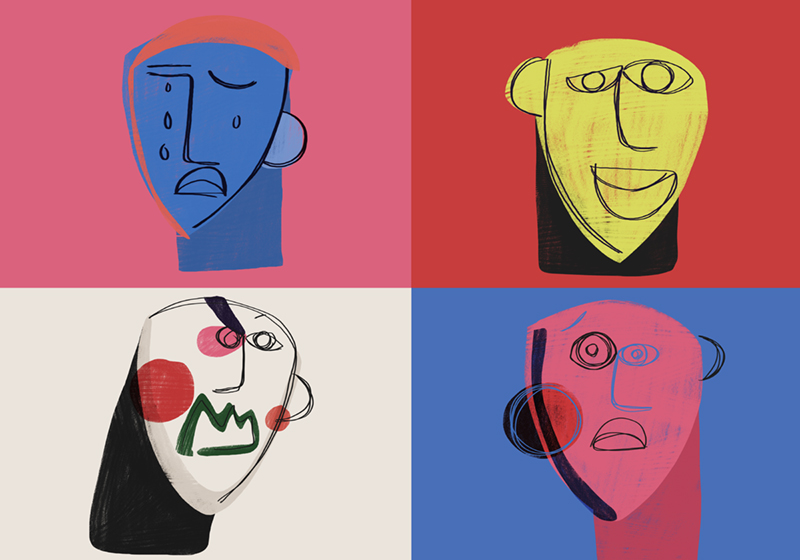
Anastasia Piatakhina Giré on Teletherapy, Borders and Building Bridges

In Different Tongues

Lawrence Rubin: When I first contacted you to schedule this chat, you had said that you needed a little time to wind down after your therapy session, which I completely understood. But you just now told me that your previous session was in Italian, and now you're speaking with me in English. It’s more than winding down, it’s completely shifting gears, so to speak. What is that like for you inside?
Anastasia Piatakhina Giré: I also had a quick chat with my daughter in between in French. I’ve gotten used to it, but it’s tiring, of course—it's code switching all the time. But on the positive side, it creates a very clear boundary between clients and their stories. The cultural context that we talk about and we're immersed in during the session is different. If I’m with a British client, the therapy will be in English, and then for the next client I might have to switch to French. It's not just switching from one language to another; it's switching from one cultural context to another, one story to another, one person to another. In a way, it helps to switch languages with different clients because it’s like you're opening one book and then putting it down to open another. If the book is in a different language, it's easier in a way to connect with the book you're reading at that moment.
LR: Do you find that you are equally effective as a therapist as you switch languages because it sounds incredibly complex.
AP:
it helps to switch languages with different clients because it’s like you're opening one book and then putting it down to open another
That’s a good question that I've often asked myself. I remember working with my first client in English. I was terribly anxious and wasn’t sure I would be able to make it, but I didn't have a choice. I already spoke with clients in Russian, Italian and French, but I was living in Spain and I wanted to expand my practice in English. So I did it. And now, after a lot of practice, I find that I am more comfortable doing therapy in English because it's really a question of distance. It gives me enough distance from the context, the cultural context.

I remember talking about this with a British client who lived in Great Britain, so I was quite familiar with their cultural context. We were talking about what it was like for me being on the fringes. I'm not completely inside. I'm not immersed in their cultural context, but I'm familiar enough to understand them. And that gives me a very interesting distance, a very interesting position. I'm pretty sure that's the experience of many therapists whose lingua franca is English. It takes some work, of course, but it's interesting. I do think that I'm a slightly different therapist in English than in Russian, which is my mother tongue. Better? Worse? I don't know, but slightly different, certainly.
LR: A different therapist! When I'm in therapy, I may switch orientations and techniques depending upon the circumstances of my client's life. But it blows my mind to think of your being a different therapist in different languages. Are you more client-centered in one, more solution focused in another, more cognitive behavioral in another? How do the languages align with your therapeutic orientation in the different tongues?
AP:
I'm probably bolder in Italian, more cognitive in French, and funnier in Russian
I'm probably bolder in Italian, more cognitive in French, and funnier in Russian. I can come up with a lot of differences. I also have clients, and that's probably my favorite situation, where we have a few languages that we share. And this goes to the topic of expatriation and working with displaced groups. My clients often do speak several languages, and they evolve in contexts where they have to learn a second language, or third or fifth. And their having a few languages really helps, because we can code switch from one to another during the session. This is one of the tools that I'm lucky to have, and I use it a lot.

I find that it really benefits therapy, really benefits the client. I often bring it up during the intake where we discuss the question of language. Sometimes, multilingual clients have a choice of which language they want to do therapy in. For example, one of my new clients speaks a few languages and previously had therapy in Japanese, but her native language is Russian. She came to see me with a very clear idea about wanting to work in Russian, which is my first language. We also share English because she used to study in England and spoke English for a while. Basically, language was the topic of our first session. So the choice of language becomes a tool that brings therapy forward. It's really interesting.
LR: Being multilingual along with your clients raises this notion of tools to a whole new level, because just as you switch therapeutic orientation in different languages, they access different parts of themselves as they move through different languages with you. It's almost like this potential for a multitude of conversations between two people.
AP:
I think the conversation becomes a polyphonic process, like multiple dialogues or a choir
I think the conversation becomes a polyphonic process, like multiple dialogues or a choir because my Russian part will connect with the Russian part of my client, but our English-speaking parts are also there and they also participate. And my client who speaks Japanese still brings it in because she knows that I'm open to it. I welcome her Japanese even if I don’t understand it. ; I ask, “How do you say it in Japanese?” or “How was that with your Japanese therapist?” It's like welcoming all those parts, which is obviously very inclusive and often very therapeutic in itself. I also work with Arabic-speaking clients, and while I don’t speak the language, it is a rich and beautiful language. I always welcome their quoting of the Qur'an or their favorite books or a family member or husband.
LR: So even though you may be with an Arabic client who is speaking in, or recollecting a memory or recounting a dream in Arabic, you can empathize with the feeling that's being expressed? You can help the client to interpret it in their mother tongue but also translate it so you can understand it? It seems like what you're doing is on the fringe of something so creative, so dynamic and rich that it almost transcends individual therapy. It's like this other level of interaction between two people that is so layered and so deep. I can't even follow it myself, and we are speaking in the same tongue and I'm not even in therapy with you.
AP: It's a lot of fun, and I'm very lucky to have all these languages and to do online therapy. It's all about access, right? It broadens access for the clients. And we know that with COVID, it was the only choice for all of us? But I've been working online for years and years, well before COVID. For people who are displaced—both my clients and myself—doing it online has been the only way to get therapy. It brings these unbelievable diversities to my practice. If I were only working in Paris, I could work with a lot of American and British clients, but I would never have seen the diversity that I see working online. Working with clients from Saudi Arabia, Iran, Russia, China and India is so enriching.

Fellow Travelers

LR: You were born in Russia, lived in Italy, and now live in France, so you are personally multicultural. And you say that working with this mélange of clients has enriched you as a person and therapist? 
AP: You put it beautifully. This is a process that nourishes me. Working with this diverse population enriches me and makes me a better therapist every day because it's challenging and challenges me in my view of myself.
When I see a client like the Russian one I described, it puts me in front of my own Russianness
When I see a client like the Russian one I described, it puts me in front of my own Russianness. After all I have experienced since leaving Russia, how Russian am I now? After all this, what's still Russian in me, what's left? Or what is my relationship with my second culture which is French? My husband is French. I live in France. My daughter is half French. What is my relationship with this context, with this culture? And all these questions are always there as I work with these people. I have to face them again and again and again, and that obviously impacts my relationship with myself all the time. So, it changes me as a person all the time.
LR: I know that there's a sense of being unsettled in those who are or have been expatriated. Do you ever have the sense in yourself that you're never quite settled internally even though you are settled externally?
AP: I have a very settled life now with my family, but I'm very unsettled and fidgety in general. I have to move, I have to change. I'm not planning to move any time soon, and with COVID it's not possible anymore; but I'm constantly traveling with my clients. I'm so aware of this because of the lockdown. Being trapped in my apartment, in a way, was really hard. I love to move. During the lockdown, my clients allowed me to travel to many places simultaneously. I was locked down in Rome, in Venice, in London, Saudi Arabia and in Russia.
LR: I wonder if in working with you, your clients who are locked down—partly because of the pandemic but also perhaps because of living in an oppressive, inescapable society—if they get to travel with you and through you in a way that is therapeutic and liberating.
AP: Absolutely! Traveling together is therapeutic. Irvin Yalom said "we're fellow travelers," right? And it's absolutely true. Existentially, we're all in the same boat and traveling together towards the end. That's a little corny, but it's true. I think I have a very heightened notion of this because the clients I work with in oppressive or very difficult regimes often feel trapped; like the people who I work with living in Saudi Arabia or Iran or Russia or some parts of China. Some people can feel trapped in Texas—a person can feel trapped in any kind of personal situation.
I become a gate, I become a window. Online therapy becomes a window to something that feels like freedom or a different place, a different reality
I become a gate, I become a window. Online therapy becomes a window to something that feels like freedom or a different place, a different reality. And it works both ways. It works sometimes for me when I feel a little trapped in my reality and we connect and travel together for an hour. And it's liberating sometimes to give that hope and means to survive.
LR: Related to the notion of fellow travelers, would you explain what you mean by Expat Therapy, the name of your website and practice specialty?
AP: I'm not really attached to that name. I was moving between countries almost a decade ago from Jersey, a very small island in La Manche in the Channel between France and England, to Spain. I had to create my practice in Spain from old pieces, and as I said, I didn't speak Spanish well enough or feel confident enough to work in the language. But I had to create a website and start a practice and was looking for a name that would make sense. The domain name “Expat Therapy” was free, so I took it—it was really on a whim. It was just, okay, let's do expat therapy.
I don't say I work with expats but prefer to say that I work with displaced and highly mobile individuals
I don't say I work with expats but prefer to say that I work with displaced and highly mobile individuals.

The term makes sense to me because it is very inclusive which I think is very important. Displaced people include those who have left their home country, but one can also be displaced internally. We can be displaced in so many different ways, but the experience deep down, the existential experience of displacement, is always there. There are certainly differences between internal and external displacement in terms of context and experience, of course, but I prefer to see it as a continuum. There's voluntary displacement on the one hand—expatriation—and these are the people I refer to as “expats,” those who wanted to leave. On the other end, you have refugees and migrants whose displacement is forced and who did not have a choice.

The experience of displacement goes deep down psychologically. I love quoting Grinberg and Grinberg, who wrote Psychoanalytic Perspectives on Migration and Exile, first published in 1984. It really made sense to me at the time and still does. They say migration or exile are traumatic experiences that involve so much stress and loss, no matter if one leaves even just for a year or two. It is about learning a new language, losing your friends and all that you know. It could be a student who does an exchange to study abroad for a year or a migrant who's forced to move because of the climate crisis, fire or flooding, war or hunger. They're each different, of course, but deep down the psychological experience is similar.
LR: Not just loss of place, but loss of language, loss of identity, loss of physical surrounding, loss of familiarity and significant others. Do you find that much of your work with displaced people, whether voluntary or involuntary, centers around grief and loss?
AP: There is a lot of that, but the work with many of my fellow travelers also involves a lot of creativity. We lose a lot, but we also find a lot because we usually move for a better life, at least we hope, right? People usually leave when they have a choice, although sometimes they don't have much of a choice for a better place, for a better life. But I have found that there's a lot of hope. They're also very good at adapting. These travelers are very resilient, or they develop this resilience that makes them very special.

these travelers are very resilient, or they develop this resilience that makes them very special
We have to turn obstacles into opportunities. Online therapy is a lot about that. I think a lot of my fellow therapists who had to work online or move online during the COVID probably experienced something like, “Wow, we don't have the client in our room. We lost the couch, we lost so much, but here we go; we can still do the work, and we can sometimes do it better and be more effective and be bolder.” That's resilience.
LR: For every displaced client who finds their way to your electronic couch, there must be a hundred or a thousand who don't have the privilege or the luxury or the resource. And they suffer in their displacement and never get the help of therapy. Does that make you sad?
AP: Of course, it's very sad, and I am very aware of this which is why I'm advocating for online therapy and have been for a long time, and am writing a book, blogging, trying to convince my fellow therapists of the importance of this work. And you know, broadening access is absolutely key. I'm at a stage where I'm also advocating for trainings, because I don't know one training in this world about online therapy around displacement, cross-cultural, or multi-lingual work. Nothing! This is exactly why I'm writing a book, because I realized that there's nothing out there. I’m also doing peer supervision and educating more therapists in cross cultural/multi-lingual work.

All on the Move

LR: When you put it that way, the work that you're doing with displaced people is the equivalent of Doctors Without Borders, the work of the United Nations and The World Health Organization. It's advocacy at a grassroots level. It's not just helping one person with depression or the anxiety related to displacement, it's advocacy at a global level.

I have seen statistics suggesting that much of the world's population is on the move.
AP: Lawrence, we're all on the move.
LR: Please say more about that, Anastasia.
AP: There's the existential part, obviously, but in the end, we are all moving towards something, right?
LR: Or away from something.
AP:
I don't know one person today who would say, “I feel perfectly settled, perfectly fine.” I would be concerned about his or her mental health.
Or away, exactly! We are dynamic beings. Life is dynamic. Everything's changing, every single moment is unique. And the world is a very unsettling place. You had said something about my being unsettled, but I think nobody's settled right now. I don't know one person today who would say, “I feel perfectly settled, perfectly fine.” That would be really weird to me. You know, I would be concerned about his or her mental health. There's the pandemic, fires, climate crisis, and that displaces us even more, right? We're trying to explore other planets and see if we can expand somehow. Humanity is in a crisis, and crisis means displacement which is the reaction to crisis. People leave because they experience a crisis.
LR: What about people who are not physically forced out of their home place but are obstructed from leaving their home place? What are some of the struggles of these “internal emigrants?”
AP: I grew up in the Soviet Union. We couldn't leave. I was young, but I remember very, very well the feeling of being trapped. I became interested in languages and learning French for example from very early on. But it was absolutely impossible, unthinkable, to go to France. I remember I had a map of Paris in my room and dreamt of living there. I read Hemingway and fantasized but I couldn't go. I absolutely couldn't go. My parents had never traveled until I made them travel. That experience stayed with me, and I have become very sensitive to people who experience that. There are so many obstructive regimes that trap people, but there are many more subtle examples when we feel stuck inside, unable to leave or needing to leave because our needs are not fulfilled or met in the place or context we are in.

there are so many obstructive regimes that trap people, but there are many more subtle examples when we feel stuck inside
And yet we cannot leave that context which brings us to the experience of “internal emigration.” That's where we go inside to withdraw from the outside, which can come out as depression. I think this involves a lot of shame because you feel like you're stuck and disempowered, different, and unaccepted.

As a young person, I remember feeling like I didn't fit where I was, but I couldn't leave. Homosexuals in today’s Russia, for example, evolve in a context where they know they're not accepted. They have to find a way out without being able to leave physically. So what do they do? They go inside, and they withdraw into a bubble. And that's a very difficult psychological setup.
LR: Where do they go if they can't come out, literally or figuratively?
AP: Coming out in some cultural and social contexts can be equal to a death sentence.
LR: What is coming out figuratively if they can't come out and enjoy who they are, whether it's religiously or sexually or politically?
AP: This is such hard work. They live a traumatizing experience, and I often feel traumatized after a session with somebody like this. But again, it's that window that I can offer them of acceptance, of understanding, of fresh air to connect with a different context. A context where it's acceptable to be seen and accepted as they are, and that makes a difference.
LR: You can offer them a window, but not necessarily a doorway.
AP: Exactly. It's not a door, it's a window. It's working within the limitations. It's like you can enter their dark room and open a window. You cannot get them out, but you can stay with them there for a while and help them to reorganize their dark room, put some lights on and invite friends in sometimes when it's possible. There are ways. And the Internet obviously opens a huge window because I'm not the only one sitting in that window; they can connect with other people just like them and that helps them to cope with internal emigration, because they're not alone.
LR: When they're in their dark place and thousands of miles away from you with no connection beyond you, how do you handle being pulled into that dark room with them? You said it's traumatizing for you. Can you give me an example of how you might deal with working with someone who is so trapped and how it affects you?
AP: Those days are hard, and I don't sleep well. But again, somebody has to sit there with them for a little bit, at least. I really rely on the relationship. I rely on human resilience and creativity. And what I find is that creativity is often a way out. It's not physically a way out, but it's a way out.
LR: Can you give me an example of a client with whom you worked where creativity was the bridge for them?
AP: I love art and am very sensitive in that way. I grew up in a very artistic family, so
I use a lot of art and artistic means when possible to help clients who are trapped in their realities to expand their reality
I use a lot of art and artistic means when possible to help clients who are trapped in their realities to expand their reality, to make something out of it. I use a lot of writing, for example, journaling and creating poetry. That's where the second language of therapy, English, for example, becomes a liberating tool—because what can be unsaid in their native language, whether it is Japanese, Arabic, or Russian, can be expressed in English.

I often invite them to explore their experience by writing an essay or piece of poetry in English. And they write wonderfully. It can also be a painting or drawing or collage, which are wonderful tools. I use anything that is available to them. It can be pictures. I may ask them to take their phone outside to take pictures of the place where they live and share that with me. Relationship to the place where they are trapped is very interesting to explore in therapy because they often have an ambivalent relationship with it. 
LR: You had mentioned that you have enjoyed the work of Irvin Yalom, who often uses dreamwork with his clients. How does dreamwork play into your online therapeutic work with displaced and mobile clients?
AP: Like in any therapy with anybody, I think dreams also have an important place with this population. There's so much that is out of reach or that we cannot grasp cognitively or voice or verbalize or even be aware of. Dreams open that window. It's another window and the more windows we can open, the better.
LR: The more you can access the psyche.
AP: Exactly! More air, more light. With the displaced individual in particular, dreamwork can be very powerful and important. The multilingual brain is slightly different from the monolingual brain. I will ask clients which languages they dream in. It's really interesting. I remember, for example, dreaming in Italian or in French and seeing my parents speaking Italian in my dream which is weird because they don’t speak Italian in reality.

I often invite the client to tell me their dream in their mother tongue, and even if I don't speak the language, I will pick up key words and they will translate them for me. It gives that additional layer of depth to the work we can do. It's really interesting. It's also a way for the clients to tell me something they cannot always convey directly in English or that is not yet in their awareness; it's a way for them to invite me into their world and their culture.

The Shame of Moving Away

LR: As I was reading some of your work, I got the sense that there might be a similarity between clients who are being physically or sexually abused in their families from whom they can’t escape, except perhaps through dissociation or substance use, and internal emigrants who are traumatized by their living circumstances, such as an oppressive regime or family, and are also incapable of escape.
AP: I know what you mean. What probably makes those experiences feel existentially similar is that in both situations, the person feels that there is something very wrong with them. If they are abused by their father or a family member and there is silence and secrecy in the family, then that's shameful, right? That triggers shame, because the only way they can make sense of it is by believing that something's wrong with them or that they’ve done something wrong. Very similar things happen, psychologically speaking, with people who feel that they don't fit into their context.

They feel like outsiders—different from everybody else, and that triggers shame. Something's wrong with me. To be the only white person in the room, the only man in the room, the only Russian in the room, that triggers shame. The levels can be different, but the experience is the same, and it's a continuum. And that's what we work with in therapy. Any therapy with a displaced person, regardless of the circumstances, has to deal with shame at some point.
LR: Our readers are familiar with the work of Joe Burgo, who wrote a wonderful book called Shame. Would you consider shame an existential dilemma for people? Does it tie into those core challenges that displaced people feel?
AP:
I'm really interested in shame in general, and think it is part of the human experience, as much as death or loss
I'm really interested in shame in general, and think it is part of the human experience, as much as death or loss. It is one of the major things that make us human. Somebody without shame doesn’t feel human to us, because shame is really part of our experience of being human. It's one of the first strong emotions that we feel when we are babies, so I think that in any psychological struggle, shame is somehow a part of any kind of psychological discomfort.
LR: Someone who is taught all their life to love the motherland or fatherland and doesn’t must struggle terribly inside with a sense of disloyalty and shame as if they've done something wrong.
AP: Have you seen clients who really struggle when they talk about their parents who were not perfect? To acknowledge their parents' shortcomings or abuse is so hard for them. That sense of loyalty and the shame that comes with it is terrible. It's so important to sit there with the client and help them to realize that it's okay to feel that way. It's okay to say, “My father abused me or was distant and disconnected or not good enough sometimes…but was still a father, and I can still love him even if I have to recognize that he did some damage.” And that is exactly the same thing that happens when we deal with a country or motherland that is not good enough. Right now, in this moment, many people probably experience their motherlands like this. I’ve certainly experienced that being Russian; I'm not always very proud of my motherland. In some ways I am, but in other ways I'm not, and that's a really difficult experience. It creates a problem.
LR: It's dissonance.
AP: Absolutely.
We are taught or told that we have to love that entity, whether a parent or a country, but we cannot because it's bad for us, because we are being mistreated or damaged in some ways. And that can create shame.
LR: It almost seems that in this sense, dislocated people are moving along the developmental pathway to autonomy, freedom of thought, freedom of communication; but that there’s a feeling of there being something wrong with them for doing so.
AP: I absolutely agree. Grinberg and Grinberg talk about this displacement—but they don't call it displacement. They call it migration or exile, but they see it as an existential issue and an existential experience. And of course, any move to a new place can be seen and perceived as a lifecycle event. It really is developmental work all the way around because, for example, people who come to see me here in Paris often come in their first year of expatriation. This might include an American who comes to work or follows a partner and settles in Paris.

And after a few weeks or months, they start to experience psychological discomfort. The place isn't as welcoming as it should be or as nice as they thought it would be. And there's this kind of disconnect between what they imagined or dreamed and the reality of their new life. People cope with that in different ways. Some write books—there are a lot of wonderful books written by American expats about Paris, for example. And that's a way of dealing and coping with a challenging, potentially traumatizing situation, but not everybody's a writer. So that's where journaling is really useful, and therapy also is very useful. So, that's what we do. Basically, we write that book together.
LR: You co-author.
AP: Exactly. We co-author the story about their emigration, displacement and expatriation. And it’s developmental work, of course. Hopefully at the end of that work, they're closer to being more autonomous and more resilient. Fluency in the new language is ideal. But that's kind of what the scope is, to bring them to that point.

Final Thoughts

LR: I had asked you earlier in the interview about your own sense of being unsettled. And it seems from our conversation thus far that you're there as a welcome agent of sorts at the gate that separates them from wherever they want to be. You're inviting but also challenging them to take a step into a space of shared discomfort and distress in hopes of feeling a bit more settled wherever they may be.
AP: There's a lot of modeling in the process of course. I have been displaced in my own life and in that therapeutic moment with them am again being displaced. It creates a kind of a kind of kinship—we're in this together, we understand each other, and that makes our work easier, in a way. It's difficult for me at times, because my own stuff comes up, of course. It gives us a shortcut, because they don't have to spell it out to me. They know that I know. Jung’s idea of the wounded healer.

we co-author the story about their emigration, displacement and expatriation
What’s interesting is that many clients come with some previous experience of therapy which sometimes was really good. And often it was absolutely not—in that they never addressed their displacement experience. I keep being bewildered. I have clients who come after four or five years of therapy who had never discussed their experiences of displacement.
LR: And that type of therapy just perpetuates their sense of…
AP: Alienation.
LR: Alienation and dislocation.
AP: Exactly. So being that welcoming space, co-creating that inclusive experience, helps them to learn how to do that for themselves.
LR: It's almost like you're a travel agent.
AP: I am, absolutely.
LR: Internal travel agent.
AP: Yes, traveling together. I love to see it that way.
LR: Your own experience allows you to cut to some of the stuff with your clients that others might not be able to get to as quickly. Do you find a challenge in how much to disclose of yourself?
AP: I have my website, and that's my kind of travel agency advertisement, and potential clients are welcomed into that space. I say a little bit about myself there, so when they come to see me they usually know that I've traveled, and they know about the languages and often come to see me because of that.
LR: Seek you out?
AP: Exactly. My average client seeks me out. We talk about it in the first session. Sometimes it's very conscious and very mindful of a choice. Sometimes it's less cognitive. Sometimes it's an intuitive choice, and we find out later why they chose me. Some guess quite quickly; sometimes they don't yet know. As we start, I work in English with some Russian clients because that's their preference. And then at some point, I try to switch and move to Russian, because obviously that was the hidden agenda.

Having that kinship, that shared ground, is obviously a shortcut. It often helps us to do better work, and I'm comfortable self-disclosing to get there. I obviously have to think about it, but usually I intuit when it's actually helpful to the client. But people rarely ask me any questions. Usually what's on the website is enough for them. After a long period of therapy with me, they will see me in different contexts, and I will have seen them in many different contexts. I may have seen them changing countries a few times, or they have seen me in my holiday house. At some point, obviously, they know a bit more about me, but that happens naturally.
LR: Have you worked with transgender clients who emigrate between genders in a culture that makes it that much more difficult for them to do so?
AP: I have worked with clients for whom it wasn't an option. Technically they couldn't do it, so it was internal work. It's extremely interesting but really tough work. It's a lot of traveling together internally, and there’s a lot of shame involved in the process. It’s kind of building that resilience in the face of a history of shame. It’s also about working on the relationship with their own bodies and their cultures and their place simultaneously, so it's a lot like relational work.
LR: What advice do you have for therapists who are venturing into the world of online therapy, especially with those who have been displaced either externally or internally? I don't see it as something that just everyone can do.
AP: It is my hope that some therapists will stick to their rooms, because that’s also needed. I love having my chairs and working here, too, because it's really important to keep with physical reality. I don't think you will always have the kind of massive migration to online therapy that has been imposed by COVID. But I don't think it should go away. Maybe therapists who score high on openness might be better suited for this niche work. Maybe it would be fun to do research looking at the difference in openness between therapists who voluntarily and involuntarily move online, shifting from a familiar to an unfamiliar space.

It helps to trust the process, the therapeutic relationship, the client and ourselves. It gets much easier once we’re in the process, because clients are pretty good at guiding us so we're not alone. Younger clients are wonderful guides.
LR: From our conversation, I think one of the greatest gifts that you bring to your work is providing clients with the sense that they're not alone. Even if they're isolated within themselves, within a house, within a geographical region, within a political party, within a religious group, they're not alone when they’re with you.
AP: I feel inspired after some good work done with the client. It's kind of like writing a book that has a lot of voices in it, and those are the voices of my clients.
LR: The voices inside of you as well.
AP: It's a choir, but a noisy space sometimes.
LR: As we finish the interview, Anastasia, I am curious about how this traveling we did together was for you?
AP: I'm having so much fun. I could keep going on and on. Thank you. It's fascinating, and thank you for not sticking to the book. I would have struggled. I really am most comfortable in a natural relationship, so I was a little anxious about this.
LR: I was a little anxious too. My questions are usually just a guide for me, and it’s a sign of a good relationship when conversation flows and ideas are shared freely. Whether it's a therapeutic conversation or an interview conversation, we get to the same place together.
AP: Thank you for creating that space, because I really feel that it was a very, very safe space. And I really appreciate it. Thank you, Larry.


Treating the Narcissistic Injury of a Narcissist

What happens when a narcissist gets fired or loses an election? These are painful experiences for anyone. But for the narcissist, the primary need is to be the center of attention to support their fragile self-esteem. While healthier people are hurt by disappointment, the narcissist feels completely destabilized by it. They cannot easily get “back on the horse.” The narcissist cannot maintain their sense of worth and is dependent upon others for sustenance. If other people mirror the self-aggrandized self of the narcissist, they are included in the narcissist’s idealized bubble. Hence, people may report that their experience of a narcissist was that they were charming and flattering. But disagreement or criticism by another person, a Board of Directors, or an electorate is experienced as a narcissistic injury. Narcissistic injuries do not feel like hurt feelings, they feel like the narcissist’s very self is being attacked. The narcissist needs constant reassurance that they are special and can spin out of control and attack others venomously when feeling unappreciated. Patrick came to see me when he was fired from a large non-profit organization. He was referred to me by another patient, a close friend and who was concerned about his depression. Patrick arrived at the first session dressed in an expensive suit, although he was not working, and explained how unfairly he had been treated. But he wanted to come twice weekly to figure out what he may have contributed to the bad outcome at work. I concurred that it seemed that the process had been unfair and that coming twice weekly was a good idea. When the first session came toward the end, I explained to him that I charge for missed sessions. If I am not given at least 24 hours’ notice, the patient is charged. If I am given more notice, I offer a make-up time, but if the patient does not take the make-up, I charge for the session. I also explained that I give the patient a bill at the end of the month and expect payment the following week in the session. (This was before the coronavirus pandemic!) Patrick said he would not pay for missed sessions twice in a week—only one at most. “There is no way I can do that. What if I have to miss two sessions in a week?” he scoffed. I knew from the referring patient that he had been paid a salary of a million dollars per year and was collecting severance pay. His resistance to paying for missed sessions was not due to financial considerations. It was clear to me that Patrick needed to feel special. He refused to follow my rules because they did not suit him. This was the first diagnostic sign to me that Patrick might have a narcissistic personality. I could have insisted on my terms, but he would not have started the treatment. I decided to accept his modification. During the first month, Patrick vacillated between remorse about some of the decisions he had made before getting fired and rage at the board of directors for accusing him of making bad decisions. Each time I thought he expressed some remorse, he immediately became defensive and expressed contempt for the board. Clients with narcissistic personalities try to build a positively valued sense of self on the illusion of not having any failings. The admission of any wrongdoing exposes unacceptable shame. When the end of the month came, I handed Patrick his bill. He did not give me a check the following week or the week after. I brought up the fact that he had not paid me. He said that he gave the bill to his accountant, and it should be in the mail. I explained that Patrick needed to pay me directly in the session because payment was part of therapy and that the payment was late, but I could not analyze his accountant. “That’s ridiculous!” Patrick exclaimed. “I’ve never heard of such a thing! My accountant pays all my bills.” “I am not Con Edison or a credit card company. I am a psychoanalyst, and part of the therapy involves you paying me directly when I give you the bill.” Patrick laughed. Then he said, “That’s really not convenient for me. I prefer my accountant pay my bills.” “I understand that,” I said. “But that is not acceptable in therapy.” Patrick got up and left the office. I was not sure if he would come back, but he did. “I called my accountant, and she was late in sending you the check.” He handed me the check. “Thank you,” I said. “I don’t know how I will remember to carry my check book all the time…,” he muttered. “You don’t need to carry it all the time, only the session after I give you the bill,” I said. He chortled. “Can you tell me what you’re feeling?” I asked. “I’m annoyed. That’s what I’m feeling. I think you’re making a big deal out of nothing,” he said. “I want to talk about what happened to me and how to get over it, and you keep talking about your damn bill.” “You sound angry.” “I’m not angry. I’m just annoyed that you’re wasting my time on this,” he said. “You’re the one who’s angry because I don’t want to follow your rule.” Narcissistic patients typically idealize or devalue the therapist. It was clear that this patient was going to devalue me. He was trying to maintain his self-esteem and avoid feeling the shame resulting from having been fired. He was projecting his sense of defectiveness onto me. But it was going to be difficult for me to tolerate being devalued. Patrick was struggling with trying to admit some of his mistakes in judgement while he was CEO while maintaining his fragile sense of self. If I concurred in any visible way each time he began to explore an error in judgement, he accused me of blaming him and not helping him move forward. I was careful to stay silent and not show any signs of concurring when he admitted a mistake. But he could not contain the conflict; he kept projecting one side of it onto me. I felt drained and hopeless after sessions in which he blamed me for criticizing him and insisted I was not listening or helping. A colleague pointed out that Patrick was still coming to sessions, so he must have an attachment to me and feel I was helping him. Perhaps, my colleague suggested, his narcissism will not allow him to feel helped because that would shake his self-esteem. It took a while for me to fully take in that insight, but once I did, I was more able to stay connected to Patrick by imagining I was in a playground watching a little boy on a see-saw, teeter-tottering between shame and blame, the core of narcissism. The more I was able to stay removed from it, the more Patrick was able to share regrets with me and tolerate them. After 18 months, Patrick got another high-status job that restored his sense of self-worth. He left treatment still claiming that my payment rules were too rigid. He was going to find another therapist who would accept payment from his accountant and understand him better. At first, I felt defeated, then sad that we were not able to get further. Now I feel that maybe he will eventually recognize the important work we did in his transition period between jobs.

Introducing Grief: How My Clients and I Have Embraced the Exploration of Loss

An Unexpected Loss

A few years ago, while working as a clinical social worker at a community mental health center, I was asked to start a grief group at the clinic. My supervisor gave me a copy of Shneidman’s Death: Current Perspectives, which I took notes on with reverence and intention. I learned about the concepts of primary and secondary losses. I considered the sociocultural construction of loss and its many manifestations. I even began to think about my own losses, and the many ways that I might be trying to lend voice to them, both in the therapy room and through the very identity I had chosen as a helping professional.

A few weeks after I began my research on grief, I experienced a sudden and unexpected loss. Just before meeting with a supervisor, I received a voicemail message from the neighbor of Chester, one of my closest friends. “Stephen, can you call me? I noticed that Chester hasn’t picked up his newspapers from the front step in a few days. I know you have a key, so I thought you may want to go check on him.” My dear friend Chester was an older man who lived alone and was a voracious reader. And “to anyone who knew Chester well, a report of piled-up newspapers was understandably unsettling”. So I left work early, raced home on my bicycle, cut through the little one-way streets in our neighborhood, and unlocked his front door. Fearing the worst, I walked into the blaring of the local NPR radio station. Odd. I climbed the creaky staircase and surveyed the hallway, my heart sinking more deeply as I entered each empty room. I found my dear friend in his bed, dead, most likely due to complications from diabetes and poor diet. In the days that followed, I helped to plan his funeral, I wrote and delivered his eulogy, and two days later, I boarded an airplane with my love, Rebecca, for a long-awaited two-week trip to Amsterdam.

I was exhausted during the trip, still caught off guard by, and unable to reckon with, the loss of Chester. In light of the impact of his death, I realized that I would not be able to go forward with the plan for the grief group at the clinic. My supervisor was supportive and understanding. And although I never started the group, the coincidence of exploring grief professionally while experiencing it personally was formative for me. And it was this uncanny parallel process that solidified my clinical interest in grief and loss. In recent times, still relatively early in my clinical career, I have devoted myself more fully to developing my own perspectives on the use of grief and loss in the therapy room. From what I have seen so far, just the mere introduction of the words “grief” and “loss” can serve as a catalyst for client self-examination and positive therapeutic change.

Grief is in the Room

Consider the following tales of loss. Elizabeth, a woman in her mid-thirties, has an obsessional fear that her beloved dog, Daisy, will die, and questions whether she could justify continuing to live following the dog’s death. Richard, a man in his late twenties, harbors the shame of a disjointed and unfulfilling collegiate career that was lost to debilitating depression. He develops a subsequent, chronic fear of mis-stepping in both his professional path and in life in general. Finally, Melissa, also in her late twenties, enjoys a budding acting career; however, the exhilaration that accompanies this new journey serves as a constant reminder of her early years sacrificed to the oppressive agenda of the religious cult in which she was raised. These are the experiences of some of my clients, who have collectively spoken to the issues of loss and grief in their various forms. As I began working with each of them, I soon recognized how the stress and pain of loss was woven into the fabric of their daily lives. Over time, I came to see these stories as reflective of significant, and sometimes traumatic, grief.

These clients had one thing in common—none of them was seeking grief counseling. Each client sought therapy for a particular problem, such as depression, OCD, or general anxiety, yet narratives of grief and loss gradually emerged as they shared seemingly peripheral issues or stories. I began to see many of my clients’ experiences as forms of what has often been called complicated grief.

Complicated grief, also sometimes called persistent grief, is described in the DSM-5 diagnosis of complex persistent bereavement disorder (CPBD). This type of grief is characterized by chronic rumination, persistent challenges to accepting the loss one has experienced, and sometimes difficulty trusting others following the loss. I would like to note that before the DSM-5 was published, members of its advisory task force worked to address issues related to conceptualizing persistent grief as part of a disordered condition. The resulting diagnosis of CPBD was eventually placed in the chapter for diagnoses requiring further study. In keeping with the ambiguity and potential pitfalls related to the assessment and labeling of grief, I try to remain flexible when talking about grief as “complicated.” I also try to practice active curiosity by examining my clients’ personal cultural beliefs about grief and loss.

Often, when a client of mine identifies with the experience of complicated grief, they endorse persistent feelings of loss without a corresponding process of connection to life beyond the loss. Moreover, they often express a chronic doubt in the possibility of meaningful discovery during examination of their grief. Complicated grief often drives a person to fixate on certain associations of loss and to avoid other associations, which can make it difficult for one to do the kind of thoughtful narrative work inherent in the grief process. Elizabeth, for instance, spent so much time fixating on her dog Daisy’s potential medical issues and feeling guilty that she was often unable to connect and be in the moment when they were together. Such complicated grief may leave a person feeling anxious, empty, or hopeless about various aspects of life. This, in turn, often leads to existential blockages, because the grief-stricken person feels unable to engage with the meaning of life in one way or another. This makes me think of Richard, who felt so preoccupied with the idea of approaching life “the right way” that he often found his relationship with his values and his deeper motivations in life to be elusive. Exploring them in session often felt pointless and painful.

Identifying and understanding stories of loss and grief have been difficult processes for me, as loss often carries with it complex ambiguities with respect to the size and duration of its consequences. A client might think the following: “Was something, in fact, lost?” Elizabeth had difficulty understanding how she could be constantly mourning her dog Daisy while she was still alive. A client may also ask if they are destined to never regain or recover from that which was lost, as did Richard following his traumatic college experience. Finally, one may wonder, “What is the right way to feel about my loss?” Melissa often asked how she should feel about the loss of her religion and the accompanying metaphysical disorientation she experienced. The above questions can feel especially complicated when we consider clients’ attachments to abstract things such as identity, whose definitions can be less convenient to identify or communicate in therapy than, say, the death of a loved one. Regardless of any challenges, I have tried to see loss and grief in my clients’ stories and to talk about the impact of losses with my clients. In doing so, I’ve found that grief work is a deeply meaningful, effective, and surprisingly welcome therapeutic endeavor.

Recognizing My Grief Blindspot

Because the characteristics of complicated grief may coincide with the symptoms of OCD, generalized anxiety, PTSD, and major depression, at times I have initially failed to identify and appreciate grief as an experience in its own right. But the overlap between diagnostic features is not the only reason I have been slow on the draw. In 2011, I took my first mental health job as a residential counselor in a behavioral, CBT-focused residential unit for people with OCD. Treatment on the highly respected unit focused on the “here and now” of clients’ experiences, and I learned to deemphasize the narratives of grief and loss in treating patients. I was trained, tacitly, to see the nature of patients’ activating triggers as relatively unimportant, and I remained incurious about the source or meaning of patients’ obsessions and compulsions, including any possible connection to grief or loss. After a year or so, and after many in-depth discussions with patients, I became bothered by the lack of attention paid to the grief that many of the patients seemed to carry. I was frustrated with the fact that our treatment, which was evidence-based and internationally known, seemed to be limited to a focus on concrete OCD triggers and behavioral responses.

A colleague at the OCD treatment program once said, “”If we only treated OCD, this would be the easiest job in the world.”” His point was that our patients often came in the door with many co-occurring forms of distress and pathology, which made it difficult to concentrate optimally on the OCD symptoms. But the reality was that we did only treat the OCD. Meanwhile, many patients, in my observation, carried complex grief stories related to their illnesses. These stories, when expressed during private check-ins, or after dinners during quiet time, often reflected experiences of stigma and alienation, as well as deep feelings of inadequacy. Patients’ personal narratives tended to give voice to an experience so familiar to those with both OCD and chronic grief—the feeling of being stuck. For many patients, the longstanding grief, the stuck feeling, reflected a perceived lack of momentum in their lives, along with understandable challenges in accepting the way things had turned out for them. Their narratives were often anchored by the belief that they were inherently dysfunctional. And whether in treatment or at home, the patients I worked with often found little opportunity to confront their own grief narratives and to make meaning of the upsetting losses they experienced throughout their lives.

Grief and the Illuminating Power of Loss

Since I have begun working through a grief lens, I’ve absorbed two valuable pieces of wisdom: (1) a single event of loss almost always contains multiple losses, and (2) a current loss often triggers past losses. Recently, a client in her 40s spoke frankly to me about “feeling like a loser” when reflecting on her decision, ten years ago, to say no to a wedding proposal of a friend. She maintained a close connection with that friend, and one day, while in the midst of a severe depression, that friend ended his life. After I spoke frankly with my client about the idea of grief and the significance of loss and explored these concepts with her, she led us to discussions of more internal, personal losses. In addition to grieving the death of her friend, she was left struggling with the notion that the past 10 years of her life had been lost. “Would I have children now?” she asked. “Would I have had beautiful memories associated with a partnership?” Her feelings of loss were further stoked by the presence of a power struggle and of a cultural conflict: “What if I had stood up to my parents, who wanted me to marry an Indian man?” she once asked me.

My client then began to mourn what was to come: the future life she feels she will never have. “I believe, Stephen, that I have lost the best years of my life,” she said to me during one session. Very quickly, our sessions broadened from talking about a primary loss (loss of her relationship to her friend), to some secondary losses (loss of identity as a married person, as a parent to children, as a person of culturally normative social development/achievement). While my client struggles with depression and some obsessional tendencies, her stories of grief and loss led us most reliably to some of the more meaningful reparative work in her life, and also appeared to increase her investment in the therapy. She attended sessions more regularly, appeared more thoughtful and creative in her reflections, and gave me more feedback. I’ve noticed an increase in therapeutic engagement with other clients who embraced grief and loss as well. Taken together, grief work has demonstrated to me its wonderful ability to help clients examine a broad spectrum of relationships and perspectives ranging from functional to existential.

Another interesting example of how one grief exposes another involves the case of Elizabeth. Initially, she shared chronic health anxiety concerning her dog, Daisy. Her anxiety manifested as obsessions related to Daisy’s getting sick and dying and compulsions aimed at assessing her health. It wasn’t until later on, after I had introduced the concept of grief, that she decided to focus on something that had previously been peripheral to our work: the story of her birth. Elizabeth had shared with me, a year prior, that she had a twin brother who died in childbirth. Later on, when Daisy experienced more serious health complications, Elizabeth explored the connection between her mother’s guilt over her brother’s death and her own subsequent lifelong attachment to health anxiety. More specifically, she began exploring her preoccupation with the health and welfare of her dog, whose relationship to her was getting crowded out every day by her obsessions and fears. An important question emerged in one session. It was a question that my client had written on a white board in her apartment and looked at periodically during the day: How can I survive after my dog dies? The question, she said, was very activating, and ultimately cut to the core of her grief. At this core seemed to be a strong element of survivor’s guilt that was a part of her birth story. Directly addressing the recurring theme of survivor’s guilt helped to disrupt the obsessions that had taken the place of real grief processing and meaning making. Elizabeth began to report a more authentic, self-compassionate exploration of the events of her birth as well as of her relationship with her family and with her beloved dog.

Final Thoughts on Grief, Love, and Loss

Far from confining them to the examination of a single relationship, grief work has allowed my clients to journey beyond the scope of the lost relationships in order to circle back to the self. In excavating the internal devastation, like old wreckage, this work has helped my clients examine their histories, their early attachments, their developmental phases, their defenses, and their cultural backgrounds. Thinking about loss has also made me a more sensitive therapist. I am more aware of my power to trigger feelings of loss in therapy. Once, when a client notified me of a sudden insurance change, I wrote them back, stating frankly that we might not be able to continue working together. In the next session, she expressed feelings of rejection, and questioned whether I cared that our relationship might end. When I reminded a client that I would soon be leaving the health center where we had worked together for two years, he became very upset, accusing me of being just another provider who was destined to abandon him. His reaction came after a couple of months of his knowing I was leaving, and of seemingly being well-adjusted to the idea.

Sometimes I feel the loss as well. Recently, after raising my session fee, I received feedback from a client. In addition to worrying if she could afford to continue seeing me, she reported being upset by a change in her perception of me as an egalitarian-minded therapist. “I thought you were for the people, Stephen,” she said. Ouch. That really threw me off. I rode my bicycle home after that session, upset that maybe she was right, that maybe I had in fact lost a piece of myself.

I want to end by touching on an idea that can at once be liberating and invalidating: that not all losses cause grief, and that even losses that cause tremendous grief can also provide relief, instill curiosity, and provide new opportunities for growth and connection. At times, I’ve worried that this sentiment reflects some of the toxic positivity and anti-grief attitudes that I see in modern day American, consumerist culture, and sometimes in evidence based, solution focused modalities. But the truth is, we have a responsibility to explore the many associations our clients, and we ourselves, have with loss.

When my friend Chester died, I felt I had lost a significant older male role model. But at the same time, his death brought about this sudden and unexpected sense of growth and preparedness that I hadn’t experienced before; it was a coming of age moment, albeit at 30 years old, that had me thinking of myself as more of an adult, maybe even more of a man. And when my client accused me of being money hungry, it was an opportunity to examine my relationship with the ethics and philosophy of value exchange in therapy. It was also an opportunity to question my attachment to an identity I sometimes feel obligated to occupy—that of the selfless helper. “What if I’m abandoning my beliefs, or acting selfishly? What if I’ve lost myself?” I asked.

In the end, I am better for asking these questions, as they have brought me to a more engaged and fulfilling, albeit uncertain, place in my practice. And I think all of the experiences outlined above, those of my clients and of my own, lead to an important reflection: that maybe it’s possible for loss to lead to connection, or reconnection, with something of value. Reflecting on grief and loss may bring us back to a purpose, an identity, or even a community. And maybe the experiences of loss and the grief we hold can help bring about a reintegration within ourselves. After all, it is often these new, and renewed, relationships with the self that we have been searching for all along.

Eating Disorders, Couples, and COVID-19

COVID-19 is a perfect storm for worsening eating disorders. It leaves people with a great deal of anxiety and uncertainty, too much time on their hands, too little support and treatment disruptions. It’s also terrible for couples. Even for the healthiest among us, spending too much time with a loved one is a wonderful way to forget about the reasons you love them. Small issues become big problems, and big problems begin to seem completely overwhelming.

Like what you are reading? For more stimulating stories, thought-provoking articles and new video announcements, sign up for our monthly newsletter.

So, as a therapist who specializes in helping couples impacted by eating disorders, I see that my clients are twice hit. Take, for example, Lyndon and Jamie (not real names, of course). Jamie has been in recovery from anorexia for the past year or so. But when COVID began, her work went virtual. As a fairly efficient employee, she completed her tasks in much less than the assigned time. And then she had a good amount of extra time to think…and worry.

Some of her worry centered on the same anxieties that plague us all. Will I get sick? Will my loved ones get sick? Will we be able to come together as a society to do the things we need to get over this calamity? Some of her worry was an echo of old ways of thinking about herself. Jamie started wondering if, with all this time on her hands, she was being productive “enough.” This led to gut-level doubt about being “good enough”—a question that, for her, often disguised itself as panic about being “thin enough.”

Simultaneously, her treatment team had all gone virtual. She was able to talk to her therapist, but she couldn’t sit in the room and physically feel support and care surrounding her. There was no chance for “limbic resonance.” She was upfront about what she was going through and talked through her fears, but she felt distant and disconnected from her therapist. Her dietician was also no longer able to weigh her in person regularly, and so she had to go for longer periods of time without the “reassurance” that she was not gaining a significant amount.

Without access to the gym classes she regularly attended, Jamie perceived herself as less active than before (although she wasn’t). And so, she started eating “just a little bit less.” And then less, and then less, as the feeling of safety she had been seeking continued to elude her.

At the same time, Lyndon was also dealing with an escalation in anxiety—at the very same moment that he was losing access to his typical ways of dealing with it. His routine was disrupted as he moved to part-time telework. Financial stress mounted as his service-based job was impacted by the virus. He was becoming depressed as he had less structure to his days, and isolated as he was unable to visit friends and family. Worst of all, Jaime—his most important support—was becoming increasingly preoccupied and unavailable.

Because they were cooped up together 24/7, Jamie’s food choices were on full display to Lyndon. He noticed her eating less and working out more. He felt her absence as she pulled away emotionally. Because of the strain he was also under, he dealt with these changes about as poorly as you would expect. When the couple entered therapy, Lyndon was asking Jamie to report all her meal choices to him. It felt impossible for him not to comment as she pushed food around on her plate. He had considered asking her to weigh herself daily to ensure she wasn’t losing too much weight, but luckily had stopped short of that point and gotten himself and Jamie into couples’ therapy.

The couple had entered a fairly typical pattern—Lyndon responded to the eating disorder in some ways that made it worse, and the worsening eating disorder made him double down on these responses. Jamie’s restriction had also come to be representative for Lyndon—a stand-in for all the things in his life he couldn’t control. He felt that if he could just get Jamie to eat better, everything would be okay. But he couldn’t, and it drove him crazy.

Even with all of this going on, the practicalities of COVID were the very first thing we dealt with in couples’ therapy. We identified areas of Jamie and Lyndon’s apartment that would become “private spaces,” where they each could retreat from the relationship. The space was small, so Lyndon ended up taking time for himself on the balcony, while Jamie took long baths. This helped each member of the couple to regulate themselves emotionally. With some breathing space, they were no longer perpetually reigniting conflict.

Then we opened space to talk about the deep anxieties that the couple was dealing with. Jamie was worried that her parents, in a hot zone for the virus, could contract it. When she started talking about these concerns with Lyndon, he was able to contextualize her eating behaviors and understand that they were about fear and uncertainty, not anger and defiance.

With this understanding, Lyndon softened. He was able to acknowledge that his identity was too wrapped up in his professional success, which the fallout from COVID-19 had pumped the brakes on. He was able to notice, and to share with Jamie, how out of control and alone he felt. With support, Lyndon became much better able to sit with his vulnerability. This made him able to sit with Jamie’s vulnerability, too, and ask her about her feelings and experiences when he noticed her having difficulty with food. Feeling more supported at home and much closer with Lyndon, as time went by Jamie felt strong enough to challenge herself to eat more normally.

***

I offer this snapshot of treatment to illustrate the ways in which successful eating disorders treatment often have little to actually do with food. In this instance, food and lack of food represented control and lack of control, safety and lack of safety. Against the backdrop of COVID-19, these fears make a great deal of sense. This treatment also capitalized on the existing attachment relationship between Jamie and Lyndon. Allowing space for the existential and practical vulnerabilities that we are all addressing right now gave them each room to connect with their own humanity, and with each other.

Preserving Connection in the Age of Polarization and Commodification

As a psychotherapist and social worker, I was often uncomfortable while watching The Social Dilemma, a new Netflix documentary (2020).

The film focuses on the challenge and threat of social media to individual mental health, family stability, and to the worldwide social fabric. Featuring interviews with technical experts, innovators, and ethicists from Facebook, Google, Instagram, and Twitter, the film takes a deep dive into the impact and repercussions of contemporary technology. These former employees speak directly to how the industry, which is perceived as serving users, is instead turning them (us) into product, and how the financial success of social media is built around manipulating us into feelings, thoughts, and actions that can be predicted and monetized.

Like what you are reading? For more stimulating stories, thought-provoking articles and new video announcements, sign up for our monthly newsletter.

These Silicon Valley industries originally framed their work around missions of helping people to connect—with each other and the world. Many of their innovators were motivated by desires to increase positive interaction and to encourage networking, facilitate personal expression, and empower underserved and disenfranchised communities. All of which utilizes language virtually identical to the terminology I absorbed as a social work student 25 years ago.

The documentary’s interviews (sporadically interrupted with less effective dramatizations) congeal over the 93-minute running time into a message that reviewers have called “genuinely scary,” “bleak,” “dire,” and “essential.” It speaks to the relationship we have all developed with technology and pointedly distinguishes the current breed of technical innovations from prior technical tools; namely, it emphasizes that a tool is a passive object with which we may choose to engage or not. The current technologies pursue our attention, draw us in, and are motivated to manipulate our usage. The constant pursuit of increasing the user’s online time not only feeds the monetary needs of the industry, but it inevitably reshapes our responses, as patterns of usage evolve into habits, and habits become addictive patterns. They may even be reshaping our world view.

Unfortunately, these arguments are consistent with what we in the mental health field accept as fact, from Skinner’s behavioral principles all the way to contemporary understanding of neuroplasticity and mirror neurons. Our expertise offers no escape hatch, it only reinforces the concerns and leaves us with our own professional dilemma: how then, within our mental health practice, are we to respond?

It’s not my job to give advice. But it is my job to help clients access information and resources that have the potential to empower them in their own pursuits.

I can raise awareness about the power of phone notifications and how they are used to shape responses.

I can repeatedly encourage folks to reach beyond what their internet stream provides them as news, facts, and history, noting that these industries have a bias toward polarization and that the feed you are getting is designed to make you more extremely biased in whatever direction you are leaning.

I can inform parents that middle school suicides have increased over 100% since the availability of cell phones and internet service.

I can affirm my client’s need for connection and a sense of community. I can affirm the ways that Facebook or other social media might serve some of those ends, and I can balance that by raising concerns about how it falls short and has been shown to increase fear of missing out (FOMO), which can create fertile ground for depression to take root.

I can work to demonstrate what human connection looks like. Yes, even on telehealth!

For over six months I had been providing counseling to a couple, both of whom struggled with issues of trust and security stemming from difficult childhood experiences, triggering each other regularly at home and in most of their shared sessions. Progress, however, was being made, and it was evident in a decrease in the severity and duration of conflicts at home. In sessions, they were increasingly capable of tolerating vulnerability with one another, and each had begun to embrace the belief that their partner’s upset was a defensive response rather than an attempt to hurt or control. Each had begun to see the other in a new way: outside of the polarized, good vs. evil worldview generated by injury, betrayal, and rejection. They were learning to accept and consider the ambiguity.

I asked the couple to turn their chairs to face one another and, once I could see they had settled, I asked them both to close their eyes and to focus attention on breath. After guiding them through a simple grounding technique, I directed their attention to their love for each other and, with eyes still closed, encouraged them to feel this love both truly and intensely and to channel it all through their eyes to their partner. I then asked them to open their eyes, to pour their love into the eyes of the other and, simultaneously, to absorb the love being gifted to them as well. After thirty seconds they both laughed, as young children might when delighted. I encouraged them to stay with it, and with broad smiles they beamed at one another. After another thirty seconds I encouraged them to conclude with a hug. The embrace was a long, sustained, fully embodied and clearly emotional connection.

With individuals I have recently begun incorporating Diane Poole-Heller’s Kind-Eyes Exercise, in which the therapist asks a client to close their eyes and imagine the eyes of someone greeting them with warmth and kindness, indicating they are happy to see them and extending enthusiastic welcome. The client is encouraged to hold that gaze and to notice the changes in sensations in their body, including effects on their breathing and heart rate, and then to introduce and try to hold the notion that they are, in fact, deserving of the warmth and kindness seen in those eyes.

Learning to embrace the other or to allow one’s self to feel treasured is learning to accept the premise that love, connection, and joy are found in the ambiguity and nuance of this imperfect moment.

In contrast, The Social Dilemma is, in part, a portrait of the hostile environment in which we all live and work. This environment constantly objectifies us. The exercises I describe here and the way I provide therapy are my attempts to hold true to what we know to be the path to human connection, wellness, and possibility. To adequately offer these services, I need to hold an awareness that the very basics of what therapy has to offer are fundamentally antithetical to many cultural norms.

And if this film has it right—that polarity is intensifying. The type of connection I facilitated and witnessed with this couple may just be an interpersonal means to resist dystopian ends.
 

2020, The Summer of No

The calendar has turned to September, and leaves have begun to change color, but before completely turning my attention to fall, I want to reflect on how strange a summer it’s been. Due to COVID-19, I have had to grapple with more unwanted changes in my psychotherapy practice than ever before. It is best summarized as the summer of “No.” In an attempt to capture the breadth and depth of my experience, I’ve created a list of the Nos that have been hardest for me.

Like what you are reading? For more stimulating stories, thought-provoking articles and new video announcements, sign up for our monthly newsletter.

No break. As a psychotherapist, summer is typically the time of a reduced schedule for me. Between my own vacation plans and those of my patients, I usually have more openings in my schedule. Typically, the warmer weather also decreases the number of new patient inquiries. For those like me who practice in parts of the country where summer sun invites us to be outside, there is less demand for psychotherapy. In contrast, during the summer of 2020, the demand for psychotherapy increased as people tried to cope with the impact of the pandemic. It was hard to say no to those seeking help when the need was so great.

No office. I, like many other therapists, became a front-line responder even as I moved out of my office and online. The scramble to learn Zoom, fashion a home office offering some semblance of professionalism, and establish new protocols with patients I’ve never met in person was a steep learning curve. Questions about HIPPA and collecting co-pays electronically became a common thread on listservs. As I lost the separation between my private and professional domains, my life became limited by lock-downs. The line between working and not-working was blurred. The dreaded commute looked less awful from the rearview mirror of nowhere to go. Six months out, my beloved office has become a very expensive post office box where I go and collect my mail on a weekly basis. Each time I open the door, I feel a bit like Miss Havisham in Great Expectations—the calendar says March, and the magazines are out of date. The water in the cooler is no longer cool or potable, most likely.

No variety. One of the deep satisfactions of my work is the individuality of my patients. The variability of the human experience set against the sameness of my physical space has kept me engaged in my work. But this summer, each session was characterized by universal angst about the pandemic. The particulars were different—the patient who was stuck in an unhappy relationship versus the mother surrounded by bored children—but the plea for reassurance was similar. Even more striking was the lack of separation between my own worries and those of my patients. I suffered from pandemic dreams and changed my routines to avoid falling ill.

No reset button. Every therapist I know complained of feeling burnt out, with little prospect of finding a way back to equilibrium. With gyms closed, travel out of the question, and social activities greatly curtailed, I found it increasingly challenging to practice self-care. As I lost track of the date and the day of the week, it was difficult to determine how to take care of myself. With no museums, movies, or plays, finding ways to let my mind rest and reset took unusual effort.

No way to meet new people. People struggled with the isolation of living alone. Figuring out how to date during the pandemic made dating apps feel even scarier than usual. Women worried about the window of fertility closing without an opportunity either to find a partner or feel safe to get or be pregnant during the pandemic. All of these fears were real, and trying to sort out how to encourage growth for my patients while respecting the reality of living through a pandemic was painful.

No joy. There was so much loss—deaths unattended, weddings canceled, and newborns not held by grandparents. There were no graduations, no proms, and no parties. Summer holidays were scaled back or nonexistent. It was hard work to find the joy in activities that now required masks and social distancing. Four of my patients, however, did get married this summer. After scaling back their plans, in the end, each celebration was a testament to flexibility and changed priorities.

No faith in our leaders. People searched for answers they could trust. Mask or no mask? Six feet apart or ten? Was flying safe or not? The discouragement and at times outrage about the failure of our leaders to lead kept our sessions focused on current news cycles with an abundance of hopelessness.

No more only pretending that Black Lives Matter. Pretending no longer passed as good enough, and although this was a positive change, the challenge was great. The reckoning of how to understand our country’s long, sordid history of racism was dissected within the safety of the therapy relationship. For many of us, especially those of us who are white, the painful and raw experiences of racist feelings and behavior were relatively new to include in our conversations.

No jobs. As patients were furloughed or laid off, economic worries became paramount. Some careers all but disappeared, such as event planners who found themselves not only without a job, but also without a career future. Recent graduates’ dreams of starting a new life were dashed. Older patients felt the sting of ageism in the workforce. For some people, it became a matter of choosing between their jobs and risking their health.

No end in sight. There was no timeframe I could offer for when things would be better. Future plans remained uncertain, and even now there is still no end in sight. Exploring topics of mortality and challenging our very American notions of invincibility and superiority evoked existential crises about the meaning of life. Patients pleaded with me for assurance that things would be all right. Holding out hope, but not false promises, for the future required striking a tenuous balance.

As I and others steel ourselves for the one-two punch of the pandemic and the election this fall, it is worth pausing and acknowledging the toll COVID-19 has taken on our own well-being, not just that of our patients. It has been exhausting. I am committed to find a way to greet the crisp, cooler autumn air and fulfill my professional responsibilities. For despite all the “Nos,” one thing I do know is that human connections are what make life worth living, especially during challenging times like these.

When a Client Resists, I Persist

When it comes to client resistance, I should know better than to blame the client. The burden is on me, the clinician, to adjust my approach, search for my hidden personal biases, repair a therapeutic breach, and empathize more effectively with the client. It is my job to remedy clinical stuckness, to take that responsibility head on, and for good reason. I am the service provider. I am in the position to help. It is not the client’s job to transform my deficiency or blind spot into effective help. I get this on an intuitive level. So why do I get stuck personalizing resistance and harboring secret negative judgements of my clients? Psychiatrist David Burns, author of Feeling Good, suggests that counselors struggle with client resistance because their egos get in the way. He says we are too fragile, therefore strive to protect our pride and identity, forcing us to match the client’s resistance with our own. Thus, to help the client and enhance the clinical work by taking their critical feedback, we must, according to Burns, “put our egos to death.” What he means by this is that I, as a clinician, need to drop my defensiveness so I can truly hear what the client is trying to communicate. Once I am no longer defensive, I am then free to see the client’s resistance for what it really is—information, rather than a personal attack, although it may feel like one. And I can use that information to adjust my approach and hopefully enhance the overall clinical work. In my experience, ego doesn’t go down without a fight; it doesn’t even like surrendering. When I have felt slighted or diminished by a client, my first impulse is to prove them wrong; I want to show them I’m right or that I’m superior, or smarter. This is the dark side of my clinical self. I find it far more clinically useful to expose this darkness to the light. This is no easy task, but the pain of putting my ego to death is worth it. A dead ego means I can engage with the client’s criticism and defensiveness without taking it personally, without being threatened, without having to argue back. The client can no longer offend or wound me. I can harness their criticism and use it as information that changes the therapeutic work. That’s empowering! But this is easier said than done, so below I provide 5 suggestions from my own clinical experience on how to do this: Reframe the client’s criticism/resistance: It is my work to reframe the client’s resistance and criticism as information. They aren’t resisting me; they are, in fact, communicating with me. And what they are saying is valuable information uttered in the hopes of making the relationship better. I try never to ignore this useful information because of my ego. The stakes are too high. Take responsibility: I am the service provider. If the client is resisting, the responsibility falls on me, not them, to remedy the situation. I will not become a defeatist or a helpless blamer of the client. I can make things better. I can directly change the situation. I am not powerless. In order to serve the client, I will own the situation and take concrete steps to address the client’s resistance. The client is a person: The client is in a vulnerable position. They aren’t trained mental health professionals with high-powered degrees, certifications, and letters after their names. How are they supposed to tell me that counseling isn’t working? Their main vehicle for feedback is resistance. Therefore, I strive for compassion for my client and for their need to resist. The client could be teaching me something: It is possible that resistance is the result of venturing into an area of my weakness or ignorance, which is not the client’s fault. I am not all-knowing and comprehensively skilled—becoming a competent clinician is a life-long endeavor. I learn just as much from my clients as they learn from me. Counseling offers me the potential to expose my ignorance. And the possibility of that shouldn’t threaten me; rather, it should excite me. Exposure of ignorance can be gentle; it can also be harsh; but within are lessons that can be used for my growth and the client’s benefit. Modeling: I can demonstrate health to my clients by receiving their resistance in a respectful manner. My goal is leading my clients and modeling healthy give-and-take. The client’s resistance can be a teaching moment where I show them how to offer feedback in a more kind and respectful manner. I recall working with a young man who taught me how to see the benefit of resistance. I remember that anytime we tried to discuss the content of his assigned workbook exercises, he would do everything in his power to change the subject, to mock the content of the workbook, to say it was boring or that it didn’t matter. He would say the exercises were “stupid.” And when he did complete the assigned work, he would write down one-word answers. This always came as a surprise to me, because our conversations at the beginning of sessions were usually engaging and positive. At the beginning of our relationship, we could spend an entire session hour talking about why he didn’t do the homework. I grew tired of the run-around and finally asked if he thought the homework was helpful. He answered honestly. He said doing the homework felt like school. And when it came time to discuss it in session, it ended our positive conversation. He added that I was the only positive male figure in his life. When he was young, his father had abandoned his family, and his mother dated a series of angry and controlling men. All of his teachers at school saw him as the “problem kid.” So it was a huge relief and comfort to be with a man whom he liked and with whom he could have fun, lighthearted conversations. In that moment, I realized that working through the content of a workbook was secondary, and what this young man really needed was a caring relationship from a man with whom he felt safe. I thanked him for his honesty and feedback and adjusted my approach. I focused more on relationship building and made the workbook exercises completely optional. I would only discuss them if he brought it up. From then on, the young man’s resistance was gone, and he voluntarily put more effort into the workbook. Understanding my client’s resistance helped me understand him at a deeper level and, in turn, improved our therapeutic relationship and its outcome. His resistance offered us both the opportunity to grow in our respective roles.

Dangerous Intimacies: Racism, Risk, and Recovery

I Have These Fantasies

“I have these fantasies,” Ivan told me, his voice low and cold as stone, his eyes sliding away from mine and fixing on the wall behind me. “I wait for one of those women outside the building. I get her alone, and then I strangle her with my bare hands.” As he said this, his hands tensed and grasped, as if wrapped around someone?s throat. “I can almost feel it,” he said.

An African-American man in his early 60s, Ivan (a pseudonym) was in therapy with me for PTSD when he made these statements. I was surprised he expressed these feelings to me. Not because of the intensity or violence of Ivan?s words, but rather by the mere fact that he actually allowed himself to utter them out loud. We had been working together for over two years at that point, and this was the first direct expression of anger he had ever shown in session. Ivan had talked often about feeling angry—stating it in a vague and matter-of-fact way—but he had refused to do more than that. When I would encourage him to elaborate, he would just shake his head, press his lips tightly closed, and wring his hands. As I later learned, this was not resistance in the classic psychotherapeutic sense—it was something altogether different. By the time Ivan finally spoke his anger, I had come to appreciate what was at stake for him in doing so.

Resentment: A feeling of indignant displeasure or persistent ill will at something regarded as a wrong, insult, or injury (Merriam Webster)

Three years before this encounter, Ivan—a thirty-year seasoned social worker and substance abuse counselor who had received numerous commendations—found himself in an unexpected situation. During a session, a client told him she had herpes and was planning to go out to spread it to as many men as she could. Alarmed, Ivan told her that was unacceptable, and that she absolutely could not do such a thing. The client became angry and stormed out. On her way past the front desk, she told the receptionist that Ivan had grabbed her and sexually assaulted her. Rather than come to Ivan and ask him what happened, or asking anyone else if they saw anything untoward during Ivan?s session (he always left the door part way open during sessions with female clients), the site manager broke protocol and went directly to the police. Ivan, unaware of the accusation, went about his day.

The following day, the police came for Ivan, hauled him down to the police station, and harshly interrogated him for four long hours. They pressured him. They threatened him with violence. They yelled in his face. They laughed as they told him they could plant drugs on him and throw him in jail anytime they wanted to, so he might as well just confess to what he had done. This kind of scenario would be a harrowing event for anyone, but for Ivan—a black man who grew up in the inner city—interrogation by the St. Louis police was especially fraught. “I really didn?t know what they would do,” he told me. “”When you grow up in the city like I did, you stay away from the cops at all costs”. I was completely at their mercy. I honestly didn?t know what would happen to me in that room.”

Ivan was eventually released and, following a thorough investigation by both the police and the Department of Mental Health, was completely exonerated of any wrongdoing. Meanwhile, the client in question had recanted, admitting that she made up the allegation because she was angry. But it was too late—Ivan?s life was in tatters. Word had gotten out among both the professional social work community and the neighborhood that Ivan was a “sexual deviant” of some sort, though in typical gossip fashion, the details became contorted. He came home to see “child molester” spray painted on his garage. He had rocks thrown through his windows. Neighbors crossed the street to avoid him, and he was asked to leave neighborhood gatherings. His girlfriend of two years left him because of the rumors.

But worse than all of this were the symptoms of PTSD Ivan developed in the wake of his interrogation at the police station. He had nightmares and flashbacks. He would spontaneously start shaking uncontrollably and pouring sweat. He paced incessantly. He became completely unable to function, let alone work. And most intense and troubling for Ivan was his absolute terror of women. “I can?t be anywhere near women,” he told me. “I?m terrified of what they?ll do, if they might accuse me of something, of what would happen then. I can?t go back to that police station. So, I stay as far away as I can from females.” This might strike you as ironic, as I am a woman, and Ivan was telling all of this to me. In fact, we talked about this often, and I will return to it in a moment.

Ivan, understandably, harbored a great deal of resentment about everything that had happened to him. Notably, however, he was not upset with the client who accused him: “The client is, well, a client. You don?t expect them to act rationally,” he said. Nor was he upset with the police who interrogated him: “The police were doing their jobs. I was just some guy they thought had done this thing.” Rather, his resentment became directed at the coworkers—all of them women—who called in the police rather than following company protocol. “That?s what I don?t understand,” he said. “My coworkers, those women—they knew me. I had worked there for six years. That?s what really gets me.” In other words, Ivan?s resentment derived from the intimacy and vulnerability he had cultivated with the people—women—who then turned on him and put him in danger. The fact that some of these women were Black women particularly upset him. “They know exactly what calling the cops on a Black man can mean,” he stressed. “They put me directly in harm?s way. I can?t believe they did that.”
Re-Sentiment:
To feel something again, to experience the past in the present.

The Burden of Being Black

In contemporary American psychotherapeutic practice, therapy is supposed to be a safe space where clients can connect with and express their deepest and most vulnerable thoughts and feelings. The reigning ideology is that many of the troubles that people experience can be ameliorated by talking through what is bothering them, expressing unexpressed emotions, giving voice to submerged or disavowed feelings. Feeling again—or maybe for the first time—sentiments that have been foreclosed for any number of reasons. This is often a frightening prospect for clients, but for Ivan it took on additional significance.

When we first began meeting, about six months after the incident in question, Ivan insisted we keep the door open—not just a crack, but wide open. He was afraid to be alone with me behind closed doors. As he explained it, “What if you felt uncomfortable or just decided to interpret something some way and accused me of something? The police told me I could get twenty years for sexual assault. Twenty years! I?m 62—that?s a lifetime. If there was another accusation, they would put me away for the rest of my life.”
Given Ivan?s fear of women and his refusal or inability to become angry in session, it quickly became clear to me that the standard therapeutic interventions for PTSD were not going to be helpful. Not because Ivan didn?t have PTSD or that they wouldn?t have helped to relieve the internal push of some of his most troubling feelings, but because these interventions assume that a person is situated in a particular way in the social and relational world… or, rather, NOT situated in a particular way. As a Black man, some of the many harmful stereotypes Ivan had to contend with were that of being construed as scary or threatening, prone to violence or loss of control, hyper-sexed. Not only is it likely that such stereotypes prompted his coworkers to call the police, it affected Ivan?s relationship with his own emotionality, especially his anger.

One day, as he sat in my office trembling and sweating and talking about how his life had become a shambles, I tried to get him to express his anger about what had happened to him. After a few minutes of this, he looked up at me, incredulous. “I?m sitting here in this room with a White woman and you?re telling me to get ANGRY? You?ve got to be kidding me. I can?t do that.” I assured him that it was ok, that this was part of his process of healing, and he just scoffed. “Doc, I know you mean well but seriously, you don?t understand. I just can?t do that. I?m a Black man. You?re a White woman. I can?t get angry around you. I?ve learned my whole life that that?s a dangerous thing to do. I just can?t do it.” Despite my assurances that it really was ok to do so, Ivan was adamant. It was, he said, for my own protection. “Not that he would ever actually hurt me, but, rather, that I might become afraid of him”. And that, he felt, would be its own kind of violence. It could also put him in danger. “What if you get scared? What if you call the cops? I?d be right back down there looking at twenty years.” Anger, in other words, was not a discrete, personal emotion or feeling for Ivan, at least not in the context of his relationship with me and others who look like me. It was part of an interpersonal anger/fear dynamic with deep social and cultural roots steeped in race, gender, and sexual bias that shaped not only how Ivan expressed his anger (or didn?t) but also how he experienced himself as a person and how others experienced him—as a potentially threatening, scary force, regardless of his actions or intentions.
Ressentiment:
The persistent indignation of the historically oppressed
(Nietzsche)

“In Ivan?s case, it was obvious to me that race likely played a role in his coworkers? assuming he was sexually dangerous and calling the police”, and that it also likely played a role in how he was treated at the police station. But Ivan himself did not bring up these issues. I waited for many months for him to do so, but he didn?t. So after about a year, as he became somewhat more stabilized, I did.

One day, as Ivan sat on my couch jiggling his leg and wringing his hands, I said, “I wonder how your being a Black man might have figured into what happened to you. Do you have any thoughts about that?” He immediately stopped jiggling his leg and looked up at me, intently. I worried that perhaps I had offended him. “Doc,” he said. “It has everything to do with it. But I didn?t know if it was ok to talk about that in here.” I assured him that it was, and this opened up a whole new line of exploration in our work together. It was only in the wake of this that he was able to tell me why he was afraid to get angry in session, and for us to work toward making that a safe thing for him to do.

Ivan doesn?t blame racism for everything, though. “I keep thinking I must have done something to bring this down on me,” he said. “I must have. Otherwise, why me?” Though at the same time he is adamant: “If I had to do it all over again, I wouldn?t do anything differently. Not one single thing. You cannot go out and spread herpes to a bunch of people. No! You cannot do that! So, I would tell the client the same thing. I wouldn?t do anything different. That gives me comfort.”

Resentment, Race, and Recognition

We have, then, three facets of the feeling of “resentment” with and within which Ivan is operating (resentment, re-sentiment, and ressentiment), each having to do with his positionality as a Black man in 21st century St. Louis, MO, and each significantly impacted by the relational context of being in therapy with me, a White woman. This reminds us that affects such as anger, fear, and resentment don?t just function in one certain way for all people, at all times—or even the same person at different times. Affects and emotions are not stable, whole, inviolable states that we either have or don?t have, like the flu. They have texture, context, and dynamism. Importantly, how we experience and express affects and emotions is deeply culturally and historically shaped. Therapies that isolate and target them as abstract phenomena (“anxiety,” or “depression,” or “fear”) dislodge these feelings from their lived realities and can, as in Ivan?s case, compound a client?s sense of alienation and disconnect rather than foster recognition and healing.

As I write this now, Ivan is doing well. We are down to one session every three weeks. He still gets triggered and has moments of intense rage or panic, but now he can go to the grocery store and complete a shopping trip without having to leave if a woman walks too close to him, and he can ride the bus without having to sit way in the back to make sure no women are behind him. He?s even considering dating again. “I never would have believed it,” he told me. “When we first met, I thought ?Oh Lordy, how is this White girl going to help me?? I thought, ?God has a pretty sick sense of humor.? But you know what, Doc? I?ve learned a lot; you?ve taught me a lot.”

Perhaps. But Ivan taught me a great deal as well. Among other things, he taught me that, even as we care for our clients, they care for us, too, and often in ways that remain invisible. But more than this, Ivan?s caring for me by “protecting” me from potential fear (and, by extension, protecting himself from the possible consequences of that fear) led me to reflect on the fact that all emotional expression is not created equal, and not everyone has the freedom or the luxury to “get in touch with their feelings” or “use their words to say how they feel.” Affect and emotion are highly racialized in the United States, and for some people, the honest expression of those feelings can be literally—even fatally—dangerous. This understandably can evoke deeply ingrained cultural scripts about who is allowed to feel what feelings and in the presence of whom, which can affect the process and course of therapy in ways that are both subtle and profound. Clients of color, and especially Black clients, carry with them not only their personal histories but also centuries of oppression, racism, and accommodations to White privilege. It?s not enough for a therapist to be informed or to feel they are open-minded and treat all clients equally. Because the world is not an equal place. “Equal” is not what clients of color have grown up with and live on a daily basis. It?s not the world they walk into when they leave the therapy room.

So what to do? Does this mean that clients of color should only see therapists of color, and white therapists should only see white clients? No. But it does mean those of us who are White clinicians are ethically obliged to educate ourselves about racial dynamics and injustices and be prepared to discuss them from a place of respect and openness with clients of color. We need to be willing to take an honest and hard look at our own privilege and how it shapes our beliefs about health and healing. And we must recognize that the theories and interventions we have learned as “best practices” are based on White norms and do not take into account the legacies of bias and oppression that shape Black clients? emotional experiences and expression. This does not make these tools useless or ineffective. But it does make them partial and in need of active interrogation and adjustment (for a collection of excellent resources on where to begin, see Race and Racism: Resources for your Practice).

I am incredibly fortunate that Ivan took a chance on me. He was traumatized and vulnerable and he took an enormous risk working with a woman, and a White woman at that. He says I taught him a lot, but what he has taught me is infinitely more valuable: he taught me to recognize how much I don?t yet know.

References

Merriam-Webster. (n.d.). Resentment. In Merriam-Webster.com dictionary. Retrieved July 7, 2020, from https://www.merriam-webster.com/dictionary/resentment.

Nietzsche, Friedrich. (1989). On The Genealogy of Morals. (W. Kauffman & R. J. Hollingdale, Trans.). Vintage Books. (Original work published 1887)

The Double Standard

“Of course, I wouldn’t say that to a friend!” My patient, Alice, has come to me for help with depression and procrastination, and we’ve identified her long-standing habit of calling herself “a lazy fuckup” when she gets stuck on an assignment. We’ve been using David Burns’ version of the “Double Standard” method of challenging this harsh negative self-talk. In this role-play method, I play an imaginary best friend who is a clone of her – with her same genetics, childhood background and adult circumstances – who has turned to her for help with her negative thoughts. She’s given me the name “Gina.”

Like what you are reading? For more stimulating stories, thought-provoking articles and new video announcements, sign up for our monthly newsletter.

 “Alice,” I say as Gina, “I’ve been feeling so stuck on this work project and feeling down on myself about it. I’ve been telling myself that I’m a lazy fuckup. Isn’t it true, that I’m a lazy fuckup?”

 “Of course, that isn’t true!” Alice rises out of her slumped position and leans forward, almost as if she were going to lay a hand on ‘Gina’s’ knee. “You aren’t a lazy fuckup. That is such an unkind thing to say.”

“So, it’s not true? Are you just being nice to me because I’m your friend?”

Absorbed in the role play, Alice shakes her head without flinching. “Of course, it’s not true.”

I had a feeling this method would be helpful to Alice, as she has demonstrated plenty of compassion for the others in her life, reserving her harshness for herself, and she had already made progress identifying the distortions in her thoughts. But despite seeing that her thoughts were distorted, she wasn’t quite connecting with her positive, encouraging thoughts. Roleplay methods are often a powerful way to bring home a change at the gut level. I continue with the role play, encouraging her to get specific.
“But Alice, I’m so stuck on this project. What makes you think I’m not a lazy fuckup?”

This takes her a bit more time, and I can see her brain shifting gears, as she starts to engage the work of compassion, work that involves seeing what is there rather than reaching for a label.

“Well, it’s true that you haven’t gotten as far in on the email copy as you would like. And you spent most of the morning doing the New York Times crossword puzzle. It sounds like you are feeling pretty stuck,”

I nod along in character, encouraging her.

“But you did finally sit down to work on it. You haven’t given up,” she continues, “and that is important.”

We both smile.

Why are we kinder to our friends than we are to ourselves? Why do we poke at ourselves with hurtful labels and lash ourselves with should statements, those whips of the mind that create anxiety, guilt and shame? In TEAM therapy, “A” stands for “Agenda Setting,” or “Analysis of Resistance.” In this step, we walk with a patient to see what is positive about negative self-talk and the painful feelings it generates. Alice has come to see that the anxiety, guilt and shame that rise up when she starts to criticize herself for procrastinating, stem from deep-seated values to be productive, to move forward on projects she cares about, to engage instead of to withdraw. Telling herself she is a lazy fuckup is a way to keep herself from enjoying her procrastination too much, a kind of guard rail that protects her from the consequences of not getting her work done.

So, knowing that there are good reasons for her to stay stern with herself, I test her again, giving another one of her harsh thoughts, in my role as Gina. “But Alice, shouldn’t I just get over myself?”

“No, no,” Alice’s eyes are warm. “You want to move past this, I can see that. But name-calling and pressuring yourself won’t be helpful. You can get past this place where you are stuck. It’s going to be hard, and scary, and you might be tempted to believe you can’t do it. But I believe in you, and you can always call me for encouragement.”

“Wow,” I say, wanting to linger as ‘Gina,’ and bask in her kind encouragement, “that feels incredibly good hearing you say that. I feel so seen and supported and encouraged.” Reluctantly, I add, “can we hit the pause button?” She nods and sits back. She is calmer, sadder, tears in her eyes. She seems fuller.

“Wow, indeed,” she says. “I know where you are going with this. Can I talk to myself that way?” She considers this. “It should be a no-brainer. I mean, right now at this moment I feel so connected to you as Gina – it seems easy to want to stay present with her and encourage her. But somehow, when it comes to me, I feel hesitant.”

“Yeah, go on. There is something important in your hesitation. Why would you be hesitant to stay encouraging instead of punitive with yourself.”

“I really, really love to procrastinate. If I’m kind to myself the way I am with Gina, I will feel better, and then how do I know that I won't just get soothed and feel better and jump on the couch with another crossword puzzle? Being strict with myself is the only way I can stay on task.”

“So, your worry is that if you let up on yourself, that you’ll become self-indulgent?”

“Yes, exactly,” she nods.

“And what would your self-indulgent voice be telling you. What are the thoughts that tempt you to the couch?”

“Oh, I’d tell myself that I can totally do this tomorrow and that I deserve a break.”

“Can we go back into the role play?” She nods, and I resume again as Gina, “Alice, thanks so much for those kind words about my project. I feel so much better that I’m going to grab that crossword and go sit on the couch. I deserve this break.”

Alice starts to crack up.

“Oh no, you don’t my friend! I love you too much to let you do that. This project is really important to you! You won’t have time later, now is the time to do it! You can do that crossword after you finish this email copy and after you confirm your plans with Diana.” She breaks from the role play, “I get it now, kindness and accountability are all wrapped up together.” She sees me open my mouth, and beats me to it, “Now that’s something I would say that to a dear friend, and to myself.” 

The I-Thou Relationship in the Age of Telehealth

Clinicians have long understood the therapeutic relationship to be the most powerful meta-intervention supporting client change and transformation. As Carl Rogers observed, the prerequisite for therapeutic change is that the client and therapist be in psychological contact. But when a computer mediates between counselor and client, how much does that impair this contact and obstruct the potential for therapeutic movement? In a world increasingly reliant upon telehealth services, we are challenged to preserve the authenticity of meeting if we hope to effectively combat the challenges to real connection inherent in technology-mediated relationships. Luckily for us, philosopher Martin Buber dedicated his entire life to uncovering the invisible potential embedded in relationships, and much of what he discovered can help us to remedy some of these relational complications in the age of telehealth.

Like what you are reading? For more stimulating stories, thought-provoking articles and new video announcements, sign up for our monthly newsletter.

Martin Buber believed that we have the capacity to relate to each other in two distinct ways. When we actively and authentically engage each other in the here and now, Buber believed that we open up to ourselves and orient towards another as a “Thou,” which he characterized by mutuality, directness, presentness, intensity, and ineffability. He saw the I-Thou relationship as a bold leap into the experience of the other, while simultaneously being transparent, present and accessible to one’s own experience. I-Thou encounters in therapy occur when we are able to truly “show up” for our clients, which then affords them the possibility of embodying themselves. Martin Buber designated this meeting between I and Thou as the most important aspect of human experience. He viewed our capacity to confirm and be confirmed in our uniqueness by others as the source of growth and transformation that structures the foundation of our shared humanity.

However, to confirm another as a Thou is no simple task. We must be willing to embody the fullness of our own experience and release ourselves to the ambiguity of the moment if we are to open up the space for an I-Thou relationship. Instead, we tend to slip into seeing the person as an “It.” When we do this, the other person is experienced as an object to be influenced or used, or a means to an end. The world of I-It can be coherent and ordered, even efficient, but inevitably lacks the essential elements of human connection and wholeness that characterize the I-Thou encounter. When an extreme I-It attitude becomes embedded in cultural patterns and human interactions, the result is greater objectification of others, exploitation of persons and resources, and forms of prejudice that obscure the common humanity that unites us.

Buber emphasized the importance of holding a balance between these two necessary poles of existence. However, in the current age of telehealth, the computer itself fundamentally alters the medium through which an I-Thou meeting can emerge and tips the scale towards an I-It interaction. As technology pulls interactions toward I-It orientations, we increase the risk that our clients will miss the authentic growth and transformation that blossoms out of a real meeting between client and therapist. The process of trusting another person with one’s vulnerabilities and sharing a lived-in experience held and expressed through one’s body is much more dimensional than two talking heads communicating through a screen with words and ideas only. We must resist the danger inherent in telehealth, so the therapeutic encounter does not become abstracted, experience-distant, and limited to language spoken from the neck up.

I feel the gravitational pull towards I-It orientations when I find myself leaning into the comfort of familiar habits while facing a client on my computer screen. The presence of the technology tends to pull me into thinking about all the relevant interventions I could implement with my client in order to help them remove their suffering. This orientation is useful at times; however, it also encourages a lack of presence in the teletherapy session that bends attention away from the invisible elements of therapy that foster human connection and growth. Instead, therapy becomes centered on the visible elements of practicality that can distract client and therapist from the deeper therapeutic aim. However, I’ve noticed that I can counter this natural bending of attention by remaining centered in my body and trusting my intuition to guide me. Technology inherently obstructs the therapeutic relationship, but it does not destroy its potential. There still exists an invisible bond that can survive the medium of pixels, a power that can be actualized if we can trust our intuition to guide us towards opening up spaces for its potency. To do this, our presence must remain oriented towards the possibility of an I-Thou encounter.

However, I find that this new technology-centered therapeutic process can be much more draining than in-person therapy because of the extra effort needed to attend to elements that would otherwise be naturally apparent and expressed. The lack of ease in reciprocity in engagement is also dually draining for the therapist, as the usual “beats” of body-to-body communication are absent. I must remember to replenish myself with moments of deep connection and meaningful engagement outside of the therapy room if I am to sustain spaces for I-Thou encounters during the age of telehealth. Though the demand for therapists to pull clients into real participation requires us to hold an age-old responsibility in a new and complicated way, the taking up of that responsibility has the power to foster a type of healing that extends far beyond the therapy room. As Martin Buber once said, “In spite of all similarities, every living situation has, like a newborn child, a new face that has never been before and will never come again. It demands of you a reaction that cannot be prepared beforehand. It demands nothing of what is past. It demands presence, responsibility; it demands you.”

***
 

Part 2 will continue the conversation on how Martin Buber’s philosophy can help to remedy some of the relational complications in the age of telehealth, while expanding his concepts to include challenges from a client’s perspective, personal examples of my struggle to remain faithful to the I-Thou relationship, and the broader sociocultural implications of technology-mediated relationships.