How To Map the Toxic Impact of Social Media on Families in Therapy

Learn how to see. Realize that everything connects to everything else

— Leonardo Da Vinci

The internet in the late 1990s was exciting because you could research topics including sports, education, and entertainment and stay in contact with old friends. In retrospect, however, when working with adolescents at a local PHP and IOP, I/we ignored the impact of Myspace and other social media websites that encouraged cutting and suicide. We attributed the increase in behavior to peer influence and the impact of dysfunctional family relationships.

Today, social media’s algorithms and influencers have more of an impact on the family than we are willing to acknowledge. It has been argued that social media’s algorithms entice family members who use social media to spend more time on the app than with their own family or friends. As a clinician who works with families in private practice and schools, it has become increasingly clear to me that social media’s algorithms and influencers often occupy the “empty chair” in the family sessions.

The “Therapeutic” Power of Influencers on Family Systems of Care

It was evident to me while watching the hearings in Washington, DC a year ago that social media companies will not change their algorithms and will not share them for everyone to understand. The Netflix documentary The Social Dilemma had many former social media employees expressing eye-opening concerns. The film revealed how tech companies hire psychologists to make a persuasive algorithm to increase the appeal and use of their apps.

Unfortunately, Congress appears powerless, unwilling, or both, to make changes due to the powerful lobbying groups. Some have said that Congress is waiting for the UK’s Parliament to take the lead in regulating this industry.

Social media makes money by showing images or comments that their algorithms “say” are interesting and encourage consumers to “like,” “comment,” or “share.” Social media companies have also learned the more divisive and inflammatory the post, the more views and money there is to be made.

Well-designed apps continually boost the user’s connection by showing information, comments, or images that they have discovered are of interest. Showing an opposing view or people from a different “virtual tribe” will decrease the views/time spent on the platform and decrease money for the makers of the app. The app creates a virtually closed system that does not allow any “disliked” information or contradictory views.

If different members of a family “like” different apps, or different posts on the same app, each member of the family may conceivably align with a virtual presence against their actual brick-and-mortar kin or friend. As a result, algorithms have the power and potential to intensify the already-present pattern of conflicts within a family system or relational circle. Disconnection, chaos, conflict, and exacerbation of individual and/or family pathology may follow.

Influencers have always been present in our society. For many years, our influencers were teachers, family members, neighbors, friends, supervisors, actors, news anchors, and other people in our community. We would ask our immediate community personal and embarrassing questions. Many times, adolescents and young adults would get personal and difficult questions answered by building up the courage to approach someone face-to-face in their community.

Building up the courage to ask questions taught us how to manage our fear and anxiety. Navigating face-to-face relationships also teaches us how to manage embarrassment, frustration, anger, resentment, and rejection which is an important step in our development. Non-virtual relationships also allow us to feel emotional and physical closeness that is missing in social media/virtual relationships.

Today, our society is teaching the belief that anxiety is a bad thing that needs to be kept at bay. We in the field know that anxiety is not the problem. Arguably, anxiety is a result of the person’s core belief and/or what is going on in a relationship that will not change for the better. Because of this, adolescents and young adults are narrowing their non-virtual relationships because it is the path with the least amount of risk.

When asking intimate or difficult questions face to face, we learn how to manage proximity and closeness in our family and friend groups. We learn who in our family and friend groups has earned the privilege to be asked these intimate questions. We learn who can keep our personal life private and who may have the better answer, which builds friendships and family relationships.

Social media triangulates family and friends to find the immediate answer and connects people to a tribe that challenges them the least. Many believe decreasing their non-virtual relationship decreases their anxiety, but it actually increases their isolation from their community and increases their anxiety when meeting someone face-to-face. Also, virtual relationships give the illusion that all of these important ingredients are present on social media.

Family members are turning to influencers as if they are therapists/experts with answers (good therapy doesn’t give answers.) Or they are turning to politicians that they must blindly follow (good politicians allow debate.) We know the politicians who are at the extreme right or left posting inflammatory statements get the most views.

These influencers are making statements encouraging family members or friends to pick sides, skipping the process of face-to-face discussion with follow-up questions or reflection that occurs in non-virtual relationships. When a person stops exchanging ideas with their family members or friends, it creates a dangerous virtual closed system.

During my training at the Minuchin Center for the Family, I was always asked, “Whose shoulders is the adolescent standing on?” One year, a family I was working with agreed to meet with Dr. Minuchin for a consultation. Dr. Minuchin said to me after the consultation, “You will fail because the system of care erodes the boundaries of the family.” It became evident that each of the six members of the family relied on their own individual therapists to reinforce their view of how everyone else in the family was toxic.

This taught me the importance of understanding the family map in addition to evaluating if different family members were in coalitions with other therapists, social workers, and/or even agencies. It was an important step to understanding the map and identifying where the coalition(s) across generational boundaries occurred with the family and larger system.

In many of the sessions, other families were able to overcome their symptoms once they began to work on their relationships and change their relationships with the systems of care. It was exciting to see when the system of care noticed their triangulation with the family. Other times it was sad to see how systems of care did not see how they were triangulated against family members.

Today, influencers are present in the family session as seen by the virtual coalitions that the member(s) must maintain as if they were their closest friends in order to be a part of their tribe/team.

The Impact of Social Media on Family Relationships

Families are always ahead of the researchers and therapists, but do we listen to the pieces together as therapists? The following are the themes/symptoms families have discussed in my own family therapy sessions as well as those of colleagues in the wider clinical world. Each of these impacts adolescents, and, in turn, how they impact the adults in their home. On both sides of the relational equation, social media has a powerful impact, and not always for the good of individual and shared relationships.

When one or more family members are engaging in excess screen time from two to sometimes more than six hours a day on social media, the research shows there is an increase in symptoms of depression and/or anxiety. If someone has this much daily screentime, they are displacing healthier activities or hobbies such as walking, sleeping, drawing, painting, mindfulness, and gardening, to name but a few. And this displacement impacts the interactions in the family and community by isolating them.

Algorithms encourage constant social competition and comparison, and as such function as social currency between peers and family members. Adolescents typically feel that they are on stage competing to increase their position in the “hierarchy” with peers and/or parents. They continually compare themselves to peers at school and other families.

The algorithms that draw them in make it difficult for them to turn off the social app and get away from the stresses of adolescence. Jockeying for competition and comparing their lives to others may at times backfire, leaving them feeling poignantly and painfully alone. Again, this constant competition and comparison mirrors similar interactions in the family that can contribute to increased anxiety and depression.

The adolescents I’ve worked with discussed how they feel lonely and alone. They feel lonely when they are not supported or perceive they are not supported by family or friends, and feel alone when they have little face-to-face contact with peers like we all experienced during COVID.

The two-dimensional views people experience when using Zoom as the primary source of connection do not “feed the soul.” There is no substitute for good eye contact and close physical proximity. The irony is social media was created to decrease feeling lonely and alone but actually amplifies it. In family sessions, many, if not all, talk about how they feel lonely and hoped that social media would fill this void but were unsuccessful.

Adolescents typically think they are invisible or always on stage. These polar positions can occur on the same day for any adolescent. They think they are invisible when they are spending more time on their phones not getting enough likes and/or views, whatever that means to them.

This causes them to work harder on their online stories and identities, decreasing the proximity with their non-virtual friends. Many adolescents begin to look for the “genuine” or “real” friends, determining they are only present in social media and not in their own hometown or within the family walls. In the family, these themes are very common when there is already a pattern of disengagement (invisible) or enmeshment (always on stage).

The adolescent also thinks their peers are waiting for them to make a mistake so it can be posted online. This position makes them feel as though they are always walking into the cafeteria for the first time as a freshman in high school. Adolescents are supposed to make mistakes, struggle, learn about relationships with typical external distractions (friends, family, media, work, and politics). But does social media fill the lonely times when the adolescent and young adult are reflective and recoup?

Being invisible or always on stage prevents the adolescent from developing close connections with peers, teachers, coaches, or other family members. This results in adolescents seeking temporary relief from asking a “person” and instead getting information from social media.

Information on the app is monitored by the algorithm and is not as embarrassing or stressful as asking a family member, friend, or teacher. This is where social media begins to enter the family, impacting the adolescent development and challenging their family’s belief system.

The algorithm also motivates the adolescent to seek select information that aligns with their narrow/closed view about politics, friendship, religion, sexual identity, sexuality, gun laws, suicide, mental health, or any other hot topic.

The Atlantic, 60 Minutes, Pew Research, the New York Times, and the Wall Street Journal have done a great job discussing all the different ways social media has triangulated members of our families. The New York Times article on suicide, “Where the Despairing Log On and Learn Ways to Die,” by Megan Twohey, or The Wall Street Journal essay, “TikTok Diagnosis Videos Leave Some Teens Thinking They Have Rare Mental Disorders,” by July Jargon are exemplars.

Social media focuses on the “person” and navigating them to topics they are interested in and picking what tribe to belong to. The information is flowing into one part of the family system and not to the whole family which triangulates family members against virtual friends or influencers. This occurs if the family is already in a state of constant conflict or conflict avoidance. A recent 60 Minute piece discussed how China does not allow TikTok to bring up divisive topics to their children or adolescents.

For the adolescent to decrease feelings of anxiety and depression, they must work for the “likes” and “views.” They will be trying to affirm their sense of self, but many times they will be accused of bragging and will feel they are not good enough when comparing or competing with others.

Body image and feeling unattractive are especially amplified by social media’s filtering app. Many plastic surgeons are reporting an increase in adolescents wanting to get surgery to look like their filtered self. Current data shows that 55% of surgeons report seeing patients who request surgery to improve their appearances in selfies, up from 42% in 2015. They want fuller lips, bigger eyes, and smaller noses. “This is an alarming trend because those filtered selfies often present an unattainable look and are blurring the lines of reality and fantasy.” (1)

When I’ve met with families and these themes come up, I have encouraged them to discuss these themes which have allowed me to see the systematic position of each family member, system of care and the influencer/algorithm.

Every family has its struggles and at times feels out of control when it goes through a stage of what Monica McGoldrick calls its family life cycle. I have seen this especially when a family enters my office as it is attempting to (re)adjust to the needs of their childhood, adolescent, or young adult. Now add the influence of social media to one or all members of the family, the spiraling becomes more intense.

Crisis of Voluntary Play for Children

The importance of free and voluntary play with children to teach them how to give and take has been well documented. There is no substitute for non-virtual relationships in the early stages of childhood. Antithetical to this, algorithms require constant attention, taking the time away from connecting with others face-to-face.

Whether it is the child who requests to go on the smartphone or the parent who gives the child a cell phone in social situations (i.e., play dates, restaurants, long car rides, it decreases the opportunity to negotiate, argue, entertain themselves, compromise, and resolve conflict. This “tech choice” leads to delaying the development of the family and prevents them from moving to the next stage of a family with an adolescent.

Children Entering Adolescence Have Not Learned to Play

There comes a point in families when adolescents are told they are no longer a child, yet neither are adults. For some adolescents, not knowing the initial stages of voluntary and free play puts them into limbo looking for answers. The adolescent and family know on some level they are missing the tools for non-virtual relationships.

First, this is where the social media’s algorithm and influencers potentially intensify the family’s struggle. When the adolescent looks to social media for the answers, this intensifies conflict. Naturally, the adolescent wants to grow away from the family. They want to connect more with peers.

The adolescent in families with intense enmeshment/disengagement and different forms of coalitions struggle the most. This is where social media’s algorithms direct the adolescent to find a group. The algorithm pulls the adolescent in to spend more time on their app, resulting in the app making money and the adolescent searching for connections separate from the family.

However, virtual connections encourage the same patterns of enmeshment/disengagement and the different forms of virtual coalitions. These intense virtual connections are sometimes in opposition to the non-virtual relationships of the family and/or community.

Secondly, this social media generation has grown up learning to communicate more virtually and less in person, especially during COVID. Many adolescents have decided that they would rather communicate virtually. It is hard for some adolescents to look into someone’s eyes, read body language, and feel the energy of being in proximity because it makes them anxious. Look at any lunchroom at any local high school. If the school allows students to be on their phones during lunch, adolescents prefer to spend time on their phones working to maintain a social virtual hierarchy.

Social media offers a prime context for navigating these tasks in new, increasingly complex ways: peers are constantly available, personal information is displayed publicly and permanently, and quantifiable peers’ feedback is instantaneously provided in forms of ”likes” and ”views.” (2). Many of us who grew up before social media can only imagine if our mistakes were on a permanent record and followed us around for the rest of our lives, never allowing us to move forward.

Thirdly, the family does not have a chance to limit the adolescent’s time on the apps because the social media’s algorithm encourages constant attention, reinforces isolation from family and non-virtual friends.

Many parents have approached me saying, “The phone is their lifeline to manage their anxiety,” or, “The phone is the only way they connect with their friends.” During these moments, I have found it useful to explore how the whole family has come to the belief that the social app has become a way to maintain the homeostasis of the family.

A Non-Virtual Family Map

I often ask families about their virtual and nonvirtual family maps. I think it is important that we ask the family about their social media involvement to understand the virtual map of the family. Do families understand the impact of the social media algorithm? Do families know how to get out of the social media web? Do we ask each member of the family who they talk to virtually or non-virtually when they are struggling?

In initial evaluations, I often explore if the family is aware of how many hours they are spending on the social media apps. It is important to assess if the family is aware of how much social media raising/influencing is involved in the marriage, parenting, and sibling subsystem. Some providers want to focus on social media addiction, but the algorithm is not like any other “addiction.”

The algorithm allows many of the family members to covertly — and sometimes overtly — bring influencers into conflict with different members in the family. These virtual relationships amplify the family’s symptoms, and unfortunately today’s therapists use the medical model to diagnose the adolescent symptoms, further pathologizing and pushing the relationships in the wrong direction. This narrow view further sets the enactments, reinforcing the enmeshment, disengagement, and coalition patterns.

Non-Virtual Family Map

It is hard to shift our medical model training from a focus on the individual’s (child, parents, siblings) deficits to one that acknowledges strengths and competencies within individuals and the family system. When individual therapy does not make significant change, families often turn to family therapy as a last resort.

After experiencing this different approach, they often express frustration that they were never given the opportunity to move forward together, instead deferring to the experts for the correct intervention and diagnosis.

Structural Family Therapy was so different in the 1970s and 1980s; it was transcendent. While many new theories of family intervention have reached the mainstream, so too have many reverted to focusing on the individual. When starting individual therapy with the adolescent, I have found it important to ask the adolescent to overcome the algorithm on their own without their parents’ involvement. As family practitioners, we need systemic thinking more now than ever to approach the intense cultural impact of algorithms and influencers.

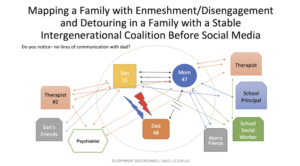
Below is a “traditional” family map that does not consider social media. It represents a compilation of families I’ve seen in therapy, rather than any one family. The symptoms include those typically seen in family practice — poor school performance, school avoidance, vaping, drinking, and using drugs.

From a system’s orientation, the symptoms are a result of the functional and dysfunctional interactions within the family system.

It’s hard for me to understand how therapists begin assessment and treatment without considering or involving the whole family. Some clinicians might say the conflict is too high, and it would only impact the adolescent negatively. Others might assume from the start that one or both parents are not willing to work or are too busy. Some might even be unaware of the importance of beginning from the position that families do not have the strength to make change.

Sometimes therapists and school staff buy into and reinforce the belief that the child or teen is the problem. In the case of this particular map, Mom “reportedly” goes to her private therapist while the son sees his own therapist. Mom and son separately complain about dad to their respective therapists and to the school staff. When mom and son voice frustration about dad and each other in the individual therapy session, disengagement with dad is reinforced. Mom and son are trying to get the type of connections from the system of care that they cannot get with Dad.

While this disengagement takes place, the son turns to his peers, attempting to pull away from mom’s enmeshment, activating her to pursue more. At home, Dad complains that his wife and son always bring up their therapist who agrees that he is unavailable and/or flawed. When this occurs, Dad becomes more distant and angrier, feeling like he is the odd person out.

When Mom gets angry at dad, she turns to her son and vents to him which activates him to challenge his father about money, drinking, and the way he treats her. At other times, the son may jump into the conversation when the parents interact about money, drinking, or the way he treats Mom.

When I attended graduate school, the common exercise was to map the triangles in the family system. Based on the above map, there are at least 24 triangles that are activated in the family-school-mental health system. The 24 triangles are:

  • The mom, son, and dad
  • The mom, son, and school social worker
  • The mom, son, and principal
  • The mom, dad, and school social worker
  • The mom, dad, and principal
  • The mom, dad, and school social worker
  • The mom, dad, and school principal
  • The mom, son, and mom’s friends
  • The mom, dad, and mom’s friends
  • The mother, dad, and dad’s friends
  • The mom, son, and son’s friends
  • The mom, son, and son’s therapist
  • The mom, son, and son’s psychiatrist
  • The mom, dad, and son’s psychiatrist
  • The mom, son’s therapist, and psychiatrist
  • The mom, dad, and son’s therapist
  • The mom, school social worker, and mom’s therapist
  • The dad, son, and son’s therapist
  • The dad, son, and son’s friends
  • The mom, son, and mom’s therapist
  • The mom, dad, and mom’s therapist
  • The son, son’s therapist, and school social worker
  • The son, son’s therapist, and psychiatrist
  • The son, school social worker, and principal

These 24 triangles are at the same time difficult for adults in the family to appreciate, even harder for an adolescent, and deeply challenging for the clinician to manage. In those triangles within the family where cross generational coalitions are activated, the symptoms in the family increase. I have often been challenged whether to discuss the impact of all these cross generational interactions with the family and whether it is important to differentiate the healthy, less healthy, and unhealthy ones from each other

On top of the above complexity, other questions arise like “where did the boundaries go?” The therapist must keep in mind how the boundary between the family and the outside world becomes invisible and the symptoms become more intense, to the point more professionals are recruited to “fix the dysfunction.”

I have also had to maintain awareness of how managed care’s enforcement and reinforcement of the medical model has influenced me and other members of the community of care, including other therapists, psychiatrists, physicians, and schools. This reinforcement has an impact on the family’s interaction with the son focusing only on his diagnosis and the correct medication, while failing to address the family relationships.

As mom turns to the school and the system of care for answers, things are not changing. She reports that her son is getting worse. Mom blames dad’s aloofness and dad blames mom’s overindulgence. Mom increases calls to the psychiatrist. The psychiatrist adjusts the medications frequently. The frequency of crises increases and the boundaries between the family and the outside world are dissolving due to the interaction between the family and the system of care.

The number of alliances increases between different family members and different professionals as more professionals/agencies are pulled into the drama. Professionals unintentionally begin to write/rewrite the individual’s and/or family’s stories, especially when utilizing the medical model.

With more stories, there are more opposing interests for each family member. This phenomenon between families and agencies is a result of a collision when both parties collaborate to uphold sociocultural trends. The goal is not only to interrupt multiple unhealthy alliances with existing professionals/agencies, but to also prevent new transactions from developing. (3)

This phenomenon was usually seen when the system of care worked with economically challenged families. We now see this also occurring with families of significant means because they can afford an individual therapist for each family member and psychiatrist(s) if needed.

As we look back at the map, it is now easier to understand that because the family has already identified what they think is the problem, it really needs to address the triangle between mom, dad, and son. It doesn’t really matter where to begin. A clinician can enter through mother-son enmeshment and coalition, father-son disengagement, or parental/marital disengagement.

It might also be useful to address the system of care coalitions between the therapist and school with the mom and son. Having the family identify how to change the interaction between the whole system allows them to move forward. It may be a challenge because getting directives from an expert, rather than looking within their own system, is what they have come to expect.

Using a Virtual Family Map to Identify Issues in Families

Before talking about the influence of social media on the family, it is important to acknowledge some of the “players” in social media. The system of social media has many parts. Social media success is dependent on an algorithm, which encourages frequent interactions by virtual and non-virtual friends.

The frequent interactions result in the shareholders receiving monetary return on their investment, the employees maintaining their jobs and bonuses, and the advertisers increasing the visibility of their product resulting in increased sales. The influencers are dependent on social media to reach as many people as possible to receive income from the app. There is a lot of pressure to have an effective algorithm to support social media.

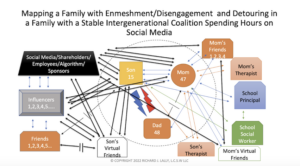
As you next look at a map depicting the interactive nature of the family and social media, it is important to keep in mind that the 24 triangles from the non-virtual map are still present, and the family boundary is already disintegrating with the school workers, friends, and therapists to seek help with the identified patient.

Now in addition to these non-virtual professionals and friends, the family is inviting social media’s virtual friends and influencers to seek help with the identified patient. Clients (and non-clients) often turn to virtual friends and influencers to provide the same connection as non-virtual friends, but these connections are void of physical closeness. Children and adolescents believe a virtual relationship can replace a non-virtual relationship. But all virtual relationships are void of physical closeness in which touch, eye contact, and a warm smile can feed the soul.

The family can turn on a social media app at any time of the day or night and the outside world is invited into the family, increasing the number of triangles exponentially. From the clinical perspective, it is critical to examine what actions (social competition, social comparison, loneliness, etc.) in the family trigger a member(s) to invite social media into the family. The therapist must also discuss how social media algorithms are activating/triggering the member(s) of the family to turn to an app to surf or post an event. This increases the time spent on the smartphone to maintain these virtual friends, non-virtual friends, and influencer relationships.

At times, social media decreases connection with non-virtual relationships and increases the connection with virtual friends and influencers. In the therapy session with this particular family, some members discuss how they rely on virtual friends and influencers more because “they understand me more than the friends in my own town/school.”

The adolescent believes these virtual figures want to listen to them more than family and non-virtual friends. It is important to ask the family what influencers and virtual friends provide that their own family members or non-virtual friends cannot. This allows the clinician to address the patterns and interactions in the family.

In the map below, I do not draw the number of different social media apps, influencers and virtual friends who are involved with the family. However, I do recommend when meeting with families, to draw each app, virtual friend, and influencer to show the number of triangles the family is managing or attempting to manage. For simplicity’s sake, I use one (black) box to represent all the social media apps and one box for all influencers and separated mom and son’s virtual friends.
 

Husband, Wife, and Social Media Triangle

What is the impact of social media on marriage? The wife turns to social media and influencers to figure out how to “fix” her marriage. The wife tries to talk to her husband about what she has learned about marriage on social media. The husband discounts the wife’s attempts to “educate him about marriage.” She eventually gives up on the marriage and “wants to focus more” on her son. She also tries to connect with previous friends and boyfriends from past life because she feels lonely and alone “looking for a connection.”

What you will see in this triangle, and all the triangles which involve social media, is a substitution of a virtual relationship for a non-virtual relationship whose connections are full of conflict or conflict avoidance. The virtual relationships convey an illusion of meaningful connection, but the person(s) feels alone and lonely because it lacks the important ingredients for a fulfilling relationship.

Mother, Father, and Social Media Triangle

Now the wife stops working on the marriage and focuses on parenting. The husband is not aware of this decision, focusing on “making money to provide food, clothing and shelter.” The father continues to feel alienated, disconnected, and disempowered, becoming angry towards the mother and son. The mother turns to school staff, therapists, non-virtual friends, virtual friends, and influencers for ways to “fix her son.”

This fosters more of an enmeshment with son, and disengagement with Dad. The son turns to school staff, his therapist, non-virtual friends, virtual friends, and influencers. Each family member describes a feeling of disconnectedness trying to overcome the feelings of being lonely/alone. Dad voices his frustration, complaining that he is “old school,” and they are “hypnotized by that damn phone.”

Mother, School, and, Social Media Triangle

In this triangle, mom calls the teachers and guidance department for support. She has frequent phone calls with the guidance counselor because the guidance counselor “is an expert with adolescents.” As you can see, dad is left out of the interactions with the school.

After a few months, her son’s behavior is not changing, and mom is frustrated with how the school is not helping her son. Mom begins to turn to social media looking for answers. Mom spends hours on the app talking to non-virtual friends, virtual friends and reading/commenting on influencer’s posts. Mom displaces healthier activities with time spent on social media. Mom begins to complain that the school is not meeting the goals set out by the Individualized Education Plan (IEP). Mom cites information from influencers from social media and the internet. The tension rises between the school and mom.

Schools today are under tremendous pressure to perform. Schools are understaffed, and do not have the mental health training or support to bring in a countercultural systemic approach into the schools despite the money being put into schools after COVID-19.

Parents, Son, and Social Media Triangle

Mom is spending hours on social media looking for answers to why her son is struggling. She also spends time looking for connections. The son also spends hours on the app interacting with non-virtual friends, virtual friends and reading influencers’ posts.

Mom pursues the son, but he only is aligned with her to challenge dad’s limit setting. When the parents attempt to be aligned, the son acts out more. We see the son increase his conflict with parents, who struggle due to their enactment/conflict avoidance with each other on how to help their son. This results in the father leaving and the mother turning to social media to find answers or overcome feelings of loneliness.

When the family interactions are in intense conflict or conflict avoidance, many children, adolescents, and young adults get most of their answers from non-virtual friends, virtual friends and influencer’s posts. The son is seeking temporary relief by getting information and trying to affirm a sense of self.

The non virtual, virtual relationships, and influencers introduce beliefs that are the opposite of the family’s beliefs and further impact the self-esteem of the adolescent. The son discusses what he learns from social media of what “real parents are like.” The decrease in face-to-face communication with family increases his anxiety, depression, irritability, and intrusive thoughts. This also confuses the family of how their family member can “think so differently.”

Son, Non-Virtual Friends, and Social Media Triangle

The son in the session discusses constant social competition/comparison, working for social currency, and thinking he at times is invisible to his non-virtual friends. The son gradually believes his non-virtual friends “don’t understand.” He believes he cannot turn to his parents because “What do they know?!”

The son begins to engage in the same interactions with his peers as his parents and avoids turning to his peers for support. The son begins to spend more time on social media with virtual friends and influencers to seek select information that matches a narrow/closed view, hoping to avoid conflict/interaction. The son then turns more to virtual friends and influencers for answers. Again, this increases his time on his smartphone and increases the family’s sense of not being good enough for each other.

Remember, the son believes there is “less stress” getting information from a stranger, pop culture icon, or a virtual friend than an enmeshed mom, disengaged father, or face-to-face with a peer(s). However, the decrease in face-to-face communication with family and non-virtual friends increases his anxiety, depression, irritability, and intrusive thoughts.

Despite the time spent on social media, the son feels alone/lonely, looking for emotional, face-to-face and physical connection, but does not have the words to express these thoughts to each other.

Mom, Therapist(s), and Social Media Triangle

Dad continues to be absent from the triangle that involves the therapist. The mother attends her own therapy and attends her son’s sessions to discuss what new information she has seen on social media.

She reviews with both therapists what she has learned on social media about new treatment, new medication, and new diagnoses. She advocates with all providers that her son is incorrectly diagnosed, hoping that would help him with his symptoms. The quality of training of the therapist determines their response to entertaining or challenging mom’s research. This may result in mom seeing a new therapist.

The individual therapists and psychiatrists are not looking at how the parents avoid “getting on the same page.” They are reacting to reports by mom about the son’s behavior. Mom and dad are unable to interact differently because they have not figured out how to work together to decrease their son’s phone usage to increase his time with non-virtual friends. The professionals are avoiding addressing the parent’s avoidance!

Mom, Psychiatrist, and Social Media Triangle

Dad is absent from the triangle that involves the psychiatrist. Mom becomes disgruntled with the psychiatrist. She begins to challenge the psychiatrist’s diagnosis and medication recommendation. The psychiatrist recommends if mom is not satisfied with his assessment, she seek a second opinion. Mom begins to look for a psychiatrist who agrees with what she has read on social media.

Son, System of Care, and Social Media

The son is seeing his individual therapist 1-2 times a week and his psychiatrist once a month. He is also spending 2-8 hours on his social app each day. The therapist has not assessed the hours the son is spending on his phone. The app is only showing views/opinions/likes/images that interest him.

The son begins to complain that the therapist does not understand him and challenges his therapist saying, “This doesn’t help.” When the therapist explores the son’s statement, he begins to discuss information from “reliable sources” from social media and influencers. He too begins to diagnose himself and discusses medication that can help. When the system of care discusses reliable sources such as universities and professional journals, the son becomes irritated saying “I don’t want to read them.”

Son, School Staff, and Social Media

Not only does the system of care increase their sessions, but the school staff increase their time with the students. The number of triangles with the son in the school increases between the child study team, teachers, and administration.

The teachers are pursuing him to get his work done — offering to meet him before school, lunchtime, and after school to complete his work. He never shows. The son is seen in class on his phone. Some teachers ignore him, and others nag him. When a teacher challenges the time he is on his phone, he tells the teacher other instructors let him do it.

The social worker is calling him down to discuss his avoidance of work and disruptive behavior in the classroom. Only when the son becomes overwhelmed, he discusses with the school social worker his home life and that medication is not working. The vice principal is meeting with him to give him detentions. The son feels frustrated with the school stating, “They are only doing this because it is their job.”

Son, Non-virtual Friend #1, Non-virtual Friend#2 with Social Media

The son leaves school to go home to continue to work on his non-virtual relationships on social media. It becomes evident that in social media apps, the same social stressors occur online like in school. It is exhausting to navigate being included and avoid being excluded at school and online. The son and non-virtual friends are jockeying for social currency and social position, never getting time off to charge their own social battery.

The son and non-virtual friends stress about the images they post. They are anxious about what the image means to them and others. The son is trying to understand the unspoken rules for posting and the reaction by his peers regarding the image. The son worries if the image appears “authentic” and will help him maintain his position inside the social media group or if a new group be formed without them.

Son, Non-virtual Friend(s), and Virtual Friends

The son struggles connecting with his non-virtual peers. He is not getting feedback from his non-virtual friends about his art and his physical appearance and finds out they have different chat rooms that do not include him. (Remember, he does not want feedback from an overly involved mom or detached father.)

He begins to look for feedback about his art and physical appearance from virtual friends. When looking for connection outside the non-virtual friend group, he states he is looking for virtual friends who are nonjudgmental.

But as time went on, it began to mirror the non-virtual group. Some of his virtual friends on social media become competitive and attempt to increase their social currency on this platform. They do this by making fun of his physical features and his art. This mirrors some of his non-virtual friends’ behavior. The son frantically searches for another virtual peer group that he believes will not activate anxiety by not challenging his views, providing a stress-free venue.

As the son increases his time searching for virtual peers and influencers over non-virtual friends — reinforcing a closed system, increasing isolation at school, and decreasing time to sleep at home. His virtual relationships are now more important — increasing time spent on the app and continuing to strive for more likes and views.

Lack of face-to-face contact with family and non-virtual friends fosters more of a virtual enmeshment with virtual friends. He describes them as “nonjudgmental” and “more accepting.” This further increases his self-doubt and increases his feelings of loneliness and creates a virtually closed system (Virtual Enmeshment).

Son, Virtual Friends, and Influencers

The virtual group is important to maintain when avoiding contact with his parents and non-virtual friends. The son describes his virtual friends as more “authentic” and describes his non-virtual friends as “fake” and “not genuine.” However, some of his virtual friends on social media become competitive and attempt to increase their social currency.

The son frantically looks for another group that is an anxiety and stress-free venue. This further increases his self-doubt and increases his feelings of loneliness. This increases the symptoms of anxiety and depression when waiting for approval from virtual friends saying, “They are the only ones who understand me.”

As the son looks for new virtual friends, he and his virtual (and non-virtual) friends look to influencers for answers on how to portray themselves. Influencers work hard to establish and maintain their position in their virtual community. The influencers are working hard to make money and increase their viewership. The influencers often ask adolescents to agree with their beliefs and recommend products they are selling. The influencers work hard to appear on the “right side” of an issue.

As the son tries to replicate the beliefs of his preferred influencers, he looks for fellow virtual friends that have done the same “research.” They notice the more they make comments in opposition to a belief, it increases their views and likes.

As the symptoms in the family increase in intensity, the members increasingly must decide who to align themselves with in the virtual and non-virtual triangle. The therapist highlights this and encourages the family to discuss and identify the boundaries of virtual and non-virtual triangles that maintain these alliances/symptoms. This allows a family to discuss non-virtual triangles that are underutilized, which reinforce healthy boundaries that benefit the family.

Using Exploring Questions to Make Circular Statements

Much has been written about joining, unbalancing, and mapping in SFT. One of the beautiful ways Structural Family Therapy (SFT) uses language is by employing circular statements to connect the family member’s behavior in the system. When SFT enters the family, the systems therapist uses the family’s own observations to connect their interactions.

It is important today to make a circular statement to widen the lens in which the family sees how all virtual and non-virtual relationships impact the relationship in the family. Below are some examples of circular statements using the words used by each family member.

I agree with you, Mom, that as long as you do not have a voice with Dad and work together, your son will not stop posting explicit images on Snapchat

Dad, as long as you sound like a drill sergeant, Mom will not find her voice as a woman and work with you as a wife and mother of your son who will continue to believe he must mirror images on Instagram

Mom, I agree that the harder you work, the less Dad helps you with parenting your daughter— your daughter will have to turn to influencers about how a woman should look and act

Peter (son), as long as your mom is worried about the frontstage appearance, she will fight with your father who is more concerned about your backstage struggles with you and your mother

What do your virtual friends give you that you cannot get from Mom, Dad, or your non-virtual friends?

Conclusion

Many are worried about the continued increase in suicide, suicide attempts, and mental health issues in the family and how Congress is powerless to challenge these companies. Many providers are not looking at what has changed in our lives in the past 25 years.

Relationships are becoming more complicated than ever. Many families and therapists are unaware of the impact of the system of care and less aware of the impact of the ubiquitous “algorithm.” It is hard to understand how the algorithm works because it is important for these companies to keep the algorithm secret for fear of losing profit.

We must also remember that each influencer, virtual friend, and nonvirtual friend has their own family map. Just as many professionals do, influencers understand how their stories, views, and images echo in the family.

Are families aware of the alliances that occur with virtual and non-virtual friends and influencers? Are we aware that when more virtual influencers and friends enter the family, more alliances increase establishing social hierarchy, increasing social competition and social currency? Are we, the clinicians, aware that influencers and virtual friends unintentionally/intentionally begin to write/rewrite stories in the family and permanently on the internet?

We must begin to understand that with more stories, there are more opposing interests for each family member. This phenomenon between families, virtual friends, nonvirtual friends, and influencers (social media) is a result of collusion when all parties collaborate to uphold their preferred sociocultural trend.

The goal is not only to highlight and interrupt the multi-alliances with existing social media but to highlight the transactional pattern in the home that maintains this pattern. Remember, a virtually closed system impacts all family members, whether one or all are using these platforms excessively.

References

(1) Susruthi, R., Myara, Maymone, B. C. & Vashi, N. Selfies-Living in the era of filtered photographs. JAMA Facial Plastic Surgery. 2018 20:6, 443-444.

(2) Nesi, J. (2022) The impact of social media on youth mental health: Challenges and opportunities. North Carolina Medical Journal, 81(2), 116-121.

(3) Colapinto, J. (1995) Dilution of family process in social services: Implications for treatment of neglectful families. Family Process. 34:59-74.

Questions for Reflections and Discussion

How has social media influenced your personal and family life?

How does the author’s premise resonate with you and the way you practice family therapy?

How have you integrated social media and app use into family therapy?

In what ways do you agree or disagree with the role of social media in family systems?

© Psychotherapy.net 2023

Current Developments in Clinical Suicidology and Mental Health Crisis Management

* If you or someone you know is struggling or in crisis, help is available. Call or text 988 or chat 988lifeline.org. Text MHA to 741741 to connect with a trained Crisis Counselor from Crisis Text Line. 

There are significant developments in the world, the United States, and our field in recent years that are significantly impacting contemporary clinical suicide prevention. The Covid-19 worldwide pandemic, the launch of the 3-digit 988 Suicide and Crisis Line in the U.S., and recent SAMHSA and Centers for Disease Control data are all examples of major forces that are fundamentally transforming the field of clinical suicidology. Many of these contemporary developments are spawning necessary and overdue changes and adaptations as to how mental health providers can more effectively work with suicidal risk. And to this end, I will explore these major developments and their impact on clinical suicidology.

Telehealth Care and Suicidal Risk

An impressive development in response to the coronavirus outbreak was the remarkably rapid embrace of telehealth to deliver mental health care. As the worldwide pandemic spread rapidly in early 2020 there was an initial hesitation of widespread use of telehealth with people who were suicidal. Indeed, there were certain large healthcare systems who moved, suspended, and even discontinued screening for suicidal risk with patients online because of a flawed presumption that one can only work with a person who is suicidal face-to-face. In other words, if you cannot tackle the patient at risk who is fleeing your office to take their life it is better not to ask! In response to this naive notion, certain leaders in the field of suicide prevention made significant efforts to identify key adaptations to working with suicide risk remotely. These adaptations mostly involve using informed consent carefully, identifying third parties who could intervene in case of an acute emergency, and anticipating issues such as a poor Wi-Fi connection and what to do in such an event (e.g., having a phone number to call if online connectivity is an issue).

Like what you are reading? For more stimulating stories, thought-provoking articles and new video announcements, sign up for our monthly newsletter.

As we were all collectively compelled to learn to provide care online perforce, many unexpected developments followed. For example, telehealth now offers a genuine opportunity to democratize the delivery of care to rural, frontier, and potentially more diverse populations. Another development in psychology was the advent of PSYPAC which enables providers to increase clinical care across state lines. Another notable Covid-based development was the common practice of instructing people who are acutely suicidal to go to their nearest emergency department for care.

With emergency departments brimming with coronavirus patients, such a recommendation became ethically and clinically dubious. Common reliance on inpatient care similarly posed the increased risk of patients contracting Covid during the pandemic's height. As the developer of the Collaborative Assessment and Management of Suicidality (CAMS), I have long been a vocal advocate of keeping patients who are at risk of suicide out of hospital emergency departments and inpatient care (if at all possible) by providing proven suicide-focused care supported by randomized controlled trials (RCTs). In response to the early stages of the pandemic, our training company CAMS-care converted the training and delivery of CAMS to online modalities (including the use of CAMS in three RCTs). We soon discovered that both training and clinical care can be effectively rendered online, and this development is helping to transform clinical care for those at risk for suicide.

The 988 Suicide and Crisis Line

In July of 2022, a major federal law was put into effect that is profoundly transforming how we must think about suicide risk and mental health crises. The “National Suicide Hotline Improvement Act of 2018” is one of the most significant legislative developments in the history of U.S. mental health care. Suddenly, we have an easy-to-remember 3-digit number that connects callers who are suicidal or otherwise in a mental health crisis to crisis professionals who are ready and able to effectively deal with them. With the knowledge that the pre-existing Lifeline was already having capacity issues, millions of dollars were subsequently allocated to help better support the new 988 mental health crisis line.

While all of this is very encouraging, the launch of 988 has created some growing pains and posed various challenges to policymakers, systems of care, and clinical providers. For example, how well do Americans know the difference between calling 911 and 988? There is a need to educate the public as to how to re-think emergencies that would have previously prompted calls to 911. There are significant issues related to “wellness checks” or “safety checks” that are primarily conducted by law enforcement officers who may have limited to no training as to how to deal effectively with mental health care crisis. For a person of color, having a police officer show up uninvited to protect you from yourself has inherent issues. 988 also brings a major focus to our existing healthcare model that is overly reliant on emergency departments and inpatient hospitalizations that too often may not be altogether therapeutic.

Fortunately, alternative models of crisis response are emerging. For example, “The Hope Institute” in Perrysburg, Ohio, provides intensive outpatient suicide-focused care using next day appointments (NDAs) wherein either CAMS or Dialectical Behavior Therapy (or both) can be provided up to four times a week to help stabilize a person who is suicidal as they await weeks — sometimes months — `to engage in available outpatient care. Within this model, adults are stabilized in six weeks while youth at risk are stabilized in just over five weeks. This is but one promising model that is re-imagining working with suicidal crises. Other promising approaches include mobile crisis response, respite care, retreat centers, certain crises-oriented technologies, and extensive use of peer support which can help reshape crisis responses.

Recent Trends in Suicide-Related Data

Over the last several years there have been notable developments in suicide-related phenomena. While we were initially encouraged when suicide rates declined a bit in 2019 and 2020, this decline was erased by an increase in 2021 (the most recent data reported by CDC). And with Covid-19 becoming a leading killer, suicide is no longer a top ten leading cause of death with 48,183 lives lost to suicide in 2021. But what has preoccupied my attention has been steady increases in the number of Americans who report having “serious thoughts of suicide” within 30 days of a survey completed by SAMHSA. Indeed, in 2021 this amounted to 12,300,000 adults and another 3,300,000 teens, altogether a whopping 15,600,000 Americans with serious suicidal thoughts! This number is over 300 times greater than the number who died by suicide in 2021.

While we grieve the loss of Americans to suicide, I would argue that we must do a much better job of identifying, assessing, and treating millions of those who suffer such that they seriously consider suicide. In truth, the suicide problem we have in the U.S. is a suicidal ideation problem — by a lot. It therefore behooves all mental health professionals to learn proven interventions like Dialectical Behavior Therapy (DBT), suicide focused cognitive behavioral therapy (CT-SP and BCBT), CAMS, or Attachment-Based Family Therapy (ABFT) to name a few of the rigorously proven interventions for suicide risk. Moreover, there have been other demographic developments of note. As suicide rates among white males have decreased, we have seen in recent CDC data that suicide ideation and behavior is on the increase among young people, particularly those of color. We certainly know the pandemic has been tough on all of us with clear increases in depression, anxiety, substance abuse, and suicidal ideation.

***

Given these recent developments in our world, I would assert that it is critical for mental health providers to become a part of the solution to suicidal suffering. We are uniquely positioned to make a life-saving difference and help decrease suicide-related suffering by keeping abreast of major developments in the field and learning to use evidence-based approaches to suicidal risk.

Questions for Thought and Discussion

In what ways did this article impact you personally and professionally?

How have you modified your own approach to suicidality in recent years?

How have you collaborated with colleagues in and around the mental health community to improve your services to suicidal clients?  

Social Media Monitoring Tips for Successful Psychotherapy with Teens

Therapeutic Encounters with Two Teens

Courtney was the kind of 10th grade-client that I completely enjoyed. She was cute, clever, and motivated. So, when she began to have an issue that ballooned into a crisis, I was a bit surprised. Her parent found out that she had shared a nude selfie with a boy she knew, who then shared it with the whole school. While Courtney’s mother was a nurse who well understood the ups and downs of being a single parent and the importance of being present for her daughter, she didn’t see this looming crisis coming and was unable to comfort her daughter.

Like what you are reading? For more stimulating stories, thought-provoking articles and new video announcements, sign up for our monthly newsletter.

My clinical work with Courtney centered around understanding her own boundaries — that being a people-pleaser is not always what’s required — and giving voice to her past losses (including the tragic death of her Father), all of which were held inside too long. Throughout our work, and hopefully beyond, DBT for frustration tolerance and CBT to calm the inner critic were supportive anchors. I also made myself available for extra sessions until she stabilized. In addition, I helped her do some damage control at her school by speaking directly with the guidance counselor.

Nevertheless, Courtney landed in the hospital from sheer humiliation. And because she was so emotionally fragile, she needed time to be safe, without her devices, to regroup, process, and consolidate her experiences. While Courtney was scarred by her mistake, blamed and mortified for what another kid didn’t yet understand about privacy, she was, thankfully, able to benefit from the immediate help.

Another college-age client, who I will call Sasha, had insomnia and relied on her smartphone to fall asleep — much like scores of others her age do. Parents, Sasha’s included, often say things like, “You can take away all her devices but it won’t help.” Sasha, as it turned out, was reliving a traumatic memory that replayed in her head, and she often woke up screaming. Although I am not a sleep expert, I realized that she was in trouble because she hadn’t attended school in over a week.

My initial work with Sasha focused on the immediate presenting problem of sleep. For me, this is always an important discussion with teens. Then we moved slowly to her past trauma using breath and yoga to help her self-regulate. The incident she was reliving every night was painful, but it didn’t have to follow her into adulthood.

Adolescent Struggles with Self-Regulation

As I reflect on these two cases, which share certain digital/social media-related elements, I also appreciate their differences. Courtney was simply burnt out from the social media backlash and ongoing shame, humiliation, and guilt she felt knowing that everyone with a smart device could see her nude picture. She needed a reset.

Sasha, having had an entirely different kind of traumatic experience, was not quite as resilient as Courtney. Her body, as Bessel van der Kolk reminds us, kept the score and intruded on her sleep despite her best efforts to use a digital remedy. In the two instances, it was important for me to differentiate between depression, trauma, and anxiety, the symptoms of which often converge. Both, however, had difficulty coping with their respective crises because of their reliance, or perhaps over-reliance, on social media and digital devices.

In the cases of Courtney and Sasha, as I do with most teens with whom I work, I included the family. I offered suggestions around self-regulation for the teen, and to the parents for helping their child regulate the use of social media and digital devices. Interestingly, and perhaps not unexpectedly, because of their overreliance on their digital devices for connection during COVID, I had an uptick in patients who were convinced they were dissociating. Perhaps they were. One client said people were watching her from within the walls of her room.

Sasha accepted a few of my suggestions for learning how to re-regulate herself, but she never quite connected the dots that “the body keeps the score.” Instead, she insisted on staying online because without her friends, there was “no score at all.”

Helping Teen Clients Find Balance

While working with families like those of Sasha and Courtney, I simultaneously model calmness, generate a decision tree of steps for addressing the crisis, and calculate the practical and emotional cost of decisions they have or are thinking of making. At the same time, I try to comfort the teen that “this too shall pass,” and to provide the needed perspective they can’t yet take. The black-and-white thinking, a hallmark of adolescence, keeps them feeling there’s no way out when there usually is.

The teen’s default and refrain often remains: what will people think of me? But with time and support, their inner voice may shift to one of more self-compassion. I often say, “What would you tell a friend?” The hyper-fixation on self-image that is also the cornerstone of adolescent thinking, amplified by the social isolation of COVID and the endless resulting on-screen hours, was the perfect storm and seedbed for some of the angst and depression we have seen among adolescents. We cannot necessarily prevent social media, but we can still protect them from its potentially harmful effects.

I worked for early internet start-ups in the health and wellness space for some time, so I cannot readily cast away the benefits of the Internet or social media. Like many teen girls with whom I’ve worked, their virtual world is their true and only world. What others see of them is all that matters.

So, in Courtney’s case, the destruction of her carefully curated online image was shattering and felt like the death of part of herself. Do we now blame social media for what happened to Courtney or for Sasha’s experience? Unfortunately, we can barely ban guns, let alone phones. Schools are trying to take phones during instruction. That’s a good idea. I don’t think my daughter ever read a book in high school. There was no attention span left by the time she reached 10th grade. Joining with the teen on her journey lets her know that at least one grown-up in the world is on her team — her teen brain doesn’t have to define her.

It is so convenient for friends, family, therapists, teachers, and parents to say “social media be damned,” especially after an episode like Courtney’s. I agree with what they’re saying; after all, it’s legitimate to protect your children (and clients) from porn, abuse, catfishing, danger, and predators. My biggest parenting regret was not removing the phones from my own children’s possession by 10:00 PM like many parents do. Sleep is critical during adolescence, but too many kids simply cannot resist the allure of talking to their friends all night.

If my patient is on social media all day and night, what would be more appropriate: to scold her and instruct the parents to remove all screens, or perhaps teach her that rest is critical to development, as is exercise, diet, spirituality, creativity, and every possible other form of self-care? I often beg clients to get a hobby.

Social Media and the Benefits of Connection

One of my current clients is doing an online degree program in a special kind of painting that she posts weekly on Instagram. Because she has a significant trauma history, her present situation doesn’t allow her to visit museums or lectures or art studio classes. But she can paint and post and maybe one day sell those paintings online.

What gives her hope is the freedom to expose her work to the world without having to leave her room or open herself to bullying, intimidation, or abuse. And then there are clients who are either ill or live in a rural setting who can talk to their BFFs (and me) without having to drive. These are the many ways a young, isolated person may reframe the online world as an adaptation to her struggles, rather than the enemy.

I am not suggesting that my clients continue mind-numbing and wasteful activities like stalking their ex, trolling through others’ emails, engaging in illegal/aggressive or shameful bullying, or worse. What I say to my colleagues who work with young people is this; save your judgment and let’s figure out what the pitfalls and potential are in each situation, then help our clients to filter in what is meaningful, useful, and practical for them within their virtual (and “real”) communities and filter out what doesn’t serve them. I love working with young people because once they “get it,” they’re usually good to go.    

How to Watch Master Therapists in Session and Build Clinical Competence

Taking Stock of Professional Development

Later life, as gerontological researcher William Randall writes, is a time for looking inward and outward as well as forward and backward. And as much as I don’t always like to acknowledge it, I am in later life. Having mysteriously and involuntarily arrived at that juncture, I find myself simultaneously shedding and accumulating; material possessions in the case of the former, and wisdom in the case of the latter. I am indeed looking forward, perhaps not yet as enthusiastically as I would like, but certainly looking backward to assess what about who I am both personally and professionally I would like to carry with me on this next leg.

Like what you are reading? For more stimulating stories, thought-provoking articles and new video announcements, sign up for our monthly newsletter.

I’ll save the “personal” for a future essay and will focus here on the professional — specifically, my evolution as a psychotherapist. Having recently retired from my full-time position as a clinical educator, I am still in the classroom, and as I wrote in a previous blog, still training future therapists. And a significant portion of that classroom work has revolved around the use of clinical training videos that we (Psychotherapy.net) produce. As a caveat, I want you to know that I used these videos long before I signed on as the Editor six years ago.

Over the years as a psychotherapist, I have had face-to-face clinical supervision, read my share of clinical books, have “performed” in front of the one-way mirror, consulted with peers on case management, and even written for the therapy audience. But it has always been clinical videos that have not only rounded out but deepened my clinical skills. So, I thought it might be useful to share some of my favorites, those on whose production I have been involved, and those whose entry into our vast collection predated my arrival on the shores of Psychotherapy.net.

Watching Experts Work with Clients

I will shamelessly (mis)appropriate the famous movie line by saying, “You had me at Irvin Yalom.” Aside from the incredible trove of his clinical writings, Yalom has shared his many individual and group therapy skills in front of the camera. His insightful work and clinical acumen have been for me and my trainees — although I suspect for many others — what the likes of Carl Rogers’ work has been for current and past generations of clinicians.

I have done a fair amount of clinical interviewing and assessment over the years in a wide range of venues with a broad range of clients: prisons, hospitals, psychiatric facilities, private practice, and in the forensic arena. As we would likely all agree, good interviewing requires both art and skill, and I have thoroughly enjoyed and learned from the diagnostic interviews of Jason Buckles, who has deepened my understanding of the kind of questions that must be asked to differentiate among many and often overlapping and conflicting diagnoses — substance abuse, personality disorder, and mood disturbance to name a few.

Good assessment, however, requires not only diagnostic facility, but a foundation in interpersonal and interviewing skills that transcend specific pathologies. And to enhance my own interviewing skills, I often turned to the work of John and Rita Sommers Flannagan, who have reminded me how to incorporate mental status, biopsychosocial, and clinical questioning into the interview process. I have also continuously relied on John’s work around suicide assessment and intervention with clients ranging in age, ethnicity, and life circumstance.

As my own clinical practice has evolved over the years, I have been exposed to — or perhaps I should say, I have exposed myself to — clients whose circumstances, culture, and values have differed widely from my own. I have embraced the personal and professional awakening that comes with looking beyond my own relatively small sphere of experience so that I could appreciate the lives of others whose paths have been so different from my own.

Watching Sue Johnson wield her velvet EFT (Emotionally Focused Therapy) sword to cut through the resistance and defenses of couples has given me the confidence to work with couples. But our EFT Masterclass, a four-volume series in which EFT is demonstrated by a team of EFT experts, has been especially enlightening. It has helped build my confidence and courage to venture into challenging couples counseling arenas like pornography addiction, grief and loss, and sexual issues.

***


Certainly, I could go on extolling the virtues of our clinical training videos, but what has been useful to me as a clinician may not be so for you. You may not be drawn to the work of these particular clinicians. But certainly, there are enough training videos in our collection to satisfy all tastes. And there are many ways to learn. You may learn best by reading or doing. Some of you may hold to the belief that 10,000 hours of doing makes for expertise. But if you have the space and desire to invite the masters along on your clinical journey and enjoy watching them at work, grab a front-row seat and tune in.


Questions for Thought and Discussion

How do you resonate with the premise of this essay?

What training videos have you found useful in your own professional development?

What challenges have you experienced in using clinical training videos?   

How To Keep Students Engaged Using Psychotherapy Training Videos

Challenges of Finding Engaging Counseling Videos for Students

Who among us, and by “us,” I refer to clinicians, clinical supervisors and trainees, and counselor educators, have not seen “Three Approaches to Psychotherapy?” Remember that timeless 1960s series of clinical demonstrations between that candid and brave 30-something Gloria and three giants of the world of psychotherapy — Fritz Perls, Albert Ellis, and Carl Rogers?

Like what you are reading? For more stimulating stories, thought-provoking articles and new video announcements, sign up for our monthly newsletter.

My guess is that some of you fondly remember watching the series with a sense of wonder and admiration, asking yourself questions like, “Will I ever become a therapist who can work as effortlessly and masterfully as these giants?” I certainly did (and sometimes, still do.) Others among you may have watched them, stored them, and discarded them long ago as you went on to develop your own therapeutic voice.

And then perhaps there are those among you who are more recent arrivals at the shores of psychotherapy, who watch these and say, “Geez, can’t they find examples of therapy sessions that are a little more current, or relevant, or interesting — it is 2023 after all!” From my own firsthand experience in the classroom as a clinical educator, I hear a collective groan when I fire up the LED projector: “OMG, not more clinical demonstrations from the crypt!”

Whether I am teaching a didactic or internship/practicum class, or supervising clinicians, I try to “read the room” by presenting videos of clinical demonstrations that will interest, challenge, and entertain the graduate students and clinical trainees with whom I work. Not always an easy feat in the digital era of YouTube, TikTok, and Facebook, where clinical snippets abound. So, I try to offset that by sharing psychotherapy training videos that break this pernicious pattern.

Make no mistake, however, I love the Gloria tapes — they are foundational! But foundations shift, and so have client (and therapist) demographics, societal challenges, and their associated psychosocial impacts. As Psychotherapy.net’s Editor, I have a particular fondness for our offerings, but this long pre-dates my association with the company.

Our videos have contributed to my own professional skill development, and in the context of this discussion, my efficacy in the clinical classroom where students want to see masterfully executed psychotherapy in action. So, since we are in award season, I thought I’d share a few of my top picks.

The Psychotherapy Training Videos I Use in the Classroom

Carl Rogers’ stature in the field of psychotherapy is IMHO the stuff of clinical legend, and certainly, we have plenty of great videos featuring Rogers at work. But I have found other creative ways to highlight core person-centered skills to my trainees and students by showing Sam Steen in session with a pre-adolescent girl who is struggling with issues related to the intersectionality of racial and sexual identity.

And, by harnessing empathy, unconditional regard, and congruence, Darrick Tovar Murray creates a safe space and meaningful connection with three African American men trying to heal from the transgenerational scars of racism.

Albert Ellis was one-of-a-kind — a clinician, innovator, and showman, who inspired generations of clinicians to consider thinking about thinking as they attempted to subdue their cognitive demons. My students appreciate the theoretical clarity of REBT, and the seemingly easy ABCDE method of identifying, challenging, and modifying self-defeating thoughts and other REBT techniques.

Class role plays are usually energized, especially when I show them Dr. Janet Wolf using REBT techniques with a single parent, on whom she turns the tables by demonstrating the client’s own irrational voices. Quite surprised, the client finally gets to see just how counterproductive these voices are in attempts to parent her children. And then there are Drs. Ed Jacobs and Christine Schimmel, who integrate REBT techniques into their group therapy with eight women.

And who can forget that classic clinical provocateur, Fritz Perls, who, with cigarette in hand, confronted Gloria in every possible way on her road to self-awareness. Interestingly, she felt that Dr. Perls was the most helpful to her out of the three clinicians.

One of my favorites from our collection is the work of the legendary Violet Oaklander, who so effortlessly and compassionately showed us how Gestalt therapy techniques work with children in play. My students are usually awed by the Gestalt therapist at work. They also enjoy watching the work of Erving Polster as he uses Gestalt therapy to help Gerald, an unmotivated and resistant client.

***

There are so many more incredible demonstrations in Psychotherapy.net’s collection. However, these are the ones that have resonated with my students and trainees when highlighting the theories and techniques of person-centered psychotherapy, REBT, and Gestalt therapy. The demographic breadth of featured clients and range of their real-life issues provide offerings with which most of my clinical students and trainees can identify. As their clinical educator, I see clearly how my students learn, grow, and feel more effective after watching brilliant examples of therapy sessions on video.   

5 Time Tested Methods for Attracting New Referrals and Building Your Brand

Suggested Tips for Clinicians:

  • Learn SEO (search engine optimization) to bring foot traffic to your practice’s site.
  • Build your advertising savvy by mastering Google business tools.
  • Consider consulting with a business coach to build your clinical practice’s brand.
For most psychotherapists in private practice, the pattern of the past two and a half years has followed a similar trajectory:

March 2020: Move to 100% teletherapy, and watch as new referrals suddenly become frighteningly scarce.

April 2020: The phone is still not ringing.

May 2020: Referrals start coming back…and then explode. In the summer, waiting lists become commonplace because clinicians can’t handle all the people who need help during the pandemic that is killing thousands of people every month and forcing businesses and schools to go all virtual.  

Like what you are reading? For more stimulating stories, thought-provoking articles and new video announcements, sign up for our monthly newsletter.

In 2020, Mental Health America reported that nearly 500,000 people struggled with a mental health disorder such as anxiety or depression. The organization offered online screenings from January through September, stating that anxiety screens increased by 634% while depression screens increased a staggering 873%. In just one year, the number of mental health visits attributed to new patients increased by 27 percent in July 2020 compared to July 2019.

The pandemic has deepened the mental health crisis, the report noted. The number of US adults expressing symptoms of major depressive disorder increased from 24 percent in August 2020 to 30 percent in December 2021, per CDC figures, and a recent article in the New York Times discussed the serious shortage in the US for child therapists.

As both an owner of a group practice as well as a business coach for psychotherapists and other group practices, I have had a birds-eye view of these patterns as they unfolded across North America. Many clinicians never had a waiting list before and were not sure how to process these inquiries. For some insurance-based group practices, the glut of referrals became a nightmare with waiting lists of over 100 people. Many potential clients were frustrated that no one in their city had any openings. Attempts to automate the process only created more feelings of depersonalization for clients and frustration for clinicians.

Yet despite these hardships, the pandemic also made marketing unnecessary for many private practices. It made it easier than ever before for licensed psychotherapists to go out on their own, working from home without even paying for an office. Spending $29.95/month for a Psychology Today ad was all that many practitioners needed to fill their schedules with new clients.

For group practices, the tricky balance of referrals, therapists and office space has been turned on its head by the pandemic. Referrals have been plentiful, but a significant number of sessions are still being conducted virtually, making decisions about future office space a guessing game. Availability of therapists has been the scarce resource of late, fueled by the sheer number of group practices and the deep advertising pockets of numerous online providers such as BetterHelp and TalkSpace.

But now there are signs that the glut of referrals is slowly diminishing for many private practitioners. As part of my business coaching service, I set up and maintain Google Ads campaigns for psychotherapists. The common refrain in the summer of 2020 was, “Turn the ads off! We can’t handle the inquiries we are getting!” That was great news because everyone could save a lot of money on marketing and still have plenty of referrals to fill caseloads. Suddenly, however, I have begun hearing the opposite from quite a few people: “Hey Joe, can you turn my ads back on? My waiting list is finally down to nothing.”

This trend is especially true for fee-for-service practices with rates over $200 per session. The combination of inflation, higher interest rates, and perceived easing of the pandemic may be leading more people to forgo therapy—especially expensive therapy—and return to other satisfying pre-pandemic activities such as indoor dining, music, travel, and visits with family and friends. Such activities may be serving as a natural antidepressant compared to the stark isolation and Zoom life during the peak of the pandemic.

So what’s a practitioner to do if a few holes suddenly appear in their caseload? As always, it’s wise to prepare for a storm when the first few clouds appear on the horizon. Interest rate increases and inflation are here to stay for a while, and fee-for-service providers are most at risk when consumers tighten their belts. To get ahead of these challenges, here are some of the time-tested methods for attracting new referrals:

     1. Improving Your Search Engine Optimization (SEO): Google is still the biggest source of referrals for most private practitioners, and nothing beats showing up on page one of Google for free. The bad news is that page one is more crowded than ever, and newer websites have a harder time competing against sites with years of immersion in the Google system. A good overview of best SEO practices you should follow can be found in numerous free resources online which can give you an idea of how to improve your ranking in Google’s search priority.

     2. Using Google Business Profile: Google still offers a wonderful free resource, the Business Profile, which includes a description of all your services, displays for photos and videos from your site, free messaging, opportunities to show up on the top half of page one with a Google Map link, and the ability to make free posts with links to your website. Note that managing individual Business Profiles will be moving to Search and Maps in the near future.

     3. Enabling Google Ads: This is still the best and easiest way to show up at the top of page one in Google search, but you’ll have to pay for the privilege. Recent improvements in automated bidding have reduced cost-per-click in many locations, and the ability to have potential clients call your office directly from an ad on their cell phone makes conversions easier than ever.

     4. Posting an Ad in Psychology Today: This grandparent of online directories for therapists still generates consistent referrals for many practitioners, and spending under $30 a month almost guarantees a positive return on investment even if you only get a few referrals a year.

     5. Community Networking: Now that more people are back in offices, marketing to referral sources in the community can offer a unique, inexpensive way to build a practice. Connect with medical professionals, educators, attorneys, and others who often need referrals for psychotherapists in their work.

     6. Creating Email Newsletters: Connecting (with permission) to past and present clients can be a wonderful way to get the word out about your services. Programs such as Constant Contact and MailChimp offer inexpensive ways to generate attractive email newsletters.

     7. Offering Lectures and Workshops: Offering lectures and workshops is a great way to attract people who may initially be resistant to psychotherapy. In my group practice, we have consistently found at least 20% of workshop attendees follow up with a therapy appointment. These can be offered in a variety of settings in the community, as well as in your own office if you have the space. And of course, if you can stomach it, you can also do them on Zoom.  

***

Attempting to read the tea leaves of psychotherapy practice is always a risky and imperfect task, especially in volatile times when unexpected events can quickly change the trajectory. Nonetheless, it seems clear that the peak of mental health referrals for some practitioners has passed. Preparing for this now will never hurt, and in fact will help to smooth out the transition if referrals drop to pre-pandemic levels.

 Questions for Thought

  • How did the pandemic challenge you to think differently about the way you practice?
  • What is your strategic short and long-term plan for building and maintaining referrals?
  • What can you do to revitalize your brand through internet marketing, pro bono workshops, and podcasts?
  • What is the feasibility of consulting with a marketing expert for you?
  • What about this article challenged you to do or think something differently to increase the client flow in your practice?  

Stephen Schueller on the Power and Promise of Mental Health Apps

Mental Health Apps 101

Lawrence Rubin: Thanks for joining me today, Stephen. I first became familiar with your work when I took a deeper dive into mental health apps and came across your work with One Mind PsyberGuide, a system for evaluating these tools. For those of our readers who may not yet be familiar with or worked with them personally or professionally, can you define a mental health app?
Stephen Schueller: A mental health app is essentially a software program that can support people in their mental health journeys. There are various kinds of mental health apps, with estimates suggesting that there are somewhere between 10,000 to 20,000 of them out there. Some of them are intended to be used on their own, so a consumer might use a product to self-manage facets of their own condition, like anxiety, depression, or trauma. And others are really meant to be used in conjunction with standard therapy.
So, for example, the Veterans Administration and the Department of Defense have developed a suite of different apps that are designed as adjuncts to standard evidence-based treatment. For example, CPT Coach for cognitive processing therapy. PTSD Coach for PTSD treatment. PE Coach for prolonged exposure. These are meant to be tools that help support a therapist and a client who are engaged in a specific type of treatment, like prolonged exposure or cognitive processing therapy.
LR:  Are the apps themselves subjected to the same type of empirical validation standards as the therapies they are adjunctive to?
SS: I think it is an appropriate question to ask. To consider what level of evaluation is needed depends on the type of product, the type of app. Those apps that are meant to be therapy adjuncts for example, are designed to replace worksheets or other supplemental content that would go along with an established evidenced-based treatments. Cognitive Processing Therapy Coach, developed by the VA and DOD, is meant to support cognitive processing therapy. Its various homework assignments, tracking components, and capacity to record the actual sessions so that clients can listen to them later and do some of the exposure exercises, all get done in the context of the app. And so, to the same degree that you probably don’t need to evaluate every new version of a worksheet associated with an established treatment protocol, you don’t need to undergo the same types of rigorous evaluations as you would do to the treatment itself.As opposed to apps that are therapeutic adjuncts, there are those that are meant to be more treatments unto themselves. And if they’re not some type of formal treatment like the ones I mentioned, they might be like self-help or self-management products, which opens some interesting questions. Like if these are replacing the self-help books of the past, do we need an evaluation of every single self-help book out there? Or is it sufficient that a self-help book aligns with evidence-based treatments and evidence-based principles if it does not have a formal evaluation?

And so, I think for these adjunctive apps, it’s important to distinguish between direct and indirect evidence. Direct evidence would entail an evaluation of the app itself that explores whether it has been subjected to clinical research studies that show effectiveness for the target condition or goal that that app is trying to change. Indirect research would be based off a pre-existing evidence-based practice, where we would be looking for fidelity of the app to that evidence-based practice.

In this latter case, the app would be evidence-informed rather than evidence-based. An app like that might be a digital CBT tool, that has some fidelity to Cognitive Behavioral Therapy principles. And I would argue that there are various levels of evidence that we should be looking at for with these apps. Obviously, I would love it if every app out there had a clinical trial showing its benefit, but I will tell you that’s not the case. Research suggests that about only 1 to 3 percent of mental health apps have any direct scientific evidence behind them. But I think if it doesn’t, an app that is evidence-informed is probably better than an app that is not based on evidence-based treatment. I think, again, it’s degrees of evidence, and that’s one of the things that we explore at One Mind PsyberGuide, is trying to look at the various degrees of evidence that are supporting various products.

LR: So, what you’re saying is that just as there is a hierarchy of what are considered highest levels of empirically backed treatment research, from randomized control trials down to anecdotal evidence, there are different levels of scientific evaluation that apps can be subjected to.
SS: That’s right. And I think I would add one other point, which is that in a lot of places we see that when treatments are adapted to new mediums, they often maintain their effectiveness. So, Cognitive Behavioral Therapy for depression has evidence that it works in person. It also works via teletherapy, in a group therapy format, as well as through self-help books. And so, to some degree, to continue to conduct the same level of studies as we move to new mediums may not be the most efficient use of our resources.When we’re taking something to new mediums and apps, is this really a new treatment, or a new practice that’s being developed through this technology? Or is it taking something that’s worked before and packaging it in a new way? And so, I think that’s the thinking around the evaluation of indirect evidence. That an established intervention already works in various realities and formats gives a lot of confidence that it would likely work in this digital delivery format, as long as it shows fidelity to those evidence-based principles that that treatment involves.

LR: We briefly mentioned self-help books. John Norcross, as an example, has done treatment outcome research at the highest empirical levels, but he has also written self-help books based on the same principles that drive his research. So that’s what you mean when you say if a therapeutic modality is robust and valid, we shouldn’t be that concerned with the transition into a different medium, such as digital technologies and apps.
SS: That’s right. Or at least we should be less concerned. The situations I worry most about are where new, innovative treatments are made possible using technology. I think those do need to meet really high standards of evidence to support their benefits.
LR: What would be an example of this?
SS: I think there’s a lot of work to do around chatbot apps, where you would interact with the app as if you’re chatting with a person, or potentially a therapist. Although they’re often based on evidence-based principles, I have some questions about the benefit of chatting with a computer program

And similarly, I’m also curious about some of these virtual care platforms using text message-based interactions with a therapist. Does that work? And what is the benefit someone gets from text-messaging back and forth with someone, even if they don’t have credentials? How do we distill evidence-based psychotherapy practices into these very brief back-and-forth interchanges?

So, I think there’s a lot of places where we do need new evidence to suggest that these things are beneficial. And I think that there is some promising evidence supporting both chatbots and text message-based interactions as potentially being clinically efficacious. But I do think these are places where we need more research to support these practices.

LR: Are these chatbot apps like virtual assistants, driven by artificial intelligence programs designed to provide human-type responses?
SS: There definitely are products like that. Three examples would be Woebot, Youper, and Wysa. All of these are apps where a user who downloads the app would be able to message back and forth with this virtual agent that is going to provide back full-text answers. Again, they’re often based on therapeutic principles. But I think that these are types of things that were not possible just a brief time ago. This is not like taking a self-help book and digitizing it. This is a very new type of thing that is possible because we have computer programs and software that can do these types of interactions.
LR: Would these types of virtual assistants be programmed with keywords that might be sent off to a therapist if the person is simultaneously working with a “live” therapist, or are they completely asynchronous standalone surrogates for therapy?
SS: It’s a little of both. You couldn’t take this program and bring it to your therapist and say, “Okay, I’m going to use this on the side, and it’s going to reach out to you if these certain words come up.” Some of the programs are designed to communicate directly with a therapist. Or they are a gateway. One way to think about these is as a low-intensity first step that can then introduce or connect someone to a therapist if necessary. And some of these programs do have that model, where if there is need for a therapist, they can step up to that higher level of care. But these aren’t the types of things where you as a client would say, “Okay, I’m going to use this in conjunction with a therapist I’m seeing.”
LR: I know that there are apps for medical care. For instance, those that monitor cardiovascular activity and then send that data to a physician or a physician’s assistant. Are there ways for some of these apps to communicate directly with a therapist, who then would respond to the client?
SS: There definitely are some apps that try to digitize measurement-based care, to allow some communication or transmission of data based on symptom tracking or logging, or other types of things that people would be doing or as part of the treatment that they’re receiving and feeding that information back to their therapist.

The Wild Frontier

LR: In the “old days,” people crowded the self-help aisles at Barnes & Noble or other bookstores. Today, in contrast, e-consumers routinely scroll through platforms like Amazon. How do folks who may not be ready or interested in taking the step into therapy find their way through this labyrinth of 10,000 to 20,000 apps? Is there some sort of roadmap, or a central directory?
SS: I think it’s hard. And I’ll say that there’s no one centralized hub. But I think most consumers go to the app stores and they put in keywords like depression, anxiety, or stress, or whatever they’re struggling with. But I think that the app stores do a very poor job differentiating these products, because most of the search results bring up apps that have four-and-a-half to five stars. That doesn’t really provide a lot of information about the difference between these apps, or which are the evidence-based ones. Relatedly, a lot of people hope or think that the FDA is going to solve this problem. I will say that the FDA has cleared some mental and behavioral health apps, starting with Reset back in 2017, which was an app focused on substance use disorders. But since then, there’s only about a handful of mental health apps, about 10, that have been cleared by the FDA. But that’s 10 out of 10,000 to 20,000 over a period of about five years, which is about two products per year that are being evaluated and cleared.

There is a class of products about which the FDA has said that “they are exercising enforcement discretion,” which means, “We probably could regulate these, but given our assessment of the risk-benefit ratio, we’ve decided not to.” Examples of apps in that category are those that allow consumers with diagnosed mental health conditions to self-manage their own symptoms, such as by providing a tool of the day or different behavioral coping skills. A lot of people think that the FDA regulation shows that something is efficacious or effective, but in actuality the FDA is mostly concerned about safety. They’re looking at the risk profile of these products, and then clearing it based on that. This is all to say that FDA is not really doing much or has not done much in this space. At the beginning of the pandemic, they paused their review of products in this space given the potential need for digital services to help support mental health problems in the pandemic. So, this is a space that’s been traditionally messy and has gotten even more so over the past couple of years.

I think a couple of places that I would point to as being better able to provide more information for consumers are the Veterans Administration and the Department of Defense. While they are mostly focused on veterans, their apps and evaluation procedures are also useful to diverse consumers, especially for therapists who are providing some of these evidence-based practices. And my project, One Mind PsyberGuide, which really tries to collect and provide some of this information for consumers to help them make informed decisions.

LR: So, with the exception of the small handful of apps the FDA and the VA and DOD have approved, publishers of mental health apps do not have to post any black box warnings.
SS: That’s exactly right. There’s little regulation of this space outside of the area that the FDA decided that they’re going to regulate, which, as you mentioned, is quite small.
LR: What are some of the criteria that a consumer should be looking at when they go to the app store?
SS: I think there are three main buckets of elements that are important to consider when searching for a mental health app. Credibility or evidence base, user experience, and then safety, especially related to privacy and data security.Credibility or evidence base goes back to the conversation we were having earlier around the evaluation of the evidence behind these products. Is there either direct (evidence-based) or indirect (evidence informed) support of the app’s effectiveness?

User experience, which is subjective, is about whether the app is easy to use, easy to learn, aesthetically pleasing, free of technical glitches, engaging, something you would come back to? Based upon this criterion, users can narrow down a set of apps to a selection of three to four and then try each of them out to see which works better for their needs.

Lastly, safety and security issues are related to data security and privacy. What is their privacy policy? What do they do with your data? Who is it accessible to? A few years back, we did a review of security policies on 120 depression apps and found that about half didn’t have any policy whatsoever, so they told you nothing about what they did with your data, which was a major red flag to us. And of the half that did have data security and privacy policies, using our scale that we developed at One Mind PsyberGuide, half of these were deemed unacceptable. These apps didn’t provide their data security and privacy policies until after you already put in information about yourself. So, for example, you would create a user profile by putting in your personal information, only after which the app would tell you, “Okay, now we’ll tell you what we do with our data.” That would be a pretty easy red flag for a consumer.

LR: In this Wild West of the internet, what entities might data be shared with?
SS: Often, it’s back to some of the big tech companies—the Googles and the Facebooks, where one’s data might be used for advertising or other marketing purposes. That would make me a little uncomfortable with mental health apps, although, honestly, I do use products that are associated with those worlds. With some of these apps, consumers just won’t know.I talk a lot about the importance of transactional value for data in this space. So, what do I get back, and does that align with what I’m using the data for? With Google Maps, for example, I’m sharing my location information, but in return, it’s helping me navigate to somewhere based on my location. That’s the transactional value, but it feels a little bit different when it comes to mental health apps. Why do they need to know my location?

LR: And since the FDA has only regulated a very small percentage of the apps, I imagine the potential for consumer deception is very great.
SS: That’s right. I think another thing is that sometimes there is a misconception where some people assume that if there’s data present, these apps must be regulated under HIPAA. But it’s important to realize that HIPAA is related to data that’s coming from covered entities, which in our case would be traditional health care providers. If an app is sharing information with a health care provider like your therapist, it should be, and hopefully is, following HIPAA regulations. But if there’s not a covered entity, then a lot of these apps are not regulated by HIPAA regulations, and they can change their terms of services or privacy policies without having to get approval from you. I’m much more comfortable with apps that are not collecting or sharing data, like a lot of the VA and DOD ones that don’t collect or share your information.

LR: I would also imagine that if a therapist assigns or recommends a particular app to a client, there’s the issue of potential vicarious liability. It would therefore behoove the clinician to become aware of all these different elements of the apps, particularly their privacy policies.
SS: That’s exactly right.
LR: Have you found that there are particular mental health conditions or client types that are more amenable to the use of mental health apps?
SS: There’s a lot of evidence to support the use of these tools for depression and anxiety. That doesn’t necessarily mean that these conditions are more amenable to apps. It’s more a reflection of where the research started and what information has accumulated. What I often say is that everything that has been treated with a psychosocial intervention has a digital tool or app that might be useful.

LR: And relatedly, some of the most effective treatments for anxiety and depression are cognitive behavioral. Have you also found some useful trans-theoretical mental health apps or those that capitalize on other types of interventions like Gestalt, or Psychoanalytic, or Existential?
SS: A lot of the apps out there are based on Cognitive Behavioral Therapy principles, but I do think there are some that could be amenable to some of the other treatments like you mentioned. Especially if we think about some of the general aspects of some of these apps. For example, you might be interested in tracking your mood or your symptoms, or different goals or values you have over time. You could imagine an app like that could be useful in a variety of different treatments.It has more to do with the theoretically aligned goals that you’re trying to achieve in those treatments and what products might support those goals that you’re trying to accomplish. But you’re right in suggesting that a lot of the tools out there are CBT-based. We recently did a study in which we reviewed apps with different features of thought records for Cognitive Behavioral Therapy. Traditionally, a therapist using CBT would give their client paper thought records to keep between sessions.

Since there are now all these digital tools that are promising or promoting that they can do this, we went back to see how faithful they were to traditional paper-and-pencil thought records. What we found is that although the set of apps we reviewed all had some elements of thought records, very few had all the elements. So, I think this is an important call for, if you’re a therapist or if you’re a consumer, to look under the hood of the app and to see what’s present in it. Pilot it, so you know what’s there. Just because it says it’s a cognitive behavioral therapy app doesn’t mean it has all the elements that you would want to be using, either as a provider or as a consumer.

LR: Have you found that to be an “optimal consumer” profile for users of mental health apps, defined by a certain set of characteristics?
SS: I think we see that people who are young, tech-savvy, and motivated tend to do better with these apps, especially on their own. In my own experience, older clients or those with less digital literacy might be a little bit more challenging to onboard. If you can train them and work with them, essentially providing a little bit of digital literacy training, these particular clients become most excited and engaged in using one of these tools. And for some of these clients, some basic digital literacy training or support can be useful in other areas of their life. I often tell clinicians to do some sort of assessment of their clients regarding their digital literacy skills, their interests, their previous experiences using apps, and health apps specifically. That information would help clinicians guide clients to the most appropriate and useful digital tool.

If they’re interested and willing to learn and excited to do so, that person might become a client who would be a good fit for a mental health app. I don’t think these tools are for everyone, and I would never, nor should a clinician ever force them on anyone. These should simply be a tool in the toolbox. It’s not the only thing we have available. But don’t assume if someone doesn’t fit the perfect profile, that there might not be some other ways to support them in using these tools. They might eventually end up being a very great fit and a very great client for it.

Challenges

LR: So, young, motivated, tech-savvy—got it! What about marginalized clients? Those that have been and/or continue to be disenfranchised, whether due to SES, education, race, culture, age?
SS: Yeah, well, I’ll say this is a place that I think the field has really failed so far. There’s a lot of promise, and a lot of dialogue like, “Oh, we’ll build these technologies, and we’ll reach people who haven’t been reached otherwise. And we’ll expand access.” The reality of the situation currently is that a lot of these products are made for White majority individuals, in terms of the language (English), the imagery, and the style of the dialogue that’s present.I think that’s shifting a little bit. I think there definitely are developers and entrepreneurs who are creating products that are tailored for traditionally marginalized and underserved groups. And I think that’s important. It’s something we’ve seen in both research studies and in our experience talking to consumers. Products that are tailored to specific populations are more effective and engaging, and those consumers see them as more appealing. But I think the reality of the situation is if you try to find a Spanish-language app or one tailored to another underserved group, there are far fewer out there. So, I think it’s a place where it’s an unfulfilled promise right now in this space, and more work needs to be done.

LR: Sort of the digital equivalent of the finding that specialized populations need specialized services by professionals who are most familiar with their needs?
SS: I think that’s exactly right, despite there being a lot of rhetoric of like, “Oh, we’ll have these products, and it gets around this problem, because we don’t have to rely on the provider. We’ve got technologies. But you still have to design it. It’s not technology—the apps must be able to meet the needs of these distinct groups. It’s not just going to be a one-size-fits-all and we can create a product without consideration of racial, ethnic, and cultural diversity.
LR: And availability is a self-limiting issue, because not everybody has an iPhone. Not everybody who has an iPhone knows what to do with it. And not everybody has a computer. If they do, it may just be for simple functioning. I don’t know if I’m overstating it when I suggest that mental health apps and digital technology like this really favors the educated, the employed, the informed, the digitally familiar.
SS:  I don’t think it’s overstated. Even if we look at research studies, the most common participants are middle-aged White women. So, I think that’s the group we know a lot about who these tools work for.
LR: What role do you see mental health apps playing in working with suicidal clients or those in crisis?
SS: I think there’s a couple places where these tools can be useful. I think one is having these apps be collections of crisis resources. I know, for example, in the case of PTSD Coach that there was a safety planning tool and crisis support services tool directly in that app. And it was such a popular feature that they developed a standalone version of that containing provider resources. So, I think some of it is putting the resources in the pockets of people at the places and time that they need them the most and that they can save lives. I’ve been part of a team that has done a little bit of work in using these tools while a person is undergoing acute treatment. We were working with people who were on an inpatient unit, learning Dialectical Behavior Therapy skills, who used this app or got the app after leaving the setting as a reminder to use the tools.We often talk about these tools as being on-ramps and off-ramps to mental health care. On-ramps to introduce people to what is this whole therapy thing about, and what are some of the things I’m going to be learning in therapy? So, not replacing treatment, but getting someone ready so that they might be more willing to go and have started learning some of those skills. And then off-ramps being the booster sessions, or the reinforcement of the skills. And I think the same thing applies to individuals who are dealing with suicidal ideation or who have been through a suicide attempt, in that these tools might be ways to provide them reinforcement of some of the skills that might be able to help support some of the things that they learned.

LR: So, mental health apps can have a wide range of usages for suicidal clients and other clients in crisis, but not as standalone resources.
SS: I think that’s exactly right. And a great point, and I think that’s something I should really emphasize and just say directly. I don’t think that these apps are replacements for therapists. But I also don’t think this is an either/or. This is a yes/and. I think that these tools can be useful in the toolboxes of therapists, as well as in toolboxes to provide mental health services broadly. And that we must think about ways in which technologies can really augment and support therapists to give them skills. Or give them resources to do things that they weren’t able to do before. But in all, I think that putting resources in the hands of clients at the times they need them is one of the biggest potentials of these tools.
LR: There’s a wide body of research that examines the impact of therapeutic relational variables on treatment outcome. When it comes to apps, that relational connection is absent. How might mental health apps, especially those that are asynchronous or not connected to a therapist, take the place of relationship? Or is it, again, not an either/or, but a yes/and?
SS:Yeah, I think it is a yes/and. We’ve done a little bit of research, as have others, looking at relational variables or therapeutic alliance to these products specifically. And we find that people do form relationships to products—in this case, apps. I think that people have attachments to their phones. It’s something I do often during in-person talks. I might say, “Everyone, hold up your phone,” and everyone whips their phone out of their pockets and shows like, hey, everyone has one of these. And I’m like, “Okay, now pass it to the person on your left.” And everyone looks at me like, “Why would I do that? I’m not giving up my phone. I’m not letting someone else touch it.” We can form attachments or feelings… I mean, not the same that we would to a therapist, but there are relational aspects that occur. I think sometimes with these apps, it’s to the authority or the sense of who developed this, and do we trust them? There are various aspects that come up. So, I think that’s one aspect.

I think another aspect, and this applies more to the products that do have some sort of human support or human component to it, is that having the smaller interactions sometimes can actually create a sense of connection or relationship. There was a study that a colleague of mine did where they had someone reach out to people. And they referred to this as mobile hovering. It was a daily text message from a person—not a therapist, not their therapist, but just someone who checked in—and would start out with three questions. Did you take your medication today? Have you had any side effects? And how are things going for you? And those were the three messages they got every day, and they got a response back. This was what was called mobile hovering. They had their therapist and their psychiatrist as well. And at the end of the study, they asked about relational variables, and the person felt most connected to the person sending them those three text messages every day, because they felt like they were really invested in them, and they were checking up on them. We’ve also done some work with automated text messaging — just pushing notifications to people every day. And clients will respond to them. And they’ll say, “Thank you.” We’ll tell them, “Hey, no one’s monitoring this. This is automatic.” Like, “Yeah, I just felt like I had to respond.” So, I do think it’s not the same. But there are relational things that come up, even with automated programs.

LR: What about mental health apps for children and teens?
SS: Some research suggests that a lot of teens have used these types of tools. There was a nationally representative survey of folks 14 to 22, and about two-thirds had used a health app. And a lot of those were focused on mental health conditions, stress, anxiety, substance use, or were apps that used interventions that related to mental health, like mindfulness. Interestingly, if you looked at those with elevated levels of depression, those who met clinical cutoffs on standard measures, three-fourths of those teens had used a help app.So, we find that they’re using these types of tools. I think one thing that is disappointing to me is that there aren’t a lot of apps that are really tailored for teens. And this goes back to some of the conversation we had earlier around traditionally underserved or marginalized populations. And I think the same thing occurs for teens, which is that a lot of the products that have been developed were developed for adults. And we typically youthify it by adding different images without really designing it with teens in mind.

we need to develop more products that are specifically designed for teens, with teens

So, I think it’s a place where there’s a lot of promise, and there’s a lot of potential. You mentioned some of them. Teens are on their phones often. They’re digital natives. They’re comfortable using technology. But we need to develop more products that are specifically designed for teens, with teens, in ways to make them better fits for that population.

Evaluation

LR: Circling back to the early part of this discussion when we addressed the evaluation of mental health apps, can you describe what One Mind PsyberGuide does?
SS: I can refer to One Mind PsyberGuide like a Consumer Reports or Wirecutter of digital mental health products. We identify, evaluate, and disseminate information about these products to help consumers make informed decisions. And we operate a website that posts all the reviews that we’ve done on them. We evaluate them on three dimensions related to the categories I mentioned earlier. We look at their credibility, user experience, and transparency around data security and privacy. And we say “transparency,” not “data security and privacy,” because we don’t do a technical audit of the app. We review their privacy policies. So, for example, if an app says that their data is safe and it’s encrypted, we don’t try to hack into their system so we can say, “Is it really encrypted?” We say, “Okay, we’ll take that at face value.” Our guide is designed to be mostly consumer-focused, geared toward people looking to use those products themselves. But we also know that a lot of clinicians turn to our product to be able to better understand what the evidence is base behind these tools.We also provide professional reviews for some of the products that we review, by which I mean we have a professional in the field use the product, review the product, and write up a short narrative review about what are some of the pros and cons, and how might you use this tool in your practice or your life. That’s like a user guide or a user manual for these tools, because a lot of these apps don’t come with instructions like, “Well, this is how you might be able to use it to help benefit clients or yourselves.” So, we provide some of that information. And that’s one of the more popular sections of our website — those professional reviews around specific products.

LR: Like what the Buros Mental Measurement Yearbook provides for psychological instruments.
SS: That’s right.
LR: I know the APA, the American Psychiatric Association, has its App Advisor. Is that similar or equivalent to One Mind PsyberGuide’s system?
SS: Yeah, I think it’s similar. The difference between the App Advisor at APA and what we do at One Mind PsyberGuide is the App Advisor is a framework that talks about the different areas you should be considering when you are evaluating an app. At One Mind PsyberGuide, we’re doing some of the evaluation and providing scores. The two systems can be quite complementary. What I often recommend for clinicians and providers is that you might use One Mind PsyberGuide as a narrowing tool, to be able to go from those 10,000 to 20,000 to a smaller subset that might be reasonable for you to look at. And then you could use the APA’s framework, to pilot and evaluate them yourselves.

As I mentioned, or as we’ve talked about, there’s a lot of ways these are like self-help books. And I wouldn’t recommend a clinician to give out a self-help book if they hadn’t read it or at least looked at it. So, I think the American Psychiatric Association’s framework is a good way to think about when you’re evaluating and looking at these apps, to identify the different features that you should be considering in your own review and evaluation of it.

LR: As we close, Stephen, I recall your saying that you were working on and had just submitted a grant to SAMSHA. Are you at liberty to share what the grant was about?
SS: It’s loosely related to mental health apps, although it will be more exciting if we get the grant. SAMSHA is starting a Center of Excellence on social media and mental well-being. So, effectively, developing a clearinghouse to help summarize the research and the evidence-based practices that might help protect children and youth who are using social media and support them in being empowered and resilient in using those tools effectively. And providing technical assistance to youth and parents and caregivers and mental health professionals around what they might be able to do around children and youth and social media.I think that it will be a great resource to help better understand what risks that social media plays, and how we might better help kids navigate that space. Because I do think that it’s an interesting challenge that was not present in my youth, in terms of the dangers, but also the opportunities that social media presents.

LR: What are you most excited about now in this whole area of mental health apps? What really gets your blood flowing?
SS:One thing I’m really interested in is how we can better use these tools to empower people who are not professionals to be able to support people in evidence-based ways. Or to embed them with extra skills that they don’t have. So, something that I’m really interested in is, as we’ve seen a lot of peer certifications programs develop across the country, how we might be able to better empower peers to connect or use mental health apps or digital products in their support of other people to bring evidence-based practices into the work that they’re doing.

So, how do we really scale with technology? Because I think that the current technologies we have, the most effective ones are those that have some form of human support. Although there’s a promise of scalability in technology, it’s not currently actual. That’s one aspect that I think is really exciting.

And another aspect that just kind of touches on the place that we’ve talked about a couple times is, how do we develop better products for different populations? For ethnic and racial minorities, for youth, for LGBTQ individuals? And I think that there are a lot of really exciting groups that are supporting that. The Upswing Fund, Headstream, different funding, and innovation platforms that are really trying to empower people from these groups to develop and evaluate products to show their benefit. Hopefully in a couple of years, I won’t have to say this is an unmet promise of this field.

LR: In a related vein, is venture capitalism something that might really boost mental health apps to the whole next level? Or is it something that might undermine the quality of mental health apps?
SS: That’s a great question. Venture capital funding in this space has grown exponentially over the past decade. So, I am excited to see people excited. And excited to see people investing money in this space. But I think ultimately it will be determined whether this is going to lead to more effective resources for those in need.
LR: Stephen, I appreciate your time. But even more, your incredible breadth of knowledge and passion in this burgeoning field. I’m going to close by thanking you.
SS: I appreciate your interest in the area.

Re-Directing Clinical Passion: Benefits and Pitfalls

“I want to help people!”

This is a desire that motivates all therapists in one form or another. Through direct service, we therapists help one individual, one couple, one family, and one group at a time. Depending on our caseload at any given moment, that adds up to a relatively small number compared to the number of people in our geographic region. We may also help people indirectly through teaching, supervising, writing, and consulting. These activities may help larger numbers of people, although we are less likely to see the fruits of our labors.

Like what you are reading? For more stimulating stories, thought-provoking articles and new video announcements, sign up for our monthly newsletter.

Helping People on a Larger Scale

Through a series of chance circumstances, I had the opportunity to help, potentially, a much larger number of people. After being certified in hypnosis in 1997, I became interested in the growing academic psychological literature on virtual reality (VR). I noticed that hypnosis and VR have a number of elements in common, with both experiences giving access to alternative realities and both experiences feeling “real.”

While I was collaborating on research using VR, George Zimmerman was acquitted of Trayvon Martin’s murder. When some people responded to Black Lives Matter with “white lives matter” or “all lives matter,” I thought these comments reflected a profound lack of understanding of the lived experience of being Black in the U.S. (not that I presume to know the lived experience). I had the idea that VR could be used to help individuals understand the lived experiences of people different from themselves. I began discussing this idea with colleagues and others, offering my idea for others to do good in the world and to help people, if the idea was viable. To my surprise, a venture capitalist offered me enough money to do a proof-of-concept study to see whether the idea worked. I was thrilled. My hope was that if the data came out the way I hoped it would that I could make a difference on a bigger scale.

The study results were very promising and the reactions from participants were equally positive; we were able to change participants’ attitudes and deeply affect them so that they were more aware of how their biases affected others and were motivated and had new learning to treat people different from themselves more respectfully. These results left me facing a difficult choice. Should I close my practice and go full-time into the unchartered waters of building a company to provide this service as workplace training and the opportunity to make a difference on this scale, or let go of the idea and keep my practice open?

Values “High”

The opportunity to have a much bigger impact was enticing. In the language of Acceptance and Commitment Therapy (ACT), building a company to upskill employees for respectful and inclusive behavior, and making an impact on a large scale would be a values rush or high. How could I not choose to build the company?

If you’ve known entrepreneurs or start-up employees through your practice or personally, you know that startups are an emotional roller coaster. I’d seen it firsthand with clients and family members but living it myself was a different story. Yet I felt it was all worthwhile. What we were building was powerful and could help employees treat each other more inclusively. It felt like I was on a mission in a way I’d never experienced in my professional life.

The Downs

Right as we were about to launch the company to the public and start selling our program, COVID hit, with quarantines instituted for an unknown length of time. Work for most people moved from the office to the home. We struggled to adapt and survive. We figured out how to provide the VR experience so people could access it from home without a dedicated VR headset.

As we tried to sell our product to HR and DEI (diversity, equity, & inclusion) leaders, we found ourselves competing with higher priorities – companies were trying to address work fires about COVID-related remote work, as well as the murders of George Floyd, Ahmaud Arbery and Brionna Taylor and how these deaths affected employees. In the end, we didn’t get the traction that I’d hoped for.

The Values Crash

As the company’s money was running low and not enough was coming in, it was heartbreaking for me to realize that three years of work (and no income) would not come to fruition. Instead of a values rush, it was a values crash. In building the company, I’d felt a thrumming sense of purpose driven by the opportunity to influence many people on a deeper level. Now, I was looking at a return to doing clinical work, helping one individual, one couple at a time. I still loved my clinical work when I had left it behind three years earlier but returning to it felt like a let-down.

To me, to use a drug analogy, it was like going from a cocaine high to drinking weak tea. A bit of caffeine just didn’t cut it. I spent weeks, months, in a funk, doing an ACT values worksheet and felt that I had no values—at least not ones to which I wanted to take committed action. The fact that COVID continued to restrict life around me probably didn’t help my outlook. I knew I was grieving, but that knowledge only took me so far. I set a date for myself: come January, I’d start letting people know I was re-opening my practice.

In January, though, I was still struggling to find values and meaning in clinical work. Don’t get me wrong. I like doing clinical work and feel I’m generally helpful to people. But running a company was like directing a musical production with a full orchestra, while working directly with clients was like directing an intimate one-or-two-person show. Each activity is rewarding, but in different ways.

Talking with friends and family helped. Time helped. And getting intellectually stimulated about clinical work helped. I am someone who likes to do a deep dive into training and to learn a new set of skills or approach every few years. Three professional opportunities helped get me really excited about returning to clinical work.

Acceptance and Commitment Therapy
I had it in my sights to get more training in ACT, an approach to therapy that, in part, helps people articulate and then “live” their values. It seemed an apt fit, given my values crash. I had the good fortune to be accepted into an ACT peer consultation training group with experienced clinicians. This wonderful group of clinicians and the training spurred me to think about my eclectic approach in a deeper way. I became excited to use the ACT approach and techniques with clients.

Discernment Counseling
I also had the good fortune to watch videos of Bill Doherty, Ph.D. doing Discernment Counseling with a couple. Discernment Counseling is a specific modality for couples in which one or both spouses are considering divorce. The goal is to help the couple get clarity and confidence in the path they’d like to take their relationship. I’d received this training before starting my company but stopped when I closed my practice. What an honor to learn from him! The videos left me re-engaged and eager to see more couples for discernment counseling.

Ethical Lives of Clients
The third professional opportunity was hearing Bill Doherty speak about his recent book, which focuses on the ethical lives of clients that we, as therapists trained in an individualist culture, may not see or address. Reading his book and discussing his ideas with colleagues brought my systems training closer to the forefront, leading me to think more deeply about the ethical dilemmas our clients face that they may or may not see, and how to raise those issues.

Value Reflection

Although there are things I’d have done differently with my company, I’m proud of the work we did, and of what I learned. I know enough about the failure rate of startups to know that I’m in good company with the failure of my company.

I’m also thankful that I had the opportunity to re-find and re-commit to the values that initially led me to become a clinical psychologist and psychotherapist. It’s exciting to be re-energized by the work as well as intellectually stimulated. 

Useful References

Virtual Superheroes: Using Superpowers in Virtual Reality to Encourage Prosocial Behavior

Using Virtual Reality to Encourage Prosocial Behavior

VR for Civility Training: Envisioning a More Respectful Workplace  

“Insta” Therapy on Social Media: Caveat Emptor

A client whom I had been seeing in couples therapy recently contacted me with an urgent question. She anxiously asked, “Could my husband be cheating?” Catching her breath for the briefest of moments, she explained that she follows various “other” therapists on TikTok and Instagram, so she sent me an email with videos she had viewed from one of their sites. The video was quite concerning to me because the “therapist” did not provide any citations for the material she used and made authoritative, expert-sounding statements about which types of people engage in infidelity. This particular therapist went on, without clear context, to intertwine various concepts from different popular theoretical models. These concepts, which included attachment styles, triangulation, the unconscious, and enmeshment, were drawn from the corresponding theoretical models of Emotionally Focused Therapy, Bowenian Family Systems Theory, Psychoanalytic Theory, and Structural Family Therapy. The resulting statements describing the “typical” unfaithful partner were a discordant patchwork quilt, which from a distance seemed to be an integrated whole, or the blanket prediction a fortune teller might offer—something like “there will be change in your life,” or “you are seeking answers to important questions.” This particular experience, along with other recent similar ones with other clients who have asked follow-up questions about information that they obtained from therapists they follow on social media platforms, has prompted reflection upon some questions related to how social media is the “new self help.” These include:

  • How are our clients to evaluate the credentials of therapists, life coaches, trainees, and even graduate students who post on these social media forums? And, relatedly, what is our ethical/professional obligation (or not) to “educate” our clients in doing so?
  • How can our clients verify whether the content they are reading, and perhaps integrating into their lives, is accurate? And relatedly, what is our role and obligation to help them in doing so, especially if what they are reading is at cross-purposes to the clinical work we are doing with them?
  • What are the clinical implications of having an uninvited co-therapist on our treatment team?
  • When might it be our ethical/legal obligation to report one of these “well-intentioned” clinicians who want to democratize the therapeutic process?
  • How can we explore the influence of these other voices on our clients’ experiences and perceptions? And relatedly, should we? Must we?
  • What is the legal responsibility and ethical obligation of therapists who have followers on these platforms if a person who is not their client follows their “advice” and has an adverse outcome? I have not seen disclaimers on most sites that these sound bites are not a substitute for therapeutic services.
Despite the above concerns, I do believe that there are certain benefits to therapists offering online information and general guidance to their audience, although disclaimers, risks and benefits, and the sources of this information and guidance are important to include. Additionally and once vetted, therapists can offer these sites, their information and videos as they might utilize bibliotherapy or cinematherapy. But in the final analysis, we should both practice and teach our clients the therapeutic version of caveat emptor.

Data Mining: The Brave New World of Mental Health

‘There will come a time when it isn’t ‘They're spying on me through my phone’ anymore. Eventually, it will be ‘My phone is spying on me.’

Philip K. Dick
 

Our smartphones spy on us day and night. They know where we go, who we know, what we buy, what we read, how much we exercise, our vital signs, the meds we take, even our patterns of sleep. So it's no great leap for savvy tech entrepreneurs to hype the idea that our smartphones can be the missing link to better mental health.
 

Like what you are reading? For more stimulating stories, thought-provoking articles and new video announcements, sign up for our monthly newsletter.

Numerous therapy apps are already available. Most were developed for profit, with greatly varying quality, little testing, and no regulation. Commercial apps often push outlandish claims: “Once you download our app, our technology starts to get an idea for how you tap, scroll and type on your smartphone—a new way to measure things like your stress, mental health symptoms, and well-being.” “You can track your measurements in the mobile app, and they’re shared with your clinical team, so they can provide you with more personalized care.” Therapy apps are pretty scary stuff, but it’s the mining of big data sets using machine learning that really terrifies me.

The idea seems so superficially appealing. Machine learning allows computers to analyze huge data sets, revealing patterns too subtle and obscure to be picked up by us mere humans. Promoters promise a brave new world of more rapid, rational, and personalized diagnosis and treatment for mental and substance use disorders. Why depend on error-prone humans when we can substitute the precision of hi-tech data science?

The possible benefits are so obvious.

Tracking how people use the internet might identify who has psychiatric problems even before they become aware of them; might help prevent suicides or violent behavior; might determine risk factors for mental illness; might improve treatment selection; and might be used to evaluate progress and identify relapse.

The hype is so easy to spin. Data mining is an inexpensive way to improve the individual patient’s mental health and the overall mental health of our society. Machine learning can even predict the future—identifying people at risk for later mental disorders, allowing us to intervene to prevent them.

Well, folks, what looks too good to be true is almost never true. In my view, mining big data sets with machine learning to diagnose psychiatric disorder is a disaster waiting to happen.

Why is it so scary and potentially evil? First off, follow the money. Big private equity money is being put into the big data mining startups. This encourages the exuberant “fake it until you make it” hype pumping up future technical potentials and ignoring obvious risks. The main customers for findings of big data analytics will be drug companies, insurance companies, and big healthcare systems—industries that have in common a terrible track record when it comes to choosing greedy profit over patient welfare.

Second, the hype is hype. Screening for psychiatric disorders in the general population has a long and doleful record of inaccuracy, misuse, and misallocation of scarce resources. There is always a huge false positive rate, falsely identifying as mentally ill individuals who have some psychiatric/psychological symptoms, but not at a level of severity or duration to produce clinically significant impairment or to require professional attention.

My nightmare scenario: the worried well will be misidentified as psychiatrically sick and start receiving repetitive pop-ups announcing that their pattern of smart-phone use suggests they may need mental health help. Soon they are flooded with ads promoting therapy apps, treatment centers, and psych medications. An incredible 12% of adults already take psychotropic medication, many without clear indication, often causing more harm than good. Data mining will help dig out an ever-larger pool of people stigmatized by false diagnosis and mistreated by psychotropic over-medication. And meanwhile, services for people with severe mental illness (who desperately do need help) will continue to be shamefully underfunded (because there’s no profit to be gained in treating them).

And finally, data mining digging for psychiatric disorders is an incredible invasion of privacy and a very slippery slope toward a dangerous surveillance state. The idea of an ever-vigilant Big Brother monitoring your every click to determine your state of mind terrifies me and should terrify you.

It is very easy to make diagnostic mistakes, very hard to correct them—and people are often haunted for life by the mislabels they carry. Rather than improving precision, I fear that machine learning will provide a pseudo-precise profusion of mistaken mislabeling. Diagnoses should always be individual, cautious, carefully done, and written in pencil—not based on untried, unregulated, overinclusive, obscenely profitable, computer algorithms.