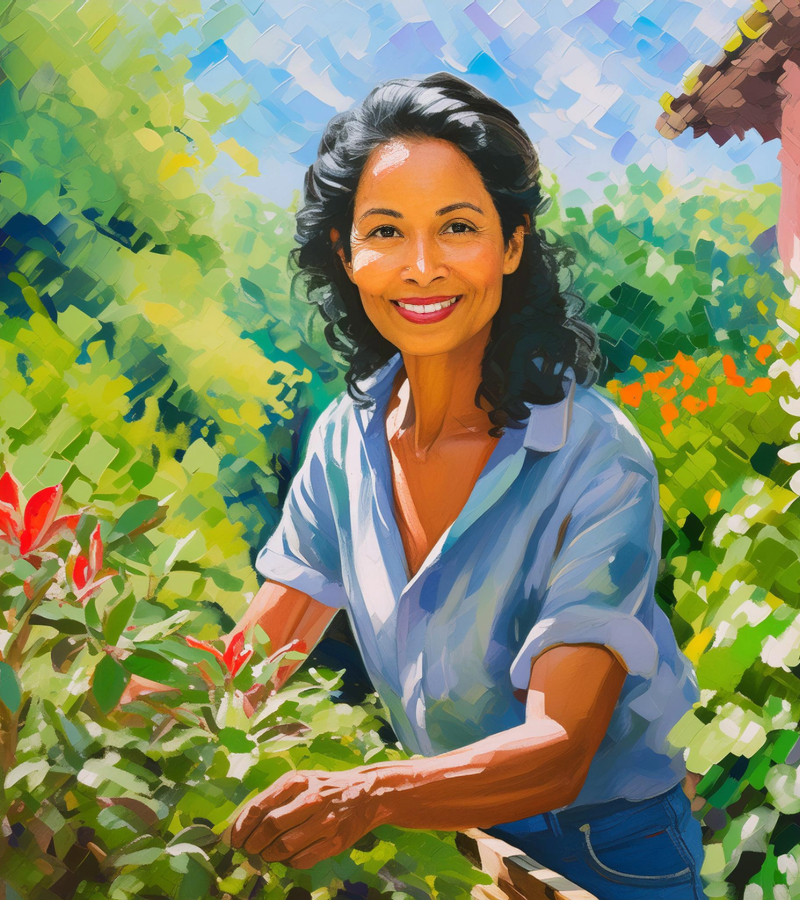
“Terra de encanto amor e sol
Não falo inglês nem espanhol
Quem te conhece não esquece
meu Brasil é com S”
–– Brasil com S, João Gilberto
I’m Adriana Müller (AM) and I live in the Abya Yala region, in the territory known by the native peoples as Pindorama but named on maps as Brazil. It is an area of 3.287.597 square miles (over 8 million square kilometres) filled with an exuberant nature and a wide variety of flora, fauna, and geography, ranging from the Amazon rainforest to the gaucho pampas, passing through the hinterland (known as ‘sertão’) and the wetlands (known as ‘pantanal’). It is a region that has always been inhabited by people who know the seasons and have mastered the art of land care. It is a territory that, over the centuries, has received people from every continent, coming through a number of means and for different reasons. Brazilian people are the mixture of all these stories that can be revealed in our cultural way of being cheerful, outgoing, interactive, greeting friends with hugs and kisses — and the ever-present cup of coffee. Our people love football and carnival, take for granted different kinds of faith and beliefs, use plenty of metaphors while speaking and we live with passion. Brazilian folks are creative, they care about the others and know how to cook using everything the earth yields. Brazilians are helpful and have healing strategies for almost every problem. We know what resistance means, and we usually show it by singing and dancing our love and pain in various tones and rhythms. Brazilian people find ways to weather the weather and survive through life challenges, always making a point to value and honour our legacy.
This article is a tribute to all this cultural heritage. It is about a work I have developed on Narrative Therapy, in particular the use of narrative metaphors. The central topic to be presented here is gardening. Here in Brazil, there are some metaphorical expressions that highlight our connection to the land: we say that someone who is down to earth and is not easily deceived is a “pé no chão” (they have their feet on the ground), and the traditional samba is known as “samba raiz” (root samba). Whoever has “one inch of land” has a place to live and all those who were born here are “children of the land.”
It is from the land that we derive our livelihood, and, throughout Brazil, people know how to clear the land, cut the furrows, sow the seeds, and harvest the crops. In the Tupi language, people born in the territory known today as Espírito Santo are called “capixabas,” which means ‘land ready for planting.’ That's where I live — in the capixabas’ land. Because of my personal experiences in planting as well as in gardening, I started some therapeutic conversations rooted in the metaphor of the garden. The idea is to intertwine the principles of narrative therapy and four moments in the process of tending a garden, inviting clients to view their lives through the glasses of the following metaphors: 1) pulling out the weeds; 2) choosing the good seeds; 3) ‘hopefying’ like a farmer and 4) celebrating the harvest. The process involves therapeutic documents such as letters or poems, the relational development of meanings and encouraging clients to understand their personal agency through the metaphor of gardening.
The Magic of the Narrative Therapeutic Encounter
According to narrative therapy, our life has a multiplicity of events that can be grouped in a certain temporal sequence, generating a narrative on a specific topic. We are not predefined nor fixed beings. On the contrary, in each one of us, stories are waiting for the right moment to come to light and reveal their power. And each story is activated through questions, resonances with other people’s stories, and present connections to past experiences. In short, it can happen in various ways, but always as an invitation to access, connect, and chain the events. As Paulo Freire said, “Pieces of time that, in fact, were in me since when I lived them, waiting for another time, which might not even have come as they came, when they could lengthen in the composition of the larger plot.” (1)Hence, this text is about aligning some moments that happened in my life story while meeting some clients — and how the images and resonances of these consultations generated metaphors and poetry.
Usually, people seek therapy when they are facing problems that limit their sense of competence, their capacity for agency, and their perception of themselves as a person of value. In short, when the story reveals more about the problem than about the person. In such moments, a narrative-based therapist seeks to rescue the beauty and dignity of life, through questions, paths and processes that give prominence to information that contributes to the creation of a good story (2).
According to my personal communication with David Epston, questions guide the conversation: trivial questions lead to trivial answers, boring questions build boring narratives and poetic questions are seeds of poetic stories. And he introduces a new kind of question — the ones with ‘Duendes’. Those questions come from the heart and bring into the conversation “the spirit of narrative therapy full of enthusiasm, irreverence, improvisation, imagination, righteous indignation at injustice, solidarity with those who suffer, collective creativity, fascination with the magic and mystery that reside at the heart of everyday life”, among others (3). An invitation to look at life with wonderfulness (4) — which Paulo Freire (5) would call the ‘beautifulness’ of life and relationships — finding ways to stop emphasising problem-saturated stories and start portraying versions that reveal people’s preferred identity.
Externalizing conversations (6), in which people name the problems and perceive themselves as separate from them, contribute to the necessary distancing so that preferred stories can be accessed. In this process, thinking about the effects of the problems in contrast to personal goals gives the person some space to see themselves as separate from the problems, and also to reconnect themselves to what La Taille (7) calls the ‘ethical view’. For me, this ethical view poses the questions “what life is worth living?” and, consequently, “who should I be to live that life?” The search for these answers leads the person to strive to be a person who deserves to live such a desirable life. Therefore, their actions are aligned with values, beliefs, principles, skills, competencies, goals, purposes, among other aspects that are their strength when facing life’s challenges and dilemmas.
Such aspects are part of the history of the person; therefore, they happen in a socio-historical environment and involve others. They also take place within what Freyre calls ‘tribio time’ – ‘tri’ for three, and ‘bio’, for life. It is an existential time that for him, is never only past, neither only present, nor only future, but all three simultaneously combined.” It is an intersection of past, present and future that evokes as well as prophesies, and in which survival and anticipation are intertwined.
La Taille also says that ethical answers about one’s life guide us to moral questions about “how should I live?” — a question that involves actions and its individual and collective consequences. In a similar way, Freire also tells us about the dialectical unity action-reflection necessary for the development of a critical consciousness that constitutes the way of being and/or transforming the world. Such concepts are very close to what Michael White called personal agency, which he described as “a sense of being able to regulate one’s own life, to intervene in one’s life to affect its course according to one’s intentions, and to do this in ways that are shaped by one’s knowledge of life and skills of living.”
In this context, re-authoring conversations which involve connecting the landscape of action (account of events) and identity (perception of meanings), seek to reveal the potentialities always present in the story and the agency of the person. In addition, re-membering conversations seek to connect us to significant people and the mutual contribution to the sense of being a person of value. Knowing that we are part of a network of affections that constitutes us and in which we actively participate by giving and receiving — and, thus, developing meaning — is important in building the notion of oneself as a person of value.
While the therapeutic meetings take place, each conversation reveals precious details that the therapist writes down or keeps in mind. Later on, such words can be given back to people as documents that ‘rescue the said from the saying of it’ (8) and can help highlight stories that reveal their preferred identities. Usually, I write documents as poetry — which can become song lyrics, as in the Rhythms of Life methodology (9) — as Rubem Alves used to say: “Words only make sense if they help us to better see the world. We learn words to improve our eyes.”
But how do we know which words are to be rescued and, later on, be delivered to those who said them? Grandesso (10) helps us:
If any lighthouse or compass to guide the journey in the field of meaning could be available, it would come more from the reactions of our body, responding more to the poetic forms of the words that touch us, than from any previous knowledge. (…) What (the therapist) can offer for that moment, are not his/her explanations or his/her theoretical knowledge, but his/her understandings in the form of reflections coming from words and images that arise from generous listening.
That is how the narrative metaphor helps throughout the therapeutic process, reminding us of White’s warning (11) about our ethical responsibility in the development of meaning, since it “powerfully shapes the training activities of the I and the relationship in which we engage under the name of therapeutic practice.” The narrative process is always respectful and seeks to position the client as an expert, therefore, a metaphor never arises before the meeting, but, during its flow. Each metaphor represents the harmony of the therapeutic context and is always a symbolic, figurative, and poetic invitation for the person to leave what is known and familiar to go towards what is possible to know.
Such scaffolding conversations, which White elaborated based on Vygotsky’s writings, are very similar to what Freire called the achievement of the “untested-feasibility”: one that is not yet, therefore is unprecedented, but whose originality lies within viable possibilities. Paro, Ventura, & Silva (13) show that, according to this Brazilian educator and philosopher, we face, individually or collectively, concrete, challenging and historical obstacles and forms of oppression, that impose themselves as if there is no way out — and which Freire calls ‘limit-situations’. We do not accept or receive such ‘limit-situations’ passively, but rather, we seek to overcome them through ‘limit-acts’. As we take distance from the ‘limit-situations’, the ‘background-awareness’[3] can emerge. The ‘background-awareness’ is something that cannot and should not remain as it is, therefore, what needs to be faced, discussed and overcome. The ‘limit-situations’, when detached from reality, can be objectified and understood as ‘issues-problems’. So, we begin “to dream of another possible world, something that does not yet exist, but may exist through the articulated action of its subjects, as an ontological need for the transformation of our individual and social reality (…), the ‘untested-feasibility’” (14).
Creativity, joy, hope, eyes that see ‘beautifulness’, freedom, dialogue… are ingredients that make the difference in a therapeutic encounter that aims at the ‘untested-feasibility’. The magic of the therapeutic encounter creates the possibility for each one to write and live their life in an unprecedented way and, creatively, to begin the ‘storyliving’ of their own life.
My Storyliving with Gardens
One year after graduating in Psychology, I moved, for professional and family reasons, to the city of Venda Nova do Imigrante, in the countryside of the state of Espírito Santo. We lived there for 10 years in a condominium on a farm. This experience soon gave birth to the idea of creating a Sustainable Development NGO — the CDS Guaçu-Virá [3]. This whole experience, both in contact with the land and the country people as well as with ecology and preservation professionals, taught me a lot about nature and its cycles, its diversity and its peculiarities. This life experience revealed the importance of our relationship with this living organism on which we inhabit and taught me precious knowledges ‘from the root’: the ones incorporated through daily experiences, for real, and in continuous partnership with Nature. For example: how can we have potable water to drink and cook? Firstly, by recovering the water springs in the woods, planting trees that could help renew the springs — or, as we used to say: “planting water.” Secondly, taking care of every tree like a precious asset until the fountain was back to life. From then on, so long ago, it still supplies 15 houses, one factory and three lakes. Through this and other praxis, day after day, for 10 years, nature taught me about Life and living.
So, when I came back to the capital city, Vitória, all these threads of knowledge and experiences were intertwined with my life. I found myself surrounded by plants and realized that the more attention I paid to them, the more they flourished. Nature always responds and, even living in an apartment, my care for them would return as buds, blossoms, birds, butterflies, and bees. Suddenly I realized I could have the farm atmosphere right in the middle of the city. As mentioned by Reis (15), gardening and other activities that involve caring for and contemplating flowers and ornamental plants, whether in the external or internal environment, generate a sense of well-being by stimulating the senses through luminosity, colours, sounds, aromas, textures and shapes, in addition to activating the aesthetic sense. Therefore, they can be important allies for the preservation and recovery of health and well-being.
When I started using the metaphor of the garden in consultations, I noticed that the enchantment was as fast as nature’s response. There is something inside that, in a special way, connects us to the idea of a garden: being a gardener, being a seed, being a flower bud, understanding the phases of a garden. There are many possibilities for applying this metaphor, and all of them invite us to beautiful narratives of agency, of developing meaning and finding resources to deal with life’s challenges. The metaphor of the garden is an invitation to rescue each one’s connection to nature. Next, you will find the metaphor of Gardening and two stories. I hope these shared ideas can contribute to nature’s power of enchantment and poetry that activate creativity. Let’s sow narrative ideas!
Gardening Narratives
“Vai o bicho homem, fruto da semente, (memória)
Renascer da própria força, própria luz e fé. (memória)
Entender que tudo é nosso, sempre esteve em nós, (história)
Somos a semente, ato, mente e voz. (magia)”
(Redescobrir – Gonzaguinha) [4]
According to White & Epston (16), “the narrative mode of thought (…) is characterised by good stories that gain credence through their lifelikeness.” Good stories have a great number of metaphorical images that organize the telling and help build a positive sense of being. If you have ever taken care of a garden — either a small one in pots or a large one over lawns — you can identify four moments of this work: pulling out the weeds, choosing the good seeds, waiting for sprouting and being happy with the result. Let me share with you the metaphor and its connections to narrative therapy.
1. Pulling out the weeds or invasive plants
Every garden has weeds that show up as unwanted guests. Dealing with them requires some specific skills: knowing how to tell plants and weeds apart, understanding the effects of these invasive plants on the flora, and establishing an action plan to better lay the garden out. This stage is the well-known narrative ‘externalization conversation’ in which we invite the clients to name the problem (weed), to check the effects of the problem on their life, to evaluate such effects and to set a plan of action to recover their life (the garden) from the consequences of the problems. In Freirian terms, we can say that this is the ‘background-awareness’ stage.
A garden full of weeds is like a story saturated with problems: it loses its strength, vigour and beauty, not because it lacks these characteristics, but because all its energy is being used to maintain the problem. That is why it is important to help people to recover their notion of personal agency through action-reflection, that will help them elaborate and put into practice their abilities to storyliving as the protagonist of the plot.
Some questions (metaphorical or not) that can help in this moment are:
Questions about the effect of the problem:
What have I been feeling / thinking?
What has been bothering me?
How does this ‘weed’ disturb me? Is it a mistletoe that suffocates me? Is it a kind of weed that traps and hurts me? Is it a weed that competes with me for water and nutrients?
Questions about the plan of action:
How do I want my garden to be?
What do I want to see blooming in my garden?
What are the main potentials of my garden?
What should I do to make this dream-garden come true?
Who can help me with this task?
What are my skills and abilities to deal with this challenge?
When can I start working in this garden?
These reflections detach the person from the problem and help to start a process to connect the person to the preferred version of his/her story — the garden each one dreams of.
2. Choosing the best seeds
While speaking about gardens and gardeners, Rubem Alves (17) invites us to the following reflection:
What comes first? The garden or the gardener? It’s the gardener. If there is a gardener, sooner or later a garden will appear. But if there is a garden without a gardener, sooner or later it will disappear. What is a gardener? A person whose mind is full of gardens. What makes a garden is what the gardener has in mind. What makes a nation is the sum total of the thoughts of those who are a part of it.
After removing the weeds, the disturbed but cleared soil is ready to receive the seeds. And, if the garden is in the gardener’s mind, it is time to help by choosing the best seeds: those aspects of life that the person holds precious, considers important and wants to keep updated. What s/he wants to plant and see growing and what activates the sense of beautifulness and wonderfulness.
In addition to the questions of the ethical and moral landscapes, arises the notion, “how do I want my garden to be?” What should I do to make it that way? What kind of gardener must I become to help this garden grow? — there are other questions that also contribute to this development, as they open the possibility for the sense of agency, values and wonderfulness:
What seeds do I choose to plant?
What do I admire and consider important to be present in the garden of my life?
What is beautiful and special about me that I want to see blossom?
What aspects of my life do I value?
What matters in my life?
Who helps me in this planting?
What did these persons teach me? And what do I teach them?
What is special and unique about this garden?
Through these reflections, people connect to what they hold precious, and their favorite story grows stronger in meaning, shape, colour and scent. The garden is coming to life.
3.'Hopefying’ like a farmer
One thing that has always impressed me in my experience living on the farm is the wisdom of the farmers. Planting is an art and, as such, it requires very specific skills, including what I usually call the ‘farmer’s hopefying.’ Firstly, the farmers let the land rest after harvesting, and, after that, they start working on it. From sunrise to sunset, they spend the day ploughing, balancing the soil nutrients, watering, planting the next crop. Tirelessly, they keep on watering that soil already sown, but still with no sign of life or success. Every farmer needs to believe in the work done and in the power of the seed — they need to believe in the ‘untested-feasibility’. They need to hopefy. They need to be “neither only patient nor only impatient, but, as Freire says, patiently impatient”.
Achieving the ‘untested-feasibility’ involves hopefying. But make no mistake: hopefy is an energetic attitude, a way of positioning yourself in life, and not a mere linguistic pun. There is the ‘hope’ from the verb to wait for. This ‘hope’ keeps us passive, static, waiting for something to happen or for someone to do something. And there is the hope as in ‘hopefying.’ To hopefy puts us in an active, dynamic position. In Freire’s words: “To hopefy is to get up, to go for it, to build, to hopefy is not to give up! To hopefy is to move forward, to join with others to do otherwise…”.
Everything we plant in life has its own time to come into being. While this time passes by, let’s remember to hopefy as the farmer does. During the consultation, that is the moment I usually write and hand over poetry to the ‘gardeners’.
4. Celebrating the harvest
Picturing the field producing and harvesting is as important as preparing the soil, planting the best seeds and knowing how to hopefy. Celebrating this moment means recognizing the strength within the whole process. In Freire’s words, “Joy does not come only when one finds something, but it is part of the search process. Teaching and learning cannot happen outside the search, outside the beautifulness and joy.” As an educator, Freire talks about the process of ‘teaching and learning’ which, in this text, is metaphorically called ‘sowing and harvesting’ — and which, as such, applies to the most different processes in life.
The harvest unfolds the power of wonderfulness — the beautifulness’ unveiled. They are the foundation for the preferred story: the one that reveals the preferred identity of the person. Realizing that one is capable of transforming soils previously taken over by weeds into gardens full of beautifulness reveals the ability each one has, as individuals and collectively, to sow dreams and reap realities.
Now the time has come to present two stories of therapeutic meetings in which the metaphor of Gardening Narratives were used. It is important to say that both stories were authorised to be published and that, for privacy, the names were omitted or modified. I would also want to point out that, like in any process, nothing follows the rules by the book. The fluidity and organization required in a written text are not found in the same way in the dynamics of interactions, which are mostly based on simultaneity, dynamic responsiveness, and constant reorganization. In Freire’s words. “An event, a fact, a deed, a gesture of anger or love, a poem, a canvas, a song, a book never has a single reason behind it. (…) That’s why I was always much more interested in understanding the process in which and how things happen than the product itself.” Therefore, you are invited to understand the process, while I keep hopefying the essence of Gardening Narratives presented in these stories comes to life beyond the didactic sequences just shown.
First Story: Once I Met a Gardener
She arrived at the office with tears in her eyes and a story of suffering to tell. There, in front of me, another woman reporting about when she discovered her husband’s betrayal, about the effort she made to forgive him, and to give them a second chance. At that time, they were two. Time passed, the wound healed, and the couple dreamed of being three. Pregnancy came as a gift, and on the day she delivered her child, she made up her mind to put all that bad story behind her. She wanted to be reborn as a mother and as a new woman. It was time for a renewed family to come into being. Along with the baby, there came forgiveness. And she cried for joy.She went home, breastfed, took care of herself, and felt whole. She felt that there was attention and care from the couple to the baby, and she was sure that this was the family she had always dreamed of. Nevertheless, a few months later, she discovered that the betrayal was not a shadow of the past, but the harsh reality of the present. That was when she came to my office, and I learned about this story combining pain and hope.
Michael White taught us that we are outside witnesses to the stories we are told. This is not trivial, and it requires responsibility both in listening generously and in responding to what we hear. He presents us with a four-step map to navigate this unfamiliar therapeutic conversation terrain, calling our attention to each expression that strikes us during the telling of the narrative, the image it brings to our minds, the resonance of it with our life and where it takes us. That day, while hearing those stories, several images — real and metaphorical ones — came to my mind. I heard them as a woman, as a wife, as a mother. I felt them as a storm, as lightning, as devastation. I took them as birth, as life, as forgiveness. Eventually, she wiped her tears, looked at me and waited for my words.
Inside me, this phrase echoed: “I feel devastated.” The image came naturally: a raked-up garden, holes everywhere. And the resonance took me back to the time when I lived on the farm and dedicated myself to the garden at home. There I made beds with colourful flowers and medicinal plants. Bordering the lot, I planted a hedge of calliandra (Calliandra brevipes), with their blooming fragrant flowers forecasting rainy days. Throughout the garden, I planted fruit trees to feed the birds, yellow trumpet flowers (Handroanthus albus) and a jambo tree (Syzygium jambos) to have a beautiful colourful rug with the fallen flowers, and a tree for each baby I had. In my garden, I planted trees, dreams, and stories.
But, in the same garden, there were weeds — lots of them! And they taught me a powerful lesson: weeds are easier to remove when they are still sprouting. One can do it with one’s bare hands. But, once they are grown and rooted, one will need a hoe and some strength. All this work breaks the soil, leaving holes all over and it harms the garden’s beauty. That was the image evoked and shared — a damaged garden. But this experience with weeds taught me we can either look at the holes and at the ugliness of the garden or we can see the loose weedless soil as a terrain for new seeds. All these memories were shared with her. “Does it make sense to you?” I asked. She said yes, and we started talking about how to till a revolved garden.
This metaphor came back a number of times throughout the meetings and conversations. Through the reauthoring conversation, she connected the landscape of action to the landscape of identity, going back and forth in time, talking about what really mattered in her life, the people who contributed to her being who she was, her dreams and projects, her skills and competences, her values and principles. While listening to these stories, a new image emerged: a living and loving garden. Then I realized she was gardening narratives.
Firstly, she strengthened herself. She reconnected herself to everything she valued and cared for. She recharted her routine including things she likes and reviving her sense of religion. She realized her ability to move forward, and she appreciated the ‘beautifulness’ of her life. Step by step, she sowed new seeds in her garden.
Then, she hopefied for a new stage: togetherness. Not to re-live the past, like in a never-ending circle, but to live a spiral-present that provided something new and more rewarding. So, she decided to invite her husband to come around and learn about her ‘garden.’ This hopefying moment enclosed the wish to till the best asset of her garden: her family. She felt inside a growing power to take herself as an agent and a sower of possible futures — of ‘untested-