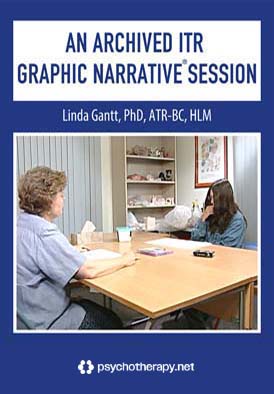
An Archived ITR Graphic Narrative Session
Video
with
Linda Gantt, PhD
Video

An Archived ITR Graphic Narrative Session

This session demonstrates the core of ITR for treating trauma. Linda helps Diane to create a “Graphic Narrative” – a trauma story done in a series of drawings on separate pieces of paper, based on the Instinctual Trauma Response – ITR. Because trauma stories are fragmented and do not follow a linear sequence, these individual drawings need to be rearranged with a therapist’s help. A “before” and an “after” drawing serve as bookends to make the story complete and – most importantly – to finally bring the trauma to an end. Diane is telling the story of the tonsillectomy she had when she was about two because in the ITR method it is crucial that the earliest traumas are processed first. These are usually preverbal experiences called “foundation traumas.” Since most troubling trauma symptoms are not stored verbally the emphasis is on doing the drawings first and then putting words to them. The capstone of the processing is putting the drawings on the wall so Linda can “re-present” the story using Diane’s words to make the event truly history – no longer plaguing her now. Commentary by Linda Gantt, PhD, ATR-BC Video Length: 1h 16m 50s
COURSE DETAILS

Overview

This session demonstrates the core of ITR for treating trauma. Linda helps Diane to create a “Graphic Narrative” – a trauma story done in a series of drawings on separate pieces of paper, based on the Instinctual Trauma Response – ITR. Because trauma stories are fragmented and do not follow a linear sequence, these individual drawings need to be rearranged with a therapist’s help. A “before” and an “after” drawing serve as bookends to make the story complete and – most importantly – to finally bring the trauma to an end.

Diane is telling the story of the tonsillectomy she had when she was about two because in the ITR method it is crucial that the earliest traumas are processed first. These are usually preverbal experiences called “foundation traumas.” Since most troubling trauma symptoms are not stored verbally the emphasis is on doing the drawings first and then putting words to them.

The capstone of the processing is putting the drawings on the wall so Linda can “re-present” the story using Diane’s words to make the event truly history – no longer plaguing her now.

Commentary by Linda Gantt, PhD, ATR-BC

This video was formerly included in the Expressive Media Arts Therapies Films Collection distributed by Expressive Media Inc.

About the Experts

Expert

Linda Gantt, PhD

Linda Gantt, PhD was compensated for her contribution. None of her books or additional offerings are required for any of the Psychotherapy.net content. Should such materials be references, it is as an additional resource.

View full profile

Disclosures

Psychotherapy.net offers trainings for cost but has no financial or other relationships to disclose.

This Disclosure Statement has been designed to meet accreditation standards; Psychotherapy.net does its best to mitigate potential conflicts of interest and eliminate bias in all areas of content. Psychotherapy.net offers training for cost but has no financial or other relationships to disclose. Additionally, there is no commercial support for this activity. None of the planners or any employee at Psychotherapy.net who has worked on this educational activity has relevant financial relationship(s) to disclose with ineligible companies.

Psychotherapy.net defines ineligible companies as those whose primary business is producing, marketing, selling, re-selling, or distributing healthcare products used by or on patients. There is no minimum financial threshold; individuals must disclose all financial relationships, regardless of the amount, with ineligible companies. We ask that all contributors disclose any and all financial relationships they have with any ineligible companies whether the individual views them as relevant to the education or not. Each experts’ specific disclosures can be found in their biography.

Help Couples Move from Conflict to Connection: A Collaborative Change Model
  • Video
  • Webinar Replay

Help Couples Move from Conflict to Connection: A Collaborative Change Model

Art as Transformation: the Life & Work of Shaun McNiff
  • Video

Art as Transformation: the Life & Work of Shaun McNiff

The DSM-5 and Psychodiagnostic Interviewing, with TR Updates
  • Course

The DSM-5 and Psychodiagnostic Interviewing, with TR Updates

Brief Art Therapy with a College Senior
  • Video

Brief Art Therapy with a College Senior

The Arts in Health Care
  • Video

The Arts in Health Care