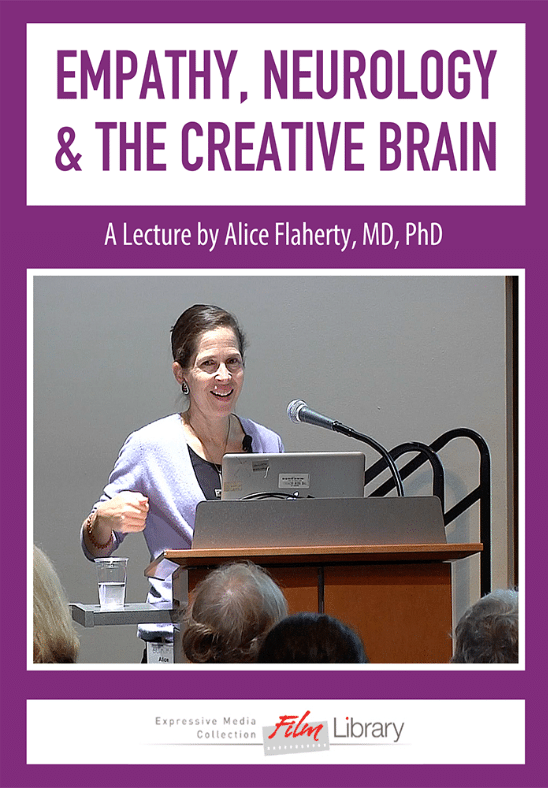
Empathy, Neurology, and the Creative Brain
Video
with
Alice Flaherty
Video

Empathy, Neurology, and the Creative Brain

Empathy, Neurology, & The Creative Brain is a lecture delivered by Alice Flaherty about the neurological function of both creativity and empathy as they pertain to mental illness and health. In it she offers a cogent exploration of the impact of creativity to both support and obstruct well being. Video Length: 1h 23m 46s
COURSE DETAILS

Overview

Dr. Alice Flaherty is a neurologist and professor at Harvard Medical School, who treats patients with movement, mood and psychogenic disorders. In this talk, she explores the impact of mental illness on creativity through a look at both visual and literary artists, as well as through her own experience with trauma and mental illness. Dr. Flaherty notes the origins of the concept of empathy as a term in the arts as well as in connection with illness and health. Through her own clinical vignettes as well as references to contemporary art, she examines the interaction between empathy and art. She helps the listener to understand the role of empathy in promoting mental health, as well as the ways in which it can interfere with psychological well being.

From Eleanor Irwin, PhD, RDT, TEP:
“In this video, Alice Flaherty, a Harvard neurologist and psychiatrist, delivers a wide-ranging talk in which she covers multiple topics, including the mind/body problem; the biology of creativity; creativity and empathy; medications that promote or inhibit creativity; mirror neurons as reflected in cognition and empathy; and (tongue in cheek) the art of being a patient. Using her own personal experience as a guide, she discusses the advantages and disadvantages of empathy, and tapping into literature and history, she discusses the ages-old controversy between creativity and mental illness; and calls creativity the highest form of human achievement.” 
About the Experts

Expert

Alice Flaherty

Alice Flaherty was compensated for her contribution. None of her books or additional offerings are required for any of the Psychotherapy.net content. Should such materials be referenced, it is as an additional resource.

View full profile

Disclosures

Psychotherapy.net offers trainings for cost but has no financial or other relationships to disclose.

This Disclosure Statement has been designed to meet accreditation standards; Psychotherapy.net does its best to mitigate potential conflicts of interest and eliminate bias in all areas of content. Psychotherapy.net offers training for cost but has no financial or other relationships to disclose. Additionally, there is no commercial support for this activity. None of the planners or any employee at Psychotherapy.net who has worked on this educational activity has relevant financial relationship(s) to disclose with ineligible companies.

Psychotherapy.net defines ineligible companies as those whose primary business is producing, marketing, selling, re-selling, or distributing healthcare products used by or on patients. There is no minimum financial threshold; individuals must disclose all financial relationships, regardless of the amount, with ineligible companies. We ask that all contributors disclose any and all financial relationships they have with any ineligible companies whether the individual views them as relevant to the education or not. Each experts’ specific disclosures can be found in their biography.

Art & Drama Therapy: Child Life Inservice Workshop
  • Video

Art & Drama Therapy: Child Life Inservice Workshop

Visual Memories: Japanese-American Internment Survivors and Art Therapy
  • Video

Visual Memories: Japanese-American Internment Survivors and Art Therapy

Art Therapy in a Military Hospital
  • Video

Art Therapy in a Military Hospital

Womens Rites & Body Speaks: Expressive Arts Groups for Growth
  • Video

Womens Rites & Body Speaks: Expressive Arts Groups for Growth

Art as Therapy for Older Adults
  • Video

Art as Therapy for Older Adults