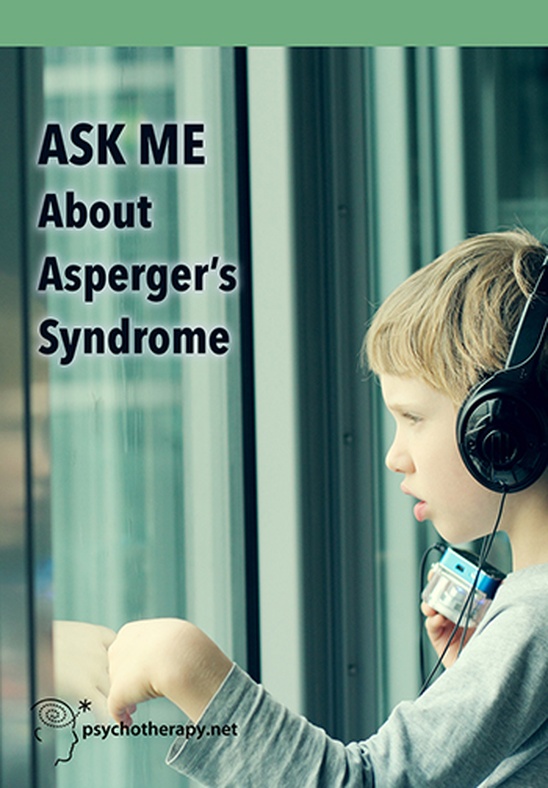
Ask Me About Aspergers Syndrome
Video
Video

Ask Me About Aspergers Syndrome

Children with Asperger’s Syndrome can play a strong role in classrooms if professionals are attuned to their particular needs. In this video you’ll learn how to do this by hearing from autism specialists, teachers, parents—and those with Asperger’s themselves.   Video length: 23m
COURSE DETAILS

Overview

Asperger’s Syndrome is a pervasive developmental disorder characterized by impairments in several areas. Those with this syndrome are considered to have high functioning ASD, or Autism Spectrum Disorder.

This video will be of interest to social workers and all mental health professionals who work with children, as kids with Asperger’s are often in the same classroom as children without any special needs. Understanding the unique strengths and challenges of these children will be important to ensure a rich educational experience for all students.

In this video teachers and autism specialists will take you through each of the domains that can be affected in children with Asperger’s Syndome:

  • Language development
  • Social interaction
  • Sensory integration
  • Motor functioning
  • Cognitive processing


They’ll discuss how children with Asperger’s struggle in these areas and provide concrete tips for supporting them throughout their school day. This will include some accommodation of the classroom environment as well as calling upon other students to support their diverse classmates. Special attention is placed on learning the distinct and unique triggers and struggles for each child. The video also offers particular sections called, “The Parent’s Perspective,” which remind the viewer of the child’s individuality.

Anyone who works with children with Asperger’s Syndrome will obtain a greater understanding of this disorder from Ask Me About Asperger’s, as well as learn actionable ways to make the classroom a better place for all children to learn.


Disclosures

Michael Thompson Productions was compensated for his/her/their contribution. None of his/her/their books or additional offerings are required for any of the Psychotherapy.net content. Should such materials be referenced, it is as an additional resource.

This Disclosure Statement has been designed to meet accreditation standards; Psychotherapy.net does its best to mitigate potential conflicts of interest and eliminate bias in all areas of content. Psychotherapy.net offers training for cost but has no financial or other relationships to disclose. Additionally, there is no commercial support for this activity. None of the planners or any employee at Psychotherapy.net who has worked on this educational activity has relevant financial relationship(s) to disclose with ineligible companies.

Psychotherapy.net defines ineligible companies as those whose primary business is producing, marketing, selling, re-selling, or distributing healthcare products used by or on patients. There is no minimum financial threshold; individuals must disclose all financial relationships, regardless of the amount, with ineligible companies. We ask that all contributors disclose any and all financial relationships they have with any ineligible companies whether the individual views them as relevant to the education or not. Each experts’ specific disclosures can be found in their biography.

Satir Family Therapy
  • Video

Satir Family Therapy

Salvador Minuchin on Family Therapy
  • Video

Salvador Minuchin on Family Therapy

Anorexia: What Therapists and Parents Need to Know
  • Video

Anorexia: What Therapists and Parents Need to Know

Art Therapy for Youngsters in Schools and the Community
  • Video

Art Therapy for Youngsters in Schools and the Community

Thomas Szasz on The Myth of Mental Illness
  • Video

Thomas Szasz on The Myth of Mental Illness