Balancing Diagnostic Accuracy with Client-Centered Care
Video
with
Travis Heath, PhD, Jason Buckles, PhD
Video 1.25 CE Credits

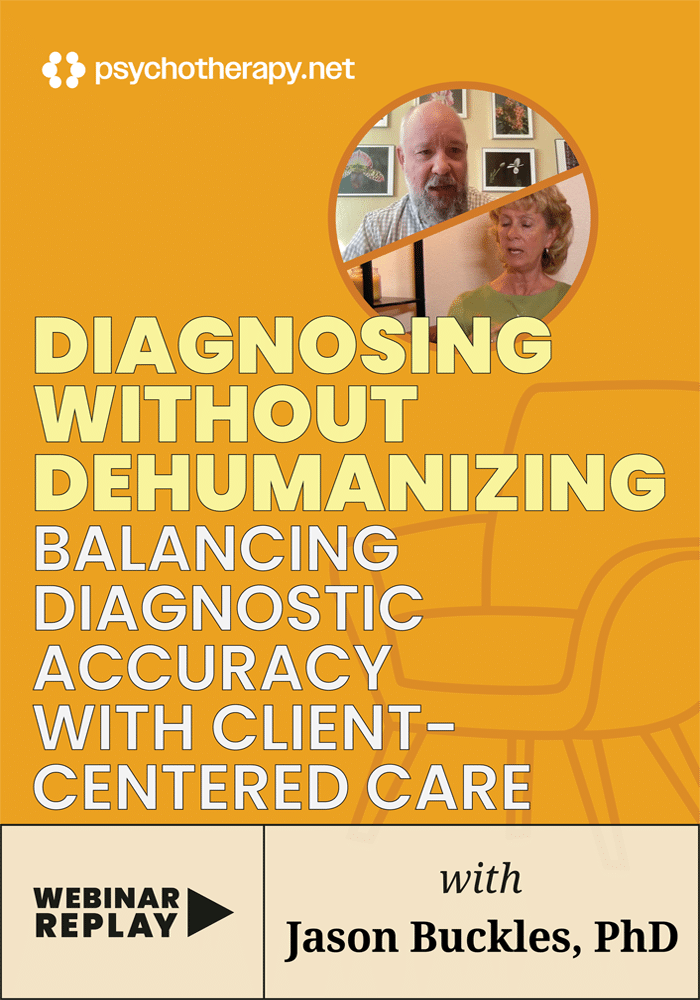
Balancing Diagnostic Accuracy with Client-Centered Care

Recent trends in clinical training have shifted from a sole focus on diagnostic accuracy to embedding diagnosis within a broader sociocultural and sociopolitical framework—in essence, humanizing the process. In this webinar, you will see Dr. Jason Buckles conduct three diagnostic interviews that humanize his clients and elevate their stories rather than reduce them to a list of symptoms.   Video length: 1h 24m
Available with a membership. 1.25 CE credits and access to 400+ video sessions in our library.
Buy a Membership
COURSE DETAILS

Overview

The diagnostic process can be hierarchical, and at times, dehumanizing. It positions the therapist as the absolute expert, and the client as the passive recipient of that expertise, in some cases, diminishing rather than elevating them. Because clients are more than their symptoms, clinicians must transition from a reductionistic perspective to one that embraces their lived experiences, the circumstances of their lives, and their stories. In this rich webinar experience, Psychotherapy.net’s Travis Heath, along with renowned diagnostic expert, Dr. Jason Buckles, will provide you with powerful clinical ideas and tools to work intimately interconnected with clients and the diagnostic process.

Developed over the course of his extensive career in scholarship and clinical practice, Buckles believes that diagnosing is both an art and a science. It should expand awareness beyond traditional Western notions of normalcy to consider the client’s lived experience and avenues for treatment and decision-making. Buckles articulates the importance of balancing the need to assign a label with the need to deeply, fully understand and develop a relationship with the client.

After watching the diagnostic interaction between Buckles and three clinically unique clients, hearing the post-session discussions with Heath, and fielding questions from a global audience, you walk away with a sense of how to humanely and holistically orient yourself in the diagnostic interview and invite your clients into conversation rather than impose it upon them.

You will come away from this invaluable learning experience by recognizing that the traditional symptom-focused diagnostic process can be limiting. In its place, should be a process that values compassion over labeling, understanding over marginalization, and presence over detachment.

What you'll learn

  • Prepare diagnostic interview questions that elevate rather than reduces clients
  • Conduct diagnostic interviews that account for clients’ lived experiences
  • Utilize the diagnostic interview as preparation for clinical intervention

About the Experts

Travis Heath, PhD
Host

Travis Heath, PhD

Travis Heath, PhD, is a licensed psychologist and has been in community practice for nearly two decades. His scholarship has included looking at shifting from a multicultural approach to counseling to one of cultural democracy that invites people to heal in mediums that are culturally near. Other writings have focused on the use of rap music in narrative therapy, working with persons entangled in the criminal injustice system in ways that maintain their dignity, narrative practice stories as pedagogy, and…

View full profile
Jason Buckles, PhD
Featured Guest

Jason Buckles, PhD

Jason Buckles, PhD, earned his Bachelor’s in Psychology at New York University in 1992. During his time there he worked on psychiatric diagnostic projects at Bellevue Hospital and the New York Psychiatric Institute. He earned his Master’s in Counseling at The University of New Mexico in 2001 and PhD at The University of New Mexico in 2016. Since 2018 he has been the Statewide Expert Consultant for the New Mexico Health Care Authority, Developmental Disabilities Supports Division - Bureau of…

View full profile

Disclosures

Jason Buckles was compensated for his contribution. None of his books or additional offerings are required for any of the Psychotherapy.net content. Should such materials be references, it is as an additional resource.

This Disclosure Statement has been designed to meet accreditation standards; Psychotherapy.net does its best to mitigate potential conflicts of interest and eliminate bias in all areas of content. Psychotherapy.net offers training for cost but has no financial or other relationships to disclose. Additionally, there is no commercial support for this activity. None of the planners or any employee at Psychotherapy.net who has worked on this educational activity has relevant financial relationship(s) to disclose with ineligible companies.

Psychotherapy.net defines ineligible companies as those whose primary business is producing, marketing, selling, re-selling, or distributing healthcare products used by or on patients. There is no minimum financial threshold; individuals must disclose all financial relationships, regardless of the amount, with ineligible companies. We ask that all contributors disclose any and all financial relationships they have with any ineligible companies whether the individual views them as relevant to the education or not. Each experts’ specific disclosures can be found in their biography.

Evidence-Based Treatment Planning for Anger Control Problems
  • Video

Evidence-Based Treatment Planning for Anger Control Problems

Evidence-Based Treatment Planning for Bipolar Disorder
  • Video

Evidence-Based Treatment Planning for Bipolar Disorder

Using a Mood Scale for Suicide Assessment
  • Video

Using a Mood Scale for Suicide Assessment

Dialectical Behavior Therapy
  • Video

Dialectical Behavior Therapy

Clinical Interviewing: Intake, Assessment & Therapeutic Alliance
  • Video

Clinical Interviewing: Intake, Assessment & Therapeutic Alliance