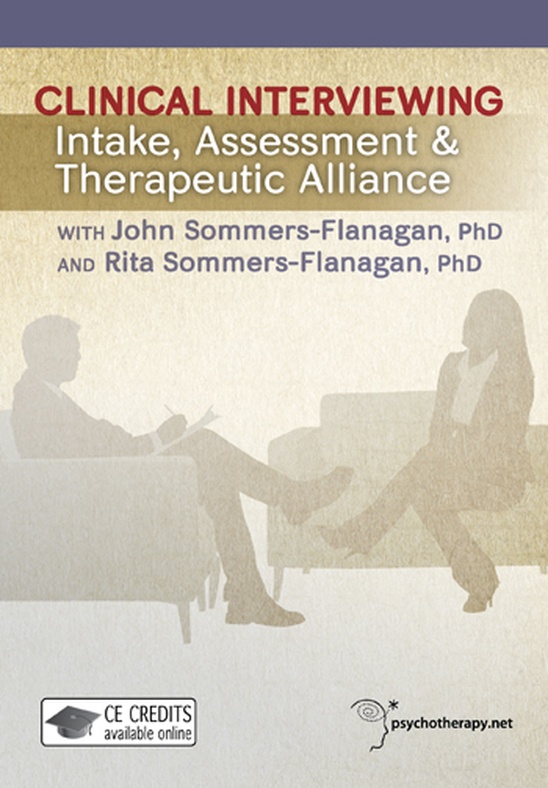
Clinical Interviewing: Intake, Assessment & Therapeutic Alliance
Video
with
John Sommers-Flanagan, PhD, Rita Sommers-Flanagan, PhD
Video 2 CE Credits

Clinical Interviewing: Intake, Assessment & Therapeutic Alliance

How do you do an assessment, collect historical data, develop a treatment plan and create a warm working alliance with clients all in the first session? Learn from experts John and Rita Sommers-Flanagan how to quickly create the foundation for a successful therapy and engage clients collaboratively in the treatment process.
Video Length: 2h 08m
 
Available with a membership. 2 CE credits and access to 400+ video sessions in our library.
Buy a Membership
COURSE DETAILS

Overview

Whether you are in private practice or working in a clinic setting, clinical interviewing skills are essential to your practice. Yet sadly, many clinicians lack a basic understanding of what’s involved in these crucial first sessions. What’s more, resources on how to gather client information are often packaged either as dry procedural steps or vague theories of communication. In this video, seasoned clinical educators John and Rita Sommers-Flanagan present an integrated, actionable combination of interviewing protocols and relational techniques that clarify how clinicians can glean necessary information in the initial sessions, while building a strong therapeutic alliance.

Weaving together structured lessons, easy-to-follow demonstrations, and delightful commentary, the Sommers-Flanagans break down interviewing skills in a straightforward way. Drawing from actual therapy sessions, they present seven interviewing themes with real-world examples of basic listening, directives, therapeutic questions, and more. Demonstrations feature easy-to-see callouts of the various skills covered, interspersed with informative, playful commentary from the hosts.

More complex interviewing skills are covered next, with detailed segments on intake interviews, mental status examinations, and suicide assessments. Here we learn thorough protocols for eliciting important information from our clients, while leveraging therapeutic listening to deepen rapport with them.

Watch the Sommers-Flanagans, along with other therapists, demonstrate these techniques with a range of clients. In addition to highlighting the clinical interview format, their toolkit emphasizes collaboration, empathy, intuition, and cultural awareness. Their warm and compassionate dynamic infuses both their teaching and therapeutic work, and makes this seemingly “clinical” material both approachable and enjoyable.

If you’re looking to learn more about clinical listening, interviewing, and assessment from clinicians who literally wrote the book on the subject, you’ll want to add this video to your library for essential tools you can start using today.

What you'll learn

  • List interventions along a continuum of clinical listening responses
  • Describe the procedures of different clinical assessments
  • Apply tools for enhancing the therapeutic alliance

About the Experts

John Sommers-Flanagan, PhD
Expert

John Sommers-Flanagan, PhD

John Sommers-Flanagan, PhD, is a professor of counselor education at the University of Montana. In addition to teaching, research, and supervision, John also has a small independent practice. Previously, he was a clinical psychologist and mental health consultant with Trapper Creek Job Corps and served as executive director of Families First Parenting Programs from 1995 to 2003. John was also a co-host of a radio talk-show on Montana Public Radio titled, “What is it with Men?” Primarily specializing in working…

View full profile
Rita Sommers-Flanagan, PhD
Expert

Rita Sommers-Flanagan, PhD

Rita Sommers-Flanagan has been a professor of counselor education at the University of Montana for over two decades. She is a clinical psychologist and has served as a mental health consultant for the Vet Center in Missoula Montana. She is also on the Executive Board of the faculty union, and very involved in the issues facing academia and higher education. Rita has published text books, professional articles, books chapters, and poems. Some of these include an ethics text, a book for…

View full profile

Disclosures

John Sommers-Flanagan and Rita Sommers-Flanagan were compensated for their contribution. None of their books or additional offerings are required for any of the Psychotherapy.net content. Should such materials be referenced, it is as an additional resource. 

This Disclosure Statement has been designed to meet accreditation standards; Psychotherapy.net does its best to mitigate potential conflicts of interest and eliminate bias in all areas of content. Psychotherapy.net offers training for cost but has no financial or other relationships to disclose. Additionally, there is no commercial support for this activity. None of the planners or any employee at Psychotherapy.net who has worked on this educational activity has relevant financial relationship(s) to disclose with ineligible companies.

Psychotherapy.net defines ineligible companies as those whose primary business is producing, marketing, selling, re-selling, or distributing healthcare products used by or on patients. There is no minimum financial threshold; individuals must disclose all financial relationships, regardless of the amount, with ineligible companies. We ask that all contributors disclose any and all financial relationships they have with any ineligible companies whether the individual views them as relevant to the education or not. Each experts’ specific disclosures can be found in their biography.

Albert Bandura on Behavior Therapy, Self Efficacy & Modeling
  • Video

Albert Bandura on Behavior Therapy, Self Efficacy & Modeling

Dialectical Behavior Therapy with Suicidal Clients Vol. 1
  • Video

Dialectical Behavior Therapy with Suicidal Clients Vol. 1

Advanced Cognitive Behavioral Interventions for OCD
  • Course

Advanced Cognitive Behavioral Interventions for OCD

Children of the Camps: The Documentary
  • Video

Children of the Camps: The Documentary

Voices of Suicide: Learning from Those who Lived
  • Video

Voices of Suicide: Learning from Those who Lived