Brief Psychoeducation for Chronic Pain
Video
with
Ronald D. Siegel, PsyD
Video

Brief Psychoeducation for Chronic Pain

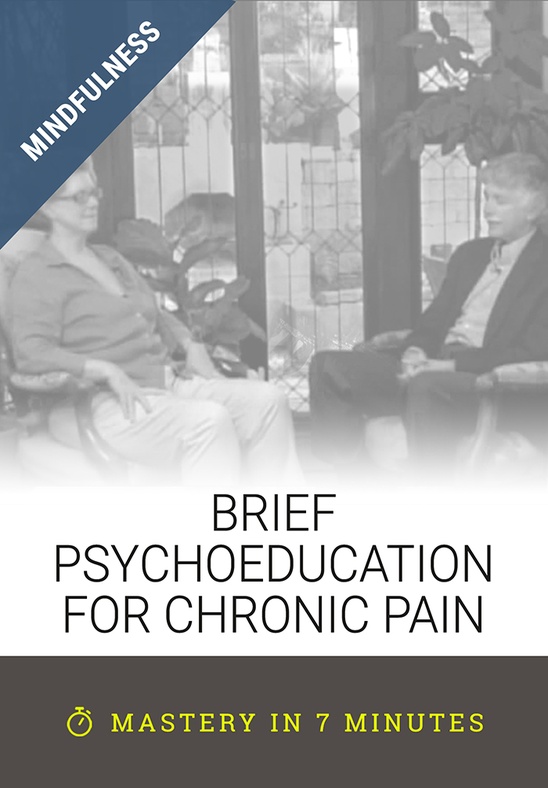
Discover a grounded, accessible approach for helping your clients struggling with chronic pain by using psychoeducation and mindfulness techniques. Video length: 7m
Buy a Membership
COURSE DETAILS

Overview

Many clients present with chronic pain, an experience that is both a physical and a psychological phenomenon. In this short video, mindfulness expert Ron Siegel provides some brief psychoeducation combined with very short experiential exercises in session with Lorraine, a 60-year-old woman who had a car accident about a year prior, and has been out of work, and struggling with pain and rehabilitation since then.

Psychoeducation helps increase a client’s willingness and motivation to engage in treatment. Watch as Siegel teaches Lorraine two things: first how fear plays a role in increasing muscle tension that often contributes to chronic pain. Second: how thoughts, for example anxiety, can significantly amplify pain sensations because it affects how we direct attention to our body. By combining information with the simple, approachable exercises demonstrated in this video, you’ll be able to give your clients useful tools for managing their chronic pain.

Want to go deeper? Watch Siegel continue to work more deeply with Lorraine in one of our other short videos, Mindfulness Exercise for Chronic Pain. 

About the Experts

Ronald D. Siegel, PsyD
Expert

Ronald D. Siegel, PsyD

Ronald D. Siegel, PsyD, is assistant professor of psychology at Harvard Medical School, where he has taught for over 30 years. He is a long-time student of mindfulness meditation and serves on the board of directors and faculty of The Institute for Meditation and Psychotherapy. He is the coauthor of Back Sense: A Revolutionary Approach to Halting the Cycle of Chronic Back Pain, which integrates Western and Eastern approaches for treating chronic back pain, coeditor of the acclaimed books for professionals, Mindfulness and Psychotherapy and Wisdom and…

View full profile

Disclosures

Ronald D. Siegel was compensated for his contribution. None of his books or additional offerings are required for any of the Psychotherapy.net content. Should such materials be referenced, it is as an additional resource.

This Disclosure Statement has been designed to meet accreditation standards; Psychotherapy.net does its best to mitigate potential conflicts of interest and eliminate bias in all areas of content. Psychotherapy.net offers training for cost but has no financial or other relationships to disclose. Additionally, there is no commercial support for this activity. None of the planners or any employee at Psychotherapy.net who has worked on this educational activity has relevant financial relationship(s) to disclose with ineligible companies.

Psychotherapy.net defines ineligible companies as those whose primary business is producing, marketing, selling, re-selling, or distributing healthcare products used by or on patients. There is no minimum financial threshold; individuals must disclose all financial relationships, regardless of the amount, with ineligible companies. We ask that all contributors disclose any and all financial relationships they have with any ineligible companies whether the individual views them as relevant to the education or not. Each experts’ specific disclosures can be found in their biography.

Crisis Counseling: 7 Steps to Effective Intervention
  • Course

Crisis Counseling: 7 Steps to Effective Intervention

The 7 Skills for Addiction-Free Living: Stress Management
  • Video

The 7 Skills for Addiction-Free Living: Stress Management

Integrating Mindfulness into Counseling and Psychotherapy
  • Video

Integrating Mindfulness into Counseling and Psychotherapy

Managing Chronic Anxiety with Mindfulness
  • Video

Managing Chronic Anxiety with Mindfulness

  • Premium
ACT in Action
  • Course

ACT in Action