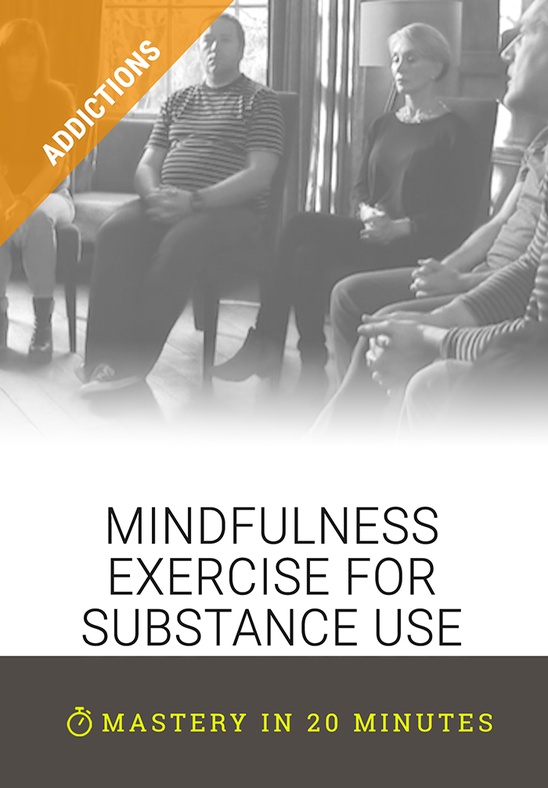
Mindfulness Exercise for Substance Use
Video
with
Devin Ashwood
Video

Mindfulness Exercise for Substance Use

Do you have clients struggling with addictions? “Urge Surfing” is a simple yet effective mindfulness technique you can teach clients to help them manage the stressors that could potentially trigger relapses. Video Length: 20m
Buy a Membership
COURSE DETAILS

Overview

We hear a lot about mindfulness these days, but it’s not always clear how to actually incorporate it effectively into psychotherapy or in this case, addiction treatment. In this demonstration you’ll see an example of a mindfulness exercise that is specifically focused on helping clients experience their cravings while not acting on them. The facilitator, Devin Ashwood, uses the metaphor of “Urge Surfing”—riding through the waves of cravings—to give his group members an opportunity to observe their own internal urges, whether manifested as bodily sensations, thoughts, or emotions, and realize that, although uncomfortable, the urges were not intolerable.

Although this is demonstrated in a group setting, this technique can be applied in individual therapy; and while the focus here is on substance use, patients who experience other forms of addictions can also benefit from learning this simple tool for tolerating emotional and sometimes, physical discomfort in order to ultimately move beyond cravings.


About the Experts

Devin Ashwood
Expert

Devin Ashwood

Devin Ashwood has worked in a range of substance misuse settings and is currently program leader and lecturer in addictions counseling for the Centre for Addiction Treatment Studies and the University of Bath. His specialties include mindfulness, interpersonal group therapy and cognitive therapy. He has been working in private practice as a therapist and supervisor for over ten years and has been delivering and teaching interpersonal group therapy since 2006. Devin’s work with the Mindfulness Based Relapse Prevention (MBRP) authors Sarah…

View full profile

Disclosures

Devin Ashwood was compensated for his/her/their contribution. None of his/her/their books or additional offerings are required for any of the Psychotherapy.net content. Should such materials be references, it is as an additional resource.

This Disclosure Statement has been designed to meet accreditation standards; Psychotherapy.net does its best to mitigate potential conflicts of interest and eliminate bias in all areas of content. Psychotherapy.net offers training for cost but has no financial or other relationships to disclose. Additionally, there is no commercial support for this activity. None of the planners or any employee at Psychotherapy.net who has worked on this educational activity has relevant financial relationship(s) to disclose with ineligible companies.

Psychotherapy.net defines ineligible companies as those whose primary business is producing, marketing, selling, re-selling, or distributing healthcare products used by or on patients. There is no minimum financial threshold; individuals must disclose all financial relationships, regardless of the amount, with ineligible companies. We ask that all contributors disclose any and all financial relationships they have with any ineligible companies whether the individual views them as relevant to the education or not. Each experts’ specific disclosures can be found in their biography.

Art Therapy IS: A Film & Two Groups for Those with Chronic Mental Illness
  • Video

Art Therapy IS: A Film & Two Groups for Those with Chronic Mental Illness

Skills in Youth Suicide Prevention
  • Video

Skills in Youth Suicide Prevention

“I’d Hear Laughter”: Finding Solutions for the Family
  • Video

“I’d Hear Laughter”: Finding Solutions for the Family

Using Family Play Genograms in Psychotherapy
  • Video

Using Family Play Genograms in Psychotherapy

The 7 Skills for Addiction-Free Living: Alternatives to Substance Abuse
  • Video

The 7 Skills for Addiction-Free Living: Alternatives to Substance Abuse