Conducting a Mental Status Examination
Video
with
Brad Hagen, PhD, RN
Video

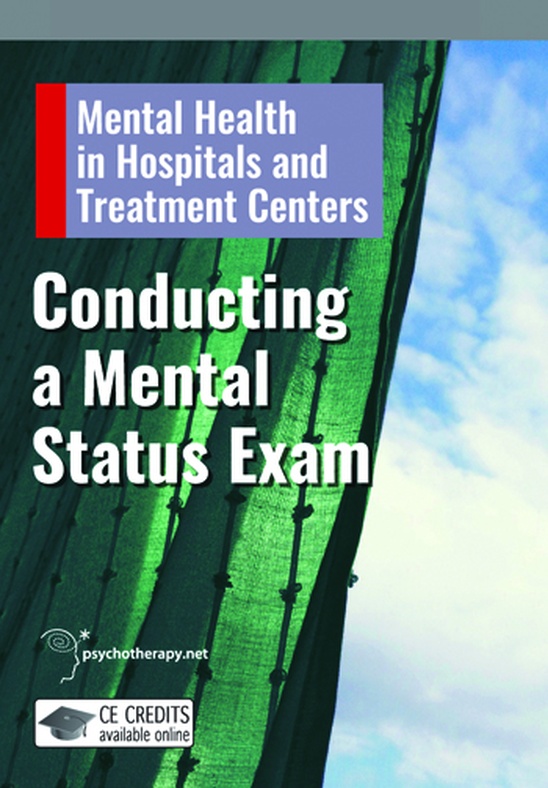
Conducting a Mental Status Examination

How do you get the essential mental status information you need from patients who mistrust your intentions? Featuring two contrasting scenarios, this video offers practical and relational tools you can use to assess patients who are difficult to engage.   Video length: 24m 03s
Buy a Membership
COURSE DETAILS

Overview

Conducting a mental status exam can be tougher than we think, particularly with highly defensive or even combative patients in acute distress. In order to be thorough, we must be persistent; but persistence without empathy can potentially alienate our patients. In this video, we are presented with two informative scenarios that contrast inexperienced and experienced interventions with a young woman hospitalized after a recent suicide attempt. Here, you’ll witness the palpable difference that transparent communication, assertive rapport, and humor can make in this essential therapeutic task.

In each vignette, Sue stops in to interview Kristy, a patient with Borderline Personality Disorder who wants to change doctors and leave the hospital as soon as possible to attend to her son. Nervous, stiff, and timid in the first scenario, Sue’s neophyte attempts to engage Kristy quickly fall flat. The nurse is easily steamrolled by Kristy’s anger, and her failure to adequately empathize or keep the interview on track only intensifies her patient’s distress.

The second vignette features a much more assertive, confident, and approachable Sue, who immediately takes charge while using light humor and a matter-of-fact tone to focus the conversation. Sue gives Kristy reflective statements, leverages her desire to see her son as a reason to complete the exam, and enlists her input to better understand her priorities. Though Kristy still challenges her, she is clearly more contained by Sue’s skilled interventions, opening up about her feelings and challenges and allowing Sue to offer options for social support during her recovery.

Whether done formally or informally, mental status exams uncover material necessary for successful treatment, so learning to conduct them thoroughly, even amid strong patient resistance, is crucial. If you’re looking to enhance your own skills in this area, this video is a must-watch.

About the Experts

Brad Hagen, PhD, RN
Expert

Brad Hagen, PhD, RN

Brad Hagen, PhD, RN, is a registered nurse, a registered psychologist, and an associate professor in the faculty of health sciences, at the University of Lethbridge in Alberta, Canada, where he teaches in the nursing and addictions counseling programs. Hagen's main research and teaching interests include the broad areas of mental health, gerontology, long-term care, psychotropic drug use, and how to bring critical social theory and/or feminist approaches to these topics.

View full profile

Disclosures

Brad Hagen was compensated for his/her/their contribution. None of his/her/their books or additional offerings are required for any of the Psychotherapy.net content. Should such materials be referenced, it is as an additional resource.

This Disclosure Statement has been designed to meet accreditation standards; Psychotherapy.net does its best to mitigate potential conflicts of interest and eliminate bias in all areas of content. Psychotherapy.net offers training for cost but has no financial or other relationships to disclose. Additionally, there is no commercial support for this activity. None of the planners or any employee at Psychotherapy.net who has worked on this educational activity has relevant financial relationship(s) to disclose with ineligible companies.

Psychotherapy.net defines ineligible companies as those whose primary business is producing, marketing, selling, re-selling, or distributing healthcare products used by or on patients. There is no minimum financial threshold; individuals must disclose all financial relationships, regardless of the amount, with ineligible companies. We ask that all contributors disclose any and all financial relationships they have with any ineligible companies whether the individual views them as relevant to the education or not. Each experts’ specific disclosures can be found in their biography.

A Brush With Life
  • Video

A Brush With Life

Safety Planning with Suicidal Clients
  • Video

Safety Planning with Suicidal Clients

The DSM-5 and Psychodiagnostic Interviewing, with TR Updates
  • Course

The DSM-5 and Psychodiagnostic Interviewing, with TR Updates

Studio Art Therapy Group in a Military Hospital
  • Video

Studio Art Therapy Group in a Military Hospital

Evidence-Based Treatment Planning for Eating Disorders and Obesity
  • Video

Evidence-Based Treatment Planning for Eating Disorders and Obesity