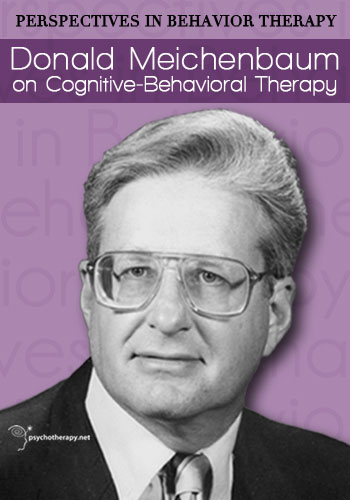
In an attempt to increase the efficacy of behavior therapy techniques, Donald Meichenbaum started paying attention to the cognitive and affective components of his client’s stories. The resulting method, Cognitive-Behavioral Therapy, is arguably one of the most widely used and influential forms of therapy today. Describing how his style developed, Meichenbaum shares an entertaining vignette depicting the way his mother tells stories – and reveals his hunch that the change process has a strong literary component. “One can look at all psychotherapy as an occasion of where the therapist hears the story that clients tell. All therapies are a series of soaps. And the question becomes, in some sense, what does a therapist do with those stories? And what does the client do with those stories?”
Identifying with investigative journalist I.F. Stone as an exemplar of iconoclastic wisdom, Meichenbaum has carefully nurtured his critical eye. This quality led to his being labeled a ‘malcontent’ by the old guard behavior therapists early in his career, and it continues to keep his mind open to advancements in therapy, regardless of theoretical orientation. He warns that therapists can become overly invested in technique, laments the didactic style of some cognitive therapy, and admonishes behavioral and cognitive-behavioral therapists to ask questions of other orientations, rather than rejecting them outright. Advocating for the movement to integrate therapeutic orientations, Meichenbaum offers specific encouragement and advice to therapists to keep an open mind and use their own critical judgment to increase their therapeutic effectiveness.