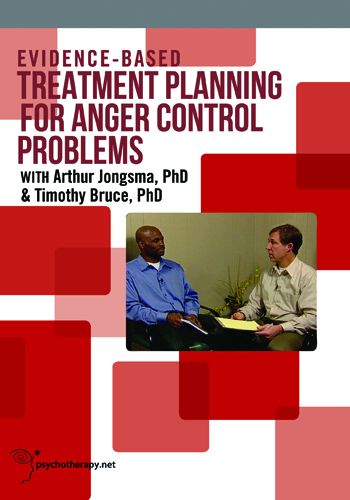
Working with problematic anger requires particular clinical skill and confidence, and treatment planning for this population is a notorious challenge. Expert clinicians Drs. Timothy Bruce and Arthur Jongsma offer welcome guidance in this new video focusing on evidence-based anger control treatment.
With their detailed outline of the essential elements of anger management plans, you’ll get solid tools to support your clients, as well as your own professional development.
Bruce and Jongsma offer a thorough overview of the clinically significant features of anger—including its emotional, cognitive, behavioral, and physiological components—that correlate to relevant Axis I, II, and III DSM diagnoses. While noting that treatment plans must be tailored to each client within the context of an authentic, empathic relationship, they present a six-step treatment planning process geared toward informing them with the latest empirically supported treatments (ESTs). A brief history of the EST movement provides further clinical context.
Sample treatment plans abound in this video, along with the clinicians’ expert commentary on the most researched ESTs for anger control. Through a series of live demonstrations, you’ll understand the ways in which anger issues can appear in clients’ presenting problems, and you’ll witness key interventions related to cognitive restructuring, relaxation training, psychoeducation, role-play, and communication skills building. Bruce and Jongsma provide commentary on the vignettes, naming important points in the therapy and offering perspectives on how your own interventions may vary. Definitions, literature critique, and relapse prevention are covered, too, for a well-rounded set of tools you can immediately use to support your clients’ improvement while meeting even the most stringent professional requirements.
If you’ve been searching for anger management resources or want to create evidence-based treatment plans with confidence, look no further than this one-of-a-kind video.
This video is part of the 12-video series, Evidence-Based Treatment Planning. Titles in this series include:
- Evidence-Based Treatment Planning for Anger Control Problems
- Evidence-Based Treatment Planning for Bipolar Disorder
- Evidence-Based Treatment Planning for Depression
- Evidence-Based Treatment Planning for Eating Disorders and Obesity
- Evidence-Based Treatment Planning for Panic Disorder
- Evidence-Based Treatment Planning for Post-Traumatic Stress Disorder
- Evidence-Based Treatment Planning for Social Anxiety Disorder
- Evidence-Based Treatment Planning for Disruptive Child and Adolescent Behavior
- Evidence-Based Treatment Planning for Obsessive Compulsive Disorder
- Evidence-Based Treatment Planning for Substance Use Disorders
- Evidence-Based Psychotherapy Treatment Planning
- Evidence-Based Treatment Planning for Generalized Anxiety Disorder