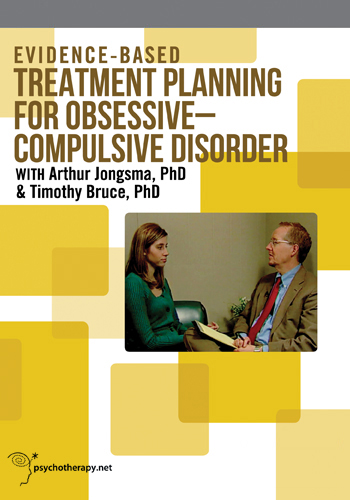
Evidence-Based Treatment Planning for Obsessive Compulsive Disorder
Video
with
Timothy Bruce, PhD, Arthur Jongsma, Jr., PhD
Video

Evidence-Based Treatment Planning for Obsessive Compulsive Disorder

Left unchecked, the distressing symptoms of Obsessive-Compulsive Disorder can condemn its sufferers to a rigid and severely diminished quality of life and without proper training, it is almost impossible for therapists to help clients with OCD overcome their symptoms. Learn the fundamentals of successful treatment in this video.
Video length: 1h 04m
COURSE DETAILS

Overview

Clients suffering from OCD are trapped in patterns that only exacerbate their considerable anxiety, and effective therapists must address both the persistent obsessions and misguided compulsions that characterize this debilitating disorder. In this video, expert clinicians Drs. Timothy Bruce and Arthur Jongsma provide evidence-based instruction on the features of OCD and its empirically supported treatments, with treatment planning essentials, case vignettes featuring a client exposure session, and insightful commentary to help you maximize clinical success.

Beginning with a survey of the DSM criteria for OCD that includes specific definitions of symptoms, Bruce and Jongsma emphasize the intrusive nature of obsessive thoughts and the excessive amount of energy clients spend on unrealistic attempts to control them (using compulsive behaviors such as ordering, washing, or checking). The two practitioners offer a six-step treatment planning process for OCD, geared toward building a plan consistent with its empirically supported treatments (ESTs). A brief history of the EST movement provides further context.

Bruce and Jongsma also offer informative, practical commentary, taking you through the various stages of evidence-based case formulation alongside related clinical demonstrations. In a series of vignettes featuring a female client working through compulsive hand-washing based in contamination fears, you’ll watch her therapist make skillful interventions (including psychoeducation, cognitive restructuring, and hierarchical exposures) based on the approaches of Exposure and Response Prevention (ERP), Cognitive Therapy, and Cognitive-Behavioral Therapy involving ERP. Behavioral definitions, short-term objectives, and long-term goals are covered too, making for a well-rounded set of tools you can start using immediately to support clients while meeting increasingly stringent professional standards.

Whether your goal is to build clinical confidence with Obsessive-Compulsive Disorder or build evidence-based treatment plans aligned with the latest empirically supported methods, this video will be an essential addition to your library.

This video is part of the 12-video series, Evidence-Based Treatment Planning. Titles in this series include:

  • Evidence-Based Treatment Planning for Anger Control Problems
  • Evidence-Based Treatment Planning for Bipolar Disorder
  • Evidence-Based Treatment Planning for Depression
  • Evidence-Based Treatment Planning for Eating Disorders and Obesity
  • Evidence-Based Treatment Planning for Panic Disorder
  • Evidence-Based Treatment Planning for Post-Traumatic Stress Disorder
  • Evidence-Based Treatment Planning for Social Anxiety Disorder
  • Evidence-Based Treatment Planning for Disruptive Child and Adolescent Behavior
  • Evidence-Based Treatment Planning for Obsessive Compulsive Disorder
  • Evidence-Based Treatment Planning for Substance Use Disorders
  • Evidence-Based Psychotherapy Treatment Planning
  • Evidence-Based Treatment Planning for Generalized Anxiety Disorder

About the Experts

Timothy Bruce, PhD
Expert

Timothy Bruce, PhD

Timothy Bruce, PhD, is Professor and Associate Chair of the Department of Psychiatry and Behavioral Medicine. A summa cum laude graduate of the honors program curriculum at Indiana State University, Bruce received his Ph.D. in Clinical Psychology from The University at Albany-State University of New York under the mentorship of Dr. David Barlow. He completed his residency training at Wilford Hall USAF Medical Center under the direction of Dr. Robert Klepac. Bruce is active in the clinical, educational, and scholarship missions…

View full profile
Arthur Jongsma, Jr., PhD
Expert

Arthur Jongsma, Jr., PhD

Arthur Jongsma, Jr., PhD, is Series Editor for the bestselling PracticePlanners® . Since 1971, he has provided professional mental health services to both inpatient and outpatient clients. He managed a group private practice for twenty-five years and is now the Executive Director of Life Guidance Services in Grand Rapids, Michigan.

View full profile

Disclosures

Timothy Bruce and Arthur Jongsma, Jr. were compensated for their contribution. None of their books or additional offerings are required for any of the Psychotherapy.net content. Should such materials be referenced, it is as an additional resource.

This Disclosure Statement has been designed to meet accreditation standards; Psychotherapy.net does its best to mitigate potential conflicts of interest and eliminate bias in all areas of content. Psychotherapy.net offers training for cost but has no financial or other relationships to disclose. Additionally, there is no commercial support for this activity. None of the planners or any employee at Psychotherapy.net who has worked on this educational activity has relevant financial relationship(s) to disclose with ineligible companies.

Psychotherapy.net defines ineligible companies as those whose primary business is producing, marketing, selling, re-selling, or distributing healthcare products used by or on patients. There is no minimum financial threshold; individuals must disclose all financial relationships, regardless of the amount, with ineligible companies. We ask that all contributors disclose any and all financial relationships they have with any ineligible companies whether the individual views them as relevant to the education or not. Each experts’ specific disclosures can be found in their biography.

Individual & Joint Art Therapy with Mother & Child
  • Video

Individual & Joint Art Therapy with Mother & Child

Arnold Lazarus on Multimodal Therapy
  • Video

Arnold Lazarus on Multimodal Therapy

Group Therapy for Addictions: An Interpersonal Relapse Prevention Approach
  • Video

Group Therapy for Addictions: An Interpersonal Relapse Prevention Approach

Tres Madres: Structural Therapy with an Anglo/Hispanic Family
  • Video

Tres Madres: Structural Therapy with an Anglo/Hispanic Family

Crisis Counseling: 7 Steps to Effective Intervention
  • Course

Crisis Counseling: 7 Steps to Effective Intervention